
CHILDREN MISSING EDUCATION Mansoora Karimuddin

Description: CHILDREN MISSING EDUCATION Mansoora Karimuddin Children Missing Education Lead Officer Children, Families and Education Directorate Luton Borough Council Overview PurposeStatutory Duty Who are CME Why are CME Responsibility of educational
Related Topics
Download Presentation
"CHILDREN MISSING EDUCATION Mansoora Karimuddin" is the property of its rightful owner. Permission is granted to download and print the materials on this website for personal, non-commercial use only, and to display it on your personal computer provided you do not modify the materials and that you retain all copyright notices contained in the materials. By downloading content from our website, you accept the terms of this agreement.
Presentation Transcript
slide1. CHILDREN MISSING EDUCATION Mansoora Karimuddin
Children Missing Education Lead Officer
Children, Families and Education Directorate
Luton Borough Council<br>
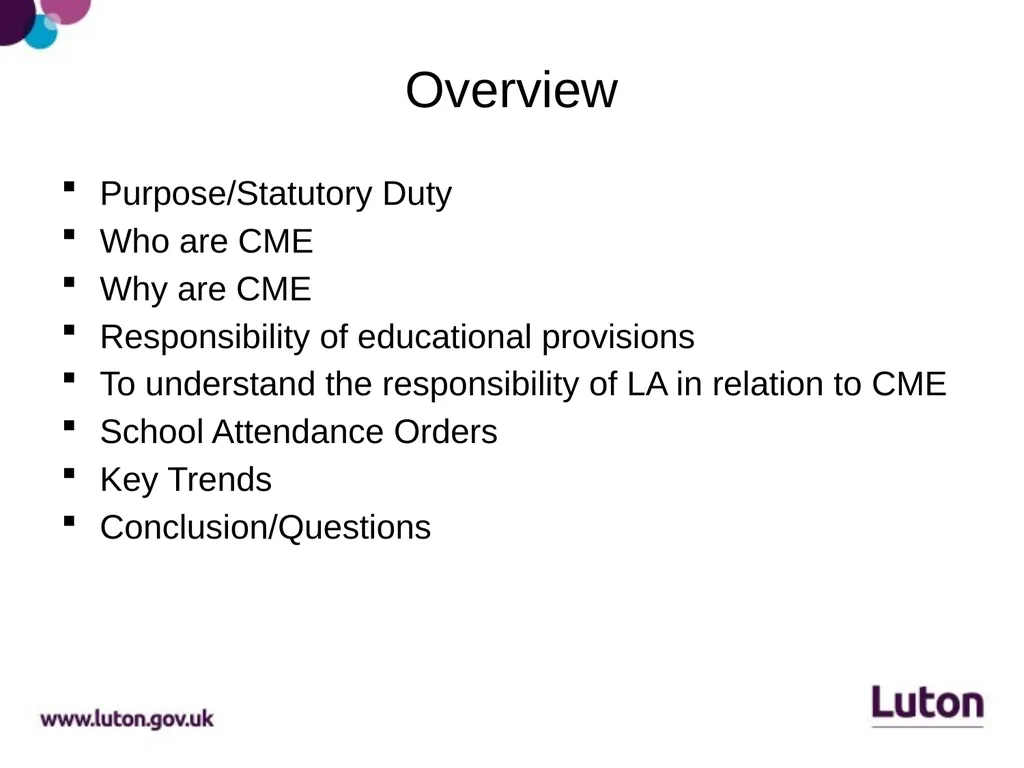
slide2. Overview Purpose/Statutory Duty
Who are CME
Why are CME
Responsibility of educational provisions
To understand the responsibility of LA in relation to CME
School Attendance Orders
Key Trends
Conclusion/Questions<br>
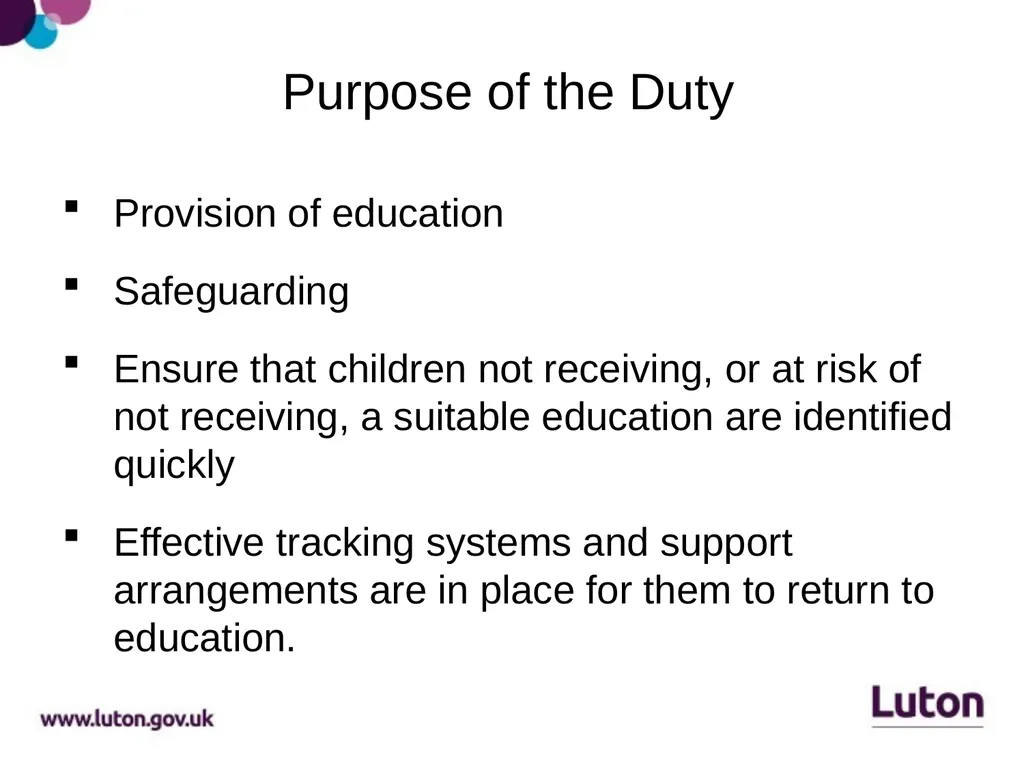
slide3. Purpose of the Duty Provision of education
Safeguarding
Ensure that children not receiving, or at risk of not receiving, a suitable education are identified quickly
Effective tracking systems and support arrangements are in place for them to return to education.<br>
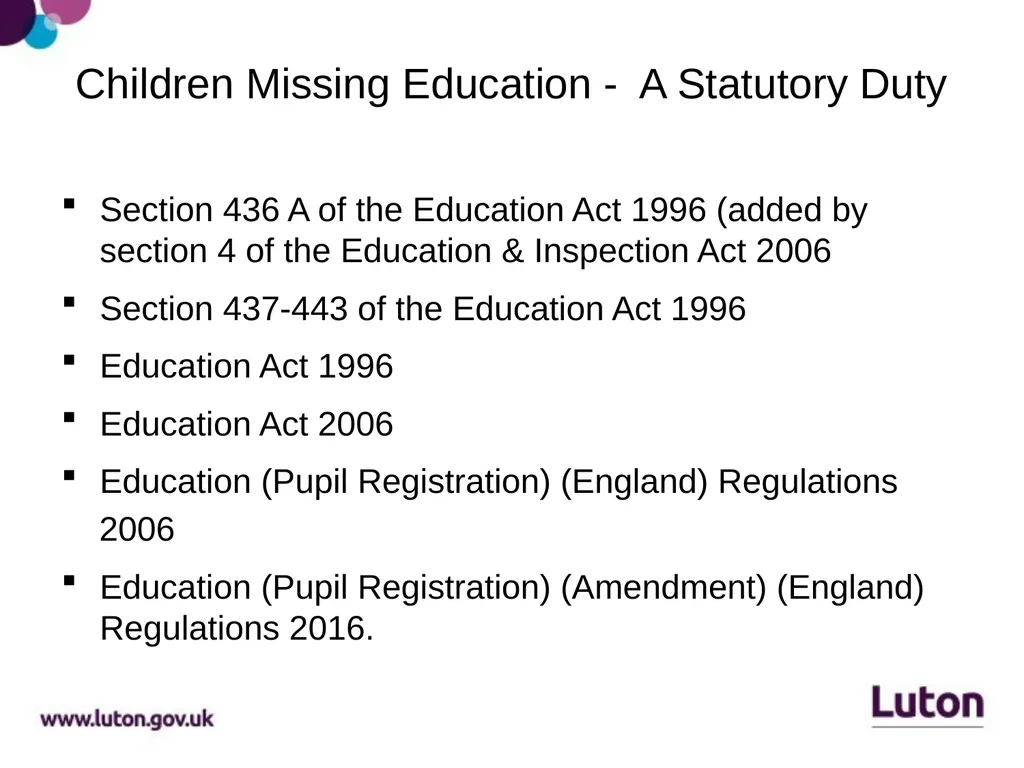
slide4. Children Missing Education - A Statutory Duty Section 436 A of the Education Act 1996 (added by section 4 of the Education & Inspection Act 2006
Section 437-443 of the Education Act 1996
Education Act 1996
Education Act 2006
Education (Pupil Registration) (England) Regulations
2006
Education (Pupil Registration) (Amendment) (England) Regulations 2016.<br>
slide5. Distinction between Children Missing Education
&
Children missing from education<br>
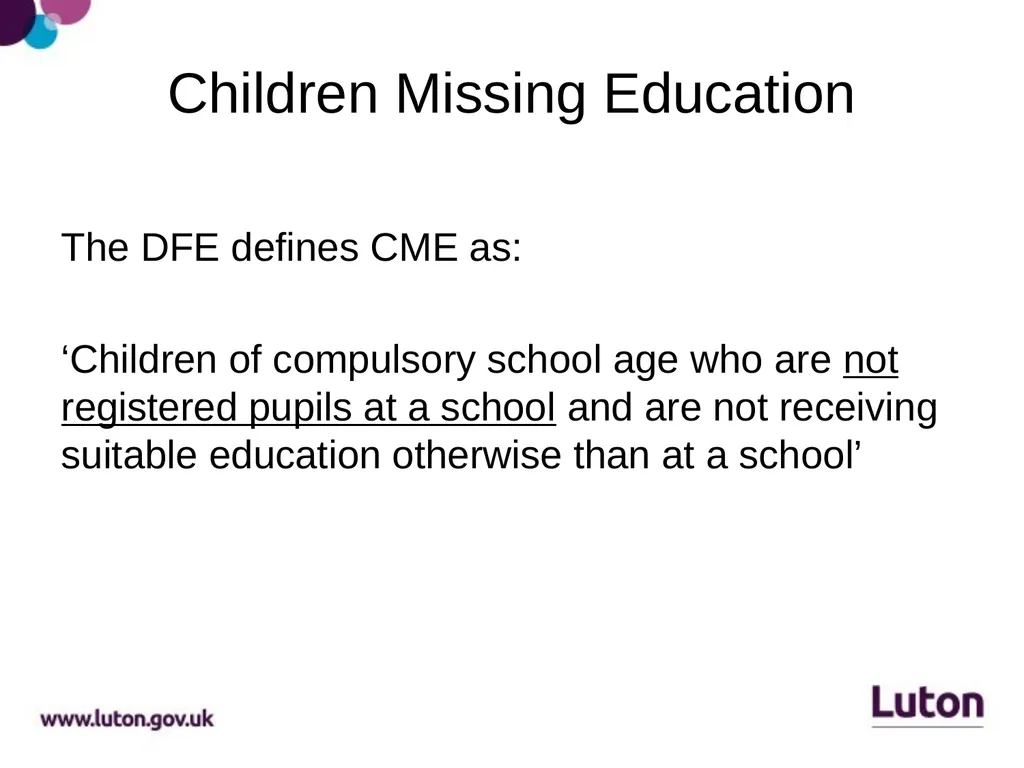
slide6. Children Missing Education The DFE defines CME as:
‘Children of compulsory school age who are not registered pupils at a school and are not receiving suitable education otherwise than at a school’<br>
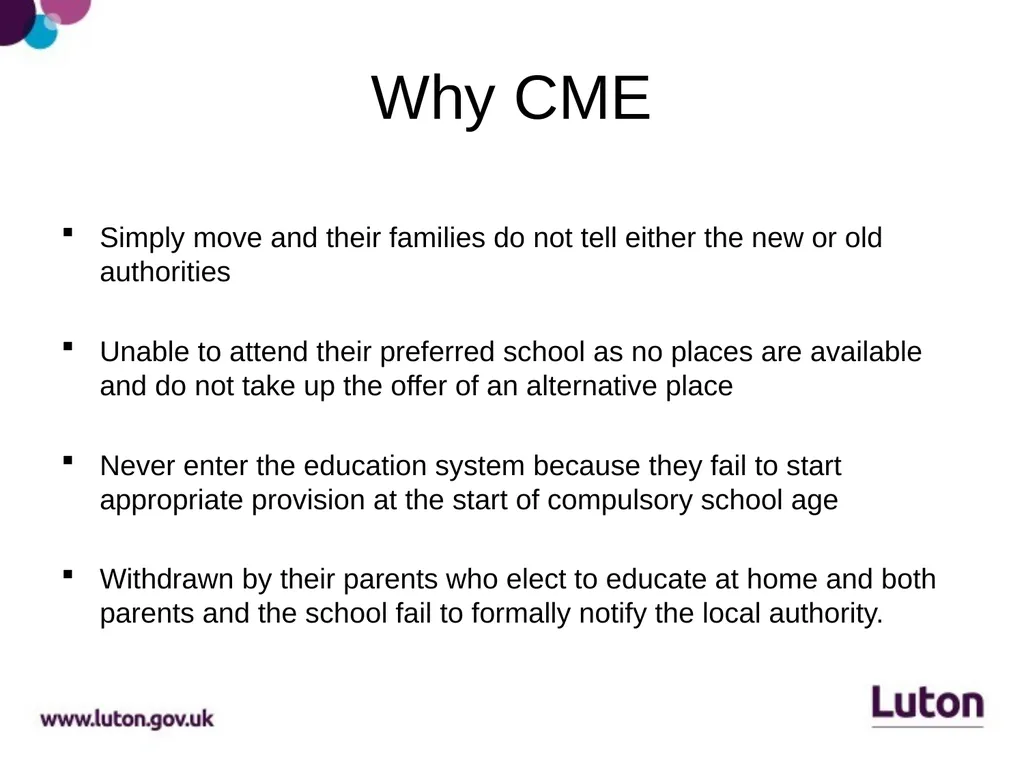
slide7. Why CME Simply move and their families do not tell either the new or old authorities
Unable to attend their preferred school as no places are available and do not take up the offer of an alternative place
Never enter the education system because they fail to start appropriate provision at the start of compulsory school age
Withdrawn by their parents who elect to educate at home and both parents and the school fail to formally notify the local authority.<br>
slide8. Why CME 2 Cease to attend school due to disputes, parental dissatisfaction, unofficial exclusion or removal from school roll
Have fled the area as part of a planned/unplanned safety arrangement
Fail to complete a transition between providers
Move area and do not register with a school
Enter the country and do not register with a school
Move into or out of the Looked after Children (LAC) system without prior notice or planning
Excluded or withdrawn from independent schools.<br>
slide9. Who are these children and why do they matter? Children who may already be vulnerable are more likely to become a child missing education
At risk of not achieving their potential in education
At risk of being out of education, training and employment in later life
At risk of physical, emotional or psychological harm
Children have a right to education and to protection from all forms of violence, abuse, neglect and exploitation<br>
slide10. Multi Agency Procedures 1 CME Policy that underpins the multi-agency work
Identification of CME through the multi-agency referral process
Tracking of CME using local and national databases
Removal from roll and Common Transfer File (CTF) guidance
Re-engaging children out of education through action planning and supporting to secure educational provision
Partnership working with other professionals and information sharing where necessary
Prioritisation of referrals where there are welfare or child protection concerns.<br>
slide11. Multi Agency Procedures 2 Role of the Local Authority CME Officer:
Co-ordination of referrals
Monitoring Compliance
Checking Process
Maintaining CME Database
Advice/Training
Casework
School Attendance Orders
Nationwide CME Enquiries/S2S Database
Reporting and Data Analysis
FOI requests/ Ofsted Inspections<br>
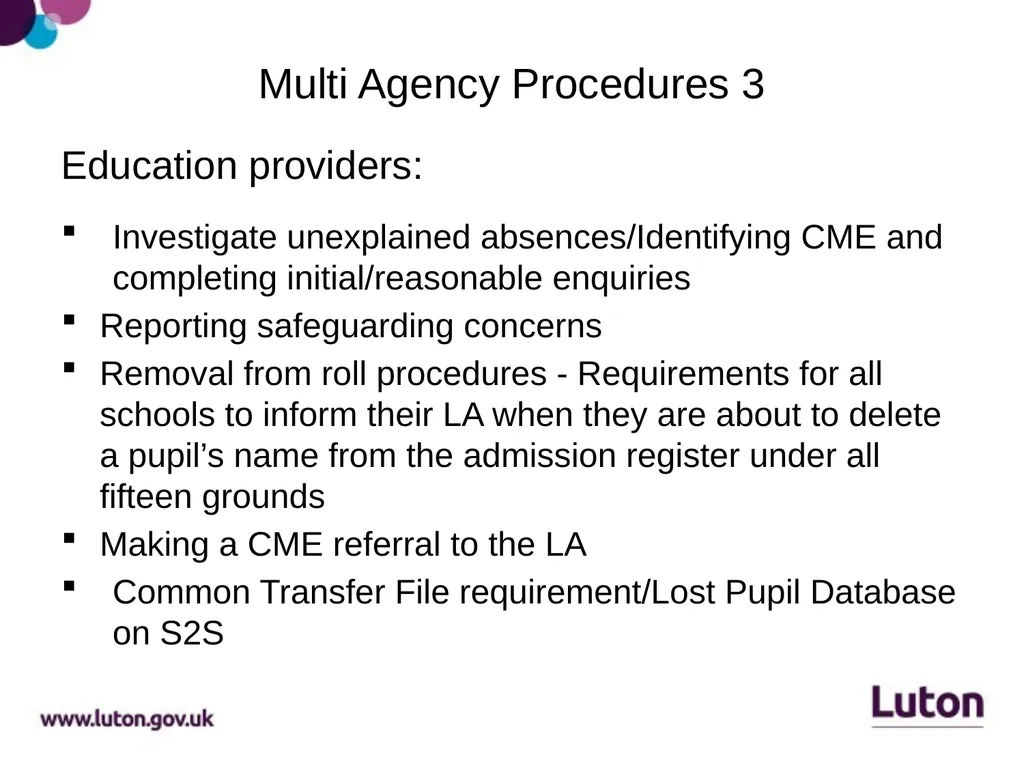
slide12. Multi Agency Procedures 3 Education providers:
Investigate unexplained absences/Identifying CME and completing initial/reasonable enquiries
Reporting safeguarding concerns
Removal from roll procedures - Requirements for all schools to inform their LA when they are about to delete a pupil’s name from the admission register under all fifteen grounds
Making a CME referral to the LA
Common Transfer File requirement/Lost Pupil Database on S2S<br>
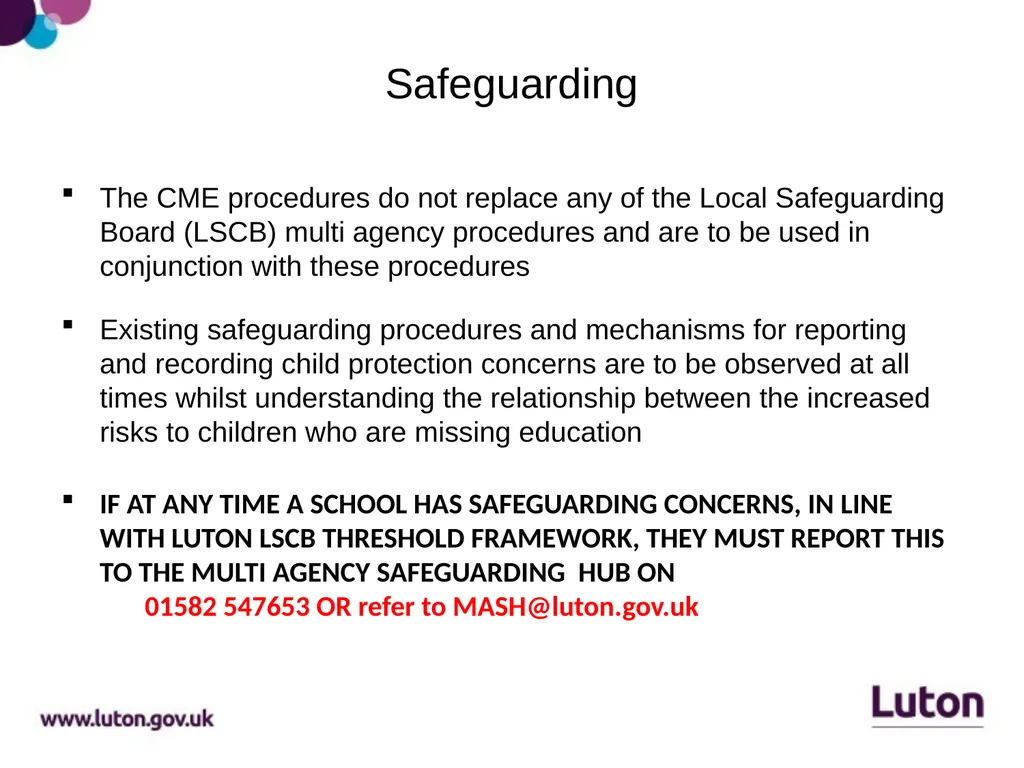
slide13. Safeguarding The CME procedures do not replace any of the Local Safeguarding Board (LSCB) multi agency procedures and are to be used in conjunction with these procedures
Existing safeguarding procedures and mechanisms for reporting and recording child protection concerns are to be observed at all times whilst understanding the relationship between the increased risks to children who are missing education
IF AT ANY TIME A SCHOOL HAS SAFEGUARDING CONCERNS, IN LINE WITH LUTON LSCB THRESHOLD FRAMEWORK, THEY MUST REPORT THIS TO THE MULTI AGENCY SAFEGUARDING HUB ON 01582 547653 OR refer to MASH@luton.gov.uk<br>
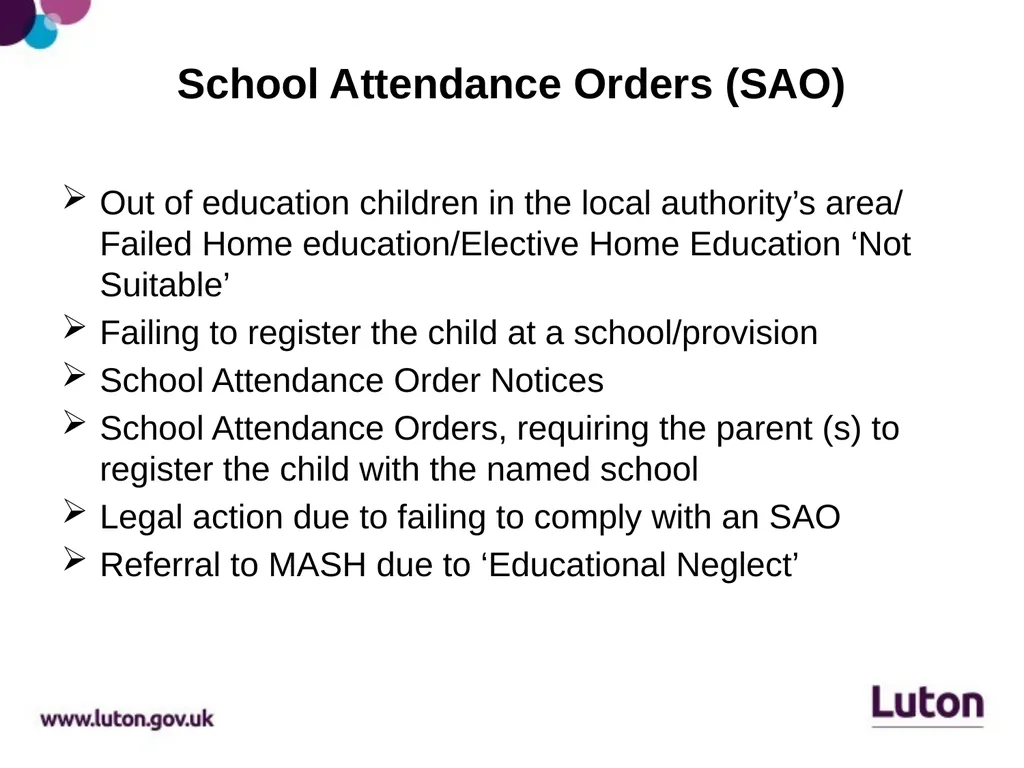
slide14. School Attendance Orders (SAO) Out of education children in the local authority’s area/ Failed Home education/Elective Home Education ‘Not Suitable’
Failing to register the child at a school/provision
School Attendance Order Notices
School Attendance Orders, requiring the parent (s) to register the child with the named school
Legal action due to failing to comply with an SAO
Referral to MASH due to ‘Educational Neglect’<br>
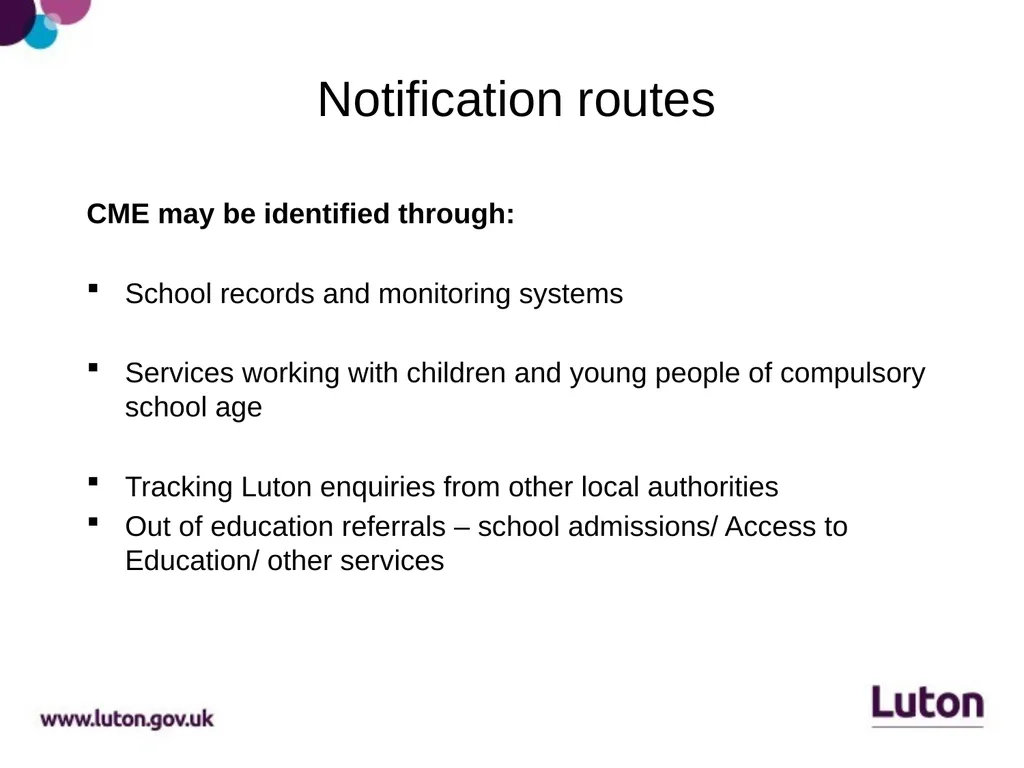
slide15. Notification routes CME may be identified through:
School records and monitoring systems
Services working with children and young people of compulsory school age
Tracking Luton enquiries from other local authorities
Out of education referrals – school admissions/ Access to Education/ other services<br>
slide16. Identification Making a referral
By secure email to cme@luton.gov.uk
For children NOT REGISTERED WITH A SCHOOL/PROVISION - Completing an Out of Education Referral Form
www.Luton.gov.uk/education
For children leaving a Luton school without securing a school place – completing a CME Pro-forma – www.Luton.gov.uk/education
Will be moving to School Portal via EYES<br>
slide17. Further information CME@luton.gov.uk
CME lead officer – 01582 548180
CME policy and procedures/referral forms https://www.luton.gov.uk
CME guidance – www.education.gov.uk
Keeping children safe in education - statutory guidance<br>
slide18. Key Trends Increase in overall referrals
Pupils placed in temporary accommodation
Children of Gypsy, Roma & Traveller (GRT) families
Increase in school attendance order notices
Over-representation of minority ethnic groups
Demand for school places
Moving abroad<br>
slide19. Conclusion The impact of CME function:
Reduction in the number of children being out of education
Supporting continuity of child’s learning/education
Inclusion/reduce exclusion
Promoting early intervention
Improving levels of educational attainment for CME
Protecting vulnerable children and young people
Improving opportunities in life.<br>
Children Missing Education Lead Officer
Children, Families and Education Directorate
Luton Borough Council<br>
slide2. Overview Purpose/Statutory Duty
Who are CME
Why are CME
Responsibility of educational provisions
To understand the responsibility of LA in relation to CME
School Attendance Orders
Key Trends
Conclusion/Questions<br>
slide3. Purpose of the Duty Provision of education
Safeguarding
Ensure that children not receiving, or at risk of not receiving, a suitable education are identified quickly
Effective tracking systems and support arrangements are in place for them to return to education.<br>
slide4. Children Missing Education - A Statutory Duty Section 436 A of the Education Act 1996 (added by section 4 of the Education & Inspection Act 2006
Section 437-443 of the Education Act 1996
Education Act 1996
Education Act 2006
Education (Pupil Registration) (England) Regulations
2006
Education (Pupil Registration) (Amendment) (England) Regulations 2016.<br>
slide5. Distinction between Children Missing Education
&
Children missing from education<br>
slide6. Children Missing Education The DFE defines CME as:
‘Children of compulsory school age who are not registered pupils at a school and are not receiving suitable education otherwise than at a school’<br>
slide7. Why CME Simply move and their families do not tell either the new or old authorities
Unable to attend their preferred school as no places are available and do not take up the offer of an alternative place
Never enter the education system because they fail to start appropriate provision at the start of compulsory school age
Withdrawn by their parents who elect to educate at home and both parents and the school fail to formally notify the local authority.<br>
slide8. Why CME 2 Cease to attend school due to disputes, parental dissatisfaction, unofficial exclusion or removal from school roll
Have fled the area as part of a planned/unplanned safety arrangement
Fail to complete a transition between providers
Move area and do not register with a school
Enter the country and do not register with a school
Move into or out of the Looked after Children (LAC) system without prior notice or planning
Excluded or withdrawn from independent schools.<br>
slide9. Who are these children and why do they matter? Children who may already be vulnerable are more likely to become a child missing education
At risk of not achieving their potential in education
At risk of being out of education, training and employment in later life
At risk of physical, emotional or psychological harm
Children have a right to education and to protection from all forms of violence, abuse, neglect and exploitation<br>
slide10. Multi Agency Procedures 1 CME Policy that underpins the multi-agency work
Identification of CME through the multi-agency referral process
Tracking of CME using local and national databases
Removal from roll and Common Transfer File (CTF) guidance
Re-engaging children out of education through action planning and supporting to secure educational provision
Partnership working with other professionals and information sharing where necessary
Prioritisation of referrals where there are welfare or child protection concerns.<br>
slide11. Multi Agency Procedures 2 Role of the Local Authority CME Officer:
Co-ordination of referrals
Monitoring Compliance
Checking Process
Maintaining CME Database
Advice/Training
Casework
School Attendance Orders
Nationwide CME Enquiries/S2S Database
Reporting and Data Analysis
FOI requests/ Ofsted Inspections<br>
slide12. Multi Agency Procedures 3 Education providers:
Investigate unexplained absences/Identifying CME and completing initial/reasonable enquiries
Reporting safeguarding concerns
Removal from roll procedures - Requirements for all schools to inform their LA when they are about to delete a pupil’s name from the admission register under all fifteen grounds
Making a CME referral to the LA
Common Transfer File requirement/Lost Pupil Database on S2S<br>
slide13. Safeguarding The CME procedures do not replace any of the Local Safeguarding Board (LSCB) multi agency procedures and are to be used in conjunction with these procedures
Existing safeguarding procedures and mechanisms for reporting and recording child protection concerns are to be observed at all times whilst understanding the relationship between the increased risks to children who are missing education
IF AT ANY TIME A SCHOOL HAS SAFEGUARDING CONCERNS, IN LINE WITH LUTON LSCB THRESHOLD FRAMEWORK, THEY MUST REPORT THIS TO THE MULTI AGENCY SAFEGUARDING HUB ON 01582 547653 OR refer to MASH@luton.gov.uk<br>
slide14. School Attendance Orders (SAO) Out of education children in the local authority’s area/ Failed Home education/Elective Home Education ‘Not Suitable’
Failing to register the child at a school/provision
School Attendance Order Notices
School Attendance Orders, requiring the parent (s) to register the child with the named school
Legal action due to failing to comply with an SAO
Referral to MASH due to ‘Educational Neglect’<br>
slide15. Notification routes CME may be identified through:
School records and monitoring systems
Services working with children and young people of compulsory school age
Tracking Luton enquiries from other local authorities
Out of education referrals – school admissions/ Access to Education/ other services<br>
slide16. Identification Making a referral
By secure email to cme@luton.gov.uk
For children NOT REGISTERED WITH A SCHOOL/PROVISION - Completing an Out of Education Referral Form
www.Luton.gov.uk/education
For children leaving a Luton school without securing a school place – completing a CME Pro-forma – www.Luton.gov.uk/education
Will be moving to School Portal via EYES<br>
slide17. Further information CME@luton.gov.uk
CME lead officer – 01582 548180
CME policy and procedures/referral forms https://www.luton.gov.uk
CME guidance – www.education.gov.uk
Keeping children safe in education - statutory guidance<br>
slide18. Key Trends Increase in overall referrals
Pupils placed in temporary accommodation
Children of Gypsy, Roma & Traveller (GRT) families
Increase in school attendance order notices
Over-representation of minority ethnic groups
Demand for school places
Moving abroad<br>
slide19. Conclusion The impact of CME function:
Reduction in the number of children being out of education
Supporting continuity of child’s learning/education
Inclusion/reduce exclusion
Promoting early intervention
Improving levels of educational attainment for CME
Protecting vulnerable children and young people
Improving opportunities in life.<br>