
Children & screen time strategy FINAL 11th
PT
Published · 15 slides · 0 views
1 / 1

Description
Children screen time strategy FINAL 11th February 2026 Authors Dr Helen Carter, Director of Public Health, Ms Keri Scott, Director of Education, Dr Lola Soler Casale, Consultant Paediatrician and Neonatologist, Gibraltar Health Authority
Related Topics
Share
Embed code
Download this presentation From Below
"Children & screen time strategy FINAL 11th" is the property of its rightful owner. Permission is granted to download and print the materials on this website for personal, non-commercial use only, and to display it on your personal computer provided you do not modify the materials and that you retain all copyright notices contained in the materials. By downloading content from our website, you accept the terms of this agreement.
Presentation Transcript
01
Children & screen time
strategy FINAL 11th February 2026
Authors
Dr Helen Carter, Director of Public Health,
Ms Keri Scott, Director of Education,
Dr Lola Soler Casale, Consultant Paediatrician and Neonatologist, Gibraltar Health Authority<br>
Authors
Dr Helen Carter, Director of Public Health,
Ms Keri Scott, Director of Education,
Dr Lola Soler Casale, Consultant Paediatrician and Neonatologist, Gibraltar Health Authority<br>
02
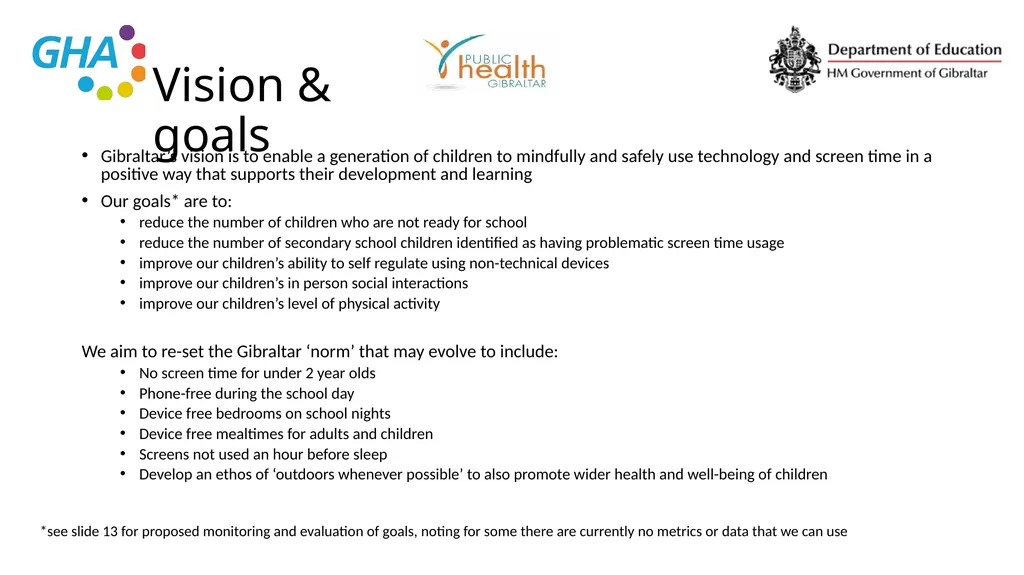
Vision & goals Gibraltar’s vision is to enable a generation of children to mindfully and safely use technology and screen time in a positive way that supports their development and learning
Our goals* are to:
reduce the number of children who are not ready for school
reduce the number of secondary school children identified as having problematic screen time usage
improve our children’s ability to self regulate using non-technical devices
improve our children’s in person social interactions
improve our children’s level of physical activity
We aim to re-set the Gibraltar ‘norm’ that may evolve to include:
No screen time for under 2 year olds
Phone-free during the school day
Device free bedrooms on school nights
Device free mealtimes for adults and children
Screens not used an hour before sleep
Develop an ethos of ‘outdoors whenever possible’ to also promote wider health and well-being of children *see slide 13 for proposed monitoring and evaluation of goals, noting for some there are currently no metrics or data that we can use<br>
Our goals* are to:
reduce the number of children who are not ready for school
reduce the number of secondary school children identified as having problematic screen time usage
improve our children’s ability to self regulate using non-technical devices
improve our children’s in person social interactions
improve our children’s level of physical activity
We aim to re-set the Gibraltar ‘norm’ that may evolve to include:
No screen time for under 2 year olds
Phone-free during the school day
Device free bedrooms on school nights
Device free mealtimes for adults and children
Screens not used an hour before sleep
Develop an ethos of ‘outdoors whenever possible’ to also promote wider health and well-being of children *see slide 13 for proposed monitoring and evaluation of goals, noting for some there are currently no metrics or data that we can use<br>
03
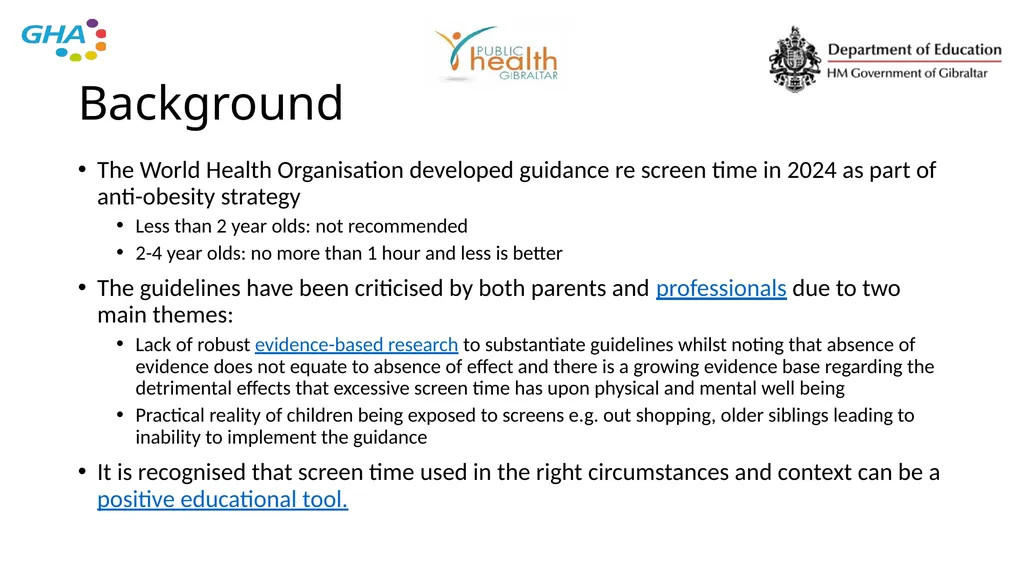
Background The World Health Organisation developed guidance re screen time in 2024 as part of anti-obesity strategy
Less than 2 year olds: not recommended
2-4 year olds: no more than 1 hour and less is better
The guidelines have been criticised by both parents and professionals due to two main themes:
Lack of robust evidence-based research to substantiate guidelines whilst noting that absence of evidence does not equate to absence of effect and there is a growing evidence base regarding the detrimental effects that excessive screen time has upon physical and mental well being
Practical reality of children being exposed to screens e.g. out shopping, older siblings leading to inability to implement the guidance
It is recognised that screen time used in the right circumstances and context can be a positive educational tool.<br>
Less than 2 year olds: not recommended
2-4 year olds: no more than 1 hour and less is better
The guidelines have been criticised by both parents and professionals due to two main themes:
Lack of robust evidence-based research to substantiate guidelines whilst noting that absence of evidence does not equate to absence of effect and there is a growing evidence base regarding the detrimental effects that excessive screen time has upon physical and mental well being
Practical reality of children being exposed to screens e.g. out shopping, older siblings leading to inability to implement the guidance
It is recognised that screen time used in the right circumstances and context can be a positive educational tool.<br>
04
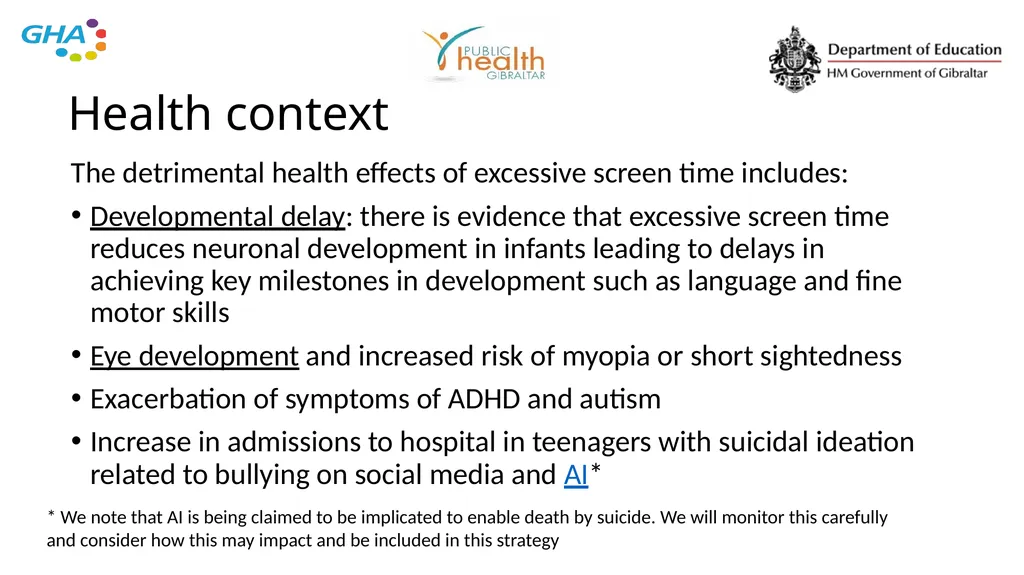
Health context The detrimental health effects of excessive screen time includes:
Developmental delay: there is evidence that excessive screen time reduces neuronal development in infants leading to delays in achieving key milestones in development such as language and fine motor skills
Eye development and increased risk of myopia or short sightedness
Exacerbation of symptoms of ADHD and autism
Increase in admissions to hospital in teenagers with suicidal ideation related to bullying on social media and AI* * We note that AI is being claimed to be implicated to enable death by suicide. We will monitor this carefully and consider how this may impact and be included in this strategy<br>
Developmental delay: there is evidence that excessive screen time reduces neuronal development in infants leading to delays in achieving key milestones in development such as language and fine motor skills
Eye development and increased risk of myopia or short sightedness
Exacerbation of symptoms of ADHD and autism
Increase in admissions to hospital in teenagers with suicidal ideation related to bullying on social media and AI* * We note that AI is being claimed to be implicated to enable death by suicide. We will monitor this carefully and consider how this may impact and be included in this strategy<br>
05
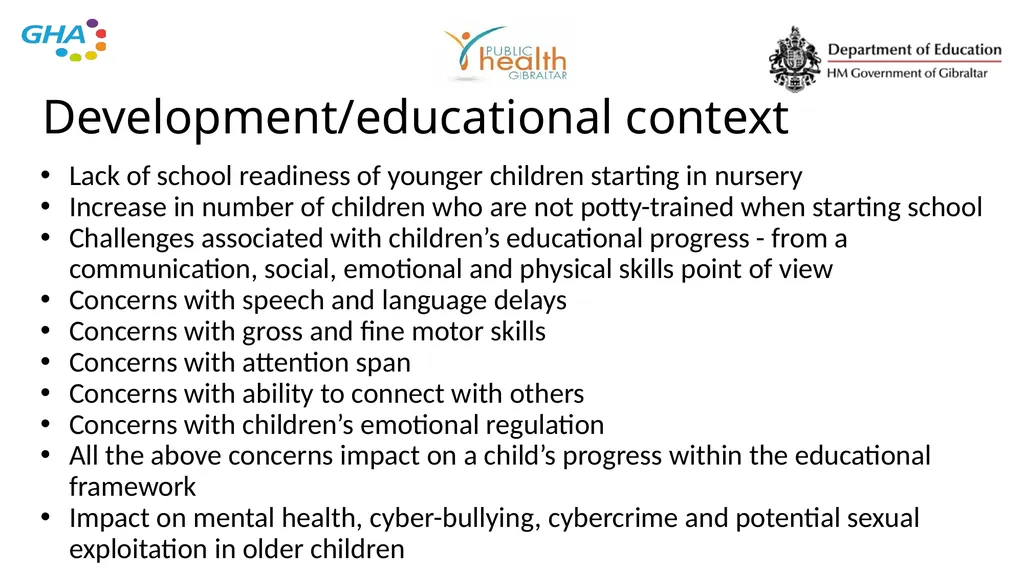
Development/educational context Lack of school readiness of younger children starting in nursery
Increase in number of children who are not potty-trained when starting school
Challenges associated with children’s educational progress - from a communication, social, emotional and physical skills point of view
Concerns with speech and language delays
Concerns with gross and fine motor skills
Concerns with attention span
Concerns with ability to connect with others
Concerns with children’s emotional regulation
All the above concerns impact on a child’s progress within the educational framework
Impact on mental health, cyber-bullying, cybercrime and potential sexual exploitation in older children<br>
Increase in number of children who are not potty-trained when starting school
Challenges associated with children’s educational progress - from a communication, social, emotional and physical skills point of view
Concerns with speech and language delays
Concerns with gross and fine motor skills
Concerns with attention span
Concerns with ability to connect with others
Concerns with children’s emotional regulation
All the above concerns impact on a child’s progress within the educational framework
Impact on mental health, cyber-bullying, cybercrime and potential sexual exploitation in older children<br>
06
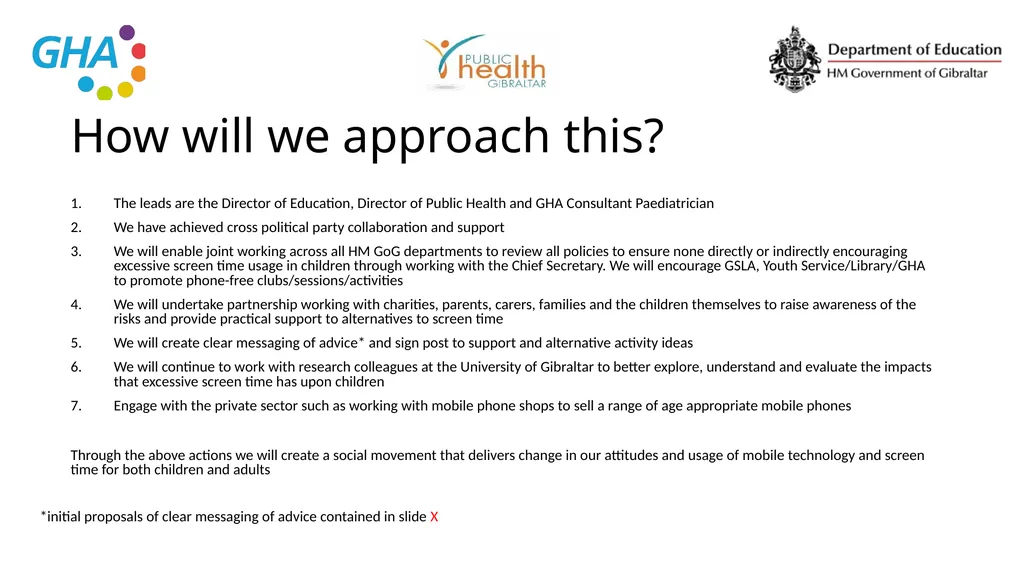
How will we approach this? The leads are the Director of Education, Director of Public Health and GHA Consultant Paediatrician
We have achieved cross political party collaboration and support
We will enable joint working across all HM GoG departments to review all policies to ensure none directly or indirectly encouraging excessive screen time usage in children through working with the Chief Secretary. We will encourage GSLA, Youth Service/Library/GHA to promote phone-free clubs/sessions/activities
We will undertake partnership working with charities, parents, carers, families and the children themselves to raise awareness of the risks and provide practical support to alternatives to screen time
We will create clear messaging of advice* and sign post to support and alternative activity ideas
We will continue to work with research colleagues at the University of Gibraltar to better explore, understand and evaluate the impacts that excessive screen time has upon children
Engage with the private sector such as working with mobile phone shops to sell a range of age appropriate mobile phones
Through the above actions we will create a social movement that delivers change in our attitudes and usage of mobile technology and screen time for both children and adults *initial proposals of clear messaging of advice contained in slide X<br>
We have achieved cross political party collaboration and support
We will enable joint working across all HM GoG departments to review all policies to ensure none directly or indirectly encouraging excessive screen time usage in children through working with the Chief Secretary. We will encourage GSLA, Youth Service/Library/GHA to promote phone-free clubs/sessions/activities
We will undertake partnership working with charities, parents, carers, families and the children themselves to raise awareness of the risks and provide practical support to alternatives to screen time
We will create clear messaging of advice* and sign post to support and alternative activity ideas
We will continue to work with research colleagues at the University of Gibraltar to better explore, understand and evaluate the impacts that excessive screen time has upon children
Engage with the private sector such as working with mobile phone shops to sell a range of age appropriate mobile phones
Through the above actions we will create a social movement that delivers change in our attitudes and usage of mobile technology and screen time for both children and adults *initial proposals of clear messaging of advice contained in slide X<br>
07
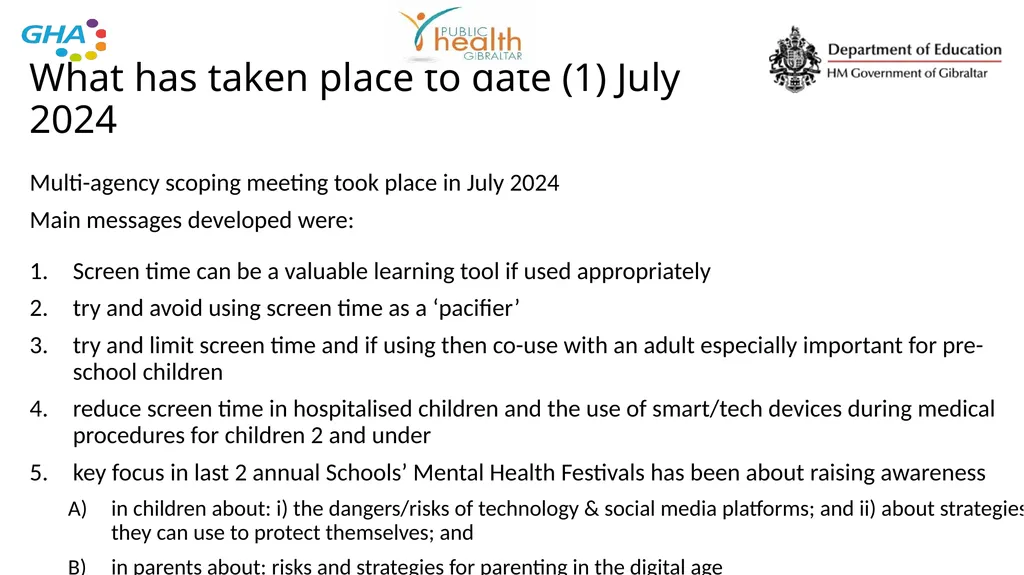
What has taken place to date (1) July 2024 Multi-agency scoping meeting took place in July 2024
Main messages developed were:
Screen time can be a valuable learning tool if used appropriately
try and avoid using screen time as a ‘pacifier’
try and limit screen time and if using then co-use with an adult especially important for pre-school children
reduce screen time in hospitalised children and the use of smart/tech devices during medical procedures for children 2 and under
key focus in last 2 annual Schools’ Mental Health Festivals has been about raising awareness
in children about: i) the dangers/risks of technology & social media platforms; and ii) about strategies they can use to protect themselves; and
in parents about: risks and strategies for parenting in the digital age<br>
Main messages developed were:
Screen time can be a valuable learning tool if used appropriately
try and avoid using screen time as a ‘pacifier’
try and limit screen time and if using then co-use with an adult especially important for pre-school children
reduce screen time in hospitalised children and the use of smart/tech devices during medical procedures for children 2 and under
key focus in last 2 annual Schools’ Mental Health Festivals has been about raising awareness
in children about: i) the dangers/risks of technology & social media platforms; and ii) about strategies they can use to protect themselves; and
in parents about: risks and strategies for parenting in the digital age<br>
08
Develop an approach related to age Proposal was to divide the ‘challenge’ into 3 age groups due to the different drivers and impacts of excessive screen time usage in these different age groups:
Pre-school: led by GHA and initial focus on removing and reducing screen time usage in GHA paediatrics settings. Aim is: parental guidance and developmental support
Primary school: led by Dept of Education and continue to build upon the wellbeing agenda delivered through the PHSE curriculum. Aim is structure and routine
Secondary school: initial focus was on research undertaken by the University of Gibraltar, establishing links to Youth strategy and continue to build upon the agenda of the PHSE curriculum. Aim is improving impacts upon sleep, low mood, bullying and encourage reporting of abuse.<br>
Pre-school: led by GHA and initial focus on removing and reducing screen time usage in GHA paediatrics settings. Aim is: parental guidance and developmental support
Primary school: led by Dept of Education and continue to build upon the wellbeing agenda delivered through the PHSE curriculum. Aim is structure and routine
Secondary school: initial focus was on research undertaken by the University of Gibraltar, establishing links to Youth strategy and continue to build upon the agenda of the PHSE curriculum. Aim is improving impacts upon sleep, low mood, bullying and encourage reporting of abuse.<br>
09
University of Gibraltar: research findings Validated questionnaires used to enable international comparisons
2472 students, 77.9% of all students in Years 7 to Year 13
93.2% of young people overall had a smart phone:
85% of Year 7 students increasing to 99% by Year 13
Indication of problematic screen time usage:
17% boys and 23% girls use screens as soon as they wake up
25% of boys and 34% of girls use screens right up until they fall asleep
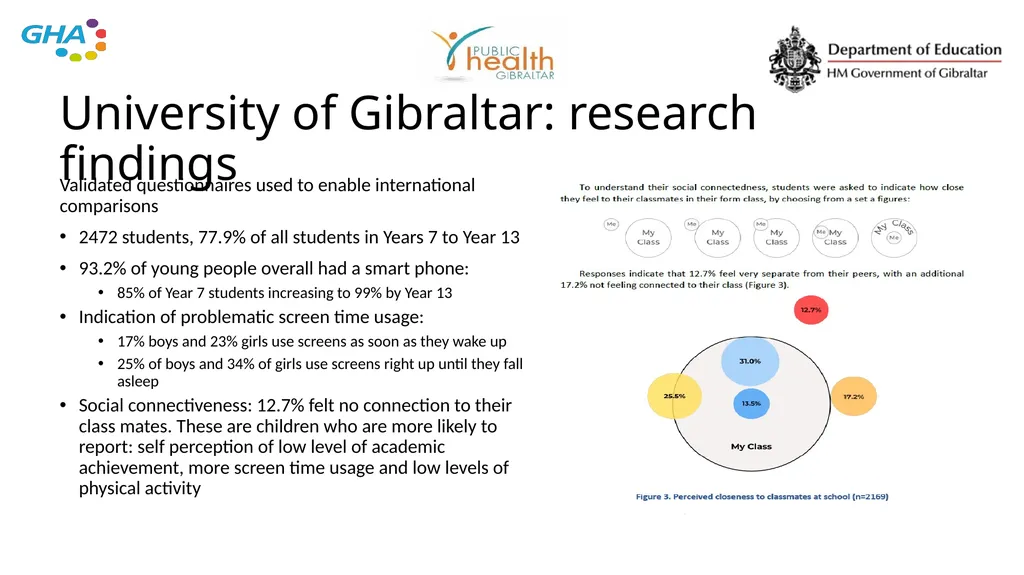
Social connectiveness: 12.7% felt no connection to their class mates. These are children who are more likely to report: self perception of low level of academic achievement, more screen time usage and low levels of physical activity<br>
2472 students, 77.9% of all students in Years 7 to Year 13
93.2% of young people overall had a smart phone:
85% of Year 7 students increasing to 99% by Year 13
Indication of problematic screen time usage:
17% boys and 23% girls use screens as soon as they wake up
25% of boys and 34% of girls use screens right up until they fall asleep
Social connectiveness: 12.7% felt no connection to their class mates. These are children who are more likely to report: self perception of low level of academic achievement, more screen time usage and low levels of physical activity<br>
10
What has taken place to date (2)
October 2025 Cross political party meeting 14th Oct:
explored the issue and reviewed work to date
agreement that DPH, Director of Education and Consultant Paediatrician are to lead this
recognition that a total ban would be unlikely to be practically implemented and adopted
frame this is not judgemental of parents and accept it’s a challenging complex issue and together we can improve the current position
a campaign should be developed that is ‘hard hitting of the detrimental impacts’ and links to practical resources for parents to use as alternatives to screen time. The links to practical advice and support are essential
recognition that social media will have to be used to deliver an awareness campaign and we should anticipate taking the criticism for this
Joint meeting between Director of Education, Director of Public Health and Smartphone Free Childhood Gibraltar 15th Oct:
Shared work undertaken to date and a commitment to continue to collaborate
Agreed to collaborate on a Chronicle article to raise awareness
Submission for publication research article from the University of Gibraltar to contribute to the global evidence base:
The role of parental control apps and parental knowledge in adolescents’ sleep-related screen usage<br>
explored the issue and reviewed work to date
agreement that DPH, Director of Education and Consultant Paediatrician are to lead this
recognition that a total ban would be unlikely to be practically implemented and adopted
frame this is not judgemental of parents and accept it’s a challenging complex issue and together we can improve the current position
a campaign should be developed that is ‘hard hitting of the detrimental impacts’ and links to practical resources for parents to use as alternatives to screen time. The links to practical advice and support are essential
recognition that social media will have to be used to deliver an awareness campaign and we should anticipate taking the criticism for this
Joint meeting between Director of Education, Director of Public Health and Smartphone Free Childhood Gibraltar 15th Oct:
Shared work undertaken to date and a commitment to continue to collaborate
Agreed to collaborate on a Chronicle article to raise awareness
Submission for publication research article from the University of Gibraltar to contribute to the global evidence base:
The role of parental control apps and parental knowledge in adolescents’ sleep-related screen usage<br>
11
What will we do now (1)? We will use a behavioural change model impacting upon:
capability-opportunity-motivation= behaviour change
Capability: we will provide and signpost to resources and support for parents and families to give them practical alternatives to screen time. For example, the Dept of Education is planning on providing new Nursery enrolments for Sept 2026 onwards, with guidance on schools’ expectations for children’s school readiness and helpful tips for parents on how they can help their child get ready for school.
Capability: we will include practical resources into antenatal classes and parenting programs
Capability: we will encourage teenagers to participate in alternative out of school activity, linking to the findings of the Youth Strategy and the Covid fund that has been used for e.g. developing new outdoor gyms to enable unstructured play areas with a specific focus on the teenagers who feel no social connection to their class, as identified in the research<br>
capability-opportunity-motivation= behaviour change
Capability: we will provide and signpost to resources and support for parents and families to give them practical alternatives to screen time. For example, the Dept of Education is planning on providing new Nursery enrolments for Sept 2026 onwards, with guidance on schools’ expectations for children’s school readiness and helpful tips for parents on how they can help their child get ready for school.
Capability: we will include practical resources into antenatal classes and parenting programs
Capability: we will encourage teenagers to participate in alternative out of school activity, linking to the findings of the Youth Strategy and the Covid fund that has been used for e.g. developing new outdoor gyms to enable unstructured play areas with a specific focus on the teenagers who feel no social connection to their class, as identified in the research<br>
12
What will we do now (2)? Opportunity: in mid January 2026 secondary schools will implement an enhanced approach to their smartphone free premises through the introduction of lockable pouches. Pupils in Primary schools are not allowed to have phones with them in their classes.
Motivation: develop a hard hitting awareness campaign, to raise awareness of the detrimental impacts of screen time on health and educational development, see appendix 1.
We will include messaging for adults to reflect upon their own screen time behaviours and the impacts that this has upon their own well being and role modelling
We will develop a specific campaign for grandparents, who play a pivotal role with childcare in Gibraltar, so that they are aware of the detrimental impacts of excessive screen time on their grandchildren
Motivation: we will explore using more innovative methods to engage with secondary school age children re the dangers of excessive screen time usage e.g. holding facilitated debates in the cinema having viewed films such as Adolescence and take the learning ‘out of the classroom’<br>
Motivation: develop a hard hitting awareness campaign, to raise awareness of the detrimental impacts of screen time on health and educational development, see appendix 1.
We will include messaging for adults to reflect upon their own screen time behaviours and the impacts that this has upon their own well being and role modelling
We will develop a specific campaign for grandparents, who play a pivotal role with childcare in Gibraltar, so that they are aware of the detrimental impacts of excessive screen time on their grandchildren
Motivation: we will explore using more innovative methods to engage with secondary school age children re the dangers of excessive screen time usage e.g. holding facilitated debates in the cinema having viewed films such as Adolescence and take the learning ‘out of the classroom’<br>
13
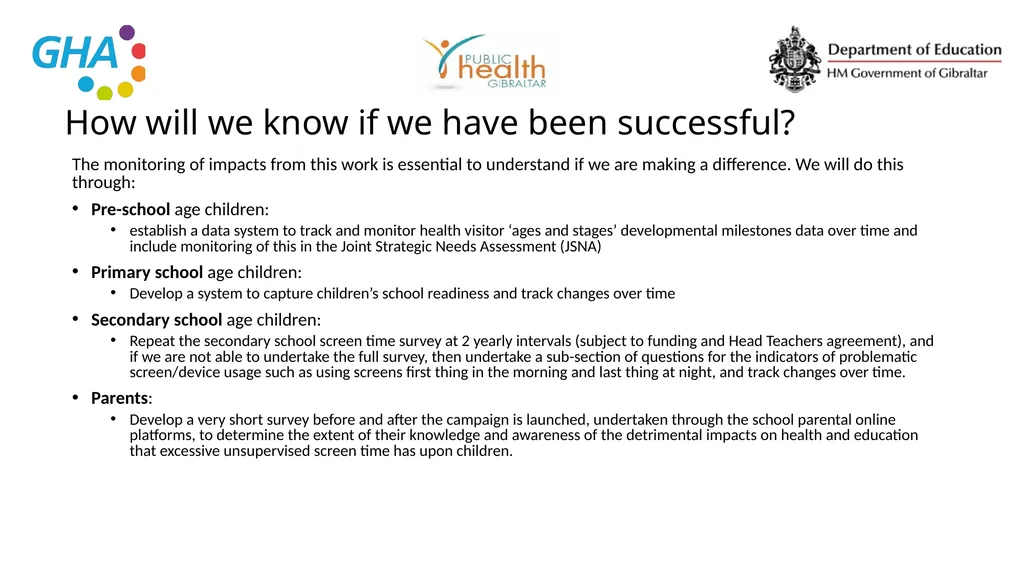
How will we know if we have been successful? The monitoring of impacts from this work is essential to understand if we are making a difference. We will do this through:
Pre-school age children:
establish a data system to track and monitor health visitor ‘ages and stages’ developmental milestones data over time and include monitoring of this in the Joint Strategic Needs Assessment (JSNA)
Primary school age children:
Develop a system to capture children’s school readiness and track changes over time
Secondary school age children:
Repeat the secondary school screen time survey at 2 yearly intervals (subject to funding and Head Teachers agreement), and if we are not able to undertake the full survey, then undertake a sub-section of questions for the indicators of problematic screen/device usage such as using screens first thing in the morning and last thing at night, and track changes over time.
Parents:
Develop a very short survey before and after the campaign is launched, undertaken through the school parental online platforms, to determine the extent of their knowledge and awareness of the detrimental impacts on health and education that excessive unsupervised screen time has upon children.<br>
Pre-school age children:
establish a data system to track and monitor health visitor ‘ages and stages’ developmental milestones data over time and include monitoring of this in the Joint Strategic Needs Assessment (JSNA)
Primary school age children:
Develop a system to capture children’s school readiness and track changes over time
Secondary school age children:
Repeat the secondary school screen time survey at 2 yearly intervals (subject to funding and Head Teachers agreement), and if we are not able to undertake the full survey, then undertake a sub-section of questions for the indicators of problematic screen/device usage such as using screens first thing in the morning and last thing at night, and track changes over time.
Parents:
Develop a very short survey before and after the campaign is launched, undertaken through the school parental online platforms, to determine the extent of their knowledge and awareness of the detrimental impacts on health and education that excessive unsupervised screen time has upon children.<br>
14
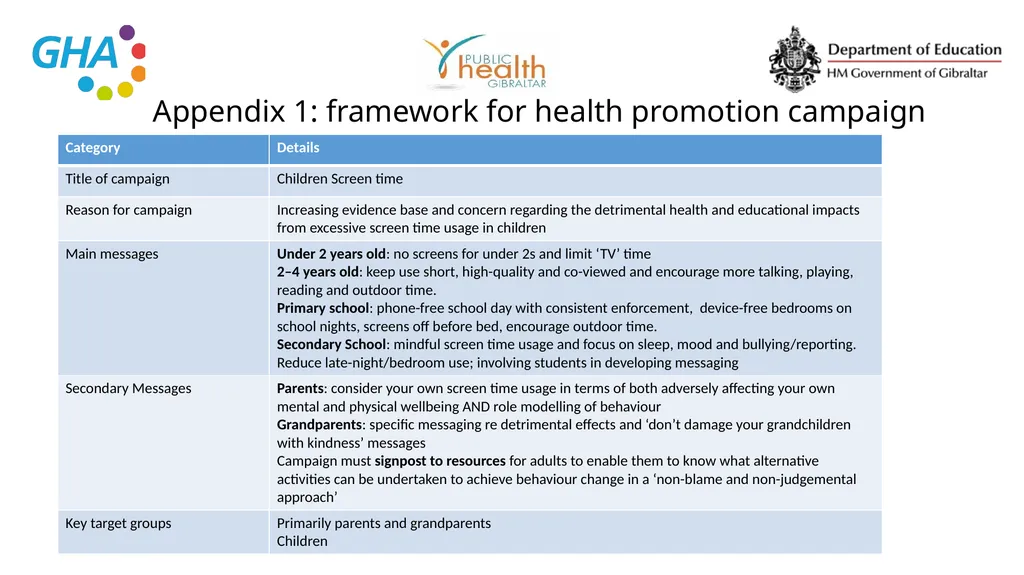
Appendix 1: framework for health promotion campaign<br>
15
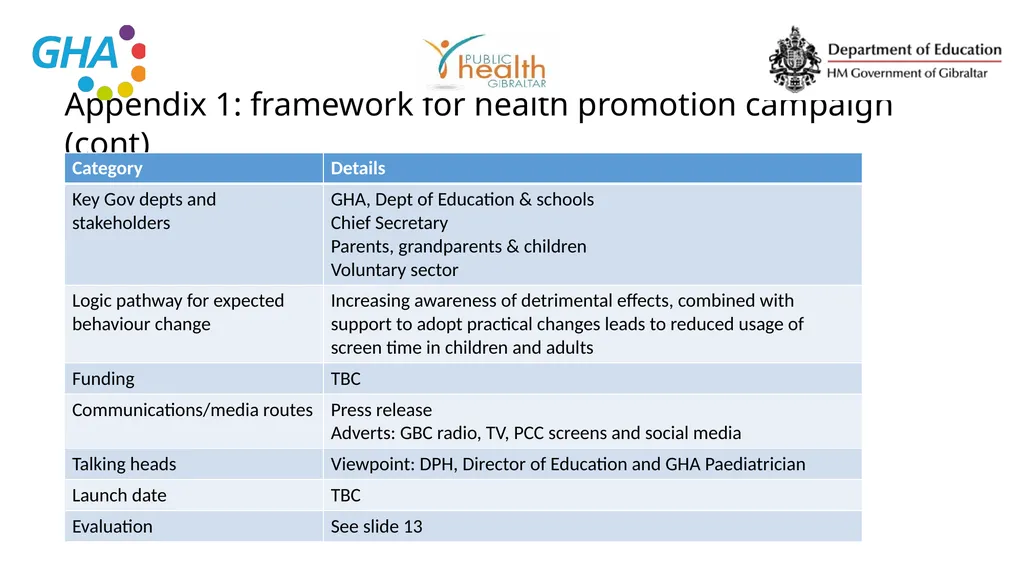
Appendix 1: framework for health promotion campaign (cont)<br>