
CHILDS Replacement Program: F2017 Q4 Assessment
Description: CHILDS Replacement Program: F2017 Q4 Assessment Report Prepared for: Arizona Department of Child Safety (DCS) Prepared by: Info-Tech Research Group Date: May 31, 2017 Table of Contents Introduction Background Executive Summary Assessment
Related Topics
Download Presentation
"CHILDS Replacement Program: F2017 Q4 Assessment" is the property of its rightful owner. Permission is granted to download and print the materials on this website for personal, non-commercial use only, and to display it on your personal computer provided you do not modify the materials and that you retain all copyright notices contained in the materials. By downloading content from our website, you accept the terms of this agreement.
Presentation Transcript
slide1. CHILDS Replacement Program:
F2017 Q4 Assessment Report Prepared for: Arizona Department of Child Safety (DCS)
Prepared by: Info-Tech Research Group
Date: May 31, 2017<br>
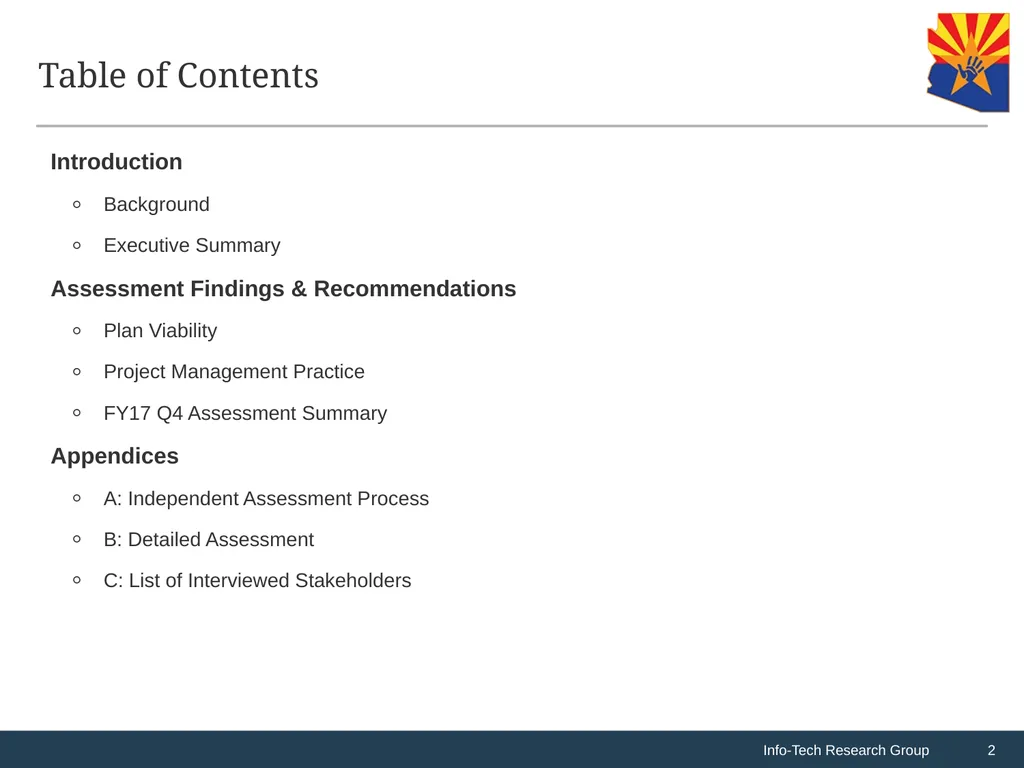
slide2. Table of Contents Introduction
Background
Executive Summary
Assessment Findings & Recommendations
Plan Viability
Project Management Practice
FY17 Q4 Assessment Summary
Appendices
A: Independent Assessment Process
B: Detailed Assessment
C: List of Interviewed Stakeholders<br>
slide3. Background The Arizona Department of Child Safety (ADCS) has completed the Planning and Initiation phases for the Program of projects to assess, procure, design, and implement a replacement of the current Federal Administration for Children and Families (ACF), Statewide Automated Child Welfare Information System (SACWIS) compliant system known as the Children’s Information Library and Data Source or CHILDS. The resulting CHILDS Replacement system will be known as Guardian and will align with the recently published (June 2016) ACF Comprehensive Child Welfare Information System (CCWIS) regulations.
The Planning phase work included the completion of a Feasibility Study, Cost-Benefit Analysis, the Federal Implementation Advance Planning Document (IAPD), a product and services roadmap, an overarching budget document and introduced an iterative procurement model for the Program of projects that will create the CHILDS replacement system (Guardian). The Initiation phase defined the program delivery approach. The program selected the Mobile Solution as well as the infrastructure platform and is now in the process of implementing the two solutions.
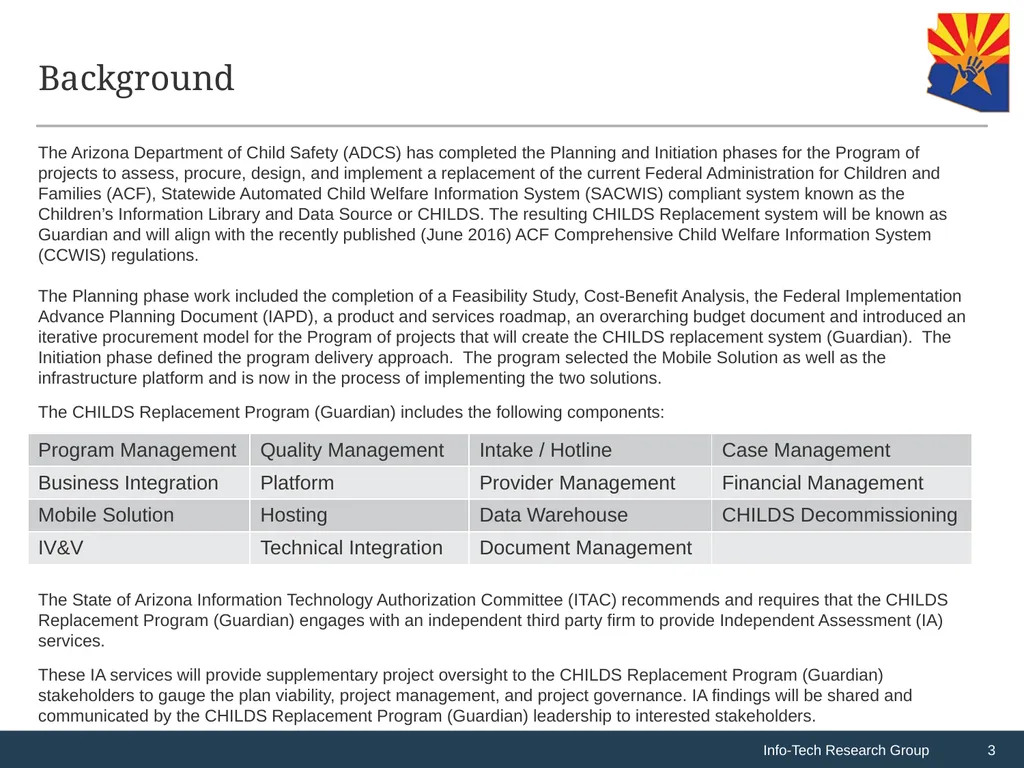
The CHILDS Replacement Program (Guardian) includes the following components:
The State of Arizona Information Technology Authorization Committee (ITAC) recommends and requires that the CHILDS Replacement Program (Guardian) engages with an independent third party firm to provide Independent Assessment (IA) services.
These IA services will provide supplementary project oversight to the CHILDS Replacement Program (Guardian) stakeholders to gauge the plan viability, project management, and project governance. IA findings will be shared and communicated by the CHILDS Replacement Program (Guardian) leadership to interested stakeholders.<br>
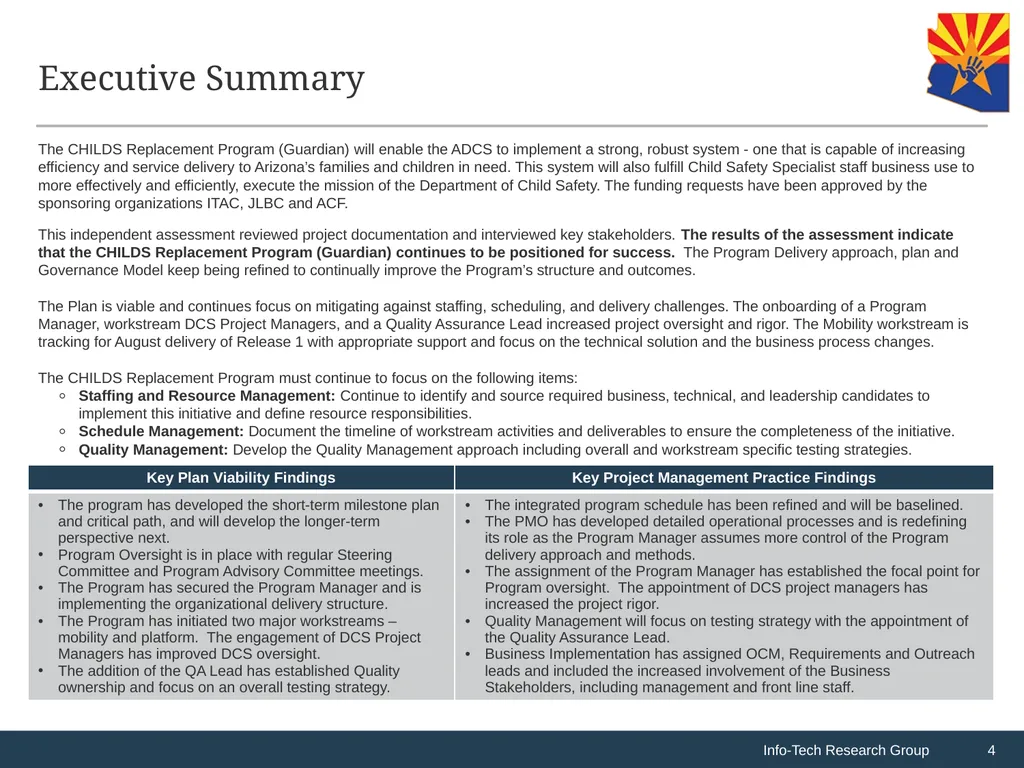
slide4. Executive Summary The CHILDS Replacement Program (Guardian) will enable the ADCS to implement a strong, robust system - one that is capable of increasing efficiency and service delivery to Arizona’s families and children in need. This system will also fulfill Child Safety Specialist staff business use to more effectively and efficiently, execute the mission of the Department of Child Safety. The funding requests have been approved by the sponsoring organizations ITAC, JLBC and ACF.
This independent assessment reviewed project documentation and interviewed key stakeholders. The results of the assessment indicate that the CHILDS Replacement Program (Guardian) continues to be positioned for success. The Program Delivery approach, plan and Governance Model keep being refined to continually improve the Program’s structure and outcomes.
The Plan is viable and continues focus on mitigating against staffing, scheduling, and delivery challenges. The onboarding of a Program Manager, workstream DCS Project Managers, and a Quality Assurance Lead increased project oversight and rigor. The Mobility workstream is tracking for August delivery of Release 1 with appropriate support and focus on the technical solution and the business process changes.
The CHILDS Replacement Program must continue to focus on the following items:
Staffing and Resource Management: Continue to identify and source required business, technical, and leadership candidates to implement this initiative and define resource responsibilities.
Schedule Management: Document the timeline of workstream activities and deliverables to ensure the completeness of the initiative.
Quality Management: Develop the Quality Management approach including overall and workstream specific testing strategies.<br>
slide5. Assessment Findings & Recommendations<br>
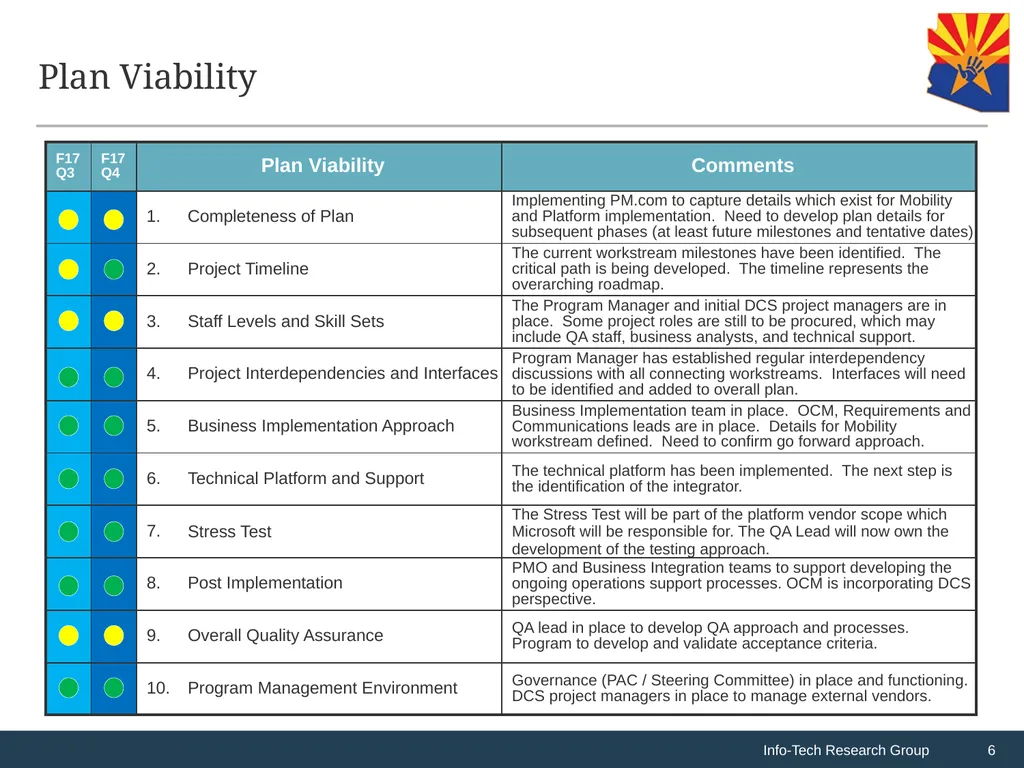
slide6. Plan Viability<br>
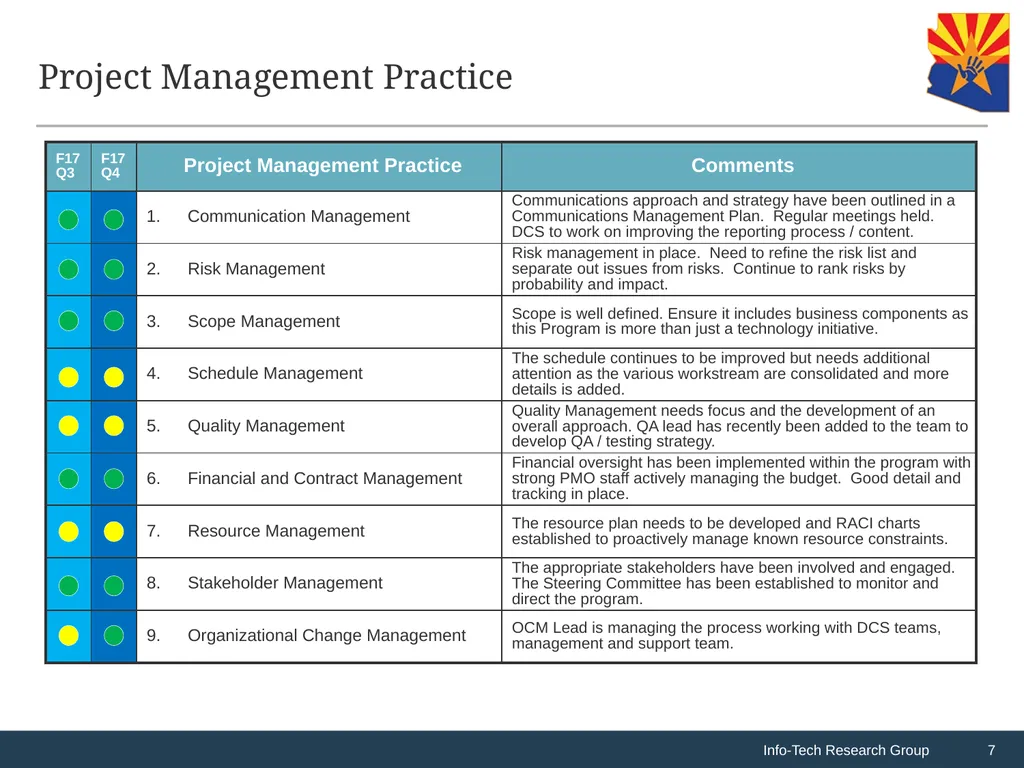
slide7. Project Management Practice<br>
slide8. FY17 Q4 Assessment Summary Key FY17 Q4 Observations:
The Arizona Department of Child Safety has resolved many project challenges in the CHILDS Replacement program between the Q3 assessment (dated February 28, 2017) and this Q4 assessment:
Staffing and Resource Management
The Guardian Program Manager has assumed leadership. DCS Project Managers have been added to the team to provide oversight and integration of vendor owned workstreams.
The addition of a Quality Assurance Manager has increased focus on managing the testing strategy and approach.
The program still needs to improve clarity around roles and responsibilities to improve collaboration, minimize duplication of work, and address missing skillsets.
Schedule Management
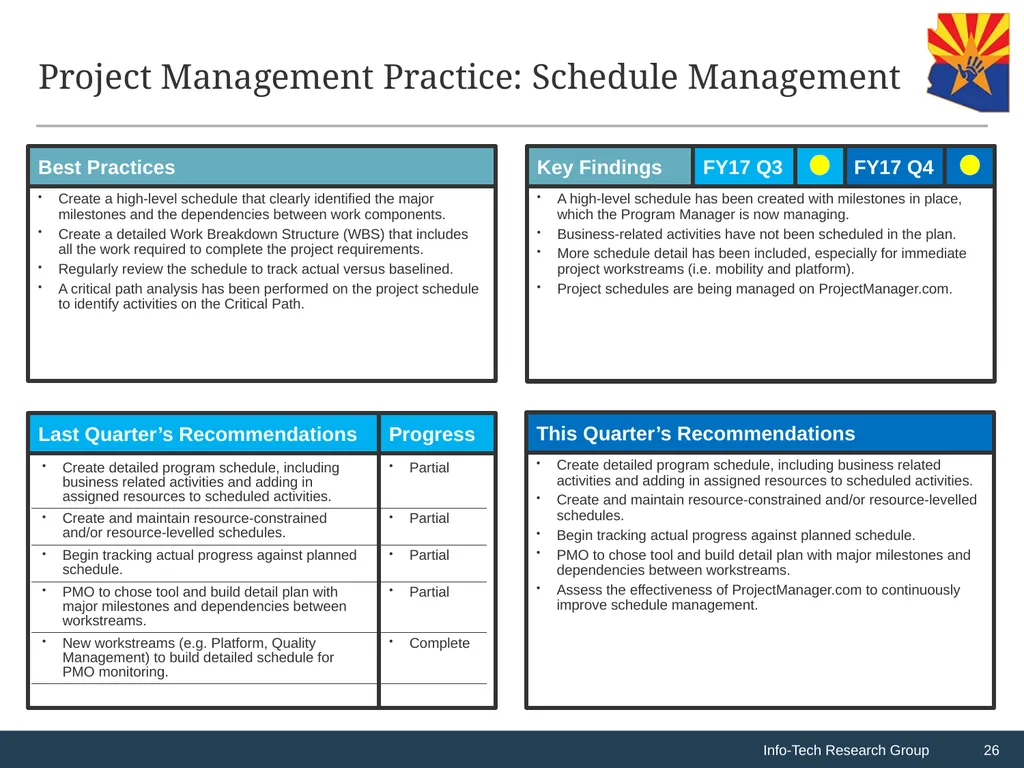
The integrated plan is being consolidated into the ProjectManager.com tool.
The individual immediate workstreams (Mobility and Platform Infrastructure) are developing integrated plans (technical and business related activities).
The subsequent workstreams plan milestones, details and deliverables need to be added.
The schedule has not been formally baselined.
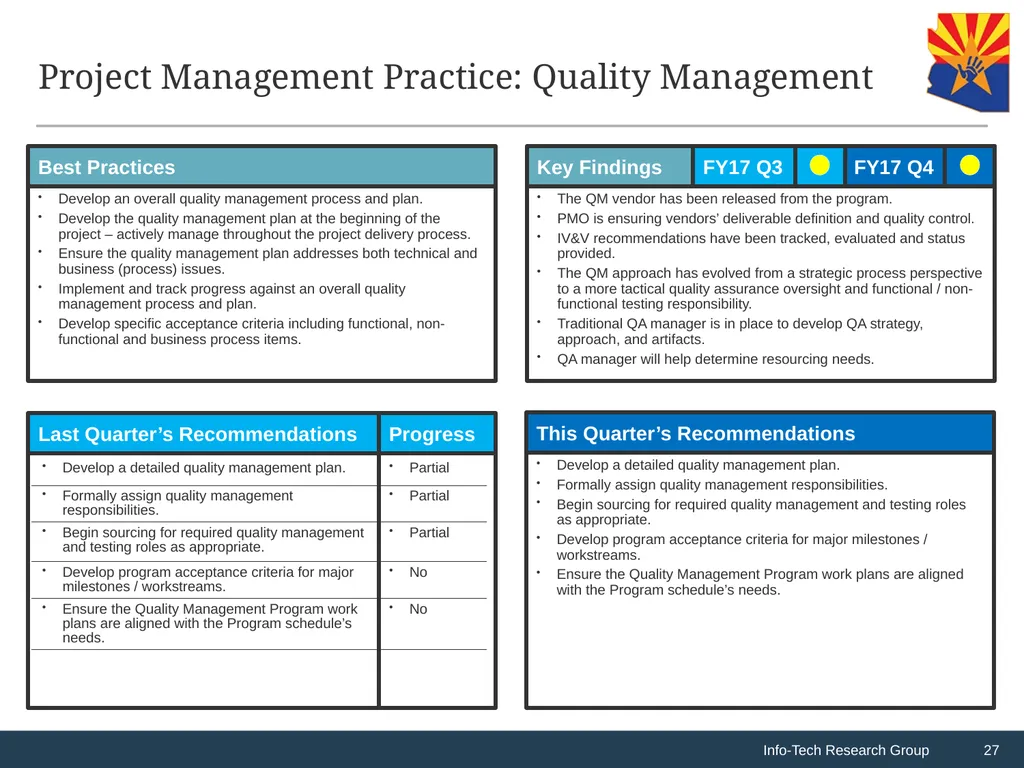
Quality Management
The Quality Management approach has been modified. A go forward Quality Management strategy is to be defined.
The appointment of a Quality Assurance lead and the development of the testing strategy bode well for the go forward delivery oversight.<br>
slide9. FY17 Q4 Assessment Summary Key FY17 Q4 Recommendations:
The FY17 Q4 assessment includes several recommendations for DCS to continue positioning the CHILDS Replacement Program for success:
Staffing and Resource Management
Develop the resourcing plan and RACI charts to help identify missing resources, roles, and responsibilities.
Track resource utilization to identify gaps and conflicts.
Schedule Management
Continue to consolidate the detail workstream schedules.
Continue to build project schedule detail and include relevant business activities in the timeline.
Program Management
Determine the future role of the PMO and its interaction with Program Management oversight.
Improve reporting dashboards and develop program and project metrics.
Quality Management
Develop the Quality Management Approach and Testing Strategy.
Detail testing metrics and define the acceptance criteria.
Plan FY18 Q1 Assessment logistics – Target for the beginning of August 2017.<br>
slide10. Appendix A: Independent Assessment Process<br>
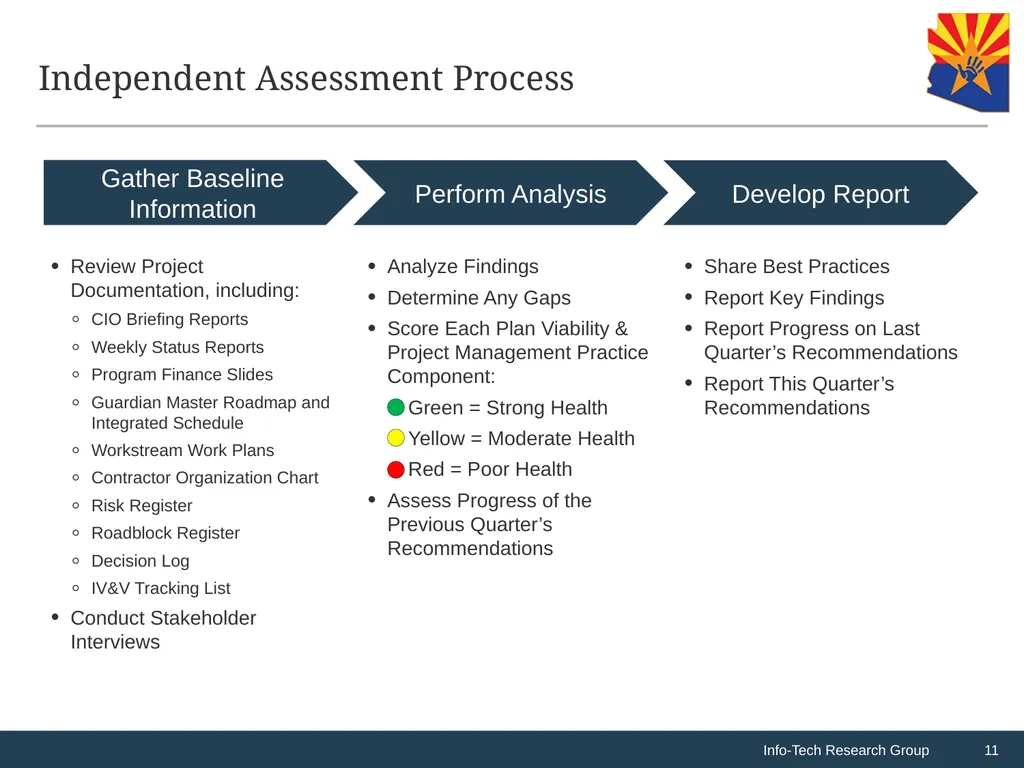
slide11. Independent Assessment Process Review Project Documentation, including:
CIO Briefing Reports
Weekly Status Reports
Program Finance Slides
Guardian Master Roadmap and Integrated Schedule
Workstream Work Plans
Contractor Organization Chart
Risk Register
Roadblock Register
Decision Log
IV&V Tracking List
Conduct Stakeholder Interviews Gather Baseline Information Perform Analysis Develop Report Analyze Findings
Determine Any Gaps
Score Each Plan Viability & Project Management Practice Component:
Green = Strong Health
Yellow = Moderate Health
Red = Poor Health
Assess Progress of the Previous Quarter’s Recommendations Share Best Practices
Report Key Findings
Report Progress on Last Quarter’s Recommendations
Report This Quarter’s Recommendations<br>
slide12. Appendix B: Detailed Assessment<br>
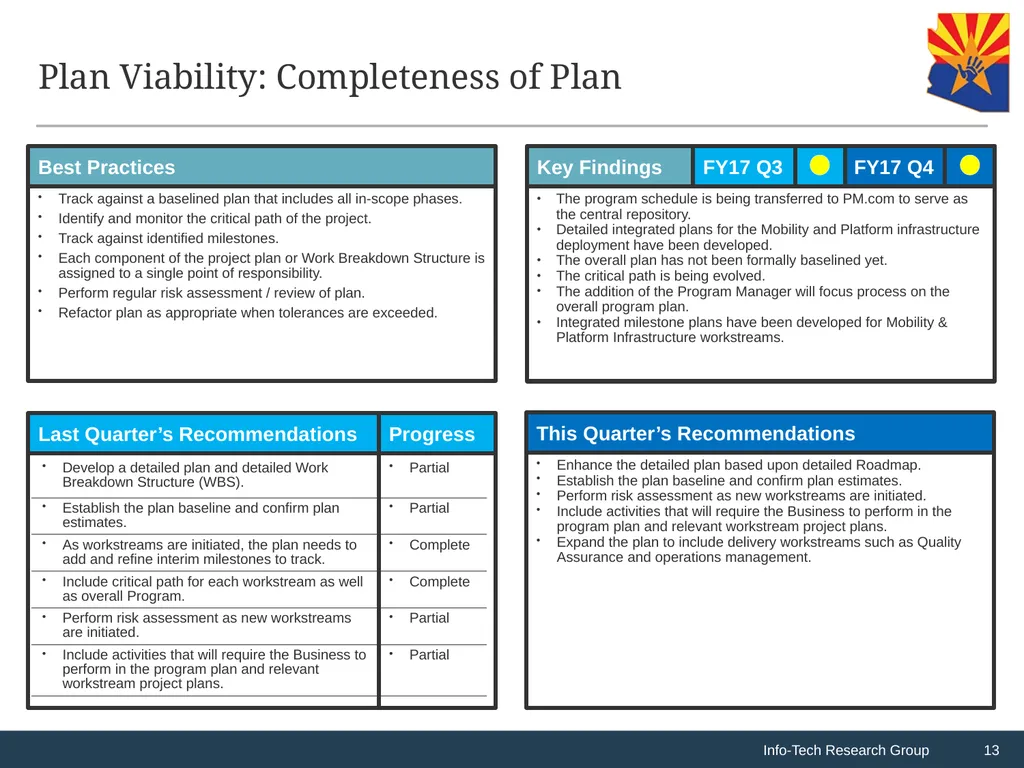
slide13. Plan Viability: Completeness of Plan Last Quarter’s Recommendations Progress<br>
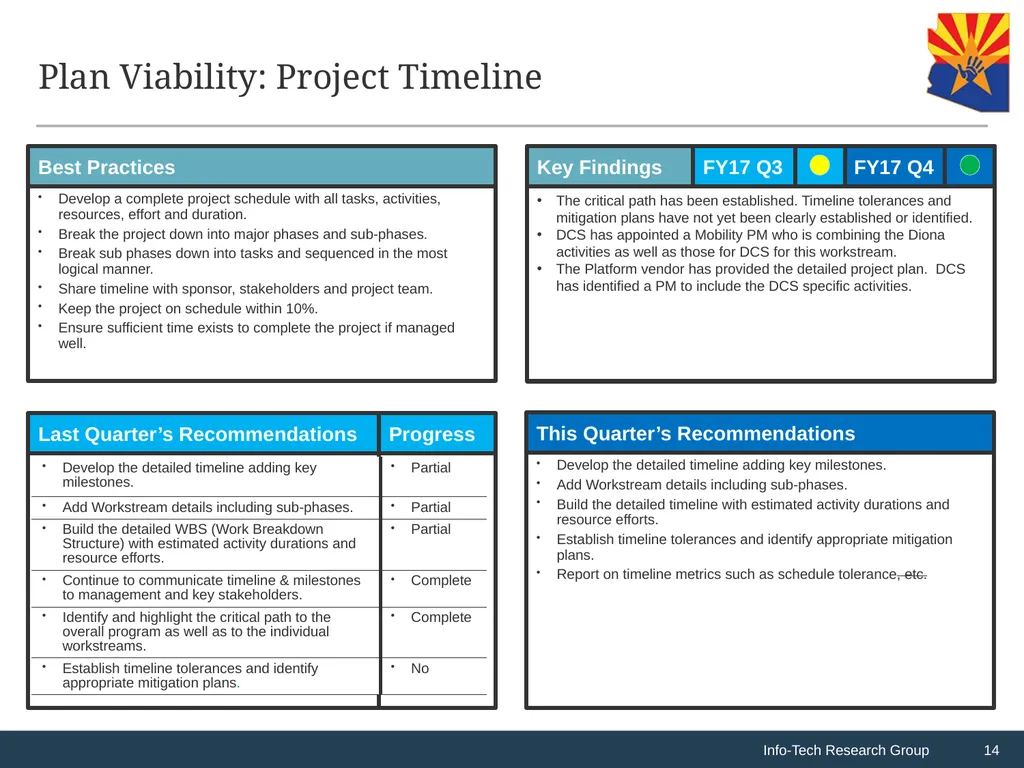
slide14. Plan Viability: Project Timeline Last Quarter’s Recommendations Progress<br>
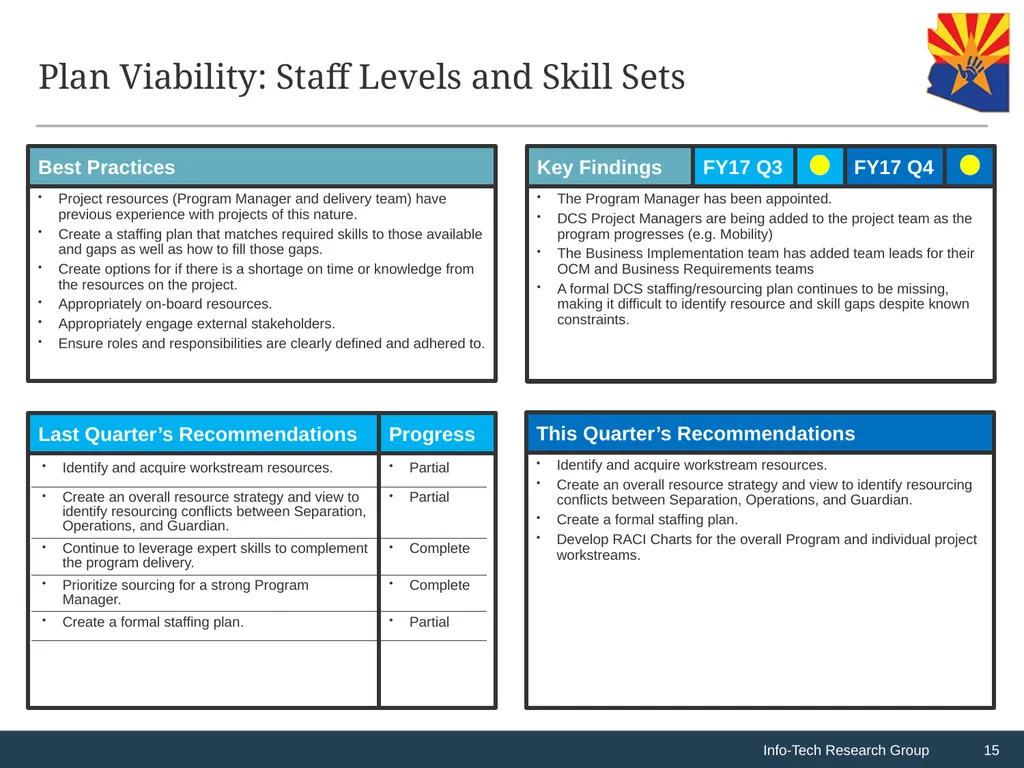
slide15. Plan Viability: Staff Levels and Skill Sets Last Quarter’s Recommendations Progress<br>
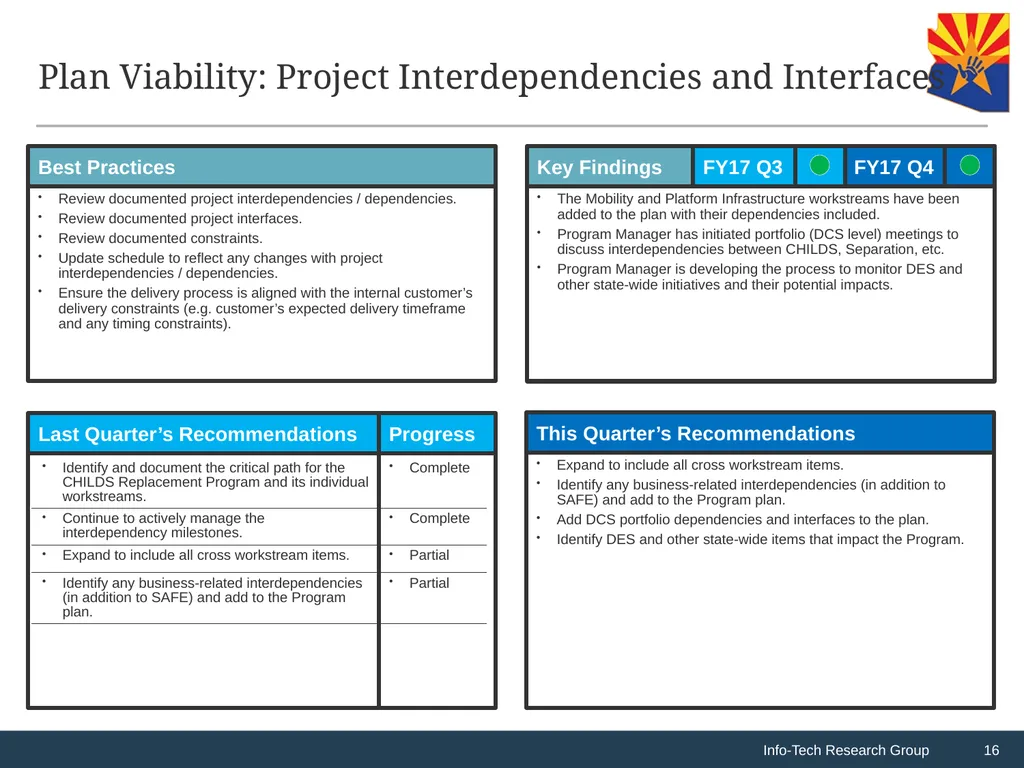
slide16. Plan Viability: Project Interdependencies and Interfaces Last Quarter’s Recommendations Progress<br>
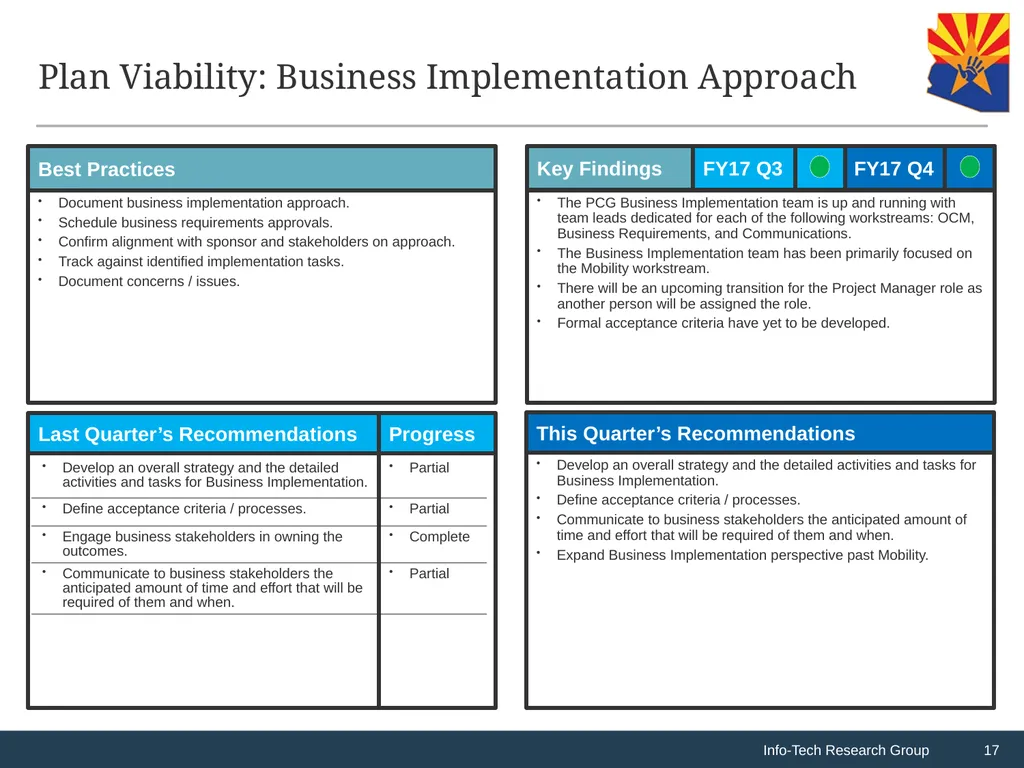
slide17. Plan Viability: Business Implementation Approach Last Quarter’s Recommendations Progress<br>
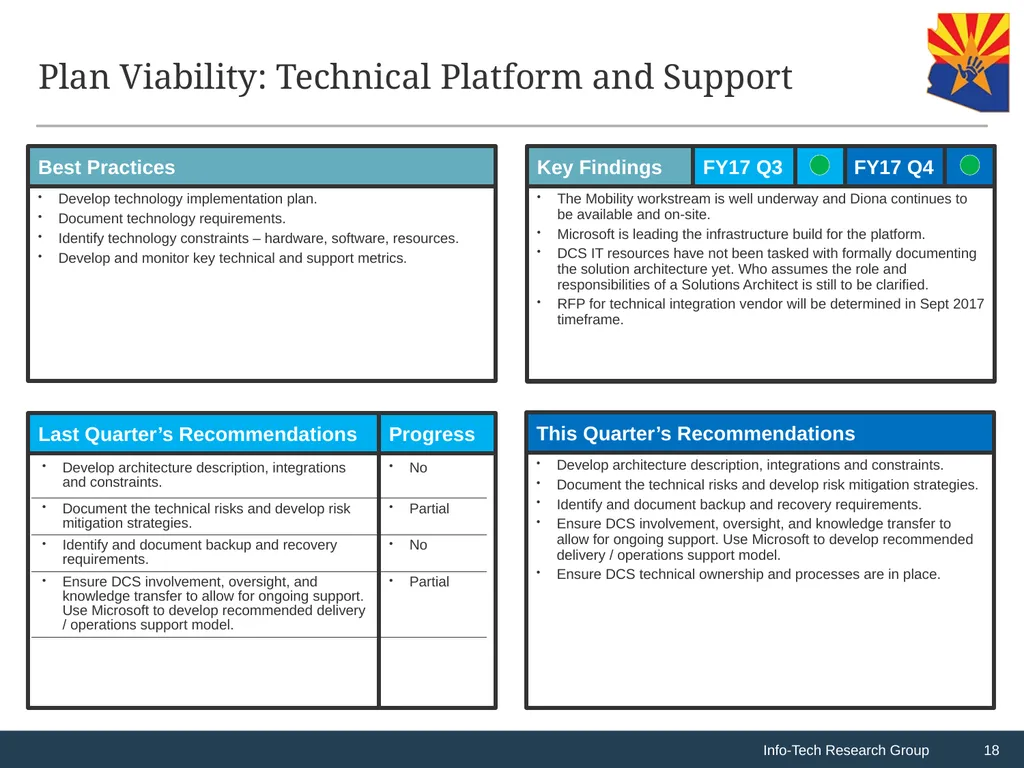
slide18. Plan Viability: Technical Platform and Support Last Quarter’s Recommendations Progress<br>
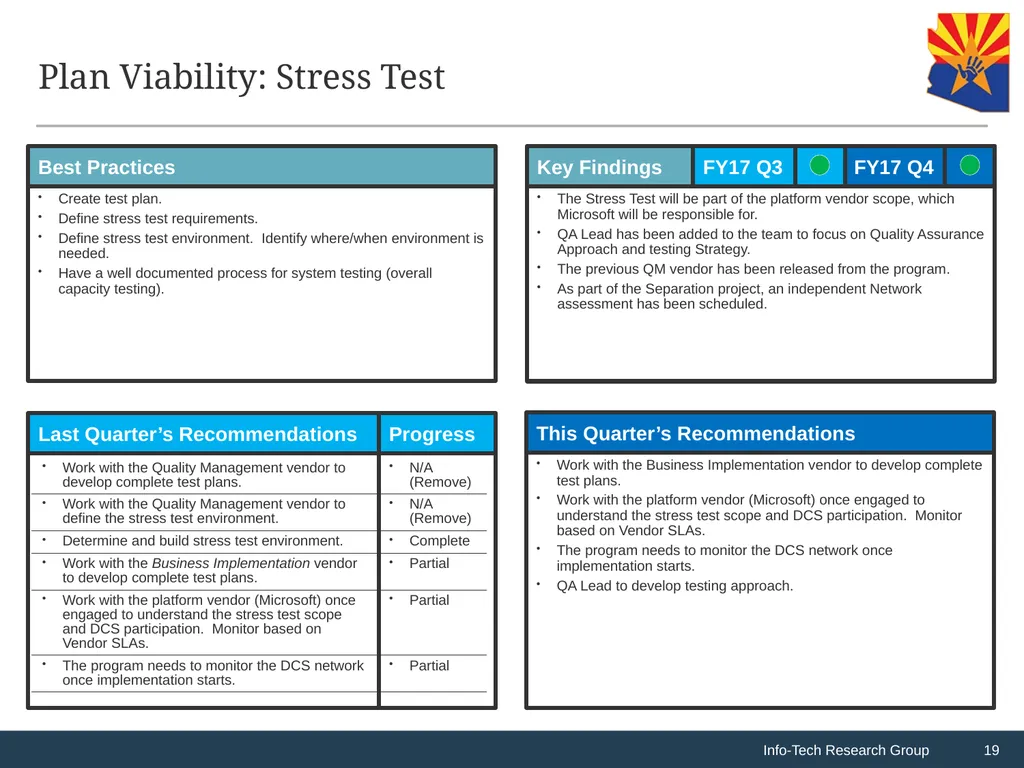
slide19. Plan Viability: Stress Test Last Quarter’s Recommendations Progress<br>
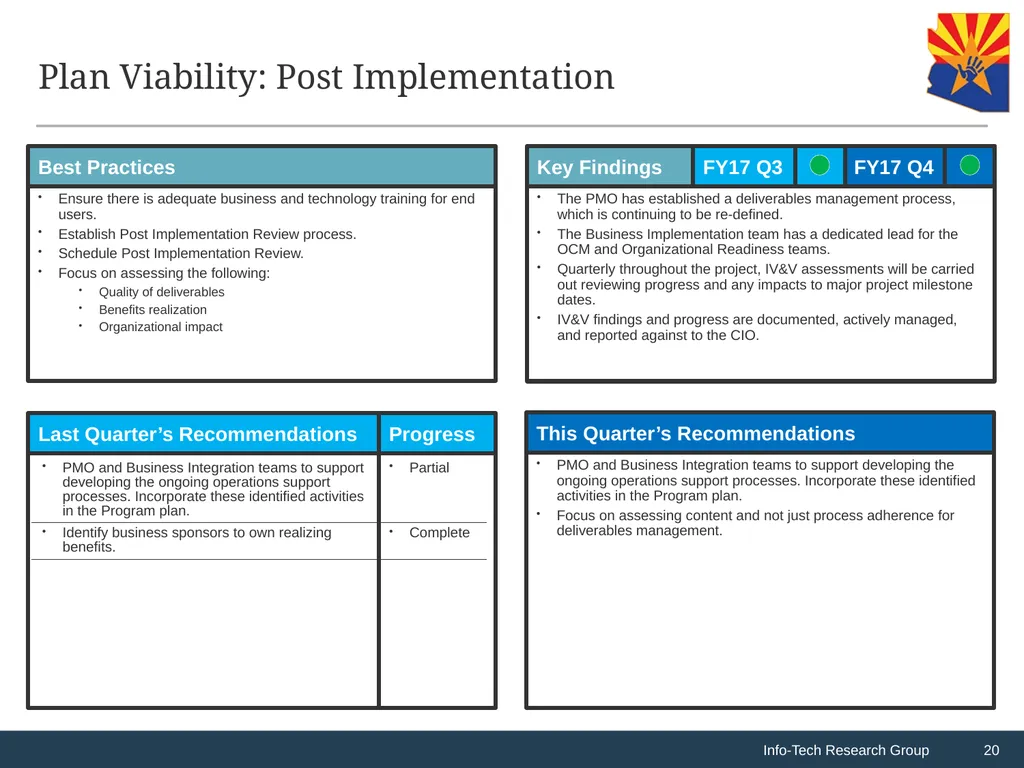
slide20. Plan Viability: Post Implementation Last Quarter’s Recommendations Progress<br>
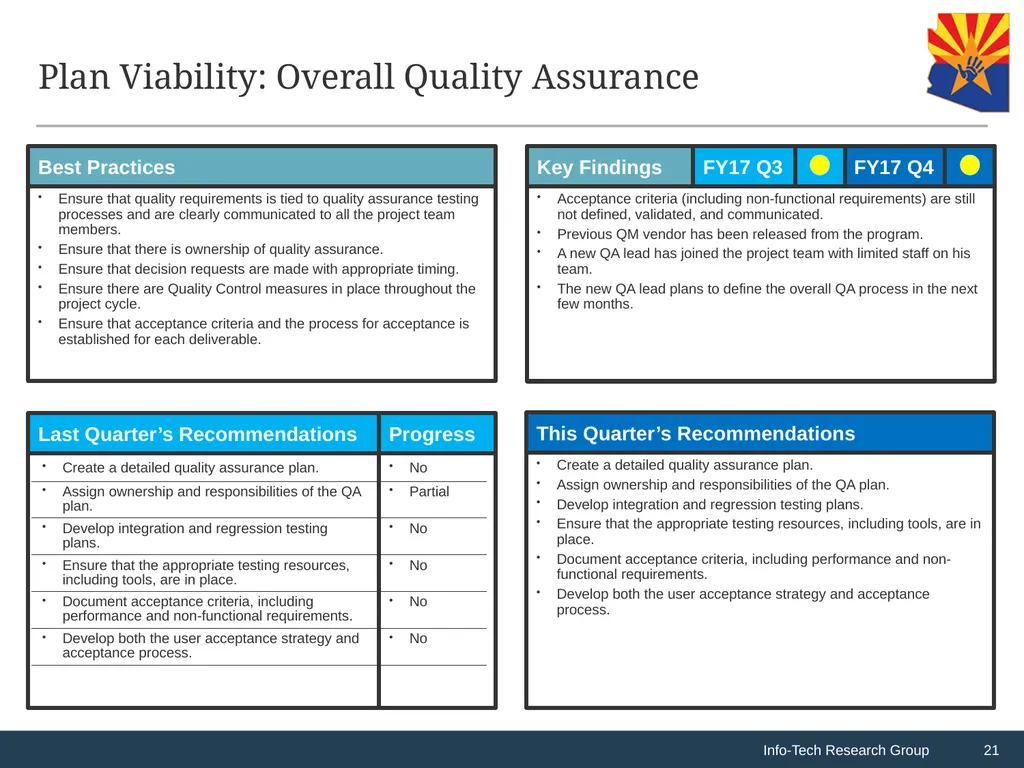
slide21. Plan Viability: Overall Quality Assurance Last Quarter’s Recommendations Progress<br>
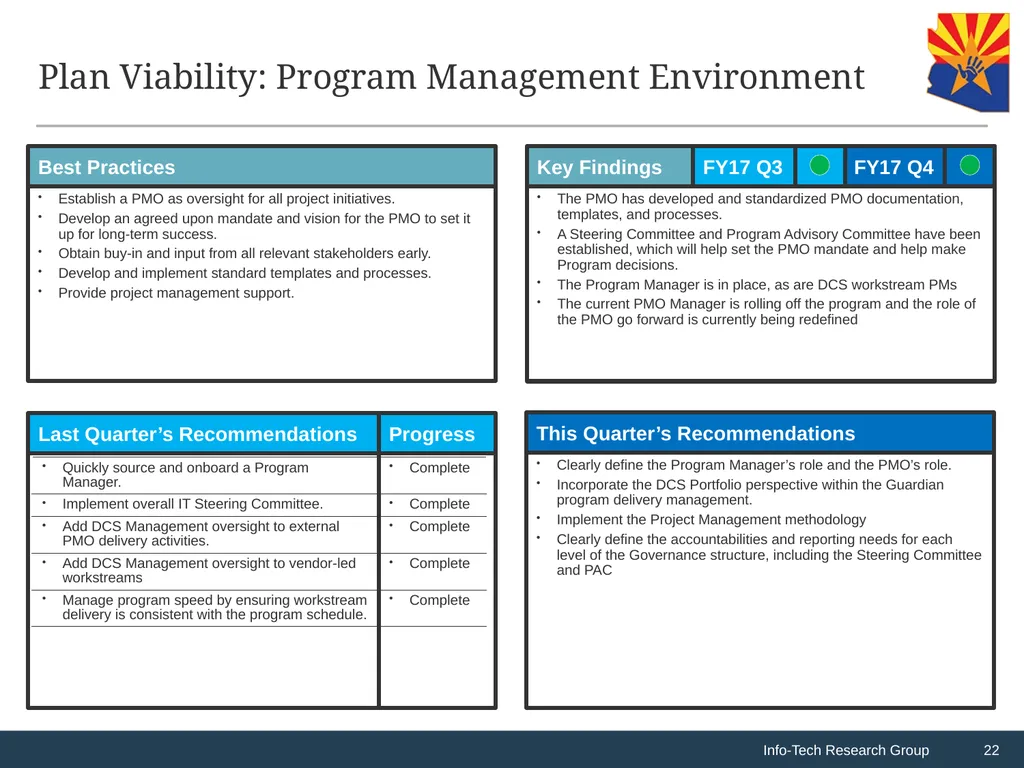
slide22. Plan Viability: Program Management Environment Last Quarter’s Recommendations Progress<br>
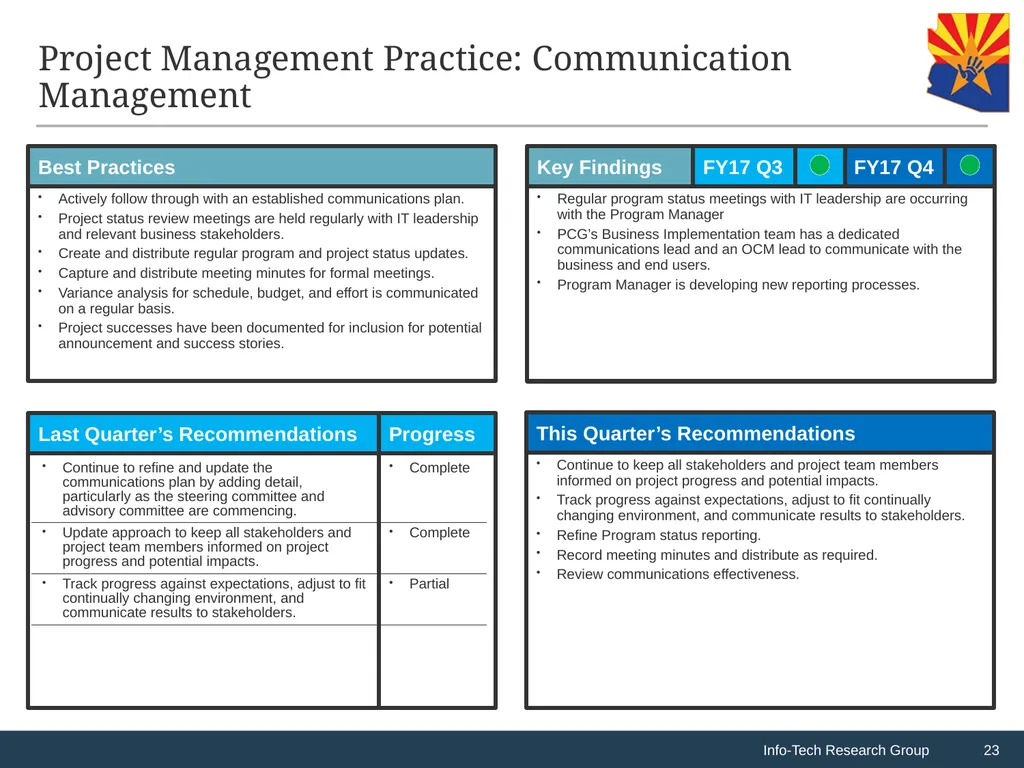
slide23. Project Management Practice: Communication Management Last Quarter’s Recommendations Progress<br>
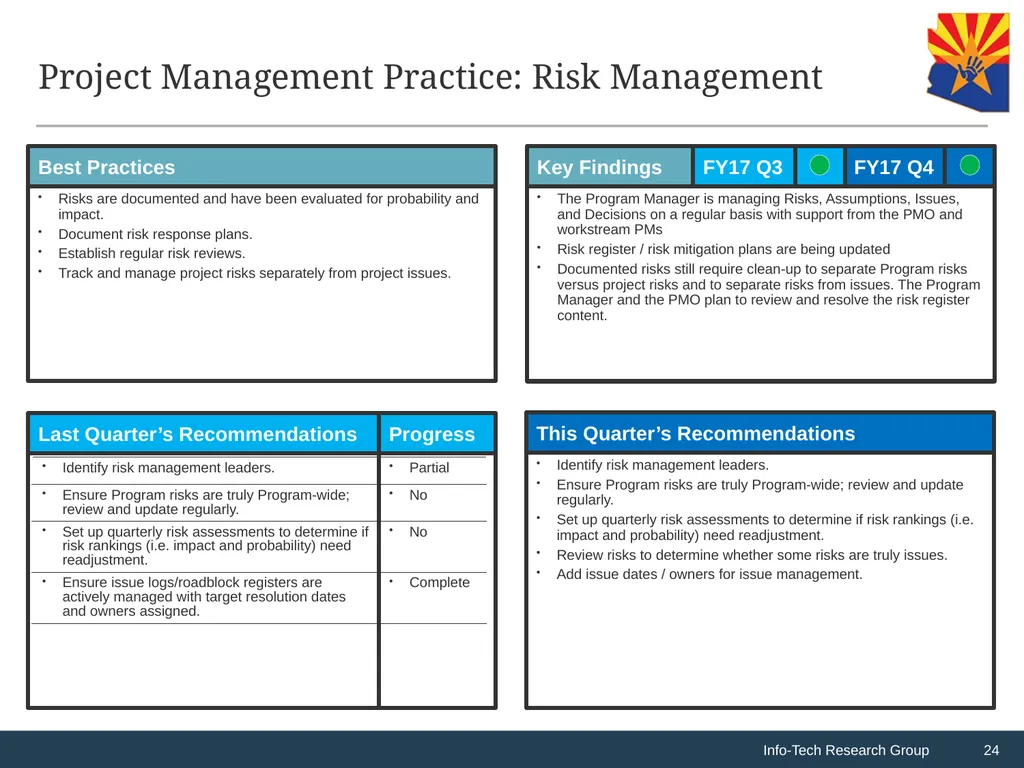
slide24. Project Management Practice: Risk Management Last Quarter’s Recommendations Progress<br>
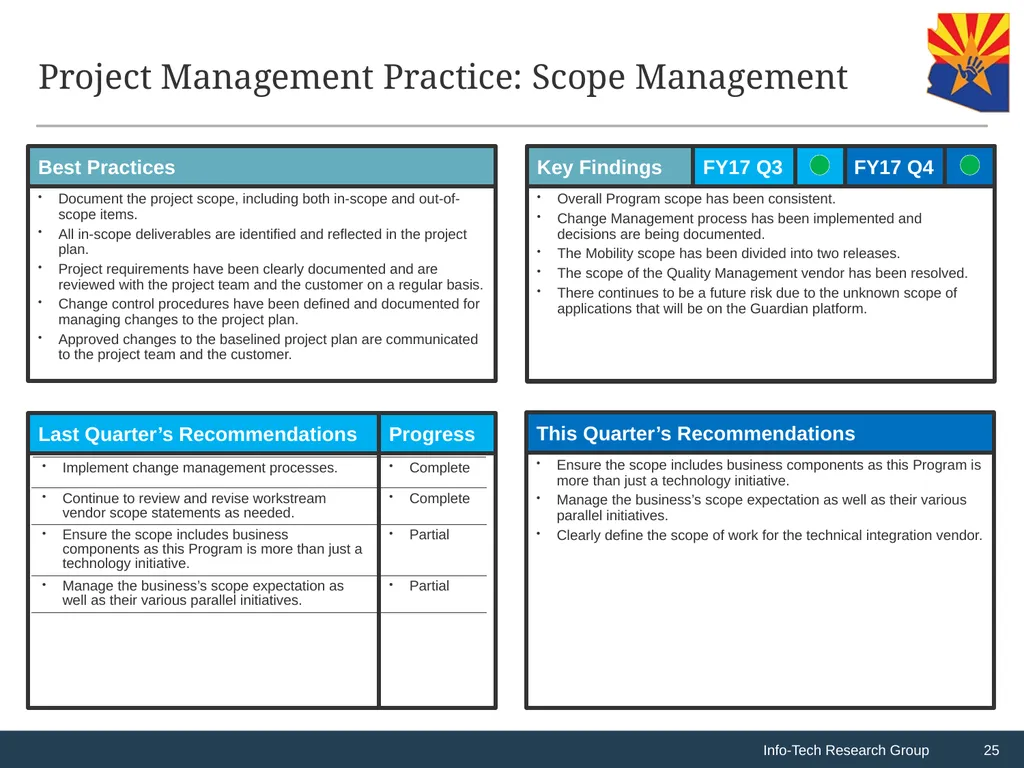
slide25. Project Management Practice: Scope Management Last Quarter’s Recommendations Progress<br>
slide26. Project Management Practice: Schedule Management Last Quarter’s Recommendations Progress<br>
slide27. Project Management Practice: Quality Management Last Quarter’s Recommendations Progress<br>
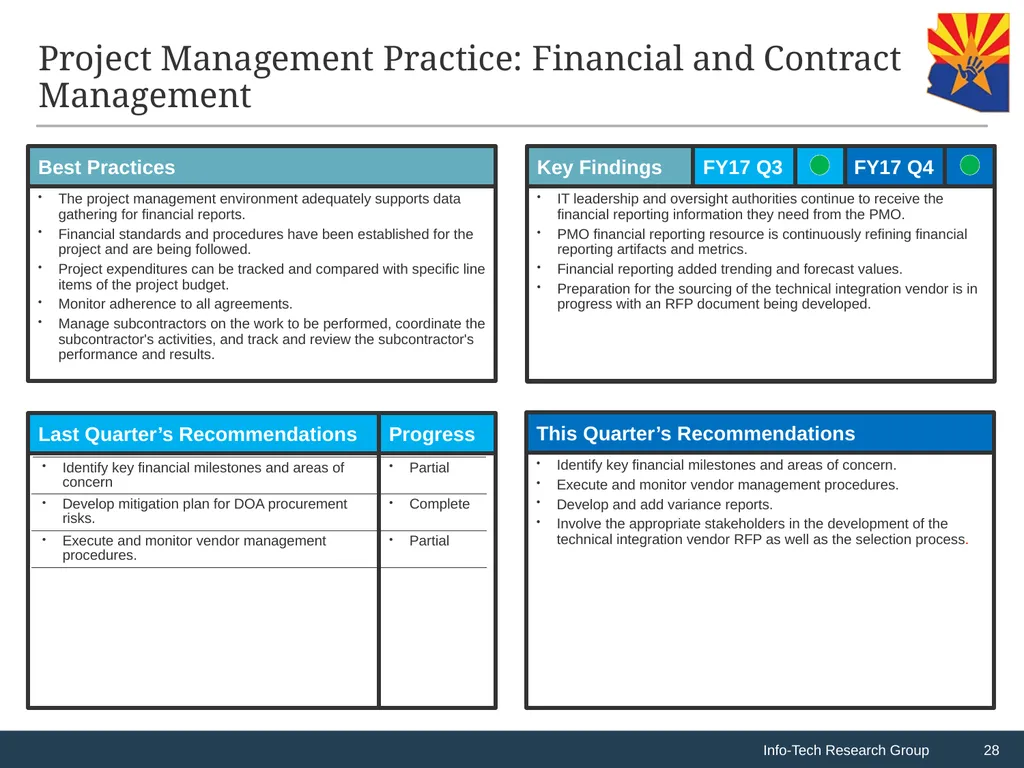
slide28. Project Management Practice: Financial and Contract Management Last Quarter’s Recommendations Progress<br>
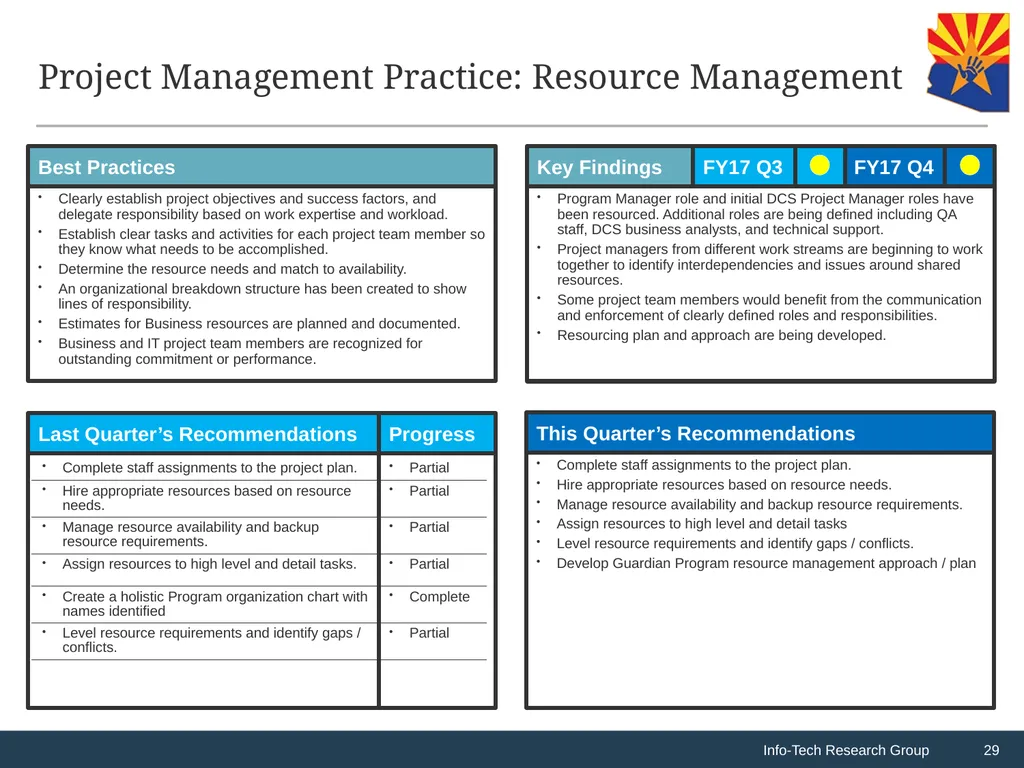
slide29. Project Management Practice: Resource Management Last Quarter’s Recommendations Progress<br>
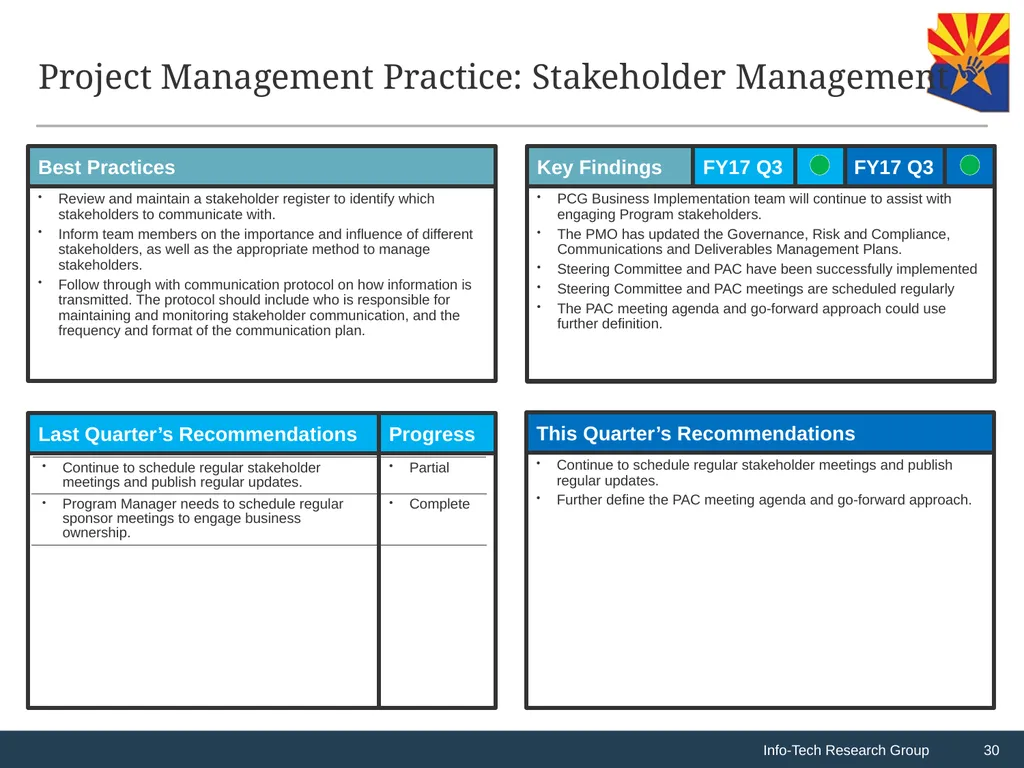
slide30. Project Management Practice: Stakeholder Management Last Quarter’s Recommendations Progress<br>
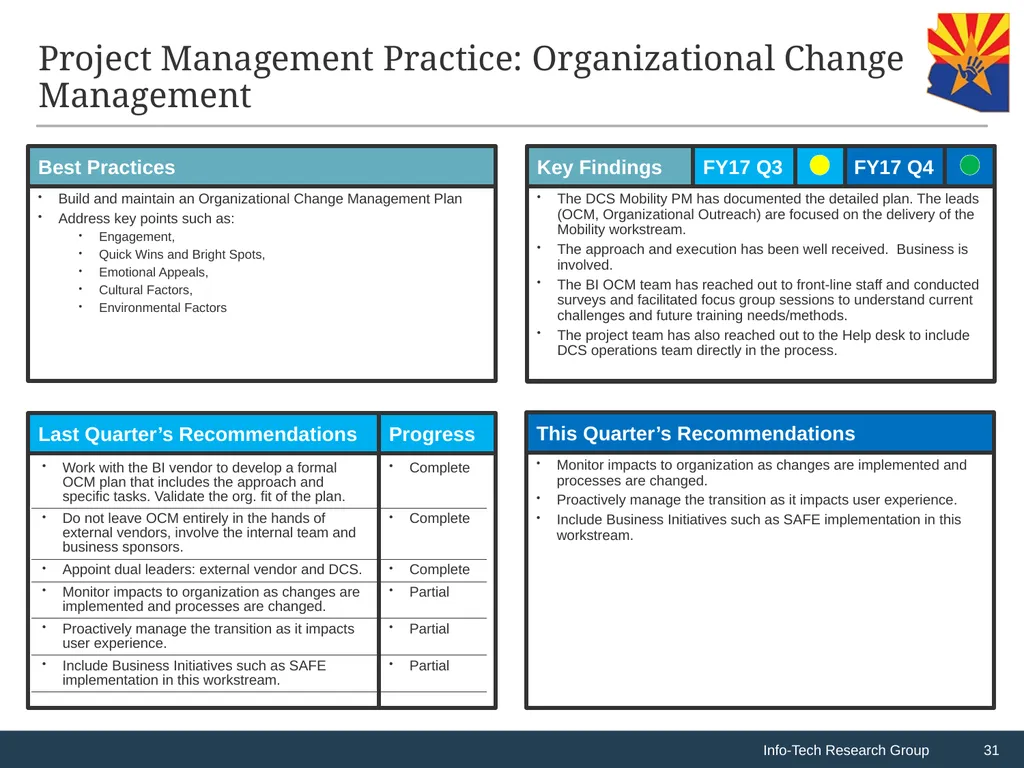
slide31. Project Management Practice: Organizational Change Management Last Quarter’s Recommendations Progress<br>
slide32. Appendix C: List of Interviewed Stakeholders<br>
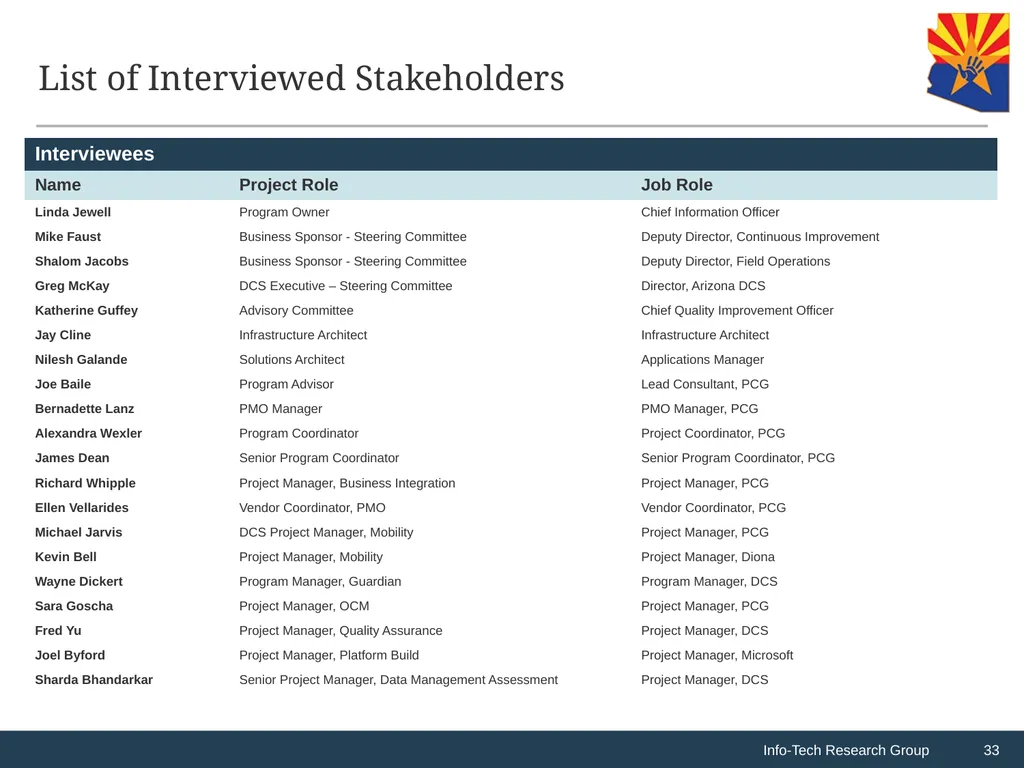
slide33. List of Interviewed Stakeholders<br>
F2017 Q4 Assessment Report Prepared for: Arizona Department of Child Safety (DCS)
Prepared by: Info-Tech Research Group
Date: May 31, 2017<br>
slide2. Table of Contents Introduction
Background
Executive Summary
Assessment Findings & Recommendations
Plan Viability
Project Management Practice
FY17 Q4 Assessment Summary
Appendices
A: Independent Assessment Process
B: Detailed Assessment
C: List of Interviewed Stakeholders<br>
slide3. Background The Arizona Department of Child Safety (ADCS) has completed the Planning and Initiation phases for the Program of projects to assess, procure, design, and implement a replacement of the current Federal Administration for Children and Families (ACF), Statewide Automated Child Welfare Information System (SACWIS) compliant system known as the Children’s Information Library and Data Source or CHILDS. The resulting CHILDS Replacement system will be known as Guardian and will align with the recently published (June 2016) ACF Comprehensive Child Welfare Information System (CCWIS) regulations.
The Planning phase work included the completion of a Feasibility Study, Cost-Benefit Analysis, the Federal Implementation Advance Planning Document (IAPD), a product and services roadmap, an overarching budget document and introduced an iterative procurement model for the Program of projects that will create the CHILDS replacement system (Guardian). The Initiation phase defined the program delivery approach. The program selected the Mobile Solution as well as the infrastructure platform and is now in the process of implementing the two solutions.
The CHILDS Replacement Program (Guardian) includes the following components:
The State of Arizona Information Technology Authorization Committee (ITAC) recommends and requires that the CHILDS Replacement Program (Guardian) engages with an independent third party firm to provide Independent Assessment (IA) services.
These IA services will provide supplementary project oversight to the CHILDS Replacement Program (Guardian) stakeholders to gauge the plan viability, project management, and project governance. IA findings will be shared and communicated by the CHILDS Replacement Program (Guardian) leadership to interested stakeholders.<br>
slide4. Executive Summary The CHILDS Replacement Program (Guardian) will enable the ADCS to implement a strong, robust system - one that is capable of increasing efficiency and service delivery to Arizona’s families and children in need. This system will also fulfill Child Safety Specialist staff business use to more effectively and efficiently, execute the mission of the Department of Child Safety. The funding requests have been approved by the sponsoring organizations ITAC, JLBC and ACF.
This independent assessment reviewed project documentation and interviewed key stakeholders. The results of the assessment indicate that the CHILDS Replacement Program (Guardian) continues to be positioned for success. The Program Delivery approach, plan and Governance Model keep being refined to continually improve the Program’s structure and outcomes.
The Plan is viable and continues focus on mitigating against staffing, scheduling, and delivery challenges. The onboarding of a Program Manager, workstream DCS Project Managers, and a Quality Assurance Lead increased project oversight and rigor. The Mobility workstream is tracking for August delivery of Release 1 with appropriate support and focus on the technical solution and the business process changes.
The CHILDS Replacement Program must continue to focus on the following items:
Staffing and Resource Management: Continue to identify and source required business, technical, and leadership candidates to implement this initiative and define resource responsibilities.
Schedule Management: Document the timeline of workstream activities and deliverables to ensure the completeness of the initiative.
Quality Management: Develop the Quality Management approach including overall and workstream specific testing strategies.<br>
slide5. Assessment Findings & Recommendations<br>
slide6. Plan Viability<br>
slide7. Project Management Practice<br>
slide8. FY17 Q4 Assessment Summary Key FY17 Q4 Observations:
The Arizona Department of Child Safety has resolved many project challenges in the CHILDS Replacement program between the Q3 assessment (dated February 28, 2017) and this Q4 assessment:
Staffing and Resource Management
The Guardian Program Manager has assumed leadership. DCS Project Managers have been added to the team to provide oversight and integration of vendor owned workstreams.
The addition of a Quality Assurance Manager has increased focus on managing the testing strategy and approach.
The program still needs to improve clarity around roles and responsibilities to improve collaboration, minimize duplication of work, and address missing skillsets.
Schedule Management
The integrated plan is being consolidated into the ProjectManager.com tool.
The individual immediate workstreams (Mobility and Platform Infrastructure) are developing integrated plans (technical and business related activities).
The subsequent workstreams plan milestones, details and deliverables need to be added.
The schedule has not been formally baselined.
Quality Management
The Quality Management approach has been modified. A go forward Quality Management strategy is to be defined.
The appointment of a Quality Assurance lead and the development of the testing strategy bode well for the go forward delivery oversight.<br>
slide9. FY17 Q4 Assessment Summary Key FY17 Q4 Recommendations:
The FY17 Q4 assessment includes several recommendations for DCS to continue positioning the CHILDS Replacement Program for success:
Staffing and Resource Management
Develop the resourcing plan and RACI charts to help identify missing resources, roles, and responsibilities.
Track resource utilization to identify gaps and conflicts.
Schedule Management
Continue to consolidate the detail workstream schedules.
Continue to build project schedule detail and include relevant business activities in the timeline.
Program Management
Determine the future role of the PMO and its interaction with Program Management oversight.
Improve reporting dashboards and develop program and project metrics.
Quality Management
Develop the Quality Management Approach and Testing Strategy.
Detail testing metrics and define the acceptance criteria.
Plan FY18 Q1 Assessment logistics – Target for the beginning of August 2017.<br>
slide10. Appendix A: Independent Assessment Process<br>
slide11. Independent Assessment Process Review Project Documentation, including:
CIO Briefing Reports
Weekly Status Reports
Program Finance Slides
Guardian Master Roadmap and Integrated Schedule
Workstream Work Plans
Contractor Organization Chart
Risk Register
Roadblock Register
Decision Log
IV&V Tracking List
Conduct Stakeholder Interviews Gather Baseline Information Perform Analysis Develop Report Analyze Findings
Determine Any Gaps
Score Each Plan Viability & Project Management Practice Component:
Green = Strong Health
Yellow = Moderate Health
Red = Poor Health
Assess Progress of the Previous Quarter’s Recommendations Share Best Practices
Report Key Findings
Report Progress on Last Quarter’s Recommendations
Report This Quarter’s Recommendations<br>
slide12. Appendix B: Detailed Assessment<br>
slide13. Plan Viability: Completeness of Plan Last Quarter’s Recommendations Progress<br>
slide14. Plan Viability: Project Timeline Last Quarter’s Recommendations Progress<br>
slide15. Plan Viability: Staff Levels and Skill Sets Last Quarter’s Recommendations Progress<br>
slide16. Plan Viability: Project Interdependencies and Interfaces Last Quarter’s Recommendations Progress<br>
slide17. Plan Viability: Business Implementation Approach Last Quarter’s Recommendations Progress<br>
slide18. Plan Viability: Technical Platform and Support Last Quarter’s Recommendations Progress<br>
slide19. Plan Viability: Stress Test Last Quarter’s Recommendations Progress<br>
slide20. Plan Viability: Post Implementation Last Quarter’s Recommendations Progress<br>
slide21. Plan Viability: Overall Quality Assurance Last Quarter’s Recommendations Progress<br>
slide22. Plan Viability: Program Management Environment Last Quarter’s Recommendations Progress<br>
slide23. Project Management Practice: Communication Management Last Quarter’s Recommendations Progress<br>
slide24. Project Management Practice: Risk Management Last Quarter’s Recommendations Progress<br>
slide25. Project Management Practice: Scope Management Last Quarter’s Recommendations Progress<br>
slide26. Project Management Practice: Schedule Management Last Quarter’s Recommendations Progress<br>
slide27. Project Management Practice: Quality Management Last Quarter’s Recommendations Progress<br>
slide28. Project Management Practice: Financial and Contract Management Last Quarter’s Recommendations Progress<br>
slide29. Project Management Practice: Resource Management Last Quarter’s Recommendations Progress<br>
slide30. Project Management Practice: Stakeholder Management Last Quarter’s Recommendations Progress<br>
slide31. Project Management Practice: Organizational Change Management Last Quarter’s Recommendations Progress<br>
slide32. Appendix C: List of Interviewed Stakeholders<br>
slide33. List of Interviewed Stakeholders<br>