
China IC Ecosystem - Challenges, Opportunities and
Description: China IC Ecosystem - Challenges, Opportunities and Forward Analysis SEMI, August 2021 Table of Contents Executive Summary Methodology 4 - 7 Section 1: Global Semiconductor Industry Overview and Outlook 8 - 16 Section 2: China
Related Topics
Download Presentation
"China IC Ecosystem - Challenges, Opportunities and" is the property of its rightful owner. Permission is granted to download and print the materials on this website for personal, non-commercial use only, and to display it on your personal computer provided you do not modify the materials and that you retain all copyright notices contained in the materials. By downloading content from our website, you accept the terms of this agreement.
Presentation Transcript
slide1. China IC Ecosystem - Challenges, Opportunities and Forward Analysis SEMI, August 2021<br>
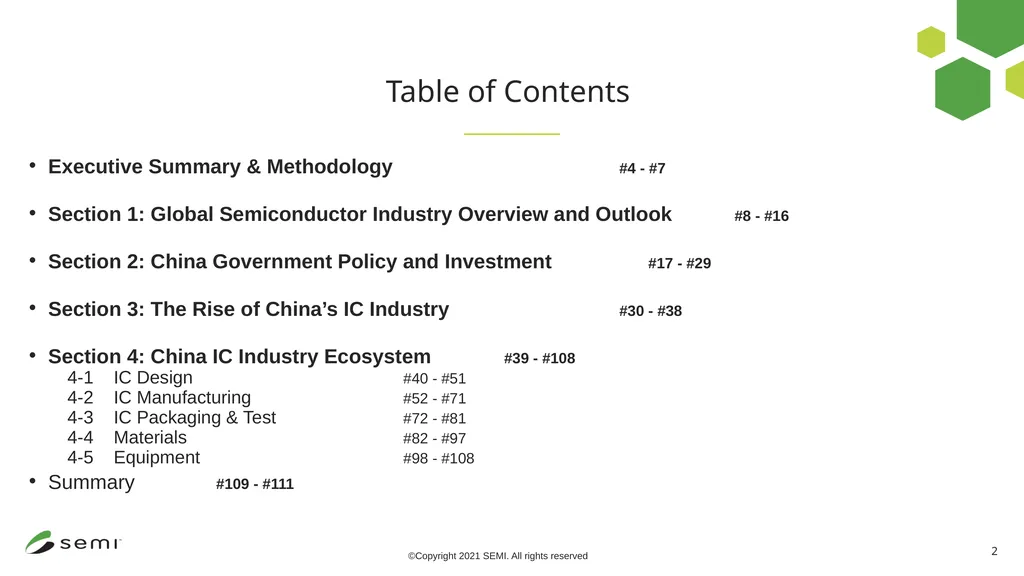
slide2. Table of Contents Executive Summary & Methodology #4 - #7
Section 1: Global Semiconductor Industry Overview and Outlook #8 - #16
Section 2: China Government Policy and Investment #17 - #29
Section 3: The Rise of China’s IC Industry #30 - #38
Section 4: China IC Industry Ecosystem #39 - #108
4-1 IC Design #40 - #51
4-2 IC Manufacturing #52 - #71
4-3 IC Packaging & Test #72 - #81
4-4 Materials #82 - #97
4-5 Equipment #98 - #108
Summary #109 - #111<br>
slide3. Report Coverage and Target Audience This report covers the full spectrum of the IC ecosystem in China as part of the global semiconductor industry. With over 70 charts, data tables, and industry maps, the report highlights China’s IC history, but also covers the latest developments throughout China from coastline cities to less developed mid-western regions.
The following aspects of China’s IC industry ecosystem are discussed in this report:
Central and local government policies
Public and industry chain analysis in relation to trade tensions
Industry value chain from design to manufacturing, equipment and materials suppliers, key players in each industry sector, supply-demand analysis
Competitive intelligence about domestic companies and their international peers
This report provides industry analysts, investors, planners, corporate executives and other professionals deep insights into China’s IC industry and market. For those who are interested in the economic and political implications of the rise of China’s IC industry, this report is an indispensable tool.<br>
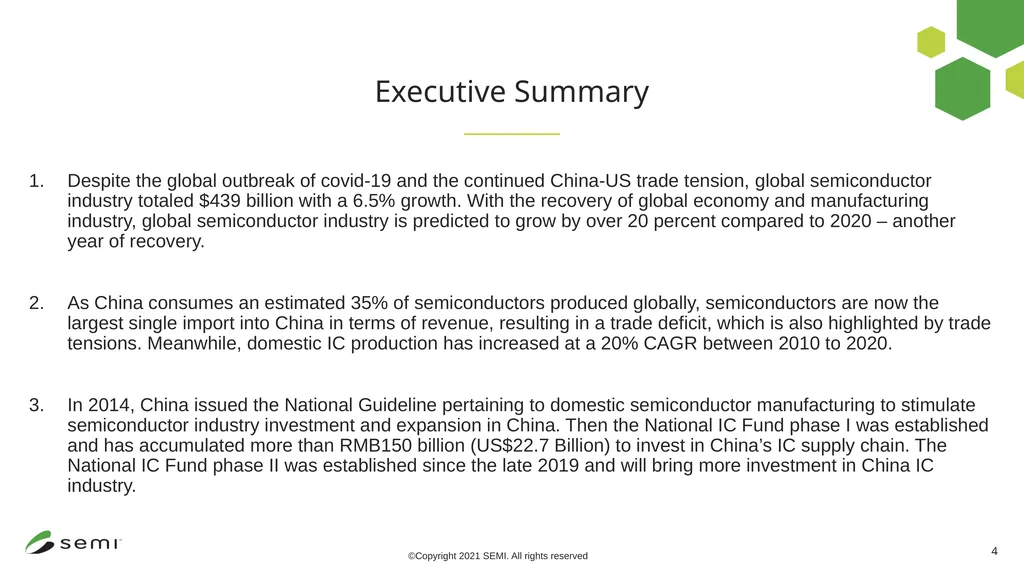
slide4. Executive Summary Despite the global outbreak of covid-19 and the continued China-US trade tension, global semiconductor industry totaled $439 billion with a 6.5% growth. With the recovery of global economy and manufacturing industry, global semiconductor industry is predicted to grow by over 20 percent compared to 2020 – another year of recovery.
As China consumes an estimated 35% of semiconductors produced globally, semiconductors are now the largest single import into China in terms of revenue, resulting in a trade deficit, which is also highlighted by trade tensions. Meanwhile, domestic IC production has increased at a 20% CAGR between 2010 to 2020.
In 2014, China issued the National Guideline pertaining to domestic semiconductor manufacturing to stimulate semiconductor industry investment and expansion in China. Then the National IC Fund phase I was established and has accumulated more than RMB150 billion (US$22.7 Billion) to invest in China’s IC supply chain. The National IC Fund phase II was established since the late 2019 and will bring more investment in China IC industry.<br>
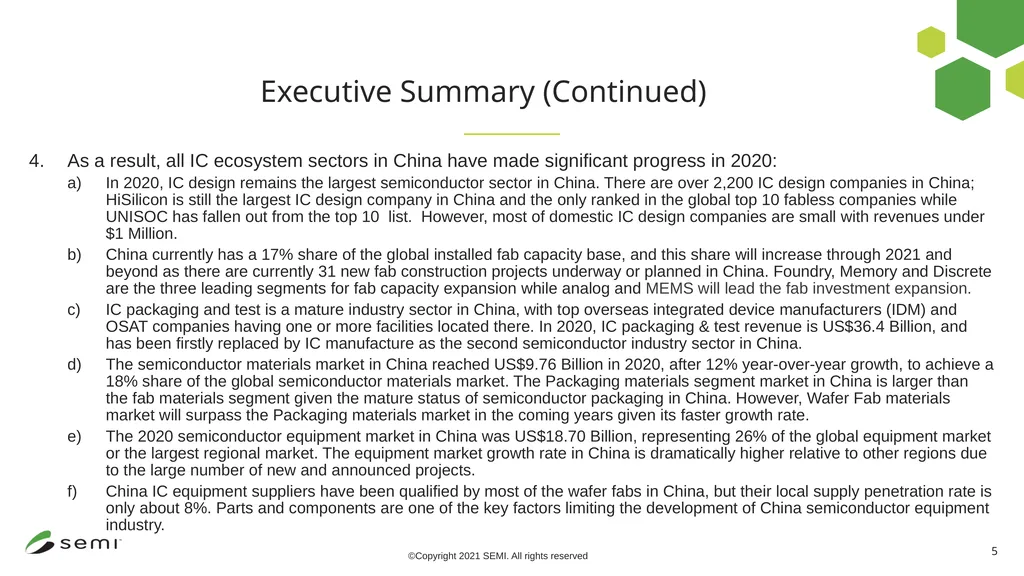
slide5. Executive Summary (Continued) As a result, all IC ecosystem sectors in China have made significant progress in 2020:
In 2020, IC design remains the largest semiconductor sector in China. There are over 2,200 IC design companies in China; HiSilicon is still the largest IC design company in China and the only ranked in the global top 10 fabless companies while UNISOC has fallen out from the top 10 list. However, most of domestic IC design companies are small with revenues under $1 Million.
China currently has a 17% share of the global installed fab capacity base, and this share will increase through 2021 and beyond as there are currently 31 new fab construction projects underway or planned in China. Foundry, Memory and Discrete are the three leading segments for fab capacity expansion while analog and MEMS will lead the fab investment expansion.
IC packaging and test is a mature industry sector in China, with top overseas integrated device manufacturers (IDM) and OSAT companies having one or more facilities located there. In 2020, IC packaging & test revenue is US$36.4 Billion, and has been firstly replaced by IC manufacture as the second semiconductor industry sector in China.
The semiconductor materials market in China reached US$9.76 Billion in 2020, after 12% year-over-year growth, to achieve a 18% share of the global semiconductor materials market. The Packaging materials segment market in China is larger than the fab materials segment given the mature status of semiconductor packaging in China. However, Wafer Fab materials market will surpass the Packaging materials market in the coming years given its faster growth rate.
The 2020 semiconductor equipment market in China was US$18.70 Billion, representing 26% of the global equipment market or the largest regional market. The equipment market growth rate in China is dramatically higher relative to other regions due to the large number of new and announced projects.
China IC equipment suppliers have been qualified by most of the wafer fabs in China, but their local supply penetration rate is only about 8%. Parts and components are one of the key factors limiting the development of China semiconductor equipment industry.<br>
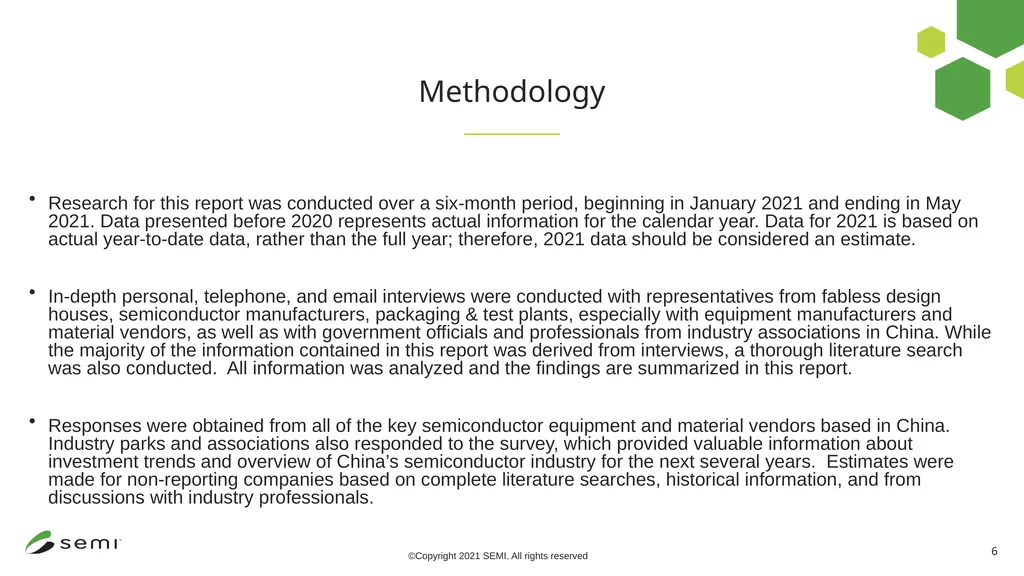
slide6. Methodology Research for this report was conducted over a six-month period, beginning in January 2021 and ending in May 2021. Data presented before 2020 represents actual information for the calendar year. Data for 2021 is based on actual year-to-date data, rather than the full year; therefore, 2021 data should be considered an estimate.
In-depth personal, telephone, and email interviews were conducted with representatives from fabless design houses, semiconductor manufacturers, packaging & test plants, especially with equipment manufacturers and material vendors, as well as with government officials and professionals from industry associations in China. While the majority of the information contained in this report was derived from interviews, a thorough literature search was also conducted. All information was analyzed and the findings are summarized in this report.
Responses were obtained from all of the key semiconductor equipment and material vendors based in China. Industry parks and associations also responded to the survey, which provided valuable information about investment trends and overview of China’s semiconductor industry for the next several years. Estimates were made for non-reporting companies based on complete literature searches, historical information, and from discussions with industry professionals.<br>
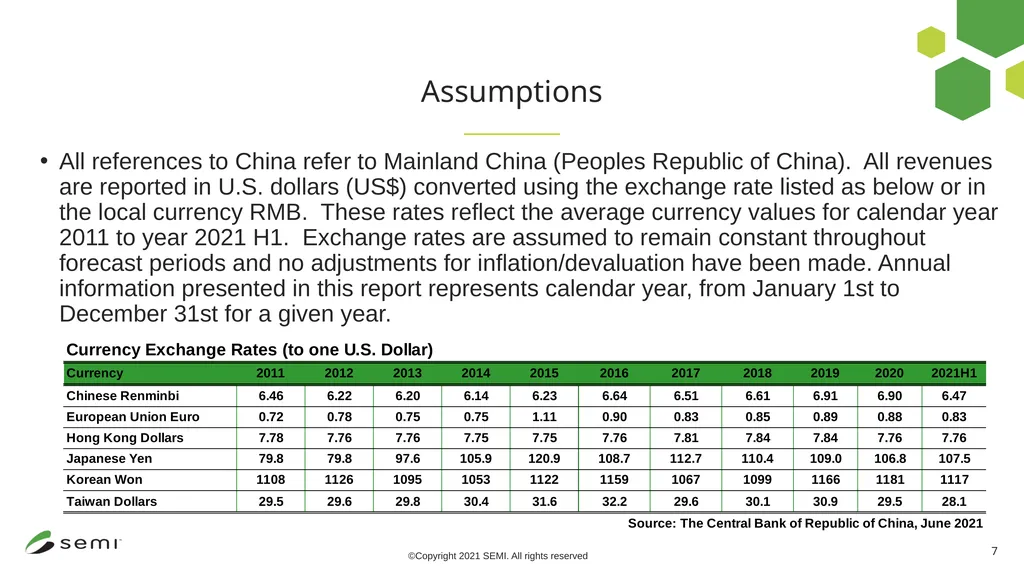
slide7. Assumptions All references to China refer to Mainland China (Peoples Republic of China). All revenues are reported in U.S. dollars (US$) converted using the exchange rate listed as below or in the local currency RMB. These rates reflect the average currency values for calendar year 2011 to year 2021 H1. Exchange rates are assumed to remain constant throughout forecast periods and no adjustments for inflation/devaluation have been made. Annual information presented in this report represents calendar year, from January 1st to December 31st for a given year.<br>
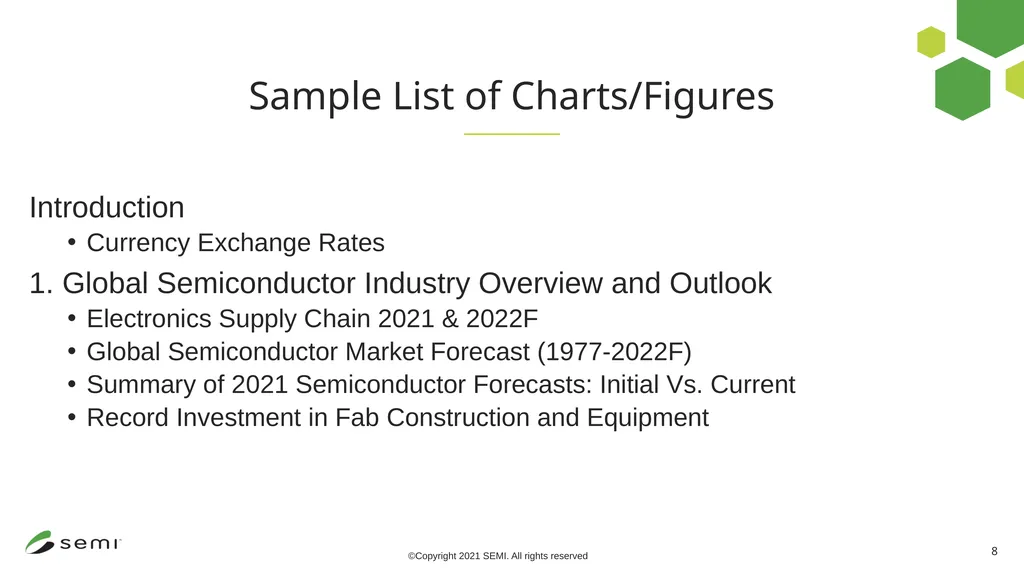
slide8. Sample List of Charts/Figures Introduction
Currency Exchange Rates
1. Global Semiconductor Industry Overview and Outlook
Electronics Supply Chain 2021 & 2022F
Global Semiconductor Market Forecast (1977-2022F)
Summary of 2021 Semiconductor Forecasts: Initial Vs. Current
Record Investment in Fab Construction and Equipment<br>
slide2. Table of Contents Executive Summary & Methodology #4 - #7
Section 1: Global Semiconductor Industry Overview and Outlook #8 - #16
Section 2: China Government Policy and Investment #17 - #29
Section 3: The Rise of China’s IC Industry #30 - #38
Section 4: China IC Industry Ecosystem #39 - #108
4-1 IC Design #40 - #51
4-2 IC Manufacturing #52 - #71
4-3 IC Packaging & Test #72 - #81
4-4 Materials #82 - #97
4-5 Equipment #98 - #108
Summary #109 - #111<br>
slide3. Report Coverage and Target Audience This report covers the full spectrum of the IC ecosystem in China as part of the global semiconductor industry. With over 70 charts, data tables, and industry maps, the report highlights China’s IC history, but also covers the latest developments throughout China from coastline cities to less developed mid-western regions.
The following aspects of China’s IC industry ecosystem are discussed in this report:
Central and local government policies
Public and industry chain analysis in relation to trade tensions
Industry value chain from design to manufacturing, equipment and materials suppliers, key players in each industry sector, supply-demand analysis
Competitive intelligence about domestic companies and their international peers
This report provides industry analysts, investors, planners, corporate executives and other professionals deep insights into China’s IC industry and market. For those who are interested in the economic and political implications of the rise of China’s IC industry, this report is an indispensable tool.<br>
slide4. Executive Summary Despite the global outbreak of covid-19 and the continued China-US trade tension, global semiconductor industry totaled $439 billion with a 6.5% growth. With the recovery of global economy and manufacturing industry, global semiconductor industry is predicted to grow by over 20 percent compared to 2020 – another year of recovery.
As China consumes an estimated 35% of semiconductors produced globally, semiconductors are now the largest single import into China in terms of revenue, resulting in a trade deficit, which is also highlighted by trade tensions. Meanwhile, domestic IC production has increased at a 20% CAGR between 2010 to 2020.
In 2014, China issued the National Guideline pertaining to domestic semiconductor manufacturing to stimulate semiconductor industry investment and expansion in China. Then the National IC Fund phase I was established and has accumulated more than RMB150 billion (US$22.7 Billion) to invest in China’s IC supply chain. The National IC Fund phase II was established since the late 2019 and will bring more investment in China IC industry.<br>
slide5. Executive Summary (Continued) As a result, all IC ecosystem sectors in China have made significant progress in 2020:
In 2020, IC design remains the largest semiconductor sector in China. There are over 2,200 IC design companies in China; HiSilicon is still the largest IC design company in China and the only ranked in the global top 10 fabless companies while UNISOC has fallen out from the top 10 list. However, most of domestic IC design companies are small with revenues under $1 Million.
China currently has a 17% share of the global installed fab capacity base, and this share will increase through 2021 and beyond as there are currently 31 new fab construction projects underway or planned in China. Foundry, Memory and Discrete are the three leading segments for fab capacity expansion while analog and MEMS will lead the fab investment expansion.
IC packaging and test is a mature industry sector in China, with top overseas integrated device manufacturers (IDM) and OSAT companies having one or more facilities located there. In 2020, IC packaging & test revenue is US$36.4 Billion, and has been firstly replaced by IC manufacture as the second semiconductor industry sector in China.
The semiconductor materials market in China reached US$9.76 Billion in 2020, after 12% year-over-year growth, to achieve a 18% share of the global semiconductor materials market. The Packaging materials segment market in China is larger than the fab materials segment given the mature status of semiconductor packaging in China. However, Wafer Fab materials market will surpass the Packaging materials market in the coming years given its faster growth rate.
The 2020 semiconductor equipment market in China was US$18.70 Billion, representing 26% of the global equipment market or the largest regional market. The equipment market growth rate in China is dramatically higher relative to other regions due to the large number of new and announced projects.
China IC equipment suppliers have been qualified by most of the wafer fabs in China, but their local supply penetration rate is only about 8%. Parts and components are one of the key factors limiting the development of China semiconductor equipment industry.<br>
slide6. Methodology Research for this report was conducted over a six-month period, beginning in January 2021 and ending in May 2021. Data presented before 2020 represents actual information for the calendar year. Data for 2021 is based on actual year-to-date data, rather than the full year; therefore, 2021 data should be considered an estimate.
In-depth personal, telephone, and email interviews were conducted with representatives from fabless design houses, semiconductor manufacturers, packaging & test plants, especially with equipment manufacturers and material vendors, as well as with government officials and professionals from industry associations in China. While the majority of the information contained in this report was derived from interviews, a thorough literature search was also conducted. All information was analyzed and the findings are summarized in this report.
Responses were obtained from all of the key semiconductor equipment and material vendors based in China. Industry parks and associations also responded to the survey, which provided valuable information about investment trends and overview of China’s semiconductor industry for the next several years. Estimates were made for non-reporting companies based on complete literature searches, historical information, and from discussions with industry professionals.<br>
slide7. Assumptions All references to China refer to Mainland China (Peoples Republic of China). All revenues are reported in U.S. dollars (US$) converted using the exchange rate listed as below or in the local currency RMB. These rates reflect the average currency values for calendar year 2011 to year 2021 H1. Exchange rates are assumed to remain constant throughout forecast periods and no adjustments for inflation/devaluation have been made. Annual information presented in this report represents calendar year, from January 1st to December 31st for a given year.<br>
slide8. Sample List of Charts/Figures Introduction
Currency Exchange Rates
1. Global Semiconductor Industry Overview and Outlook
Electronics Supply Chain 2021 & 2022F
Global Semiconductor Market Forecast (1977-2022F)
Summary of 2021 Semiconductor Forecasts: Initial Vs. Current
Record Investment in Fab Construction and Equipment<br>