
CHM-SEC-151 (BSc. Second Semester) Class Notes on
CB
Published · 24 slides · 0 views
1 / 1
Description
CHM-SEC-151 (BSc. Second Semester) Class Notes on Analysis of Water Prepared By Dr. Ponchami Sharma Assistant Professor Department of Chemistry Haflong Government College ANALYSIS OF WATER Introduction Water is a fundamental resource
Related Topics
Share
Embed code
Download this presentation From Below
"CHM-SEC-151 (BSc. Second Semester) Class Notes on" is the property of its rightful owner. Permission is granted to download and print the materials on this website for personal, non-commercial use only, and to display it on your personal computer provided you do not modify the materials and that you retain all copyright notices contained in the materials. By downloading content from our website, you accept the terms of this agreement.
Presentation Transcript
01
CHM-SEC-151
(BSc. Second Semester) Class Notes on
Analysis of Water Prepared By
Dr. Ponchami Sharma
Assistant Professor
Department of Chemistry
Haflong Government College<br>
(BSc. Second Semester) Class Notes on
Analysis of Water Prepared By
Dr. Ponchami Sharma
Assistant Professor
Department of Chemistry
Haflong Government College<br>
02
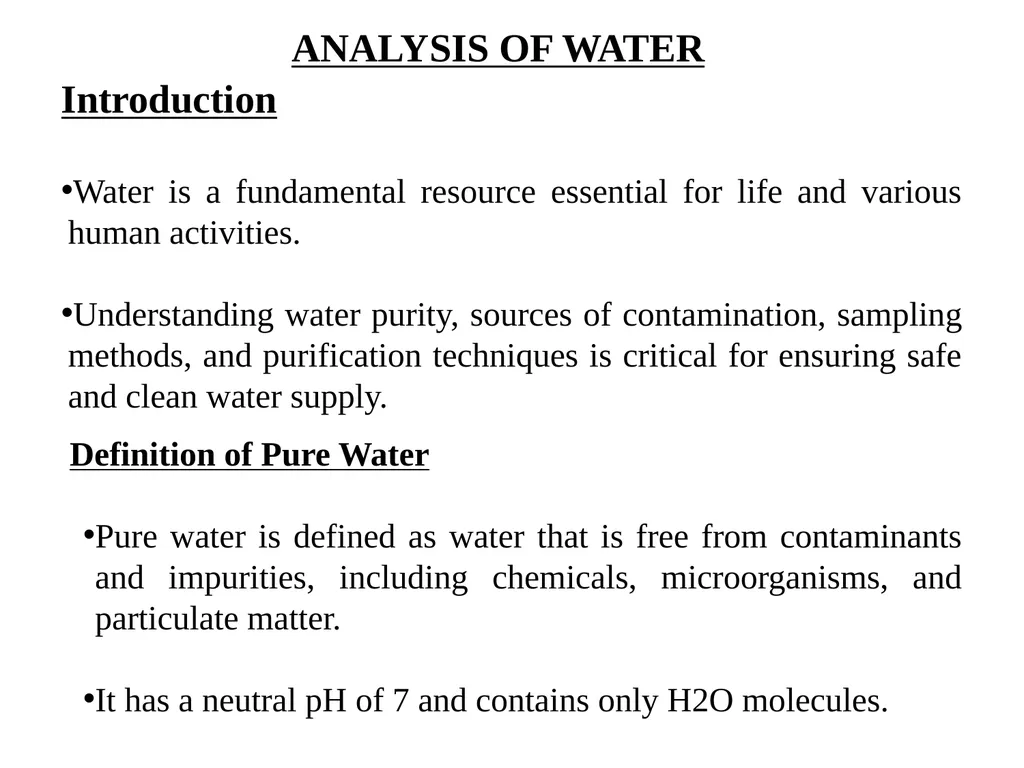
ANALYSIS OF WATER Introduction
Water is a fundamental resource essential for life and various human activities.
Understanding water purity, sources of contamination, sampling methods, and purification techniques is critical for ensuring safe and clean water supply. Definition of Pure Water
Pure water is defined as water that is free from contaminants and impurities, including chemicals, microorganisms, and particulate matter.
It has a neutral pH of 7 and contains only H2O molecules.<br>
Water is a fundamental resource essential for life and various human activities.
Understanding water purity, sources of contamination, sampling methods, and purification techniques is critical for ensuring safe and clean water supply. Definition of Pure Water
Pure water is defined as water that is free from contaminants and impurities, including chemicals, microorganisms, and particulate matter.
It has a neutral pH of 7 and contains only H2O molecules.<br>
03
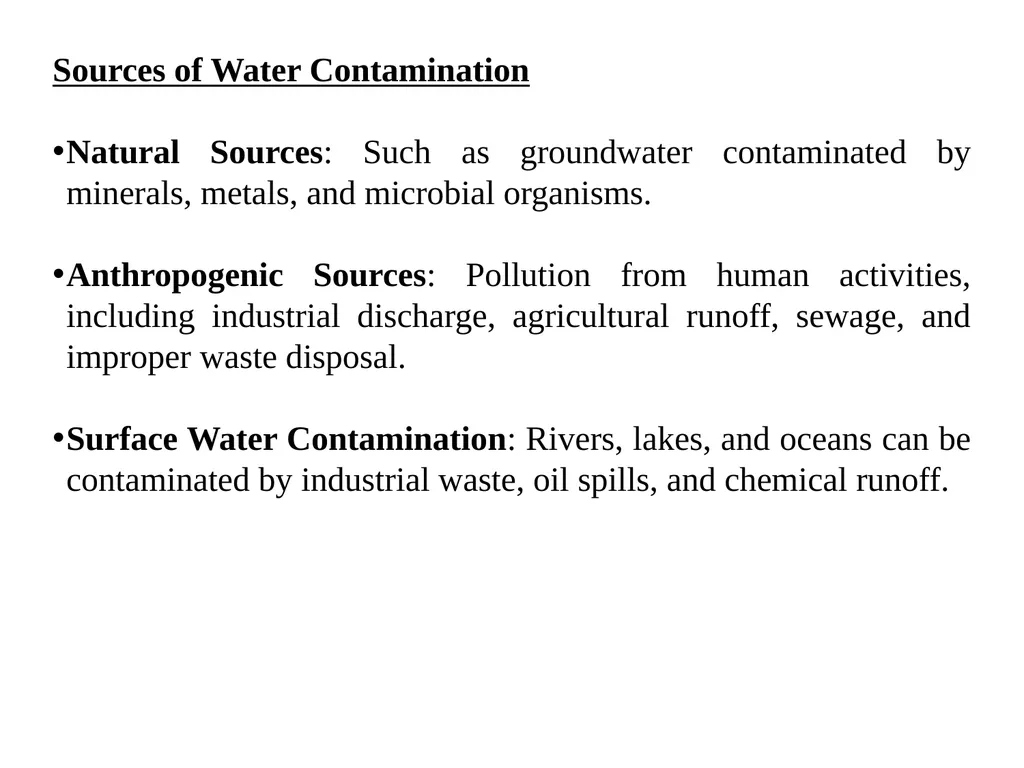
Sources of Water Contamination
Natural Sources: Such as groundwater contaminated by minerals, metals, and microbial organisms.
Anthropogenic Sources: Pollution from human activities, including industrial discharge, agricultural runoff, sewage, and improper waste disposal.
Surface Water Contamination: Rivers, lakes, and oceans can be contaminated by industrial waste, oil spills, and chemical runoff.<br>
Natural Sources: Such as groundwater contaminated by minerals, metals, and microbial organisms.
Anthropogenic Sources: Pollution from human activities, including industrial discharge, agricultural runoff, sewage, and improper waste disposal.
Surface Water Contamination: Rivers, lakes, and oceans can be contaminated by industrial waste, oil spills, and chemical runoff.<br>
04
Common Contaminants in Water
Microorganisms: Bacteria, viruses, and protozoa can cause waterborne diseases like cholera, typhoid, and dysentery.
Chemical Contaminants: Including heavy metals (lead, arsenic), pesticides, industrial chemicals, and pharmaceutical residues.
Physical Contaminants: Sediments, suspended solids, and debris can affect water clarity and quality.<br>
Microorganisms: Bacteria, viruses, and protozoa can cause waterborne diseases like cholera, typhoid, and dysentery.
Chemical Contaminants: Including heavy metals (lead, arsenic), pesticides, industrial chemicals, and pharmaceutical residues.
Physical Contaminants: Sediments, suspended solids, and debris can affect water clarity and quality.<br>
05
Grab Sampling
Definition: Collecting water samples at a specific time and location.
Procedure:
Select sampling site and time.
Lower sample container into water, avoiding sediment disturbance.
Collect sample, ensuring proper sealing and labeling.
Applications: Suitable for assessing short-term variations in water quality. Sampling of Water<br>
Definition: Collecting water samples at a specific time and location.
Procedure:
Select sampling site and time.
Lower sample container into water, avoiding sediment disturbance.
Collect sample, ensuring proper sealing and labeling.
Applications: Suitable for assessing short-term variations in water quality. Sampling of Water<br>
06
Composite Sampling
Definition: Combining multiple grab samples collected over a period.
Procedure:
Collect grab samples at regular intervals (e.g., hourly, daily).
Mix samples thoroughly to create a composite sample.
Analyze composite sample to obtain an average representation of water quality.
Applications: Useful for long-term monitoring and assessing overall water quality trends.<br>
Definition: Combining multiple grab samples collected over a period.
Procedure:
Collect grab samples at regular intervals (e.g., hourly, daily).
Mix samples thoroughly to create a composite sample.
Analyze composite sample to obtain an average representation of water quality.
Applications: Useful for long-term monitoring and assessing overall water quality trends.<br>
07
Automatic Sampling
Definition: Using automated samplers to collect water samples at predetermined intervals.
Procedure:
Set sampling intervals and duration on the automated sampler.
Deploy sampler in the water body.
Sampler collects water samples at specified intervals without human intervention.
Applications: Ideal for continuous monitoring of water quality over extended periods.<br>
Definition: Using automated samplers to collect water samples at predetermined intervals.
Procedure:
Set sampling intervals and duration on the automated sampler.
Deploy sampler in the water body.
Sampler collects water samples at specified intervals without human intervention.
Applications: Ideal for continuous monitoring of water quality over extended periods.<br>
08
Depth Integrated Sampling
Definition: Collecting water samples from different depths to assess vertical variations in water quality.
Procedure:
Lower sampling device or sampler to desired depth intervals.
Collect samples at each depth.
Analyze samples to understand vertical distribution of contaminants.
Applications: Important for studying stratification in lakes, reservoirs, and oceans.<br>
Definition: Collecting water samples from different depths to assess vertical variations in water quality.
Procedure:
Lower sampling device or sampler to desired depth intervals.
Collect samples at each depth.
Analyze samples to understand vertical distribution of contaminants.
Applications: Important for studying stratification in lakes, reservoirs, and oceans.<br>
09
Purposive Sampling
Definition: Selecting sampling sites based on specific criteria or objectives.
Procedure:
Identify sampling objectives (e.g., pollution sources, water use).
Select sampling sites accordingly, ensuring representative coverage.
Collect samples based on predetermined criteria.
Applications: Useful for targeted assessment of pollution sources or sensitive ecosystems.<br>
Definition: Selecting sampling sites based on specific criteria or objectives.
Procedure:
Identify sampling objectives (e.g., pollution sources, water use).
Select sampling sites accordingly, ensuring representative coverage.
Collect samples based on predetermined criteria.
Applications: Useful for targeted assessment of pollution sources or sensitive ecosystems.<br>
10
In-situ Measurement
Definition: Conducting on-site measurements of water quality parameters without collecting water samples.
Procedure:
Use portable instruments to measure parameters such as pH, temperature, dissolved oxygen, and conductivity directly in the water.
Record measurements at each sampling location.
Applications: Provides real-time data on water quality conditions, supplementing traditional sampling methods.<br>
Definition: Conducting on-site measurements of water quality parameters without collecting water samples.
Procedure:
Use portable instruments to measure parameters such as pH, temperature, dissolved oxygen, and conductivity directly in the water.
Record measurements at each sampling location.
Applications: Provides real-time data on water quality conditions, supplementing traditional sampling methods.<br>
11
By Boiling
Introduction
Boiling water is one of the oldest and simplest methods for purifying water.
It is highly effective in killing various harmful microorganisms present in water.
Process of Boiling
Water is heated to its boiling point, typically 100°C (212°F) at sea level.
Sustained boiling for a minimum of one minute is recommended to ensure proper purification.
Mechanism of Action
Boiling destroys pathogenic bacteria, viruses, and parasites present in water.
Heat disrupts the structure of microbial proteins and enzymes, rendering them inactive. Purification of Water<br>
Introduction
Boiling water is one of the oldest and simplest methods for purifying water.
It is highly effective in killing various harmful microorganisms present in water.
Process of Boiling
Water is heated to its boiling point, typically 100°C (212°F) at sea level.
Sustained boiling for a minimum of one minute is recommended to ensure proper purification.
Mechanism of Action
Boiling destroys pathogenic bacteria, viruses, and parasites present in water.
Heat disrupts the structure of microbial proteins and enzymes, rendering them inactive. Purification of Water<br>
12
Advantages
Cost-effective: Requires minimal equipment and resources.
Easily accessible: Can be performed using common household stoves or campfires.
Kills a broad spectrum of microorganisms, making water safe for consumption.
Limitations
Does not remove chemical contaminants or dissolved solids.
Energy-intensive, especially for large-scale purification.
Time-consuming compared to other methods such as filtration or chemical treatment.<br>
Cost-effective: Requires minimal equipment and resources.
Easily accessible: Can be performed using common household stoves or campfires.
Kills a broad spectrum of microorganisms, making water safe for consumption.
Limitations
Does not remove chemical contaminants or dissolved solids.
Energy-intensive, especially for large-scale purification.
Time-consuming compared to other methods such as filtration or chemical treatment.<br>
13
By Filtration
Introduction
Water purification is the process of removing contaminants from water to produce clean and safe drinking water.
Filtration Process
Filtration is a key step in water purification where water passes through a medium that traps impurities.
Types of Filtration:
Gravity Filtration:
Relies on gravity to pull water through a filtration medium such as sand or gravel.
Commonly used in household water filters and municipal water treatment plants.<br>
Introduction
Water purification is the process of removing contaminants from water to produce clean and safe drinking water.
Filtration Process
Filtration is a key step in water purification where water passes through a medium that traps impurities.
Types of Filtration:
Gravity Filtration:
Relies on gravity to pull water through a filtration medium such as sand or gravel.
Commonly used in household water filters and municipal water treatment plants.<br>
14
Pressure Filtration:
Water is forced through a filtration medium under pressure, increasing the filtration rate.
Often used in industrial applications and advanced water treatment systems.
Activated Carbon Filtration:
Utilizes activated carbon to adsorb impurities such as organic compounds, chlorine, and odors.
Effective in removing taste and odor from water.
Membrane Filtration:
Involves passing water through a semipermeable membrane that blocks contaminants based on size.
Includes microfiltration, ultrafiltration, and reverse osmosis.<br>
Water is forced through a filtration medium under pressure, increasing the filtration rate.
Often used in industrial applications and advanced water treatment systems.
Activated Carbon Filtration:
Utilizes activated carbon to adsorb impurities such as organic compounds, chlorine, and odors.
Effective in removing taste and odor from water.
Membrane Filtration:
Involves passing water through a semipermeable membrane that blocks contaminants based on size.
Includes microfiltration, ultrafiltration, and reverse osmosis.<br>
15
Advantages of Filtration:
Removes a wide range of contaminants including sediments, microorganisms, chemicals, and heavy metals.
Cost-effective and energy-efficient compared to other purification methods.
Suitable for both large-scale water treatment plants and small-scale household systems.
Challenges:
Proper maintenance is crucial to ensure optimal performance and prevent clogging of filtration media.
Some contaminants may require additional treatment beyond filtration alone.
Initial investment costs for advanced filtration systems can be high.
Applications:
Municipal water treatment plants
Residential water filtration systems
Industrial processes such as food and beverage production, pharmaceuticals, and electronics manufacturing.<br>
Removes a wide range of contaminants including sediments, microorganisms, chemicals, and heavy metals.
Cost-effective and energy-efficient compared to other purification methods.
Suitable for both large-scale water treatment plants and small-scale household systems.
Challenges:
Proper maintenance is crucial to ensure optimal performance and prevent clogging of filtration media.
Some contaminants may require additional treatment beyond filtration alone.
Initial investment costs for advanced filtration systems can be high.
Applications:
Municipal water treatment plants
Residential water filtration systems
Industrial processes such as food and beverage production, pharmaceuticals, and electronics manufacturing.<br>
16
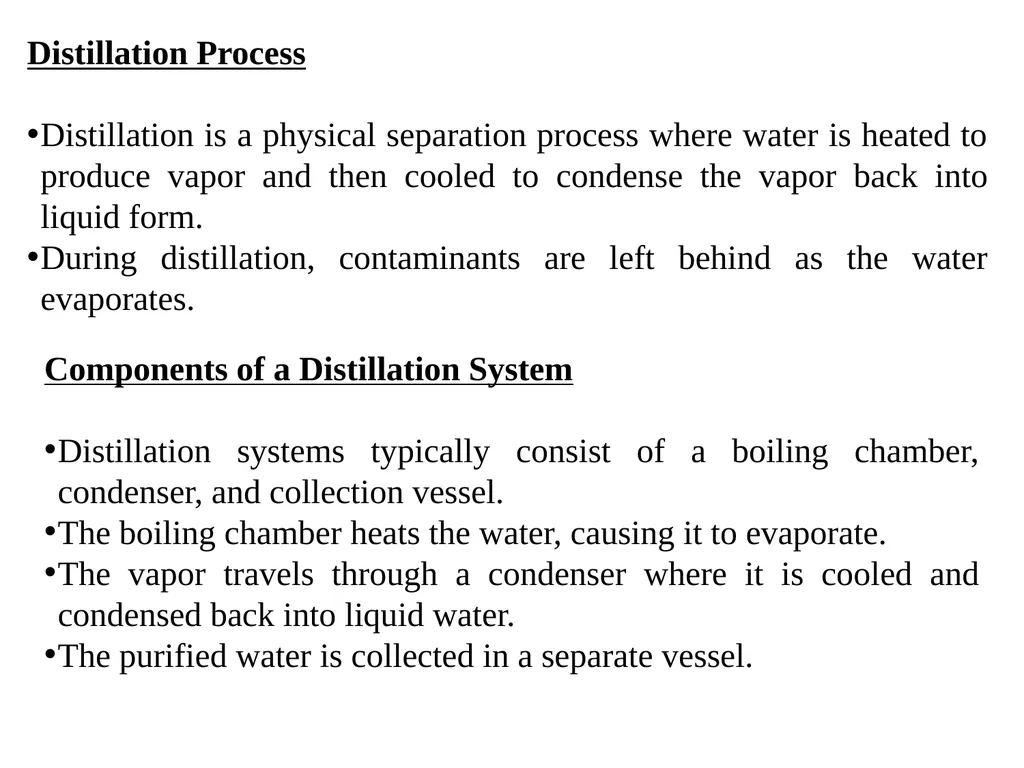
Distillation Process
Distillation is a physical separation process where water is heated to produce vapor and then cooled to condense the vapor back into liquid form.
During distillation, contaminants are left behind as the water evaporates. Components of a Distillation System
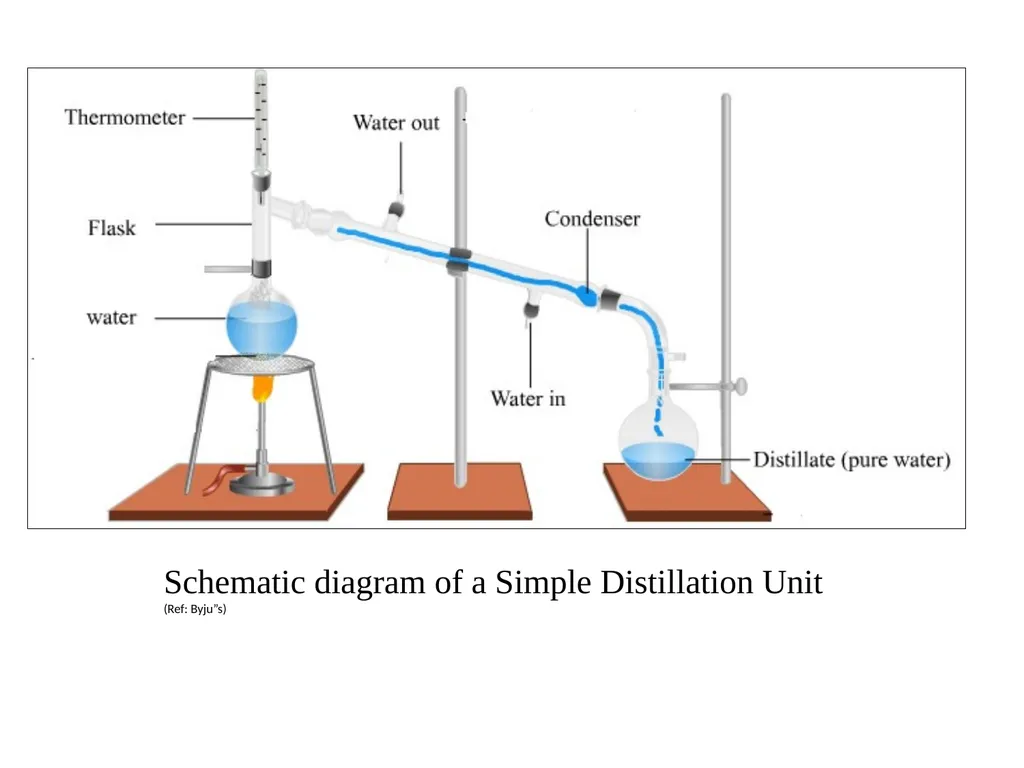
Distillation systems typically consist of a boiling chamber, condenser, and collection vessel.
The boiling chamber heats the water, causing it to evaporate.
The vapor travels through a condenser where it is cooled and condensed back into liquid water.
The purified water is collected in a separate vessel.<br>
Distillation is a physical separation process where water is heated to produce vapor and then cooled to condense the vapor back into liquid form.
During distillation, contaminants are left behind as the water evaporates. Components of a Distillation System
Distillation systems typically consist of a boiling chamber, condenser, and collection vessel.
The boiling chamber heats the water, causing it to evaporate.
The vapor travels through a condenser where it is cooled and condensed back into liquid water.
The purified water is collected in a separate vessel.<br>
17
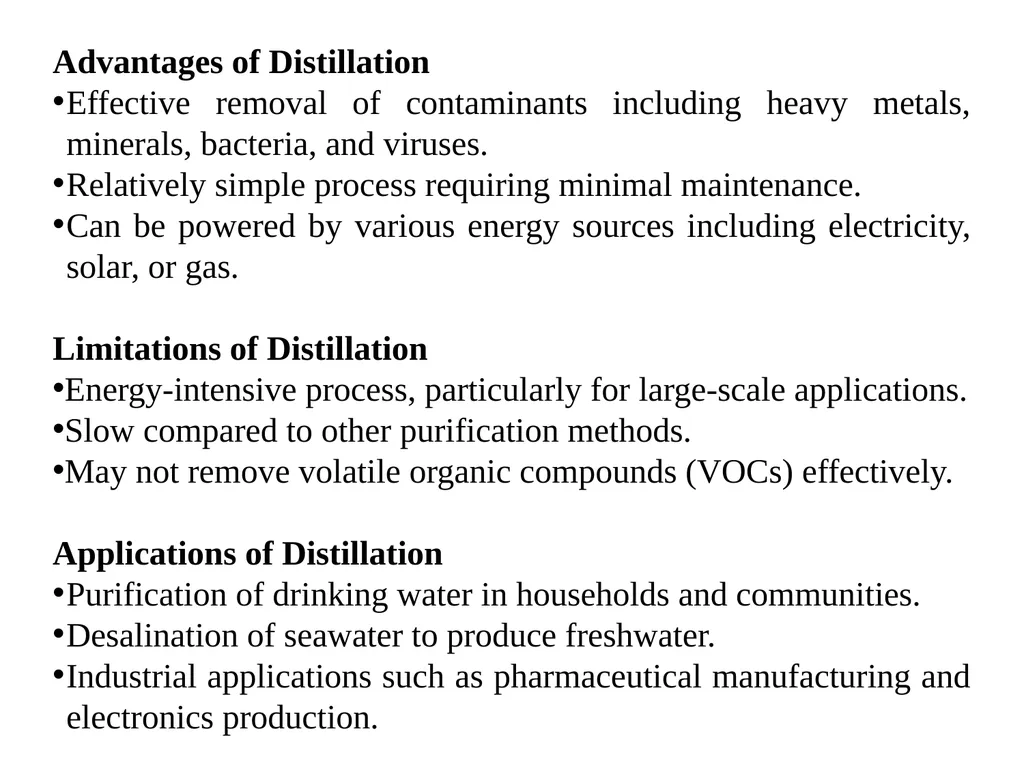
Advantages of Distillation
Effective removal of contaminants including heavy metals, minerals, bacteria, and viruses.
Relatively simple process requiring minimal maintenance.
Can be powered by various energy sources including electricity, solar, or gas.
Limitations of Distillation
Energy-intensive process, particularly for large-scale applications.
Slow compared to other purification methods.
May not remove volatile organic compounds (VOCs) effectively.
Applications of Distillation
Purification of drinking water in households and communities.
Desalination of seawater to produce freshwater.
Industrial applications such as pharmaceutical manufacturing and electronics production.<br>
Effective removal of contaminants including heavy metals, minerals, bacteria, and viruses.
Relatively simple process requiring minimal maintenance.
Can be powered by various energy sources including electricity, solar, or gas.
Limitations of Distillation
Energy-intensive process, particularly for large-scale applications.
Slow compared to other purification methods.
May not remove volatile organic compounds (VOCs) effectively.
Applications of Distillation
Purification of drinking water in households and communities.
Desalination of seawater to produce freshwater.
Industrial applications such as pharmaceutical manufacturing and electronics production.<br>
18
Schematic diagram of a Simple Distillation Unit
(Ref: Byju”s)<br>
(Ref: Byju”s)<br>
19
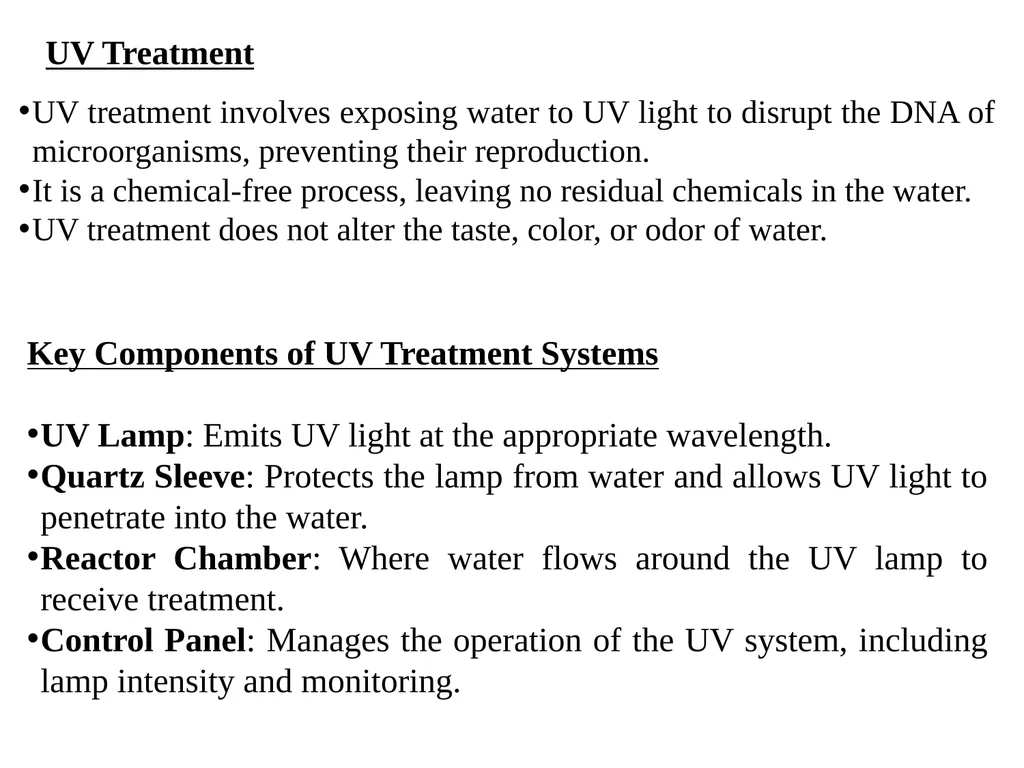
UV Treatment UV treatment involves exposing water to UV light to disrupt the DNA of microorganisms, preventing their reproduction.
It is a chemical-free process, leaving no residual chemicals in the water.
UV treatment does not alter the taste, color, or odor of water. Key Components of UV Treatment Systems
UV Lamp: Emits UV light at the appropriate wavelength.
Quartz Sleeve: Protects the lamp from water and allows UV light to penetrate into the water.
Reactor Chamber: Where water flows around the UV lamp to receive treatment.
Control Panel: Manages the operation of the UV system, including lamp intensity and monitoring.<br>
It is a chemical-free process, leaving no residual chemicals in the water.
UV treatment does not alter the taste, color, or odor of water. Key Components of UV Treatment Systems
UV Lamp: Emits UV light at the appropriate wavelength.
Quartz Sleeve: Protects the lamp from water and allows UV light to penetrate into the water.
Reactor Chamber: Where water flows around the UV lamp to receive treatment.
Control Panel: Manages the operation of the UV system, including lamp intensity and monitoring.<br>
20
Advantages of UV Treatment
Effective against a wide range of microorganisms, including bacteria, viruses, and protozoa.
No harmful byproducts are generated during the purification process.
Requires minimal maintenance compared to other methods like chlorination.
Environmentally friendly and energy-efficient. Limitations of UV Treatment
Does not remove non-biological contaminants such as heavy metals, chemicals, or sediment.
Effectiveness can be reduced if water is turbid or contains particles that block UV light penetration.
Dependence on electricity for operation.<br>
Effective against a wide range of microorganisms, including bacteria, viruses, and protozoa.
No harmful byproducts are generated during the purification process.
Requires minimal maintenance compared to other methods like chlorination.
Environmentally friendly and energy-efficient. Limitations of UV Treatment
Does not remove non-biological contaminants such as heavy metals, chemicals, or sediment.
Effectiveness can be reduced if water is turbid or contains particles that block UV light penetration.
Dependence on electricity for operation.<br>
21
Applications of UV Treatment
Drinking Water Treatment: Municipal water treatment plants, residential filtration systems, and portable water purification devices.
Wastewater Treatment: Disinfection of treated wastewater before discharge into the environment.
Industrial Applications: Used in various industries for process water, pharmaceuticals, and food and beverage production.<br>
Drinking Water Treatment: Municipal water treatment plants, residential filtration systems, and portable water purification devices.
Wastewater Treatment: Disinfection of treated wastewater before discharge into the environment.
Industrial Applications: Used in various industries for process water, pharmaceuticals, and food and beverage production.<br>
22
Reverse Osmosis:
Definition: Reverse osmosis is a process that utilizes a semi-permeable membrane to remove ions, molecules, and larger particles from water.
Principle: It works on the principle of applying pressure to overcome osmotic pressure, forcing water through the membrane while leaving contaminants behind. Components of Reverse Osmosis System:
Pre-filtration: Removes larger particles and sediments to prevent clogging and prolong membrane life.
Reverse Osmosis Membrane: Semi-permeable membrane that separates pure water from impurities.
Pressure Pump: Applies pressure to push water through the membrane.
Post-filtration: Additional filtration to enhance water quality and taste.<br>
Definition: Reverse osmosis is a process that utilizes a semi-permeable membrane to remove ions, molecules, and larger particles from water.
Principle: It works on the principle of applying pressure to overcome osmotic pressure, forcing water through the membrane while leaving contaminants behind. Components of Reverse Osmosis System:
Pre-filtration: Removes larger particles and sediments to prevent clogging and prolong membrane life.
Reverse Osmosis Membrane: Semi-permeable membrane that separates pure water from impurities.
Pressure Pump: Applies pressure to push water through the membrane.
Post-filtration: Additional filtration to enhance water quality and taste.<br>
23
Process of Reverse Osmosis:
Inlet water enters the system and goes through pre-filtration to remove sediments.
Pressurized water is forced through the RO membrane, where contaminants are left behind.
Purified water is collected while impurities are flushed away.
Post-filtration may occur to further enhance water quality before distribution. Advantages of Reverse Osmosis:
High Efficiency: Removes up to 99% of contaminants including bacteria, viruses, heavy metals, and dissolved solids.
Versatility: Suitable for various applications including residential, commercial, and industrial water purification.
Environmentally Friendly: Reduces the need for bottled water, minimizing plastic waste.<br>
Inlet water enters the system and goes through pre-filtration to remove sediments.
Pressurized water is forced through the RO membrane, where contaminants are left behind.
Purified water is collected while impurities are flushed away.
Post-filtration may occur to further enhance water quality before distribution. Advantages of Reverse Osmosis:
High Efficiency: Removes up to 99% of contaminants including bacteria, viruses, heavy metals, and dissolved solids.
Versatility: Suitable for various applications including residential, commercial, and industrial water purification.
Environmentally Friendly: Reduces the need for bottled water, minimizing plastic waste.<br>
24
Applications of Reverse Osmosis:
Residential: Provides households with clean drinking water, improving health and well-being.
Commercial: Used in restaurants, hotels, and offices for cooking, drinking, and beverage preparation.
Industrial: Essential for manufacturing processes, pharmaceutical production, and semiconductor manufacturing.
Desalination: Plays a crucial role in converting seawater into freshwater for drinking and irrigation.<br>
Residential: Provides households with clean drinking water, improving health and well-being.
Commercial: Used in restaurants, hotels, and offices for cooking, drinking, and beverage preparation.
Industrial: Essential for manufacturing processes, pharmaceutical production, and semiconductor manufacturing.
Desalination: Plays a crucial role in converting seawater into freshwater for drinking and irrigation.<br>