
Chris Barrett STARS program training October 26,
AM
Published · 22 slides · 0 views
1 / 1
Description
Chris Barrett STARS program training October 26, 2026 Navigating Peer Review Why is peer reviewed publication important? Credentialing Employers, grantsmakers, others check pub records. Quality control Especially if you want non-specialists
Related Topics
Share
Embed code
Download this presentation From Below
"Chris Barrett STARS program training October 26," is the property of its rightful owner. Permission is granted to download and print the materials on this website for personal, non-commercial use only, and to display it on your personal computer provided you do not modify the materials and that you retain all copyright notices contained in the materials. By downloading content from our website, you accept the terms of this agreement.
Presentation Transcript
01
Chris Barrett
STARS program training
October 26, 2026 Navigating Peer Review<br>
02
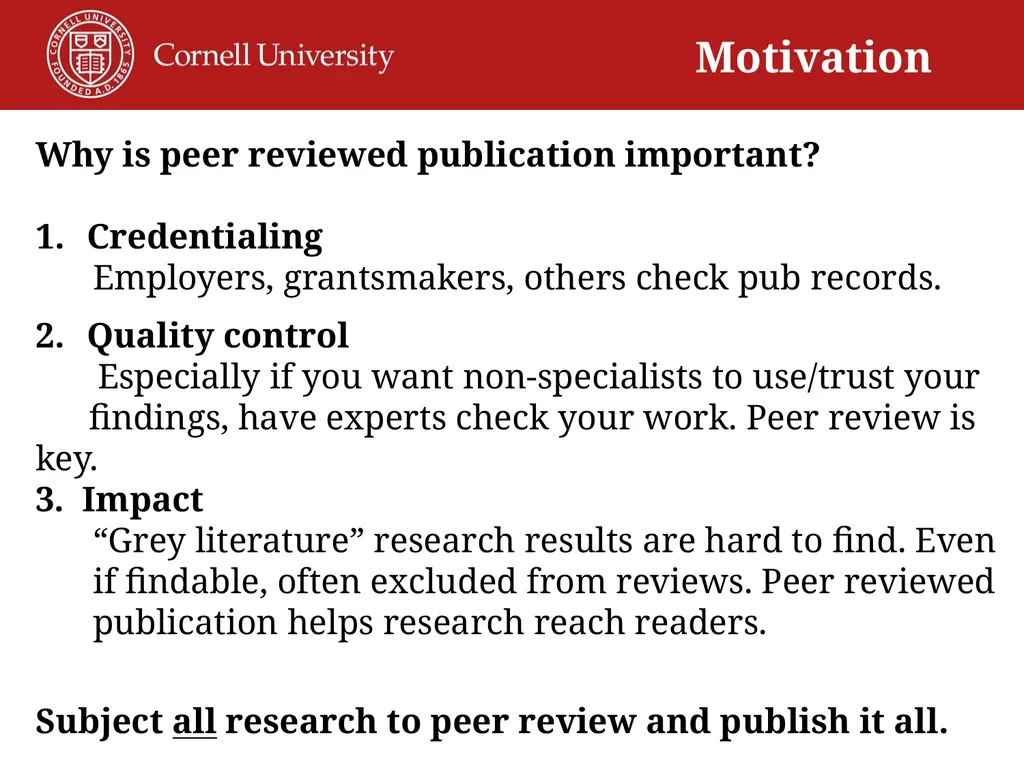
Why is peer reviewed publication important?
Credentialing
Employers, grantsmakers, others check pub records.
Quality control
Especially if you want non-specialists to use/trust your
findings, have experts check your work. Peer review is key.
3. Impact
“Grey literature” research results are hard to find. Even if findable, often excluded from reviews. Peer reviewed publication helps research reach readers.
Subject all research to peer review and publish it all. Motivation<br>
03
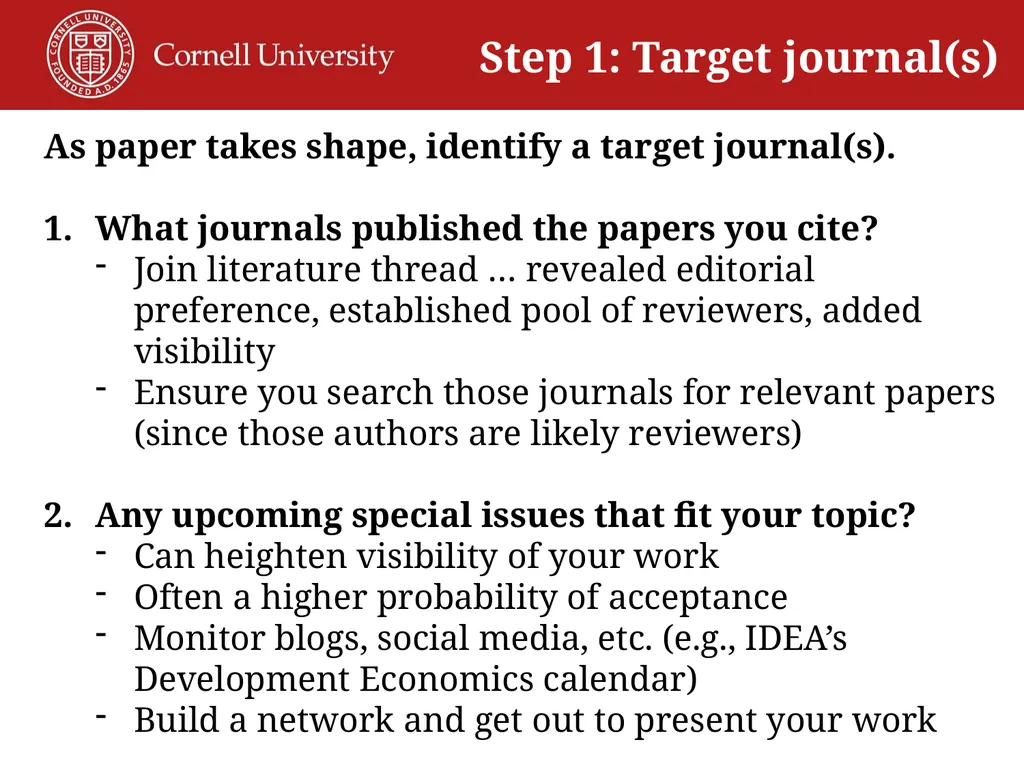
Step 1: Target journal(s) As paper takes shape, identify a target journal(s).
What journals published the papers you cite?
Join literature thread … revealed editorial preference, established pool of reviewers, added visibility
Ensure you search those journals for relevant papers (since those authors are likely reviewers)
Any upcoming special issues that fit your topic?
Can heighten visibility of your work
Often a higher probability of acceptance
Monitor blogs, social media, etc. (e.g., IDEA’s Development Economics calendar)
Build a network and get out to present your work<br>
04
Step 1: Target journal(s) 3. What is the right journal level to pitch?
What readership should be interested? Discipline, multi-disciplinary, or sub-discipline audience?
How original is the work?
How rigorous and important are the findings?
4. When to submit to a ‘reach’ journal?
- You have generalizable findings (theory, methods, or
empirics of quite general interest + compelling evidence).
Journal has a new editor with an interest in the area.
You can afford the time for an extra expected rejection.<br>
05
Step 1: Target journal(s) 5. Are you willing to review regularly for the journal?
- Past and prospective authors are the natural reviewer pool. Authors enter an implicit social contract by submitting.
6. Are you obliged (or want) to publish open access?
- Check cost to ensure you can afford it or check with grants agency if they will support it directly (e.g., BMGF does).
7. Know terms of submission: are they ok for you?
Is there a submission or publication fee?
Is there an obligation to submit data and/or code for reproducibility purposes?
If cannot fully comply (e.g., using restricted access data), report that in cover letter at time of submission.<br>
06
Step 2: Submission Your masterpiece is ready!
1. When to submit?
Usually take time to present at conferences, especially at longer seminars where people can poke holes in it.
Send to friends/authors in the space for feedback (short email w/ title/abstract and link/attachment). Do not expect replies. Be sure to reciprocate for those who help!
Get feedback from AI (Refine.ink especially good)
Revise based on the feedback. Once you are getting no substantive new comments not yet addressed, submit.
Exception: when others are working on same topic and you are in a race to publish, submit earlier.<br>
07
Step 2: Submission 2. Check for plagiarism and reproducibility
Most journals use online plagiarism detection tools (iThenticate, etc.). Run your paper through a utility to check for inadvertent plagiarism (e.g., due to poor notetaking, using material prepared by a less-careful or unscrupulous co-author or RA, etc.). Fix any problem before submitting!
Have someone take your code and data to verify the reproducibility of your empirical results. Example: CCSS’ Results Reproduction service – a proofreading service for your coding and data
Nothing is more embarrassing/career-damaging than an academic integrity issue ... whether willful or inadvertent.<br>
08
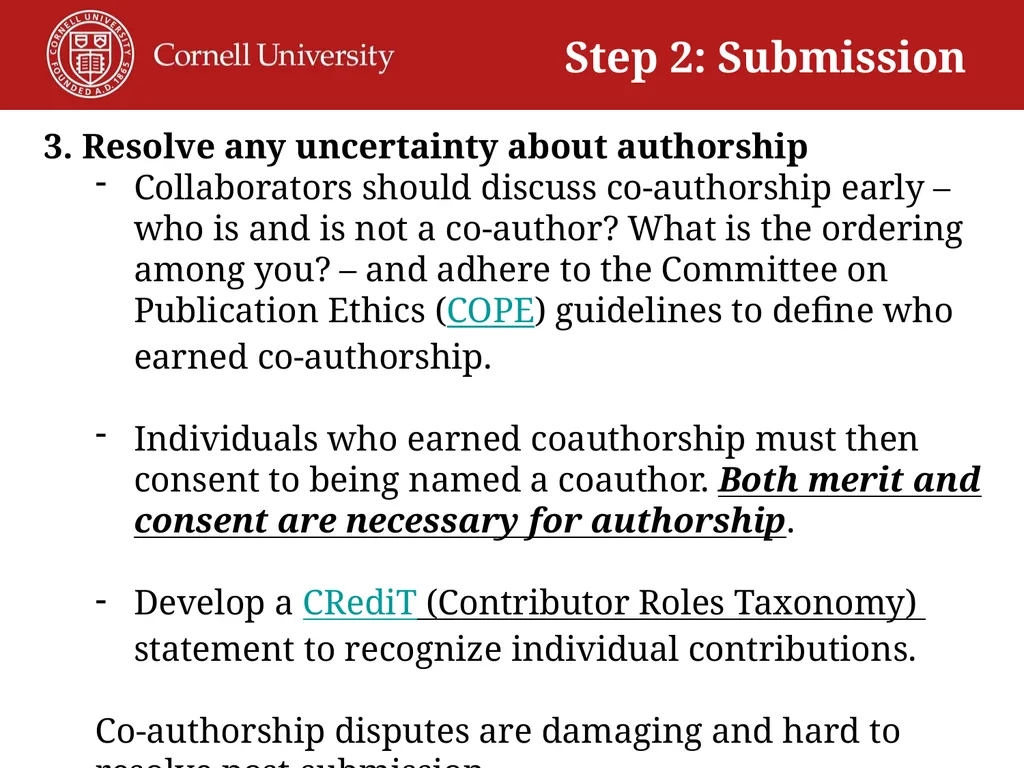
Step 2: Submission 3. Resolve any uncertainty about authorship
Collaborators should discuss co-authorship early – who is and is not a co-author? What is the ordering among you? – and adhere to the Committee on Publication Ethics (COPE) guidelines to define who earned co-authorship.
Individuals who earned coauthorship must then consent to being named a coauthor. Both merit and consent are necessary for authorship.
Develop a CRediT (Contributor Roles Taxonomy) statement to recognize individual contributions.
Co-authorship disputes are damaging and hard to resolve post-submission.<br>
09
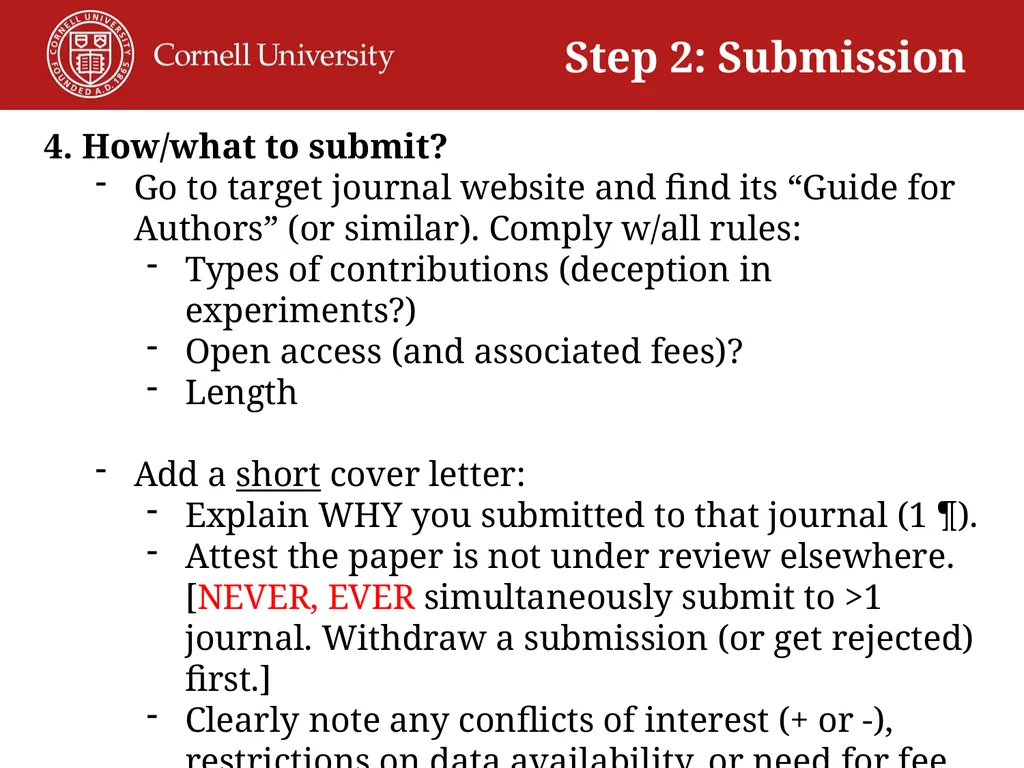
Step 2: Submission 4. How/what to submit?
Go to target journal website and find its “Guide for Authors” (or similar). Comply w/all rules:
Types of contributions (deception in experiments?)
Open access (and associated fees)?
Length
Add a short cover letter:
Explain WHY you submitted to that journal (1 ¶).
Attest the paper is not under review elsewhere. [NEVER, EVER simultaneously submit to >1 journal. Withdraw a submission (or get rejected) first.]
Clearly note any conflicts of interest (+ or -), restrictions on data availability, or need for fee waiver.
Any request to avoid specific potential reviewer(s).<br>
10
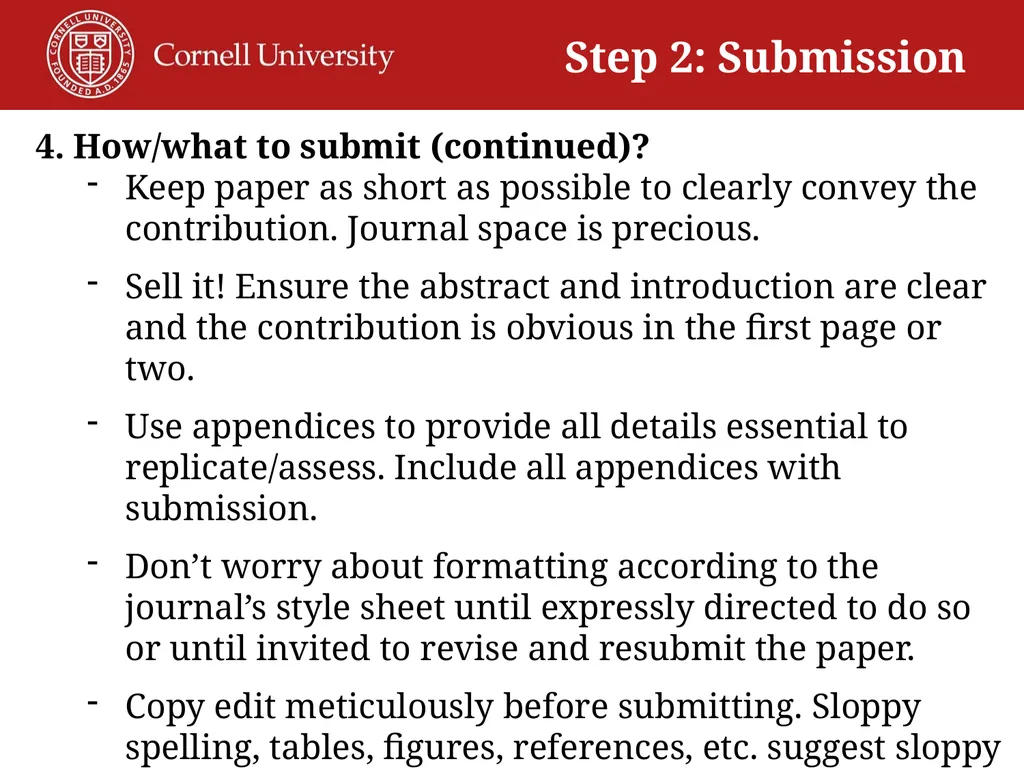
Step 2: Submission 4. How/what to submit (continued)?
Keep paper as short as possible to clearly convey the contribution. Journal space is precious.
Sell it! Ensure the abstract and introduction are clear and the contribution is obvious in the first page or two.
Use appendices to provide all details essential to replicate/assess. Include all appendices with submission.
Don’t worry about formatting according to the journal’s style sheet until expressly directed to do so or until invited to revise and resubmit the paper.
Copy edit meticulously before submitting. Sloppy spelling, tables, figures, references, etc. suggest sloppy research.<br>
11
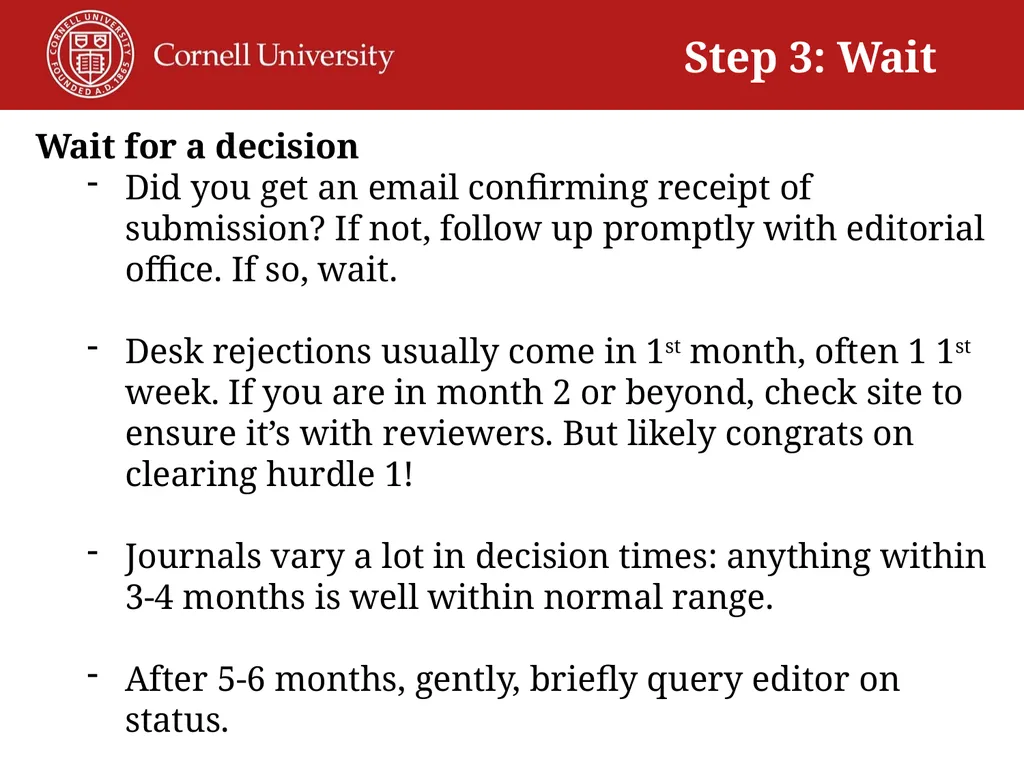
Step 3: Wait Wait for a decision
Did you get an email confirming receipt of submission? If not, follow up promptly with editorial office. If so, wait.
Desk rejections usually come in 1st month, often 1 1st week. If you are in month 2 or beyond, check site to ensure it’s with reviewers. But likely congrats on clearing hurdle 1!
Journals vary a lot in decision times: anything within 3-4 months is well within normal range.
After 5-6 months, gently, briefly query editor on status.
After 12 months, give a deadline at which time you will withdraw the paper and submit elsewhere.<br>
12
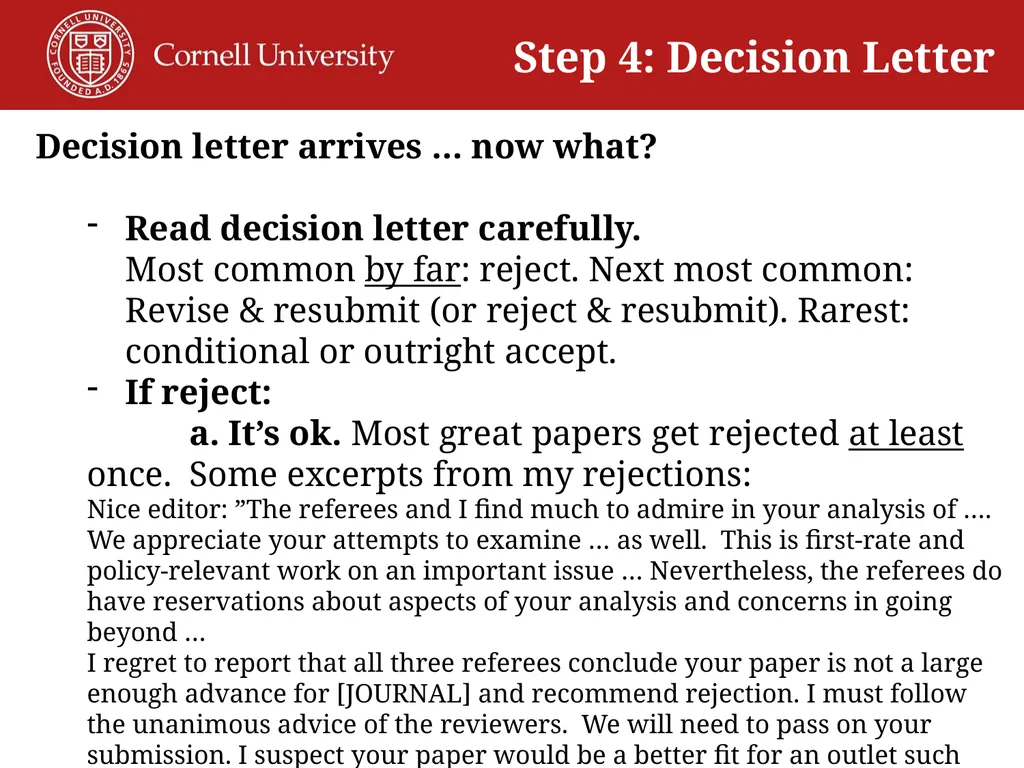
Step 4: Decision Letter Decision letter arrives … now what?
Read decision letter carefully. Most common by far: reject. Next most common: Revise & resubmit (or reject & resubmit). Rarest: conditional or outright accept.
If reject:
a. It’s ok. Most great papers get rejected at least once. Some excerpts from my rejections:
Nice editor: ”The referees and I find much to admire in your analysis of …. We appreciate your attempts to examine … as well. This is first-rate and policy-relevant work on an important issue … Nevertheless, the referees do have reservations about aspects of your analysis and concerns in going beyond …
I regret to report that all three referees conclude your paper is not a large enough advance for [JOURNAL] and recommend rejection. I must follow the unanimous advice of the reviewers. We will need to pass on your submission. I suspect your paper would be a better fit for an outlet such as ...”<br>
13
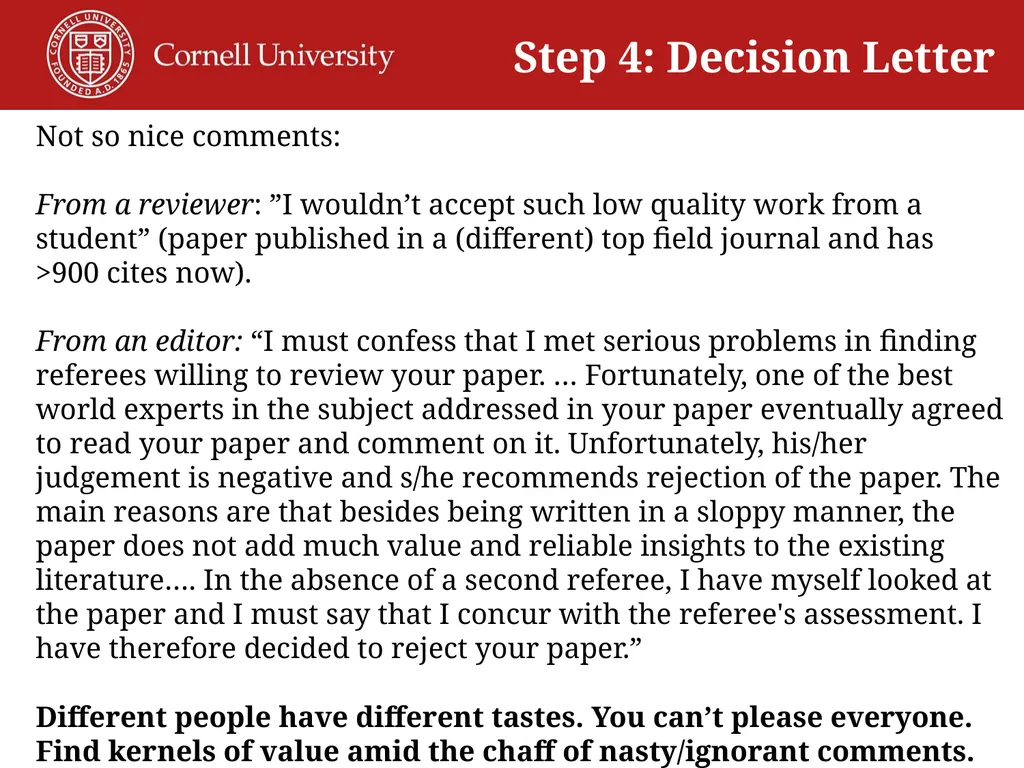
Step 4: Decision Letter Not so nice comments:
From a reviewer: ”I wouldn’t accept such low quality work from a student” (paper published in a (different) top field journal and has >900 cites now).
From an editor: “I must confess that I met serious problems in finding referees willing to review your paper. … Fortunately, one of the best world experts in the subject addressed in your paper eventually agreed to read your paper and comment on it. Unfortunately, his/her judgement is negative and s/he recommends rejection of the paper. The main reasons are that besides being written in a sloppy manner, the paper does not add much value and reliable insights to the existing literature…. In the absence of a second referee, I have myself looked at the paper and I must say that I concur with the referee's assessment. I have therefore decided to reject your paper.”
Different people have different tastes. You can’t please everyone. Find kernels of value amid the chaff of nasty/ignorant comments.<br>
14
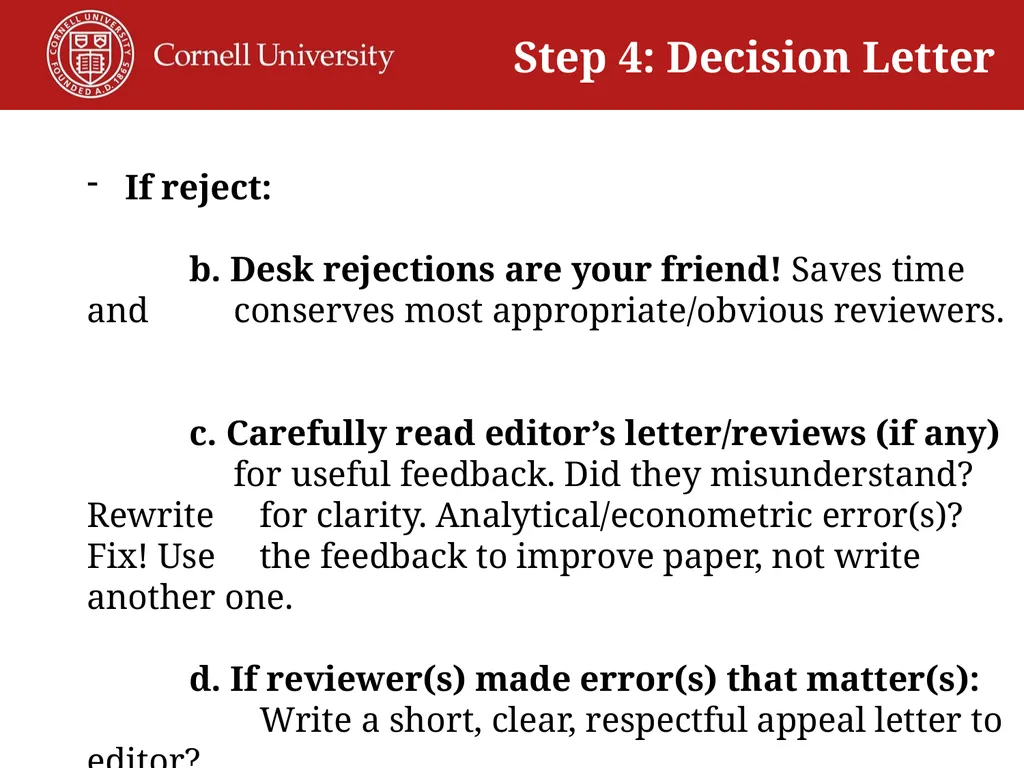
Step 4: Decision Letter If reject:
b. Desk rejections are your friend! Saves time and conserves most appropriate/obvious reviewers.
c. Carefully read editor’s letter/reviews (if any) for useful feedback. Did they misunderstand? Rewrite for clarity. Analytical/econometric error(s)? Fix! Use the feedback to improve paper, not write another one.
d. If reviewer(s) made error(s) that matter(s): Write a short, clear, respectful appeal letter to editor?<br>
15
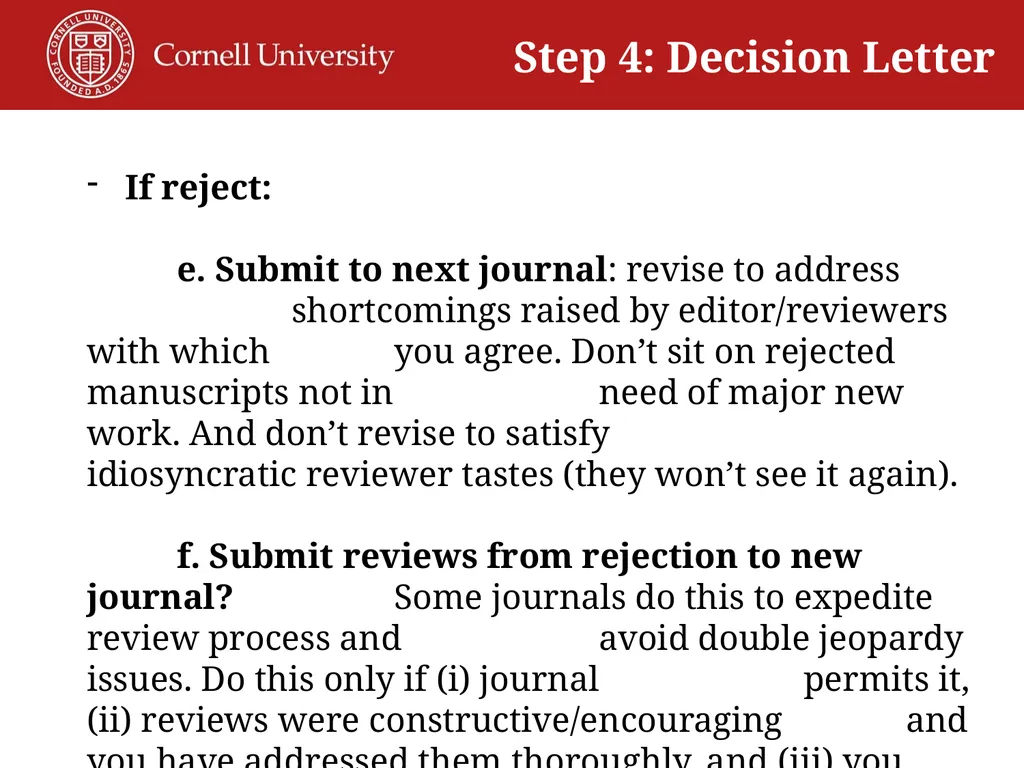
Step 4: Decision Letter If reject:
e. Submit to next journal: revise to address shortcomings raised by editor/reviewers with which you agree. Don’t sit on rejected manuscripts not in need of major new work. And don’t revise to satisfy idiosyncratic reviewer tastes (they won’t see it again).
f. Submit reviews from rejection to new journal? Some journals do this to expedite review process and avoid double jeopardy issues. Do this only if (i) journal permits it, (ii) reviews were constructive/encouraging and you have addressed them thoroughly, and (iii) you don’t dramatically recast the paper.<br>
16
Step 4: Decision Letter If reject:
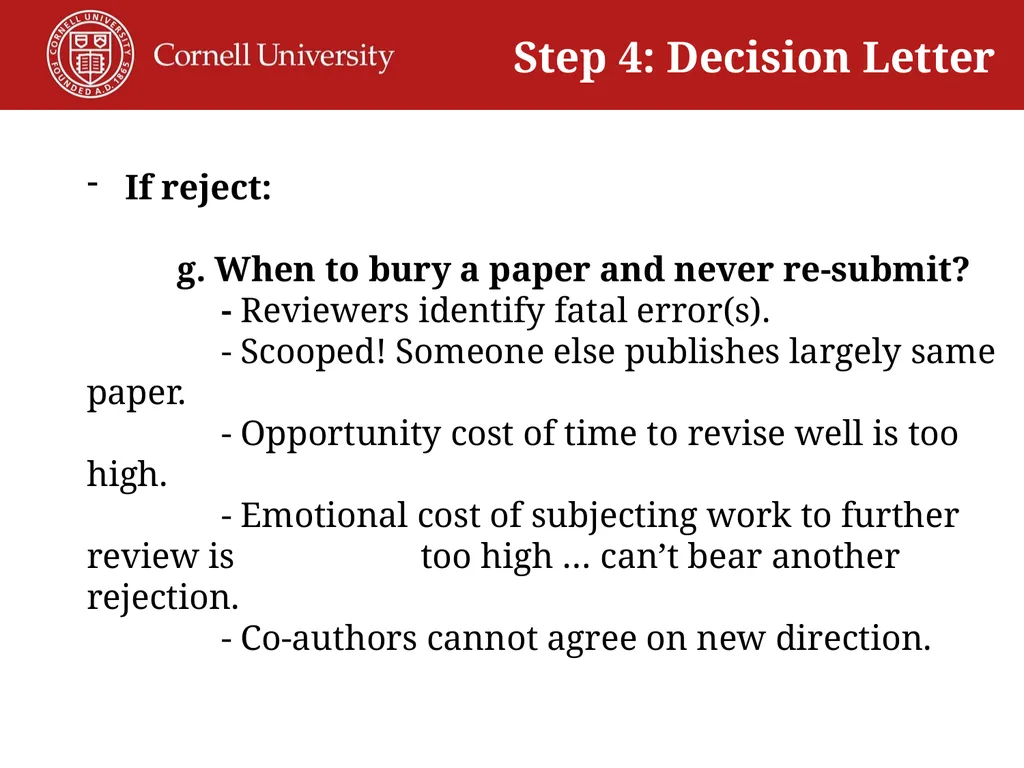
g. When to bury a paper and never re-submit?
- Reviewers identify fatal error(s).
- Scooped! Someone else publishes largely same paper.
- Opportunity cost of time to revise well is too high.
- Emotional cost of subjecting work to further review is too high … can’t bear another rejection.
- Co-authors cannot agree on new direction.<br>
17
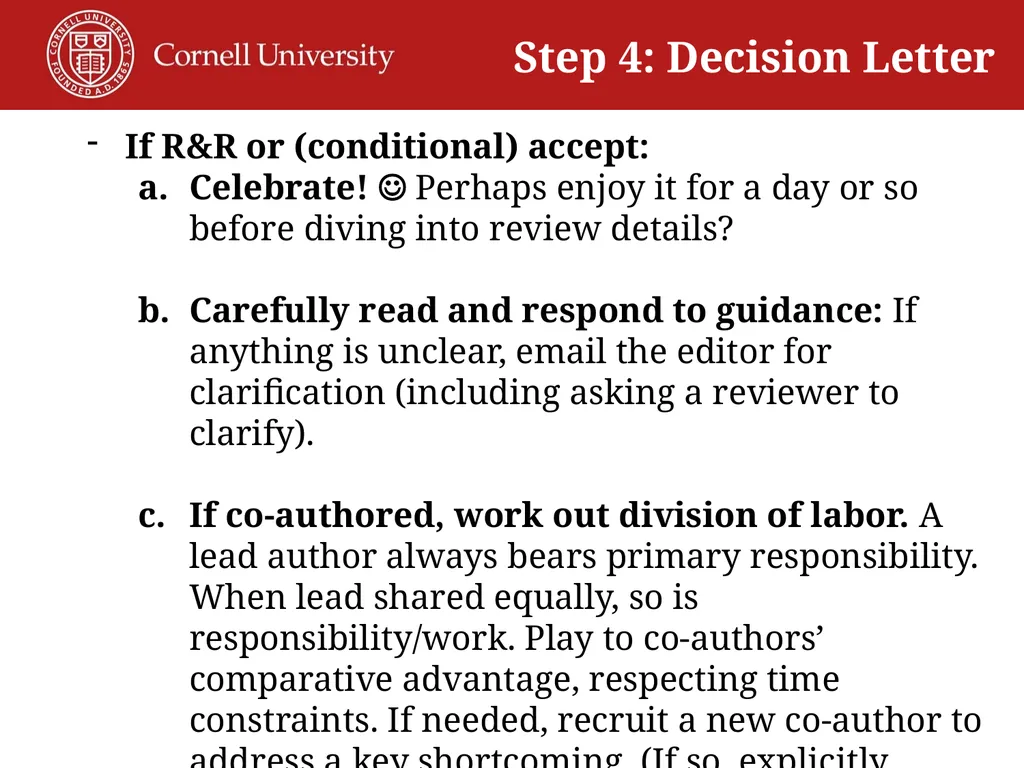
Step 4: Decision Letter If R&R or (conditional) accept:
Celebrate! Perhaps enjoy it for a day or so before diving into review details?
Carefully read and respond to guidance: If anything is unclear, email the editor for clarification (including asking a reviewer to clarify).
If co-authored, work out division of labor. A lead author always bears primary responsibility. When lead shared equally, so is responsibility/work. Play to co-authors’ comparative advantage, respecting time constraints. If needed, recruit a new co-author to address a key shortcoming. (If so, explicitly request editor’s permission before resubmitting.)<br>
18
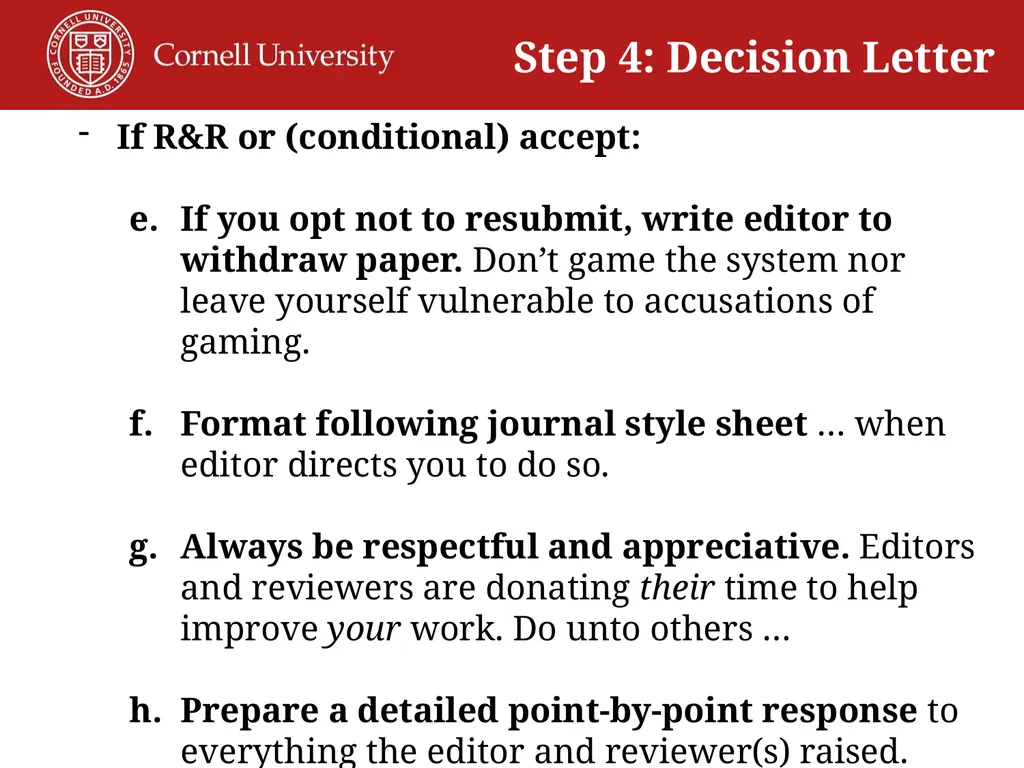
Step 4: Decision Letter If R&R or (conditional) accept:
If you opt not to resubmit, write editor to withdraw paper. Don’t game the system nor leave yourself vulnerable to accusations of gaming.
Format following journal style sheet … when editor directs you to do so.
Always be respectful and appreciative. Editors and reviewers are donating their time to help improve your work. Do unto others …
Prepare a detailed point-by-point response to everything the editor and reviewer(s) raised. Repeat their remarks verbatim.<br>
19
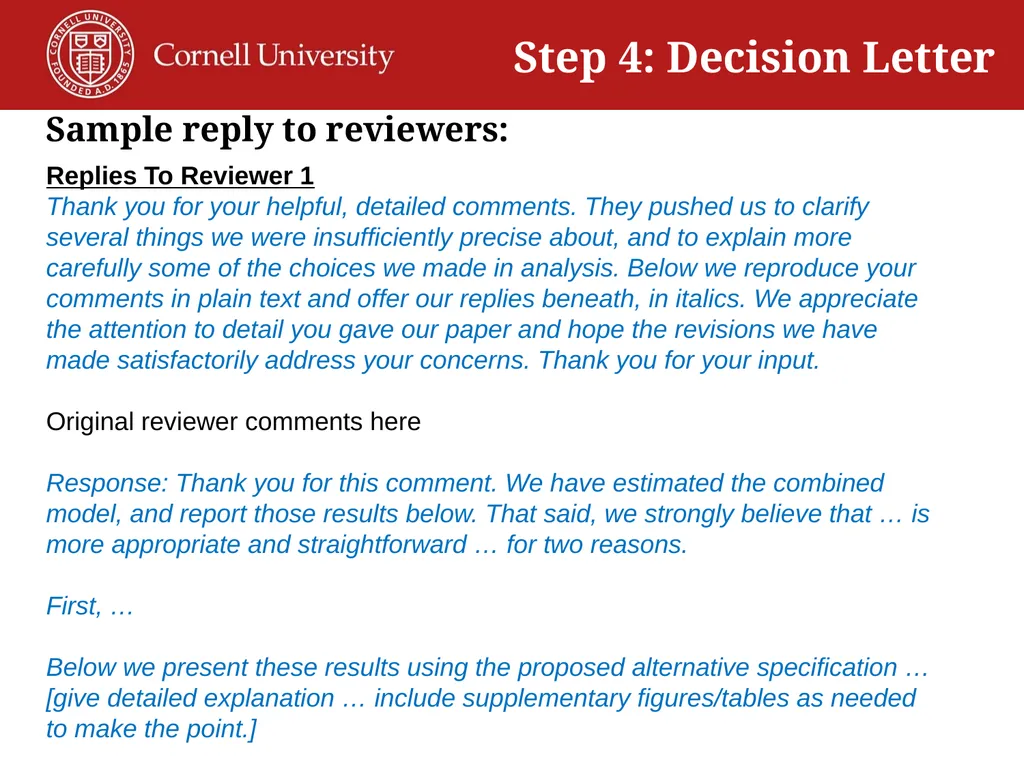
Step 4: Decision Letter Sample reply to reviewers: Replies To Reviewer 1
Thank you for your helpful, detailed comments. They pushed us to clarify several things we were insufficiently precise about, and to explain more carefully some of the choices we made in analysis. Below we reproduce your comments in plain text and offer our replies beneath, in italics. We appreciate the attention to detail you gave our paper and hope the revisions we have made satisfactorily address your concerns. Thank you for your input.
Original reviewer comments here
Response: Thank you for this comment. We have estimated the combined model, and report those results below. That said, we strongly believe that … is more appropriate and straightforward … for two reasons.
First, …
Below we present these results using the proposed alternative specification …
[give detailed explanation … include supplementary figures/tables as needed to make the point.]<br>
20
Step 5: Turning tables Review unto others as you would have them review unto you
Once submitted, you join the reviewer pool.
Reciprocate! Peer review is a collective action problem. Free riding undermines the system’s value. Expect editors to disfavor free riders, including those who submit perfunctory or nasty reviews. Tit-for-tat.
Respond promptly, constructively, and kindly:
For more details see:<br>
21
Step 5: Turning tables What goes into a good peer review?
A brief note to the editor with a clear recommendation. Do not repeat the comments to the author(s); the editor will read those anyway.
Provide author(s) w/constructive comments. Always find things to compliment. Be kind but firm and clear.
Break comments into groups: major ‘must do’ revisions, minor ‘must do’ revisions (e.g., typos, clean up figures/tables), and ‘recommended’ revisions (items where reasonable people might disagree)
Do not indicate to the author your recommendation to the editor. You advise the editor. You have no decision-making authority. Reviewer hubris diminishes them in editors’ eyes.
Never use GAI to draft review, only to clean up your draft.<br>
22
Thank you for your time and attention
Comments/questions? Thank you<br>
Comments/questions? Thank you<br>