
Circuit Simulation via Matrix Exponential Method
YM
Published · 65 slides · 0 views
1 / 1



Description
Circuit Simulation via Matrix Exponential Method Speaker: Shih-Hung Weng Adviser: Chung-Kuan Cheng Date: 05312013 1 Foundation of Design Flow 2 Emerging Demands Full system verification and analysis scalability and performance 3 time
Related Topics
Share
Embed code
Download this presentation From Below
"Circuit Simulation via Matrix Exponential Method" is the property of its rightful owner. Permission is granted to download and print the materials on this website for personal, non-commercial use only, and to display it on your personal computer provided you do not modify the materials and that you retain all copyright notices contained in the materials. By downloading content from our website, you accept the terms of this agreement.
Presentation Transcript
01
Circuit Simulation via Matrix Exponential Method Speaker: Shih-Hung Weng
Adviser: Chung-Kuan Cheng
Date: 05/31/2013 1<br>
Adviser: Chung-Kuan Cheng
Date: 05/31/2013 1<br>
02
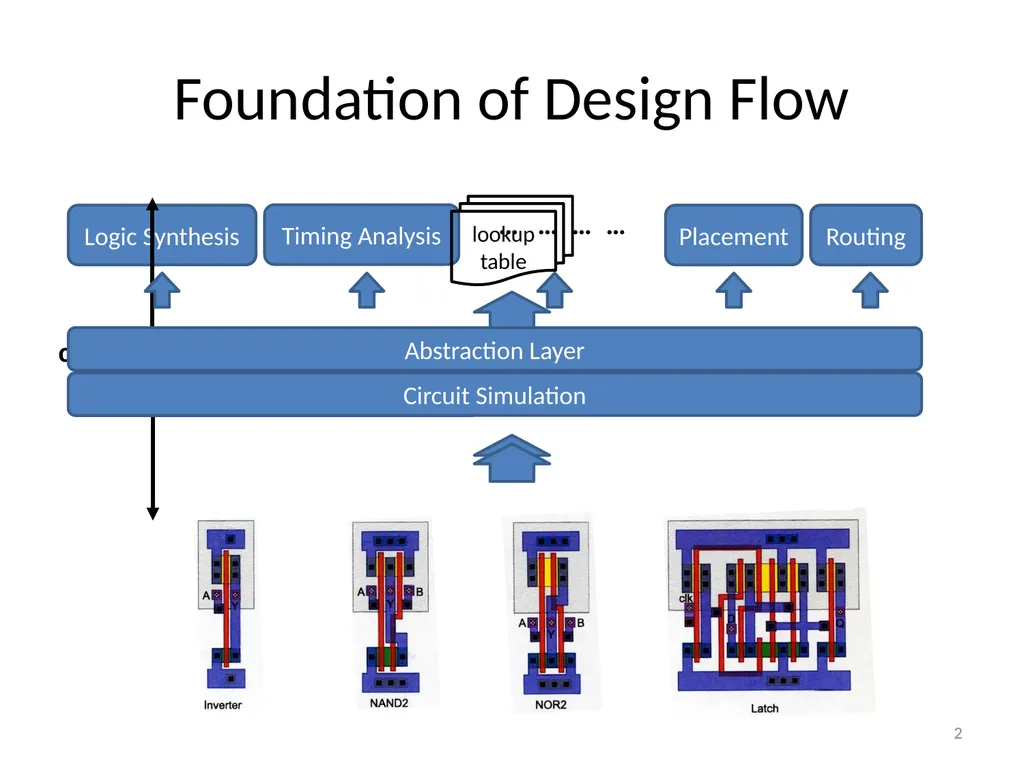
Foundation of Design Flow 2<br>
03
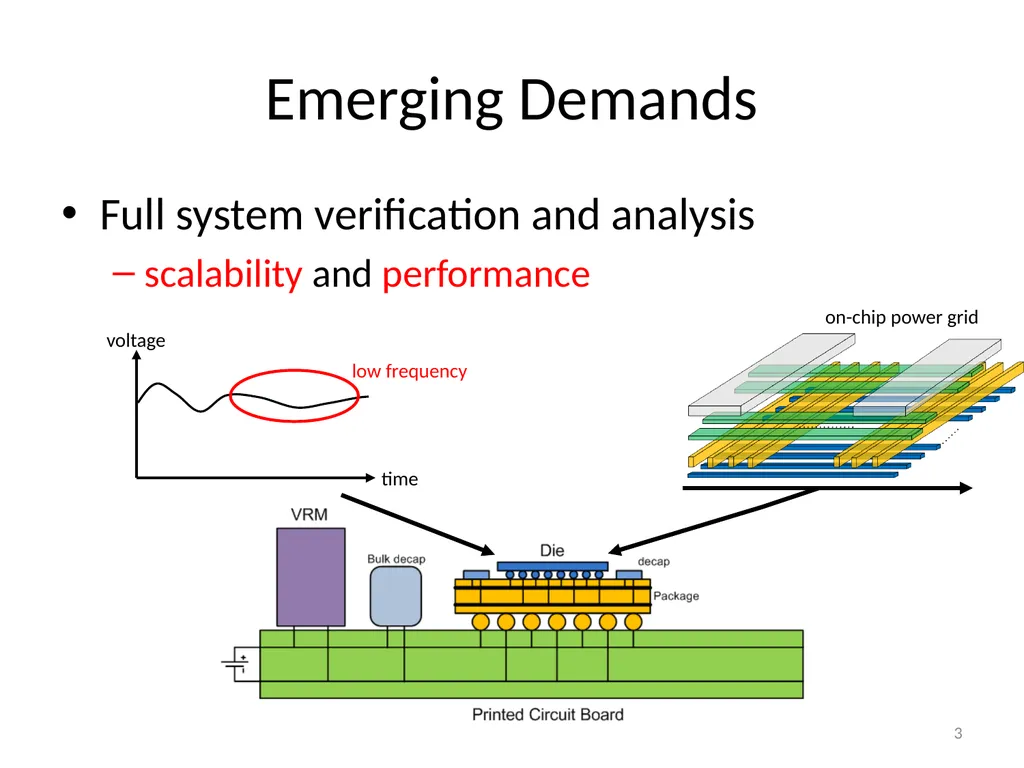
Emerging Demands Full system verification and analysis
scalability and performance 3 time voltage on-chip power grid low frequency<br>
scalability and performance 3 time voltage on-chip power grid low frequency<br>
04
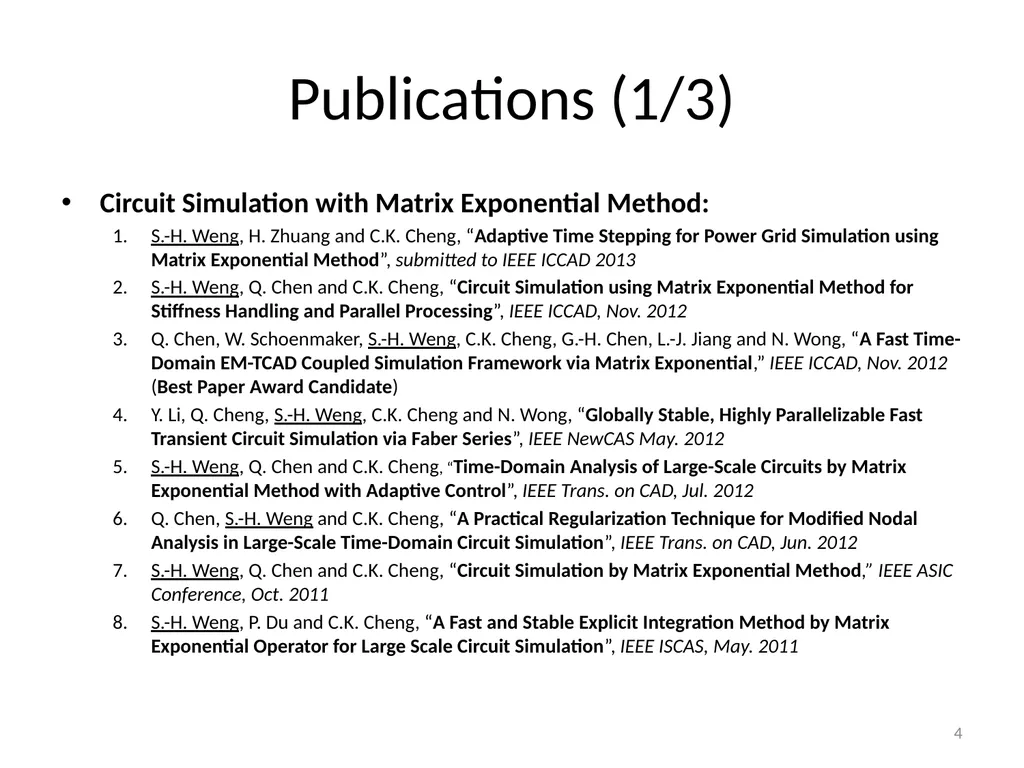
Publications (1/3) Circuit Simulation with Matrix Exponential Method:
S.-H. Weng, H. Zhuang and C.K. Cheng, “Adaptive Time Stepping for Power Grid Simulation using Matrix Exponential Method”, submitted to IEEE ICCAD 2013
S.-H. Weng, Q. Chen and C.K. Cheng, “Circuit Simulation using Matrix Exponential Method for Stiffness Handling and Parallel Processing”, IEEE ICCAD, Nov. 2012
Q. Chen, W. Schoenmaker, S.-H. Weng, C.K. Cheng, G.-H. Chen, L.-J. Jiang and N. Wong, “A Fast Time-Domain EM-TCAD Coupled Simulation Framework via Matrix Exponential,” IEEE ICCAD, Nov. 2012 (Best Paper Award Candidate)
Y. Li, Q. Cheng, S.-H. Weng, C.K. Cheng and N. Wong, “Globally Stable, Highly Parallelizable Fast Transient Circuit Simulation via Faber Series”, IEEE NewCAS May. 2012
S.-H. Weng, Q. Chen and C.K. Cheng, “Time-Domain Analysis of Large-Scale Circuits by Matrix Exponential Method with Adaptive Control”, IEEE Trans. on CAD, Jul. 2012
Q. Chen, S.-H. Weng and C.K. Cheng, “A Practical Regularization Technique for Modified Nodal Analysis in Large-Scale Time-Domain Circuit Simulation”, IEEE Trans. on CAD, Jun. 2012
S.-H. Weng, Q. Chen and C.K. Cheng, “Circuit Simulation by Matrix Exponential Method,” IEEE ASIC Conference, Oct. 2011
S.-H. Weng, P. Du and C.K. Cheng, “A Fast and Stable Explicit Integration Method by Matrix Exponential Operator for Large Scale Circuit Simulation”, IEEE ISCAS, May. 2011 4<br>
S.-H. Weng, H. Zhuang and C.K. Cheng, “Adaptive Time Stepping for Power Grid Simulation using Matrix Exponential Method”, submitted to IEEE ICCAD 2013
S.-H. Weng, Q. Chen and C.K. Cheng, “Circuit Simulation using Matrix Exponential Method for Stiffness Handling and Parallel Processing”, IEEE ICCAD, Nov. 2012
Q. Chen, W. Schoenmaker, S.-H. Weng, C.K. Cheng, G.-H. Chen, L.-J. Jiang and N. Wong, “A Fast Time-Domain EM-TCAD Coupled Simulation Framework via Matrix Exponential,” IEEE ICCAD, Nov. 2012 (Best Paper Award Candidate)
Y. Li, Q. Cheng, S.-H. Weng, C.K. Cheng and N. Wong, “Globally Stable, Highly Parallelizable Fast Transient Circuit Simulation via Faber Series”, IEEE NewCAS May. 2012
S.-H. Weng, Q. Chen and C.K. Cheng, “Time-Domain Analysis of Large-Scale Circuits by Matrix Exponential Method with Adaptive Control”, IEEE Trans. on CAD, Jul. 2012
Q. Chen, S.-H. Weng and C.K. Cheng, “A Practical Regularization Technique for Modified Nodal Analysis in Large-Scale Time-Domain Circuit Simulation”, IEEE Trans. on CAD, Jun. 2012
S.-H. Weng, Q. Chen and C.K. Cheng, “Circuit Simulation by Matrix Exponential Method,” IEEE ASIC Conference, Oct. 2011
S.-H. Weng, P. Du and C.K. Cheng, “A Fast and Stable Explicit Integration Method by Matrix Exponential Operator for Large Scale Circuit Simulation”, IEEE ISCAS, May. 2011 4<br>
05
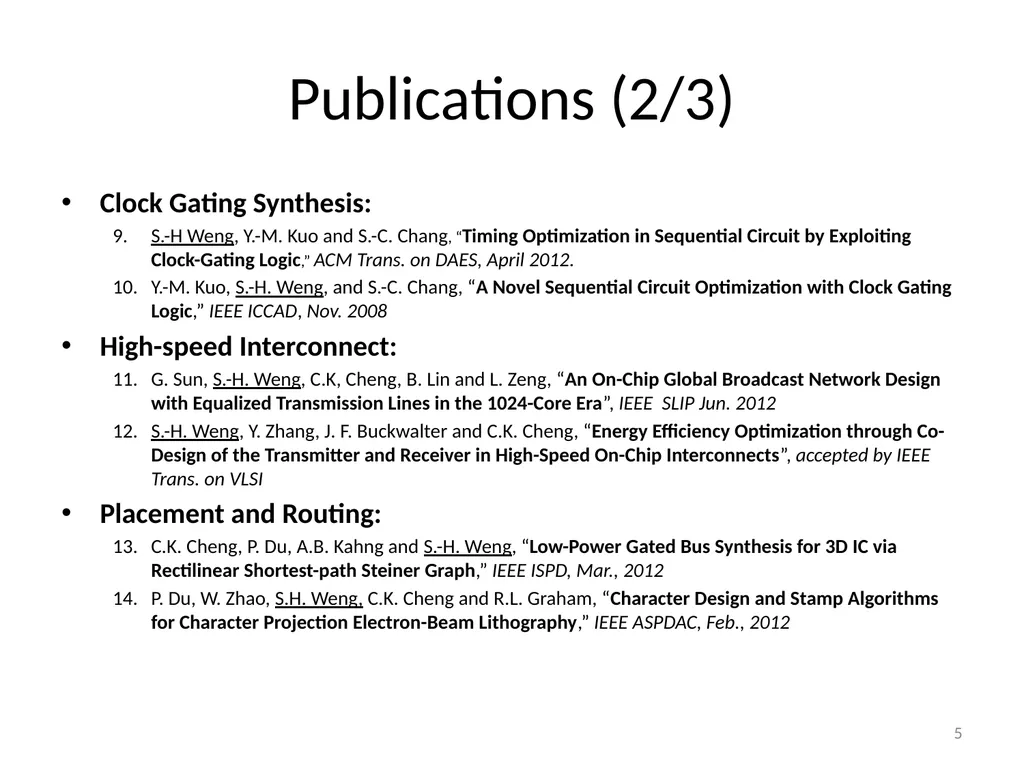
Publications (2/3) Clock Gating Synthesis:
S.-H Weng, Y.-M. Kuo and S.-C. Chang, “Timing Optimization in Sequential Circuit by Exploiting Clock-Gating Logic,” ACM Trans. on DAES, April 2012.
Y.-M. Kuo, S.-H. Weng, and S.-C. Chang, “A Novel Sequential Circuit Optimization with Clock Gating Logic,” IEEE ICCAD, Nov. 2008
High-speed Interconnect:
G. Sun, S.-H. Weng, C.K, Cheng, B. Lin and L. Zeng, “An On-Chip Global Broadcast Network Design with Equalized Transmission Lines in the 1024-Core Era”, IEEE SLIP Jun. 2012
S.-H. Weng, Y. Zhang, J. F. Buckwalter and C.K. Cheng, “Energy Efficiency Optimization through Co-Design of the Transmitter and Receiver in High-Speed On-Chip Interconnects”, accepted by IEEE Trans. on VLSI
Placement and Routing:
C.K. Cheng, P. Du, A.B. Kahng and S.-H. Weng, “Low-Power Gated Bus Synthesis for 3D IC via Rectilinear Shortest-path Steiner Graph,” IEEE ISPD, Mar., 2012
P. Du, W. Zhao, S.H. Weng, C.K. Cheng and R.L. Graham, “Character Design and Stamp Algorithms for Character Projection Electron-Beam Lithography,” IEEE ASPDAC, Feb., 2012 5<br>
S.-H Weng, Y.-M. Kuo and S.-C. Chang, “Timing Optimization in Sequential Circuit by Exploiting Clock-Gating Logic,” ACM Trans. on DAES, April 2012.
Y.-M. Kuo, S.-H. Weng, and S.-C. Chang, “A Novel Sequential Circuit Optimization with Clock Gating Logic,” IEEE ICCAD, Nov. 2008
High-speed Interconnect:
G. Sun, S.-H. Weng, C.K, Cheng, B. Lin and L. Zeng, “An On-Chip Global Broadcast Network Design with Equalized Transmission Lines in the 1024-Core Era”, IEEE SLIP Jun. 2012
S.-H. Weng, Y. Zhang, J. F. Buckwalter and C.K. Cheng, “Energy Efficiency Optimization through Co-Design of the Transmitter and Receiver in High-Speed On-Chip Interconnects”, accepted by IEEE Trans. on VLSI
Placement and Routing:
C.K. Cheng, P. Du, A.B. Kahng and S.-H. Weng, “Low-Power Gated Bus Synthesis for 3D IC via Rectilinear Shortest-path Steiner Graph,” IEEE ISPD, Mar., 2012
P. Du, W. Zhao, S.H. Weng, C.K. Cheng and R.L. Graham, “Character Design and Stamp Algorithms for Character Projection Electron-Beam Lithography,” IEEE ASPDAC, Feb., 2012 5<br>
06
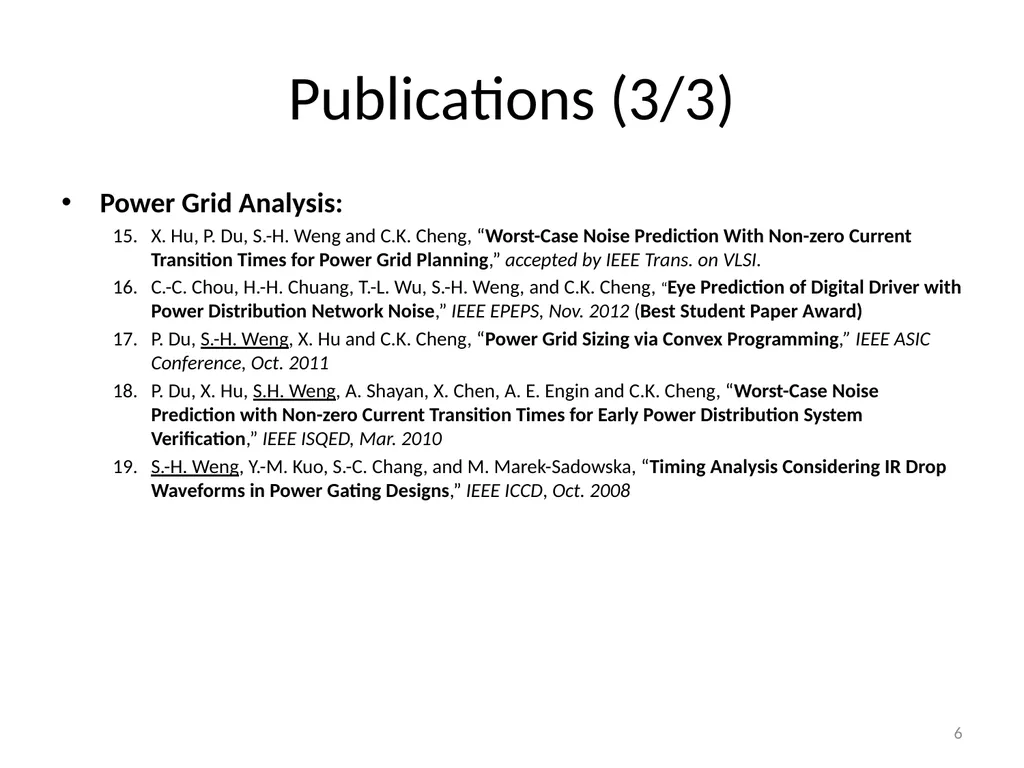
Publications (3/3) Power Grid Analysis:
X. Hu, P. Du, S.-H. Weng and C.K. Cheng, “Worst-Case Noise Prediction With Non-zero Current Transition Times for Power Grid Planning,” accepted by IEEE Trans. on VLSI.
C.-C. Chou, H.-H. Chuang, T.-L. Wu, S.-H. Weng, and C.K. Cheng, “Eye Prediction of Digital Driver with Power Distribution Network Noise,” IEEE EPEPS, Nov. 2012 (Best Student Paper Award)
P. Du, S.-H. Weng, X. Hu and C.K. Cheng, “Power Grid Sizing via Convex Programming,” IEEE ASIC Conference, Oct. 2011
P. Du, X. Hu, S.H. Weng, A. Shayan, X. Chen, A. E. Engin and C.K. Cheng, “Worst-Case Noise Prediction with Non-zero Current Transition Times for Early Power Distribution System Verification,” IEEE ISQED, Mar. 2010
S.-H. Weng, Y.-M. Kuo, S.-C. Chang, and M. Marek-Sadowska, “Timing Analysis Considering IR Drop Waveforms in Power Gating Designs,” IEEE ICCD, Oct. 2008 6<br>
X. Hu, P. Du, S.-H. Weng and C.K. Cheng, “Worst-Case Noise Prediction With Non-zero Current Transition Times for Power Grid Planning,” accepted by IEEE Trans. on VLSI.
C.-C. Chou, H.-H. Chuang, T.-L. Wu, S.-H. Weng, and C.K. Cheng, “Eye Prediction of Digital Driver with Power Distribution Network Noise,” IEEE EPEPS, Nov. 2012 (Best Student Paper Award)
P. Du, S.-H. Weng, X. Hu and C.K. Cheng, “Power Grid Sizing via Convex Programming,” IEEE ASIC Conference, Oct. 2011
P. Du, X. Hu, S.H. Weng, A. Shayan, X. Chen, A. E. Engin and C.K. Cheng, “Worst-Case Noise Prediction with Non-zero Current Transition Times for Early Power Distribution System Verification,” IEEE ISQED, Mar. 2010
S.-H. Weng, Y.-M. Kuo, S.-C. Chang, and M. Marek-Sadowska, “Timing Analysis Considering IR Drop Waveforms in Power Gating Designs,” IEEE ICCD, Oct. 2008 6<br>
07
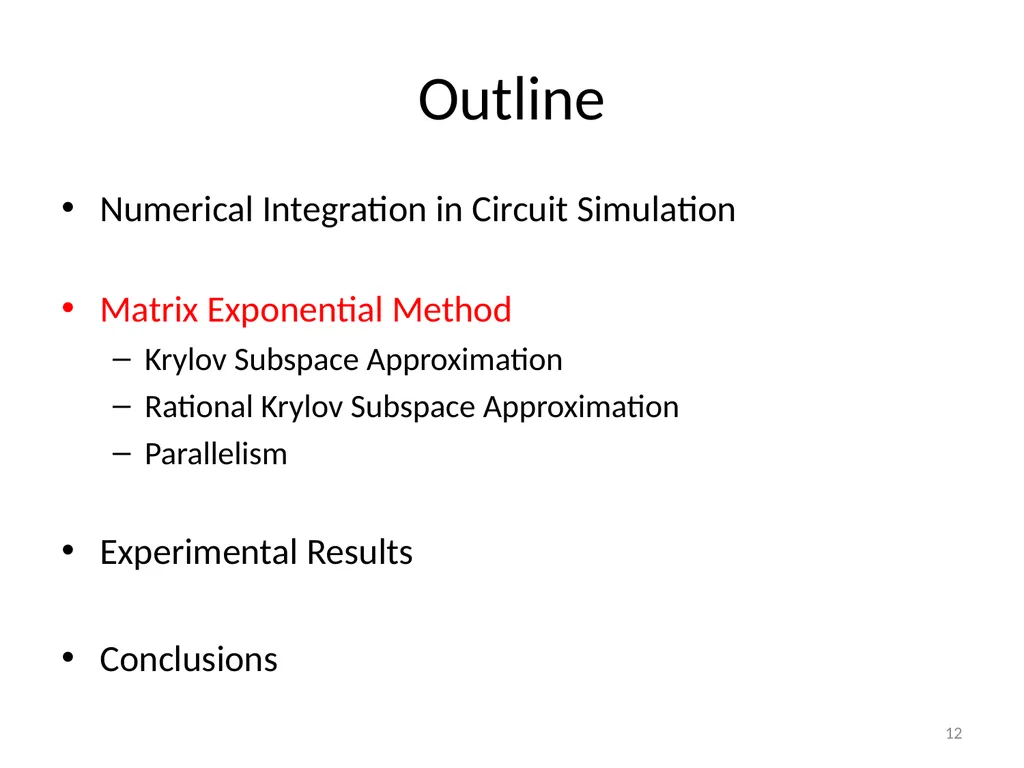
Outline Numerical Integration in Circuit Simulation
Matrix Exponential Method
Krylov Subspace Approximation
Rational Krylov Subspace Approximation
Parallelism
Experimental Results
Conclusions 7<br>
Matrix Exponential Method
Krylov Subspace Approximation
Rational Krylov Subspace Approximation
Parallelism
Experimental Results
Conclusions 7<br>
08
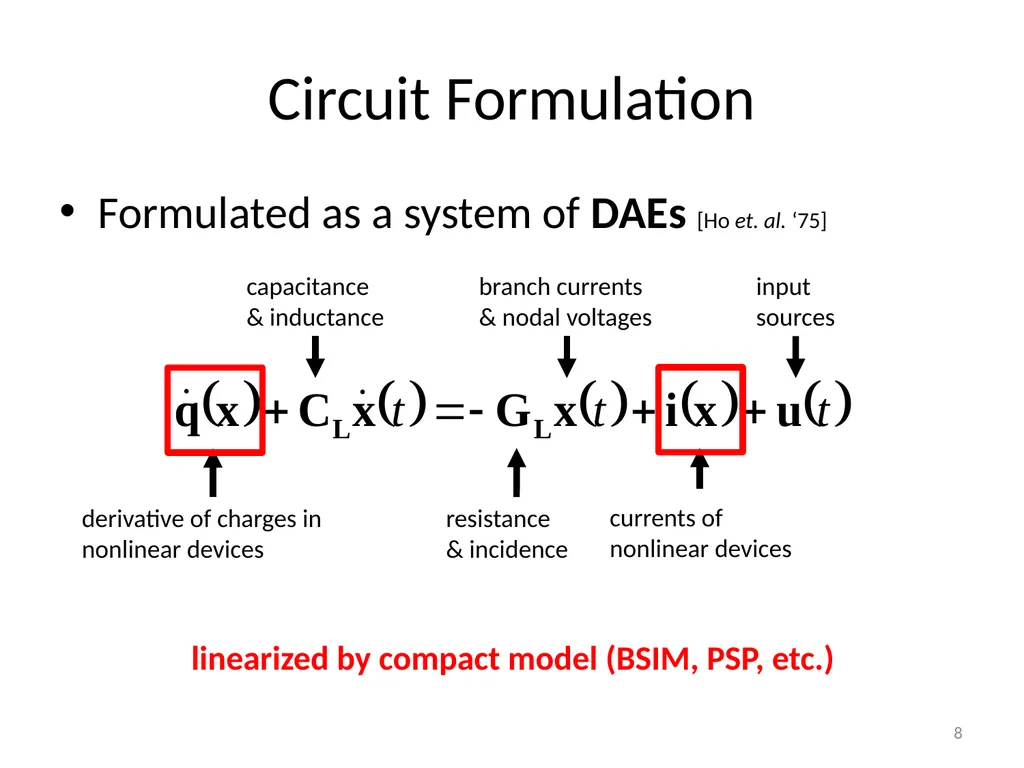
Circuit Formulation Formulated as a system of DAEs [Ho et. al. ‘75] 8<br>
09
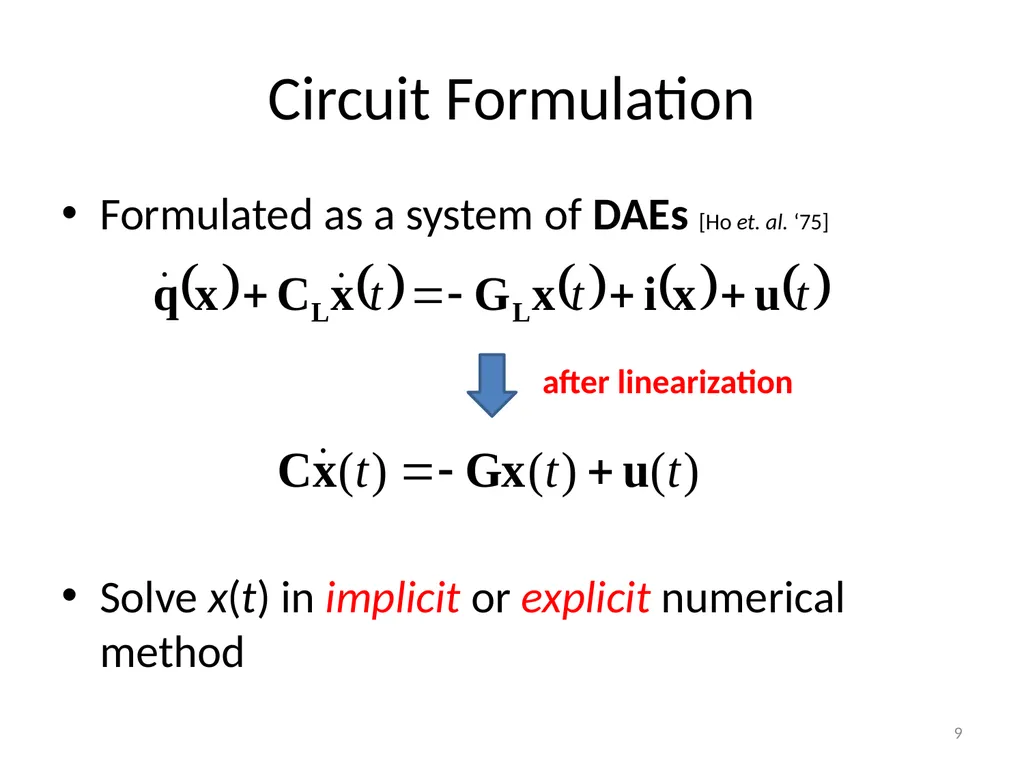
Circuit Formulation Formulated as a system of DAEs [Ho et. al. ‘75]
Solve x(t) in implicit or explicit numerical method 9<br>
Solve x(t) in implicit or explicit numerical method 9<br>
10
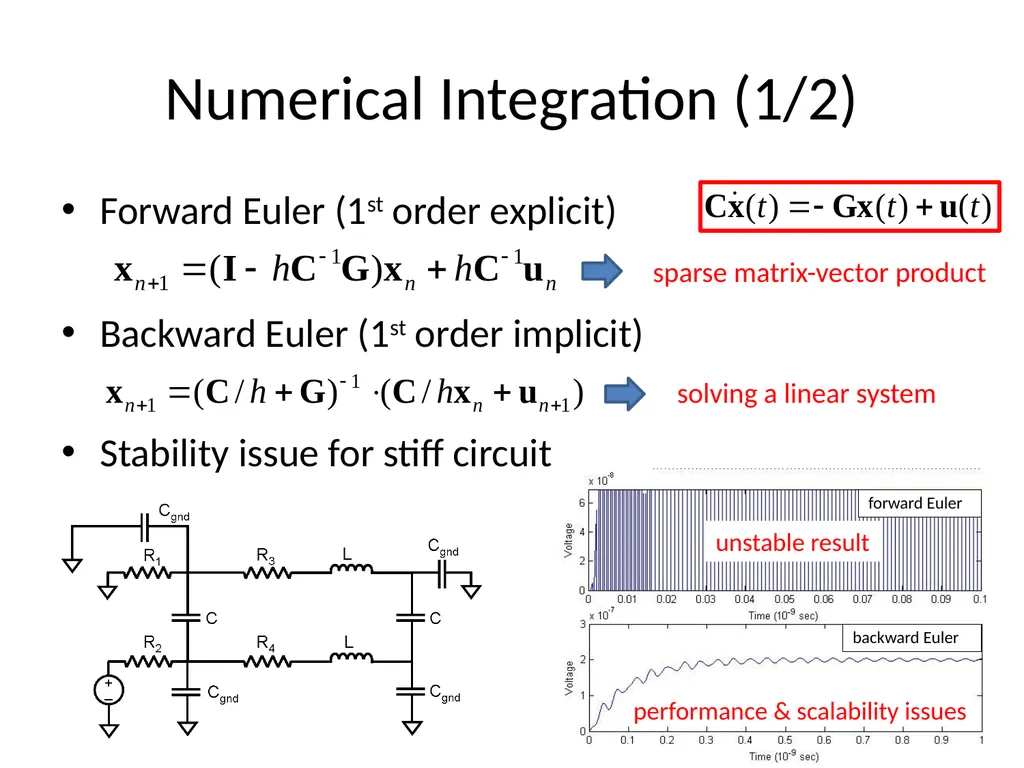
10 Numerical Integration (1/2) Forward Euler (1st order explicit)
Backward Euler (1st order implicit)
Stability issue for stiff circuit unstable result performance & scalability issues<br>
Backward Euler (1st order implicit)
Stability issue for stiff circuit unstable result performance & scalability issues<br>
11
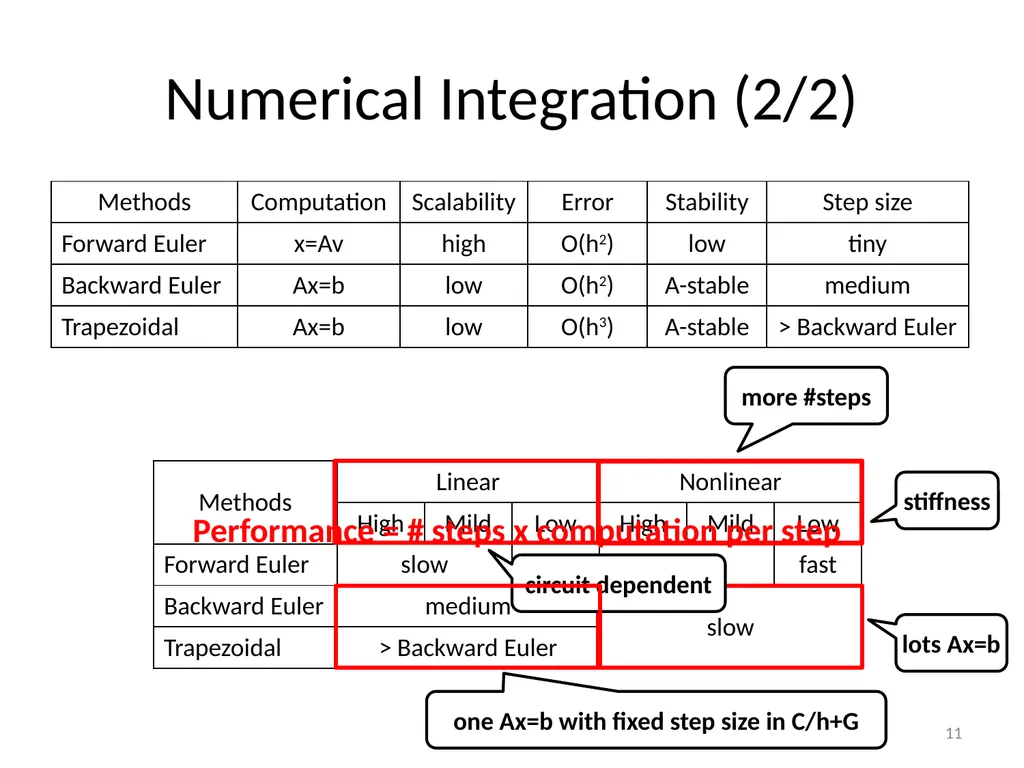
Numerical Integration (2/2) 11 lots Ax=b one Ax=b with fixed step size in C/h+G Performance = # steps x computation per step circuit dependent more #steps<br>
12
Outline Numerical Integration in Circuit Simulation
Matrix Exponential Method
Krylov Subspace Approximation
Rational Krylov Subspace Approximation
Parallelism
Experimental Results
Conclusions 12<br>
Matrix Exponential Method
Krylov Subspace Approximation
Rational Krylov Subspace Approximation
Parallelism
Experimental Results
Conclusions 12<br>
13
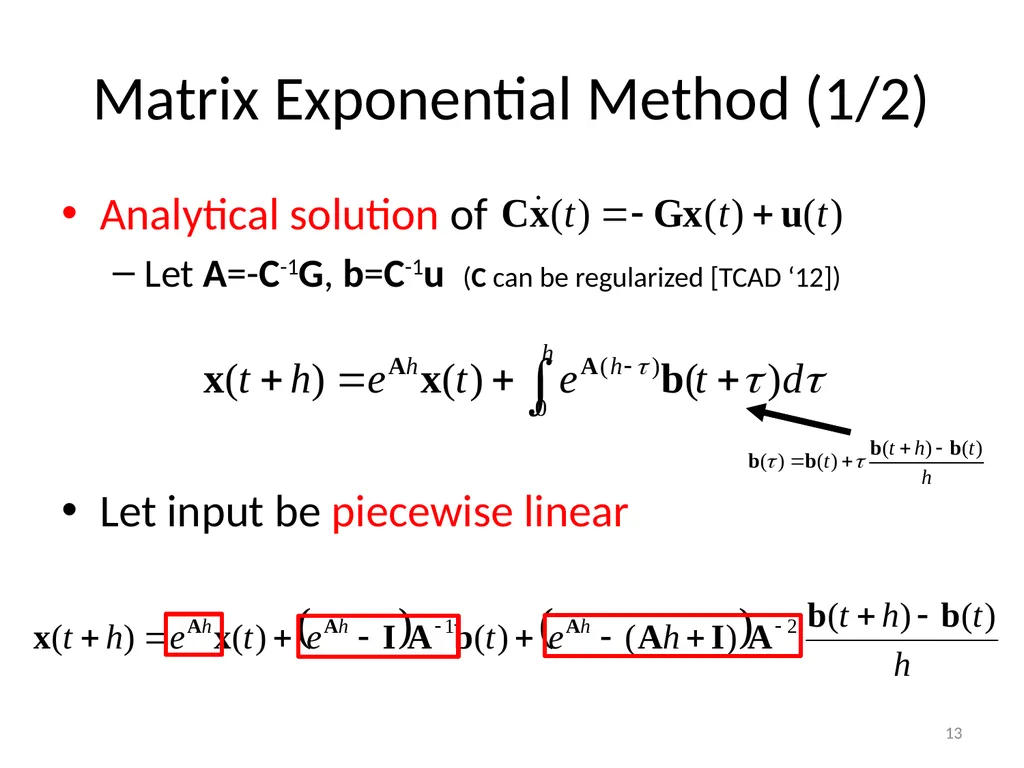
Matrix Exponential Method (1/2) Analytical solution of
Let A=-C-1G, b=C-1u (C can be regularized [TCAD ‘12])
Let input be piecewise linear 13<br>
Let A=-C-1G, b=C-1u (C can be regularized [TCAD ‘12])
Let input be piecewise linear 13<br>
14
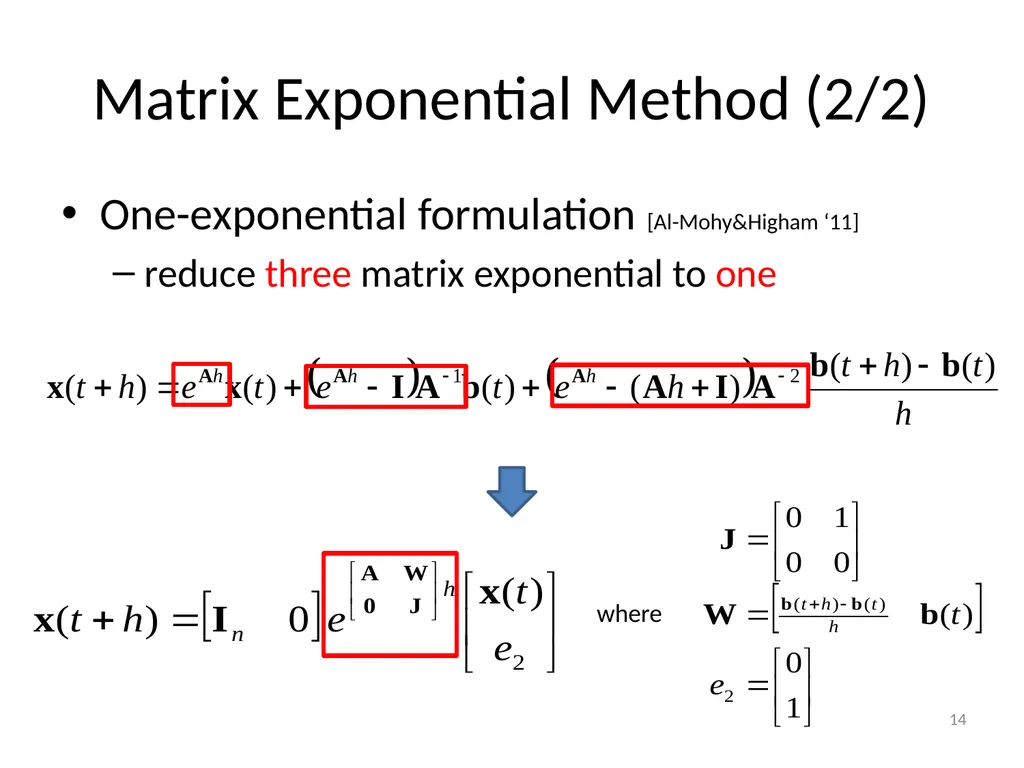
Matrix Exponential Method (2/2) One-exponential formulation [Al-Mohy&Higham ‘11]
reduce three matrix exponential to one 14<br>
reduce three matrix exponential to one 14<br>
15
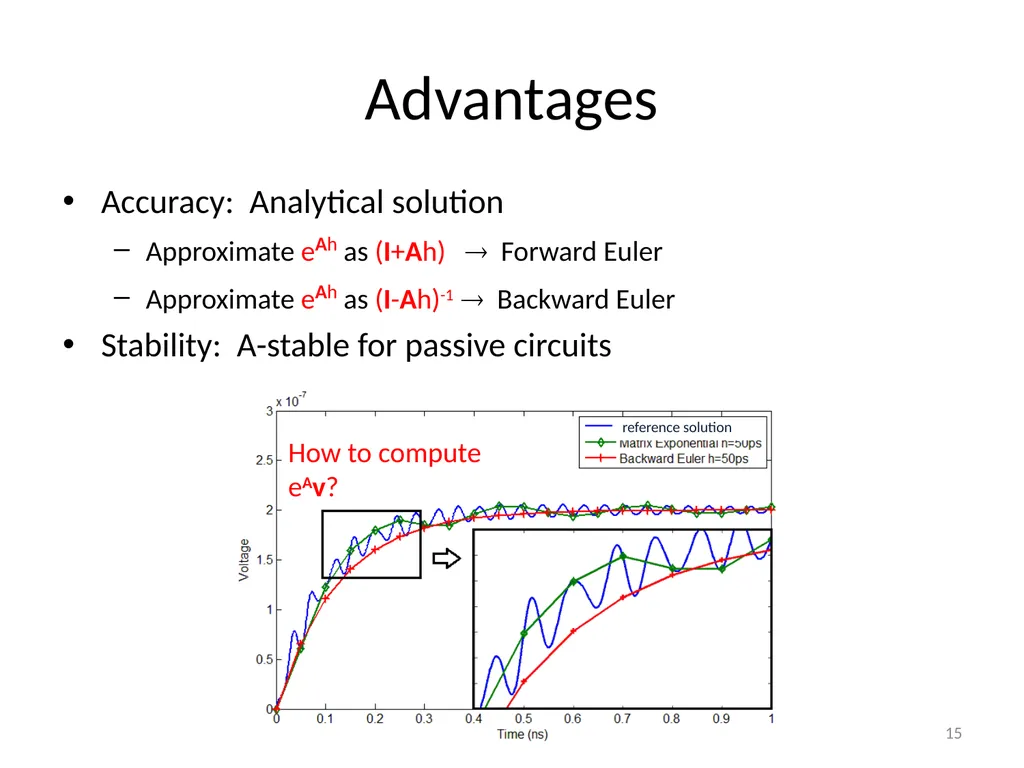
Advantages Accuracy: Analytical solution
Approximate eAh as (I+Ah) Forward Euler
Approximate eAh as (I-Ah)-1 Backward Euler
Stability: A-stable for passive circuits 15 How to compute
eAv?<br>
Approximate eAh as (I+Ah) Forward Euler
Approximate eAh as (I-Ah)-1 Backward Euler
Stability: A-stable for passive circuits 15 How to compute
eAv?<br>
16
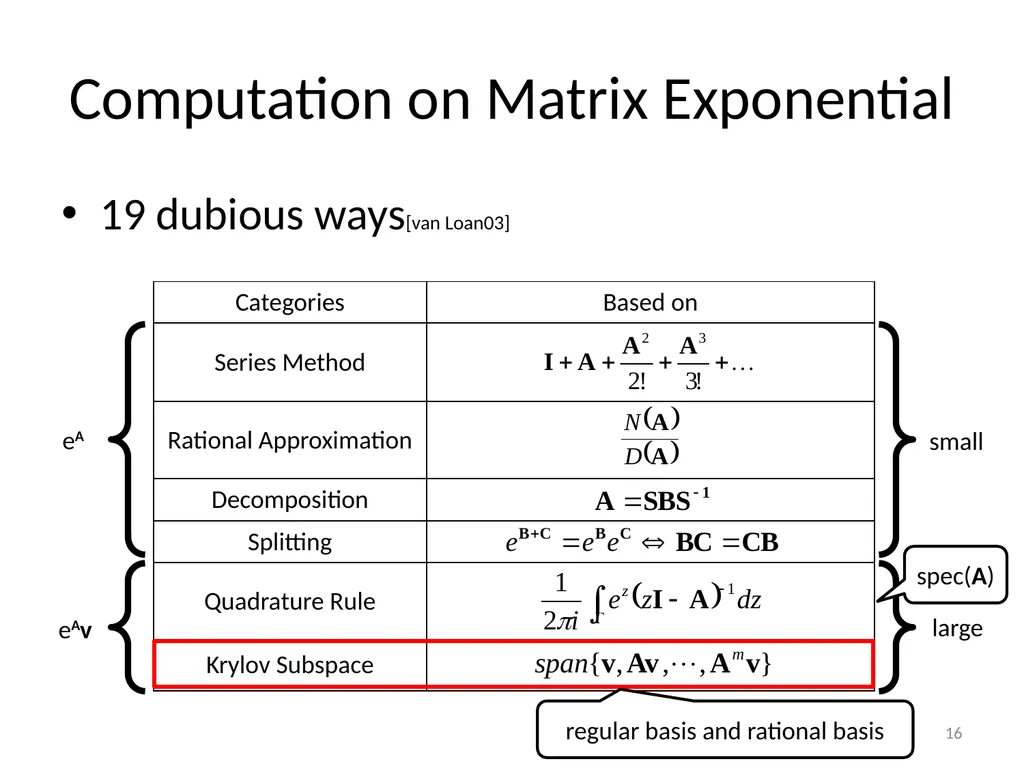
Computation on Matrix Exponential 19 dubious ways[van Loan03] 16 spec(A) regular basis and rational basis<br>
17
Outline Numerical Integration in Circuit Simulation
Matrix Exponential Method
Krylov Subspace Approximation
Rational Krylov Subspace Approximation
Parallelism
Experimental Results
Conclusions 17<br>
Matrix Exponential Method
Krylov Subspace Approximation
Rational Krylov Subspace Approximation
Parallelism
Experimental Results
Conclusions 17<br>
18
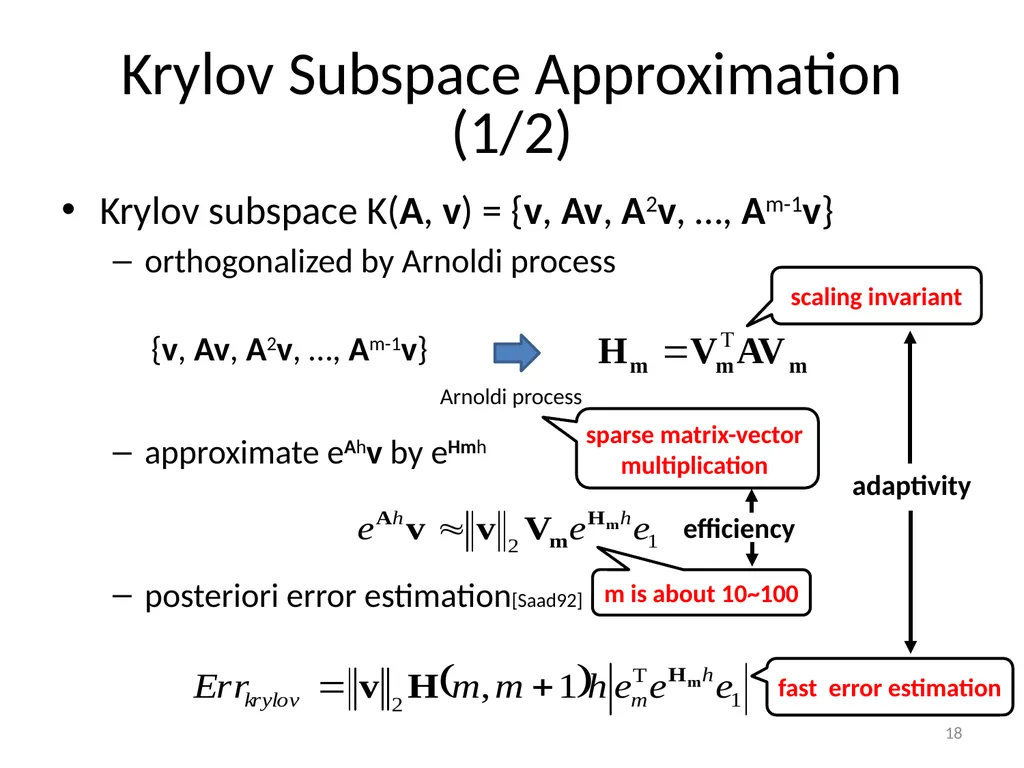
Krylov Subspace Approximation (1/2) Krylov subspace K(A, v) = {v, Av, A2v, …, Am-1v}
orthogonalized by Arnoldi process
approximate eAhv by eHmh
posteriori error estimation[Saad92] 18 {v, Av, A2v, …, Am-1v} Arnoldi process sparse matrix-vector
multiplication m is about 10~100 fast error estimation scaling invariant<br>
orthogonalized by Arnoldi process
approximate eAhv by eHmh
posteriori error estimation[Saad92] 18 {v, Av, A2v, …, Am-1v} Arnoldi process sparse matrix-vector
multiplication m is about 10~100 fast error estimation scaling invariant<br>
19
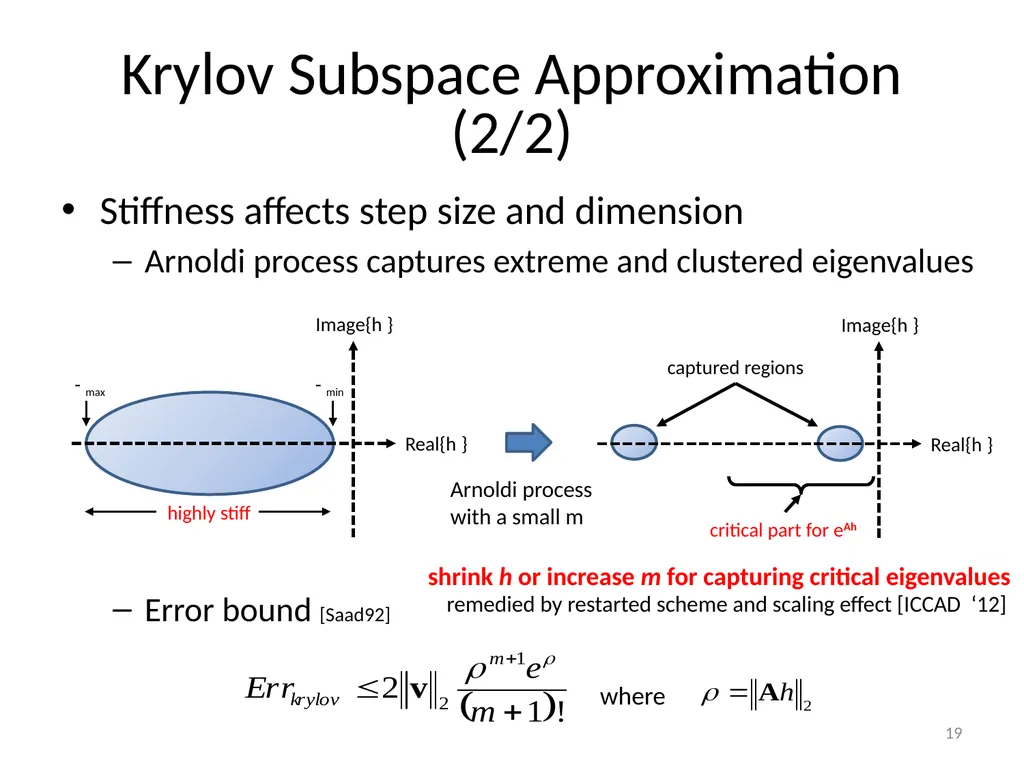
Stiffness affects step size and dimension
Arnoldi process captures extreme and clustered eigenvalues
Error bound [Saad92] Krylov Subspace Approximation (2/2) 19 critical part for eAh shrink h or increase m for capturing critical eigenvalues where remedied by restarted scheme and scaling effect [ICCAD ‘12]<br>
Arnoldi process captures extreme and clustered eigenvalues
Error bound [Saad92] Krylov Subspace Approximation (2/2) 19 critical part for eAh shrink h or increase m for capturing critical eigenvalues where remedied by restarted scheme and scaling effect [ICCAD ‘12]<br>
20
Outline Numerical Integration in Circuit Simulation
Matrix Exponential Method
Krylov Subspace Approximation
Rational Krylov Subspace Approximation
Parallelism
Experimental Results
Conclusions 20<br>
Matrix Exponential Method
Krylov Subspace Approximation
Rational Krylov Subspace Approximation
Parallelism
Experimental Results
Conclusions 20<br>
21
Rational basis (I-A)-1
K((I-A)-1, v) = {v, (I-A)-1v, …, (I-A)-mv} Rational Krylov Subspace Approximation (1/2) 21 avoid regularization of C one LU for linear circuit w=Avj<br>
K((I-A)-1, v) = {v, (I-A)-1v, …, (I-A)-mv} Rational Krylov Subspace Approximation (1/2) 21 avoid regularization of C one LU for linear circuit w=Avj<br>
22
Rational basis (I-A)-1
K((I-A)-1, v) = {v, (I-A)-1v, …, (I-A)-mv}
Approximation of eAhv
Posteriori error estimation[van den Eshof 06] Rational Krylov Subspace Approximation (1/2) 22 adaptivity<br>
K((I-A)-1, v) = {v, (I-A)-1v, …, (I-A)-mv}
Approximation of eAhv
Posteriori error estimation[van den Eshof 06] Rational Krylov Subspace Approximation (1/2) 22 adaptivity<br>
23
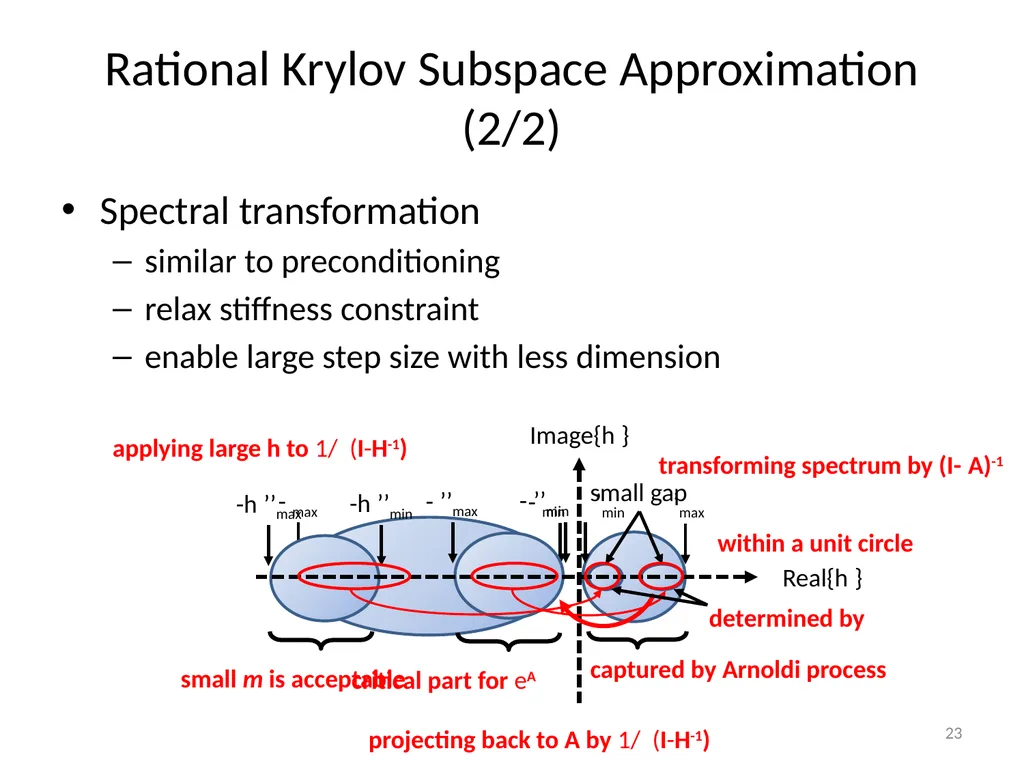
Spectral transformation
similar to preconditioning
relax stiffness constraint
enable large step size with less dimension Rational Krylov Subspace Approximation (2/2) 23 Image{h} Real{h} transforming spectrum by (I-A)-1 projecting back to A by 1/ (I-H-1) applying large h to 1/ (I-H-1) within a unit circle<br>
similar to preconditioning
relax stiffness constraint
enable large step size with less dimension Rational Krylov Subspace Approximation (2/2) 23 Image{h} Real{h} transforming spectrum by (I-A)-1 projecting back to A by 1/ (I-H-1) applying large h to 1/ (I-H-1) within a unit circle<br>
24
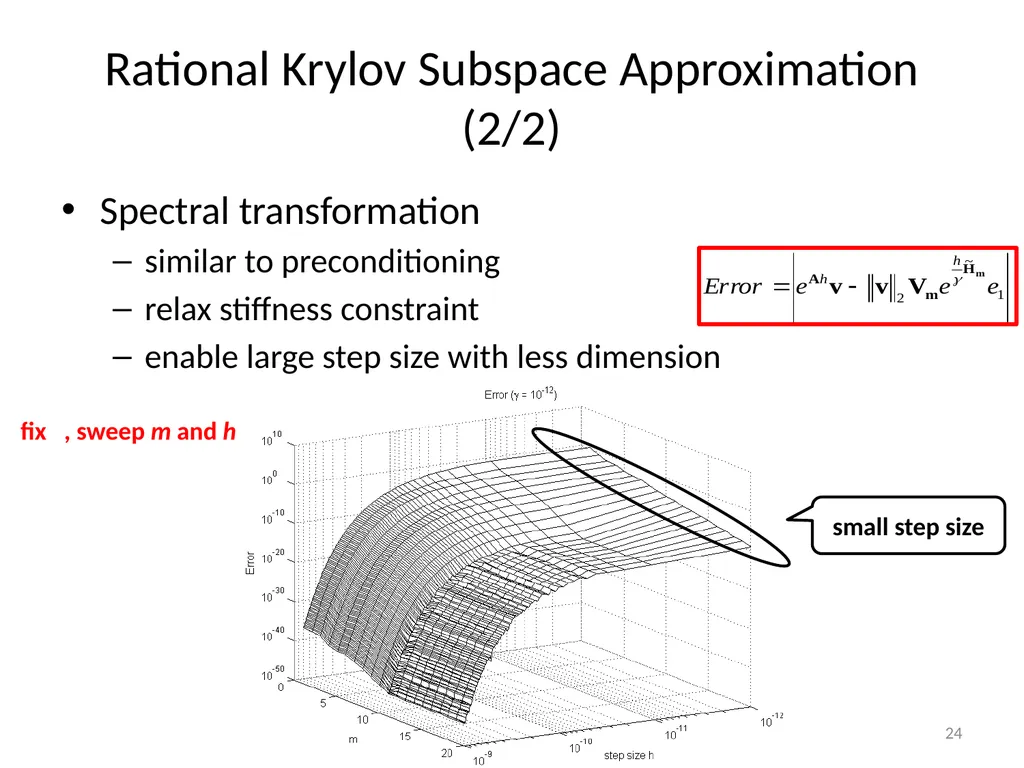
Spectral transformation
similar to preconditioning
relax stiffness constraint
enable large step size with less dimension Rational Krylov Subspace Approximation (2/2) 24 fix , sweep m and h<br>
similar to preconditioning
relax stiffness constraint
enable large step size with less dimension Rational Krylov Subspace Approximation (2/2) 24 fix , sweep m and h<br>
25
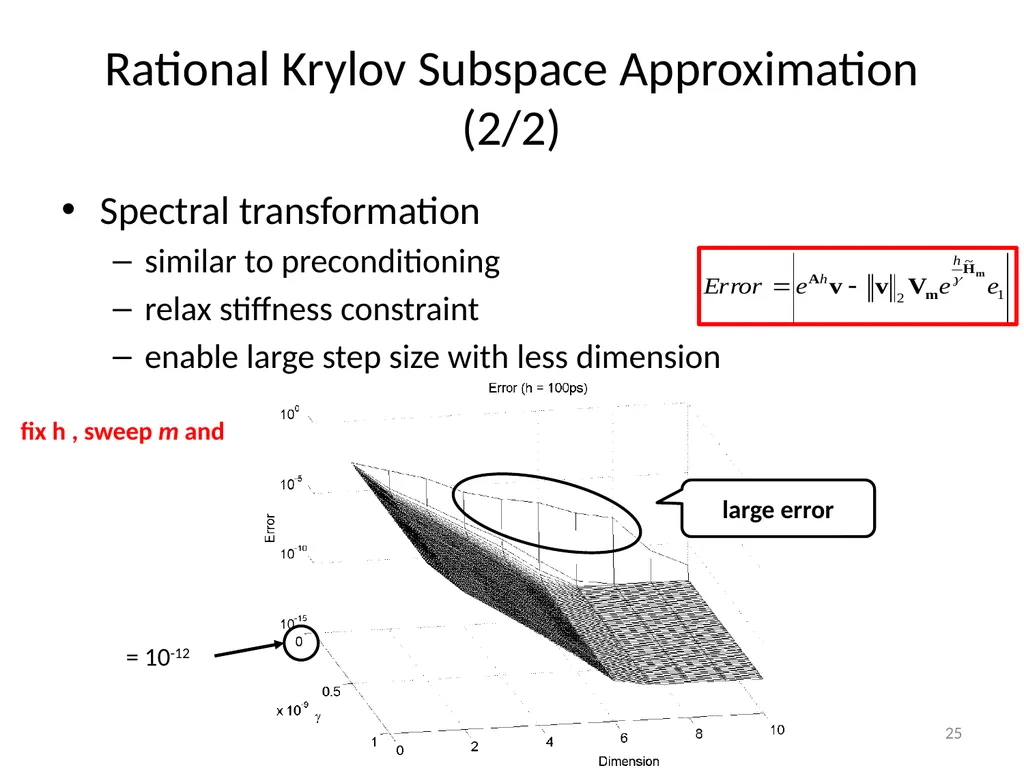
Spectral transformation
similar to preconditioning
relax stiffness constraint
enable large step size with less dimension Rational Krylov Subspace Approximation (2/2) 25 = 10-12 fix h , sweep m and <br>
similar to preconditioning
relax stiffness constraint
enable large step size with less dimension Rational Krylov Subspace Approximation (2/2) 25 = 10-12 fix h , sweep m and <br>
26
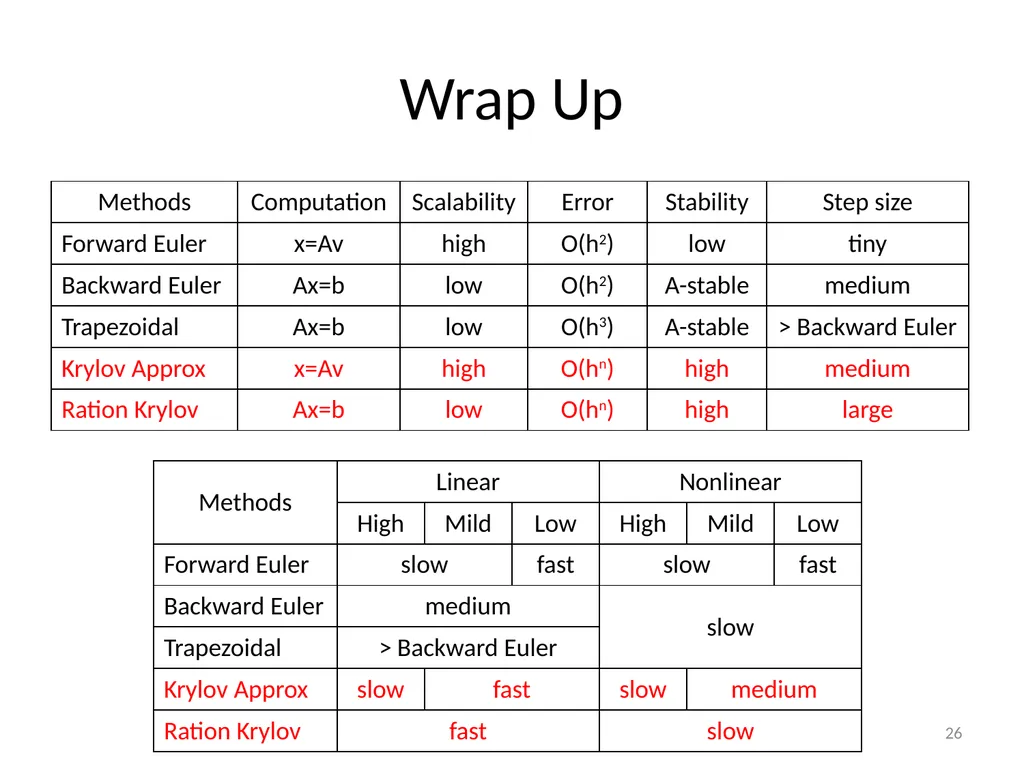
Wrap Up 26<br>
27
Outline Numerical Integration in Circuit Simulation
Matrix Exponential Method
Krylov Subspace Approximation
Rational Krylov Subspace Approximation
Parallelism
Experimental Results
Conclusions 27<br>
Matrix Exponential Method
Krylov Subspace Approximation
Rational Krylov Subspace Approximation
Parallelism
Experimental Results
Conclusions 27<br>
28
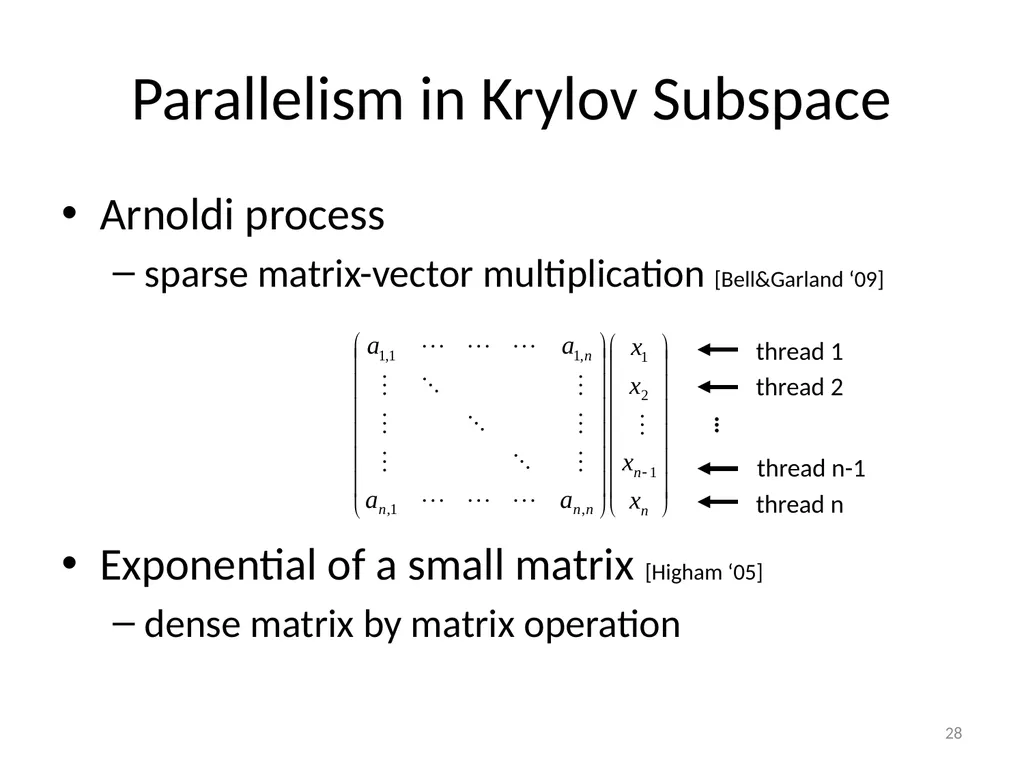
Parallelism in Krylov Subspace Arnoldi process
sparse matrix-vector multiplication [Bell&Garland ‘09]
Exponential of a small matrix [Higham ‘05]
dense matrix by matrix operation 28<br>
sparse matrix-vector multiplication [Bell&Garland ‘09]
Exponential of a small matrix [Higham ‘05]
dense matrix by matrix operation 28<br>
29
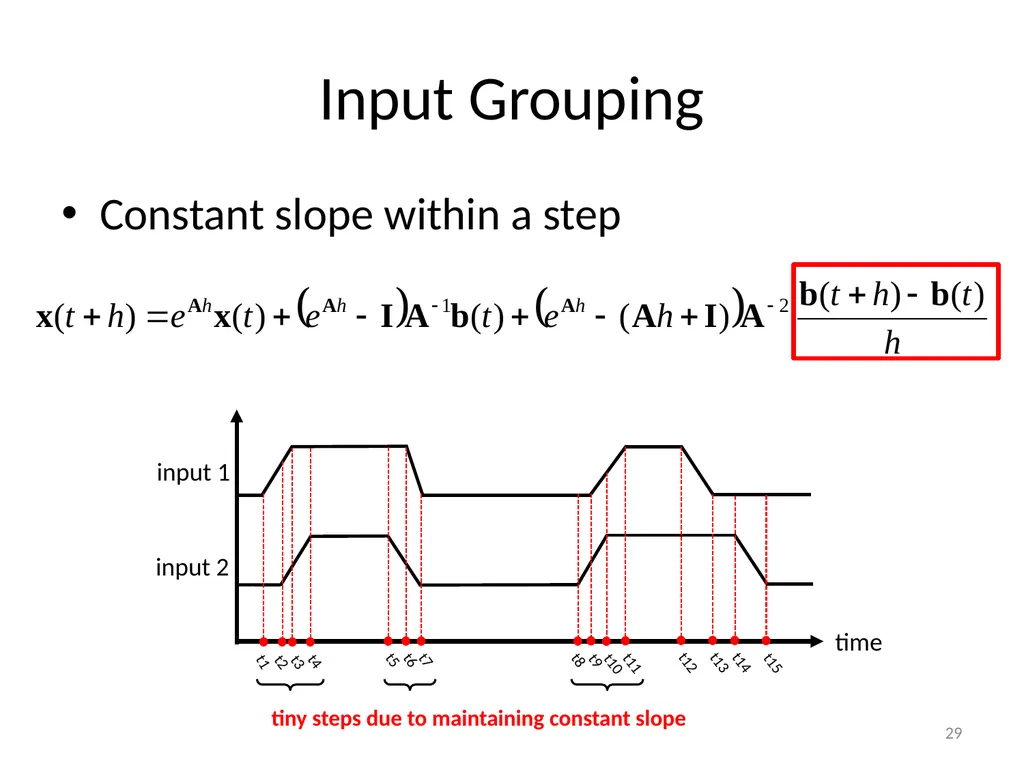
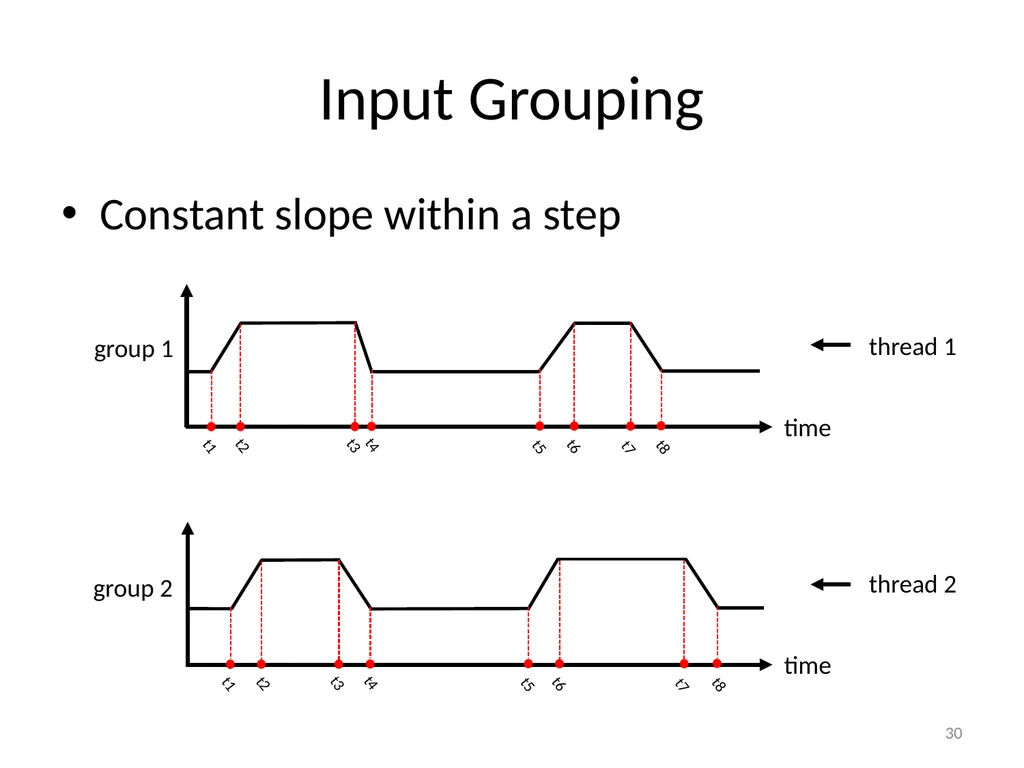
t9 Constant slope within a step Input Grouping 29 t1 t2 t3 t4 t5 t6 t7 t8 t10 t11 t12 t13 t14 t15<br>
30
Constant slope within a step Input Grouping 30 group 1 group 2 time time<br>
31
Outline Numerical Integration in Circuit Simulation
Matrix Exponential Method
Krylov Subspace Approximation
Rational Krylov Subspace Approximation
Parallelism
Experimental Results
Conclusions 31<br>
Matrix Exponential Method
Krylov Subspace Approximation
Rational Krylov Subspace Approximation
Parallelism
Experimental Results
Conclusions 31<br>
32
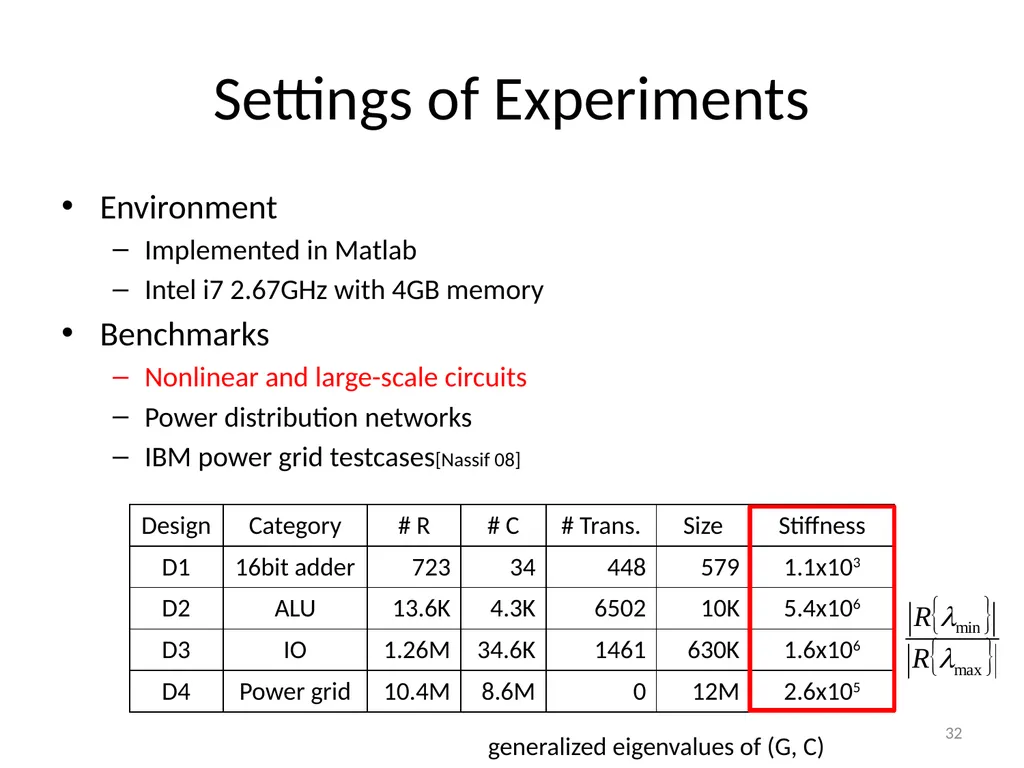
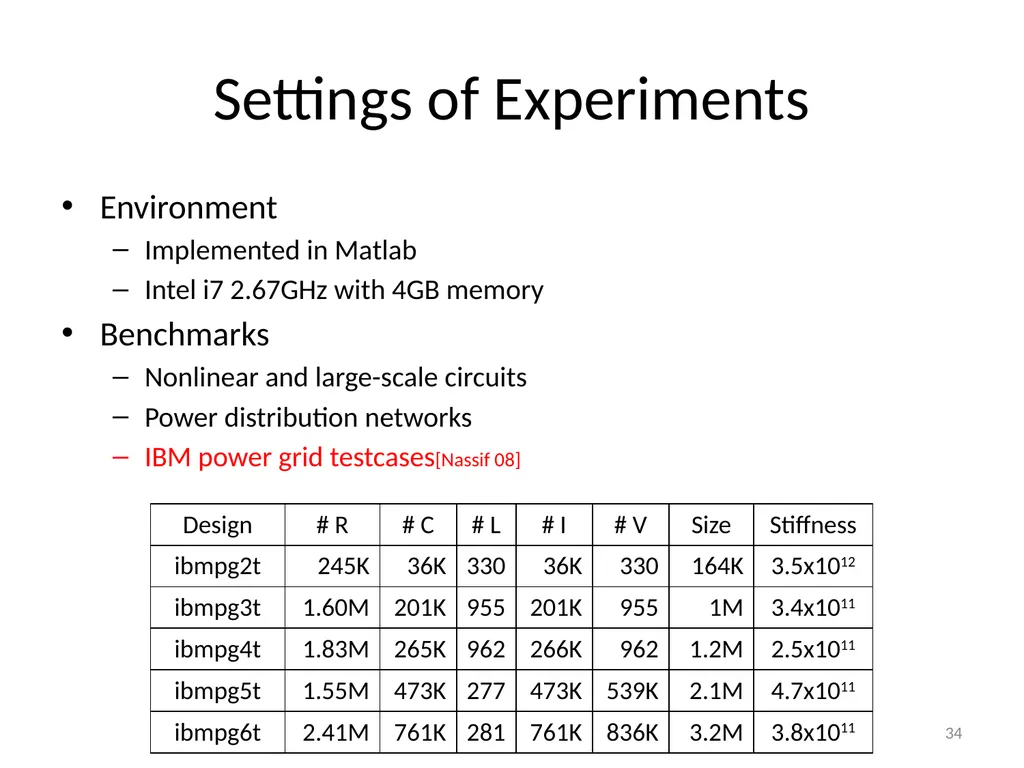
Settings of Experiments Environment
Implemented in Matlab
Intel i7 2.67GHz with 4GB memory
Benchmarks
Nonlinear and large-scale circuits
Power distribution networks
IBM power grid testcases[Nassif 08] 32 generalized eigenvalues of (G, C)<br>
Implemented in Matlab
Intel i7 2.67GHz with 4GB memory
Benchmarks
Nonlinear and large-scale circuits
Power distribution networks
IBM power grid testcases[Nassif 08] 32 generalized eigenvalues of (G, C)<br>
33
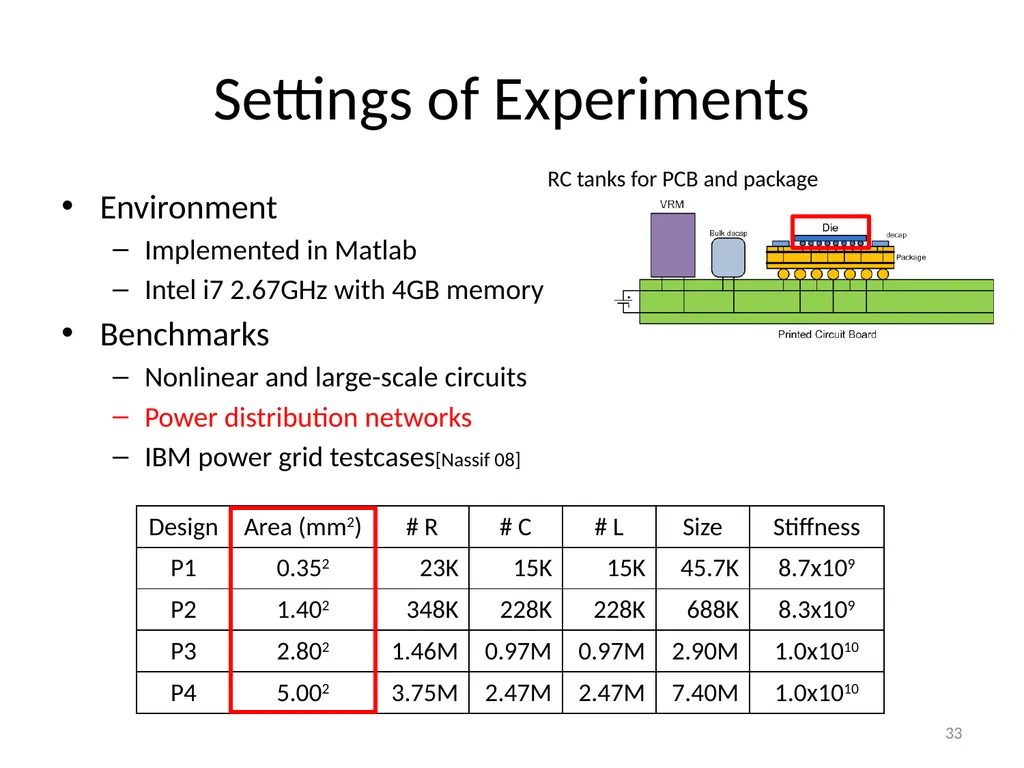
Settings of Experiments Environment
Implemented in Matlab
Intel i7 2.67GHz with 4GB memory
Benchmarks
Nonlinear and large-scale circuits
Power distribution networks
IBM power grid testcases[Nassif 08] 33 RC tanks for PCB and package<br>
Implemented in Matlab
Intel i7 2.67GHz with 4GB memory
Benchmarks
Nonlinear and large-scale circuits
Power distribution networks
IBM power grid testcases[Nassif 08] 33 RC tanks for PCB and package<br>
34
Settings of Experiments Environment
Implemented in Matlab
Intel i7 2.67GHz with 4GB memory
Benchmarks
Nonlinear and large-scale circuits
Power distribution networks
IBM power grid testcases[Nassif 08] 34<br>
Implemented in Matlab
Intel i7 2.67GHz with 4GB memory
Benchmarks
Nonlinear and large-scale circuits
Power distribution networks
IBM power grid testcases[Nassif 08] 34<br>
35
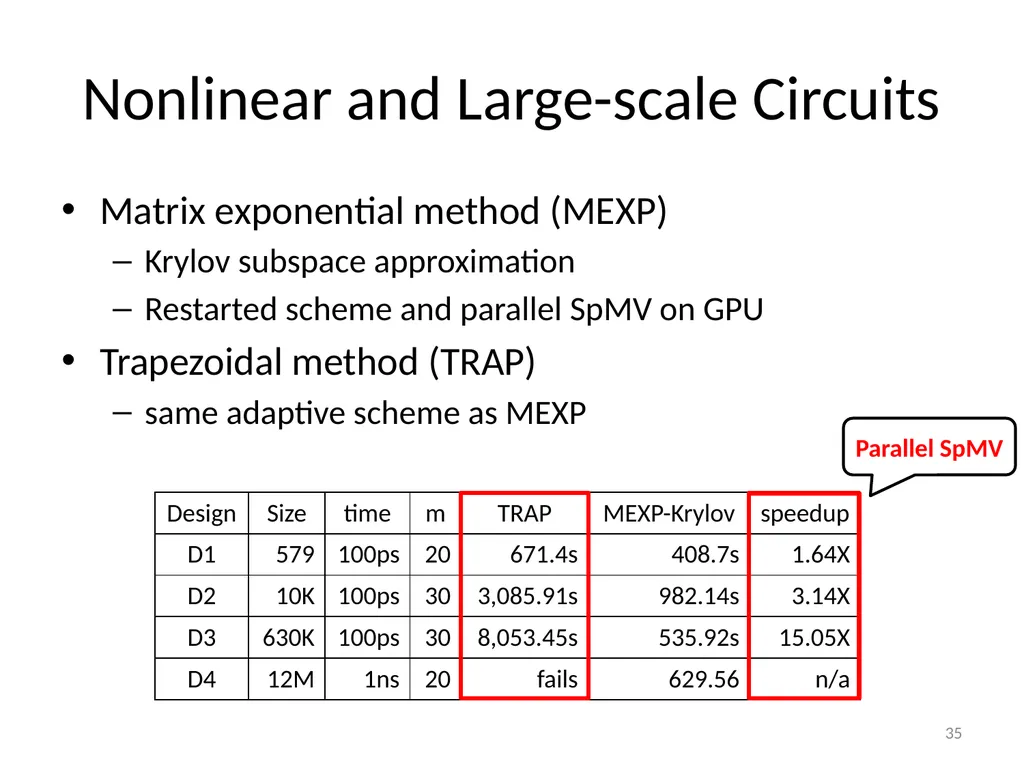
Nonlinear and Large-scale Circuits Matrix exponential method (MEXP)
Krylov subspace approximation
Restarted scheme and parallel SpMV on GPU
Trapezoidal method (TRAP)
same adaptive scheme as MEXP 35 Parallel SpMV<br>
Krylov subspace approximation
Restarted scheme and parallel SpMV on GPU
Trapezoidal method (TRAP)
same adaptive scheme as MEXP 35 Parallel SpMV<br>
36
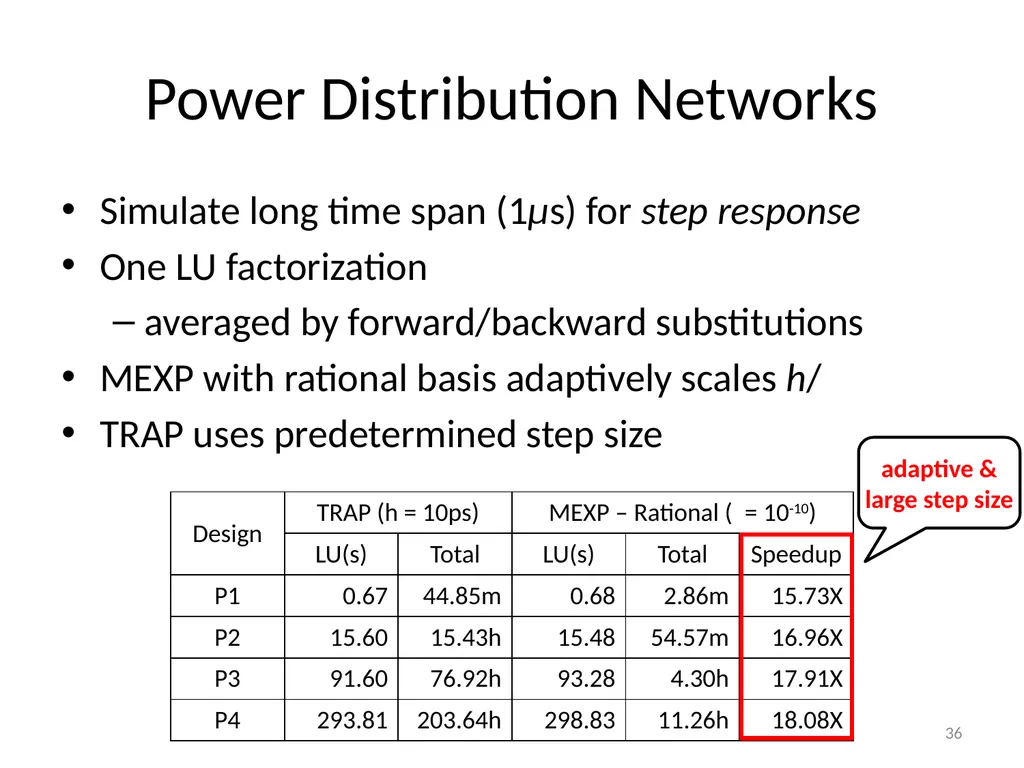
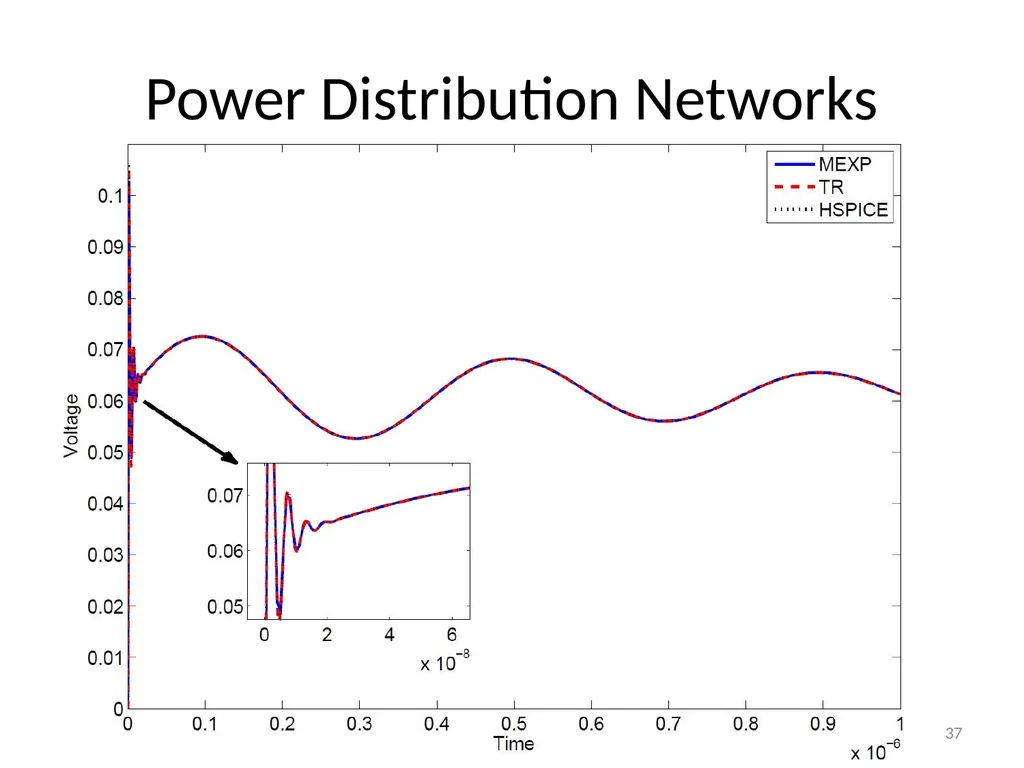
Power Distribution Networks Simulate long time span (1μs) for step response
One LU factorization
averaged by forward/backward substitutions
MEXP with rational basis adaptively scales h/
TRAP uses predetermined step size 36 adaptive & large step size<br>
One LU factorization
averaged by forward/backward substitutions
MEXP with rational basis adaptively scales h/
TRAP uses predetermined step size 36 adaptive & large step size<br>
37
Power Distribution Networks 37<br>
38
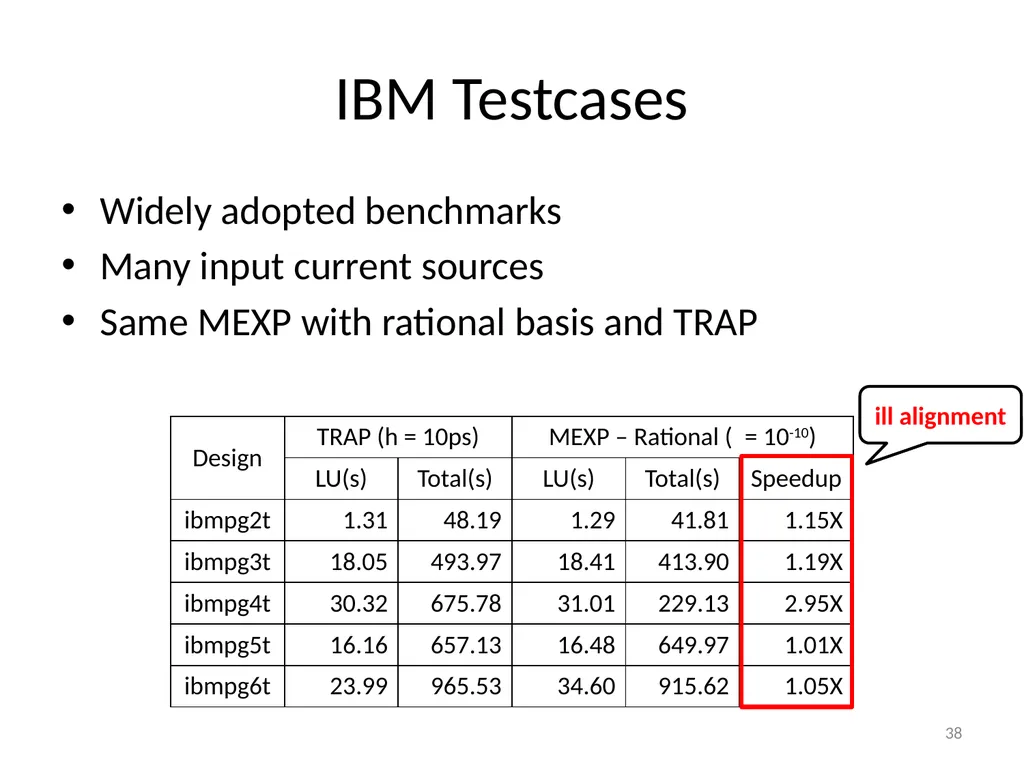
IBM Testcases Widely adopted benchmarks
Many input current sources
Same MEXP with rational basis and TRAP 38 ill alignment<br>
Many input current sources
Same MEXP with rational basis and TRAP 38 ill alignment<br>
39
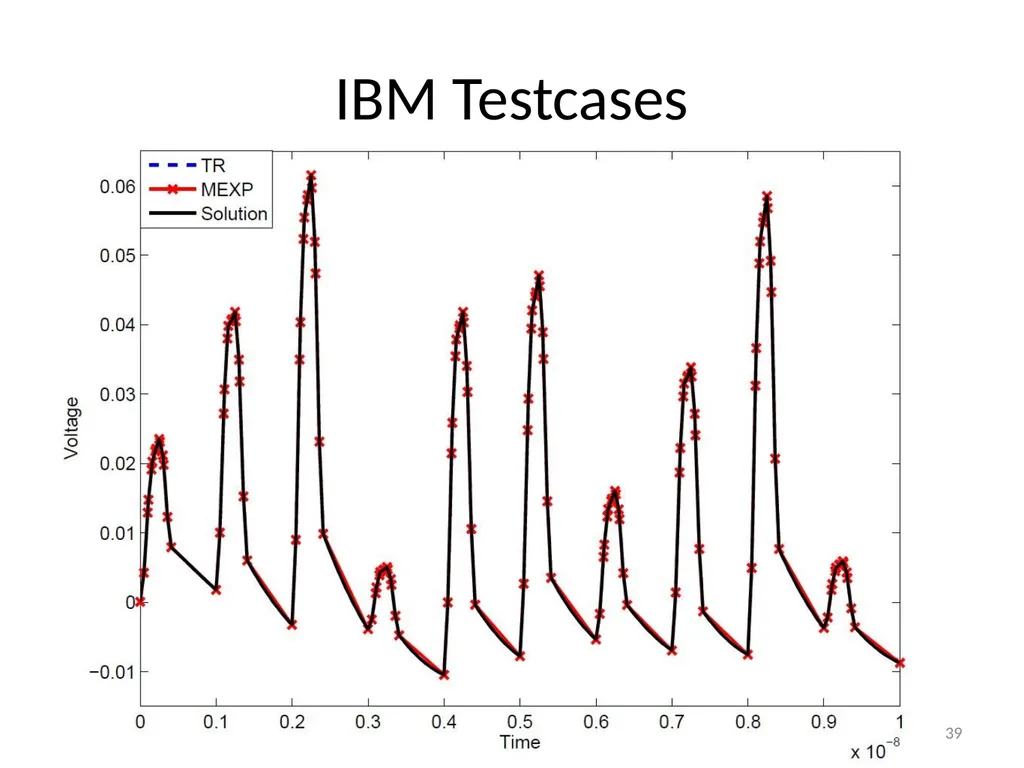
IBM Testcases 39<br>
40
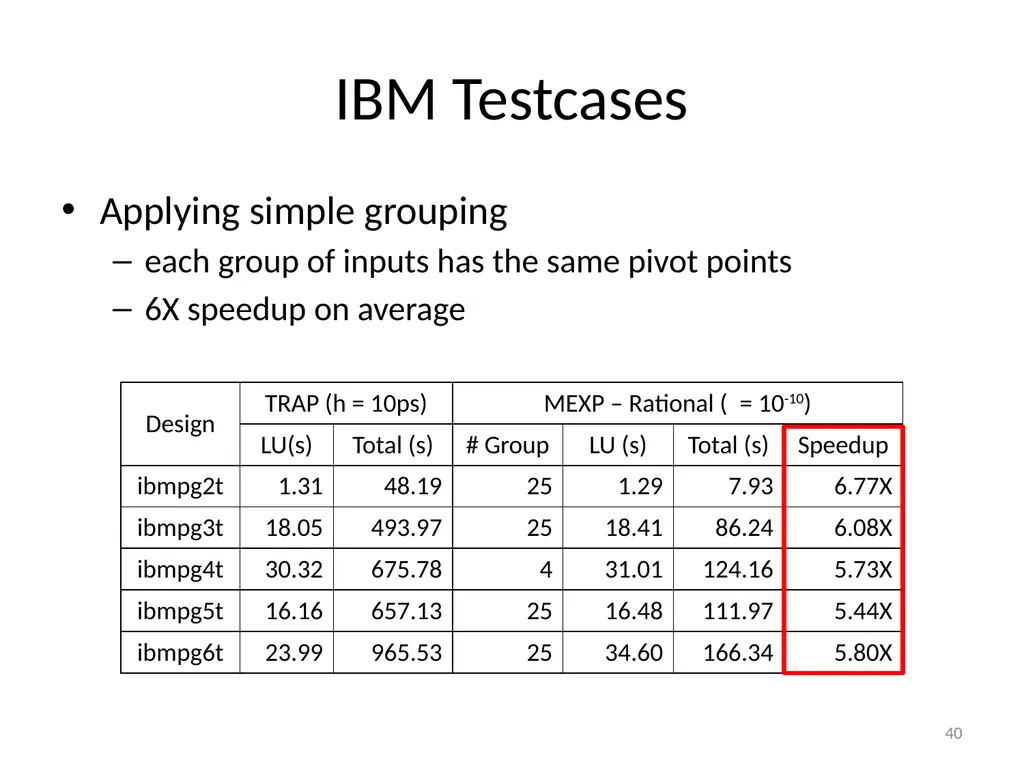
Applying simple grouping
each group of inputs has the same pivot points
6X speedup on average IBM Testcases 40<br>
each group of inputs has the same pivot points
6X speedup on average IBM Testcases 40<br>
41
Conclusions Emerging challenges in the circuit simulation
scalability and performance
Matrix exponential method
accuracy, adaptivity and stability
regular and rational Krylov subspace approximation
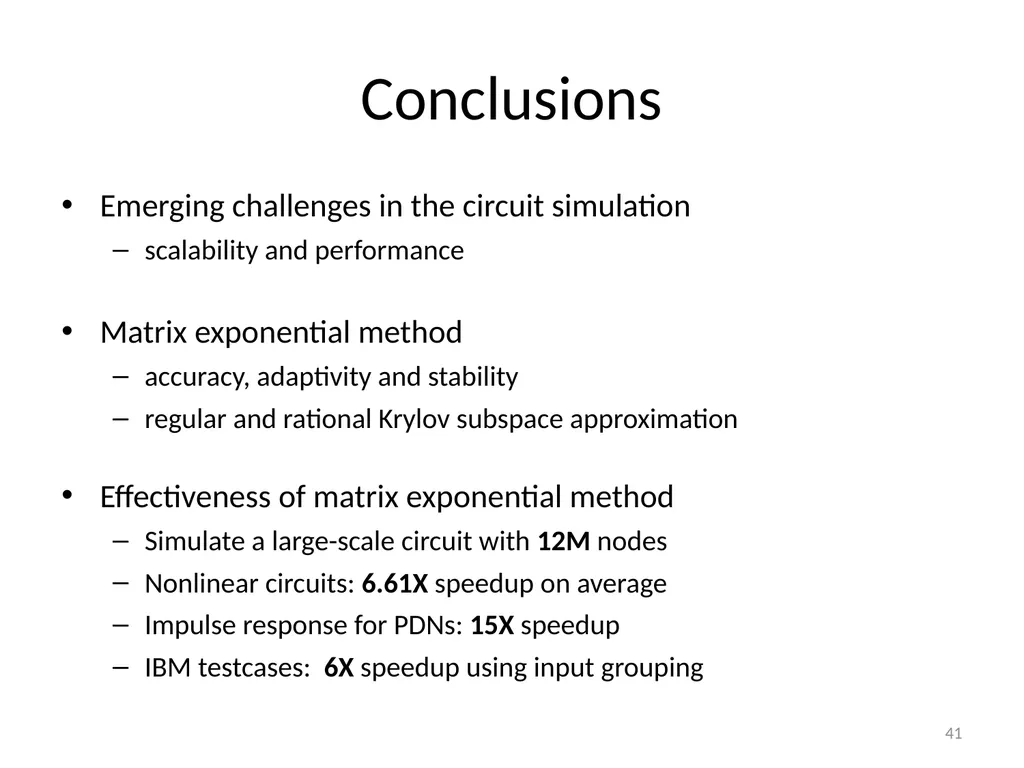
Effectiveness of matrix exponential method
Simulate a large-scale circuit with 12M nodes
Nonlinear circuits: 6.61X speedup on average
Impulse response for PDNs: 15X speedup
IBM testcases: 6X speedup using input grouping 41<br>
scalability and performance
Matrix exponential method
accuracy, adaptivity and stability
regular and rational Krylov subspace approximation
Effectiveness of matrix exponential method
Simulate a large-scale circuit with 12M nodes
Nonlinear circuits: 6.61X speedup on average
Impulse response for PDNs: 15X speedup
IBM testcases: 6X speedup using input grouping 41<br>
42
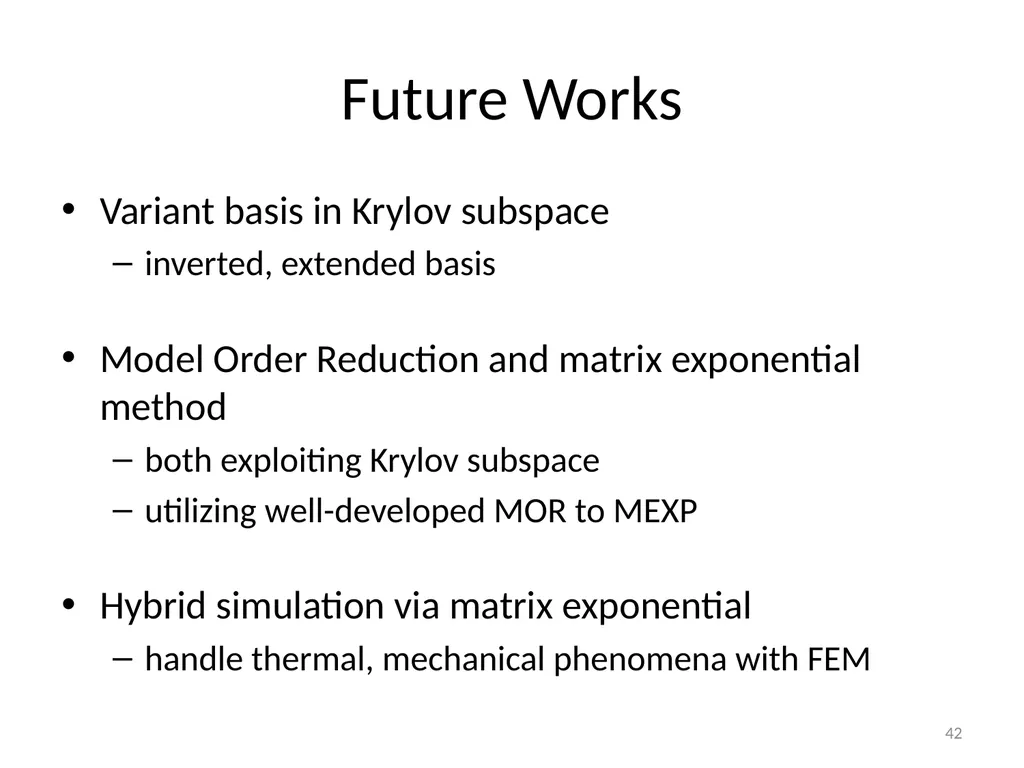
Future Works Variant basis in Krylov subspace
inverted, extended basis
Model Order Reduction and matrix exponential method
both exploiting Krylov subspace
utilizing well-developed MOR to MEXP
Hybrid simulation via matrix exponential
handle thermal, mechanical phenomena with FEM 42<br>
inverted, extended basis
Model Order Reduction and matrix exponential method
both exploiting Krylov subspace
utilizing well-developed MOR to MEXP
Hybrid simulation via matrix exponential
handle thermal, mechanical phenomena with FEM 42<br>
43
Thank you! 43<br>
44
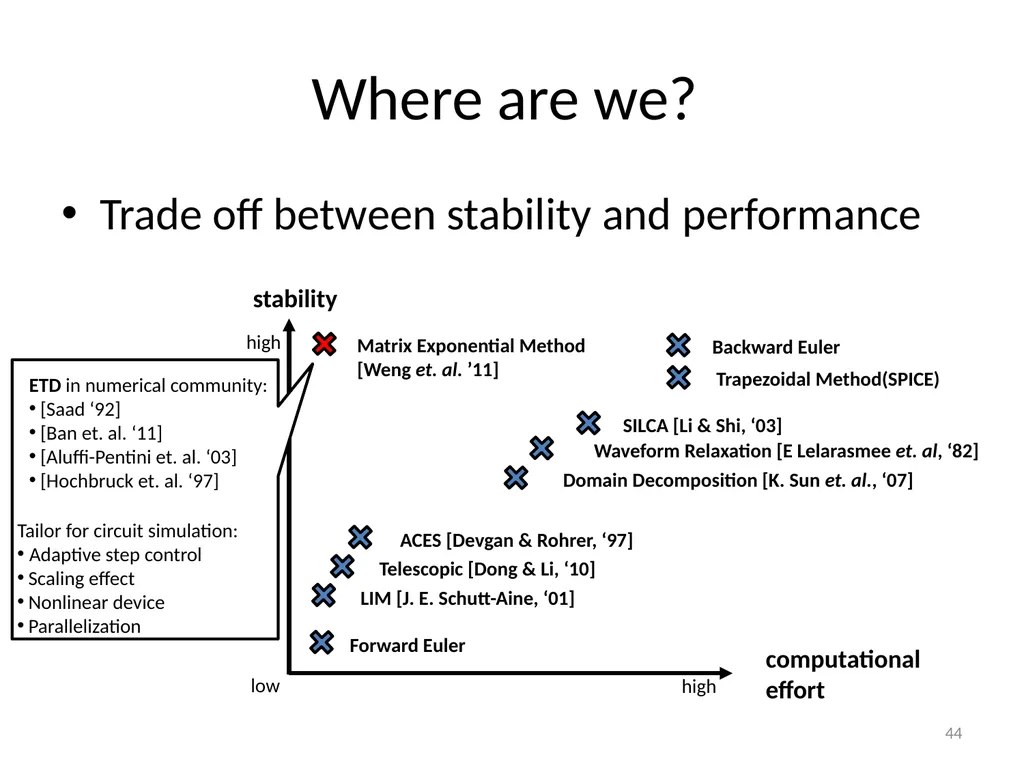
Trade off between stability and performance Where are we? 44 computational
effort stability high low high Tailor for circuit simulation:
Adaptive step control
Scaling effect
Nonlinear device
Parallelization ETD in numerical community:
[Saad ‘92]
[Ban et. al. ‘11]
[Aluffi-Pentini et. al. ‘03]
[Hochbruck et. al. ‘97]<br>
effort stability high low high Tailor for circuit simulation:
Adaptive step control
Scaling effect
Nonlinear device
Parallelization ETD in numerical community:
[Saad ‘92]
[Ban et. al. ‘11]
[Aluffi-Pentini et. al. ‘03]
[Hochbruck et. al. ‘97]<br>
45
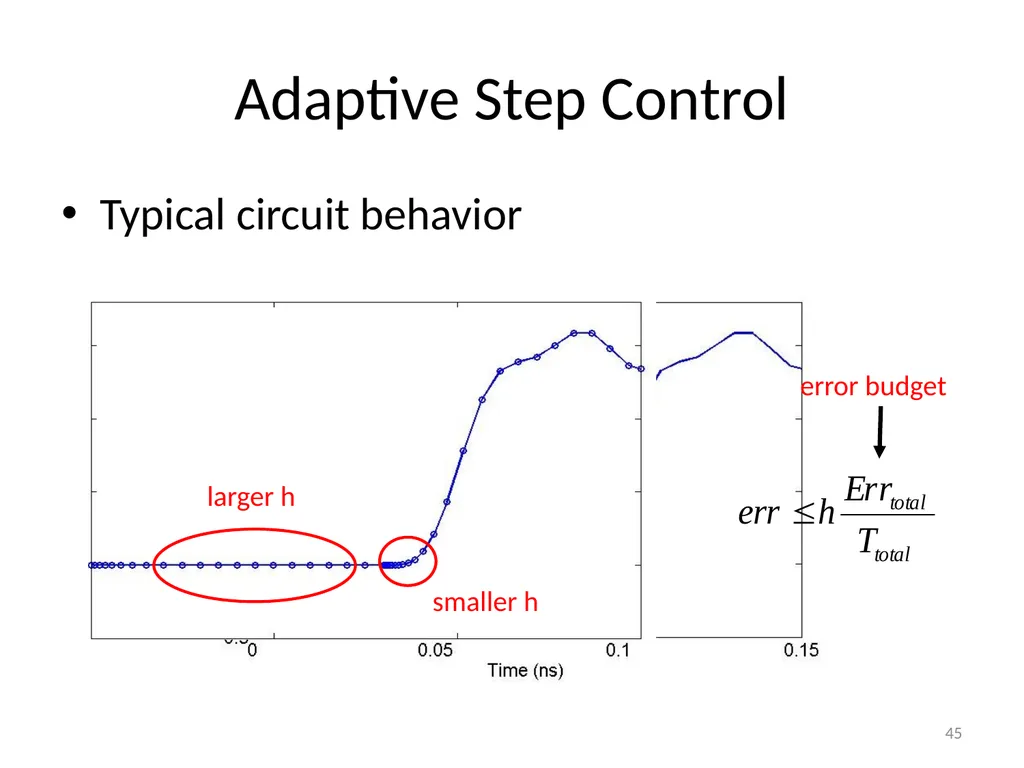
Adaptive Step Control Typical circuit behavior 45 larger h smaller h<br>
46
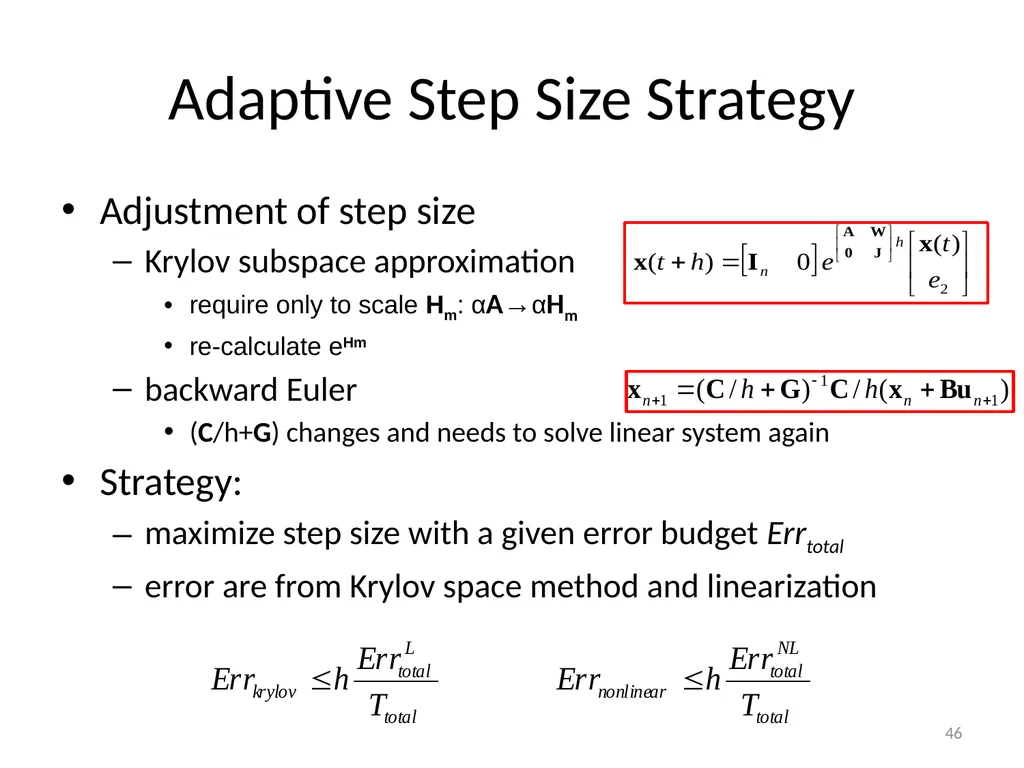
Adaptive Step Size Strategy Adjustment of step size
Krylov subspace approximation
require only to scale Hm: αA→αHm
re-calculate eHm
backward Euler
(C/h+G) changes and needs to solve linear system again
Strategy:
maximize step size with a given error budget Errtotal
error are from Krylov space method and linearization 46<br>
Krylov subspace approximation
require only to scale Hm: αA→αHm
re-calculate eHm
backward Euler
(C/h+G) changes and needs to solve linear system again
Strategy:
maximize step size with a given error budget Errtotal
error are from Krylov space method and linearization 46<br>
47
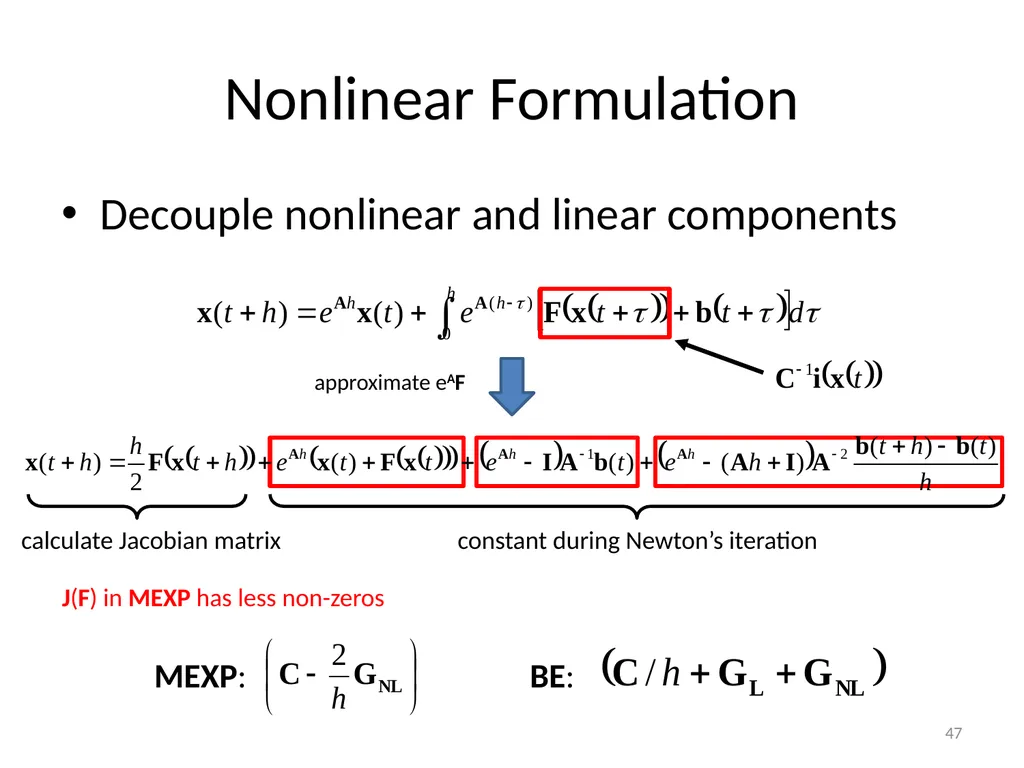
Nonlinear Formulation Decouple nonlinear and linear components 47 J(F) in MEXP has less non-zeros<br>
48
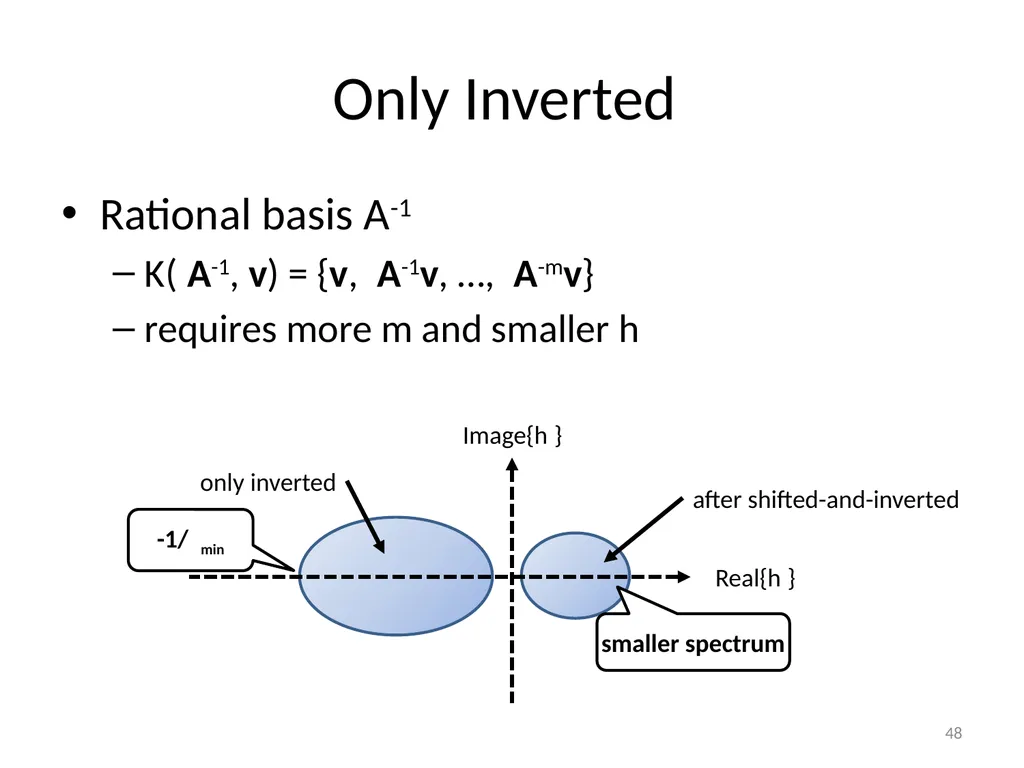
Rational basis A-1
K(A-1, v) = {v, A-1v, …, A-mv}
requires more m and smaller h Only Inverted 48 Image{h} Real{h} after shifted-and-inverted only inverted smaller spectrum -1/ min<br>
K(A-1, v) = {v, A-1v, …, A-mv}
requires more m and smaller h Only Inverted 48 Image{h} Real{h} after shifted-and-inverted only inverted smaller spectrum -1/ min<br>
49
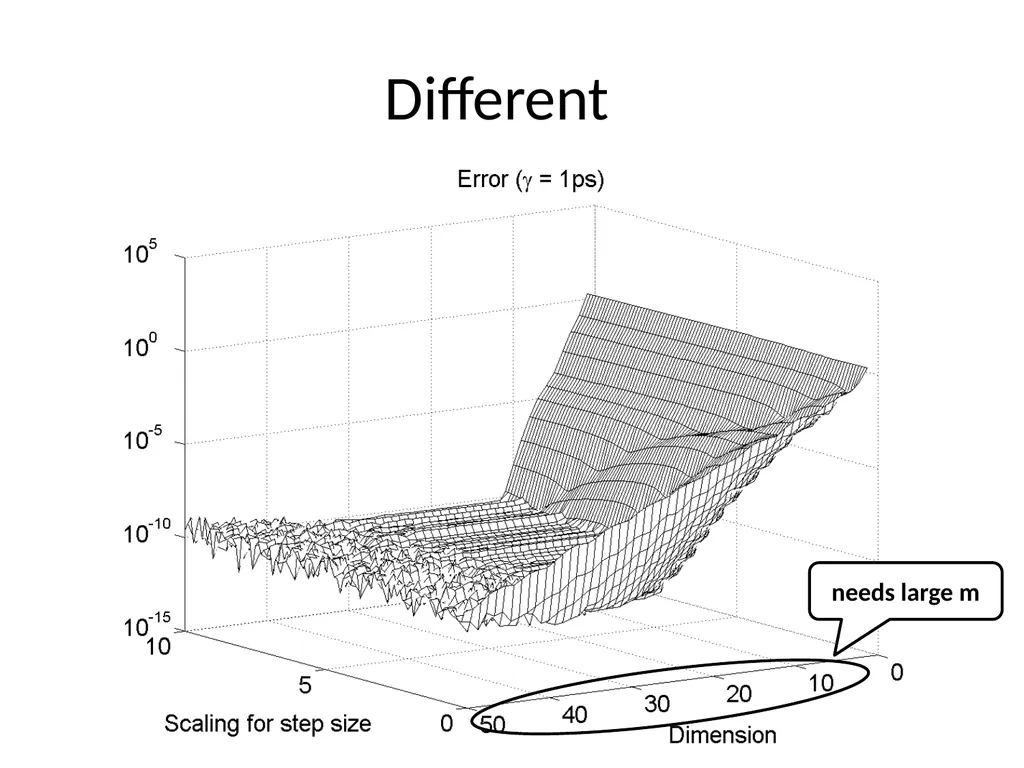
Different 49<br>
50
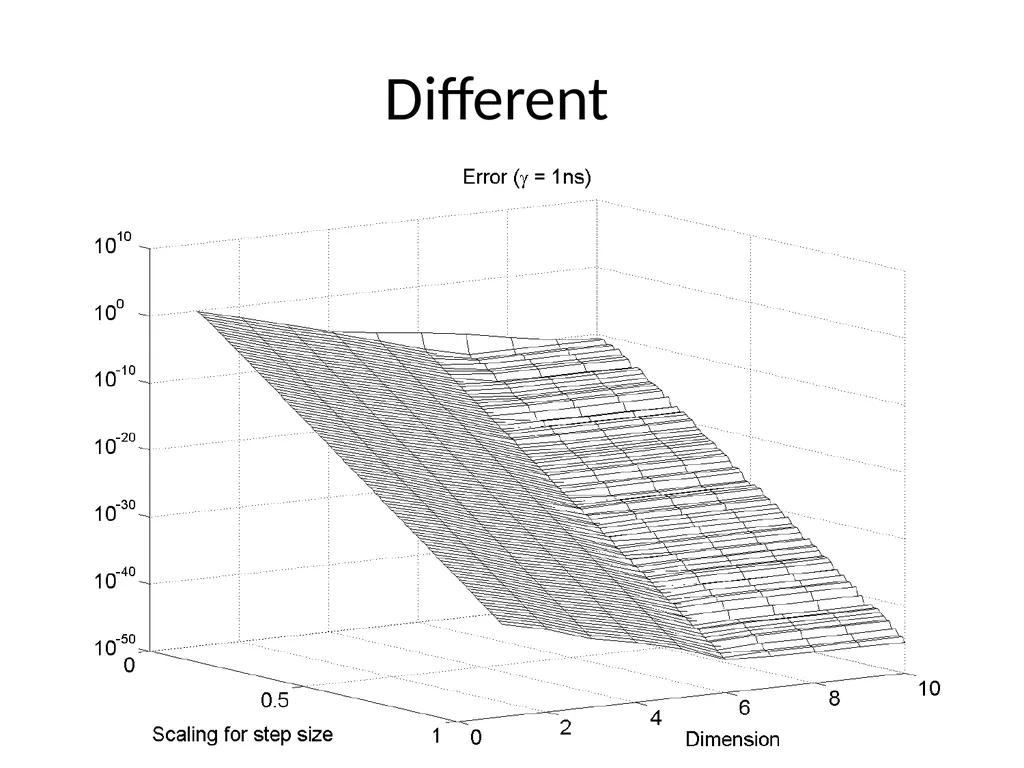
Different 50<br>
51
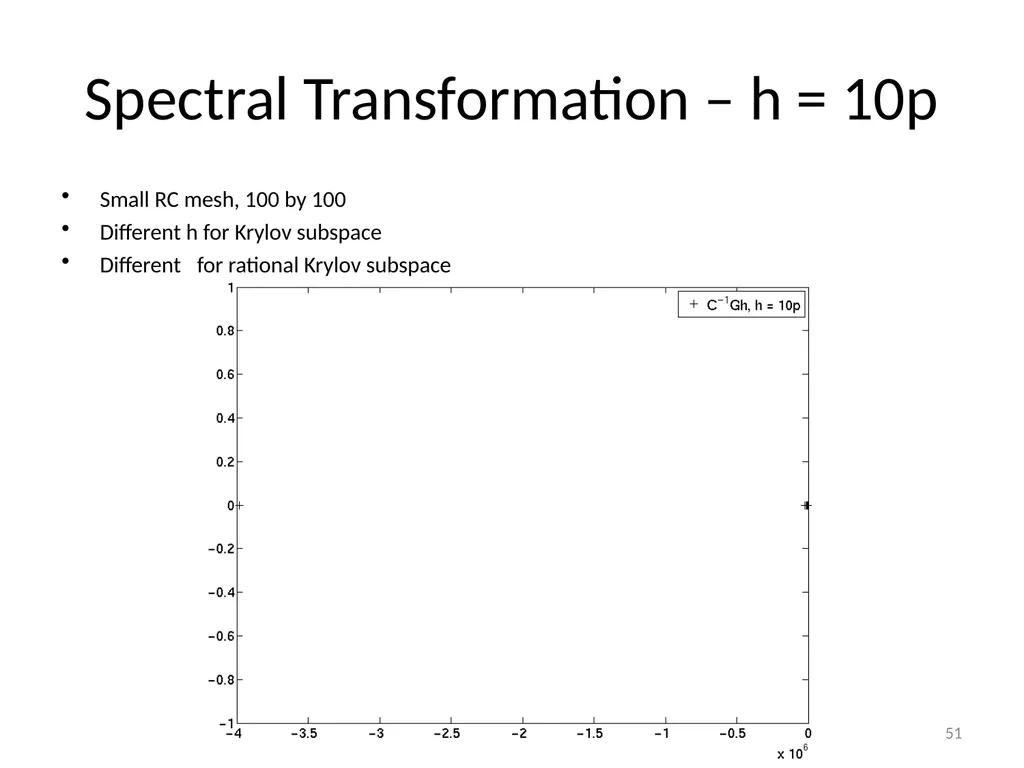
Spectral Transformation – h = 10p Small RC mesh, 100 by 100
Different h for Krylov subspace
Different for rational Krylov subspace 51<br>
Different h for Krylov subspace
Different for rational Krylov subspace 51<br>
52
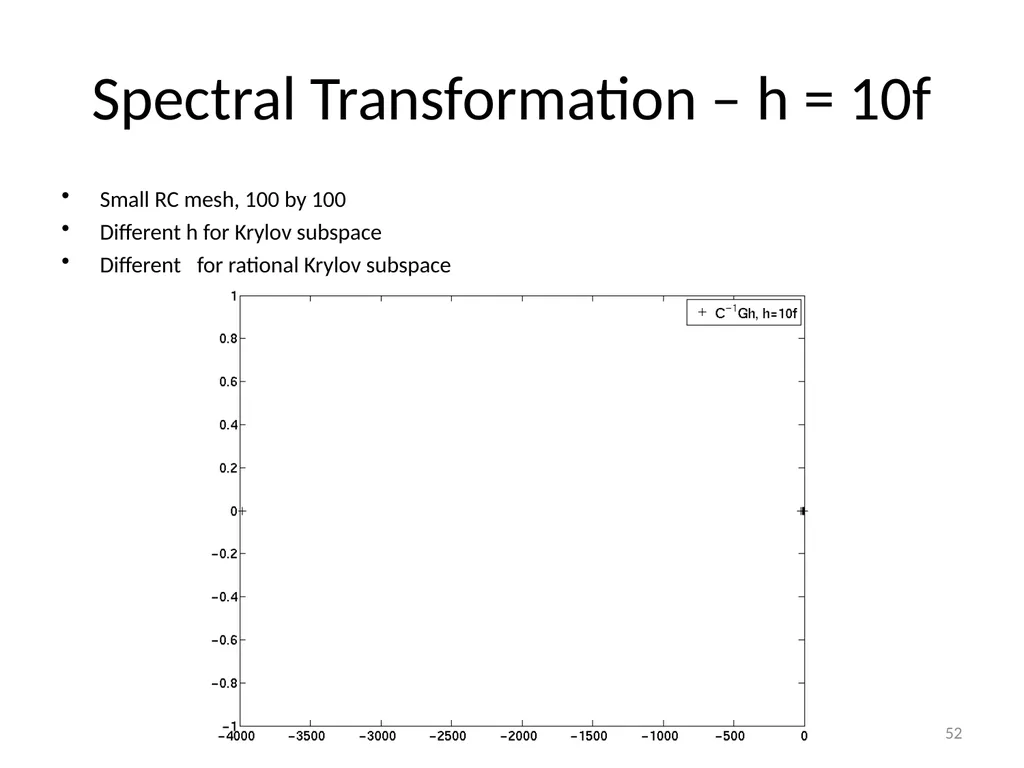
Spectral Transformation – h = 10f Small RC mesh, 100 by 100
Different h for Krylov subspace
Different for rational Krylov subspace 52<br>
Different h for Krylov subspace
Different for rational Krylov subspace 52<br>
53
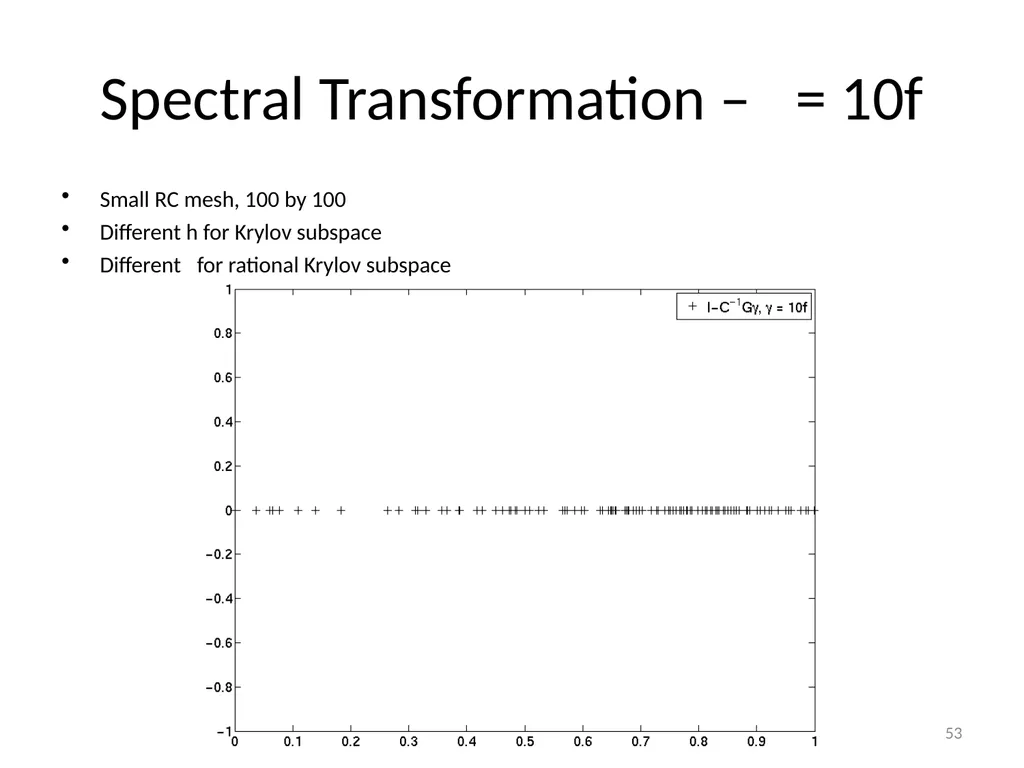
Spectral Transformation – = 10f Small RC mesh, 100 by 100
Different h for Krylov subspace
Different for rational Krylov subspace 53<br>
Different h for Krylov subspace
Different for rational Krylov subspace 53<br>
54
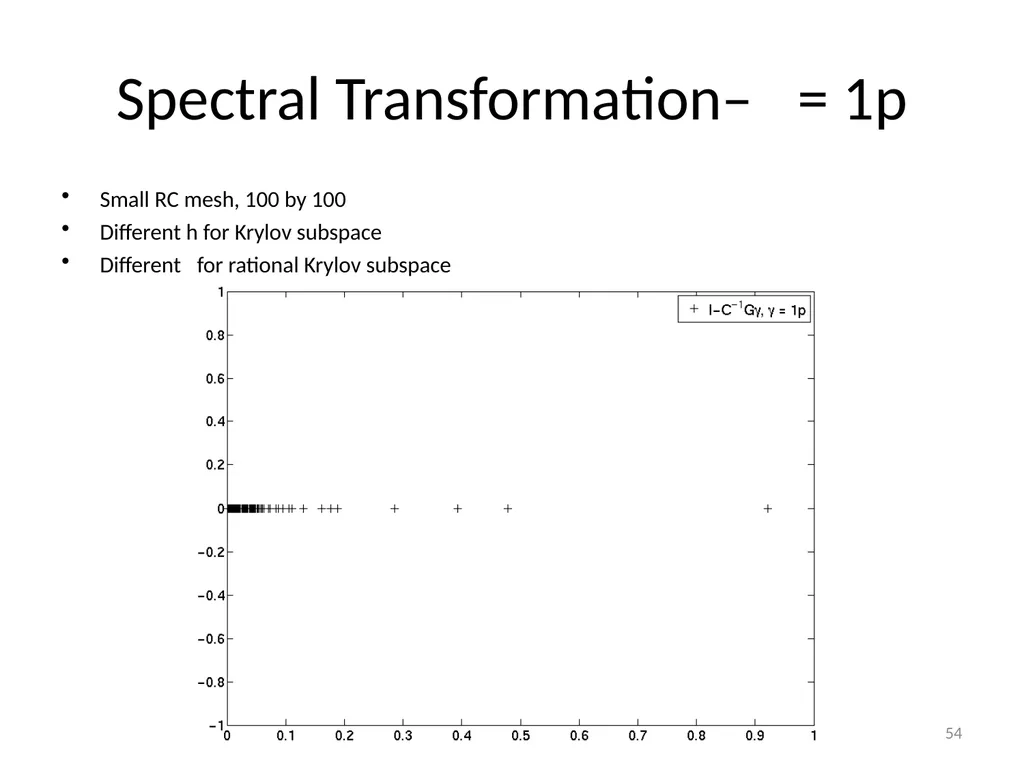
Spectral Transformation– = 1p Small RC mesh, 100 by 100
Different h for Krylov subspace
Different for rational Krylov subspace 54<br>
Different h for Krylov subspace
Different for rational Krylov subspace 54<br>
55
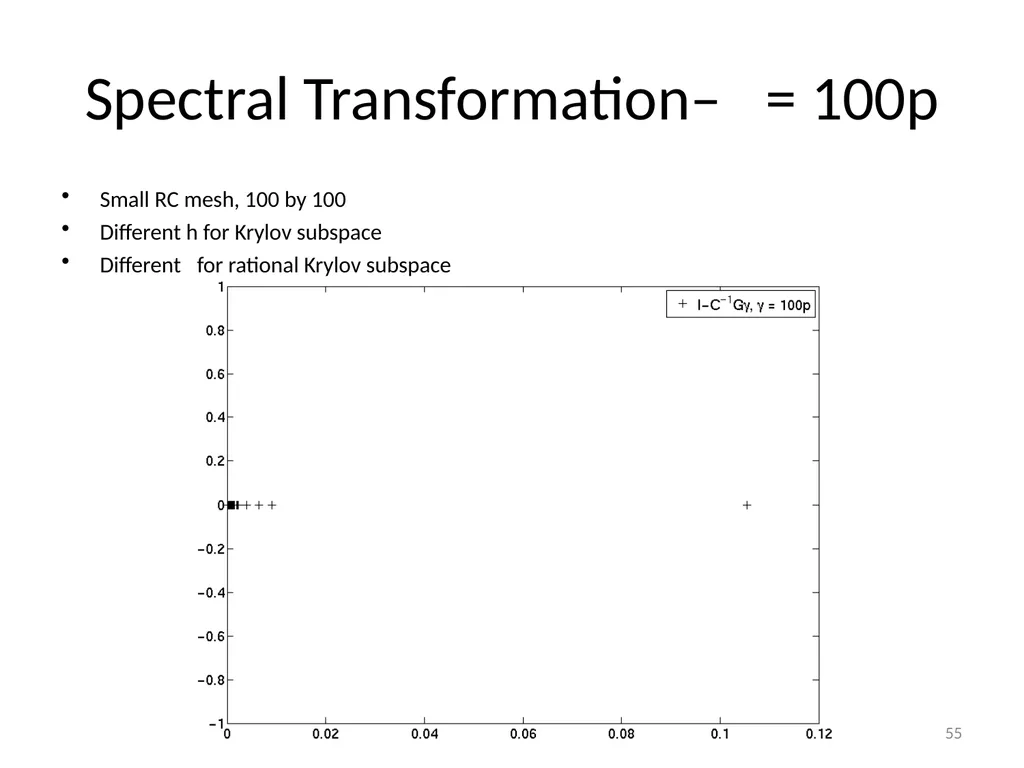
Spectral Transformation– = 100p Small RC mesh, 100 by 100
Different h for Krylov subspace
Different for rational Krylov subspace 55<br>
Different h for Krylov subspace
Different for rational Krylov subspace 55<br>
56
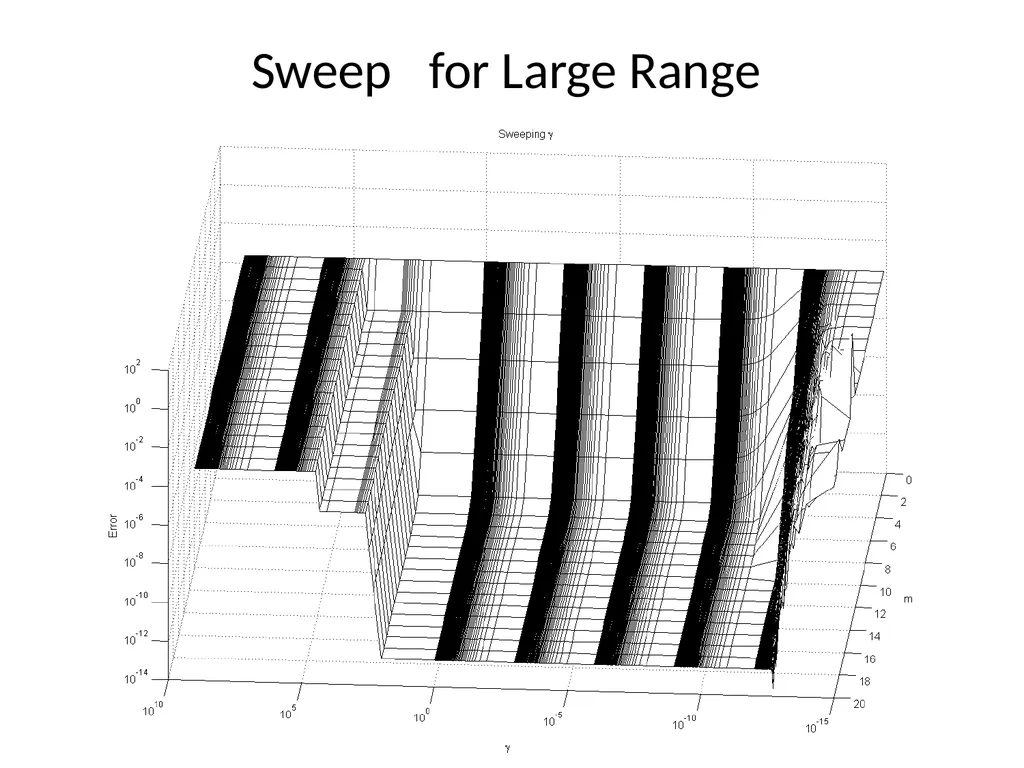
Sweep for Large Range 56<br>
57
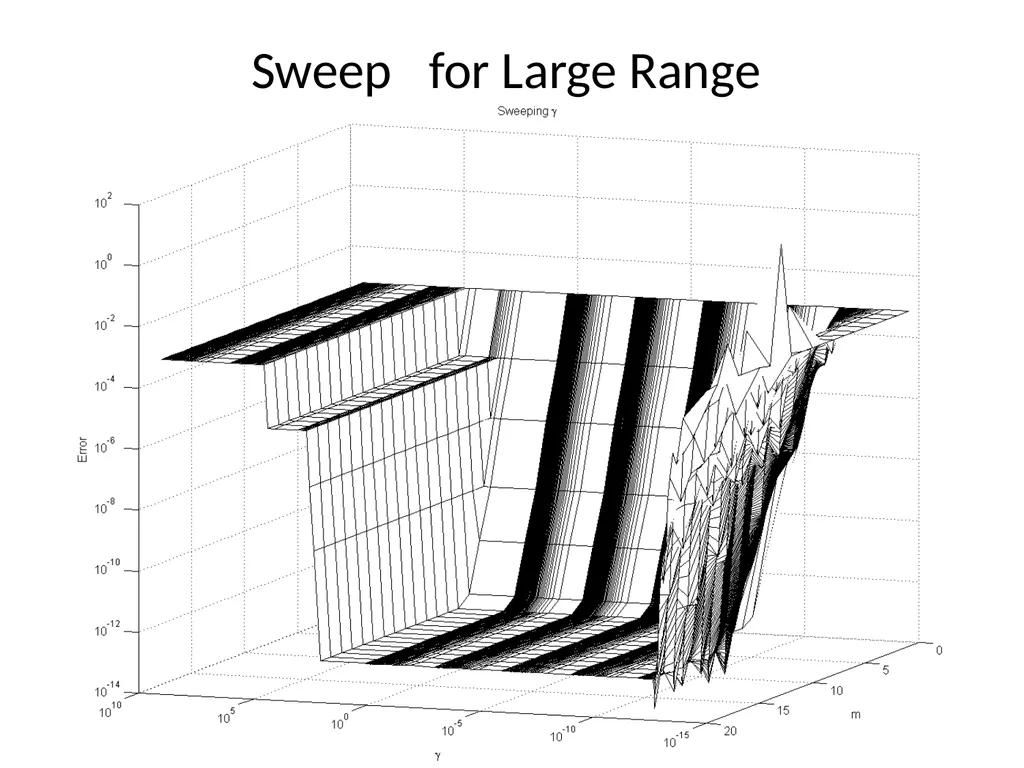
Sweep for Large Range 57<br>
58
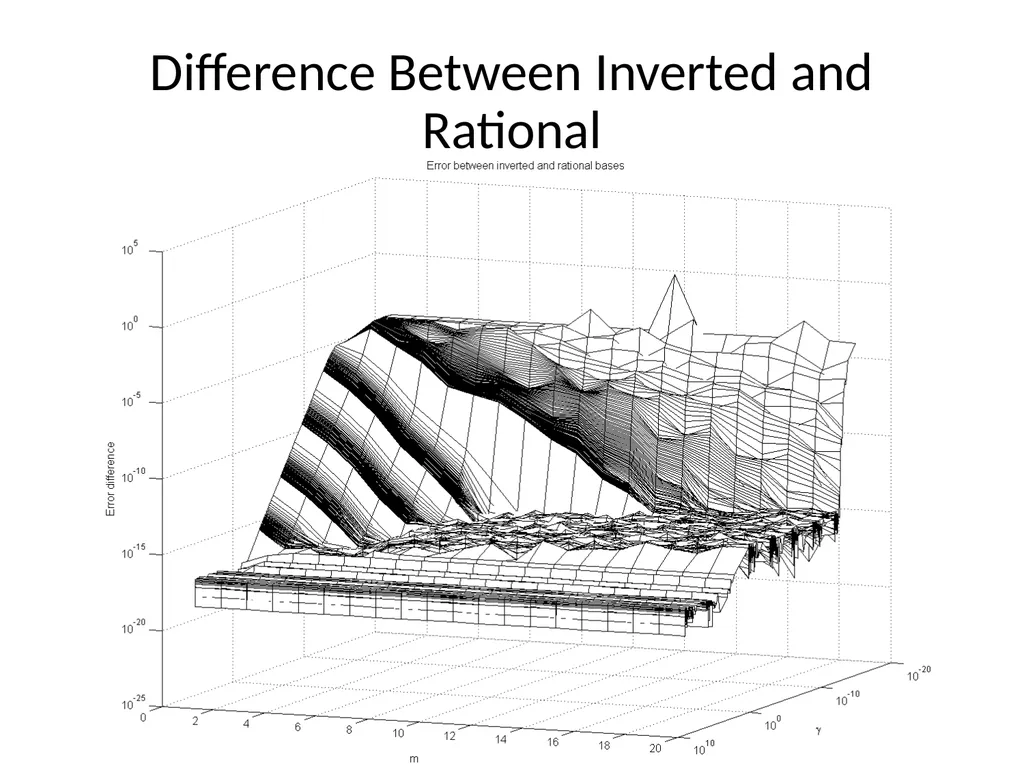
Difference Between Inverted and Rational 58<br>
59
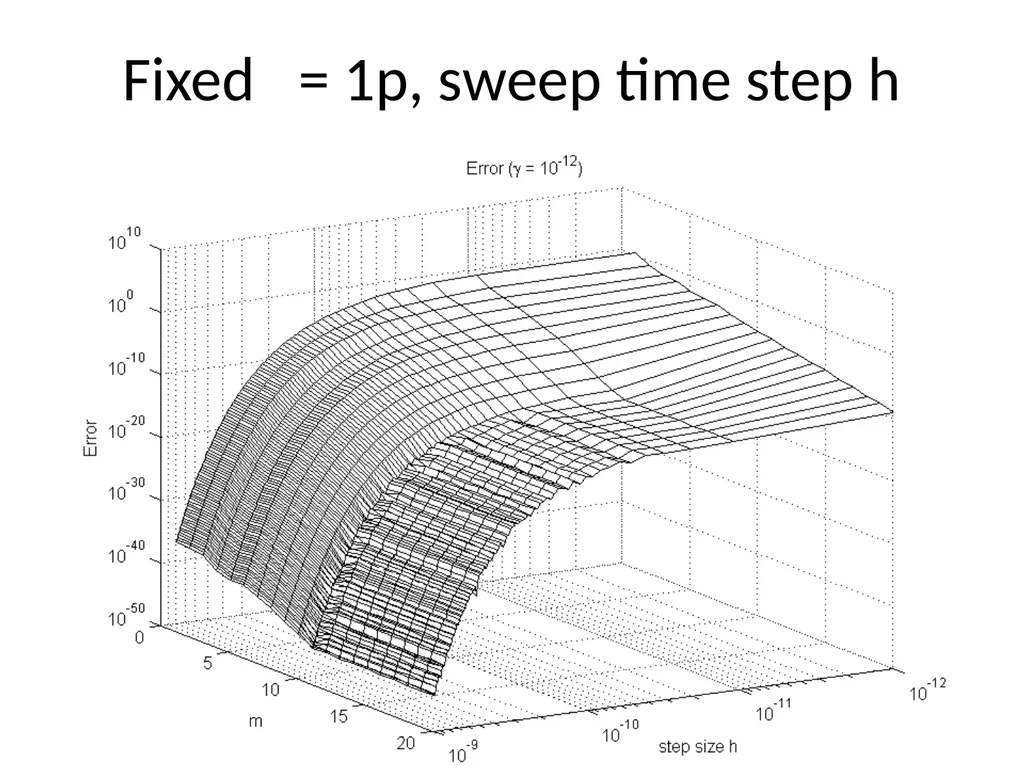
Fixed = 1p, sweep time step h 59<br>
60
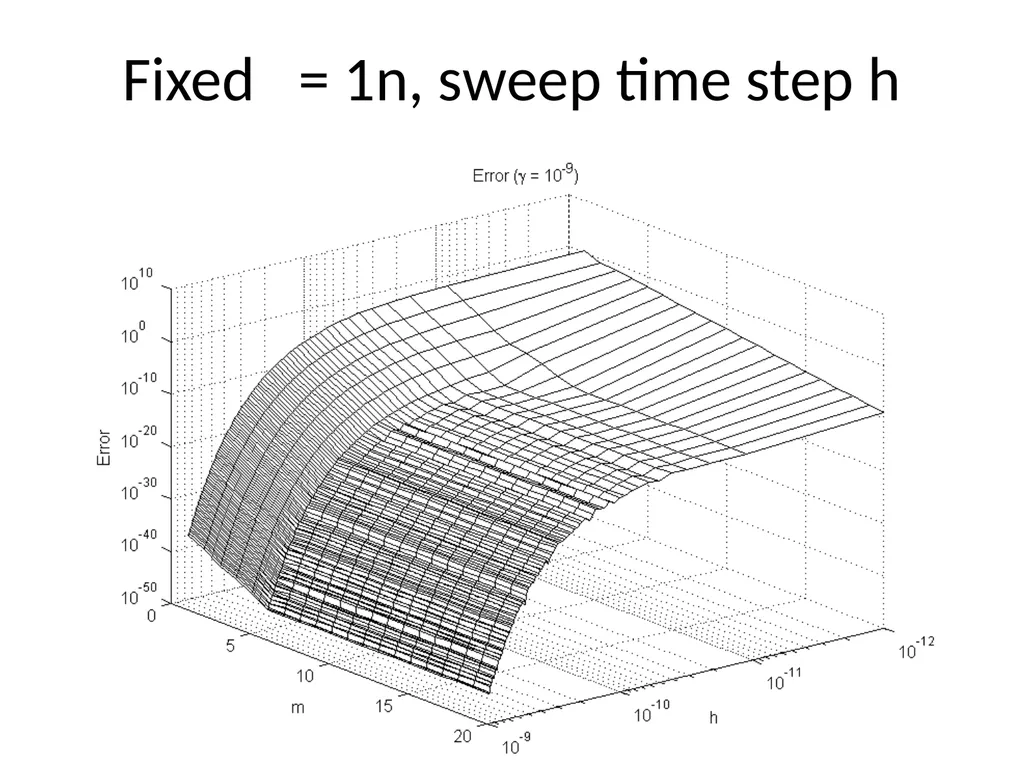
Fixed = 1n, sweep time step h 60<br>
61
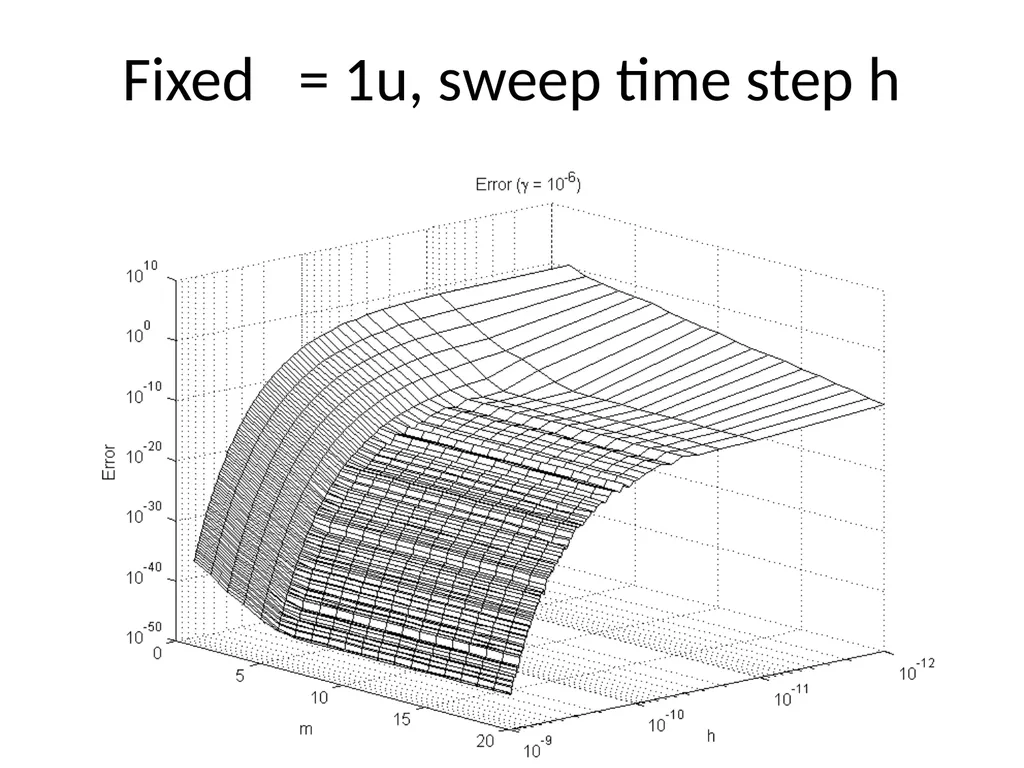
Fixed = 1u, sweep time step h 61<br>
62
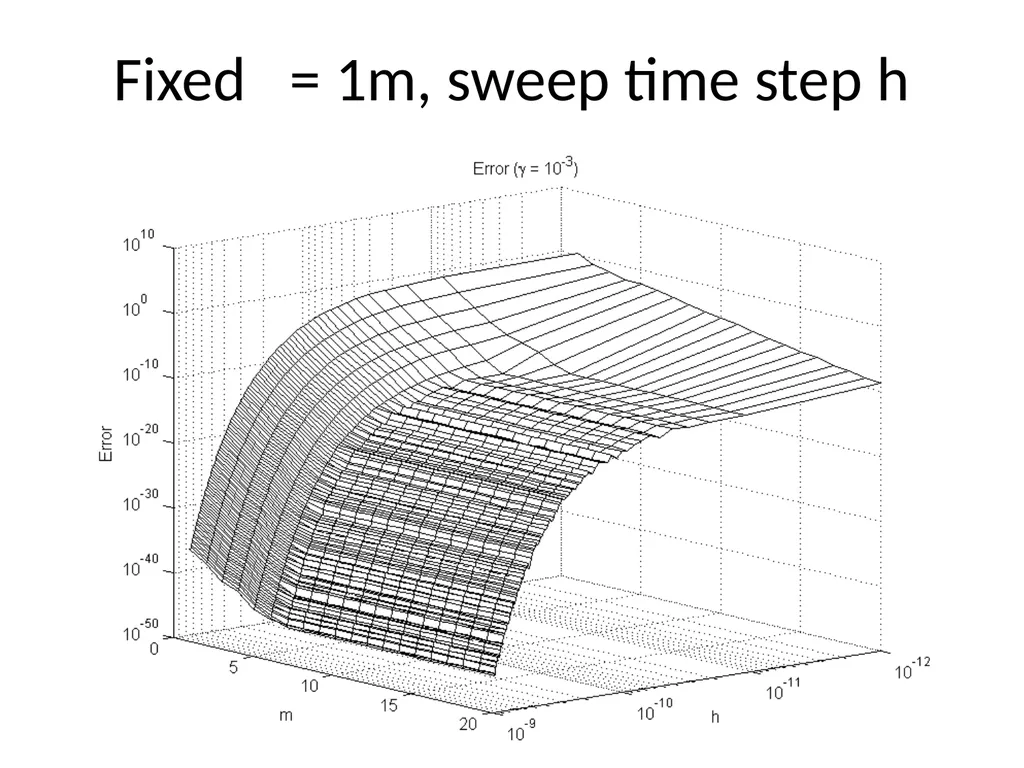
Fixed = 1m, sweep time step h 62<br>
63
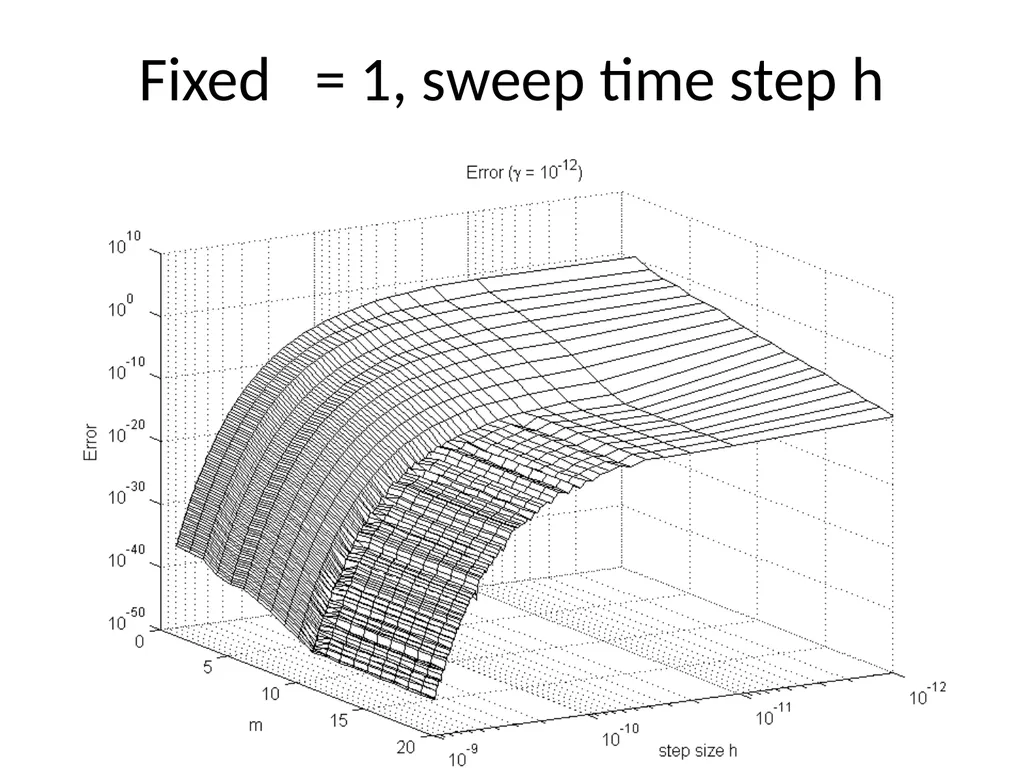
Fixed = 1, sweep time step h 63<br>
64
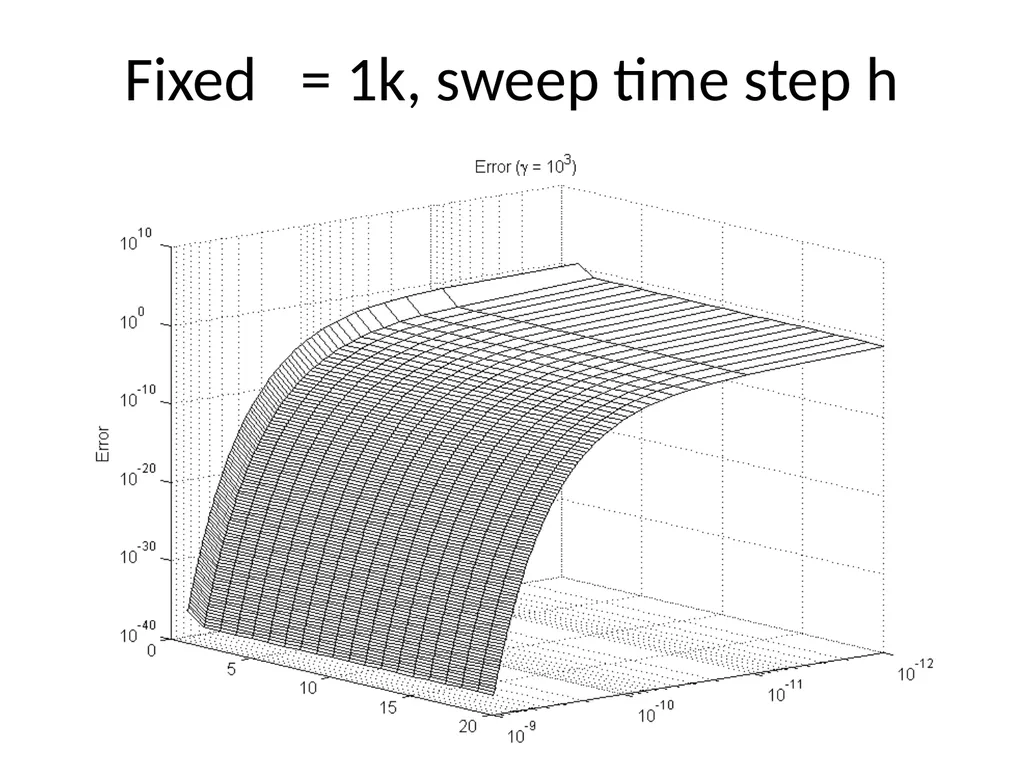
Fixed = 1k, sweep time step h 64<br>
65
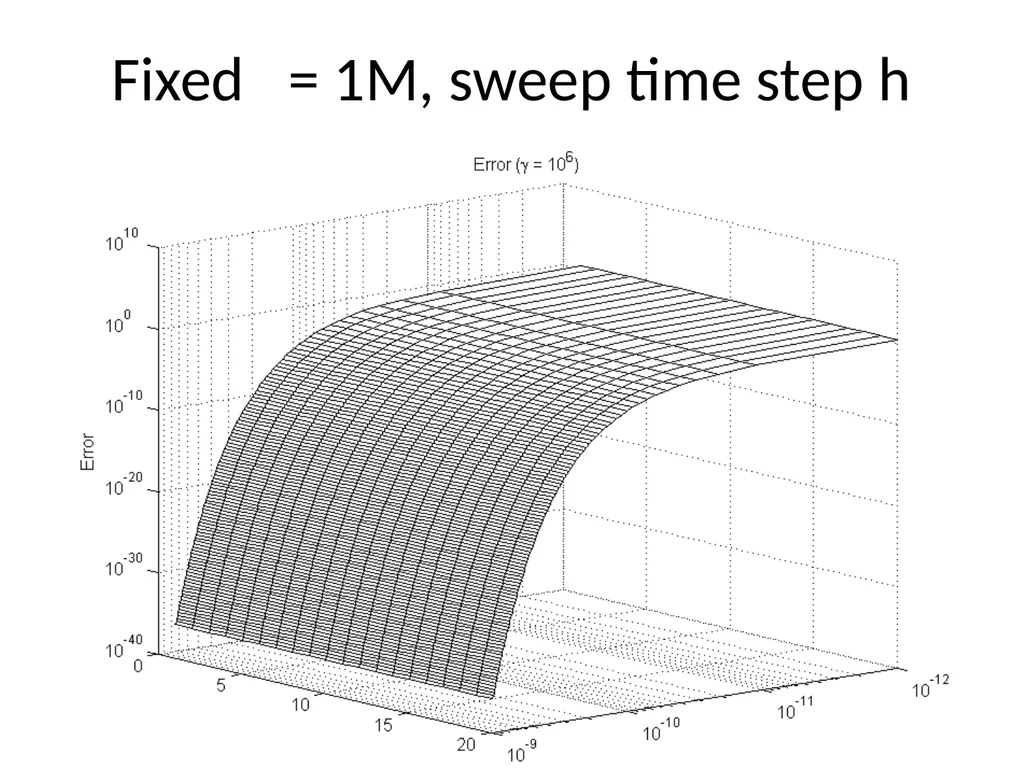
Fixed = 1M, sweep time step h 65<br>