Civil society guide on working with the UNCAC Mirella Dummar Frahi Civil Society Team Leader, UNODC Plus, general opportunities for capacity building, networking, on International Anti-Corruption Day, and fundraising Introduction to the
"Civil society guide on working with the UNCAC" is the property of its rightful owner. Permission is granted to
download and print the materials on this website for personal, non-commercial use only, and to display it
on your personal computer provided you do not modify the materials and that you retain all copyright
notices contained in the materials. By downloading content from our website, you accept the terms of this
agreement.
Presentation Transcript
01
Civil society guide on working with the UNCAC Mirella Dummar Frahi
Civil Society Team Leader, UNODC<br>
02
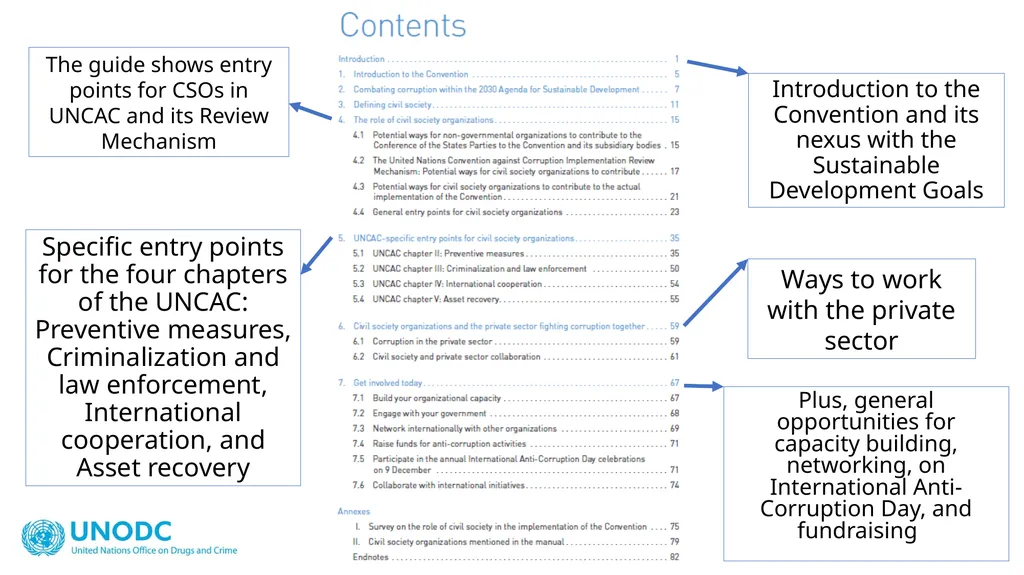
Plus, general opportunities for capacity building, networking, on International Anti-Corruption Day, and fundraising Introduction to the Convention and its nexus with the Sustainable Development Goals Specific entry points for the four chapters of the UNCAC: Preventive measures, Criminalization and law enforcement, International cooperation, and Asset recovery The guide shows entry points for CSOs in UNCAC and its Review Mechanism Ways to work with the private sector<br>
03
Highlighting civil society stories Contains over 70 examples of CSO success stories and examples from around the world
Each example listed under the specific entry points in text
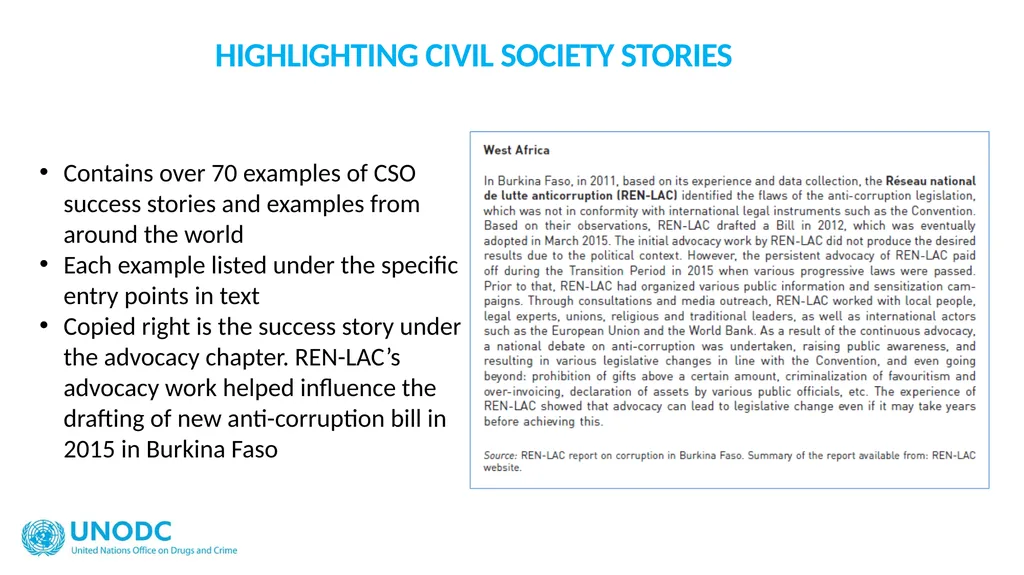
Copied right is the success story under the advocacy chapter. REN-LAC’s advocacy work helped influence the drafting of new anti-corruption bill in 2015 in Burkina Faso<br>
04
CSO Entry Points: Preventive measures (UNCAC Chapter II) Art 13 encourages civil society participation
National Action Plans and Strategies (Art. 5)- the formulation and implementation.
Public reporting (Art. 10) and transparency, access to information laws.
Codes of conduct (Art. 8) and Public procurement (Art. 9)
Integrity in the judicial system (Art. 11)<br>
05
CSO Entry Points: Criminalization and Law Enforcement (Chapter III) Advocate for means to deter and punish corruption
Whistleblowing and Whistleblower Protection (Art. 33) and witness protection (Art. 32)
Example of TI’s Advocacy and Legal Advice Centres (ALACs) providing free and confidential legal advice to witnesses and victims of corruption. Currently operating in 11 African states<br>
06
CSO Entry Points: International cooperation (Chapter IV) and asset recovery (Chapter V) CSOs may assist States in:
Advocacy and awareness raising on specific cases/legislation
Investigation and legal action e.g. representation of victims
Monitoring the use of confiscated assets<br>
07
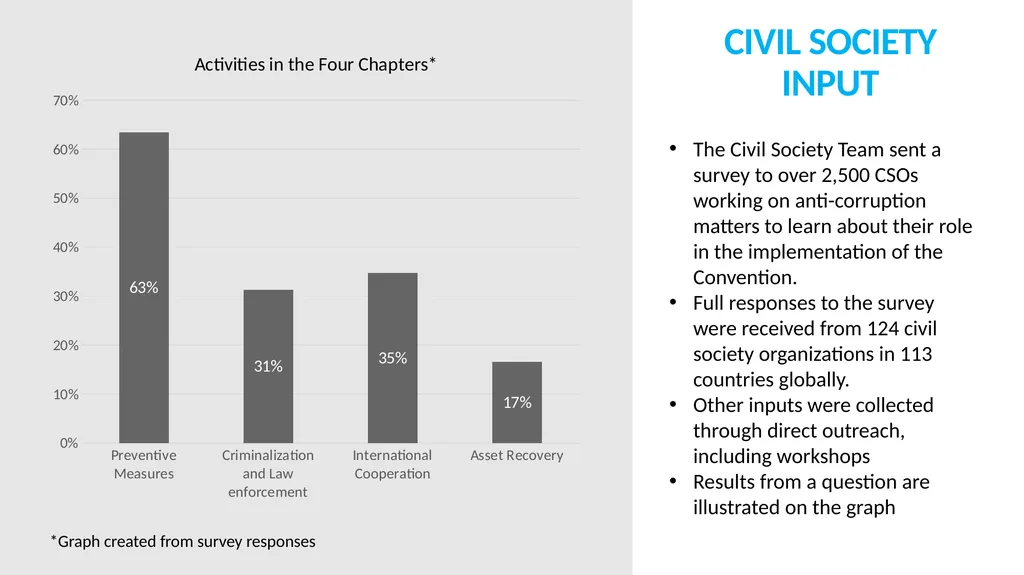
CIVIL SOCIETY INPUT The Civil Society Team sent a survey to over 2,500 CSOs working on anti-corruption matters to learn about their role in the implementation of the Convention.
Full responses to the survey were received from 124 civil society organizations in 113 countries globally.
Other inputs were collected through direct outreach, including workshops
Results from a question are illustrated on the graph *Graph created from survey responses<br>
08
unodc-ngounit@un.org +43 1 26060 5582 Civil Society TEAM Thank you for your attention!<br>