
CLASS X FIRST FLIGHT A TIGER IN THE ZOO BY:





Description: CLASS X FIRST FLIGHT A TIGER IN THE ZOO BY: LESLIE NORRIS INTRODUCTION The poem written by Leslie Norris explains the agony and helplessness of a caged tiger that lives in a zoo. The poet explains what his life could be if he had been a
Related Topics
Download Presentation
"CLASS X FIRST FLIGHT A TIGER IN THE ZOO BY:" is the property of its rightful owner. Permission is granted to download and print the materials on this website for personal, non-commercial use only, and to display it on your personal computer provided you do not modify the materials and that you retain all copyright notices contained in the materials. By downloading content from our website, you accept the terms of this agreement.
Presentation Transcript
slide1. CLASS X
FIRST FLIGHT A TIGER IN THE ZOO
BY: LESLIE NORRIS<br>
slide2. INTRODUCTION The poem written by Leslie Norris explains the agony and helplessness of a caged tiger that lives in a zoo. The poet explains what his life could be if he had been a free animal. The poet has tried to explain about the condition of animals that are caged by human beings for their own fun.<br>
slide3. He stalks in his vivid stripes The few steps of his cage, On pads of velvet quiet, In his quiet rage.
He should be lurking in shadow, Sliding through long grass Near the water hole Where plump deer pass.
He should be snarling around houses At the jungle’s edge, Baring his white fangs, his claws, Terrorising the village!
But he’s locked in a concrete cell, His strength behind bars, Stalking the length of his cage, Ignoring visitors.<br>
slide4. He hears the last voice at night, The patrolling cars, And stares with his brilliant eyes At the brilliant stars.<br>
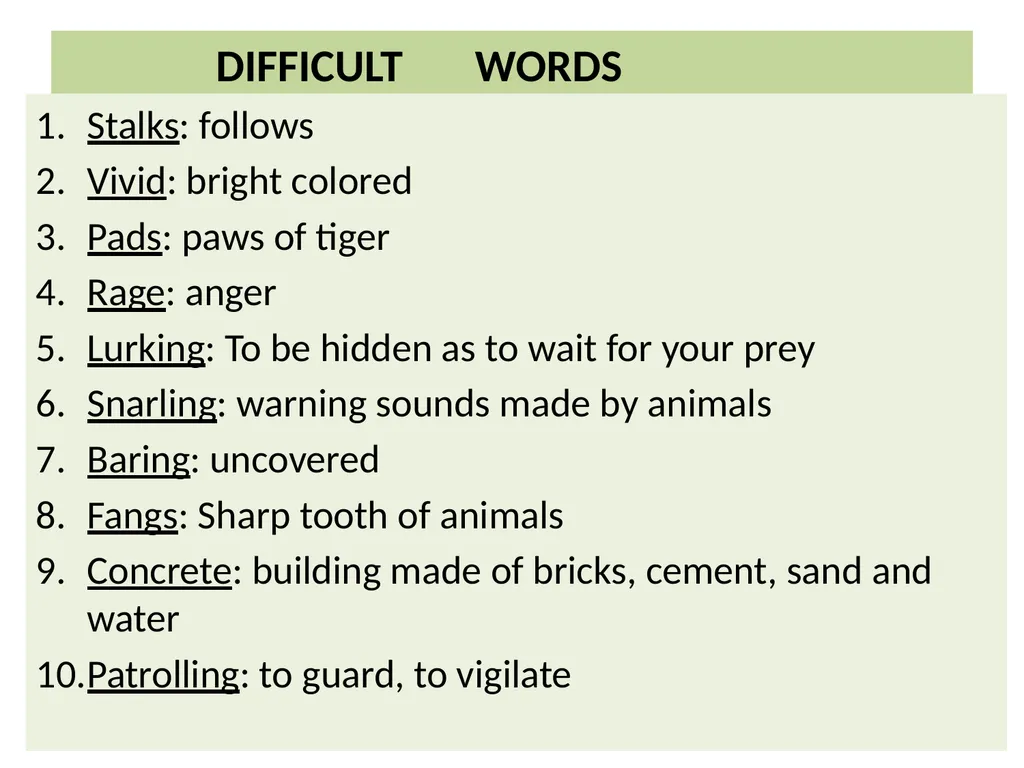
slide5. DIFFICULT WORDS Stalks: follows
Vivid: bright colored
Pads: paws of tiger
Rage: anger
Lurking: To be hidden as to wait for your prey
Snarling: warning sounds made by animals
Baring: uncovered
Fangs: Sharp tooth of animals
Concrete: building made of bricks, cement, sand and water
Patrolling: to guard, to vigilate<br>
slide6. He stalks in his vivid stripes
The few steps of his cage, STANZA 1
On pads of velvet quiet
In his quiet rage.
EXPLANATION
The tiger moves here and there in his cage. The strips on his body are of strong bright colors. He is full of rage but is quiet because he knows that he is helpless here.He further says that the tiger can take only a few steps because the cage is small. The tiger tries to control his anger by quietly walking in the limited area of his cage.<br>
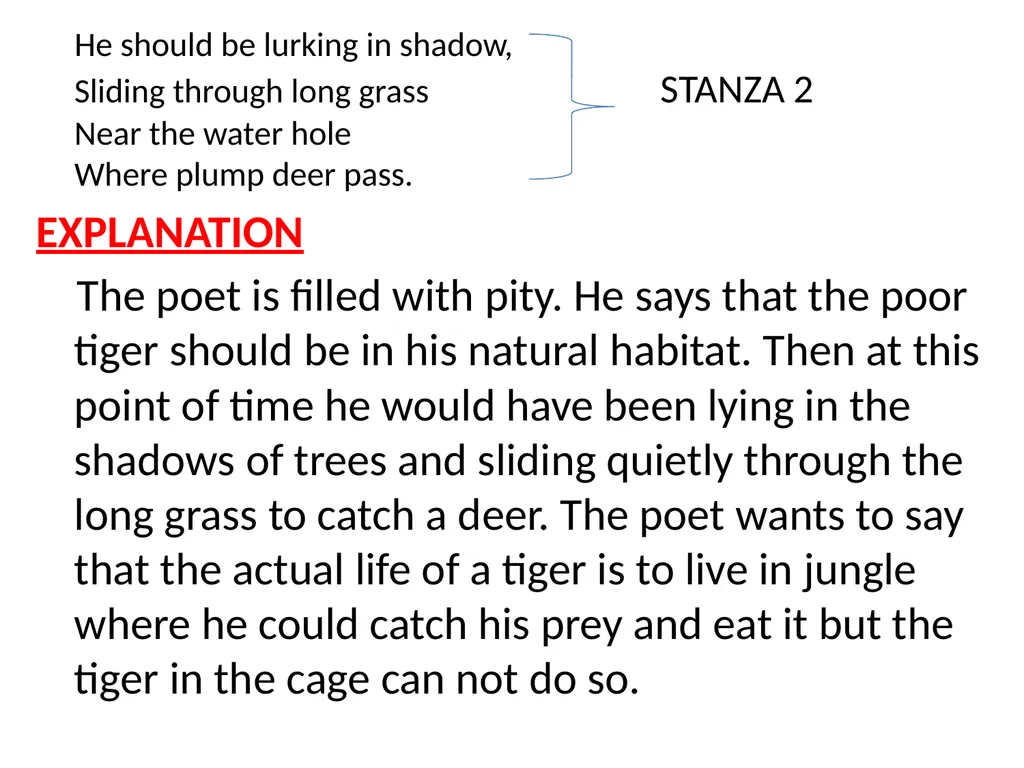
slide7. He should be lurking in shadow, Sliding through long grass STANZA 2 Near the water hole Where plump deer pass.
EXPLANATION
The poet is filled with pity. He says that the poor tiger should be in his natural habitat. Then at this point of time he would have been lying in the shadows of trees and sliding quietly through the long grass to catch a deer. The poet wants to say that the actual life of a tiger is to live in jungle where he could catch his prey and eat it but the tiger in the cage can not do so.<br>
slide8. He should be snarling around houses At the jungle’s edge, STANZA 3 Baring his white fangs, his claws, Terrorising the village!
EXPLANATION
The poet says that if the tiger would have been free, he would have snarled around the houses located at the outskirts of the forest. He would terrorise people with his sharp tooth and claws. This would create fear among the people living in the villages.<br>
slide9. But he’s locked in a concrete cell, His strength behind bars, STANZA 4 Stalking the length of his cage, Ignoring visitors.
EXPLANATION
The poet sees the tiger trapped in a concrete cell in the zoo. He is imprisoned behind the bars. He ignores the visitors who came to zoo to have a look at him. He just stalks in the cage. He never tries to terrorise the visitors because his power is restricted by the cage.<br>
slide10. He hears the last voice at night, The patrolling cars, STANZA 5 And stares with his brilliant eyes At the brilliant stars.
EXPLANATION
The poet says that in the night, the tiger hears the sounds of the patrolling cars. Patrolling cars are the vehicles of police which are used to guard at night. He then stares at the shining stars with his shining eyes. The poet wants to say that the tiger is sad and as he is confined in the cage, he cannot do anything. Therefore, he stares at the stars in the night and tries to divert his thoughts towards them.<br>
slide11. THEME The poet compares the life of a tiger in the Zoo with its life in its natural habitat.
The poet conveys an important message that the wild animals should be kept in their natural habitat. In zoo animals feel angry, helpless and unhappy and remember their life and environment in the forest.
The poet effectively portrays the hardships of animals in the cage and humans should undertsand that animals should be kept in their natural environment only.<br>
BY: LESLIE NORRIS<br>
slide2. INTRODUCTION The poem written by Leslie Norris explains the agony and helplessness of a caged tiger that lives in a zoo. The poet explains what his life could be if he had been a free animal. The poet has tried to explain about the condition of animals that are caged by human beings for their own fun.<br>
slide3. He stalks in his vivid stripes The few steps of his cage, On pads of velvet quiet, In his quiet rage.
He should be lurking in shadow, Sliding through long grass Near the water hole Where plump deer pass.
He should be snarling around houses At the jungle’s edge, Baring his white fangs, his claws, Terrorising the village!
But he’s locked in a concrete cell, His strength behind bars, Stalking the length of his cage, Ignoring visitors.<br>
slide4. He hears the last voice at night, The patrolling cars, And stares with his brilliant eyes At the brilliant stars.<br>
slide5. DIFFICULT WORDS Stalks: follows
Vivid: bright colored
Pads: paws of tiger
Rage: anger
Lurking: To be hidden as to wait for your prey
Snarling: warning sounds made by animals
Baring: uncovered
Fangs: Sharp tooth of animals
Concrete: building made of bricks, cement, sand and water
Patrolling: to guard, to vigilate<br>
slide6. He stalks in his vivid stripes
The few steps of his cage, STANZA 1
On pads of velvet quiet
In his quiet rage.
EXPLANATION
The tiger moves here and there in his cage. The strips on his body are of strong bright colors. He is full of rage but is quiet because he knows that he is helpless here.He further says that the tiger can take only a few steps because the cage is small. The tiger tries to control his anger by quietly walking in the limited area of his cage.<br>
slide7. He should be lurking in shadow, Sliding through long grass STANZA 2 Near the water hole Where plump deer pass.
EXPLANATION
The poet is filled with pity. He says that the poor tiger should be in his natural habitat. Then at this point of time he would have been lying in the shadows of trees and sliding quietly through the long grass to catch a deer. The poet wants to say that the actual life of a tiger is to live in jungle where he could catch his prey and eat it but the tiger in the cage can not do so.<br>
slide8. He should be snarling around houses At the jungle’s edge, STANZA 3 Baring his white fangs, his claws, Terrorising the village!
EXPLANATION
The poet says that if the tiger would have been free, he would have snarled around the houses located at the outskirts of the forest. He would terrorise people with his sharp tooth and claws. This would create fear among the people living in the villages.<br>
slide9. But he’s locked in a concrete cell, His strength behind bars, STANZA 4 Stalking the length of his cage, Ignoring visitors.
EXPLANATION
The poet sees the tiger trapped in a concrete cell in the zoo. He is imprisoned behind the bars. He ignores the visitors who came to zoo to have a look at him. He just stalks in the cage. He never tries to terrorise the visitors because his power is restricted by the cage.<br>
slide10. He hears the last voice at night, The patrolling cars, STANZA 5 And stares with his brilliant eyes At the brilliant stars.
EXPLANATION
The poet says that in the night, the tiger hears the sounds of the patrolling cars. Patrolling cars are the vehicles of police which are used to guard at night. He then stares at the shining stars with his shining eyes. The poet wants to say that the tiger is sad and as he is confined in the cage, he cannot do anything. Therefore, he stares at the stars in the night and tries to divert his thoughts towards them.<br>
slide11. THEME The poet compares the life of a tiger in the Zoo with its life in its natural habitat.
The poet conveys an important message that the wild animals should be kept in their natural habitat. In zoo animals feel angry, helpless and unhappy and remember their life and environment in the forest.
The poet effectively portrays the hardships of animals in the cage and humans should undertsand that animals should be kept in their natural environment only.<br>