Clausewitz in the Age of Autonomy: The 7th

Published  . 0 views
↓ Download
Clausewitz in the Age of Autonomy: The 7th
1 / 1
Clausewitz in the Age of Autonomy: The 7th - slide 1 of 41 Clausewitz in the Age of Autonomy: The 7th - slide 2 of 41 Clausewitz in the Age of Autonomy: The 7th - slide 3 of 41 Clausewitz in the Age of Autonomy: The 7th - slide 4 of 41 Clausewitz in the Age of Autonomy: The 7th - slide 5 of 41 Clausewitz in the Age of Autonomy: The 7th - slide 6 of 41 Clausewitz in the Age of Autonomy: The 7th - slide 7 of 41 Clausewitz in the Age of Autonomy: The 7th - slide 8 of 41 Clausewitz in the Age of Autonomy: The 7th - slide 9 of 41 Clausewitz in the Age of Autonomy: The 7th - slide 10 of 41 Clausewitz in the Age of Autonomy: The 7th - slide 11 of 41 Clausewitz in the Age of Autonomy: The 7th - slide 12 of 41 Clausewitz in the Age of Autonomy: The 7th - slide 13 of 41 Clausewitz in the Age of Autonomy: The 7th - slide 14 of 41 Clausewitz in the Age of Autonomy: The 7th - slide 15 of 41 Clausewitz in the Age of Autonomy: The 7th - slide 16 of 41 Clausewitz in the Age of Autonomy: The 7th - slide 17 of 41 Clausewitz in the Age of Autonomy: The 7th - slide 18 of 41 Clausewitz in the Age of Autonomy: The 7th - slide 19 of 41 Clausewitz in the Age of Autonomy: The 7th - slide 20 of 41 Clausewitz in the Age of Autonomy: The 7th - slide 21 of 41 Clausewitz in the Age of Autonomy: The 7th - slide 22 of 41 Clausewitz in the Age of Autonomy: The 7th - slide 23 of 41 Clausewitz in the Age of Autonomy: The 7th - slide 24 of 41 Clausewitz in the Age of Autonomy: The 7th - slide 25 of 41 Clausewitz in the Age of Autonomy: The 7th - slide 26 of 41 Clausewitz in the Age of Autonomy: The 7th - slide 27 of 41 Clausewitz in the Age of Autonomy: The 7th - slide 28 of 41 Clausewitz in the Age of Autonomy: The 7th - slide 29 of 41 Clausewitz in the Age of Autonomy: The 7th - slide 30 of 41 Clausewitz in the Age of Autonomy: The 7th - slide 31 of 41 Clausewitz in the Age of Autonomy: The 7th - slide 32 of 41 Clausewitz in the Age of Autonomy: The 7th - slide 33 of 41 Clausewitz in the Age of Autonomy: The 7th - slide 34 of 41 Clausewitz in the Age of Autonomy: The 7th - slide 35 of 41 Clausewitz in the Age of Autonomy: The 7th - slide 36 of 41 Clausewitz in the Age of Autonomy: The 7th - slide 37 of 41 Clausewitz in the Age of Autonomy: The 7th - slide 38 of 41 Clausewitz in the Age of Autonomy: The 7th - slide 39 of 41 Clausewitz in the Age of Autonomy: The 7th - slide 40 of 41 Clausewitz in the Age of Autonomy: The 7th - slide 41 of 41
Description: Clausewitz in the Age of Autonomy: The 7th Military Revolution: F. G. Hoffman, Ph.D. Institute for National Strategic Studies National Defense University A New Era? The day when autonomous weapons begin to select their own targets, the

Related Topics

Download Presentation

"Clausewitz in the Age of Autonomy: The 7th" is the property of its rightful owner. Permission is granted to download and print the materials on this website for personal, non-commercial use only, and to display it on your personal computer provided you do not modify the materials and that you retain all copyright notices contained in the materials. By downloading content from our website, you accept the terms of this agreement.

Presentation Transcript

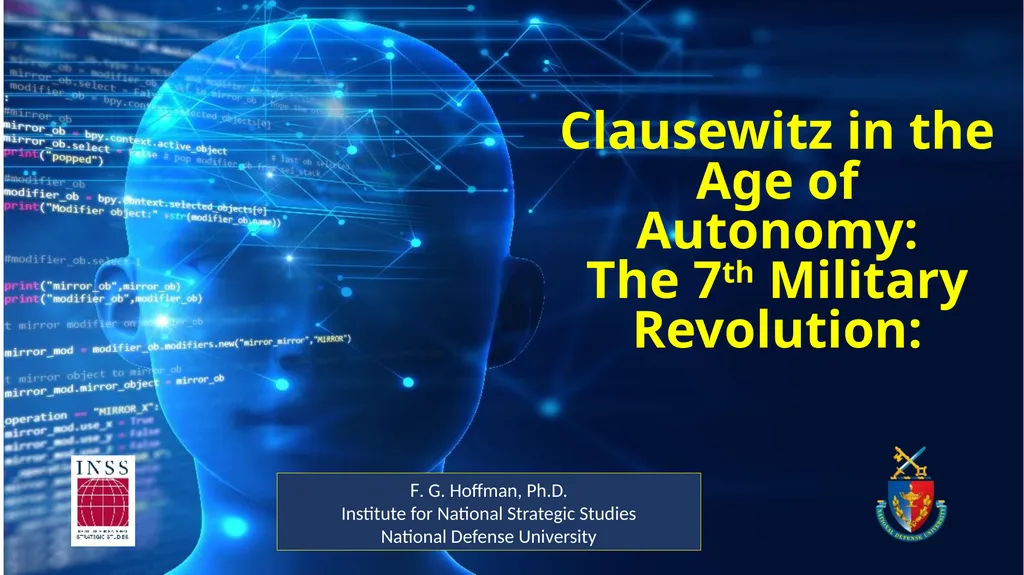
slide1. Clausewitz in the Age of Autonomy: The 7th Military Revolution: F. G. Hoffman, Ph.D.
Institute for National Strategic Studies
National Defense University<br>
slide2. A New Era? “The day when “autonomous weapons begin to select their own targets, the moment the responsibility of establishing whether a human is friend or foe is given to the machine, we will have crossed a threshold and a new era will have begun.”
Manuel De Landa, War in the Age of Intelligent Machines (New York: Zone, 1991), 46. 2<br>
slide3. Outline Intro– Defining Military Revolutions
Progress in Robotics and AI
Potential Military Applications
AI and Great Power Competition
Russian and Chinese Perspectives
Impact on Military Theory
Changing Nature/Character of War
National Security Implications
Conclusion 3<br>
slide4. A New Military Revolution? (and why does it matter) A Military Revolution’s defining feature is a fundamental change in the framework of war.
They are defined as uncontrollable, unpredictable & unforeseeable.
These eras “recast society and the state as well as military organizations. They alter the capacity of states to create and project military power. And their effects are additive.”
RMAs are lesser transformations, often subsets of the larger revolution.
MacGregor Knox and Williamson Murray, eds., The Dynamics of Military Revolution, 1300–2050 (New York: Cambridge University Press, 2001), 6–7. Regardless of which, we need to rigorously explore the uncontrollable & unpredictable impacts of AI and Autonomy to enhance foresight, as well as better manage the consequences of the “unforeseeable. “ 4<br>
slide5. Autonomy: The 7th Military Revolution 5<br>
slide6. Possible Military Applications Strategic and operational decision support systems (COA evaluation and gaming/red teaming)
Improved cyber-attack indicators and warnings and defenses that enhance cyber-security.
Improved intelligence processing with timely exploitation from imagery and signals intelligence.
Unmanned undersea vehicles (UUVs) that autonomously conduct missions including detection/destruction of mines & undersea vessels.
Long-range and stealthy underwater vehicles for offensive maritime mining of adversary seaports or active and defense of critical maritime infrastructure such as under-water cables.
Long-range, unmanned and armed aerial vehicles that support ground and reconnaissance forces.
Unmanned systems that navigate complex, dense urban terrain for intelligence missions and lethal force applications.
Self-organizing maneuver (swarming) by multiple platforms in ground air and sea domains that gain and defend a positional advantage or apply lethal strike capabilities. Adapted from Final Report of the Defense Science Board (DSB) Summer Study on Autonomy , June 26, 2016, p. 2. 6<br>
slide7. Kinds of Artificial Intelligence Narrow AI. Refers to task-specific AI-enabled systems programmed to conduct routine tasks.
This is the form that many researchers can conceive of being employed over the next decade.
Applications include improved command and control, intelligence, and enhance weapons or support driverless vehicles or unmanned aerial vehicles.
General AI (AGI). A more complex form of AI that can try, learn, adapt to do tasks that it is not programmed to execute.
Any machine with true AGI would be able to perform a cognitive or intellectual task like a human being.
Not in our careers, but in our lifetime, we will confront Hal’s “grandchildren.” Dave Bowman: Open the pod bay doors, HAL.
HAL: I'm sorry, Dave. I'm afraid I can't do that.
Dave Bowman: What's the problem?
HAL: I think you know what the problem is just as well as I do.
Dave Bowman: What are you talking about, HAL?
HAL: This mission is too important for me to allow you to jeopardize it.
Dave Bowman: I don't know what you're talking about, HAL.
HAL: I know that you and Frank were planning to disconnect me, and I'm afraid that's something I cannot allow to happen. 7<br>
slide8. https://www.facebook.com/wired/videos/1937884016297793/ Trends: Robots and AI 8 1. Robotics and Unmanned Systems

2. Artificial Intelligence

Diagnosis
Creative Art: Poetry, Music,

Games: Chess, Poker and Go

Simulated Fighter Pilot Contest<br>
slide9. Current and Projected Growth in Robotics 9<br>
slide10. AlphaGo Zero’s Victory AlphaGo Zero was built around an algorithm based on reinforcement learning, not loaded with human data or game histories beyond the basic rules.
It became its own teacher, employing a neural network to predict and counter an opponent's moves.
Despite no experience or library, AlphaGo Zero bested AlphaGo, 100 times to 0. 10<br>
slide11. Breakthrough??? AlphaGo Zero "In a short space of time, AlphaGo Zero has understood all of the Go knowledge that has been accumulated by humans over thousands of years of playing. Sometimes it's actually chosen to go beyond that and discovered something that the humans hadn't even discovered in this time period.” David Silver, Google 11<br>
slide12. Future Operating Environment “The next two decades will see significant advances in autonomy and machine learning, to include the emergence of robots working together in groups and as swarms. New and powerful robotic systems will be used to perform complex actions, make autonomous decisions, deliver lethal force, provide ISR coverage, and speed response times over wider areas of the globe.”
Joint Operational Environment 2035 “The increased capability robots is likely to change the face of warfare,” with the possibility that some countries may replace potentially large numbers of troops with robots by 2045. UK MOD’s Global Strategic Trends, 5th Edition 12<br>
slide13. UK Strategic Trends Assessment “Increasingly, machines capable of combat are likely to be used on the battlefield under close human supervision, but as confidence in the machines capabilities grow, they could be employed further away from human supervision.
In time,…, machines will be used first, before putting people in harm’s way. Cheap mass-produced swarming devices could be used to conduct attacks, overwhelming defensive systems.
Armed machines are also likely to be developed, … to automatically engage targets without human intervention. Removing the operator from danger should reduce the occurrence of instinctive, adrenalin-fuelled decision-making, influenced by fear, fatigue and anger…” 13<br>
slide14. Are We Preparing for the Future??? “…current concepts of operation barely scratch the surface of the potential for today’s unmanned systems, much less future generations of far more advanced unmanned and increasingly autonomous platforms… The potential of future unmanned systems promises to be both more profound and possibly revolutionary in nature.”

Robert O. Work and Shawn Brimley, 20YY: Preparing for War in the Robotic Age, January 2014, p. 22. https://www.facebook.com/engineeringsciencee/videos/889735037854785/ 14<br>
slide15. PRIORITIZED FUNDING FOR AI R&D The Administration has prioritized funding for fundamental AI research and computing infrastructure, machine learning, and autonomous systems.
The US government’s investment in unclassified R&D for AI and related technologies has grown by over 40% since 2015,
in addition to substantial classified investments across defense & intelligence
Both Office of Management and Budget & the Office Science and Technology Policy directed agencies to focus on emerging technologies including machine learning and autonomous systems.
The Administration’s FY2019 Budget Request is the first in history to designate artificial intelligence and autonomous and unmanned systems as R&D priorities. “To maintain our competitive advantage, the United States will prioritize emerging technologies critical to economic growth and security , such as data science, encryption, autonomous technologies, gene editing, new materials, nanotechnology, advanced computing technologies, and artificial intelligence. From self-driving cars to autonomous weapons, the field of artificial intelligence, in particular, is progressing rapidly.” National Security Strategy, p. 20. 15<br>
slide16. Intro– Defining Military Revolutions
Basics of Robotics and AI
Potential Military Applications
Russian and Chinese Perspectives
New source of competition
Impact on Military Theory & Changing Nature/Character of War
Military Implications
Conclusion Outline 16<br>
slide17. Projection from Moscow 17 “Artificial intelligence is the future---whoever becomes the leader in this sphere will become the ruler of the world.” V. Putin, Sept. 1, 2017<br>
slide18. “Another factor influencing the essence of modern means of armed conflict is the use of modern automated complexes of military equipment and research in the area of artificial intelligence. While today we have flying drones, tomorrow’s battlefields will be filled with walking, crawling, jumping, and flying robots. In the near future it is possible a fully robotized unit will be created, capable of independently conducting military operations.” V. Gerasimov, Military-Industrial Kurier, 8, no. 476 (Feb. 27–March 5, 2013) Russian authorities set a goal for 30% of combat power generated by remotely operated or autonomous systems. Despite senior leadership declarations, Russian AI investments and applications appear to lag China’s considerably. 18<br>
slide19. "By 2030, we shall make artificial intelligence theory, technology, and application at the world's leading level," Chinese Government AI plan. The New Generation AI Development Plan (新一代人工智能发展规划) China has rapidly emerged as a powerhouse in artificial intelligence, seeking to become “the world’s premier AI innovation center.” 
China’s quest to “lead the world” in AI, while building up an AI industry of 1 trillion RMB ($150 B) by 2030, is part of an ambitious national agenda, as articulated in the New Generation AI Development Plan of July 2017. 
Although the future trajectory of China’s AI revolution remains to be seen, China is seeking a private/public model of innovation, that leverages commercial progress while also exploiting synergies with national defense applications through a national strategy of military-civil fusion (军民融合). 19<br>
slide20. Source: https://www.rolandberger.com/en/Point-of-View/China-steps-up-a-gear-with-artificial-intelligence.html 20 This analysis over emphasizes AI investments in previous decades and under emphasizes Second Mover advantages exploiting predatory Chinese actions. Venture Capital Investments in AI<br>
slide21. Some Aspects of the Competition “By 2020, they will have caught up. By 2025, they will be better than us. By 2030, they will dominate the industries.” Eric Schmidt, former CEO Google and Alphabet 21<br>
slide22. The United States holds several advantages today especially in numbers of companies and human capital assets.

Some of these advantages have been substantially negated over the past few years and could disappear by 2025.

China is climbing much harder and faster with greater focus 22<br>
slide23. Who’s Winning the Competition? Now 2025 China is distinctly behind in Lee’s assessment, but is projected to accelerate by 2025 as the Innovation phase transitions to Implementation, which favors the Chinese. 23 Source: Kai-Fu Lee, AI Superpowers, China, Silicon Valley and the New World Order, p. 193<br>
slide24. Outline Intro– Defining Military Revolutions
Basics of Robotics and AI
Potential Military Applications
Russian and Chinese Perspectives
Impact on Military Theory & Changing Nature/Character of War
National Security Implications
Conclusions 24<br>
slide25. Nature vs Character Two Major Schools of Thought:
The Immutables assert that war’s nature is inherently immutable but agree that warfare’s character frequently evolves
The Heretics claim that key aspects of war’s nature can be altered substantially, eliminating fog/friction at the operational level of war for example
Both are wrong: war is polymorphic, beyond a True Chameleon that changes more than its shape or color.
War’s nature and character interact and change each other
“Immutable” perspective is a drag on understanding dynamic eras of disruptive technological change war is “more than a true chameleon that slightly adapts its characteristics to the given case.” 25<br>
slide26. Clausewitz’s Trinity: An Analytical Framework Government Population Military An invaluable tool for examining changes in both nature and character of war. “These three tendencies are like three different codes of law, deep-rooted in their subject and yet variable in their relationship to one another. A theory that ignores anyone of them or seeks to fix an arbitrary relationship between them would conflict with reality to such an extent that for this reason alone it would be totally useless.”

Carl v. Clausewitz, On War, Paret & Howard, trans, p. 89<br>
slide27. A non-hierarchal trinity War 27 A fixed relationship would be “totally useless.” Dead Prussian<br>
slide28. Clausewitz’s Trinity: An Analytical Framework Government Population Military Both government and military commanders will employ AI-enabled systems to explore options, generate strategy, and make timely decisions. Commander’s intuition less useful? Commander’s intent more important to Autonomous Weapons Systems Gov’t will need less support for Machine Wars with little blood Both sides will try to manipulate popular opinion & influence domestic audiences<br>
slide29. Exploring AI and War’s Nature 29<br>
slide30. Squaring the Holy Trinity The “Quad” of the 7th Military Revolution AI systems could offer a purely rational source of calculation and genius in war, supporting both Statesman and General but certainly not operating independently of both. 30<br>
slide31. Outline Intro– Defining Military Revolutions
Basics of Robotics and AI
Potential Military Applications
Russian and Chinese Perspectives
Impact on Military Theory & Changing Nature/Character of War
National Security Implications
Conclusions 31<br>
slide32. Strategy with Artificial Intelligence 32 “Hyperwar as a concept emerges from the speed of future war, which comes in almost equal parts from …AI- powered intelligence analysis and AI-powered decision support in command and control, right up to where a human figures in the decision making. The string of detect, decide, and act will be accelerated immeasurably by AI.” Gen. John Allen, USMC (ret.) & Amir Husain, “AI Will Change the Balance of Power,” Naval Institute Proceedings, August 2018.<br>
slide33. Strategy with Artificial Intelligence 33 “Hyperwar as a concept emerges from the speed of future war, which comes in almost equal parts from …AI- powered intelligence analysis and AI-powered decision support in command and control, right up to where a human figures in the decision making. The string of detect, decide, and act will be accelerated immeasurably by AI.” Gen. John Allen, USMC (ret.) & Amir Husain, “AI Will Change the Balance of Power,” Naval Institute Proceedings, August 2018.<br>
slide34. Human-Machine Teaming 34 For both policy, bureaucratic and practical reasons, most progress in leveraging AI and Unmanned Systems in defense will be made in Human/Machine Teaming. “Leaving humans in the loop and humans on the loop will be critical in both the design and early deployment of lethal systems in human-machine teaming .”
Major Gen. Mick Ryan, Australian Army, Human-Machine Teaming for Future Ground Forces, 2018, p. 35<br>
slide35. Cyber D’oeil ??? Clausewitz’s ideal for intuition & coup d’oeil may be challenged
The Commander’s intuitive grasp of the battlespace will be augmented by AI-enabled decision support systems:
-Intelligence synthesis, COA development , wargaming, & Red Teaming
The coup d’oeil of the human may be replaced by a AI-enabled “cyber d’oeil” to support decision-making.
This will not happen overnight, and there will be some “artificial stupidity.”1
Is “System 3 Thinking” required to account for human-directed exploitation of AI systems and BCI.
1. Sydney J. Freedberg Jr., “Artificial Stupidity: Learning To Trust Artificial Intelligence (Sometimes),” Breaking Defense, July 5, 2017. Coup d’oeil, “the quick recognition of a truth that the mind would ordinarily miss or would perceive only after long study and reflection.” 35<br>
slide36. Employment Impacts/Personnel Shifts Social Asocial Optimizat-ion based Creativity/Contextual CEO
Defense Attorney
Psychiatrist Loan Underwriter
Telemarketer
Basic Translator Teacher
Doctor (Gen. Prac.)
Financial Planner Medical Researcher
Columnist
Artist What military jobs can be placed in Danger Zone? Where would you place Theater strategist, campaign planner, intelligence analyst, strike targeteer, Joint logistician/mobility planner, etc., ??? 36<br>
slide37. Implications for National Security Potential for potent first-mover advantage?
Permanent, large-scale monopoly or temporary advantage others emulate?
Speed of C2 and decision-making in “hyperwar”—potential for civilian/military friction
Does AI induce more risk taking by making preemptive war easier, less political risk, but more likely and/or necessary???
Priorities for Investment (C2, cyber defense, offense or defense)???
Organizational & cultural barriers may retard innovation more than technology. 37<br>
slide38. Conclusions Robotics advancing quickly. Limited autonomy is here: very likely to grow.
Growth in specific task specific AI applications, not AGI, to be expected.
Need not fear Terminator Syndrome, Slaughter Bots or Musk’s “Demon”
Policy to ensure accountability over lethal force is reasonable
But assumes competitors equally restrained
Connections with Defense Innovation Base critical.
Need to invest into our understanding of what the 7th Military Revolution can (and cannot) deliver. 38<br>
slide39. Questions??? 39<br>
slide40. Recommended Reading 40<br>
slide41. Are Algorithms Really Autonomous and Bias Free? Do we inadvertently program our own hidden heuristics and blatant biases into the code we write?

Can a machine learning system “learn” emotions, biases, etc?

Can an LAWS be duped or manipulated by Digital Deception?

Can a LAWS be penetrated and internally defeated?

If we require “In/On the Loop” oversight, is the system reliably fast enough? 41<br>