
Cleopatra’s suicide; methods and reasoning L.O. To
CP
Published · 8 slides · 0 views

1 / 1

Description
Cleopatras suicide; methods and reasoning L.O. To understand the factors behind Cleopatras decision to commit suicide. L.O. to assess the presentation of her death in Roman sources. Octavian arrives in Alexandria Having followed Antony
Related Topics
Share
Embed code
Download this presentation From Below
"Cleopatra’s suicide; methods and reasoning L.O. To" is the property of its rightful owner. Permission is granted to download and print the materials on this website for personal, non-commercial use only, and to display it on your personal computer provided you do not modify the materials and that you retain all copyright notices contained in the materials. By downloading content from our website, you accept the terms of this agreement.
Presentation Transcript
01
Cleopatra’s suicide; methods and reasoning L.O. To understand the factors behind Cleopatra’s decision to commit suicide.
L.O. to assess the presentation of her death in Roman sources.<br>
L.O. to assess the presentation of her death in Roman sources.<br>
02
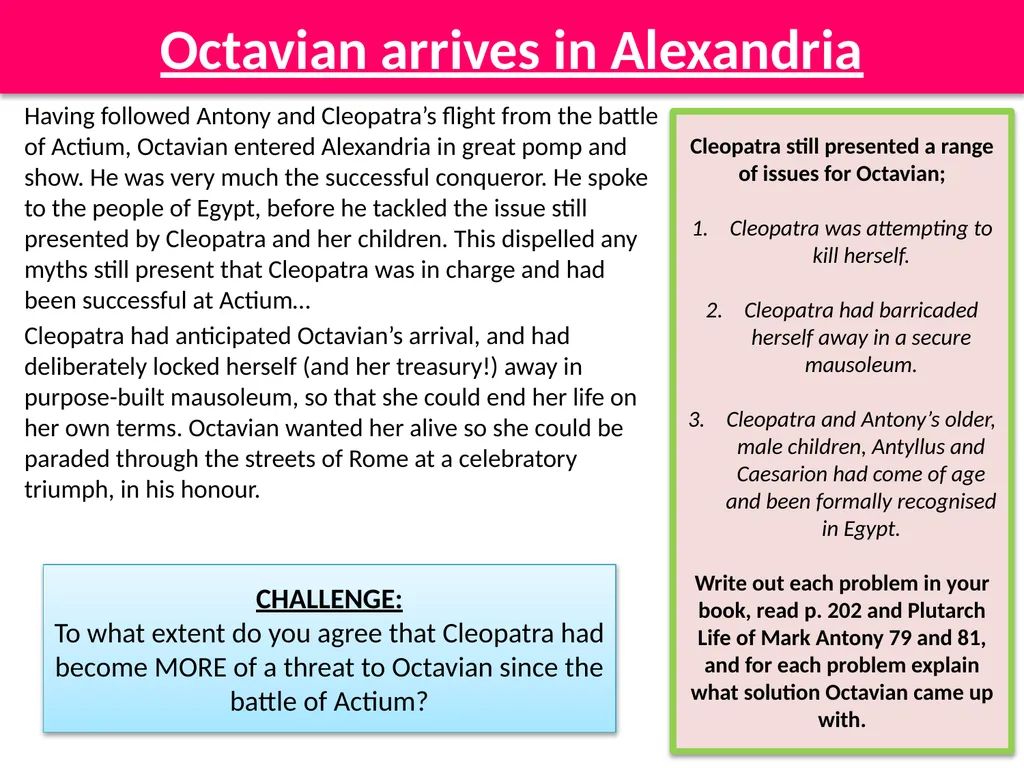
Octavian arrives in Alexandria Having followed Antony and Cleopatra’s flight from the battle of Actium, Octavian entered Alexandria in great pomp and show. He was very much the successful conqueror. He spoke to the people of Egypt, before he tackled the issue still presented by Cleopatra and her children. This dispelled any myths still present that Cleopatra was in charge and had been successful at Actium…
Cleopatra had anticipated Octavian’s arrival, and had deliberately locked herself (and her treasury!) away in purpose-built mausoleum, so that she could end her life on her own terms. Octavian wanted her alive so she could be paraded through the streets of Rome at a celebratory triumph, in his honour. Cleopatra still presented a range of issues for Octavian;
Cleopatra was attempting to kill herself.
Cleopatra had barricaded herself away in a secure mausoleum.
Cleopatra and Antony’s older, male children, Antyllus and Caesarion had come of age and been formally recognised in Egypt.
Write out each problem in your book, read p. 202 and Plutarch Life of Mark Antony 79 and 81, and for each problem explain what solution Octavian came up with. CHALLENGE:
To what extent do you agree that Cleopatra had become MORE of a threat to Octavian since the battle of Actium?<br>
Cleopatra had anticipated Octavian’s arrival, and had deliberately locked herself (and her treasury!) away in purpose-built mausoleum, so that she could end her life on her own terms. Octavian wanted her alive so she could be paraded through the streets of Rome at a celebratory triumph, in his honour. Cleopatra still presented a range of issues for Octavian;
Cleopatra was attempting to kill herself.
Cleopatra had barricaded herself away in a secure mausoleum.
Cleopatra and Antony’s older, male children, Antyllus and Caesarion had come of age and been formally recognised in Egypt.
Write out each problem in your book, read p. 202 and Plutarch Life of Mark Antony 79 and 81, and for each problem explain what solution Octavian came up with. CHALLENGE:
To what extent do you agree that Cleopatra had become MORE of a threat to Octavian since the battle of Actium?<br>
03
Extra info on Cleopatra and Antony’s younger children The three younger children that Cleopatra had born to Antony, Alexander Helios, Cleopatra Selene and Ptolmey Philadelphus, were treated surprisingly well by Octavian, after their parents’ death.
Initially, they were all taken to Rome and paraded through the streets in golden chains, as was the tradition with any Roman triumph. Octavian wanted to make it clear that his enemies and had been defeated, and as he had chosen to buy Antony and Cleopatra, he made do with their children as evidence. Ptolmey was 4 at the time, the twins were 10.
Afterwards, all three children were trusted into the care of Octavian’s wife, Livia, who is reported to have actually taken good care of them! The boys disappear from the history books quite quickly, but this is taken to be a sign of their dying in childhood, rather than any sinister murder. Cleopatra Selene would go on to have a happy and prosperous marriage with the King of North African client kingdom, who had also been paraded through the streets of Rome when his own father was defeated. She would rule fairly and as a popular monarch, who would (reportedly) grow up to look very much like her mother and grandfather (Ptolemy Auletes).<br>
Initially, they were all taken to Rome and paraded through the streets in golden chains, as was the tradition with any Roman triumph. Octavian wanted to make it clear that his enemies and had been defeated, and as he had chosen to buy Antony and Cleopatra, he made do with their children as evidence. Ptolmey was 4 at the time, the twins were 10.
Afterwards, all three children were trusted into the care of Octavian’s wife, Livia, who is reported to have actually taken good care of them! The boys disappear from the history books quite quickly, but this is taken to be a sign of their dying in childhood, rather than any sinister murder. Cleopatra Selene would go on to have a happy and prosperous marriage with the King of North African client kingdom, who had also been paraded through the streets of Rome when his own father was defeated. She would rule fairly and as a popular monarch, who would (reportedly) grow up to look very much like her mother and grandfather (Ptolemy Auletes).<br>
04
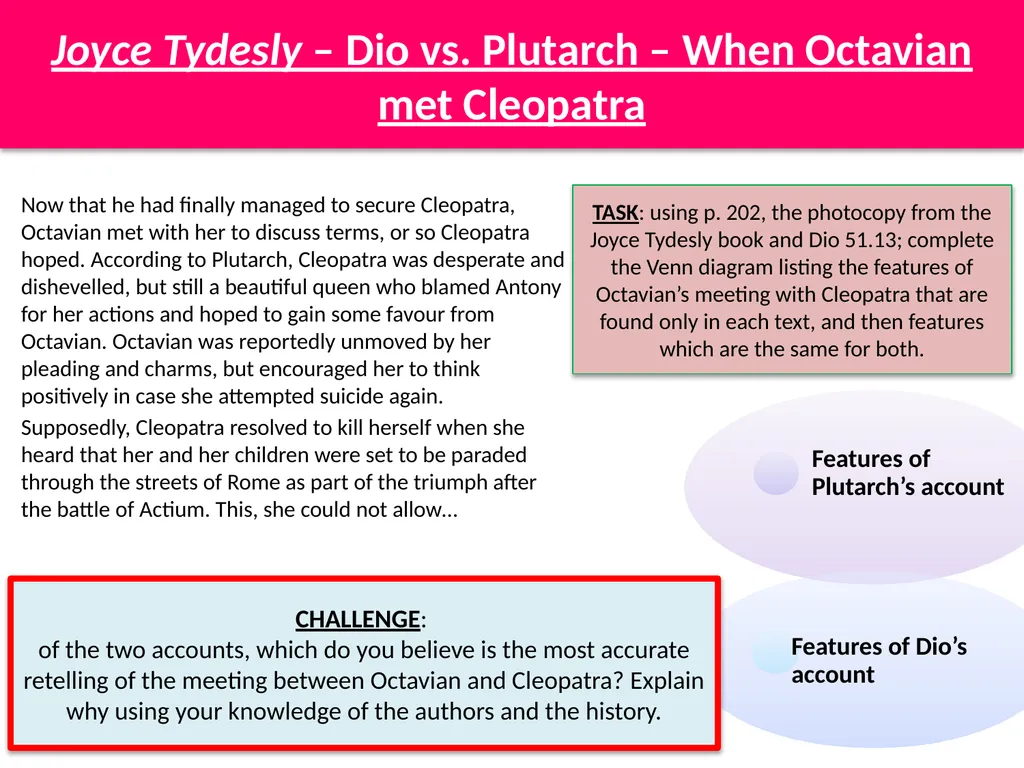
Joyce Tydesly – Dio vs. Plutarch – When Octavian met Cleopatra Now that he had finally managed to secure Cleopatra, Octavian met with her to discuss terms, or so Cleopatra hoped. According to Plutarch, Cleopatra was desperate and dishevelled, but still a beautiful queen who blamed Antony for her actions and hoped to gain some favour from Octavian. Octavian was reportedly unmoved by her pleading and charms, but encouraged her to think positively in case she attempted suicide again.
Supposedly, Cleopatra resolved to kill herself when she heard that her and her children were set to be paraded through the streets of Rome as part of the triumph after the battle of Actium. This, she could not allow… TASK: using p. 202, the photocopy from the Joyce Tydesly book and Dio 51.13; complete the Venn diagram listing the features of Octavian’s meeting with Cleopatra that are found only in each text, and then features which are the same for both. CHALLENGE:
of the two accounts, which do you believe is the most accurate retelling of the meeting between Octavian and Cleopatra? Explain why using your knowledge of the authors and the history.<br>
Supposedly, Cleopatra resolved to kill herself when she heard that her and her children were set to be paraded through the streets of Rome as part of the triumph after the battle of Actium. This, she could not allow… TASK: using p. 202, the photocopy from the Joyce Tydesly book and Dio 51.13; complete the Venn diagram listing the features of Octavian’s meeting with Cleopatra that are found only in each text, and then features which are the same for both. CHALLENGE:
of the two accounts, which do you believe is the most accurate retelling of the meeting between Octavian and Cleopatra? Explain why using your knowledge of the authors and the history.<br>
05
Cassius Dio, Roman History, 51.13 – Cleopatra meets with Octavian and prepares for death Such words she uttered, expecting to move him to pity, but Caesar(Octavian) made no answer to them; fearing, however, that she might kill herself, he begged her again to be of good cheer, and not only did not remove any of her attendants but also took special care of her, that she might add brilliance to his triumph. This purpose she suspected, and regarding that fate as worse than a thousand deaths, she developed a genuine desire to die, and not only addressed many requests to Caesar that she might die in some manner or other, but also devised many plans herself. But when she could accomplish nothing, she feigned a change of heart, pretending to set great hopes in him and also in Livia (his wife). She said she would sail to Rome of her own free will, and she prepared some treasures to use as gifts, in the hope that by these means she might inspire belief that it was not her purpose to die, and so might be less closely guarded and thus be able to destroy herself.
And so it came about. For as soon as the others and Epaphroditus (servant of Octavian), to whose charge she had been committed, had come to believe that she really felt as she pretended to, and neglected to keep a careful watch, she made her preparations to die as painlessly as possible.
First she gave a sealed paper, in which she begged Caesar (Ocatvian ) to order that she be buried beside Antony, to Epaphroditus himself to deliver, pretending that it contained some other matter, and then, having by this excuse freed herself of his presence, she set to her task. She put on her most beautiful clothing, arranged her body in most regal pose, took in her hands all the emblems of royalty, and so died.<br>
And so it came about. For as soon as the others and Epaphroditus (servant of Octavian), to whose charge she had been committed, had come to believe that she really felt as she pretended to, and neglected to keep a careful watch, she made her preparations to die as painlessly as possible.
First she gave a sealed paper, in which she begged Caesar (Ocatvian ) to order that she be buried beside Antony, to Epaphroditus himself to deliver, pretending that it contained some other matter, and then, having by this excuse freed herself of his presence, she set to her task. She put on her most beautiful clothing, arranged her body in most regal pose, took in her hands all the emblems of royalty, and so died.<br>
06
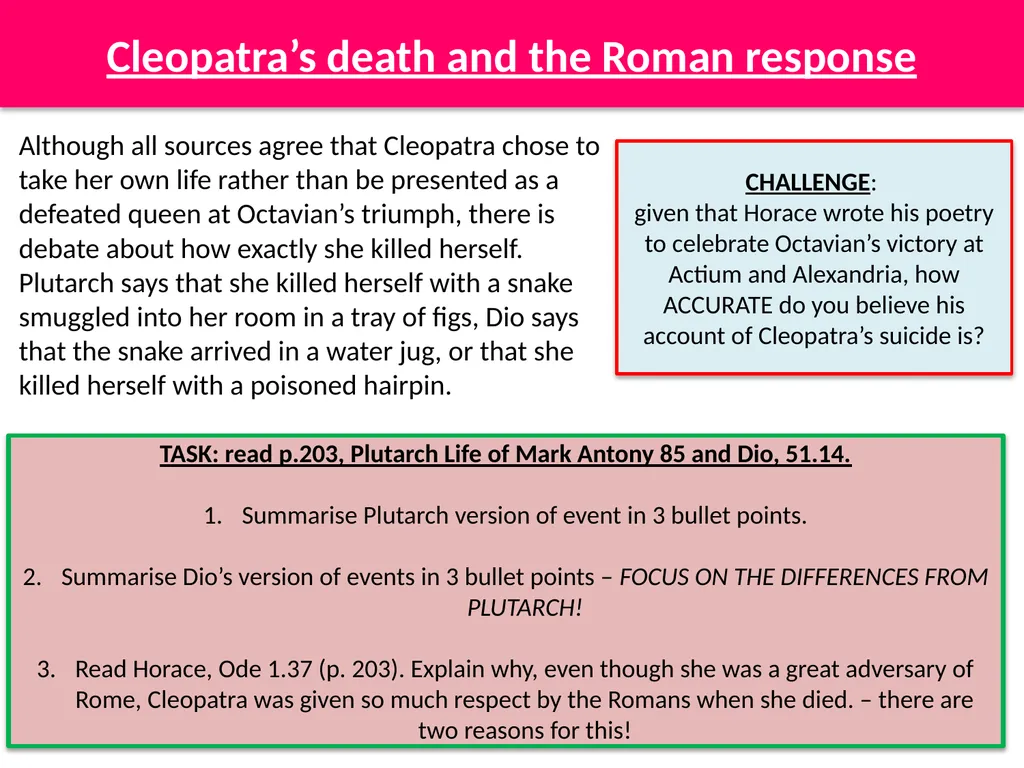
Cleopatra’s death and the Roman response Although all sources agree that Cleopatra chose to take her own life rather than be presented as a defeated queen at Octavian’s triumph, there is debate about how exactly she killed herself. Plutarch says that she killed herself with a snake smuggled into her room in a tray of figs, Dio says that the snake arrived in a water jug, or that she killed herself with a poisoned hairpin. TASK: read p.203, Plutarch Life of Mark Antony 85 and Dio, 51.14.
Summarise Plutarch version of event in 3 bullet points.
Summarise Dio’s version of events in 3 bullet points – FOCUS ON THE DIFFERENCES FROM PLUTARCH!
Read Horace, Ode 1.37 (p. 203). Explain why, even though she was a great adversary of Rome, Cleopatra was given so much respect by the Romans when she died. – there are two reasons for this! CHALLENGE:
given that Horace wrote his poetry to celebrate Octavian’s victory at Actium and Alexandria, how ACCURATE do you believe his account of Cleopatra’s suicide is?<br>
Summarise Plutarch version of event in 3 bullet points.
Summarise Dio’s version of events in 3 bullet points – FOCUS ON THE DIFFERENCES FROM PLUTARCH!
Read Horace, Ode 1.37 (p. 203). Explain why, even though she was a great adversary of Rome, Cleopatra was given so much respect by the Romans when she died. – there are two reasons for this! CHALLENGE:
given that Horace wrote his poetry to celebrate Octavian’s victory at Actium and Alexandria, how ACCURATE do you believe his account of Cleopatra’s suicide is?<br>
07
No one knows clearly in what way she perished, for the only marks on her body were slight pricks on the arm. Some say she applied to herself an asp (a poisonous snake) which had been brought in to her in a water-jar, or perhaps hidden in some flowers.
Others declare that she had smeared a pin, with which she used to fasten her hair, with some poison that was so strong that in ordinary circumstances it would not injure the body at all, but if it came into contact with even a drop of blood would destroy the body very quietly and painlessly; and that previous to this time she had worn it in her hair as usual, but now had made a slight scratch on her arm and had dipped the pin in the blood.
In this or in some very similar way she perished, and her two handmaidens with her. As for the eunuch (male servant of Cleopatra), he had allowed himself to be bitten by the snakes at the very time of Cleopatra's arrest, and after being bitten by them had leaped into a coffin already prepared for him. When Caesar heard of Cleopatra's death, he was astounded, and not only viewed her body but also made use of drugs and Psylli in the hope that she might revive. These Psylli are males, for there are no women born into their tribe, and they have the power to suck out any poison of any reptile, if use is made of them immediately, before the victim dies… But Caesar, when he could not in any way resuscitate Cleopatra, felt both admiration and pity for her, and was excessively grieved on his own account, as if he had been deprived of all the glory of his victory. Cassius Dio, Roman History, 51.14 – Cleopatra kills herself and Octavian tries to save her<br>
Others declare that she had smeared a pin, with which she used to fasten her hair, with some poison that was so strong that in ordinary circumstances it would not injure the body at all, but if it came into contact with even a drop of blood would destroy the body very quietly and painlessly; and that previous to this time she had worn it in her hair as usual, but now had made a slight scratch on her arm and had dipped the pin in the blood.
In this or in some very similar way she perished, and her two handmaidens with her. As for the eunuch (male servant of Cleopatra), he had allowed himself to be bitten by the snakes at the very time of Cleopatra's arrest, and after being bitten by them had leaped into a coffin already prepared for him. When Caesar heard of Cleopatra's death, he was astounded, and not only viewed her body but also made use of drugs and Psylli in the hope that she might revive. These Psylli are males, for there are no women born into their tribe, and they have the power to suck out any poison of any reptile, if use is made of them immediately, before the victim dies… But Caesar, when he could not in any way resuscitate Cleopatra, felt both admiration and pity for her, and was excessively grieved on his own account, as if he had been deprived of all the glory of his victory. Cassius Dio, Roman History, 51.14 – Cleopatra kills herself and Octavian tries to save her<br>
08
NEW LESSON AFTER SLIDE 6 WAS SET FOR HOMEWORK!<br>
09
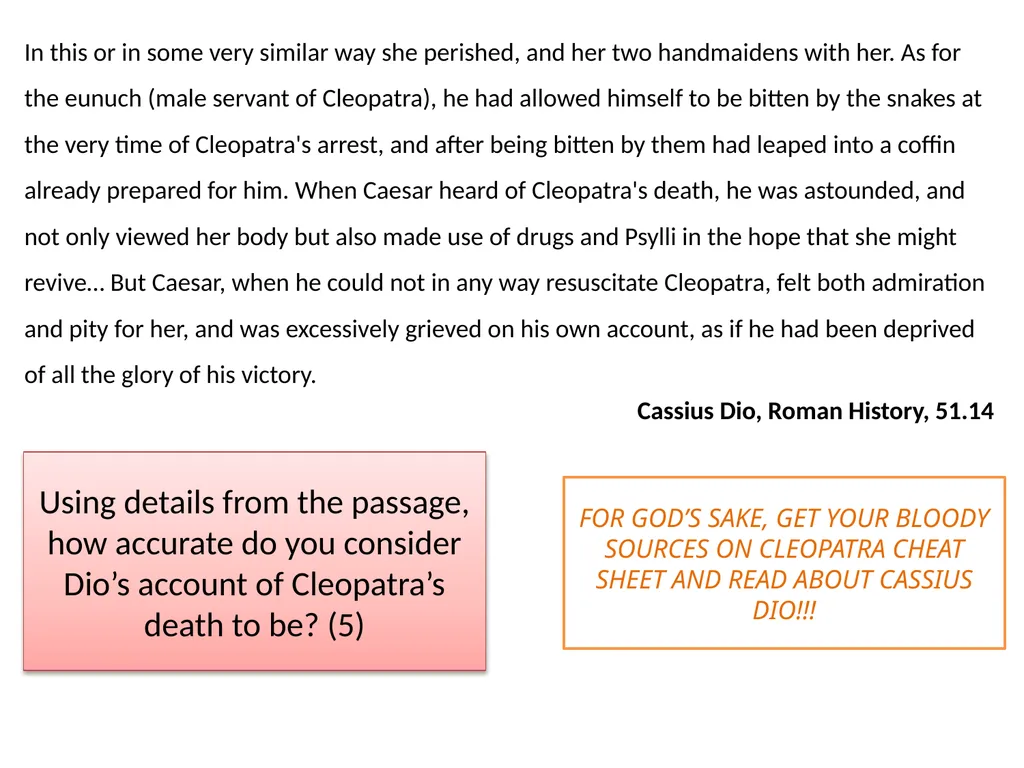
In this or in some very similar way she perished, and her two handmaidens with her. As for the eunuch (male servant of Cleopatra), he had allowed himself to be bitten by the snakes at the very time of Cleopatra's arrest, and after being bitten by them had leaped into a coffin already prepared for him. When Caesar heard of Cleopatra's death, he was astounded, and not only viewed her body but also made use of drugs and Psylli in the hope that she might revive… But Caesar, when he could not in any way resuscitate Cleopatra, felt both admiration and pity for her, and was excessively grieved on his own account, as if he had been deprived of all the glory of his victory.
Cassius Dio, Roman History, 51.14 Using details from the passage, how accurate do you consider Dio’s account of Cleopatra’s death to be? (5) FOR GOD’S SAKE, GET YOUR BLOODY SOURCES ON CLEOPATRA CHEAT SHEET AND READ ABOUT CASSIUS DIO!!!<br>
Cassius Dio, Roman History, 51.14 Using details from the passage, how accurate do you consider Dio’s account of Cleopatra’s death to be? (5) FOR GOD’S SAKE, GET YOUR BLOODY SOURCES ON CLEOPATRA CHEAT SHEET AND READ ABOUT CASSIUS DIO!!!<br>
10
The suicides of Mark Antony and Cleopatra were hugely significant for Octavian, each in their own way.
Broadly speaking, Octavian now had unfettered access to power, and the path to total control of Rome was now open to him. As we know, Octavian will go on to become Caesar Augustus, the first Emperor of Rome, and usher in a ‘Golden Age’ of Roman Emperors.
The death of Mark Antony eliminated the last major rival to that power, but the death o Cleopatra gave Octavian access to the financial resources he desperately needed to pay off his soldiers, as well as some much needed good PR! Significance of the suicides for Octavian TASK: read p.204 of the textbook, and crate 5 revision flashcards to cover the 5 points of significance for Octavian.
On each flashcard, include a small doodle/ illustration to help you remember that point of significance. – this is called Dual Coding and is a well-recognised form of revision! CHALLENGE: read Plutarch, Life of Mark Antony, 86. answer the two following questions in full.
What can we learn from this source about the death of Cleopatra VII? (5)
Using details from the passage, how accurate do you consider Plutarch’s account of Cleopatra’s death to be? (5)<br>
Broadly speaking, Octavian now had unfettered access to power, and the path to total control of Rome was now open to him. As we know, Octavian will go on to become Caesar Augustus, the first Emperor of Rome, and usher in a ‘Golden Age’ of Roman Emperors.
The death of Mark Antony eliminated the last major rival to that power, but the death o Cleopatra gave Octavian access to the financial resources he desperately needed to pay off his soldiers, as well as some much needed good PR! Significance of the suicides for Octavian TASK: read p.204 of the textbook, and crate 5 revision flashcards to cover the 5 points of significance for Octavian.
On each flashcard, include a small doodle/ illustration to help you remember that point of significance. – this is called Dual Coding and is a well-recognised form of revision! CHALLENGE: read Plutarch, Life of Mark Antony, 86. answer the two following questions in full.
What can we learn from this source about the death of Cleopatra VII? (5)
Using details from the passage, how accurate do you consider Plutarch’s account of Cleopatra’s death to be? (5)<br>
11
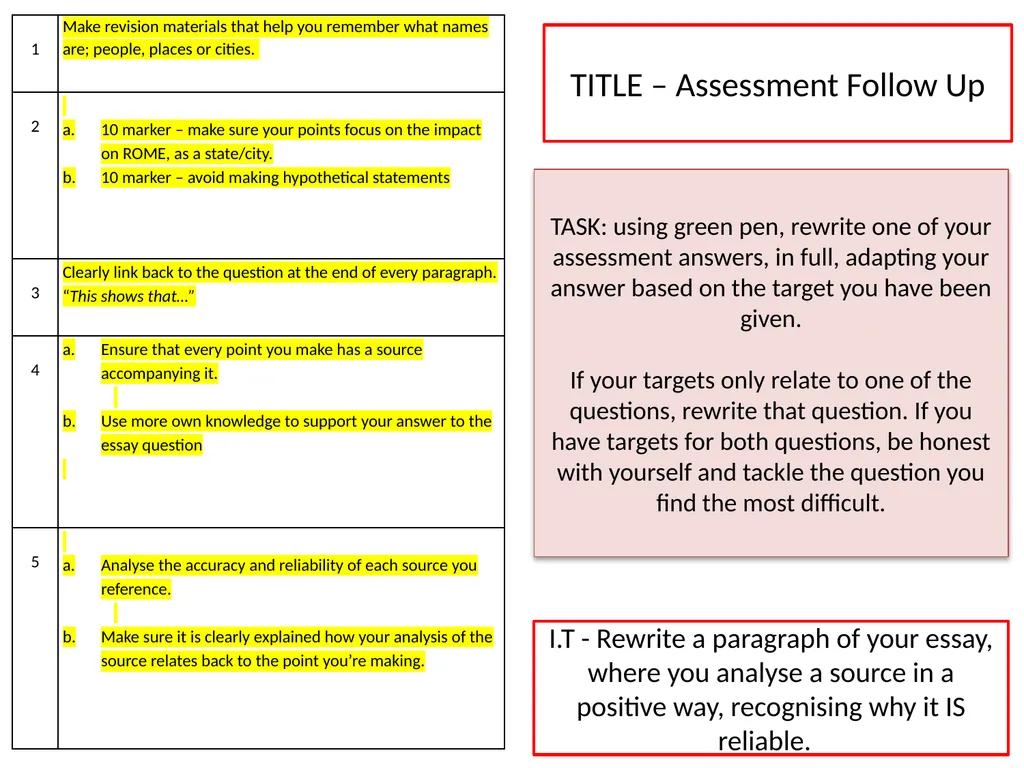
I.T - Rewrite a paragraph of your essay, where you analyse a source in a positive way, recognising why it IS reliable. TASK: using green pen, rewrite one of your assessment answers, in full, adapting your answer based on the target you have been given.
If your targets only relate to one of the questions, rewrite that question. If you have targets for both questions, be honest with yourself and tackle the question you find the most difficult. TITLE – Assessment Follow Up<br>
If your targets only relate to one of the questions, rewrite that question. If you have targets for both questions, be honest with yourself and tackle the question you find the most difficult. TITLE – Assessment Follow Up<br>