
Clifford Histed, Chicago Stavroula Lambrakopoulos,
AS
Published · 55 slides · 0 views

1 / 1



Description
Clifford Histed, Chicago Stavroula Lambrakopoulos, Washington, DC Vince Martinez, Washington, D.C. Cary J. Meer, New York and Washington, D.C Hot Topics in Enforcement and Examinations 2018 INVESTMENT MANAGEMENT CONFERENCE CHICAGO January
Related Topics
Share
Embed code
Download this presentation From Below
"Clifford Histed, Chicago Stavroula Lambrakopoulos," is the property of its rightful owner. Permission is granted to download and print the materials on this website for personal, non-commercial use only, and to display it on your personal computer provided you do not modify the materials and that you retain all copyright notices contained in the materials. By downloading content from our website, you accept the terms of this agreement.
Presentation Transcript
01
Clifford Histed, Chicago
Stavroula Lambrakopoulos, Washington, DC
Vince Martinez, Washington, D.C.
Cary J. Meer, New York and Washington, D.C Hot Topics in Enforcement and Examinations 2018 INVESTMENT MANAGEMENT CONFERENCE
CHICAGO January 31, 2018 #301490210v3<br>
Stavroula Lambrakopoulos, Washington, DC
Vince Martinez, Washington, D.C.
Cary J. Meer, New York and Washington, D.C Hot Topics in Enforcement and Examinations 2018 INVESTMENT MANAGEMENT CONFERENCE
CHICAGO January 31, 2018 #301490210v3<br>
02
Overview of presentation SEC Priorities and Trends
Selected SEC Enforcement Actions Involving Investment Advisers
OCIE Examination Priorities and Guidance
SEC Cybersecurity Developments
NFA Examinations Guidance
CFTC, NFA, and Exchange Enforcement 2<br>
Selected SEC Enforcement Actions Involving Investment Advisers
OCIE Examination Priorities and Guidance
SEC Cybersecurity Developments
NFA Examinations Guidance
CFTC, NFA, and Exchange Enforcement 2<br>
03
SEC Priorities and Trends 3<br>
04
SEC Transition issues SEC leadership is new and only recently operating at full strength
New Chairman Clayton and SEC Enforcement Co-Director Steven Peikin appointed mid-2017
Commissioners Peirce and Jackson confirmed in late 2017
But, terms of 2 remaining Commissioners expiring
Stein (2017) and Piwowar (2018)
Day-to-day business of enforcement and examinations continues
A shifting of examination staff has taken place
Investment adviser examinations are rising 4<br>
New Chairman Clayton and SEC Enforcement Co-Director Steven Peikin appointed mid-2017
Commissioners Peirce and Jackson confirmed in late 2017
But, terms of 2 remaining Commissioners expiring
Stein (2017) and Piwowar (2018)
Day-to-day business of enforcement and examinations continues
A shifting of examination staff has taken place
Investment adviser examinations are rising 4<br>
05
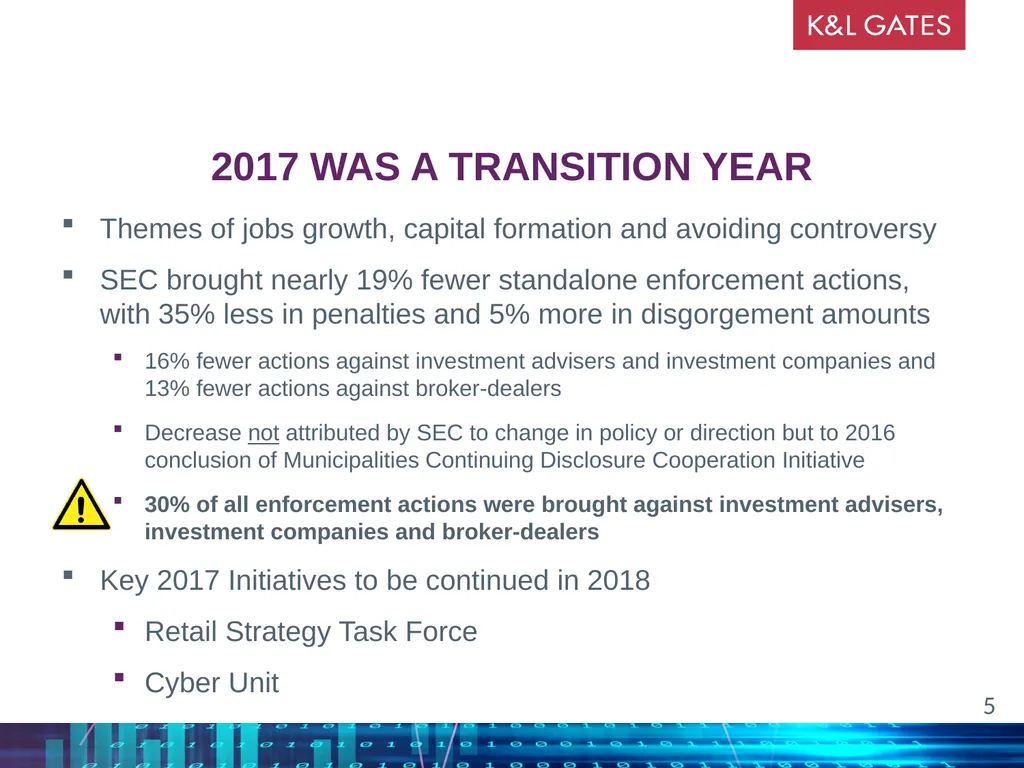
2017 was a transition year Themes of jobs growth, capital formation and avoiding controversy
SEC brought nearly 19% fewer standalone enforcement actions, with 35% less in penalties and 5% more in disgorgement amounts
16% fewer actions against investment advisers and investment companies and 13% fewer actions against broker-dealers
Decrease not attributed by SEC to change in policy or direction but to 2016 conclusion of Municipalities Continuing Disclosure Cooperation Initiative
30% of all enforcement actions were brought against investment advisers, investment companies and broker-dealers
Key 2017 Initiatives to be continued in 2018
Retail Strategy Task Force
Cyber Unit 5<br>
SEC brought nearly 19% fewer standalone enforcement actions, with 35% less in penalties and 5% more in disgorgement amounts
16% fewer actions against investment advisers and investment companies and 13% fewer actions against broker-dealers
Decrease not attributed by SEC to change in policy or direction but to 2016 conclusion of Municipalities Continuing Disclosure Cooperation Initiative
30% of all enforcement actions were brought against investment advisers, investment companies and broker-dealers
Key 2017 Initiatives to be continued in 2018
Retail Strategy Task Force
Cyber Unit 5<br>
06
Hot enforcement topics in 2017 Plain vanilla fraud, Ponzi schemes, issuer disclosure and accounting fraud, digital currency and distributed ledger cases, insider trading and fewer “broken windows” cases
Approval of Enforcement Division Co-Head required for initiation of Formal Orders of Investigation, reversing 2009 delegation to lower senior staff
Supreme Court ruling that five-year Statute of Limitations applies to disgorgement actions (SEC v. Kokesh)
Cooperation credit still seen and touted as a factor in settlements 6<br>
Approval of Enforcement Division Co-Head required for initiation of Formal Orders of Investigation, reversing 2009 delegation to lower senior staff
Supreme Court ruling that five-year Statute of Limitations applies to disgorgement actions (SEC v. Kokesh)
Cooperation credit still seen and touted as a factor in settlements 6<br>
07
Hot enforcement topics in 2017 Preference for litigated administrative proceedings on the wane?
Despite an about-face on ALJ appointments, the question is still bound for the Supreme Court
Whistleblowers still rewarded (>$150 MM). Employment agreements scrutinized for anti-retaliation and “pre-taliation” language
Fewer settled actions involving admissions
Fiduciary duties of advisers and conflicts of interest remain key
Clayton’s focus on individual culpability rather than corporate liability 7<br>
Despite an about-face on ALJ appointments, the question is still bound for the Supreme Court
Whistleblowers still rewarded (>$150 MM). Employment agreements scrutinized for anti-retaliation and “pre-taliation” language
Fewer settled actions involving admissions
Fiduciary duties of advisers and conflicts of interest remain key
Clayton’s focus on individual culpability rather than corporate liability 7<br>
08
Hot enforcement topics in 2017 Chief Compliance Officer Liability
Insider trading (and related supervision liability)
Fiduciary duties of advisers and conflicts of interest
Cherry-picking favorable trades and expenses
Distribution-in-Guise
Share class selection
Undisclosed fees and expenses
Undisclosed fee acceleration
Misleading performance and fund valuation
Pay-to-Play 8<br>
Insider trading (and related supervision liability)
Fiduciary duties of advisers and conflicts of interest
Cherry-picking favorable trades and expenses
Distribution-in-Guise
Share class selection
Undisclosed fees and expenses
Undisclosed fee acceleration
Misleading performance and fund valuation
Pay-to-Play 8<br>
09
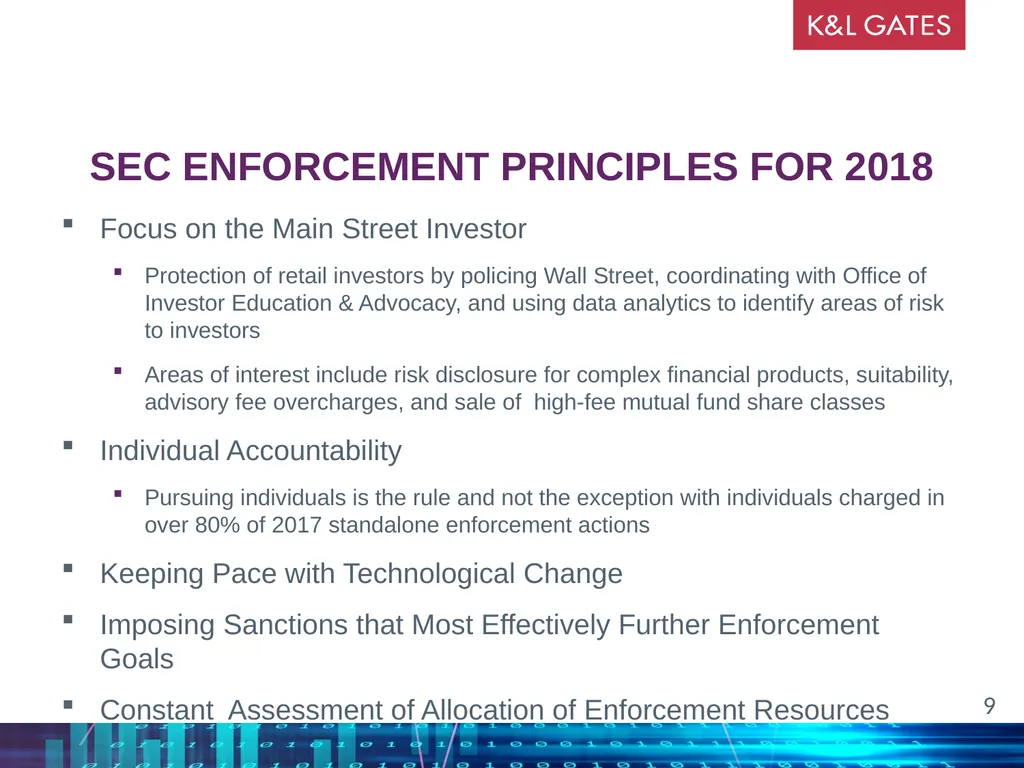
Sec enforcement principles for 2018 Focus on the Main Street Investor
Protection of retail investors by policing Wall Street, coordinating with Office of Investor Education & Advocacy, and using data analytics to identify areas of risk to investors
Areas of interest include risk disclosure for complex financial products, suitability, advisory fee overcharges, and sale of high-fee mutual fund share classes
Individual Accountability
Pursuing individuals is the rule and not the exception with individuals charged in over 80% of 2017 standalone enforcement actions
Keeping Pace with Technological Change
Imposing Sanctions that Most Effectively Further Enforcement Goals
Constant Assessment of Allocation of Enforcement Resources 9<br>
Protection of retail investors by policing Wall Street, coordinating with Office of Investor Education & Advocacy, and using data analytics to identify areas of risk to investors
Areas of interest include risk disclosure for complex financial products, suitability, advisory fee overcharges, and sale of high-fee mutual fund share classes
Individual Accountability
Pursuing individuals is the rule and not the exception with individuals charged in over 80% of 2017 standalone enforcement actions
Keeping Pace with Technological Change
Imposing Sanctions that Most Effectively Further Enforcement Goals
Constant Assessment of Allocation of Enforcement Resources 9<br>
10
Selected SEC Enforcement
Actions Involving Investment Advisers 10<br>
11
Chief compliance officer liability Susan M. Diamond, Advisers Act Rel. No. 4619 (Jan. 19, 2017)
Private funds adviser allegedly filed Forms ADV with false statements that financial statements were audited and would be distributed; CCO found liable for overseeing completion of forms containing the false statements
Violation of Advisers Act Section 207; nine month industry suspension; permanent bar from acting as a partner, officer, branch manager, or director, or in a compliance capacity for advisers; $15,000 penalty
David I. Osunkwo, Advisers Act Rel. No. 4745 (Aug. 15, 2017)
Outsourced CCO failed to file timely and accurate Forms ADV and amendments; filings overstated AUM and total number of client accounts; allegedly relied on and failed to verify of CIO’s inaccurate statements
Violations of Advisers Act Sections 204 and 207; $30,000 penalty; 12 month industry suspension
Firms sanctioned for recordkeeping and filing violations 11<br>
Private funds adviser allegedly filed Forms ADV with false statements that financial statements were audited and would be distributed; CCO found liable for overseeing completion of forms containing the false statements
Violation of Advisers Act Section 207; nine month industry suspension; permanent bar from acting as a partner, officer, branch manager, or director, or in a compliance capacity for advisers; $15,000 penalty
David I. Osunkwo, Advisers Act Rel. No. 4745 (Aug. 15, 2017)
Outsourced CCO failed to file timely and accurate Forms ADV and amendments; filings overstated AUM and total number of client accounts; allegedly relied on and failed to verify of CIO’s inaccurate statements
Violations of Advisers Act Sections 204 and 207; $30,000 penalty; 12 month industry suspension
Firms sanctioned for recordkeeping and filing violations 11<br>
12
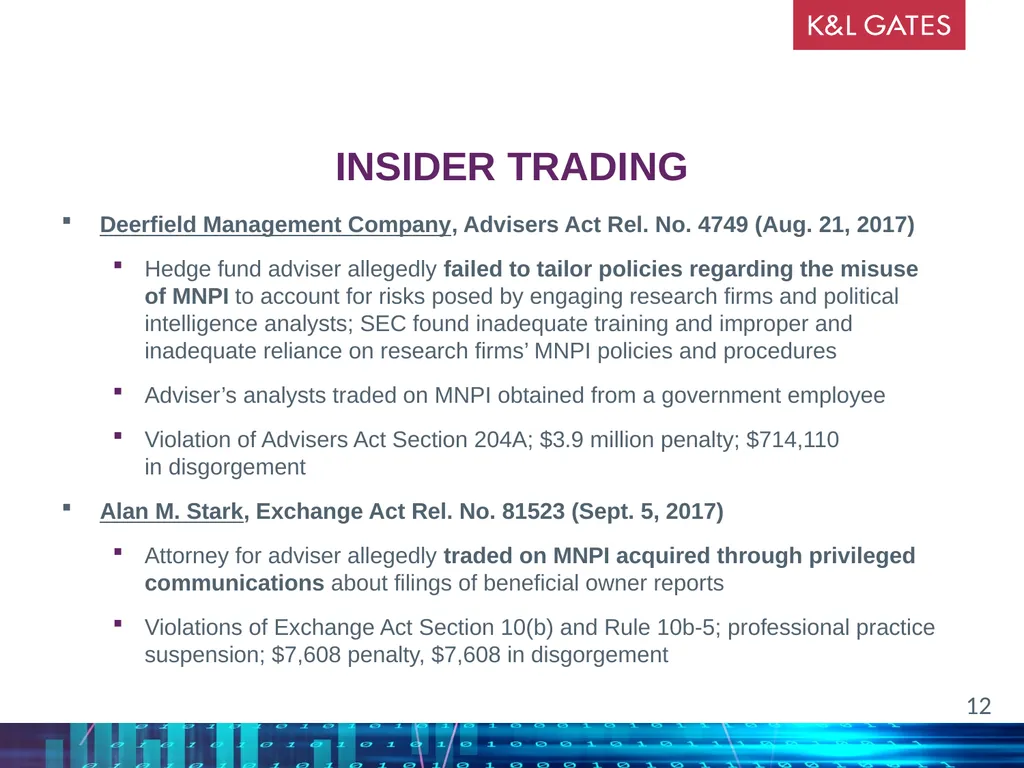
Insider trading Deerfield Management Company, Advisers Act Rel. No. 4749 (Aug. 21, 2017)
Hedge fund adviser allegedly failed to tailor policies regarding the misuse of MNPI to account for risks posed by engaging research firms and political intelligence analysts; SEC found inadequate training and improper and inadequate reliance on research firms’ MNPI policies and procedures
Adviser’s analysts traded on MNPI obtained from a government employee
Violation of Advisers Act Section 204A; $3.9 million penalty; $714,110 in disgorgement
Alan M. Stark, Exchange Act Rel. No. 81523 (Sept. 5, 2017)
Attorney for adviser allegedly traded on MNPI acquired through privileged communications about filings of beneficial owner reports
Violations of Exchange Act Section 10(b) and Rule 10b-5; professional practice suspension; $7,608 penalty, $7,608 in disgorgement 12<br>
Hedge fund adviser allegedly failed to tailor policies regarding the misuse of MNPI to account for risks posed by engaging research firms and political intelligence analysts; SEC found inadequate training and improper and inadequate reliance on research firms’ MNPI policies and procedures
Adviser’s analysts traded on MNPI obtained from a government employee
Violation of Advisers Act Section 204A; $3.9 million penalty; $714,110 in disgorgement
Alan M. Stark, Exchange Act Rel. No. 81523 (Sept. 5, 2017)
Attorney for adviser allegedly traded on MNPI acquired through privileged communications about filings of beneficial owner reports
Violations of Exchange Act Section 10(b) and Rule 10b-5; professional practice suspension; $7,608 penalty, $7,608 in disgorgement 12<br>
13
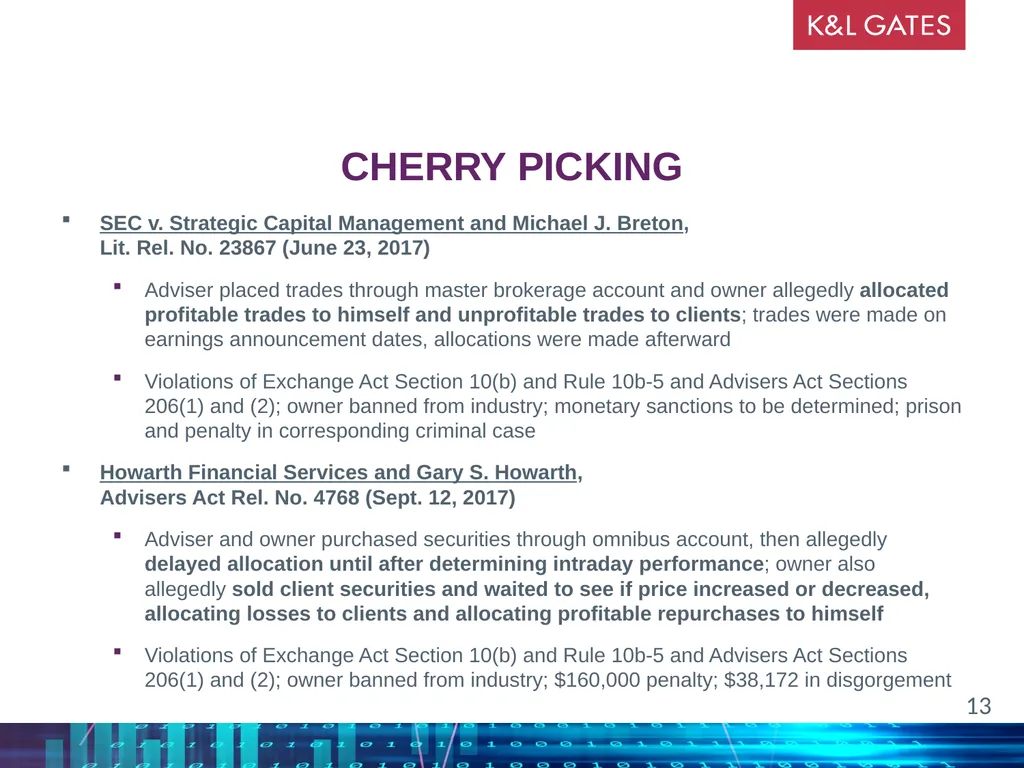
Cherry picking SEC v. Strategic Capital Management and Michael J. Breton,
Lit. Rel. No. 23867 (June 23, 2017)
Adviser placed trades through master brokerage account and owner allegedly allocated profitable trades to himself and unprofitable trades to clients; trades were made on earnings announcement dates, allocations were made afterward
Violations of Exchange Act Section 10(b) and Rule 10b-5 and Advisers Act Sections 206(1) and (2); owner banned from industry; monetary sanctions to be determined; prison and penalty in corresponding criminal case
Howarth Financial Services and Gary S. Howarth, Advisers Act Rel. No. 4768 (Sept. 12, 2017)
Adviser and owner purchased securities through omnibus account, then allegedly delayed allocation until after determining intraday performance; owner also allegedly sold client securities and waited to see if price increased or decreased, allocating losses to clients and allocating profitable repurchases to himself
Violations of Exchange Act Section 10(b) and Rule 10b-5 and Advisers Act Sections 206(1) and (2); owner banned from industry; $160,000 penalty; $38,172 in disgorgement 13<br>
Adviser placed trades through master brokerage account and owner allegedly allocated profitable trades to himself and unprofitable trades to clients; trades were made on earnings announcement dates, allocations were made afterward
Violations of Exchange Act Section 10(b) and Rule 10b-5 and Advisers Act Sections 206(1) and (2); owner banned from industry; monetary sanctions to be determined; prison and penalty in corresponding criminal case
Howarth Financial Services and Gary S. Howarth, Advisers Act Rel. No. 4768 (Sept. 12, 2017)
Adviser and owner purchased securities through omnibus account, then allegedly delayed allocation until after determining intraday performance; owner also allegedly sold client securities and waited to see if price increased or decreased, allocating losses to clients and allocating profitable repurchases to himself
Violations of Exchange Act Section 10(b) and Rule 10b-5 and Advisers Act Sections 206(1) and (2); owner banned from industry; $160,000 penalty; $38,172 in disgorgement 13<br>
14
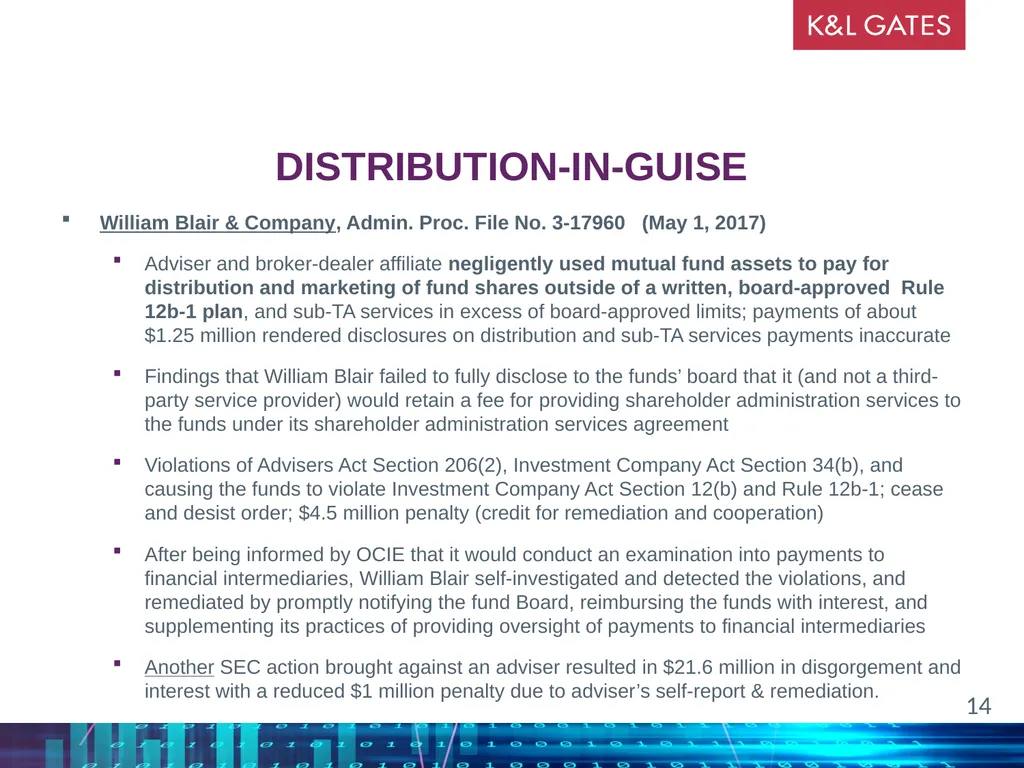
DISTRIBUTION-IN-GUISE William Blair & Company, Admin. Proc. File No. 3-17960 (May 1, 2017)
Adviser and broker-dealer affiliate negligently used mutual fund assets to pay for distribution and marketing of fund shares outside of a written, board-approved Rule 12b-1 plan, and sub-TA services in excess of board-approved limits; payments of about $1.25 million rendered disclosures on distribution and sub-TA services payments inaccurate
Findings that William Blair failed to fully disclose to the funds’ board that it (and not a third-party service provider) would retain a fee for providing shareholder administration services to the funds under its shareholder administration services agreement
Violations of Advisers Act Section 206(2), Investment Company Act Section 34(b), and causing the funds to violate Investment Company Act Section 12(b) and Rule 12b-1; cease and desist order; $4.5 million penalty (credit for remediation and cooperation)
After being informed by OCIE that it would conduct an examination into payments to financial intermediaries, William Blair self-investigated and detected the violations, and remediated by promptly notifying the fund Board, reimbursing the funds with interest, and supplementing its practices of providing oversight of payments to financial intermediaries
Another SEC action brought against an adviser resulted in $21.6 million in disgorgement and interest with a reduced $1 million penalty due to adviser’s self-report & remediation. 14<br>
Adviser and broker-dealer affiliate negligently used mutual fund assets to pay for distribution and marketing of fund shares outside of a written, board-approved Rule 12b-1 plan, and sub-TA services in excess of board-approved limits; payments of about $1.25 million rendered disclosures on distribution and sub-TA services payments inaccurate
Findings that William Blair failed to fully disclose to the funds’ board that it (and not a third-party service provider) would retain a fee for providing shareholder administration services to the funds under its shareholder administration services agreement
Violations of Advisers Act Section 206(2), Investment Company Act Section 34(b), and causing the funds to violate Investment Company Act Section 12(b) and Rule 12b-1; cease and desist order; $4.5 million penalty (credit for remediation and cooperation)
After being informed by OCIE that it would conduct an examination into payments to financial intermediaries, William Blair self-investigated and detected the violations, and remediated by promptly notifying the fund Board, reimbursing the funds with interest, and supplementing its practices of providing oversight of payments to financial intermediaries
Another SEC action brought against an adviser resulted in $21.6 million in disgorgement and interest with a reduced $1 million penalty due to adviser’s self-report & remediation. 14<br>
15
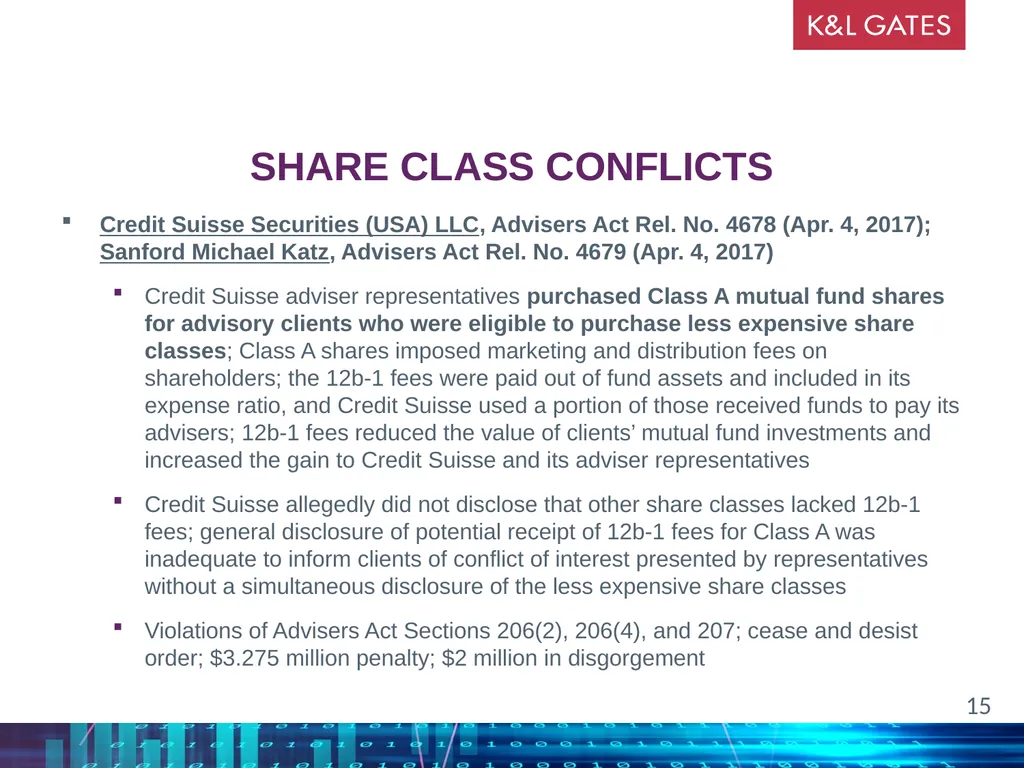
Share class Conflicts Credit Suisse Securities (USA) LLC, Advisers Act Rel. No. 4678 (Apr. 4, 2017);
Sanford Michael Katz, Advisers Act Rel. No. 4679 (Apr. 4, 2017)
Credit Suisse adviser representatives purchased Class A mutual fund shares for advisory clients who were eligible to purchase less expensive share classes; Class A shares imposed marketing and distribution fees on shareholders; the 12b-1 fees were paid out of fund assets and included in its expense ratio, and Credit Suisse used a portion of those received funds to pay its advisers; 12b-1 fees reduced the value of clients’ mutual fund investments and increased the gain to Credit Suisse and its adviser representatives
Credit Suisse allegedly did not disclose that other share classes lacked 12b-1 fees; general disclosure of potential receipt of 12b-1 fees for Class A was inadequate to inform clients of conflict of interest presented by representatives without a simultaneous disclosure of the less expensive share classes
Violations of Advisers Act Sections 206(2), 206(4), and 207; cease and desist order; $3.275 million penalty; $2 million in disgorgement 15<br>
Credit Suisse adviser representatives purchased Class A mutual fund shares for advisory clients who were eligible to purchase less expensive share classes; Class A shares imposed marketing and distribution fees on shareholders; the 12b-1 fees were paid out of fund assets and included in its expense ratio, and Credit Suisse used a portion of those received funds to pay its advisers; 12b-1 fees reduced the value of clients’ mutual fund investments and increased the gain to Credit Suisse and its adviser representatives
Credit Suisse allegedly did not disclose that other share classes lacked 12b-1 fees; general disclosure of potential receipt of 12b-1 fees for Class A was inadequate to inform clients of conflict of interest presented by representatives without a simultaneous disclosure of the less expensive share classes
Violations of Advisers Act Sections 206(2), 206(4), and 207; cease and desist order; $3.275 million penalty; $2 million in disgorgement 15<br>
16
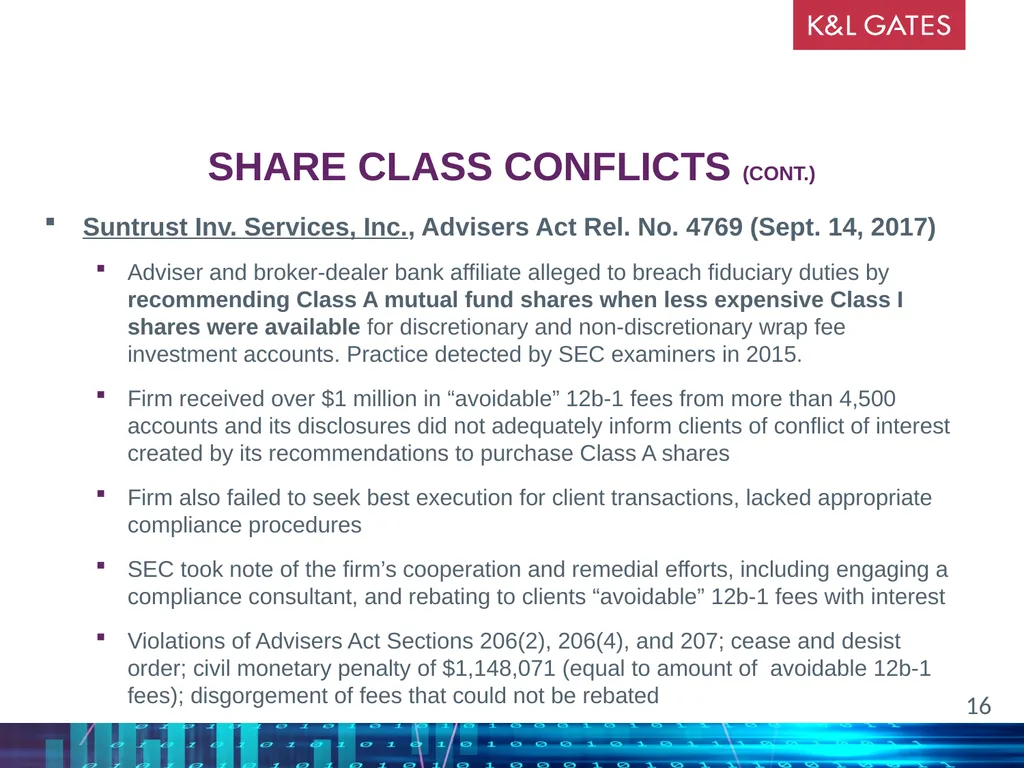
Share Class Conflicts (cont.) Suntrust Inv. Services, Inc., Advisers Act Rel. No. 4769 (Sept. 14, 2017)
Adviser and broker-dealer bank affiliate alleged to breach fiduciary duties by recommending Class A mutual fund shares when less expensive Class I shares were available for discretionary and non-discretionary wrap fee investment accounts. Practice detected by SEC examiners in 2015.
Firm received over $1 million in “avoidable” 12b-1 fees from more than 4,500 accounts and its disclosures did not adequately inform clients of conflict of interest created by its recommendations to purchase Class A shares
Firm also failed to seek best execution for client transactions, lacked appropriate compliance procedures
SEC took note of the firm’s cooperation and remedial efforts, including engaging a compliance consultant, and rebating to clients “avoidable” 12b-1 fees with interest
Violations of Advisers Act Sections 206(2), 206(4), and 207; cease and desist order; civil monetary penalty of $1,148,071 (equal to amount of avoidable 12b-1 fees); disgorgement of fees that could not be rebated 16<br>
Adviser and broker-dealer bank affiliate alleged to breach fiduciary duties by recommending Class A mutual fund shares when less expensive Class I shares were available for discretionary and non-discretionary wrap fee investment accounts. Practice detected by SEC examiners in 2015.
Firm received over $1 million in “avoidable” 12b-1 fees from more than 4,500 accounts and its disclosures did not adequately inform clients of conflict of interest created by its recommendations to purchase Class A shares
Firm also failed to seek best execution for client transactions, lacked appropriate compliance procedures
SEC took note of the firm’s cooperation and remedial efforts, including engaging a compliance consultant, and rebating to clients “avoidable” 12b-1 fees with interest
Violations of Advisers Act Sections 206(2), 206(4), and 207; cease and desist order; civil monetary penalty of $1,148,071 (equal to amount of avoidable 12b-1 fees); disgorgement of fees that could not be rebated 16<br>
17
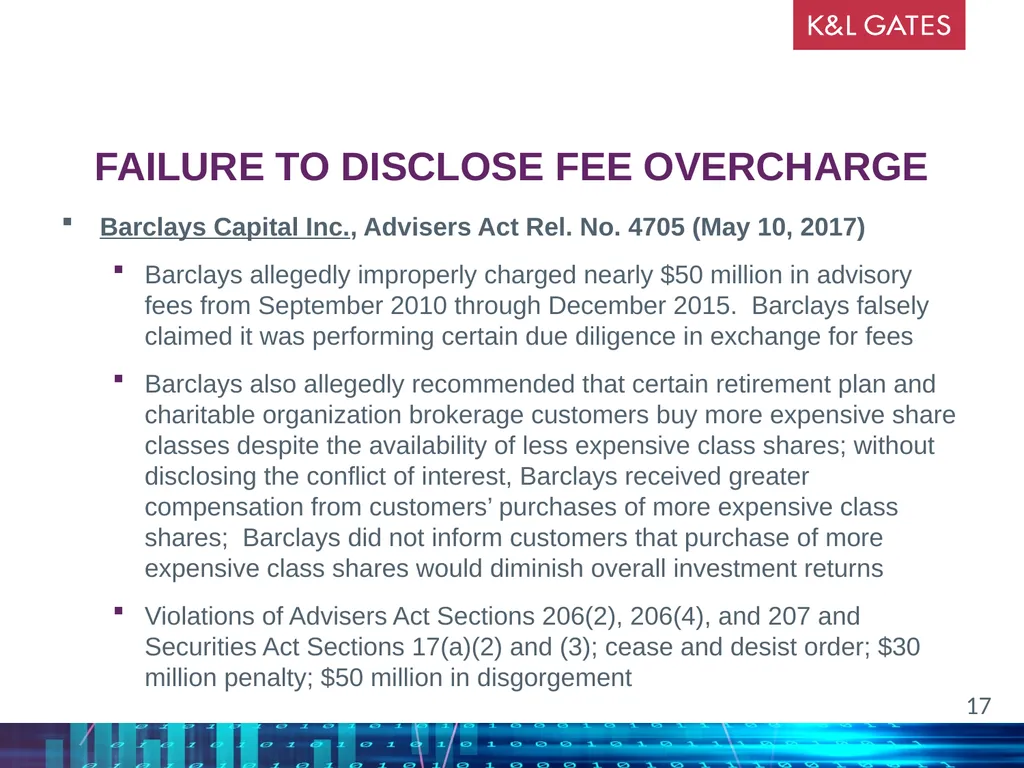
FAILURE TO DISCLOSE Fee Overcharge Barclays Capital Inc., Advisers Act Rel. No. 4705 (May 10, 2017)
Barclays allegedly improperly charged nearly $50 million in advisory fees from September 2010 through December 2015. Barclays falsely claimed it was performing certain due diligence in exchange for fees
Barclays also allegedly recommended that certain retirement plan and charitable organization brokerage customers buy more expensive share classes despite the availability of less expensive class shares; without disclosing the conflict of interest, Barclays received greater compensation from customers’ purchases of more expensive class shares; Barclays did not inform customers that purchase of more expensive class shares would diminish overall investment returns
Violations of Advisers Act Sections 206(2), 206(4), and 207 and Securities Act Sections 17(a)(2) and (3); cease and desist order; $30 million penalty; $50 million in disgorgement 17<br>
Barclays allegedly improperly charged nearly $50 million in advisory fees from September 2010 through December 2015. Barclays falsely claimed it was performing certain due diligence in exchange for fees
Barclays also allegedly recommended that certain retirement plan and charitable organization brokerage customers buy more expensive share classes despite the availability of less expensive class shares; without disclosing the conflict of interest, Barclays received greater compensation from customers’ purchases of more expensive class shares; Barclays did not inform customers that purchase of more expensive class shares would diminish overall investment returns
Violations of Advisers Act Sections 206(2), 206(4), and 207 and Securities Act Sections 17(a)(2) and (3); cease and desist order; $30 million penalty; $50 million in disgorgement 17<br>
18
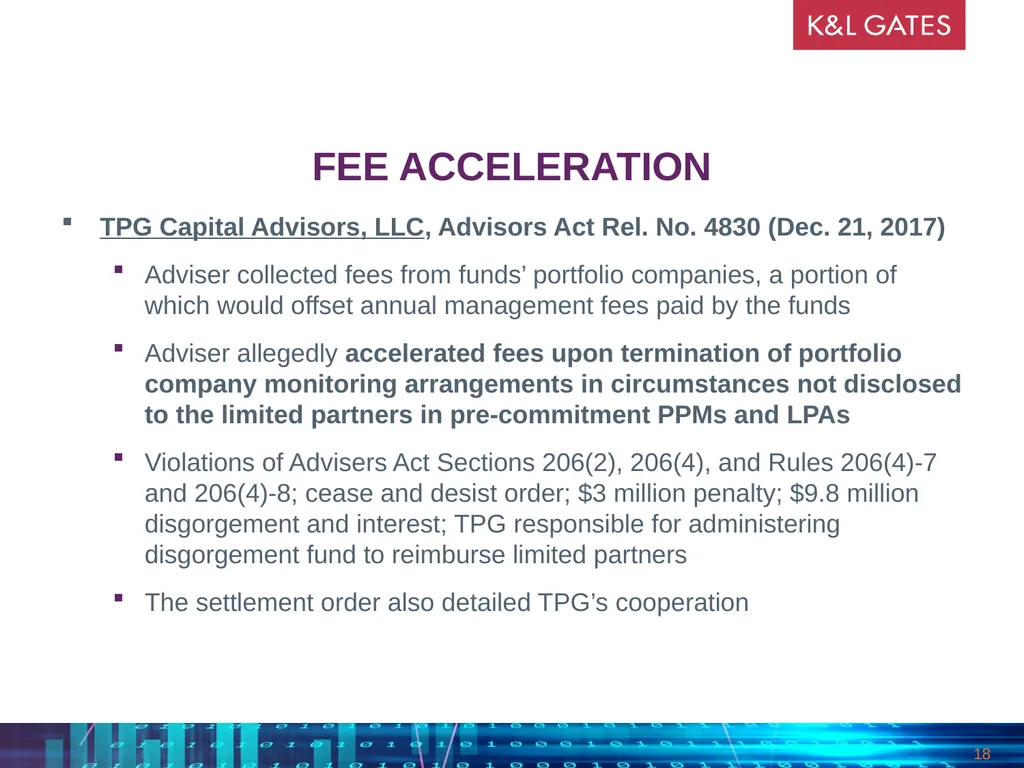
FEE Acceleration TPG Capital Advisors, LLC, Advisors Act Rel. No. 4830 (Dec. 21, 2017)
Adviser collected fees from funds’ portfolio companies, a portion of which would offset annual management fees paid by the funds
Adviser allegedly accelerated fees upon termination of portfolio company monitoring arrangements in circumstances not disclosed to the limited partners in pre-commitment PPMs and LPAs
Violations of Advisers Act Sections 206(2), 206(4), and Rules 206(4)-7 and 206(4)-8; cease and desist order; $3 million penalty; $9.8 million disgorgement and interest; TPG responsible for administering disgorgement fund to reimburse limited partners
The settlement order also detailed TPG’s cooperation 18<br>
Adviser collected fees from funds’ portfolio companies, a portion of which would offset annual management fees paid by the funds
Adviser allegedly accelerated fees upon termination of portfolio company monitoring arrangements in circumstances not disclosed to the limited partners in pre-commitment PPMs and LPAs
Violations of Advisers Act Sections 206(2), 206(4), and Rules 206(4)-7 and 206(4)-8; cease and desist order; $3 million penalty; $9.8 million disgorgement and interest; TPG responsible for administering disgorgement fund to reimburse limited partners
The settlement order also detailed TPG’s cooperation 18<br>
19
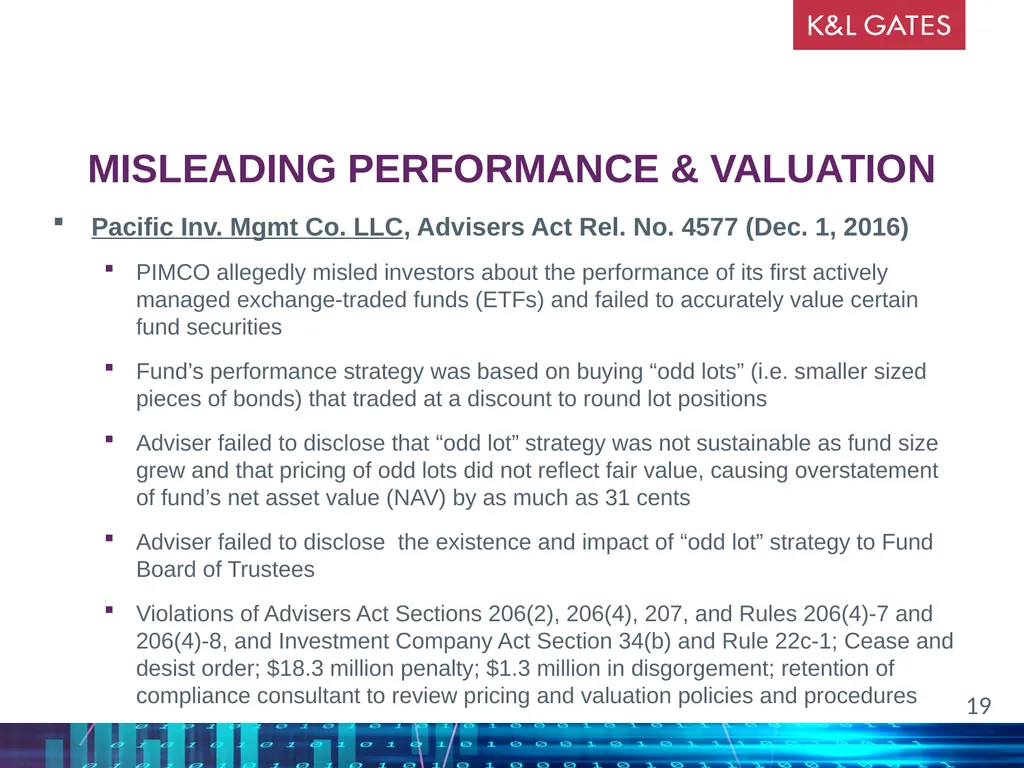
Misleading performance & valuation Pacific Inv. Mgmt Co. LLC, Advisers Act Rel. No. 4577 (Dec. 1, 2016)
PIMCO allegedly misled investors about the performance of its first actively managed exchange-traded funds (ETFs) and failed to accurately value certain fund securities
Fund’s performance strategy was based on buying “odd lots” (i.e. smaller sized pieces of bonds) that traded at a discount to round lot positions
Adviser failed to disclose that “odd lot” strategy was not sustainable as fund size grew and that pricing of odd lots did not reflect fair value, causing overstatement of fund’s net asset value (NAV) by as much as 31 cents
Adviser failed to disclose the existence and impact of “odd lot” strategy to Fund Board of Trustees
Violations of Advisers Act Sections 206(2), 206(4), 207, and Rules 206(4)-7 and 206(4)-8, and Investment Company Act Section 34(b) and Rule 22c-1; Cease and desist order; $18.3 million penalty; $1.3 million in disgorgement; retention of compliance consultant to review pricing and valuation policies and procedures 19<br>
PIMCO allegedly misled investors about the performance of its first actively managed exchange-traded funds (ETFs) and failed to accurately value certain fund securities
Fund’s performance strategy was based on buying “odd lots” (i.e. smaller sized pieces of bonds) that traded at a discount to round lot positions
Adviser failed to disclose that “odd lot” strategy was not sustainable as fund size grew and that pricing of odd lots did not reflect fair value, causing overstatement of fund’s net asset value (NAV) by as much as 31 cents
Adviser failed to disclose the existence and impact of “odd lot” strategy to Fund Board of Trustees
Violations of Advisers Act Sections 206(2), 206(4), 207, and Rules 206(4)-7 and 206(4)-8, and Investment Company Act Section 34(b) and Rule 22c-1; Cease and desist order; $18.3 million penalty; $1.3 million in disgorgement; retention of compliance consultant to review pricing and valuation policies and procedures 19<br>
20
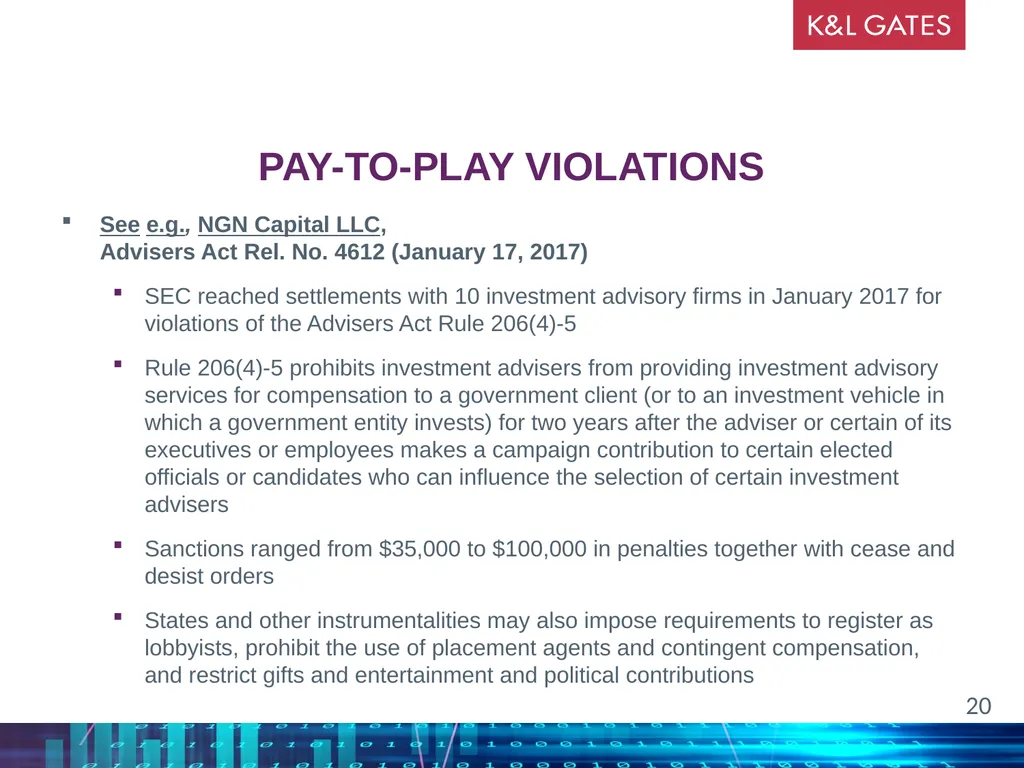
PAY-TO-PLAY VIOLATIONS See e.g., NGN Capital LLC,
Advisers Act Rel. No. 4612 (January 17, 2017)
SEC reached settlements with 10 investment advisory firms in January 2017 for violations of the Advisers Act Rule 206(4)-5
Rule 206(4)-5 prohibits investment advisers from providing investment advisory services for compensation to a government client (or to an investment vehicle in which a government entity invests) for two years after the adviser or certain of its executives or employees makes a campaign contribution to certain elected officials or candidates who can influence the selection of certain investment advisers
Sanctions ranged from $35,000 to $100,000 in penalties together with cease and desist orders
States and other instrumentalities may also impose requirements to register as lobbyists, prohibit the use of placement agents and contingent compensation, and restrict gifts and entertainment and political contributions 20<br>
SEC reached settlements with 10 investment advisory firms in January 2017 for violations of the Advisers Act Rule 206(4)-5
Rule 206(4)-5 prohibits investment advisers from providing investment advisory services for compensation to a government client (or to an investment vehicle in which a government entity invests) for two years after the adviser or certain of its executives or employees makes a campaign contribution to certain elected officials or candidates who can influence the selection of certain investment advisers
Sanctions ranged from $35,000 to $100,000 in penalties together with cease and desist orders
States and other instrumentalities may also impose requirements to register as lobbyists, prohibit the use of placement agents and contingent compensation, and restrict gifts and entertainment and political contributions 20<br>
21
OCIE Examination Priorities and Guidance 21<br>
22
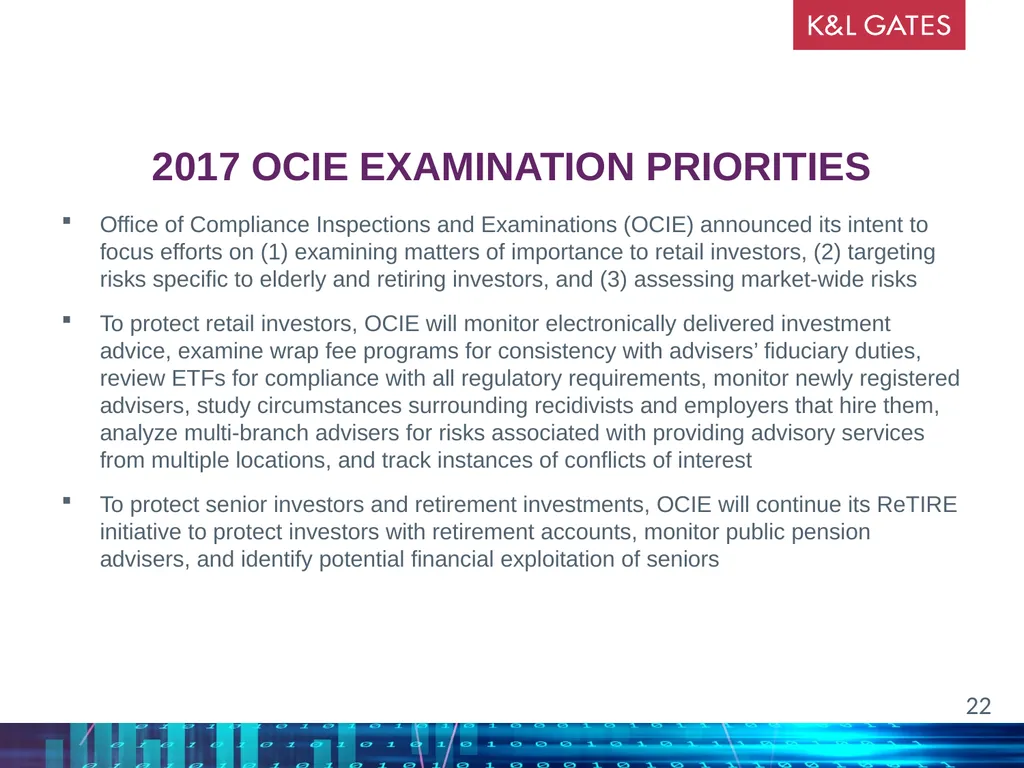
2017 OCIE EXAMINATION Priorities Office of Compliance Inspections and Examinations (OCIE) announced its intent to focus efforts on (1) examining matters of importance to retail investors, (2) targeting risks specific to elderly and retiring investors, and (3) assessing market-wide risks
To protect retail investors, OCIE will monitor electronically delivered investment advice, examine wrap fee programs for consistency with advisers’ fiduciary duties, review ETFs for compliance with all regulatory requirements, monitor newly registered advisers, study circumstances surrounding recidivists and employers that hire them, analyze multi-branch advisers for risks associated with providing advisory services from multiple locations, and track instances of conflicts of interest
To protect senior investors and retirement investments, OCIE will continue its ReTIRE initiative to protect investors with retirement accounts, monitor public pension advisers, and identify potential financial exploitation of seniors 22<br>
To protect retail investors, OCIE will monitor electronically delivered investment advice, examine wrap fee programs for consistency with advisers’ fiduciary duties, review ETFs for compliance with all regulatory requirements, monitor newly registered advisers, study circumstances surrounding recidivists and employers that hire them, analyze multi-branch advisers for risks associated with providing advisory services from multiple locations, and track instances of conflicts of interest
To protect senior investors and retirement investments, OCIE will continue its ReTIRE initiative to protect investors with retirement accounts, monitor public pension advisers, and identify potential financial exploitation of seniors 22<br>
23
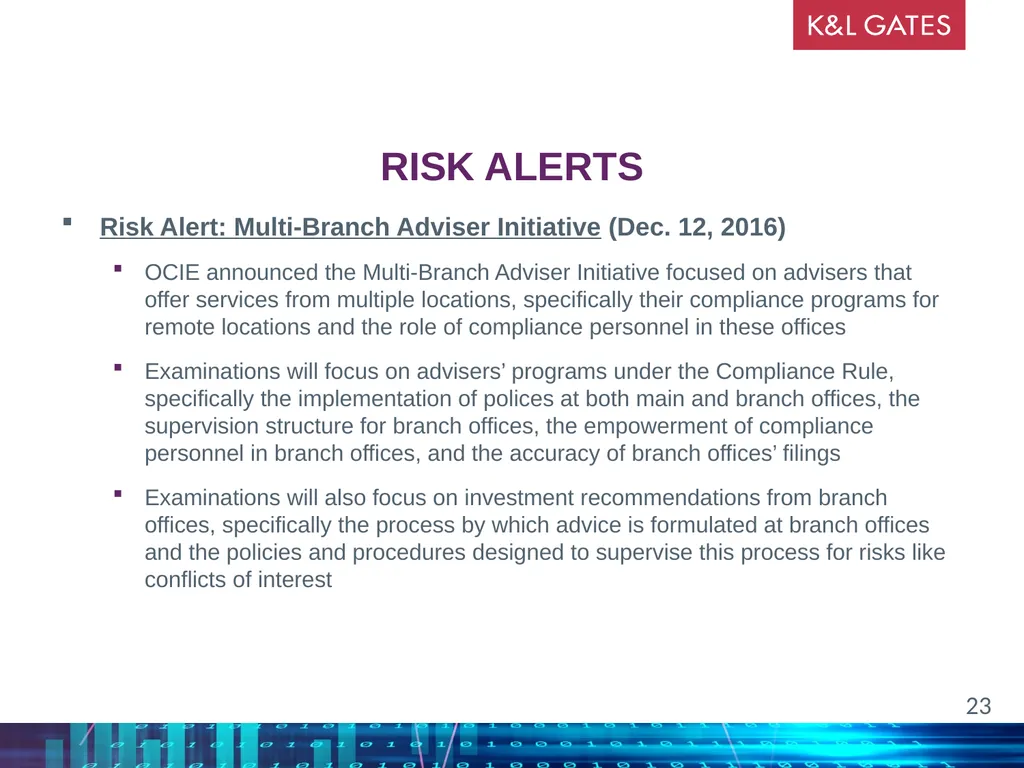
Risk Alerts Risk Alert: Multi-Branch Adviser Initiative (Dec. 12, 2016)
OCIE announced the Multi-Branch Adviser Initiative focused on advisers that offer services from multiple locations, specifically their compliance programs for remote locations and the role of compliance personnel in these offices
Examinations will focus on advisers’ programs under the Compliance Rule, specifically the implementation of polices at both main and branch offices, the supervision structure for branch offices, the empowerment of compliance personnel in branch offices, and the accuracy of branch offices’ filings
Examinations will also focus on investment recommendations from branch offices, specifically the process by which advice is formulated at branch offices and the policies and procedures designed to supervise this process for risks like conflicts of interest 23<br>
OCIE announced the Multi-Branch Adviser Initiative focused on advisers that offer services from multiple locations, specifically their compliance programs for remote locations and the role of compliance personnel in these offices
Examinations will focus on advisers’ programs under the Compliance Rule, specifically the implementation of polices at both main and branch offices, the supervision structure for branch offices, the empowerment of compliance personnel in branch offices, and the accuracy of branch offices’ filings
Examinations will also focus on investment recommendations from branch offices, specifically the process by which advice is formulated at branch offices and the policies and procedures designed to supervise this process for risks like conflicts of interest 23<br>
24
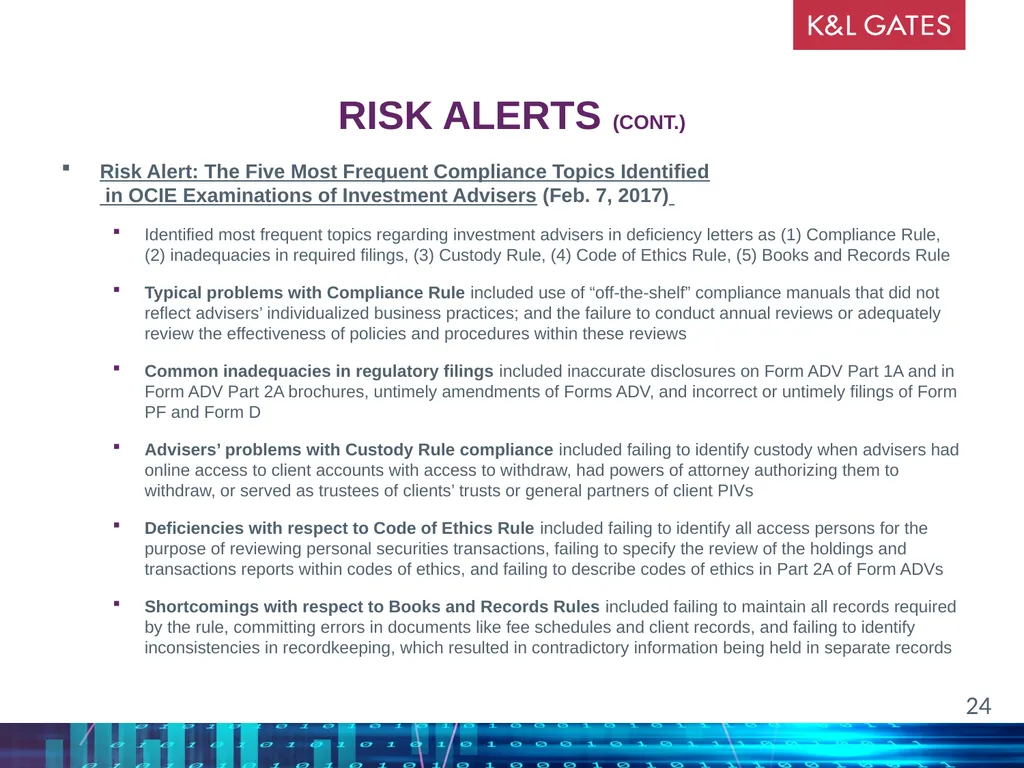
Risk Alerts (cont.) Risk Alert: The Five Most Frequent Compliance Topics Identified
in OCIE Examinations of Investment Advisers (Feb. 7, 2017)
Identified most frequent topics regarding investment advisers in deficiency letters as (1) Compliance Rule, (2) inadequacies in required filings, (3) Custody Rule, (4) Code of Ethics Rule, (5) Books and Records Rule
Typical problems with Compliance Rule included use of “off-the-shelf” compliance manuals that did not reflect advisers’ individualized business practices; and the failure to conduct annual reviews or adequately review the effectiveness of policies and procedures within these reviews
Common inadequacies in regulatory filings included inaccurate disclosures on Form ADV Part 1A and in Form ADV Part 2A brochures, untimely amendments of Forms ADV, and incorrect or untimely filings of Form PF and Form D
Advisers’ problems with Custody Rule compliance included failing to identify custody when advisers had online access to client accounts with access to withdraw, had powers of attorney authorizing them to withdraw, or served as trustees of clients’ trusts or general partners of client PIVs
Deficiencies with respect to Code of Ethics Rule included failing to identify all access persons for the purpose of reviewing personal securities transactions, failing to specify the review of the holdings and transactions reports within codes of ethics, and failing to describe codes of ethics in Part 2A of Form ADVs
Shortcomings with respect to Books and Records Rules included failing to maintain all records required by the rule, committing errors in documents like fee schedules and client records, and failing to identify inconsistencies in recordkeeping, which resulted in contradictory information being held in separate records 24<br>
Identified most frequent topics regarding investment advisers in deficiency letters as (1) Compliance Rule, (2) inadequacies in required filings, (3) Custody Rule, (4) Code of Ethics Rule, (5) Books and Records Rule
Typical problems with Compliance Rule included use of “off-the-shelf” compliance manuals that did not reflect advisers’ individualized business practices; and the failure to conduct annual reviews or adequately review the effectiveness of policies and procedures within these reviews
Common inadequacies in regulatory filings included inaccurate disclosures on Form ADV Part 1A and in Form ADV Part 2A brochures, untimely amendments of Forms ADV, and incorrect or untimely filings of Form PF and Form D
Advisers’ problems with Custody Rule compliance included failing to identify custody when advisers had online access to client accounts with access to withdraw, had powers of attorney authorizing them to withdraw, or served as trustees of clients’ trusts or general partners of client PIVs
Deficiencies with respect to Code of Ethics Rule included failing to identify all access persons for the purpose of reviewing personal securities transactions, failing to specify the review of the holdings and transactions reports within codes of ethics, and failing to describe codes of ethics in Part 2A of Form ADVs
Shortcomings with respect to Books and Records Rules included failing to maintain all records required by the rule, committing errors in documents like fee schedules and client records, and failing to identify inconsistencies in recordkeeping, which resulted in contradictory information being held in separate records 24<br>
25
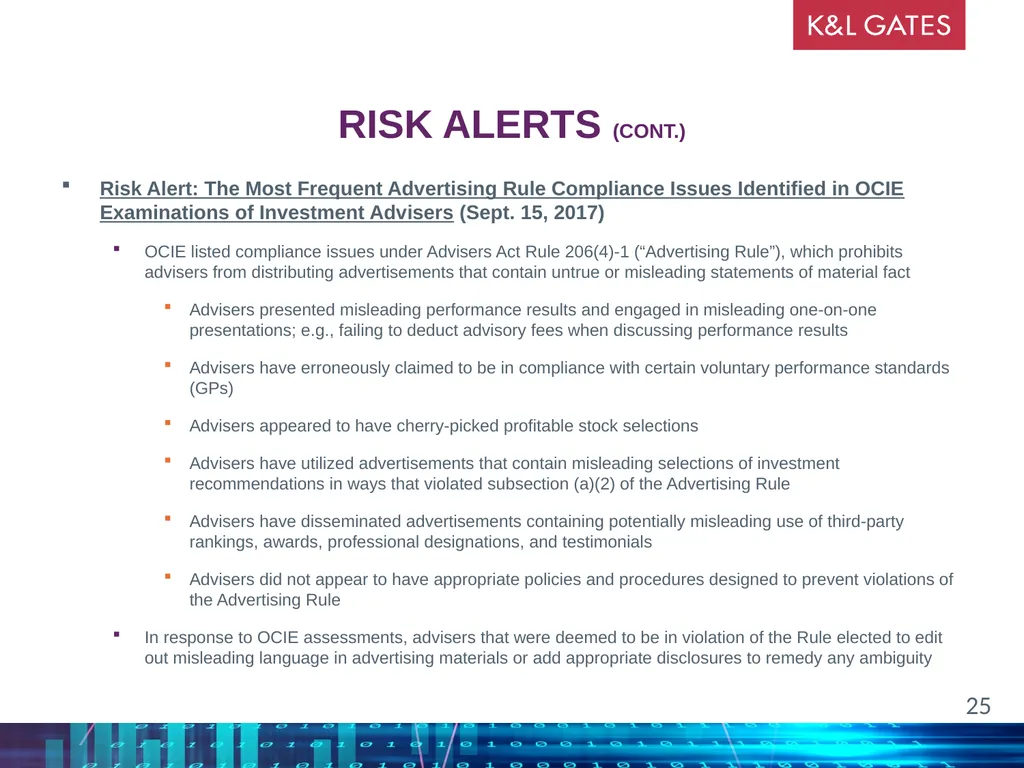
Risk Alerts (cont.) Risk Alert: The Most Frequent Advertising Rule Compliance Issues Identified in OCIE Examinations of Investment Advisers (Sept. 15, 2017)
OCIE listed compliance issues under Advisers Act Rule 206(4)-1 (“Advertising Rule”), which prohibits advisers from distributing advertisements that contain untrue or misleading statements of material fact
Advisers presented misleading performance results and engaged in misleading one-on-one presentations; e.g., failing to deduct advisory fees when discussing performance results
Advisers have erroneously claimed to be in compliance with certain voluntary performance standards (GPs)
Advisers appeared to have cherry-picked profitable stock selections
Advisers have utilized advertisements that contain misleading selections of investment recommendations in ways that violated subsection (a)(2) of the Advertising Rule
Advisers have disseminated advertisements containing potentially misleading use of third-party rankings, awards, professional designations, and testimonials
Advisers did not appear to have appropriate policies and procedures designed to prevent violations of the Advertising Rule
In response to OCIE assessments, advisers that were deemed to be in violation of the Rule elected to edit out misleading language in advertising materials or add appropriate disclosures to remedy any ambiguity 25<br>
OCIE listed compliance issues under Advisers Act Rule 206(4)-1 (“Advertising Rule”), which prohibits advisers from distributing advertisements that contain untrue or misleading statements of material fact
Advisers presented misleading performance results and engaged in misleading one-on-one presentations; e.g., failing to deduct advisory fees when discussing performance results
Advisers have erroneously claimed to be in compliance with certain voluntary performance standards (GPs)
Advisers appeared to have cherry-picked profitable stock selections
Advisers have utilized advertisements that contain misleading selections of investment recommendations in ways that violated subsection (a)(2) of the Advertising Rule
Advisers have disseminated advertisements containing potentially misleading use of third-party rankings, awards, professional designations, and testimonials
Advisers did not appear to have appropriate policies and procedures designed to prevent violations of the Advertising Rule
In response to OCIE assessments, advisers that were deemed to be in violation of the Rule elected to edit out misleading language in advertising materials or add appropriate disclosures to remedy any ambiguity 25<br>
26
SEC Cybersecurity Developments 26<br>
27
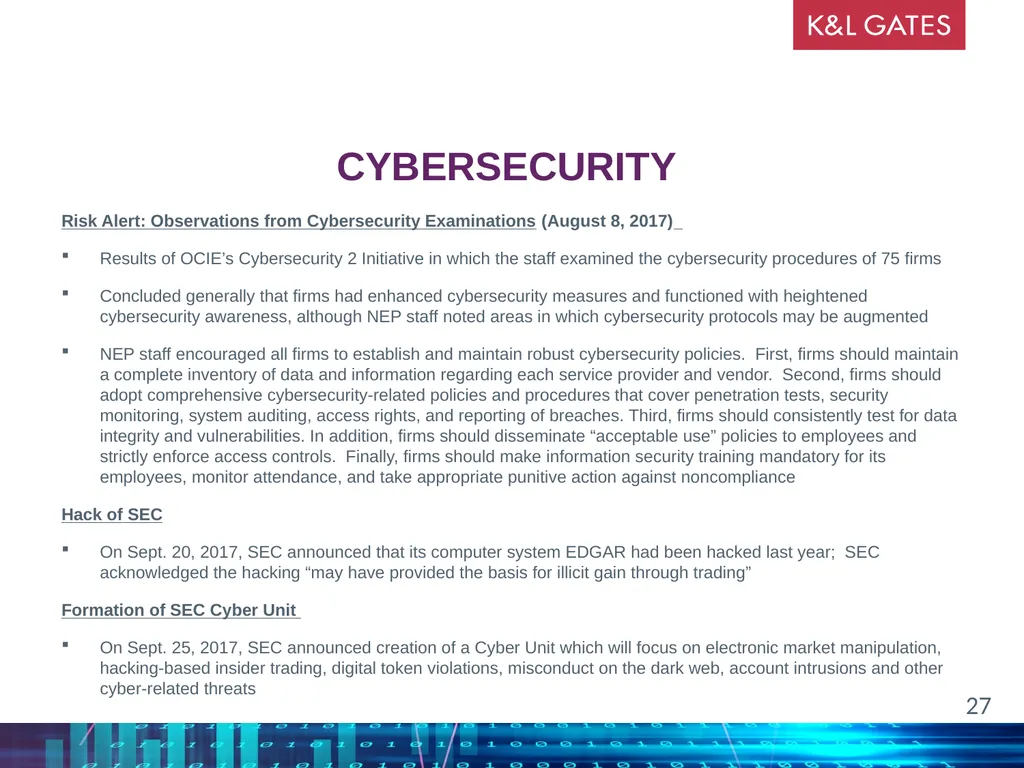
Cybersecurity Risk Alert: Observations from Cybersecurity Examinations (August 8, 2017)
Results of OCIE’s Cybersecurity 2 Initiative in which the staff examined the cybersecurity procedures of 75 firms
Concluded generally that firms had enhanced cybersecurity measures and functioned with heightened cybersecurity awareness, although NEP staff noted areas in which cybersecurity protocols may be augmented
NEP staff encouraged all firms to establish and maintain robust cybersecurity policies. First, firms should maintain a complete inventory of data and information regarding each service provider and vendor. Second, firms should adopt comprehensive cybersecurity-related policies and procedures that cover penetration tests, security monitoring, system auditing, access rights, and reporting of breaches. Third, firms should consistently test for data integrity and vulnerabilities. In addition, firms should disseminate “acceptable use” policies to employees and strictly enforce access controls. Finally, firms should make information security training mandatory for its employees, monitor attendance, and take appropriate punitive action against noncompliance
Hack of SEC
On Sept. 20, 2017, SEC announced that its computer system EDGAR had been hacked last year; SEC acknowledged the hacking “may have provided the basis for illicit gain through trading”
Formation of SEC Cyber Unit
On Sept. 25, 2017, SEC announced creation of a Cyber Unit which will focus on electronic market manipulation, hacking-based insider trading, digital token violations, misconduct on the dark web, account intrusions and other cyber-related threats 27<br>
Results of OCIE’s Cybersecurity 2 Initiative in which the staff examined the cybersecurity procedures of 75 firms
Concluded generally that firms had enhanced cybersecurity measures and functioned with heightened cybersecurity awareness, although NEP staff noted areas in which cybersecurity protocols may be augmented
NEP staff encouraged all firms to establish and maintain robust cybersecurity policies. First, firms should maintain a complete inventory of data and information regarding each service provider and vendor. Second, firms should adopt comprehensive cybersecurity-related policies and procedures that cover penetration tests, security monitoring, system auditing, access rights, and reporting of breaches. Third, firms should consistently test for data integrity and vulnerabilities. In addition, firms should disseminate “acceptable use” policies to employees and strictly enforce access controls. Finally, firms should make information security training mandatory for its employees, monitor attendance, and take appropriate punitive action against noncompliance
Hack of SEC
On Sept. 20, 2017, SEC announced that its computer system EDGAR had been hacked last year; SEC acknowledged the hacking “may have provided the basis for illicit gain through trading”
Formation of SEC Cyber Unit
On Sept. 25, 2017, SEC announced creation of a Cyber Unit which will focus on electronic market manipulation, hacking-based insider trading, digital token violations, misconduct on the dark web, account intrusions and other cyber-related threats 27<br>
28
NFA Examinations Guidance 28<br>
29
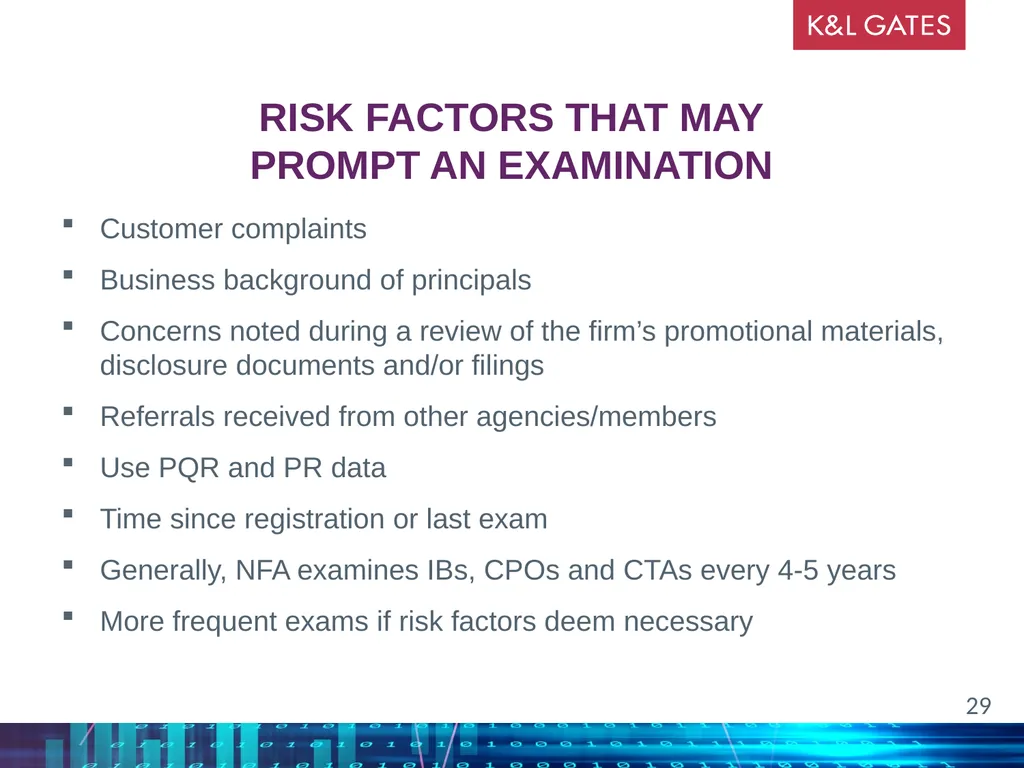
RISK FACTORS THAT MAY
PROMPT AN EXAMINATION Customer complaints
Business background of principals
Concerns noted during a review of the firm’s promotional materials, disclosure documents and/or filings
Referrals received from other agencies/members
Use PQR and PR data
Time since registration or last exam
Generally, NFA examines IBs, CPOs and CTAs every 4-5 years
More frequent exams if risk factors deem necessary 29<br>
Business background of principals
Concerns noted during a review of the firm’s promotional materials, disclosure documents and/or filings
Referrals received from other agencies/members
Use PQR and PR data
Time since registration or last exam
Generally, NFA examines IBs, CPOs and CTAs every 4-5 years
More frequent exams if risk factors deem necessary 29<br>
30
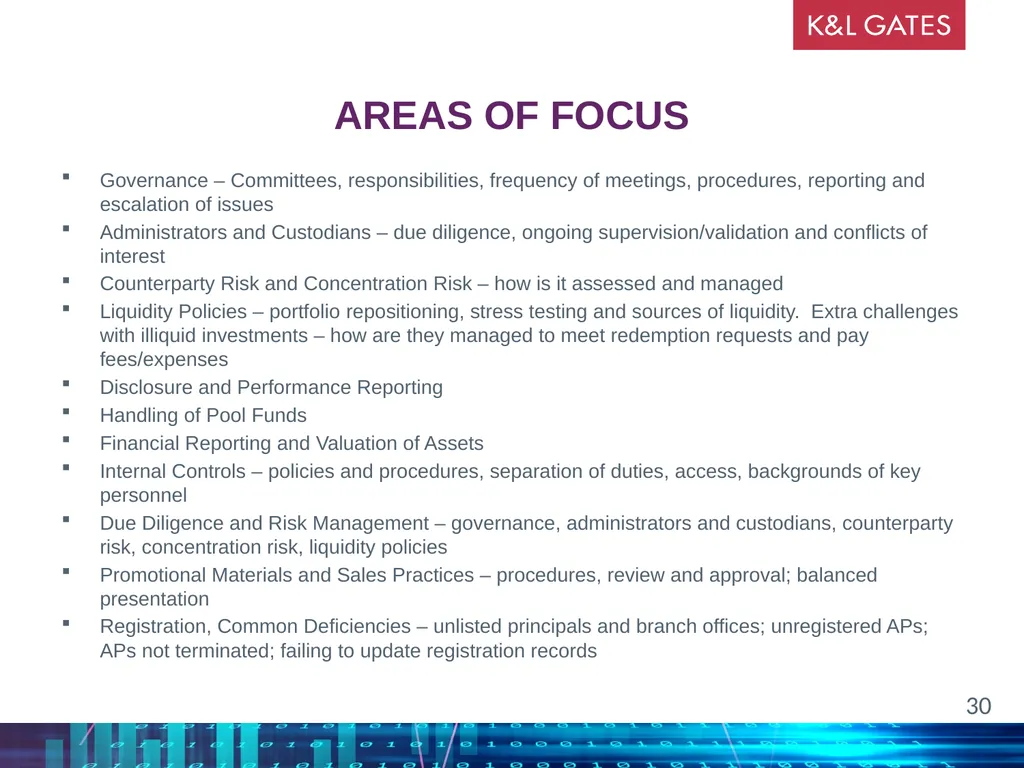
AREAS OF FOCUS Governance – Committees, responsibilities, frequency of meetings, procedures, reporting and escalation of issues
Administrators and Custodians – due diligence, ongoing supervision/validation and conflicts of interest
Counterparty Risk and Concentration Risk – how is it assessed and managed
Liquidity Policies – portfolio repositioning, stress testing and sources of liquidity. Extra challenges with illiquid investments – how are they managed to meet redemption requests and pay fees/expenses
Disclosure and Performance Reporting
Handling of Pool Funds
Financial Reporting and Valuation of Assets
Internal Controls – policies and procedures, separation of duties, access, backgrounds of key personnel
Due Diligence and Risk Management – governance, administrators and custodians, counterparty risk, concentration risk, liquidity policies
Promotional Materials and Sales Practices – procedures, review and approval; balanced presentation
Registration, Common Deficiencies – unlisted principals and branch offices; unregistered APs; APs not terminated; failing to update registration records 30<br>
Administrators and Custodians – due diligence, ongoing supervision/validation and conflicts of interest
Counterparty Risk and Concentration Risk – how is it assessed and managed
Liquidity Policies – portfolio repositioning, stress testing and sources of liquidity. Extra challenges with illiquid investments – how are they managed to meet redemption requests and pay fees/expenses
Disclosure and Performance Reporting
Handling of Pool Funds
Financial Reporting and Valuation of Assets
Internal Controls – policies and procedures, separation of duties, access, backgrounds of key personnel
Due Diligence and Risk Management – governance, administrators and custodians, counterparty risk, concentration risk, liquidity policies
Promotional Materials and Sales Practices – procedures, review and approval; balanced presentation
Registration, Common Deficiencies – unlisted principals and branch offices; unregistered APs; APs not terminated; failing to update registration records 30<br>
31
Disclosure documents and
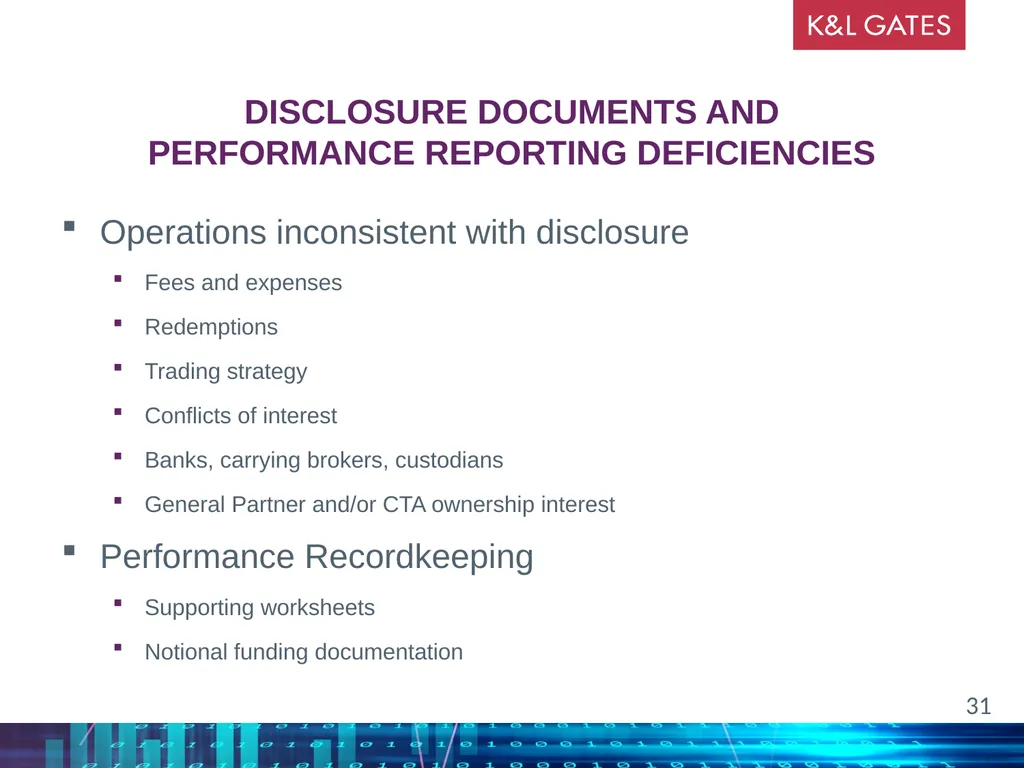
performance reporting deficiencieS Operations inconsistent with disclosure
Fees and expenses
Redemptions
Trading strategy
Conflicts of interest
Banks, carrying brokers, custodians
General Partner and/or CTA ownership interest
Performance Recordkeeping
Supporting worksheets
Notional funding documentation 31<br>
Fees and expenses
Redemptions
Trading strategy
Conflicts of interest
Banks, carrying brokers, custodians
General Partner and/or CTA ownership interest
Performance Recordkeeping
Supporting worksheets
Notional funding documentation 31<br>
32
BYLAW 1101 DEFICIENCIES:
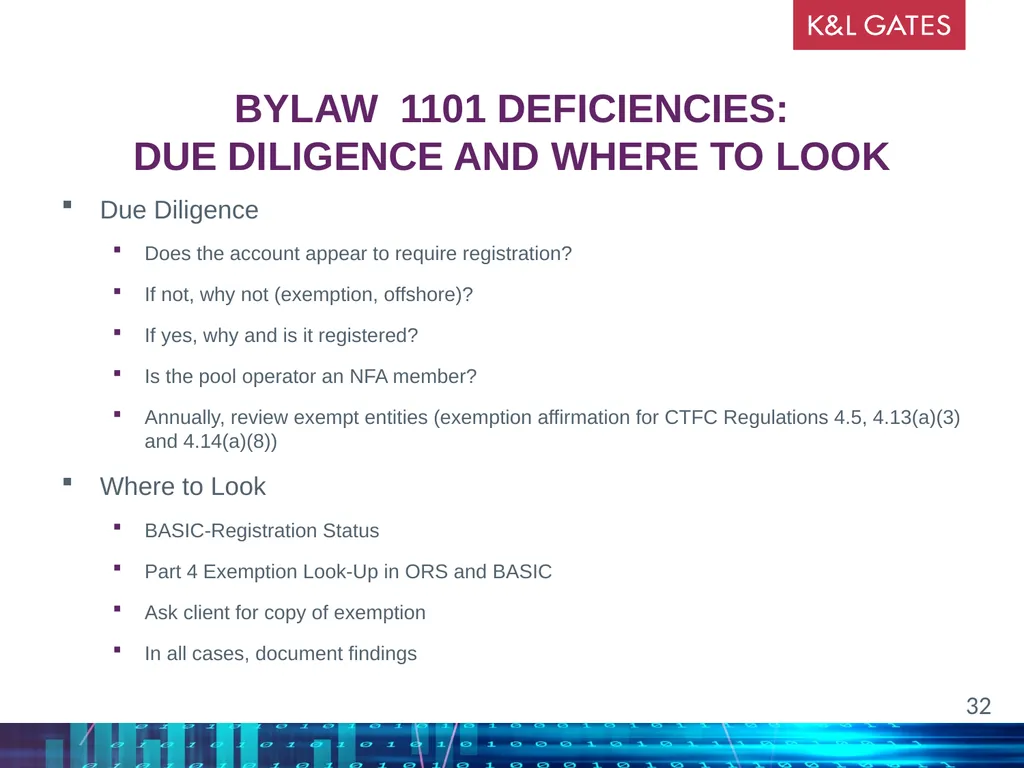
DUE DILIGENCE AND WHERE TO LOOK Due Diligence
Does the account appear to require registration?
If not, why not (exemption, offshore)?
If yes, why and is it registered?
Is the pool operator an NFA member?
Annually, review exempt entities (exemption affirmation for CTFC Regulations 4.5, 4.13(a)(3) and 4.14(a)(8))
Where to Look
BASIC-Registration Status
Part 4 Exemption Look-Up in ORS and BASIC
Ask client for copy of exemption
In all cases, document findings 32<br>
Does the account appear to require registration?
If not, why not (exemption, offshore)?
If yes, why and is it registered?
Is the pool operator an NFA member?
Annually, review exempt entities (exemption affirmation for CTFC Regulations 4.5, 4.13(a)(3) and 4.14(a)(8))
Where to Look
BASIC-Registration Status
Part 4 Exemption Look-Up in ORS and BASIC
Ask client for copy of exemption
In all cases, document findings 32<br>
33
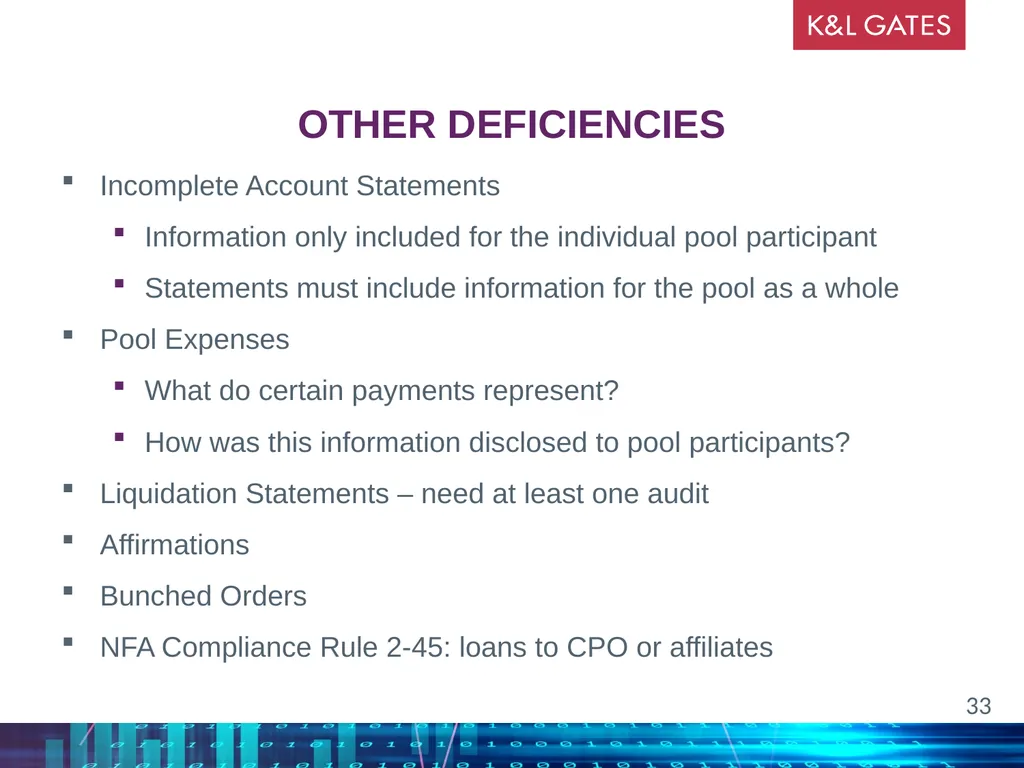
Other Deficiencies Incomplete Account Statements
Information only included for the individual pool participant
Statements must include information for the pool as a whole
Pool Expenses
What do certain payments represent?
How was this information disclosed to pool participants?
Liquidation Statements – need at least one audit
Affirmations
Bunched Orders
NFA Compliance Rule 2-45: loans to CPO or affiliates 33<br>
Information only included for the individual pool participant
Statements must include information for the pool as a whole
Pool Expenses
What do certain payments represent?
How was this information disclosed to pool participants?
Liquidation Statements – need at least one audit
Affirmations
Bunched Orders
NFA Compliance Rule 2-45: loans to CPO or affiliates 33<br>
34
CFTC, NFA, and Exchange Enforcement 34<br>
35
THE EXCHANGES ARE THE REGULATOR The exchanges themselves are the front line regulators of listed futures and futures options
The CFTC grants the exchanges their licenses to operate, and polices how they police traders
CFTC Regulations require the exchanges to require market participants to consent to the exchanges’ jurisdiction as a condition of market access
If you access the futures markets, you are subject to exchange discipline – membership not required
The exchanges have their own form of legal system, made up of investigators, prosecutors, and courts 35<br>
The CFTC grants the exchanges their licenses to operate, and polices how they police traders
CFTC Regulations require the exchanges to require market participants to consent to the exchanges’ jurisdiction as a condition of market access
If you access the futures markets, you are subject to exchange discipline – membership not required
The exchanges have their own form of legal system, made up of investigators, prosecutors, and courts 35<br>
36
THE EXCHANGES ARE THE REGULATOR It is a federal crime to lie to the exchange
The increasing specter of criminal prosecution for “disruptive” or “disorderly” trading now can make the decision whether to speak to exchange investigators much more difficult, depending on the circumstances
Be thoughtful. Be careful. Take exchange interviews very seriously.
Exchange interviews will be shared with the CFTC upon request
And with the Justice Department 36<br>
The increasing specter of criminal prosecution for “disruptive” or “disorderly” trading now can make the decision whether to speak to exchange investigators much more difficult, depending on the circumstances
Be thoughtful. Be careful. Take exchange interviews very seriously.
Exchange interviews will be shared with the CFTC upon request
And with the Justice Department 36<br>
37
THE EXCHANGES ARE THE REGULATOR The exchanges can suspend or terminate access to the market for failure to provide records or testimony
It is an exchange violation for a firm to not diligently supervise its agents
Firms face strict liability for the acts of their agents
Exchanges can impose significant monetary penalties – the CME increased its maximum fine from $1 million to $5 million per violation
Though exchanges can issue warning letters, the CFTC told one futures exchange, “issuing a warning letter for a substantive trading violation is never appropriate.” 37<br>
It is an exchange violation for a firm to not diligently supervise its agents
Firms face strict liability for the acts of their agents
Exchanges can impose significant monetary penalties – the CME increased its maximum fine from $1 million to $5 million per violation
Though exchanges can issue warning letters, the CFTC told one futures exchange, “issuing a warning letter for a substantive trading violation is never appropriate.” 37<br>
38
CFTC ENFORCEMENT FOR FAILURE TO SUPERVISE – LOGISTA ADVISORS LLC Commodity Trading Advisor / Commodity Pool Operator employed crude oil futures and options trading strategy
Trader allegedly engaged in “spoofing” - bidding or offering with the intent to cancel the bid or offer before execution
A digression concerning spoofing 38<br>
Trader allegedly engaged in “spoofing” - bidding or offering with the intent to cancel the bid or offer before execution
A digression concerning spoofing 38<br>
39
REMEMBER “SPOOFING”? Michael Coscia was the first trader who was criminally charged and then convicted at trial for spoofing, following settlements with the CFTC and all four CME Group futures exchanges
On August 7, 2017, the Seventh Circuit Court of Appeals affirmed Coscia’s conviction and sentence
There have been several indictments and guilty pleas
The CFTC and futures exchanges have continued their aggressive investigations and enforcement actions
It is unwise to tell yourself “the traders at my firm would never spoof” 39<br>
On August 7, 2017, the Seventh Circuit Court of Appeals affirmed Coscia’s conviction and sentence
There have been several indictments and guilty pleas
The CFTC and futures exchanges have continued their aggressive investigations and enforcement actions
It is unwise to tell yourself “the traders at my firm would never spoof” 39<br>
40
CFTC ENFORCEMENT FOR FAILURE TO SUPERVISE – LOGISTA ADVISORS LLC Commodity Trading Advisor / Commodity Pool Operator with crude oil futures and options trading strategy
A Logista trader allegedly engaged in the disruptive trading strategy called “spoofing” - bidding or offering with the intent to cancel the bid or offer before execution on a foreign futures exchange
According to the CFTC, Logista lacked any policies or procedures for the detection and deterrence of disruptive trading
Logista allegedly gave no training on disruptive trading 40<br>
A Logista trader allegedly engaged in the disruptive trading strategy called “spoofing” - bidding or offering with the intent to cancel the bid or offer before execution on a foreign futures exchange
According to the CFTC, Logista lacked any policies or procedures for the detection and deterrence of disruptive trading
Logista allegedly gave no training on disruptive trading 40<br>
41
CFTC ENFORCEMENT FOR FAILURE TO SUPERVISE – LOGISTA ADVISORS LLC When the foreign futures exchange contacted Logista’s FCM about the trading, Logista allegedly failed to supervise its personnel in providing the FCM with a proper response to the exchange’s questions
Logista allegedly did not investigate the trading
Did not ask the trader to explain the conduct
Did not tell the trader that the conduct was problematic
Logista allegedly provided inaccurate explanations to the FCM and exchange for several weeks 41<br>
Logista allegedly did not investigate the trading
Did not ask the trader to explain the conduct
Did not tell the trader that the conduct was problematic
Logista allegedly provided inaccurate explanations to the FCM and exchange for several weeks 41<br>
42
CFTC ENFORCEMENT FOR FAILURE TO SUPERVISE – LOGISTA ADVISORS LLC In Logista the CFTC tells us that Regulation 166.3 “imposes upon registrants [CPOs / CTAs] an affirmative duty to supervise their employees and agents diligently by implementing and executing an adequate supervisory structure and compliance program”
For a registrant to fulfill its duties under Regulation 166.3, it must both design an adequate program of supervision and ensure that the program is followed
A violation under Regulation 166.3 is an independent violation for which no underlying violation is necessary
$250,000 civil monetary penalty 42<br>
For a registrant to fulfill its duties under Regulation 166.3, it must both design an adequate program of supervision and ensure that the program is followed
A violation under Regulation 166.3 is an independent violation for which no underlying violation is necessary
$250,000 civil monetary penalty 42<br>
43
CFTC ENFORCEMENT FOR FAILURE TO SUPERVISE – TILLAGE COMMODITIES LLC CPO Tillage hired a third party administrator, SS&C Technologies, Inc., to operate the pool’s bank account, process and disburse customer redemptions and withdrawals, and maintain its books and records
Over a period of 21 days in March 2016, the administrator received seven fraudulent requests to transfer funds from the pool account, and processed five of the requests resulting in the loss of millions of dollars of pool assets
According to the CFTC, Tillage failed to supervise its fund administrator 43<br>
Over a period of 21 days in March 2016, the administrator received seven fraudulent requests to transfer funds from the pool account, and processed five of the requests resulting in the loss of millions of dollars of pool assets
According to the CFTC, Tillage failed to supervise its fund administrator 43<br>
44
CFTC ENFORCEMENT FOR FAILURE TO SUPERVISE – TILLAGE COMMODITIES LLC Again, a violation of Regulation 166.3 is an independent violation for which no underlying violation is necessary
Even though Tillage made the pool participants whole upon request, and hired a reputable third-party fund administrator, and was a fraud victim, the CFTC fined Tillage $150,000 for failing to supervise its administrator
Litigation between Tillage and the fund administrator is pending
CPOs and CTAs must review their policies and procedures regularly and vigilantly to assess how effectively they identify and remedy the firm’s risks 44<br>
Even though Tillage made the pool participants whole upon request, and hired a reputable third-party fund administrator, and was a fraud victim, the CFTC fined Tillage $150,000 for failing to supervise its administrator
Litigation between Tillage and the fund administrator is pending
CPOs and CTAs must review their policies and procedures regularly and vigilantly to assess how effectively they identify and remedy the firm’s risks 44<br>
45
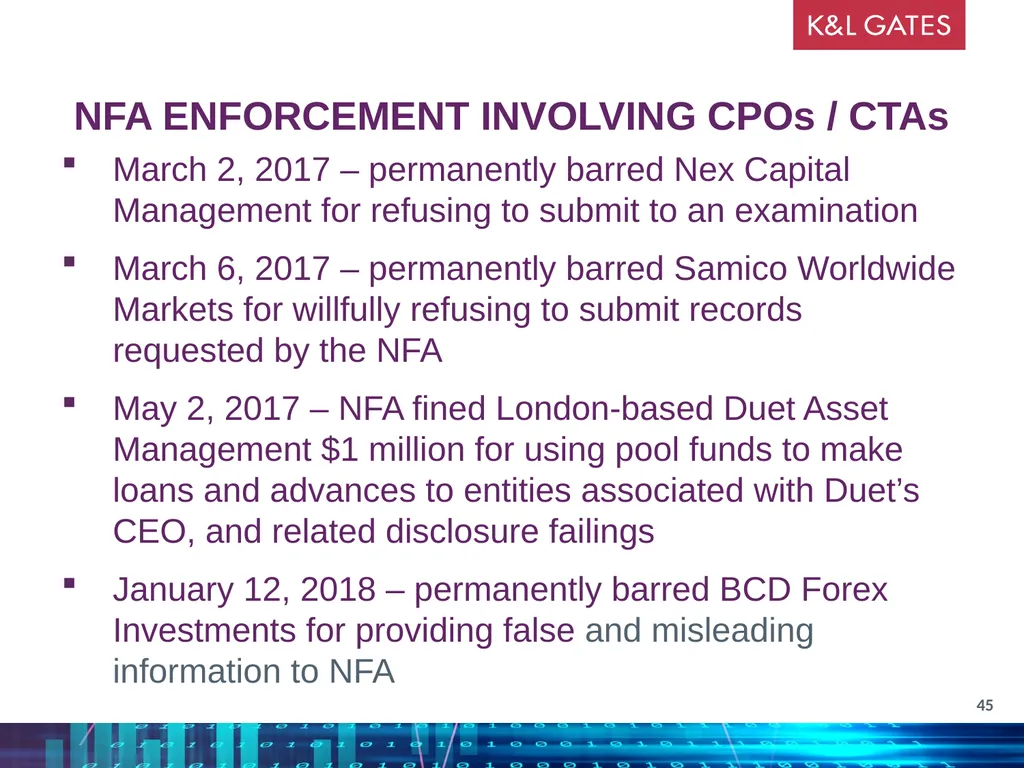
NFA ENFORCEMENT INVOLVING CPOs / CTAs March 2, 2017 – permanently barred Nex Capital Management for refusing to submit to an examination
March 6, 2017 – permanently barred Samico Worldwide Markets for willfully refusing to submit records requested by the NFA
May 2, 2017 – NFA fined London-based Duet Asset Management $1 million for using pool funds to make loans and advances to entities associated with Duet’s CEO, and related disclosure failings
January 12, 2018 – permanently barred BCD Forex Investments for providing false and misleading information to NFA 45<br>
March 6, 2017 – permanently barred Samico Worldwide Markets for willfully refusing to submit records requested by the NFA
May 2, 2017 – NFA fined London-based Duet Asset Management $1 million for using pool funds to make loans and advances to entities associated with Duet’s CEO, and related disclosure failings
January 12, 2018 – permanently barred BCD Forex Investments for providing false and misleading information to NFA 45<br>
46
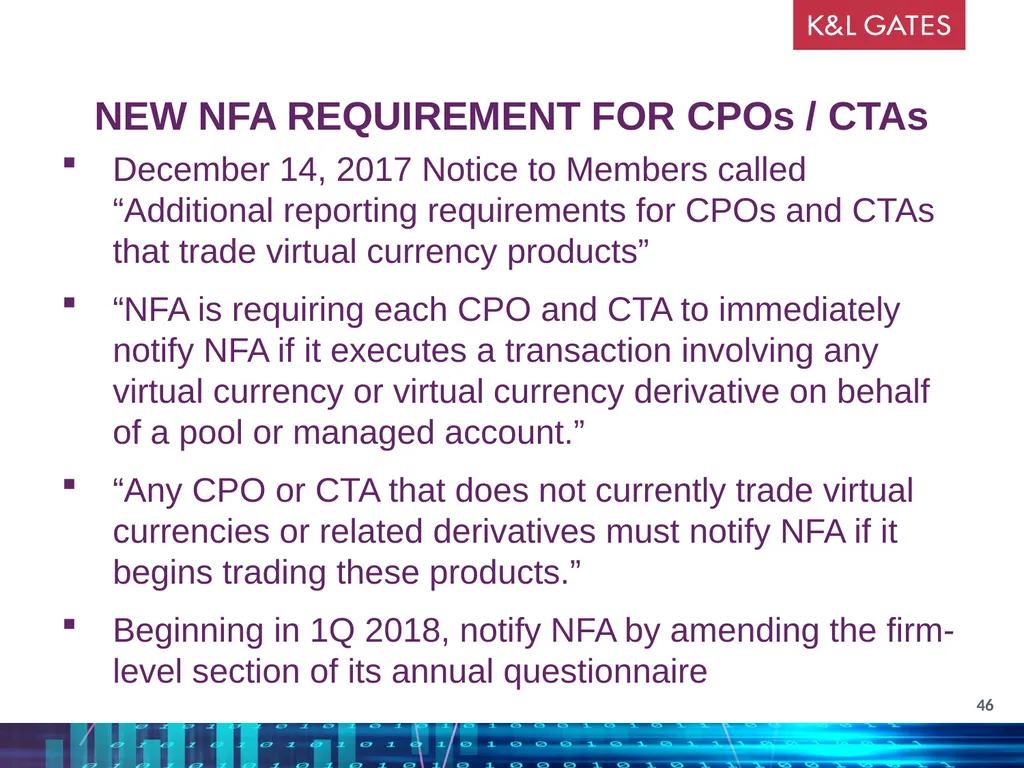
NEW NFA REQUIREMENT FOR CPOs / CTAs December 14, 2017 Notice to Members called “Additional reporting requirements for CPOs and CTAs that trade virtual currency products”
“NFA is requiring each CPO and CTA to immediately notify NFA if it executes a transaction involving any virtual currency or virtual currency derivative on behalf of a pool or managed account.”
“Any CPO or CTA that does not currently trade virtual currencies or related derivatives must notify NFA if it begins trading these products.”
Beginning in 1Q 2018, notify NFA by amending the firm-level section of its annual questionnaire 46<br>
“NFA is requiring each CPO and CTA to immediately notify NFA if it executes a transaction involving any virtual currency or virtual currency derivative on behalf of a pool or managed account.”
“Any CPO or CTA that does not currently trade virtual currencies or related derivatives must notify NFA if it begins trading these products.”
Beginning in 1Q 2018, notify NFA by amending the firm-level section of its annual questionnaire 46<br>
47
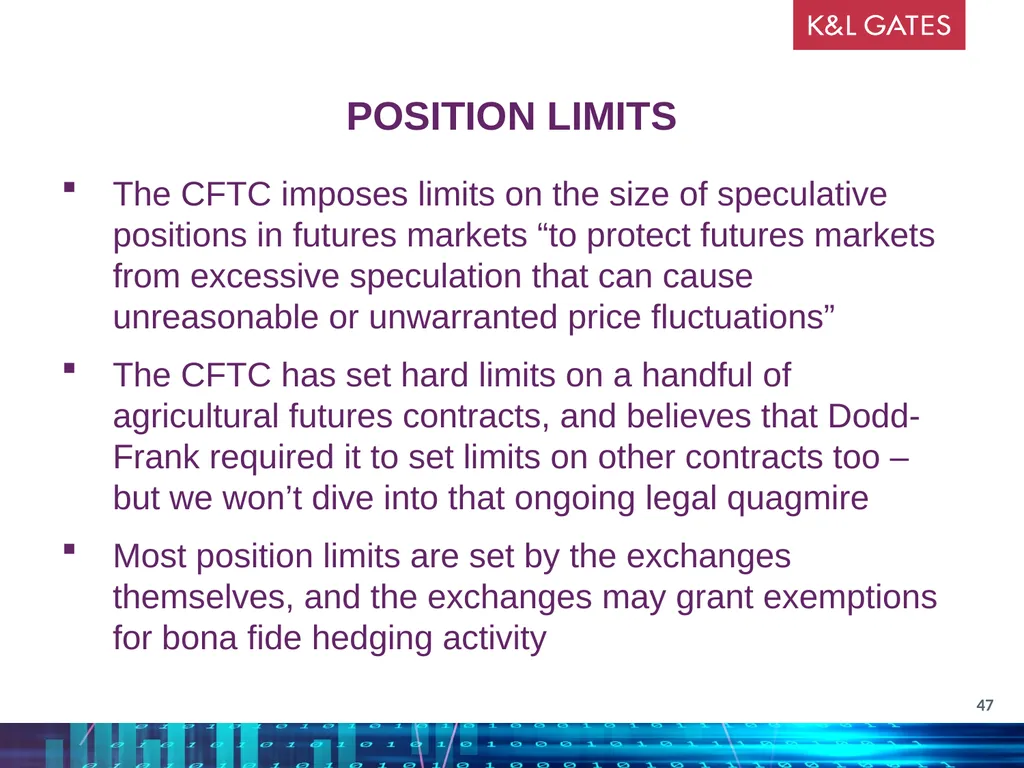
POSITION LIMITS The CFTC imposes limits on the size of speculative positions in futures markets “to protect futures markets from excessive speculation that can cause unreasonable or unwarranted price fluctuations”
The CFTC has set hard limits on a handful of agricultural futures contracts, and believes that Dodd- Frank required it to set limits on other contracts too – but we won’t dive into that ongoing legal quagmire
Most position limits are set by the exchanges themselves, and the exchanges may grant exemptions for bona fide hedging activity 47<br>
The CFTC has set hard limits on a handful of agricultural futures contracts, and believes that Dodd- Frank required it to set limits on other contracts too – but we won’t dive into that ongoing legal quagmire
Most position limits are set by the exchanges themselves, and the exchanges may grant exemptions for bona fide hedging activity 47<br>
48
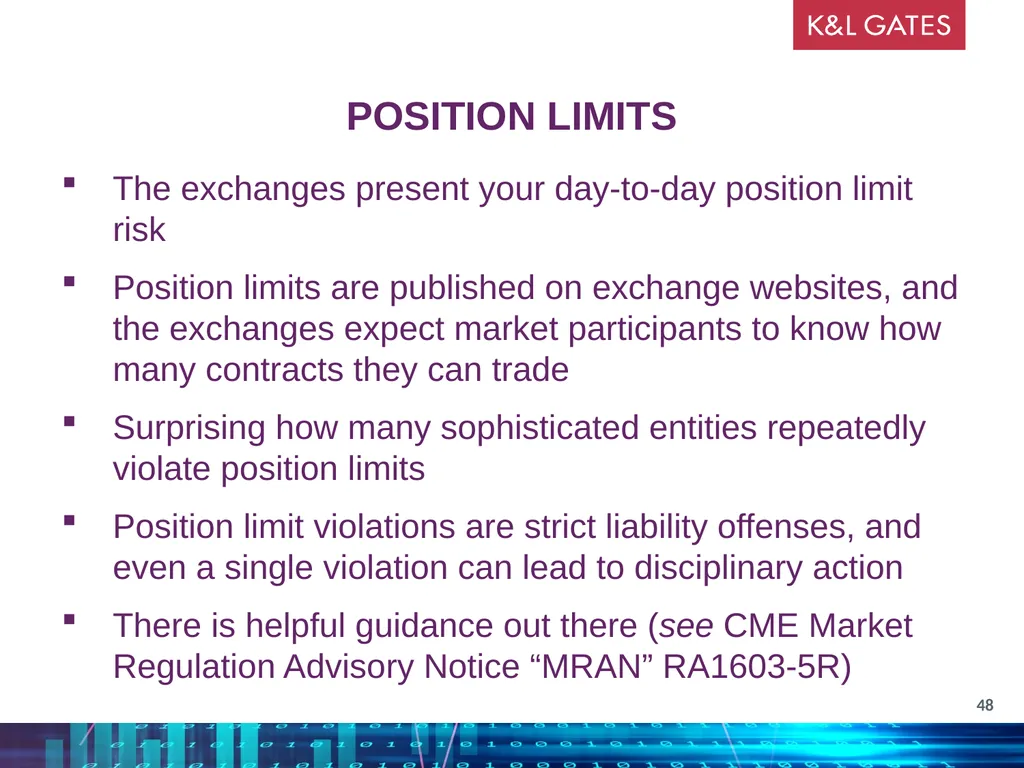
POSITION LIMITS The exchanges present your day-to-day position limit risk
Position limits are published on exchange websites, and the exchanges expect market participants to know how many contracts they can trade
Surprising how many sophisticated entities repeatedly violate position limits
Position limit violations are strict liability offenses, and even a single violation can lead to disciplinary action
There is helpful guidance out there (see CME Market Regulation Advisory Notice “MRAN” RA1603-5R) 48<br>
Position limits are published on exchange websites, and the exchanges expect market participants to know how many contracts they can trade
Surprising how many sophisticated entities repeatedly violate position limits
Position limit violations are strict liability offenses, and even a single violation can lead to disciplinary action
There is helpful guidance out there (see CME Market Regulation Advisory Notice “MRAN” RA1603-5R) 48<br>
49
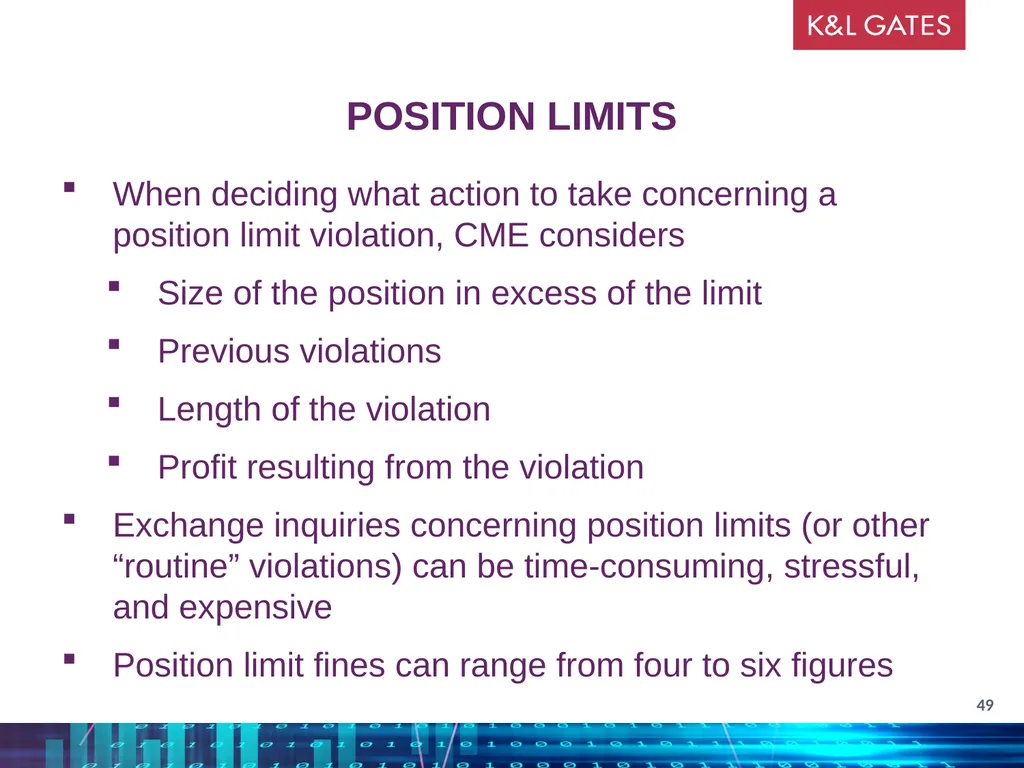
POSITION LIMITS When deciding what action to take concerning a position limit violation, CME considers
Size of the position in excess of the limit
Previous violations
Length of the violation
Profit resulting from the violation
Exchange inquiries concerning position limits (or other “routine” violations) can be time-consuming, stressful, and expensive
Position limit fines can range from four to six figures 49<br>
Size of the position in excess of the limit
Previous violations
Length of the violation
Profit resulting from the violation
Exchange inquiries concerning position limits (or other “routine” violations) can be time-consuming, stressful, and expensive
Position limit fines can range from four to six figures 49<br>
50
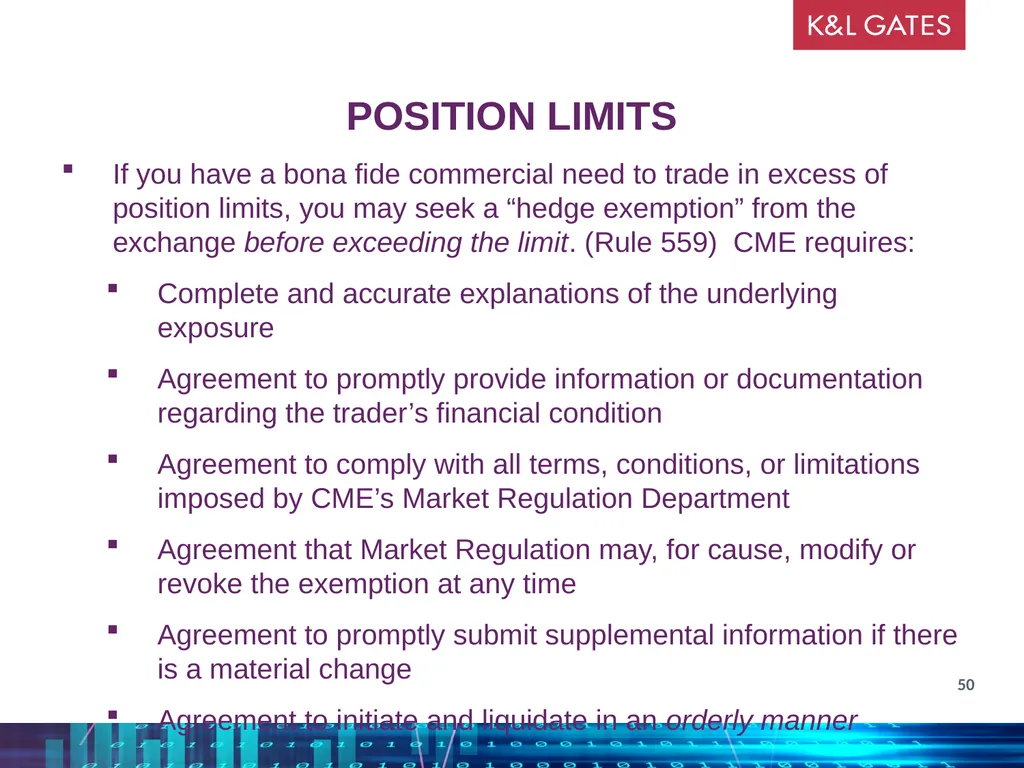
POSITION LIMITS If you have a bona fide commercial need to trade in excess of position limits, you may seek a “hedge exemption” from the exchange before exceeding the limit. (Rule 559) CME requires:
Complete and accurate explanations of the underlying exposure
Agreement to promptly provide information or documentation regarding the trader’s financial condition
Agreement to comply with all terms, conditions, or limitations imposed by CME’s Market Regulation Department
Agreement that Market Regulation may, for cause, modify or revoke the exemption at any time
Agreement to promptly submit supplemental information if there is a material change
Agreement to initiate and liquidate in an orderly manner 50<br>
Complete and accurate explanations of the underlying exposure
Agreement to promptly provide information or documentation regarding the trader’s financial condition
Agreement to comply with all terms, conditions, or limitations imposed by CME’s Market Regulation Department
Agreement that Market Regulation may, for cause, modify or revoke the exemption at any time
Agreement to promptly submit supplemental information if there is a material change
Agreement to initiate and liquidate in an orderly manner 50<br>
51
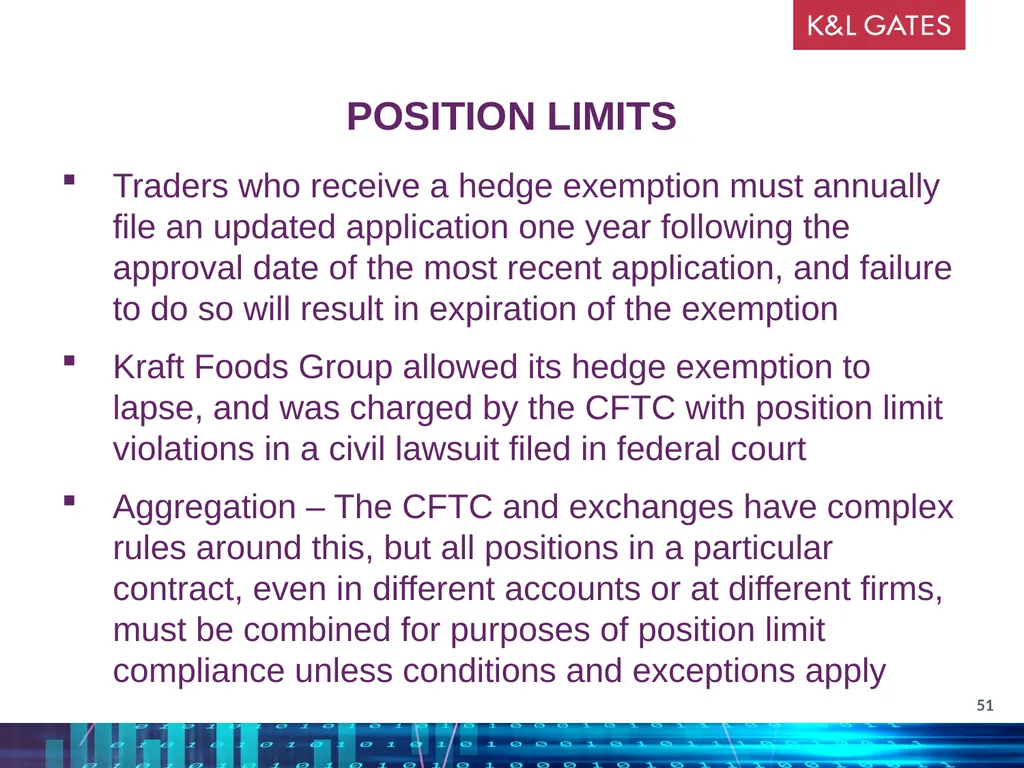
POSITION LIMITS Traders who receive a hedge exemption must annually file an updated application one year following the approval date of the most recent application, and failure to do so will result in expiration of the exemption
Kraft Foods Group allowed its hedge exemption to lapse, and was charged by the CFTC with position limit violations in a civil lawsuit filed in federal court
Aggregation – The CFTC and exchanges have complex rules around this, but all positions in a particular contract, even in different accounts or at different firms, must be combined for purposes of position limit compliance unless conditions and exceptions apply 51<br>
Kraft Foods Group allowed its hedge exemption to lapse, and was charged by the CFTC with position limit violations in a civil lawsuit filed in federal court
Aggregation – The CFTC and exchanges have complex rules around this, but all positions in a particular contract, even in different accounts or at different firms, must be combined for purposes of position limit compliance unless conditions and exceptions apply 51<br>
52
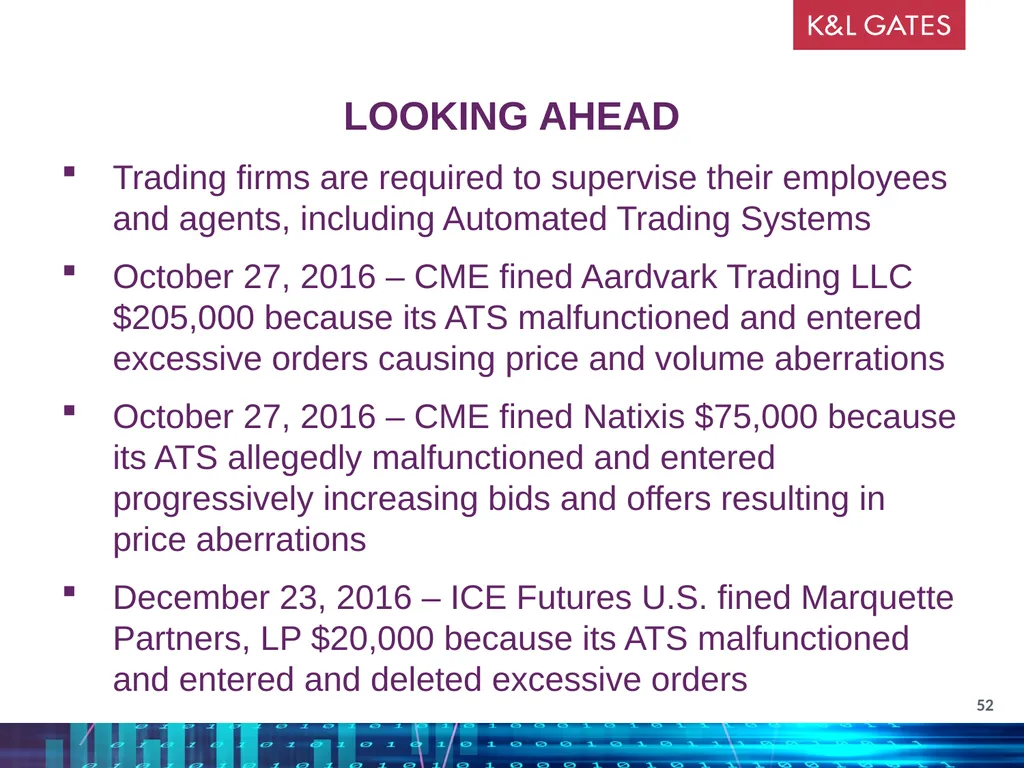
LOOKING AHEAD Trading firms are required to supervise their employees and agents, including Automated Trading Systems
October 27, 2016 – CME fined Aardvark Trading LLC $205,000 because its ATS malfunctioned and entered excessive orders causing price and volume aberrations
October 27, 2016 – CME fined Natixis $75,000 because its ATS allegedly malfunctioned and entered progressively increasing bids and offers resulting in price aberrations
December 23, 2016 – ICE Futures U.S. fined Marquette Partners, LP $20,000 because its ATS malfunctioned and entered and deleted excessive orders 52<br>
October 27, 2016 – CME fined Aardvark Trading LLC $205,000 because its ATS malfunctioned and entered excessive orders causing price and volume aberrations
October 27, 2016 – CME fined Natixis $75,000 because its ATS allegedly malfunctioned and entered progressively increasing bids and offers resulting in price aberrations
December 23, 2016 – ICE Futures U.S. fined Marquette Partners, LP $20,000 because its ATS malfunctioned and entered and deleted excessive orders 52<br>
53
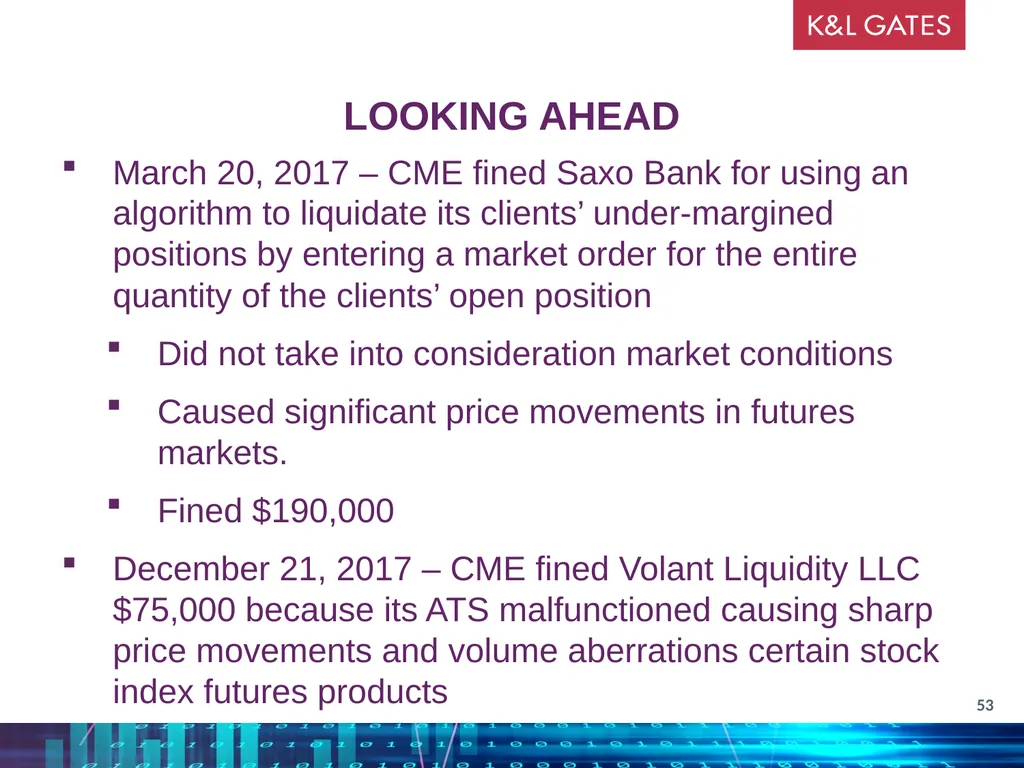
LOOKING AHEAD March 20, 2017 – CME fined Saxo Bank for using an algorithm to liquidate its clients’ under-margined positions by entering a market order for the entire quantity of the clients’ open position
Did not take into consideration market conditions
Caused significant price movements in futures markets.
Fined $190,000
December 21, 2017 – CME fined Volant Liquidity LLC $75,000 because its ATS malfunctioned causing sharp price movements and volume aberrations certain stock index futures products 53<br>
Did not take into consideration market conditions
Caused significant price movements in futures markets.
Fined $190,000
December 21, 2017 – CME fined Volant Liquidity LLC $75,000 because its ATS malfunctioned causing sharp price movements and volume aberrations certain stock index futures products 53<br>
54
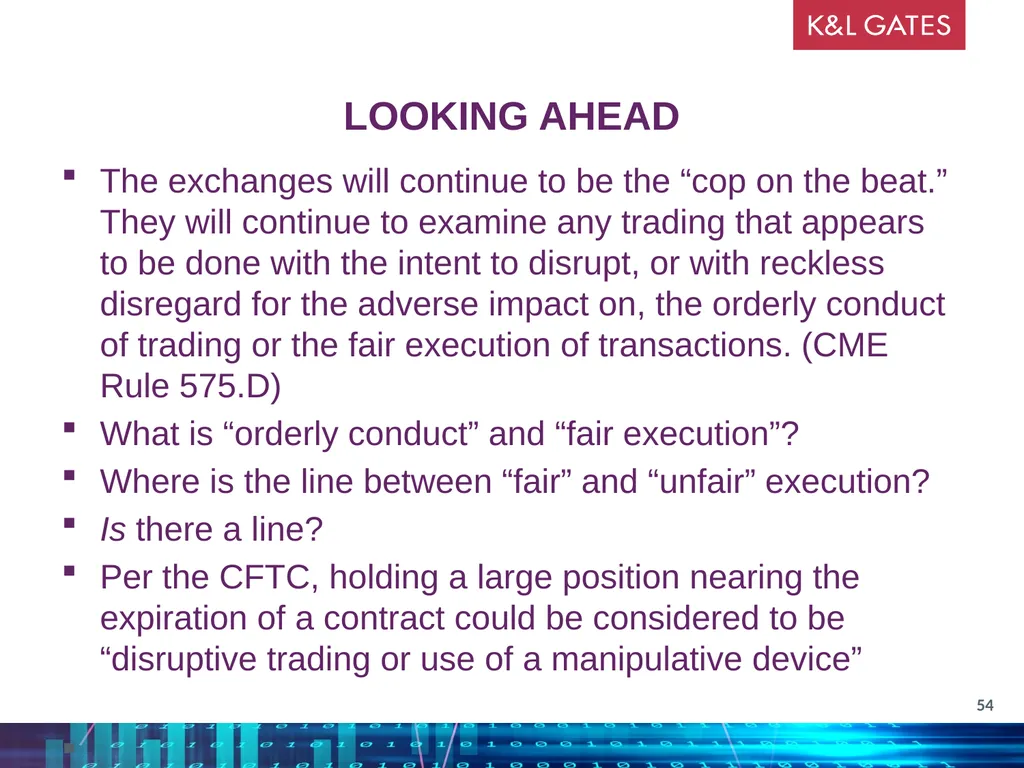
LOOKING AHEAD The exchanges will continue to be the “cop on the beat.” They will continue to examine any trading that appears to be done with the intent to disrupt, or with reckless disregard for the adverse impact on, the orderly conduct of trading or the fair execution of transactions. (CME Rule 575.D)
What is “orderly conduct” and “fair execution”?
Where is the line between “fair” and “unfair” execution?
Is there a line?
Per the CFTC, holding a large position nearing the expiration of a contract could be considered to be “disruptive trading or use of a manipulative device” 54<br>
What is “orderly conduct” and “fair execution”?
Where is the line between “fair” and “unfair” execution?
Is there a line?
Per the CFTC, holding a large position nearing the expiration of a contract could be considered to be “disruptive trading or use of a manipulative device” 54<br>