
Clinical Virology Case Studies Derrick Chen, MD
MJ
Published · 61 slides · 0 views

1 / 1



Description
Clinical Virology Case Studies Derrick Chen, MD Associate Professor, Dept of Pathology and Lab Medicine, Univ of Wisconsin Madison Medical Director, Clinical Microbiology, UW Health Disclosures No relevant conflicts of interest Case
Related Topics
Share
Embed code
Download this presentation From Below
"Clinical Virology Case Studies Derrick Chen, MD" is the property of its rightful owner. Permission is granted to download and print the materials on this website for personal, non-commercial use only, and to display it on your personal computer provided you do not modify the materials and that you retain all copyright notices contained in the materials. By downloading content from our website, you accept the terms of this agreement.
Presentation Transcript
01
Clinical Virology Case Studies Derrick Chen, MD
Associate Professor, Dept of Pathology and Lab Medicine, Univ of Wisconsin – Madison
Medical Director, Clinical Microbiology, UW Health<br>
Associate Professor, Dept of Pathology and Lab Medicine, Univ of Wisconsin – Madison
Medical Director, Clinical Microbiology, UW Health<br>
02
Disclosures No relevant conflicts of interest<br>
03
Case Selection Criteria<br>
04
Case Selection Criteria<br>
05
Case Selection Criteria Based on the selection criteria, your thoughts are:<br>
06
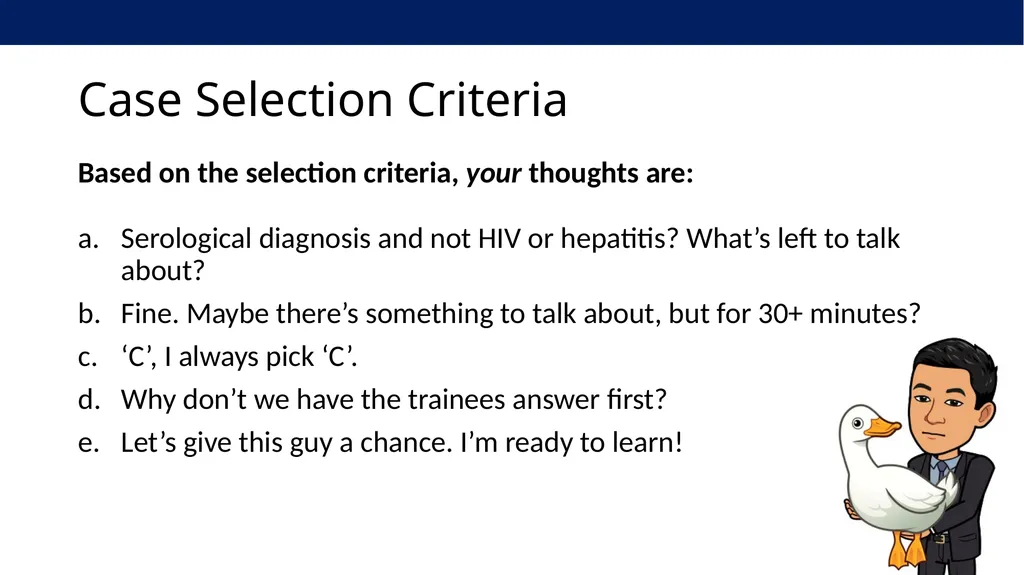
Case Selection Criteria Based on the selection criteria, your thoughts are:
Serological diagnosis and not HIV or hepatitis? What’s left to talk about?<br>
Serological diagnosis and not HIV or hepatitis? What’s left to talk about?<br>
07
Case Selection Criteria Based on the selection criteria, your thoughts are:
Serological diagnosis and not HIV or hepatitis? What’s left to talk about?
Fine. Maybe there’s something to talk about, but for 30+ minutes?<br>
Serological diagnosis and not HIV or hepatitis? What’s left to talk about?
Fine. Maybe there’s something to talk about, but for 30+ minutes?<br>
08
Case Selection Criteria Based on the selection criteria, your thoughts are:
Serological diagnosis and not HIV or hepatitis? What’s left to talk about?
Fine. Maybe there’s something to talk about, but for 30+ minutes?
‘C’, I always pick ‘C’.<br>
Serological diagnosis and not HIV or hepatitis? What’s left to talk about?
Fine. Maybe there’s something to talk about, but for 30+ minutes?
‘C’, I always pick ‘C’.<br>
09
Case Selection Criteria Based on the selection criteria, your thoughts are:
Serological diagnosis and not HIV or hepatitis? What’s left to talk about?
Fine. Maybe there’s something to talk about, but for 30+ minutes?
‘C’, I always pick ‘C’.
Why don’t we have the trainees answer first?<br>
Serological diagnosis and not HIV or hepatitis? What’s left to talk about?
Fine. Maybe there’s something to talk about, but for 30+ minutes?
‘C’, I always pick ‘C’.
Why don’t we have the trainees answer first?<br>
10
Case Selection Criteria Based on the selection criteria, your thoughts are:
Serological diagnosis and not HIV or hepatitis? What’s left to talk about?
Fine. Maybe there’s something to talk about, but for 30+ minutes?
‘C’, I always pick ‘C’.
Why don’t we have the trainees answer first?
Let’s give this guy a chance. I’m ready to learn!<br>
Serological diagnosis and not HIV or hepatitis? What’s left to talk about?
Fine. Maybe there’s something to talk about, but for 30+ minutes?
‘C’, I always pick ‘C’.
Why don’t we have the trainees answer first?
Let’s give this guy a chance. I’m ready to learn!<br>
11
Case 1: sore throat<br>
12
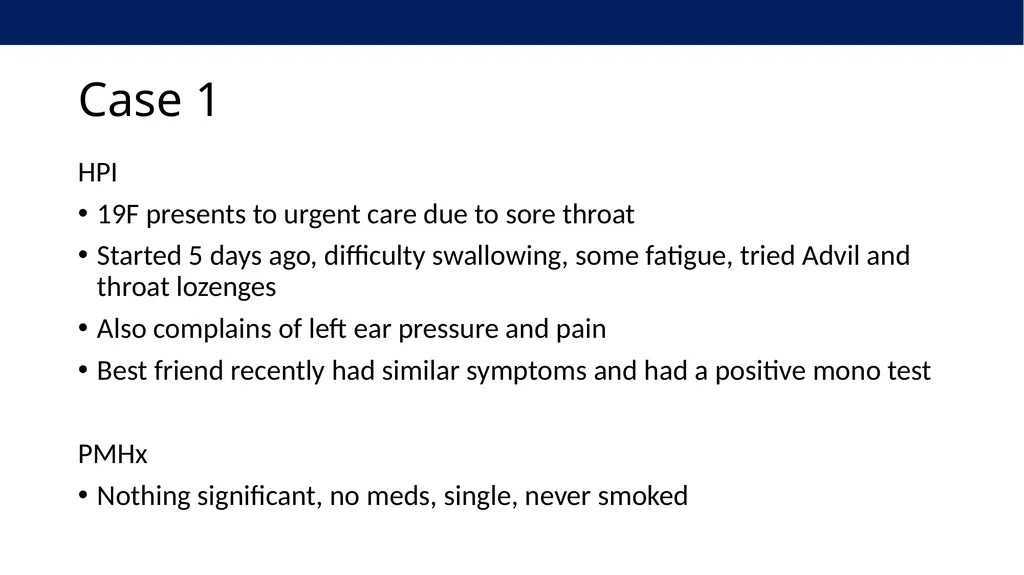
Case 1 HPI
19F presents to urgent care due to sore throat
Started 5 days ago, difficulty swallowing, some fatigue, tried Advil and throat lozenges
Also complains of left ear pressure and pain
Best friend recently had similar symptoms and had a positive mono test
PMHx
Nothing significant, no meds, single, never smoked<br>
19F presents to urgent care due to sore throat
Started 5 days ago, difficulty swallowing, some fatigue, tried Advil and throat lozenges
Also complains of left ear pressure and pain
Best friend recently had similar symptoms and had a positive mono test
PMHx
Nothing significant, no meds, single, never smoked<br>
13
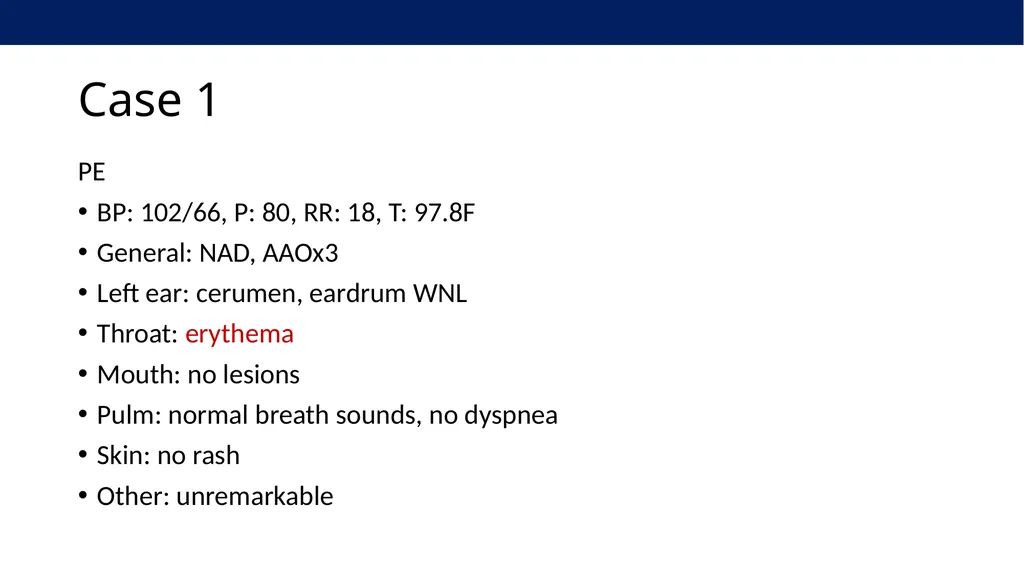
Case 1 PE
BP: 102/66, P: 80, RR: 18, T: 97.8F
General: NAD, AAOx3
Left ear: cerumen, eardrum WNL
Throat: erythema
Mouth: no lesions
Pulm: normal breath sounds, no dyspnea
Skin: no rash
Other: unremarkable<br>
BP: 102/66, P: 80, RR: 18, T: 97.8F
General: NAD, AAOx3
Left ear: cerumen, eardrum WNL
Throat: erythema
Mouth: no lesions
Pulm: normal breath sounds, no dyspnea
Skin: no rash
Other: unremarkable<br>
14
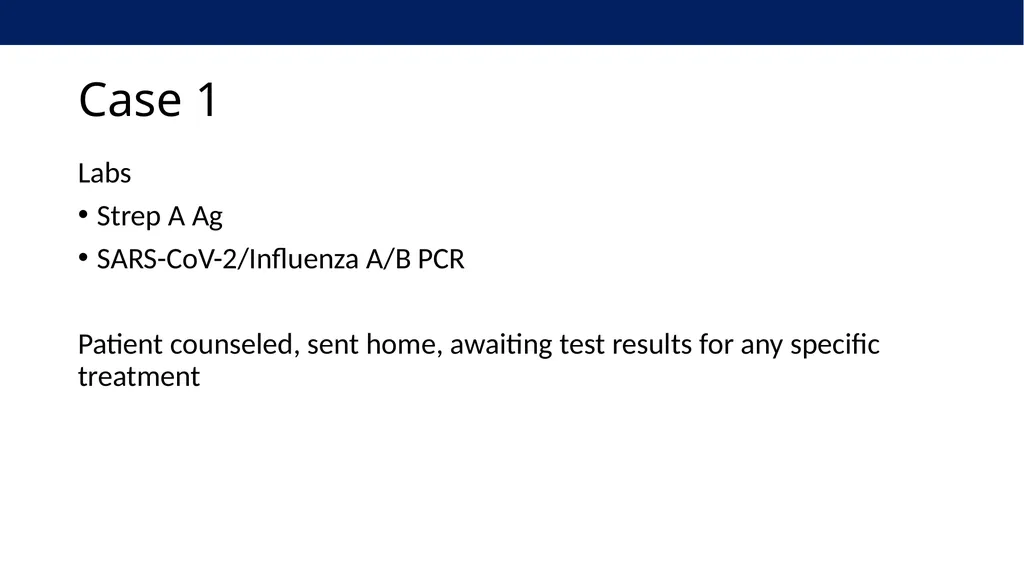
Case 1 Labs
Strep A Ag
SARS-CoV-2/Influenza A/B PCR
Patient counseled, sent home, awaiting test results for any specific treatment<br>
Strep A Ag
SARS-CoV-2/Influenza A/B PCR
Patient counseled, sent home, awaiting test results for any specific treatment<br>
15
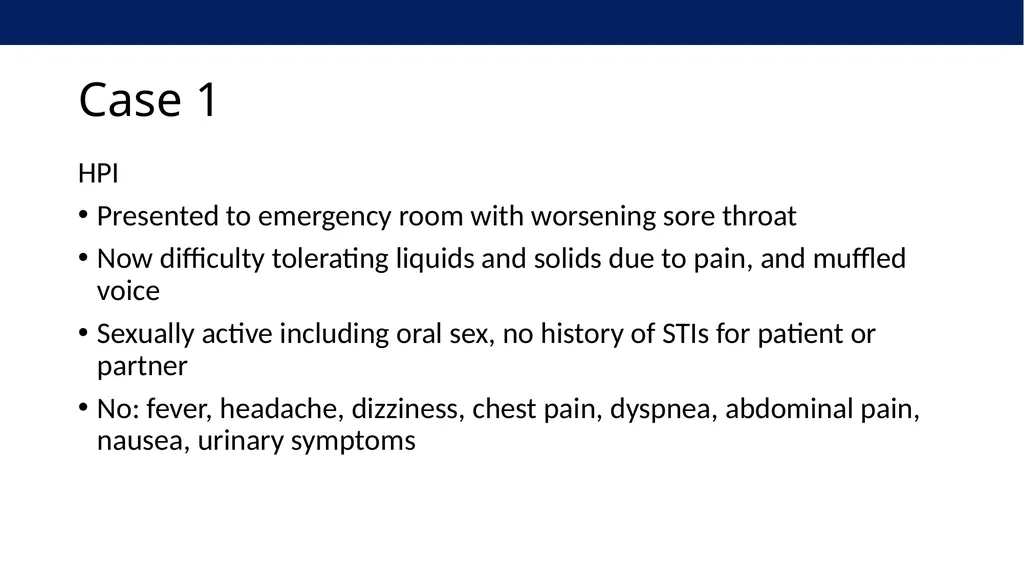
Case 1 HPI
Presented to emergency room with worsening sore throat
Now difficulty tolerating liquids and solids due to pain, and muffled voice
Sexually active including oral sex, no history of STIs for patient or partner
No: fever, headache, dizziness, chest pain, dyspnea, abdominal pain, nausea, urinary symptoms<br>
Presented to emergency room with worsening sore throat
Now difficulty tolerating liquids and solids due to pain, and muffled voice
Sexually active including oral sex, no history of STIs for patient or partner
No: fever, headache, dizziness, chest pain, dyspnea, abdominal pain, nausea, urinary symptoms<br>
16
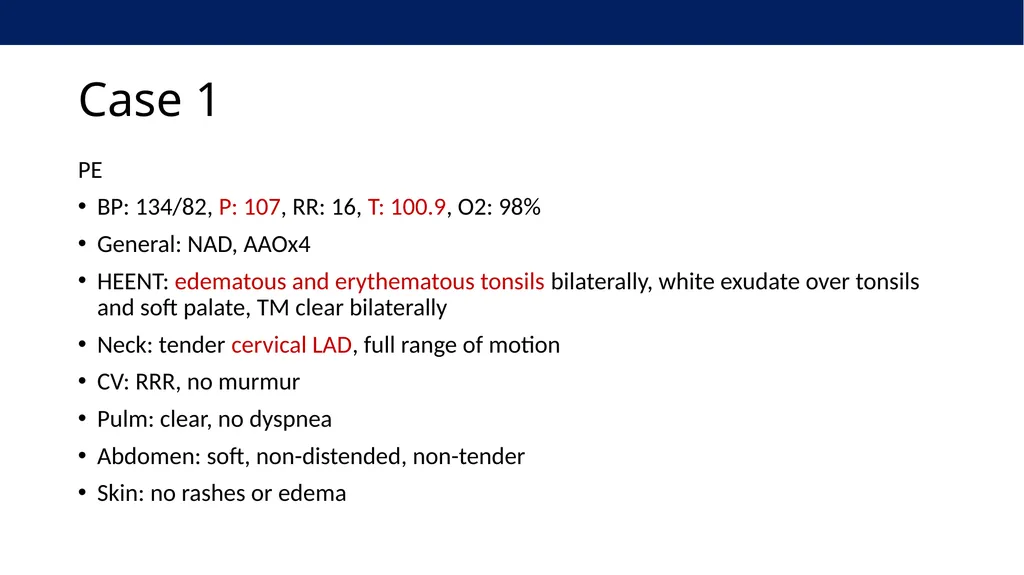
Case 1 PE
BP: 134/82, P: 107, RR: 16, T: 100.9, O2: 98%
General: NAD, AAOx4
HEENT: edematous and erythematous tonsils bilaterally, white exudate over tonsils and soft palate, TM clear bilaterally
Neck: tender cervical LAD, full range of motion
CV: RRR, no murmur
Pulm: clear, no dyspnea
Abdomen: soft, non-distended, non-tender
Skin: no rashes or edema<br>
BP: 134/82, P: 107, RR: 16, T: 100.9, O2: 98%
General: NAD, AAOx4
HEENT: edematous and erythematous tonsils bilaterally, white exudate over tonsils and soft palate, TM clear bilaterally
Neck: tender cervical LAD, full range of motion
CV: RRR, no murmur
Pulm: clear, no dyspnea
Abdomen: soft, non-distended, non-tender
Skin: no rashes or edema<br>
17
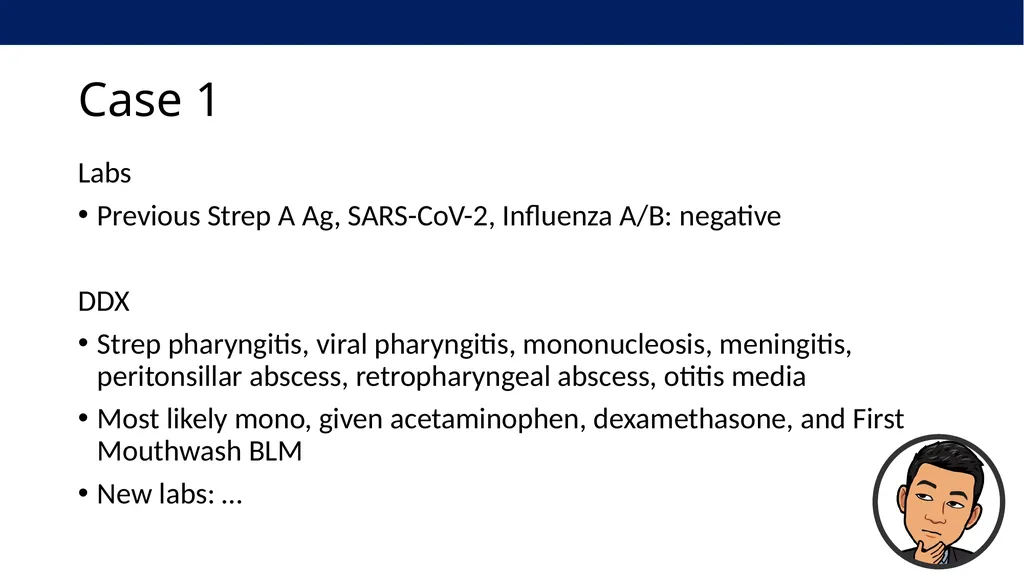
Labs
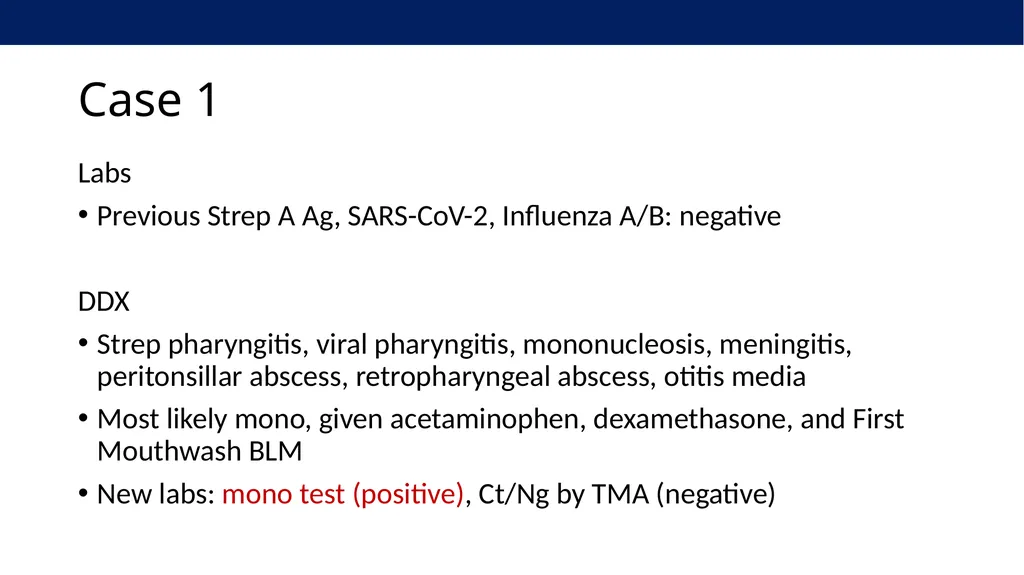
Previous Strep A Ag, SARS-CoV-2, Influenza A/B: negative
DDX
Strep pharyngitis, viral pharyngitis, mononucleosis, meningitis, peritonsillar abscess, retropharyngeal abscess, otitis media
Most likely mono, given acetaminophen, dexamethasone, and First Mouthwash BLM
New labs: … Case 1<br>
Previous Strep A Ag, SARS-CoV-2, Influenza A/B: negative
DDX
Strep pharyngitis, viral pharyngitis, mononucleosis, meningitis, peritonsillar abscess, retropharyngeal abscess, otitis media
Most likely mono, given acetaminophen, dexamethasone, and First Mouthwash BLM
New labs: … Case 1<br>
18
Labs
Previous Strep A Ag, SARS-CoV-2, Influenza A/B: negative
DDX
Strep pharyngitis, viral pharyngitis, mononucleosis, meningitis, peritonsillar abscess, retropharyngeal abscess, otitis media
Most likely mono, given acetaminophen, dexamethasone, and First Mouthwash BLM
New labs: mono test (positive), Ct/Ng by TMA (negative) Case 1<br>
Previous Strep A Ag, SARS-CoV-2, Influenza A/B: negative
DDX
Strep pharyngitis, viral pharyngitis, mononucleosis, meningitis, peritonsillar abscess, retropharyngeal abscess, otitis media
Most likely mono, given acetaminophen, dexamethasone, and First Mouthwash BLM
New labs: mono test (positive), Ct/Ng by TMA (negative) Case 1<br>
19
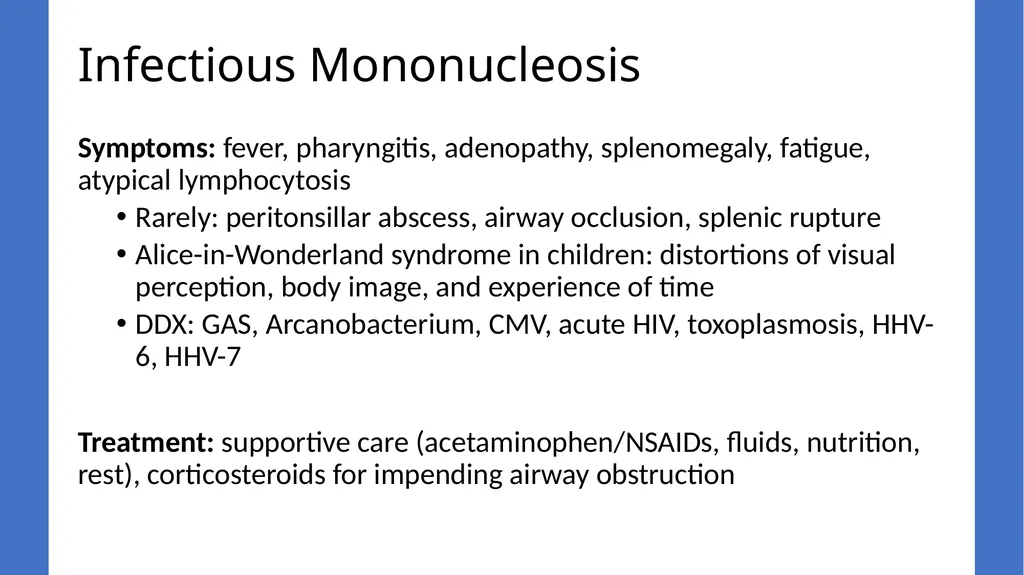
Infectious Mononucleosis Symptoms: fever, pharyngitis, adenopathy, splenomegaly, fatigue, atypical lymphocytosis
Rarely: peritonsillar abscess, airway occlusion, splenic rupture
Alice-in-Wonderland syndrome in children: distortions of visual perception, body image, and experience of time
DDX: GAS, Arcanobacterium, CMV, acute HIV, toxoplasmosis, HHV-6, HHV-7
Treatment: supportive care (acetaminophen/NSAIDs, fluids, nutrition, rest), corticosteroids for impending airway obstruction<br>
Rarely: peritonsillar abscess, airway occlusion, splenic rupture
Alice-in-Wonderland syndrome in children: distortions of visual perception, body image, and experience of time
DDX: GAS, Arcanobacterium, CMV, acute HIV, toxoplasmosis, HHV-6, HHV-7
Treatment: supportive care (acetaminophen/NSAIDs, fluids, nutrition, rest), corticosteroids for impending airway obstruction<br>
20
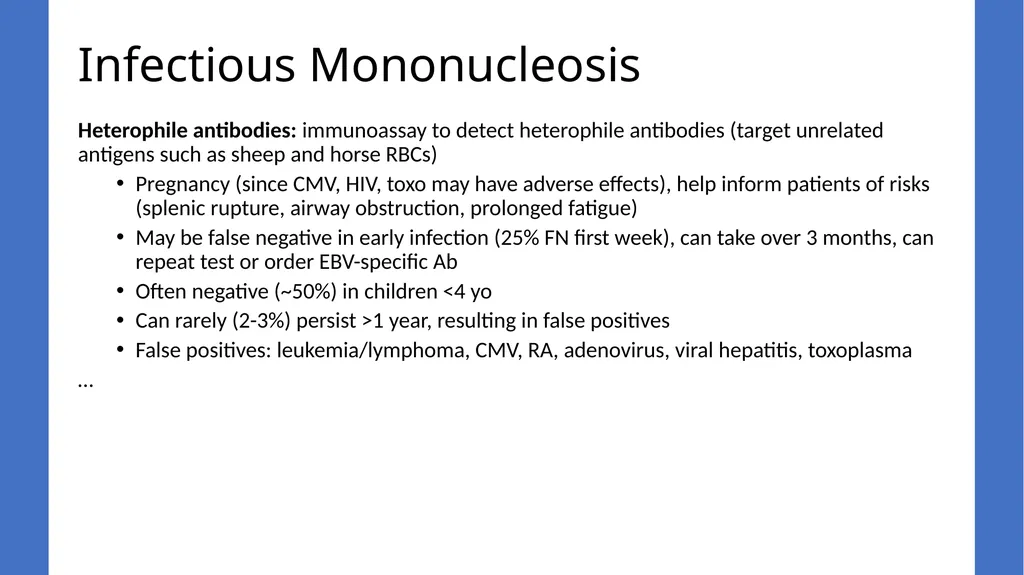
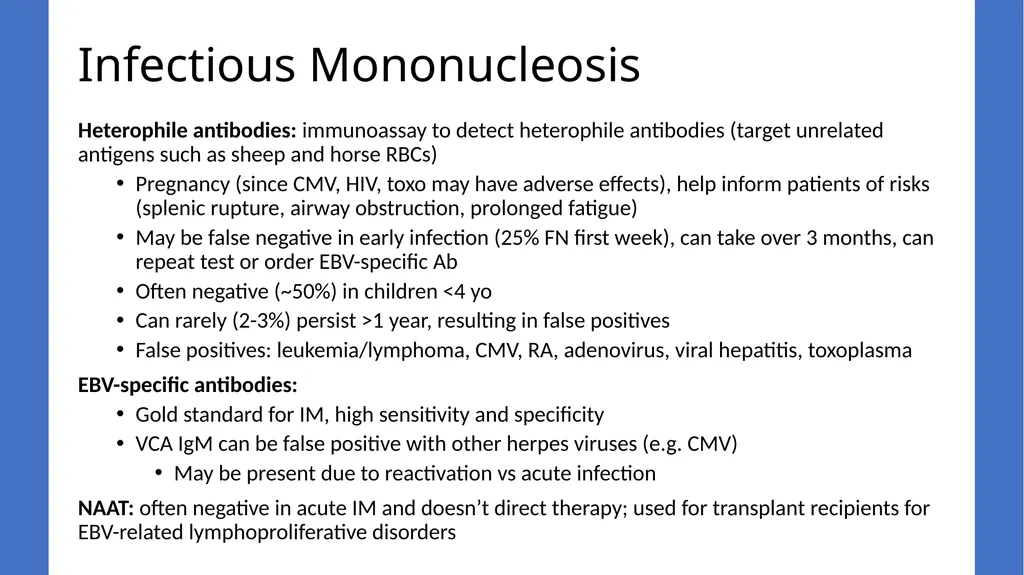
Heterophile antibodies: immunoassay to detect heterophile antibodies (target unrelated antigens such as sheep and horse RBCs)
Pregnancy (since CMV, HIV, toxo may have adverse effects), help inform patients of risks (splenic rupture, airway obstruction, prolonged fatigue)
May be false negative in early infection (25% FN first week), can take over 3 months, can repeat test or order EBV-specific Ab
Often negative (~50%) in children <4 yo
Can rarely (2-3%) persist >1 year, resulting in false positives
False positives: leukemia/lymphoma, CMV, RA, adenovirus, viral hepatitis, toxoplasma
… Infectious Mononucleosis<br>
Pregnancy (since CMV, HIV, toxo may have adverse effects), help inform patients of risks (splenic rupture, airway obstruction, prolonged fatigue)
May be false negative in early infection (25% FN first week), can take over 3 months, can repeat test or order EBV-specific Ab
Often negative (~50%) in children <4 yo
Can rarely (2-3%) persist >1 year, resulting in false positives
False positives: leukemia/lymphoma, CMV, RA, adenovirus, viral hepatitis, toxoplasma
… Infectious Mononucleosis<br>
21
Heterophile antibodies: immunoassay to detect heterophile antibodies (target unrelated antigens such as sheep and horse RBCs)
Pregnancy (since CMV, HIV, toxo may have adverse effects), help inform patients of risks (splenic rupture, airway obstruction, prolonged fatigue)
May be false negative in early infection (25% FN first week), can take over 3 months, can repeat test or order EBV-specific Ab
Often negative (~50%) in children <4 yo
Can rarely (2-3%) persist >1 year, resulting in false positives
False positives: leukemia/lymphoma, CMV, RA, adenovirus, viral hepatitis, toxoplasma
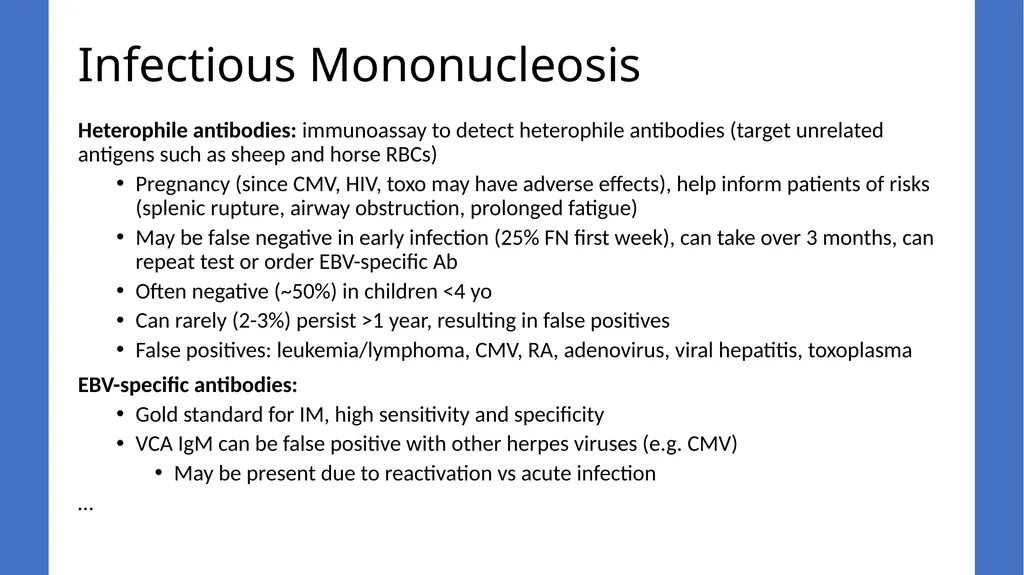
EBV-specific antibodies:
Gold standard for IM, high sensitivity and specificity
VCA IgM can be false positive with other herpes viruses (e.g. CMV)
May be present due to reactivation vs acute infection
… Infectious Mononucleosis<br>
Pregnancy (since CMV, HIV, toxo may have adverse effects), help inform patients of risks (splenic rupture, airway obstruction, prolonged fatigue)
May be false negative in early infection (25% FN first week), can take over 3 months, can repeat test or order EBV-specific Ab
Often negative (~50%) in children <4 yo
Can rarely (2-3%) persist >1 year, resulting in false positives
False positives: leukemia/lymphoma, CMV, RA, adenovirus, viral hepatitis, toxoplasma
EBV-specific antibodies:
Gold standard for IM, high sensitivity and specificity
VCA IgM can be false positive with other herpes viruses (e.g. CMV)
May be present due to reactivation vs acute infection
… Infectious Mononucleosis<br>
22
Heterophile antibodies: immunoassay to detect heterophile antibodies (target unrelated antigens such as sheep and horse RBCs)
Pregnancy (since CMV, HIV, toxo may have adverse effects), help inform patients of risks (splenic rupture, airway obstruction, prolonged fatigue)
May be false negative in early infection (25% FN first week), can take over 3 months, can repeat test or order EBV-specific Ab
Often negative (~50%) in children <4 yo
Can rarely (2-3%) persist >1 year, resulting in false positives
False positives: leukemia/lymphoma, CMV, RA, adenovirus, viral hepatitis, toxoplasma
EBV-specific antibodies:
Gold standard for IM, high sensitivity and specificity
VCA IgM can be false positive with other herpes viruses (e.g. CMV)
May be present due to reactivation vs acute infection
NAAT: often negative in acute IM and doesn’t direct therapy; used for transplant recipients for EBV-related lymphoproliferative disorders Infectious Mononucleosis<br>
Pregnancy (since CMV, HIV, toxo may have adverse effects), help inform patients of risks (splenic rupture, airway obstruction, prolonged fatigue)
May be false negative in early infection (25% FN first week), can take over 3 months, can repeat test or order EBV-specific Ab
Often negative (~50%) in children <4 yo
Can rarely (2-3%) persist >1 year, resulting in false positives
False positives: leukemia/lymphoma, CMV, RA, adenovirus, viral hepatitis, toxoplasma
EBV-specific antibodies:
Gold standard for IM, high sensitivity and specificity
VCA IgM can be false positive with other herpes viruses (e.g. CMV)
May be present due to reactivation vs acute infection
NAAT: often negative in acute IM and doesn’t direct therapy; used for transplant recipients for EBV-related lymphoproliferative disorders Infectious Mononucleosis<br>
23
Case 2: hypotonia<br>
24
HPI
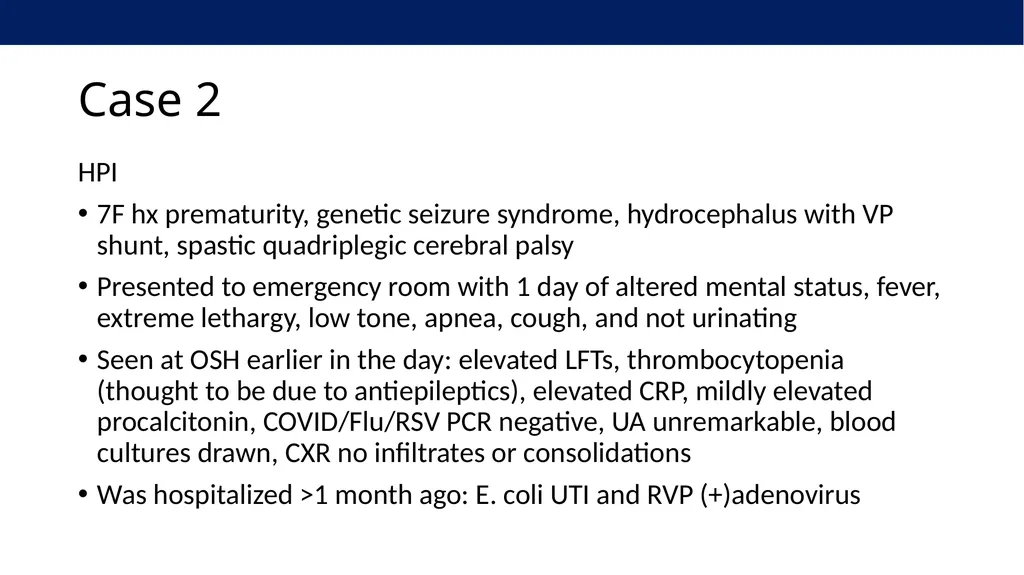
7F hx prematurity, genetic seizure syndrome, hydrocephalus with VP shunt, spastic quadriplegic cerebral palsy
Presented to emergency room with 1 day of altered mental status, fever, extreme lethargy, low tone, apnea, cough, and not urinating
Seen at OSH earlier in the day: elevated LFTs, thrombocytopenia (thought to be due to antiepileptics), elevated CRP, mildly elevated procalcitonin, COVID/Flu/RSV PCR negative, UA unremarkable, blood cultures drawn, CXR no infiltrates or consolidations
Was hospitalized >1 month ago: E. coli UTI and RVP (+)adenovirus Case 2<br>
7F hx prematurity, genetic seizure syndrome, hydrocephalus with VP shunt, spastic quadriplegic cerebral palsy
Presented to emergency room with 1 day of altered mental status, fever, extreme lethargy, low tone, apnea, cough, and not urinating
Seen at OSH earlier in the day: elevated LFTs, thrombocytopenia (thought to be due to antiepileptics), elevated CRP, mildly elevated procalcitonin, COVID/Flu/RSV PCR negative, UA unremarkable, blood cultures drawn, CXR no infiltrates or consolidations
Was hospitalized >1 month ago: E. coli UTI and RVP (+)adenovirus Case 2<br>
25
Case 2 PE
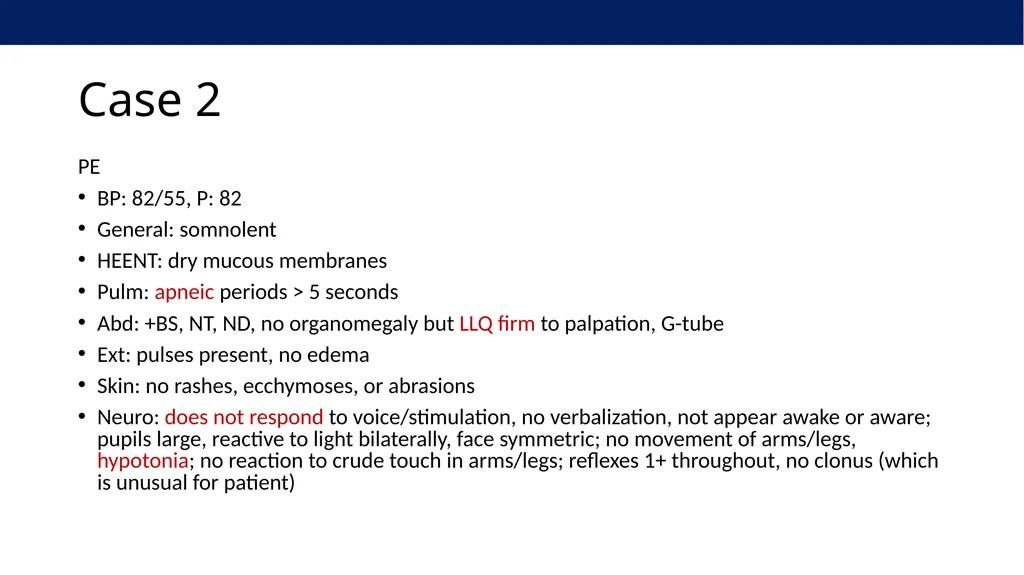
BP: 82/55, P: 82
General: somnolent
HEENT: dry mucous membranes
Pulm: apneic periods > 5 seconds
Abd: +BS, NT, ND, no organomegaly but LLQ firm to palpation, G-tube
Ext: pulses present, no edema
Skin: no rashes, ecchymoses, or abrasions
Neuro: does not respond to voice/stimulation, no verbalization, not appear awake or aware; pupils large, reactive to light bilaterally, face symmetric; no movement of arms/legs, hypotonia; no reaction to crude touch in arms/legs; reflexes 1+ throughout, no clonus (which is unusual for patient)<br>
BP: 82/55, P: 82
General: somnolent
HEENT: dry mucous membranes
Pulm: apneic periods > 5 seconds
Abd: +BS, NT, ND, no organomegaly but LLQ firm to palpation, G-tube
Ext: pulses present, no edema
Skin: no rashes, ecchymoses, or abrasions
Neuro: does not respond to voice/stimulation, no verbalization, not appear awake or aware; pupils large, reactive to light bilaterally, face symmetric; no movement of arms/legs, hypotonia; no reaction to crude touch in arms/legs; reflexes 1+ throughout, no clonus (which is unusual for patient)<br>
26
Case 2 DDX
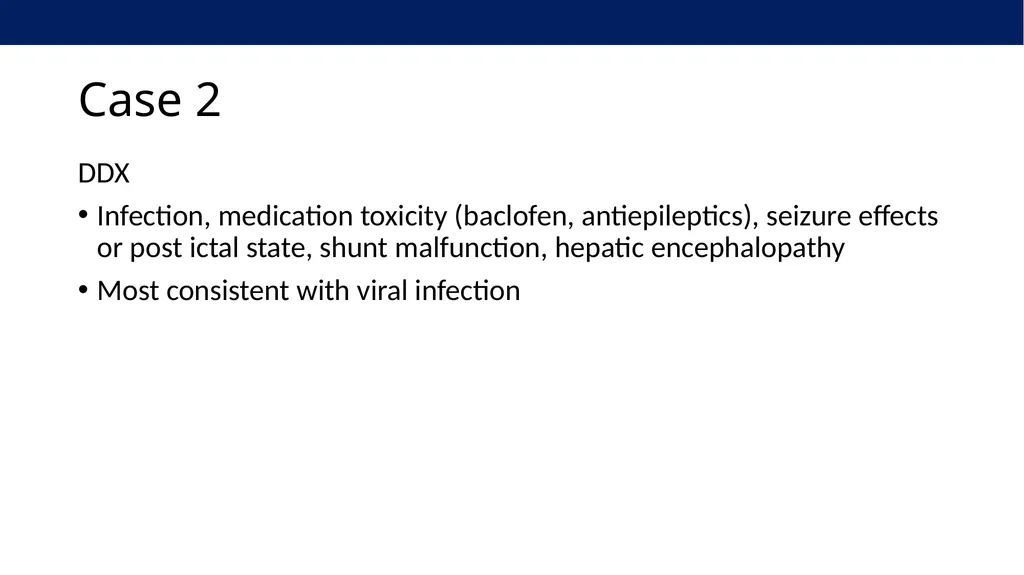
Infection, medication toxicity (baclofen, antiepileptics), seizure effects or post ictal state, shunt malfunction, hepatic encephalopathy
Most consistent with viral infection<br>
Infection, medication toxicity (baclofen, antiepileptics), seizure effects or post ictal state, shunt malfunction, hepatic encephalopathy
Most consistent with viral infection<br>
27
Case 2 Studies
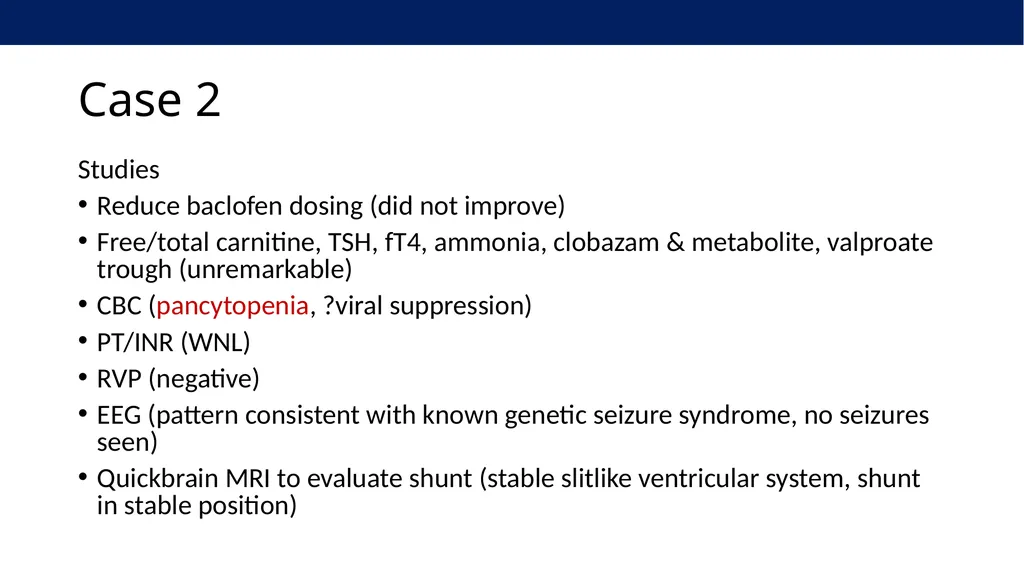
Reduce baclofen dosing (did not improve)
Free/total carnitine, TSH, fT4, ammonia, clobazam & metabolite, valproate trough (unremarkable)
CBC (pancytopenia, ?viral suppression)
PT/INR (WNL)
RVP (negative)
EEG (pattern consistent with known genetic seizure syndrome, no seizures seen)
Quickbrain MRI to evaluate shunt (stable slitlike ventricular system, shunt in stable position)<br>
Reduce baclofen dosing (did not improve)
Free/total carnitine, TSH, fT4, ammonia, clobazam & metabolite, valproate trough (unremarkable)
CBC (pancytopenia, ?viral suppression)
PT/INR (WNL)
RVP (negative)
EEG (pattern consistent with known genetic seizure syndrome, no seizures seen)
Quickbrain MRI to evaluate shunt (stable slitlike ventricular system, shunt in stable position)<br>
28
Case 2 Additional studies
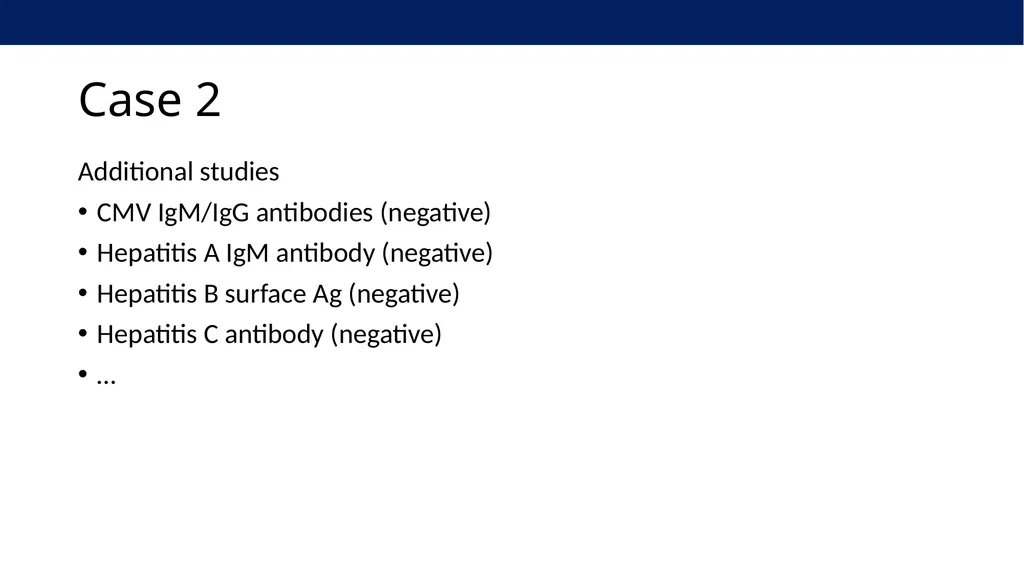
CMV IgM/IgG antibodies (negative)
Hepatitis A IgM antibody (negative)
Hepatitis B surface Ag (negative)
Hepatitis C antibody (negative)
…<br>
CMV IgM/IgG antibodies (negative)
Hepatitis A IgM antibody (negative)
Hepatitis B surface Ag (negative)
Hepatitis C antibody (negative)
…<br>
29
Case 2 Additional studies
CMV IgM/IgG antibodies (negative)
Hepatitis A IgM antibody (negative)
Hepatitis B surface Ag (negative)
Hepatitis C antibody (negative)
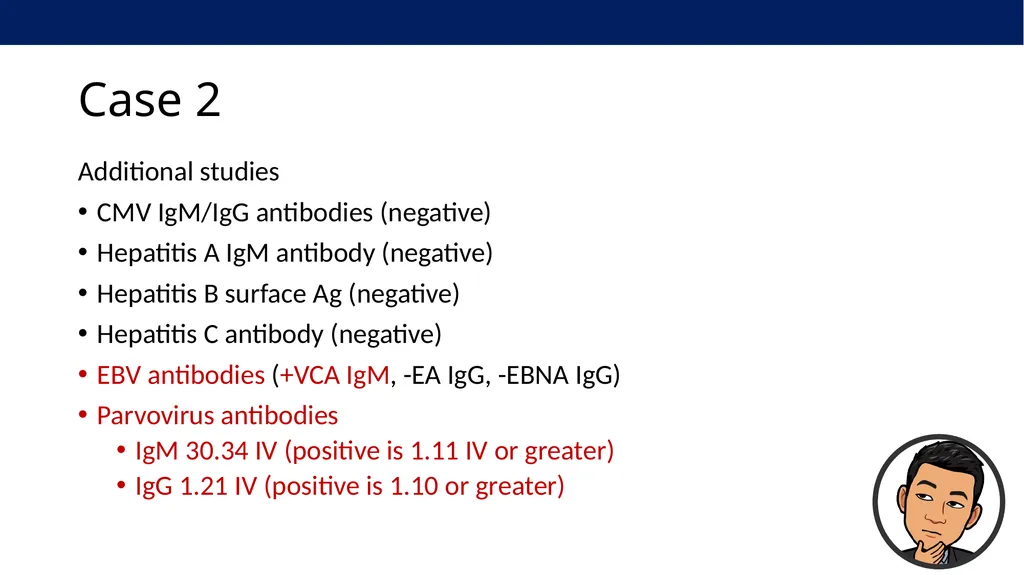
EBV antibodies (+VCA IgM, -EA IgG, -EBNA IgG)
Parvovirus antibodies
IgM 30.34 IV (positive is 1.11 IV or greater)
IgG 1.21 IV (positive is 1.10 or greater)<br>
CMV IgM/IgG antibodies (negative)
Hepatitis A IgM antibody (negative)
Hepatitis B surface Ag (negative)
Hepatitis C antibody (negative)
EBV antibodies (+VCA IgM, -EA IgG, -EBNA IgG)
Parvovirus antibodies
IgM 30.34 IV (positive is 1.11 IV or greater)
IgG 1.21 IV (positive is 1.10 or greater)<br>
30
Case 2 Clinical Considerations
Parvovirus
Was noted to have transient rash on cheeks and torso
Pancytopenia
No polyarthropathy or joint swelling
EBV
Had diarrhea early on in illness (more likely EBV vs parvovirus)<br>
Parvovirus
Was noted to have transient rash on cheeks and torso
Pancytopenia
No polyarthropathy or joint swelling
EBV
Had diarrhea early on in illness (more likely EBV vs parvovirus)<br>
31
False-Positive EBV and HSV due to Parvovirus EBV may result in false-positive parvovirus IgM results
…<br>
…<br>
32
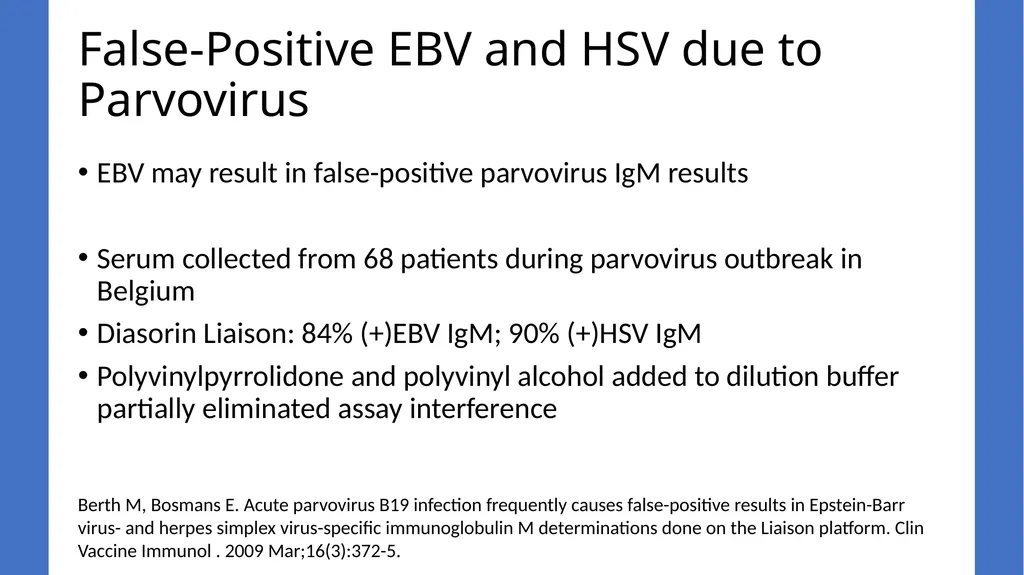
False-Positive EBV and HSV due to Parvovirus EBV may result in false-positive parvovirus IgM results
Serum collected from 68 patients during parvovirus outbreak in Belgium
Diasorin Liaison: 84% (+)EBV IgM; 90% (+)HSV IgM
Polyvinylpyrrolidone and polyvinyl alcohol added to dilution buffer partially eliminated assay interference Berth M, Bosmans E. Acute parvovirus B19 infection frequently causes false-positive results in Epstein-Barr virus- and herpes simplex virus-specific immunoglobulin M determinations done on the Liaison platform. Clin Vaccine Immunol . 2009 Mar;16(3):372-5.<br>
Serum collected from 68 patients during parvovirus outbreak in Belgium
Diasorin Liaison: 84% (+)EBV IgM; 90% (+)HSV IgM
Polyvinylpyrrolidone and polyvinyl alcohol added to dilution buffer partially eliminated assay interference Berth M, Bosmans E. Acute parvovirus B19 infection frequently causes false-positive results in Epstein-Barr virus- and herpes simplex virus-specific immunoglobulin M determinations done on the Liaison platform. Clin Vaccine Immunol . 2009 Mar;16(3):372-5.<br>
33
Case 3: joint pain<br>
34
Case 3 HPI
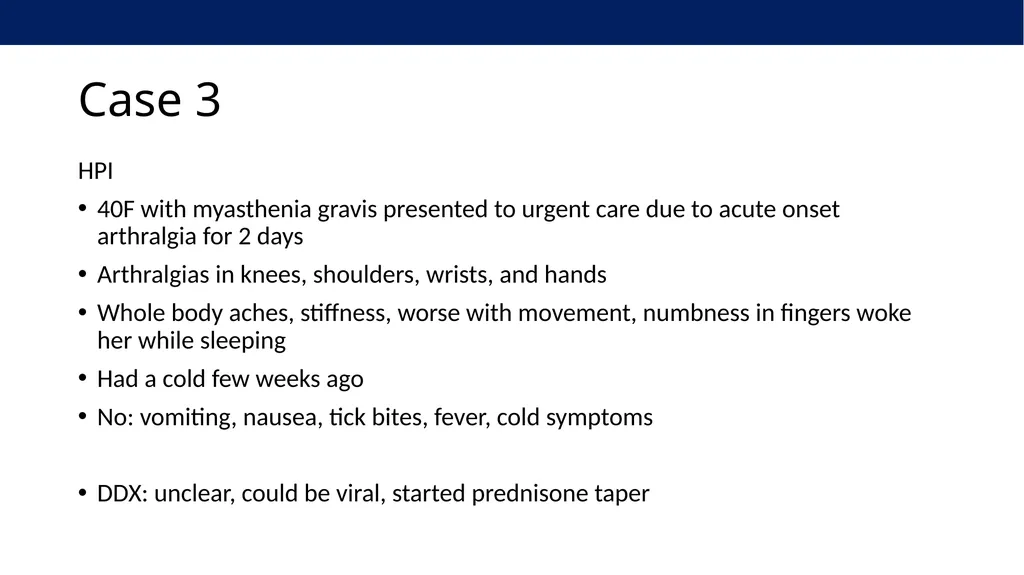
40F with myasthenia gravis presented to urgent care due to acute onset arthralgia for 2 days
Arthralgias in knees, shoulders, wrists, and hands
Whole body aches, stiffness, worse with movement, numbness in fingers woke her while sleeping
Had a cold few weeks ago
No: vomiting, nausea, tick bites, fever, cold symptoms
DDX: unclear, could be viral, started prednisone taper<br>
40F with myasthenia gravis presented to urgent care due to acute onset arthralgia for 2 days
Arthralgias in knees, shoulders, wrists, and hands
Whole body aches, stiffness, worse with movement, numbness in fingers woke her while sleeping
Had a cold few weeks ago
No: vomiting, nausea, tick bites, fever, cold symptoms
DDX: unclear, could be viral, started prednisone taper<br>
35
Case 3 Labs
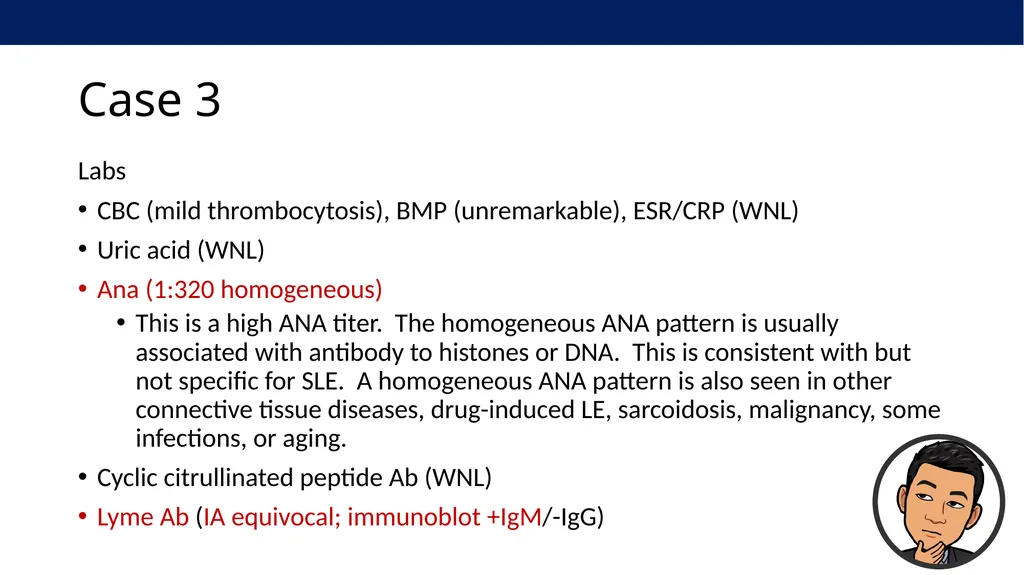
CBC (mild thrombocytosis), BMP (unremarkable), ESR/CRP (WNL)
Uric acid (WNL)
Ana (1:320 homogeneous)
This is a high ANA titer. The homogeneous ANA pattern is usually associated with antibody to histones or DNA. This is consistent with but not specific for SLE. A homogeneous ANA pattern is also seen in other connective tissue diseases, drug-induced LE, sarcoidosis, malignancy, some infections, or aging.
Cyclic citrullinated peptide Ab (WNL)
Lyme Ab (IA equivocal; immunoblot +IgM/-IgG)<br>
CBC (mild thrombocytosis), BMP (unremarkable), ESR/CRP (WNL)
Uric acid (WNL)
Ana (1:320 homogeneous)
This is a high ANA titer. The homogeneous ANA pattern is usually associated with antibody to histones or DNA. This is consistent with but not specific for SLE. A homogeneous ANA pattern is also seen in other connective tissue diseases, drug-induced LE, sarcoidosis, malignancy, some infections, or aging.
Cyclic citrullinated peptide Ab (WNL)
Lyme Ab (IA equivocal; immunoblot +IgM/-IgG)<br>
36
Case 3 Clinical Considerations
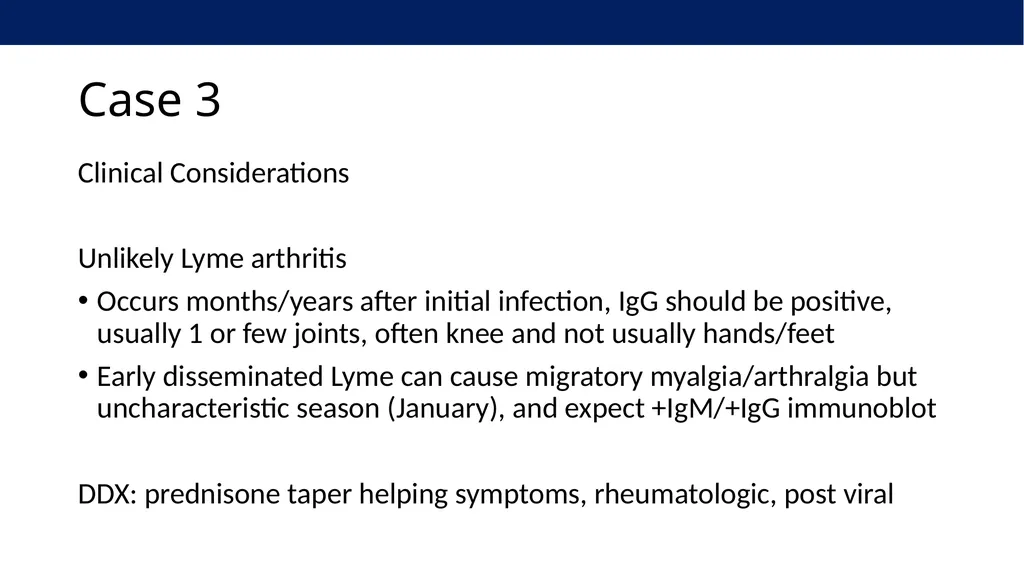
Unlikely Lyme arthritis
Occurs months/years after initial infection, IgG should be positive, usually 1 or few joints, often knee and not usually hands/feet
Early disseminated Lyme can cause migratory myalgia/arthralgia but uncharacteristic season (January), and expect +IgM/+IgG immunoblot
DDX: prednisone taper helping symptoms, rheumatologic, post viral<br>
Unlikely Lyme arthritis
Occurs months/years after initial infection, IgG should be positive, usually 1 or few joints, often knee and not usually hands/feet
Early disseminated Lyme can cause migratory myalgia/arthralgia but uncharacteristic season (January), and expect +IgM/+IgG immunoblot
DDX: prednisone taper helping symptoms, rheumatologic, post viral<br>
37
Case 3 Additional Labs
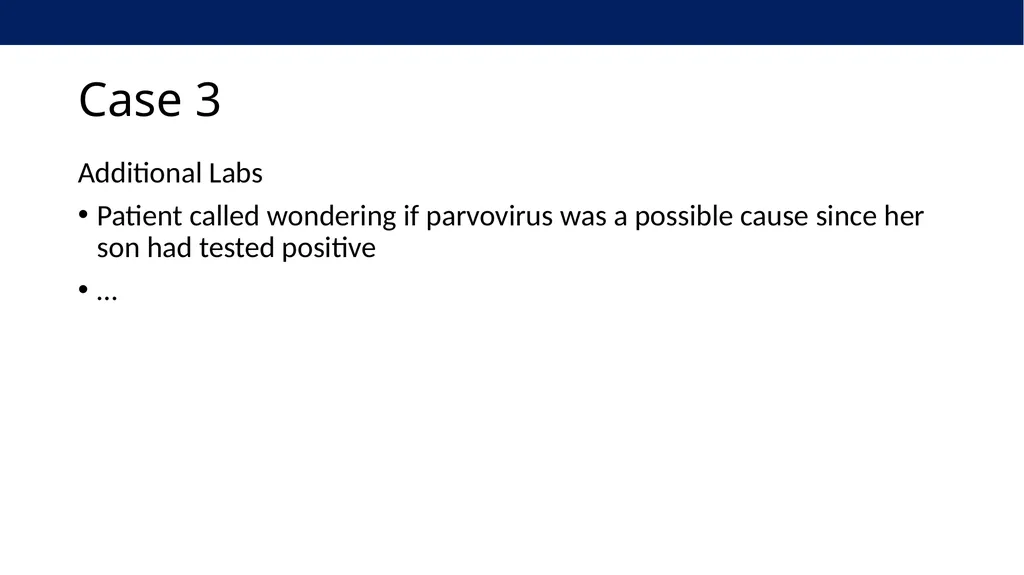
Patient called wondering if parvovirus was a possible cause since her son had tested positive
…<br>
Patient called wondering if parvovirus was a possible cause since her son had tested positive
…<br>
38
Case 3 Additional Labs
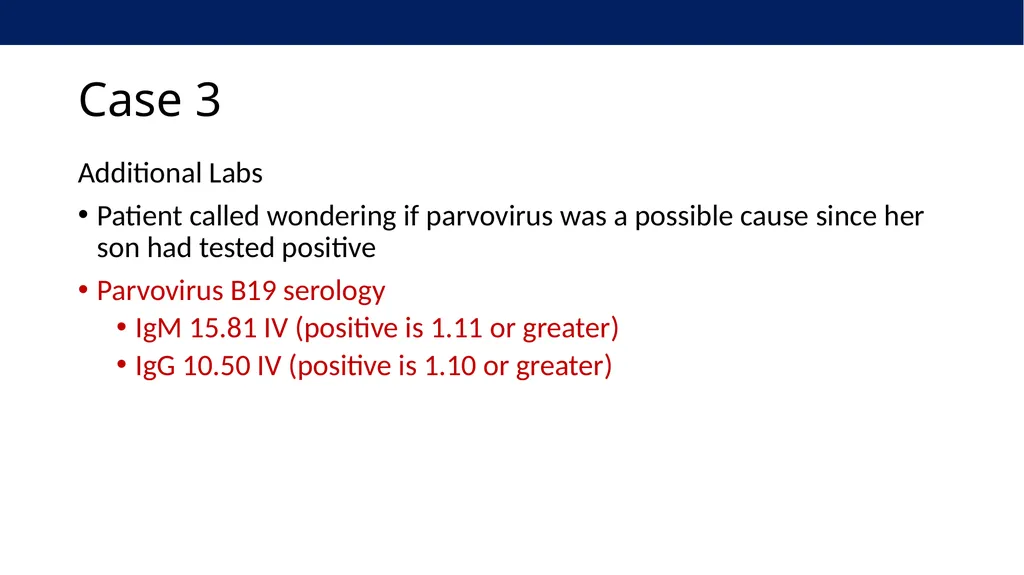
Patient called wondering if parvovirus was a possible cause since her son had tested positive
Parvovirus B19 serology
IgM 15.81 IV (positive is 1.11 or greater)
IgG 10.50 IV (positive is 1.10 or greater)<br>
Patient called wondering if parvovirus was a possible cause since her son had tested positive
Parvovirus B19 serology
IgM 15.81 IV (positive is 1.11 or greater)
IgG 10.50 IV (positive is 1.10 or greater)<br>
39
Parvovirus B19 Syndromes
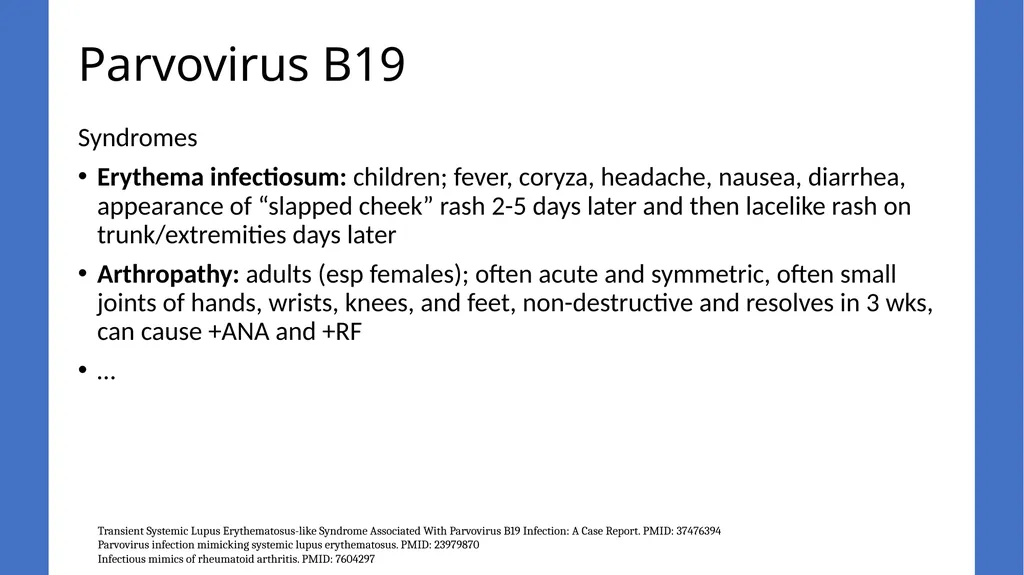
Erythema infectiosum: children; fever, coryza, headache, nausea, diarrhea, appearance of “slapped cheek” rash 2-5 days later and then lacelike rash on trunk/extremities days later
Arthropathy: adults (esp females); often acute and symmetric, often small joints of hands, wrists, knees, and feet, non-destructive and resolves in 3 wks, can cause +ANA and +RF
… Transient Systemic Lupus Erythematosus-like Syndrome Associated With Parvovirus B19 Infection: A Case Report. PMID: 37476394 Parvovirus infection mimicking systemic lupus erythematosus. PMID: 23979870 Infectious mimics of rheumatoid arthritis. PMID: 7604297<br>
Erythema infectiosum: children; fever, coryza, headache, nausea, diarrhea, appearance of “slapped cheek” rash 2-5 days later and then lacelike rash on trunk/extremities days later
Arthropathy: adults (esp females); often acute and symmetric, often small joints of hands, wrists, knees, and feet, non-destructive and resolves in 3 wks, can cause +ANA and +RF
… Transient Systemic Lupus Erythematosus-like Syndrome Associated With Parvovirus B19 Infection: A Case Report. PMID: 37476394 Parvovirus infection mimicking systemic lupus erythematosus. PMID: 23979870 Infectious mimics of rheumatoid arthritis. PMID: 7604297<br>
40
Parvovirus B19 Syndromes
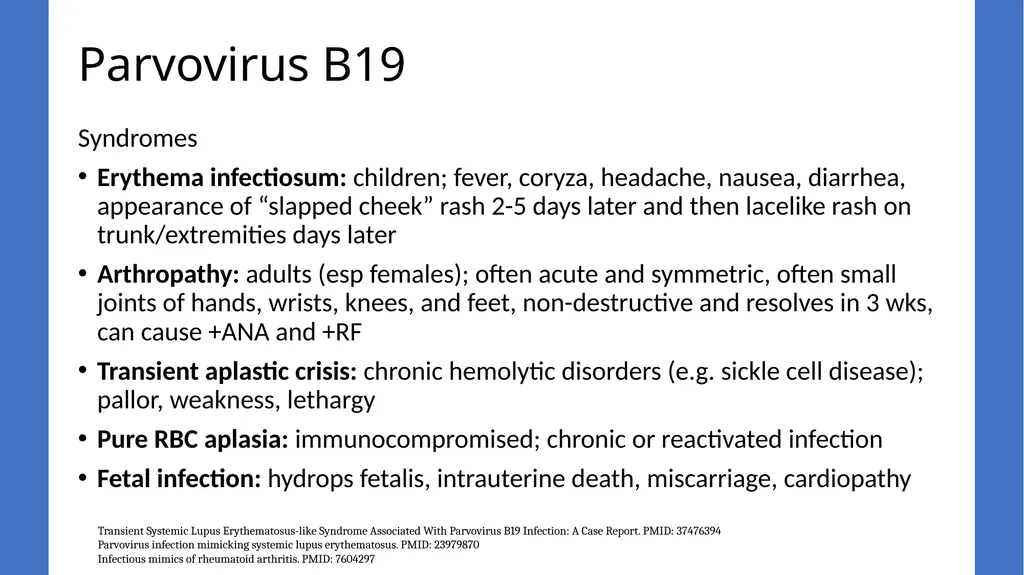
Erythema infectiosum: children; fever, coryza, headache, nausea, diarrhea, appearance of “slapped cheek” rash 2-5 days later and then lacelike rash on trunk/extremities days later
Arthropathy: adults (esp females); often acute and symmetric, often small joints of hands, wrists, knees, and feet, non-destructive and resolves in 3 wks, can cause +ANA and +RF
Transient aplastic crisis: chronic hemolytic disorders (e.g. sickle cell disease); pallor, weakness, lethargy
Pure RBC aplasia: immunocompromised; chronic or reactivated infection
Fetal infection: hydrops fetalis, intrauterine death, miscarriage, cardiopathy Transient Systemic Lupus Erythematosus-like Syndrome Associated With Parvovirus B19 Infection: A Case Report. PMID: 37476394 Parvovirus infection mimicking systemic lupus erythematosus. PMID: 23979870 Infectious mimics of rheumatoid arthritis. PMID: 7604297<br>
Erythema infectiosum: children; fever, coryza, headache, nausea, diarrhea, appearance of “slapped cheek” rash 2-5 days later and then lacelike rash on trunk/extremities days later
Arthropathy: adults (esp females); often acute and symmetric, often small joints of hands, wrists, knees, and feet, non-destructive and resolves in 3 wks, can cause +ANA and +RF
Transient aplastic crisis: chronic hemolytic disorders (e.g. sickle cell disease); pallor, weakness, lethargy
Pure RBC aplasia: immunocompromised; chronic or reactivated infection
Fetal infection: hydrops fetalis, intrauterine death, miscarriage, cardiopathy Transient Systemic Lupus Erythematosus-like Syndrome Associated With Parvovirus B19 Infection: A Case Report. PMID: 37476394 Parvovirus infection mimicking systemic lupus erythematosus. PMID: 23979870 Infectious mimics of rheumatoid arthritis. PMID: 7604297<br>
41
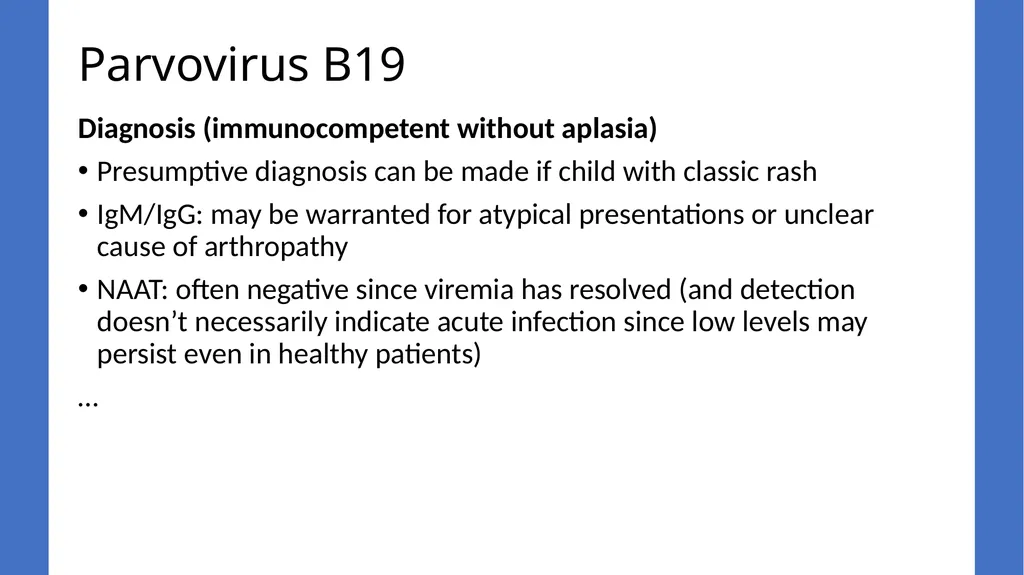
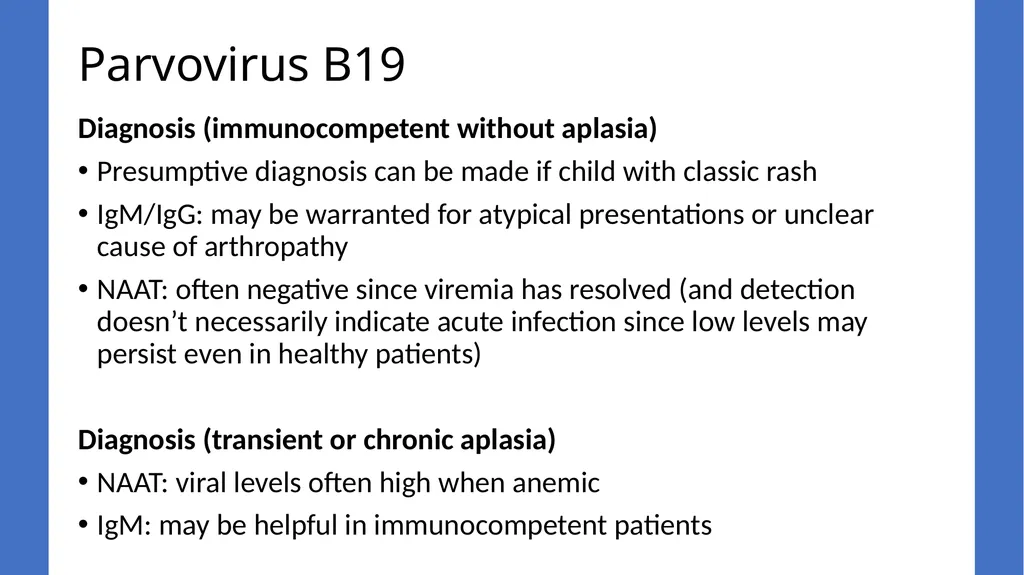
Diagnosis (immunocompetent without aplasia)
Presumptive diagnosis can be made if child with classic rash
IgM/IgG: may be warranted for atypical presentations or unclear cause of arthropathy
NAAT: often negative since viremia has resolved (and detection doesn’t necessarily indicate acute infection since low levels may persist even in healthy patients)
… Parvovirus B19<br>
Presumptive diagnosis can be made if child with classic rash
IgM/IgG: may be warranted for atypical presentations or unclear cause of arthropathy
NAAT: often negative since viremia has resolved (and detection doesn’t necessarily indicate acute infection since low levels may persist even in healthy patients)
… Parvovirus B19<br>
42
Diagnosis (immunocompetent without aplasia)
Presumptive diagnosis can be made if child with classic rash
IgM/IgG: may be warranted for atypical presentations or unclear cause of arthropathy
NAAT: often negative since viremia has resolved (and detection doesn’t necessarily indicate acute infection since low levels may persist even in healthy patients)
Diagnosis (transient or chronic aplasia)
NAAT: viral levels often high when anemic
IgM: may be helpful in immunocompetent patients Parvovirus B19<br>
Presumptive diagnosis can be made if child with classic rash
IgM/IgG: may be warranted for atypical presentations or unclear cause of arthropathy
NAAT: often negative since viremia has resolved (and detection doesn’t necessarily indicate acute infection since low levels may persist even in healthy patients)
Diagnosis (transient or chronic aplasia)
NAAT: viral levels often high when anemic
IgM: may be helpful in immunocompetent patients Parvovirus B19<br>
43
Case 4: rash<br>
44
Case 4 HPI
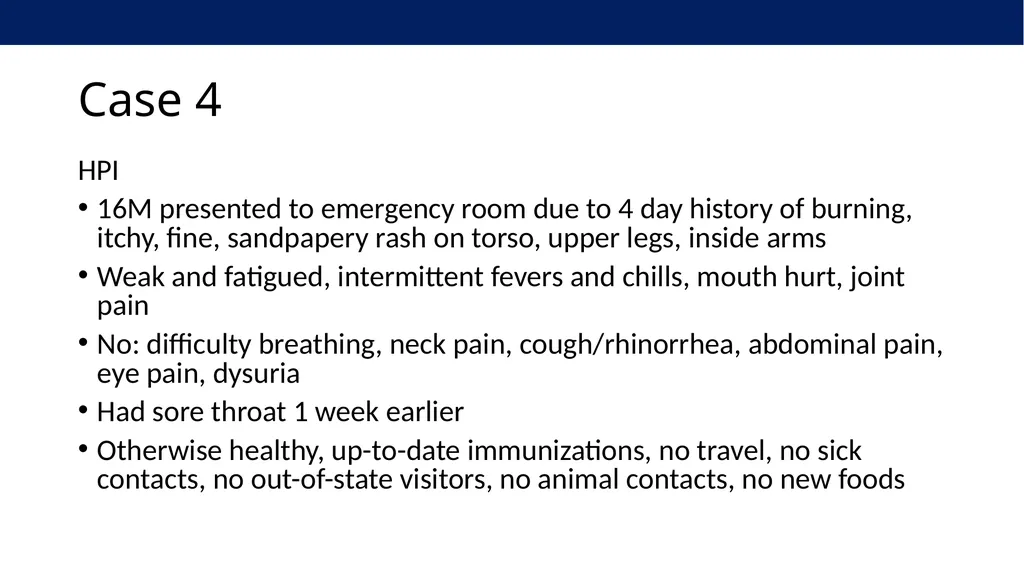
16M presented to emergency room due to 4 day history of burning, itchy, fine, sandpapery rash on torso, upper legs, inside arms
Weak and fatigued, intermittent fevers and chills, mouth hurt, joint pain
No: difficulty breathing, neck pain, cough/rhinorrhea, abdominal pain, eye pain, dysuria
Had sore throat 1 week earlier
Otherwise healthy, up-to-date immunizations, no travel, no sick contacts, no out-of-state visitors, no animal contacts, no new foods<br>
16M presented to emergency room due to 4 day history of burning, itchy, fine, sandpapery rash on torso, upper legs, inside arms
Weak and fatigued, intermittent fevers and chills, mouth hurt, joint pain
No: difficulty breathing, neck pain, cough/rhinorrhea, abdominal pain, eye pain, dysuria
Had sore throat 1 week earlier
Otherwise healthy, up-to-date immunizations, no travel, no sick contacts, no out-of-state visitors, no animal contacts, no new foods<br>
45
Case 4 PE
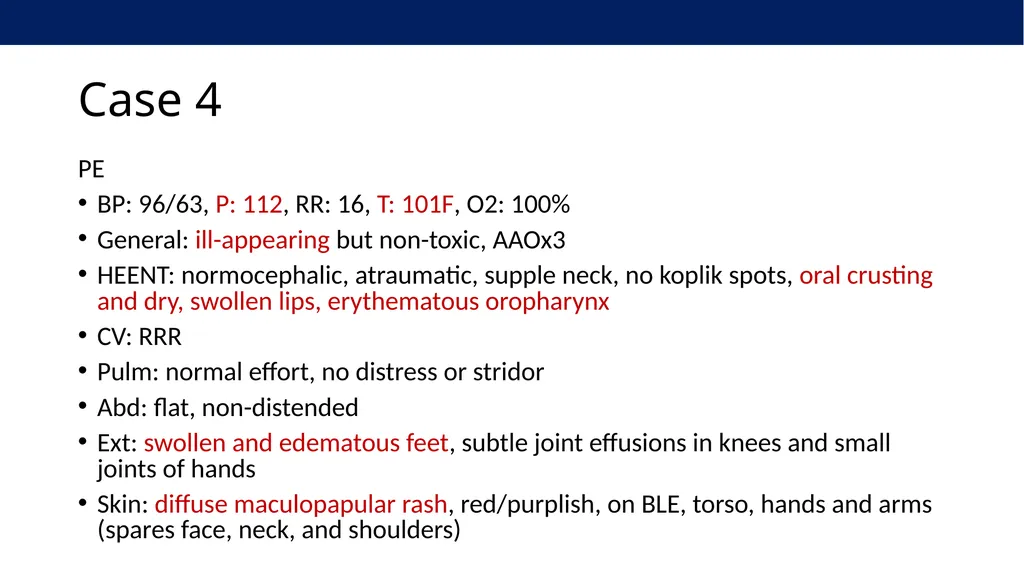
BP: 96/63, P: 112, RR: 16, T: 101F, O2: 100%
General: ill-appearing but non-toxic, AAOx3
HEENT: normocephalic, atraumatic, supple neck, no koplik spots, oral crusting and dry, swollen lips, erythematous oropharynx
CV: RRR
Pulm: normal effort, no distress or stridor
Abd: flat, non-distended
Ext: swollen and edematous feet, subtle joint effusions in knees and small joints of hands
Skin: diffuse maculopapular rash, red/purplish, on BLE, torso, hands and arms (spares face, neck, and shoulders)<br>
BP: 96/63, P: 112, RR: 16, T: 101F, O2: 100%
General: ill-appearing but non-toxic, AAOx3
HEENT: normocephalic, atraumatic, supple neck, no koplik spots, oral crusting and dry, swollen lips, erythematous oropharynx
CV: RRR
Pulm: normal effort, no distress or stridor
Abd: flat, non-distended
Ext: swollen and edematous feet, subtle joint effusions in knees and small joints of hands
Skin: diffuse maculopapular rash, red/purplish, on BLE, torso, hands and arms (spares face, neck, and shoulders)<br>
46
Case 4 DDX
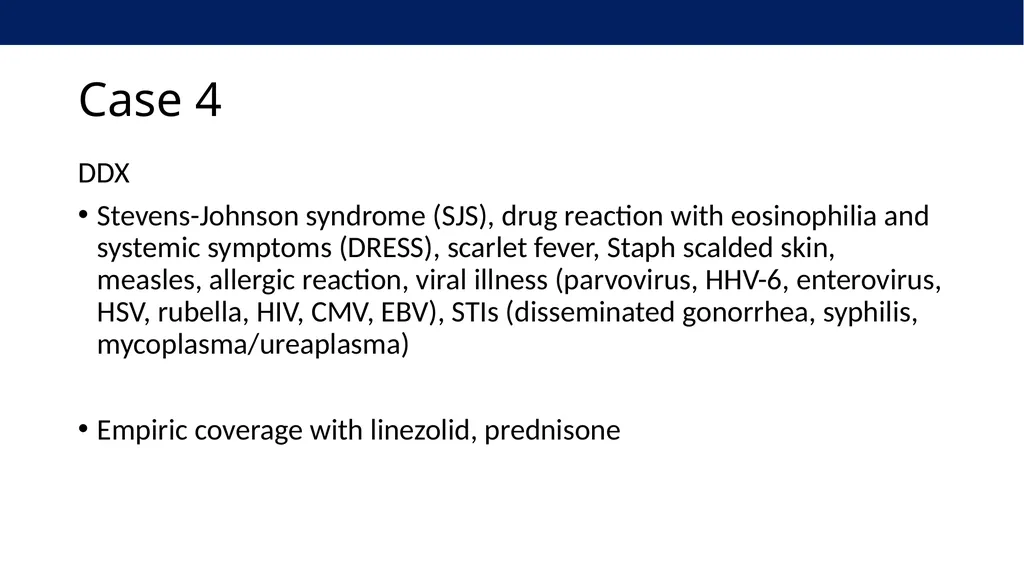
Stevens-Johnson syndrome (SJS), drug reaction with eosinophilia and systemic symptoms (DRESS), scarlet fever, Staph scalded skin, measles, allergic reaction, viral illness (parvovirus, HHV-6, enterovirus, HSV, rubella, HIV, CMV, EBV), STIs (disseminated gonorrhea, syphilis, mycoplasma/ureaplasma)
Empiric coverage with linezolid, prednisone<br>
Stevens-Johnson syndrome (SJS), drug reaction with eosinophilia and systemic symptoms (DRESS), scarlet fever, Staph scalded skin, measles, allergic reaction, viral illness (parvovirus, HHV-6, enterovirus, HSV, rubella, HIV, CMV, EBV), STIs (disseminated gonorrhea, syphilis, mycoplasma/ureaplasma)
Empiric coverage with linezolid, prednisone<br>
47
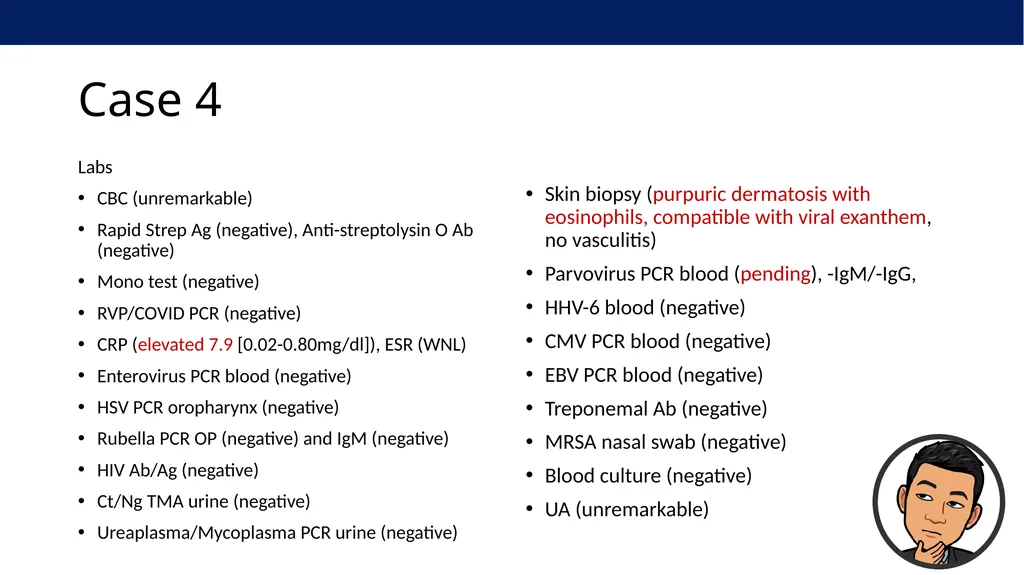
Case 4 Labs
CBC (unremarkable)
Rapid Strep Ag (negative), Anti-streptolysin O Ab (negative)
Mono test (negative)
RVP/COVID PCR (negative)
CRP (elevated 7.9 [0.02-0.80mg/dl]), ESR (WNL)
Enterovirus PCR blood (negative)
HSV PCR oropharynx (negative)
Rubella PCR OP (negative) and IgM (negative)
HIV Ab/Ag (negative)
Ct/Ng TMA urine (negative)
Ureaplasma/Mycoplasma PCR urine (negative) Skin biopsy (purpuric dermatosis with eosinophils, compatible with viral exanthem, no vasculitis)
Parvovirus PCR blood (pending), -IgM/-IgG,
HHV-6 blood (negative)
CMV PCR blood (negative)
EBV PCR blood (negative)
Treponemal Ab (negative)
MRSA nasal swab (negative)
Blood culture (negative)
UA (unremarkable)<br>
CBC (unremarkable)
Rapid Strep Ag (negative), Anti-streptolysin O Ab (negative)
Mono test (negative)
RVP/COVID PCR (negative)
CRP (elevated 7.9 [0.02-0.80mg/dl]), ESR (WNL)
Enterovirus PCR blood (negative)
HSV PCR oropharynx (negative)
Rubella PCR OP (negative) and IgM (negative)
HIV Ab/Ag (negative)
Ct/Ng TMA urine (negative)
Ureaplasma/Mycoplasma PCR urine (negative) Skin biopsy (purpuric dermatosis with eosinophils, compatible with viral exanthem, no vasculitis)
Parvovirus PCR blood (pending), -IgM/-IgG,
HHV-6 blood (negative)
CMV PCR blood (negative)
EBV PCR blood (negative)
Treponemal Ab (negative)
MRSA nasal swab (negative)
Blood culture (negative)
UA (unremarkable)<br>
48
Case 4 Discharged
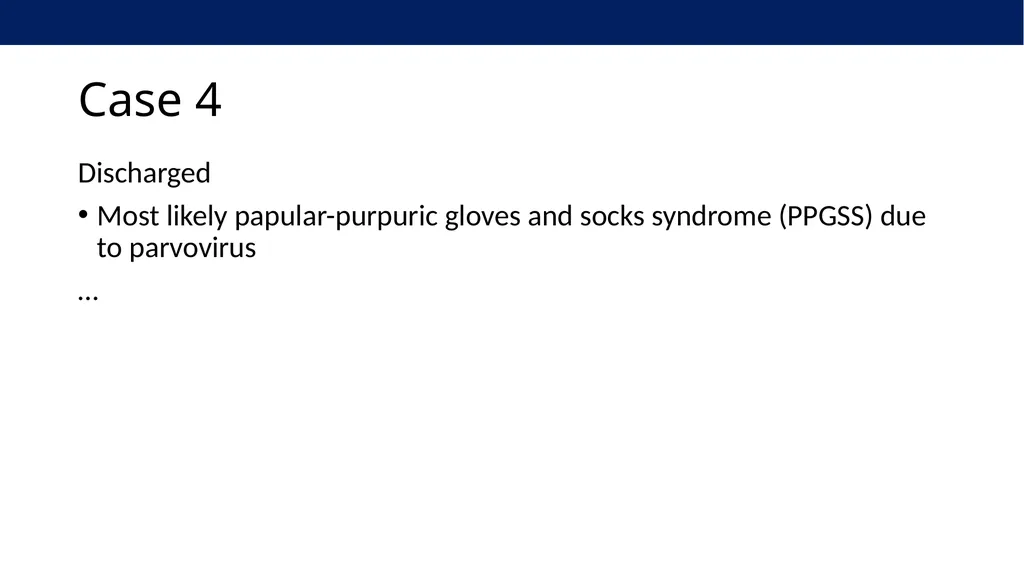
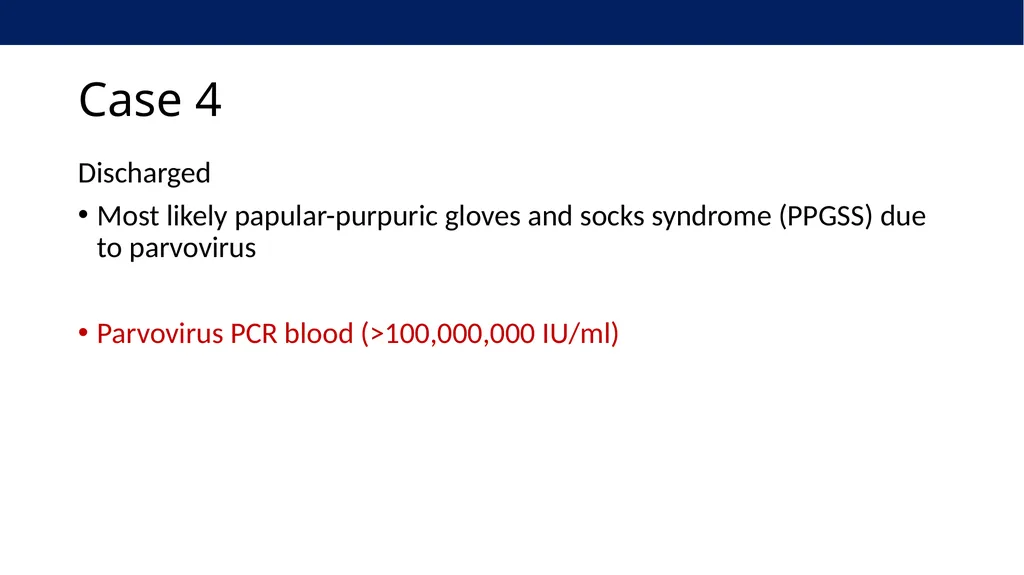
Most likely papular-purpuric gloves and socks syndrome (PPGSS) due to parvovirus
…<br>
Most likely papular-purpuric gloves and socks syndrome (PPGSS) due to parvovirus
…<br>
49
Case 4 Discharged
Most likely papular-purpuric gloves and socks syndrome (PPGSS) due to parvovirus
Parvovirus PCR blood (>100,000,000 IU/ml)<br>
Most likely papular-purpuric gloves and socks syndrome (PPGSS) due to parvovirus
Parvovirus PCR blood (>100,000,000 IU/ml)<br>
50
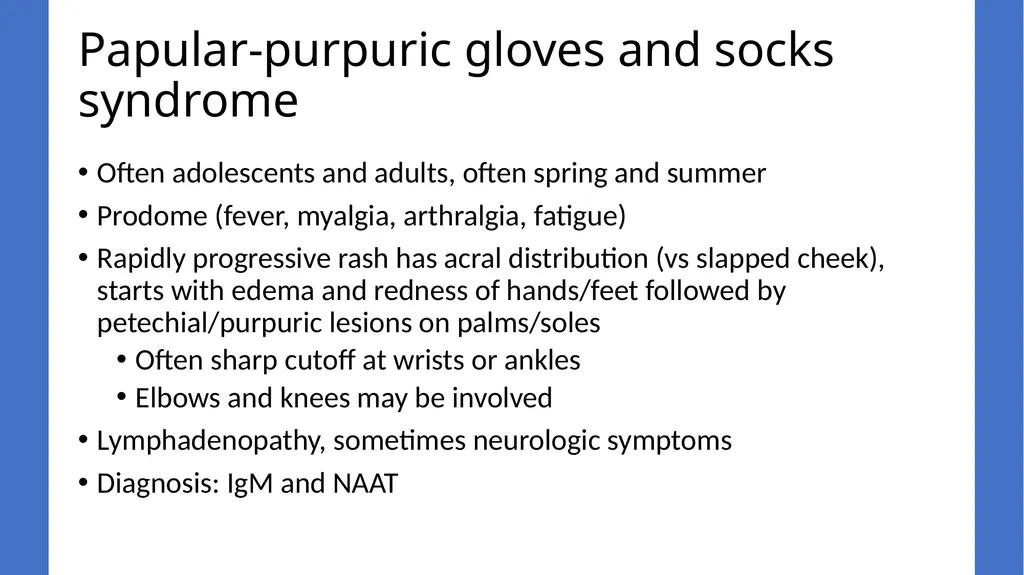
Papular-purpuric gloves and socks syndrome Often adolescents and adults, often spring and summer
Prodome (fever, myalgia, arthralgia, fatigue)
Rapidly progressive rash has acral distribution (vs slapped cheek), starts with edema and redness of hands/feet followed by petechial/purpuric lesions on palms/soles
Often sharp cutoff at wrists or ankles
Elbows and knees may be involved
Lymphadenopathy, sometimes neurologic symptoms
Diagnosis: IgM and NAAT<br>
Prodome (fever, myalgia, arthralgia, fatigue)
Rapidly progressive rash has acral distribution (vs slapped cheek), starts with edema and redness of hands/feet followed by petechial/purpuric lesions on palms/soles
Often sharp cutoff at wrists or ankles
Elbows and knees may be involved
Lymphadenopathy, sometimes neurologic symptoms
Diagnosis: IgM and NAAT<br>
51
Case 5: confusion<br>
52
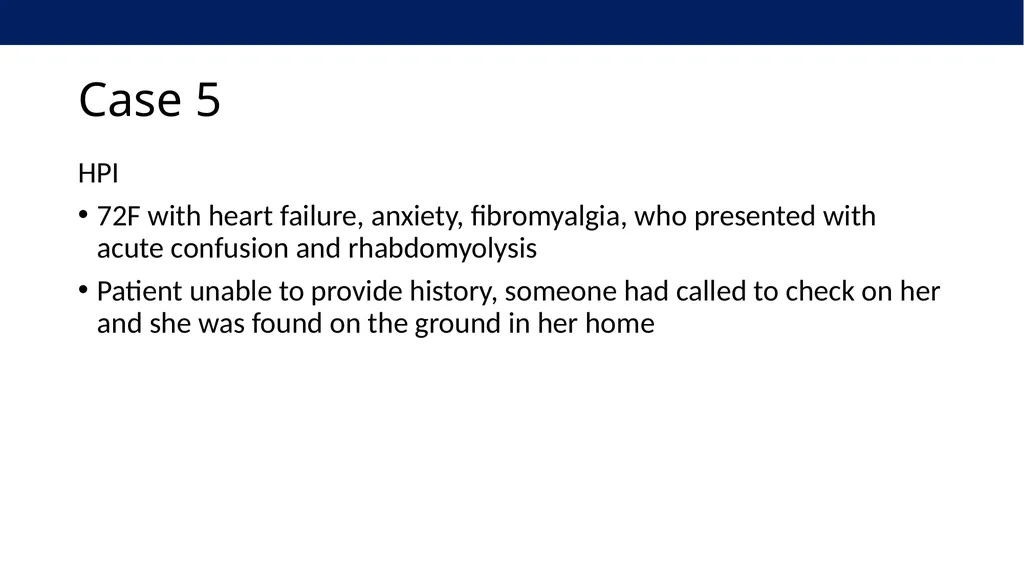
Case 5 HPI
72F with heart failure, anxiety, fibromyalgia, who presented with acute confusion and rhabdomyolysis
Patient unable to provide history, someone had called to check on her and she was found on the ground in her home<br>
72F with heart failure, anxiety, fibromyalgia, who presented with acute confusion and rhabdomyolysis
Patient unable to provide history, someone had called to check on her and she was found on the ground in her home<br>
53
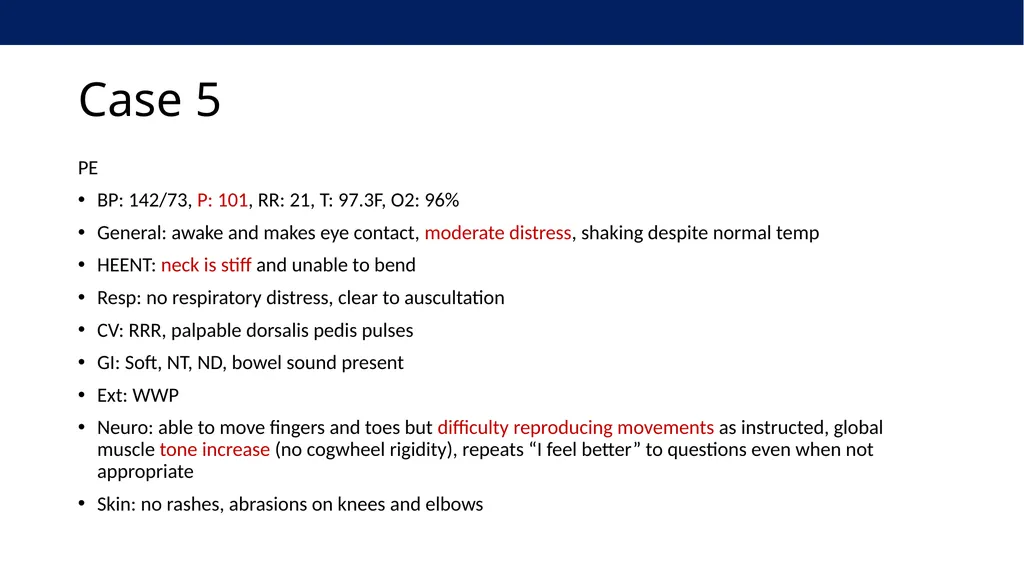
Case 5 PE
BP: 142/73, P: 101, RR: 21, T: 97.3F, O2: 96%
General: awake and makes eye contact, moderate distress, shaking despite normal temp
HEENT: neck is stiff and unable to bend
Resp: no respiratory distress, clear to auscultation
CV: RRR, palpable dorsalis pedis pulses
GI: Soft, NT, ND, bowel sound present
Ext: WWP
Neuro: able to move fingers and toes but difficulty reproducing movements as instructed, global muscle tone increase (no cogwheel rigidity), repeats “I feel better” to questions even when not appropriate
Skin: no rashes, abrasions on knees and elbows<br>
BP: 142/73, P: 101, RR: 21, T: 97.3F, O2: 96%
General: awake and makes eye contact, moderate distress, shaking despite normal temp
HEENT: neck is stiff and unable to bend
Resp: no respiratory distress, clear to auscultation
CV: RRR, palpable dorsalis pedis pulses
GI: Soft, NT, ND, bowel sound present
Ext: WWP
Neuro: able to move fingers and toes but difficulty reproducing movements as instructed, global muscle tone increase (no cogwheel rigidity), repeats “I feel better” to questions even when not appropriate
Skin: no rashes, abrasions on knees and elbows<br>
54
Case 5 DDX
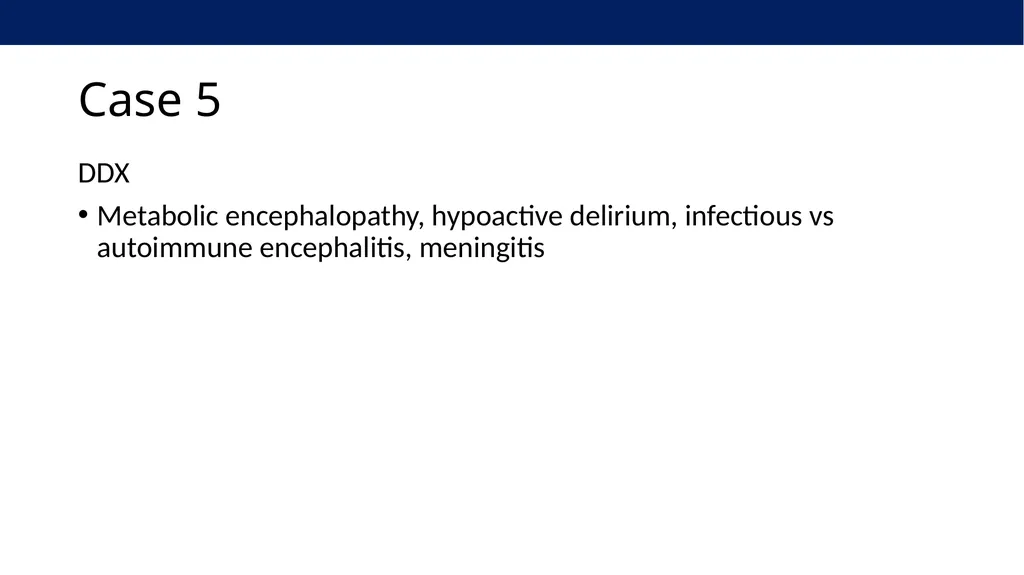
Metabolic encephalopathy, hypoactive delirium, infectious vs autoimmune encephalitis, meningitis<br>
Metabolic encephalopathy, hypoactive delirium, infectious vs autoimmune encephalitis, meningitis<br>
55
Case 5 Studies
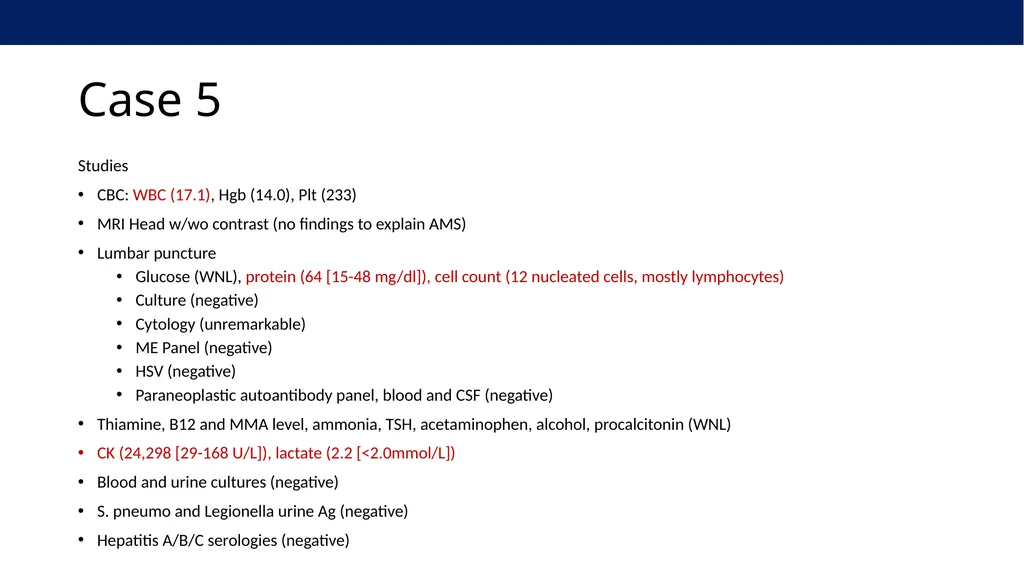
CBC: WBC (17.1), Hgb (14.0), Plt (233)
MRI Head w/wo contrast (no findings to explain AMS)
Lumbar puncture
Glucose (WNL), protein (64 [15-48 mg/dl]), cell count (12 nucleated cells, mostly lymphocytes)
Culture (negative)
Cytology (unremarkable)
ME Panel (negative)
HSV (negative)
Paraneoplastic autoantibody panel, blood and CSF (negative)
Thiamine, B12 and MMA level, ammonia, TSH, acetaminophen, alcohol, procalcitonin (WNL)
CK (24,298 [29-168 U/L]), lactate (2.2 [<2.0mmol/L])
Blood and urine cultures (negative)
S. pneumo and Legionella urine Ag (negative)
Hepatitis A/B/C serologies (negative)<br>
CBC: WBC (17.1), Hgb (14.0), Plt (233)
MRI Head w/wo contrast (no findings to explain AMS)
Lumbar puncture
Glucose (WNL), protein (64 [15-48 mg/dl]), cell count (12 nucleated cells, mostly lymphocytes)
Culture (negative)
Cytology (unremarkable)
ME Panel (negative)
HSV (negative)
Paraneoplastic autoantibody panel, blood and CSF (negative)
Thiamine, B12 and MMA level, ammonia, TSH, acetaminophen, alcohol, procalcitonin (WNL)
CK (24,298 [29-168 U/L]), lactate (2.2 [<2.0mmol/L])
Blood and urine cultures (negative)
S. pneumo and Legionella urine Ag (negative)
Hepatitis A/B/C serologies (negative)<br>
56
Case 5 ID Consult
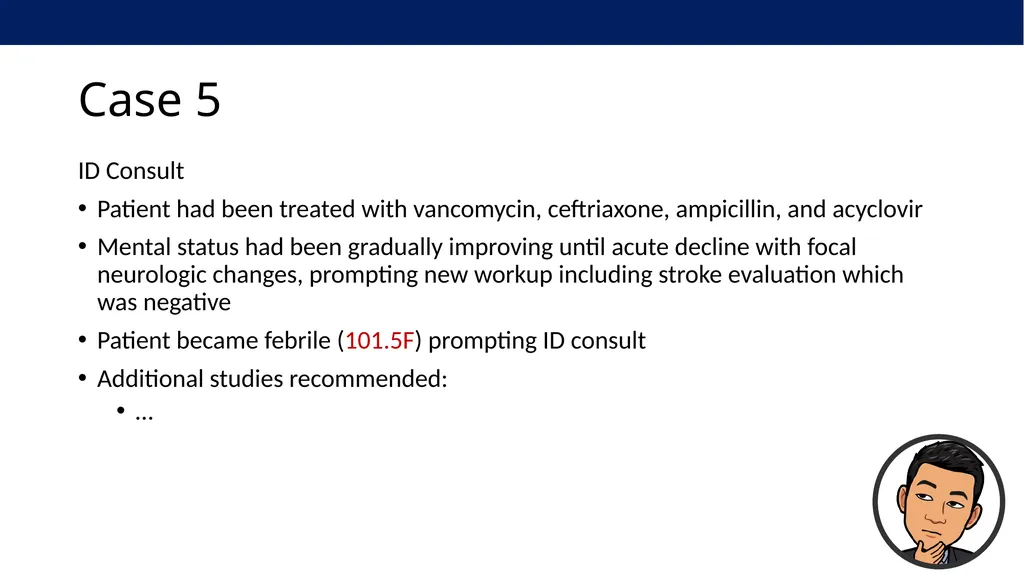
Patient had been treated with vancomycin, ceftriaxone, ampicillin, and acyclovir
Mental status had been gradually improving until acute decline with focal neurologic changes, prompting new workup including stroke evaluation which was negative
Patient became febrile (101.5F) prompting ID consult
Additional studies recommended:
…<br>
Patient had been treated with vancomycin, ceftriaxone, ampicillin, and acyclovir
Mental status had been gradually improving until acute decline with focal neurologic changes, prompting new workup including stroke evaluation which was negative
Patient became febrile (101.5F) prompting ID consult
Additional studies recommended:
…<br>
57
Case 5 ID Consult
Patient had been treated with vancomycin, ceftriaxone, ampicillin, and acyclovir
Mental status had been gradually improving until acute decline with focal neurologic changes, prompting new workup including stroke evaluation which was negative
Patient became febrile (101.5F) prompting ID consult
Additional studies recommended:
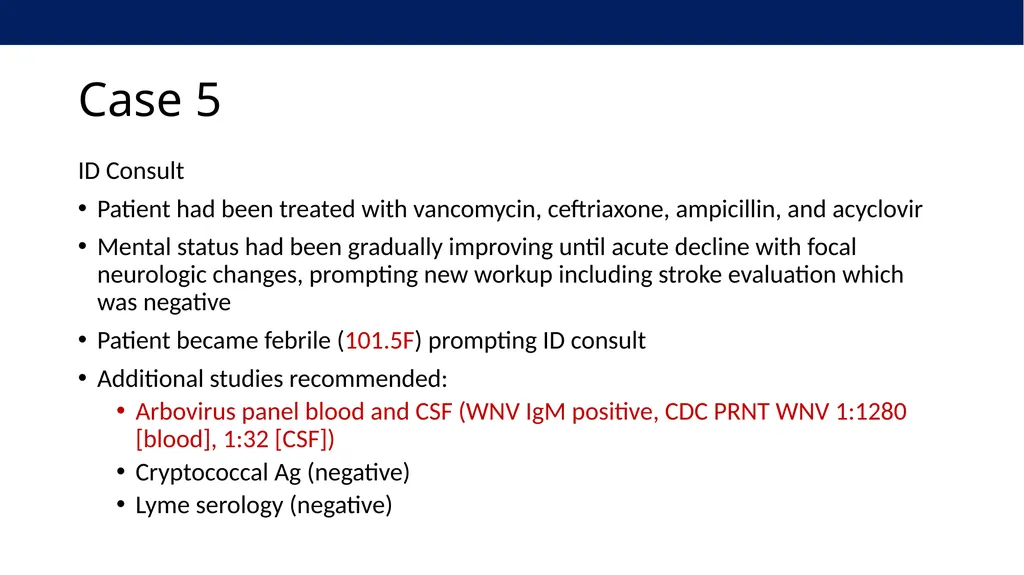
Arbovirus panel blood and CSF (WNV IgM positive, CDC PRNT WNV 1:1280 [blood], 1:32 [CSF])
Cryptococcal Ag (negative)
Lyme serology (negative)<br>
Patient had been treated with vancomycin, ceftriaxone, ampicillin, and acyclovir
Mental status had been gradually improving until acute decline with focal neurologic changes, prompting new workup including stroke evaluation which was negative
Patient became febrile (101.5F) prompting ID consult
Additional studies recommended:
Arbovirus panel blood and CSF (WNV IgM positive, CDC PRNT WNV 1:1280 [blood], 1:32 [CSF])
Cryptococcal Ag (negative)
Lyme serology (negative)<br>
58
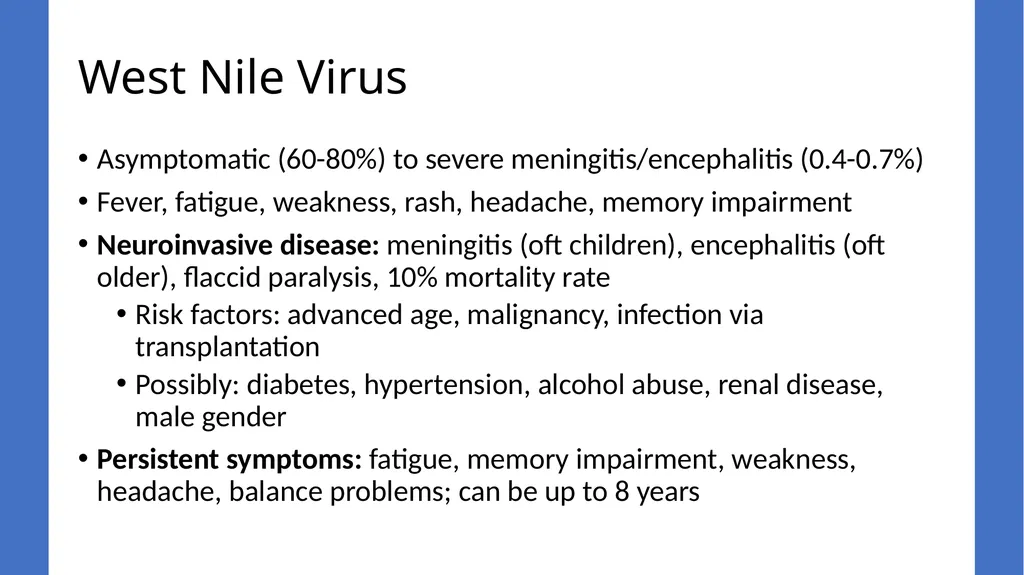
West Nile Virus Asymptomatic (60-80%) to severe meningitis/encephalitis (0.4-0.7%)
Fever, fatigue, weakness, rash, headache, memory impairment
Neuroinvasive disease: meningitis (oft children), encephalitis (oft older), flaccid paralysis, 10% mortality rate
Risk factors: advanced age, malignancy, infection via transplantation
Possibly: diabetes, hypertension, alcohol abuse, renal disease, male gender
Persistent symptoms: fatigue, memory impairment, weakness, headache, balance problems; can be up to 8 years<br>
Fever, fatigue, weakness, rash, headache, memory impairment
Neuroinvasive disease: meningitis (oft children), encephalitis (oft older), flaccid paralysis, 10% mortality rate
Risk factors: advanced age, malignancy, infection via transplantation
Possibly: diabetes, hypertension, alcohol abuse, renal disease, male gender
Persistent symptoms: fatigue, memory impairment, weakness, headache, balance problems; can be up to 8 years<br>
59
Diagnosis
Unexplained febrile illness, encephalitis, meningitis, and/or flaccid paralysis during mosquito season
IgM by EIA, serum and CSF (presence in CSF is highly indicative of neuroinvasive disease)
PRNT to confirm if concern for cross-reactivity (dengue, yellow fever, St. Louis encephalitis, Zika, Japanese encephalitis viruses)
NAAT: limited value due to short-lived and low-level viremia West Nile Virus<br>
Unexplained febrile illness, encephalitis, meningitis, and/or flaccid paralysis during mosquito season
IgM by EIA, serum and CSF (presence in CSF is highly indicative of neuroinvasive disease)
PRNT to confirm if concern for cross-reactivity (dengue, yellow fever, St. Louis encephalitis, Zika, Japanese encephalitis viruses)
NAAT: limited value due to short-lived and low-level viremia West Nile Virus<br>
60
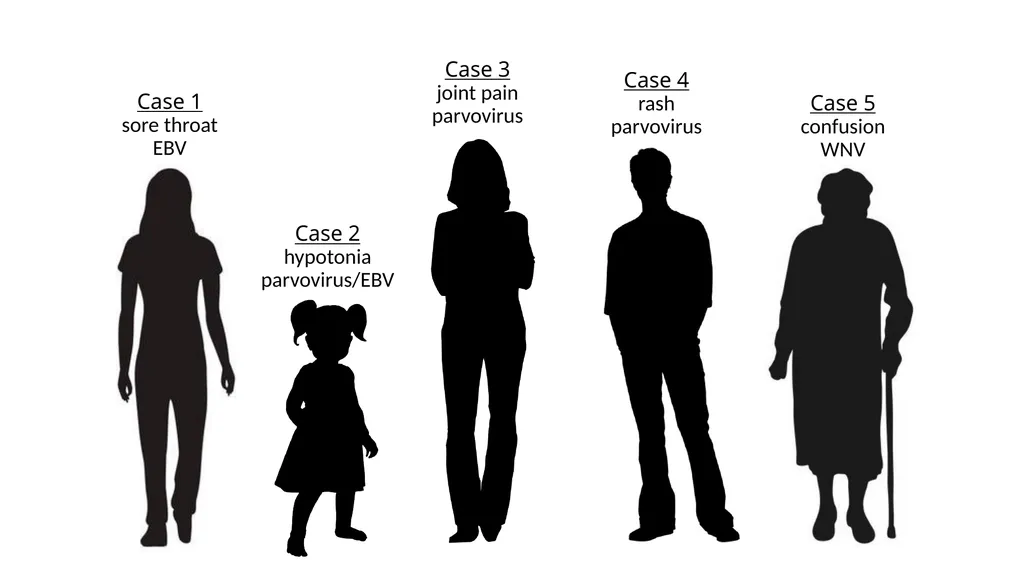
Case 1
sore throat
EBV Case 2 hypotonia
parvovirus/EBV Case 3 joint pain
parvovirus Case 4 rash
parvovirus Case 5 confusion
WNV<br>
EBV Case 2 hypotonia
parvovirus/EBV Case 3 joint pain
parvovirus Case 4 rash
parvovirus Case 5 confusion
WNV<br>
61
Clinical Virology Case Studies Derrick Chen, MD
Associate Professor, Dept of Pathology and Lab Medicine, Univ of Wisconsin – Madison
Medical Director, Clinical Microbiology, UW Health<br>
Associate Professor, Dept of Pathology and Lab Medicine, Univ of Wisconsin – Madison
Medical Director, Clinical Microbiology, UW Health<br>