
CLOVE GODI SUSMITHA CLOVE Scientific Name :
SB
Published · 15 slides · 0 views

1 / 1



Description
CLOVE GODI SUSMITHA CLOVE Scientific Name : Syzygium aromaticum Merrill and Perry. Syn. Eugenia carryophyllus (Spregal) Family : Myrtaceae The clove is one of the important tree spice crop grown in India. The clove of commerce is the fully
Related Topics
Share
Embed code
Download this presentation From Below
"CLOVE GODI SUSMITHA CLOVE Scientific Name :" is the property of its rightful owner. Permission is granted to download and print the materials on this website for personal, non-commercial use only, and to display it on your personal computer provided you do not modify the materials and that you retain all copyright notices contained in the materials. By downloading content from our website, you accept the terms of this agreement.
Presentation Transcript
01
CLOVE GODI SUSMITHA<br>
02
CLOVE
Scientific Name : Syzygium aromaticum
Merrill and Perry. [Syn. Eugenia carryophyllus (Spregal)
Family : Myrtaceae
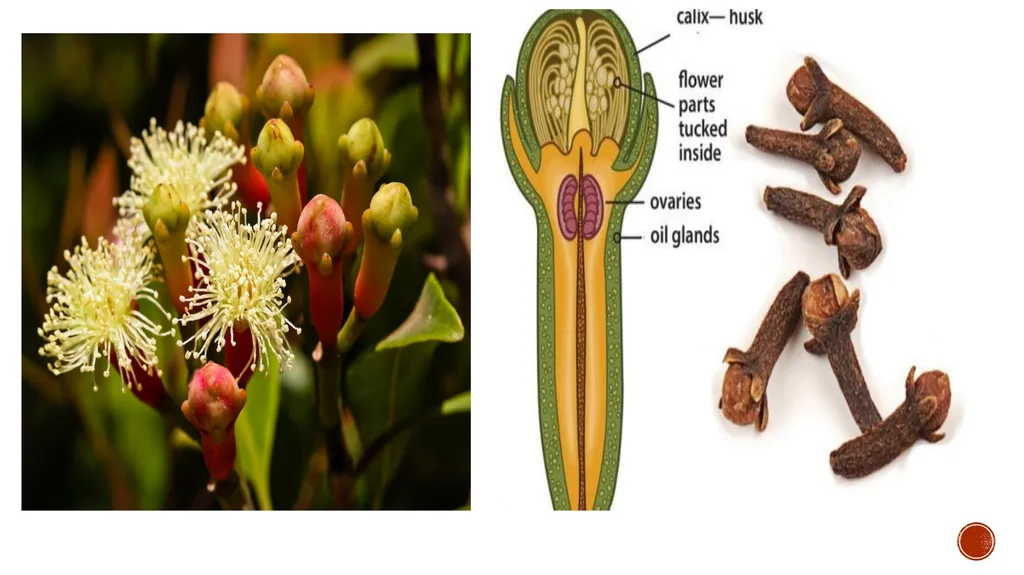
The clove is one of the important tree spice crop grown in India. The clove of commerce is the fully grown but unopened aromatic dried flower bud of an evergreen tree syzygium aromaticum. The term 'clove' is derived from the French word 'cloy' and the English word 'clout', both meaning 'nail'. The word may have been based on the likeness of the flower bud of the clove tree to a broad-headed nail.
Clove is one of the most ancient and valuable spices of the Orient, known as far back as the 1st century sc.
Clove is valued as a spice and for its essential oil.
The volatile oil obtained from the clove bud contains mainly eugenol- (80-90%) and caryophyllene (4-8%).
The major use of cloves is for domestic culinary purposes, as a spice to flavour both sweet and savoury dishes and in the preparation of pickles and sauces.
Cloves, both whole and ground, are used in baked goods, cakes, confectionery, chocolates, puddings, desserts, sweets, syrups, preserves, etc.
Clove is used for flavouring curries, gravies, ketchup and spice mixtures.
The inferior culls are used for the production of clove oil, which is used as a flavourant for all kinds of food products, in soap preparation, perfumery and the synthetic preparation of vanillin.
Owing to the antiseptic property of eugenol, clove oil is invariably an ingredient in chewing gums, toothpastes and mouthwashes.
In dentistry, eugenol is used in combination with zinc oxide for the temporary filling of cavities. It is also used for flavouring of `Kretek' cigarettes in Indonesia. It is reported to aid in digestion and is also used as an antispasmodic and counter irritant.<br>
03
Cloves are acrid, bitter, aromatic, refrigerant, ophthalmic, a digestive, carminative, stomachic, stimulant, antispasmodic, antibacterial, rubefacient, aphrodisiac, appetising, expectorant, emolient, anthelmintic, sialogogue, rejuvenating, galacto-purifier, diuretic, febrifuge and tonic.
They are useful in halitosis, odontalgia, ophthalmology, flatulence, colic, gastropathy, anorexia, cough, asthma, vitiated conditions of kapha and pitta, burning sensation, skin diseases, helminthiasis, agalactia, impurity of breast milk, strangury, fever, cephalagia, neuralgia, lumbago, dental caries, hyperacidity, vomiting, dyspepsia, 2 hepatopathy, general debility and tuberculosis.
The oil is also useful in catarrh, cough, bronchitis, vitiated conditions of vata, gastrohelcosis, odontalgia and ceplialalgia.
Externally, the oil is used as a rubefacient and counter-irritant.<br>
04
Origin and distribution
Clove is indigenous to the Molluccas Island of Eastern Indonesia.
Later, it was introduced to Mauritius and later on established in the islands of Zanzibar and Pemba.
The important clove-producing countries in the world are Tanzania (Zanzibar), Pemba, Madagascar and Indonesia. Clove is also grown in Malaysia, Sri Lanka, Haiti and India. In India, clove was introduced in 1800 AD by the East India company and is now cultivated in Tamil Nadu, Kerala and Karnataka.
In Karnataka it is being cultivated other mixed crop in coffee, coconut and arecanut in Chikkamagalore, Hassan, Dakshina Kannada and Shimoga districts.
Area and Production:
In India the clove is cultivated in an area of 2,600 ha. with annual production of 1,160 tonnes. The productivity is 400 kg/ha.<br>
05
Botany :
The clove is an evergreen tree growing to a height of 7-15 m.
The trunk is conical when young, later becoming roughly cylindrical. It begins to fork near the base, into two or three main erect branches.
The smaller branches are semi-erect, the twigs are brittle, smooth and greyish-white in colour, and the whole head is bushy and dense.
The leaves are simple, opposite, exstipulate, glabrous and aromatic owing to plenty of oil glands on the lower surface. The lamina is lanceolate or narrowly elliptic, bluntly acuminate at the apex, cuneate and bare. The new leaves appear in flushes and are bright pink. Later, the upper surface becomes glossy and dark green and wavy with recurved leaf margins.
The hermaphrodite flowers are borne on a terminal, corymbose, trichotomous panicle. The inflorescence is shortly pedunculate, branched from the base and shorter than the leaves. The bracts and bracteoles are narrow, acute and fall quickly. The number of flowers varies from 3 to 50; a fleshy hypanthium is present, surrounded by the sepals. The hypanthium is green in the young bud, flushed pink at anthesis and turns deep red after the stamens fall.
Above the sepals, there are four dome-shaped whitish petals. After fertilisation, the stamens and styles invariably fall. The lower part of the flower along with the calyx develops into a fleshy, dark, one-seeded drupe. The sepals are reduced to triangular projections and this is popularly 3 known as the 'mother of clove'.
The stamens are numerous, the anthers are pale yellow, with a small, pale brown, inconspicuous connective gland.
The style is very stout, swollen at the base, pale green and dotted with glands. The two-celled, multi-ovate, inferior ovary is embedded at the top of the hypanthium.
The fruit (mother-of-clove) is usually a single-seeded drupe, but occasionally contains two seeds also.<br>
06
Climate
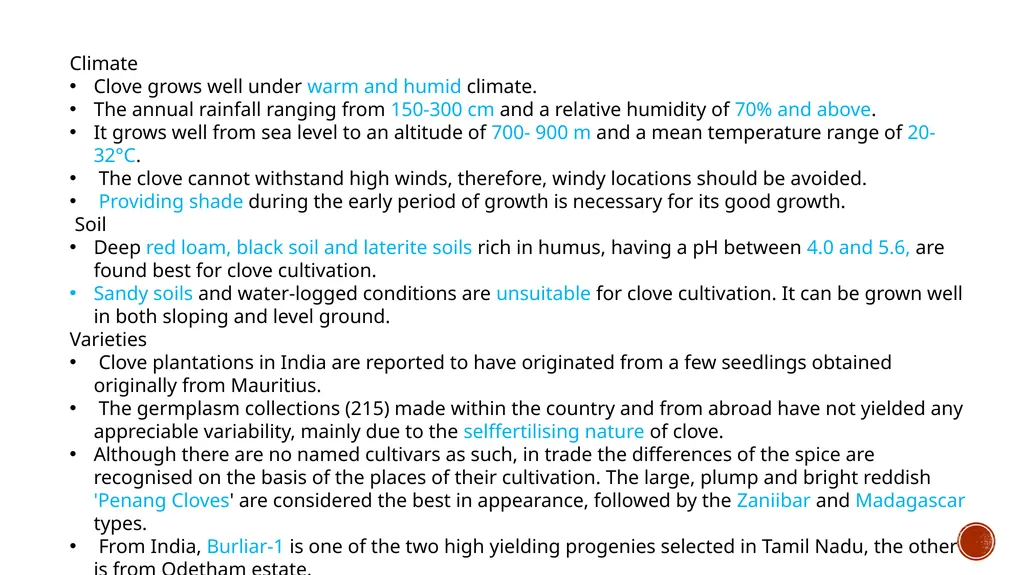
Clove grows well under warm and humid climate.
The annual rainfall ranging from 150-300 cm and a relative humidity of 70% and above.
It grows well from sea level to an altitude of 700- 900 m and a mean temperature range of 20-32°C.
The clove cannot withstand high winds, therefore, windy locations should be avoided.
Providing shade during the early period of growth is necessary for its good growth.
Soil
Deep red loam, black soil and laterite soils rich in humus, having a pH between 4.0 and 5.6, are found best for clove cultivation.
Sandy soils and water-logged conditions are unsuitable for clove cultivation. It can be grown well in both sloping and level ground.
Varieties
Clove plantations in India are reported to have originated from a few seedlings obtained originally from Mauritius.
The germplasm collections (215) made within the country and from abroad have not yielded any appreciable variability, mainly due to the selffertilising nature of clove.
Although there are no named cultivars as such, in trade the differences of the spice are recognised on the basis of the places of their cultivation. The large, plump and bright reddish 'Penang Cloves' are considered the best in appearance, followed by the Zaniibar and Madagascar types.
From India, Burliar-1 is one of the two high yielding progenies selected in Tamil Nadu, the other is from Odetham estate.<br>
07
One of the cultivars is also recognised by the name Amboyan clove.
Two distinct bud variants were identified, one is having bolder flower buds than the normal type (King clove) and the other one is smaller than the normal clove (Liliput clove/mini clove) the above two types differed distinctly from normal cloves.
The mother cloves of two king clove types (KC-1 and KC-2) and Liliput clove (Lc-1) are collected under being evaluated at Horticultural Research Station, Yercaud.
Apart from this twelve high yielding types were also identified from the survey made in the different estates at Nagercoil region
Propagation
Clove is propagated through seed and vegetative means by soft wood cuttings and by buddings.
However, the approach method of grafting using its own rootstock has been successful in clove. Generally, clove is only propagated through seeds.
Seed propagation
Clove is propagated through seed which is called the mother’s of clove.
The seeds are extracted from the ripe fruits (mother-of-clove) obtained from regular bearing trees.
The fruits for seed collection are allowed to ripen on the tree itself and drop down naturally. The seeds are then soaked in water overnight prior to sowing, in order to dehusk them.
Afterwards, only fully-developed, uniform-sized seeds, which show signs of germination by the presence of pink pedicle, are used for sowing and the remaining are discarded.
Since the viability of the seeds is very short, they should be sown as soon as possible in raised nursery beds of 90-100 cm width, 15 cm height and of convenient length, at 2 cm depth at a spacing of 12-20 cm both ways.<br>
08
The seeds sprout in about two weeks depending on the individual vigour of the seeds and germination is completed in 40 days.
If fresh seeds are sown, seed germination to the extent of over 90% may be obtained.
The seedlings are very slow in their initial growth and when they are 50-60 cm tall they start branching and are transferred to polythene bags (30 cm x 15 cm) containing a mixture of good soil, well decomposed cowdung and sand (in the ratio of about 3:3:1).
After they are one to two years old, they are ready for transplanting into the main field.
While the seedlings are in the nursery, sufficient shade and irrigation should be provided. Age, colour of cotyledon and height of seedlings determine the time of transplanting.
Nine to twelve months to two year old seedlings and are suited for main field planting.
Study revealed that clove seedlings can be made ready for transplanting in one year by foliar application of GA (200 ppm).<br>
09
Planting
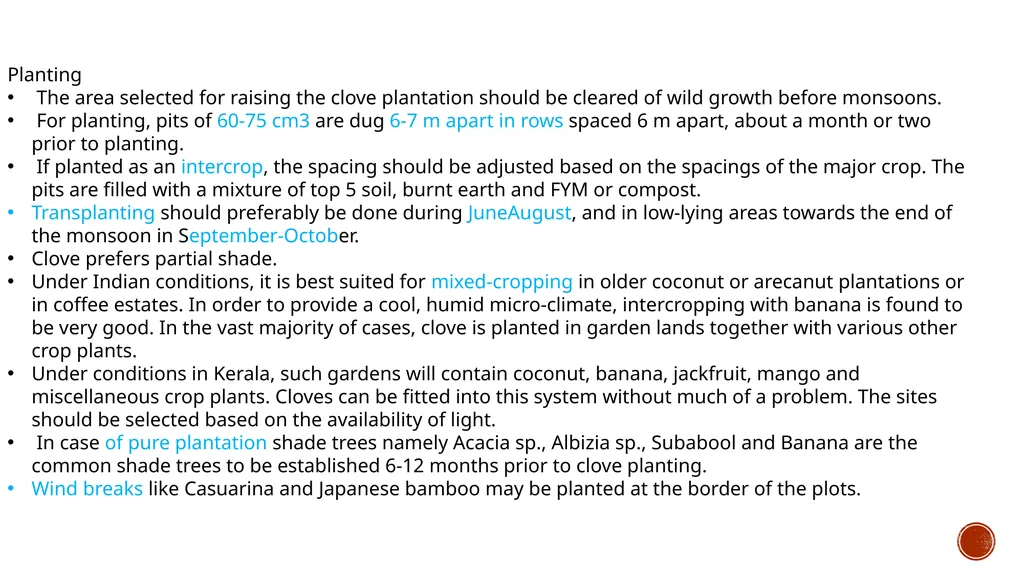
The area selected for raising the clove plantation should be cleared of wild growth before monsoons.
For planting, pits of 60-75 cm3 are dug 6-7 m apart in rows spaced 6 m apart, about a month or two prior to planting.
If planted as an intercrop, the spacing should be adjusted based on the spacings of the major crop. The pits are filled with a mixture of top 5 soil, burnt earth and FYM or compost.
Transplanting should preferably be done during JuneAugust, and in low-lying areas towards the end of the monsoon in September-October.
Clove prefers partial shade.
Under Indian conditions, it is best suited for mixed-cropping in older coconut or arecanut plantations or in coffee estates. In order to provide a cool, humid micro-climate, intercropping with banana is found to be very good. In the vast majority of cases, clove is planted in garden lands together with various other crop plants.
Under conditions in Kerala, such gardens will contain coconut, banana, jackfruit, mango and miscellaneous crop plants. Cloves can be fitted into this system without much of a problem. The sites should be selected based on the availability of light.
In case of pure plantation shade trees namely Acacia sp., Albizia sp., Subabool and Banana are the common shade trees to be established 6-12 months prior to clove planting.
Wind breaks like Casuarina and Japanese bamboo may be planted at the border of the plots.<br>
10
Mulching:
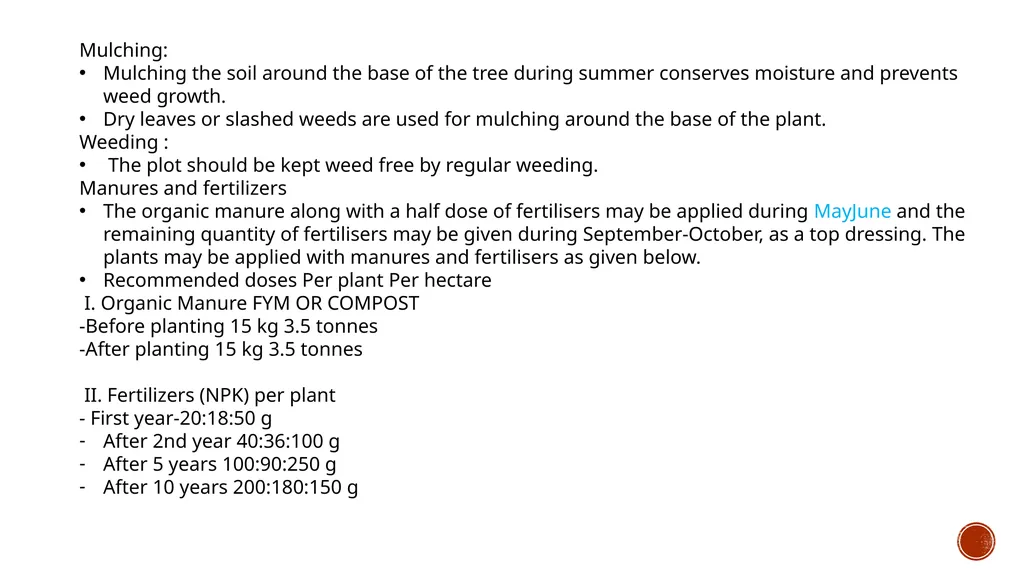
Mulching the soil around the base of the tree during summer conserves moisture and prevents weed growth.
Dry leaves or slashed weeds are used for mulching around the base of the plant.
Weeding :
The plot should be kept weed free by regular weeding.
Manures and fertilizers
The organic manure along with a half dose of fertilisers may be applied during MayJune and the remaining quantity of fertilisers may be given during September-October, as a top dressing. The plants may be applied with manures and fertilisers as given below.
Recommended doses Per plant Per hectare
I. Organic Manure FYM OR COMPOST
-Before planting 15 kg 3.5 tonnes
-After planting 15 kg 3.5 tonnes
II. Fertilizers (NPK) per plant
- First year-20:18:50 g
After 2nd year 40:36:100 g
After 5 years 100:90:250 g
After 10 years 200:180:150 g<br>
11
Irrigation
In the first 3-4 years, extreme care should be taken especially during the summer months. Plant-based water application has to be very scrupulously followed.
Studies indicated that dripping of eight liters of water per plant per day, recorded the highest plant type and number of branches in the juvenile phase.
Inter-cropping Clove can be inter-cropped in coconut, arecanut, nutmeg and banana plantations of the midlands. In higher elevations, it can be mixed cropped with pepper or coffee.
Harvesting and yield
Though clove trees flower from 4-6 years of their planting, the trees generally start bearing an economic yield 18-20 years from the time of planting and the production continues for 80 years or more.
The bearing between the years varies quite a lot and a bumper crop can only be expected about once every 4 years, being influenced by the weather and the previous crop load.
The flowering season varies from September-October in the plains to December-January at high altitudes.
Cloves, which are the unopened flower buds, are produced on the terminal shoots of the twigs. The buds are collected when they are dull red or pink in colour and less than 2 cm long.
The inflorescence is harvested without damaging the branches when the buds have reached their full size, but before they open, so that the petals together with the stamens inside form the head of the dried clove. Delayed picking, i.e., after the opening of the buds, will devalue the spice<br>
12
The yield of cloves is found to vary from year to year.
The average yield at Burliar is 2 kg per tree (500 kg/ha) per year.
But, there are individual trees which are reported to give 8-10 kg in some years.
In comparison, the average yield in Zanzibar from a well-grown bearing tree is reported to be very high (40 kg/year). Yields upto 80 kg/tree/ year have also been recorded.
About 11,000-15,000 dried cloves weigh one kilogram.
Cloves are normally packed in double jet sacks of 50-60 kg capacity each.<br>
13
Processing
The appearance, size, content and aromatic characteristics of its volatile oil are the factors which decide the quality of the dried spice.
Also, they should be free of mustiness and mould.
The best prices are obtained for whole dried cloves of a good bold size with a bright, uniform, reddish-brown colour.
The features mentioned above are, in turn, influenced to a great extent by the care taken in the harvesting, drying, cleaning and sorting operations, and the storage conditions.
Prior to drying, the buds are removed from the stems and then piled in separate heaps for later individual drying, during which, over-ripe cloves and gleanings of fallen flowers are sorted out.
Drying is undertaken as soon as possible, after the buds have separated from the clusters.
If the buds are left too long in heaps they will ferment and the dried spice will have a whitish, shrivelled appearance (Khoker cloves).
In sunny weather, drying may take four to five days to produce a brightly-coloured dried spice of attractive appearance.
The correct stage of drying is reached when the base of the bud is dark brown, and the rest of the bud lighter brown in colour.
On drying, the cloves retain about two-thirds of their original fresh green weight.
Then another sorting is done to separate 'mother-of-cloves' and ',choker cloves'.<br>
14
A final thorough cleaning, sorting and grading is carried out by the exporting firms prior to packing.
The stems remaining after the separation of the buds from the freshly-harvested clusters are dried similarly and are used to distil clove oil by the steam distillation method.
The duration of distillation ranges from 8-25 hours depending upon the size of the still, the nature and volume of steam and the condition of the cloves.
The leaves and small twigs yield clove-leaf oil.
Clove-stem oil is obtained from the stems attached to the buds and flowers, and bud oil from the buds.
The essential oil yield is 17- 19% from clove buds, 6% from the clove stems and 2-3% from the leaves
Grading
Whole cloves are graded as special (Hand-picked), Grade-2, Grade-3, Ground (powdered) cloves, while the defective cloves are named as Khoker cloves, Headless cloves, Mother cloves, Extraneous matter, etc.
Value-added products
Clove oil, ground clove, oleoresins, clove-stem oil, clove-leaf oil, oil of mother of cloves and clove-root oil are some of the value-added products of clove.
Adulterants
Cloves are sometimes adulterated with headless cloves and clove stems.
They may also be adulterated with Khoker cloves or mother cloves and other extraneous matter like dust, dirt, stones, clay particles and pieces of wood.
The adulterants of clove-bud oil are stem oil, and clove-leaf oil.
Another form of adulteration is the addition of clove terpenes, synthetic terpineol, dibenzyl or dibenzylether and acetins in clove-bud oil<br>