
CM FORUM knowledge sharing Unprocessed results

Description: CM FORUM knowledge sharing Unprocessed results Ericsson, 2019-11-21 Relationship control Ericsson 2019-11-19 Jenny Kloste Summary: Will requires higher control of interfaces (APIs) to govern the compatibility between objects Parent-child
Related Topics
Download Presentation
"CM FORUM knowledge sharing Unprocessed results" is the property of its rightful owner. Permission is granted to download and print the materials on this website for personal, non-commercial use only, and to display it on your personal computer provided you do not modify the materials and that you retain all copyright notices contained in the materials. By downloading content from our website, you accept the terms of this agreement.
Presentation Transcript
slide1. CM FORUM
knowledge sharing Unprocessed results
Ericsson, 2019-11-21<br>
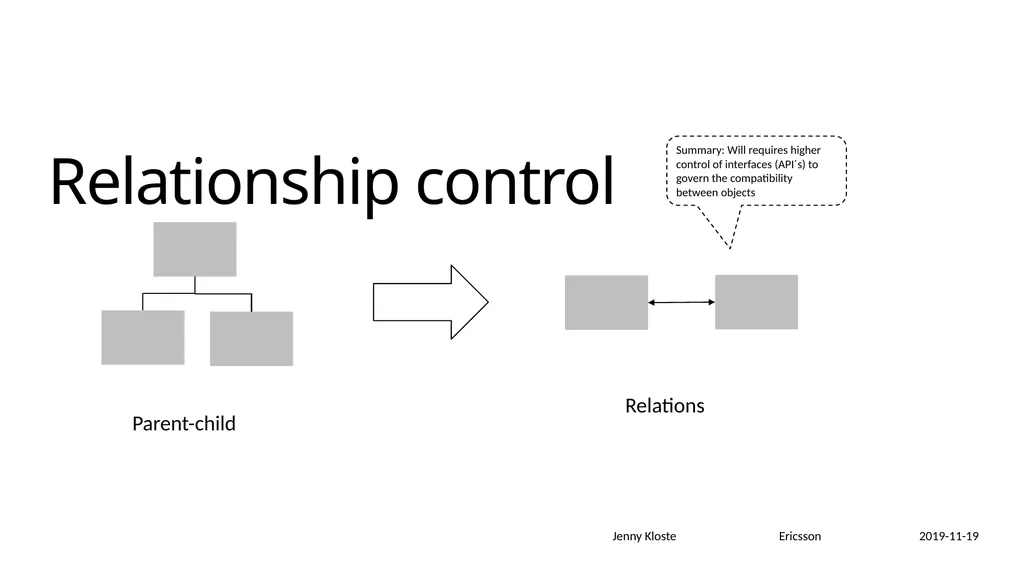
slide2. Relationship control Ericsson 2019-11-19 Jenny Kloste Summary: Will requires higher control of interfaces (API´s) to govern the compatibility between objects Parent-child Relations<br>
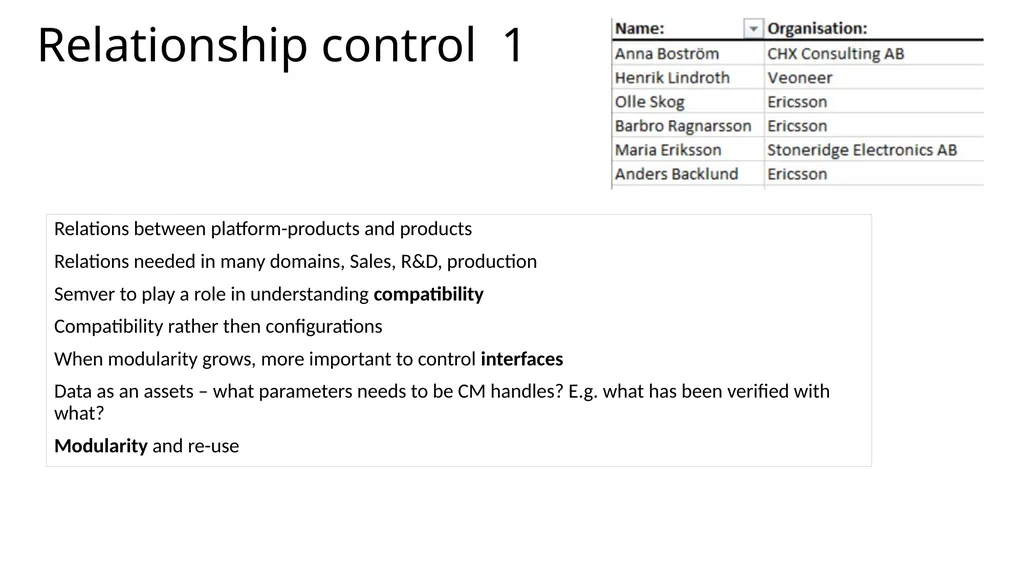
slide3. Relationship control 1 Relations between platform-products and products
Relations needed in many domains, Sales, R&D, production
Semver to play a role in understanding compatibility
Compatibility rather then configurations
When modularity grows, more important to control interfaces
Data as an assets – what parameters needs to be CM handles? E.g. what has been verified with what?
Modularity and re-use<br>
slide4. Relationship control 2 First step is to identify critical relations and document them somehow
Close resemblence to ”Interface management”, Inom SW: API management, versioning of interfaces
Let the relation or interface be a configuration item (with lifecycle, id, version etc)
Ericsson: bl a ”Used by”, ”provided”, ”related to”, kan kontrolleras men svårt att skapa pedagogiska överblicksbilder
Pensionsmynd: relationen som behöver kontrolleras är: microtjänster-tjänster, ”överenskommelser med externa intressenter”, ”GDPR-beroendet”
Graph-databaser ger stöd men förutsätter såklart att man har rätt ut vilka beroenden som man har
Behovet finns att betrakta relationer i en 3d-modell
Den mänskliga relationen – förmågan hos medarbetaren att tolka definitioner på relationer<br>
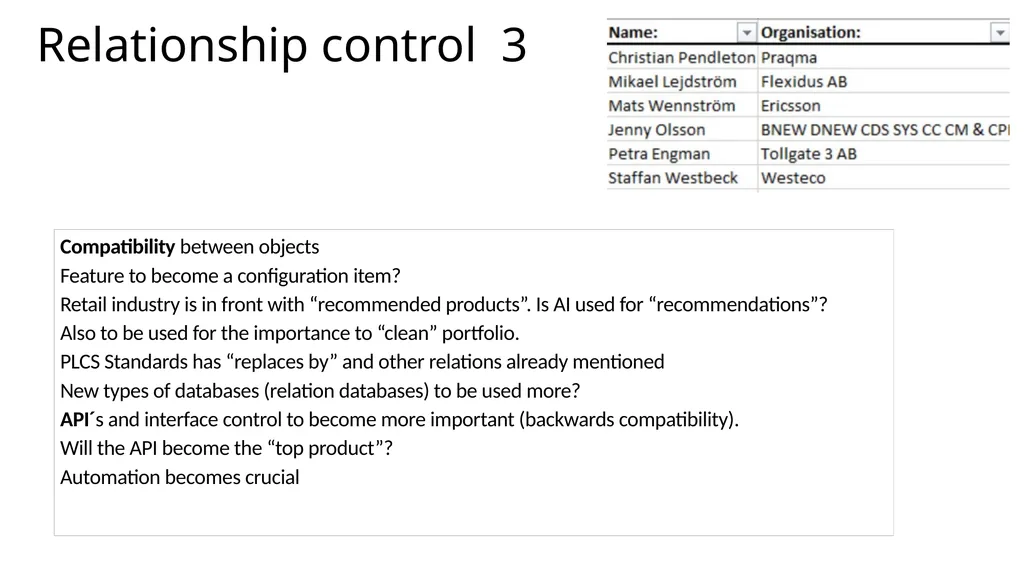
slide5. Relationship control 3 Compatibility between objects
Feature to become a configuration item?
Retail industry is in front with “recommended products”. Is AI used for “recommendations”?
Also to be used for the importance to “clean” portfolio.
PLCS Standards has “replaces by” and other relations already mentioned
New types of databases (relation databases) to be used more?
API´s and interface control to become more important (backwards compatibility).
Will the API become the “top product”?
Automation becomes crucial<br>
slide6. Lifecycle, session 1 Emil, Staffan, Charlott, Raul, Johan
-Increased frequency of release to customer (Ericsson). Continues Delivery concept.
-Life cycle management from requirement to removed from market/in-field
-Much focus on development part of the product lifecycle
-The latter part of the lifecycle, Maintenance to end-of life, is more difficult to control
-Who decides the life length for a product?
-Spare part phase
-Last Time Buy on a component. To be able to estimate the amount of needed component we need to know/estimate the customer needs.
-Global distributed production. The same system and processes should be used globally
-Number of stages in the life cycle can differ depending on the business need
-Different levels of released. A product might not be used just because it is released. It must have been approved for that system/usage. Available for different markets?
-From a cost perspective it is easier to change a electronic component. For mechanic there is a cost and a leadtime for changing the tools. SW can have a long start-up time when trying to change old SW due to compilers/tools/knowledge<br>
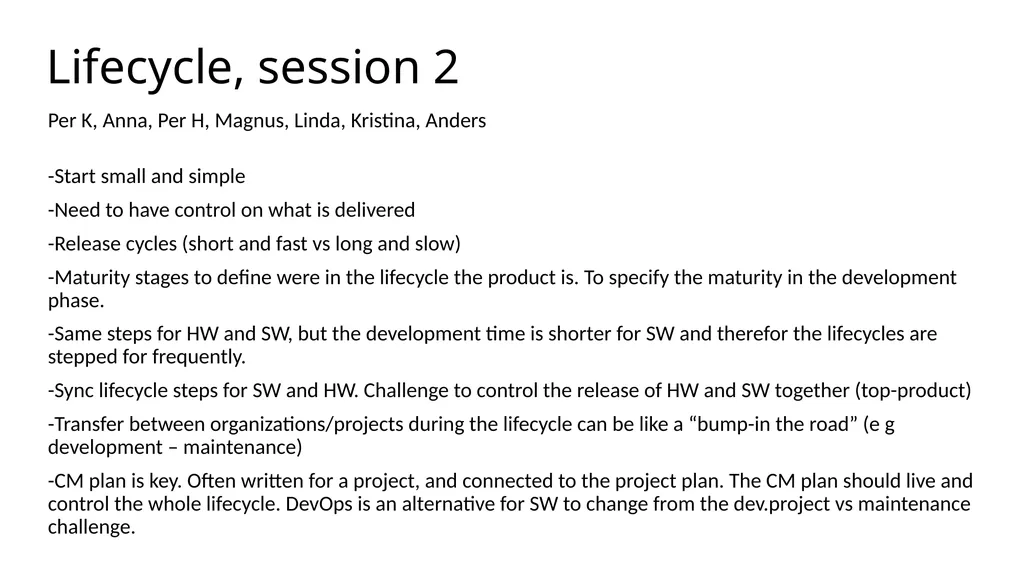
slide8. Lifecycle, session 2 Per K, Anna, Per H, Magnus, Linda, Kristina, Anders
-Start small and simple
-Need to have control on what is delivered
-Release cycles (short and fast vs long and slow)
-Maturity stages to define were in the lifecycle the product is. To specify the maturity in the development phase.
-Same steps for HW and SW, but the development time is shorter for SW and therefor the lifecycles are stepped for frequently.
-Sync lifecycle steps for SW and HW. Challenge to control the release of HW and SW together (top-product)
-Transfer between organizations/projects during the lifecycle can be like a “bump-in the road” (e g development – maintenance)
-CM plan is key. Often written for a project, and connected to the project plan. The CM plan should live and control the whole lifecycle. DevOps is an alternative for SW to change from the dev.project vs maintenance challenge.<br>
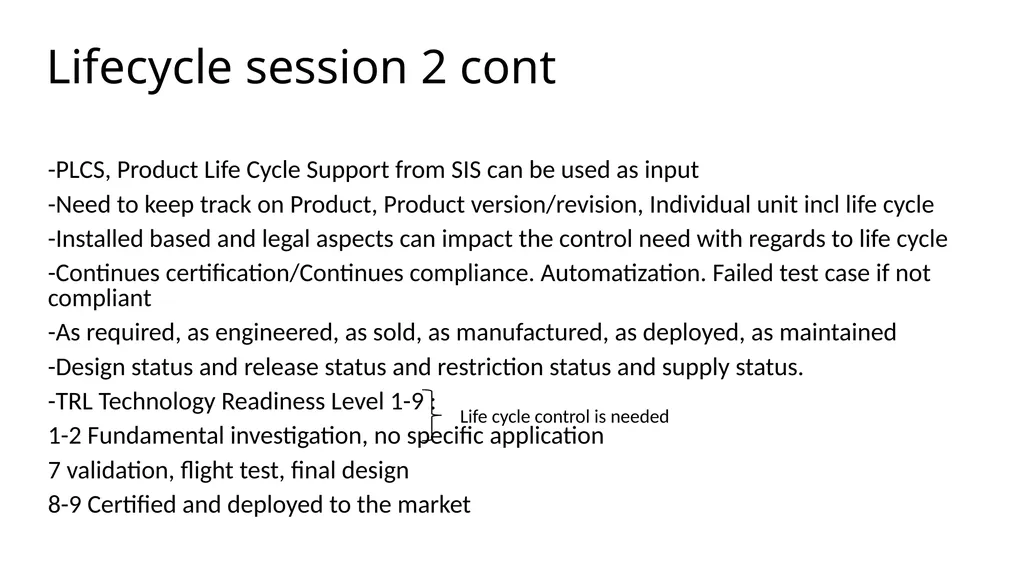
slide9. Lifecycle session 2 cont -PLCS, Product Life Cycle Support from SIS can be used as input
-Need to keep track on Product, Product version/revision, Individual unit incl life cycle
-Installed based and legal aspects can impact the control need with regards to life cycle
-Continues certification/Continues compliance. Automatization. Failed test case if not compliant
-As required, as engineered, as sold, as manufactured, as deployed, as maintained
-Design status and release status and restriction status and supply status.
-TRL Technology Readiness Level 1-9 :
1-2 Fundamental investigation, no specific application
7 validation, flight test, final design
8-9 Certified and deployed to the market Life cycle control is needed<br>
slide10. CM Forum CM for legal requirement Participants: Jenny Olsson
Kristina Lennartsson
Marina Omar
Pernilla Sjöberg<br>
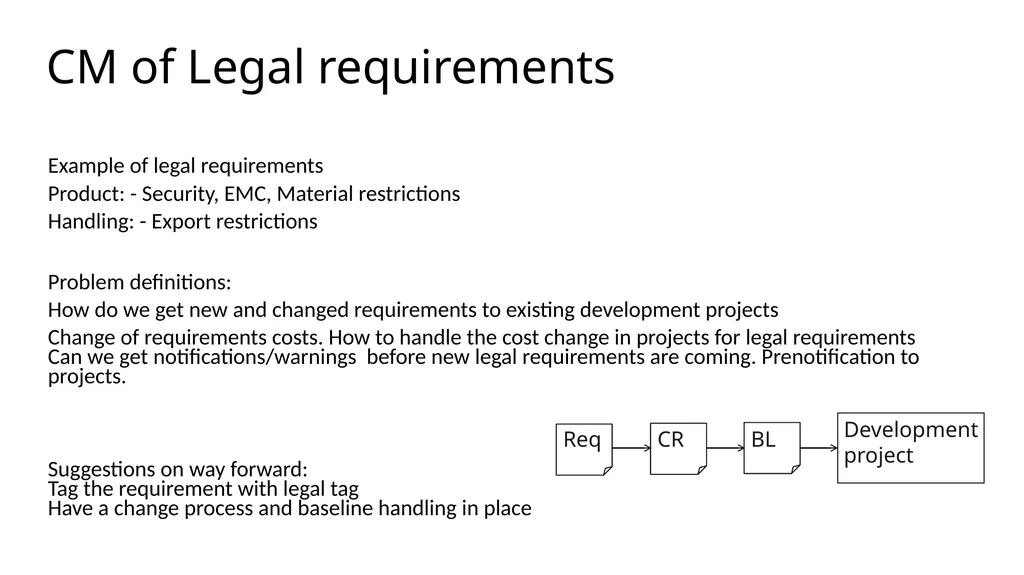
slide11. CM of Legal requirements Example of legal requirements
Product: - Security, EMC, Material restrictions
Handling: - Export restrictions
Problem definitions:
How do we get new and changed requirements to existing development projects
Change of requirements costs. How to handle the cost change in projects for legal requirements Can we get notifications/warnings before new legal requirements are coming. Prenotification to projects.
Suggestions on way forward: Tag the requirement with legal tag Have a change process and baseline handling in place<br>
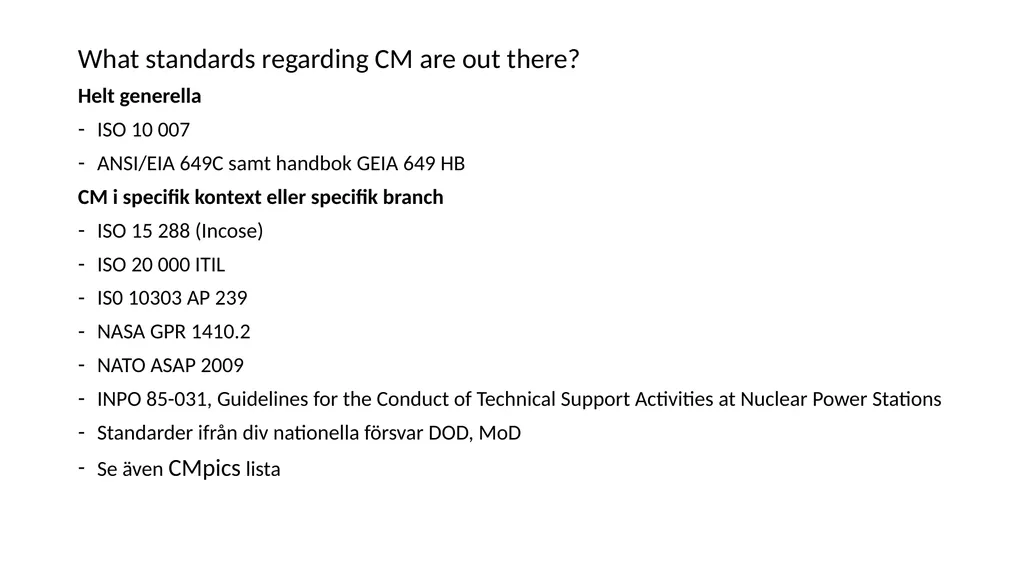
slide12. What standards regarding CM are out there?
Helt generella
ISO 10 007
ANSI/EIA 649C samt handbok GEIA 649 HB
CM i specifik kontext eller specifik branch
ISO 15 288 (Incose)
ISO 20 000 ITIL
IS0 10303 AP 239
NASA GPR 1410.2
NATO ASAP 2009
INPO 85-031, Guidelines for the Conduct of Technical Support Activities at Nuclear Power Stations
Standarder ifrån div nationella försvar DOD, MoD
Se även CMpics lista<br>
slide13. Which standards are actually used?
ISO 10 007 är sannolikt mest förekommande, men för vid – med andra ord: ingen använder den.
Which standards bring actual value to the organization?
Vi föreslår ANSI 649, men används den?
What, in terms of CM, should be standardized but isn’t?
En standardiserad uppsättning krav på en leverantörs CM-verksamhet
Standardiserade indikatorer på effektiv CM-verksamhet (nyckeltal)
Standardiserad rollbeskrivning för en Configuration Manager<br>
Ericsson, 2019-11-21<br>
slide2. Relationship control Ericsson 2019-11-19 Jenny Kloste Summary: Will requires higher control of interfaces (API´s) to govern the compatibility between objects Parent-child Relations<br>
slide3. Relationship control 1 Relations between platform-products and products
Relations needed in many domains, Sales, R&D, production
Semver to play a role in understanding compatibility
Compatibility rather then configurations
When modularity grows, more important to control interfaces
Data as an assets – what parameters needs to be CM handles? E.g. what has been verified with what?
Modularity and re-use<br>
slide4. Relationship control 2 First step is to identify critical relations and document them somehow
Close resemblence to ”Interface management”, Inom SW: API management, versioning of interfaces
Let the relation or interface be a configuration item (with lifecycle, id, version etc)
Ericsson: bl a ”Used by”, ”provided”, ”related to”, kan kontrolleras men svårt att skapa pedagogiska överblicksbilder
Pensionsmynd: relationen som behöver kontrolleras är: microtjänster-tjänster, ”överenskommelser med externa intressenter”, ”GDPR-beroendet”
Graph-databaser ger stöd men förutsätter såklart att man har rätt ut vilka beroenden som man har
Behovet finns att betrakta relationer i en 3d-modell
Den mänskliga relationen – förmågan hos medarbetaren att tolka definitioner på relationer<br>
slide5. Relationship control 3 Compatibility between objects
Feature to become a configuration item?
Retail industry is in front with “recommended products”. Is AI used for “recommendations”?
Also to be used for the importance to “clean” portfolio.
PLCS Standards has “replaces by” and other relations already mentioned
New types of databases (relation databases) to be used more?
API´s and interface control to become more important (backwards compatibility).
Will the API become the “top product”?
Automation becomes crucial<br>
slide6. Lifecycle, session 1 Emil, Staffan, Charlott, Raul, Johan
-Increased frequency of release to customer (Ericsson). Continues Delivery concept.
-Life cycle management from requirement to removed from market/in-field
-Much focus on development part of the product lifecycle
-The latter part of the lifecycle, Maintenance to end-of life, is more difficult to control
-Who decides the life length for a product?
-Spare part phase
-Last Time Buy on a component. To be able to estimate the amount of needed component we need to know/estimate the customer needs.
-Global distributed production. The same system and processes should be used globally
-Number of stages in the life cycle can differ depending on the business need
-Different levels of released. A product might not be used just because it is released. It must have been approved for that system/usage. Available for different markets?
-From a cost perspective it is easier to change a electronic component. For mechanic there is a cost and a leadtime for changing the tools. SW can have a long start-up time when trying to change old SW due to compilers/tools/knowledge<br>
slide8. Lifecycle, session 2 Per K, Anna, Per H, Magnus, Linda, Kristina, Anders
-Start small and simple
-Need to have control on what is delivered
-Release cycles (short and fast vs long and slow)
-Maturity stages to define were in the lifecycle the product is. To specify the maturity in the development phase.
-Same steps for HW and SW, but the development time is shorter for SW and therefor the lifecycles are stepped for frequently.
-Sync lifecycle steps for SW and HW. Challenge to control the release of HW and SW together (top-product)
-Transfer between organizations/projects during the lifecycle can be like a “bump-in the road” (e g development – maintenance)
-CM plan is key. Often written for a project, and connected to the project plan. The CM plan should live and control the whole lifecycle. DevOps is an alternative for SW to change from the dev.project vs maintenance challenge.<br>
slide9. Lifecycle session 2 cont -PLCS, Product Life Cycle Support from SIS can be used as input
-Need to keep track on Product, Product version/revision, Individual unit incl life cycle
-Installed based and legal aspects can impact the control need with regards to life cycle
-Continues certification/Continues compliance. Automatization. Failed test case if not compliant
-As required, as engineered, as sold, as manufactured, as deployed, as maintained
-Design status and release status and restriction status and supply status.
-TRL Technology Readiness Level 1-9 :
1-2 Fundamental investigation, no specific application
7 validation, flight test, final design
8-9 Certified and deployed to the market Life cycle control is needed<br>
slide10. CM Forum CM for legal requirement Participants: Jenny Olsson
Kristina Lennartsson
Marina Omar
Pernilla Sjöberg<br>
slide11. CM of Legal requirements Example of legal requirements
Product: - Security, EMC, Material restrictions
Handling: - Export restrictions
Problem definitions:
How do we get new and changed requirements to existing development projects
Change of requirements costs. How to handle the cost change in projects for legal requirements Can we get notifications/warnings before new legal requirements are coming. Prenotification to projects.
Suggestions on way forward: Tag the requirement with legal tag Have a change process and baseline handling in place<br>
slide12. What standards regarding CM are out there?
Helt generella
ISO 10 007
ANSI/EIA 649C samt handbok GEIA 649 HB
CM i specifik kontext eller specifik branch
ISO 15 288 (Incose)
ISO 20 000 ITIL
IS0 10303 AP 239
NASA GPR 1410.2
NATO ASAP 2009
INPO 85-031, Guidelines for the Conduct of Technical Support Activities at Nuclear Power Stations
Standarder ifrån div nationella försvar DOD, MoD
Se även CMpics lista<br>
slide13. Which standards are actually used?
ISO 10 007 är sannolikt mest förekommande, men för vid – med andra ord: ingen använder den.
Which standards bring actual value to the organization?
Vi föreslår ANSI 649, men används den?
What, in terms of CM, should be standardized but isn’t?
En standardiserad uppsättning krav på en leverantörs CM-verksamhet
Standardiserade indikatorer på effektiv CM-verksamhet (nyckeltal)
Standardiserad rollbeskrivning för en Configuration Manager<br>