CMDB and IRE Identification and Reconciliation of CIs BPC Name Senior Business Process Consultant TC Name Senior Technical Consultant Ref: 0003544 The Identification and Reconciliation Engine is a framework which processes payloads in order
"CMDB and IRE Identification and Reconciliation of" is the property of its rightful owner. Permission is granted to
download and print the materials on this website for personal, non-commercial use only, and to display it
on your personal computer provided you do not modify the materials and that you retain all copyright
notices contained in the materials. By downloading content from our website, you accept the terms of this
agreement.
Presentation Transcript
01
CMDB and IRE Identification and Reconciliation of CIs BPC Name Senior Business Process Consultant TC Name Senior Technical Consultant Ref: 0003544<br>
02
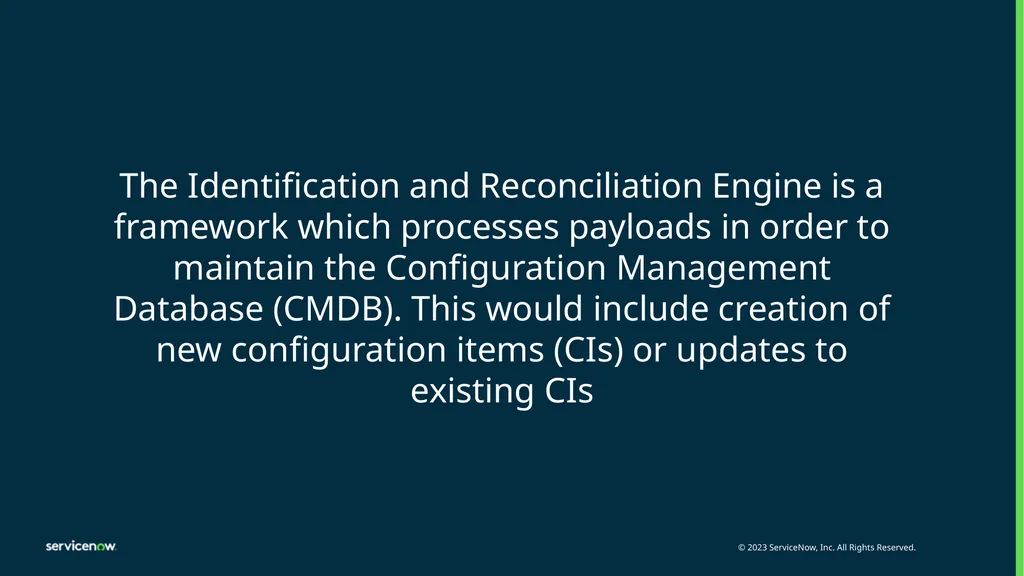
The Identification and Reconciliation Engine is a framework which processes payloads in order to maintain the Configuration Management Database (CMDB). This would include creation of new configuration items (CIs) or updates to existing CIs<br>
03
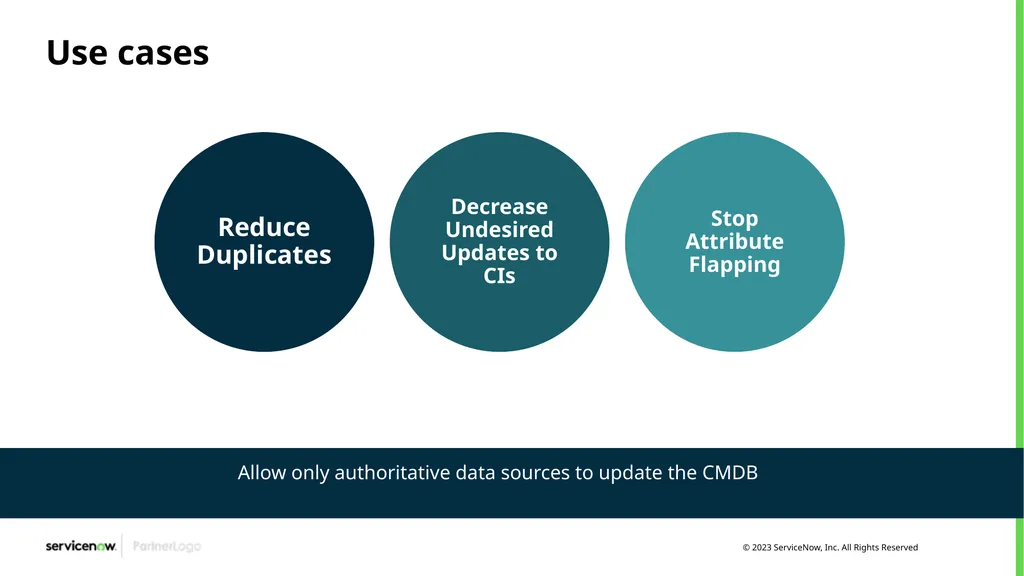
Reduce Duplicates Decrease Undesired Updates to CIs Stop Attribute Flapping Use cases Allow only authoritative data sources to update the CMDB<br>
04
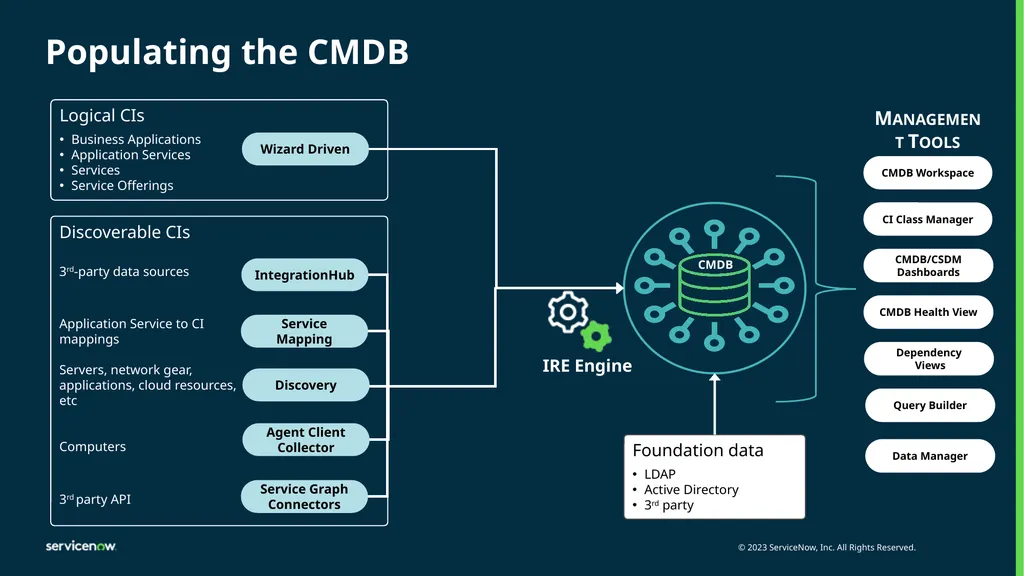
Populating the CMDB Logical CIs
Business Applications
Application Services
Services
Service Offerings Discoverable CIs
3rd party API Foundation data
LDAP
Active Directory
3rd party IRE Engine Management Tools CMDB Wizard Driven IntegrationHub Service Mapping Discovery Agent Client Collector Service Graph Connectors CMDB Workspace CI Class Manager CMDB/CSDM Dashboards CMDB Health View Dependency
Views Query Builder Data Manager<br>
05
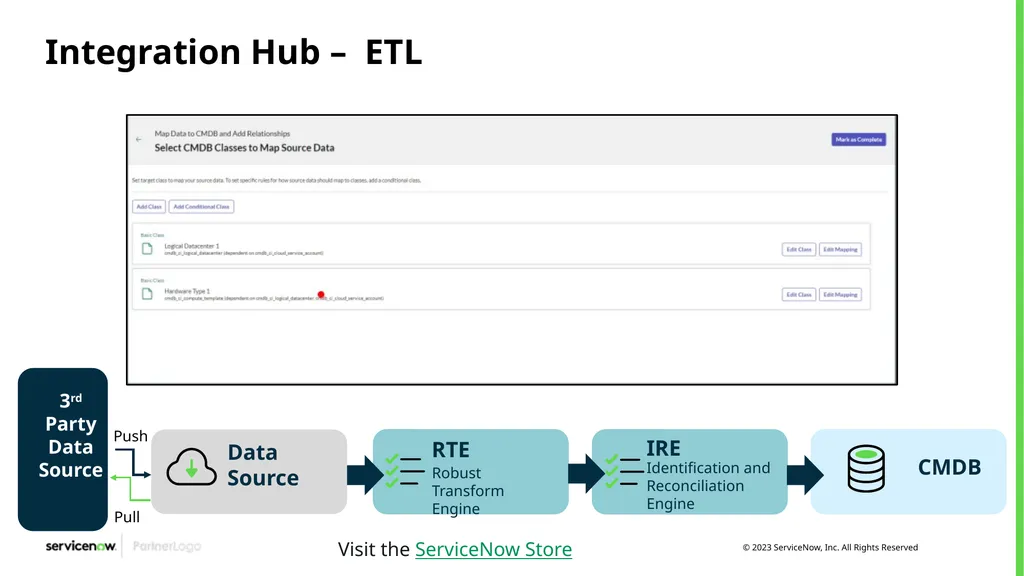
Integration Hub – ETL 3rd Party Data Source RTE Robust Transform Engine Data
Source IRE Identification and Reconciliation Engine CMDB Push Pull Visit the ServiceNow Store<br>
06
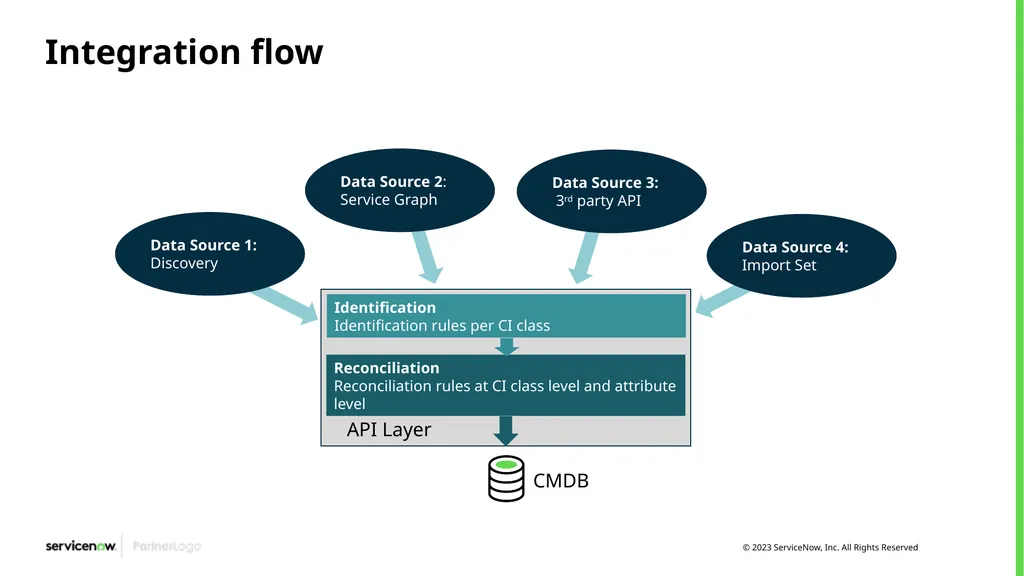
Data Source 2: Service Graph Data Source 3:
3rd party API Data Source 4:
Import Set Identification
Identification rules per CI class Reconciliation
Reconciliation rules at CI class level and attribute level API Layer CMDB Data Source 1: Discovery Integration flow<br>
07
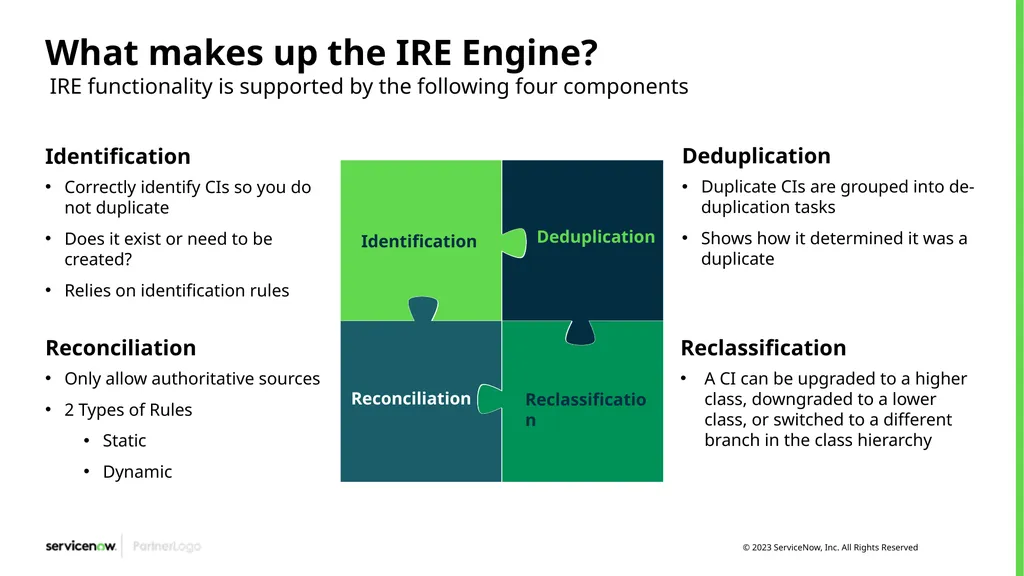
What makes up the IRE Engine? IRE functionality is supported by the following four components Identification Correctly identify CIs so you do not duplicate
Does it exist or need to be created?
Relies on identification rules Deduplication Duplicate CIs are grouped into de-duplication tasks
Shows how it determined it was a duplicate Reclassification A CI can be upgraded to a higher class, downgraded to a lower class, or switched to a different branch in the class hierarchy Reconciliation Only allow authoritative sources
2 Types of Rules
Static
Dynamic Deduplication Reconciliation Reclassification<br>
08
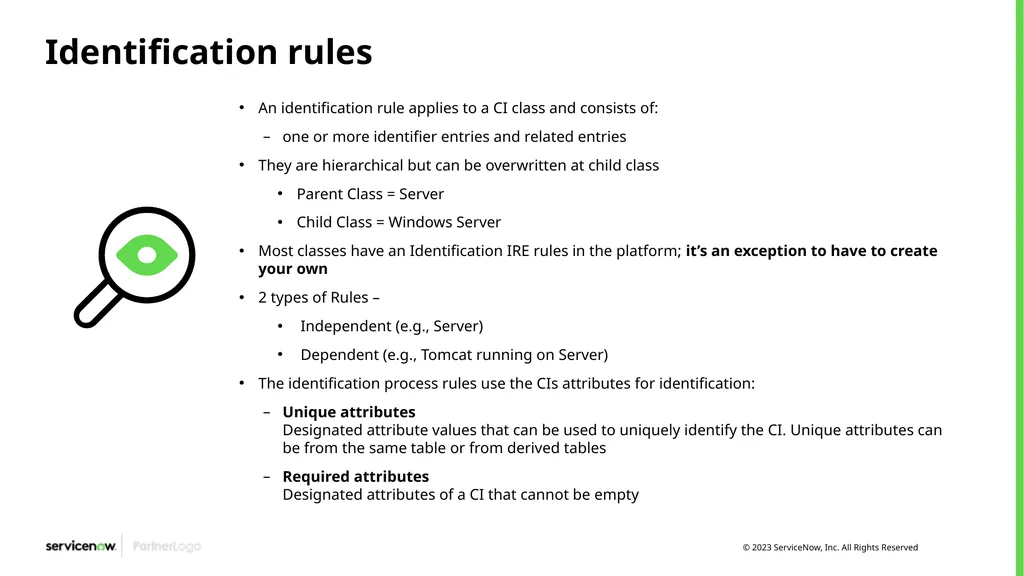
An identification rule applies to a CI class and consists of:
one or more identifier entries and related entries
They are hierarchical but can be overwritten at child class
Parent Class = Server
Child Class = Windows Server
Most classes have an Identification IRE rules in the platform; it’s an exception to have to create your own
2 types of Rules –
Independent (e.g., Server)
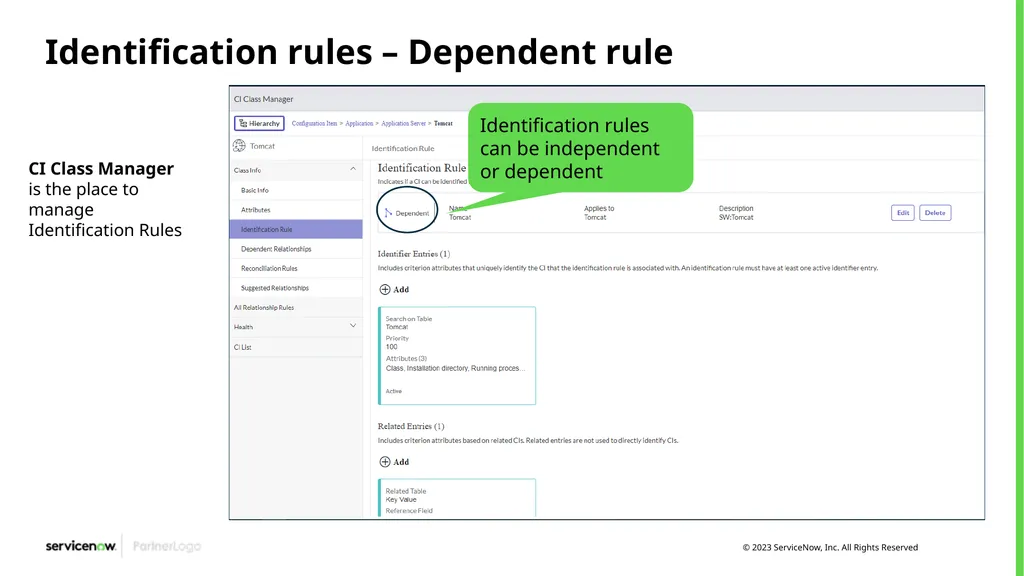
Dependent (e.g., Tomcat running on Server)
The identification process rules use the CIs attributes for identification:
Unique attributes Designated attribute values that can be used to uniquely identify the CI. Unique attributes can be from the same table or from derived tables
Required attributes Designated attributes of a CI that cannot be empty Identification rules<br>
09
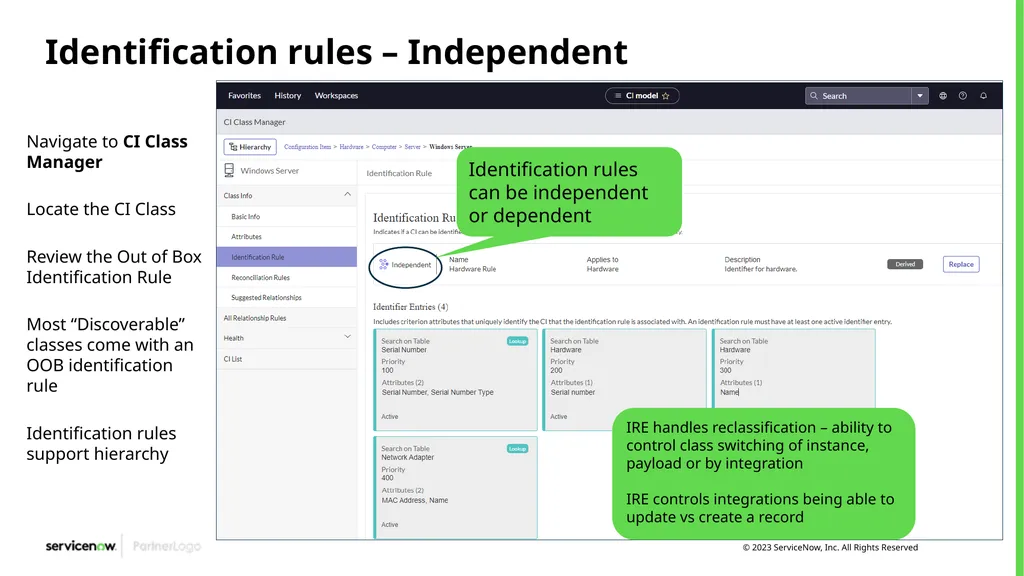
Identification rules – Independent Navigate to CI Class Manager
Locate the CI Class
Review the Out of Box Identification Rule
Most “Discoverable” classes come with an OOB identification rule
Identification rules support hierarchy Identification rules can be independent or dependent IRE handles reclassification – ability to control class switching of instance, payload or by integration
IRE controls integrations being able to update vs create a record<br>
10
Identification rules – Dependent rule CI Class Manager is the place to manage Identification Rules Identification rules can be independent or dependent<br>
11
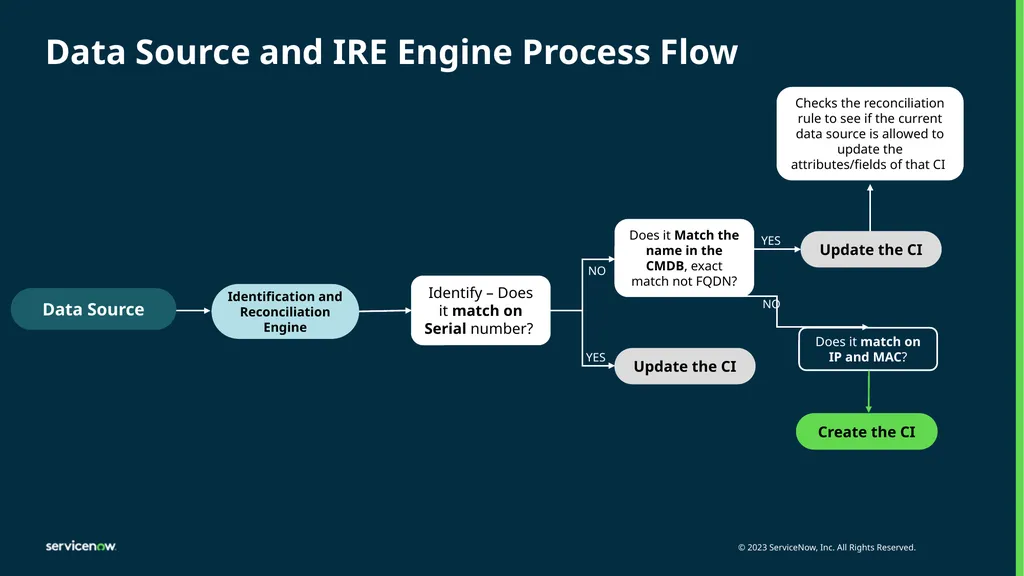
Data Source and IRE Engine Process Flow Identify – Does it match on Serial number? Does it Match the name in the CMDB, exact match not FQDN? NO YES Does it match on IP and MAC? NO Checks the reconciliation rule to see if the current data source is allowed to update the attributes/fields of that CI Data Source Identification and Reconciliation Engine Update the CI YES Update the CI Create the CI<br>
12
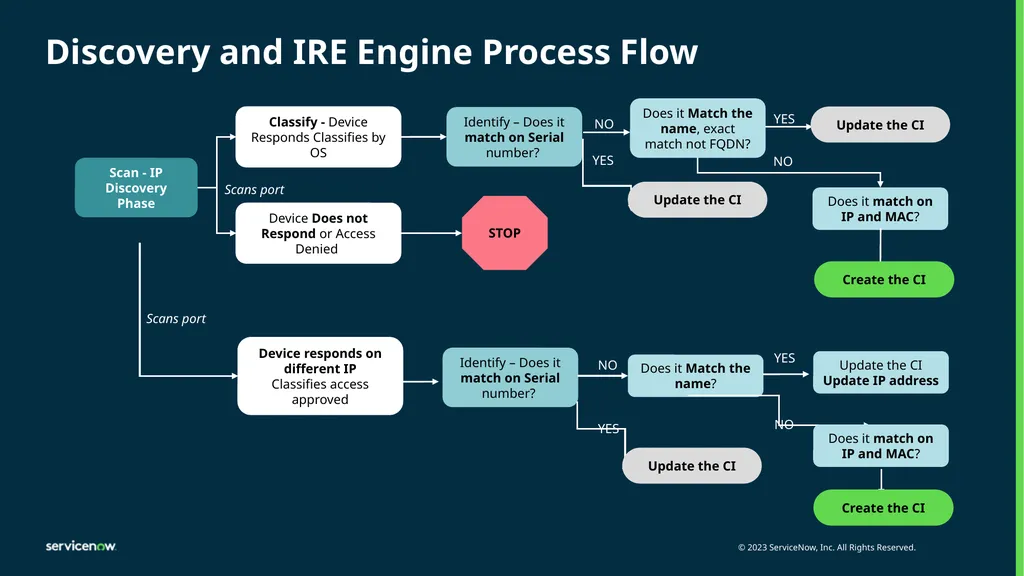
Discovery and IRE Engine Process Flow Update the CI Update the CI Update the CI Create the CI Create the CI<br>
13
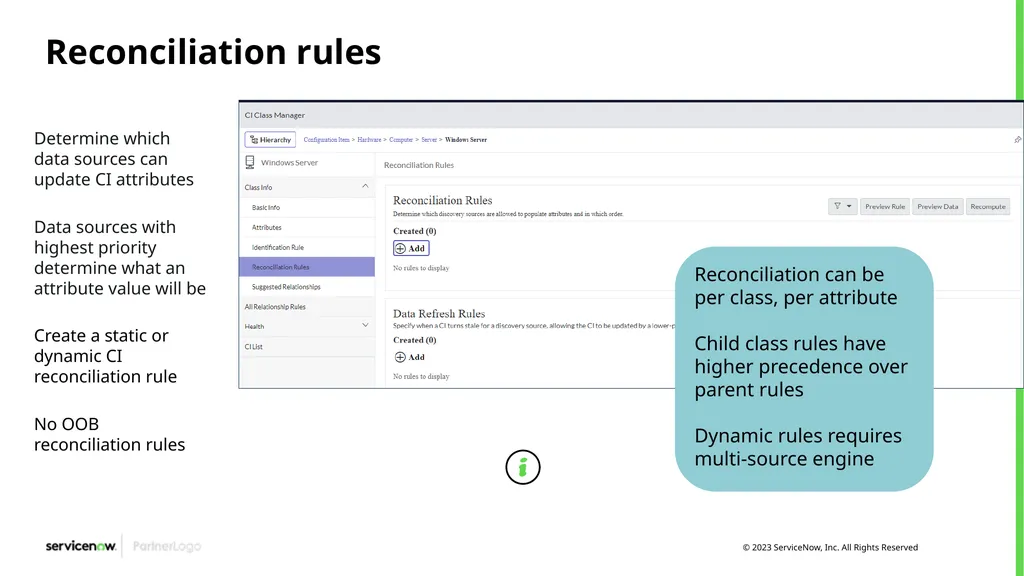
Reconciliation rules Determine which data sources can update CI attributes
Data sources with highest priority determine what an attribute value will be
Create a static or dynamic CI reconciliation rule
No OOB reconciliation rules Reconciliation can be per class, per attribute
Child class rules have higher precedence over parent rules
Dynamic rules requires multi-source engine<br>
14
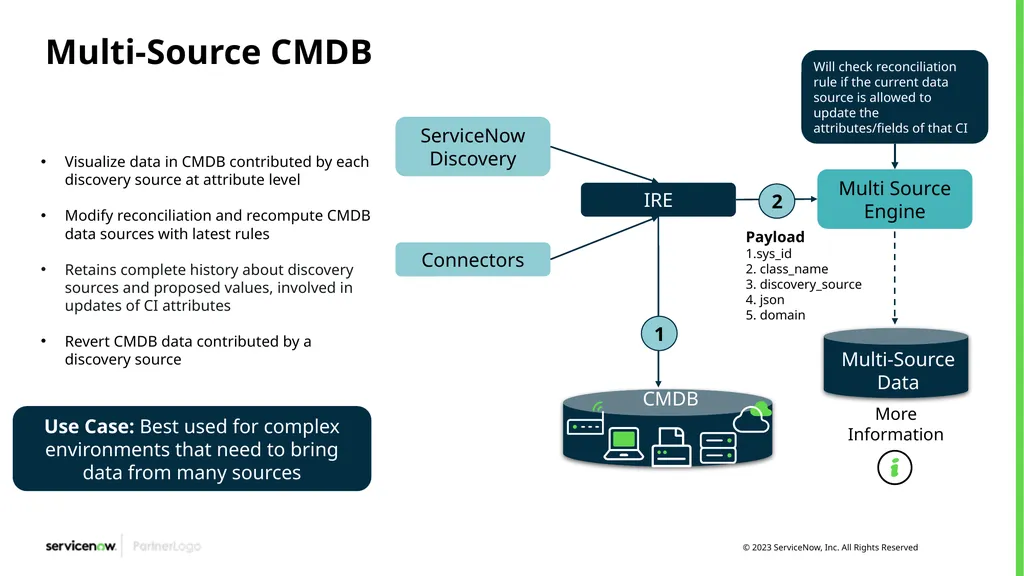
Multi-Source CMDB Visualize data in CMDB contributed by each discovery source at attribute level
Modify reconciliation and recompute CMDB data sources with latest rules
Retains complete history about discovery sources and proposed values, involved in updates of CI attributes
Revert CMDB data contributed by a discovery source ServiceNow Discovery Connectors IRE Multi Source Engine Multi-Source Data 1 2 Payload
1.sys_id
2. class_name
3. discovery_source
4. json
5. domain Use Case: Best used for complex environments that need to bring data from many sources More Information Will check reconciliation rule if the current data source is allowed to update the attributes/fields of that CI<br>
15
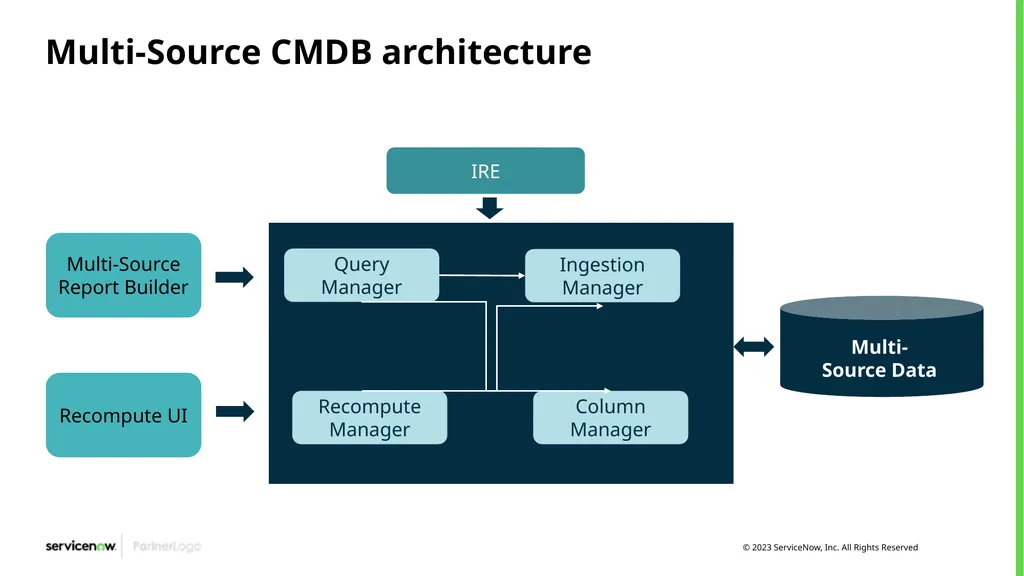
Multi-Source CMDB architecture<br>
16
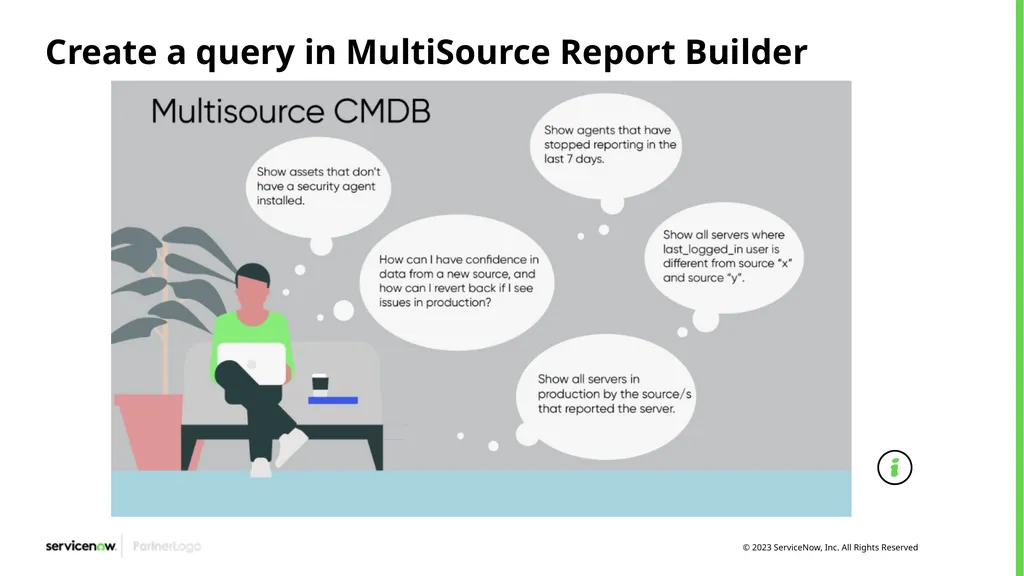
Create a query in MultiSource Report Builder<br>
17
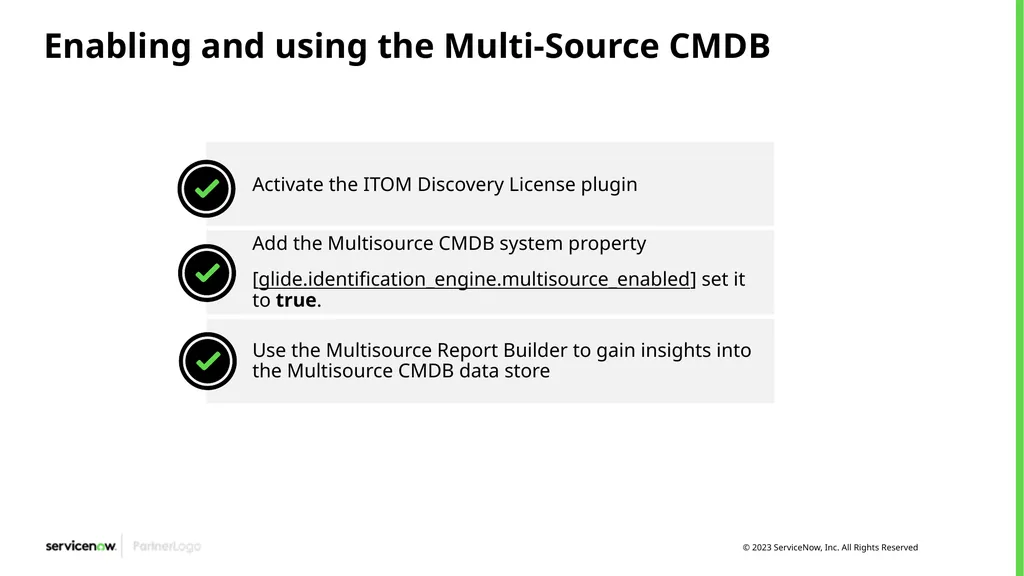
Enabling and using the Multi-Source CMDB Activate the ITOM Discovery License plugin Add the Multisource CMDB system property
[glide.identification_engine.multisource_enabled] set it to true. Use the Multisource Report Builder to gain insights into the Multisource CMDB data store<br>
18
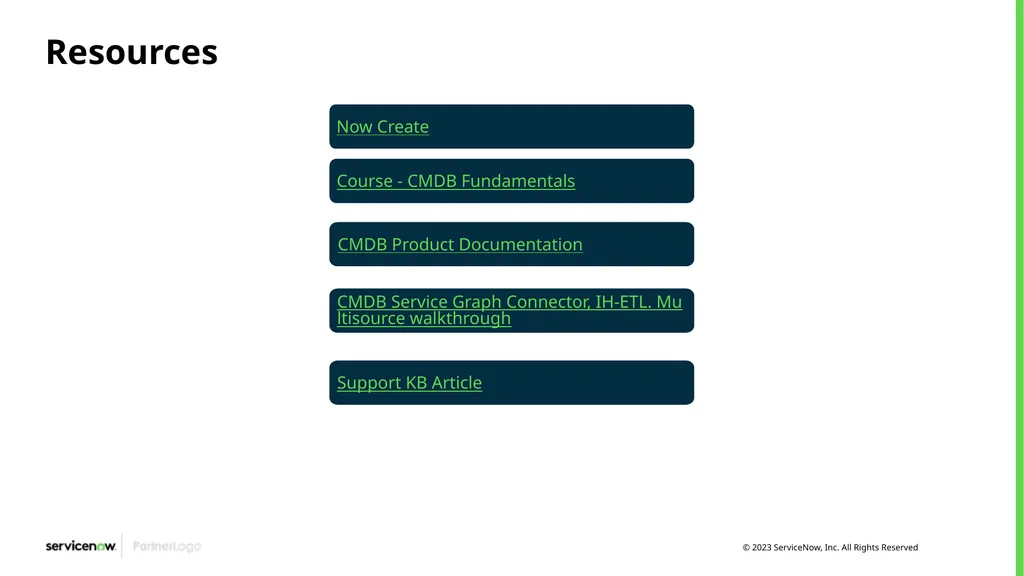
Resources Now Create Course - CMDB Fundamentals CMDB Product Documentation CMDB Service Graph Connector, IH-ETL. Multisource walkthrough Support KB Article<br>