
CMPE/SE 131 Software Engineering April 20 Class
FD
Published · 40 slides · 0 views
1 / 1
Description
CMPESE 131 Software Engineering April 20 Class Meeting Department of Computer Engineering San José State University Spring 2017 Instructor: Ron Mak www.cs.sjsu.edumak 2 Project Scheduling Triangle Time, resources, and features are
Related Topics
Share
Embed code
Download this presentation From Below
"CMPE/SE 131 Software Engineering April 20 Class" is the property of its rightful owner. Permission is granted to download and print the materials on this website for personal, non-commercial use only, and to display it on your personal computer provided you do not modify the materials and that you retain all copyright notices contained in the materials. By downloading content from our website, you accept the terms of this agreement.
Presentation Transcript
01
CMPE/SE 131
Software Engineering
April 20 Class Meeting Department of Computer Engineering
San José State University
Spring 2017
Instructor: Ron Mak
www.cs.sjsu.edu/~mak<br>
www.cs.sjsu.edu/~mak<br>
02
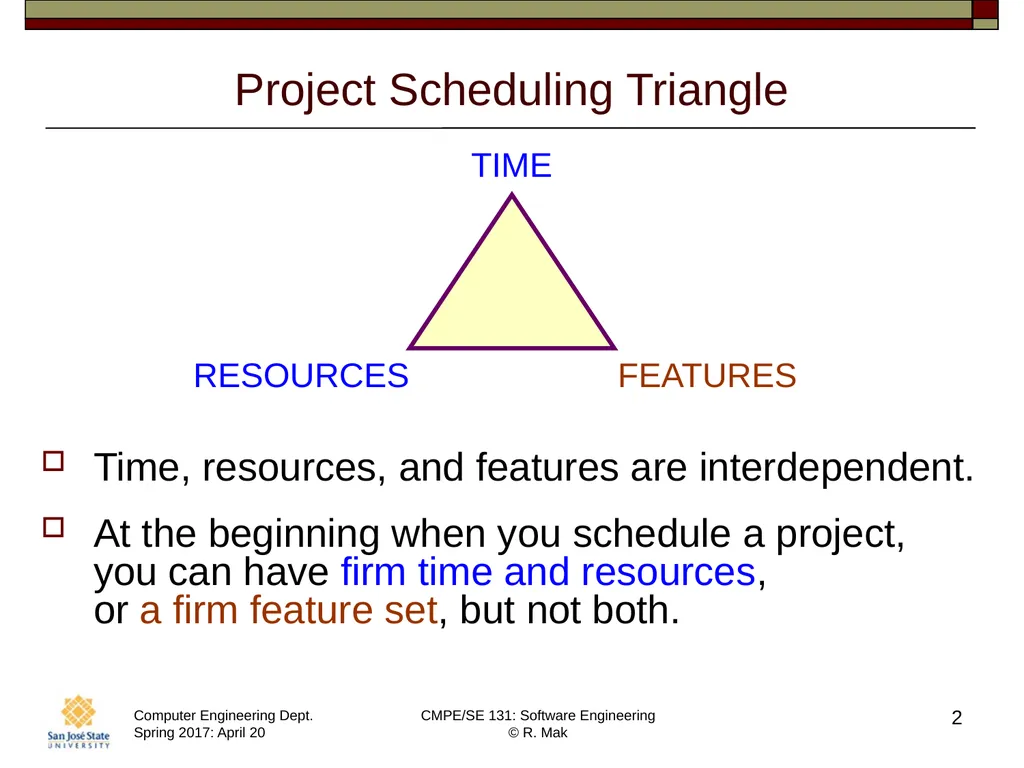
2 Project Scheduling Triangle Time, resources, and features are interdependent.
At the beginning when you schedule a project, you can have firm time and resources, or a firm feature set, but not both. FEATURES RESOURCES TIME<br>
At the beginning when you schedule a project, you can have firm time and resources, or a firm feature set, but not both. FEATURES RESOURCES TIME<br>
03
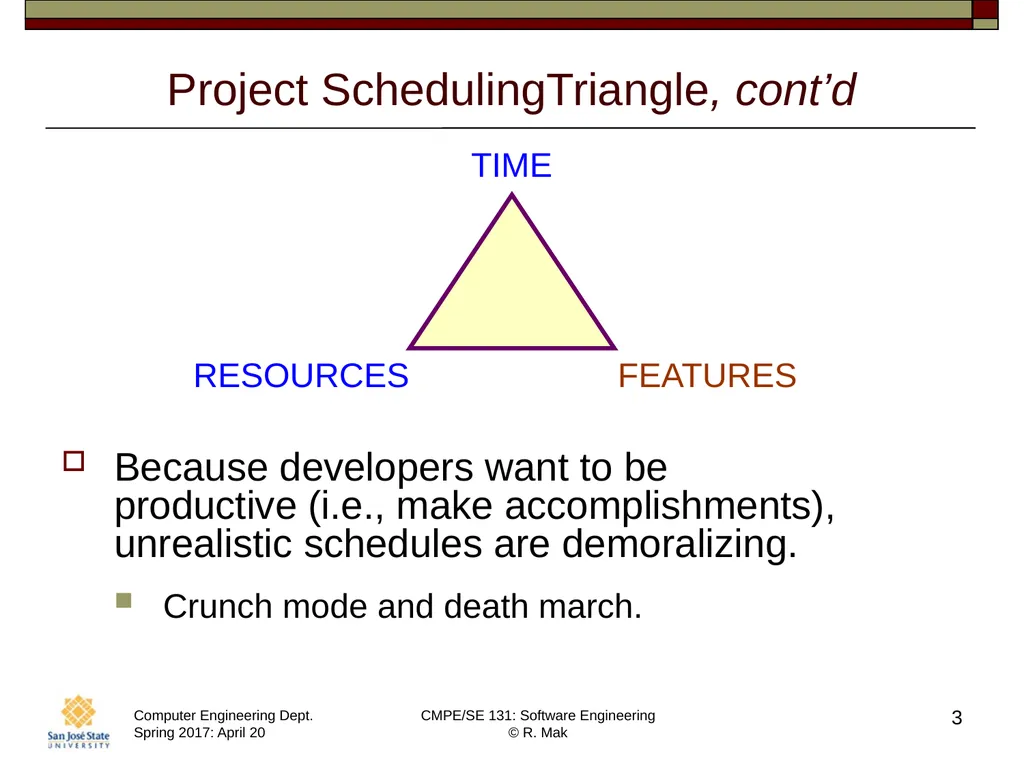
3 Project SchedulingTriangle, cont’d Because developers want to be
productive (i.e., make accomplishments), unrealistic schedules are demoralizing.
Crunch mode and death march. FEATURES RESOURCES TIME<br>
Crunch mode and death march. FEATURES RESOURCES TIME<br>
04
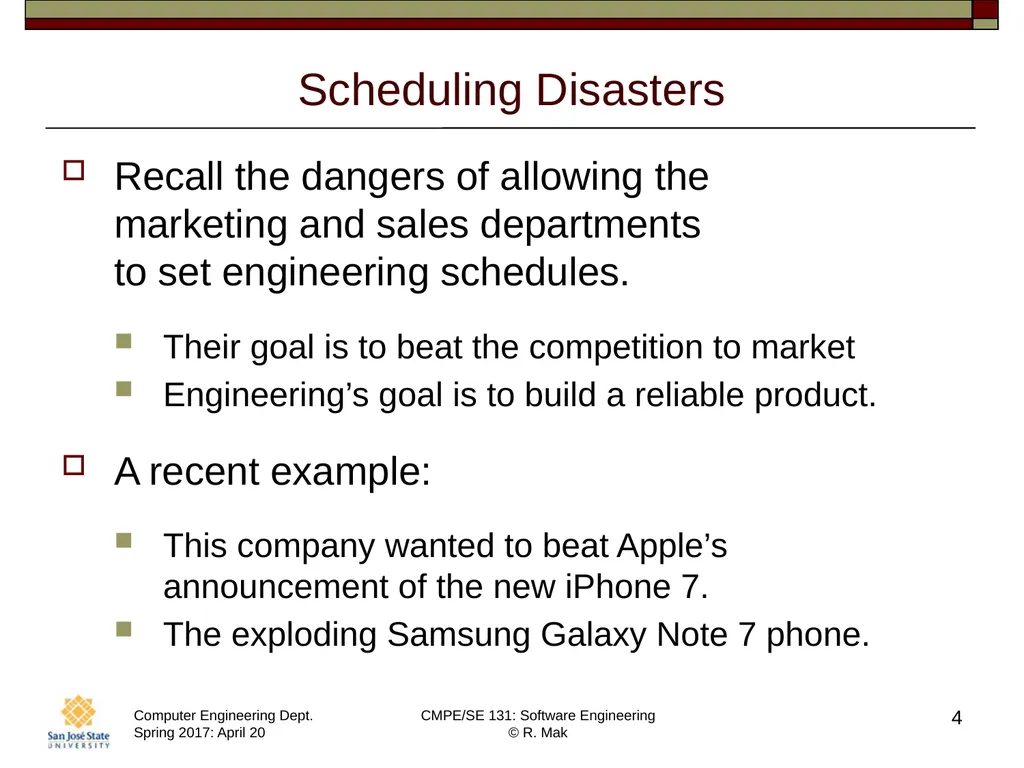
Scheduling Disasters Recall the dangers of allowing the
marketing and sales departments
to set engineering schedules.
Their goal is to beat the competition to market
Engineering’s goal is to build a reliable product.
A recent example:
This company wanted to beat Apple’s announcement of the new iPhone 7.
The exploding Samsung Galaxy Note 7 phone. 4<br>
Their goal is to beat the competition to market
Engineering’s goal is to build a reliable product.
A recent example:
This company wanted to beat Apple’s announcement of the new iPhone 7.
The exploding Samsung Galaxy Note 7 phone. 4<br>
05
5 Project Failures Why study failed projects?
Failure is a far stronger learning experience than success.
Robert Glass
When you’re failing, you’re forced to be creative, to dig deep and think hard, night and day. Every company needs people who have been through that.
Bill Gates<br>
Failure is a far stronger learning experience than success.
Robert Glass
When you’re failing, you’re forced to be creative, to dig deep and think hard, night and day. Every company needs people who have been through that.
Bill Gates<br>
06
6 Causes of Project Failures Technology
New technology that isn’t ready or is improperly used.
Performance
Performance requirements were not seriously considered during design.
“ We can just add faster hardware.”
Project management
Inexperienced and/or clueless managers.
Unrealistic schedules.<br>
New technology that isn’t ready or is improperly used.
Performance
Performance requirements were not seriously considered during design.
“ We can just add faster hardware.”
Project management
Inexperienced and/or clueless managers.
Unrealistic schedules.<br>
07
7 10 Signs of Project Failure Project managers don’t understand users’ needs.
Scope is ill-defined.
Project changes are managed poorly.
The chosen technology changes.
Business needs change.
Deadlines are unrealistic.
The project lacks people with appropriate skills.
Best practices and lessons are ignored.
Users are resistant.
Sponsorship is lost.<br>
Scope is ill-defined.
Project changes are managed poorly.
The chosen technology changes.
Business needs change.
Deadlines are unrealistic.
The project lacks people with appropriate skills.
Best practices and lessons are ignored.
Users are resistant.
Sponsorship is lost.<br>
08
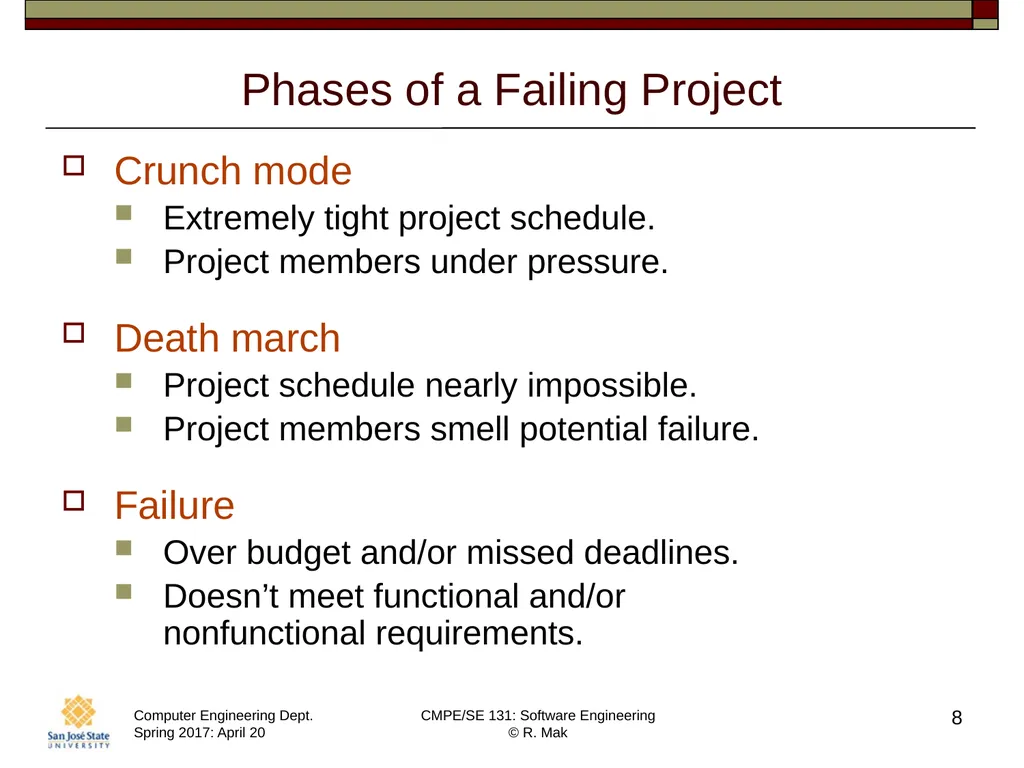
8 Phases of a Failing Project Crunch mode
Extremely tight project schedule.
Project members under pressure.
Death march
Project schedule nearly impossible.
Project members smell potential failure.
Failure
Over budget and/or missed deadlines.
Doesn’t meet functional and/or nonfunctional requirements.<br>
Extremely tight project schedule.
Project members under pressure.
Death march
Project schedule nearly impossible.
Project members smell potential failure.
Failure
Over budget and/or missed deadlines.
Doesn’t meet functional and/or nonfunctional requirements.<br>
09
9 Example of a Failed Project Denver International Airport’s
Automated Baggage-Handling System<br>
10
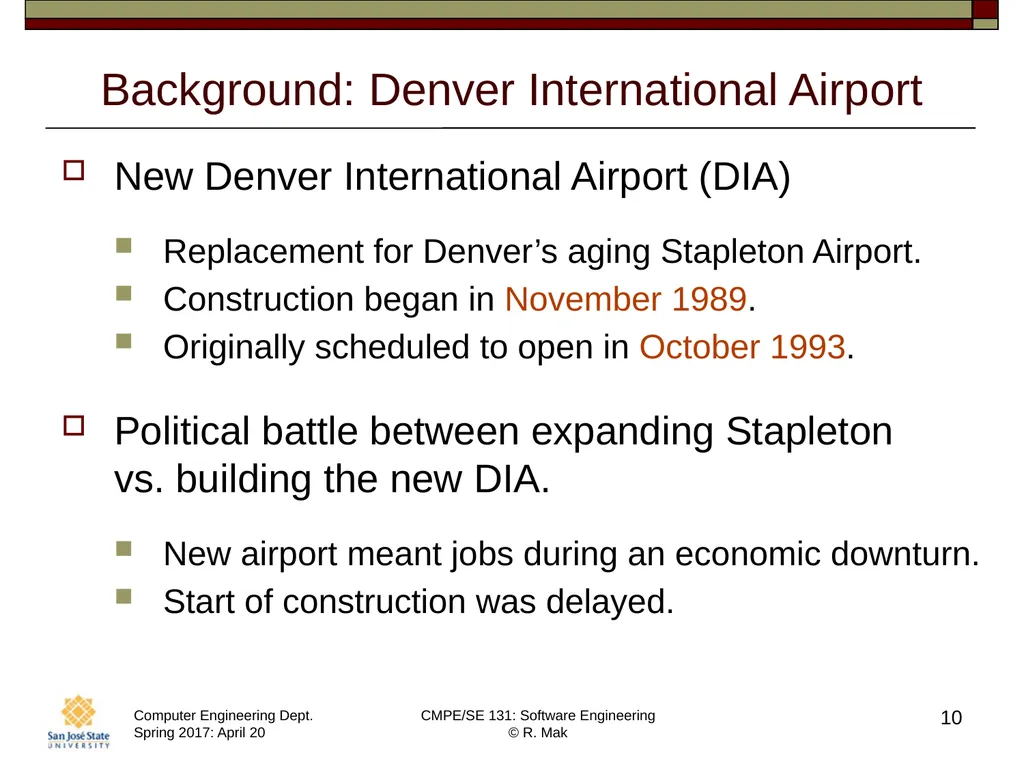
10 Background: Denver International Airport New Denver International Airport (DIA)
Replacement for Denver’s aging Stapleton Airport.
Construction began in November 1989.
Originally scheduled to open in October 1993.
Political battle between expanding Stapleton vs. building the new DIA.
New airport meant jobs during an economic downturn.
Start of construction was delayed.<br>
Replacement for Denver’s aging Stapleton Airport.
Construction began in November 1989.
Originally scheduled to open in October 1993.
Political battle between expanding Stapleton vs. building the new DIA.
New airport meant jobs during an economic downturn.
Start of construction was delayed.<br>
11
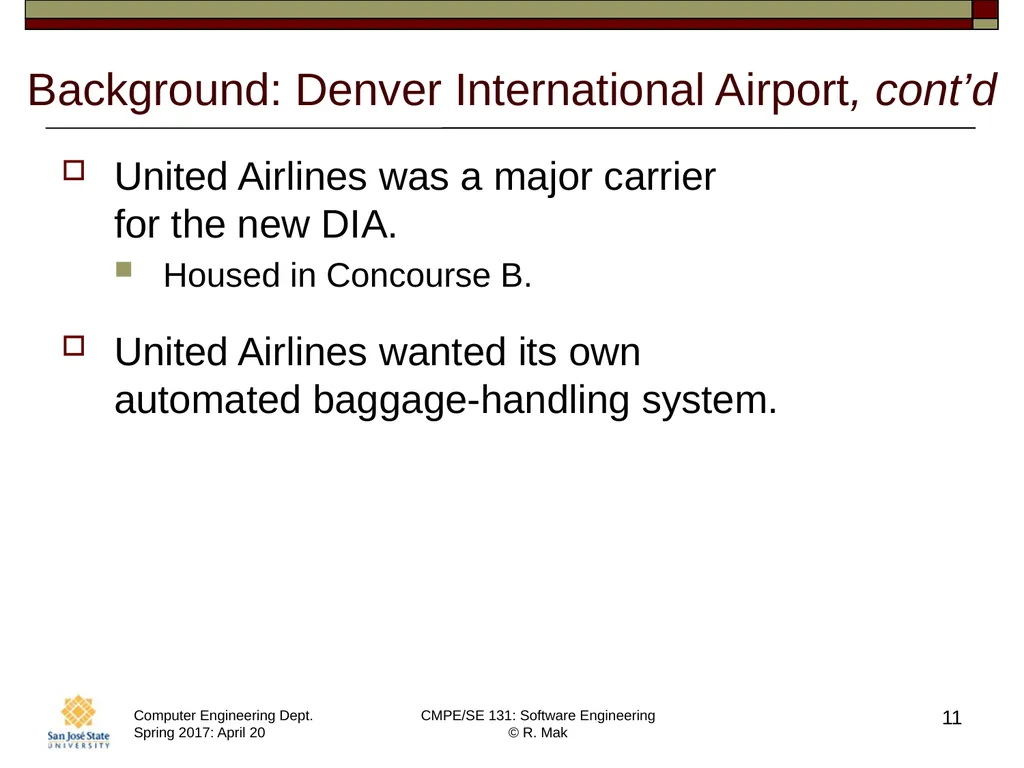
11 Background: Denver International Airport, cont’d United Airlines was a major carrier
for the new DIA.
Housed in Concourse B.
United Airlines wanted its own automated baggage-handling system.<br>
Housed in Concourse B.
United Airlines wanted its own automated baggage-handling system.<br>
12
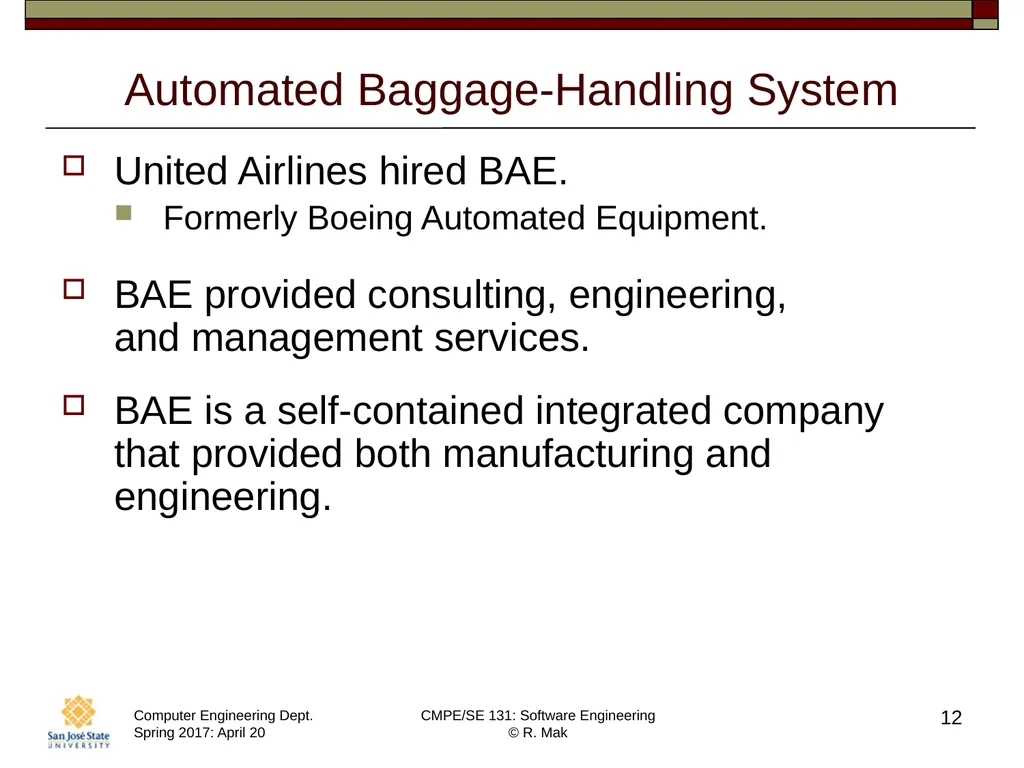
12 Automated Baggage-Handling System United Airlines hired BAE.
Formerly Boeing Automated Equipment.
BAE provided consulting, engineering, and management services.
BAE is a self-contained integrated company that provided both manufacturing and engineering.<br>
Formerly Boeing Automated Equipment.
BAE provided consulting, engineering, and management services.
BAE is a self-contained integrated company that provided both manufacturing and engineering.<br>
13
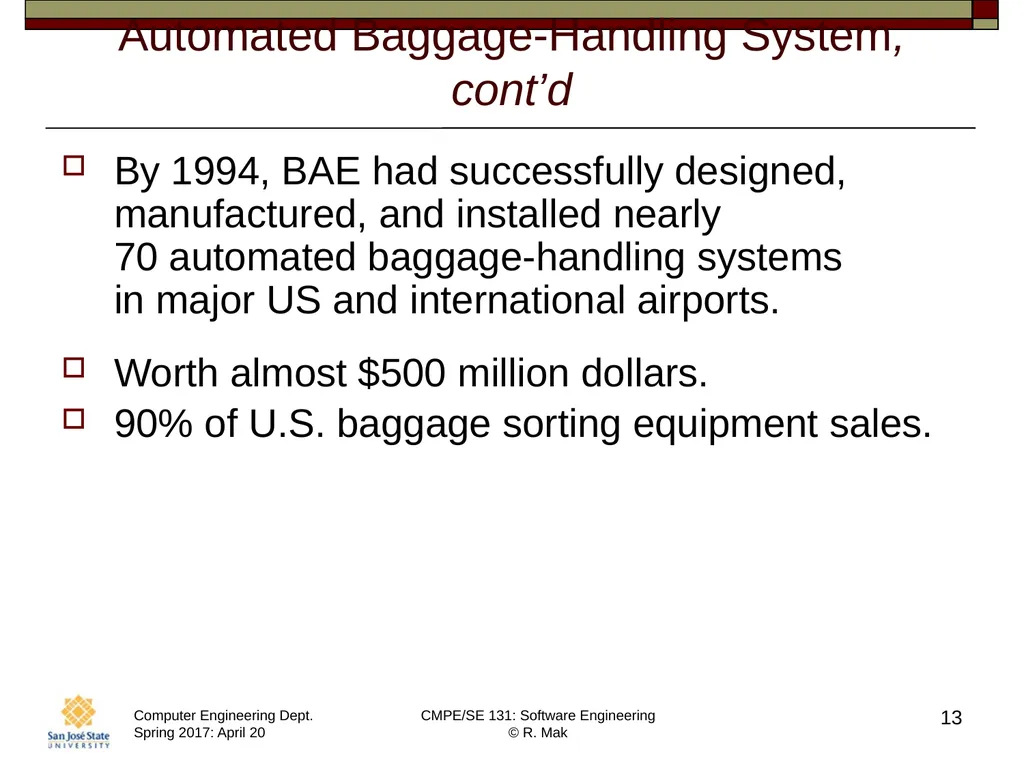
13 Automated Baggage-Handling System, cont’d By 1994, BAE had successfully designed, manufactured, and installed nearly
70 automated baggage-handling systems
in major US and international airports.
Worth almost $500 million dollars.
90% of U.S. baggage sorting equipment sales.<br>
Worth almost $500 million dollars.
90% of U.S. baggage sorting equipment sales.<br>
14
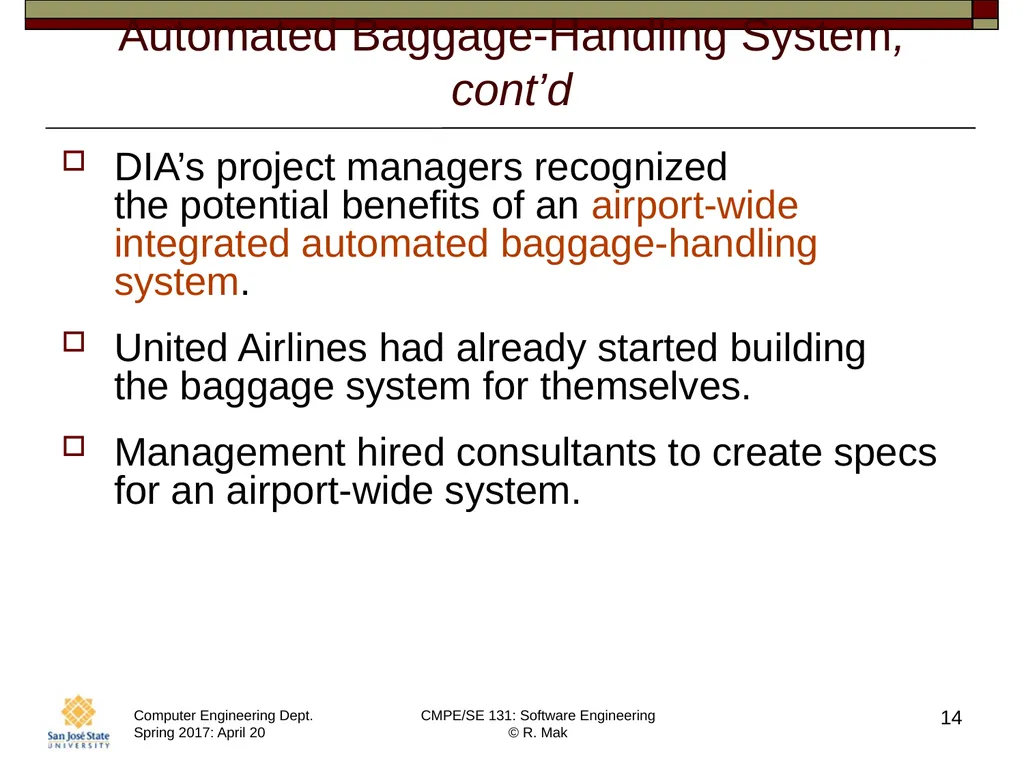
14 Automated Baggage-Handling System, cont’d DIA’s project managers recognized
the potential benefits of an airport-wide integrated automated baggage-handling system.
United Airlines had already started building the baggage system for themselves.
Management hired consultants to create specs for an airport-wide system.<br>
United Airlines had already started building the baggage system for themselves.
Management hired consultants to create specs for an airport-wide system.<br>
15
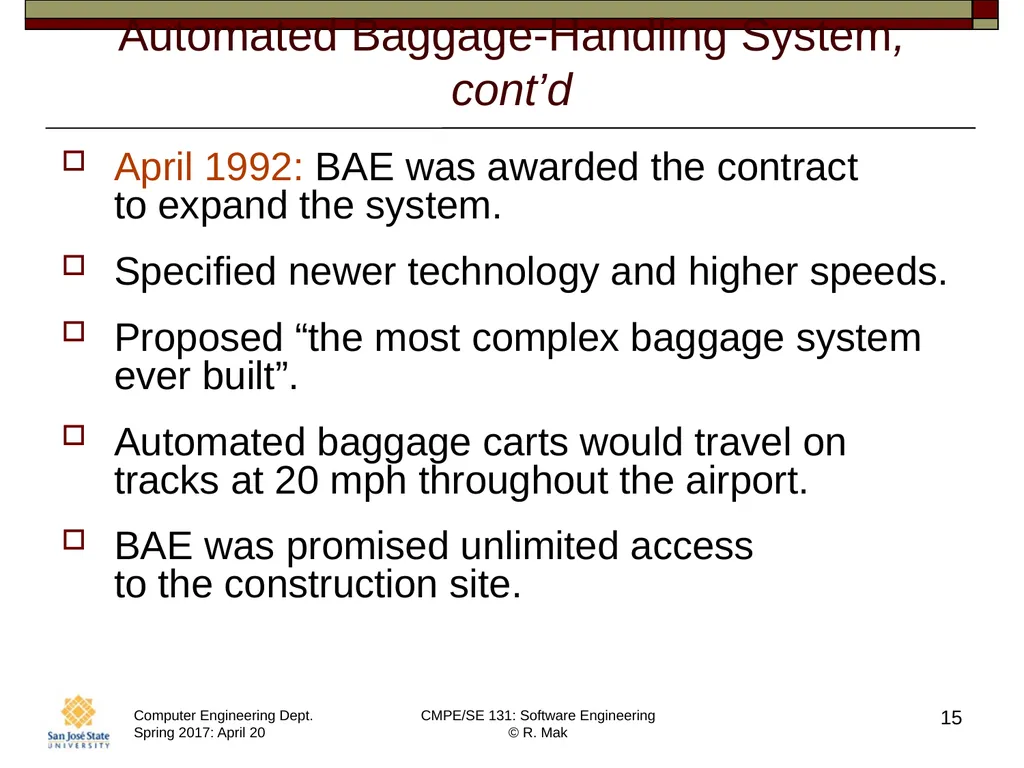
15 April 1992: BAE was awarded the contract
to expand the system.
Specified newer technology and higher speeds.
Proposed “the most complex baggage system ever built”.
Automated baggage carts would travel on tracks at 20 mph throughout the airport.
BAE was promised unlimited access to the construction site. Automated Baggage-Handling System, cont’d<br>
Specified newer technology and higher speeds.
Proposed “the most complex baggage system ever built”.
Automated baggage carts would travel on tracks at 20 mph throughout the airport.
BAE was promised unlimited access to the construction site. Automated Baggage-Handling System, cont’d<br>
16
16 DIA project management never asked
the other airlines what they wanted
or needed for baggage handling.
If we build it, they’ll use it. Automated Baggage-Handling System, cont’d<br>
If we build it, they’ll use it. Automated Baggage-Handling System, cont’d<br>
17
17 BAE had to conform to DIA’s
project management structure.
The concourses (A, B, and C) and the main terminal each had a senior manager.
The baggage-handling system traversed all four empires.
No information system was in place to coordinate decisions among BAE and the senior managers. Automated Baggage-Handling System, cont’d<br>
The concourses (A, B, and C) and the main terminal each had a senior manager.
The baggage-handling system traversed all four empires.
No information system was in place to coordinate decisions among BAE and the senior managers. Automated Baggage-Handling System, cont’d<br>
18
18 Work already done for United Airlines
had to be ripped out and reinstalled
for the expanded system.
Walls were removed and new floors were installed.
DIA project management turnovers.
The new manager in charge of baggage handling was inexperienced.
BAE was not given unrestricted access to the construction site as promised. Automated Baggage-Handling System, cont’d<br>
Walls were removed and new floors were installed.
DIA project management turnovers.
The new manager in charge of baggage handling was inexperienced.
BAE was not given unrestricted access to the construction site as promised. Automated Baggage-Handling System, cont’d<br>
19
19 The airlines requested changes
to the system’s design after the
mechanical and software designs
were supposed to be frozen. Automated Baggage-Handling System, cont’d<br>
20
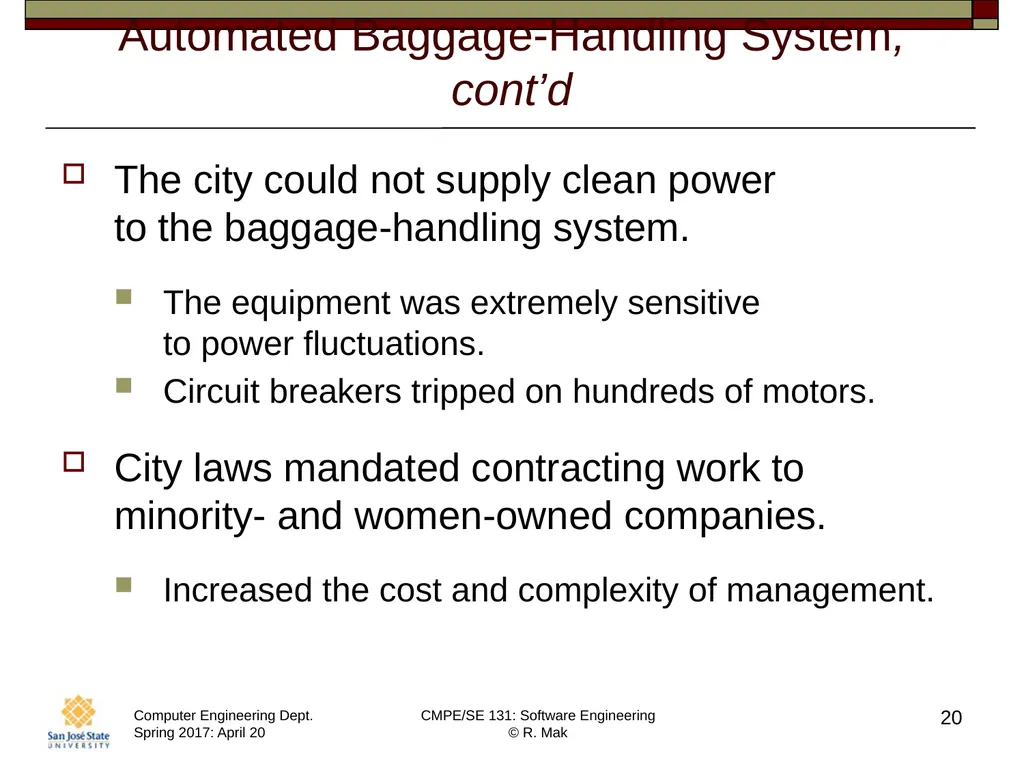
20 The city could not supply clean power
to the baggage-handling system.
The equipment was extremely sensitive to power fluctuations.
Circuit breakers tripped on hundreds of motors.
City laws mandated contracting work to minority- and women-owned companies.
Increased the cost and complexity of management. Automated Baggage-Handling System, cont’d<br>
The equipment was extremely sensitive to power fluctuations.
Circuit breakers tripped on hundreds of motors.
City laws mandated contracting work to minority- and women-owned companies.
Increased the cost and complexity of management. Automated Baggage-Handling System, cont’d<br>
21
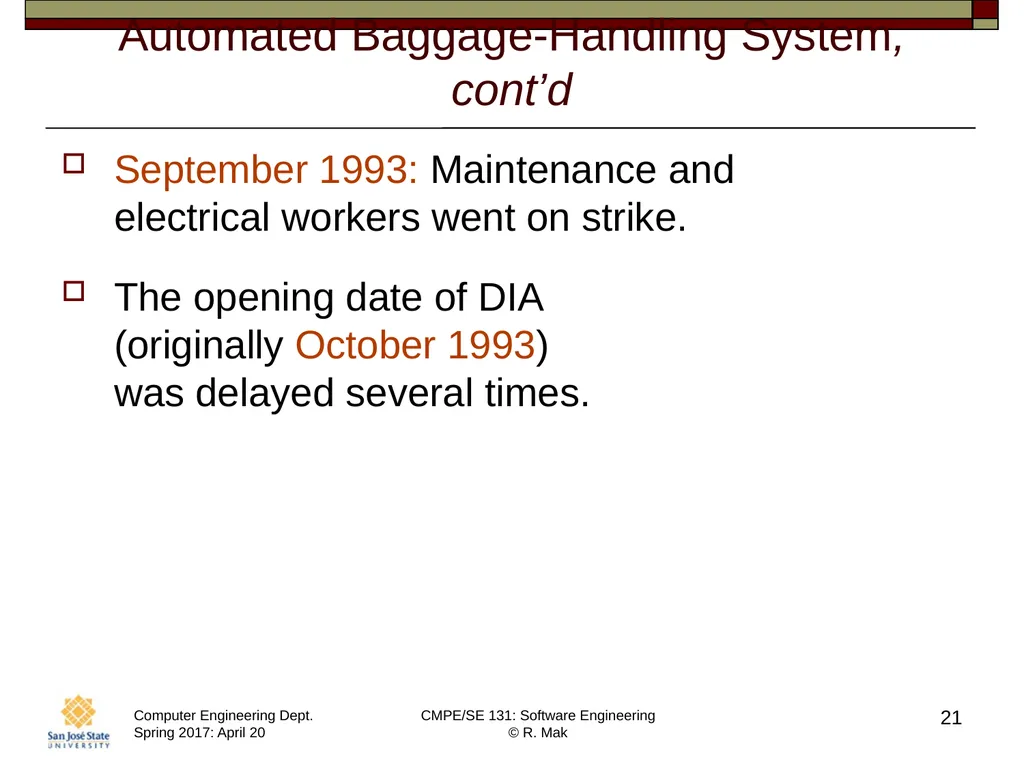
21 September 1993: Maintenance and
electrical workers went on strike.
The opening date of DIA (originally October 1993) was delayed several times. Automated Baggage-Handling System, cont’d<br>
The opening date of DIA (originally October 1993) was delayed several times. Automated Baggage-Handling System, cont’d<br>
22
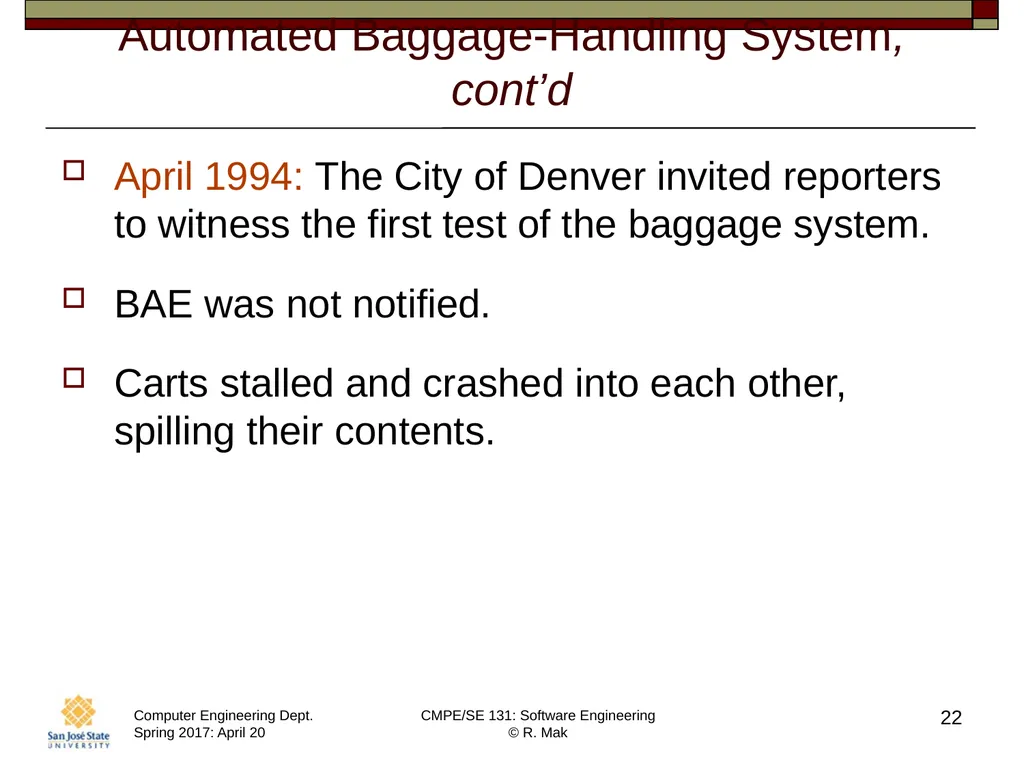
22 April 1994: The City of Denver invited reporters to witness the first test of the baggage system.
BAE was not notified.
Carts stalled and crashed into each other, spilling their contents. Automated Baggage-Handling System, cont’d<br>
BAE was not notified.
Carts stalled and crashed into each other, spilling their contents. Automated Baggage-Handling System, cont’d<br>
23
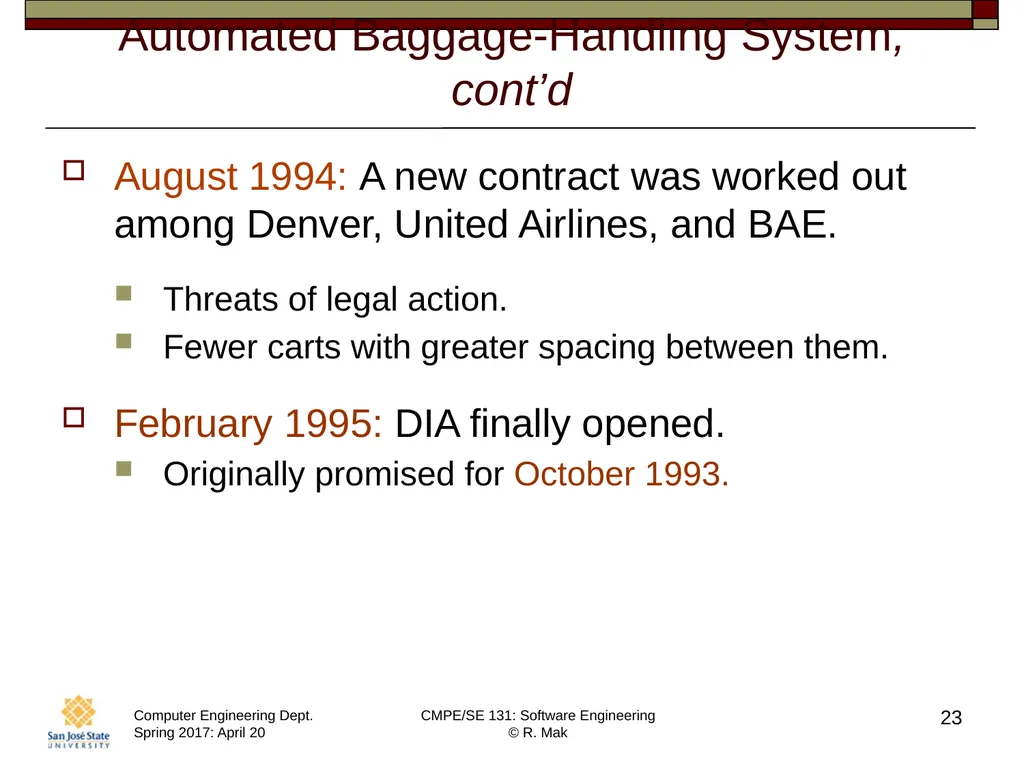
23 August 1994: A new contract was worked out among Denver, United Airlines, and BAE.
Threats of legal action.
Fewer carts with greater spacing between them.
February 1995: DIA finally opened.
Originally promised for October 1993. Automated Baggage-Handling System, cont’d<br>
Threats of legal action.
Fewer carts with greater spacing between them.
February 1995: DIA finally opened.
Originally promised for October 1993. Automated Baggage-Handling System, cont’d<br>
24
24 The automated baggage-handling system
that was finally built:
A simplified system to serve United Airlines in Concourse B (the original plan).
Continental Airlines used a traditional tug-and-cart system in Concourse A with plans to switch to the automated system.
BAE had plans to build an automated system in Concourse C for the other airlines.
Three separate baggage-handling systems. Automated Baggage-Handling System, cont’d<br>
A simplified system to serve United Airlines in Concourse B (the original plan).
Continental Airlines used a traditional tug-and-cart system in Concourse A with plans to switch to the automated system.
BAE had plans to build an automated system in Concourse C for the other airlines.
Three separate baggage-handling systems. Automated Baggage-Handling System, cont’d<br>
25
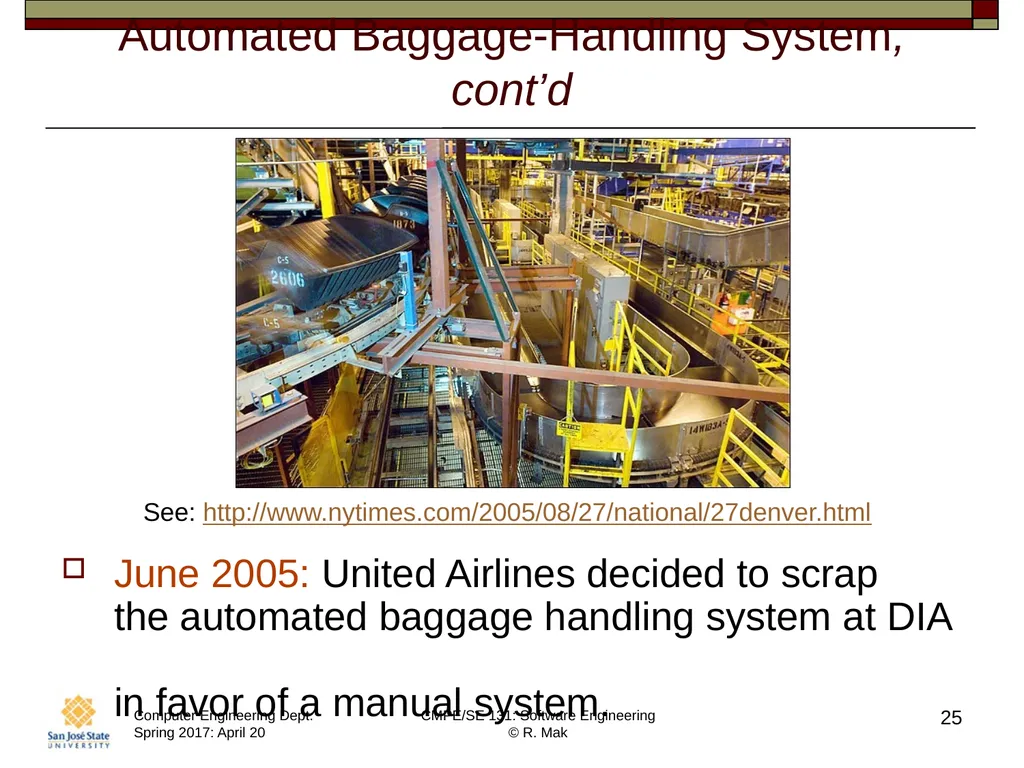
25 June 2005: United Airlines decided to scrap
the automated baggage handling system at DIA
in favor of a manual system. See: http://www.nytimes.com/2005/08/27/national/27denver.html Automated Baggage-Handling System, cont’d<br>
26
26 How to Spot Impending Doom Benchmark goals aren’t met.
Unresolved issues outnumber deliverables.
Communication breaks down within project team and with customers.
Project costs escalate.<br>
Unresolved issues outnumber deliverables.
Communication breaks down within project team and with customers.
Project costs escalate.<br>
27
27 When to Kill a Project When costs exceed business benefits.
When deadlines continue to be missed.
When technology and/or business needs evolve beyond the project’s scope.<br>
When deadlines continue to be missed.
When technology and/or business needs evolve beyond the project’s scope.<br>
28
28 Software Engineering Code The IEEE-CS/ACM Software Engineering Code of Ethics and Professional Practice (SECEPP)
Developed jointly in the late 1990s by:
The Computer Society of the Institute for Electrical and Electronics Engineers (IEEE-CS)
The Association for Computing Machinery (ACM)
Short version and the longer full version.
http://seeri.etsu.edu/se_code_adopter/page.asp?Name=Code<br>
Developed jointly in the late 1990s by:
The Computer Society of the Institute for Electrical and Electronics Engineers (IEEE-CS)
The Association for Computing Machinery (ACM)
Short version and the longer full version.
http://seeri.etsu.edu/se_code_adopter/page.asp?Name=Code<br>
29
29 Software Engineering Code: Preamble Software engineers shall commit themselves to making the analysis, specification, design, development, testing and maintenance of software a beneficial and respected profession.
In accordance with their commitment to the health, safety and welfare of the public, software engineers shall adhere to the following Eight Principles:<br>
In accordance with their commitment to the health, safety and welfare of the public, software engineers shall adhere to the following Eight Principles:<br>
30
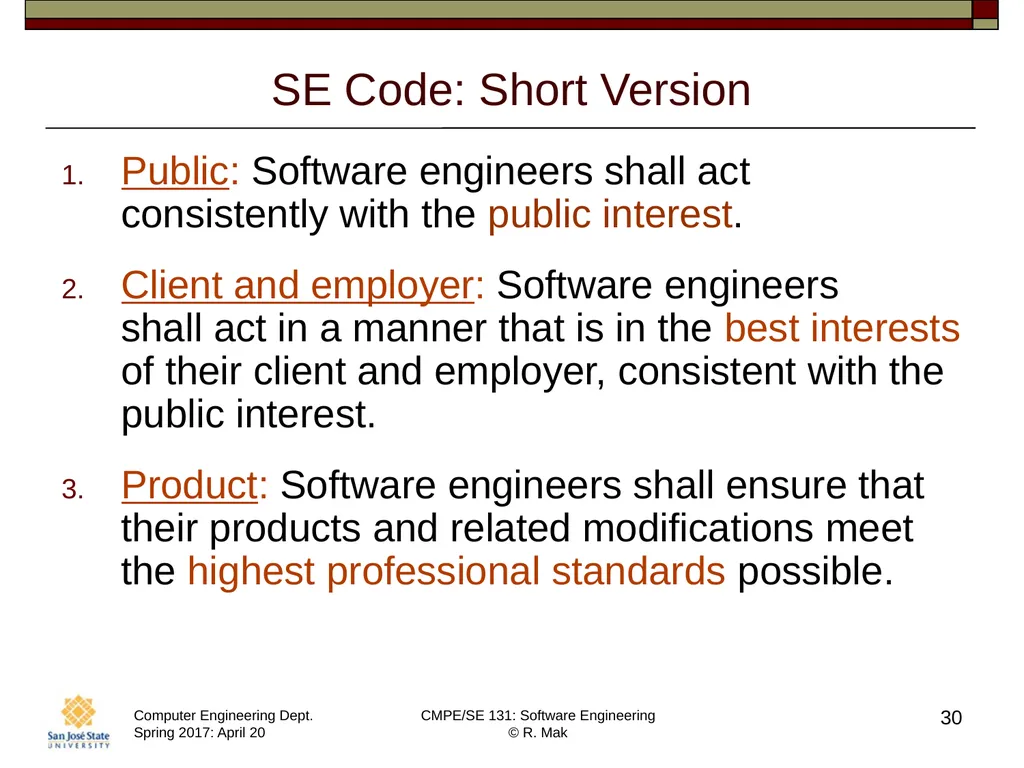
30 SE Code: Short Version Public: Software engineers shall act consistently with the public interest.
Client and employer: Software engineers shall act in a manner that is in the best interests of their client and employer, consistent with the public interest.
Product: Software engineers shall ensure that their products and related modifications meet the highest professional standards possible.<br>
Client and employer: Software engineers shall act in a manner that is in the best interests of their client and employer, consistent with the public interest.
Product: Software engineers shall ensure that their products and related modifications meet the highest professional standards possible.<br>
31
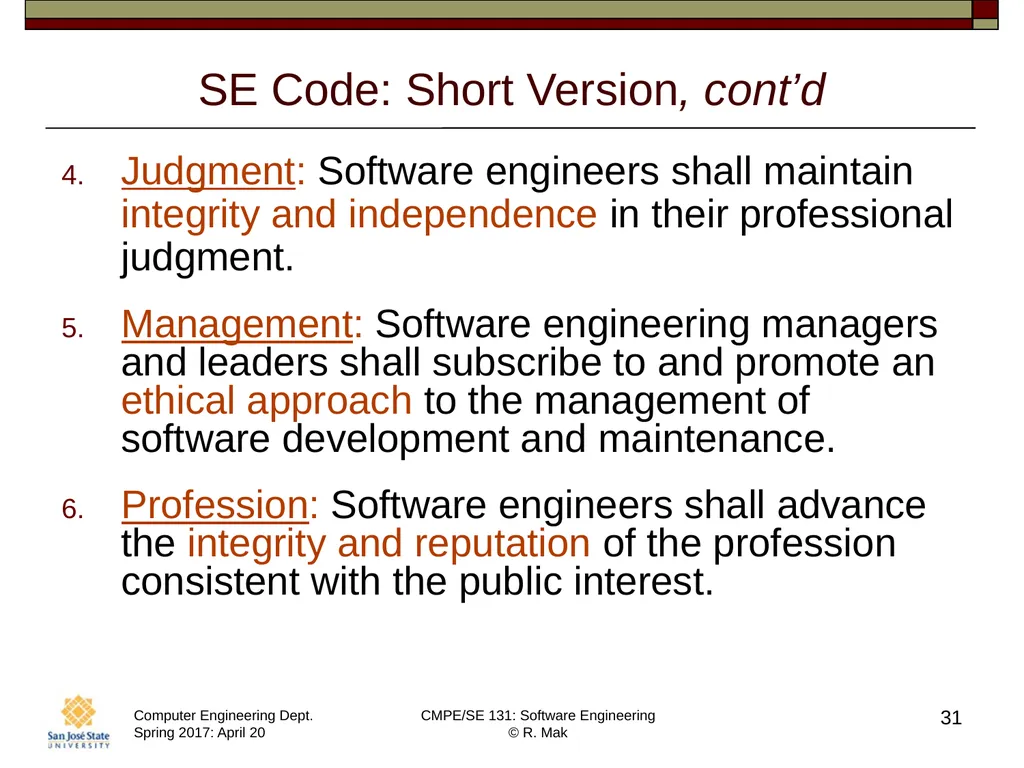
31 SE Code: Short Version, cont’d Judgment: Software engineers shall maintain
integrity and independence in their professional judgment.
Management: Software engineering managers and leaders shall subscribe to and promote an ethical approach to the management of software development and maintenance.
Profession: Software engineers shall advance the integrity and reputation of the profession consistent with the public interest.<br>
Management: Software engineering managers and leaders shall subscribe to and promote an ethical approach to the management of software development and maintenance.
Profession: Software engineers shall advance the integrity and reputation of the profession consistent with the public interest.<br>
32
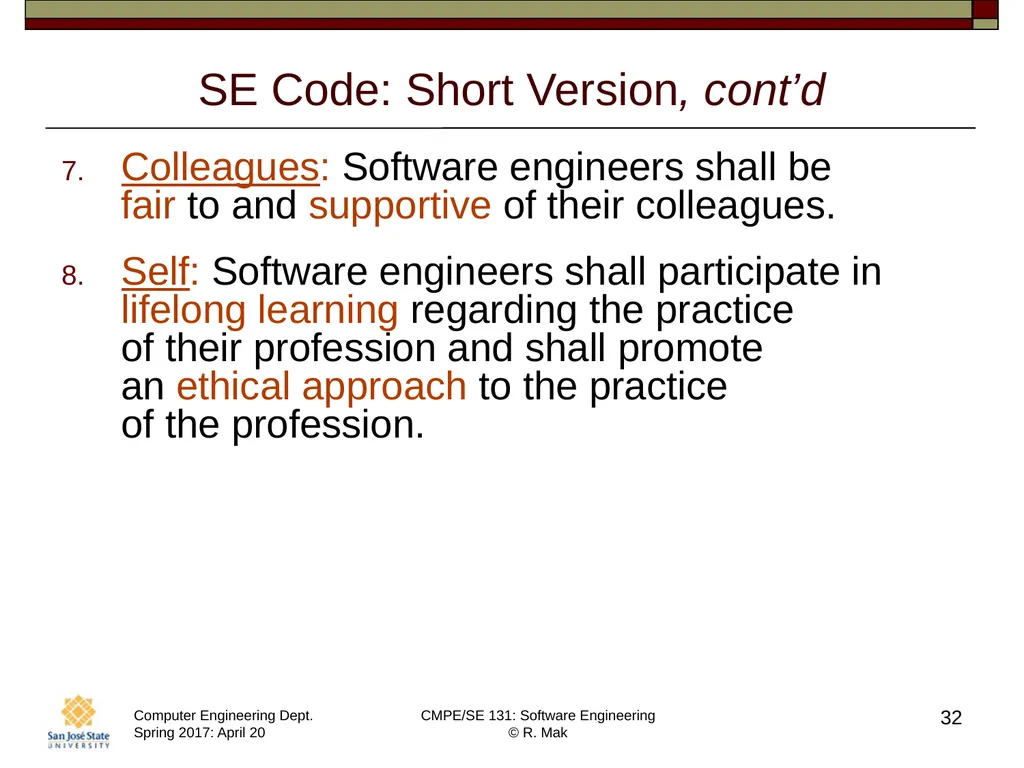
32 SE Code: Short Version, cont’d Colleagues: Software engineers shall be
fair to and supportive of their colleagues.
Self: Software engineers shall participate in lifelong learning regarding the practice of their profession and shall promote an ethical approach to the practice of the profession.<br>
Self: Software engineers shall participate in lifelong learning regarding the practice of their profession and shall promote an ethical approach to the practice of the profession.<br>
33
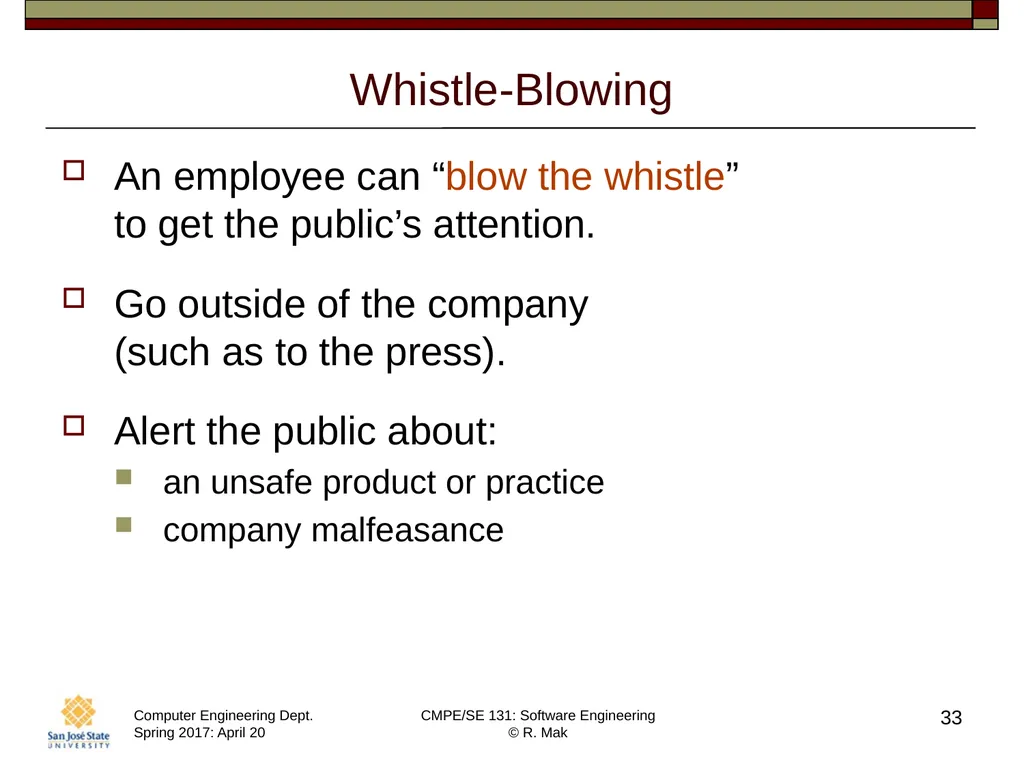
33 Whistle-Blowing An employee can “blow the whistle”
to get the public’s attention.
Go outside of the company (such as to the press).
Alert the public about:
an unsafe product or practice
company malfeasance<br>
Go outside of the company (such as to the press).
Alert the public about:
an unsafe product or practice
company malfeasance<br>
34
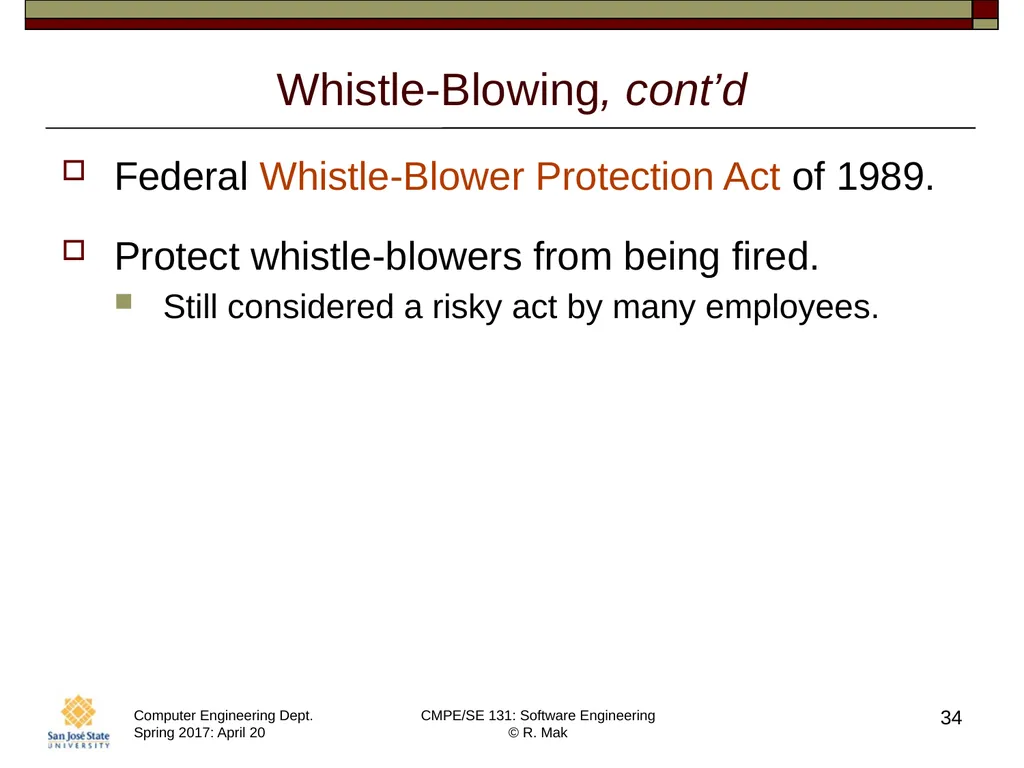
34 Whistle-Blowing, cont’d Federal Whistle-Blower Protection Act of 1989.
Protect whistle-blowers from being fired.
Still considered a risky act by many employees.<br>
Protect whistle-blowers from being fired.
Still considered a risky act by many employees.<br>
35
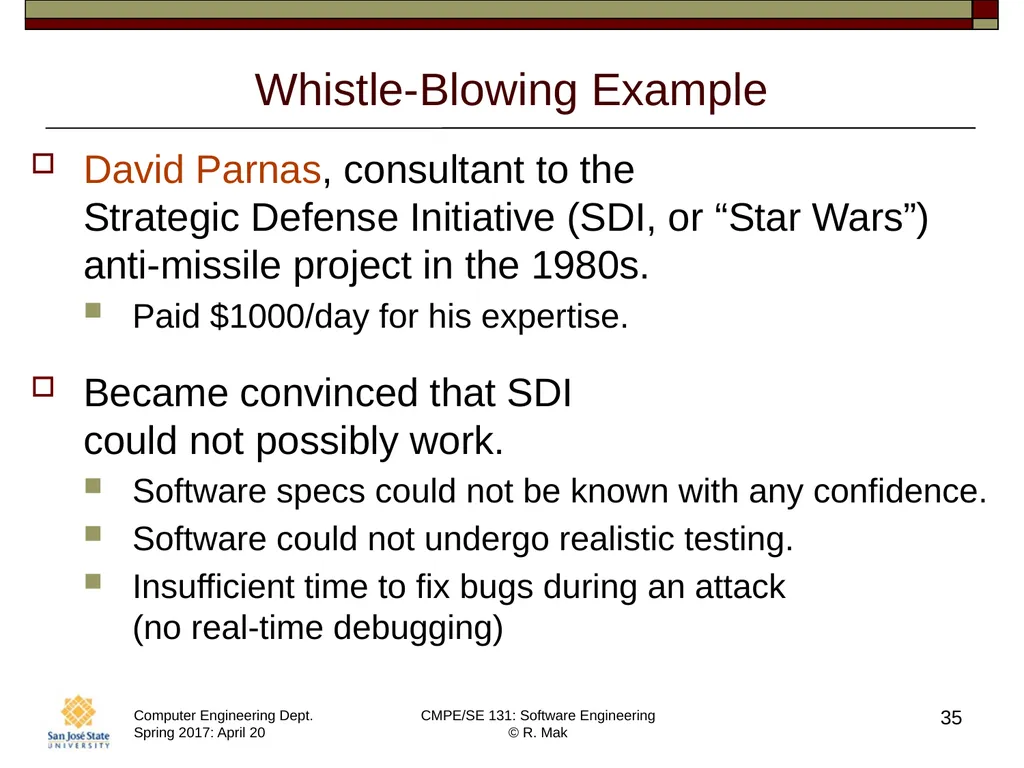
35 Whistle-Blowing Example David Parnas, consultant to the
Strategic Defense Initiative (SDI, or “Star Wars”)
anti-missile project in the 1980s.
Paid $1000/day for his expertise.
Became convinced that SDI could not possibly work.
Software specs could not be known with any confidence.
Software could not undergo realistic testing.
Insufficient time to fix bugs during an attack (no real-time debugging)<br>
Paid $1000/day for his expertise.
Became convinced that SDI could not possibly work.
Software specs could not be known with any confidence.
Software could not undergo realistic testing.
Insufficient time to fix bugs during an attack (no real-time debugging)<br>
36
36 Whistle-Blowing Example, cont’d David Parnas blew the whistle and went public with his concerns.
Walked away from a lucrative contract.
Accused of disloyalty and of acting in his own self-interest.<br>
Walked away from a lucrative contract.
Accused of disloyalty and of acting in his own self-interest.<br>
37
37 When Should Engineers Blow the Whistle? Permitted to blow the whistle vs.
morally obligated to blow the whistle.
Escalating conditions:
Potential harm to the public is serious and considerable.
The engineers have presented their concerns to management.
Management does not respond satisfactorily and the engineers have gone all the way up the management chain.
The engineers have documented evidence that harm will occur.
There is strong evidence that making the information public will prevent the harm.<br>
Escalating conditions:
Potential harm to the public is serious and considerable.
The engineers have presented their concerns to management.
Management does not respond satisfactorily and the engineers have gone all the way up the management chain.
The engineers have documented evidence that harm will occur.
There is strong evidence that making the information public will prevent the harm.<br>
38
38 When Should Engineers Blow the Whistle? cont’d Do engineers have a greater obligation to blow the whistle in situations that ordinary persons might not?<br>
39
39 Mak’s Maxims on Speaking Out Or:
Ron’s Excellent (Mis)Adventures in Startup-Land
Speaking out should not be a career-limiting act!
Maxim 1: Make sure your boss realizes that you’re trying to help him, not take over his job.
Maxim 2: Don’t embarrass your boss in front of his peers and superiors.
Don’t call him a liar in front of others.
Don’t tell him he’s the worst human being you’ve ever encountered, in front of others.<br>
Speaking out should not be a career-limiting act!
Maxim 1: Make sure your boss realizes that you’re trying to help him, not take over his job.
Maxim 2: Don’t embarrass your boss in front of his peers and superiors.
Don’t call him a liar in front of others.
Don’t tell him he’s the worst human being you’ve ever encountered, in front of others.<br>
40
40 Mak’s Maxims on Speaking Out, cont’d Consequences of speaking out
when things are going really badly:
Management will listen to you and things will improve. Or,
Management will ignore you and things will continue to get worse. Or,
You will be deemed “not a team player” and be fired or pressured to quit, or you decide on your own to quit.
In either case, it won’t matter to you anymore.<br>
Management will listen to you and things will improve. Or,
Management will ignore you and things will continue to get worse. Or,
You will be deemed “not a team player” and be fired or pressured to quit, or you decide on your own to quit.
In either case, it won’t matter to you anymore.<br>