
Co-Management and Accountability in Welfare
TA
Published · 16 slides · 0 views

1 / 1

Description
Co-Management and Accountability in Welfare Services A Cross-Country Comparative Study of Home Elderly Care Emanuele Frezza Innovation in Local Government Joint PhD-Training School Spetses, Greece 13.09.2015 Co-management The term
Related Topics
Share
Embed code
Download this presentation From Below
"Co-Management and Accountability in Welfare" is the property of its rightful owner. Permission is granted to download and print the materials on this website for personal, non-commercial use only, and to display it on your personal computer provided you do not modify the materials and that you retain all copyright notices contained in the materials. By downloading content from our website, you accept the terms of this agreement.
Presentation Transcript
01
Co-Management and Accountability in Welfare Services
A Cross-Country Comparative Study of Home Elderly Care
Emanuele Frezza “Innovation in Local Government”
Joint PhD-Training School
Spetses, Greece
13.09.2015<br>
A Cross-Country Comparative Study of Home Elderly Care
Emanuele Frezza “Innovation in Local Government”
Joint PhD-Training School
Spetses, Greece
13.09.2015<br>
02
Co-management
The term co-management refers to an arrangement in which the third sector produces public services in collaboration with the state (Pestoff and Brandsen, 2008).
Co-managing public services with third sector organisations represents a relevant source of innovation in the on-going process of public administration reform.
The simultaneous engagement of public and non-profit stakeholders for the delivery of a wide range of services occurs mostly at the local level and it has become increasingly common.
Even though literature on the topic of joint collaborations between state and third sector actors is extensive, the notion of co-management is still observed by scholars without the support of a unique theoretical and analytical framework.<br>
The term co-management refers to an arrangement in which the third sector produces public services in collaboration with the state (Pestoff and Brandsen, 2008).
Co-managing public services with third sector organisations represents a relevant source of innovation in the on-going process of public administration reform.
The simultaneous engagement of public and non-profit stakeholders for the delivery of a wide range of services occurs mostly at the local level and it has become increasingly common.
Even though literature on the topic of joint collaborations between state and third sector actors is extensive, the notion of co-management is still observed by scholars without the support of a unique theoretical and analytical framework.<br>
03
Accountabilty in Public-Third Sector Partnerships: a contested issue
In several Western European countries, the creation of public-third sector partnerships for the purpose of welfare services delivery represents an example of a diffused and expanding co-management practice…
…However, within those partnerships, public administrations are faced with the need and pressure to hold third sector organisations accountable for quality of service provision and such task is becoming more complex and contested given that:
Several types of public-third sector partnerships have been established and their change and reorganisation are constantly in motion.
Different accountability mechanisms are progressively introduced into different partnerships, leading to the identification of specific accountability types.
Distinct accountability types seem to have become predominant in countries characterized by distinct welfare and administrative systems.<br>
In several Western European countries, the creation of public-third sector partnerships for the purpose of welfare services delivery represents an example of a diffused and expanding co-management practice…
…However, within those partnerships, public administrations are faced with the need and pressure to hold third sector organisations accountable for quality of service provision and such task is becoming more complex and contested given that:
Several types of public-third sector partnerships have been established and their change and reorganisation are constantly in motion.
Different accountability mechanisms are progressively introduced into different partnerships, leading to the identification of specific accountability types.
Distinct accountability types seem to have become predominant in countries characterized by distinct welfare and administrative systems.<br>
04
RQ: Under what conditions are third sector organisations held accountable to public administration when welfare services are co-managed through partnership agreements?
RQ1: What types of public-third sector partnerships exist in Italy, Germany and the United Kingdom for the provision of welfare services?
RQ2: What accountability mechanisms are introduced within them?
RQ3: What factors influence the emergence of specific types of accountability?<br>
RQ1: What types of public-third sector partnerships exist in Italy, Germany and the United Kingdom for the provision of welfare services?
RQ2: What accountability mechanisms are introduced within them?
RQ3: What factors influence the emergence of specific types of accountability?<br>
05
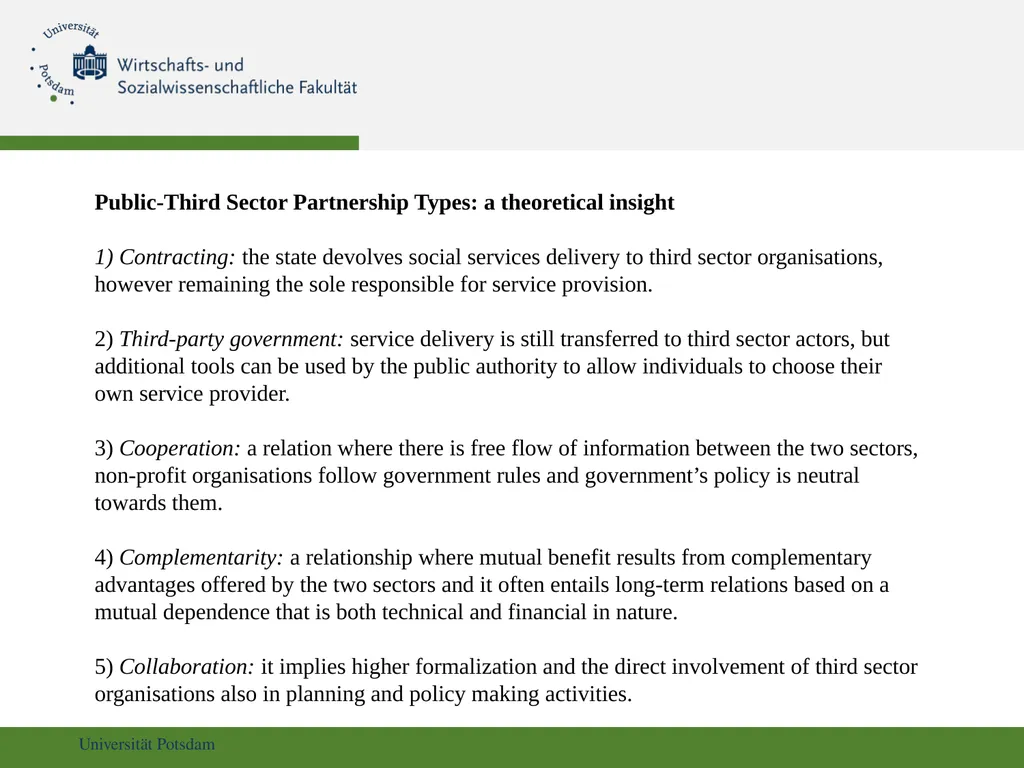
Public-Third Sector Partnership Types: a theoretical insight
1) Contracting: the state devolves social services delivery to third sector organisations, however remaining the sole responsible for service provision.
2) Third-party government: service delivery is still transferred to third sector actors, but additional tools can be used by the public authority to allow individuals to choose their own service provider.
3) Cooperation: a relation where there is free flow of information between the two sectors, non-profit organisations follow government rules and government’s policy is neutral towards them.
4) Complementarity: a relationship where mutual benefit results from complementary advantages offered by the two sectors and it often entails long-term relations based on a mutual dependence that is both technical and financial in nature.
5) Collaboration: it implies higher formalization and the direct involvement of third sector organisations also in planning and policy making activities.<br>
1) Contracting: the state devolves social services delivery to third sector organisations, however remaining the sole responsible for service provision.
2) Third-party government: service delivery is still transferred to third sector actors, but additional tools can be used by the public authority to allow individuals to choose their own service provider.
3) Cooperation: a relation where there is free flow of information between the two sectors, non-profit organisations follow government rules and government’s policy is neutral towards them.
4) Complementarity: a relationship where mutual benefit results from complementary advantages offered by the two sectors and it often entails long-term relations based on a mutual dependence that is both technical and financial in nature.
5) Collaboration: it implies higher formalization and the direct involvement of third sector organisations also in planning and policy making activities.<br>
06
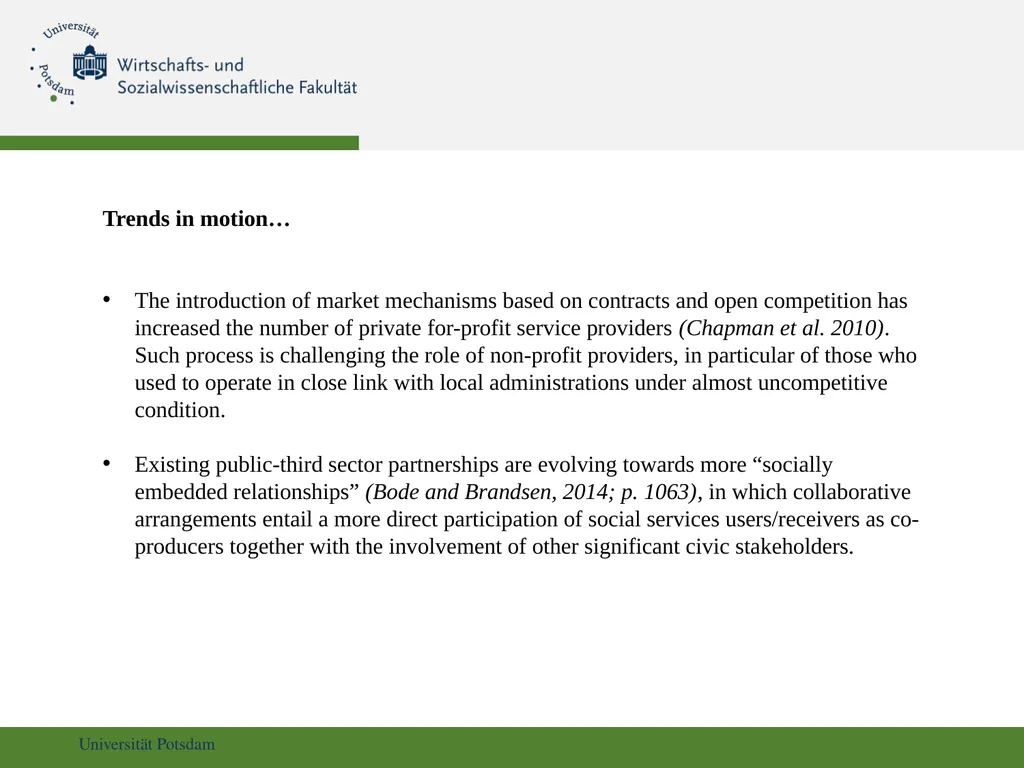
Trends in motion…
The introduction of market mechanisms based on contracts and open competition has increased the number of private for-profit service providers (Chapman et al. 2010). Such process is challenging the role of non-profit providers, in particular of those who used to operate in close link with local administrations under almost uncompetitive condition.
Existing public-third sector partnerships are evolving towards more “socially embedded relationships” (Bode and Brandsen, 2014; p. 1063), in which collaborative arrangements entail a more direct participation of social services users/receivers as co-producers together with the involvement of other significant civic stakeholders.<br>
The introduction of market mechanisms based on contracts and open competition has increased the number of private for-profit service providers (Chapman et al. 2010). Such process is challenging the role of non-profit providers, in particular of those who used to operate in close link with local administrations under almost uncompetitive condition.
Existing public-third sector partnerships are evolving towards more “socially embedded relationships” (Bode and Brandsen, 2014; p. 1063), in which collaborative arrangements entail a more direct participation of social services users/receivers as co-producers together with the involvement of other significant civic stakeholders.<br>
07
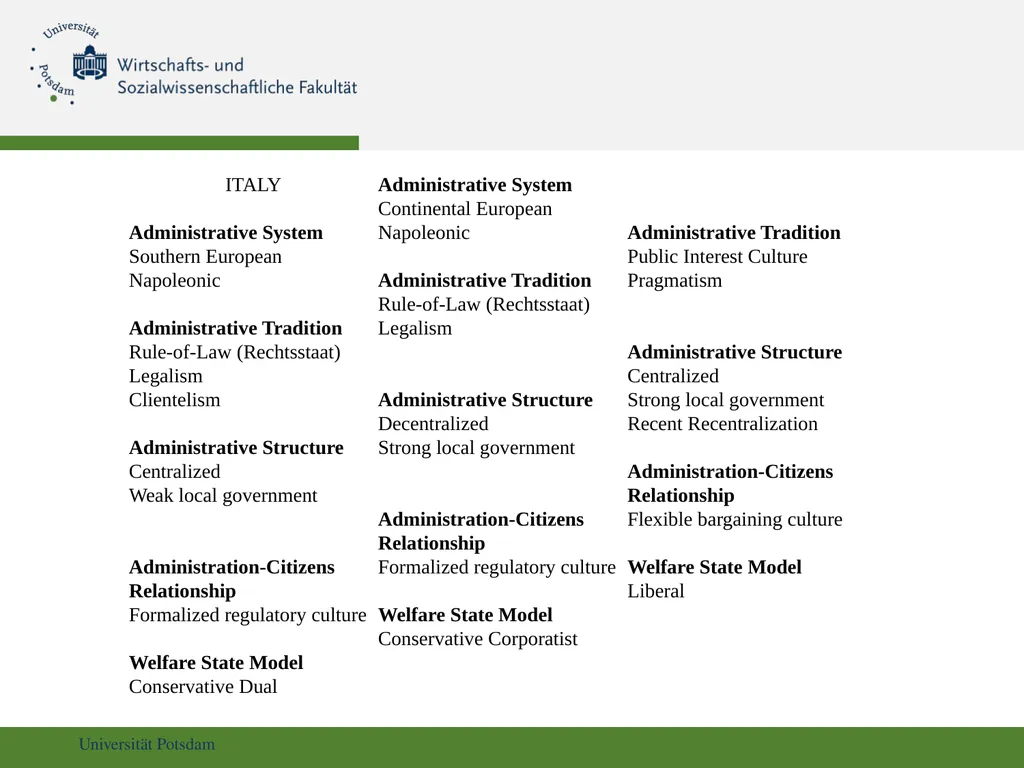
ITALY
Administrative System
Southern European Napoleonic
Administrative Tradition
Rule-of-Law (Rechtsstaat)
Legalism
Clientelism
Administrative Structure
Centralized
Weak local government
Administration-Citizens
Relationship
Formalized regulatory culture
Welfare State Model
Conservative Dual
GERMANY
Administrative System
Continental European Napoleonic
Administrative Tradition
Rule-of-Law (Rechtsstaat)
Legalism
Administrative Structure
Decentralized
Strong local government
Administration-Citizens
Relationship
Formalized regulatory culture
Welfare State Model
Conservative Corporatist
UK
Administrative System
Anglo-Saxon
Administrative Tradition
Public Interest Culture
Pragmatism
Administrative Structure
Centralized
Strong local government
Recent Recentralization
Administration-Citizens
Relationship
Flexible bargaining culture
Welfare State Model
Liberal<br>
Administrative System
Southern European Napoleonic
Administrative Tradition
Rule-of-Law (Rechtsstaat)
Legalism
Clientelism
Administrative Structure
Centralized
Weak local government
Administration-Citizens
Relationship
Formalized regulatory culture
Welfare State Model
Conservative Dual
GERMANY
Administrative System
Continental European Napoleonic
Administrative Tradition
Rule-of-Law (Rechtsstaat)
Legalism
Administrative Structure
Decentralized
Strong local government
Administration-Citizens
Relationship
Formalized regulatory culture
Welfare State Model
Conservative Corporatist
UK
Administrative System
Anglo-Saxon
Administrative Tradition
Public Interest Culture
Pragmatism
Administrative Structure
Centralized
Strong local government
Recent Recentralization
Administration-Citizens
Relationship
Flexible bargaining culture
Welfare State Model
Liberal<br>
08
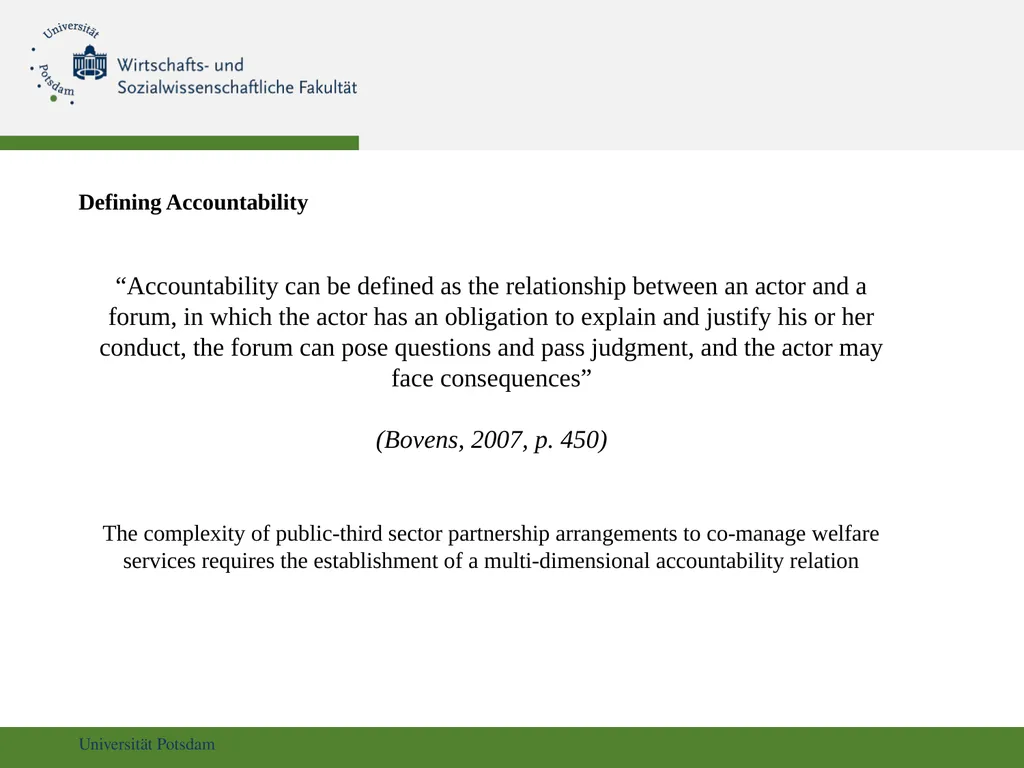
Defining Accountability
“Accountability can be defined as the relationship between an actor and a forum, in which the actor has an obligation to explain and justify his or her conduct, the forum can pose questions and pass judgment, and the actor may face consequences”
(Bovens, 2007, p. 450)
The complexity of public-third sector partnership arrangements to co-manage welfare services requires the establishment of a multi-dimensional accountability relation<br>
“Accountability can be defined as the relationship between an actor and a forum, in which the actor has an obligation to explain and justify his or her conduct, the forum can pose questions and pass judgment, and the actor may face consequences”
(Bovens, 2007, p. 450)
The complexity of public-third sector partnership arrangements to co-manage welfare services requires the establishment of a multi-dimensional accountability relation<br>
09
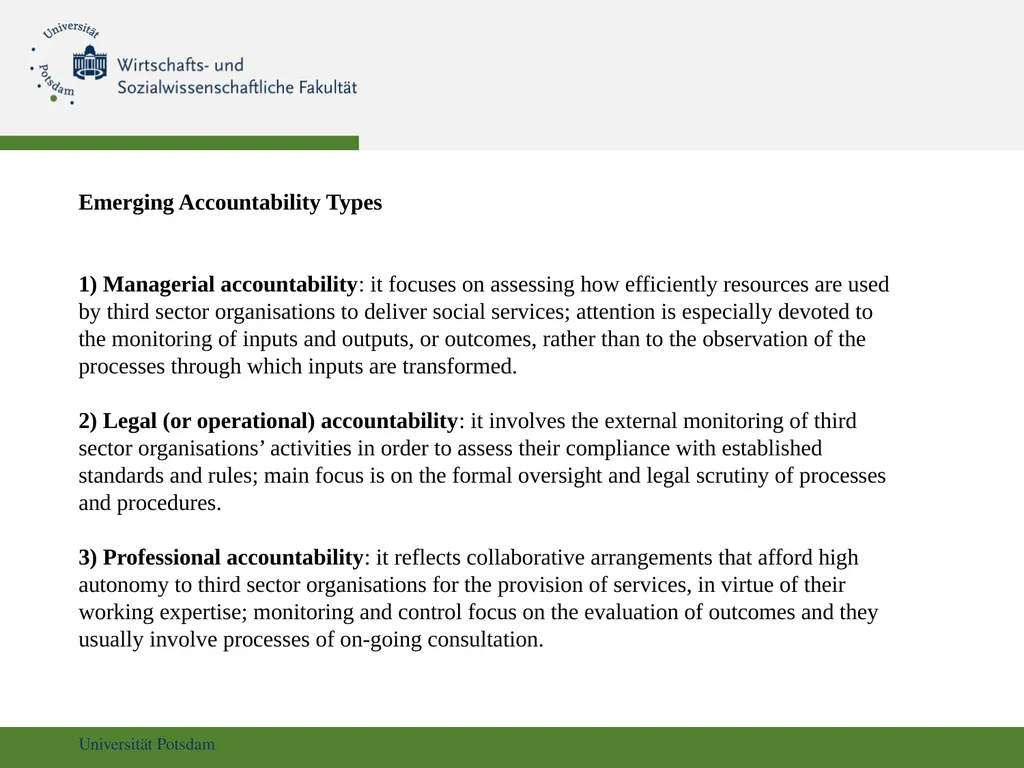
Emerging Accountability Types
1) Managerial accountability: it focuses on assessing how efficiently resources are used by third sector organisations to deliver social services; attention is especially devoted to the monitoring of inputs and outputs, or outcomes, rather than to the observation of the processes through which inputs are transformed.
2) Legal (or operational) accountability: it involves the external monitoring of third sector organisations’ activities in order to assess their compliance with established standards and rules; main focus is on the formal oversight and legal scrutiny of processes and procedures.
3) Professional accountability: it reflects collaborative arrangements that afford high autonomy to third sector organisations for the provision of services, in virtue of their working expertise; monitoring and control focus on the evaluation of outcomes and they usually involve processes of on-going consultation.<br>
1) Managerial accountability: it focuses on assessing how efficiently resources are used by third sector organisations to deliver social services; attention is especially devoted to the monitoring of inputs and outputs, or outcomes, rather than to the observation of the processes through which inputs are transformed.
2) Legal (or operational) accountability: it involves the external monitoring of third sector organisations’ activities in order to assess their compliance with established standards and rules; main focus is on the formal oversight and legal scrutiny of processes and procedures.
3) Professional accountability: it reflects collaborative arrangements that afford high autonomy to third sector organisations for the provision of services, in virtue of their working expertise; monitoring and control focus on the evaluation of outcomes and they usually involve processes of on-going consultation.<br>
10
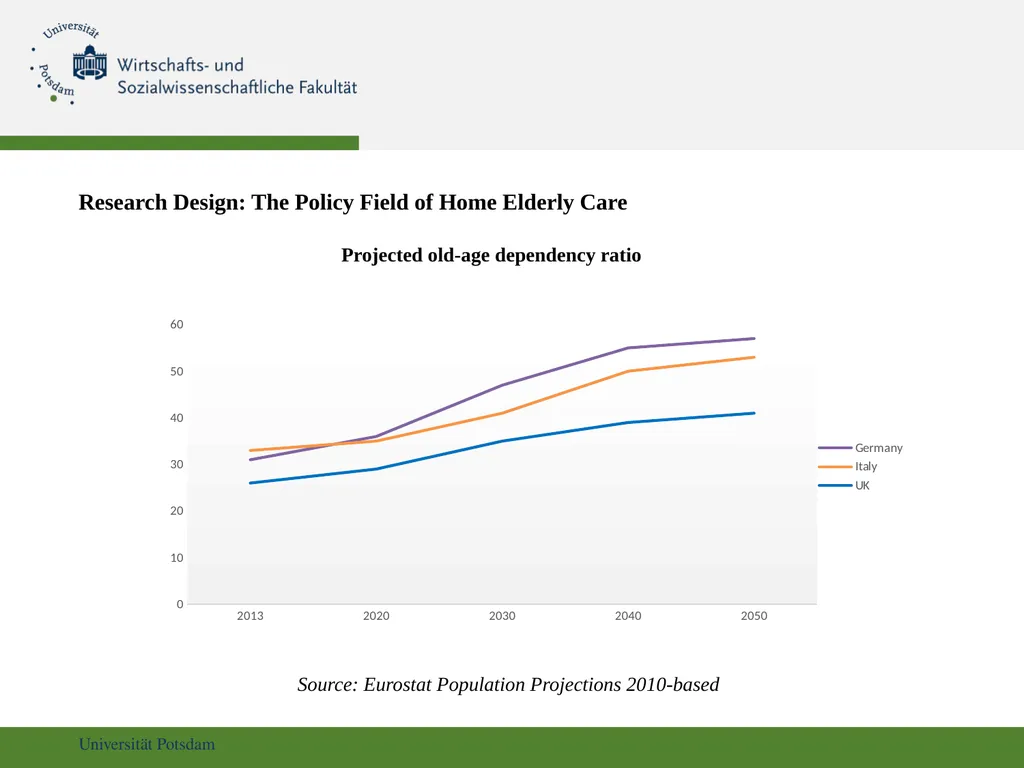
Research Design: The Policy Field of Home Elderly Care
Projected old-age dependency ratio Source: Eurostat Population Projections 2010-based<br>
Projected old-age dependency ratio Source: Eurostat Population Projections 2010-based<br>
11
Research Design: The Policy Field of Home Elderly Care
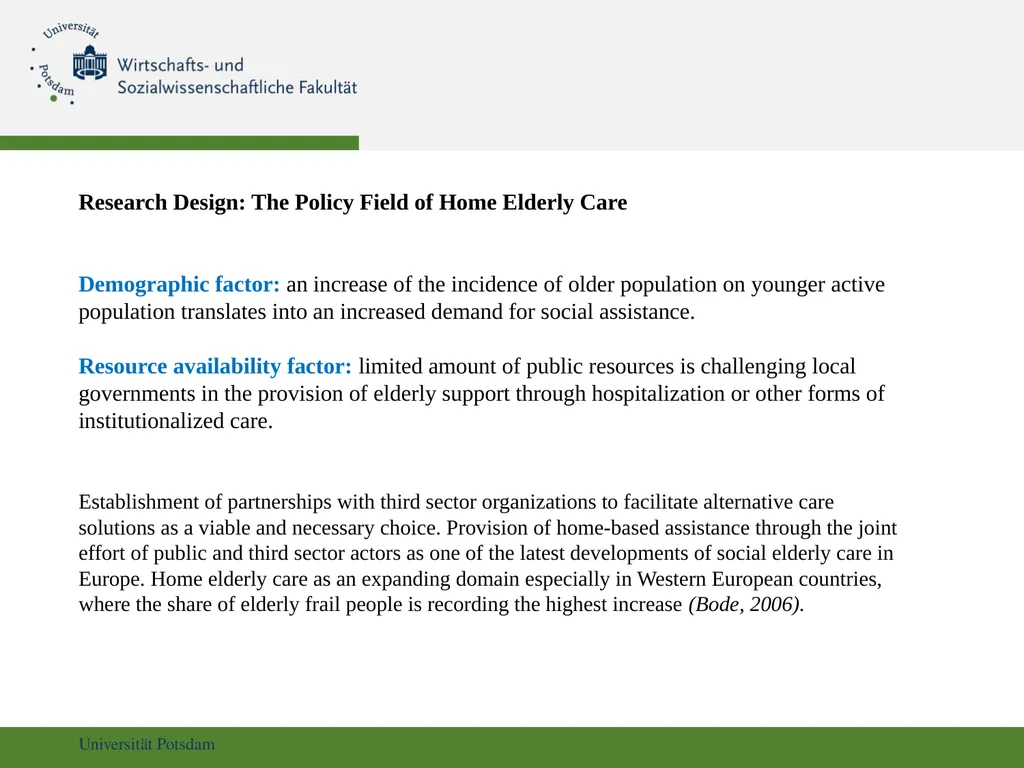
Demographic factor: an increase of the incidence of older population on younger active population translates into an increased demand for social assistance.
Resource availability factor: limited amount of public resources is challenging local governments in the provision of elderly support through hospitalization or other forms of institutionalized care.
Establishment of partnerships with third sector organizations to facilitate alternative care solutions as a viable and necessary choice. Provision of home-based assistance through the joint effort of public and third sector actors as one of the latest developments of social elderly care in Europe. Home elderly care as an expanding domain especially in Western European countries, where the share of elderly frail people is recording the highest increase (Bode, 2006).<br>
Demographic factor: an increase of the incidence of older population on younger active population translates into an increased demand for social assistance.
Resource availability factor: limited amount of public resources is challenging local governments in the provision of elderly support through hospitalization or other forms of institutionalized care.
Establishment of partnerships with third sector organizations to facilitate alternative care solutions as a viable and necessary choice. Provision of home-based assistance through the joint effort of public and third sector actors as one of the latest developments of social elderly care in Europe. Home elderly care as an expanding domain especially in Western European countries, where the share of elderly frail people is recording the highest increase (Bode, 2006).<br>
12
Methodology
STEP 1: Case studies with semi-structured interviews (RQ 1 & RQ 2)
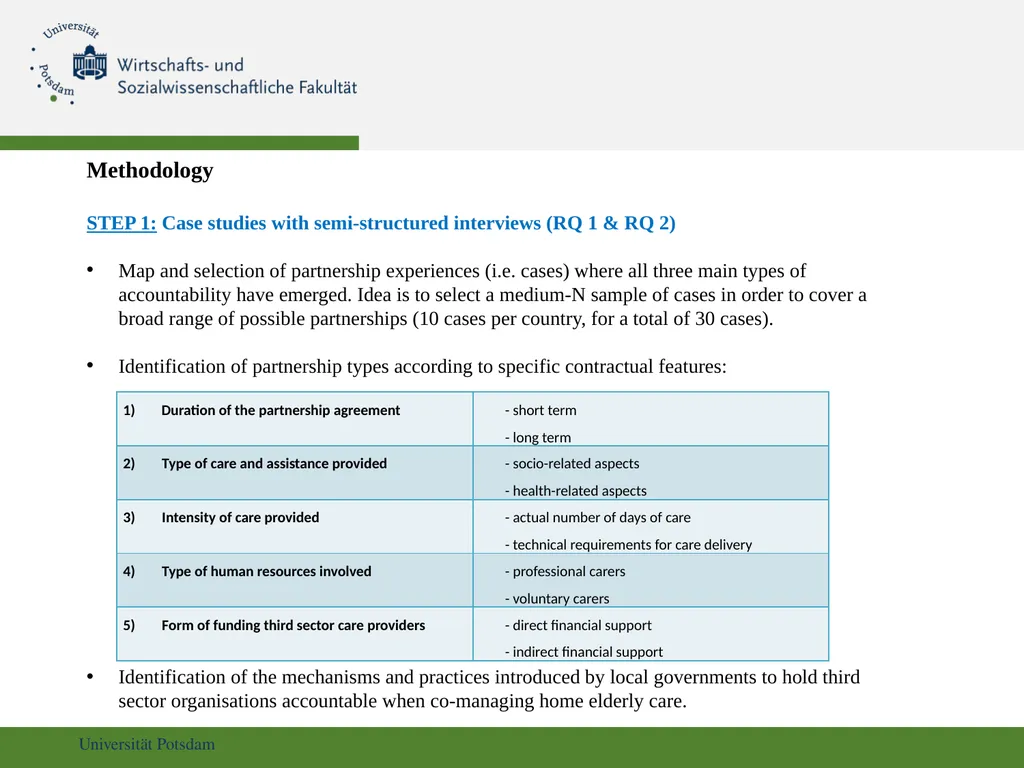
Map and selection of partnership experiences (i.e. cases) where all three main types of accountability have emerged. Idea is to select a medium-N sample of cases in order to cover a broad range of possible partnerships (10 cases per country, for a total of 30 cases).
Identification of partnership types according to specific contractual features:
Identification of the mechanisms and practices introduced by local governments to hold third sector organisations accountable when co-managing home elderly care.<br>
STEP 1: Case studies with semi-structured interviews (RQ 1 & RQ 2)
Map and selection of partnership experiences (i.e. cases) where all three main types of accountability have emerged. Idea is to select a medium-N sample of cases in order to cover a broad range of possible partnerships (10 cases per country, for a total of 30 cases).
Identification of partnership types according to specific contractual features:
Identification of the mechanisms and practices introduced by local governments to hold third sector organisations accountable when co-managing home elderly care.<br>
13
Methodology
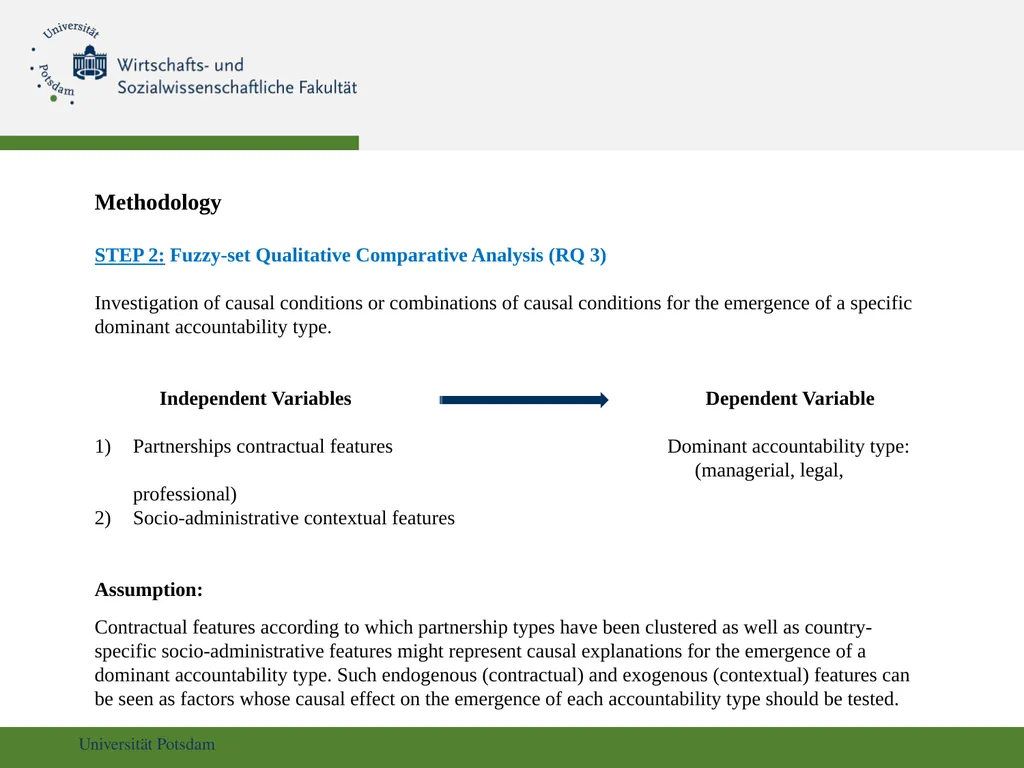
STEP 2: Fuzzy-set Qualitative Comparative Analysis (RQ 3)
Investigation of causal conditions or combinations of causal conditions for the emergence of a specific dominant accountability type.
Independent Variables Dependent Variable
Partnerships contractual features Dominant accountability type: (managerial, legal, professional)
Socio-administrative contextual features
Assumption:
Contractual features according to which partnership types have been clustered as well as country-specific socio-administrative features might represent causal explanations for the emergence of a dominant accountability type. Such endogenous (contractual) and exogenous (contextual) features can be seen as factors whose causal effect on the emergence of each accountability type should be tested.<br>
STEP 2: Fuzzy-set Qualitative Comparative Analysis (RQ 3)
Investigation of causal conditions or combinations of causal conditions for the emergence of a specific dominant accountability type.
Independent Variables Dependent Variable
Partnerships contractual features Dominant accountability type: (managerial, legal, professional)
Socio-administrative contextual features
Assumption:
Contractual features according to which partnership types have been clustered as well as country-specific socio-administrative features might represent causal explanations for the emergence of a dominant accountability type. Such endogenous (contractual) and exogenous (contextual) features can be seen as factors whose causal effect on the emergence of each accountability type should be tested.<br>
14
Selected References
Bernstein, S. (1991). Managing Contracted Services in the Nonprofit Agency. Philadelphia: Temple University Press.
Bode, I. (2006). Co-Governance within Networks and the Nonprofit-Forprofit Divide. A Cross-Cultural Perspective on the Evolution of Domiciliary Elderly Care. Public Management Review, 8 (4): 551–566.
Bode, I. and Brandsen, T. (2014). State-third Sector Partnerships: A short overview of key issues in the debate. Public Management Review, 16 (8): 1055-1066.
Bovens, M. (2007). Analysing and assessing accountability: A conceptual framework. European Law Journal, 13: 447–468.
Brandsen, T., Oude Vrielink, M., Schillemans T. and van Hout, E. (2011). “Non-Profit Organisations, Democratisation, and New Forms of Accountability”. In Ball, A. and Osborne, S.P. (eds). Social Accounting and Public Management, pp. 90-102. New York: Routledge Taylor and Francis Group.
Brandsen, T. and van Hout, E. (2006). Co-management in public service networks. Public Management Review, 8 (4): 537-549.
Chapman, T., Brown, J., Ford, C. and Baxter, B. (2010). Trouble with Champions: Local Public Sector-Third Sector Partnerships and the Future Prospects for Collaborative Governance in the UK. Policy Studies, 31 (6): 613–630.
DeHoog, R. H. (1990). Competition, Negotiating or Cooperation: Three Models for Service Contracting. Administration and Society. 22 (3): 317-340.
DiMaggio, P. J. and Powell, W. W. (1983). The iron cage revisited: institutional isomorphism and collective rationality in organizational fields. American Sociological Review, 48 (1): 147-160.
Dubnick, M. J. and Frederickson, H. G. (2010). Accountable agents: Federal performance measurement and third-party government. Journal of Public Administration Research and Theory, 20: 143-159.
Eurostat Demoghraphic data: Population projections 2010-based.
Evers, A. (2005). Mixed Welfare Systems and Hybrid Organizations: Changes in the Governance and Provision of Social Services. International Journal of Public Administration, 28 (9–10): 737–748.
Evers, A and Laville, J. L. eds. (2004). The Third Sector in Europe. Cheltenham: Edward Elgar.
Ferris, J. M. (1993). The Double-Edged Sword of Social Service Contracting: Public Accountability Versus Nonprofit Autonomy. Nonprofit Management and Leadership, 3 (4): 363-376.<br>
Bernstein, S. (1991). Managing Contracted Services in the Nonprofit Agency. Philadelphia: Temple University Press.
Bode, I. (2006). Co-Governance within Networks and the Nonprofit-Forprofit Divide. A Cross-Cultural Perspective on the Evolution of Domiciliary Elderly Care. Public Management Review, 8 (4): 551–566.
Bode, I. and Brandsen, T. (2014). State-third Sector Partnerships: A short overview of key issues in the debate. Public Management Review, 16 (8): 1055-1066.
Bovens, M. (2007). Analysing and assessing accountability: A conceptual framework. European Law Journal, 13: 447–468.
Brandsen, T., Oude Vrielink, M., Schillemans T. and van Hout, E. (2011). “Non-Profit Organisations, Democratisation, and New Forms of Accountability”. In Ball, A. and Osborne, S.P. (eds). Social Accounting and Public Management, pp. 90-102. New York: Routledge Taylor and Francis Group.
Brandsen, T. and van Hout, E. (2006). Co-management in public service networks. Public Management Review, 8 (4): 537-549.
Chapman, T., Brown, J., Ford, C. and Baxter, B. (2010). Trouble with Champions: Local Public Sector-Third Sector Partnerships and the Future Prospects for Collaborative Governance in the UK. Policy Studies, 31 (6): 613–630.
DeHoog, R. H. (1990). Competition, Negotiating or Cooperation: Three Models for Service Contracting. Administration and Society. 22 (3): 317-340.
DiMaggio, P. J. and Powell, W. W. (1983). The iron cage revisited: institutional isomorphism and collective rationality in organizational fields. American Sociological Review, 48 (1): 147-160.
Dubnick, M. J. and Frederickson, H. G. (2010). Accountable agents: Federal performance measurement and third-party government. Journal of Public Administration Research and Theory, 20: 143-159.
Eurostat Demoghraphic data: Population projections 2010-based.
Evers, A. (2005). Mixed Welfare Systems and Hybrid Organizations: Changes in the Governance and Provision of Social Services. International Journal of Public Administration, 28 (9–10): 737–748.
Evers, A and Laville, J. L. eds. (2004). The Third Sector in Europe. Cheltenham: Edward Elgar.
Ferris, J. M. (1993). The Double-Edged Sword of Social Service Contracting: Public Accountability Versus Nonprofit Autonomy. Nonprofit Management and Leadership, 3 (4): 363-376.<br>
15
Frumkin, P. (2005). On being Nonprofit. Harvard University Press: Cambridge, Massachusetts.
Genet, N. et al. (2011). Home Care in Europe: a systematic literature review. BMC Health Services Research, 11:207.
Hall, P. (2003). “Aligning Ontology and Methodology in Comparative Research”. In: Mahoney, J. and Rueschmeyer, D. (eds). Comparative Historical Analysis in the Social Science, pp. 373-404. Cambridge University Press, Cambridge.
Kramer, R. (1981). Voluntary Agencies in the Welfare State. Berkeley: University of California Press, 1981.
Pavolini, E. and Ranci, C. (2008). Restructuring the welfare state: reforms in long-term care in Western European countries. Journal of European Social Policy, 18 (3): 246-259.
Pesaresi, F. and Gori, C. (2003). Servizi domiciliari e residenziali per gli anziani non autosufficienti in Europa. Tendenze Nuove, 4-5, pp. 433-0, doi: 10.1450/9538.
Pestoff, V. and Brandsen, T. (2008). Co-Production: The Third Sector and the Delivery of Public Services. London: Routledge Taylor and Francis Group.
Ragin, C. (2000). Fuzzy-Set Social Science. University of Chicago Press, Chicago.
Rihoux, B (2006). Qualitative Comparative Analysis (QCA) and Related Systematic Comparative Methods. Recent Advances and Remaining Challenges for Social Science Research. International Sociology, 21, pp. 679–706.
Salamon, L. M. (1995). Partners in Public Service: Government-Nonprofit Relations in the Modern Welfare State. Baltimore, Md: Johns Hopkins University Press.
Schillemans, T. and Busuioc, M. (2014). Predicting Public Sector Accountability: From Agency Drift to Forum Drift. Journal of Public Administration Research and Theory, 25 (1): 191-215.
Scott, W. R. and Meyer, J. W. (1991). “The organization of societal sectors”. In Powell, W. W. and DiMaggio, P. J. (eds.). The new institutionalism in organizational analysis, pp. 108-140. Chicago: University of Chicago Press.
Suchman, M. C. (1995). Managing Legitimacy: Strategic and Institutional Approaches. The Academy of Management Review, 20 (3): 571-610.
Tarricone, R. and Tsouros, A. eds. (2008). Home Care in Europe: the solid facts. Copenhagen, WHO Regional Office for Europe.<br>
Genet, N. et al. (2011). Home Care in Europe: a systematic literature review. BMC Health Services Research, 11:207.
Hall, P. (2003). “Aligning Ontology and Methodology in Comparative Research”. In: Mahoney, J. and Rueschmeyer, D. (eds). Comparative Historical Analysis in the Social Science, pp. 373-404. Cambridge University Press, Cambridge.
Kramer, R. (1981). Voluntary Agencies in the Welfare State. Berkeley: University of California Press, 1981.
Pavolini, E. and Ranci, C. (2008). Restructuring the welfare state: reforms in long-term care in Western European countries. Journal of European Social Policy, 18 (3): 246-259.
Pesaresi, F. and Gori, C. (2003). Servizi domiciliari e residenziali per gli anziani non autosufficienti in Europa. Tendenze Nuove, 4-5, pp. 433-0, doi: 10.1450/9538.
Pestoff, V. and Brandsen, T. (2008). Co-Production: The Third Sector and the Delivery of Public Services. London: Routledge Taylor and Francis Group.
Ragin, C. (2000). Fuzzy-Set Social Science. University of Chicago Press, Chicago.
Rihoux, B (2006). Qualitative Comparative Analysis (QCA) and Related Systematic Comparative Methods. Recent Advances and Remaining Challenges for Social Science Research. International Sociology, 21, pp. 679–706.
Salamon, L. M. (1995). Partners in Public Service: Government-Nonprofit Relations in the Modern Welfare State. Baltimore, Md: Johns Hopkins University Press.
Schillemans, T. and Busuioc, M. (2014). Predicting Public Sector Accountability: From Agency Drift to Forum Drift. Journal of Public Administration Research and Theory, 25 (1): 191-215.
Scott, W. R. and Meyer, J. W. (1991). “The organization of societal sectors”. In Powell, W. W. and DiMaggio, P. J. (eds.). The new institutionalism in organizational analysis, pp. 108-140. Chicago: University of Chicago Press.
Suchman, M. C. (1995). Managing Legitimacy: Strategic and Institutional Approaches. The Academy of Management Review, 20 (3): 571-610.
Tarricone, R. and Tsouros, A. eds. (2008). Home Care in Europe: the solid facts. Copenhagen, WHO Regional Office for Europe.<br>
16
Thank you for your attention<br>