CoachingCounseling Identify challenges associated with supervising difficult employees Manage your own feelings effectively Create a positive work environment for all Focus on problems, not personalities Respond positively to challenging
"Coaching/Counseling Identify challenges associated" is the property of its rightful owner. Permission is granted to
download and print the materials on this website for personal, non-commercial use only, and to display it
on your personal computer provided you do not modify the materials and that you retain all copyright
notices contained in the materials. By downloading content from our website, you accept the terms of this
agreement.
Presentation Transcript
01
Coaching/Counseling<br>
02
Identify challenges associated with supervising difficult employees
Manage your own feelings effectively
Create a positive work environment for all
Focus on problems, not personalities
Respond positively to challenging employees and treat them fairly Session Objectives<br>
03
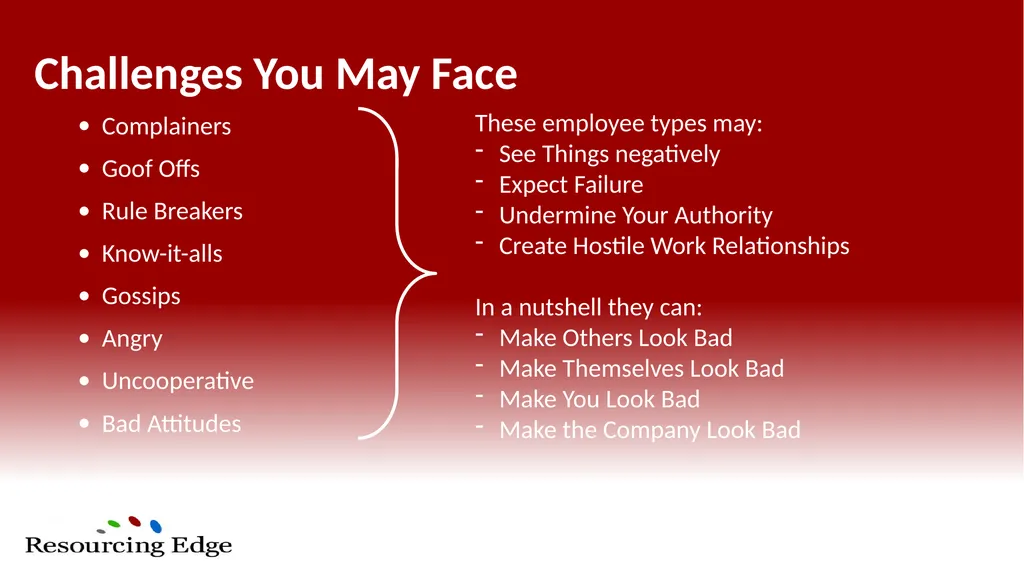
Challenges You May Face Complainers
Goof Offs
Rule Breakers
Know-it-alls
Gossips
Angry
Uncooperative
Bad Attitudes These employee types may:
See Things negatively
Expect Failure
Undermine Your Authority
Create Hostile Work Relationships
In a nutshell they can:
Make Others Look Bad
Make Themselves Look Bad
Make You Look Bad
Make the Company Look Bad<br>
04
Coaching and Counseling Why Not Just Fire Them? Even difficult workers can turn around with effective coaching
Replacement costs are high
Other costs may occur
Reassignment may work
Firing may affect morale<br>
05
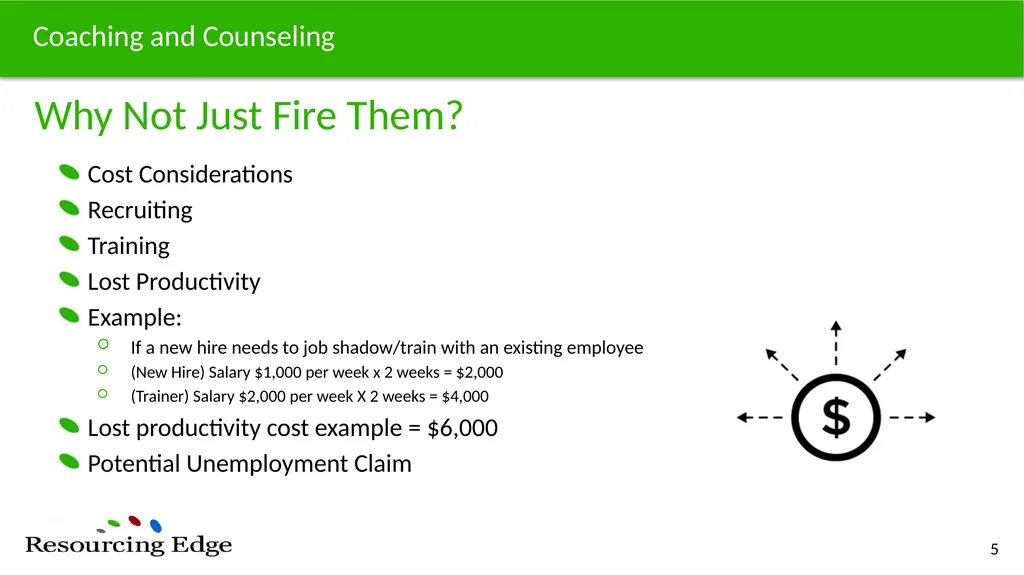
Coaching and Counseling Why Not Just Fire Them? Cost Considerations
Recruiting
Training
Lost Productivity
Example:
If a new hire needs to job shadow/train with an existing employee
(New Hire) Salary $1,000 per week x 2 weeks = $2,000
(Trainer) Salary $2,000 per week X 2 weeks = $4,000
Lost productivity cost example = $6,000
Potential Unemployment Claim<br>
06
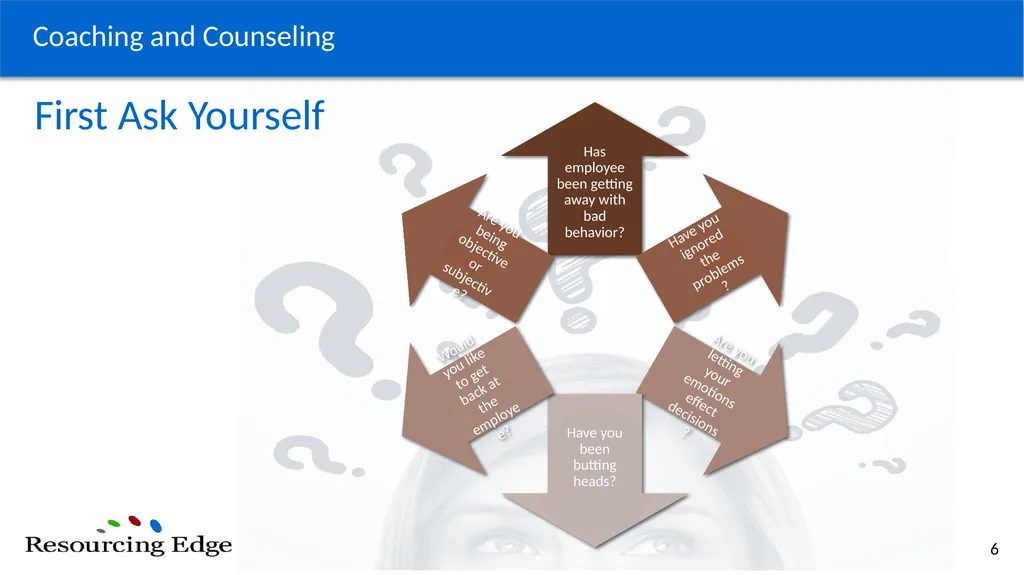
Coaching and Counseling First Ask Yourself<br>
07
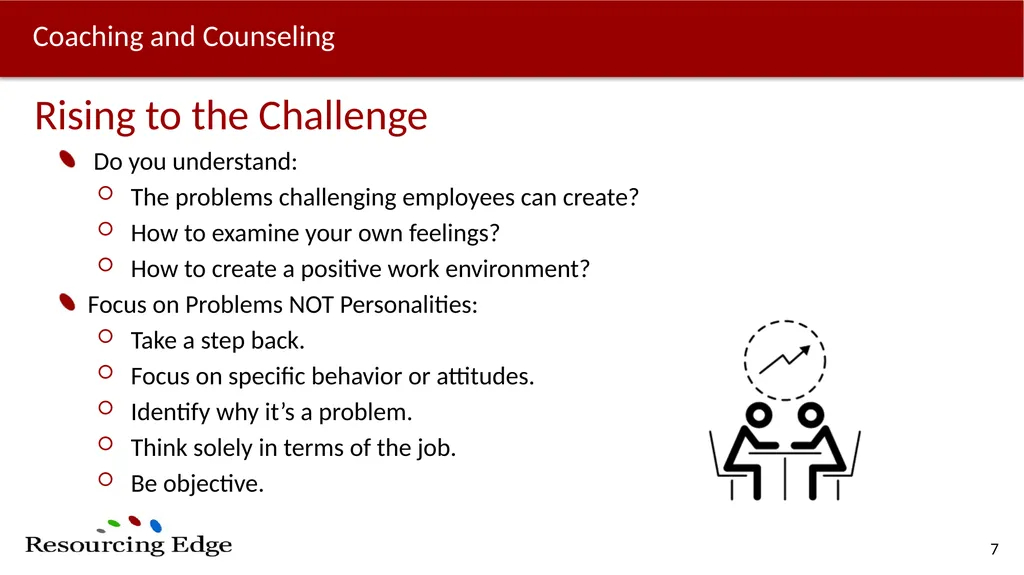
Coaching and Counseling Rising to the Challenge Do you understand:
The problems challenging employees can create?
How to examine your own feelings?
How to create a positive work environment?
Focus on Problems NOT Personalities:
Take a step back.
Focus on specific behavior or attitudes.
Identify why it’s a problem.
Think solely in terms of the job.
Be objective.<br>
08
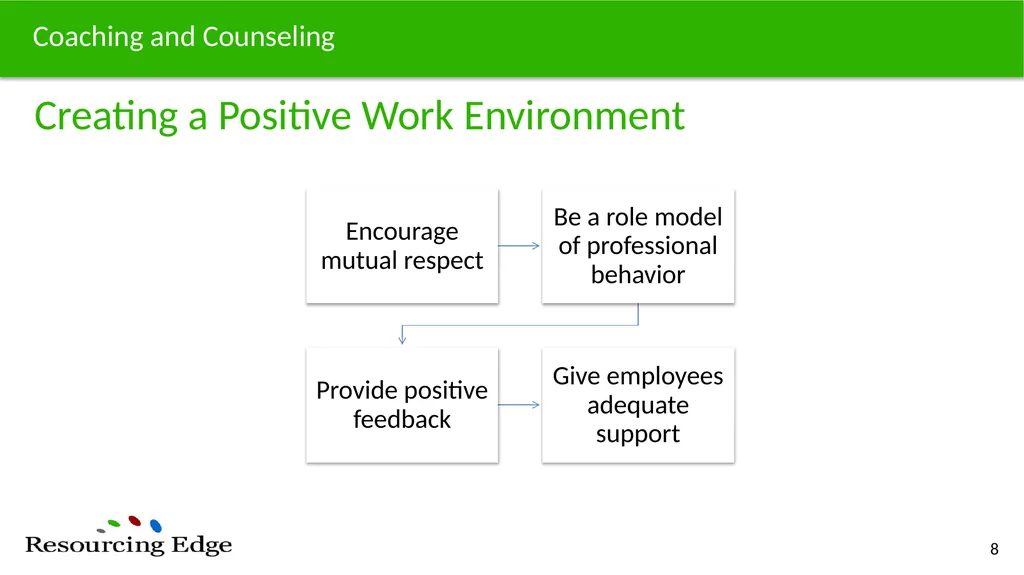
Coaching and Counseling Creating a Positive Work Environment<br>
09
Coaching and Counseling Preparing to Address Challenges Be Prepared
Be Brief
Be Specific
Explain the Impact
Stay Calm<br>
10
Challenges and Solutions<br>
11
Challenge
Lack of Cooperation
Comes in late every day, but is not difficult to work with.
Questions a decision you made on a large project.
Refuses to cooperate with others in a group project, stating that he would rather work alone.<br>
12
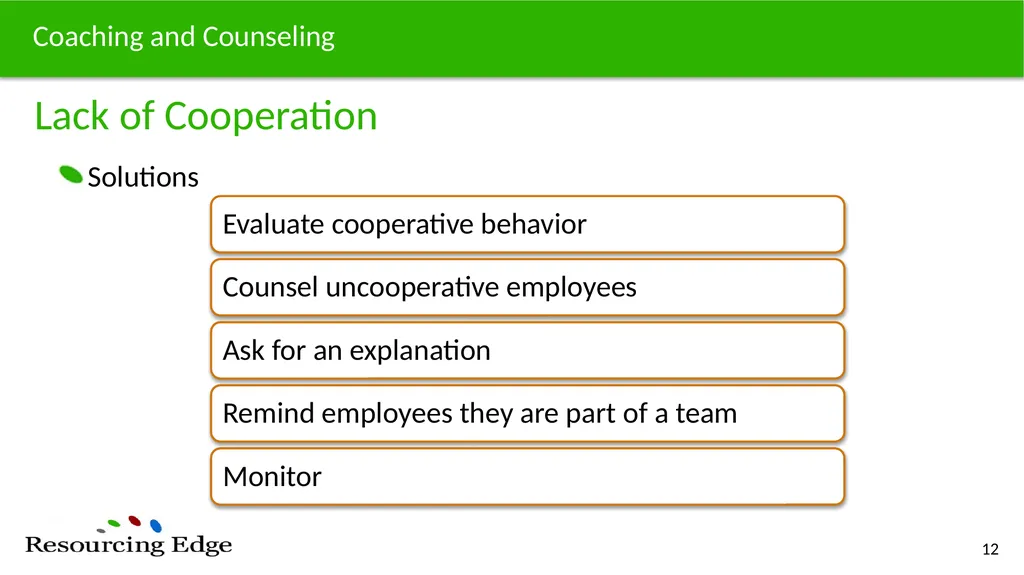
Coaching and Counseling Lack of Cooperation Solutions<br>
13
Challenge
Attendance Issues
Comes in late every day, but is not difficult to work with.
Calls off with notice and the occurrences are sporadic.
Calls off with very short notice.
Calls off regularly and a pattern has become apparent.<br>
14
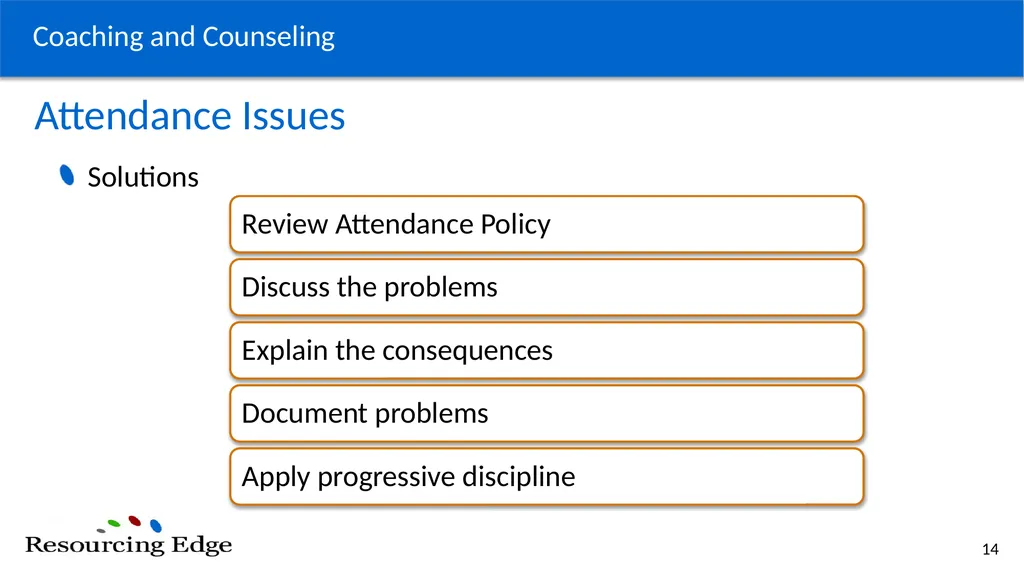
Coaching and Counseling Attendance Issues Solutions<br>
15
Challenge
Poor Performance
Employee turns in sub-par projects, clearly not following instructions.
Employee does not interact during team meetings.
Employee is not engage during planning meetings, but sends good ideas via email.
Employee complains of ideas shared in the group and does not offer constructive alternatives.<br>
16
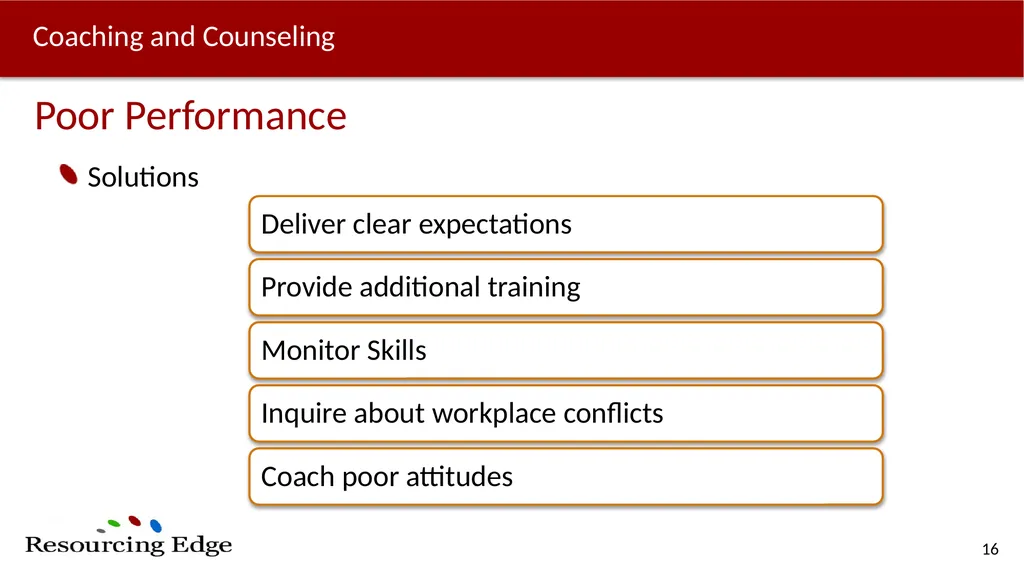
Coaching and Counseling Poor Performance Solutions<br>
17
Pause for the Cause
Anger Issues
Displays anger at employees from other departments when asked for information.
Has an extremely bad attitude one day, but is generally a pleasant person.<br>
18
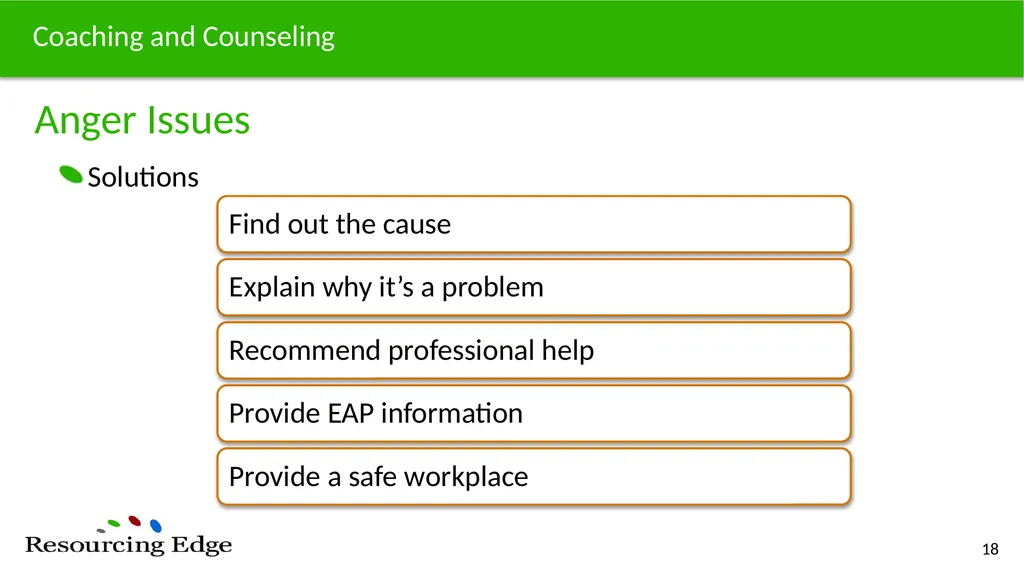
Coaching and Counseling Solutions Anger Issues<br>
19
Case Study
Improving Corrective Action Plans<br>
20
Improving Corrective Action Plans Case Study 1 What should be included in written “requirements” for employee improvement?<br>
21
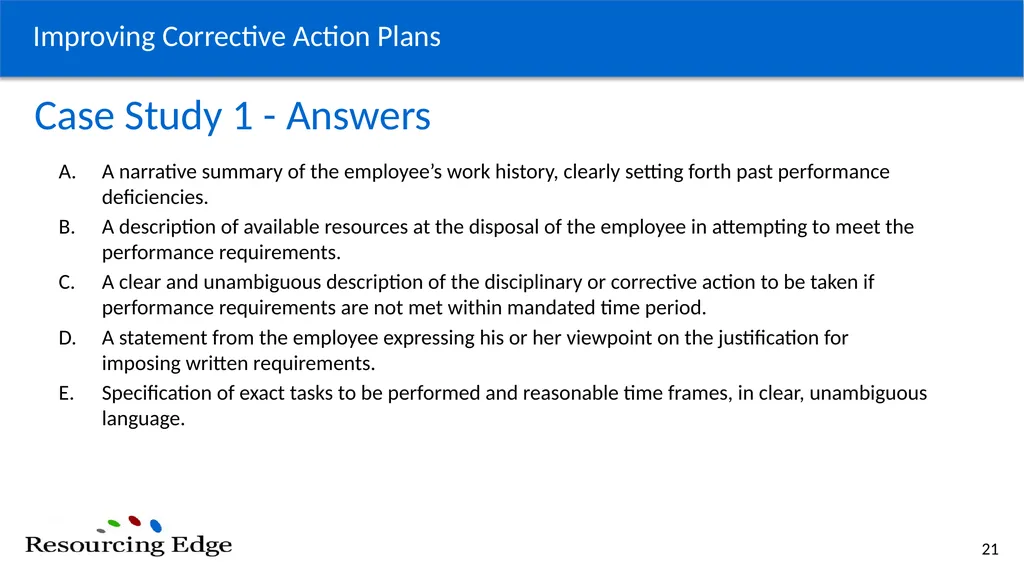
Improving Corrective Action Plans Case Study 1 - Answers A narrative summary of the employee’s work history, clearly setting forth past performance deficiencies.
A description of available resources at the disposal of the employee in attempting to meet the performance requirements.
A clear and unambiguous description of the disciplinary or corrective action to be taken if performance requirements are not met within mandated time period.
A statement from the employee expressing his or her viewpoint on the justification for imposing written requirements.
Specification of exact tasks to be performed and reasonable time frames, in clear, unambiguous language.<br>
22
Improving Corrective Action Plans Case Study 1 - Answers One example of an “exact task” using clear, unambiguous language is the following direction: “You are to be at your desk no later than 8:00 a.m. each day.” Compare it with “I would like you to be at your desk by 8:00 a.m. each day” and it is easy to see which statement is more likely to get results. You should set your time frames to allow the employee a reasonable opportunity to correct performance deficiencies, with the knowledge that another formal evaluation will be conducted at the end of the correction period to gauge the employee’s success.<br>
23
Key Points to Remember Never ignore the problem
Manage your own feelings
Create a positive work environment
Focus on problems, not personalities
Use positive strategies<br>
24
Questions ?<br>
25
This webinar is designed to provide accurate and authoritative information about the subject matter covered. The publisher is not engaged in rendering legal services.
This webinar provides general information only and does not constitute legal advice. No attorney-client relationship has been created. If legal advice or other expert assistance is required, the services of a competent professional should be sought. We recommend that you consult with qualified local counsel familiar with your specific situation before taking any action. Disclaimer<br>
26
Thank You! If you have any additional questions, please don’t hesitate to let us know. We’re here to help.<br>