
CODE OF ETHICS (Practical Approach) 1 1 2
NS
Published · 34 slides · 0 views
1 / 1
Description
CODE OF ETHICS (Practical Approach) 1 1 2 Disclaimer : The views expressed in the presentation is exclusively that of the author. The information contained herein is of a general nature and is not intended to address the circumstances of
Related Topics
Share
Embed code
Download this presentation From Below
"CODE OF ETHICS (Practical Approach) 1 1 2" is the property of its rightful owner. Permission is granted to download and print the materials on this website for personal, non-commercial use only, and to display it on your personal computer provided you do not modify the materials and that you retain all copyright notices contained in the materials. By downloading content from our website, you accept the terms of this agreement.
Presentation Transcript
01
CODE OF ETHICS
(Practical Approach) 1 1<br>
(Practical Approach) 1 1<br>
02
2 Disclaimer :
The views expressed in the presentation is exclusively that of the author.
The information contained herein is of a general nature and is not intended to address the circumstances of any particular individual or entity.
Although we endeavour to provide accurate and timely information, there can be no guarantee that such information is accurate as of the date it is received or that it will continue to be accurate in the future.
The presenter is in no case liable for any damages incurred by relying on the ideas implemented without adequate consultation.<br>
The views expressed in the presentation is exclusively that of the author.
The information contained herein is of a general nature and is not intended to address the circumstances of any particular individual or entity.
Although we endeavour to provide accurate and timely information, there can be no guarantee that such information is accurate as of the date it is received or that it will continue to be accurate in the future.
The presenter is in no case liable for any damages incurred by relying on the ideas implemented without adequate consultation.<br>
03
Objective of Chartered Accountants Act 3 The Chartered Accountants Act,1949 was enacted to constitute an autonomous association of accountants to maintain the standards of professional competence and for regulating the profession of chartered accountants. It maintains the standards of the professional qualifications and conduct required of the members of the profession.<br>
04
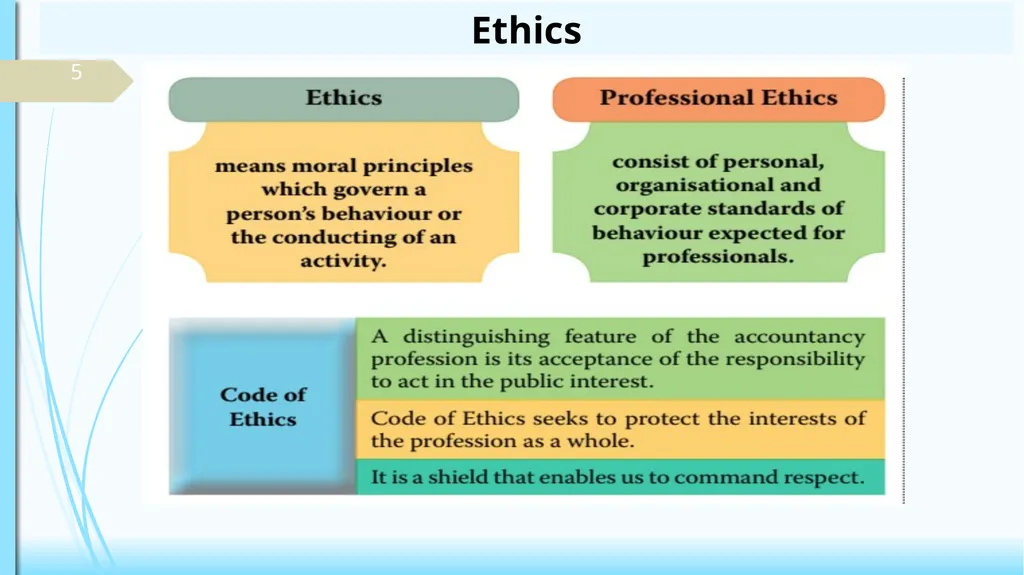
ETHICS 4 The term “Ethics” means moral principles which governs a persons behaviour or the conducting of an activity. It is the branch of knowledge that deals with moral principles,
“professional ethics” consists of personal, organisational and corporate standards of behaviour expected for professionals.
There can be different moral codes to different sections of the Society or professionals.<br>
“professional ethics” consists of personal, organisational and corporate standards of behaviour expected for professionals.
There can be different moral codes to different sections of the Society or professionals.<br>
05
Ethics 5<br>
06
Ethics 6 Chartered Accountants as professionals are engaged in building trust to vast verities of users, whether shareholders, government, banks, investors, employees or others, which imposes a public interest responsibility on their profession. Like other professionals Chartered Accounts have also some set of Code of Ethics. The Chartered Accountant, either in practice or in service , has to abide by these ethical behaviours . The Service users should be able to feel secure that there exists a framework of professional ethics which governs the provisions of those services. Any deviation from ethical responsibilities brings the disciplinary mechanism into action against the Chartered Accountants<br>
07
Therefore, we need to Comply or get them complied, as the case may be. The relevant Laws and Regulations, Code of Ethics (earlier also known as Code of Conduct)
For compliance we must know
Which Laws and Regulations etc are to be complied
What are to be complied<br>
For compliance we must know
Which Laws and Regulations etc are to be complied
What are to be complied<br>
08
The Relevant Laws and Regulations
Code of Ethics (Vol I) (2019 Edition)- on the basis of International Ethical Standard Board (Under revision)
Code of ethics (Vol II) (2020 Edition) (under revision)
Code of Ethics (Vol III) (Case Law Referencer) (March 2020 Edition)(under revision)
Frequently asked Questions on Ethical Issues (February 2021edition)
Compendium on Disciplinary case studies (February 2022 Edition)
The Chartered Accountants, the Cost and Works Accountants and the Company Secretaries (Amendment) Act, 2022. Dated 18th April 2022<br>
Code of Ethics (Vol I) (2019 Edition)- on the basis of International Ethical Standard Board (Under revision)
Code of ethics (Vol II) (2020 Edition) (under revision)
Code of Ethics (Vol III) (Case Law Referencer) (March 2020 Edition)(under revision)
Frequently asked Questions on Ethical Issues (February 2021edition)
Compendium on Disciplinary case studies (February 2022 Edition)
The Chartered Accountants, the Cost and Works Accountants and the Company Secretaries (Amendment) Act, 2022. Dated 18th April 2022<br>
09
The Relevant Laws and Regulations (Contd)
The Chartered Accountant Act, 1949 (as amended)
The Chartered Accountants Regulations, 1988 (amended upto 15th February 2023)
The Chartered Accountants (Procedure of Investigations of professional or other misconduct and Conduct of Cases) Rules, 2007.
Various guidelines issued by Council from time to time (General Guidelines 2008, Revised Guidelines on advertisement, Tender Guidelines, Corporate form of Practice guidelines, Logo Guideline, UDIN Guidelines, Net-working Guidelines, Multi- disciplinary practice guideline etc.)<br>
The Chartered Accountant Act, 1949 (as amended)
The Chartered Accountants Regulations, 1988 (amended upto 15th February 2023)
The Chartered Accountants (Procedure of Investigations of professional or other misconduct and Conduct of Cases) Rules, 2007.
Various guidelines issued by Council from time to time (General Guidelines 2008, Revised Guidelines on advertisement, Tender Guidelines, Corporate form of Practice guidelines, Logo Guideline, UDIN Guidelines, Net-working Guidelines, Multi- disciplinary practice guideline etc.)<br>
10
The Relevant Laws and Regulations (Contd)
Booklet on Important decisions of Ethical Standard Board/ Council (June 2022 edition)
The Important Orders of NFRA (which will give an idea the areas where auditors miss out or ignore) and NFRA is able to impose penalty running into Lakhs and crores and debarment from auditing/ internal auditing for some years.
SQC – Standards on Quality Control (series 1 to 99)- (SQM in coming days)
Various SA – Standards on Auditing (Series 100 onwards) Avoid “After thought” Stigma<br>
Booklet on Important decisions of Ethical Standard Board/ Council (June 2022 edition)
The Important Orders of NFRA (which will give an idea the areas where auditors miss out or ignore) and NFRA is able to impose penalty running into Lakhs and crores and debarment from auditing/ internal auditing for some years.
SQC – Standards on Quality Control (series 1 to 99)- (SQM in coming days)
Various SA – Standards on Auditing (Series 100 onwards) Avoid “After thought” Stigma<br>
11
The Relevant Laws and Regulations (Contd)
SREs- Standards on review Engagements (3000 series)
SRSs- Standards on Related Services (4000 series)
Various Accounting Standards including IND AS
The relevant Laws applicable to the Clients
Self Regulatory measures recommended by ICAI
Multi disciplinary Partnership (Notification dated 8th July 2021)<br>
SREs- Standards on review Engagements (3000 series)
SRSs- Standards on Related Services (4000 series)
Various Accounting Standards including IND AS
The relevant Laws applicable to the Clients
Self Regulatory measures recommended by ICAI
Multi disciplinary Partnership (Notification dated 8th July 2021)<br>
12
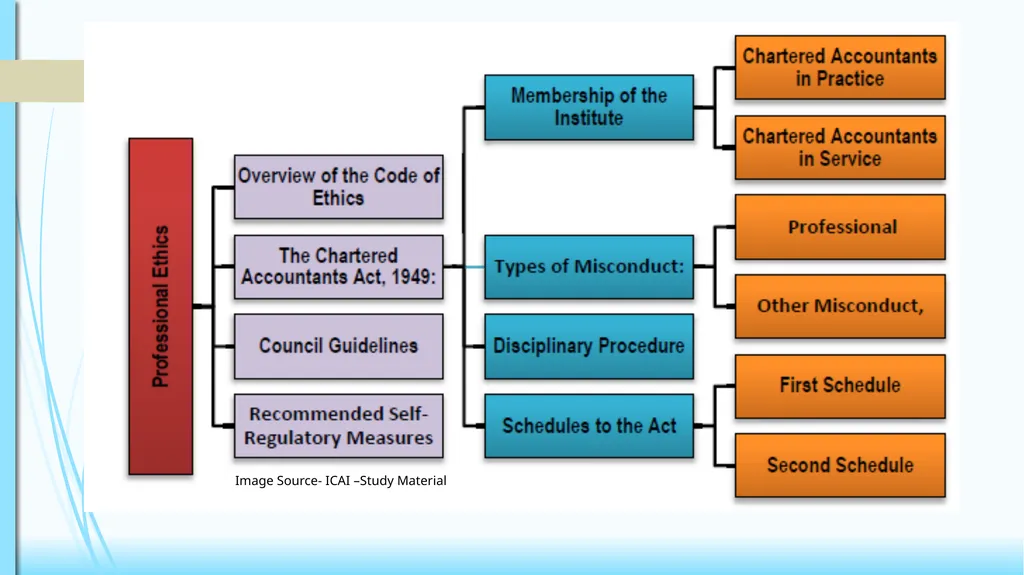
Image Source- ICAI –Study Material<br>
13
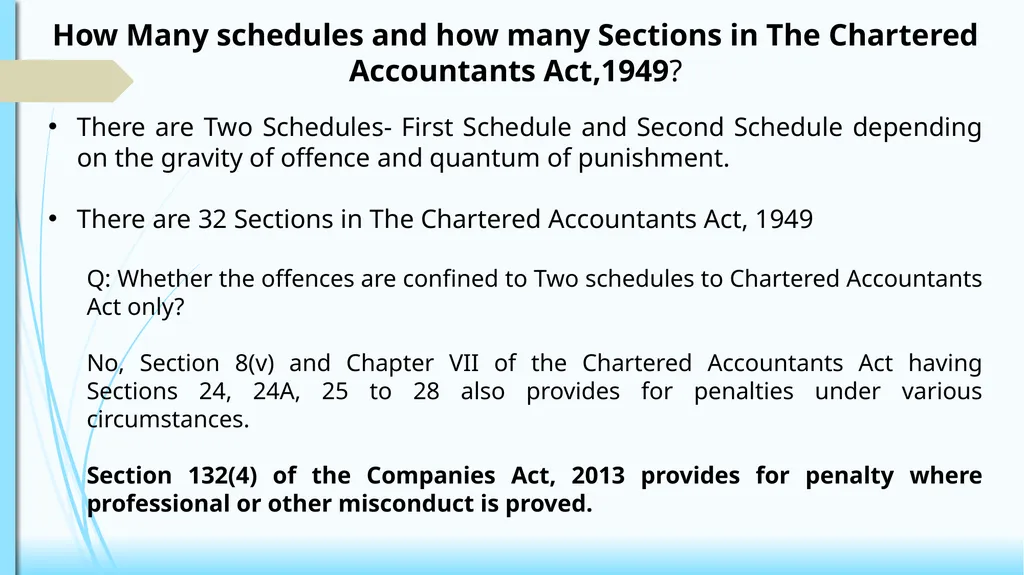
How Many schedules and how many Sections in The Chartered Accountants Act,1949?
There are Two Schedules- First Schedule and Second Schedule depending on the gravity of offence and quantum of punishment.
There are 32 Sections in The Chartered Accountants Act, 1949
Q: Whether the offences are confined to Two schedules to Chartered Accountants Act only?
No, Section 8(v) and Chapter VII of the Chartered Accountants Act having Sections 24, 24A, 25 to 28 also provides for penalties under various circumstances.
Section 132(4) of the Companies Act, 2013 provides for penalty where professional or other misconduct is proved.<br>
There are Two Schedules- First Schedule and Second Schedule depending on the gravity of offence and quantum of punishment.
There are 32 Sections in The Chartered Accountants Act, 1949
Q: Whether the offences are confined to Two schedules to Chartered Accountants Act only?
No, Section 8(v) and Chapter VII of the Chartered Accountants Act having Sections 24, 24A, 25 to 28 also provides for penalties under various circumstances.
Section 132(4) of the Companies Act, 2013 provides for penalty where professional or other misconduct is proved.<br>
14
Professional or other misconduct defined
‘22. For the purposes of this Act, the expression “professional or other misconduct” shall be
deemed to include any act or omission, on the part of any member of the Institute either in his individual capacity or as partner or owner of a firm, as mentioned in any of the Schedules,
but nothing in this section shall be construed to limit or abridge in any way the power conferred or duty cast on the Director (Discipline) under sub-section (1) of section 21 to inquire into the conduct of such member or firm, under any other circumstances.’.<br>
‘22. For the purposes of this Act, the expression “professional or other misconduct” shall be
deemed to include any act or omission, on the part of any member of the Institute either in his individual capacity or as partner or owner of a firm, as mentioned in any of the Schedules,
but nothing in this section shall be construed to limit or abridge in any way the power conferred or duty cast on the Director (Discipline) under sub-section (1) of section 21 to inquire into the conduct of such member or firm, under any other circumstances.’.<br>
15
Professional or other misconduct defined (contd..)
The definition is not exhaustive but inclusive one, as such may include many more criteria.
Any act or omission on the part of the member as mentioned in any of the schedules. (presently First and Second Schedule)
Misconduct may either in his individual capacity
Misconduct may be as a partner of the firm
Misconduct may be as a proprietor of the Firm<br>
The definition is not exhaustive but inclusive one, as such may include many more criteria.
Any act or omission on the part of the member as mentioned in any of the schedules. (presently First and Second Schedule)
Misconduct may either in his individual capacity
Misconduct may be as a partner of the firm
Misconduct may be as a proprietor of the Firm<br>
16
Professional or other misconduct defined
the Director (Discipline) has vast power and duty to inquire into the conduct of the
>member or
>Firm or
>Member and firm
Under any other circumstances also (i.e. in addition to circumstances stated in schedules)
This Section cannot limit or curtail, in any way, the power or duty conferred to the Directorate.<br>
the Director (Discipline) has vast power and duty to inquire into the conduct of the
>member or
>Firm or
>Member and firm
Under any other circumstances also (i.e. in addition to circumstances stated in schedules)
This Section cannot limit or curtail, in any way, the power or duty conferred to the Directorate.<br>
17
What constitutes `misconduct
under any other circumstances’ has to be determined on case to case basis
keeping in view the facts of the circumstances of each case.
Fraud, intention to deceive and committing an act which affects the public or society at large could be in the ambit of such misconduct.<br>
under any other circumstances’ has to be determined on case to case basis
keeping in view the facts of the circumstances of each case.
Fraud, intention to deceive and committing an act which affects the public or society at large could be in the ambit of such misconduct.<br>
18
Misconduct
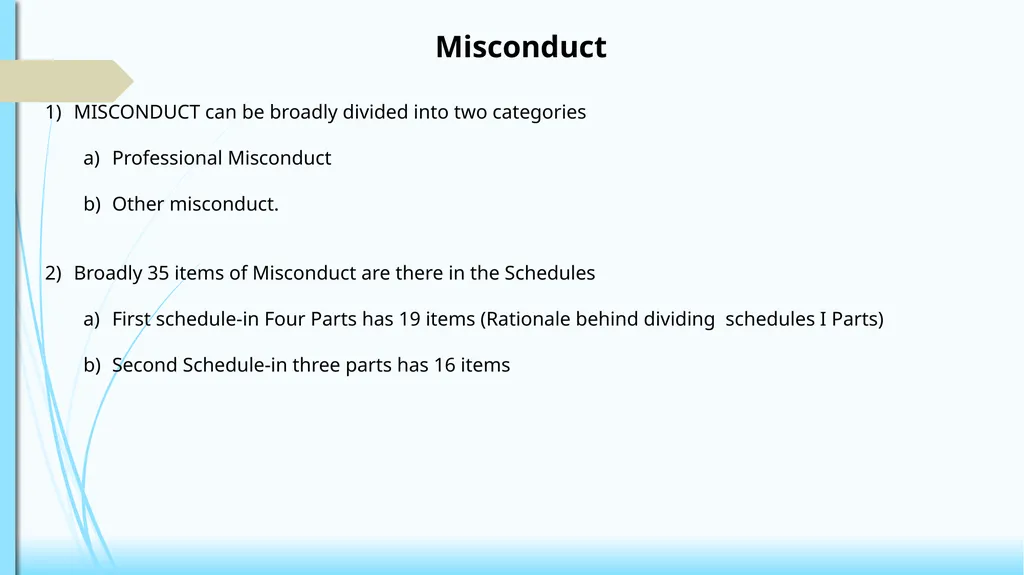
MISCONDUCT can be broadly divided into two categories
Professional Misconduct
Other misconduct.
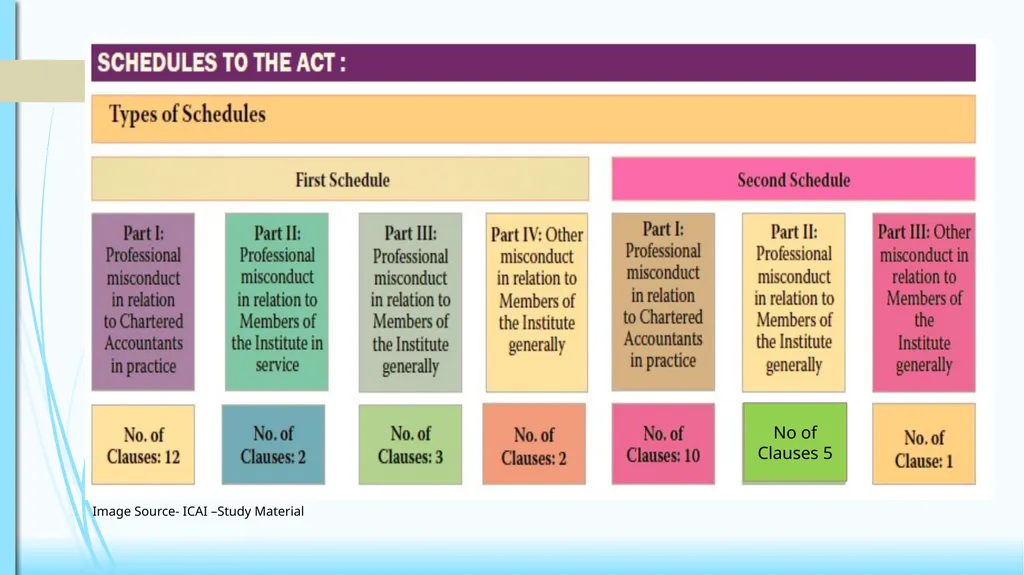
Broadly 35 items of Misconduct are there in the Schedules
First schedule-in Four Parts has 19 items (Rationale behind dividing schedules I Parts)
Second Schedule-in three parts has 16 items<br>
MISCONDUCT can be broadly divided into two categories
Professional Misconduct
Other misconduct.
Broadly 35 items of Misconduct are there in the Schedules
First schedule-in Four Parts has 19 items (Rationale behind dividing schedules I Parts)
Second Schedule-in three parts has 16 items<br>
19
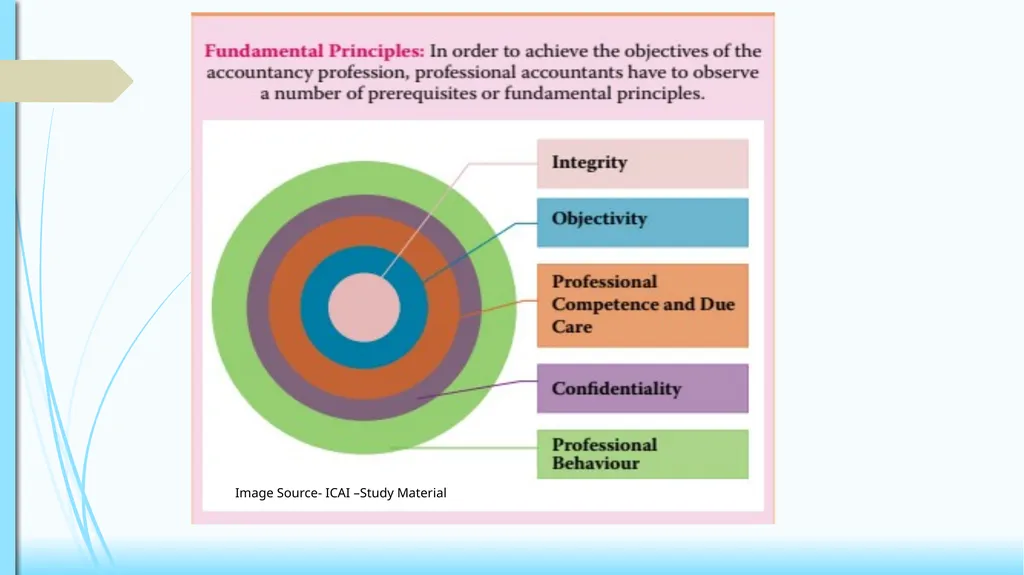
Few Important Extracts from CA Act Image Source- ICAI –Study Material<br>
20
Image Source- ICAI –Study Material<br>
21
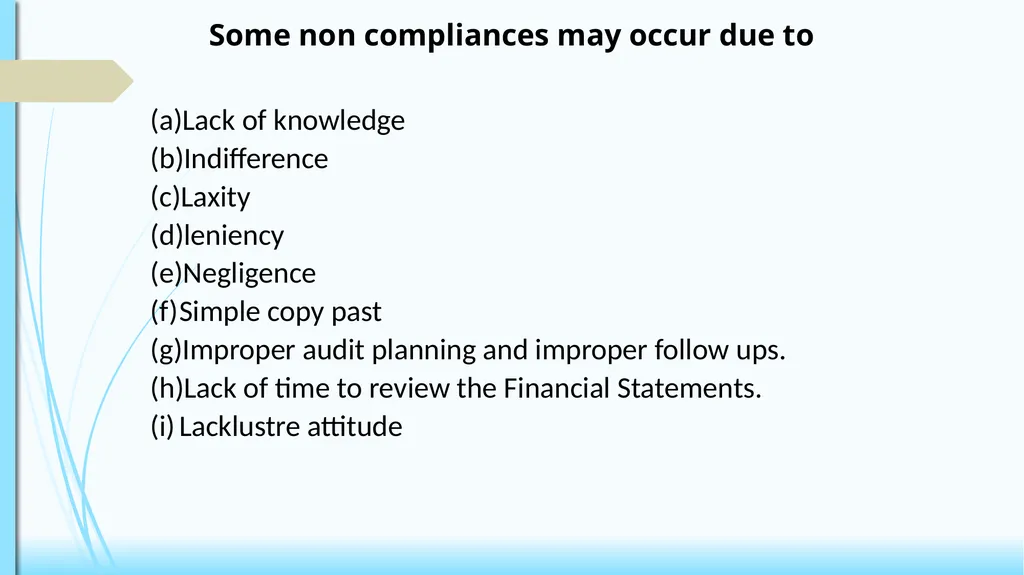
Some non compliances may occur due to
Lack of knowledge
Indifference
Laxity
leniency
Negligence
Simple copy past
Improper audit planning and improper follow ups.
Lack of time to review the Financial Statements.
Lacklustre attitude<br>
Lack of knowledge
Indifference
Laxity
leniency
Negligence
Simple copy past
Improper audit planning and improper follow ups.
Lack of time to review the Financial Statements.
Lacklustre attitude<br>
22
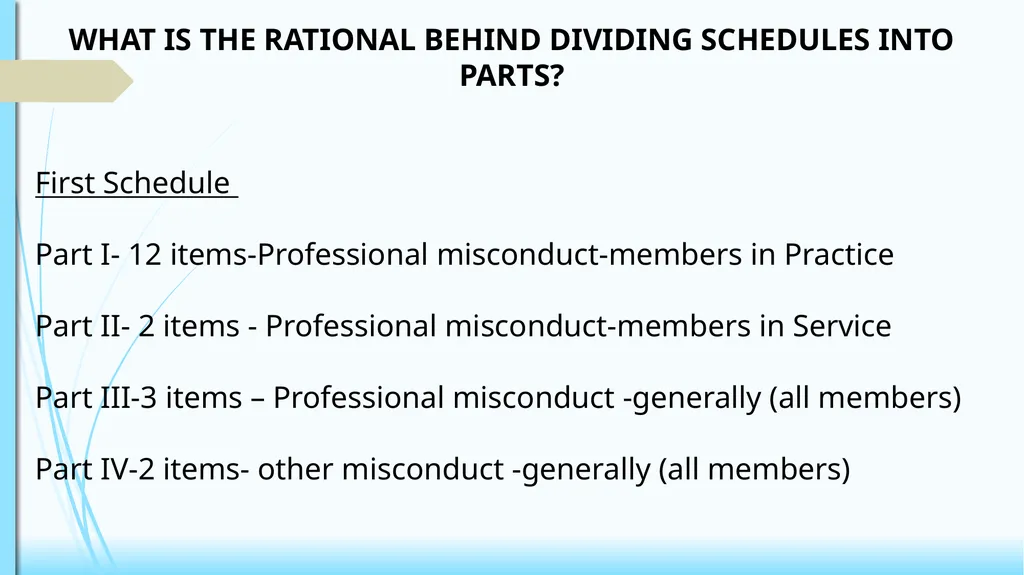
WHAT IS THE RATIONAL BEHIND DIVIDING SCHEDULES INTO PARTS?
First Schedule
Part I- 12 items-Professional misconduct-members in Practice
Part II- 2 items - Professional misconduct-members in Service
Part III-3 items – Professional misconduct -generally (all members)
Part IV-2 items- other misconduct -generally (all members)<br>
First Schedule
Part I- 12 items-Professional misconduct-members in Practice
Part II- 2 items - Professional misconduct-members in Service
Part III-3 items – Professional misconduct -generally (all members)
Part IV-2 items- other misconduct -generally (all members)<br>
23
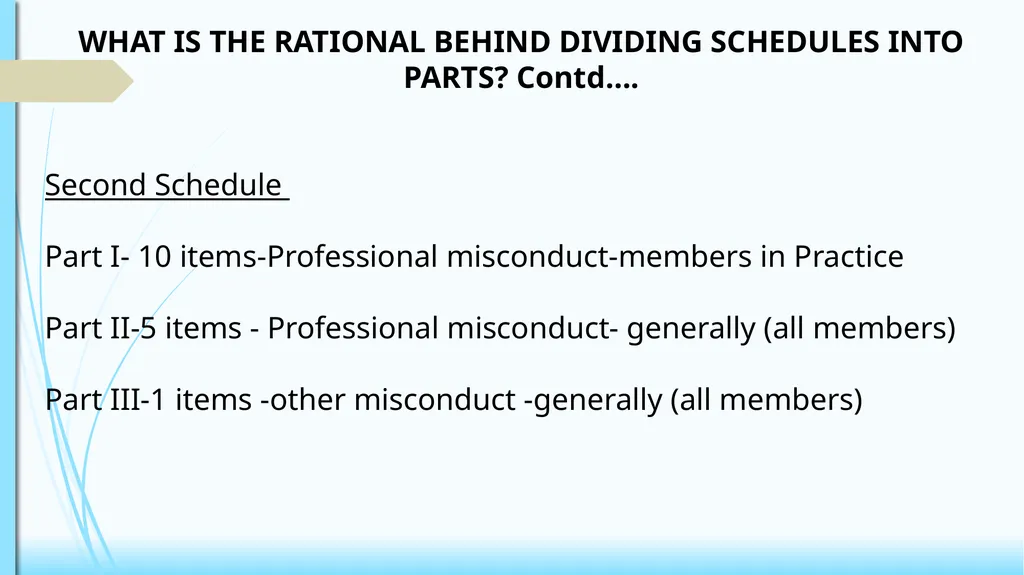
WHAT IS THE RATIONAL BEHIND DIVIDING SCHEDULES INTO PARTS? Contd….
Second Schedule
Part I- 10 items-Professional misconduct-members in Practice
Part II-5 items - Professional misconduct- generally (all members)
Part III-1 items -other misconduct -generally (all members)<br>
Second Schedule
Part I- 10 items-Professional misconduct-members in Practice
Part II-5 items - Professional misconduct- generally (all members)
Part III-1 items -other misconduct -generally (all members)<br>
24
FIRST SCHEDULE
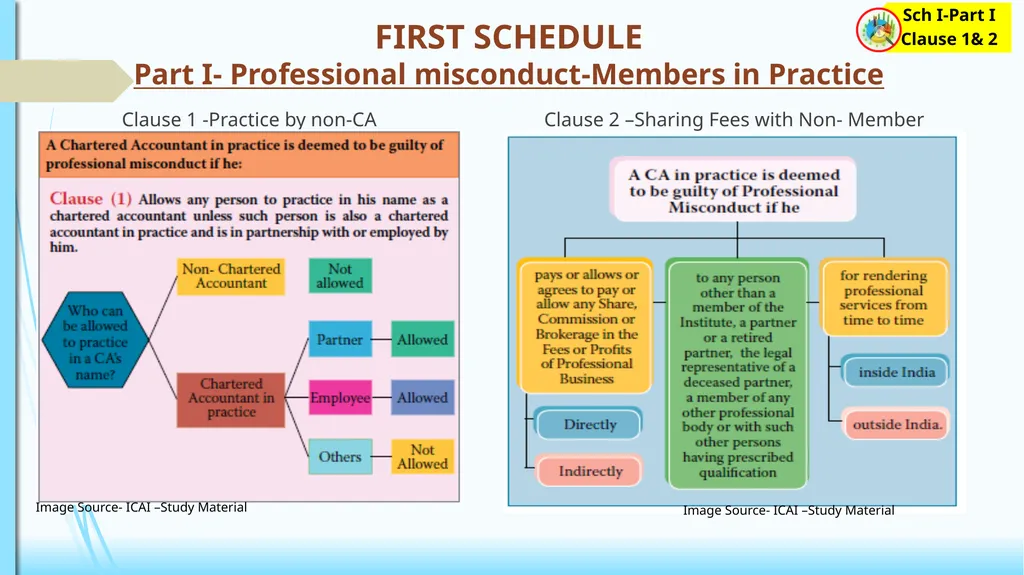
Part I- Professional misconduct-Members in Practice Clause 1 -Practice by non-CA Clause 2 –Sharing Fees with Non- Member<br>
25
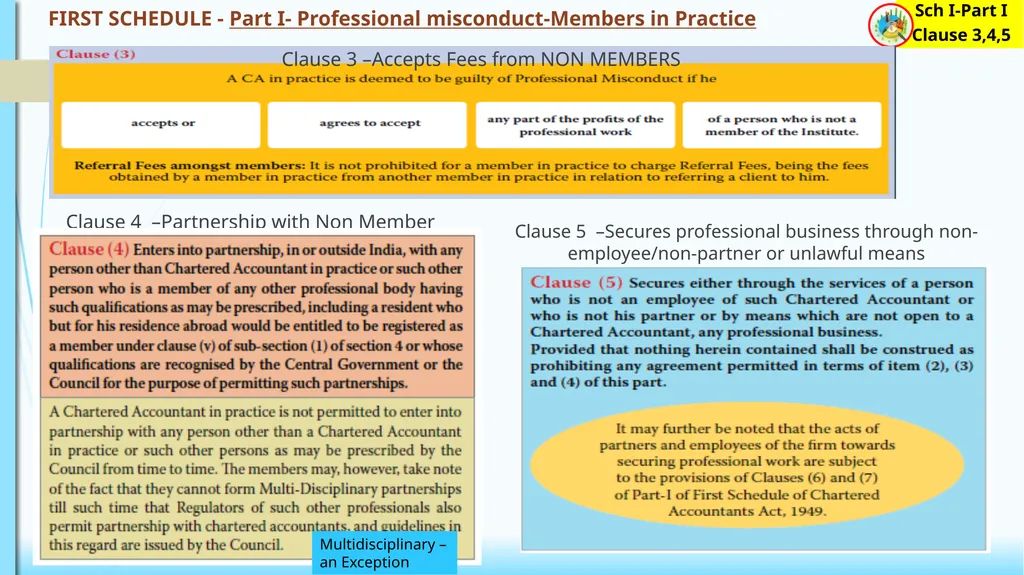
FIRST SCHEDULE - Part I- Professional misconduct-Members in Practice Clause 4 –Partnership with Non Member Clause 3 –Accepts Fees from NON MEMBERS Clause 5 –Secures professional business through non- employee/non-partner or unlawful means Multidisciplinary – an Exception<br>
26
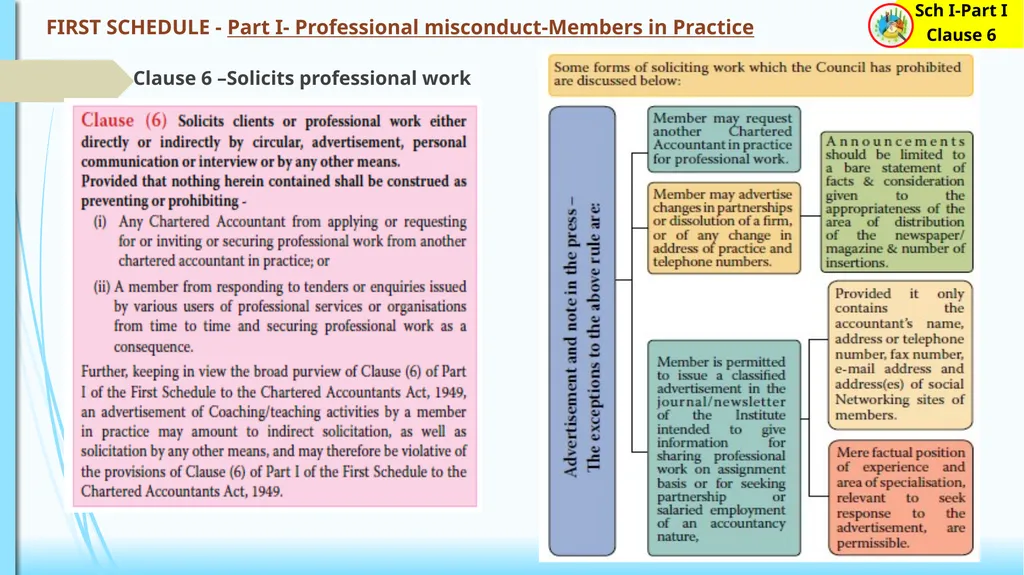
FIRST SCHEDULE - Part I- Professional misconduct-Members in Practice Clause 6 –Solicits professional work<br>
27
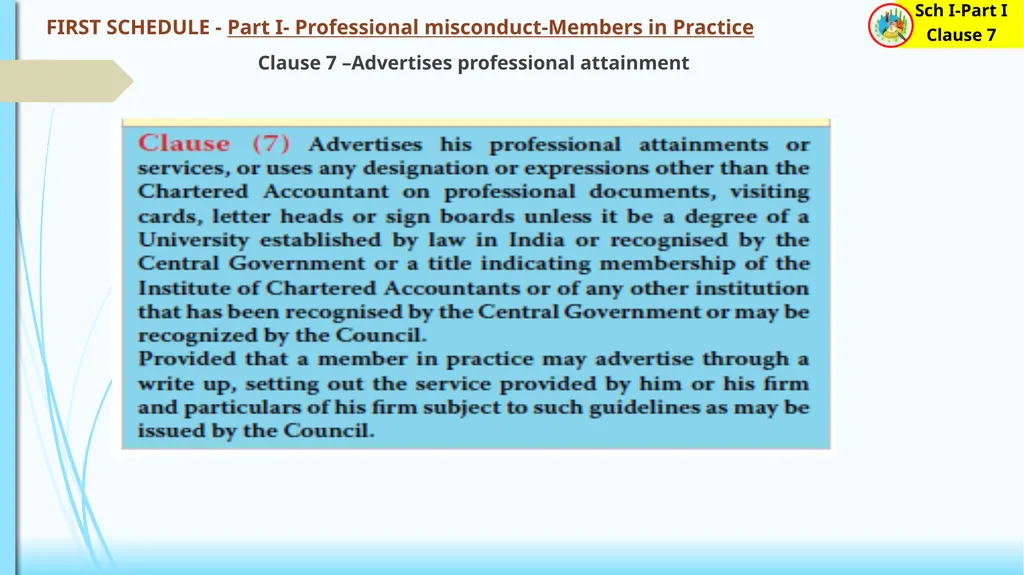
FIRST SCHEDULE - Part I- Professional misconduct-Members in Practice Clause 7 –Advertises professional attainment<br>
28
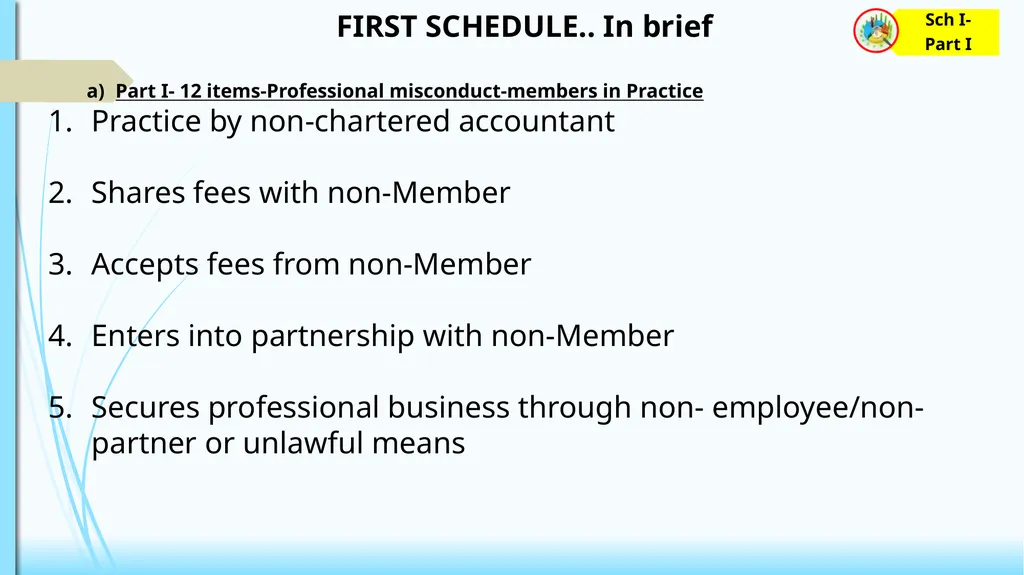
FIRST SCHEDULE.. In brief
Part I- 12 items-Professional misconduct-members in Practice
Practice by non-chartered accountant
Shares fees with non-Member
Accepts fees from non-Member
Enters into partnership with non-Member
Secures professional business through non- employee/non-partner or unlawful means<br>
Part I- 12 items-Professional misconduct-members in Practice
Practice by non-chartered accountant
Shares fees with non-Member
Accepts fees from non-Member
Enters into partnership with non-Member
Secures professional business through non- employee/non-partner or unlawful means<br>
29
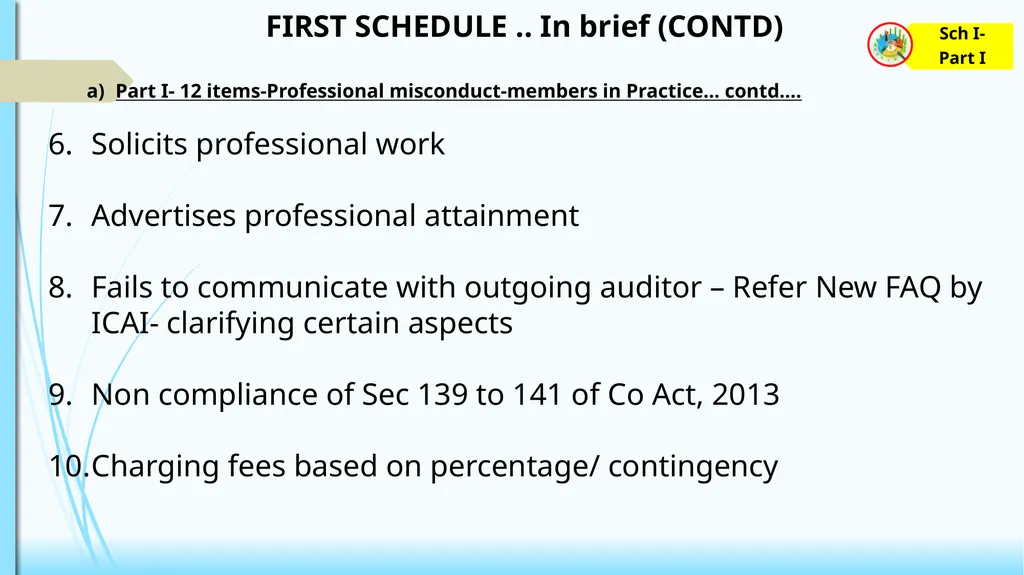
FIRST SCHEDULE .. In brief (CONTD)
Part I- 12 items-Professional misconduct-members in Practice… contd….
Solicits professional work
Advertises professional attainment
Fails to communicate with outgoing auditor – Refer New FAQ by ICAI- clarifying certain aspects
Non compliance of Sec 139 to 141 of Co Act, 2013
Charging fees based on percentage/ contingency<br>
Part I- 12 items-Professional misconduct-members in Practice… contd….
Solicits professional work
Advertises professional attainment
Fails to communicate with outgoing auditor – Refer New FAQ by ICAI- clarifying certain aspects
Non compliance of Sec 139 to 141 of Co Act, 2013
Charging fees based on percentage/ contingency<br>
30
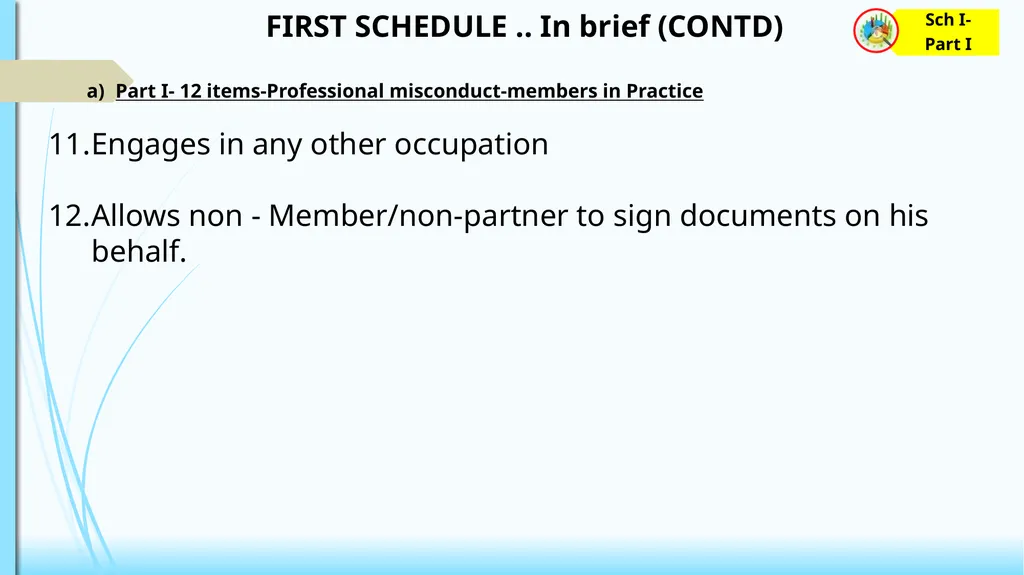
FIRST SCHEDULE .. In brief (CONTD)
Part I- 12 items-Professional misconduct-members in Practice
Engages in any other occupation
Allows non - Member/non-partner to sign documents on his behalf.<br>
Part I- 12 items-Professional misconduct-members in Practice
Engages in any other occupation
Allows non - Member/non-partner to sign documents on his behalf.<br>
31
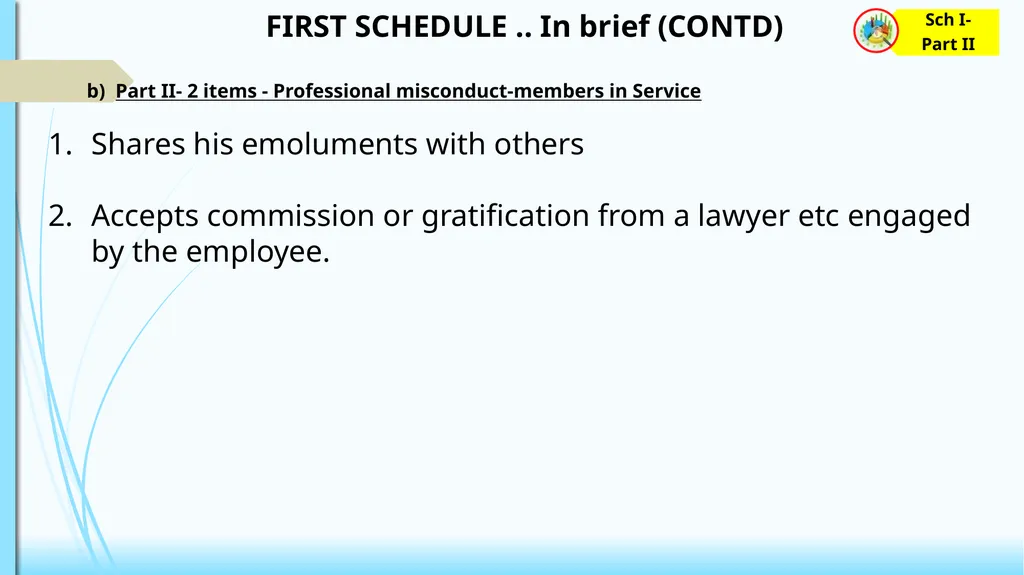
FIRST SCHEDULE .. In brief (CONTD)
Part II- 2 items - Professional misconduct-members in Service
Shares his emoluments with others
Accepts commission or gratification from a lawyer etc engaged by the employee.<br>
Part II- 2 items - Professional misconduct-members in Service
Shares his emoluments with others
Accepts commission or gratification from a lawyer etc engaged by the employee.<br>
32
FIRST SCHEDULE .. In brief (CONTD)
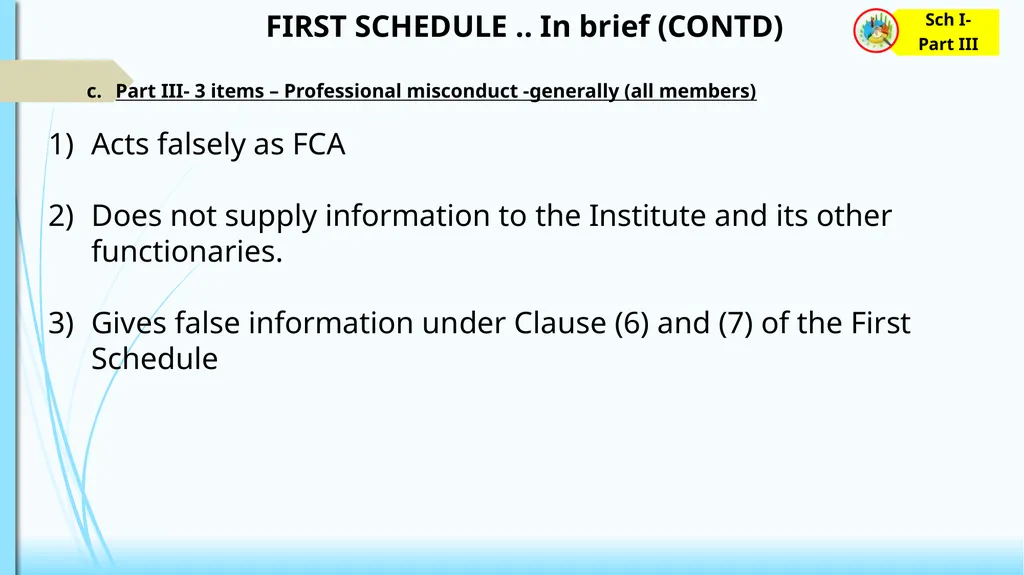
Part III- 3 items – Professional misconduct -generally (all members)
Acts falsely as FCA
Does not supply information to the Institute and its other functionaries.
Gives false information under Clause (6) and (7) of the First Schedule<br>
Part III- 3 items – Professional misconduct -generally (all members)
Acts falsely as FCA
Does not supply information to the Institute and its other functionaries.
Gives false information under Clause (6) and (7) of the First Schedule<br>
33
FIRST SCHEDULE .. In brief (CONTD)
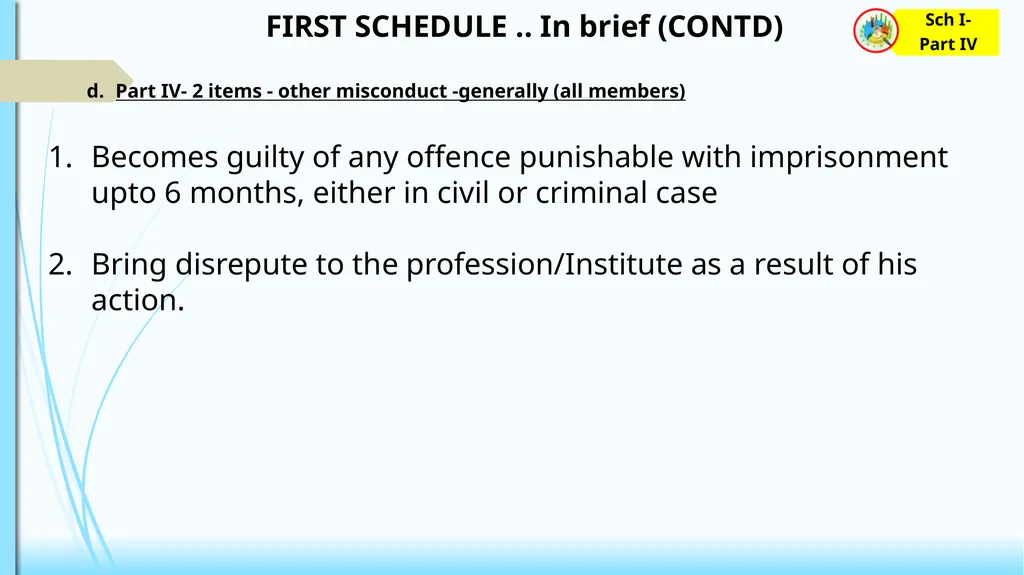
Part IV- 2 items - other misconduct -generally (all members)
Becomes guilty of any offence punishable with imprisonment upto 6 months, either in civil or criminal case
Bring disrepute to the profession/Institute as a result of his action.<br>
Part IV- 2 items - other misconduct -generally (all members)
Becomes guilty of any offence punishable with imprisonment upto 6 months, either in civil or criminal case
Bring disrepute to the profession/Institute as a result of his action.<br>
34
SECOND SCHEDULE .. In brief
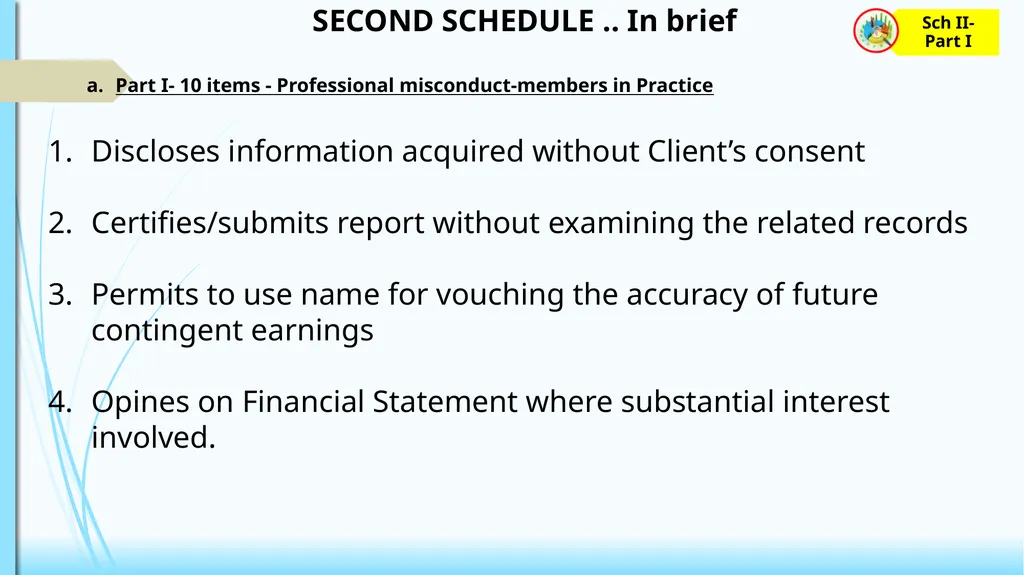
Part I- 10 items - Professional misconduct-members in Practice
Discloses information acquired without Client’s consent
Certifies/submits report without examining the related records
Permits to use name for vouching the accuracy of future contingent earnings
Opines on Financial Statement where substantial interest involved.<br>
Part I- 10 items - Professional misconduct-members in Practice
Discloses information acquired without Client’s consent
Certifies/submits report without examining the related records
Permits to use name for vouching the accuracy of future contingent earnings
Opines on Financial Statement where substantial interest involved.<br>
35
SECOND SCHEDULE .. In brief (Contd)
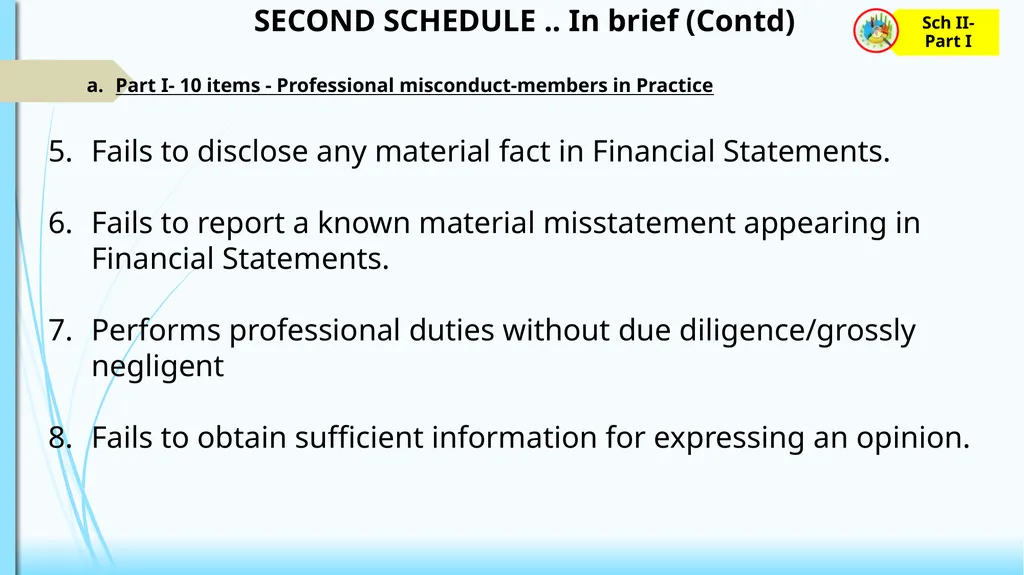
Part I- 10 items - Professional misconduct-members in Practice
Fails to disclose any material fact in Financial Statements.
Fails to report a known material misstatement appearing in Financial Statements.
Performs professional duties without due diligence/grossly negligent
Fails to obtain sufficient information for expressing an opinion.<br>
Part I- 10 items - Professional misconduct-members in Practice
Fails to disclose any material fact in Financial Statements.
Fails to report a known material misstatement appearing in Financial Statements.
Performs professional duties without due diligence/grossly negligent
Fails to obtain sufficient information for expressing an opinion.<br>
36
SECOND SCHEDULE .. In brief (Contd)
Part I- 10 items - Professional misconduct-members in Practice
Fails to invite attention to any material departure from the generally accepted procedure of audit.
10. Keeps client’s money without opening separate bank account.<br>
Part I- 10 items - Professional misconduct-members in Practice
Fails to invite attention to any material departure from the generally accepted procedure of audit.
10. Keeps client’s money without opening separate bank account.<br>
37
SECOND SCHEDULE (Contd)
Part II- 5 items - Professional misconduct- generally (all members)
Contravenes any of the provisions of the Chartered Accountants Act/Regulations & Guidelines issued by the Council. (Brahmastra)
Discloses employer’s information without permission.
Provides false information to the Institute and its different authorities.<br>
Part II- 5 items - Professional misconduct- generally (all members)
Contravenes any of the provisions of the Chartered Accountants Act/Regulations & Guidelines issued by the Council. (Brahmastra)
Discloses employer’s information without permission.
Provides false information to the Institute and its different authorities.<br>
38
SECOND SCHEDULE (Contd)
Part II- 5 items - Professional misconduct- generally (all members)
Defalcates/embezzles money received in professional capacity.
acts as an auditor of the company in contravention of the provisions of the Companies Act, 2013.<br>
Part II- 5 items - Professional misconduct- generally (all members)
Defalcates/embezzles money received in professional capacity.
acts as an auditor of the company in contravention of the provisions of the Companies Act, 2013.<br>
39
SECOND SCHEDULE (Contd)-some clauses
Part I- Clause (7) Performs professional duties without due diligence/grossly negligent
Clause (7): does not exercise due diligence, or is grossly negligent in the conduct of his professional duties;
Though very simply worded, it is a vital clause which unusually gets attracted whenever it is necessary to judge whether the accountant has honestly and reasonably discharged his duties. Diligence means care; caution; attention and care required from a person in a given situation and the expression ‘due diligence’ means a measure of prudence, activity, or alertness, as is proper to be expected from, and ordinarily exercised by, a reasonable and prudent member in practice under the particular circumstance
The expression ‘negligence’ covers a wide field and extends from the frontiers of fraud to collateral and minor negligence.<br>
Part I- Clause (7) Performs professional duties without due diligence/grossly negligent
Clause (7): does not exercise due diligence, or is grossly negligent in the conduct of his professional duties;
Though very simply worded, it is a vital clause which unusually gets attracted whenever it is necessary to judge whether the accountant has honestly and reasonably discharged his duties. Diligence means care; caution; attention and care required from a person in a given situation and the expression ‘due diligence’ means a measure of prudence, activity, or alertness, as is proper to be expected from, and ordinarily exercised by, a reasonable and prudent member in practice under the particular circumstance
The expression ‘negligence’ covers a wide field and extends from the frontiers of fraud to collateral and minor negligence.<br>
40
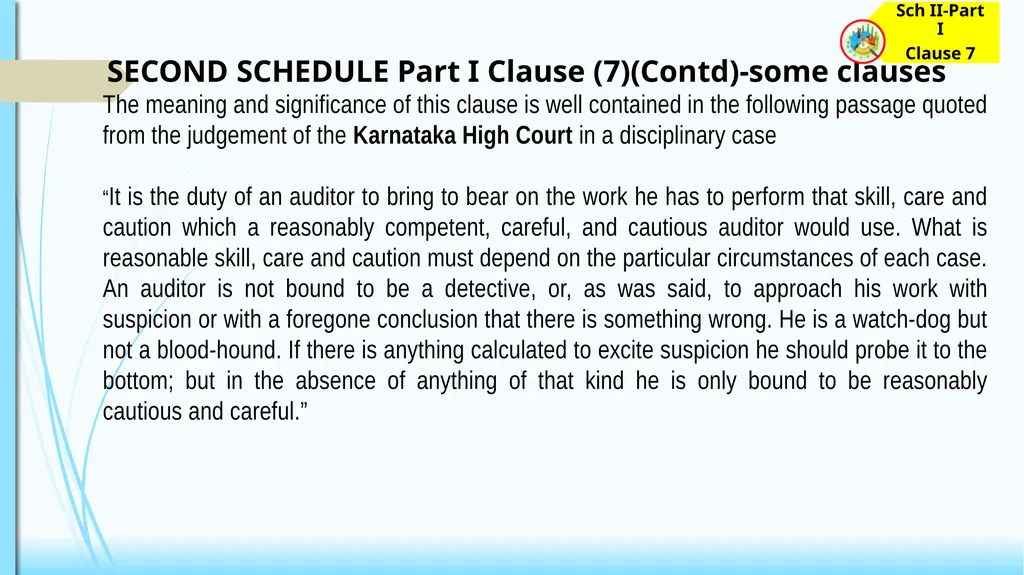
SECOND SCHEDULE Part I Clause (7)(Contd)-some clauses
The meaning and significance of this clause is well contained in the following passage quoted from the judgement of the Karnataka High Court in a disciplinary case
“It is the duty of an auditor to bring to bear on the work he has to perform that skill, care and caution which a reasonably competent, careful, and cautious auditor would use. What is reasonable skill, care and caution must depend on the particular circumstances of each case. An auditor is not bound to be a detective, or, as was said, to approach his work with suspicion or with a foregone conclusion that there is something wrong. He is a watch-dog but not a blood-hound. If there is anything calculated to excite suspicion he should probe it to the bottom; but in the absence of anything of that kind he is only bound to be reasonably cautious and careful.”<br>
The meaning and significance of this clause is well contained in the following passage quoted from the judgement of the Karnataka High Court in a disciplinary case
“It is the duty of an auditor to bring to bear on the work he has to perform that skill, care and caution which a reasonably competent, careful, and cautious auditor would use. What is reasonable skill, care and caution must depend on the particular circumstances of each case. An auditor is not bound to be a detective, or, as was said, to approach his work with suspicion or with a foregone conclusion that there is something wrong. He is a watch-dog but not a blood-hound. If there is anything calculated to excite suspicion he should probe it to the bottom; but in the absence of anything of that kind he is only bound to be reasonably cautious and careful.”<br>
41
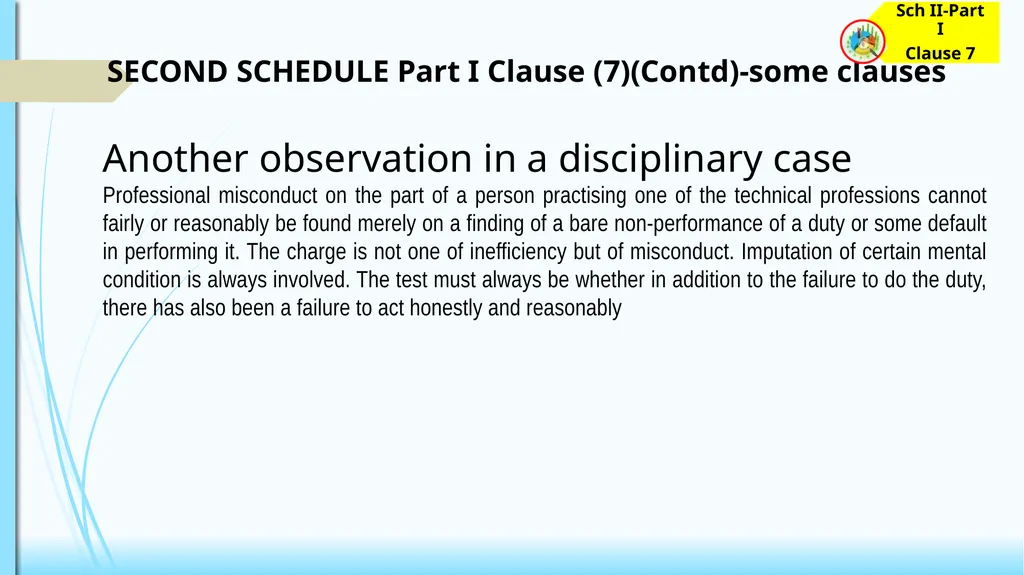
SECOND SCHEDULE Part I Clause (7)(Contd)-some clauses
Another observation in a disciplinary case
Professional misconduct on the part of a person practising one of the technical professions cannot fairly or reasonably be found merely on a finding of a bare non-performance of a duty or some default in performing it. The charge is not one of inefficiency but of misconduct. Imputation of certain mental condition is always involved. The test must always be whether in addition to the failure to do the duty, there has also been a failure to act honestly and reasonably<br>
Another observation in a disciplinary case
Professional misconduct on the part of a person practising one of the technical professions cannot fairly or reasonably be found merely on a finding of a bare non-performance of a duty or some default in performing it. The charge is not one of inefficiency but of misconduct. Imputation of certain mental condition is always involved. The test must always be whether in addition to the failure to do the duty, there has also been a failure to act honestly and reasonably<br>
42
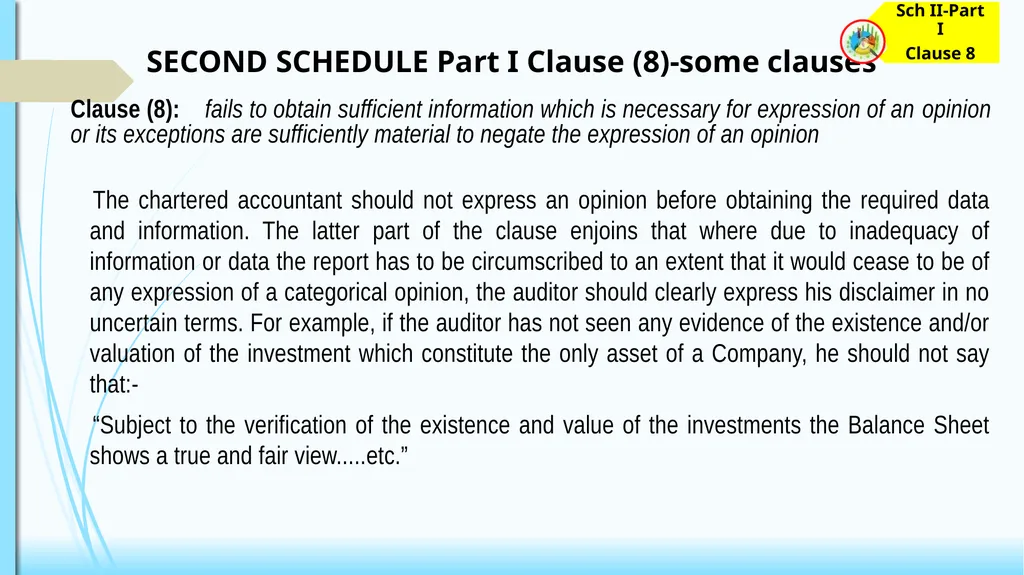
SECOND SCHEDULE Part I Clause (8)-some clauses
Clause (8): fails to obtain sufficient information which is necessary for expression of an opinion
or its exceptions are sufficiently material to negate the expression of an opinion
The chartered accountant should not express an opinion before obtaining the required data and information. The latter part of the clause enjoins that where due to inadequacy of information or data the report has to be circumscribed to an extent that it would cease to be of any expression of a categorical opinion, the auditor should clearly express his disclaimer in no uncertain terms. For example, if the auditor has not seen any evidence of the existence and/or valuation of the investment which constitute the only asset of a Company, he should not say that:-
“Subject to the verification of the existence and value of the investments the Balance Sheet shows a true and fair view.....etc.”<br>
Clause (8): fails to obtain sufficient information which is necessary for expression of an opinion
or its exceptions are sufficiently material to negate the expression of an opinion
The chartered accountant should not express an opinion before obtaining the required data and information. The latter part of the clause enjoins that where due to inadequacy of information or data the report has to be circumscribed to an extent that it would cease to be of any expression of a categorical opinion, the auditor should clearly express his disclaimer in no uncertain terms. For example, if the auditor has not seen any evidence of the existence and/or valuation of the investment which constitute the only asset of a Company, he should not say that:-
“Subject to the verification of the existence and value of the investments the Balance Sheet shows a true and fair view.....etc.”<br>
43
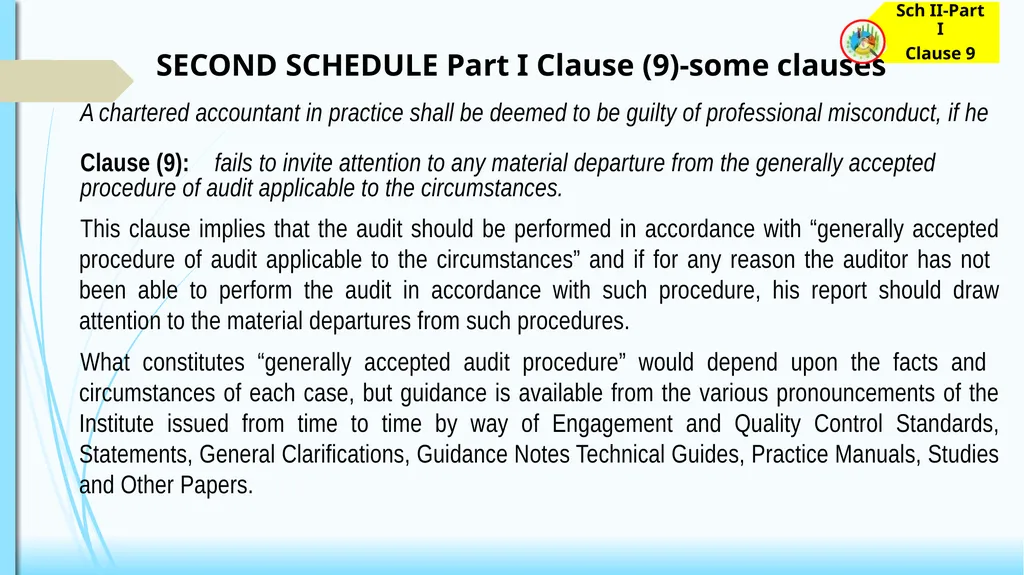
SECOND SCHEDULE Part I Clause (9)-some clauses
A chartered accountant in practice shall be deemed to be guilty of professional misconduct, if he
Clause (9): fails to invite attention to any material departure from the generally accepted
procedure of audit applicable to the circumstances.
This clause implies that the audit should be performed in accordance with “generally accepted procedure of audit applicable to the circumstances” and if for any reason the auditor has not been able to perform the audit in accordance with such procedure, his report should draw attention to the material departures from such procedures.
What constitutes “generally accepted audit procedure” would depend upon the facts and circumstances of each case, but guidance is available from the various pronouncements of the Institute issued from time to time by way of Engagement and Quality Control Standards, Statements, General Clarifications, Guidance Notes Technical Guides, Practice Manuals, Studies and Other Papers.<br>
A chartered accountant in practice shall be deemed to be guilty of professional misconduct, if he
Clause (9): fails to invite attention to any material departure from the generally accepted
procedure of audit applicable to the circumstances.
This clause implies that the audit should be performed in accordance with “generally accepted procedure of audit applicable to the circumstances” and if for any reason the auditor has not been able to perform the audit in accordance with such procedure, his report should draw attention to the material departures from such procedures.
What constitutes “generally accepted audit procedure” would depend upon the facts and circumstances of each case, but guidance is available from the various pronouncements of the Institute issued from time to time by way of Engagement and Quality Control Standards, Statements, General Clarifications, Guidance Notes Technical Guides, Practice Manuals, Studies and Other Papers.<br>
44
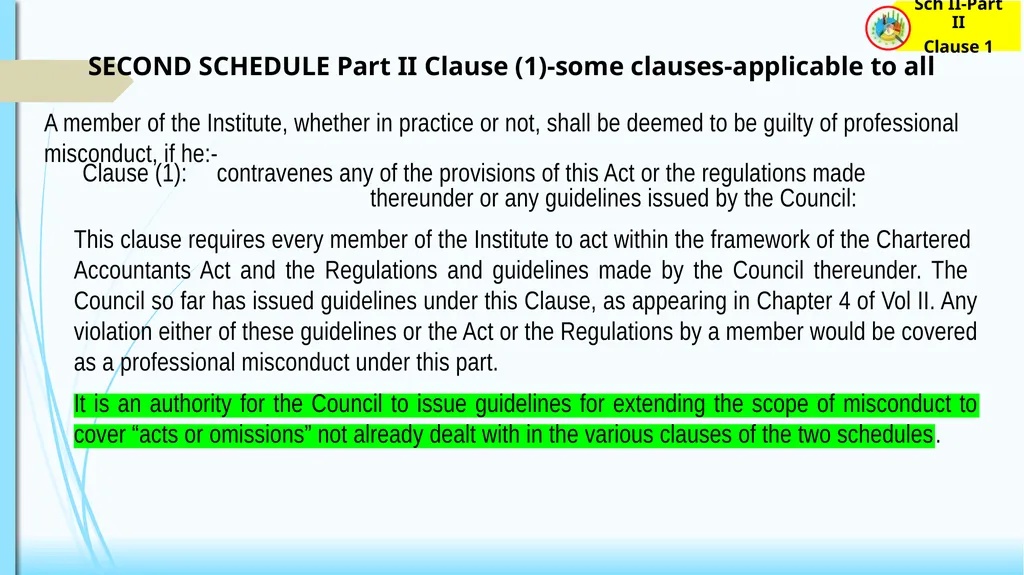
SECOND SCHEDULE Part II Clause (1)-some clauses-applicable to all
A member of the Institute, whether in practice or not, shall be deemed to be guilty of professional misconduct, if he:-
Clause (1): contravenes any of the provisions of this Act or the regulations made
thereunder or any guidelines issued by the Council:
This clause requires every member of the Institute to act within the framework of the Chartered Accountants Act and the Regulations and guidelines made by the Council thereunder. The Council so far has issued guidelines under this Clause, as appearing in Chapter 4 of Vol II. Any violation either of these guidelines or the Act or the Regulations by a member would be covered as a professional misconduct under this part.
It is an authority for the Council to issue guidelines for extending the scope of misconduct to cover “acts or omissions” not already dealt with in the various clauses of the two schedules.<br>
A member of the Institute, whether in practice or not, shall be deemed to be guilty of professional misconduct, if he:-
Clause (1): contravenes any of the provisions of this Act or the regulations made
thereunder or any guidelines issued by the Council:
This clause requires every member of the Institute to act within the framework of the Chartered Accountants Act and the Regulations and guidelines made by the Council thereunder. The Council so far has issued guidelines under this Clause, as appearing in Chapter 4 of Vol II. Any violation either of these guidelines or the Act or the Regulations by a member would be covered as a professional misconduct under this part.
It is an authority for the Council to issue guidelines for extending the scope of misconduct to cover “acts or omissions” not already dealt with in the various clauses of the two schedules.<br>
45
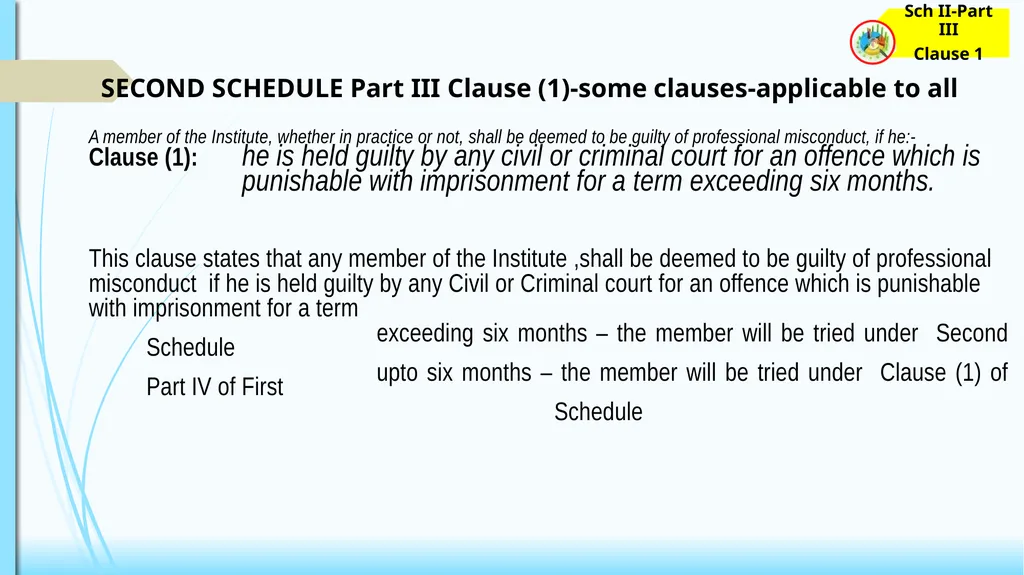
SECOND SCHEDULE Part III Clause (1)-some clauses-applicable to all
A member of the Institute, whether in practice or not, shall be deemed to be guilty of professional misconduct, if he:-
Clause (1): he is held guilty by any civil or criminal court for an offence which is
punishable with imprisonment for a term exceeding six months.
This clause states that any member of the Institute ,shall be deemed to be guilty of professional
misconduct if he is held guilty by any Civil or Criminal court for an offence which is punishable
with imprisonment for a term
exceeding six months – the member will be tried under Second Schedule
upto six months – the member will be tried under Clause (1) of Part IV of First
Schedule<br>
A member of the Institute, whether in practice or not, shall be deemed to be guilty of professional misconduct, if he:-
Clause (1): he is held guilty by any civil or criminal court for an offence which is
punishable with imprisonment for a term exceeding six months.
This clause states that any member of the Institute ,shall be deemed to be guilty of professional
misconduct if he is held guilty by any Civil or Criminal court for an offence which is punishable
with imprisonment for a term
exceeding six months – the member will be tried under Second Schedule
upto six months – the member will be tried under Clause (1) of Part IV of First
Schedule<br>
46
Any further Questions ??? 47 QUESTIONS ????<br>