04
Common reactions to implementing a code review practice Why unnecessarily prolong an already tedious task?
Costly in terms of time and personnel
Unwillingness to share work that was energy- and time-consuming
Fear that others will find out that I am not smart (or even good) at code writing
Fear of finding a bug that will pulverize all my findings
→ Fear of “free-riders”, “know-it-all”s, “naming-and-shaming”<br>
05
Famous example 1 Reinhard and Rogoff, 2010, “Growth in a Time of Debt”: when national debts approach 90% of gross domestic product, economic growth dropped off sharply → used to justfy austerity policies in response to the Great Recession of 2008
Study conclusions based on data omissions, unconventional weighting procedures, and a coding error
Bloomberg Businessweek, 2013: “The Excel Error that Changed History”
Vable, A. M., Diehl, S. F., & Glymour, M. M. (2021). Code Review as a Simple Trick to Enhance Reproducibility, Accelerate Learning, and Improve the Quality of Your Team’s Research. American Journal of Epidemiology. doi: 10.1093/aje/kwab092<br>
06
Famous example 2 Coding error led to retraction of study reporting effects of an RCT
From the retraction: “The identified programming error was in a file used for preparation of the analytic data sets for statistical analysis and occurred while the variable referring to the study “arm” (ie, group) assignment was recoded. The purpose of the recoding was to change the randomization assignment variable format of “1, 2” to a binary format of “0, 1.” However, the assignment was made incorrectly and resulted in a reversed coding of the study groups. “
Aboumater H, Robert A. Wise. Notice of Retraction. Aboumatar et al. Effect of a Program Combining Transitional Care and Long-term Self-management Support on Outcomes of Hospitalized Patients With Chronic Obstructive Pulmonary Disease: A Randomized Clinical Trial. JAMA. 2018;320(22):2. JAMA J Am Med Assoc. 2019;322(14).<br>
07
Reviewing: Ubiquitous practice in research Grant proposal reviewing by peers
Ethical review in line with ethical standards/research integrity
Manuscript review (revision) by co-authors
Manuscript review by peers at journal
Reviewing of policy and practice recommendations by professional societies
Review and co-creation of research by users: practitioners, patients and other stakeholders
… then why not review code as well?<br>
08
Positive outcomes of code review practices Increases confidence of code author and code reviewer
Decreases stress
Accelerates learning
Contributes to team building
Codifys best practices
Vable, A. M., Diehl, S. F., & Glymour, M. M. (2021). Code Review as a Simple Trick to Enhance Reproducibility, Accelerate Learning, and Improve the Quality of Your Team’s Research. American Journal of Epidemiology. doi: 10.1093/aje/kwab092<br>
09
Code writing: Best practices For group leader/PI:
Code review should be implemented by group leader/PI, normative for all papers arising from the research group
Contextualize as problem-solving exercise rather than error-finding exercise
Encourage friendly, collegial atmosphere
Possibly create a ‘Style Guide’
Vable, A. M., Diehl, S. F., & Glymour, M. M. (2021). Code Review as a Simple Trick to Enhance Reproducibility, Accelerate Learning, and Improve the Quality of Your Team’s Research. American Journal of Epidemiology. doi: 10.1093/aje/kwab092<br>
10
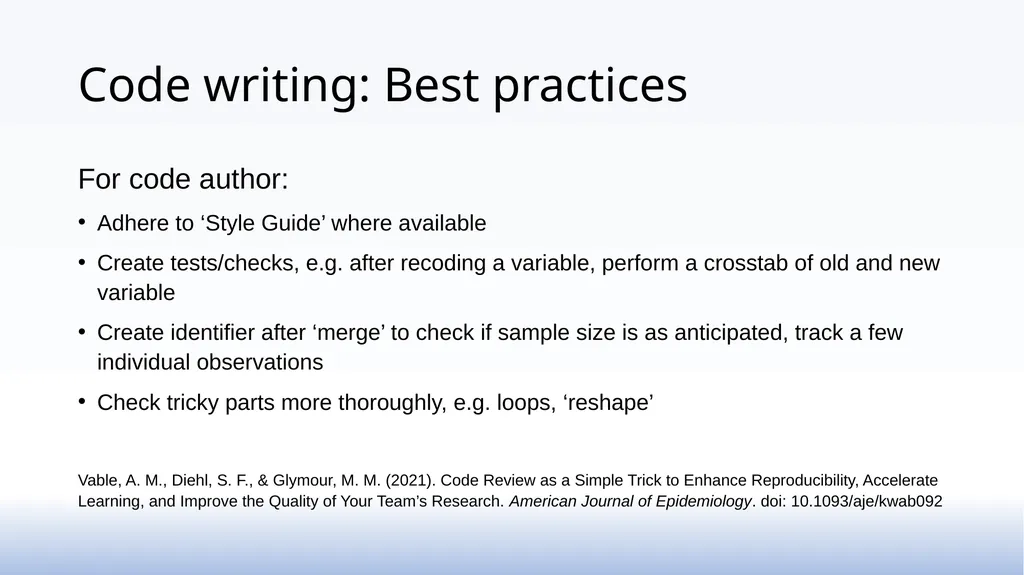
Code writing: Best practices For code author:
Adhere to ‘Style Guide’ where available
Create tests/checks, e.g. after recoding a variable, perform a crosstab of old and new variable
Create identifier after ‘merge’ to check if sample size is as anticipated, track a few individual observations
Check tricky parts more thoroughly, e.g. loops, ‘reshape’
Vable, A. M., Diehl, S. F., & Glymour, M. M. (2021). Code Review as a Simple Trick to Enhance Reproducibility, Accelerate Learning, and Improve the Quality of Your Team’s Research. American Journal of Epidemiology. doi: 10.1093/aje/kwab092<br>
11
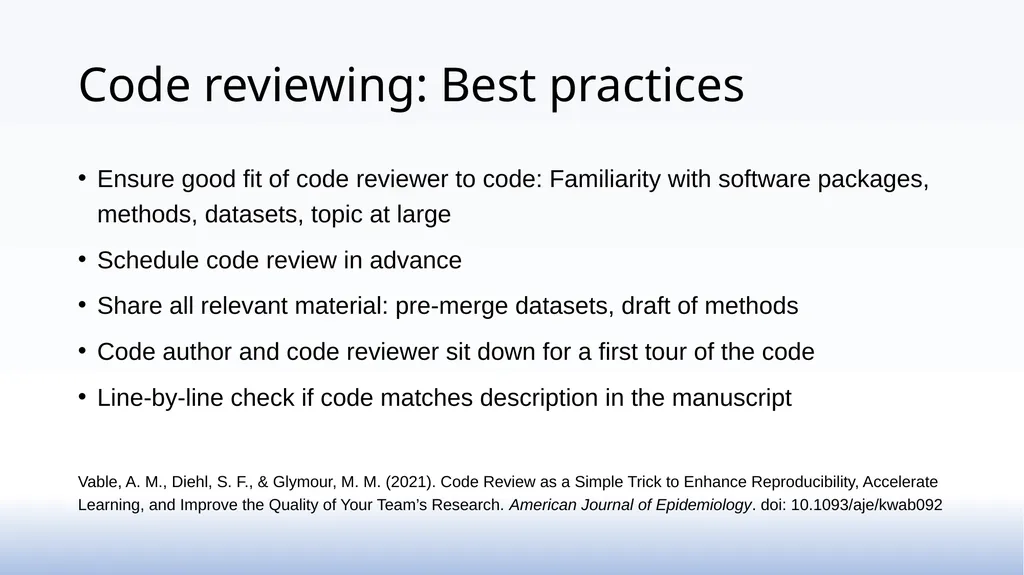
Code reviewing: Best practices Ensure good fit of code reviewer to code: Familiarity with software packages, methods, datasets, topic at large
Schedule code review in advance
Share all relevant material: pre-merge datasets, draft of methods
Code author and code reviewer sit down for a first tour of the code
Line-by-line check if code matches description in the manuscript
Vable, A. M., Diehl, S. F., & Glymour, M. M. (2021). Code Review as a Simple Trick to Enhance Reproducibility, Accelerate Learning, and Improve the Quality of Your Team’s Research. American Journal of Epidemiology. doi: 10.1093/aje/kwab092<br>
12
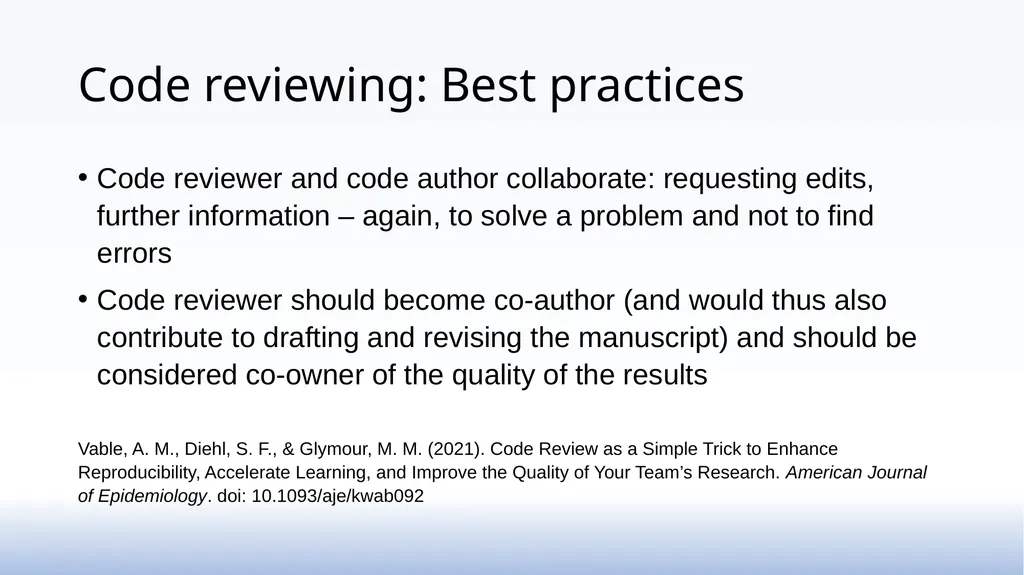
Code reviewing: Best practices Code reviewer and code author collaborate: requesting edits, further information – again, to solve a problem and not to find errors
Code reviewer should become co-author (and would thus also contribute to drafting and revising the manuscript) and should be considered co-owner of the quality of the results
Vable, A. M., Diehl, S. F., & Glymour, M. M. (2021). Code Review as a Simple Trick to Enhance Reproducibility, Accelerate Learning, and Improve the Quality of Your Team’s Research. American Journal of Epidemiology. doi: 10.1093/aje/kwab092<br>
13
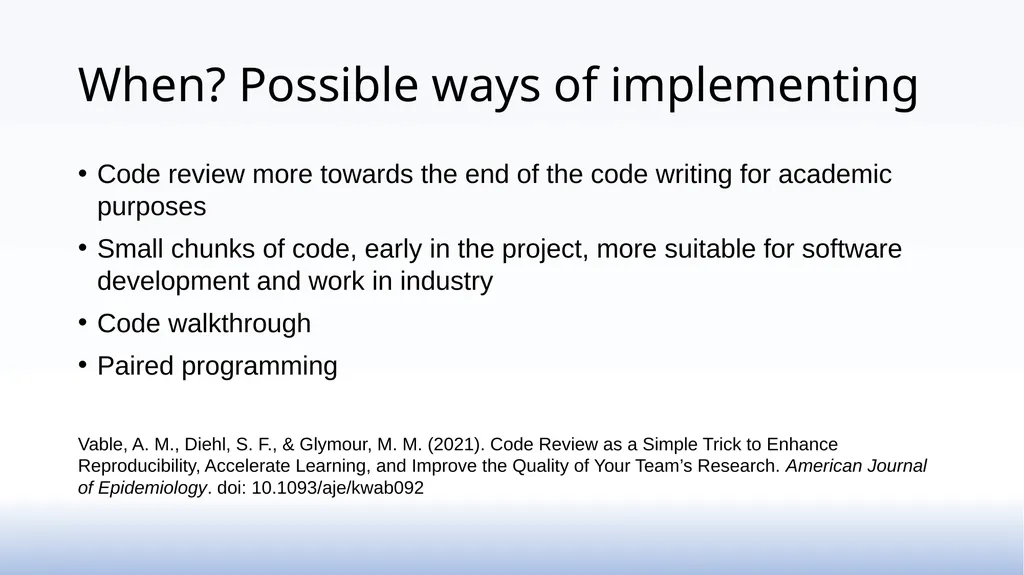
When? Possible ways of implementing Code review more towards the end of the code writing for academic purposes
Small chunks of code, early in the project, more suitable for software development and work in industry
Code walkthrough
Paired programming
Vable, A. M., Diehl, S. F., & Glymour, M. M. (2021). Code Review as a Simple Trick to Enhance Reproducibility, Accelerate Learning, and Improve the Quality of Your Team’s Research. American Journal of Epidemiology. doi: 10.1093/aje/kwab092<br>
14
Specifics See the ‘Style Guide’ in Vable et al. (2021)
Create section headers, e.g. merge datasets, clean variables, appendix analyses
Remove redundancies and experimental code, but include tests of code
When recoding, always generate a new variable
Order code in the same order as presented in the manuscript
Define the analytic sample: 1 – eligible, 0 – ineligible
Dichotomous variables: 0 – no, 1 – yes (e.g. ‘female’ instead of ‘sex’)<br>
15
“Humans are fallible: If your research group uses code written by humans, code review is a must.”
Vable, A. M., Diehl, S. F., & Glymour, M. M. (2021). Code Review as a Simple Trick to Enhance Reproducibility, Accelerate Learning, and Improve the Quality of Your Team’s Research. American Journal of Epidemiology. doi: 10.1093/aje/kwab092<br>