
Cold Read Questions: Act One AN INSPECTOR CALLS 1
T
Published · 15 slides · 0 views

1 / 1
Description
Cold Read Questions: Act One AN INSPECTOR CALLS 1 READ THE PLAY 1. What are our first impressions of the Birling family based on their descriptions in the stage directions? Mr Birling: A heavy-looking, rather portentous man in his middle
Related Topics
Share
Embed code
Download this presentation From Below
"Cold Read Questions: Act One AN INSPECTOR CALLS 1" is the property of its rightful owner. Permission is granted to download and print the materials on this website for personal, non-commercial use only, and to display it on your personal computer provided you do not modify the materials and that you retain all copyright notices contained in the materials. By downloading content from our website, you accept the terms of this agreement.
Presentation Transcript
01
Cold Read Questions:
Act One AN INSPECTOR
CALLS 1<br>
Act One AN INSPECTOR
CALLS 1<br>
02
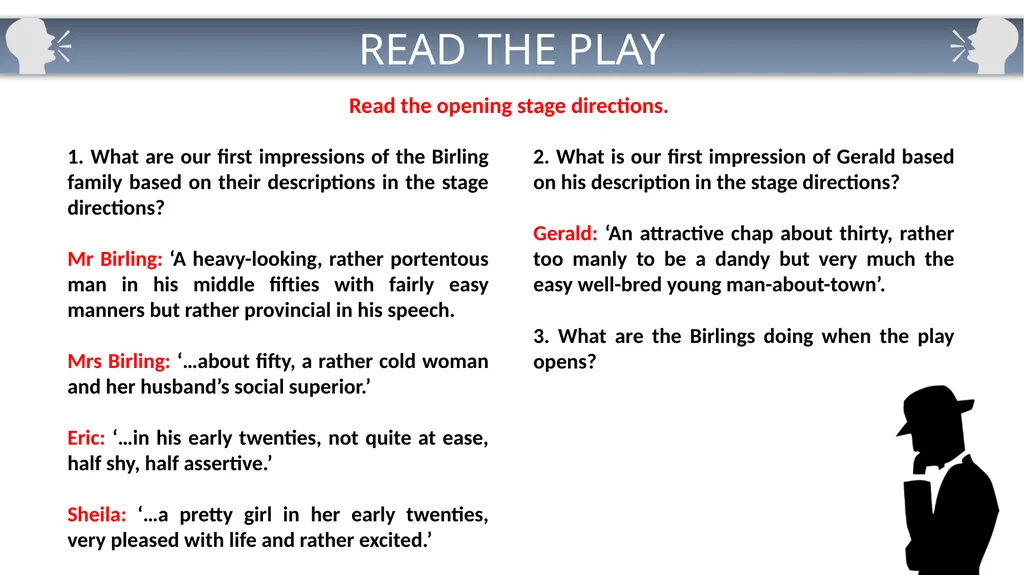
READ THE PLAY 1. What are our first impressions of the Birling family based on their descriptions in the stage directions?
Mr Birling: ‘A heavy-looking, rather portentous man in his middle fifties with fairly easy manners but rather provincial in his speech.
Mrs Birling: ‘…about fifty, a rather cold woman and her husband’s social superior.’
Eric: ‘…in his early twenties, not quite at ease, half shy, half assertive.’
Sheila: ‘…a pretty girl in her early twenties, very pleased with life and rather excited.’ Read the opening stage directions. 2. What is our first impression of Gerald based on his description in the stage directions?
Gerald: ‘An attractive chap about thirty, rather too manly to be a dandy but very much the easy well-bred young man-about-town’. 3. What are the Birlings doing when the play opens?<br>
Mr Birling: ‘A heavy-looking, rather portentous man in his middle fifties with fairly easy manners but rather provincial in his speech.
Mrs Birling: ‘…about fifty, a rather cold woman and her husband’s social superior.’
Eric: ‘…in his early twenties, not quite at ease, half shy, half assertive.’
Sheila: ‘…a pretty girl in her early twenties, very pleased with life and rather excited.’ Read the opening stage directions. 2. What is our first impression of Gerald based on his description in the stage directions?
Gerald: ‘An attractive chap about thirty, rather too manly to be a dandy but very much the easy well-bred young man-about-town’. 3. What are the Birlings doing when the play opens?<br>
03
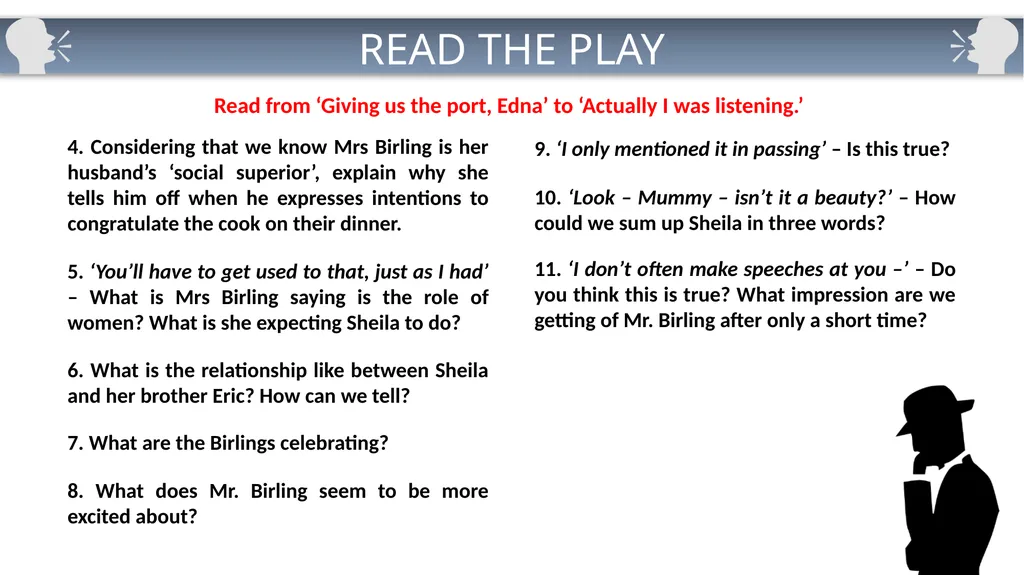
READ THE PLAY Read from ‘Giving us the port, Edna’ to ‘Actually I was listening.’ 4. Considering that we know Mrs Birling is her husband’s ‘social superior’, explain why she tells him off when he expresses intentions to congratulate the cook on their dinner. 5. ‘You’ll have to get used to that, just as I had’ – What is Mrs Birling saying is the role of women? What is she expecting Sheila to do? 6. What is the relationship like between Sheila and her brother Eric? How can we tell? 9. ‘I only mentioned it in passing’ – Is this true? 7. What are the Birlings celebrating? 8. What does Mr. Birling seem to be more excited about? 10. ‘Look – Mummy – isn’t it a beauty?’ – How could we sum up Sheila in three words? 11. ‘I don’t often make speeches at you –’ – Do you think this is true? What impression are we getting of Mr. Birling after only a short time?<br>
04
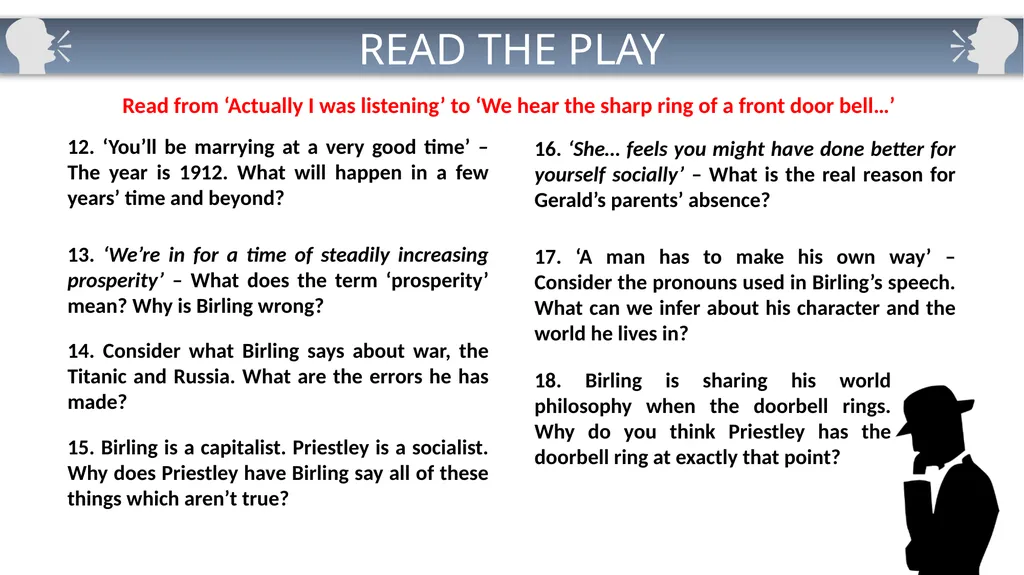
READ THE PLAY Read from ‘Actually I was listening’ to ‘We hear the sharp ring of a front door bell…’ 12. ‘You’ll be marrying at a very good time’ – The year is 1912. What will happen in a few years’ time and beyond? 13. ‘We’re in for a time of steadily increasing prosperity’ – What does the term ‘prosperity’ mean? Why is Birling wrong? 14. Consider what Birling says about war, the Titanic and Russia. What are the errors he has made? 16. ‘She… feels you might have done better for yourself socially’ – What is the real reason for Gerald’s parents’ absence? 15. Birling is a capitalist. Priestley is a socialist. Why does Priestley have Birling say all of these things which aren’t true? 17. ‘A man has to make his own way’ – Consider the pronouns used in Birling’s speech. What can we infer about his character and the world he lives in? 18. Birling is sharing his world philosophy when the doorbell rings. Why do you think Priestley has the doorbell ring at exactly that point?<br>
05
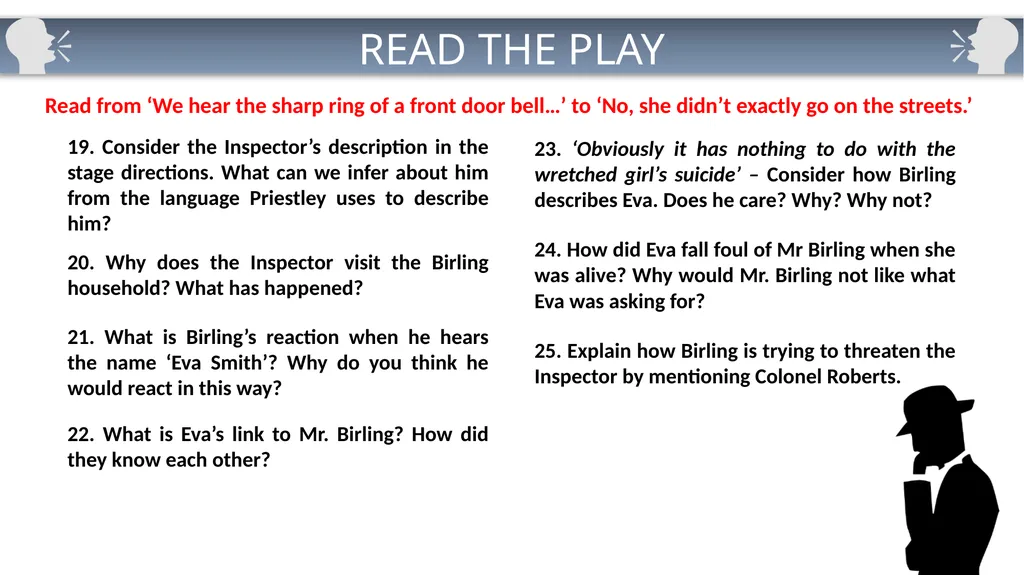
READ THE PLAY Read from ‘We hear the sharp ring of a front door bell…’ to ‘No, she didn’t exactly go on the streets.’ 19. Consider the Inspector’s description in the stage directions. What can we infer about him from the language Priestley uses to describe him? 20. Why does the Inspector visit the Birling household? What has happened? 21. What is Birling’s reaction when he hears the name ‘Eva Smith’? Why do you think he would react in this way? 23. ‘Obviously it has nothing to do with the wretched girl’s suicide’ – Consider how Birling describes Eva. Does he care? Why? Why not? 22. What is Eva’s link to Mr. Birling? How did they know each other? 24. How did Eva fall foul of Mr Birling when she was alive? Why would Mr. Birling not like what Eva was asking for? 25. Explain how Birling is trying to threaten the Inspector by mentioning Colonel Roberts.<br>
06
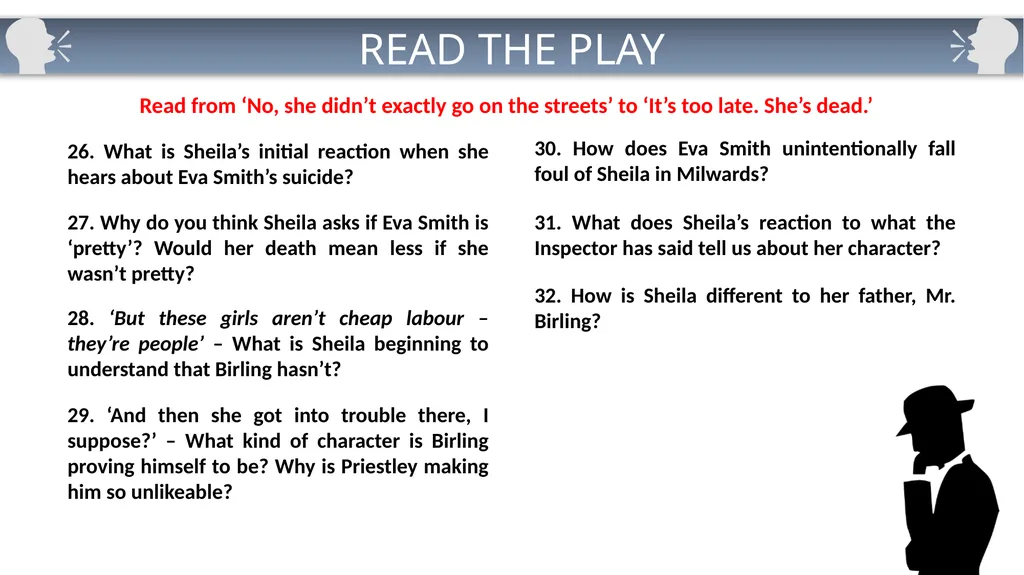
READ THE PLAY Read from ‘No, she didn’t exactly go on the streets’ to ‘It’s too late. She’s dead.’ 26. What is Sheila’s initial reaction when she hears about Eva Smith’s suicide? 27. Why do you think Sheila asks if Eva Smith is ‘pretty’? Would her death mean less if she wasn’t pretty? 28. ‘But these girls aren’t cheap labour – they’re people’ – What is Sheila beginning to understand that Birling hasn’t? 30. How does Eva Smith unintentionally fall foul of Sheila in Milwards? 29. ‘And then she got into trouble there, I suppose?’ – What kind of character is Birling proving himself to be? Why is Priestley making him so unlikeable? 31. What does Sheila’s reaction to what the Inspector has said tell us about her character? 32. How is Sheila different to her father, Mr. Birling?<br>
07
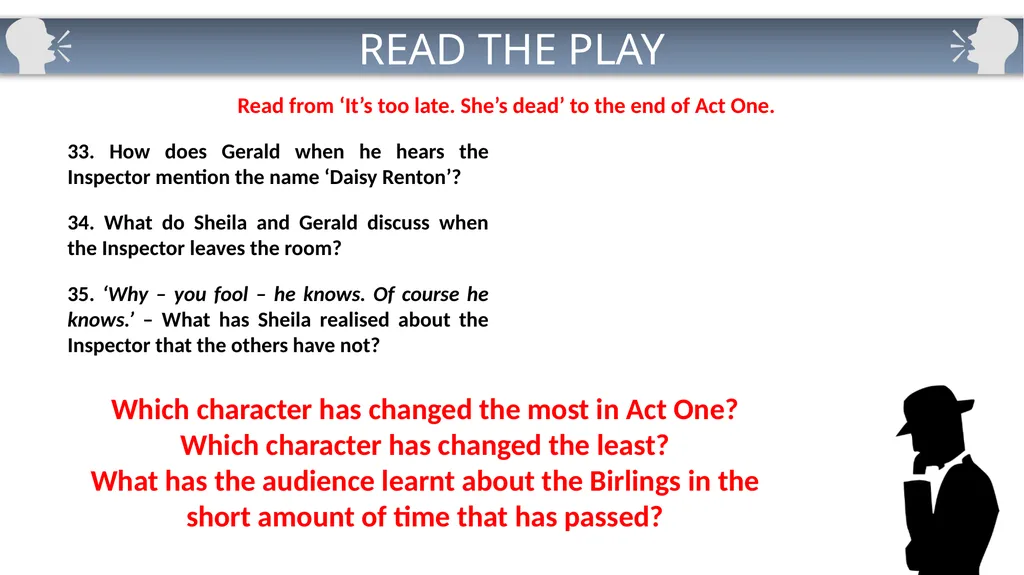
READ THE PLAY Read from ‘It’s too late. She’s dead’ to the end of Act One. 33. How does Gerald when he hears the Inspector mention the name ‘Daisy Renton’? 34. What do Sheila and Gerald discuss when the Inspector leaves the room? 35. ‘Why – you fool – he knows. Of course he knows.’ – What has Sheila realised about the Inspector that the others have not? Which character has changed the most in Act One?
Which character has changed the least?
What has the audience learnt about the Birlings in the short amount of time that has passed?<br>
Which character has changed the least?
What has the audience learnt about the Birlings in the short amount of time that has passed?<br>
08
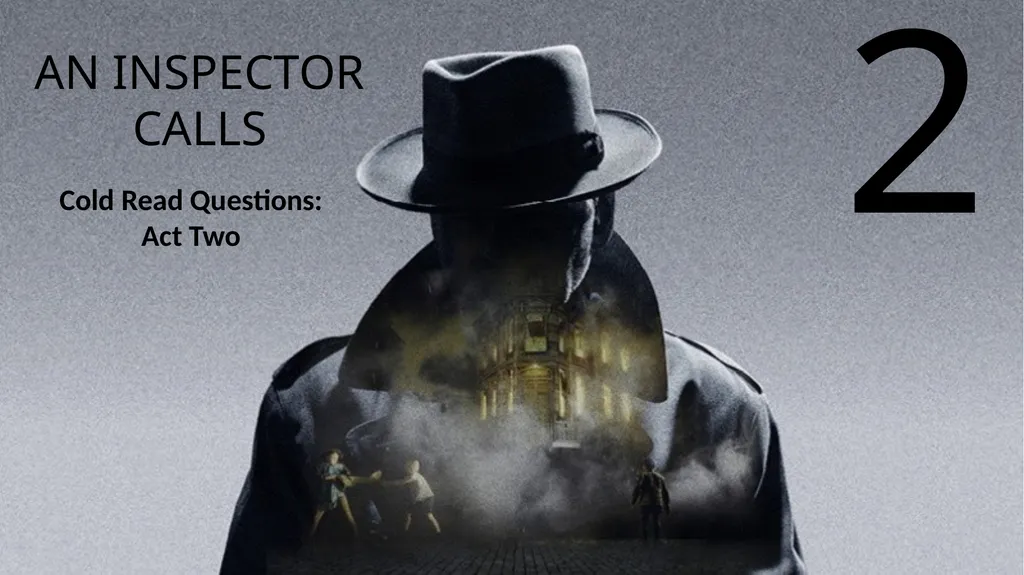
Cold Read Questions:
Act Two AN INSPECTOR
CALLS 2<br>
Act Two AN INSPECTOR
CALLS 2<br>
09
READ THE PLAY Read from the beginning of Act Two to ‘You needn’t give me any rope.’ 1. How have Birling and Gerald treated Eva in the play so far? Why does Gerald try to dismiss Sheila’s behaviour as a result of an ‘exciting and tiring day’? 2. The Inspector ‘massively’ takes charge – What kind of character is the Inspector? 5. Mrs Birling speaks to the Inspector ‘grandly’. What impression do we get of her? 4. ‘We often do on the young ones. They’re more impressionable’ – What is the Inspector saying about the younger generation in society? Is being ‘impressionable’ a good or bad thing? 6. Mrs Birling is unaware that Eric has been drinking. Earlier in the play, she questioned where Sheila picked up the expression, ‘squiffy’. What kind of mother is she? 7. ‘You needn’t give me any rope.’ – What does the Inspector mean? 3. ‘Sheila feels this at once’ – How is Sheila becoming a more perceptive person?<br>
10
READ THE PLAY Read from ‘You needn’t give me any rope’ to ‘She hand him the ring’. 8. ‘It’s a favourite haunt of women in the town’ – Should Gerald really be seen in the stalls bar at the Palace Variety Theatre? 9. Consider how Gerald meets Eva (now known as Daisy). What is your opinion on Gerald’s intentions? 12. Even if Gerald was not engaged to Sheila, would he have been able to keep seeing Daisy? 11. ‘I protest against the way in which my daughter, a young unmarried girl, is being dragged into this’ – Birling still tries to protect his daughter because she is ‘young’ and ‘unmarried’. What does this tell us about society in Edwardian Britain? 13. Even though Gerald ends the affair, his time with Daisy did bring her some happiness. Do you think we, as an audience, should be more sympathetic to Gerald or does he deserve our criticism as much as the Birlings? 14. ‘She hands him the ring’ – Turn back to page 5 where Sheila says, ‘I’ll never let it go out of my sight for an instant.’ What is the significance of Sheila handing back the ring? What does this moment symbolise? 10. ‘I didn’t ask for anything in return’ – Do you think Gerald took advantage of Daisy?<br>
11
READ THE PLAY Read from ‘She hands him the ring’ to the end of Act Two. 15. ‘You and I aren’t’ the same people who sat down to dinner here.’ – How have Sheila and Gerald changed? 16. ‘Public men, Mr Birling, have responsibilities as well as privileges.’ – What is Priestley’s message here? What is the role of the Inspector? 19. Why does Mrs. Birling shun her responsibility? Who does she say should look be responsible for looking after Eva at this point? 18. How does Mrs. Birling act when the Inspector is interrogating her? What does this tell us about her character? 20. What does Mrs Birling say should happen to the baby’s father? Why? 17. How does Mrs Birling know Eva Smith? How does Eva Smith fall foul of Mrs Birling? 21. Now that Eric has been revealed as the father of Eva’s baby, explain how Mrs Birling has unknowingly condemned her son to punishment.<br>
12
Cold Read Questions:
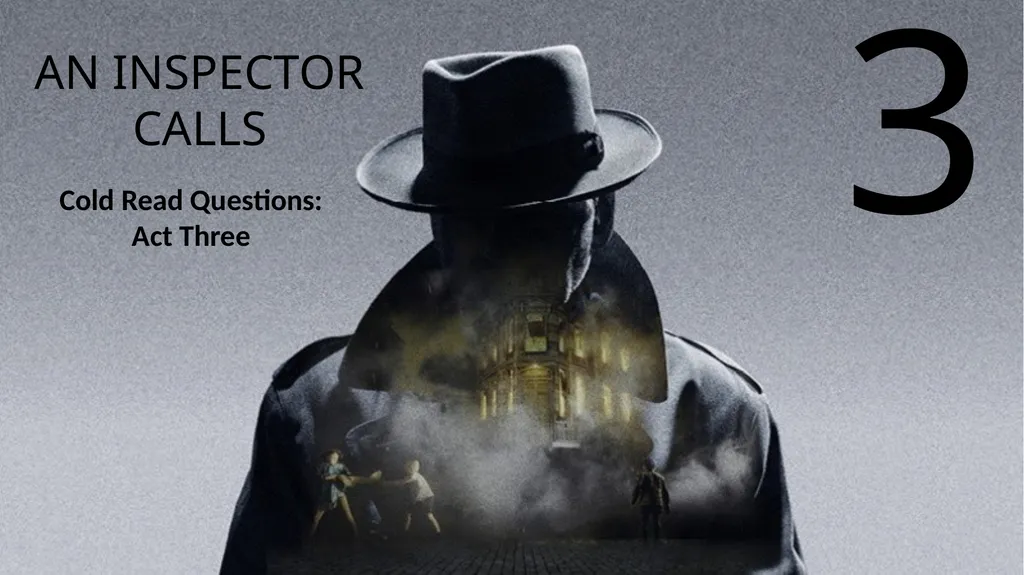
Act Three AN INSPECTOR
CALLS 3<br>
Act Three AN INSPECTOR
CALLS 3<br>
13
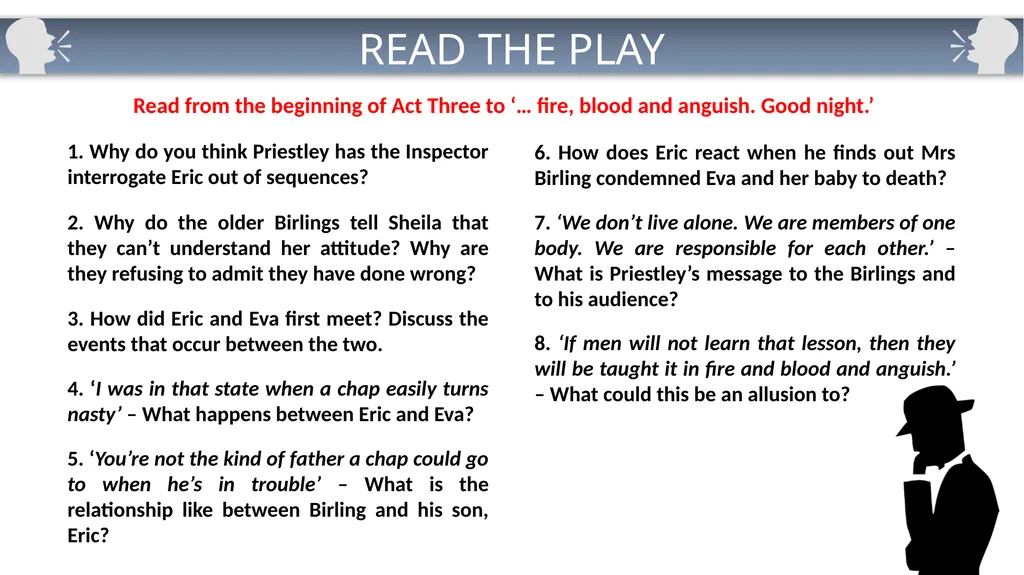
READ THE PLAY Read from the beginning of Act Three to ‘… fire, blood and anguish. Good night.’ 1. Why do you think Priestley has the Inspector interrogate Eric out of sequences? 2. Why do the older Birlings tell Sheila that they can’t understand her attitude? Why are they refusing to admit they have done wrong? 6. How does Eric react when he finds out Mrs Birling condemned Eva and her baby to death? 4. ‘I was in that state when a chap easily turns nasty’ – What happens between Eric and Eva? 7. ‘We don’t live alone. We are members of one body. We are responsible for each other.’ – What is Priestley’s message to the Birlings and to his audience? 8. ‘If men will not learn that lesson, then they will be taught it in fire and blood and anguish.’ – What could this be an allusion to? 3. How did Eric and Eva first meet? Discuss the events that occur between the two. 5. ‘You’re not the kind of father a chap could go to when he’s in trouble’ – What is the relationship like between Birling and his son, Eric?<br>
14
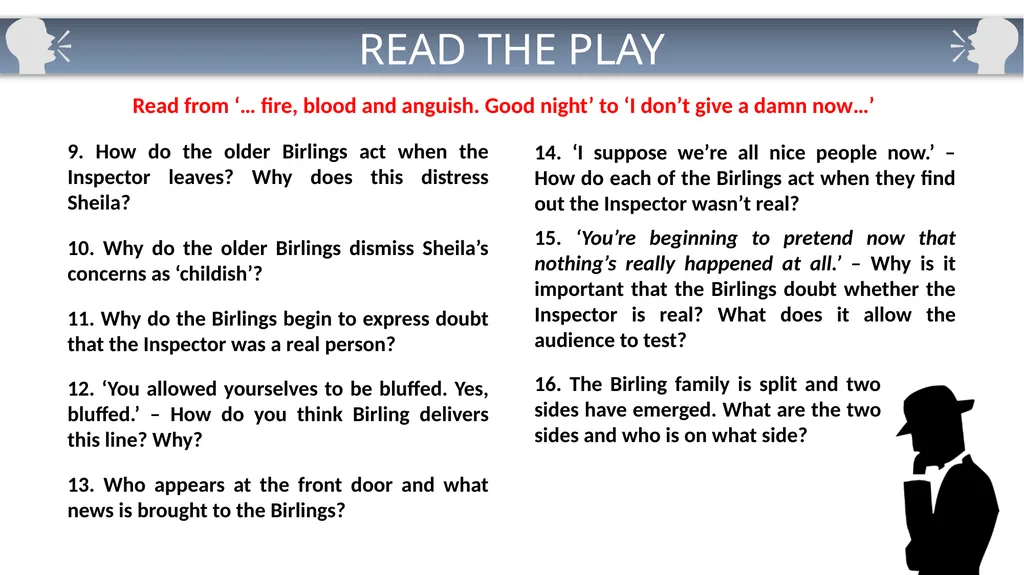
READ THE PLAY Read from ‘… fire, blood and anguish. Good night’ to ‘I don’t give a damn now…’ 9. How do the older Birlings act when the Inspector leaves? Why does this distress Sheila? 10. Why do the older Birlings dismiss Sheila’s concerns as ‘childish’? 14. ‘I suppose we’re all nice people now.’ – How do each of the Birlings act when they find out the Inspector wasn’t real? 12. ‘You allowed yourselves to be bluffed. Yes, bluffed.’ – How do you think Birling delivers this line? Why? 15. ‘You’re beginning to pretend now that nothing’s really happened at all.’ – Why is it important that the Birlings doubt whether the Inspector is real? What does it allow the audience to test? 16. The Birling family is split and two sides have emerged. What are the two sides and who is on what side? 11. Why do the Birlings begin to express doubt that the Inspector was a real person? 13. Who appears at the front door and what news is brought to the Birlings?<br>
15
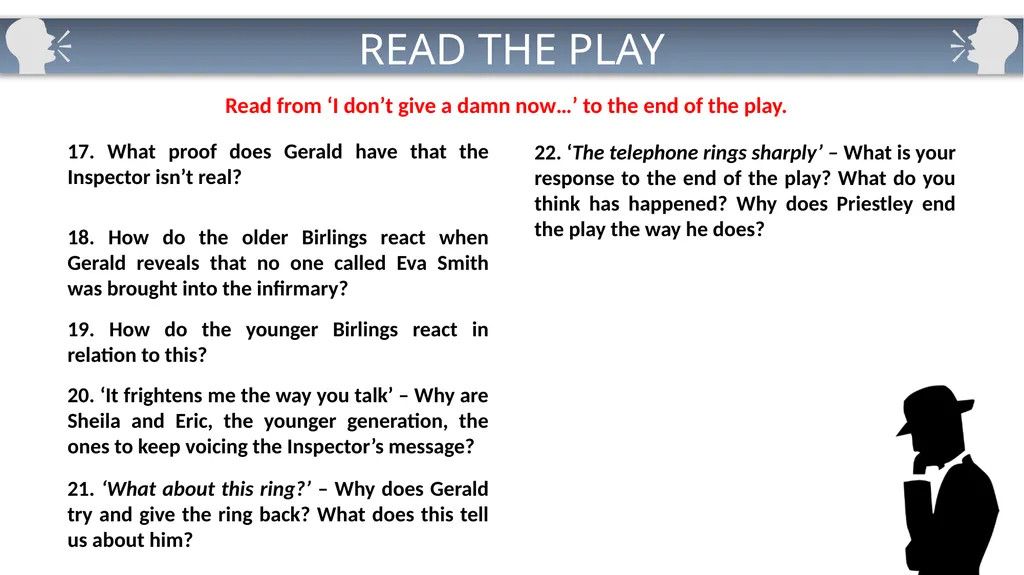
READ THE PLAY Read from ‘I don’t give a damn now…’ to the end of the play. 17. What proof does Gerald have that the Inspector isn’t real? 18. How do the older Birlings react when Gerald reveals that no one called Eva Smith was brought into the infirmary? 22. ‘The telephone rings sharply’ – What is your response to the end of the play? What do you think has happened? Why does Priestley end the play the way he does? 20. ‘It frightens me the way you talk’ – Why are Sheila and Eric, the younger generation, the ones to keep voicing the Inspector’s message? 19. How do the younger Birlings react in relation to this? 21. ‘What about this ring?’ – Why does Gerald try and give the ring back? What does this tell us about him?<br>