
Cold Weather Working Dan Shears National HS&E
TF
Published · 20 slides · 0 views
1 / 1


Description
Cold Weather Working Dan Shears National HSE Director Friday 2nd December 2022 What do we mean by Cold Weather Working? Any work activity taking place in environmental conditions brought about by excessive cold or wet weather This can
Related Topics
Share
Embed code
Download this presentation From Below
"Cold Weather Working Dan Shears National HS&E" is the property of its rightful owner. Permission is granted to download and print the materials on this website for personal, non-commercial use only, and to display it on your personal computer provided you do not modify the materials and that you retain all copyright notices contained in the materials. By downloading content from our website, you accept the terms of this agreement.
Presentation Transcript
01
Cold Weather Working Dan Shears
National HS&E Director
Friday 2nd December 2022<br>
National HS&E Director
Friday 2nd December 2022<br>
02
What do we mean by ‘Cold Weather Working’? Any work activity taking place in environmental conditions brought about by excessive cold or wet weather
This can more than just ice and snow; flooding, fog and mist are also cold weather events
Such events are becoming more frequent as a result of climate change – the flooding incidents of the past few years were not a coincidence
So these events are foreseeable – which means employers should plan for them, and have policies and procedures in place.<br>
This can more than just ice and snow; flooding, fog and mist are also cold weather events
Such events are becoming more frequent as a result of climate change – the flooding incidents of the past few years were not a coincidence
So these events are foreseeable – which means employers should plan for them, and have policies and procedures in place.<br>
03
Health Effects of Extreme Cold Working in cold temperatures can cause the hands and feet to become cold and painful. It can cause loss of feeling making it difficult to carry out detailed work with the hands. In extreme cases exposure to cold can lead to frostbite.
In addition to problems with the hands and feet, working in cold temperatures can lead to a lowering of the body temperature which in turn can cause problems with concentration, tiredness and an increased risk of accidents.
Cold work can increase the risk of workers developing Vibration White Finger, back and other muscular injuries. Workers suffering from breathing problems such as COPD; and heart/circulation conditions may be more sensitive to cold working.
Outdoor workers may be more at risk from developing problems due to the combination of cold air temperatures and strong winds, called the ‘wind chill factor’, and wet conditions.<br>
In addition to problems with the hands and feet, working in cold temperatures can lead to a lowering of the body temperature which in turn can cause problems with concentration, tiredness and an increased risk of accidents.
Cold work can increase the risk of workers developing Vibration White Finger, back and other muscular injuries. Workers suffering from breathing problems such as COPD; and heart/circulation conditions may be more sensitive to cold working.
Outdoor workers may be more at risk from developing problems due to the combination of cold air temperatures and strong winds, called the ‘wind chill factor’, and wet conditions.<br>
04
Health Effects of Extreme Cold Acute Effects:
Hypothermia,
frostbite,
trench foot
Chronic Effects:
Respiratory effects
Cardiovascular effects
Musculoskeletal disorders Cold Stress
Cooling of body parts may result in various cold injuries – nonfreezing injuries, freezing injuries – and hypothermia, which is the most serious.<br>
Hypothermia,
frostbite,
trench foot
Chronic Effects:
Respiratory effects
Cardiovascular effects
Musculoskeletal disorders Cold Stress
Cooling of body parts may result in various cold injuries – nonfreezing injuries, freezing injuries – and hypothermia, which is the most serious.<br>
05
Temperature extremes can result in impaired performance A decrease of 1degree C in core temperature (subclinical hypothermia) may already markedly impair performance and could increase the risk of occupational injuries & accidents.
It’s a safety issue as well as a health issue<br>
It’s a safety issue as well as a health issue<br>
06
Key Risks of Cold Weather Events The first issue is whether workers should attempt to travel into work at all. Issue is both getting to the place of work, and provision to return home if weather remains or deteriorates.
The employer will likely have a policy on this – usually called the “emergency plan” or “business continuity plan” -which stipulates that workers are expected to make ‘reasonable attempts’ to get into work
The Health and Safety at Work Act only applies when at work – but this depends on contract and custom & practice – many members will be working from the moment they leave home, especially those without a fixed workplace.
In addition, the employer cannot put workers at risk in attempting to get to work. It is obviously unreasonable to expect a worker to drive through a blizzard or flood, unless they have the vehicle and equipment to safely do so.<br>
The employer will likely have a policy on this – usually called the “emergency plan” or “business continuity plan” -which stipulates that workers are expected to make ‘reasonable attempts’ to get into work
The Health and Safety at Work Act only applies when at work – but this depends on contract and custom & practice – many members will be working from the moment they leave home, especially those without a fixed workplace.
In addition, the employer cannot put workers at risk in attempting to get to work. It is obviously unreasonable to expect a worker to drive through a blizzard or flood, unless they have the vehicle and equipment to safely do so.<br>
07
What about public sector & utilities workers? Many GMB members work in jobs that expect them to travel during adverse weather – in hospitals, schools, ambulances, local authorities, and making emergency repairs to power and water supplies.
In such cases, the employer may have provided vehicles suitable to drive in the conditions, or adaptive assistance such as snow chains
The decision to travel is a judgement call – the employer may term this a ‘dynamic risk assessment’ – which is acceptable so long as it is understood that the outcome can be a decision not to travel.
It is crucial to assess not just the conditions when beginning work, but also the likely situation on return – there may be potential to be stranded either at the workplace or out at site.<br>
In such cases, the employer may have provided vehicles suitable to drive in the conditions, or adaptive assistance such as snow chains
The decision to travel is a judgement call – the employer may term this a ‘dynamic risk assessment’ – which is acceptable so long as it is understood that the outcome can be a decision not to travel.
It is crucial to assess not just the conditions when beginning work, but also the likely situation on return – there may be potential to be stranded either at the workplace or out at site.<br>
08
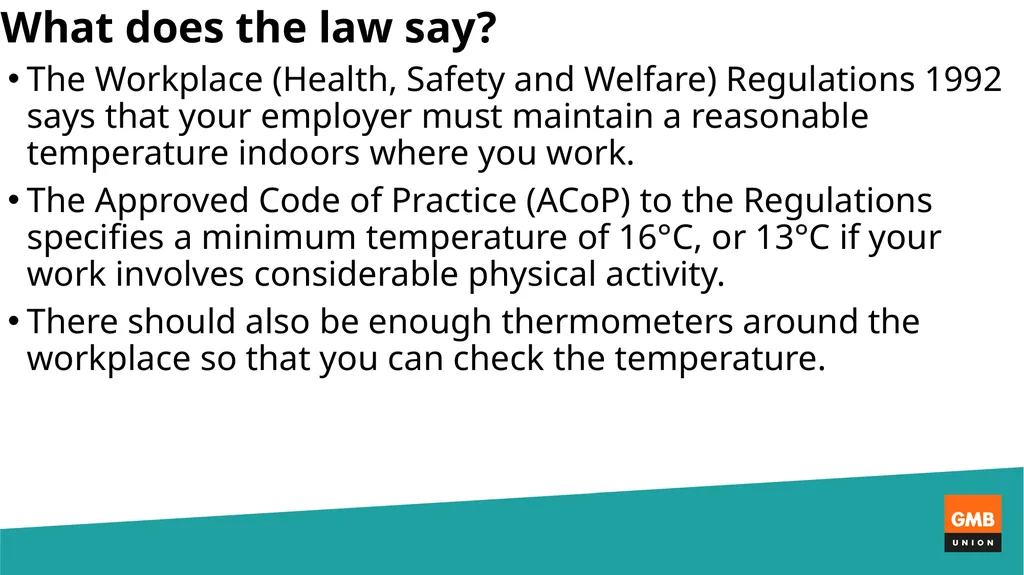
What does the law say? The Workplace (Health, Safety and Welfare) Regulations 1992 says that your employer must maintain a reasonable temperature indoors where you work.
The Approved Code of Practice (ACoP) to the Regulations specifies a minimum temperature of 16°C, or 13°C if your work involves considerable physical activity.
There should also be enough thermometers around the workplace so that you can check the temperature.<br>
The Approved Code of Practice (ACoP) to the Regulations specifies a minimum temperature of 16°C, or 13°C if your work involves considerable physical activity.
There should also be enough thermometers around the workplace so that you can check the temperature.<br>
09
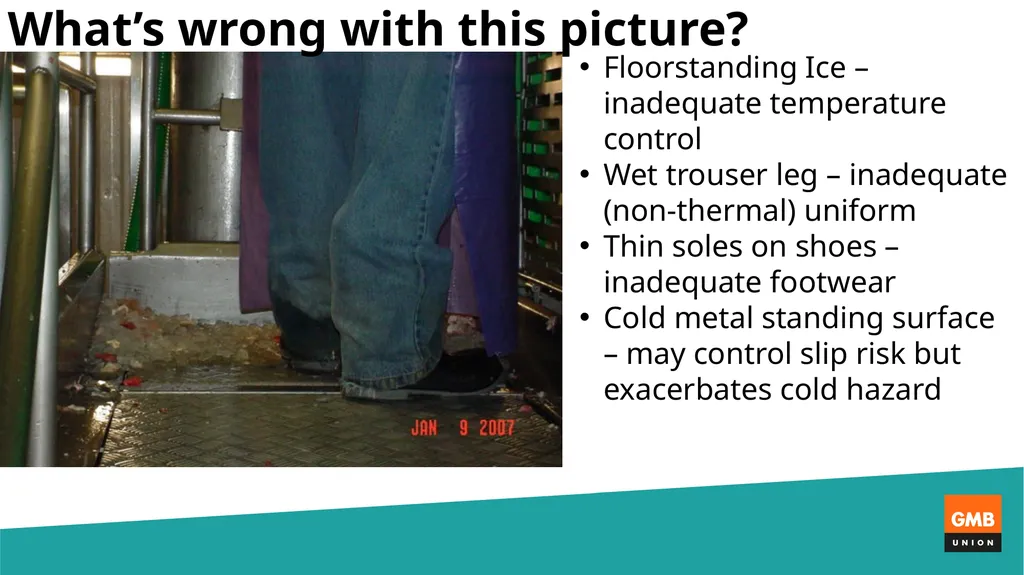
What’s wrong with this picture? Floorstanding Ice – inadequate temperature control
Wet trouser leg – inadequate (non-thermal) uniform
Thin soles on shoes – inadequate footwear
Cold metal standing surface – may control slip risk but exacerbates cold hazard<br>
Wet trouser leg – inadequate (non-thermal) uniform
Thin soles on shoes – inadequate footwear
Cold metal standing surface – may control slip risk but exacerbates cold hazard<br>
10
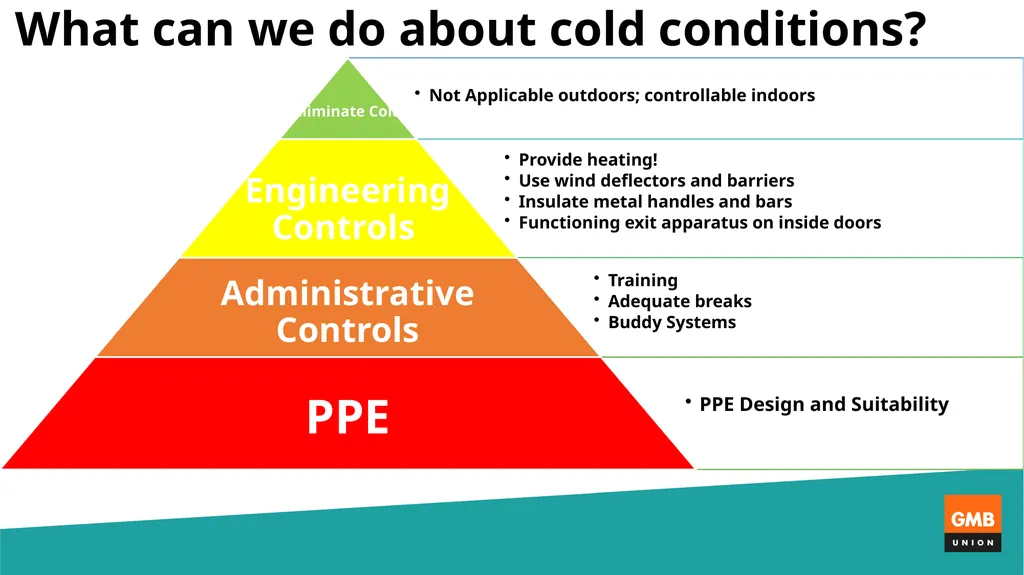
What can we do about cold conditions?<br>
11
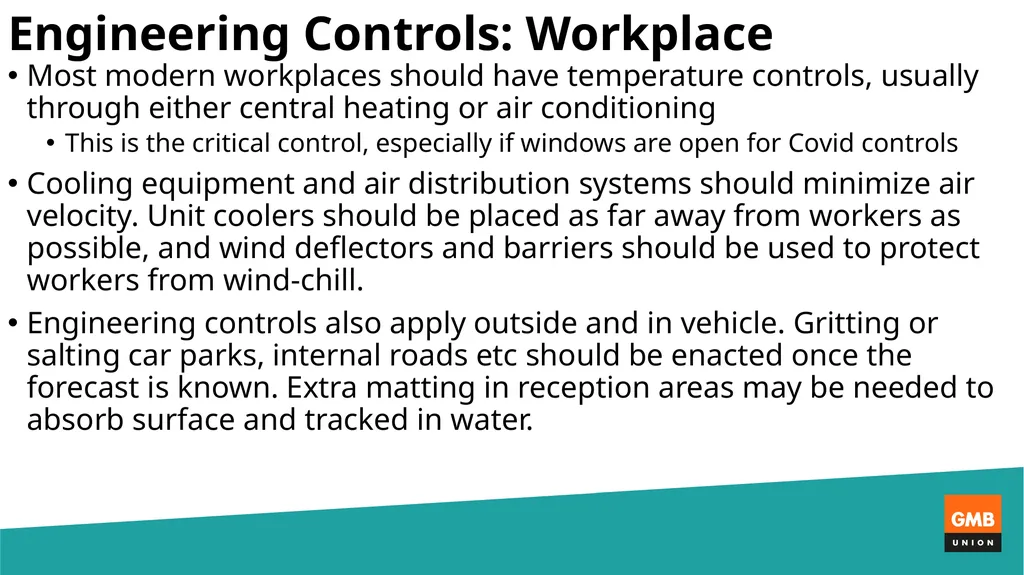
Engineering Controls: Workplace Most modern workplaces should have temperature controls, usually through either central heating or air conditioning
This is the critical control, especially if windows are open for Covid controls
Cooling equipment and air distribution systems should minimize air velocity. Unit coolers should be placed as far away from workers as possible, and wind deflectors and barriers should be used to protect workers from wind-chill.
Engineering controls also apply outside and in vehicle. Gritting or salting car parks, internal roads etc should be enacted once the forecast is known. Extra matting in reception areas may be needed to absorb surface and tracked in water.<br>
This is the critical control, especially if windows are open for Covid controls
Cooling equipment and air distribution systems should minimize air velocity. Unit coolers should be placed as far away from workers as possible, and wind deflectors and barriers should be used to protect workers from wind-chill.
Engineering controls also apply outside and in vehicle. Gritting or salting car parks, internal roads etc should be enacted once the forecast is known. Extra matting in reception areas may be needed to absorb surface and tracked in water.<br>
12
Engineering Controls: Vehicle Provision of de-icer for windscreens and door locks (WD-40 if needed)
Use of vehicle heating, and allowing time for cab to heat up
Provision of snow chains or tyres if needed
Checks and maintenance on lights, wipers and tyres before setting out, and time allocated for this
Additional equipment – snow shovel; phone charger/power pack; blanket; fleece; flask for hot drink
Refresher training on defensive driving in winter,<br>
Use of vehicle heating, and allowing time for cab to heat up
Provision of snow chains or tyres if needed
Checks and maintenance on lights, wipers and tyres before setting out, and time allocated for this
Additional equipment – snow shovel; phone charger/power pack; blanket; fleece; flask for hot drink
Refresher training on defensive driving in winter,<br>
13
Administrative Controls: Signs & Symptoms of cold stress
Mental confusion
Skin changes, especially in colouration
First Aid For Cold Stress
Move the person to a warm, dry area.
Remove wet clothes and replace with dry clothes, cover the body with layers of blankets; Do not cover the face.
Give warm sweetened drinks if alert (not alcohol), to help increase the body temperature. Never try to give a drink to an unconscious person.
Place warm bottles or hot packs in armpits, sides of chest, and groin.<br>
Mental confusion
Skin changes, especially in colouration
First Aid For Cold Stress
Move the person to a warm, dry area.
Remove wet clothes and replace with dry clothes, cover the body with layers of blankets; Do not cover the face.
Give warm sweetened drinks if alert (not alcohol), to help increase the body temperature. Never try to give a drink to an unconscious person.
Place warm bottles or hot packs in armpits, sides of chest, and groin.<br>
14
Working outside in the cold: Control measures include:
provision of thermal protective equipment, layered where possible, waterproof where needed;
giving extra breaks in warm sheltered areas;
providing regular hot drinks;
frequent rotation out of cold environment;
insulation of hand held tools;
slip resistant safety footwear intended for wet weather use.
cleats or snowshoes should be provided in snow conditions and
enhanced oversight of lone workers – check calls and regularly updating including journeys to home.
Gloves must be fit for purpose<br>
provision of thermal protective equipment, layered where possible, waterproof where needed;
giving extra breaks in warm sheltered areas;
providing regular hot drinks;
frequent rotation out of cold environment;
insulation of hand held tools;
slip resistant safety footwear intended for wet weather use.
cleats or snowshoes should be provided in snow conditions and
enhanced oversight of lone workers – check calls and regularly updating including journeys to home.
Gloves must be fit for purpose<br>
15
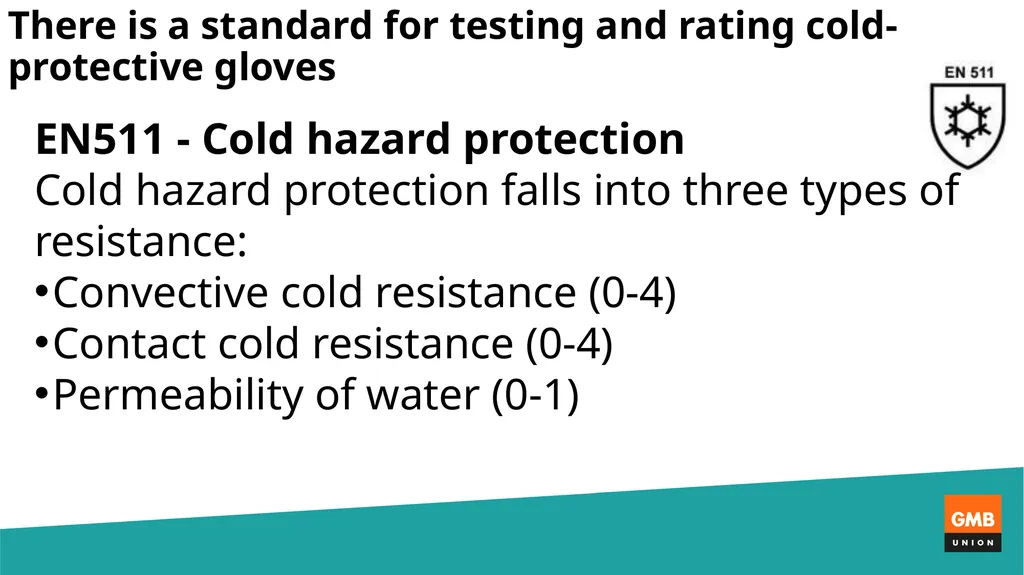
There is a standard for testing and rating cold-protective gloves EN511 - Cold hazard protection
Cold hazard protection falls into three types of resistance:
Convective cold resistance (0-4)
Contact cold resistance (0-4)
Permeability of water (0-1)<br>
Cold hazard protection falls into three types of resistance:
Convective cold resistance (0-4)
Contact cold resistance (0-4)
Permeability of water (0-1)<br>
16
Gloves should fit comfortably<br>
17
Gloves should fit comfortably<br>
18
Frequently asked questions Can I stay at home to look after children if schools are shut? – Potentially yes, but with possible loss of pay or annual leave
Will I get paid if I can’t get into work? – Not necessarily, this will depend on whether the workplace is open or not, and the policy of the employer
Do I get paid if my workplace is closed? – Yes, but you may be asked to work from home or a different location
Should my employer tell customers/clients about disruption? - Employers who interact with the public should use social media to manage customer expectations in affected areas – this will help to reduce violence and aggression risks
What determines if it is safe to travel? – Usually there will be announcements made by local authorities – roads may be flooded or impassable due to snow; buses and trains may not run. If the public are told not to travel, this is good evidence that road travel is unsafe.<br>
Will I get paid if I can’t get into work? – Not necessarily, this will depend on whether the workplace is open or not, and the policy of the employer
Do I get paid if my workplace is closed? – Yes, but you may be asked to work from home or a different location
Should my employer tell customers/clients about disruption? - Employers who interact with the public should use social media to manage customer expectations in affected areas – this will help to reduce violence and aggression risks
What determines if it is safe to travel? – Usually there will be announcements made by local authorities – roads may be flooded or impassable due to snow; buses and trains may not run. If the public are told not to travel, this is good evidence that road travel is unsafe.<br>
19
Organising Actions Talk to members and non-members
Proactive inspection – testing contingency plans
Workplace Meetings if unsatisfactory
Surveys
Threaten HSE/LA if needed
Section 44 Employment Rights Act 1996 if serious and imminent danger<br>
Proactive inspection – testing contingency plans
Workplace Meetings if unsatisfactory
Surveys
Threaten HSE/LA if needed
Section 44 Employment Rights Act 1996 if serious and imminent danger<br>