
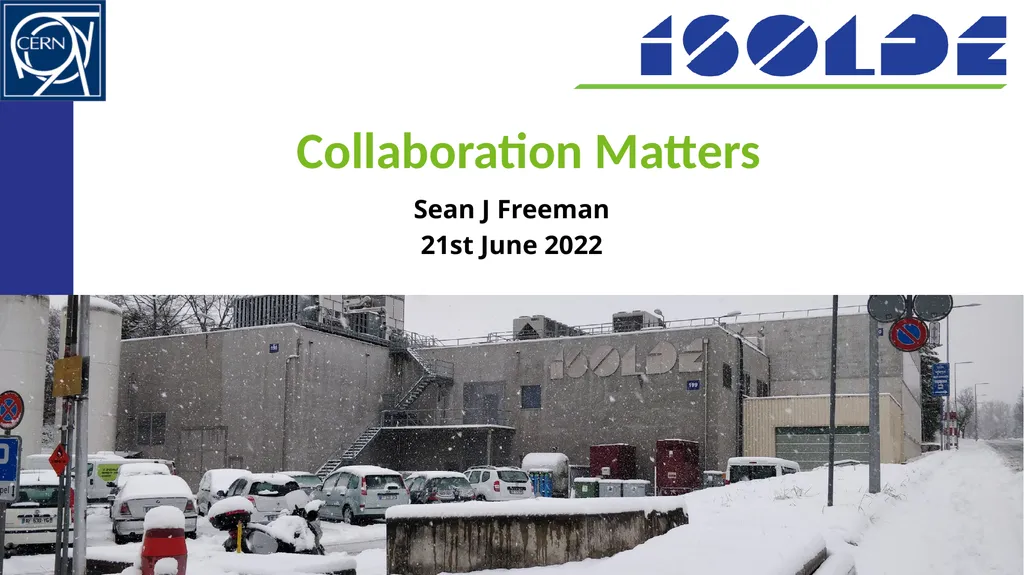
Collaboration Matters Sean J Freeman 21st June
MS
Published · 19 slides · 0 views

1 / 1
Description
Collaboration Matters Sean J Freeman 21st June 2022 Preparation for FRC we will be joined by Helge Meinhard. Collaboration Contributions. MOU Annex Updates. User Support Update. EUROLABS Update. Beam Dumps and 2 GeV. Delivery Issues
Related Topics
Share
Embed code
Download this presentation From Below
"Collaboration Matters Sean J Freeman 21st June" is the property of its rightful owner. Permission is granted to download and print the materials on this website for personal, non-commercial use only, and to display it on your personal computer provided you do not modify the materials and that you retain all copyright notices contained in the materials. By downloading content from our website, you accept the terms of this agreement.
Presentation Transcript
01
Collaboration Matters Sean J Freeman
21st June 2022<br>
21st June 2022<br>
02
Preparation for FRC – we will be joined by Helge Meinhard.
Collaboration Contributions.
MOU Annex Updates.
User Support Update.
EUROLABS Update.
Beam Dumps and 2 GeV.
Delivery Issues Report Back.
Equipment Items for Purchase.
Collaboration with Iran Update.
MOUs for Beam Line Devices and Third-Party Accounts.
H&S and Training.<br>
Collaboration Contributions.
MOU Annex Updates.
User Support Update.
EUROLABS Update.
Beam Dumps and 2 GeV.
Delivery Issues Report Back.
Equipment Items for Purchase.
Collaboration with Iran Update.
MOUs for Beam Line Devices and Third-Party Accounts.
H&S and Training.<br>
03
Preparation for Financial Review Committee Required by the new CERN General Conditions to have an annual financial review. Some additional work – but a good opportunity to talk directly to funding agencies. Introduction (SJF).
General comments on FRC’s at CERN (Helge).
Clarify FRC membership.
Discussion of the draft arrangements and questions concerning the draft FAP report. Next steps:
Discuss details of the arrangements with CERN Directorate and obtain approval.
Identify all the FRC members – ISCC input needed.
Arrange first meeting in Spring 23.<br>
General comments on FRC’s at CERN (Helge).
Clarify FRC membership.
Discussion of the draft arrangements and questions concerning the draft FAP report. Next steps:
Discuss details of the arrangements with CERN Directorate and obtain approval.
Identify all the FRC members – ISCC input needed.
Arrange first meeting in Spring 23.<br>
04
Collaboration Contributions We agreed to extend the CZ-IEAP institutional agreement until CZ are in a position to become a full member – formal re-signing delayed as IEAP budget under negotiation. GR and ZA have been paying 30k CHF (GR since 2010 and ZA since 2015).
Both of these agreements run out in 2022 – so we need to finalise the situation for 2023 and beyond. No current issues with 2022 contributions – most invoices have been sent and several paid. By arrangement, some will be sent later in the year.<br>
Both of these agreements run out in 2022 – so we need to finalise the situation for 2023 and beyond. No current issues with 2022 contributions – most invoices have been sent and several paid. By arrangement, some will be sent later in the year.<br>
05
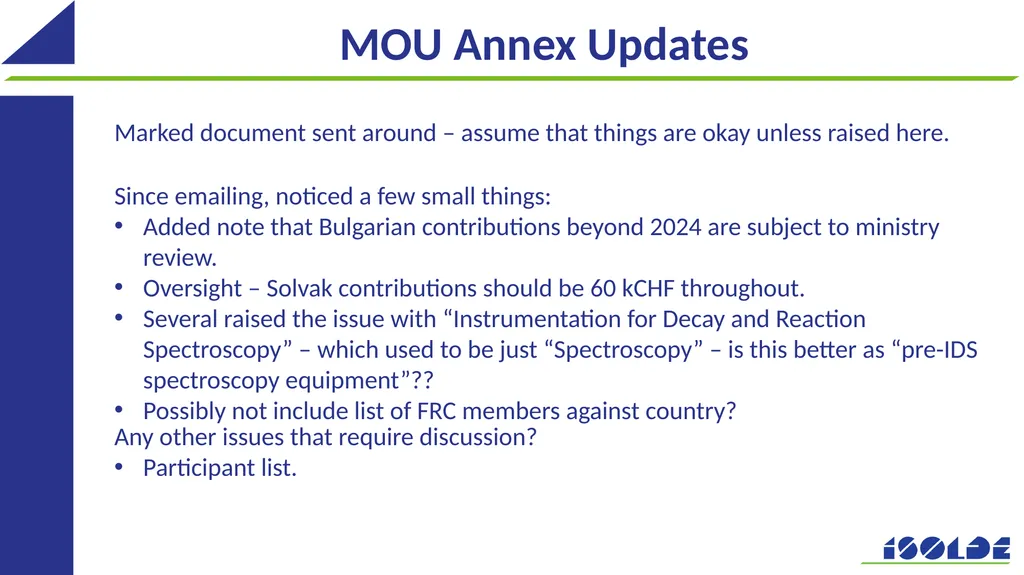
MOU Annex Updates Marked document sent around – assume that things are okay unless raised here. Since emailing, noticed a few small things:
Added note that Bulgarian contributions beyond 2024 are subject to ministry review.
Oversight – Solvak contributions should be 60 kCHF throughout.
Several raised the issue with “Instrumentation for Decay and Reaction Spectroscopy” – which used to be just “Spectroscopy” – is this better as “pre-IDS spectroscopy equipment”??
Possibly not include list of FRC members against country? Any other issues that require discussion?
Participant list.<br>
Added note that Bulgarian contributions beyond 2024 are subject to ministry review.
Oversight – Solvak contributions should be 60 kCHF throughout.
Several raised the issue with “Instrumentation for Decay and Reaction Spectroscopy” – which used to be just “Spectroscopy” – is this better as “pre-IDS spectroscopy equipment”??
Possibly not include list of FRC members against country? Any other issues that require discussion?
Participant list.<br>
06
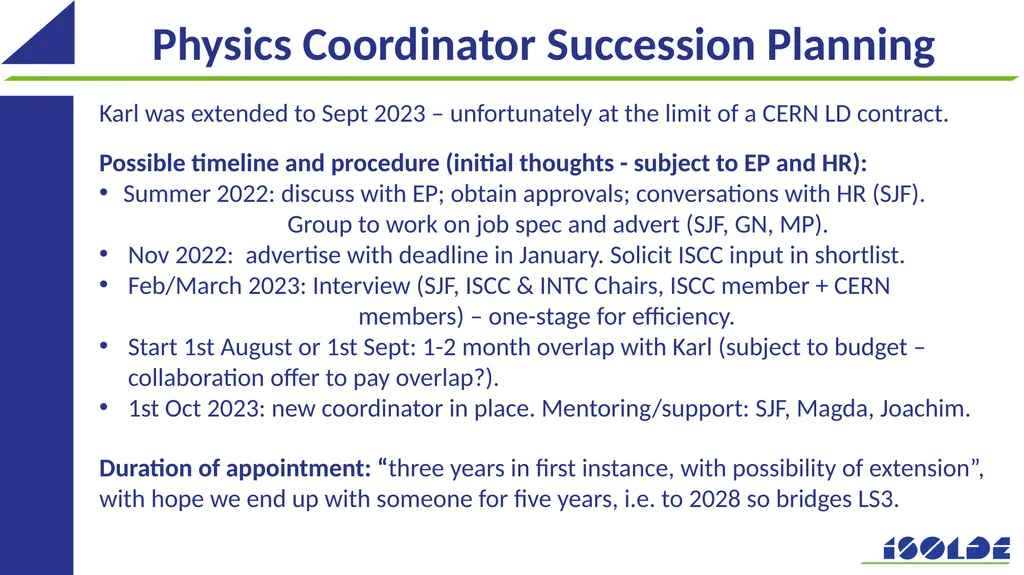
Physics Coordinator Succession Planning Karl was extended to Sept 2023 – unfortunately at the limit of a CERN LD contract. Possible timeline and procedure (initial thoughts - subject to EP and HR):
Summer 2022: discuss with EP; obtain approvals; conversations with HR (SJF).
Group to work on job spec and advert (SJF, GN, MP).
Nov 2022: advertise with deadline in January. Solicit ISCC input in shortlist.
Feb/March 2023: Interview (SJF, ISCC & INTC Chairs, ISCC member + CERN members) – one-stage for efficiency.
Start 1st August or 1st Sept: 1-2 month overlap with Karl (subject to budget – collaboration offer to pay overlap?).
1st Oct 2023: new coordinator in place. Mentoring/support: SJF, Magda, Joachim. Duration of appointment: “three years in first instance, with possibility of extension”, with hope we end up with someone for five years, i.e. to 2028 so bridges LS3.<br>
Summer 2022: discuss with EP; obtain approvals; conversations with HR (SJF).
Group to work on job spec and advert (SJF, GN, MP).
Nov 2022: advertise with deadline in January. Solicit ISCC input in shortlist.
Feb/March 2023: Interview (SJF, ISCC & INTC Chairs, ISCC member + CERN members) – one-stage for efficiency.
Start 1st August or 1st Sept: 1-2 month overlap with Karl (subject to budget – collaboration offer to pay overlap?).
1st Oct 2023: new coordinator in place. Mentoring/support: SJF, Magda, Joachim. Duration of appointment: “three years in first instance, with possibility of extension”, with hope we end up with someone for five years, i.e. to 2028 so bridges LS3.<br>
07
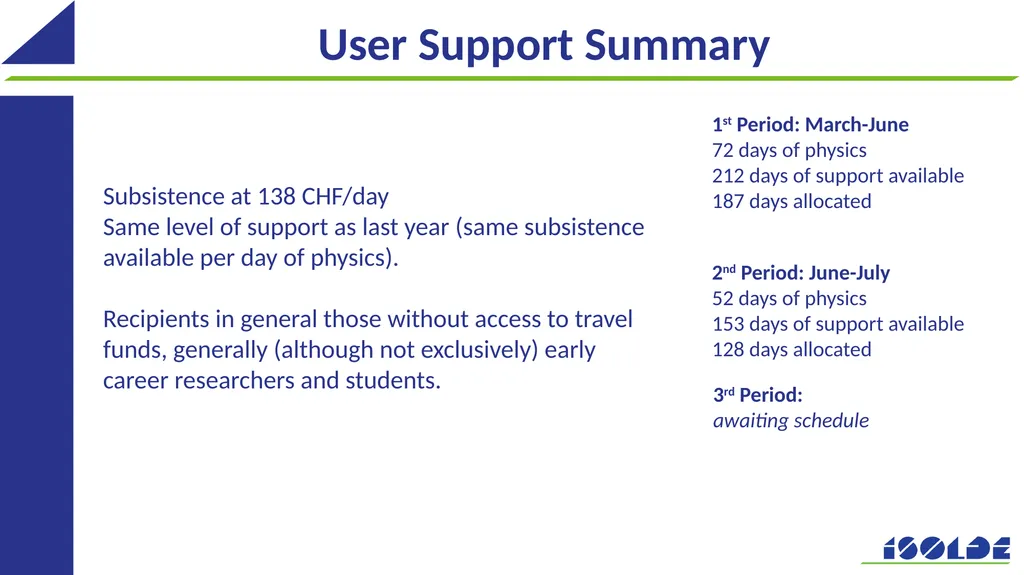
User Support Summary Subsistence at 138 CHF/day
Same level of support as last year (same subsistence available per day of physics).
Recipients in general those without access to travel funds, generally (although not exclusively) early career researchers and students. 1st Period: March-June
72 days of physics
212 days of support available
187 days allocated 2nd Period: June-July
52 days of physics
153 days of support available
128 days allocated 3rd Period:
awaiting schedule<br>
Same level of support as last year (same subsistence available per day of physics).
Recipients in general those without access to travel funds, generally (although not exclusively) early career researchers and students. 1st Period: March-June
72 days of physics
212 days of support available
187 days allocated 2nd Period: June-July
52 days of physics
153 days of support available
128 days allocated 3rd Period:
awaiting schedule<br>
08
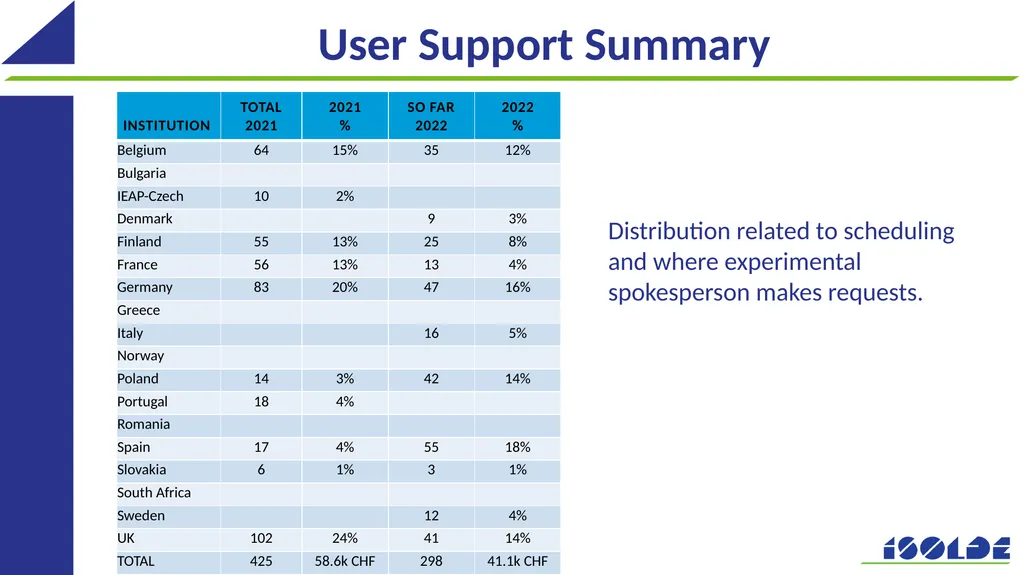
User Support Summary 8 Distribution related to scheduling and where experimental spokesperson makes requests.<br>
09
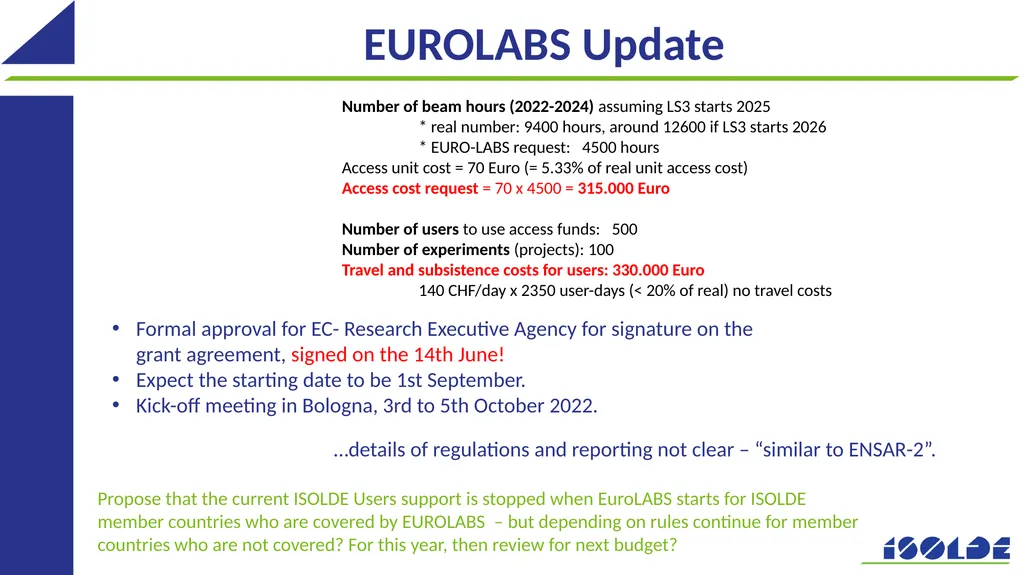
EUROLABS Update Formal approval for EC- Research Executive Agency for signature on the grant agreement, signed on the 14th June!
Expect the starting date to be 1st September.
Kick-off meeting in Bologna, 3rd to 5th October 2022. …details of regulations and reporting not clear – “similar to ENSAR-2”. Number of beam hours (2022-2024) assuming LS3 starts 2025
* real number: 9400 hours, around 12600 if LS3 starts 2026
* EURO-LABS request: 4500 hours
Access unit cost = 70 Euro (= 5.33% of real unit access cost)
Access cost request = 70 x 4500 = 315.000 Euro
Number of users to use access funds: 500
Number of experiments (projects): 100
Travel and subsistence costs for users: 330.000 Euro
140 CHF/day x 2350 user-days (< 20% of real) no travel costs Propose that the current ISOLDE Users support is stopped when EuroLABS starts for ISOLDE member countries who are covered by EUROLABS – but depending on rules continue for member countries who are not covered? For this year, then review for next budget?<br>
Expect the starting date to be 1st September.
Kick-off meeting in Bologna, 3rd to 5th October 2022. …details of regulations and reporting not clear – “similar to ENSAR-2”. Number of beam hours (2022-2024) assuming LS3 starts 2025
* real number: 9400 hours, around 12600 if LS3 starts 2026
* EURO-LABS request: 4500 hours
Access unit cost = 70 Euro (= 5.33% of real unit access cost)
Access cost request = 70 x 4500 = 315.000 Euro
Number of users to use access funds: 500
Number of experiments (projects): 100
Travel and subsistence costs for users: 330.000 Euro
140 CHF/day x 2350 user-days (< 20% of real) no travel costs Propose that the current ISOLDE Users support is stopped when EuroLABS starts for ISOLDE member countries who are covered by EUROLABS – but depending on rules continue for member countries who are not covered? For this year, then review for next budget?<br>
10
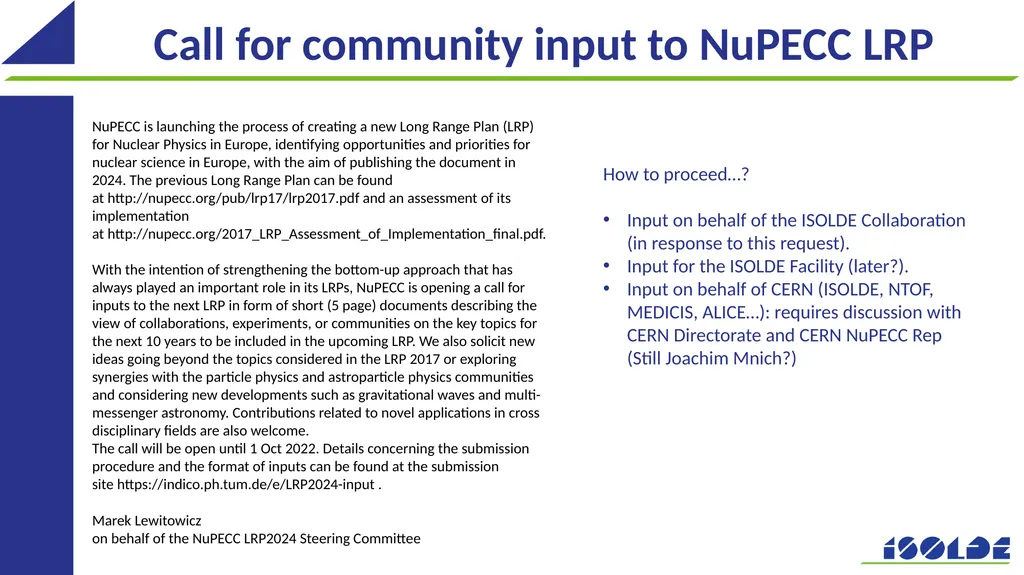
Call for community input to NuPECC LRP NuPECC is launching the process of creating a new Long Range Plan (LRP) for Nuclear Physics in Europe, identifying opportunities and priorities for nuclear science in Europe, with the aim of publishing the document in 2024. The previous Long Range Plan can be found at http://nupecc.org/pub/lrp17/lrp2017.pdf and an assessment of its implementation at http://nupecc.org/2017_LRP_Assessment_of_Implementation_final.pdf.
With the intention of strengthening the bottom-up approach that has always played an important role in its LRPs, NuPECC is opening a call for inputs to the next LRP in form of short (5 page) documents describing the view of collaborations, experiments, or communities on the key topics for the next 10 years to be included in the upcoming LRP. We also solicit new ideas going beyond the topics considered in the LRP 2017 or exploring synergies with the particle physics and astroparticle physics communities and considering new developments such as gravitational waves and multi-messenger astronomy. Contributions related to novel applications in cross disciplinary fields are also welcome.
The call will be open until 1 Oct 2022. Details concerning the submission procedure and the format of inputs can be found at the submission site https://indico.ph.tum.de/e/LRP2024-input .
Marek Lewitowicz
on behalf of the NuPECC LRP2024 Steering Committee How to proceed…?
Input on behalf of the ISOLDE Collaboration (in response to this request).
Input for the ISOLDE Facility (later?).
Input on behalf of CERN (ISOLDE, NTOF, MEDICIS, ALICE…): requires discussion with CERN Directorate and CERN NuPECC Rep (Still Joachim Mnich?)<br>
Input on behalf of the ISOLDE Collaboration (in response to this request).
Input for the ISOLDE Facility (later?).
Input on behalf of CERN (ISOLDE, NTOF, MEDICIS, ALICE…): requires discussion with CERN Directorate and CERN NuPECC Rep (Still Joachim Mnich?)<br>
11
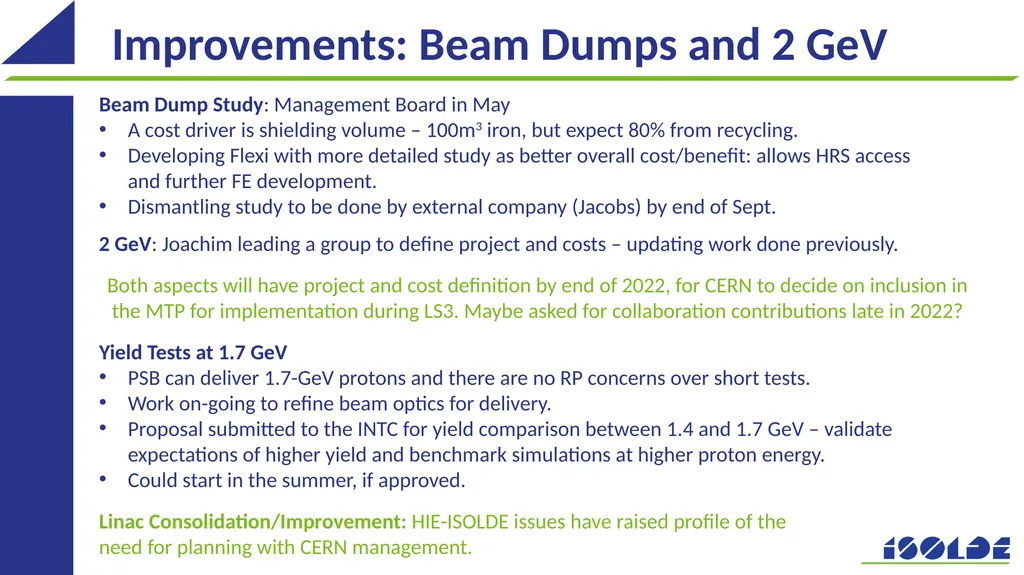
Improvements: Beam Dumps and 2 GeV Beam Dump Study: Management Board in May
A cost driver is shielding volume – 100m3 iron, but expect 80% from recycling.
Developing Flexi with more detailed study as better overall cost/benefit: allows HRS access and further FE development.
Dismantling study to be done by external company (Jacobs) by end of Sept. 2 GeV: Joachim leading a group to define project and costs – updating work done previously. Yield Tests at 1.7 GeV
PSB can deliver 1.7-GeV protons and there are no RP concerns over short tests.
Work on-going to refine beam optics for delivery.
Proposal submitted to the INTC for yield comparison between 1.4 and 1.7 GeV – validate expectations of higher yield and benchmark simulations at higher proton energy.
Could start in the summer, if approved. Both aspects will have project and cost definition by end of 2022, for CERN to decide on inclusion in the MTP for implementation during LS3. Maybe asked for collaboration contributions late in 2022? Linac Consolidation/Improvement: HIE-ISOLDE issues have raised profile of the need for planning with CERN management.<br>
A cost driver is shielding volume – 100m3 iron, but expect 80% from recycling.
Developing Flexi with more detailed study as better overall cost/benefit: allows HRS access and further FE development.
Dismantling study to be done by external company (Jacobs) by end of Sept. 2 GeV: Joachim leading a group to define project and costs – updating work done previously. Yield Tests at 1.7 GeV
PSB can deliver 1.7-GeV protons and there are no RP concerns over short tests.
Work on-going to refine beam optics for delivery.
Proposal submitted to the INTC for yield comparison between 1.4 and 1.7 GeV – validate expectations of higher yield and benchmark simulations at higher proton energy.
Could start in the summer, if approved. Both aspects will have project and cost definition by end of 2022, for CERN to decide on inclusion in the MTP for implementation during LS3. Maybe asked for collaboration contributions late in 2022? Linac Consolidation/Improvement: HIE-ISOLDE issues have raised profile of the need for planning with CERN management.<br>
12
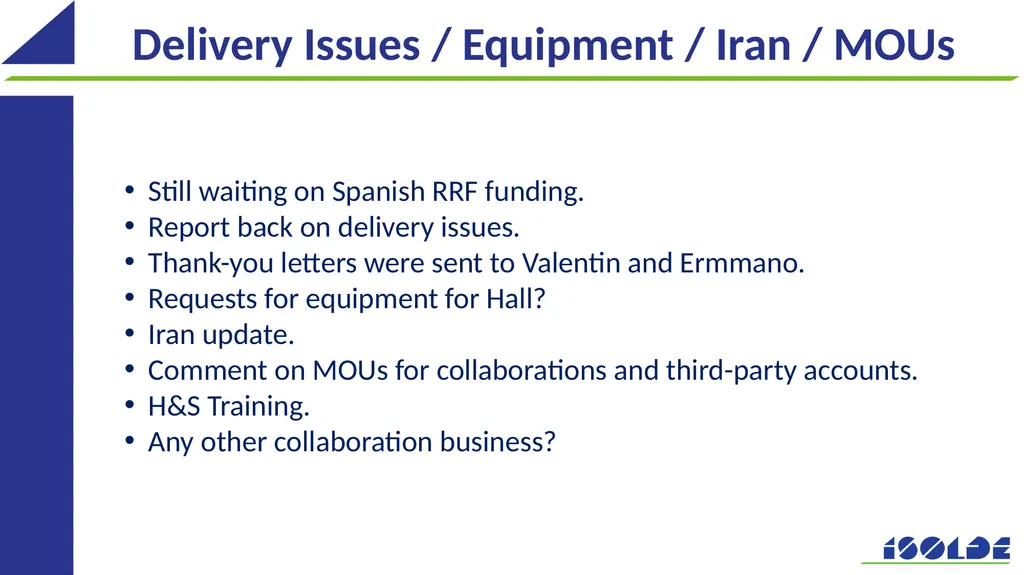
Delivery Issues / Equipment / Iran / MOUs Still waiting on Spanish RRF funding.
Report back on delivery issues.
Thank-you letters were sent to Valentin and Ermmano.
Requests for equipment for Hall?
Iran update.
Comment on MOUs for collaborations and third-party accounts.
H&S Training.
Any other collaboration business?<br>
Report back on delivery issues.
Thank-you letters were sent to Valentin and Ermmano.
Requests for equipment for Hall?
Iran update.
Comment on MOUs for collaborations and third-party accounts.
H&S Training.
Any other collaboration business?<br>
13
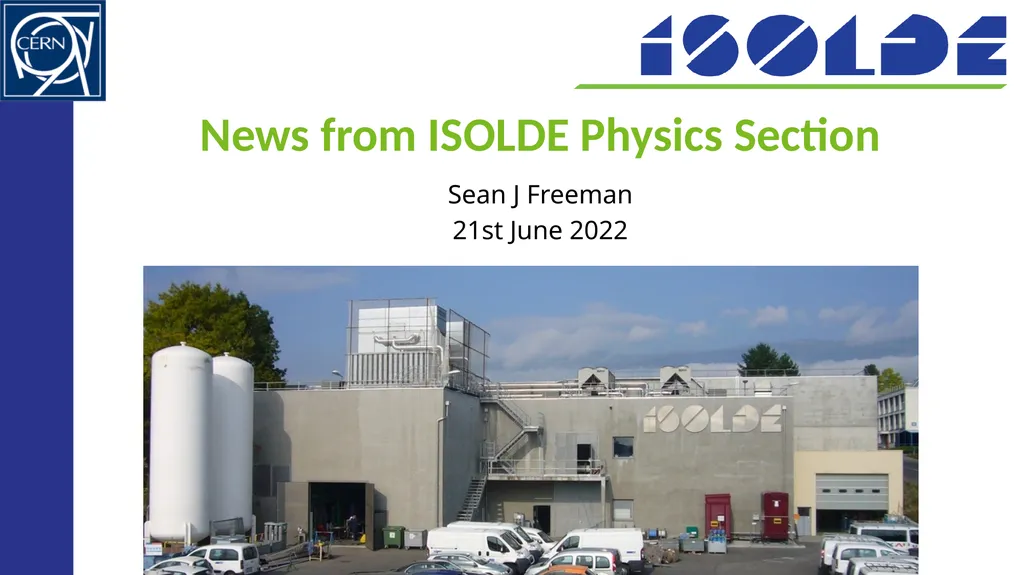
News from ISOLDE Physics Section Sean J Freeman
21st June 2022<br>
21st June 2022<br>
14
Workshop 2022 14 Wednesday 30th November to Friday 2nd December
Planning for 125 participants using the Council Chamber – but will try for a hybrid meeting - INTC will be good learning experience.
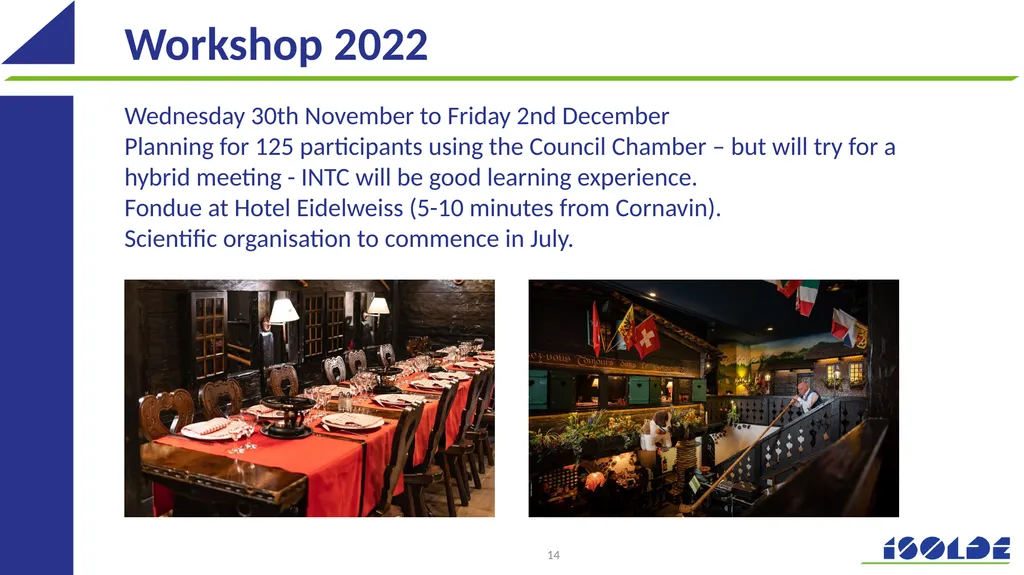
Fondue at Hotel Eidelweiss (5-10 minutes from Cornavin).
Scientific organisation to commence in July.<br>
Planning for 125 participants using the Council Chamber – but will try for a hybrid meeting - INTC will be good learning experience.
Fondue at Hotel Eidelweiss (5-10 minutes from Cornavin).
Scientific organisation to commence in July.<br>
15
EPIC Proceedings 15<br>
16
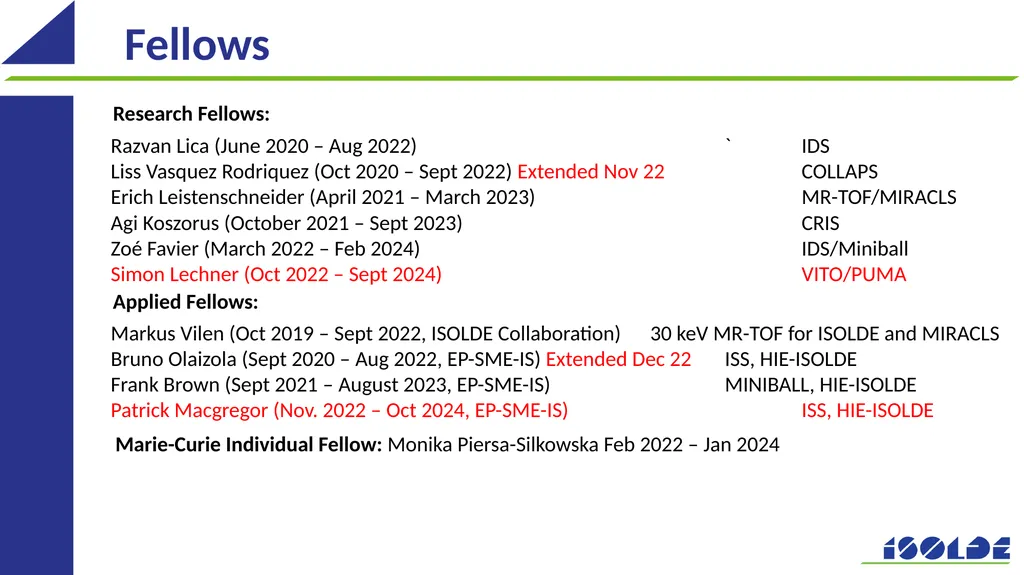
Fellows Razvan Lica (June 2020 – Aug 2022) ` IDS
Liss Vasquez Rodriquez (Oct 2020 – Sept 2022) Extended Nov 22 COLLAPS
Erich Leistenschneider (April 2021 – March 2023) MR-TOF/MIRACLS
Agi Koszorus (October 2021 – Sept 2023) CRIS
Zoé Favier (March 2022 – Feb 2024) IDS/Miniball
Simon Lechner (Oct 2022 – Sept 2024) VITO/PUMA Markus Vilen (Oct 2019 – Sept 2022, ISOLDE Collaboration) 30 keV MR-TOF for ISOLDE and MIRACLS
Bruno Olaizola (Sept 2020 – Aug 2022, EP-SME-IS) Extended Dec 22 ISS, HIE-ISOLDE
Frank Brown (Sept 2021 – August 2023, EP-SME-IS) MINIBALL, HIE-ISOLDE
Patrick Macgregor (Nov. 2022 – Oct 2024, EP-SME-IS) ISS, HIE-ISOLDE Research Fellows: Applied Fellows: Marie-Curie Individual Fellow: Monika Piersa-Silkowska Feb 2022 – Jan 2024<br>
Liss Vasquez Rodriquez (Oct 2020 – Sept 2022) Extended Nov 22 COLLAPS
Erich Leistenschneider (April 2021 – March 2023) MR-TOF/MIRACLS
Agi Koszorus (October 2021 – Sept 2023) CRIS
Zoé Favier (March 2022 – Feb 2024) IDS/Miniball
Simon Lechner (Oct 2022 – Sept 2024) VITO/PUMA Markus Vilen (Oct 2019 – Sept 2022, ISOLDE Collaboration) 30 keV MR-TOF for ISOLDE and MIRACLS
Bruno Olaizola (Sept 2020 – Aug 2022, EP-SME-IS) Extended Dec 22 ISS, HIE-ISOLDE
Frank Brown (Sept 2021 – August 2023, EP-SME-IS) MINIBALL, HIE-ISOLDE
Patrick Macgregor (Nov. 2022 – Oct 2024, EP-SME-IS) ISS, HIE-ISOLDE Research Fellows: Applied Fellows: Marie-Curie Individual Fellow: Monika Piersa-Silkowska Feb 2022 – Jan 2024<br>
17
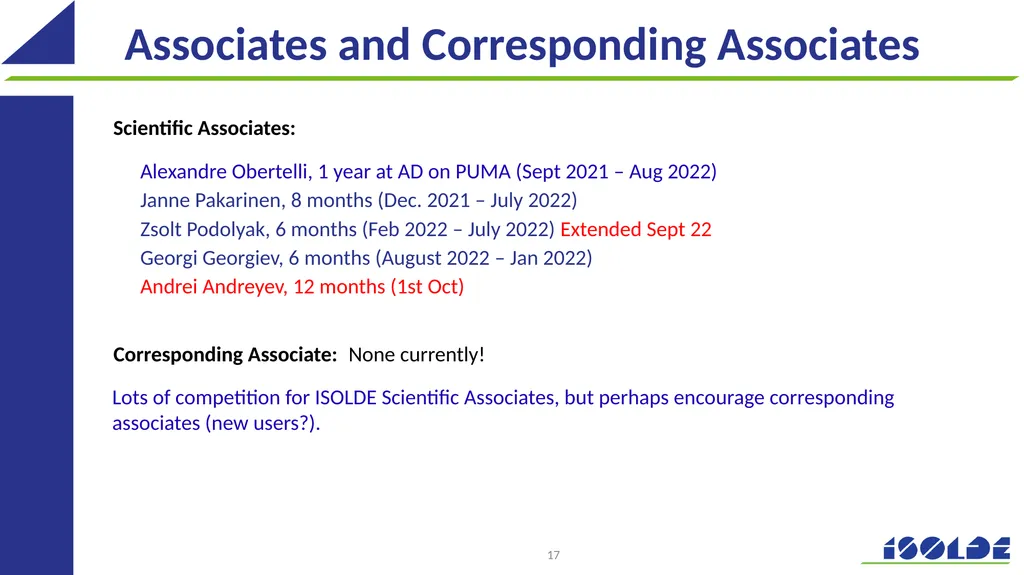
Associates and Corresponding Associates 17 Alexandre Obertelli, 1 year at AD on PUMA (Sept 2021 – Aug 2022)
Janne Pakarinen, 8 months (Dec. 2021 – July 2022)
Zsolt Podolyak, 6 months (Feb 2022 – July 2022) Extended Sept 22
Georgi Georgiev, 6 months (August 2022 – Jan 2022)
Andrei Andreyev, 12 months (1st Oct) Lots of competition for ISOLDE Scientific Associates, but perhaps encourage corresponding associates (new users?). None currently! Scientific Associates: Corresponding Associate:<br>
Janne Pakarinen, 8 months (Dec. 2021 – July 2022)
Zsolt Podolyak, 6 months (Feb 2022 – July 2022) Extended Sept 22
Georgi Georgiev, 6 months (August 2022 – Jan 2022)
Andrei Andreyev, 12 months (1st Oct) Lots of competition for ISOLDE Scientific Associates, but perhaps encourage corresponding associates (new users?). None currently! Scientific Associates: Corresponding Associate:<br>
18
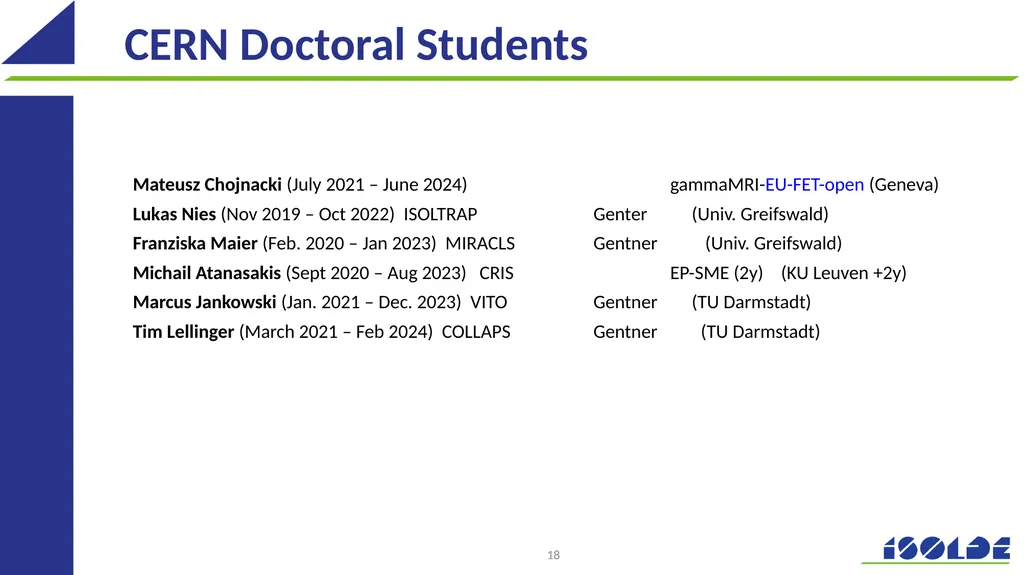
CERN Doctoral Students 18 Mateusz Chojnacki (July 2021 – June 2024) gammaMRI-EU-FET-open (Geneva)
Lukas Nies (Nov 2019 – Oct 2022) ISOLTRAP Genter (Univ. Greifswald)
Franziska Maier (Feb. 2020 – Jan 2023) MIRACLS Gentner (Univ. Greifswald)
Michail Atanasakis (Sept 2020 – Aug 2023) CRIS EP-SME (2y) (KU Leuven +2y)
Marcus Jankowski (Jan. 2021 – Dec. 2023) VITO Gentner (TU Darmstadt)
Tim Lellinger (March 2021 – Feb 2024) COLLAPS Gentner (TU Darmstadt)<br>
Lukas Nies (Nov 2019 – Oct 2022) ISOLTRAP Genter (Univ. Greifswald)
Franziska Maier (Feb. 2020 – Jan 2023) MIRACLS Gentner (Univ. Greifswald)
Michail Atanasakis (Sept 2020 – Aug 2023) CRIS EP-SME (2y) (KU Leuven +2y)
Marcus Jankowski (Jan. 2021 – Dec. 2023) VITO Gentner (TU Darmstadt)
Tim Lellinger (March 2021 – Feb 2024) COLLAPS Gentner (TU Darmstadt)<br>
19
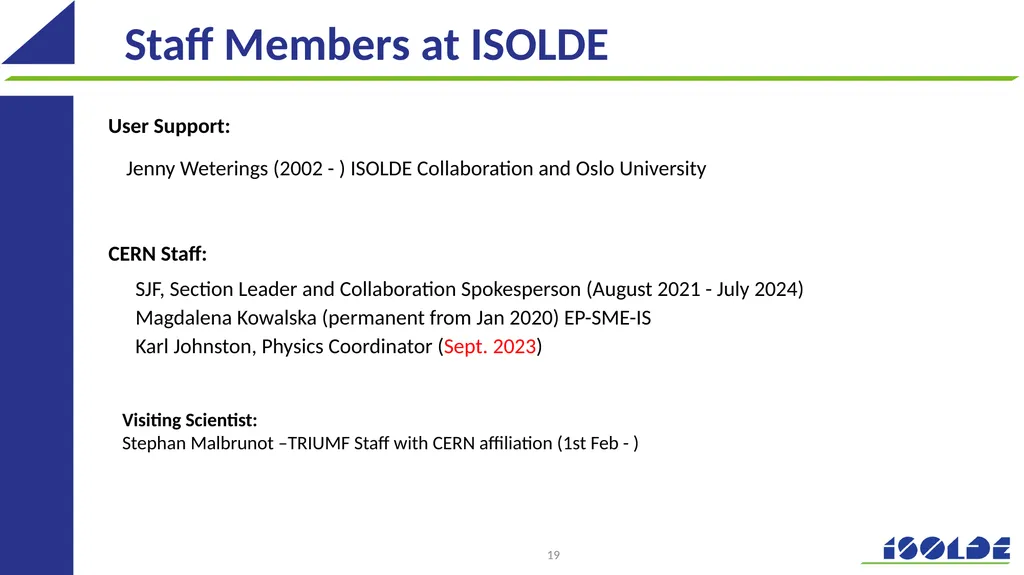
Staff Members at ISOLDE 19 SJF, Section Leader and Collaboration Spokesperson (August 2021 - July 2024)
Magdalena Kowalska (permanent from Jan 2020) EP-SME-IS
Karl Johnston, Physics Coordinator (Sept. 2023) Jenny Weterings (2002 - ) ISOLDE Collaboration and Oslo University CERN Staff: User Support: Visiting Scientist:
Stephan Malbrunot –TRIUMF Staff with CERN affiliation (1st Feb - )<br>
Magdalena Kowalska (permanent from Jan 2020) EP-SME-IS
Karl Johnston, Physics Coordinator (Sept. 2023) Jenny Weterings (2002 - ) ISOLDE Collaboration and Oslo University CERN Staff: User Support: Visiting Scientist:
Stephan Malbrunot –TRIUMF Staff with CERN affiliation (1st Feb - )<br>