College Accounting A Contemporary Approach Fourth
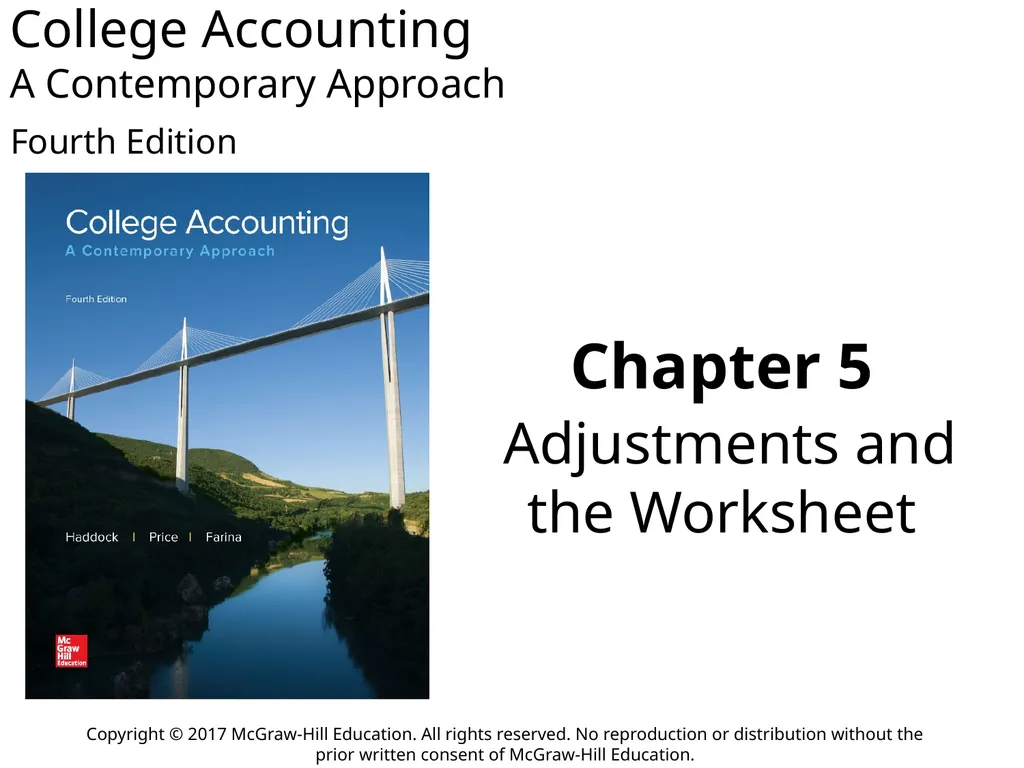
Description: College Accounting A Contemporary Approach Fourth Edition Chapter 5 Adjustments and the Worksheet Copyright 2017 McGraw-Hill Education. All rights reserved. No reproduction or distribution without the prior written consent of McGraw-Hill
Related Topics
Download Presentation
"College Accounting A Contemporary Approach Fourth" is the property of its rightful owner. Permission is granted to download and print the materials on this website for personal, non-commercial use only, and to display it on your personal computer provided you do not modify the materials and that you retain all copyright notices contained in the materials. By downloading content from our website, you accept the terms of this agreement.
Presentation Transcript
slide1. College AccountingA Contemporary Approach Fourth Edition Chapter 5 Adjustments and the Worksheet Copyright © 2017 McGraw-Hill Education. All rights reserved. No reproduction or distribution without the prior written consent of McGraw-Hill Education.<br>
slide2. Learning Objectives SECTION 1: The Worksheet
5-1 Complete a trial balance on a worksheet.
5-2 Prepare adjustments for unrecorded business transactions.
SECTION 2: Financial Statements
5-3 Complete the worksheet.
5-4 Prepare an income statement, statement of owner's equity, and balance sheet from the completed worksheet.
5-5 Journalize and post the adjusting entries.
5-6 Define the accounting terms new to this chapter.<br>
slide3. Section 1: The Worksheet Learning Objective 5-1: Complete a trial balance on a worksheet.<br>
slide4. Section 1, Objective 5-1: Complete a trial balance on a worksheet. Worksheet The worksheet has an Account Name column
The worksheet also has five sections
Each section has two columns<br>
slide5. Section 1, Objective 5-1: Complete a trial balance on a worksheet. Worksheet: Trial Balance (1 of 4) Complete the Trial Balance section in four steps:
Enter the general ledger account names.
Transfer the general ledger account balances to the Debit and Credit columns of the Trial Balance section.
Total the Debit and Credit columns to prove that the trial balance is in balance.
Place a double rule under each Trial Balance column to show that the work in that column is complete.<br>
slide6. Section 1, Objective 5-1: Complete a trial balance on a worksheet. Worksheet: Trial Balance (2 of 4) Eli’s Consulting Services Worksheet Month Ended December 31, 2019
Step 1: Enter the general ledger account names.<br>
slide7. Section 1, Objective 5-1: Complete a trial balance on a worksheet. Worksheet: Trial Balance (3 of 4) Step 2: Transfer the general ledger account balances to the Debit and Credit columns of the Trial Balance section.<br>
slide8. Section 1, Objective 5-1: Complete a trial balance on a worksheet. Worksheet: Trial Balance (4 of 4) Step 3: Total the Debit and Credit columns to prove that the trial balance is in balance.
Step 4: Place a double rule under each Trial Balance column to show that the work in that column is complete.<br>
slide9. Section 1: The Worksheet Learning Objective 5-2: Prepare adjustments for unrecorded business transactions.<br>
slide10. Section 1, Objective 5-2: Prepare adjustments for unrecorded business transactions. The Supplies Adjustment Eli’s Consulting Services began the month with $1,500 in supplies. At the end of the month, $1,000 in supplies remained.
QUESTION:
What dollar amount of supplies was used during the month?
ANSWER:
$ 1,500 – 1,000 = $ 500<br>
slide11. Section 1, Objective 5-2: Prepare adjustments for unrecorded business transactions. The Prepaid Adjustment On November 20, 2019, Eli’ s Consulting Services paid $8,000 for the December and January rent. As of December 31, 2019, one month’s rent had already been used up.
QUESTION:
What dollar amount of rent was used during the month of December?
ANSWER:
$ 8,000 – 4,000 = $ 4,000<br>
slide12. Section 1, Objective 5-2: Prepare adjustments for unrecorded business transactions. Depreciation The cost is recorded as an asset and charged to expense over the time the asset is used for the business.
Asset Pie:
Dec 2016 (Expense)
Jan 2017 (Expense)
Feb 2017 (Expense)
This expense is called depreciation<br>
slide13. Section 1, Objective 5-2: Prepare adjustments for unrecorded business transactions. Straight-line depreciation There are several methods to calculate depreciation. Eli’s Consulting Services uses the straight-line method.
QUESTION:
What is straight-line depreciation?
ANSWER:
Straight-line depreciation (S/L) allocates an asset’s cost in equal amounts to each accounting period of its useful life.<br>
slide14. Section 1, Objective 5-2: Prepare adjustments for unrecorded business transactions. Calculating Depreciation Eli’s Consulting Services purchased equipment in November, 2019.
Cost = $11,000
Useful life = 5 years or 60 months (5 years x 12 months)
Salvage value = $0
QUESTION:
What dollar amount of depreciation expense should be recorded for the month?<br>
slide15. Section 1, Objective 5-2: Prepare adjustments for unrecorded business transactions. Adjustment for Depreciation Instead of decreasing the asset account directly, the adjustment for depreciation is recorded in a contra account named Accumulated Depreciation—Equipment.<br>
slide16. Section 1, Objective 5-2: Prepare adjustments for unrecorded business transactions. Worksheet: Prepare Adjustments (1 of 2) Adjusting entries are first entered in the Adjustments section of the worksheet
When all adjustments are entered, total and rule the Adjustments columns.<br>
slide17. Worksheet: Prepare Adjustments (2 of 2)<br>
slide18. Section 1, Objective 5-2: Prepare adjustments for unrecorded business transactions. Book Value Book value = Original cost – Accumulated depreciation = 11,000 – 183 = 10,817<br>
slide19. Section 2. The Accounting Cycle Step 1: Analyze transactions
Step 2: Journalize the data about transactions
Step 3: Post the data about transactions
Step 4: Prepare a worksheet
Step 5: Prepare financial statements
Step 6: Record adjusting entries
Step 7: Record closing entries
Step 8: Prepare a postclosing trial balance
Step 9: Interpret the financial information<br>
slide20. Section 2: Financial Statements Learning Objective 5-3: Complete the worksheet.<br>
slide21. Section 2, Objective 5-3: Complete the worksheet. Preparing the Work Sheet You have already seen how to prepare the first two sections of a worksheet:
Trial Balance
Adjustments
You will now learn how to complete a worksheet. Preparing a worksheet is the fourth step of the accounting cycle.<br>
slide22. Section 2, Objective 5-3: Complete the worksheet. Worksheet: Complete (1 of 4) Step 1: Combine the figures from the Trial Balance section and the Adjustments section. Record the results in the Adjusted Trial Balance columns.
The accounts that do not have adjustments are extended from the Trial Balance section to the Adjusted Trial Balance section.
The Supplies account has a $1,500 debit balance in the Trial Balance section and a $500 credit in the Adjustments section. ($1,500 debit and $500 credit = $1,000)
Step 2: Total the Debit and Credit columns in the Adjusted Trial Balance section. Confirm that debits equal credits.<br>
slide23. Section 2, Objective 5-3: Complete the worksheet. Worksheet: Complete (2 of 4) For accounts that appear on the balance sheet, enter the amount in the appropriate column of the Balance Sheet section. For accounts that appear on the income statement, enter the amount in the appropriate column of the Income Statement section.
After all the account balances are transferred to the financial statement sections, total the Debit and Credit columns.
Subtract the smaller total from the larger total in the Income Statement section to find the Net Income or Net Loss.<br>
slide24. Section 2, Objective 5-3: Complete the worksheet. Worksheet: Complete (3 of 4) If the credit total is more than the debit total, the firm has net income. . .
Enter the amount on the Net Income line. (47,000 – 13,333 = 33,667)
Total the Income Statement and the Balance Sheet sections<br>
slide25. Section 2, Objective 5-3: Complete the worksheet. Worksheet: Complete (4 of 4)<br>
slide26. Section 2: Financial Statements Learning Objective 5- 4: Prepare financial statements from the worksheet.<br>
slide27. Section 2, Objective 5-4: Prepare financial statements from the worksheet. Income Statement (1 of 2)<br>
slide28. Section 2, Objective 5-4: Prepare financial statements from the worksheet. Income Statement (2 of 2)<br>
slide29. Section 2, Objective 5-4: Prepare financial statements from the worksheet. Account Form of Balance Sheet<br>
slide30. Section 2, Objective 5-4: Prepare financial statements from the worksheet. Report Form of Balance Sheet<br>
slide31. Section 2: Financial Statements Learning Objective 5-5: Journalize and post the adjusting entries.<br>
slide32. Section 2, Objective 5-5: Journalize and post the adjusting entries. Worksheet Remember, a worksheet is just a tool that accountants use.
The worksheet is NOT...
A financial statement
A permanent part of the accounting records
It is only a tool. BUT....
The adjustments shown on the worksheet must become part of the permanent accounting records. Each adjustment is journalized and posted to the general ledger accounts.<br>
slide33. Section 2, Objective 5-5: Journalize and post the adjusting entries. Consulting Services record QUESTION:
What adjustments must Eli’s Consulting Services record for the month?
ANSWER:
Adjustment for supplies used.
Adjustment for expired rent.
Adjustment for depreciation.<br>
slide34. Section 2, Objective 5-5: Journalize and post the adjusting entries. General Journal Here is the first adjusting journal entry which has been posted to the Supplies Expense ledger account.<br>
slide2. Learning Objectives SECTION 1: The Worksheet
5-1 Complete a trial balance on a worksheet.
5-2 Prepare adjustments for unrecorded business transactions.
SECTION 2: Financial Statements
5-3 Complete the worksheet.
5-4 Prepare an income statement, statement of owner's equity, and balance sheet from the completed worksheet.
5-5 Journalize and post the adjusting entries.
5-6 Define the accounting terms new to this chapter.<br>
slide3. Section 1: The Worksheet Learning Objective 5-1: Complete a trial balance on a worksheet.<br>
slide4. Section 1, Objective 5-1: Complete a trial balance on a worksheet. Worksheet The worksheet has an Account Name column
The worksheet also has five sections
Each section has two columns<br>
slide5. Section 1, Objective 5-1: Complete a trial balance on a worksheet. Worksheet: Trial Balance (1 of 4) Complete the Trial Balance section in four steps:
Enter the general ledger account names.
Transfer the general ledger account balances to the Debit and Credit columns of the Trial Balance section.
Total the Debit and Credit columns to prove that the trial balance is in balance.
Place a double rule under each Trial Balance column to show that the work in that column is complete.<br>
slide6. Section 1, Objective 5-1: Complete a trial balance on a worksheet. Worksheet: Trial Balance (2 of 4) Eli’s Consulting Services Worksheet Month Ended December 31, 2019
Step 1: Enter the general ledger account names.<br>
slide7. Section 1, Objective 5-1: Complete a trial balance on a worksheet. Worksheet: Trial Balance (3 of 4) Step 2: Transfer the general ledger account balances to the Debit and Credit columns of the Trial Balance section.<br>
slide8. Section 1, Objective 5-1: Complete a trial balance on a worksheet. Worksheet: Trial Balance (4 of 4) Step 3: Total the Debit and Credit columns to prove that the trial balance is in balance.
Step 4: Place a double rule under each Trial Balance column to show that the work in that column is complete.<br>
slide9. Section 1: The Worksheet Learning Objective 5-2: Prepare adjustments for unrecorded business transactions.<br>
slide10. Section 1, Objective 5-2: Prepare adjustments for unrecorded business transactions. The Supplies Adjustment Eli’s Consulting Services began the month with $1,500 in supplies. At the end of the month, $1,000 in supplies remained.
QUESTION:
What dollar amount of supplies was used during the month?
ANSWER:
$ 1,500 – 1,000 = $ 500<br>
slide11. Section 1, Objective 5-2: Prepare adjustments for unrecorded business transactions. The Prepaid Adjustment On November 20, 2019, Eli’ s Consulting Services paid $8,000 for the December and January rent. As of December 31, 2019, one month’s rent had already been used up.
QUESTION:
What dollar amount of rent was used during the month of December?
ANSWER:
$ 8,000 – 4,000 = $ 4,000<br>
slide12. Section 1, Objective 5-2: Prepare adjustments for unrecorded business transactions. Depreciation The cost is recorded as an asset and charged to expense over the time the asset is used for the business.
Asset Pie:
Dec 2016 (Expense)
Jan 2017 (Expense)
Feb 2017 (Expense)
This expense is called depreciation<br>
slide13. Section 1, Objective 5-2: Prepare adjustments for unrecorded business transactions. Straight-line depreciation There are several methods to calculate depreciation. Eli’s Consulting Services uses the straight-line method.
QUESTION:
What is straight-line depreciation?
ANSWER:
Straight-line depreciation (S/L) allocates an asset’s cost in equal amounts to each accounting period of its useful life.<br>
slide14. Section 1, Objective 5-2: Prepare adjustments for unrecorded business transactions. Calculating Depreciation Eli’s Consulting Services purchased equipment in November, 2019.
Cost = $11,000
Useful life = 5 years or 60 months (5 years x 12 months)
Salvage value = $0
QUESTION:
What dollar amount of depreciation expense should be recorded for the month?<br>
slide15. Section 1, Objective 5-2: Prepare adjustments for unrecorded business transactions. Adjustment for Depreciation Instead of decreasing the asset account directly, the adjustment for depreciation is recorded in a contra account named Accumulated Depreciation—Equipment.<br>
slide16. Section 1, Objective 5-2: Prepare adjustments for unrecorded business transactions. Worksheet: Prepare Adjustments (1 of 2) Adjusting entries are first entered in the Adjustments section of the worksheet
When all adjustments are entered, total and rule the Adjustments columns.<br>
slide17. Worksheet: Prepare Adjustments (2 of 2)<br>
slide18. Section 1, Objective 5-2: Prepare adjustments for unrecorded business transactions. Book Value Book value = Original cost – Accumulated depreciation = 11,000 – 183 = 10,817<br>
slide19. Section 2. The Accounting Cycle Step 1: Analyze transactions
Step 2: Journalize the data about transactions
Step 3: Post the data about transactions
Step 4: Prepare a worksheet
Step 5: Prepare financial statements
Step 6: Record adjusting entries
Step 7: Record closing entries
Step 8: Prepare a postclosing trial balance
Step 9: Interpret the financial information<br>
slide20. Section 2: Financial Statements Learning Objective 5-3: Complete the worksheet.<br>
slide21. Section 2, Objective 5-3: Complete the worksheet. Preparing the Work Sheet You have already seen how to prepare the first two sections of a worksheet:
Trial Balance
Adjustments
You will now learn how to complete a worksheet. Preparing a worksheet is the fourth step of the accounting cycle.<br>
slide22. Section 2, Objective 5-3: Complete the worksheet. Worksheet: Complete (1 of 4) Step 1: Combine the figures from the Trial Balance section and the Adjustments section. Record the results in the Adjusted Trial Balance columns.
The accounts that do not have adjustments are extended from the Trial Balance section to the Adjusted Trial Balance section.
The Supplies account has a $1,500 debit balance in the Trial Balance section and a $500 credit in the Adjustments section. ($1,500 debit and $500 credit = $1,000)
Step 2: Total the Debit and Credit columns in the Adjusted Trial Balance section. Confirm that debits equal credits.<br>
slide23. Section 2, Objective 5-3: Complete the worksheet. Worksheet: Complete (2 of 4) For accounts that appear on the balance sheet, enter the amount in the appropriate column of the Balance Sheet section. For accounts that appear on the income statement, enter the amount in the appropriate column of the Income Statement section.
After all the account balances are transferred to the financial statement sections, total the Debit and Credit columns.
Subtract the smaller total from the larger total in the Income Statement section to find the Net Income or Net Loss.<br>
slide24. Section 2, Objective 5-3: Complete the worksheet. Worksheet: Complete (3 of 4) If the credit total is more than the debit total, the firm has net income. . .
Enter the amount on the Net Income line. (47,000 – 13,333 = 33,667)
Total the Income Statement and the Balance Sheet sections<br>
slide25. Section 2, Objective 5-3: Complete the worksheet. Worksheet: Complete (4 of 4)<br>
slide26. Section 2: Financial Statements Learning Objective 5- 4: Prepare financial statements from the worksheet.<br>
slide27. Section 2, Objective 5-4: Prepare financial statements from the worksheet. Income Statement (1 of 2)<br>
slide28. Section 2, Objective 5-4: Prepare financial statements from the worksheet. Income Statement (2 of 2)<br>
slide29. Section 2, Objective 5-4: Prepare financial statements from the worksheet. Account Form of Balance Sheet<br>
slide30. Section 2, Objective 5-4: Prepare financial statements from the worksheet. Report Form of Balance Sheet<br>
slide31. Section 2: Financial Statements Learning Objective 5-5: Journalize and post the adjusting entries.<br>
slide32. Section 2, Objective 5-5: Journalize and post the adjusting entries. Worksheet Remember, a worksheet is just a tool that accountants use.
The worksheet is NOT...
A financial statement
A permanent part of the accounting records
It is only a tool. BUT....
The adjustments shown on the worksheet must become part of the permanent accounting records. Each adjustment is journalized and posted to the general ledger accounts.<br>
slide33. Section 2, Objective 5-5: Journalize and post the adjusting entries. Consulting Services record QUESTION:
What adjustments must Eli’s Consulting Services record for the month?
ANSWER:
Adjustment for supplies used.
Adjustment for expired rent.
Adjustment for depreciation.<br>
slide34. Section 2, Objective 5-5: Journalize and post the adjusting entries. General Journal Here is the first adjusting journal entry which has been posted to the Supplies Expense ledger account.<br>