
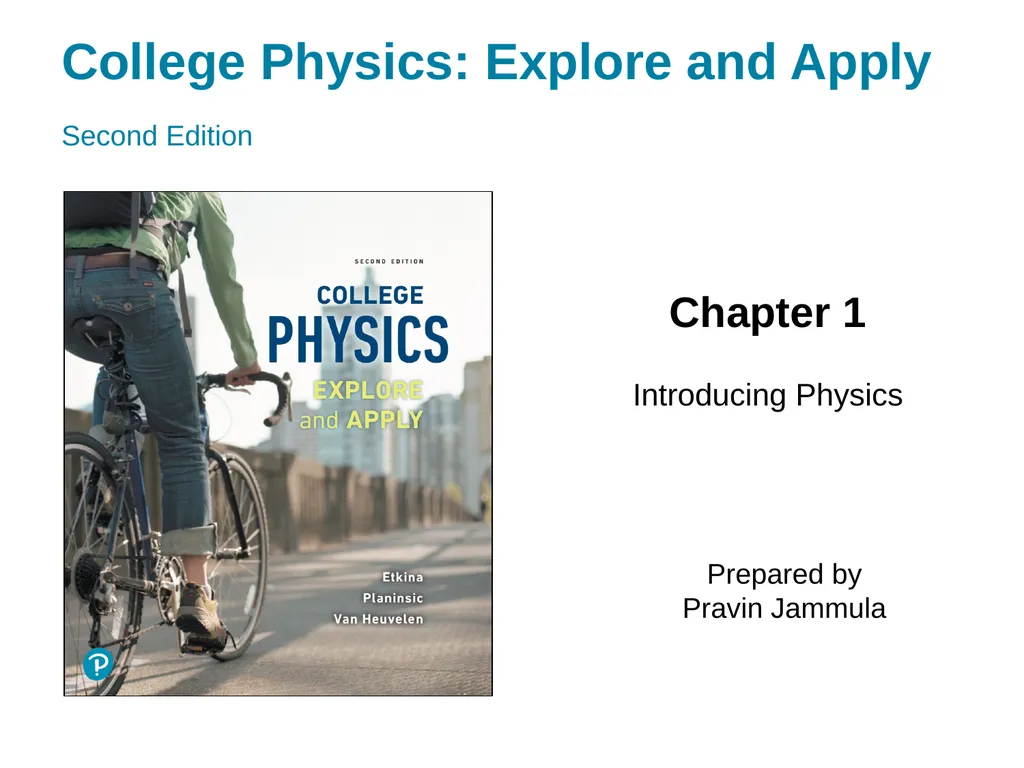
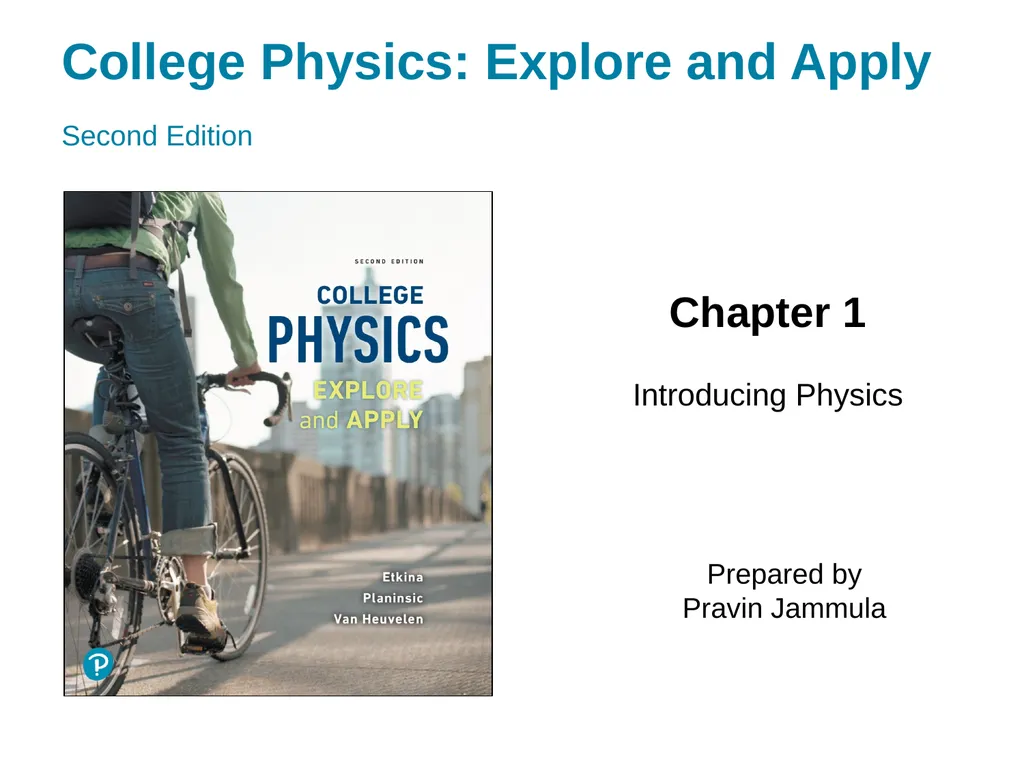
College Physics: Explore and Apply Second Edition
DJ
Published · 61 slides · 0 views
1 / 1
Description
College Physics: Explore and Apply Second Edition Chapter 1 Introducing Physics Prepared by Pravin Jammula Chapter 1: Introducing Physics (1 of 6) Goals: Students will learn to use College Physics: Explore and Apply, the Active Learning
Related Topics
Share
Embed code
Download this presentation From Below
"College Physics: Explore and Apply Second Edition" is the property of its rightful owner. Permission is granted to download and print the materials on this website for personal, non-commercial use only, and to display it on your personal computer provided you do not modify the materials and that you retain all copyright notices contained in the materials. By downloading content from our website, you accept the terms of this agreement.
Presentation Transcript
01
College Physics: Explore and Apply Second Edition Chapter 1 Introducing Physics Prepared by
Pravin Jammula<br>
Pravin Jammula<br>
02
Chapter 1: Introducing Physics (1 of 6) Goals:
Students will learn to use College Physics: Explore and Apply, the Active Learning Guide (A L G), Mastering Physics, and other support materials for learning physics.<br>
Students will learn to use College Physics: Explore and Apply, the Active Learning Guide (A L G), Mastering Physics, and other support materials for learning physics.<br>
03
Chapter 1: Introducing Physics (2 of 6) The Two Important Foundational Principles of Learning:
Learning is a physics process: No one can learn by observing somebody else or listening to somebody else without a purposeful effort to connect these sensory experiences to what they already know and to actively test new ideas. This principle is also known as active learning.
Learning is a social process that involves people sharing, debating, and testing their ideas in interaction with others. This principle is often referred to as group work.<br>
Learning is a physics process: No one can learn by observing somebody else or listening to somebody else without a purposeful effort to connect these sensory experiences to what they already know and to actively test new ideas. This principle is also known as active learning.
Learning is a social process that involves people sharing, debating, and testing their ideas in interaction with others. This principle is often referred to as group work.<br>
04
Chapter 1: Introducing Physics (3 of 6) The Six Foundational Principles of the Learning System
Experiments are the foundations of knowledge creation in physics.
Concept first, name second.
Careful language.
Building a bridge between words and mathematics.
Making sense of mathematics.
Moving away from a plug-and-chug problem-solving approach.<br>
Experiments are the foundations of knowledge creation in physics.
Concept first, name second.
Careful language.
Building a bridge between words and mathematics.
Making sense of mathematics.
Moving away from a plug-and-chug problem-solving approach.<br>
05
Chapter 1: Introducing Physics (4 of 6) General Learning Objectives:
A. Scientific abilities objectives Ability to represent phenomena and knowledge in multiple ways.
Ability to design and conduct scientific investigations.
Ability to apply physics ideas to solve practical real-world problems through designing experiments and/or calculations.
Ability to collect, represent, and evaluate data from a real experiment and from a video of an experiment.
Ability to evaluate the reasonableness of an idea or calculated/experimental result.
Ability to effectively communicate ideas to others
Ability to reflect.
Ability to work with a scientific text (in any format).<br>
A. Scientific abilities objectives Ability to represent phenomena and knowledge in multiple ways.
Ability to design and conduct scientific investigations.
Ability to apply physics ideas to solve practical real-world problems through designing experiments and/or calculations.
Ability to collect, represent, and evaluate data from a real experiment and from a video of an experiment.
Ability to evaluate the reasonableness of an idea or calculated/experimental result.
Ability to effectively communicate ideas to others
Ability to reflect.
Ability to work with a scientific text (in any format).<br>
06
Chapter 1: Introducing Physics (5 of 6) General Learning Objectives:
A. Scientific abilities objectives Ability to represent phenomena and knowledge in multiple ways.
Ability to design and conduct scientific investigations. B. Learning about learning/conceptions of learning
C. General mathematical abilities
D. Problem-solving abilities<br>
A. Scientific abilities objectives Ability to represent phenomena and knowledge in multiple ways.
Ability to design and conduct scientific investigations. B. Learning about learning/conceptions of learning
C. General mathematical abilities
D. Problem-solving abilities<br>
07
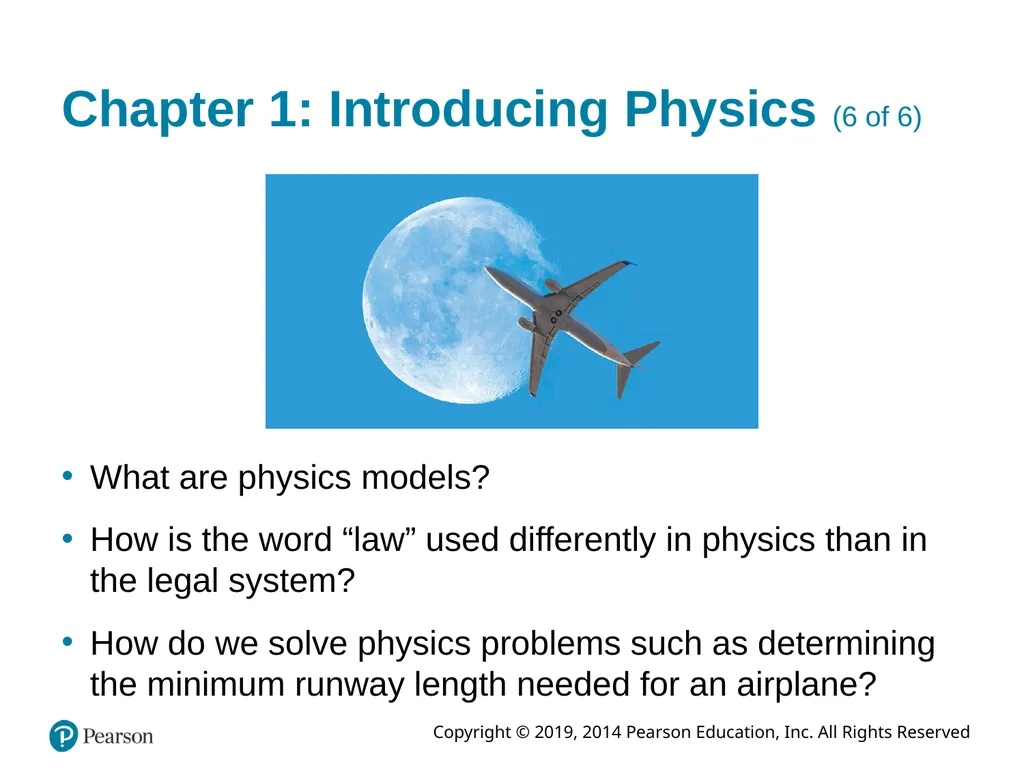
Chapter 1: Introducing Physics (6 of 6) What are physics models?
How is the word “law” used differently in physics than in the legal system?
How do we solve physics problems such as determining the minimum runway length needed for an airplane?<br>
How is the word “law” used differently in physics than in the legal system?
How do we solve physics problems such as determining the minimum runway length needed for an airplane?<br>
08
1.1 What Is Physics? (1 of 8) Physics is a fundamental experimental science.
Motion, waves, light, electricity, magnetism, atoms, and nuclei are some of the many subjects in physics.
Physics allows one to understand many aspects of the world, from why bending over to lift a heavy load can injure your back to why Earth’s climate is changing.
Physics is used in other fields of science, such as biology, medicine, astronomy, architecture, engineering, agriculture, and anthropology, to help solve problems.<br>
Motion, waves, light, electricity, magnetism, atoms, and nuclei are some of the many subjects in physics.
Physics allows one to understand many aspects of the world, from why bending over to lift a heavy load can injure your back to why Earth’s climate is changing.
Physics is used in other fields of science, such as biology, medicine, astronomy, architecture, engineering, agriculture, and anthropology, to help solve problems.<br>
09
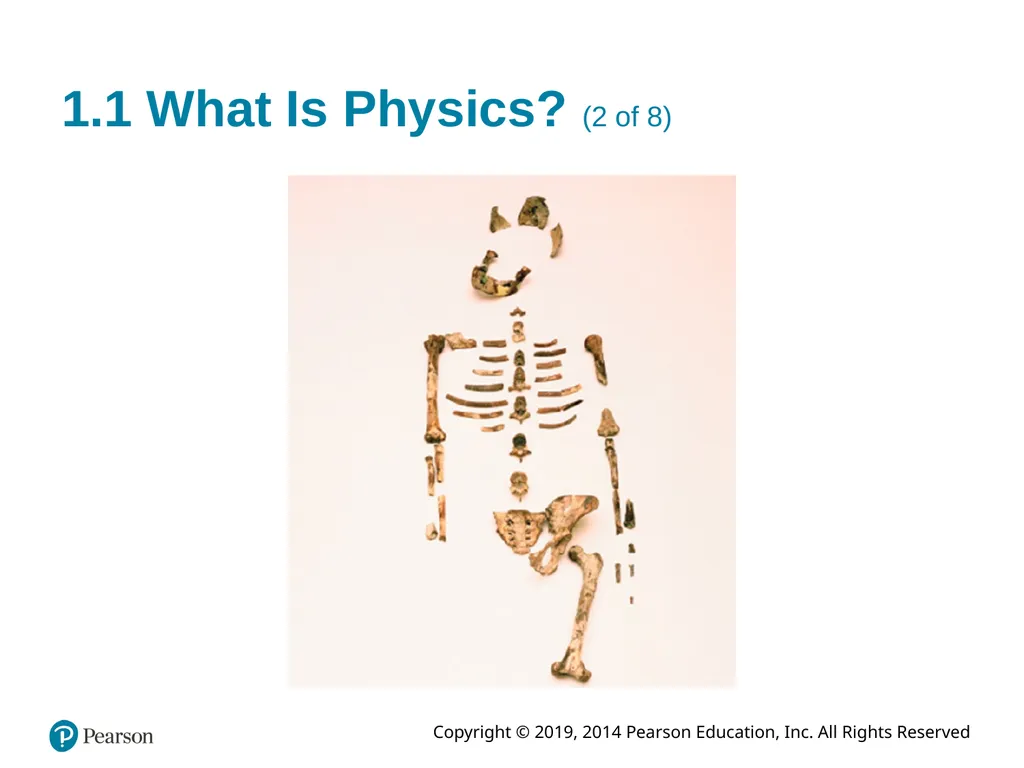
1.1 What Is Physics? (2 of 8)<br>
10
1.1 What Is Physics? (3 of 8) List of some processes employed to physicists to discover and use the basic laws of physics
Collecting and analyzing experimental data.
Making explanations and experimentally testing them.
Creating different representations (pictures, graphs, bar charts, etc.) of physical processes.
Finding mathematical relations—mathematical models—between different variables.
Testing those relations in new experiments.<br>
Collecting and analyzing experimental data.
Making explanations and experimentally testing them.
Creating different representations (pictures, graphs, bar charts, etc.) of physical processes.
Finding mathematical relations—mathematical models—between different variables.
Testing those relations in new experiments.<br>
11
1.1 What Is Physics? (4 of 8) The search for rules
Physicists search for general rules, or laws, to understand the behavior of the world they live in.
The meaning of the word law in physics is somewhat different than in daily usage; law means a causal mathematical relationship between variables.
Causal relations show how change in one quantity affects the change in another quantity, but does not explain why causation occurs.
Laws are temporary in nature; new findings lead to modifications or sometimes abandonment.<br>
Physicists search for general rules, or laws, to understand the behavior of the world they live in.
The meaning of the word law in physics is somewhat different than in daily usage; law means a causal mathematical relationship between variables.
Causal relations show how change in one quantity affects the change in another quantity, but does not explain why causation occurs.
Laws are temporary in nature; new findings lead to modifications or sometimes abandonment.<br>
12
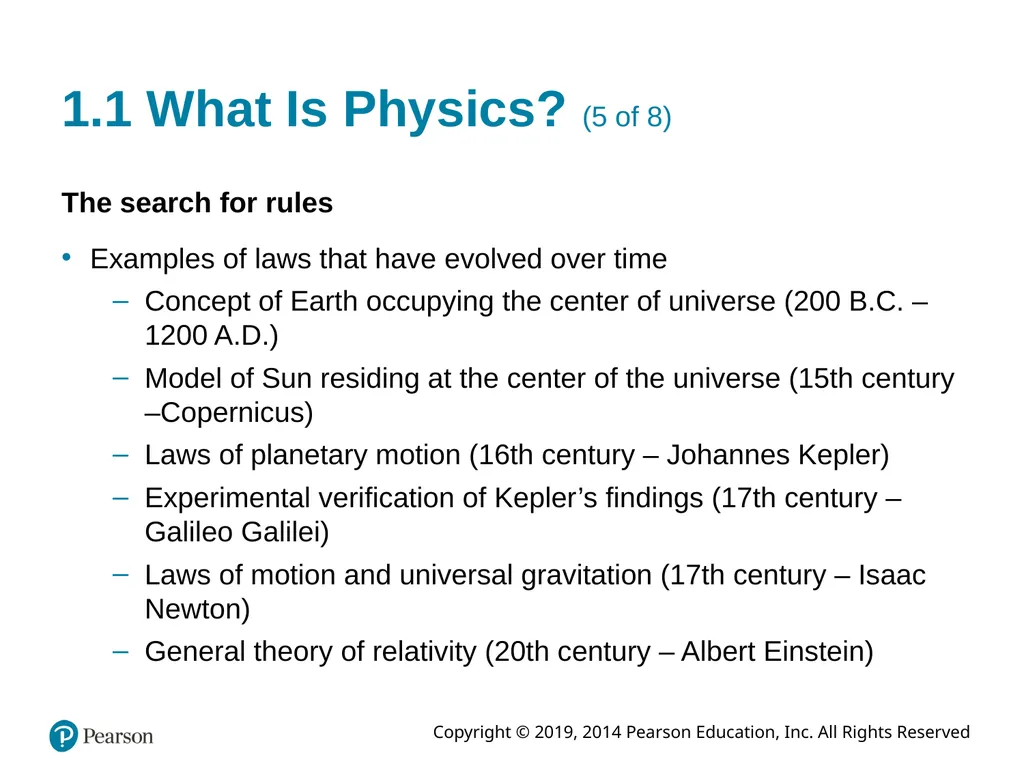
1.1 What Is Physics? (5 of 8) The search for rules
Examples of laws that have evolved over time
Concept of Earth occupying the center of universe (200 B.C. – 1200 A.D.)
Model of Sun residing at the center of the universe (15th century –Copernicus)
Laws of planetary motion (16th century – Johannes Kepler)
Experimental verification of Kepler’s findings (17th century – Galileo Galilei)
Laws of motion and universal gravitation (17th century – Isaac Newton)
General theory of relativity (20th century – Albert Einstein)<br>
Examples of laws that have evolved over time
Concept of Earth occupying the center of universe (200 B.C. – 1200 A.D.)
Model of Sun residing at the center of the universe (15th century –Copernicus)
Laws of planetary motion (16th century – Johannes Kepler)
Experimental verification of Kepler’s findings (17th century – Galileo Galilei)
Laws of motion and universal gravitation (17th century – Isaac Newton)
General theory of relativity (20th century – Albert Einstein)<br>
13
1.1 What Is Physics? (6 of 8) The processes for devising and using new models
Physicists constantly engage in experimental investigations to find answers to their questions.
Physicists use special measuring devices to observe phenomena (natural and planned).
Physicists describe their observations (words, numbers, graphs, etc.).
Physicists look for repeating features called patterns.
By doing all the listed tasks, physicists answer the question of “why” the phenomenon happened and come up with quantitative explanations called mathematical models that explain the phenomenon.<br>
Physicists constantly engage in experimental investigations to find answers to their questions.
Physicists use special measuring devices to observe phenomena (natural and planned).
Physicists describe their observations (words, numbers, graphs, etc.).
Physicists look for repeating features called patterns.
By doing all the listed tasks, physicists answer the question of “why” the phenomenon happened and come up with quantitative explanations called mathematical models that explain the phenomenon.<br>
14
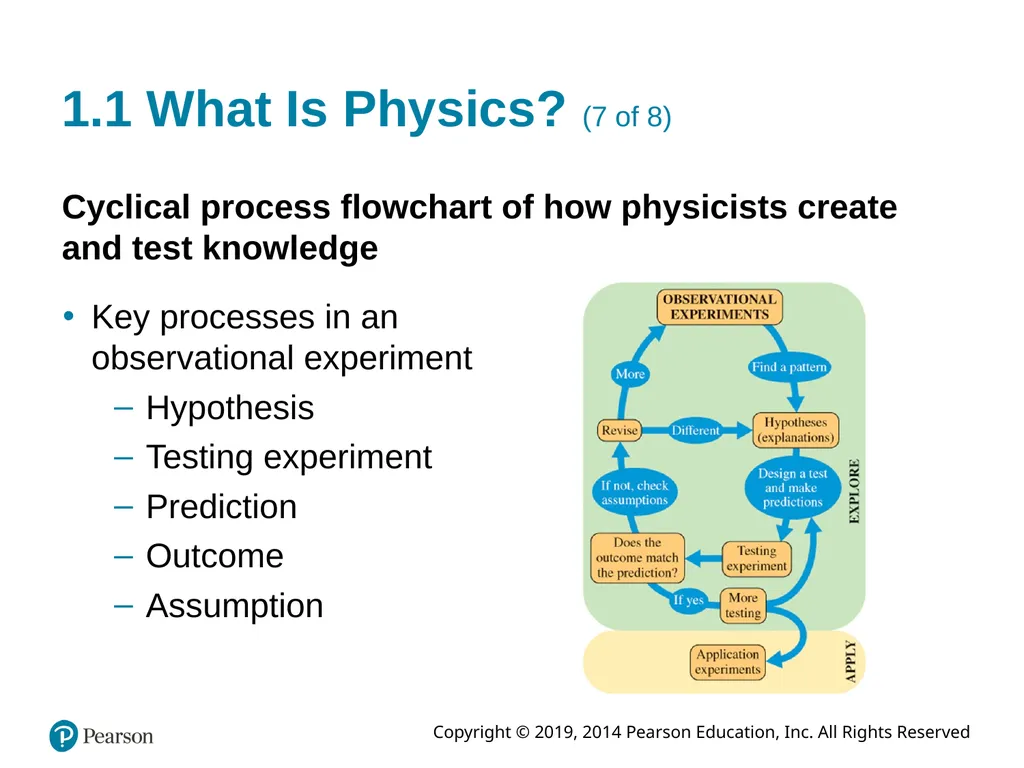
1.1 What Is Physics? (7 of 8) Cyclical process flowchart of how physicists create and test knowledge Key processes in an observational experiment
Hypothesis
Testing experiment
Prediction
Outcome
Assumption<br>
Hypothesis
Testing experiment
Prediction
Outcome
Assumption<br>
15
1.1 What Is Physics? (8 of 8) How will learning physics change your interactions with the world?
Learning physics can change the way you think about the world.
Studying physics is a way to acquire the processes of knowledge construction.
Understanding physics will help you differentiate between actual evidence and unsubstantiated claims.<br>
Learning physics can change the way you think about the world.
Studying physics is a way to acquire the processes of knowledge construction.
Understanding physics will help you differentiate between actual evidence and unsubstantiated claims.<br>
16
1.2 Modeling (1 of 5) Physicists study how the complex world works.
The investigation into some aspect of that world often begins with a simplified version.
These simplified representations, called models, are useful in understanding any complex physical phenomena.
Physics begin with simple models and then add complexity as needed to investigate more detailed aspects of the phenomena.
Example of how one moves their body as one walks
Back foot movement
Arm movement
Trunk movement
Head movement<br>
The investigation into some aspect of that world often begins with a simplified version.
These simplified representations, called models, are useful in understanding any complex physical phenomena.
Physics begin with simple models and then add complexity as needed to investigate more detailed aspects of the phenomena.
Example of how one moves their body as one walks
Back foot movement
Arm movement
Trunk movement
Head movement<br>
17
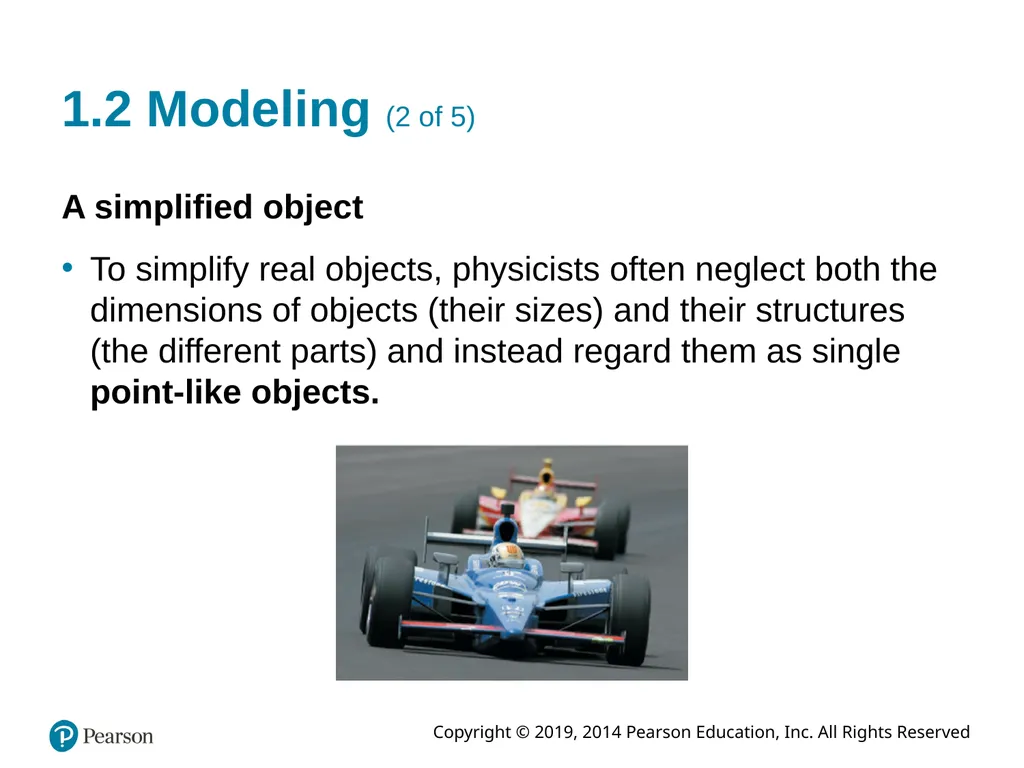
1.2 Modeling (2 of 5) A simplified object
To simplify real objects, physicists often neglect both the dimensions of objects (their sizes) and their structures (the different parts) and instead regard them as single point-like objects.<br>
To simplify real objects, physicists often neglect both the dimensions of objects (their sizes) and their structures (the different parts) and instead regard them as single point-like objects.<br>
18
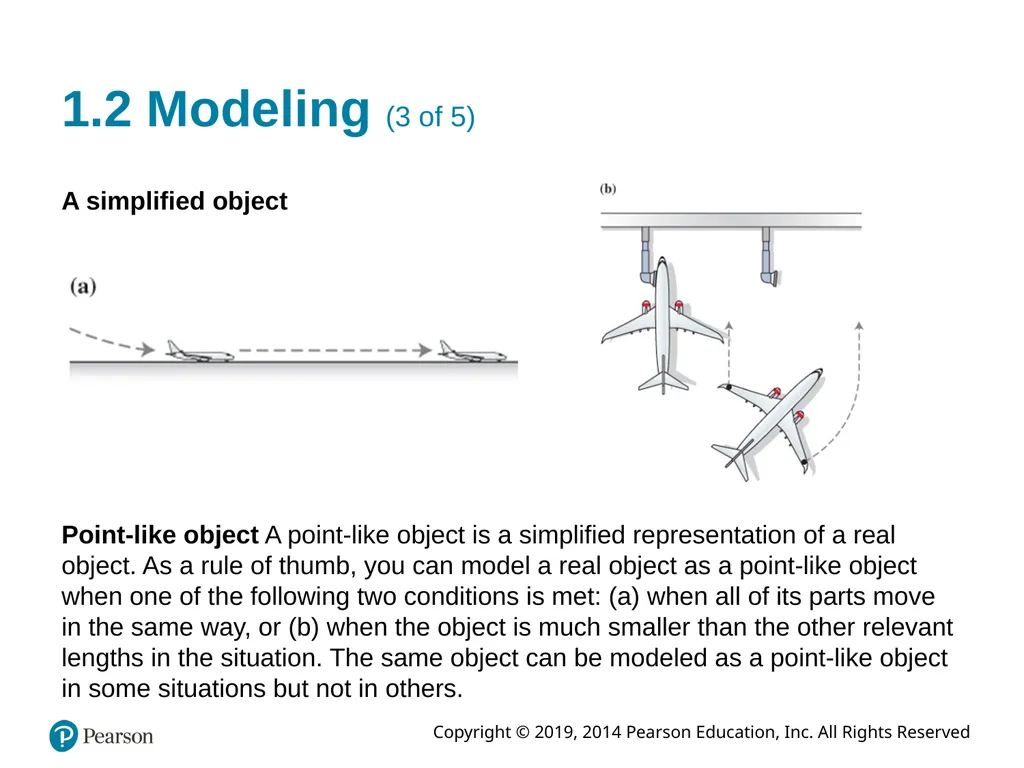
1.2 Modeling (3 of 5) A simplified object Point-like object A point-like object is a simplified representation of a real object. As a rule of thumb, you can model a real object as a point-like object when one of the following two conditions is met: (a) when all of its parts move in the same way, or (b) when the object is much smaller than the other relevant lengths in the situation. The same object can be modeled as a point-like object in some situations but not in others.<br>
19
1.2 Modeling (4 of 5) Modeling
The process that we followed to decide when a real object could be considered a point-like object is an example of what is called modeling.
In addition to simplifying the objects that they study, scientists simplify the interactions between objects and also the processes that are occurring in the real world.
Scientists add complexity as their understanding grows.
Galileo Galilei is believed to be the first scientist to consciously model a phenomenon.
Ignored falling bodies’ interaction with air when studying falling objects<br>
The process that we followed to decide when a real object could be considered a point-like object is an example of what is called modeling.
In addition to simplifying the objects that they study, scientists simplify the interactions between objects and also the processes that are occurring in the real world.
Scientists add complexity as their understanding grows.
Galileo Galilei is believed to be the first scientist to consciously model a phenomenon.
Ignored falling bodies’ interaction with air when studying falling objects<br>
20
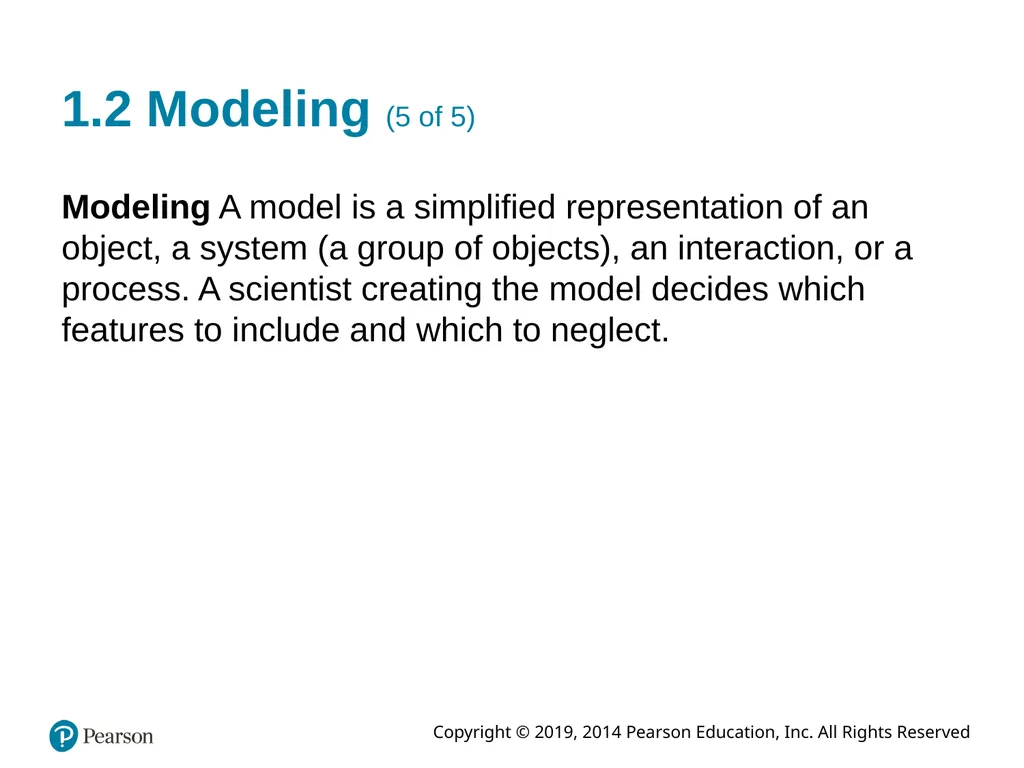
1.2 Modeling (5 of 5) Modeling A model is a simplified representation of an object, a system (a group of objects), an interaction, or a process. A scientist creating the model decides which features to include and which to neglect.<br>
21
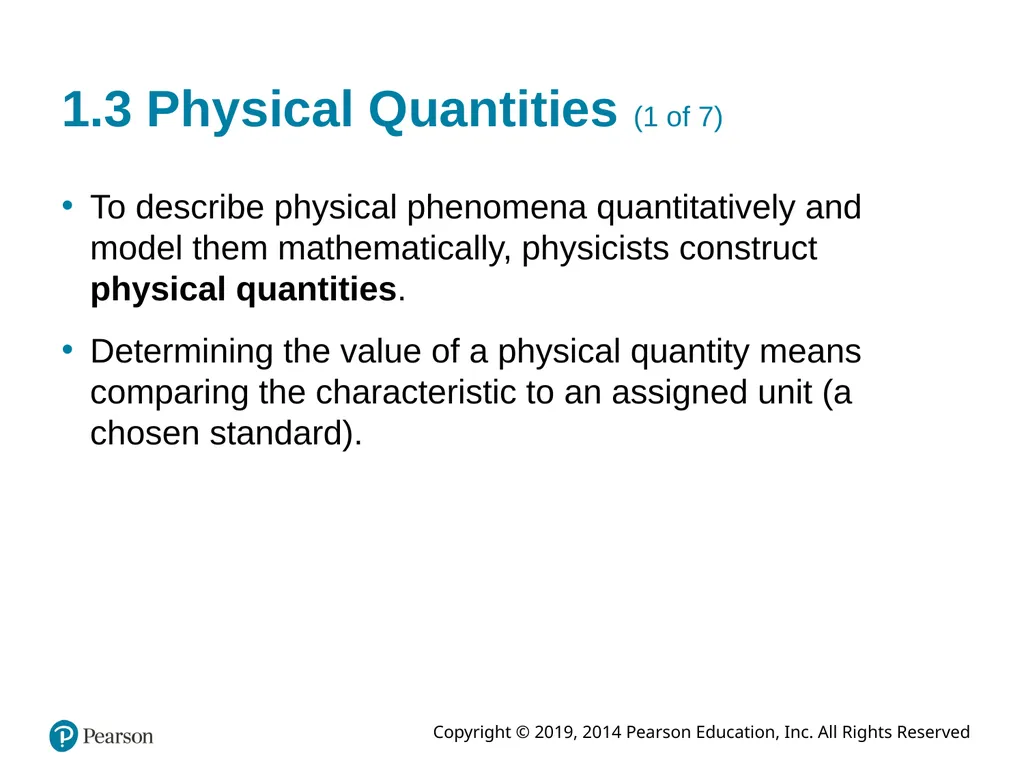
1.3 Physical Quantities (1 of 7) To describe physical phenomena quantitatively and model them mathematically, physicists construct physical quantities.
Determining the value of a physical quantity means comparing the characteristic to an assigned unit (a chosen standard).<br>
Determining the value of a physical quantity means comparing the characteristic to an assigned unit (a chosen standard).<br>
22
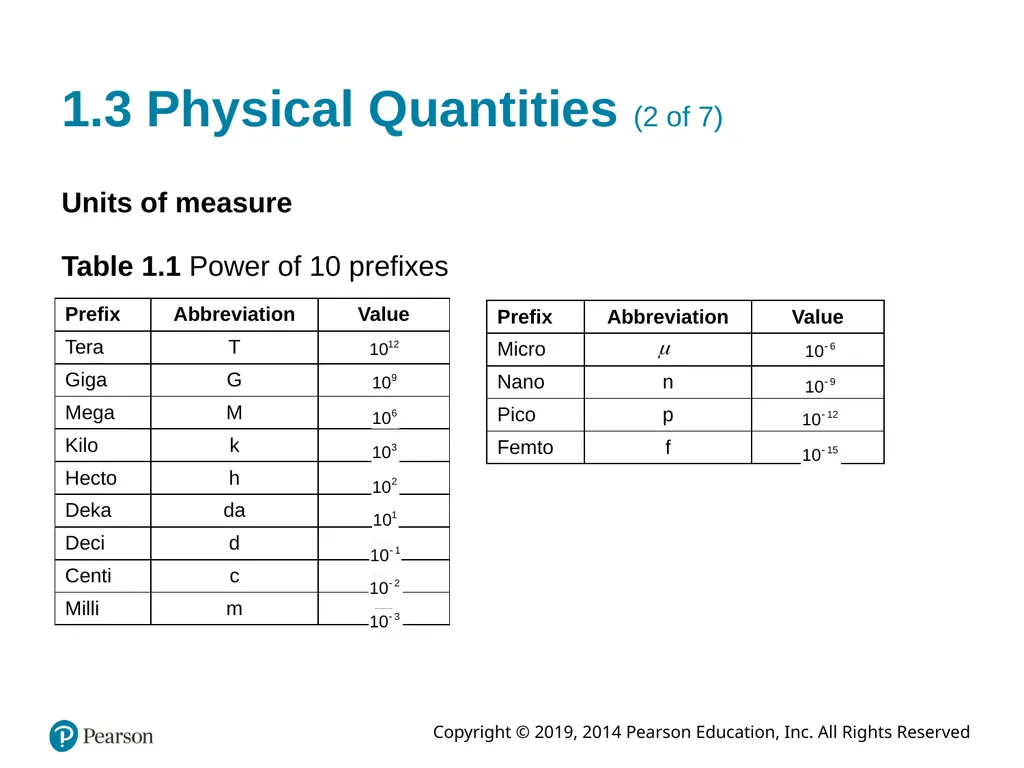
1.3 Physical Quantities (2 of 7) Units of measure Table 1.1 Power of 10 prefixes<br>
23
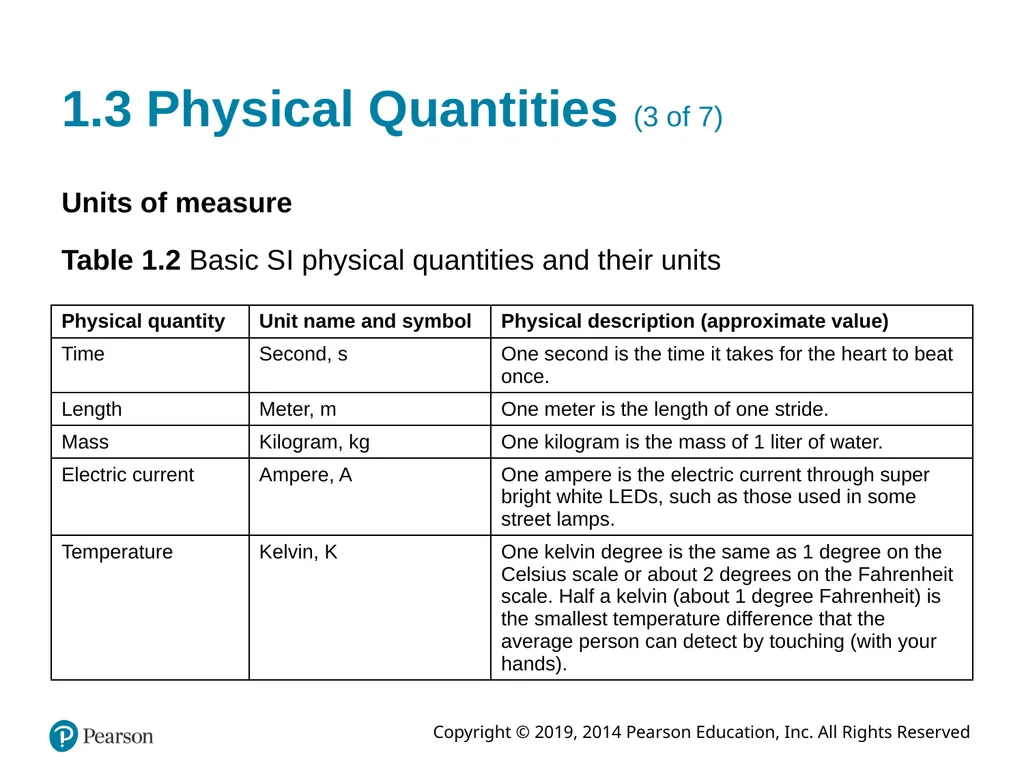
1.3 Physical Quantities (3 of 7) Units of measure Table 1.2 Basic S I physical quantities and their units<br>
24
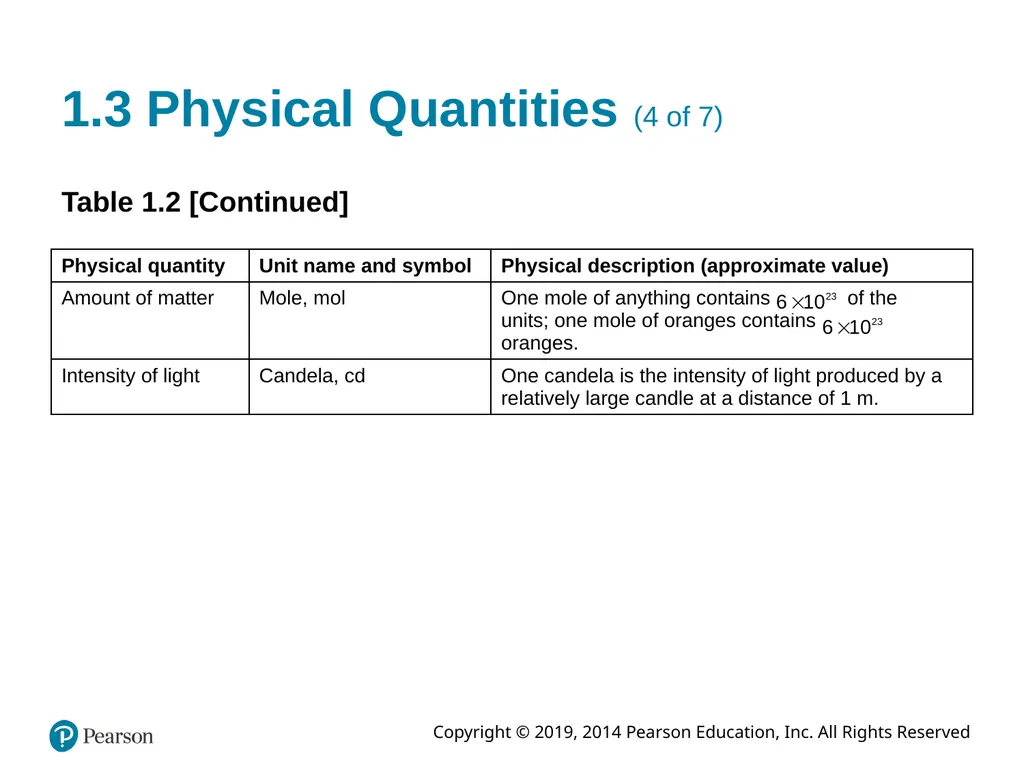
1.3 Physical Quantities (4 of 7) Table 1.2 [Continued]<br>
25
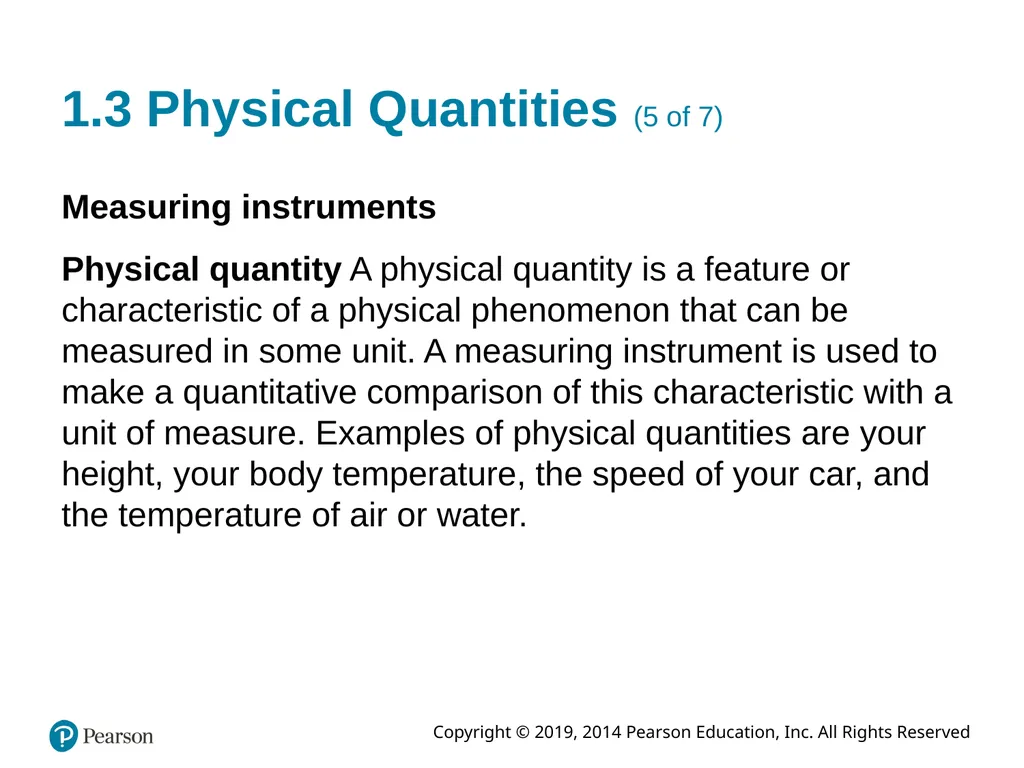
1.3 Physical Quantities (5 of 7) Measuring instruments
Physical quantity A physical quantity is a feature or characteristic of a physical phenomenon that can be measured in some unit. A measuring instrument is used to make a quantitative comparison of this characteristic with a unit of measure. Examples of physical quantities are your height, your body temperature, the speed of your car, and the temperature of air or water.<br>
Physical quantity A physical quantity is a feature or characteristic of a physical phenomenon that can be measured in some unit. A measuring instrument is used to make a quantitative comparison of this characteristic with a unit of measure. Examples of physical quantities are your height, your body temperature, the speed of your car, and the temperature of air or water.<br>
26
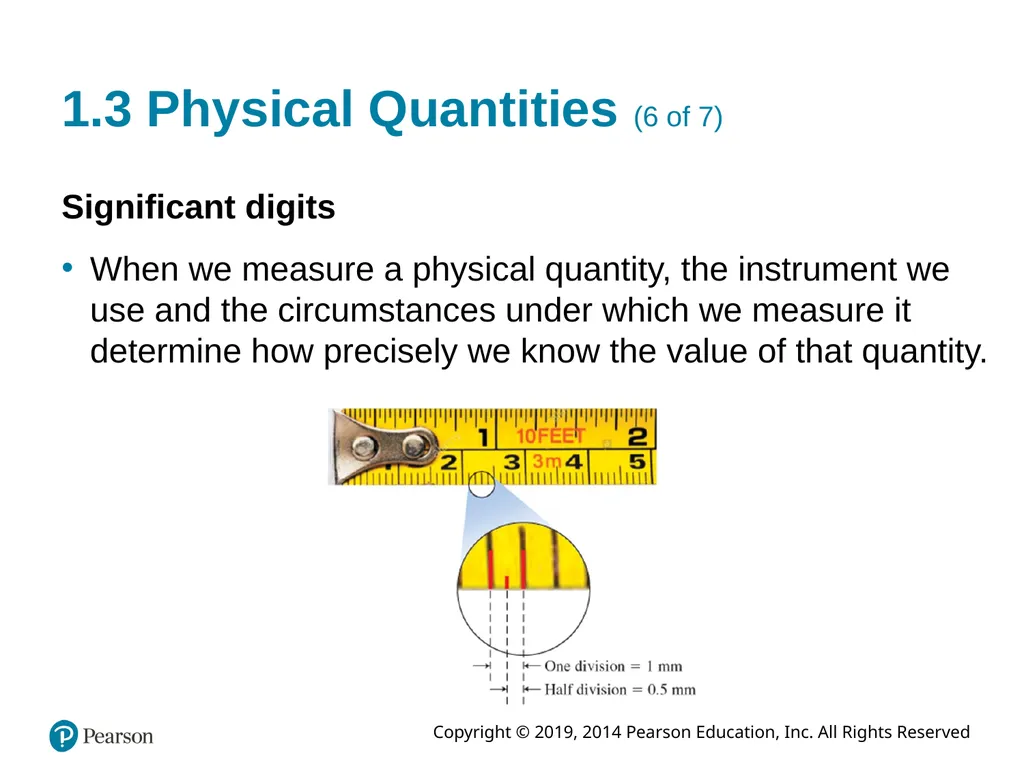
1.3 Physical Quantities (6 of 7) Significant digits
When we measure a physical quantity, the instrument we use and the circumstances under which we measure it determine how precisely we know the value of that quantity.<br>
When we measure a physical quantity, the instrument we use and the circumstances under which we measure it determine how precisely we know the value of that quantity.<br>
27
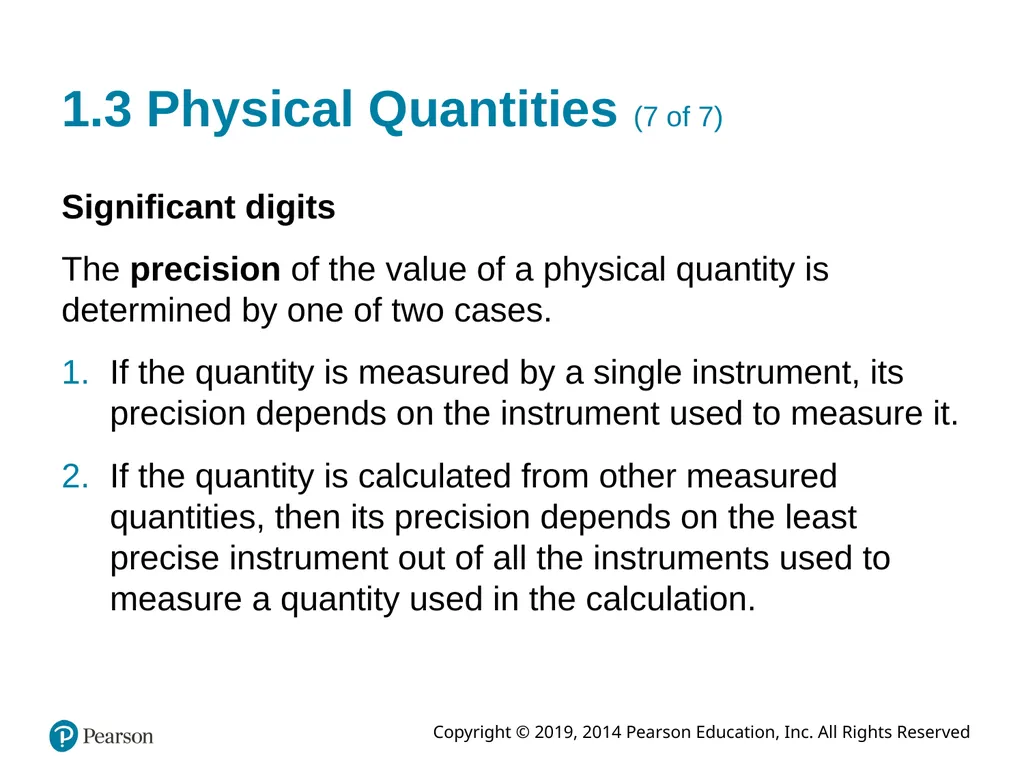
1.3 Physical Quantities (7 of 7) Significant digits
The precision of the value of a physical quantity is determined by one of two cases.
If the quantity is measured by a single instrument, its precision depends on the instrument used to measure it.
If the quantity is calculated from other measured quantities, then its precision depends on the least precise instrument out of all the instruments used to measure a quantity used in the calculation.<br>
The precision of the value of a physical quantity is determined by one of two cases.
If the quantity is measured by a single instrument, its precision depends on the instrument used to measure it.
If the quantity is calculated from other measured quantities, then its precision depends on the least precise instrument out of all the instruments used to measure a quantity used in the calculation.<br>
28
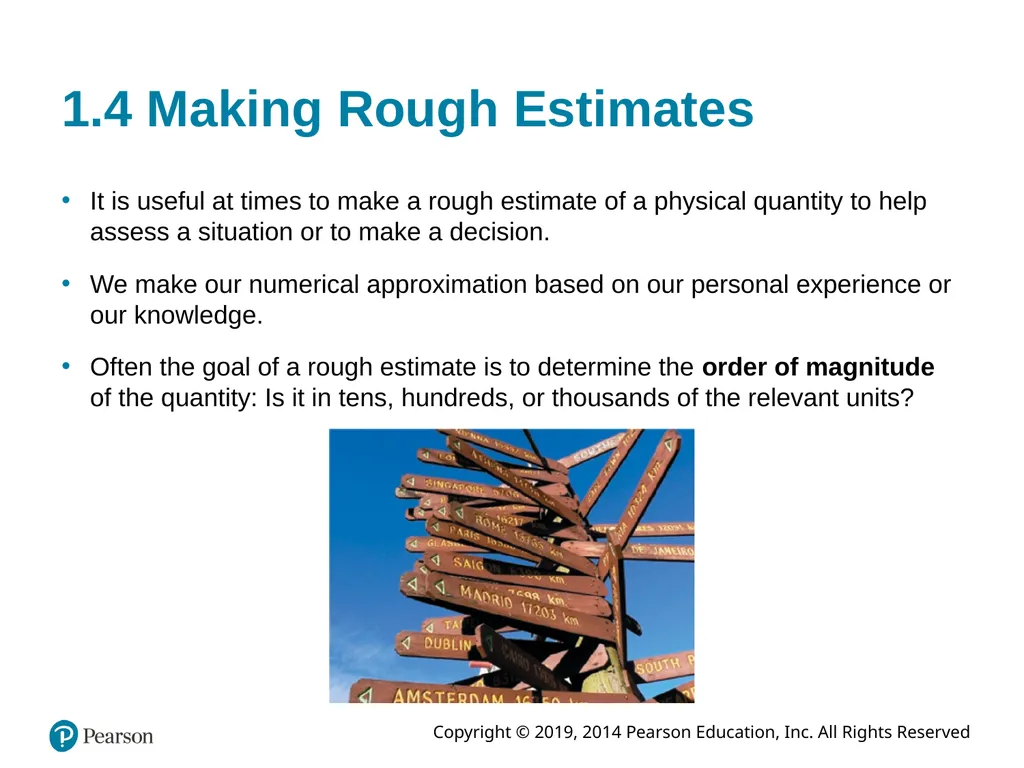
1.4 Making Rough Estimates It is useful at times to make a rough estimate of a physical quantity to help assess a situation or to make a decision.
We make our numerical approximation based on our personal experience or our knowledge.
Often the goal of a rough estimate is to determine the order of magnitude of the quantity: Is it in tens, hundreds, or thousands of the relevant units?<br>
We make our numerical approximation based on our personal experience or our knowledge.
Often the goal of a rough estimate is to determine the order of magnitude of the quantity: Is it in tens, hundreds, or thousands of the relevant units?<br>
29
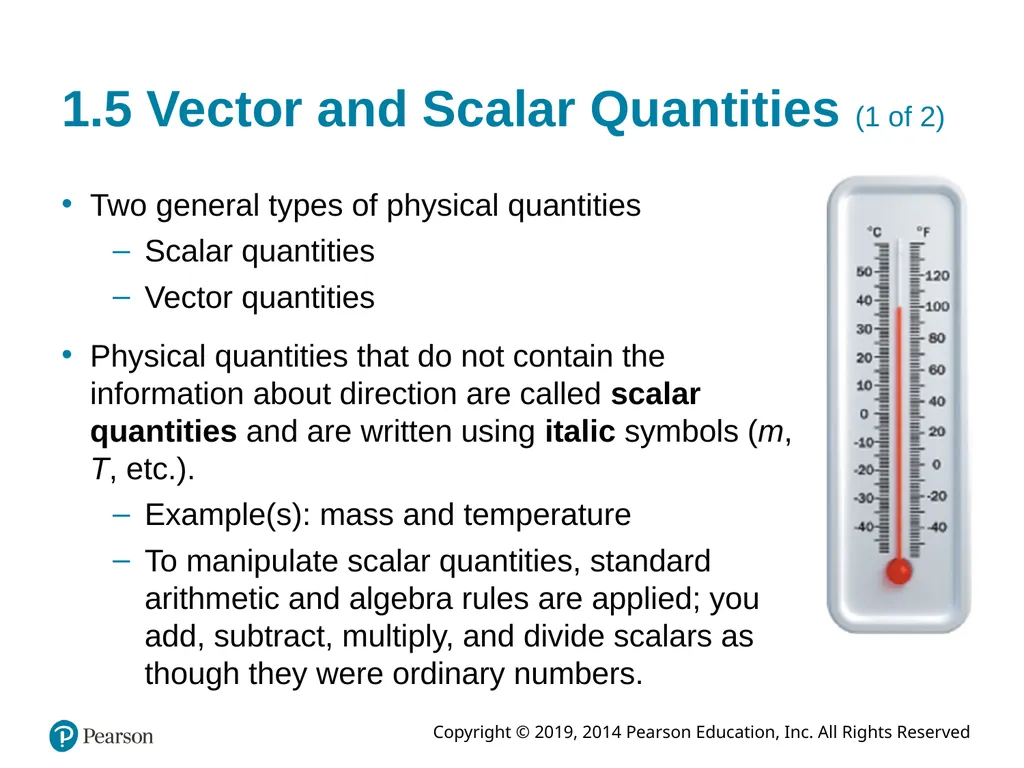
1.5 Vector and Scalar Quantities (1 of 2) Two general types of physical quantities
Scalar quantities
Vector quantities
Physical quantities that do not contain the information about direction are called scalar quantities and are written using italic symbols (m, T, etc.).
Example(s): mass and temperature
To manipulate scalar quantities, standard arithmetic and algebra rules are applied; you add, subtract, multiply, and divide scalars as though they were ordinary numbers.<br>
Scalar quantities
Vector quantities
Physical quantities that do not contain the information about direction are called scalar quantities and are written using italic symbols (m, T, etc.).
Example(s): mass and temperature
To manipulate scalar quantities, standard arithmetic and algebra rules are applied; you add, subtract, multiply, and divide scalars as though they were ordinary numbers.<br>
30
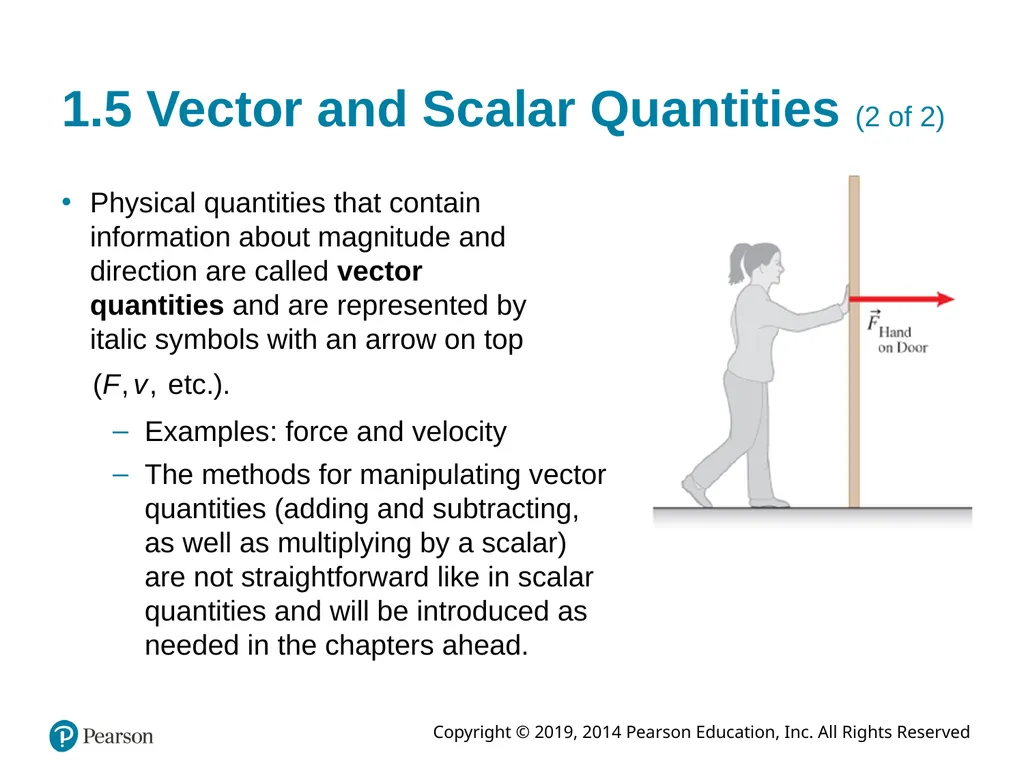
1.5 Vector and Scalar Quantities (2 of 2) Physical quantities that contain information about magnitude and direction are called vector quantities and are represented by italic symbols with an arrow on top Examples: force and velocity
The methods for manipulating vector quantities (adding and subtracting, as well as multiplying by a scalar) are not straightforward like in scalar quantities and will be introduced as needed in the chapters ahead.<br>
The methods for manipulating vector quantities (adding and subtracting, as well as multiplying by a scalar) are not straightforward like in scalar quantities and will be introduced as needed in the chapters ahead.<br>
31
1.6 How to Use This Book to Learn Physics (1 of 30) The goals of this textbook are to help you construct understanding of some of the most important ideas in physics, learn to use physics knowledge to analyze physical phenomenon, and develop general process skills that scientists use in the practice of science.
Learning from a scientific text is an important skill for scientists. By learning to work with this textbook efficiently, you will not only learn physics but also develop textbook reading skills that will be helpful in learning other science subjects.
Read Section 1.6 from the textbook; then after working through the first few chapters, revisit this section and read it again.<br>
Learning from a scientific text is an important skill for scientists. By learning to work with this textbook efficiently, you will not only learn physics but also develop textbook reading skills that will be helpful in learning other science subjects.
Read Section 1.6 from the textbook; then after working through the first few chapters, revisit this section and read it again.<br>
32
1.6 How to Use This Book to Learn Physics (2 of 30) Most important strategy that will help you learn better is called interrogation.
Interrogation means continually asking yourself the same question when reading the text. This question, provided in the box below, is very important. Why is this true? Make sure you ask yourself this question as often as possible so that it eventually becomes a habit.<br>
Interrogation means continually asking yourself the same question when reading the text. This question, provided in the box below, is very important. Why is this true? Make sure you ask yourself this question as often as possible so that it eventually becomes a habit.<br>
33
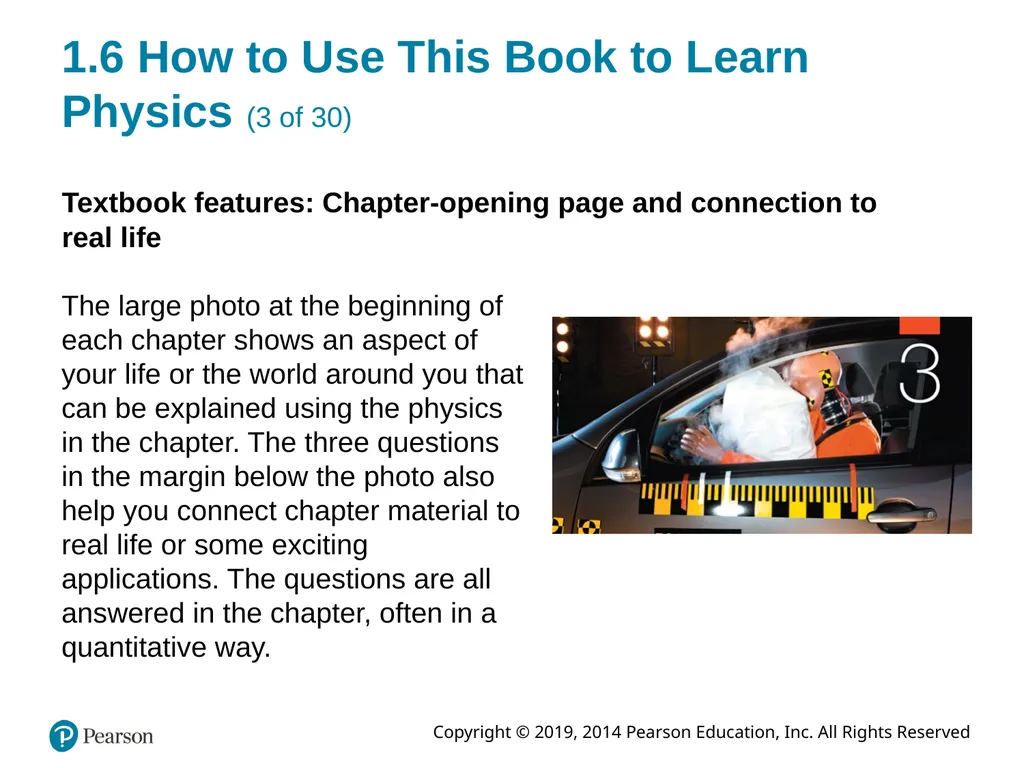
1.6 How to Use This Book to Learn Physics (3 of 30) Textbook features: Chapter-opening page and connection to real life The large photo at the beginning of each chapter shows an aspect of your life or the world around you that can be explained using the physics in the chapter. The three questions in the margin below the photo also help you connect chapter material to real life or some exciting applications. The questions are all answered in the chapter, often in a quantitative way.<br>
34
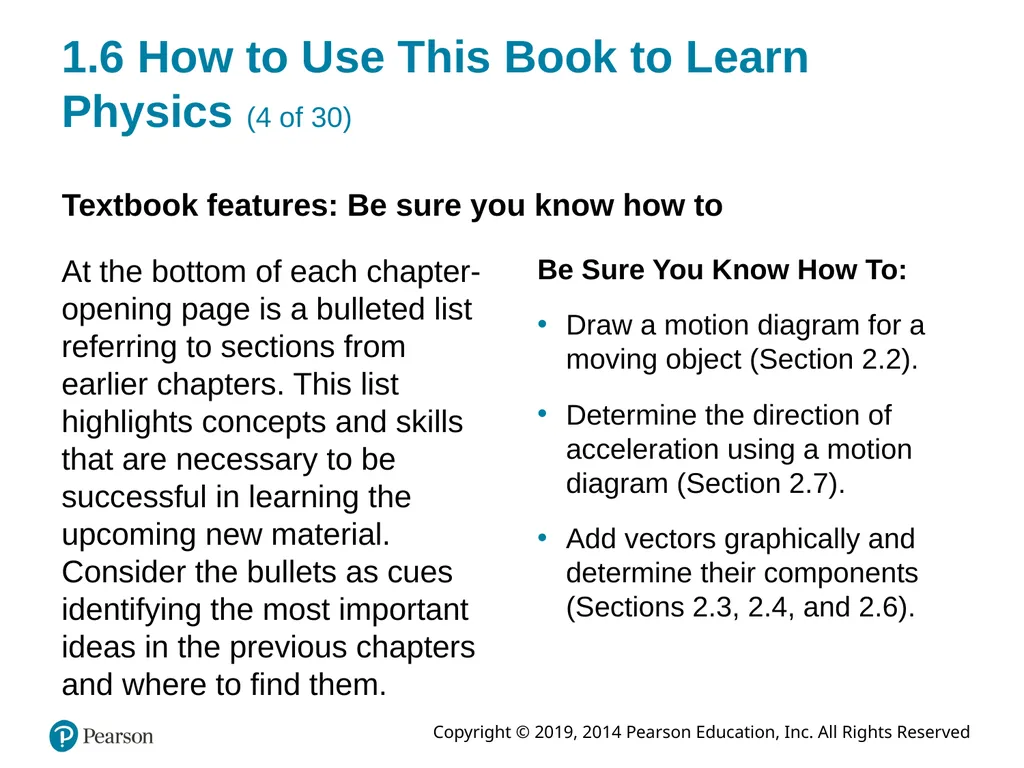
1.6 How to Use This Book to Learn Physics (4 of 30) Textbook features: Be sure you know how to At the bottom of each chapter-opening page is a bulleted list referring to sections from earlier chapters. This list highlights concepts and skills that are necessary to be successful in learning the upcoming new material. Consider the bullets as cues identifying the most important ideas in the previous chapters and where to find them. Be Sure You Know How To:
Draw a motion diagram for a moving object (Section 2.2).
Determine the direction of acceleration using a motion diagram (Section 2.7).
Add vectors graphically and determine their components (Sections 2.3, 2.4, and 2.6).<br>
Draw a motion diagram for a moving object (Section 2.2).
Determine the direction of acceleration using a motion diagram (Section 2.7).
Add vectors graphically and determine their components (Sections 2.3, 2.4, and 2.6).<br>
35
1.6 How to Use This Book to Learn Physics (5 of 30) Textbook features: Physics Tool Boxes
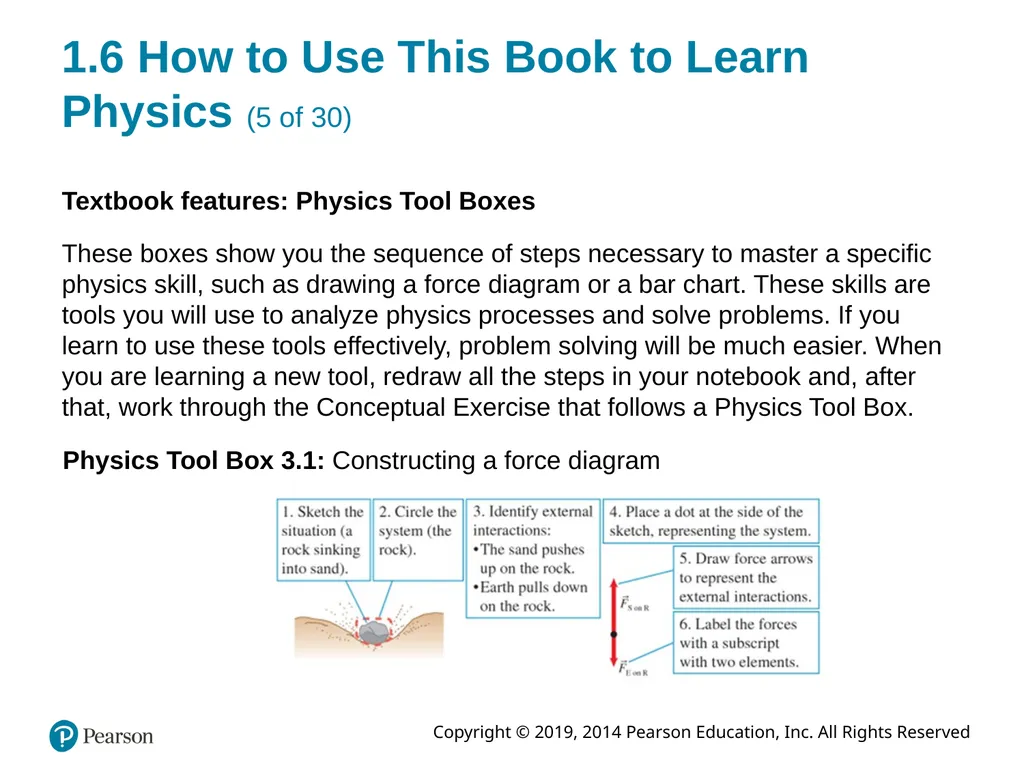
These boxes show you the sequence of steps necessary to master a specific physics skill, such as drawing a force diagram or a bar chart. These skills are tools you will use to analyze physics processes and solve problems. If you learn to use these tools effectively, problem solving will be much easier. When you are learning a new tool, redraw all the steps in your notebook and, after that, work through the Conceptual Exercise that follows a Physics Tool Box. Physics Tool Box 3.1: Constructing a force diagram<br>
These boxes show you the sequence of steps necessary to master a specific physics skill, such as drawing a force diagram or a bar chart. These skills are tools you will use to analyze physics processes and solve problems. If you learn to use these tools effectively, problem solving will be much easier. When you are learning a new tool, redraw all the steps in your notebook and, after that, work through the Conceptual Exercise that follows a Physics Tool Box. Physics Tool Box 3.1: Constructing a force diagram<br>
36
1.6 How to Use This Book to Learn Physics (6 of 30) Textbook features: Observational Experiment Tables (Cont’d)
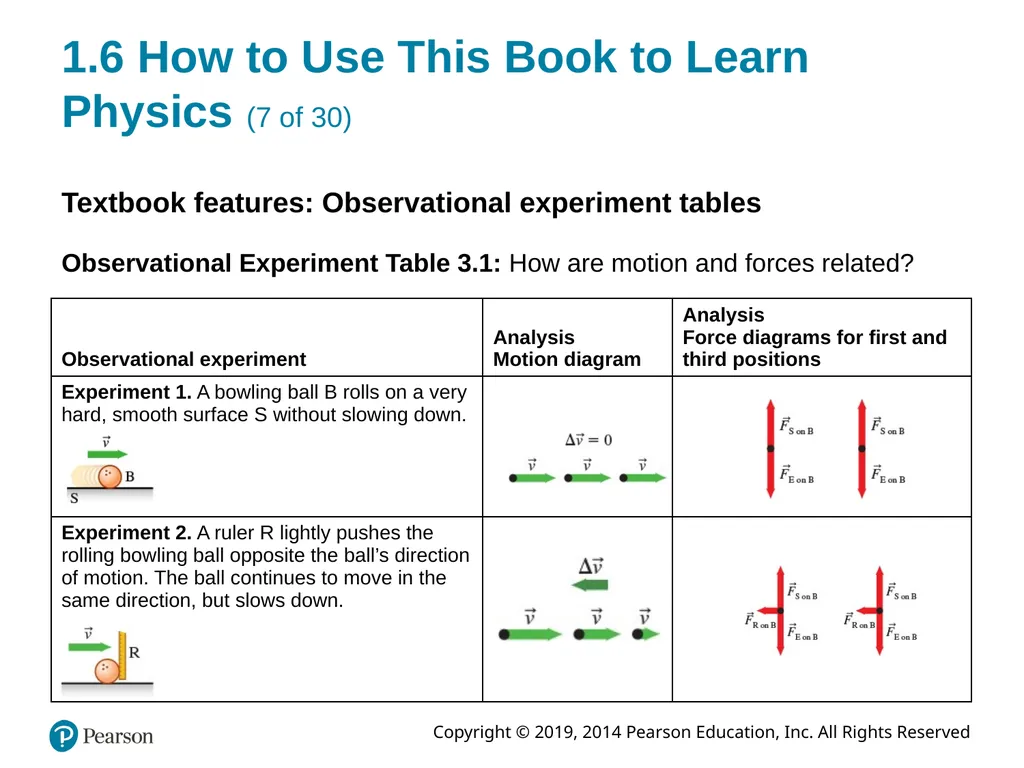
These tables help you learn how to observe simple experiments carefully and look for patterns. The goal of these tables is to show you where physics concepts and mathematical models come from. When working with an Observational Experiment Table, first watch the video of the experiment. Then read the description of the experiment in the left column of the table and try to analyze it without looking at the rest of the table. After you are done, compare your analysis to the analysis in the right-hand column(s) of the table and see if you agree with the described patterns.<br>
These tables help you learn how to observe simple experiments carefully and look for patterns. The goal of these tables is to show you where physics concepts and mathematical models come from. When working with an Observational Experiment Table, first watch the video of the experiment. Then read the description of the experiment in the left column of the table and try to analyze it without looking at the rest of the table. After you are done, compare your analysis to the analysis in the right-hand column(s) of the table and see if you agree with the described patterns.<br>
37
1.6 How to Use This Book to Learn Physics (7 of 30) Textbook features: Observational experiment tables Observational Experiment Table 3.1: How are motion and forces related?<br>
38
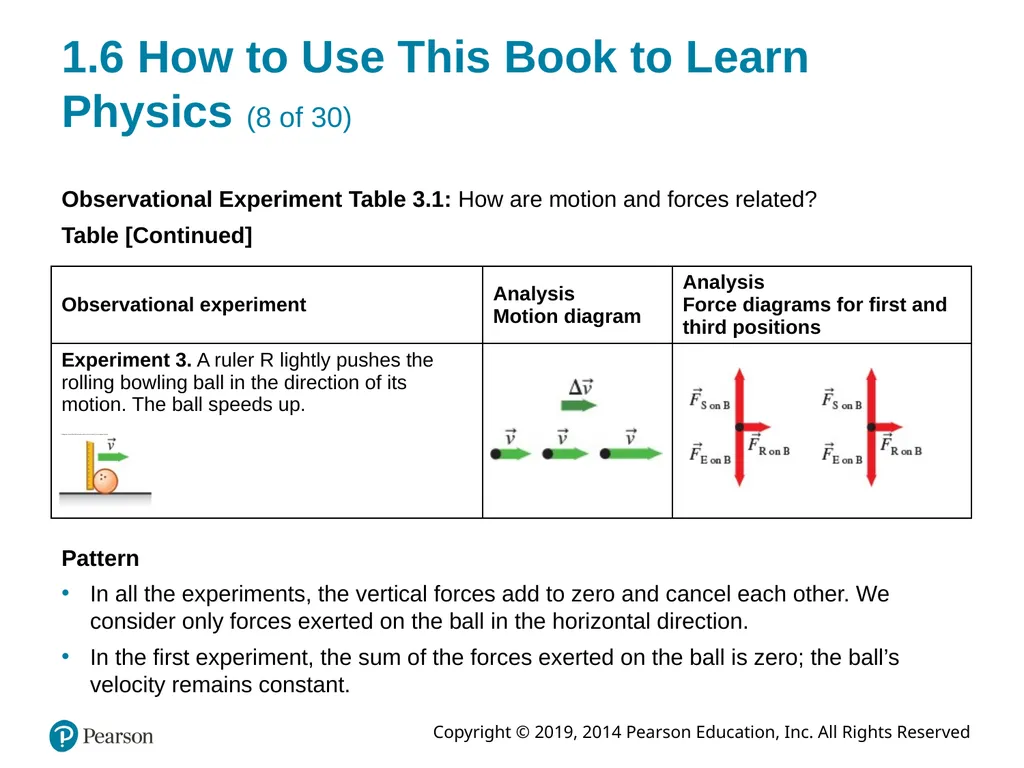
1.6 How to Use This Book to Learn Physics (8 of 30) Observational Experiment Table 3.1: How are motion and forces related?
Table [Continued] Pattern
In all the experiments, the vertical forces add to zero and cancel each other. We consider only forces exerted on the ball in the horizontal direction.
In the first experiment, the sum of the forces exerted on the ball is zero; the ball’s velocity remains constant.<br>
Table [Continued] Pattern
In all the experiments, the vertical forces add to zero and cancel each other. We consider only forces exerted on the ball in the horizontal direction.
In the first experiment, the sum of the forces exerted on the ball is zero; the ball’s velocity remains constant.<br>
39
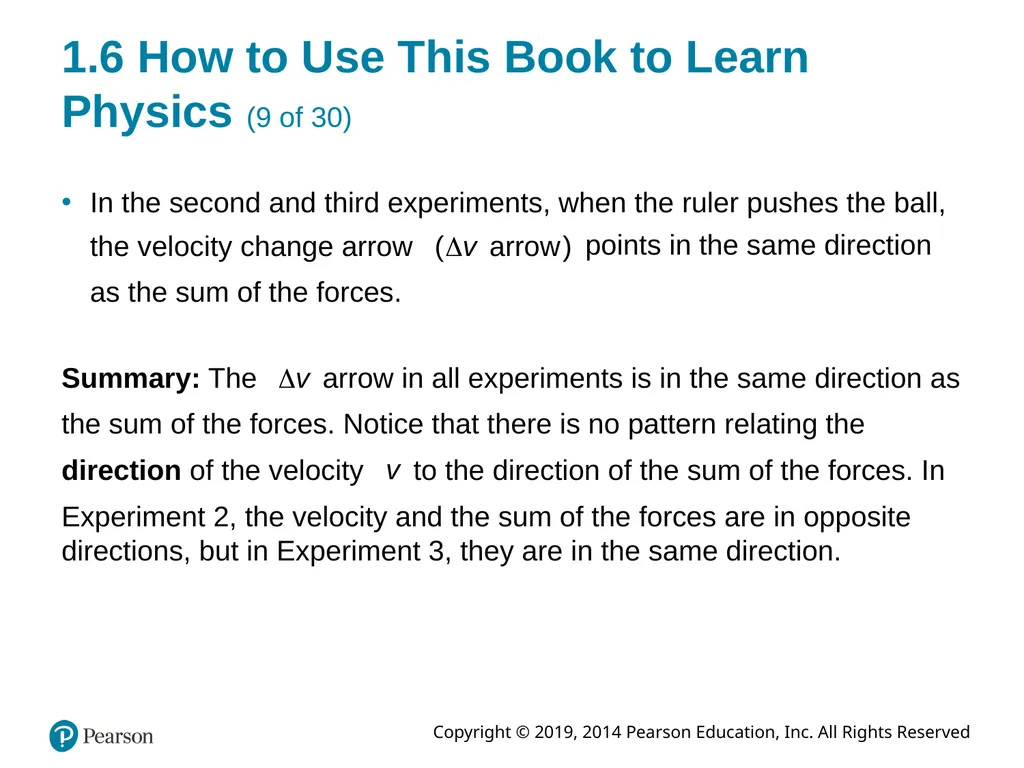
1.6 How to Use This Book to Learn Physics (9 of 30) In the second and third experiments, when the ruler pushes the ball, the velocity change arrow points in the same direction as the sum of the forces. Summary: The arrow in all experiments is in the same direction as the sum of the forces. Notice that there is no pattern relating the direction of the velocity to the direction of the sum of the forces. In Experiment 2, the velocity and the sum of the forces are in opposite directions, but in Experiment 3, they are in the same direction.<br>
40
1.6 How to Use This Book to Learn Physics (10 of 30) Textbook features: Testing Experiment Tables (Cont’d)
These tables help you learn how to test patterns or explanations (many of them will be the patterns that emerged from the Observational Experiment Tables). Your procedure with these tables is different. First, read the description of the experiment in the left column, then try to use the pattern or explanation being tested to predict the outcome of the experiment. Only then should you watch the video or read about the outcome in the far right column.<br>
These tables help you learn how to test patterns or explanations (many of them will be the patterns that emerged from the Observational Experiment Tables). Your procedure with these tables is different. First, read the description of the experiment in the left column, then try to use the pattern or explanation being tested to predict the outcome of the experiment. Only then should you watch the video or read about the outcome in the far right column.<br>
41
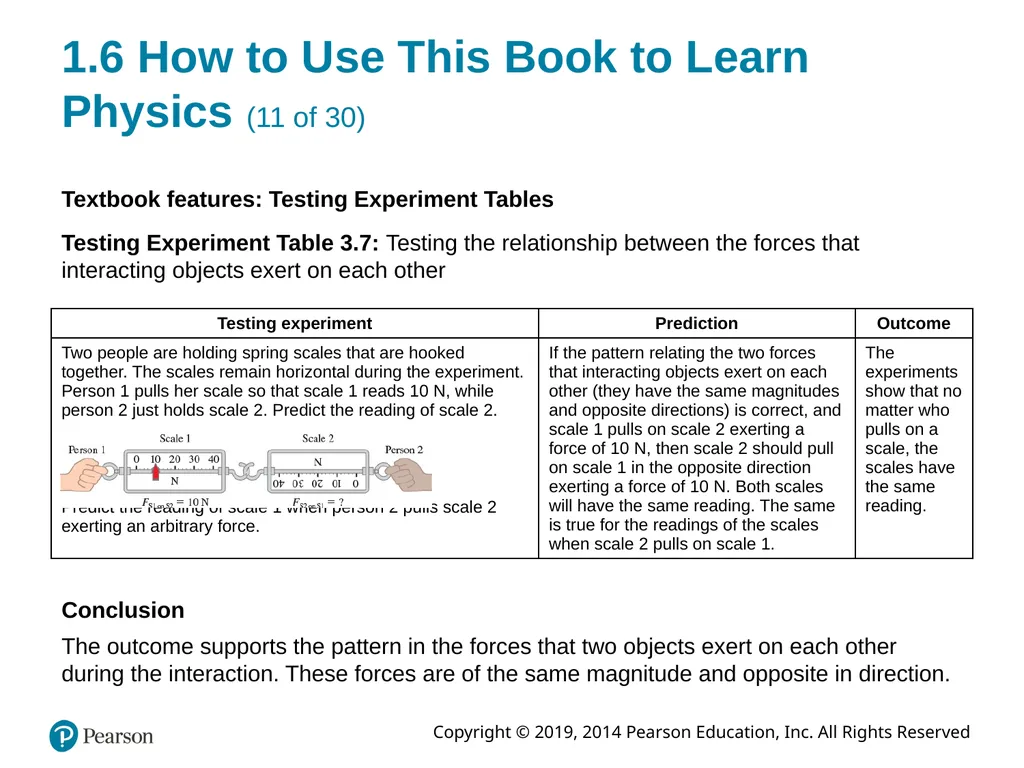
1.6 How to Use This Book to Learn Physics (11 of 30) Textbook features: Testing Experiment Tables Testing Experiment Table 3.7: Testing the relationship between the forces that interacting objects exert on each other Conclusion
The outcome supports the pattern in the forces that two objects exert on each other during the interaction. These forces are of the same magnitude and opposite in direction.<br>
The outcome supports the pattern in the forces that two objects exert on each other during the interaction. These forces are of the same magnitude and opposite in direction.<br>
42
1.6 How to Use This Book to Learn Physics (12 of 30) Textbook features: Tips
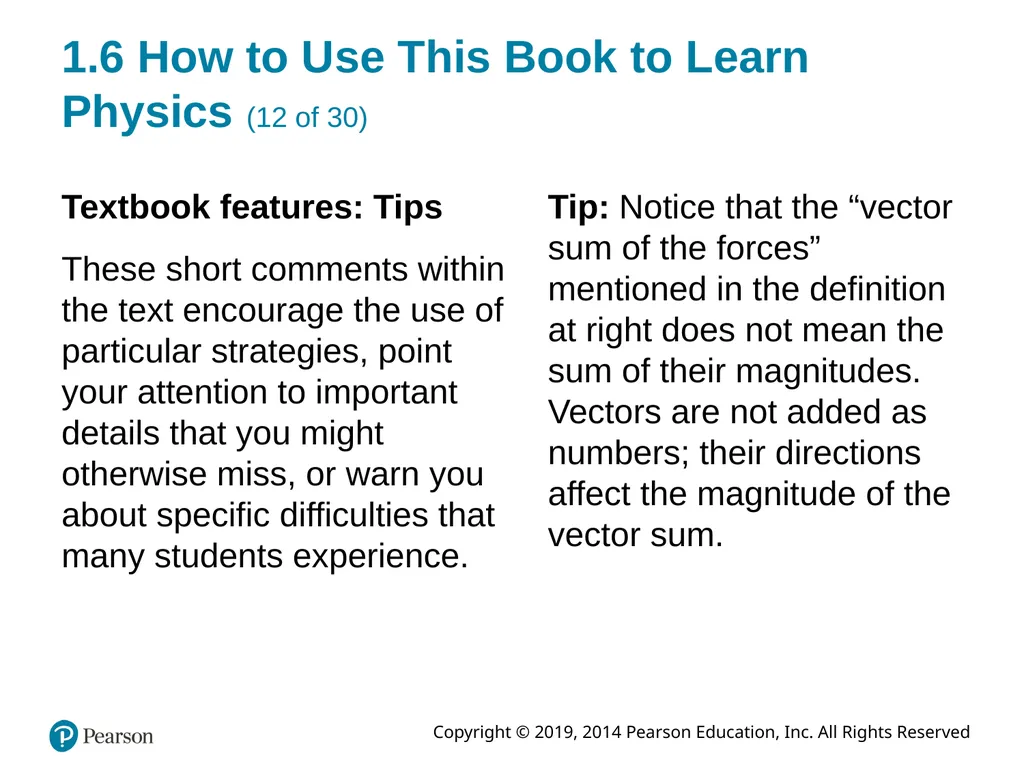
These short comments within the text encourage the use of particular strategies, point your attention to important details that you might otherwise miss, or warn you about specific difficulties that many students experience. Tip: Notice that the “vector sum of the forces” mentioned in the definition at right does not mean the sum of their magnitudes. Vectors are not added as numbers; their directions affect the magnitude of the vector sum.<br>
These short comments within the text encourage the use of particular strategies, point your attention to important details that you might otherwise miss, or warn you about specific difficulties that many students experience. Tip: Notice that the “vector sum of the forces” mentioned in the definition at right does not mean the sum of their magnitudes. Vectors are not added as numbers; their directions affect the magnitude of the vector sum.<br>
43
1.6 How to Use This Book to Learn Physics (13 of 30) Textbook features: Review Questions
At the end of each section is a Review Question. The goal of these questions is to help you learn how to read a scientific text and interrogate it in a way that is similar to how physicists interrogate claims. This skill is a major component of critical thinking. After you read the question, first try to form your opinion about the answer and only after that reread the section and try to find evidence that will support or refute your opinion. You can then check the answers to Review Questions in Appendix D.<br>
At the end of each section is a Review Question. The goal of these questions is to help you learn how to read a scientific text and interrogate it in a way that is similar to how physicists interrogate claims. This skill is a major component of critical thinking. After you read the question, first try to form your opinion about the answer and only after that reread the section and try to find evidence that will support or refute your opinion. You can then check the answers to Review Questions in Appendix D.<br>
44
1.6 How to Use This Book to Learn Physics (14 of 30) Textbook features: Chapter summaries
The summary at the end of each chapter helps you reflect on what you learned. Compare different representations of the same idea and try to find anything you might have missed or misunderstood. Do you understand the connections? Can you write the mathematics illustrated by a diagram? This process is the best strategy to make sure you did not miss anything.<br>
The summary at the end of each chapter helps you reflect on what you learned. Compare different representations of the same idea and try to find anything you might have missed or misunderstood. Do you understand the connections? Can you write the mathematics illustrated by a diagram? This process is the best strategy to make sure you did not miss anything.<br>
45
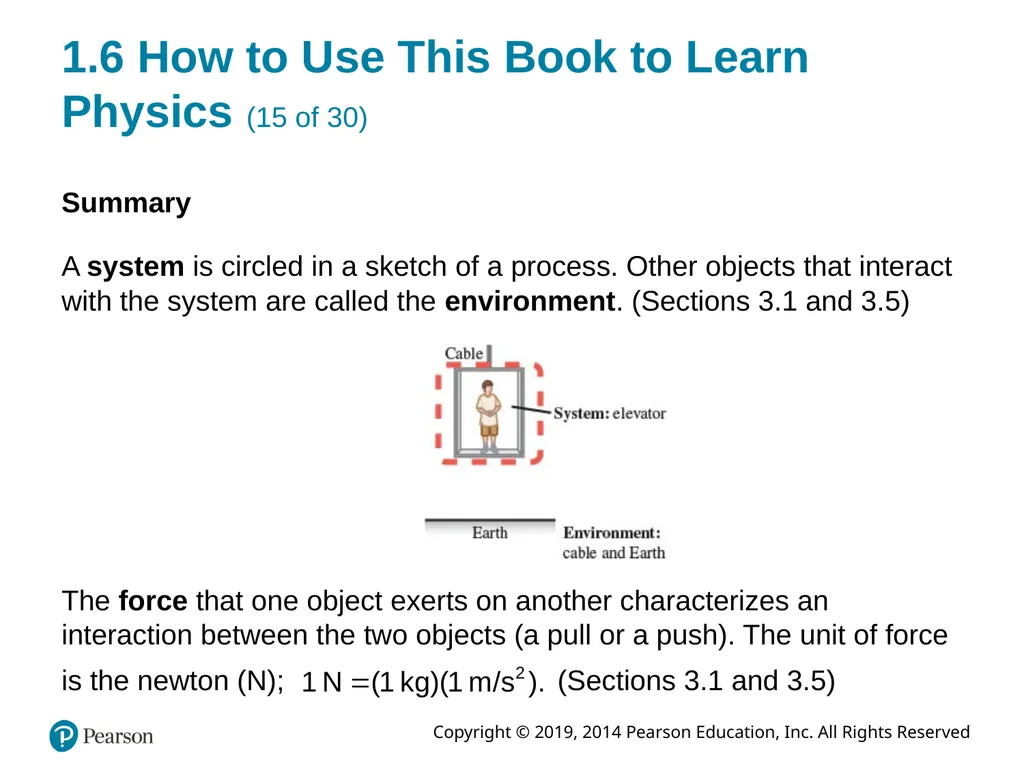
1.6 How to Use This Book to Learn Physics (15 of 30) Summary A system is circled in a sketch of a process. Other objects that interact with the system are called the environment. (Sections 3.1 and 3.5) The force that one object exerts on another characterizes an interaction between the two objects (a pull or a push). The unit of force is the newton (N); (Sections 3.1 and 3.5)<br>
46
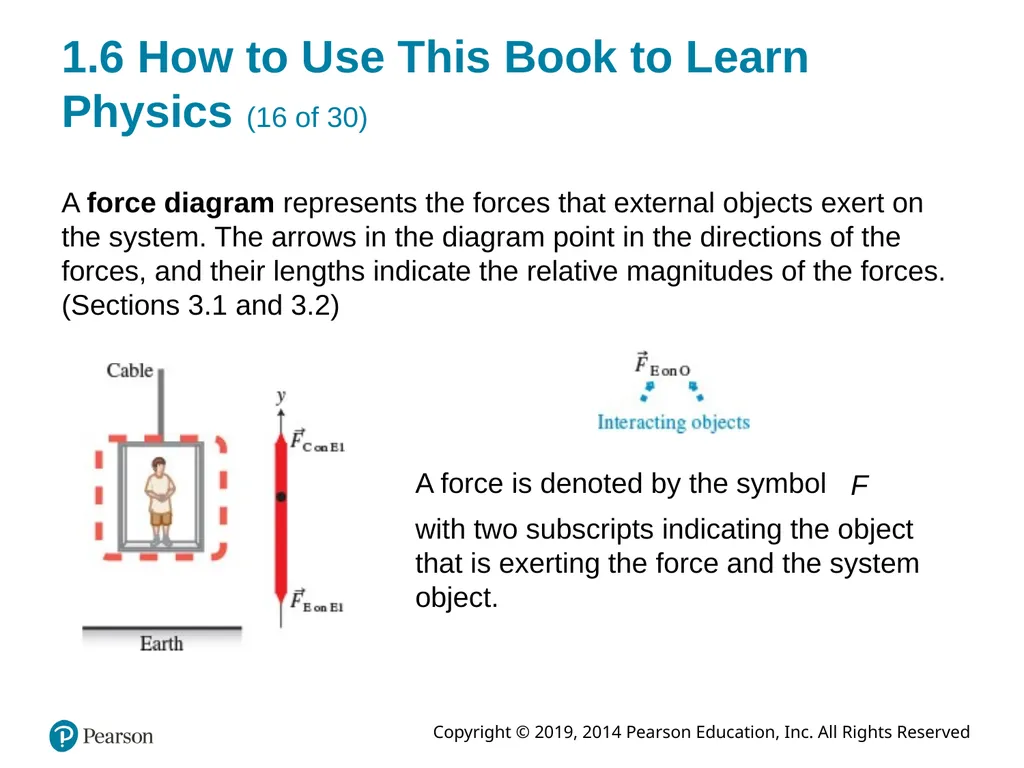
1.6 How to Use This Book to Learn Physics (16 of 30) A force diagram represents the forces that external objects exert on the system. The arrows in the diagram point in the directions of the forces, and their lengths indicate the relative magnitudes of the forces. (Sections 3.1 and 3.2) A force is denoted by the symbol with two subscripts indicating the object that is exerting the force and the system object.<br>
47
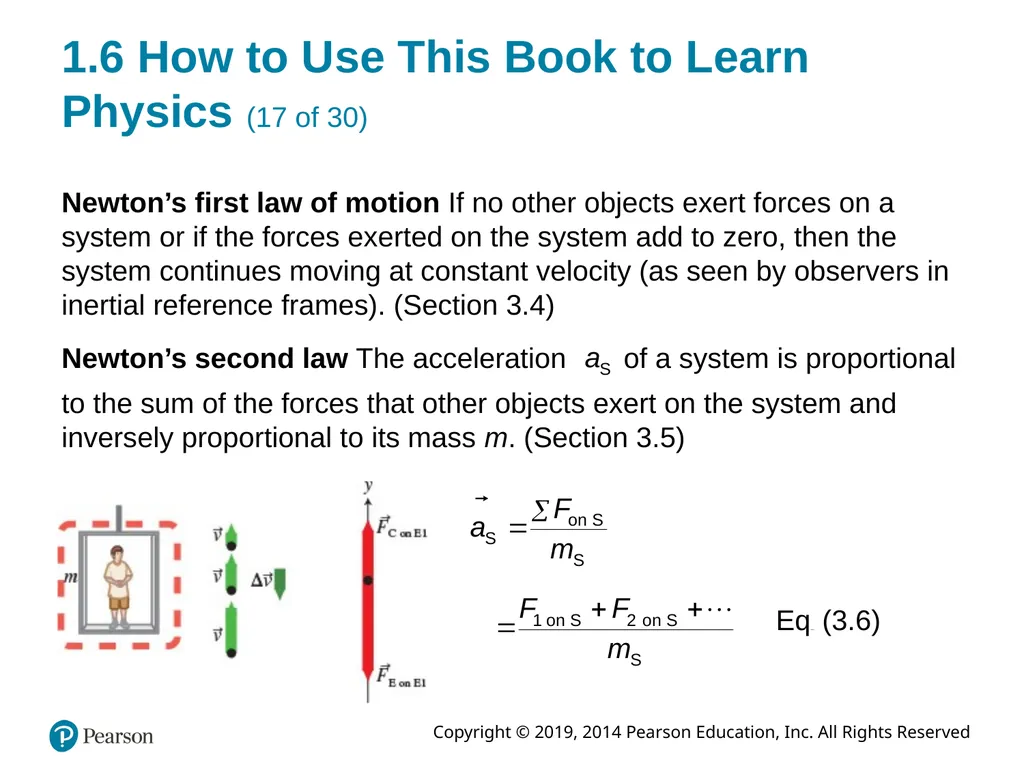
1.6 How to Use This Book to Learn Physics (17 of 30) Newton’s first law of motion If no other objects exert forces on a system or if the forces exerted on the system add to zero, then the system continues moving at constant velocity (as seen by observers in inertial reference frames). (Section 3.4) Newton’s second law The acceleration of a system is proportional to the sum of the forces that other objects exert on the system and inversely proportional to its mass m. (Section 3.5) Equation (3.6)<br>
48
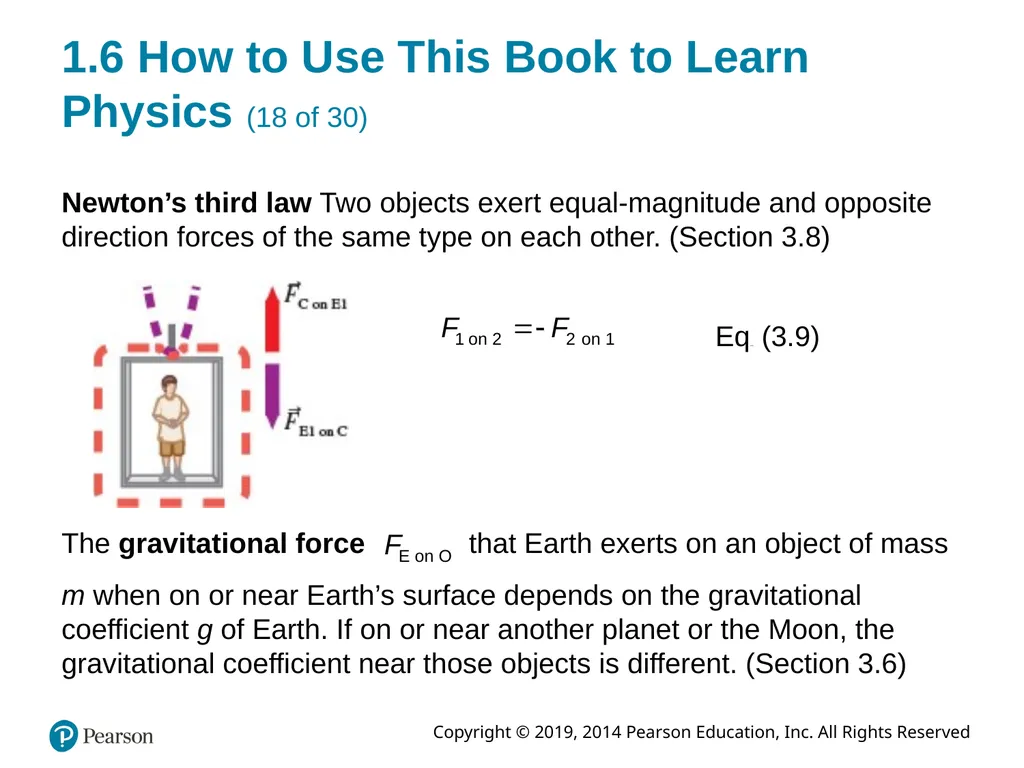
1.6 How to Use This Book to Learn Physics (18 of 30) Newton’s third law Two objects exert equal-magnitude and opposite direction forces of the same type on each other. (Section 3.8) Equation (3.9) The gravitational force that Earth exerts on an object of mass m when on or near Earth’s surface depends on the gravitational coefficient g of Earth. If on or near another planet or the Moon, the gravitational coefficient near those objects is different. (Section 3.6)<br>
49
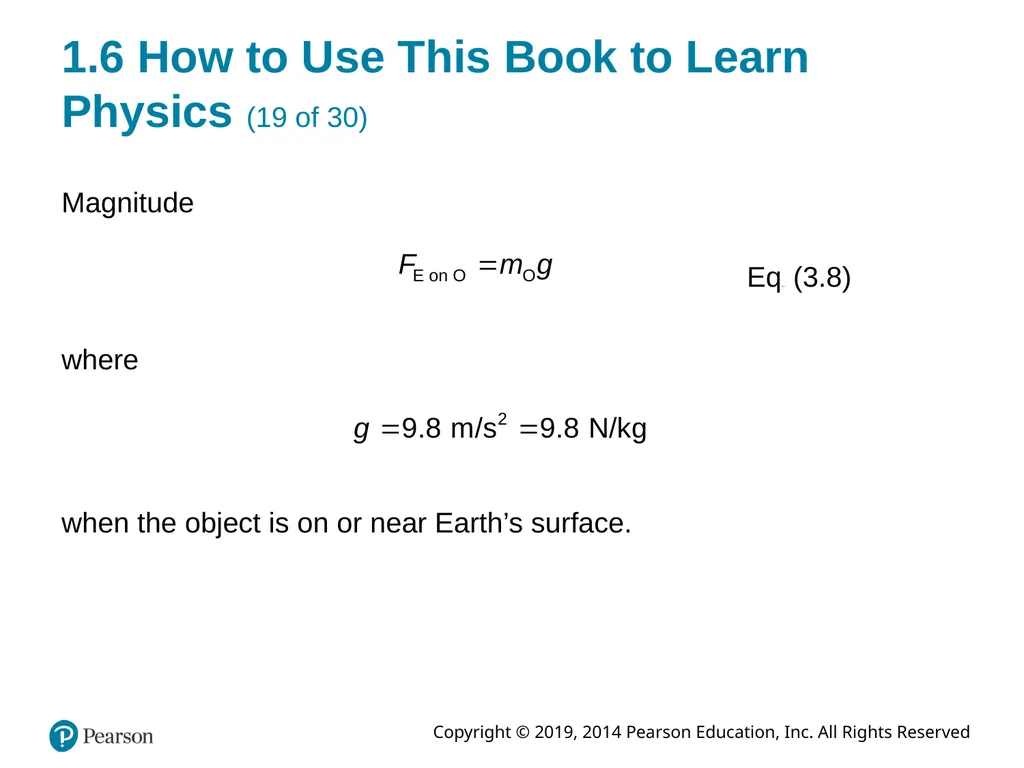
1.6 How to Use This Book to Learn Physics (19 of 30) Magnitude Equation (3.8) where when the object is on or near Earth’s surface.<br>
50
1.6 How to Use This Book to Learn Physics (20 of 30) Problem solving
This textbook teaches you how to approach physics problem solving in a very systematic way.
If you consistently follow the problem-solving strategy demonstrated in worked examples, by the end of the course you will be an expert problem solver.
Every example has four problem-solving steps that we suggest you use when solving any physics problem.
Start by reading the problem at least three times to completely understand the problem statement. Next, try to visualize the problem situation and draw a sketch. This is the beginning of the first step.<br>
This textbook teaches you how to approach physics problem solving in a very systematic way.
If you consistently follow the problem-solving strategy demonstrated in worked examples, by the end of the course you will be an expert problem solver.
Every example has four problem-solving steps that we suggest you use when solving any physics problem.
Start by reading the problem at least three times to completely understand the problem statement. Next, try to visualize the problem situation and draw a sketch. This is the beginning of the first step.<br>
51
1.6 How to Use This Book to Learn Physics (21 of 30) Problem solving: Sketch and translate
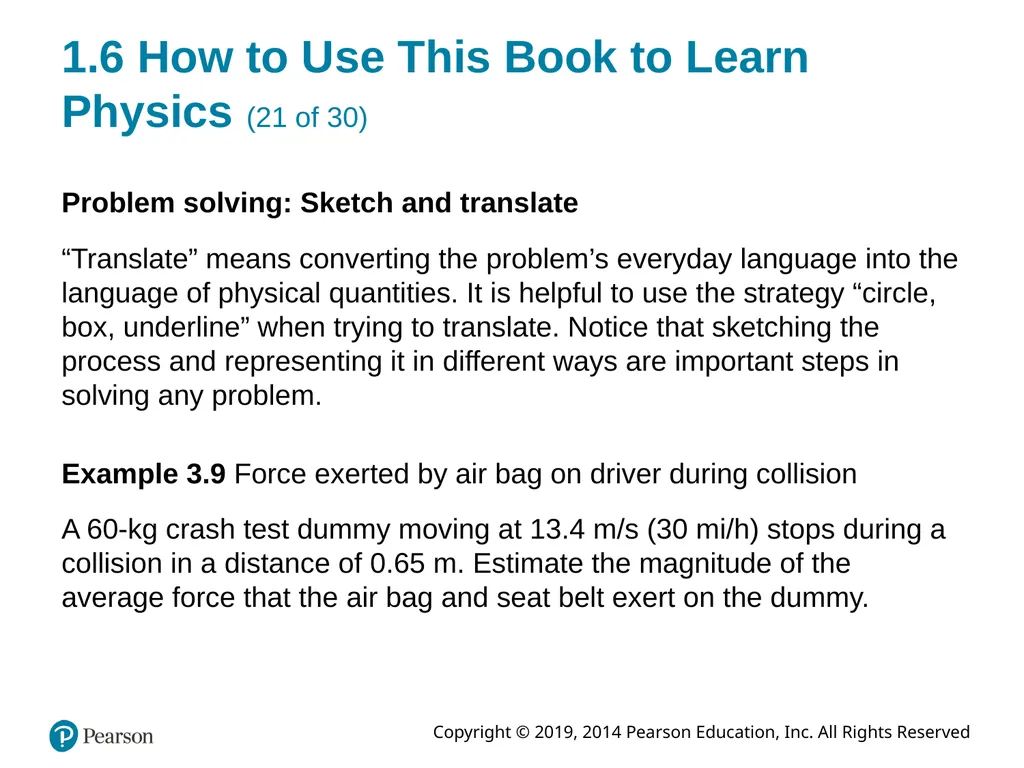
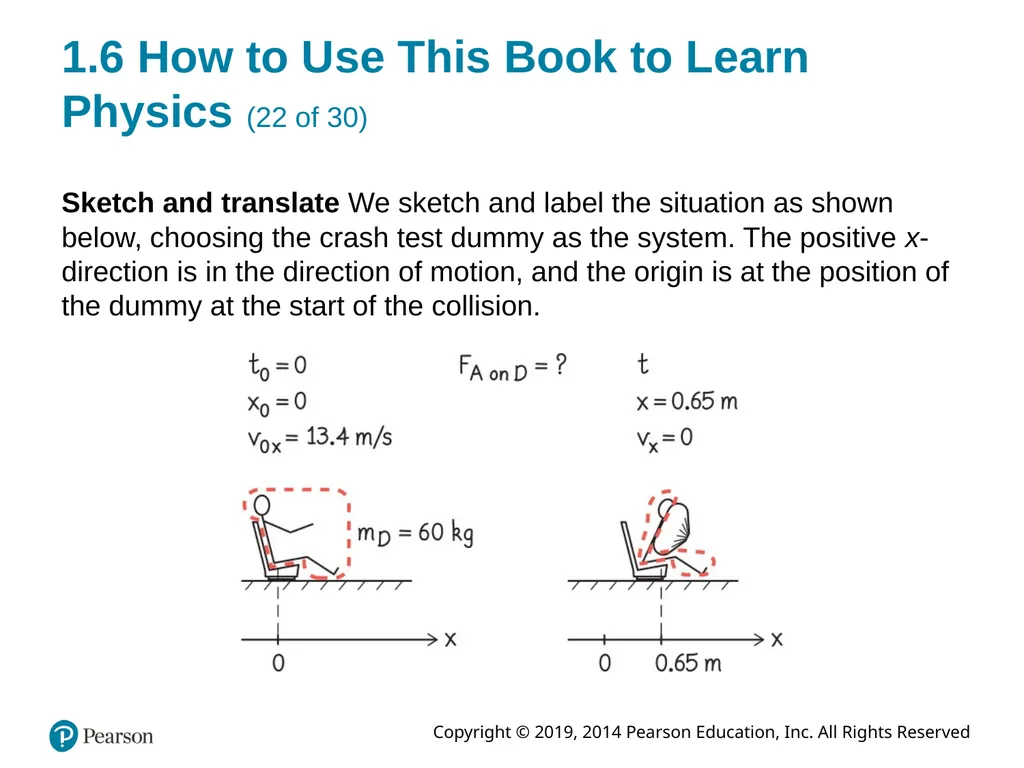
“Translate” means converting the problem’s everyday language into the language of physical quantities. It is helpful to use the strategy “circle, box, underline” when trying to translate. Notice that sketching the process and representing it in different ways are important steps in solving any problem. Example 3.9 Force exerted by air bag on driver during collision
A 60-kg crash test dummy moving at 13.4 m/s (30 mi/h) stops during a collision in a distance of 0.65 m. Estimate the magnitude of the average force that the air bag and seat belt exert on the dummy.<br>
“Translate” means converting the problem’s everyday language into the language of physical quantities. It is helpful to use the strategy “circle, box, underline” when trying to translate. Notice that sketching the process and representing it in different ways are important steps in solving any problem. Example 3.9 Force exerted by air bag on driver during collision
A 60-kg crash test dummy moving at 13.4 m/s (30 mi/h) stops during a collision in a distance of 0.65 m. Estimate the magnitude of the average force that the air bag and seat belt exert on the dummy.<br>
52
1.6 How to Use This Book to Learn Physics (22 of 30) Sketch and translate We sketch and label the situation as shown below, choosing the crash test dummy as the system. The positive x-direction is in the direction of motion, and the origin is at the position of the dummy at the start of the collision.<br>
53
1.6 How to Use This Book to Learn Physics (23 of 30) Problem solving: Simplify and diagram
Here you will make necessary simplifications and choose a productive physics representation (from your Tool Box). Determine how you can simplify the situation. How will you model the object of interest? What interactions can you neglect? You will learn a new representation in nearly every chapter; thus the choice of a productive one is key to solving the problem.<br>
Here you will make necessary simplifications and choose a productive physics representation (from your Tool Box). Determine how you can simplify the situation. How will you model the object of interest? What interactions can you neglect? You will learn a new representation in nearly every chapter; thus the choice of a productive one is key to solving the problem.<br>
54
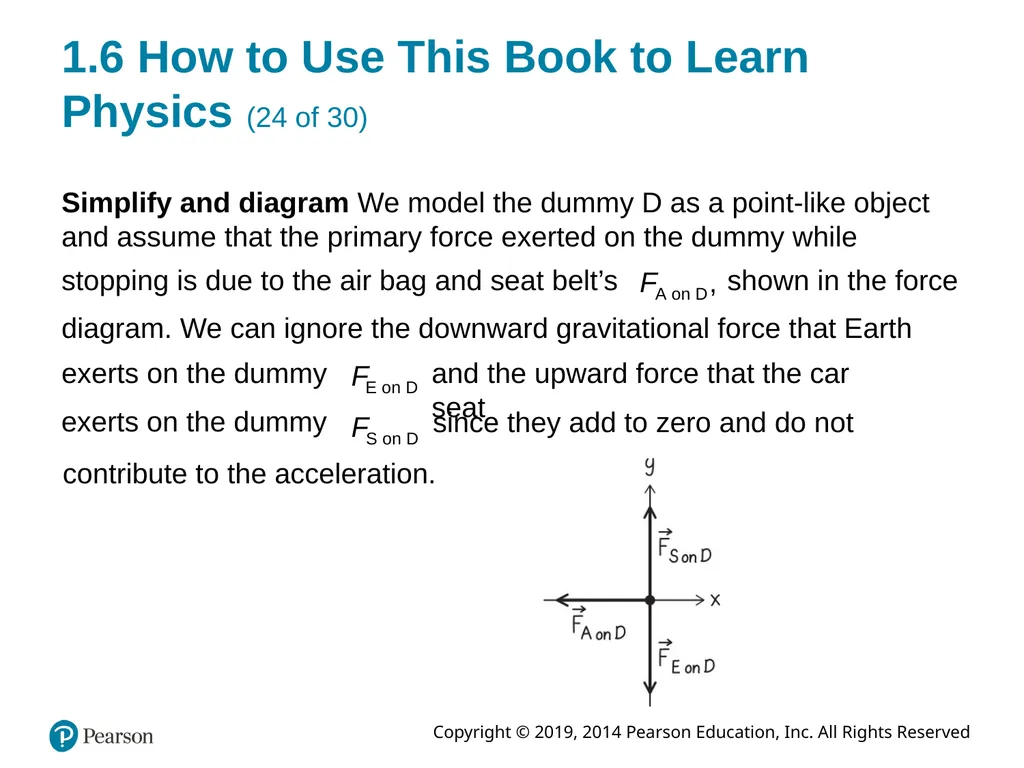
1.6 How to Use This Book to Learn Physics (24 of 30) Simplify and diagram We model the dummy D as a point-like object and assume that the primary force exerted on the dummy while stopping is due to the air bag and seat belt’s shown in the force diagram. We can ignore the downward gravitational force that Earth exerts on the dummy and the upward force that the car seat exerts on the dummy since they add to zero and do not contribute to the acceleration.<br>
55
1.6 How to Use This Book to Learn Physics (25 of 30) Problem solving: Represent mathematically
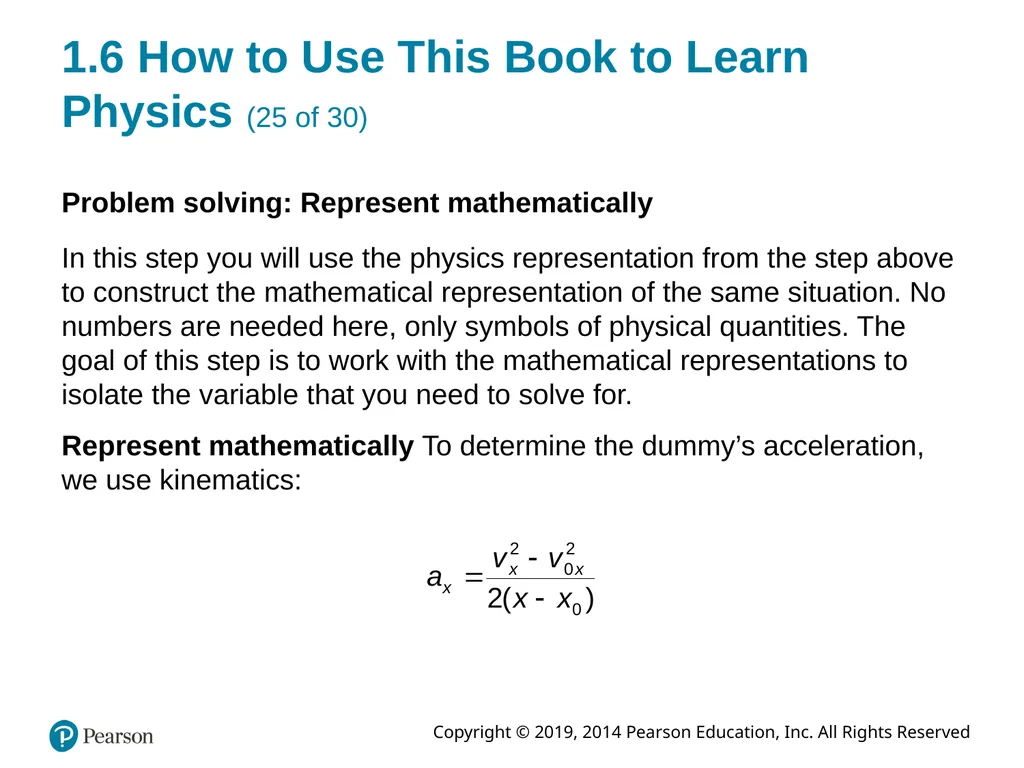
In this step you will use the physics representation from the step above to construct the mathematical representation of the same situation. No numbers are needed here, only symbols of physical quantities. The goal of this step is to work with the mathematical representations to isolate the variable that you need to solve for. Represent mathematically To determine the dummy’s acceleration, we use kinematics:<br>
In this step you will use the physics representation from the step above to construct the mathematical representation of the same situation. No numbers are needed here, only symbols of physical quantities. The goal of this step is to work with the mathematical representations to isolate the variable that you need to solve for. Represent mathematically To determine the dummy’s acceleration, we use kinematics:<br>
56
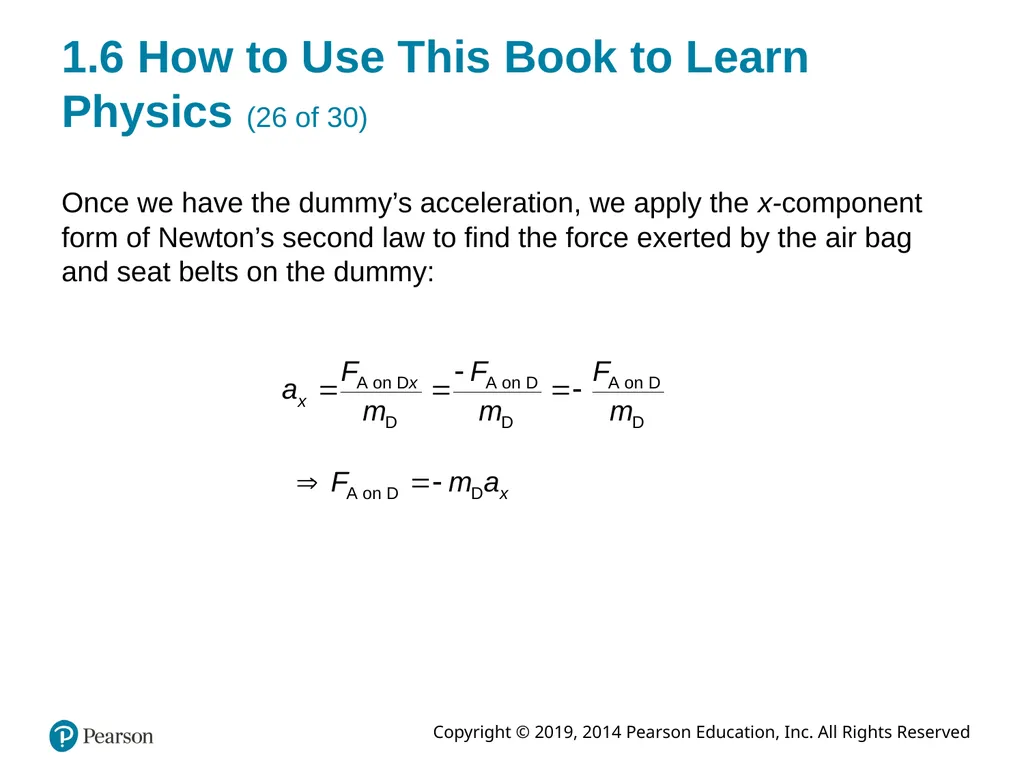
1.6 How to Use This Book to Learn Physics (26 of 30) Once we have the dummy’s acceleration, we apply the x-component form of Newton’s second law to find the force exerted by the air bag and seat belts on the dummy:<br>
57
1.6 How to Use This Book to Learn Physics (27 of 30) Problem solving: Solve and evaluate
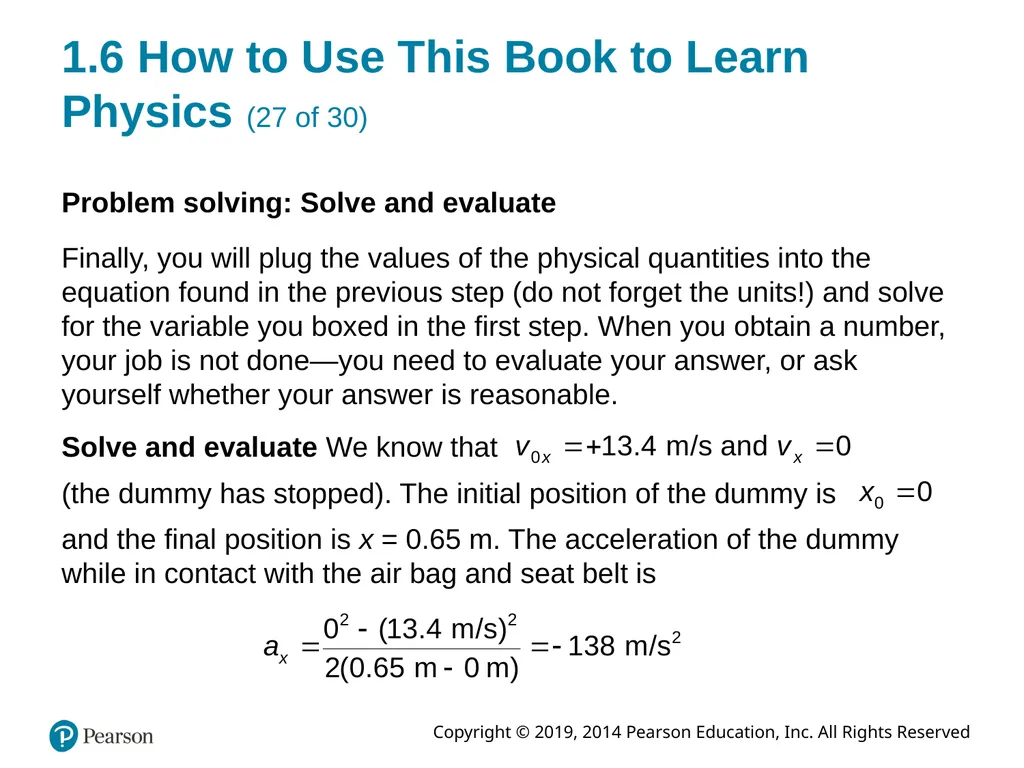
Finally, you will plug the values of the physical quantities into the equation found in the previous step (do not forget the units!) and solve for the variable you boxed in the first step. When you obtain a number, your job is not done—you need to evaluate your answer, or ask yourself whether your answer is reasonable. Solve and evaluate We know that (the dummy has stopped). The initial position of the dummy is and the final position is x = 0.65 m. The acceleration of the dummy while in contact with the air bag and seat belt is<br>
Finally, you will plug the values of the physical quantities into the equation found in the previous step (do not forget the units!) and solve for the variable you boxed in the first step. When you obtain a number, your job is not done—you need to evaluate your answer, or ask yourself whether your answer is reasonable. Solve and evaluate We know that (the dummy has stopped). The initial position of the dummy is and the final position is x = 0.65 m. The acceleration of the dummy while in contact with the air bag and seat belt is<br>
58
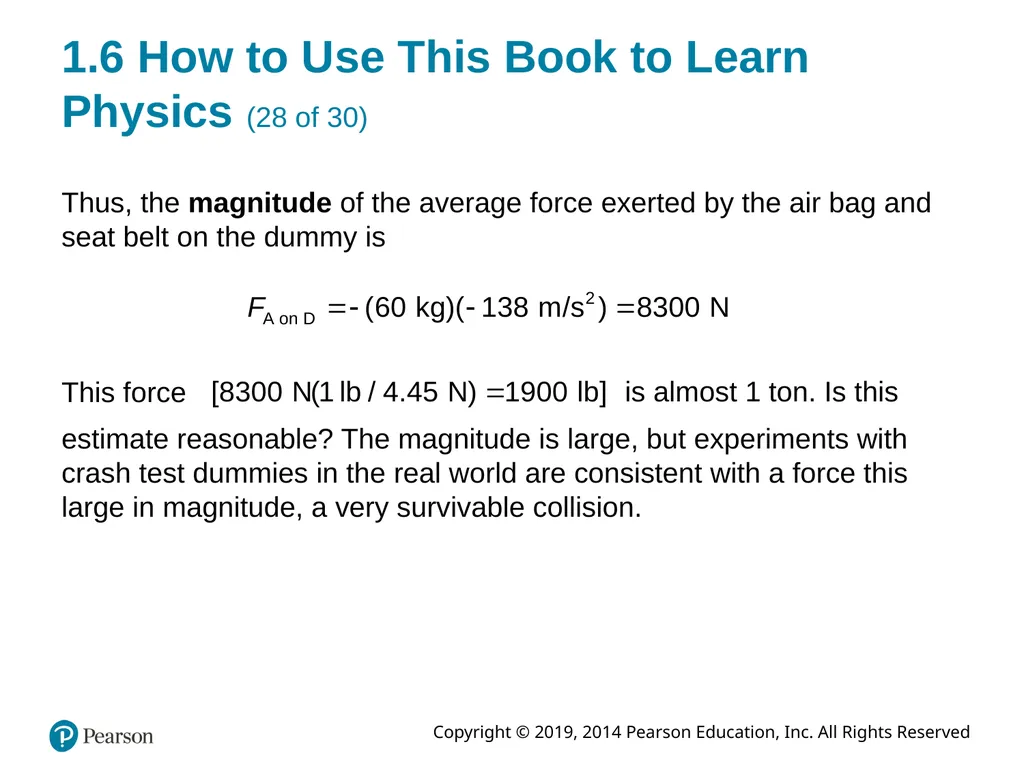
1.6 How to Use This Book to Learn Physics (28 of 30) Thus, the magnitude of the average force exerted by the air bag and seat belt on the dummy is This force is almost 1 ton. Is this estimate reasonable? The magnitude is large, but experiments with crash test dummies in the real world are consistent with a force this large in magnitude, a very survivable collision.<br>
59
1.6 How to Use This Book to Learn Physics (29 of 30) Problem solving: Solve and evaluate
Try to solve example problems by using this four-step strategy without looking at the solution.
After finishing, compare your solution to the one described in the book.
Then do the “try it yourself” part of the example problem and compare your answer to the book’s answer.
If you are still having difficulty, use the same strategy to actively solve other example problems in the text or the Active Learning Guide. Uncover the solutions only after you have tried to complete the problem on your own.<br>
Try to solve example problems by using this four-step strategy without looking at the solution.
After finishing, compare your solution to the one described in the book.
Then do the “try it yourself” part of the example problem and compare your answer to the book’s answer.
If you are still having difficulty, use the same strategy to actively solve other example problems in the text or the Active Learning Guide. Uncover the solutions only after you have tried to complete the problem on your own.<br>
60
1.6 How to Use This Book to Learn Physics (30 of 30) Summary
We are confident that this book will act as a useful companion in your study of physics and that you will take from the course not just the knowledge of physics but also an understanding of the process of science that will help you in all your scientific endeavors. Learning physics through the approach used in this book builds a deeper understanding of physics concepts and an improved ability to solve difficult problems compared to traditional learning methods. In addition, you will learn to reason scientifically and be able to transfer those reasoning skills to many other aspects of your life.<br>
We are confident that this book will act as a useful companion in your study of physics and that you will take from the course not just the knowledge of physics but also an understanding of the process of science that will help you in all your scientific endeavors. Learning physics through the approach used in this book builds a deeper understanding of physics concepts and an improved ability to solve difficult problems compared to traditional learning methods. In addition, you will learn to reason scientifically and be able to transfer those reasoning skills to many other aspects of your life.<br>
61
Copyright This work is protected by United States copyright laws and is provided solely for the use of instructors in teaching their courses and assessing student learning. Dissemination or sale of any part of this work (including on the World Wide Web) will destroy the integrity of the work and is not permitted. The work and materials from it should never be made available to students except by instructors using the accompanying text in their classes. All recipients of this work are expected to abide by these restrictions and to honor the intended pedagogical purposes and the needs of other instructors who rely on these materials.<br>