
Combined Static and Dynamic Mutability Analysis



















Description: Combined Static and Dynamic Mutability Analysis Shay Artzi, Adam Kiezun, David Glasser Michael D. Ernst CSAIL, MIT Parameter P of method M is: Mutable if some execution of M can change the state of Ps referent object using P Immutable if
Related Topics
Download Presentation
"Combined Static and Dynamic Mutability Analysis" is the property of its rightful owner. Permission is granted to download and print the materials on this website for personal, non-commercial use only, and to display it on your personal computer provided you do not modify the materials and that you retain all copyright notices contained in the materials. By downloading content from our website, you accept the terms of this agreement.
Presentation Transcript
slide1. Combined Static and Dynamic Mutability Analysis Shay Artzi, Adam Kiezun,
David Glasser Michael D. Ernst
CSAIL, MIT<br>
slide2. Parameter P of method M is:
Mutable if some execution of M can change the state of P’s referent object using P
Immutable if no such execution exists
A method is pure (side-effect free) if:
All its parameters are immutable (including receiver and global state) 2 Mutability/Immutability Definition<br>
slide3. 3 Mutability Example class List {
…
int size(List this){ return n;}
void add(List this, Object o) {…}
List addAll(List this, List l){…}
List clone(List this){
return new List().addAll(this); }
void remove(List this, Object O) {
if(!this.contains(o)) return;
…
}
}<br>
slide4. 4 Mutability Example class List {
…
int size(List this){ return n;}
void add(List this, Object o) {…}
List addAll(List this, List l){…}
List clone(List this){
return new List().addAll(this); }
void remove(List this, Object O) {
if(!this.contains(o)) return;
…
}
} * Immutable<br>
slide5. 5 Mutability Example class List {
…
int size(List this){ return n;}
void add(List this, Object o) {…}
List addAll(List this, List l){…}
List clone(List this){
return new List().addAll(this); }
void remove(List this, Object O) {
if(!this.contains(o)) return;
…
}
} * Immutable * Mutable<br>
slide6. 6 Mutability Example class List {
…
int size(List this){ return n;}
void add(List this, Object o) {…}
List addAll(List this, List l){…}
List clone(List this){
return new List().addAll(this); }
void remove(List this, Object O) {
if(!this.contains(o)) return;
…
}
} * Immutable * Mutable
* Pure Method<br>
slide7. Requires sound mutability information:
Modeling (Burdy 05)
Compiler optimizations (Clausen 97)
Verification (Tkachuk 03)
Typestate checker (Deline 04)
Can use unsound mutability information:
Regression oracle creation (Marini 05, Xie 06)
Test input generation (Artzi 06)
Invariant detection (Ernst 01)
Specification mining (Dallmeier 06)
Program comprehension (Dolado 03)
Refactoring tools 7 Uses of Mutability Information<br>
slide8. Palulu tool for test generation (Artzi et al.,06)
Generate tests based on a model
Models describe legal sequences of calls
Smaller models
Faster systematic exploration
Greater search space exploration by random generator
Easier to compare models
Prune models
Removing calls that do not mutate objects
Preserving the state
Can reduce model by 90% 8 Application: Test Input Generation<br>
slide9. Mutability Definition and Applications
Technique:
Staged analysis
Static analyses
Dynamic analyses
Evaluation
Conclusions 9 Outline<br>
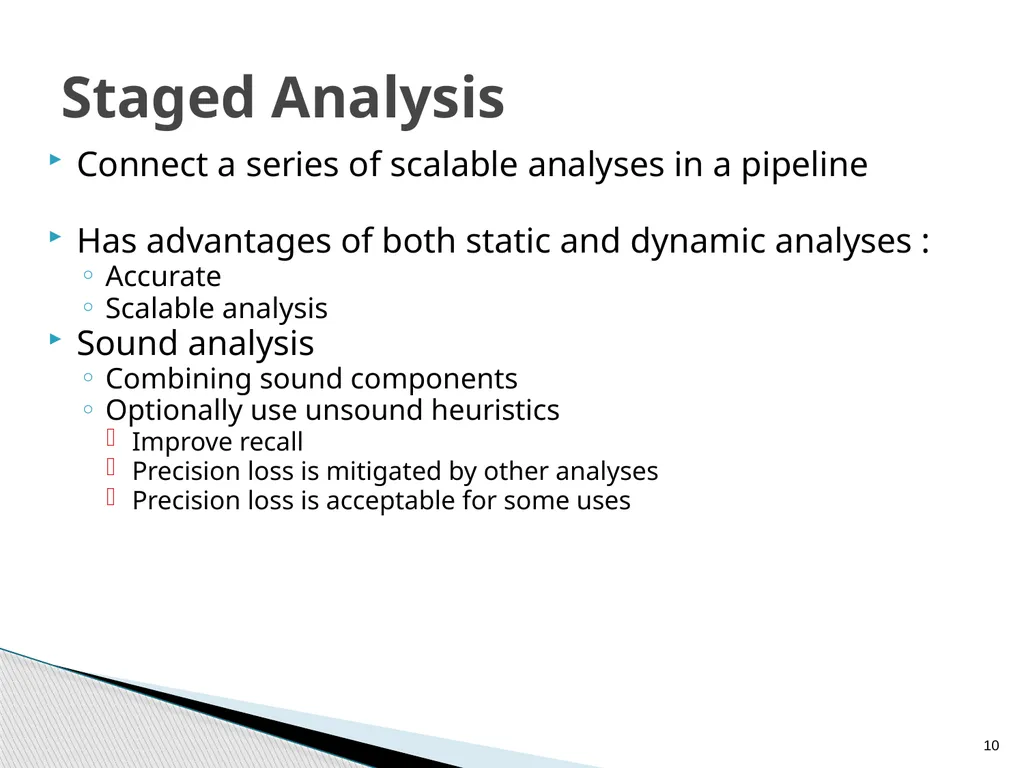
slide10. Staged Analysis Connect a series of scalable analyses in a pipeline
Has advantages of both static and dynamic analyses :
Accurate
Scalable analysis
Sound analysis
Combining sound components
Optionally use unsound heuristics
Improve recall
Precision loss is mitigated by other analyses
Precision loss is acceptable for some uses 10<br>
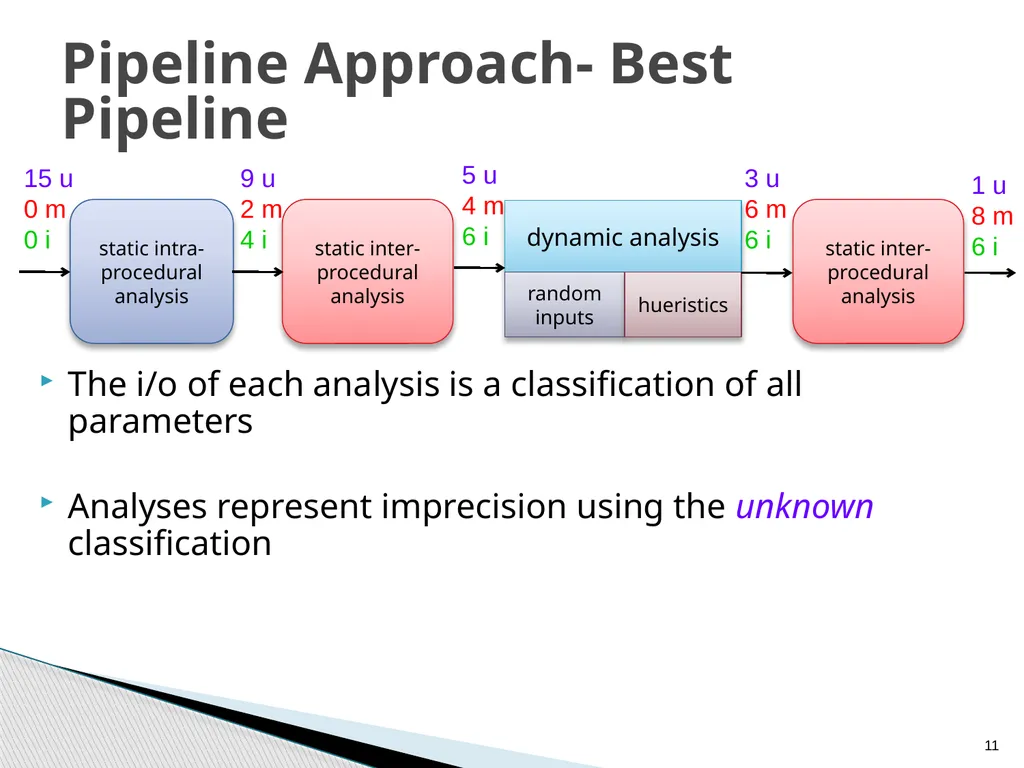
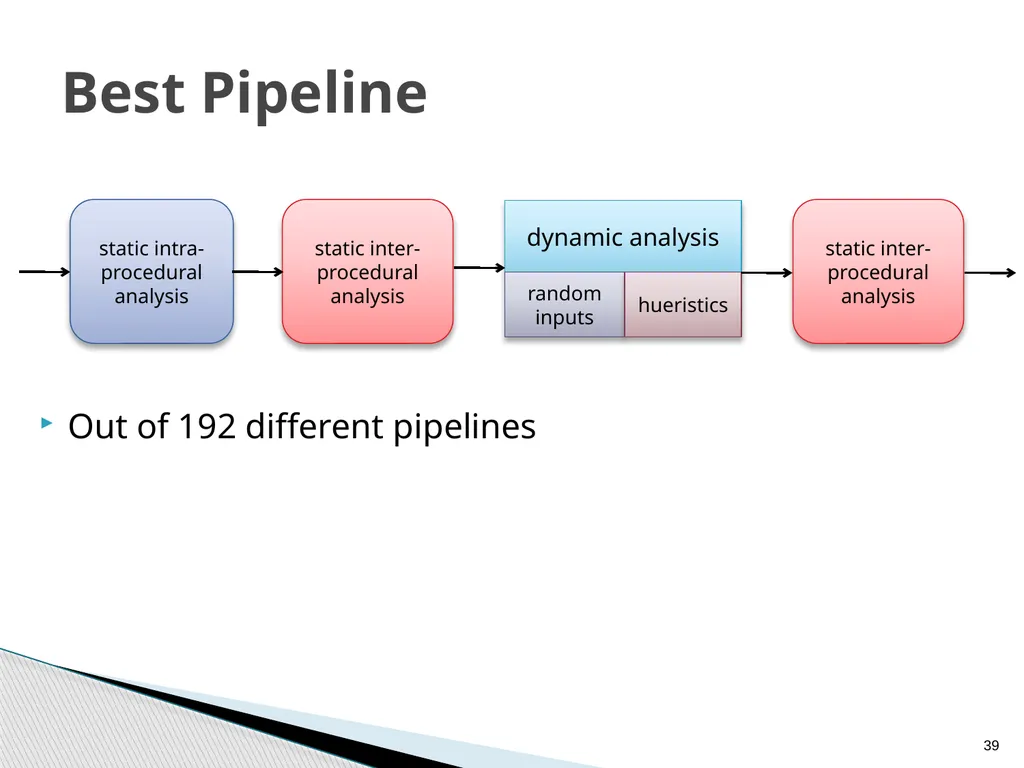
slide11. Pipeline Approach- Best Pipeline The i/o of each analysis is a classification of all parameters
Analyses represent imprecision using the unknown classification 11 9 u
2 m
4 i 5 u
4 m
6 i 1 u
8 m
6 i 15 u
0 m
0 i static intra-procedural analysis static inter-procedural analysis static inter-procedural analysis 3 u
6 m
6 i<br>
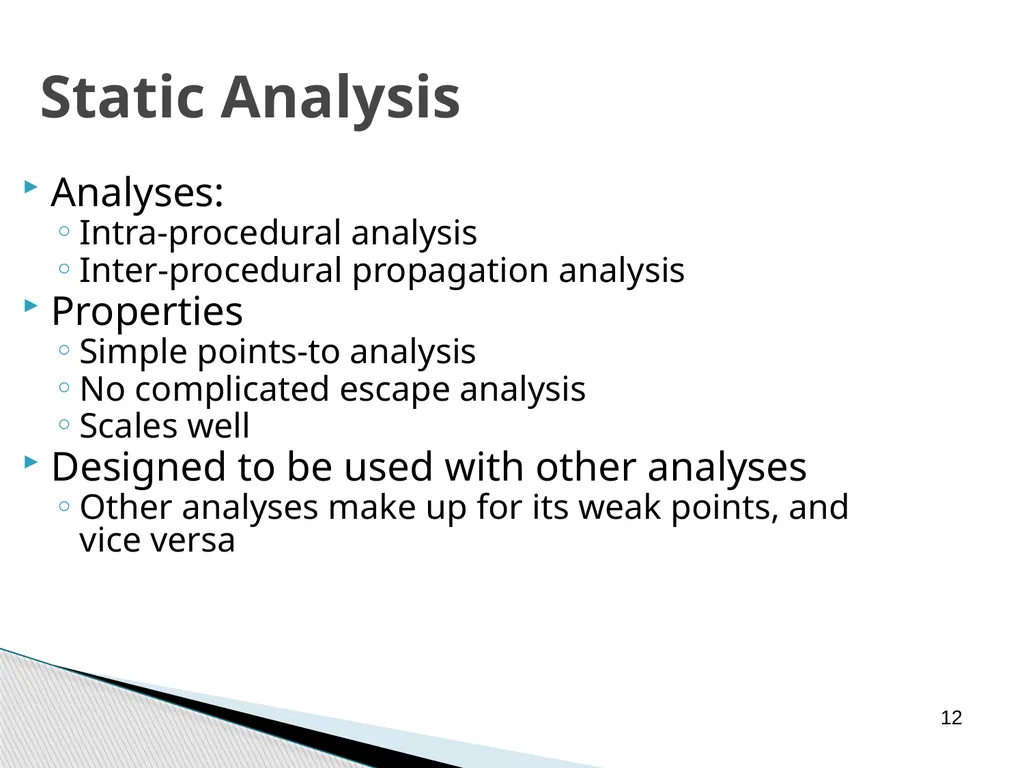
slide12. 12 Static Analysis Analyses:
Intra-procedural analysis
Inter-procedural propagation analysis
Properties
Simple points-to analysis
No complicated escape analysis
Scales well
Designed to be used with other analyses
Other analyses make up for its weak points, and vice versa<br>
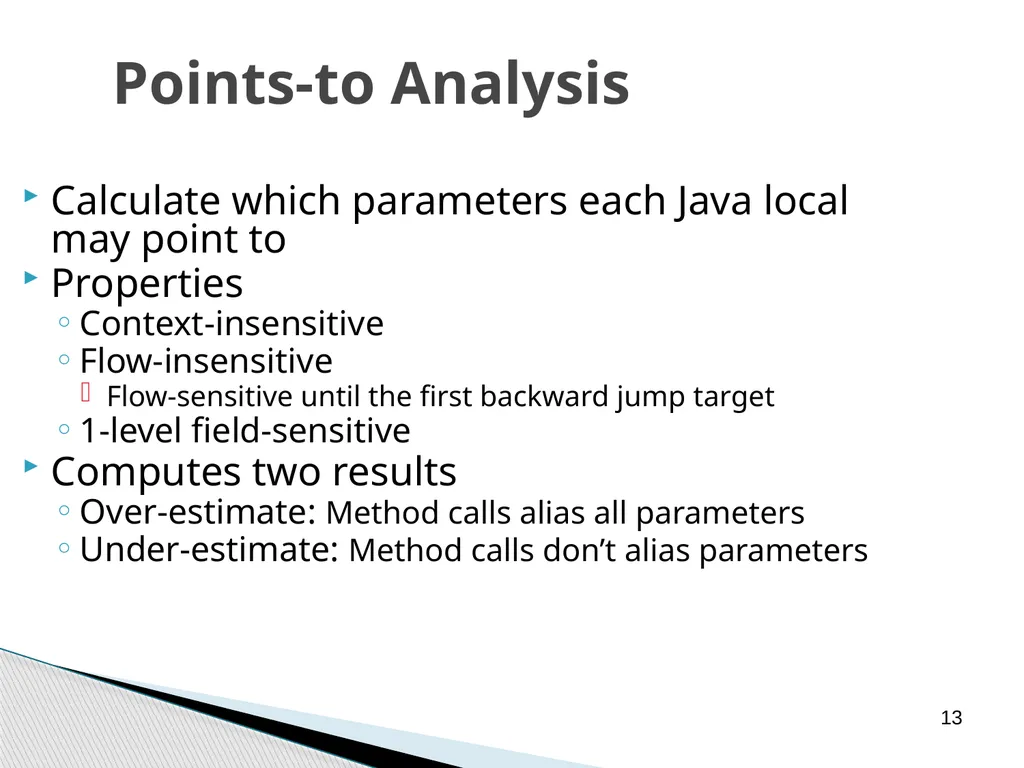
slide13. 13 Points-to Analysis Calculate which parameters each Java local may point to
Properties
Context-insensitive
Flow-insensitive
Flow-sensitive until the first backward jump target
1-level field-sensitive
Computes two results
Over-estimate: Method calls alias all parameters
Under-estimate: Method calls don’t alias parameters<br>
slide14. Algorithm
Use over-estimate points to sets
Mark direct field and array mutations as mutable
Mark parameters that aren’t directly mutated and don’t escape as immutable
Leave the rest as unknown
Soundness
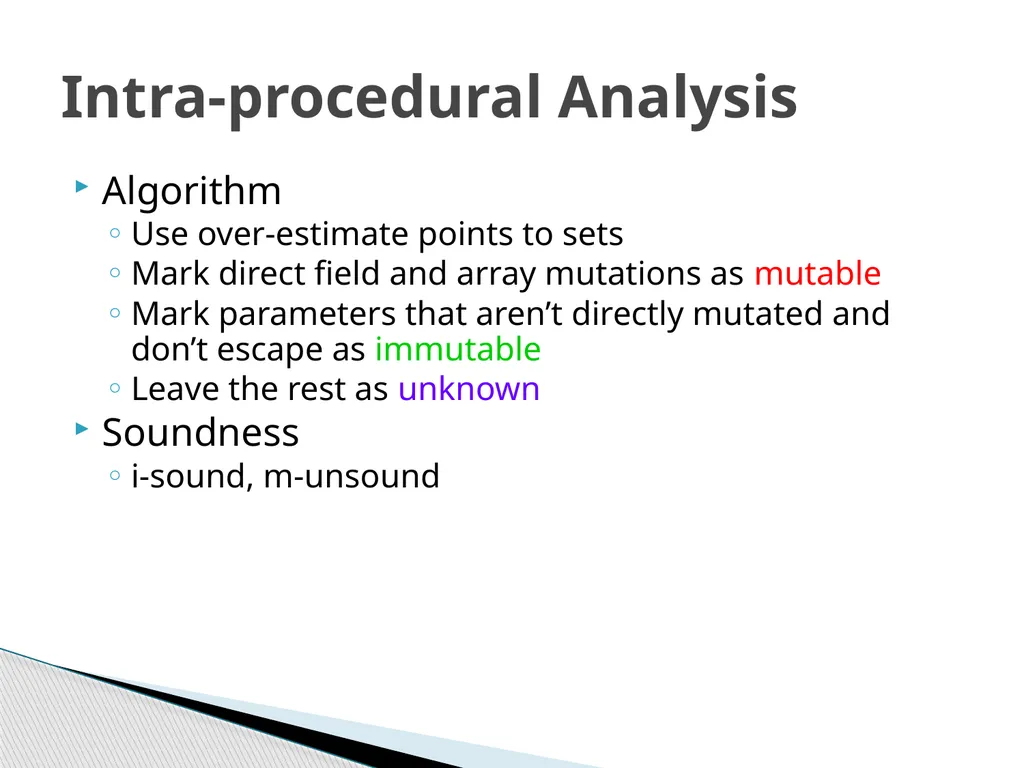
i-sound, m-unsound Intra-procedural Analysis<br>
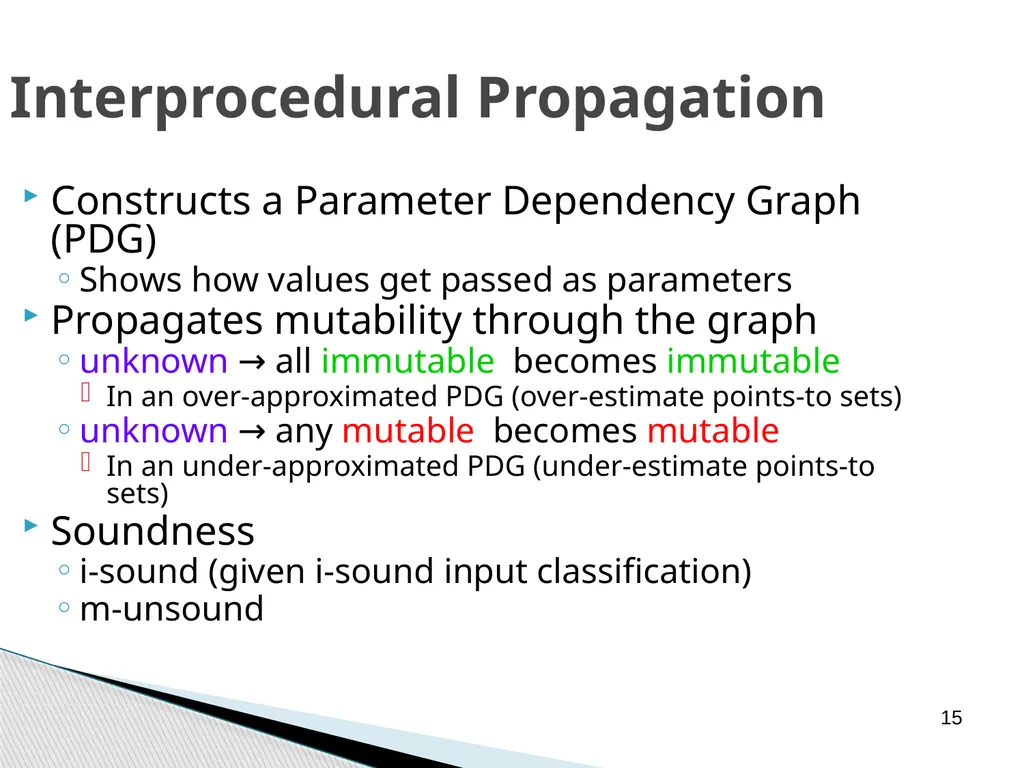
slide15. 15 Interprocedural Propagation Constructs a Parameter Dependency Graph (PDG)
Shows how values get passed as parameters
Propagates mutability through the graph
unknown → all immutable becomes immutable
In an over-approximated PDG (over-estimate points-to sets)
unknown → any mutable becomes mutable
In an under-approximated PDG (under-estimate points-to sets)
Soundness
i-sound (given i-sound input classification)
m-unsound<br>
slide16. Observe program execution
On field/array write:
Mark as mutable all non-aliased formal parameters that transitively point to the mutated object 16 Dynamic Mutability Analysis<br>
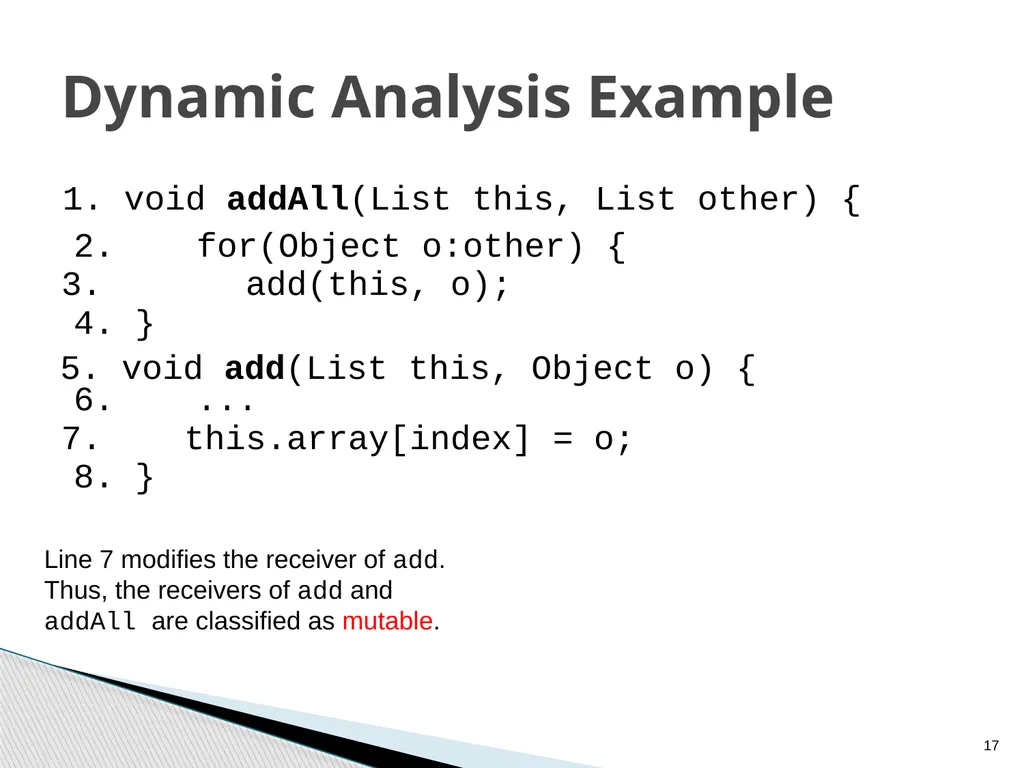
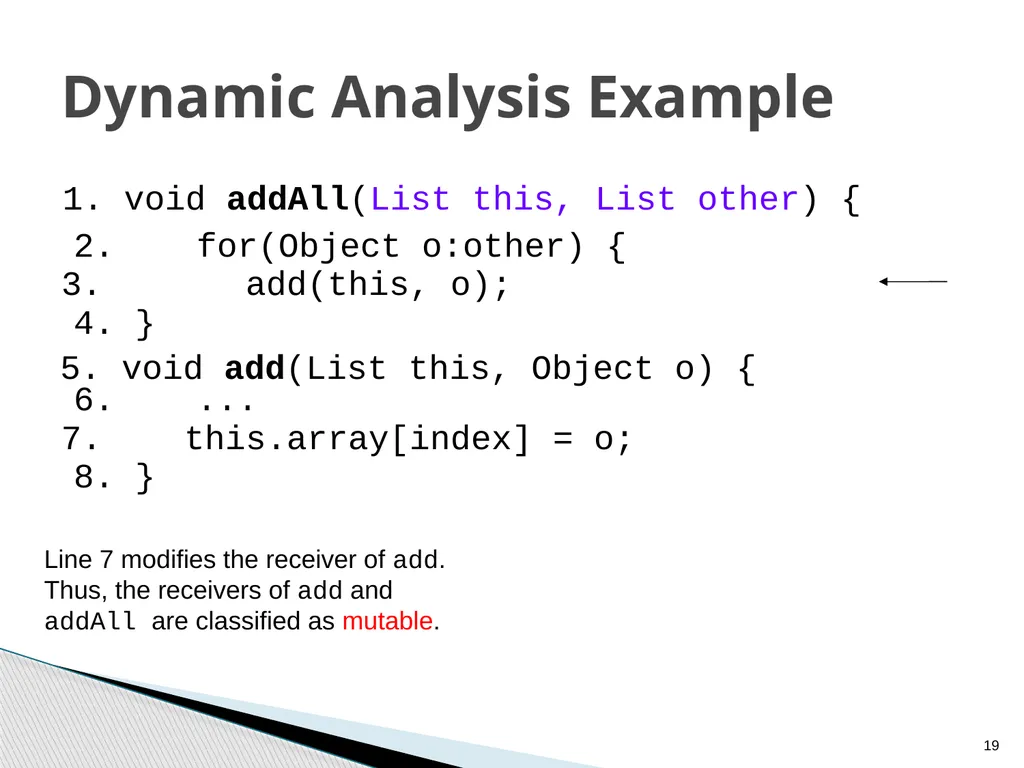
slide17. 2. for(Object o:other) {
4. }
6. ...
8. } 17 Dynamic Analysis Example 3. add(this, o); 5. void add(List this, Object o) { 7. this.array[index] = o; Line 7 modifies the receiver of add.
Thus, the receivers of add and addAll are classified as mutable. 1. void addAll(List this, List other) {<br>
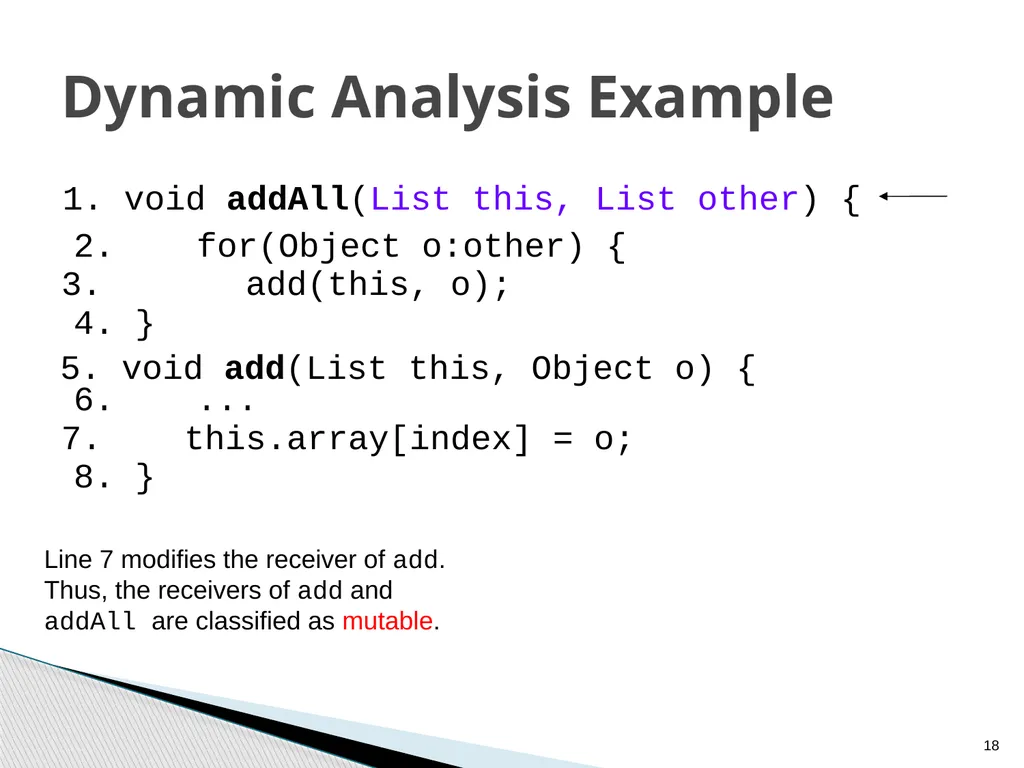
slide18. 2. for(Object o:other) {
4. }
6. ...
8. } 18 Dynamic Analysis Example 3. add(this, o); 5. void add(List this, Object o) { 7. this.array[index] = o; Line 7 modifies the receiver of add.
Thus, the receivers of add and addAll are classified as mutable. 1. void addAll(List this, List other) {<br>
slide19. 2. for(Object o:other) {
4. }
6. ...
8. } 19 Dynamic Analysis Example 3. add(this, o); 5. void add(List this, Object o) { 7. this.array[index] = o; Line 7 modifies the receiver of add.
Thus, the receivers of add and addAll are classified as mutable. 1. void addAll(List this, List other) {<br>
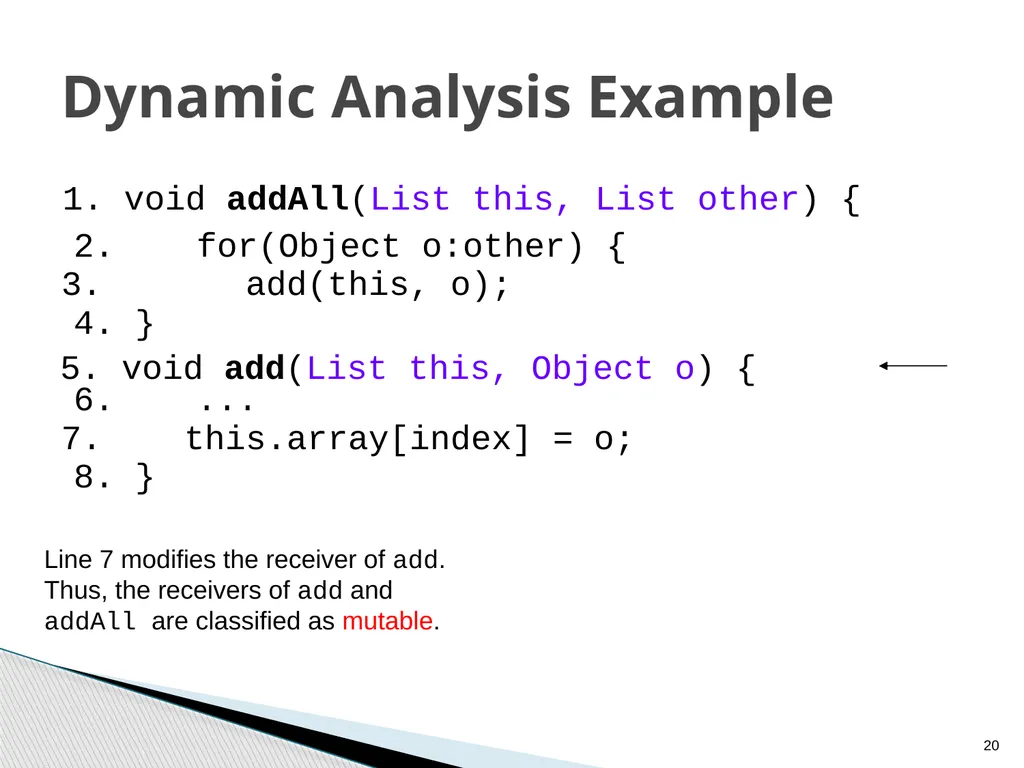
slide20. 2. for(Object o:other) {
4. }
6. ...
8. } 20 Dynamic Analysis Example 3. add(this, o); 5. void add(List this, Object o) { 7. this.array[index] = o; Line 7 modifies the receiver of add.
Thus, the receivers of add and addAll are classified as mutable. 1. void addAll(List this, List other) {<br>
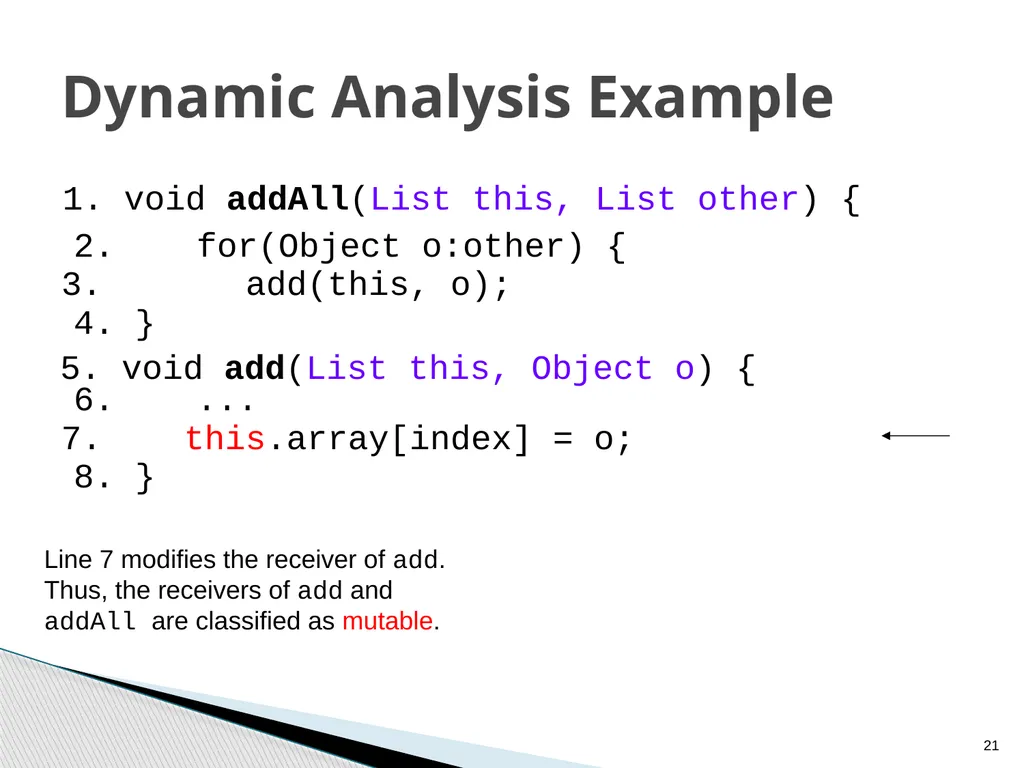
slide21. 2. for(Object o:other) {
4. }
6. ...
8. } 21 Dynamic Analysis Example 3. add(this, o); 5. void add(List this, Object o) { 7. this.array[index] = o; Line 7 modifies the receiver of add.
Thus, the receivers of add and addAll are classified as mutable. 1. void addAll(List this, List other) {<br>
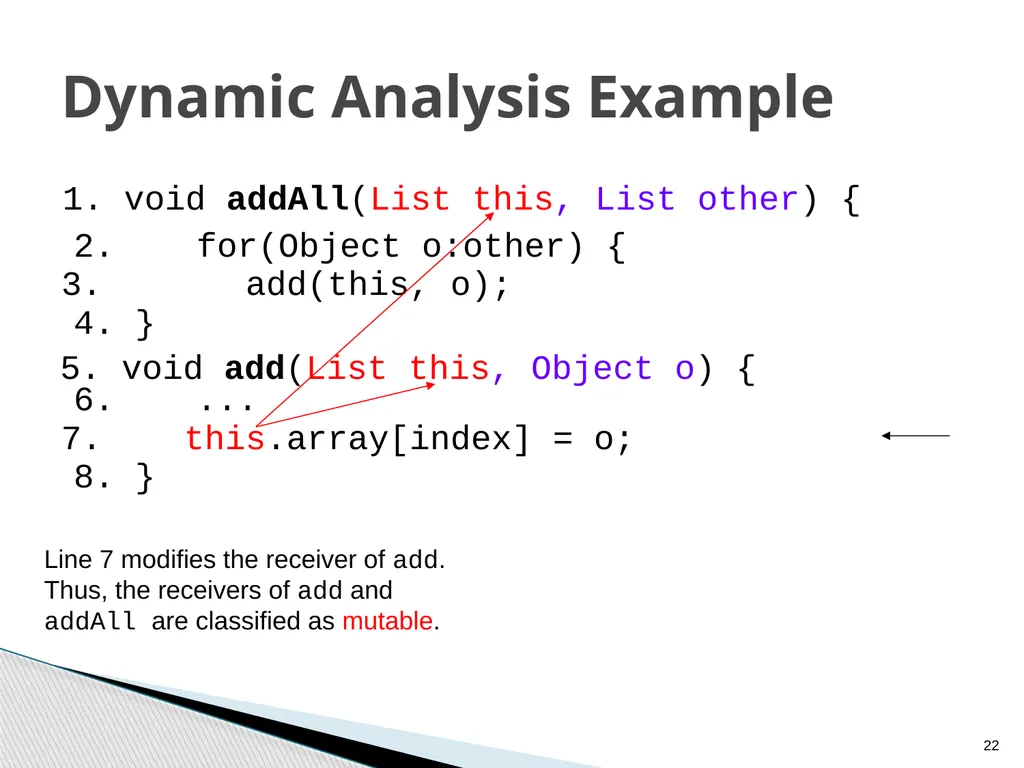
slide22. 2. for(Object o:other) {
4. }
6. ...
8. } 22 Dynamic Analysis Example 3. add(this, o); 5. void add(List this, Object o) { 7. this.array[index] = o; Line 7 modifies the receiver of add.
Thus, the receivers of add and addAll are classified as mutable. 1. void addAll(List this, List other) {<br>
slide23. Maintain a model of the heap
Allows searching backwards in the object graph
Avoids using reflection for searching
Caching
For each object, cache the set of corresponding formal parameters, and reachable objects
Lazy computation
Compute reachable set only when a write occurs 23 Dynamic Analysis Optimizations<br>
slide24. Classify a parameter of method M as immutable if
M executed >N times
M coverage > T%
At the end of the pipeline/component analysis
During analysis
Advantages:
Algorithm classifies parameters as immutable in addition to mutable
adds 6% correctly classified immutable parameters to the best pipeline
Improve performance
Disadvantages:
May classify mutable parameters as immutable
0.1% misclassification in our experiments) 24 Heuristic: Classifying Parameters as Immutable<br>
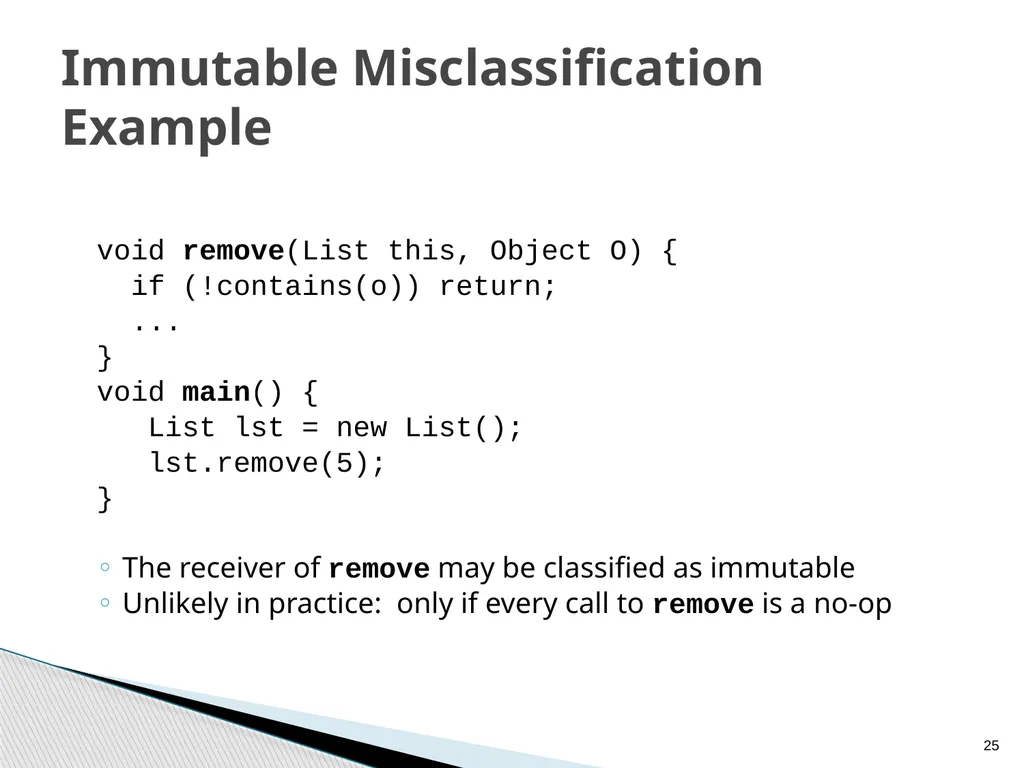
slide25. void remove(List this, Object O) {
if (!contains(o)) return;
...
}
void main() {
List lst = new List();
lst.remove(5);
}
The receiver of remove may be classified as immutable
Unlikely in practice: only if every call to remove is a no-op 25 Immutable Misclassification Example<br>
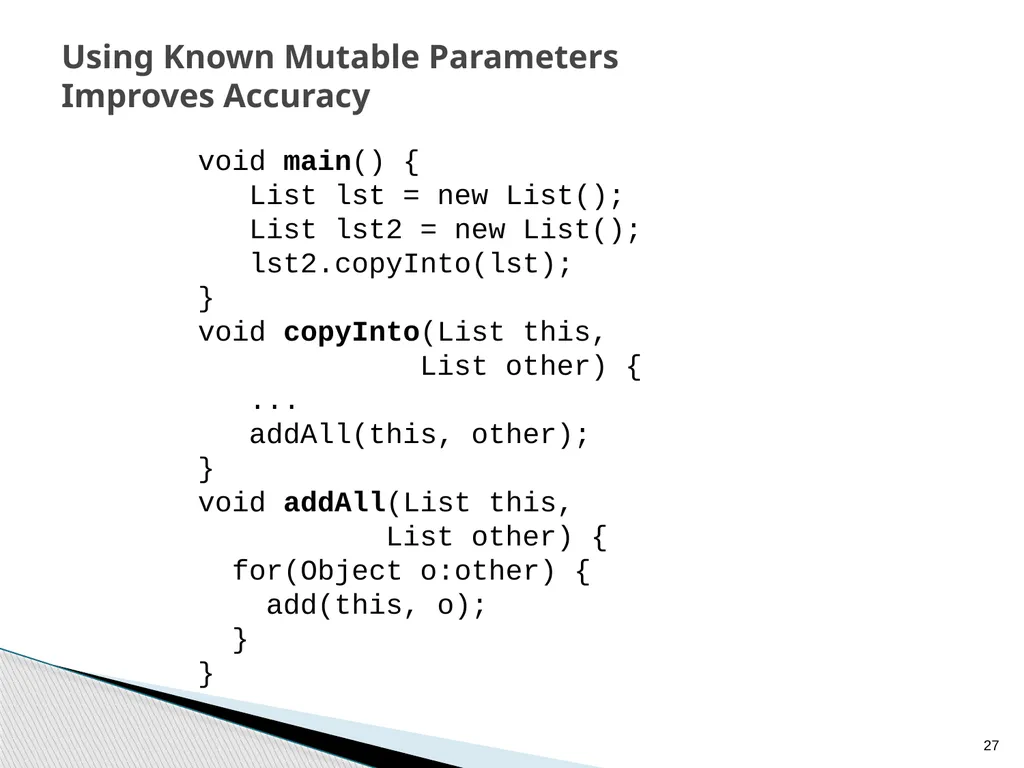
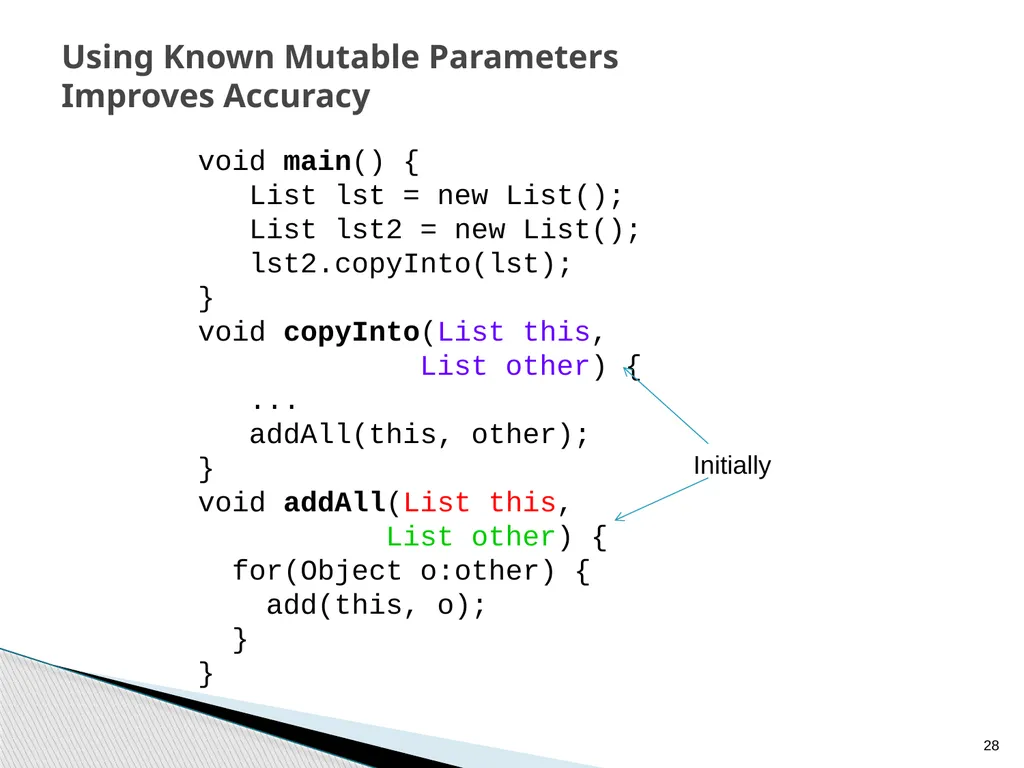
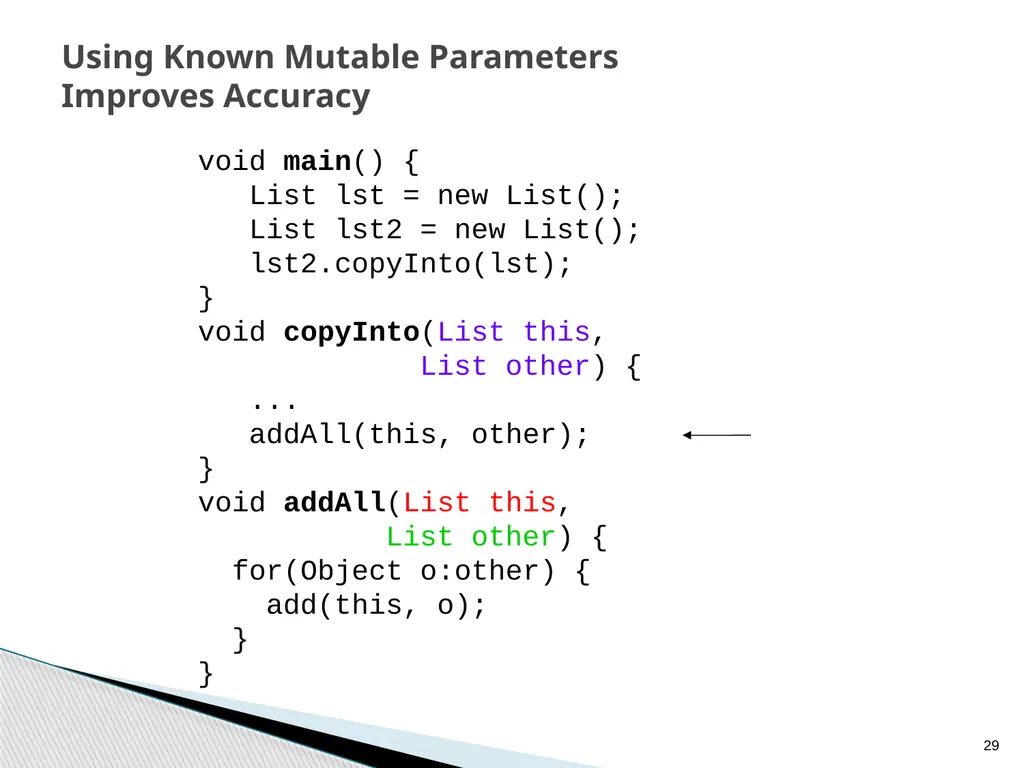
slide26. Treat object passed to a mutable parameter as if it is immediately mutated
Advantages:
Can discover potential mutation that does not happen in the execution
Minor performance improvement
Disadvantages:
Can propagate misclassifications
Did not happen in our experiments 26 Heuristic: Using Known Mutable Parameters<br>
slide27. 27 Using Known Mutable Parameters Improves Accuracy void main() {
List lst = new List();
List lst2 = new List();
lst2.copyInto(lst);
}
void copyInto(List this, List other) {
...
addAll(this, other);
}
void addAll(List this,
List other) { for(Object o:other) {
add(this, o);
}
}<br>
slide28. 28 Using Known Mutable Parameters Improves Accuracy void main() {
List lst = new List();
List lst2 = new List();
lst2.copyInto(lst);
}
void copyInto(List this, List other) {
...
addAll(this, other);
}
void addAll(List this,
List other) { for(Object o:other) {
add(this, o);
}
} Initially<br>
slide29. 29 Using Known Mutable Parameters Improves Accuracy void main() {
List lst = new List();
List lst2 = new List();
lst2.copyInto(lst);
}
void copyInto(List this, List other) {
...
addAll(this, other);
}
void addAll(List this,
List other) { for(Object o:other) {
add(this, o);
}
}<br>
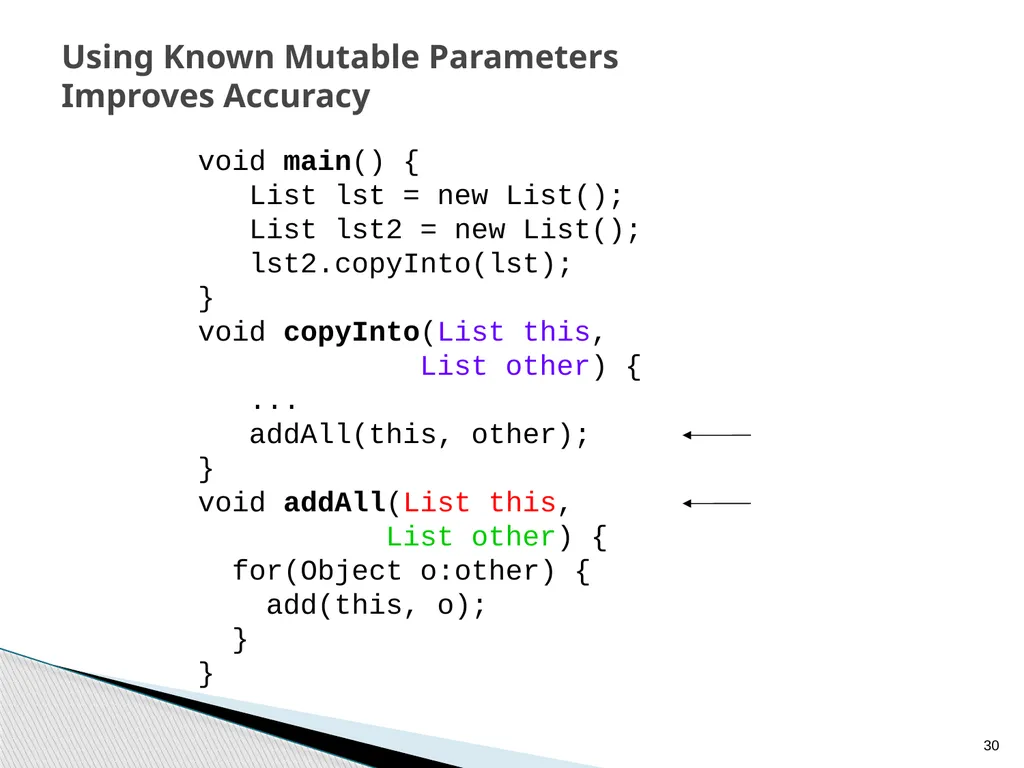
slide30. 30 Using Known Mutable Parameters Improves Accuracy void main() {
List lst = new List();
List lst2 = new List();
lst2.copyInto(lst);
}
void copyInto(List this, List other) {
...
addAll(this, other);
}
void addAll(List this,
List other) { for(Object o:other) {
add(this, o);
}
}<br>
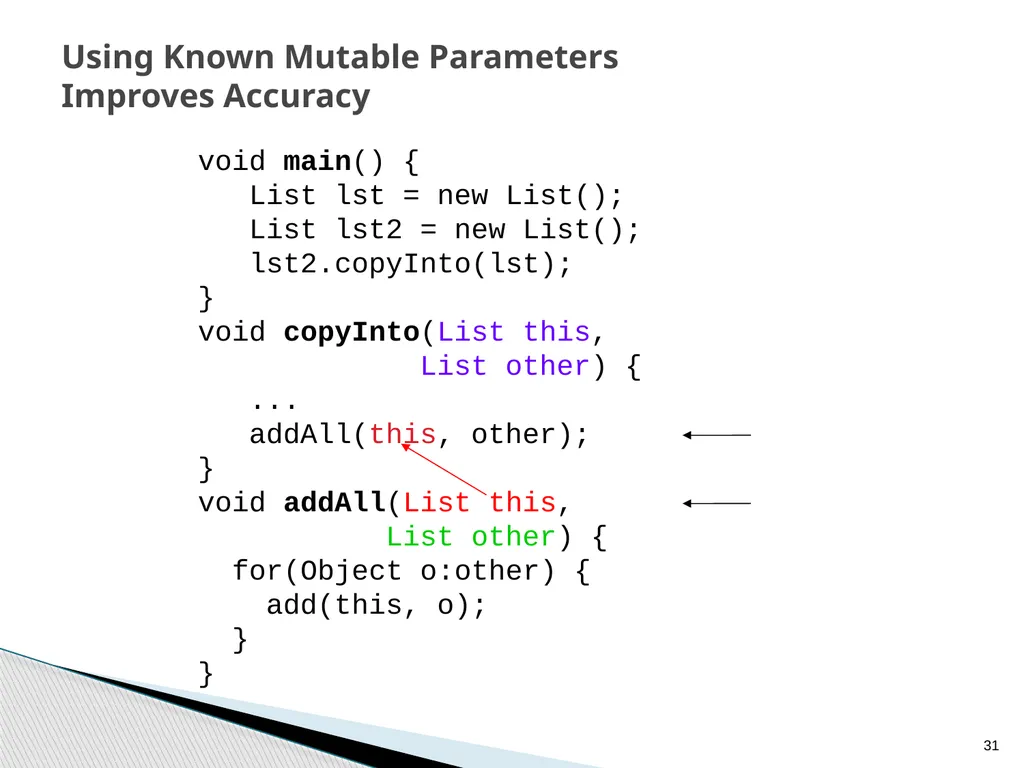
slide31. 31 Using Known Mutable Parameters Improves Accuracy void main() {
List lst = new List();
List lst2 = new List();
lst2.copyInto(lst);
}
void copyInto(List this, List other) {
...
addAll(this, other);
}
void addAll(List this,
List other) { for(Object o:other) {
add(this, o);
}
}<br>
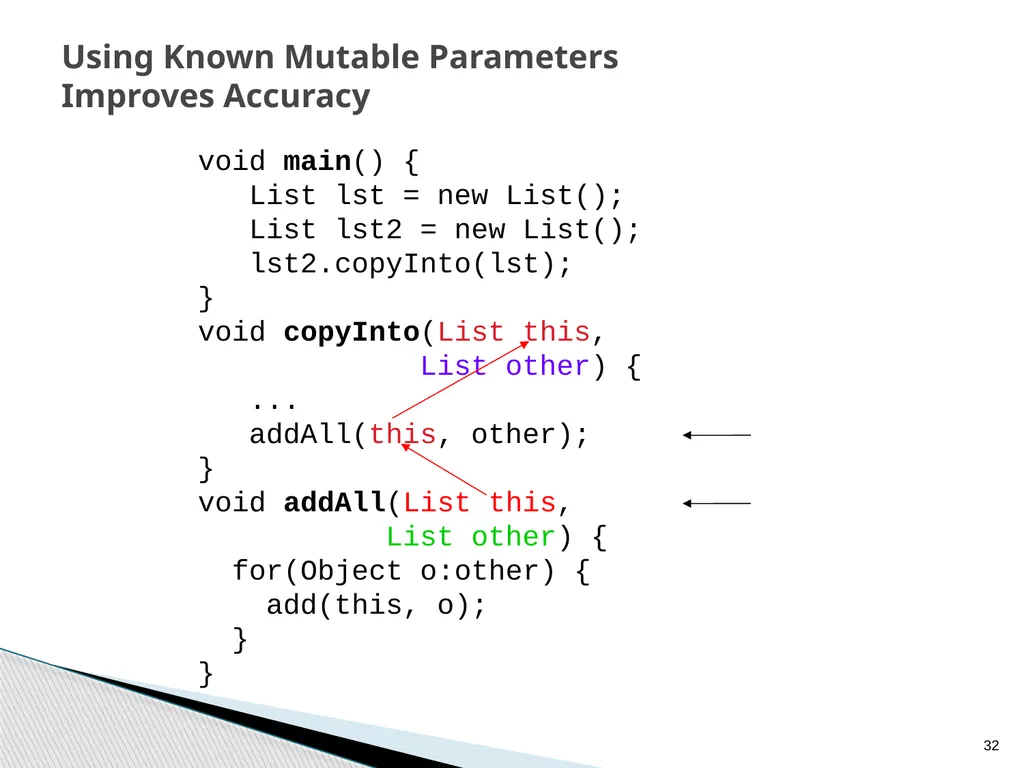
slide32. 32 Using Known Mutable Parameters Improves Accuracy void main() {
List lst = new List();
List lst2 = new List();
lst2.copyInto(lst);
}
void copyInto(List this, List other) {
...
addAll(this, other);
}
void addAll(List this,
List other) { for(Object o:other) {
add(this, o);
}
}<br>
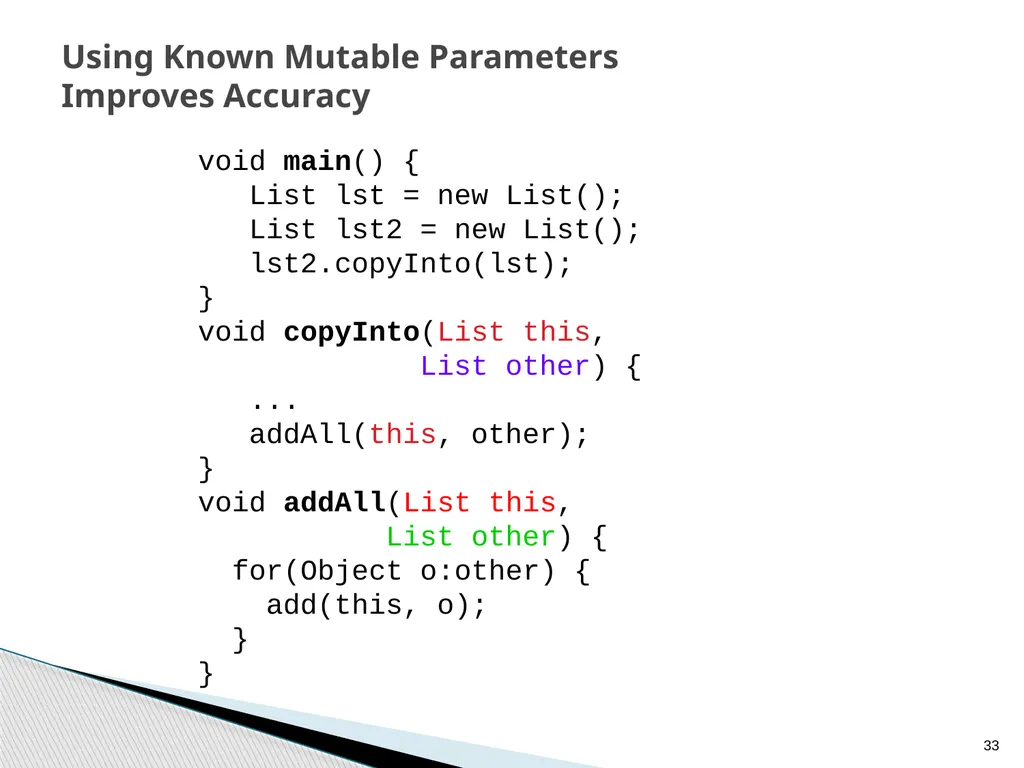
slide33. 33 Using Known Mutable Parameters Improves Accuracy void main() {
List lst = new List();
List lst2 = new List();
lst2.copyInto(lst);
}
void copyInto(List this, List other) {
...
addAll(this, other);
}
void addAll(List this,
List other) { for(Object o:other) {
add(this, o);
}
}<br>
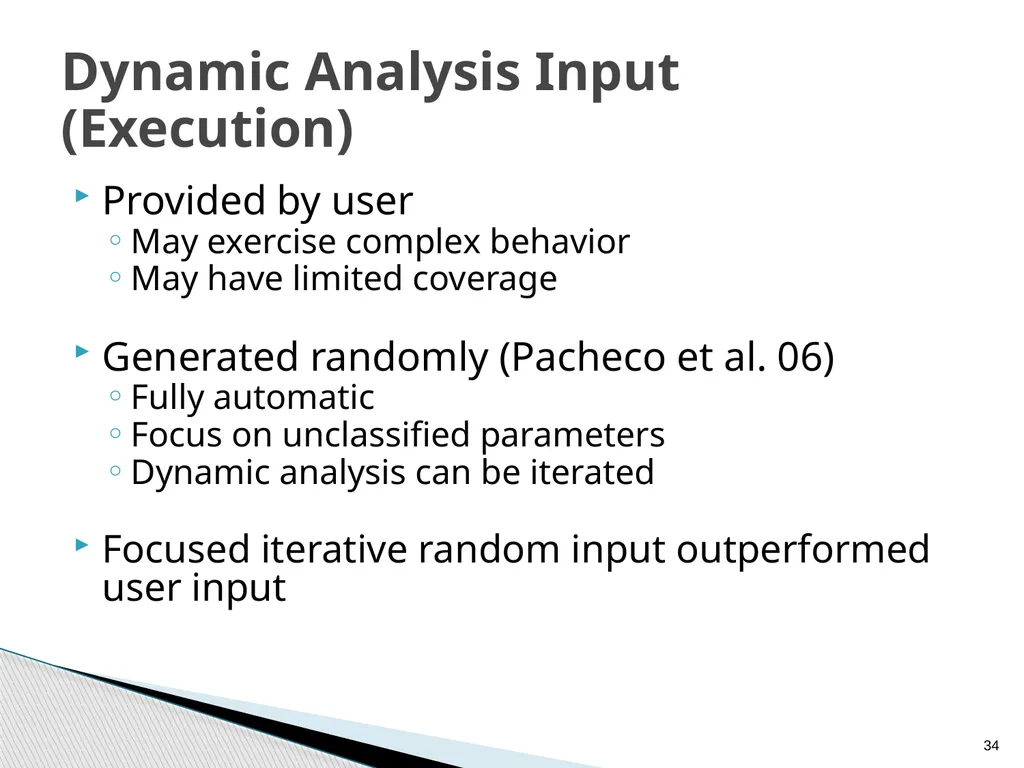
slide34. Dynamic Analysis Input (Execution) Provided by user
May exercise complex behavior
May have limited coverage
Generated randomly (Pacheco et al. 06)
Fully automatic
Focus on unclassified parameters
Dynamic analysis can be iterated
Focused iterative random input outperformed user input 34<br>
slide35. Pipeline construction
Finding the best pipeline
Accuracy
Scalability
Applicability 35 Evaluation<br>
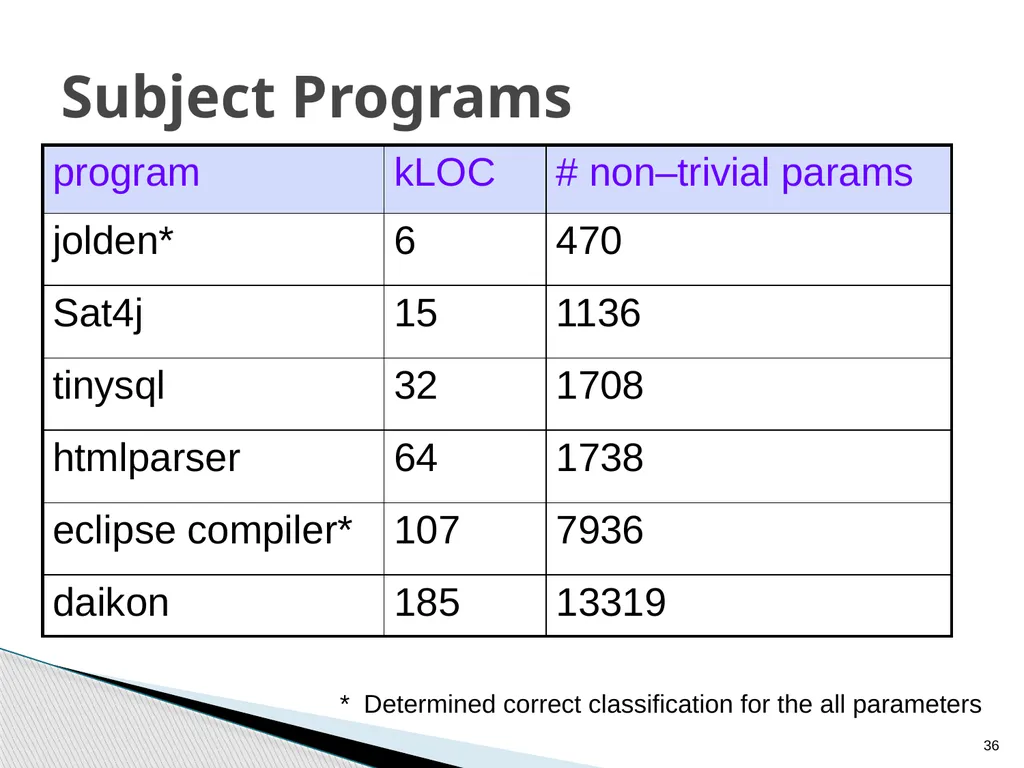
slide36. Subject Programs 36 * Determined correct classification for the all parameters<br>
slide37. Start with the intra-procedural static analysis:
Accurate and very simple.
Classify many trivial or easily detectable parameters
Run inter-procedural static analysis after each analysis:
Only the first time is expensive (PDG creation)
Improves the classification by 0.3%-40%
Static analyses should precede dynamic analysis
Reduces imprecision by 75% 37 Pipeline Construction<br>
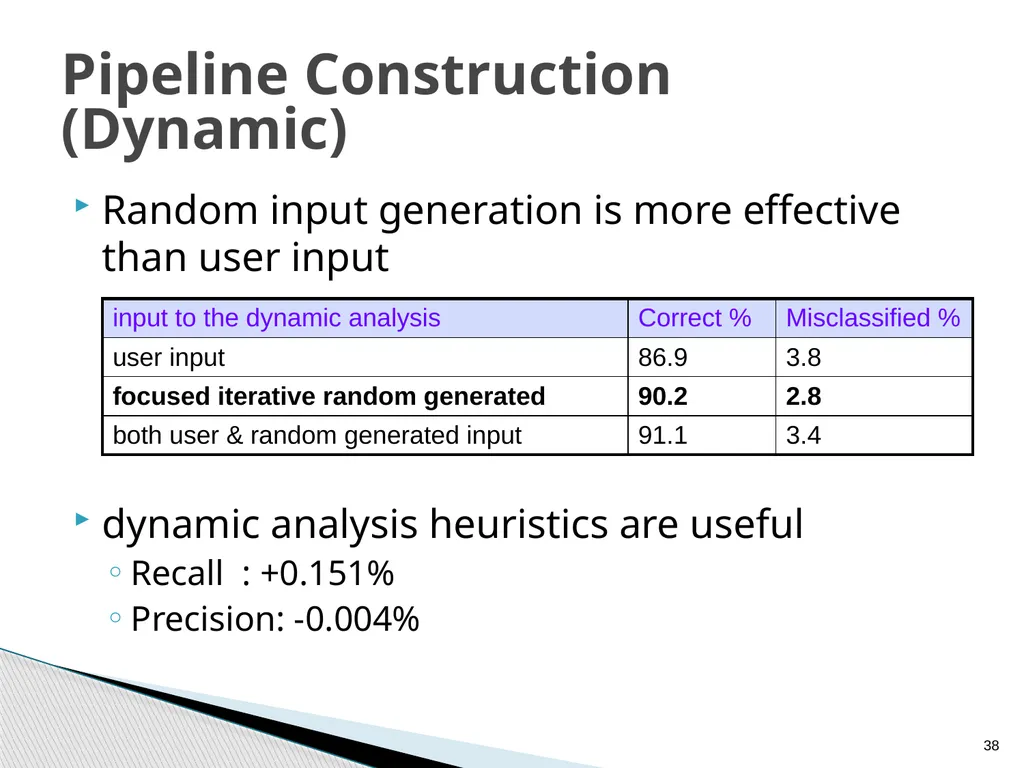
slide38. Pipeline Construction (Dynamic) Random input generation is more effective than user input
dynamic analysis heuristics are useful
Recall : +0.151%
Precision: -0.004% 38<br>
slide39. Best Pipeline Out of 192 different pipelines 39 static intra-procedural analysis static inter-procedural analysis static inter-procedural analysis<br>
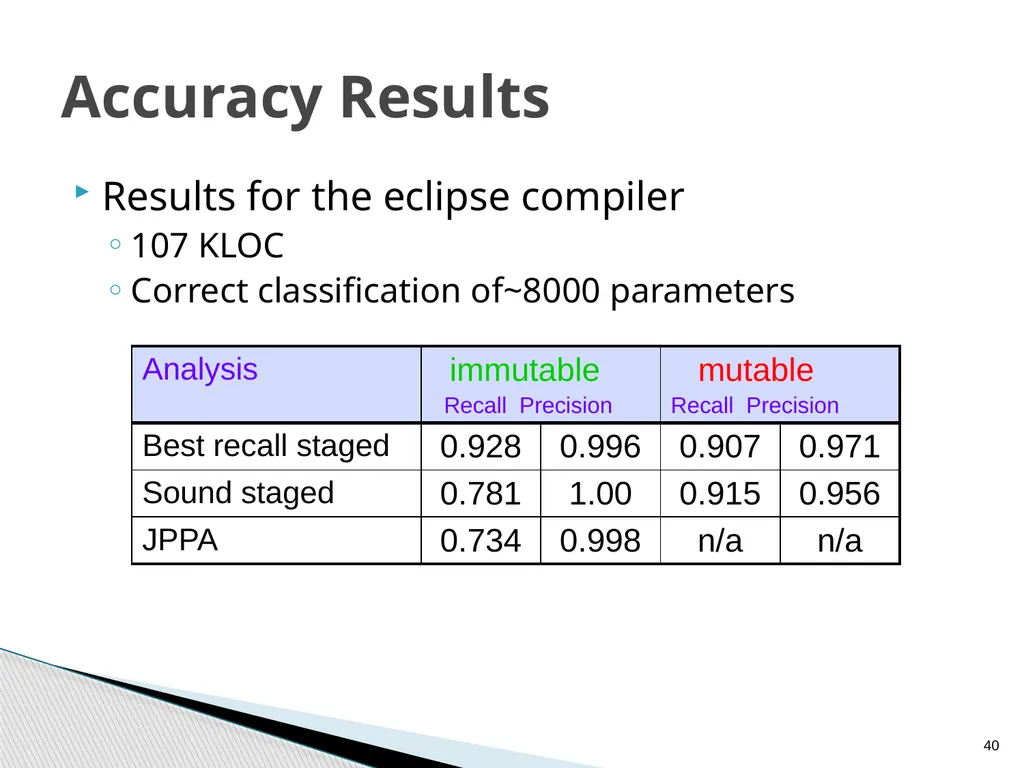
slide40. Results for the eclipse compiler
107 KLOC
Correct classification of~8000 parameters 40 Accuracy Results<br>
slide41. Scalability Evaluation Execution times on Daikon
185KLOC
Largest subject program 41<br>
slide42. Applicability Evaluation Client application:
Palulu (Artzi et al.,06): Model-based test input generation 42<br>
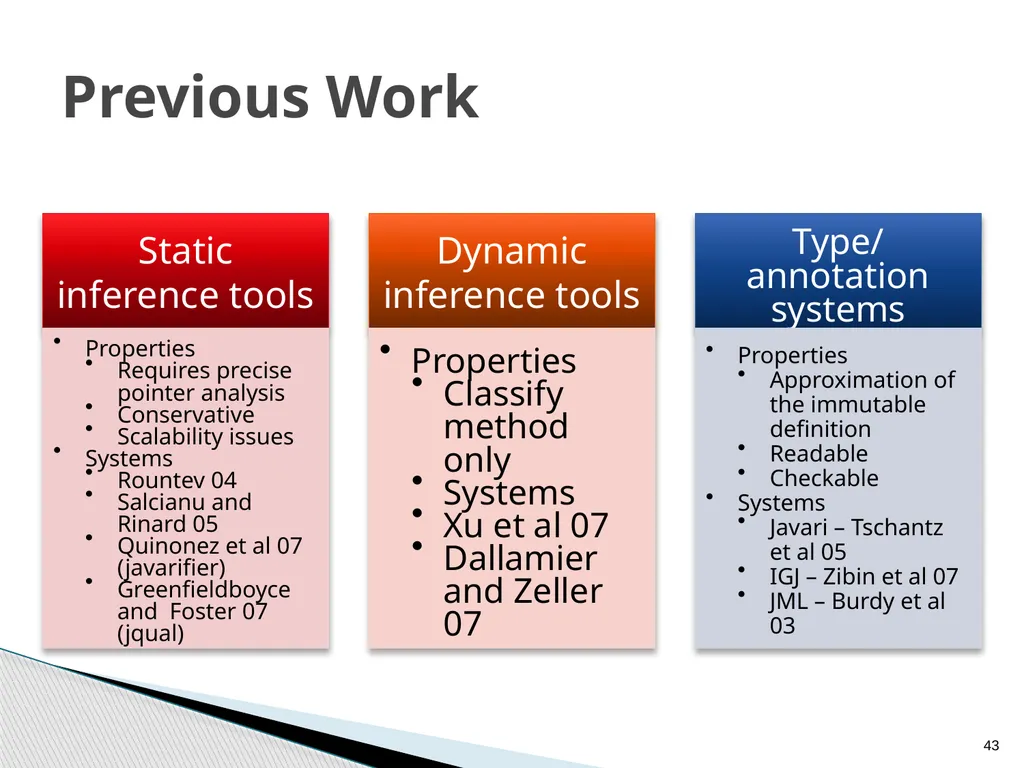
slide43. 43 Previous Work<br>
slide44. Framework for staged mutability analysis
Novel dynamic analysis
Combination of lightweight static and dynamic analysis
Compute both mutable and immutable
Scalable
Accurate
Evaluation
Evaluated many sound and unsound instantiations
Investigate complexity vs. precision tradeoffs
Aids client applications 44 Conclusions<br>
David Glasser Michael D. Ernst
CSAIL, MIT<br>
slide2. Parameter P of method M is:
Mutable if some execution of M can change the state of P’s referent object using P
Immutable if no such execution exists
A method is pure (side-effect free) if:
All its parameters are immutable (including receiver and global state) 2 Mutability/Immutability Definition<br>
slide3. 3 Mutability Example class List {
…
int size(List this){ return n;}
void add(List this, Object o) {…}
List addAll(List this, List l){…}
List clone(List this){
return new List().addAll(this); }
void remove(List this, Object O) {
if(!this.contains(o)) return;
…
}
}<br>
slide4. 4 Mutability Example class List {
…
int size(List this){ return n;}
void add(List this, Object o) {…}
List addAll(List this, List l){…}
List clone(List this){
return new List().addAll(this); }
void remove(List this, Object O) {
if(!this.contains(o)) return;
…
}
} * Immutable<br>
slide5. 5 Mutability Example class List {
…
int size(List this){ return n;}
void add(List this, Object o) {…}
List addAll(List this, List l){…}
List clone(List this){
return new List().addAll(this); }
void remove(List this, Object O) {
if(!this.contains(o)) return;
…
}
} * Immutable * Mutable<br>
slide6. 6 Mutability Example class List {
…
int size(List this){ return n;}
void add(List this, Object o) {…}
List addAll(List this, List l){…}
List clone(List this){
return new List().addAll(this); }
void remove(List this, Object O) {
if(!this.contains(o)) return;
…
}
} * Immutable * Mutable
* Pure Method<br>
slide7. Requires sound mutability information:
Modeling (Burdy 05)
Compiler optimizations (Clausen 97)
Verification (Tkachuk 03)
Typestate checker (Deline 04)
Can use unsound mutability information:
Regression oracle creation (Marini 05, Xie 06)
Test input generation (Artzi 06)
Invariant detection (Ernst 01)
Specification mining (Dallmeier 06)
Program comprehension (Dolado 03)
Refactoring tools 7 Uses of Mutability Information<br>
slide8. Palulu tool for test generation (Artzi et al.,06)
Generate tests based on a model
Models describe legal sequences of calls
Smaller models
Faster systematic exploration
Greater search space exploration by random generator
Easier to compare models
Prune models
Removing calls that do not mutate objects
Preserving the state
Can reduce model by 90% 8 Application: Test Input Generation<br>
slide9. Mutability Definition and Applications
Technique:
Staged analysis
Static analyses
Dynamic analyses
Evaluation
Conclusions 9 Outline<br>
slide10. Staged Analysis Connect a series of scalable analyses in a pipeline
Has advantages of both static and dynamic analyses :
Accurate
Scalable analysis
Sound analysis
Combining sound components
Optionally use unsound heuristics
Improve recall
Precision loss is mitigated by other analyses
Precision loss is acceptable for some uses 10<br>
slide11. Pipeline Approach- Best Pipeline The i/o of each analysis is a classification of all parameters
Analyses represent imprecision using the unknown classification 11 9 u
2 m
4 i 5 u
4 m
6 i 1 u
8 m
6 i 15 u
0 m
0 i static intra-procedural analysis static inter-procedural analysis static inter-procedural analysis 3 u
6 m
6 i<br>
slide12. 12 Static Analysis Analyses:
Intra-procedural analysis
Inter-procedural propagation analysis
Properties
Simple points-to analysis
No complicated escape analysis
Scales well
Designed to be used with other analyses
Other analyses make up for its weak points, and vice versa<br>
slide13. 13 Points-to Analysis Calculate which parameters each Java local may point to
Properties
Context-insensitive
Flow-insensitive
Flow-sensitive until the first backward jump target
1-level field-sensitive
Computes two results
Over-estimate: Method calls alias all parameters
Under-estimate: Method calls don’t alias parameters<br>
slide14. Algorithm
Use over-estimate points to sets
Mark direct field and array mutations as mutable
Mark parameters that aren’t directly mutated and don’t escape as immutable
Leave the rest as unknown
Soundness
i-sound, m-unsound Intra-procedural Analysis<br>
slide15. 15 Interprocedural Propagation Constructs a Parameter Dependency Graph (PDG)
Shows how values get passed as parameters
Propagates mutability through the graph
unknown → all immutable becomes immutable
In an over-approximated PDG (over-estimate points-to sets)
unknown → any mutable becomes mutable
In an under-approximated PDG (under-estimate points-to sets)
Soundness
i-sound (given i-sound input classification)
m-unsound<br>
slide16. Observe program execution
On field/array write:
Mark as mutable all non-aliased formal parameters that transitively point to the mutated object 16 Dynamic Mutability Analysis<br>
slide17. 2. for(Object o:other) {
4. }
6. ...
8. } 17 Dynamic Analysis Example 3. add(this, o); 5. void add(List this, Object o) { 7. this.array[index] = o; Line 7 modifies the receiver of add.
Thus, the receivers of add and addAll are classified as mutable. 1. void addAll(List this, List other) {<br>
slide18. 2. for(Object o:other) {
4. }
6. ...
8. } 18 Dynamic Analysis Example 3. add(this, o); 5. void add(List this, Object o) { 7. this.array[index] = o; Line 7 modifies the receiver of add.
Thus, the receivers of add and addAll are classified as mutable. 1. void addAll(List this, List other) {<br>
slide19. 2. for(Object o:other) {
4. }
6. ...
8. } 19 Dynamic Analysis Example 3. add(this, o); 5. void add(List this, Object o) { 7. this.array[index] = o; Line 7 modifies the receiver of add.
Thus, the receivers of add and addAll are classified as mutable. 1. void addAll(List this, List other) {<br>
slide20. 2. for(Object o:other) {
4. }
6. ...
8. } 20 Dynamic Analysis Example 3. add(this, o); 5. void add(List this, Object o) { 7. this.array[index] = o; Line 7 modifies the receiver of add.
Thus, the receivers of add and addAll are classified as mutable. 1. void addAll(List this, List other) {<br>
slide21. 2. for(Object o:other) {
4. }
6. ...
8. } 21 Dynamic Analysis Example 3. add(this, o); 5. void add(List this, Object o) { 7. this.array[index] = o; Line 7 modifies the receiver of add.
Thus, the receivers of add and addAll are classified as mutable. 1. void addAll(List this, List other) {<br>
slide22. 2. for(Object o:other) {
4. }
6. ...
8. } 22 Dynamic Analysis Example 3. add(this, o); 5. void add(List this, Object o) { 7. this.array[index] = o; Line 7 modifies the receiver of add.
Thus, the receivers of add and addAll are classified as mutable. 1. void addAll(List this, List other) {<br>
slide23. Maintain a model of the heap
Allows searching backwards in the object graph
Avoids using reflection for searching
Caching
For each object, cache the set of corresponding formal parameters, and reachable objects
Lazy computation
Compute reachable set only when a write occurs 23 Dynamic Analysis Optimizations<br>
slide24. Classify a parameter of method M as immutable if
M executed >N times
M coverage > T%
At the end of the pipeline/component analysis
During analysis
Advantages:
Algorithm classifies parameters as immutable in addition to mutable
adds 6% correctly classified immutable parameters to the best pipeline
Improve performance
Disadvantages:
May classify mutable parameters as immutable
0.1% misclassification in our experiments) 24 Heuristic: Classifying Parameters as Immutable<br>
slide25. void remove(List this, Object O) {
if (!contains(o)) return;
...
}
void main() {
List lst = new List();
lst.remove(5);
}
The receiver of remove may be classified as immutable
Unlikely in practice: only if every call to remove is a no-op 25 Immutable Misclassification Example<br>
slide26. Treat object passed to a mutable parameter as if it is immediately mutated
Advantages:
Can discover potential mutation that does not happen in the execution
Minor performance improvement
Disadvantages:
Can propagate misclassifications
Did not happen in our experiments 26 Heuristic: Using Known Mutable Parameters<br>
slide27. 27 Using Known Mutable Parameters Improves Accuracy void main() {
List lst = new List();
List lst2 = new List();
lst2.copyInto(lst);
}
void copyInto(List this, List other) {
...
addAll(this, other);
}
void addAll(List this,
List other) { for(Object o:other) {
add(this, o);
}
}<br>
slide28. 28 Using Known Mutable Parameters Improves Accuracy void main() {
List lst = new List();
List lst2 = new List();
lst2.copyInto(lst);
}
void copyInto(List this, List other) {
...
addAll(this, other);
}
void addAll(List this,
List other) { for(Object o:other) {
add(this, o);
}
} Initially<br>
slide29. 29 Using Known Mutable Parameters Improves Accuracy void main() {
List lst = new List();
List lst2 = new List();
lst2.copyInto(lst);
}
void copyInto(List this, List other) {
...
addAll(this, other);
}
void addAll(List this,
List other) { for(Object o:other) {
add(this, o);
}
}<br>
slide30. 30 Using Known Mutable Parameters Improves Accuracy void main() {
List lst = new List();
List lst2 = new List();
lst2.copyInto(lst);
}
void copyInto(List this, List other) {
...
addAll(this, other);
}
void addAll(List this,
List other) { for(Object o:other) {
add(this, o);
}
}<br>
slide31. 31 Using Known Mutable Parameters Improves Accuracy void main() {
List lst = new List();
List lst2 = new List();
lst2.copyInto(lst);
}
void copyInto(List this, List other) {
...
addAll(this, other);
}
void addAll(List this,
List other) { for(Object o:other) {
add(this, o);
}
}<br>
slide32. 32 Using Known Mutable Parameters Improves Accuracy void main() {
List lst = new List();
List lst2 = new List();
lst2.copyInto(lst);
}
void copyInto(List this, List other) {
...
addAll(this, other);
}
void addAll(List this,
List other) { for(Object o:other) {
add(this, o);
}
}<br>
slide33. 33 Using Known Mutable Parameters Improves Accuracy void main() {
List lst = new List();
List lst2 = new List();
lst2.copyInto(lst);
}
void copyInto(List this, List other) {
...
addAll(this, other);
}
void addAll(List this,
List other) { for(Object o:other) {
add(this, o);
}
}<br>
slide34. Dynamic Analysis Input (Execution) Provided by user
May exercise complex behavior
May have limited coverage
Generated randomly (Pacheco et al. 06)
Fully automatic
Focus on unclassified parameters
Dynamic analysis can be iterated
Focused iterative random input outperformed user input 34<br>
slide35. Pipeline construction
Finding the best pipeline
Accuracy
Scalability
Applicability 35 Evaluation<br>
slide36. Subject Programs 36 * Determined correct classification for the all parameters<br>
slide37. Start with the intra-procedural static analysis:
Accurate and very simple.
Classify many trivial or easily detectable parameters
Run inter-procedural static analysis after each analysis:
Only the first time is expensive (PDG creation)
Improves the classification by 0.3%-40%
Static analyses should precede dynamic analysis
Reduces imprecision by 75% 37 Pipeline Construction<br>
slide38. Pipeline Construction (Dynamic) Random input generation is more effective than user input
dynamic analysis heuristics are useful
Recall : +0.151%
Precision: -0.004% 38<br>
slide39. Best Pipeline Out of 192 different pipelines 39 static intra-procedural analysis static inter-procedural analysis static inter-procedural analysis<br>
slide40. Results for the eclipse compiler
107 KLOC
Correct classification of~8000 parameters 40 Accuracy Results<br>
slide41. Scalability Evaluation Execution times on Daikon
185KLOC
Largest subject program 41<br>
slide42. Applicability Evaluation Client application:
Palulu (Artzi et al.,06): Model-based test input generation 42<br>
slide43. 43 Previous Work<br>
slide44. Framework for staged mutability analysis
Novel dynamic analysis
Combination of lightweight static and dynamic analysis
Compute both mutable and immutable
Scalable
Accurate
Evaluation
Evaluated many sound and unsound instantiations
Investigate complexity vs. precision tradeoffs
Aids client applications 44 Conclusions<br>