
Mutability Immutability vs. Mutability Immutable







Description: Mutability Immutability vs. Mutability Immutable vs. Mutable An immutable value is unchanging once created. Immutable types (that weve covered): int, float, string A mutable value can change in value throughout the course of computation.
Related Topics
Download Presentation
"Mutability Immutability vs. Mutability Immutable" is the property of its rightful owner. Permission is granted to download and print the materials on this website for personal, non-commercial use only, and to display it on your personal computer provided you do not modify the materials and that you retain all copyright notices contained in the materials. By downloading content from our website, you accept the terms of this agreement.
Presentation Transcript
slide1. Mutability<br>
slide2. Immutability vs. Mutability<br>
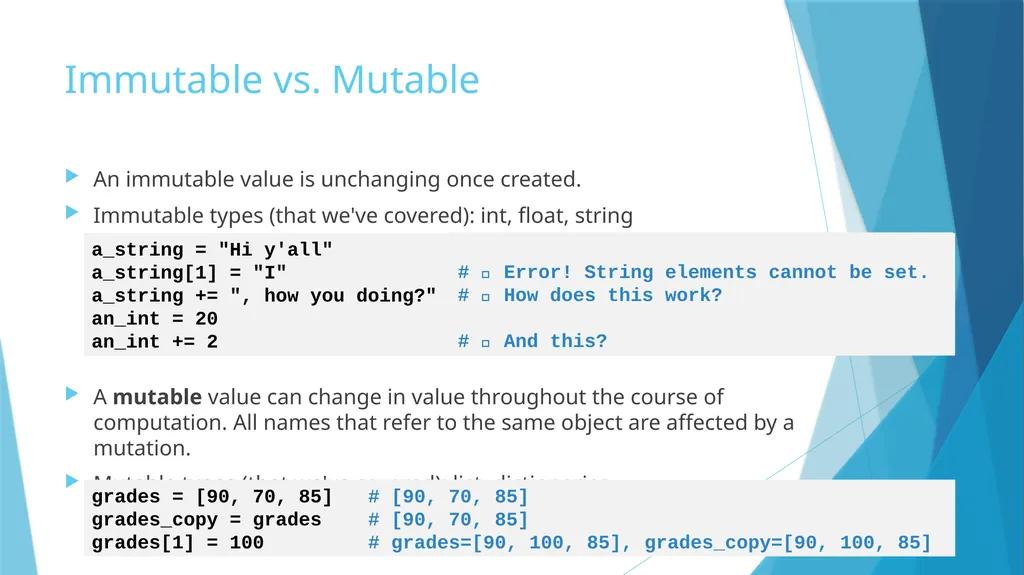
slide3. Immutable vs. Mutable An immutable value is unchanging once created.
Immutable types (that we've covered): int, float, string
A mutable value can change in value throughout the course of computation. All names that refer to the same object are affected by a mutation.
Mutable types (that we've covered): list, dictionaries a_string = "Hi y'all"
a_string[1] = "I"
a_string += ", how you doing?"
an_int = 20
an_int += 2 # 🚫 Error! String elements cannot be set.
# 🤔 How does this work?
# 🤔 And this? grades = [90, 70, 85]
grades_copy = grades
grades[1] = 100 # [90, 70, 85]
# [90, 70, 85]
# grades=[90, 100, 85], grades_copy=[90, 100, 85]<br>
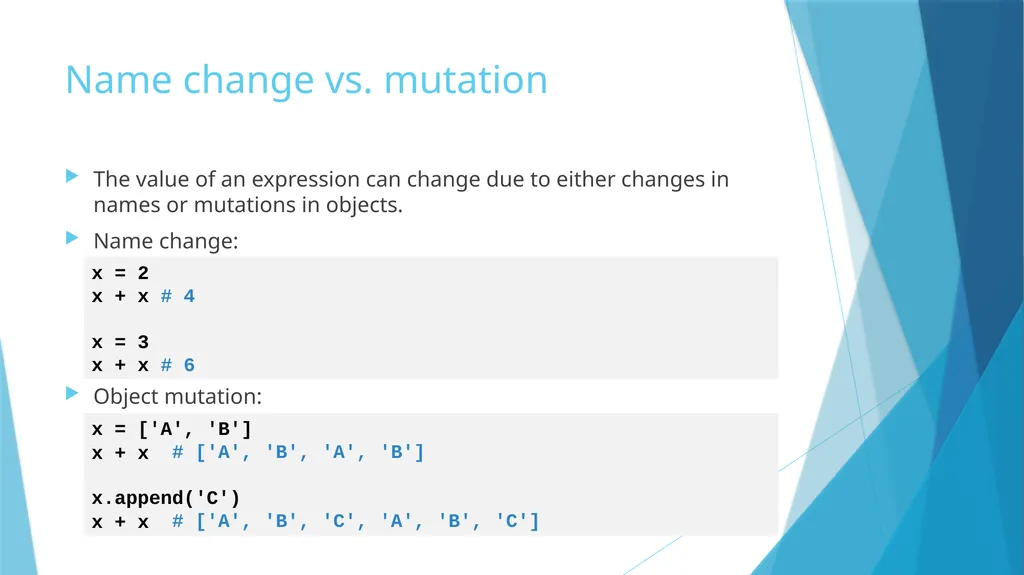
slide4. Name change vs. mutation The value of an expression can change due to either changes in names or mutations in objects.
Name change:
Object mutation: x + x
x + x x + x
x + x x = 2
# 4
x = 3
# 6 x = ['A', 'B']
# ['A', 'B', 'A', 'B']
x.append('C')
# ['A', 'B', 'C', 'A', 'B', 'C']<br>
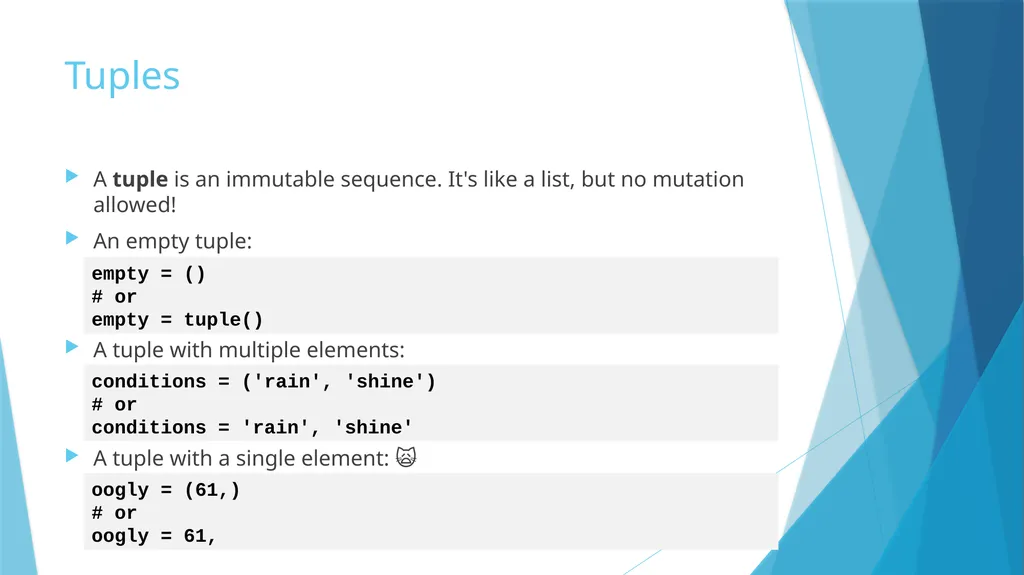
slide5. Tuples A tuple is an immutable sequence. It's like a list, but no mutation allowed!
An empty tuple:
A tuple with multiple elements:
A tuple with a single element: 🙀 empty = ()
# or
empty = tuple() conditions = ('rain', 'shine')
# or
conditions = 'rain', 'shine' oogly = (61,)
# or
oogly = 61,<br>
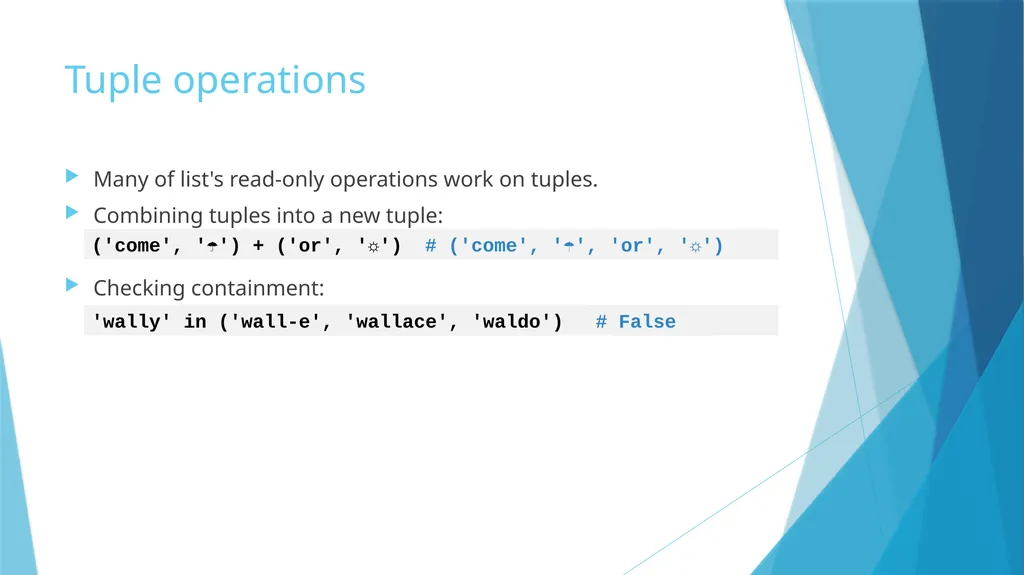
slide6. Tuple operations Many of list's read-only operations work on tuples.
Combining tuples into a new tuple:
Checking containment: ('come', '☂') + ('or', '☼') 'wally' in ('wall-e', 'wallace', 'waldo') # ('come', '☂', 'or', '☼') # False<br>
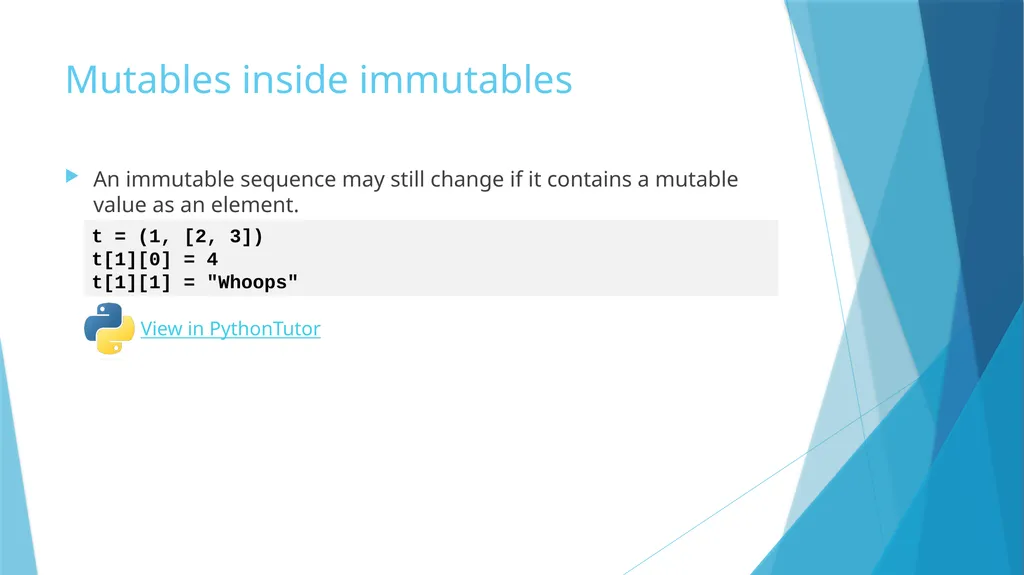
slide7. Mutables inside immutables An immutable sequence may still change if it contains a mutable value as an element. t = (1, [2, 3])
t[1][0] = 4
t[1][1] = "Whoops"<br>
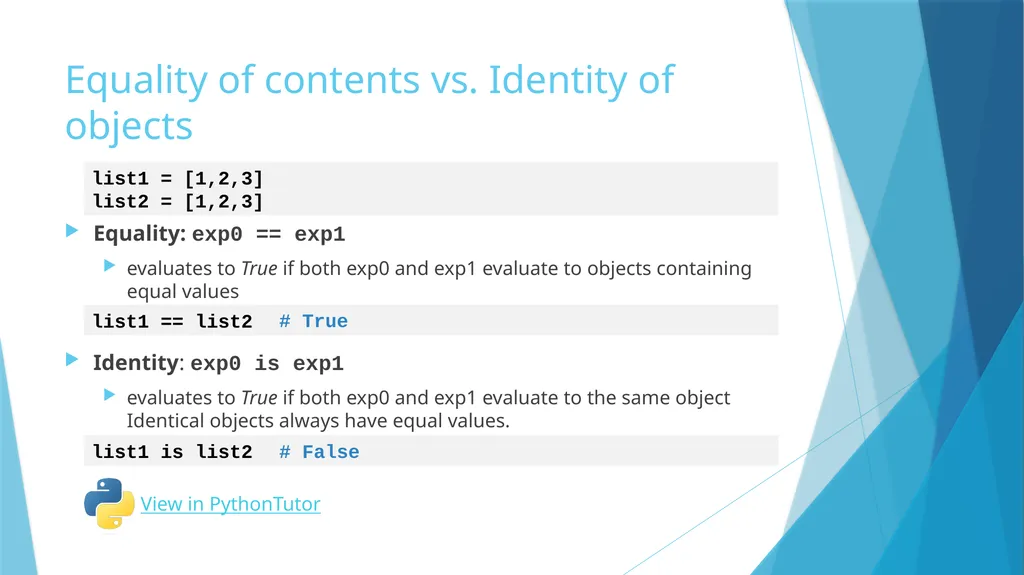
slide8. Equality of contents vs. Identity of objects Equality: exp0 == exp1
evaluates to True if both exp0 and exp1 evaluate to objects containing equal values
Identity: exp0 is exp1
evaluates to True if both exp0 and exp1 evaluate to the same object Identical objects always have equal values. list1 = [1,2,3]
list2 = [1,2,3] list1 == list2 list1 is list2 # True # False<br>
slide9. List mutation<br>
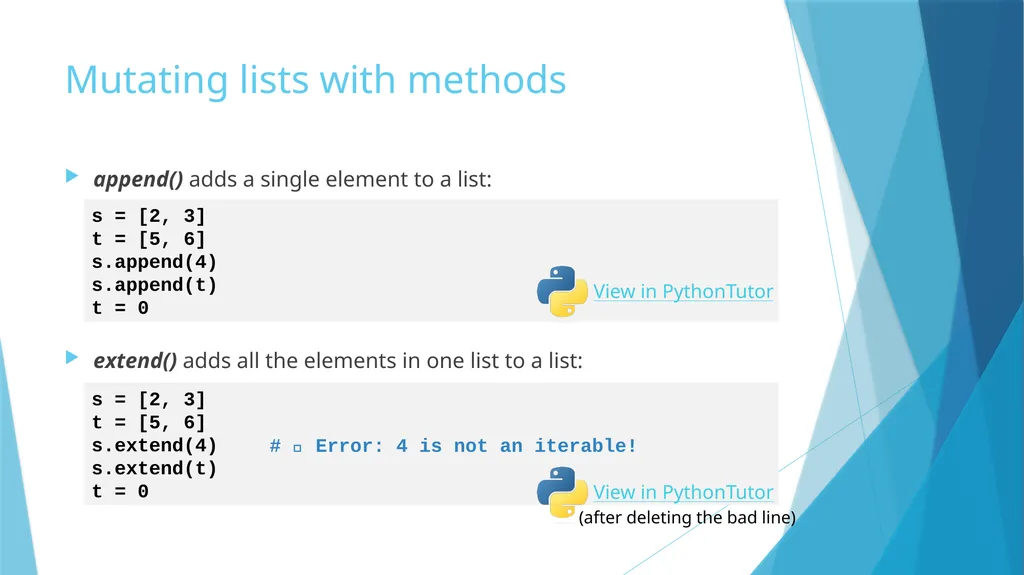
slide10. Mutating lists with methods append() adds a single element to a list:
extend() adds all the elements in one list to a list: s = [2, 3]
t = [5, 6]
s.append(4)
s.append(t)
t = 0 s = [2, 3]
t = [5, 6]
s.extend(4)
s.extend(t)
t = 0 # 🚫 Error: 4 is not an iterable!
(after deleting the bad line)<br>
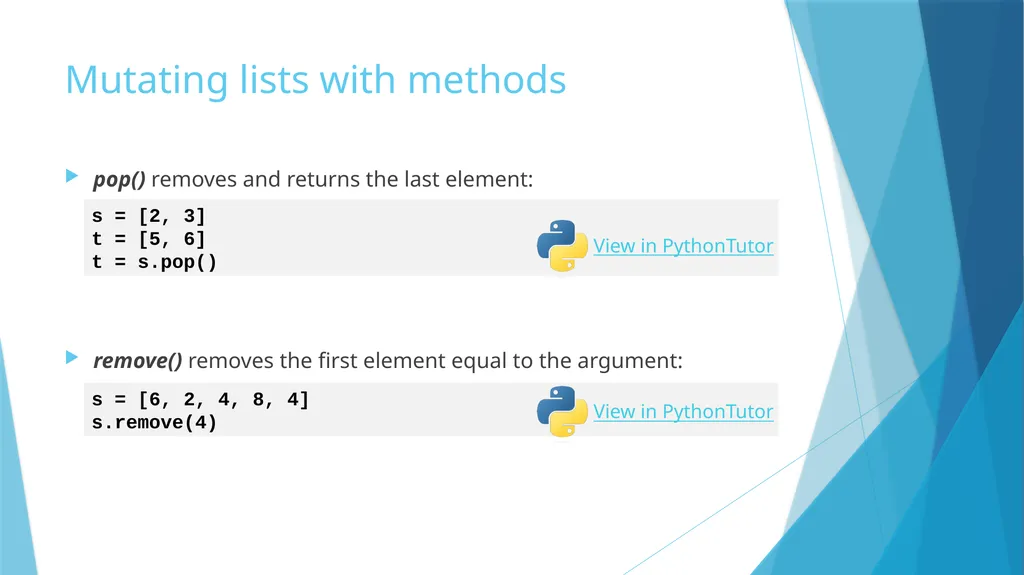
slide11. Mutating lists with methods pop() removes and returns the last element:
remove() removes the first element equal to the argument: s = [2, 3]
t = [5, 6]
t = s.pop() s = [6, 2, 4, 8, 4]
s.remove(4)<br>
slide12. Slicing<br>
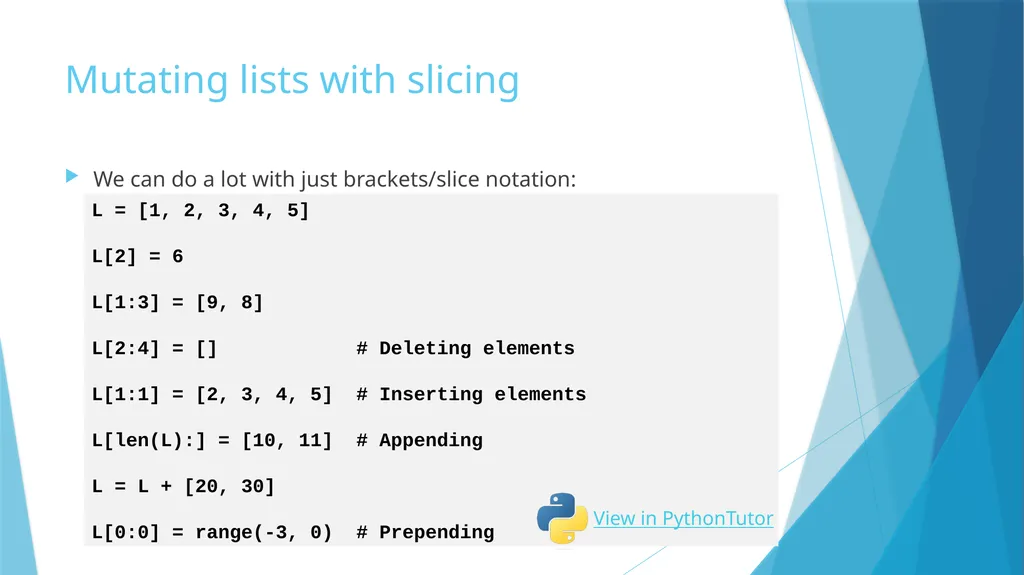
slide13. Mutating lists with slicing We can do a lot with just brackets/slice notation: L = [1, 2, 3, 4, 5]
L[2] = 6
L[1:3] = [9, 8]
L[2:4] = [] # Deleting elements
L[1:1] = [2, 3, 4, 5] # Inserting elements
L[len(L):] = [10, 11] # Appending
L = L + [20, 30]
L[0:0] = range(-3, 0) # Prepending<br>
slide14. Beware, Mutation! 👻<br>
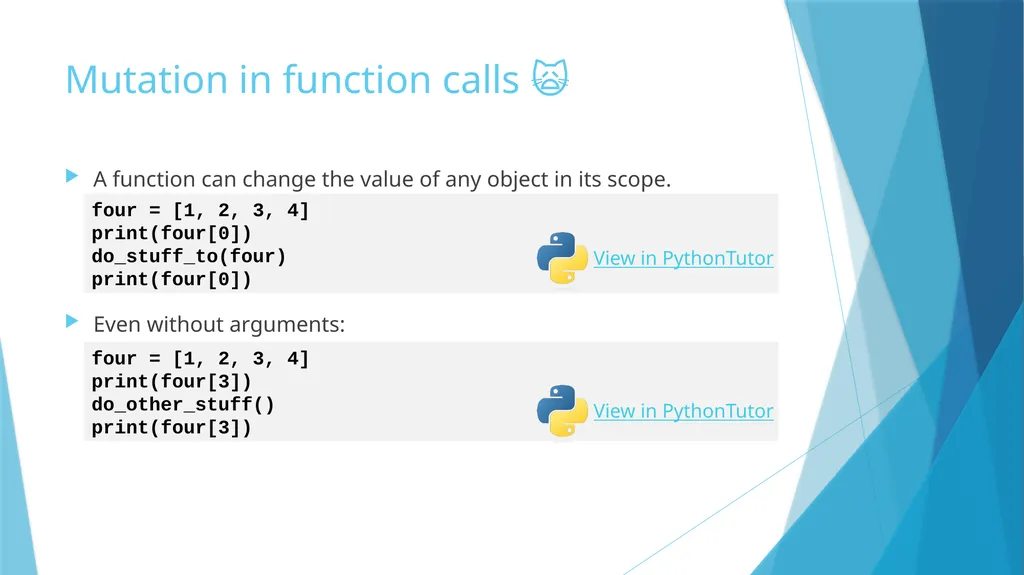
slide15. Mutation in function calls 🙀 A function can change the value of any object in its scope.
Even without arguments: four = [1, 2, 3, 4]
print(four[0])
do_stuff_to(four)
print(four[0]) four = [1, 2, 3, 4]
print(four[3])
do_other_stuff()
print(four[3])<br>
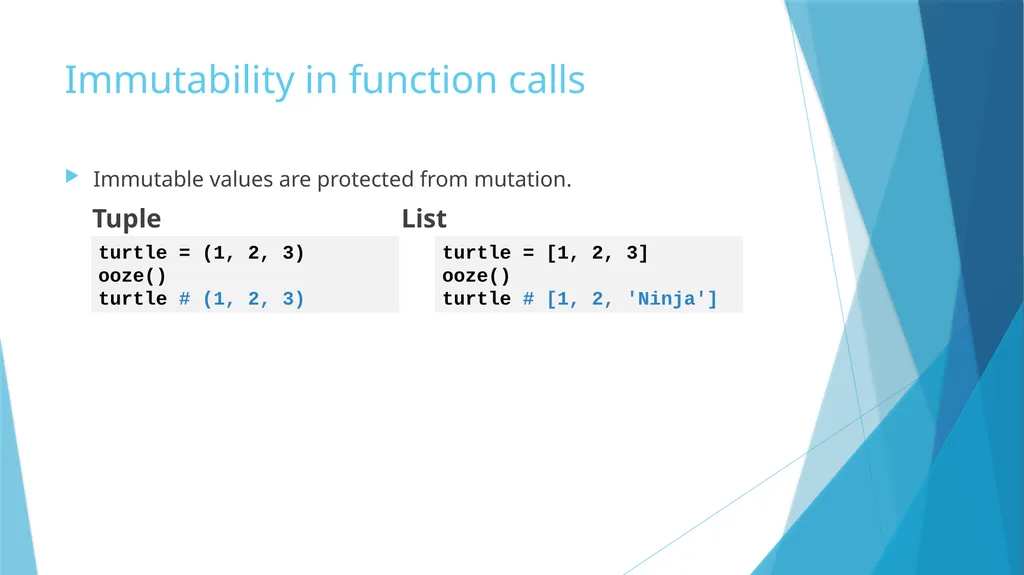
slide16. Immutability in function calls Immutable values are protected from mutation.
Tuple List turtle = [1, 2, 3]
ooze()
turtle # [1, 2, 'Ninja'] turtle = (1, 2, 3)
ooze()
turtle # (1, 2, 3)<br>
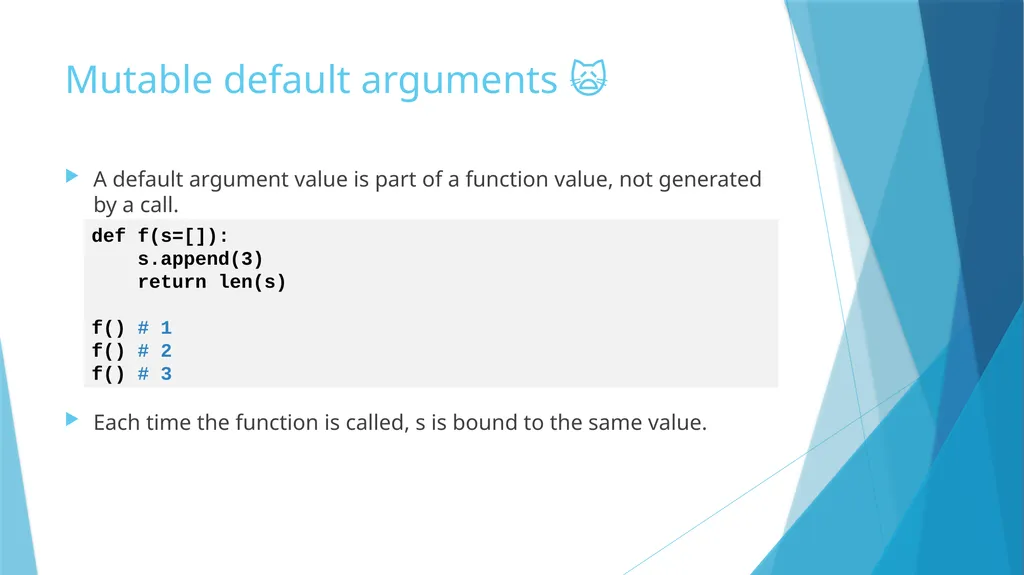
slide17. Mutable default arguments 🙀 A default argument value is part of a function value, not generated by a call.
Each time the function is called, s is bound to the same value. def f(s=[]):
s.append(3)
return len(s)
f() # 1
f() # 2
f() # 3<br>
slide18. Mutable functions<br>
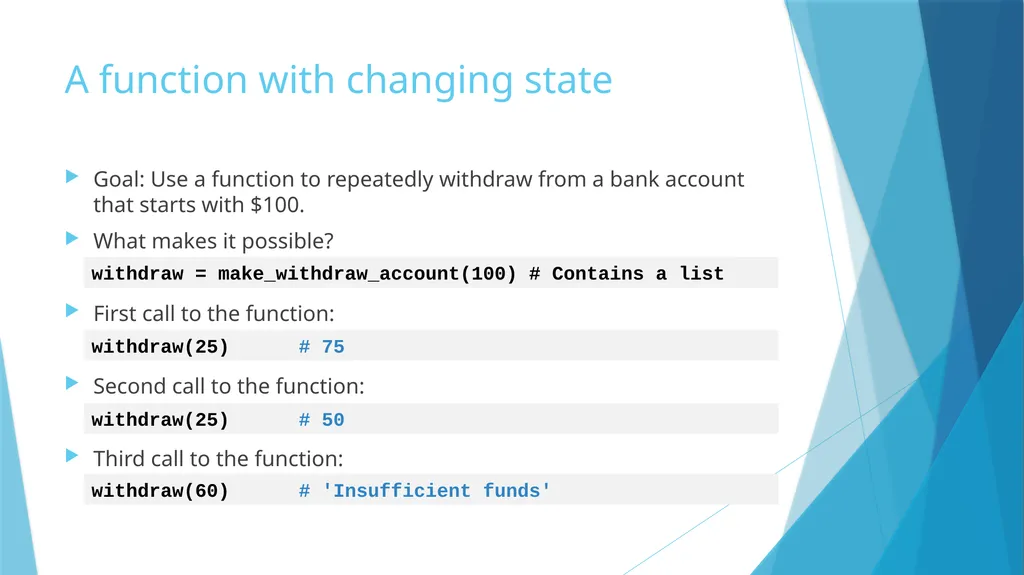
slide19. A function with changing state Goal: Use a function to repeatedly withdraw from a bank account that starts with $100.
What makes it possible?
First call to the function:
Second call to the function:
Third call to the function: withdraw = make_withdraw_account(100) # Contains a list withdraw(25) # 75 withdraw(25) # 50 withdraw(60) # 'Insufficient funds'<br>
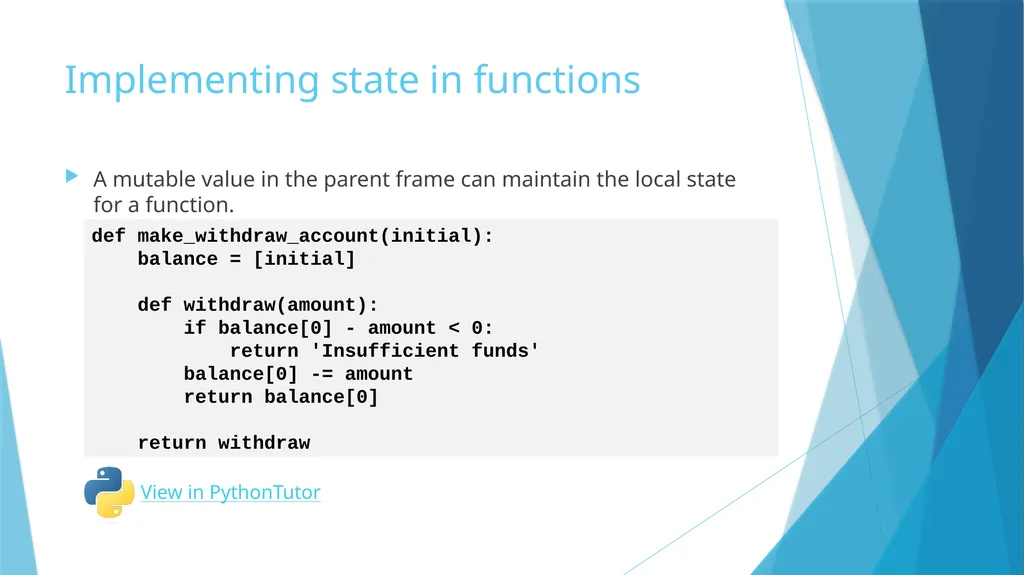
slide20. Implementing state in functions A mutable value in the parent frame can maintain the local state for a function. def make_withdraw_account(initial):
balance = [initial]
def withdraw(amount):
if balance[0] - amount < 0:
return 'Insufficient funds'
balance[0] -= amount
return balance[0]
return withdraw<br>
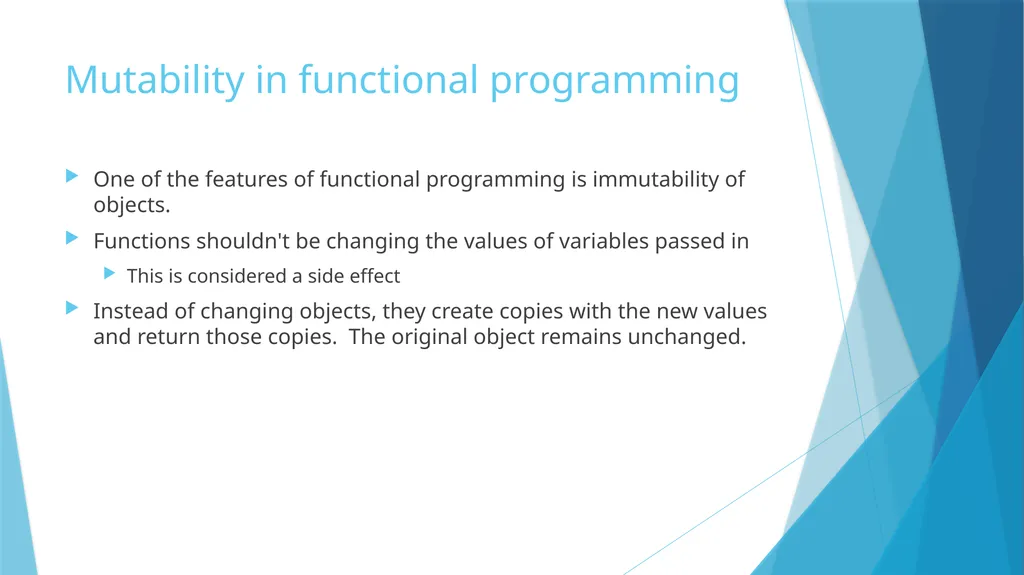
slide21. Mutability in functional programming One of the features of functional programming is immutability of objects.
Functions shouldn't be changing the values of variables passed in
This is considered a side effect
Instead of changing objects, they create copies with the new values and return those copies. The original object remains unchanged.<br>
slide2. Immutability vs. Mutability<br>
slide3. Immutable vs. Mutable An immutable value is unchanging once created.
Immutable types (that we've covered): int, float, string
A mutable value can change in value throughout the course of computation. All names that refer to the same object are affected by a mutation.
Mutable types (that we've covered): list, dictionaries a_string = "Hi y'all"
a_string[1] = "I"
a_string += ", how you doing?"
an_int = 20
an_int += 2 # 🚫 Error! String elements cannot be set.
# 🤔 How does this work?
# 🤔 And this? grades = [90, 70, 85]
grades_copy = grades
grades[1] = 100 # [90, 70, 85]
# [90, 70, 85]
# grades=[90, 100, 85], grades_copy=[90, 100, 85]<br>
slide4. Name change vs. mutation The value of an expression can change due to either changes in names or mutations in objects.
Name change:
Object mutation: x + x
x + x x + x
x + x x = 2
# 4
x = 3
# 6 x = ['A', 'B']
# ['A', 'B', 'A', 'B']
x.append('C')
# ['A', 'B', 'C', 'A', 'B', 'C']<br>
slide5. Tuples A tuple is an immutable sequence. It's like a list, but no mutation allowed!
An empty tuple:
A tuple with multiple elements:
A tuple with a single element: 🙀 empty = ()
# or
empty = tuple() conditions = ('rain', 'shine')
# or
conditions = 'rain', 'shine' oogly = (61,)
# or
oogly = 61,<br>
slide6. Tuple operations Many of list's read-only operations work on tuples.
Combining tuples into a new tuple:
Checking containment: ('come', '☂') + ('or', '☼') 'wally' in ('wall-e', 'wallace', 'waldo') # ('come', '☂', 'or', '☼') # False<br>
slide7. Mutables inside immutables An immutable sequence may still change if it contains a mutable value as an element. t = (1, [2, 3])
t[1][0] = 4
t[1][1] = "Whoops"<br>
slide8. Equality of contents vs. Identity of objects Equality: exp0 == exp1
evaluates to True if both exp0 and exp1 evaluate to objects containing equal values
Identity: exp0 is exp1
evaluates to True if both exp0 and exp1 evaluate to the same object Identical objects always have equal values. list1 = [1,2,3]
list2 = [1,2,3] list1 == list2 list1 is list2 # True # False<br>
slide9. List mutation<br>
slide10. Mutating lists with methods append() adds a single element to a list:
extend() adds all the elements in one list to a list: s = [2, 3]
t = [5, 6]
s.append(4)
s.append(t)
t = 0 s = [2, 3]
t = [5, 6]
s.extend(4)
s.extend(t)
t = 0 # 🚫 Error: 4 is not an iterable!
(after deleting the bad line)<br>
slide11. Mutating lists with methods pop() removes and returns the last element:
remove() removes the first element equal to the argument: s = [2, 3]
t = [5, 6]
t = s.pop() s = [6, 2, 4, 8, 4]
s.remove(4)<br>
slide12. Slicing<br>
slide13. Mutating lists with slicing We can do a lot with just brackets/slice notation: L = [1, 2, 3, 4, 5]
L[2] = 6
L[1:3] = [9, 8]
L[2:4] = [] # Deleting elements
L[1:1] = [2, 3, 4, 5] # Inserting elements
L[len(L):] = [10, 11] # Appending
L = L + [20, 30]
L[0:0] = range(-3, 0) # Prepending<br>
slide14. Beware, Mutation! 👻<br>
slide15. Mutation in function calls 🙀 A function can change the value of any object in its scope.
Even without arguments: four = [1, 2, 3, 4]
print(four[0])
do_stuff_to(four)
print(four[0]) four = [1, 2, 3, 4]
print(four[3])
do_other_stuff()
print(four[3])<br>
slide16. Immutability in function calls Immutable values are protected from mutation.
Tuple List turtle = [1, 2, 3]
ooze()
turtle # [1, 2, 'Ninja'] turtle = (1, 2, 3)
ooze()
turtle # (1, 2, 3)<br>
slide17. Mutable default arguments 🙀 A default argument value is part of a function value, not generated by a call.
Each time the function is called, s is bound to the same value. def f(s=[]):
s.append(3)
return len(s)
f() # 1
f() # 2
f() # 3<br>
slide18. Mutable functions<br>
slide19. A function with changing state Goal: Use a function to repeatedly withdraw from a bank account that starts with $100.
What makes it possible?
First call to the function:
Second call to the function:
Third call to the function: withdraw = make_withdraw_account(100) # Contains a list withdraw(25) # 75 withdraw(25) # 50 withdraw(60) # 'Insufficient funds'<br>
slide20. Implementing state in functions A mutable value in the parent frame can maintain the local state for a function. def make_withdraw_account(initial):
balance = [initial]
def withdraw(amount):
if balance[0] - amount < 0:
return 'Insufficient funds'
balance[0] -= amount
return balance[0]
return withdraw<br>
slide21. Mutability in functional programming One of the features of functional programming is immutability of objects.
Functions shouldn't be changing the values of variables passed in
This is considered a side effect
Instead of changing objects, they create copies with the new values and return those copies. The original object remains unchanged.<br>