
Immutability Changes Everything! October 10, 2012
CP
Published · 36 slides · 0 views
1 / 1

Description
Immutability Changes Everything! October 10, 2012 Pat Helland Salesforce.com Outline Introduction Accountants Dont Use Erasers Keeping the Stone Tablets Safe Hey! Versions Are Immutable, Too! Immutability by Reference Immutability Is in
Related Topics
Share
Embed code
Download this presentation From Below
"Immutability Changes Everything! October 10, 2012" is the property of its rightful owner. Permission is granted to download and print the materials on this website for personal, non-commercial use only, and to display it on your personal computer provided you do not modify the materials and that you retain all copyright notices contained in the materials. By downloading content from our website, you accept the terms of this agreement.
Presentation Transcript
01
Immutability Changes Everything! October 10, 2012
Pat Helland
Salesforce.com<br>
Pat Helland
Salesforce.com<br>
02
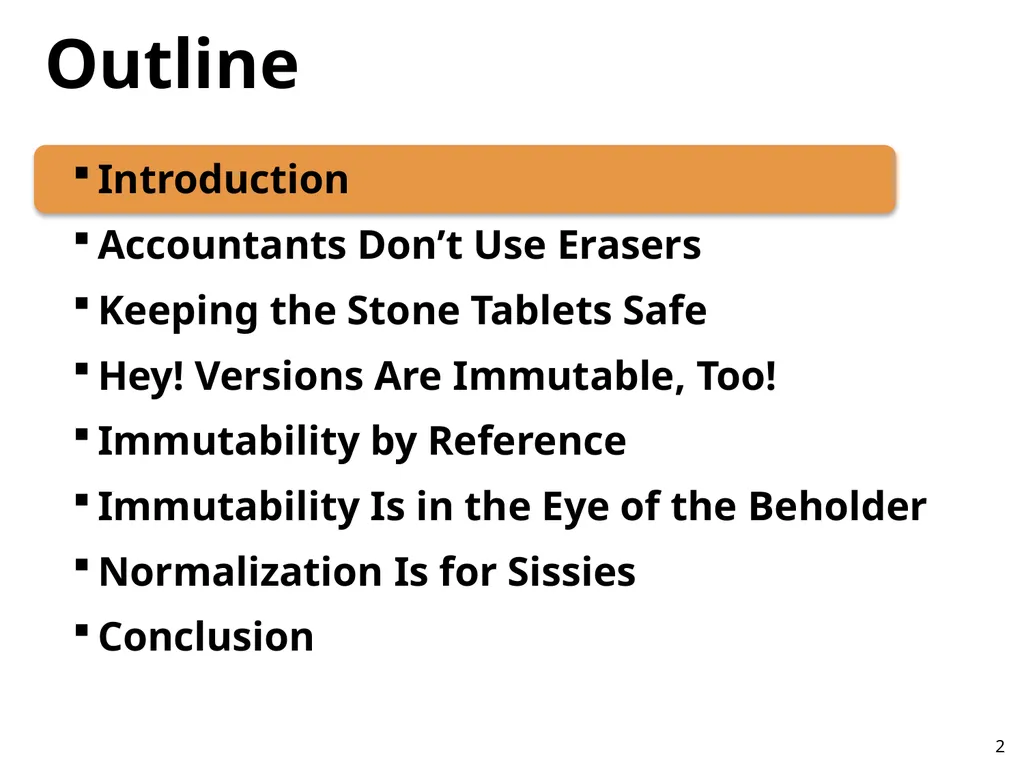
Outline Introduction
Accountants Don’t Use Erasers
Keeping the Stone Tablets Safe
Hey! Versions Are Immutable, Too!
Immutability by Reference
Immutability Is in the Eye of the Beholder
Normalization Is for Sissies
Conclusion 2<br>
Accountants Don’t Use Erasers
Keeping the Stone Tablets Safe
Hey! Versions Are Immutable, Too!
Immutability by Reference
Immutability Is in the Eye of the Beholder
Normalization Is for Sissies
Conclusion 2<br>
03
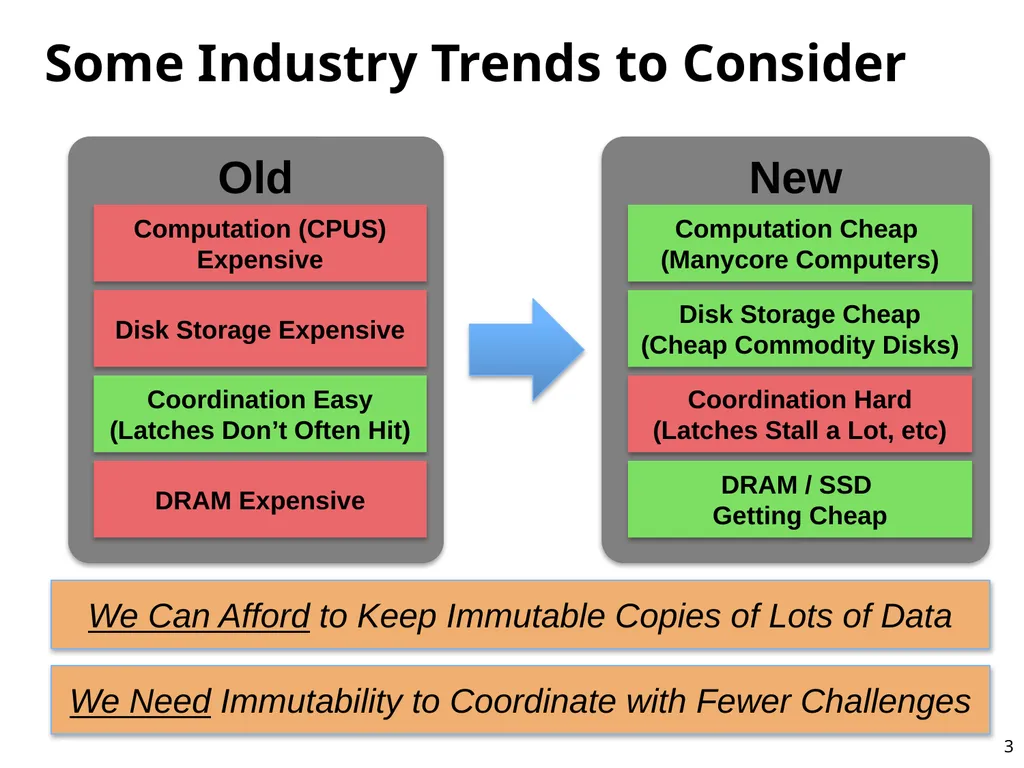
Some Industry Trends to Consider 3 We Can Afford to Keep Immutable Copies of Lots of Data We Need Immutability to Coordinate with Fewer Challenges<br>
04
Increasing Storage, Distribution, and Ambiguity Increasing Storage
Cost per Gigabyte/Terabyte/Petabyte is dropping
We can keep LOTS OF data for a LONG time
Increasing Distribution
More and more, we have data and work spread across a great distance
Data within the Datacenter may be far away…
Data within a many-core chip may be far away…
Increasing Ambiguity
When trying to coordinate with systems that are farther away, there’s more that’s happened since you’ve heard the news
Can you take action with incomplete knowledge?
Can you wait for enough knowledge? 4 This may be easing as we get faster and flatter networks in the datacenter Instruction opportunities lost waiting for a semaphore increase with more cores…<br>
Cost per Gigabyte/Terabyte/Petabyte is dropping
We can keep LOTS OF data for a LONG time
Increasing Distribution
More and more, we have data and work spread across a great distance
Data within the Datacenter may be far away…
Data within a many-core chip may be far away…
Increasing Ambiguity
When trying to coordinate with systems that are farther away, there’s more that’s happened since you’ve heard the news
Can you take action with incomplete knowledge?
Can you wait for enough knowledge? 4 This may be easing as we get faster and flatter networks in the datacenter Instruction opportunities lost waiting for a semaphore increase with more cores…<br>
05
Outline Introduction
Accountants Don’t Use Erasers
Keeping the Stone Tablets Safe
Hey! Versions Are Immutable, Too!
Immutability by Reference
Immutability Is in the Eye of the Beholder
Normalization Is for Sissies
Conclusion 5<br>
Accountants Don’t Use Erasers
Keeping the Stone Tablets Safe
Hey! Versions Are Immutable, Too!
Immutability by Reference
Immutability Is in the Eye of the Beholder
Normalization Is for Sissies
Conclusion 5<br>
06
“Append-Only” Computing Many kinds of computing are “Append-Only”
Observations are recorded forever (or a long time)
Derived results are calculated on demand
You can’t rewrite history
Database transaction logs record all the changes made to the database
High-speed appends to the log
You never modify the log other than by appending to it
The database is a cache of a subset of the log!
The latest value of each record is kept in the database 6<br>
Observations are recorded forever (or a long time)
Derived results are calculated on demand
You can’t rewrite history
Database transaction logs record all the changes made to the database
High-speed appends to the log
You never modify the log other than by appending to it
The database is a cache of a subset of the log!
The latest value of each record is kept in the database 6<br>
07
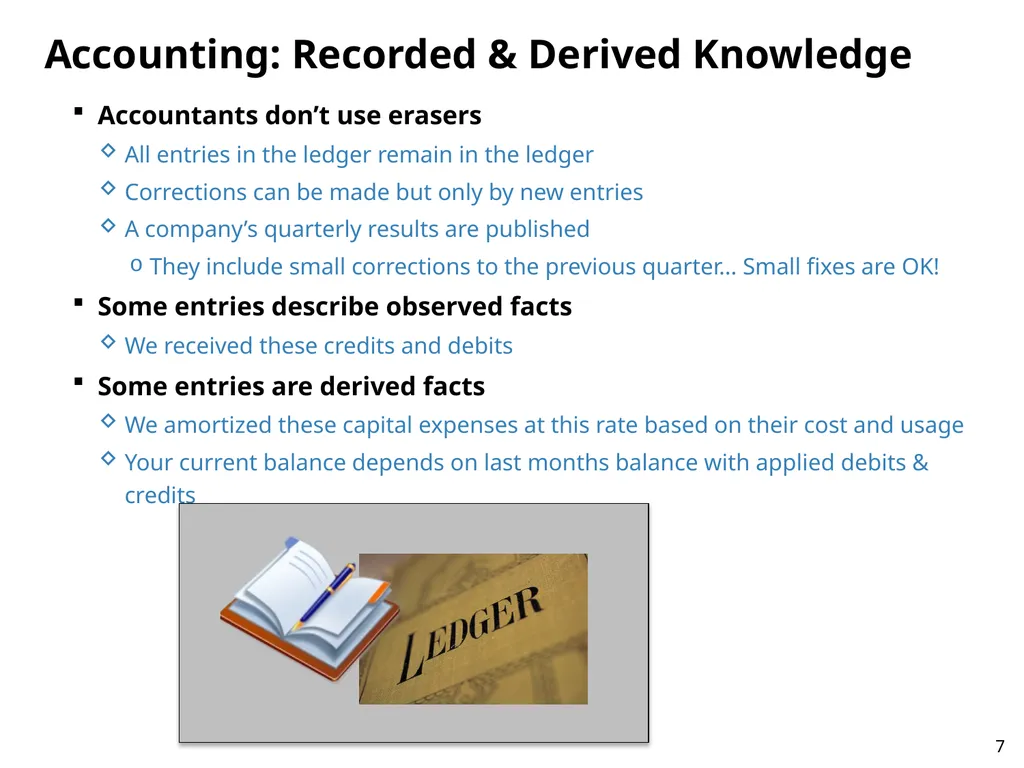
Accounting: Recorded & Derived Knowledge Accountants don’t use erasers
All entries in the ledger remain in the ledger
Corrections can be made but only by new entries
A company’s quarterly results are published
They include small corrections to the previous quarter… Small fixes are OK!
Some entries describe observed facts
We received these credits and debits
Some entries are derived facts
We amortized these capital expenses at this rate based on their cost and usage
Your current balance depends on last months balance with applied debits & credits 7<br>
All entries in the ledger remain in the ledger
Corrections can be made but only by new entries
A company’s quarterly results are published
They include small corrections to the previous quarter… Small fixes are OK!
Some entries describe observed facts
We received these credits and debits
Some entries are derived facts
We amortized these capital expenses at this rate based on their cost and usage
Your current balance depends on last months balance with applied debits & credits 7<br>
08
The Append-Only View of
Distributed Single-Master Computing Single-Master computing means somehow we order the changes
Centralized Computing
Two-Phase Commit or Paxos
Optimistic Concurrency Control
Somehow, we semantically apply one change at a time
Each change is layered over its predecessors
We can perceive a new set of values superseding the old ones
This may be transactional or single-record changes but they appear in an order
We continue to append new knowledge over the immutable history
The new version of the truth is interpreted through the older versions 8<br>
Centralized Computing
Two-Phase Commit or Paxos
Optimistic Concurrency Control
Somehow, we semantically apply one change at a time
Each change is layered over its predecessors
We can perceive a new set of values superseding the old ones
This may be transactional or single-record changes but they appear in an order
We continue to append new knowledge over the immutable history
The new version of the truth is interpreted through the older versions 8<br>
09
Distributed Computing “Back in the Day” Back before telephones, people used messengers
Kids walking through town or riding bicycles to deliver the message
The US Postal Service or the Pony Express would deliver the message
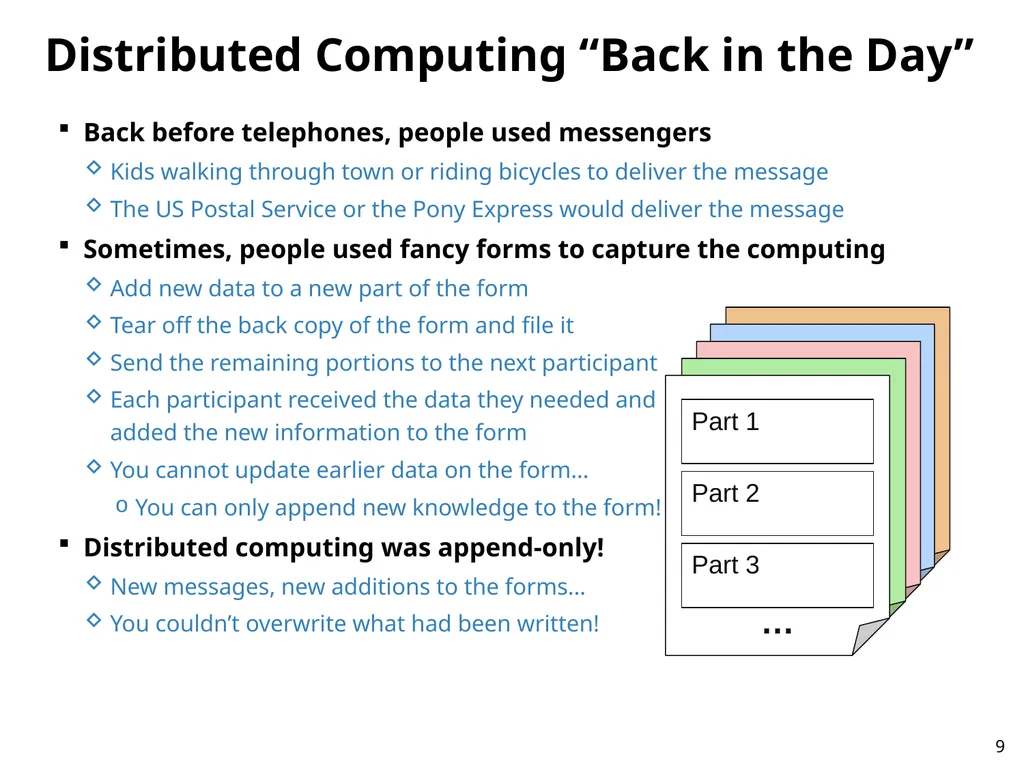
Sometimes, people used fancy forms to capture the computing
Add new data to a new part of the form
Tear off the back copy of the form and file it
Send the remaining portions to the next participant
Each participant received the data they needed and added the new information to the form
You cannot update earlier data on the form…
You can only append new knowledge to the form!
Distributed computing was append-only!
New messages, new additions to the forms…
You couldn’t overwrite what had been written! 9<br>
Kids walking through town or riding bicycles to deliver the message
The US Postal Service or the Pony Express would deliver the message
Sometimes, people used fancy forms to capture the computing
Add new data to a new part of the form
Tear off the back copy of the form and file it
Send the remaining portions to the next participant
Each participant received the data they needed and added the new information to the form
You cannot update earlier data on the form…
You can only append new knowledge to the form!
Distributed computing was append-only!
New messages, new additions to the forms…
You couldn’t overwrite what had been written! 9<br>
10
Outline Introduction
Accountants Don’t Use Erasers
Keeping the Stone Tablets Safe
Hey! Versions Are Immutable, Too!
Immutability by Reference
Immutability Is in the Eye of the Beholder
Normalization Is for Sissies
Conclusion 10<br>
Accountants Don’t Use Erasers
Keeping the Stone Tablets Safe
Hey! Versions Are Immutable, Too!
Immutability by Reference
Immutability Is in the Eye of the Beholder
Normalization Is for Sissies
Conclusion 10<br>
11
Files, Blocks, & Replication for
Durability & Availability GFS and HDFS (and others) offer highly-available files
A file is a bunch of blocks (or chunks)
The file (as a file name and description of needed blocks) is highly available
Each block (chunk) is replicated within the cluster for durability and availability
Blocks are typically replicated three times with scrubbing
Replicas are placed across fault-zones
Each file is immutable and (typically) single writer
The file is created, one process can append to it, it lives for a while and is deleted
Multi-writer files are hard (GFS had some challenges with failures and replicas)
Immutable files and immutable blocks empower this replication
The file system has no concept of a change to a complete file
Each block’s immutability allows it to be replicated (and have extra replicas, too) 11 High Availability of Immutable Blocks Is Affordable Now! Google, Amazon, Yahoo, Microsoft, and more keep Petabytes & Exabytes<br>
A file is a bunch of blocks (or chunks)
The file (as a file name and description of needed blocks) is highly available
Each block (chunk) is replicated within the cluster for durability and availability
Blocks are typically replicated three times with scrubbing
Replicas are placed across fault-zones
Each file is immutable and (typically) single writer
The file is created, one process can append to it, it lives for a while and is deleted
Multi-writer files are hard (GFS had some challenges with failures and replicas)
Immutable files and immutable blocks empower this replication
The file system has no concept of a change to a complete file
Each block’s immutability allows it to be replicated (and have extra replicas, too) 11 High Availability of Immutable Blocks Is Affordable Now! Google, Amazon, Yahoo, Microsoft, and more keep Petabytes & Exabytes<br>
12
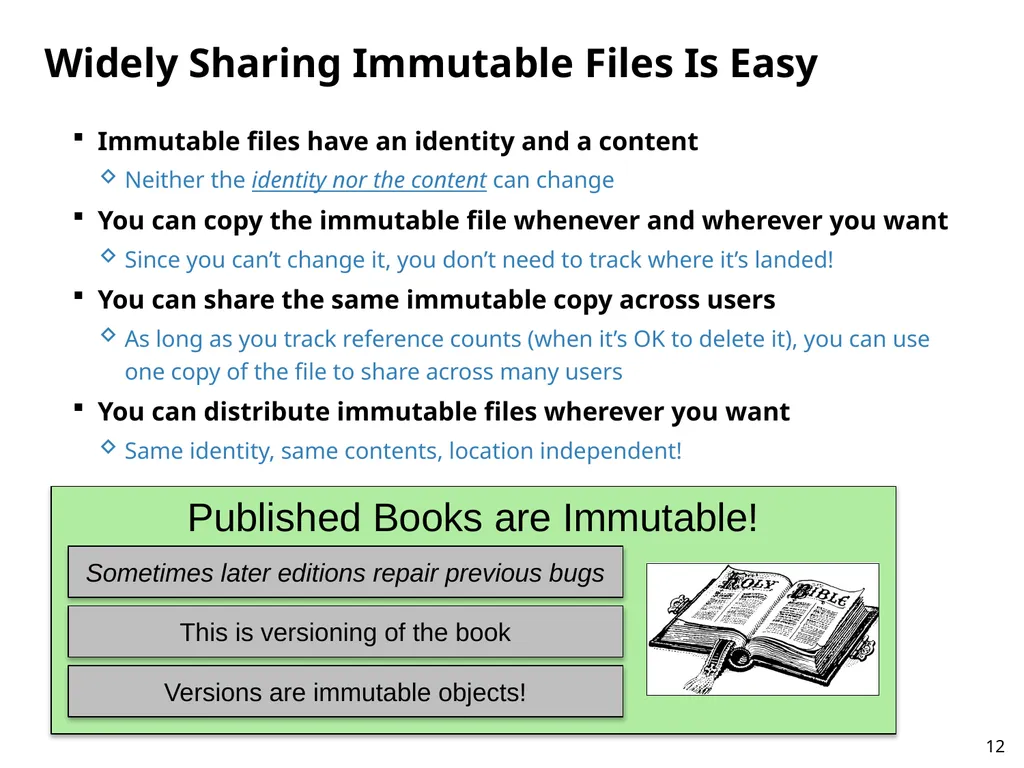
Widely Sharing Immutable Files Is Easy Immutable files have an identity and a content
Neither the identity nor the content can change
You can copy the immutable file whenever and wherever you want
Since you can’t change it, you don’t need to track where it’s landed!
You can share the same immutable copy across users
As long as you track reference counts (when it’s OK to delete it), you can use one copy of the file to share across many users
You can distribute immutable files wherever you want
Same identity, same contents, location independent! 12 Published Books are Immutable! Sometimes later editions repair previous bugs This is versioning of the book Versions are immutable objects!<br>
Neither the identity nor the content can change
You can copy the immutable file whenever and wherever you want
Since you can’t change it, you don’t need to track where it’s landed!
You can share the same immutable copy across users
As long as you track reference counts (when it’s OK to delete it), you can use one copy of the file to share across many users
You can distribute immutable files wherever you want
Same identity, same contents, location independent! 12 Published Books are Immutable! Sometimes later editions repair previous bugs This is versioning of the book Versions are immutable objects!<br>
13
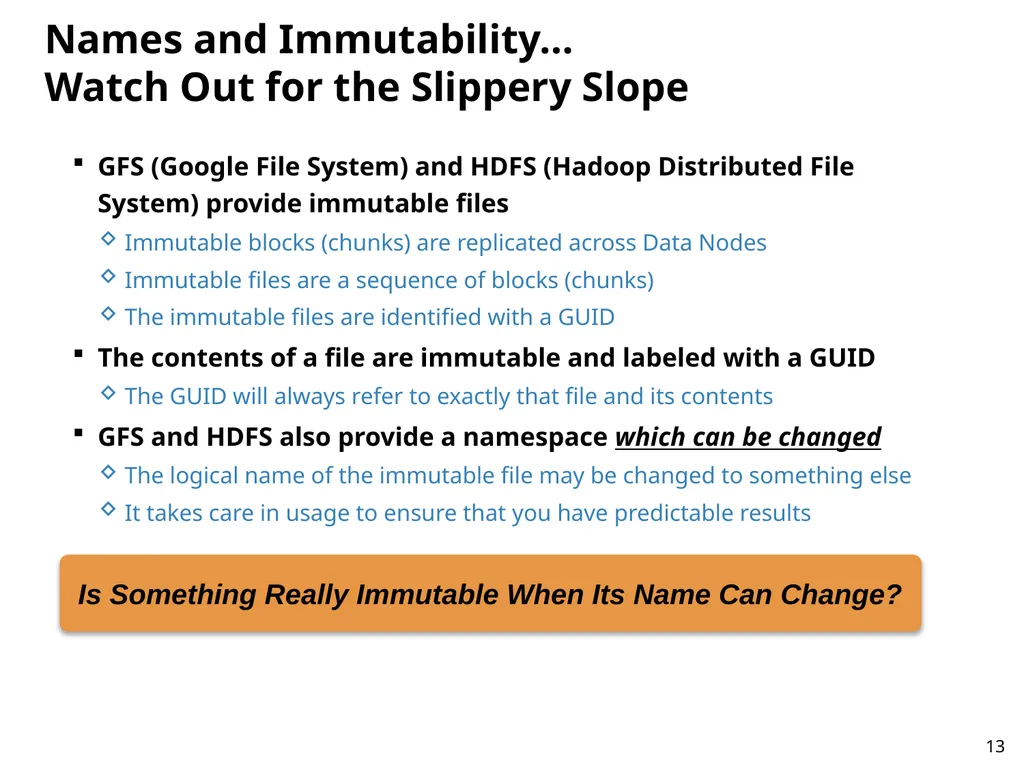
Names and Immutability…
Watch Out for the Slippery Slope GFS (Google File System) and HDFS (Hadoop Distributed File System) provide immutable files
Immutable blocks (chunks) are replicated across Data Nodes
Immutable files are a sequence of blocks (chunks)
The immutable files are identified with a GUID
The contents of a file are immutable and labeled with a GUID
The GUID will always refer to exactly that file and its contents
GFS and HDFS also provide a namespace which can be changed
The logical name of the immutable file may be changed to something else
It takes care in usage to ensure that you have predictable results 13 Is Something Really Immutable When Its Name Can Change?<br>
Immutable blocks (chunks) are replicated across Data Nodes
Immutable files are a sequence of blocks (chunks)
The immutable files are identified with a GUID
The contents of a file are immutable and labeled with a GUID
The GUID will always refer to exactly that file and its contents
GFS and HDFS also provide a namespace which can be changed
The logical name of the immutable file may be changed to something else
It takes care in usage to ensure that you have predictable results 13 Is Something Really Immutable When Its Name Can Change?<br>
14
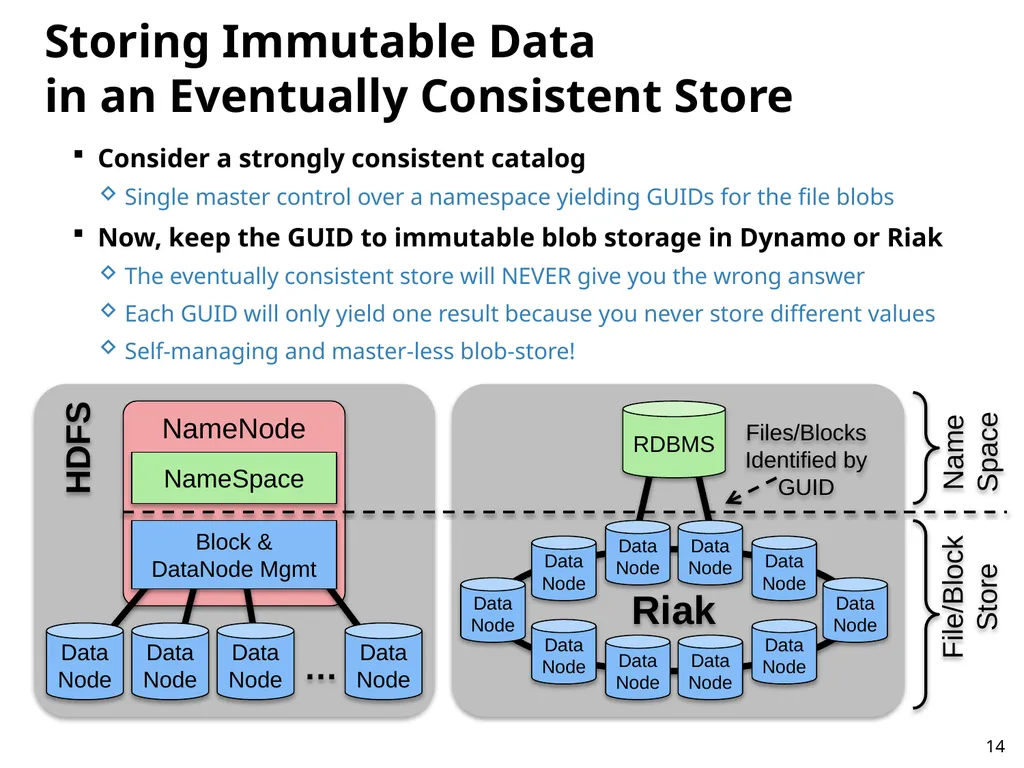
Storing Immutable Data
in an Eventually Consistent Store Consider a strongly consistent catalog
Single master control over a namespace yielding GUIDs for the file blobs
Now, keep the GUID to immutable blob storage in Dynamo or Riak
The eventually consistent store will NEVER give you the wrong answer
Each GUID will only yield one result because you never store different values
Self-managing and master-less blob-store! 14 RDBMS Files/Blocks Identified by GUID Name Space File/Block Store<br>
Single master control over a namespace yielding GUIDs for the file blobs
Now, keep the GUID to immutable blob storage in Dynamo or Riak
The eventually consistent store will NEVER give you the wrong answer
Each GUID will only yield one result because you never store different values
Self-managing and master-less blob-store! 14 RDBMS Files/Blocks Identified by GUID Name Space File/Block Store<br>
15
Outline Introduction
Accountants Don’t Use Erasers
Keeping the Stone Tablets Safe
Hey! Versions Are Immutable, Too!
Immutability by Reference
Immutability Is in the Eye of the Beholder
Normalization Is for Sissies
Conclusion 15<br>
Accountants Don’t Use Erasers
Keeping the Stone Tablets Safe
Hey! Versions Are Immutable, Too!
Immutability by Reference
Immutability Is in the Eye of the Beholder
Normalization Is for Sissies
Conclusion 15<br>
16
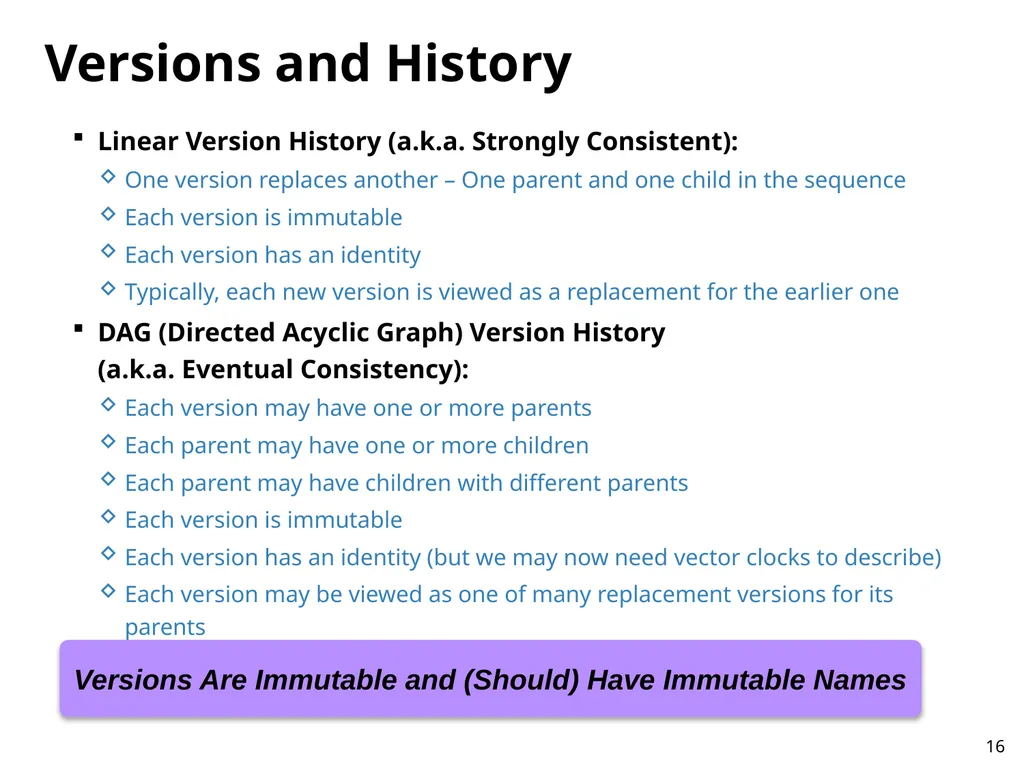
Versions and History Linear Version History (a.k.a. Strongly Consistent):
One version replaces another – One parent and one child in the sequence
Each version is immutable
Each version has an identity
Typically, each new version is viewed as a replacement for the earlier one
DAG (Directed Acyclic Graph) Version History (a.k.a. Eventual Consistency):
Each version may have one or more parents
Each parent may have one or more children
Each parent may have children with different parents
Each version is immutable
Each version has an identity (but we may now need vector clocks to describe)
Each version may be viewed as one of many replacement versions for its parents 16 Versions Are Immutable and (Should) Have Immutable Names<br>
One version replaces another – One parent and one child in the sequence
Each version is immutable
Each version has an identity
Typically, each new version is viewed as a replacement for the earlier one
DAG (Directed Acyclic Graph) Version History (a.k.a. Eventual Consistency):
Each version may have one or more parents
Each parent may have one or more children
Each parent may have children with different parents
Each version is immutable
Each version has an identity (but we may now need vector clocks to describe)
Each version may be viewed as one of many replacement versions for its parents 16 Versions Are Immutable and (Should) Have Immutable Names<br>
17
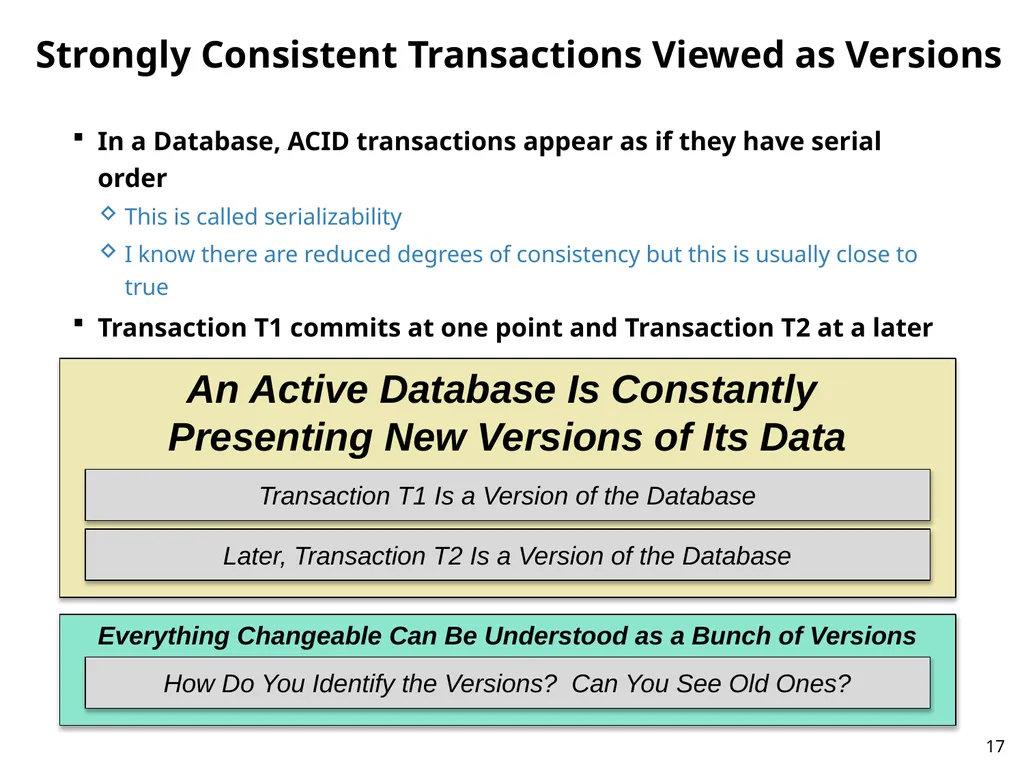
Strongly Consistent Transactions Viewed as Versions In a Database, ACID transactions appear as if they have serial order
This is called serializability
I know there are reduced degrees of consistency but this is usually close to true
Transaction T1 commits at one point and Transaction T2 at a later one
Transaction T1 presents a consistent view of the entire database
Transaction T2 presents a different and later view of the database 17<br>
This is called serializability
I know there are reduced degrees of consistency but this is usually close to true
Transaction T1 commits at one point and Transaction T2 at a later one
Transaction T1 presents a consistent view of the entire database
Transaction T2 presents a different and later view of the database 17<br>
18
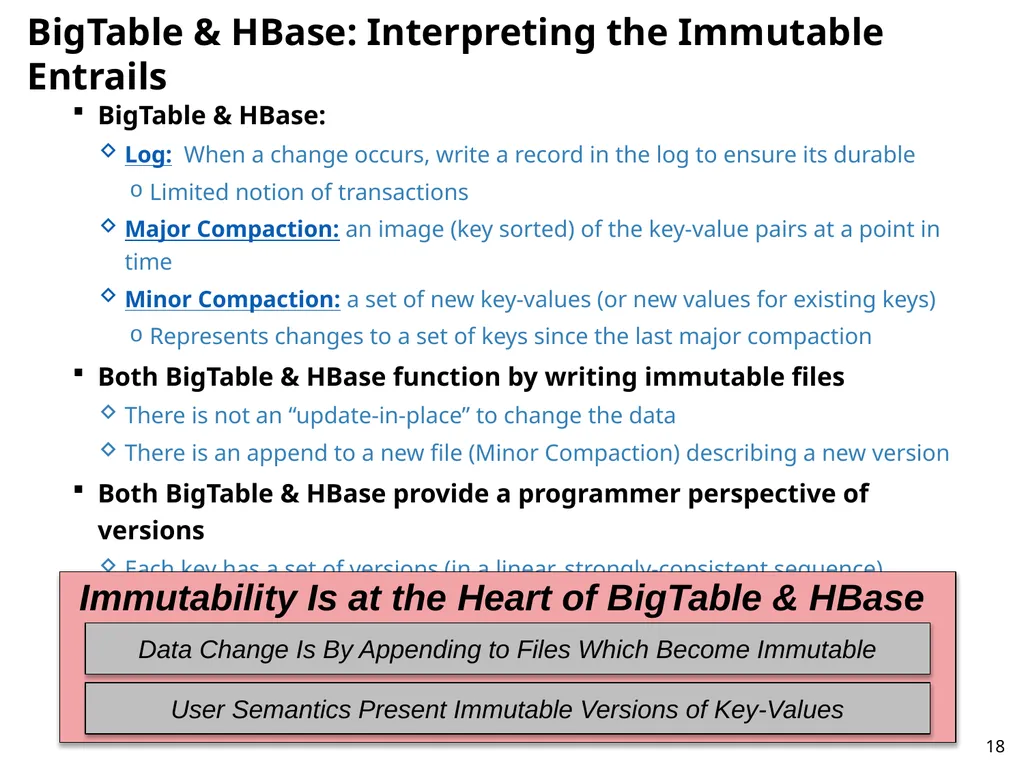
BigTable & HBase: Interpreting the Immutable Entrails BigTable & HBase:
Log: When a change occurs, write a record in the log to ensure its durable
Limited notion of transactions
Major Compaction: an image (key sorted) of the key-value pairs at a point in time
Minor Compaction: a set of new key-values (or new values for existing keys)
Represents changes to a set of keys since the last major compaction
Both BigTable & HBase function by writing immutable files
There is not an “update-in-place” to change the data
There is an append to a new file (Minor Compaction) describing a new version
Both BigTable & HBase provide a programmer perspective of versions
Each key has a set of versions (in a linear, strongly-consistent sequence)
A read may get the latest version or may get an earlier version 18<br>
Log: When a change occurs, write a record in the log to ensure its durable
Limited notion of transactions
Major Compaction: an image (key sorted) of the key-value pairs at a point in time
Minor Compaction: a set of new key-values (or new values for existing keys)
Represents changes to a set of keys since the last major compaction
Both BigTable & HBase function by writing immutable files
There is not an “update-in-place” to change the data
There is an append to a new file (Minor Compaction) describing a new version
Both BigTable & HBase provide a programmer perspective of versions
Each key has a set of versions (in a linear, strongly-consistent sequence)
A read may get the latest version or may get an earlier version 18<br>
19
Outline Introduction
Accountants Don’t Use Erasers
Keeping the Stone Tablets Safe
Hey! Versions Are Immutable, Too!
Immutability by Reference
Immutability Is in the Eye of the Beholder
Normalization Is for Sissies
Conclusion 19<br>
Accountants Don’t Use Erasers
Keeping the Stone Tablets Safe
Hey! Versions Are Immutable, Too!
Immutability by Reference
Immutability Is in the Eye of the Beholder
Normalization Is for Sissies
Conclusion 19<br>
20
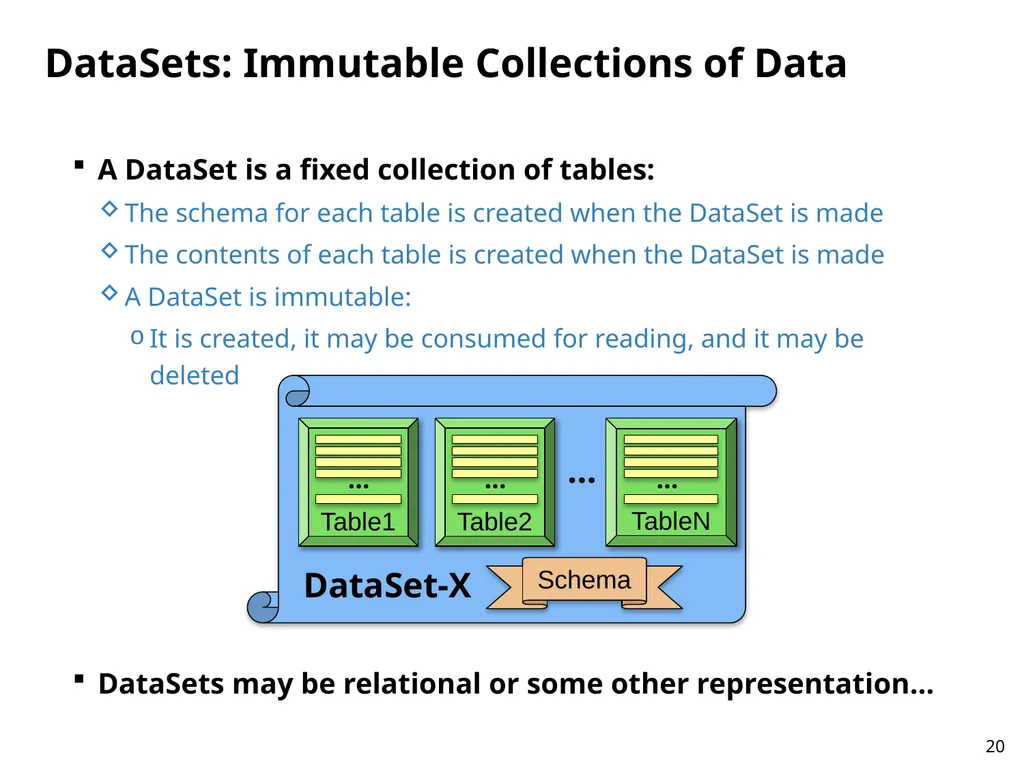
DataSets: Immutable Collections of Data A DataSet is a fixed collection of tables:
The schema for each table is created when the DataSet is made
The contents of each table is created when the DataSet is made
A DataSet is immutable:
It is created, it may be consumed for reading, and it may be deleted
DataSets may be relational or some other representation… 20<br>
The schema for each table is created when the DataSet is made
The contents of each table is created when the DataSet is made
A DataSet is immutable:
It is created, it may be consumed for reading, and it may be deleted
DataSets may be relational or some other representation… 20<br>
21
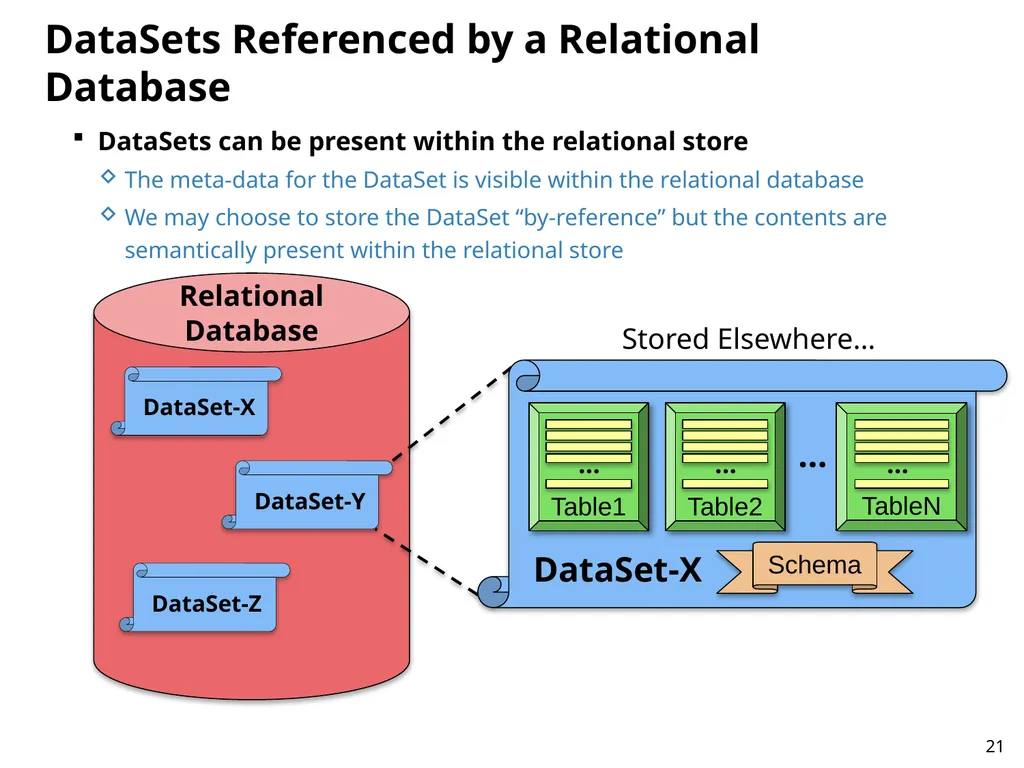
DataSets Referenced by a Relational Database DataSets can be present within the relational store
The meta-data for the DataSet is visible within the relational database
We may choose to store the DataSet “by-reference” but the contents are semantically present within the relational store 21 Relational
Database Stored Elsewhere…<br>
The meta-data for the DataSet is visible within the relational database
We may choose to store the DataSet “by-reference” but the contents are semantically present within the relational store 21 Relational
Database Stored Elsewhere…<br>
22
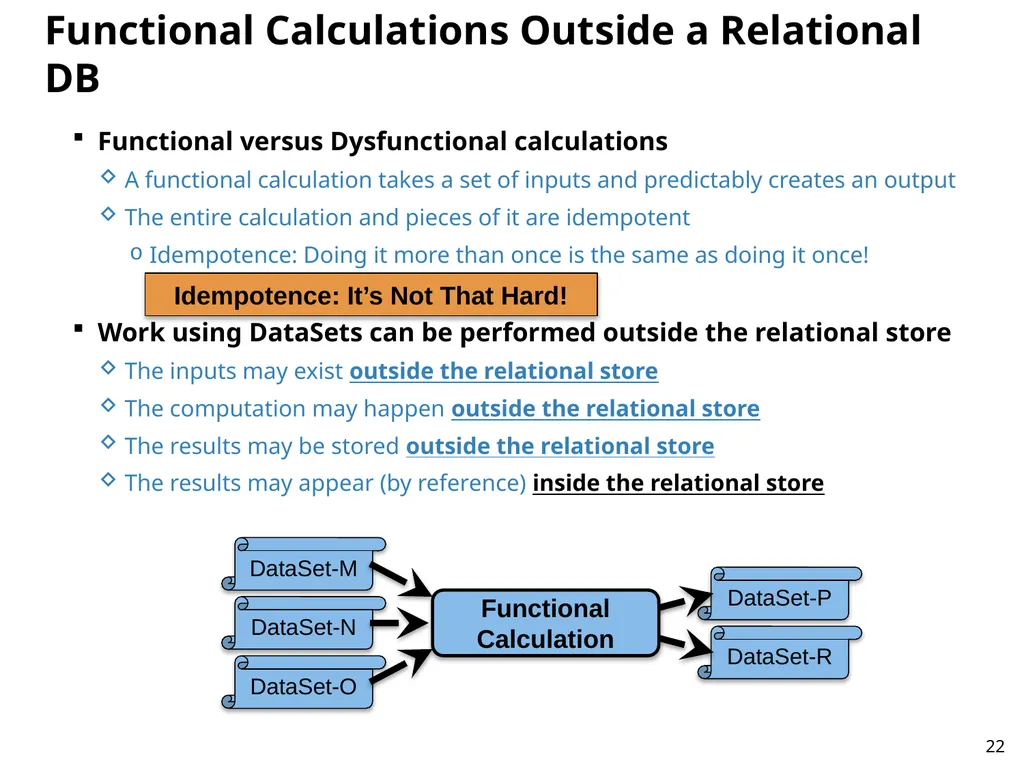
Functional Calculations Outside a Relational DB Functional versus Dysfunctional calculations
A functional calculation takes a set of inputs and predictably creates an output
The entire calculation and pieces of it are idempotent
Idempotence: Doing it more than once is the same as doing it once!
Work using DataSets can be performed outside the relational store
The inputs may exist outside the relational store
The computation may happen outside the relational store
The results may be stored outside the relational store
The results may appear (by reference) inside the relational store 22 Idempotence: It’s Not That Hard!<br>
A functional calculation takes a set of inputs and predictably creates an output
The entire calculation and pieces of it are idempotent
Idempotence: Doing it more than once is the same as doing it once!
Work using DataSets can be performed outside the relational store
The inputs may exist outside the relational store
The computation may happen outside the relational store
The results may be stored outside the relational store
The results may appear (by reference) inside the relational store 22 Idempotence: It’s Not That Hard!<br>
23
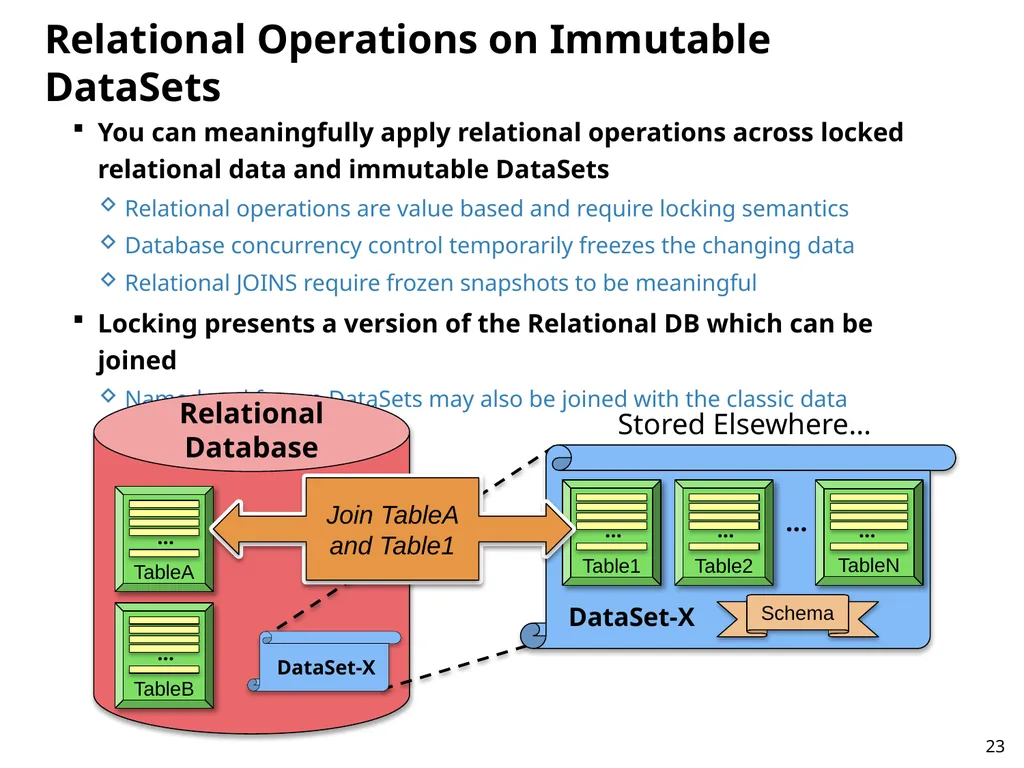
Relational Operations on Immutable DataSets You can meaningfully apply relational operations across locked relational data and immutable DataSets
Relational operations are value based and require locking semantics
Database concurrency control temporarily freezes the changing data
Relational JOINS require frozen snapshots to be meaningful
Locking presents a version of the Relational DB which can be joined
Named and frozen DataSets may also be joined with the classic data 23 Relational
Database Stored Elsewhere…<br>
Relational operations are value based and require locking semantics
Database concurrency control temporarily freezes the changing data
Relational JOINS require frozen snapshots to be meaningful
Locking presents a version of the Relational DB which can be joined
Named and frozen DataSets may also be joined with the classic data 23 Relational
Database Stored Elsewhere…<br>
24
Outline Introduction
Accountants Don’t Use Erasers
Keeping the Stone Tablets Safe
Hey! Versions Are Immutable, Too!
Immutability by Reference
Immutability Is in the Eye of the Beholder
Normalization Is for Sissies
Conclusion 24<br>
Accountants Don’t Use Erasers
Keeping the Stone Tablets Safe
Hey! Versions Are Immutable, Too!
Immutability by Reference
Immutability Is in the Eye of the Beholder
Normalization Is for Sissies
Conclusion 24<br>
25
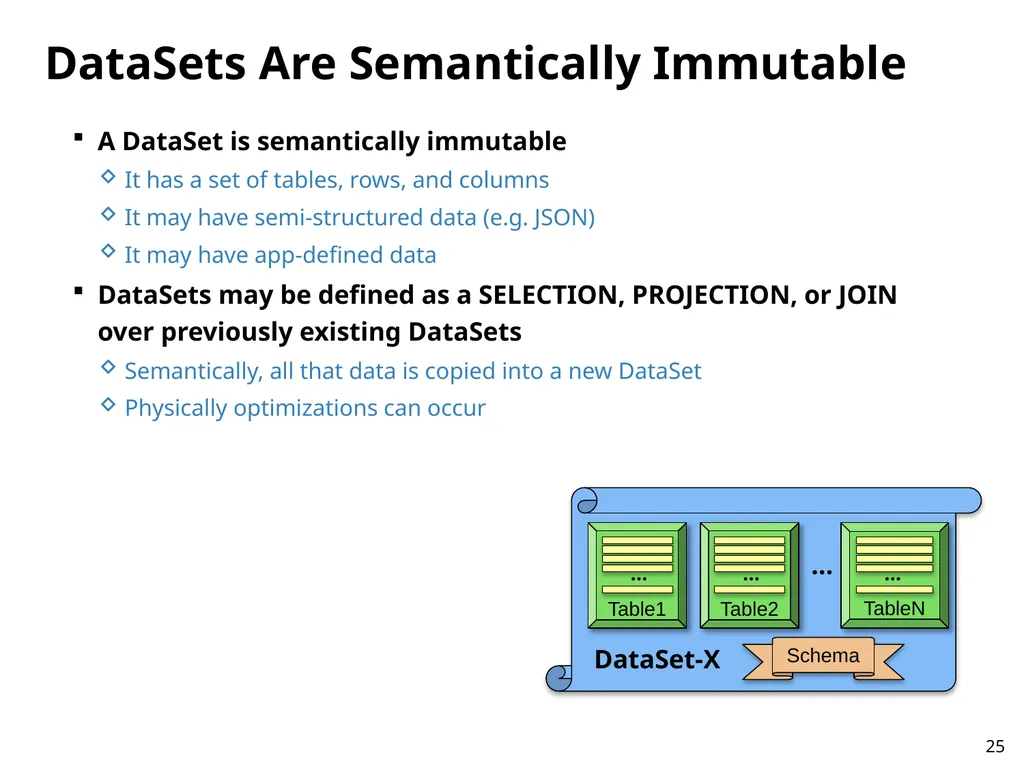
DataSets Are Semantically Immutable A DataSet is semantically immutable
It has a set of tables, rows, and columns
It may have semi-structured data (e.g. JSON)
It may have app-defined data
DataSets may be defined as a SELECTION, PROJECTION, or JOIN over previously existing DataSets
Semantically, all that data is copied into a new DataSet
Physically optimizations can occur 25<br>
It has a set of tables, rows, and columns
It may have semi-structured data (e.g. JSON)
It may have app-defined data
DataSets may be defined as a SELECTION, PROJECTION, or JOIN over previously existing DataSets
Semantically, all that data is copied into a new DataSet
Physically optimizations can occur 25<br>
26
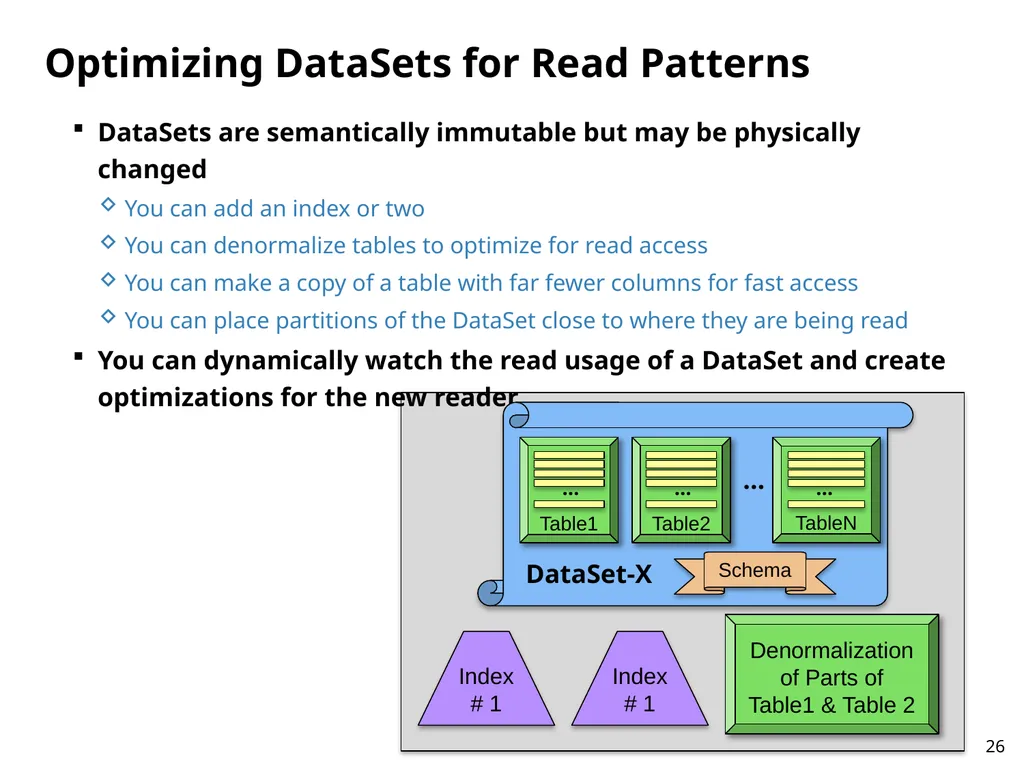
Optimizing DataSets for Read Patterns DataSets are semantically immutable but may be physically changed
You can add an index or two
You can denormalize tables to optimize for read access
You can make a copy of a table with far fewer columns for fast access
You can place partitions of the DataSet close to where they are being read
You can dynamically watch the read usage of a DataSet and create optimizations for the new reader 26 Index# 1 Denormalization of Parts of Table1 & Table 2 Index# 1<br>
You can add an index or two
You can denormalize tables to optimize for read access
You can make a copy of a table with far fewer columns for fast access
You can place partitions of the DataSet close to where they are being read
You can dynamically watch the read usage of a DataSet and create optimizations for the new reader 26 Index# 1 Denormalization of Parts of Table1 & Table 2 Index# 1<br>
27
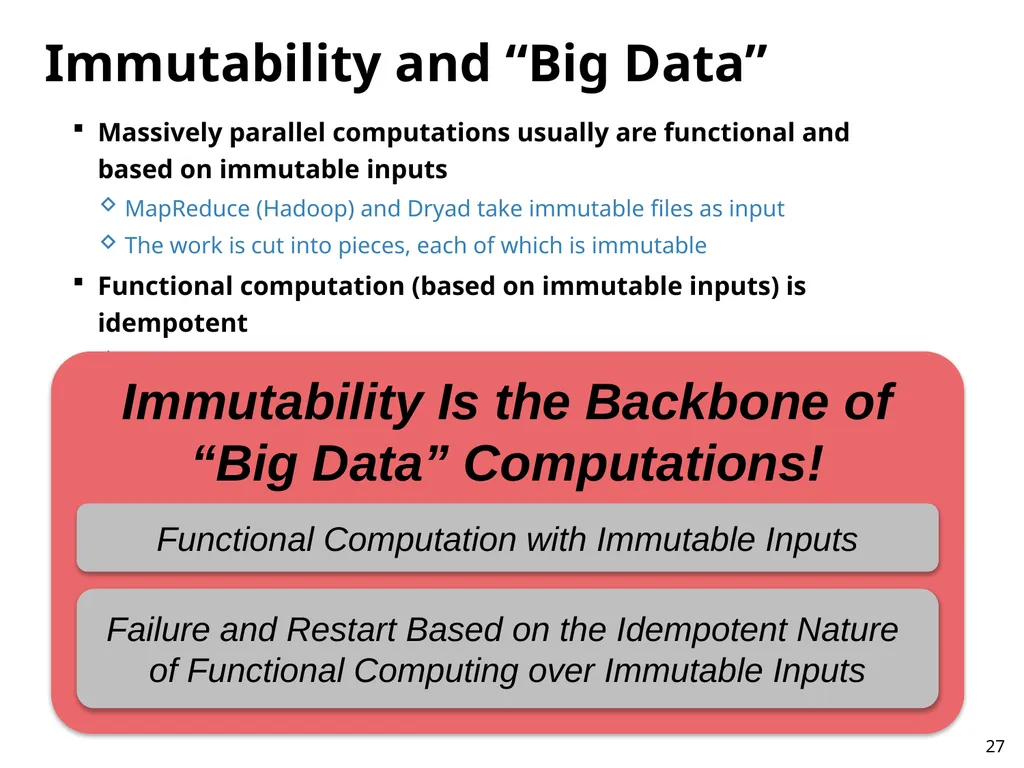
Immutability and “Big Data” Massively parallel computations usually are functional and
based on immutable inputs
MapReduce (Hadoop) and Dryad take immutable files as input
The work is cut into pieces, each of which is immutable
Functional computation (based on immutable inputs) is idempotent
It’s OK to croak and restart 27<br>
MapReduce (Hadoop) and Dryad take immutable files as input
The work is cut into pieces, each of which is immutable
Functional computation (based on immutable inputs) is idempotent
It’s OK to croak and restart 27<br>
28
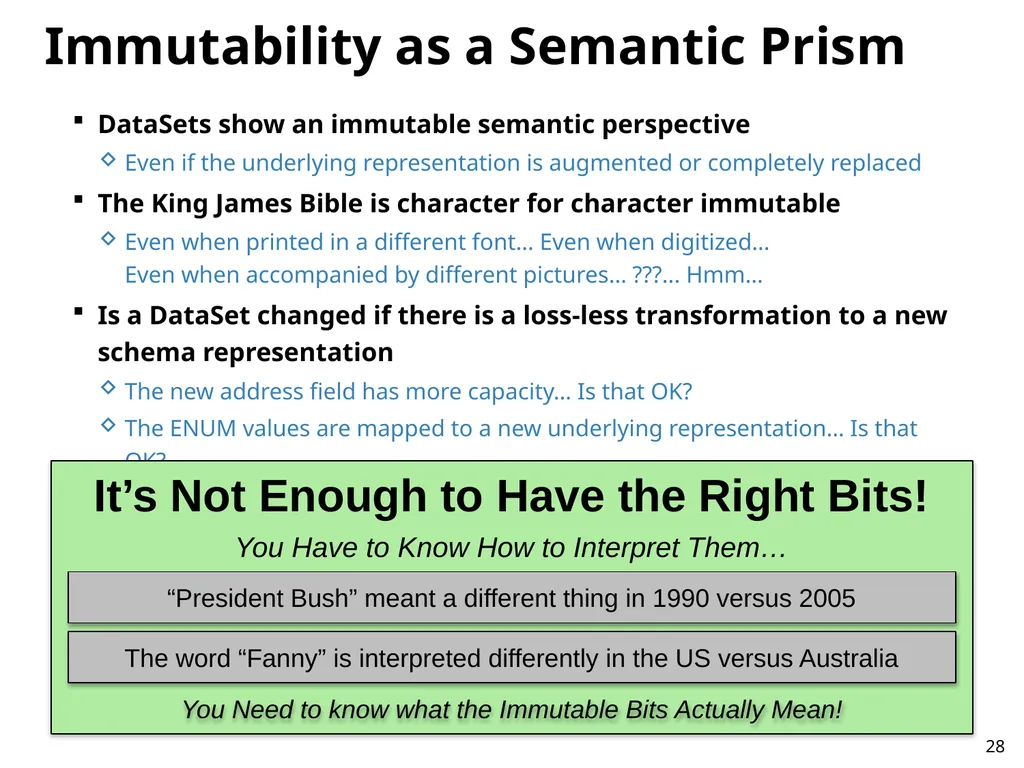
Immutability as a Semantic Prism DataSets show an immutable semantic perspective
Even if the underlying representation is augmented or completely replaced
The King James Bible is character for character immutable
Even when printed in a different font… Even when digitized… Even when accompanied by different pictures… ???... Hmm…
Is a DataSet changed if there is a loss-less transformation to a new schema representation
The new address field has more capacity… Is that OK?
The ENUM values are mapped to a new underlying representation… Is that OK? 28 It’s Not Enough to Have the Right Bits!
You Have to Know How to Interpret Them… “President Bush” meant a different thing in 1990 versus 2005 The word “Fanny” is interpreted differently in the US versus Australia You Need to know what the Immutable Bits Actually Mean!<br>
Even if the underlying representation is augmented or completely replaced
The King James Bible is character for character immutable
Even when printed in a different font… Even when digitized… Even when accompanied by different pictures… ???... Hmm…
Is a DataSet changed if there is a loss-less transformation to a new schema representation
The new address field has more capacity… Is that OK?
The ENUM values are mapped to a new underlying representation… Is that OK? 28 It’s Not Enough to Have the Right Bits!
You Have to Know How to Interpret Them… “President Bush” meant a different thing in 1990 versus 2005 The word “Fanny” is interpreted differently in the US versus Australia You Need to know what the Immutable Bits Actually Mean!<br>
29
Outline Introduction
Accountants Don’t Use Erasers
Keeping the Stone Tablets Safe
Hey! Versions Are Immutable, Too!
Immutability by Reference
Immutability Is in the Eye of the Beholder
Normalization Is for Sissies
Conclusion 29<br>
Accountants Don’t Use Erasers
Keeping the Stone Tablets Safe
Hey! Versions Are Immutable, Too!
Immutability by Reference
Immutability Is in the Eye of the Beholder
Normalization Is for Sissies
Conclusion 29<br>
30
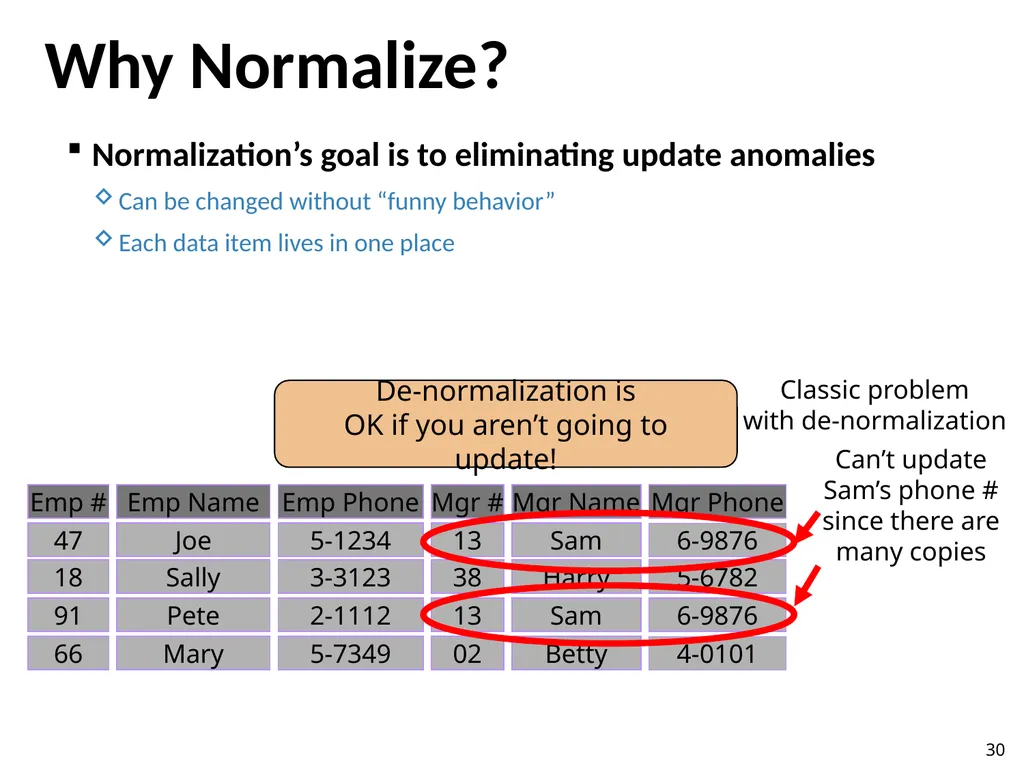
Why Normalize? Normalization’s goal is to eliminating update anomalies
Can be changed without “funny behavior”
Each data item lives in one place De-normalization is
OK if you aren’t going to update! 30<br>
Can be changed without “funny behavior”
Each data item lives in one place De-normalization is
OK if you aren’t going to update! 30<br>
31
We Are Swimming in a Sea of Immutable Data 31<br>
32
Think First Before You Normalize 32<br>
33
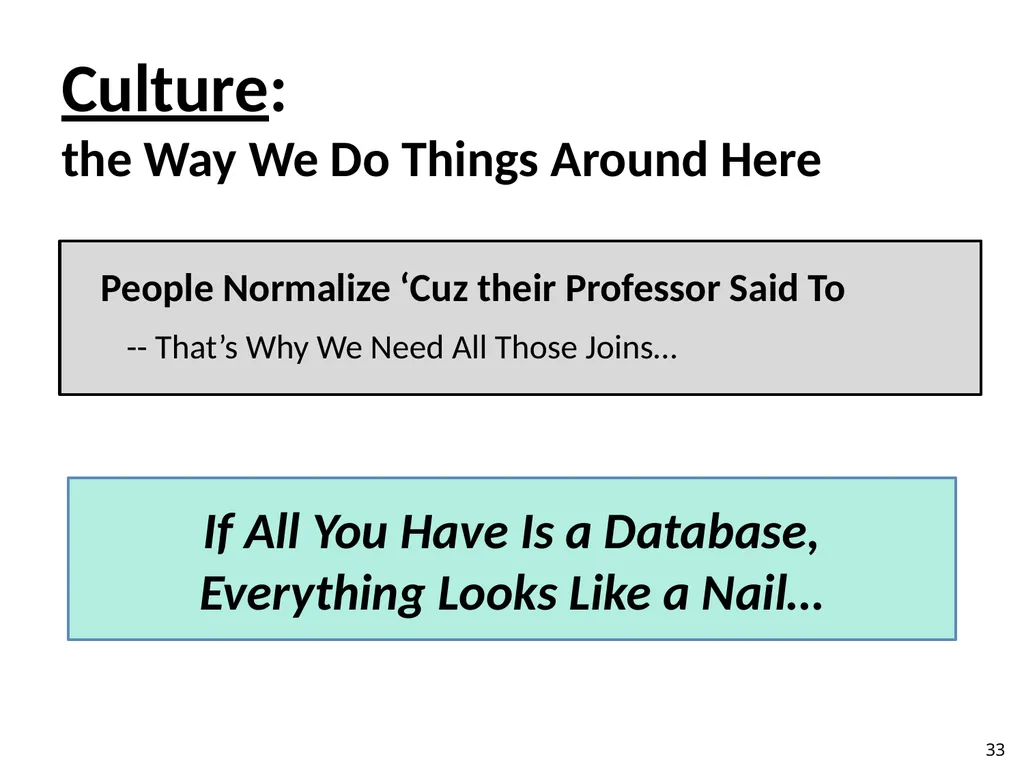
People Normalize ‘Cuz their Professor Said To
-- That’s Why We Need All Those Joins… Culture: the Way We Do Things Around Here If All You Have Is a Database, Everything Looks Like a Nail… 33<br>
-- That’s Why We Need All Those Joins… Culture: the Way We Do Things Around Here If All You Have Is a Database, Everything Looks Like a Nail… 33<br>
34
Outline Introduction
Accountants Don’t Use Erasers
Keeping the Stone Tablets Safe
Hey! Versions Are Immutable, Too!
Immutability by Reference
Immutability Is in the Eye of the Beholder
Normalization Is for Sissies
Conclusion 34<br>
Accountants Don’t Use Erasers
Keeping the Stone Tablets Safe
Hey! Versions Are Immutable, Too!
Immutability by Reference
Immutability Is in the Eye of the Beholder
Normalization Is for Sissies
Conclusion 34<br>
35
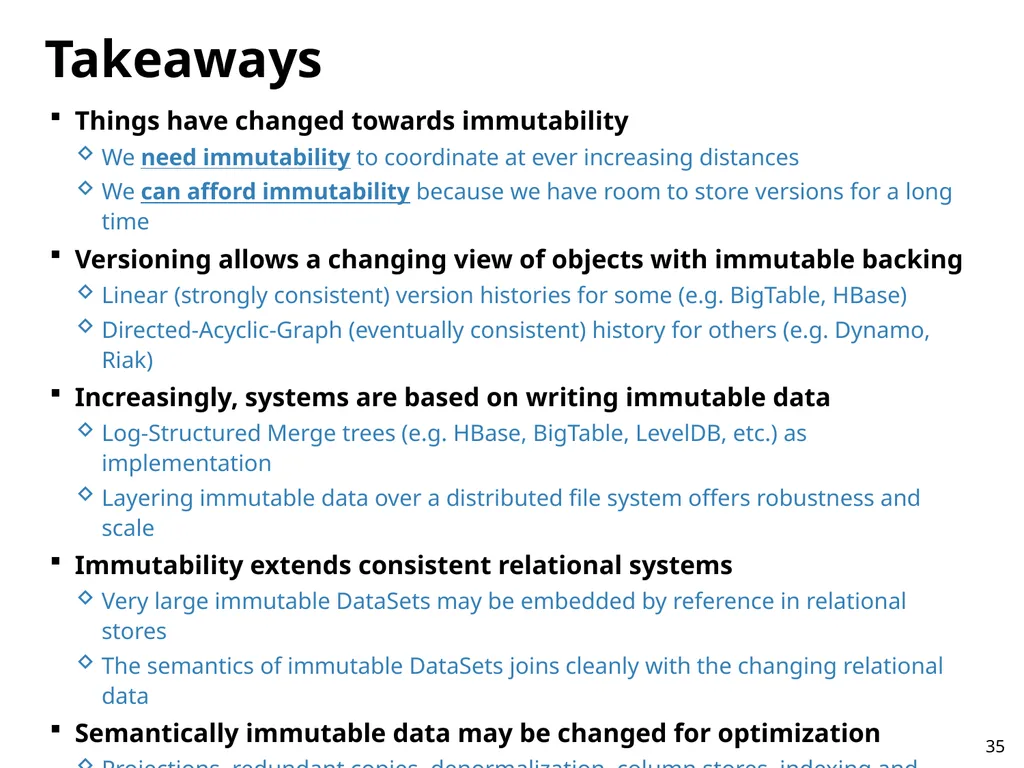
Takeaways Things have changed towards immutability
We need immutability to coordinate at ever increasing distances
We can afford immutability because we have room to store versions for a long time
Versioning allows a changing view of objects with immutable backing
Linear (strongly consistent) version histories for some (e.g. BigTable, HBase)
Directed-Acyclic-Graph (eventually consistent) history for others (e.g. Dynamo, Riak)
Increasingly, systems are based on writing immutable data
Log-Structured Merge trees (e.g. HBase, BigTable, LevelDB, etc.) as implementation
Layering immutable data over a distributed file system offers robustness and scale
Immutability extends consistent relational systems
Very large immutable DataSets may be embedded by reference in relational stores
The semantics of immutable DataSets joins cleanly with the changing relational data
Semantically immutable data may be changed for optimization
Projections, redundant copies, denormalization, column stores, indexing and more…
Semantically immutable means the user behavior doesn’t change
Immutability is the backbone of emerging “Big Data” systems
MapReduce, Hadoop, and more leverage immutable snapshots 35<br>
We need immutability to coordinate at ever increasing distances
We can afford immutability because we have room to store versions for a long time
Versioning allows a changing view of objects with immutable backing
Linear (strongly consistent) version histories for some (e.g. BigTable, HBase)
Directed-Acyclic-Graph (eventually consistent) history for others (e.g. Dynamo, Riak)
Increasingly, systems are based on writing immutable data
Log-Structured Merge trees (e.g. HBase, BigTable, LevelDB, etc.) as implementation
Layering immutable data over a distributed file system offers robustness and scale
Immutability extends consistent relational systems
Very large immutable DataSets may be embedded by reference in relational stores
The semantics of immutable DataSets joins cleanly with the changing relational data
Semantically immutable data may be changed for optimization
Projections, redundant copies, denormalization, column stores, indexing and more…
Semantically immutable means the user behavior doesn’t change
Immutability is the backbone of emerging “Big Data” systems
MapReduce, Hadoop, and more leverage immutable snapshots 35<br>
36
36 Immutability Changes Everything!<br>