
Common Change Theories and Application to
OM
Published · 28 slides · 0 views
1 / 1

Description
Common Change Theories and Application to Different Nursing Situations Sonia Udod and Joan Wagner Creative commons attribution 4.0 international license June 2018 Authors Title Open License The PowerPoint slide deck created by Joan Wagner,
Related Topics
Share
Embed code
Download this presentation From Below
"Common Change Theories and Application to" is the property of its rightful owner. Permission is granted to download and print the materials on this website for personal, non-commercial use only, and to display it on your personal computer provided you do not modify the materials and that you retain all copyright notices contained in the materials. By downloading content from our website, you accept the terms of this agreement.
Presentation Transcript
01
Common Change Theories and Application to Different Nursing Situations Sonia Udod and Joan Wagner Creative commons attribution 4.0 international license June 2018 Author’s Title<br>
02
Open License The PowerPoint slide deck created by Joan Wagner, and designed by JVDW Designs, for the open textbook Leadership and Influencing Change in Nursing is licensed under a Creative Commons Attribution 4.0 International License, except where otherwise noted. The University of Regina logo is a registered trademark.
Under the terms of the Creative Commons Attribution 4.0 International License, you are free to retain, reuse, copy, redistribute, and revise this PowerPoint – in whole or in part – as long as you provide attribution to Joan Wagner. Download the PowerPoint slide deck for Leadership and Influencing Change in Nursing by Joan Wagner for free at www.uregina.ca/open-access/open-textbooks.
For questions about University of Regina’s Open Textbook Publishing Program, contact: open.textbooks@uregina.ca. CC BY 4.0 International License 2<br>
Under the terms of the Creative Commons Attribution 4.0 International License, you are free to retain, reuse, copy, redistribute, and revise this PowerPoint – in whole or in part – as long as you provide attribution to Joan Wagner. Download the PowerPoint slide deck for Leadership and Influencing Change in Nursing by Joan Wagner for free at www.uregina.ca/open-access/open-textbooks.
For questions about University of Regina’s Open Textbook Publishing Program, contact: open.textbooks@uregina.ca. CC BY 4.0 International License 2<br>
03
Learning Objectives Explain why nurses have the opportunity to be change agents.
Identify how different theorists explain change.
Discuss how the nursing process is similar to the change process.
Discuss the medicine wheel as a change model.
Describe the nurse leader’s role in implementing change and the call to action.
Differentiate among change strategies.
Recognize how to handle resistance to change. CC BY 4.0 International License 3<br>
Identify how different theorists explain change.
Discuss how the nursing process is similar to the change process.
Discuss the medicine wheel as a change model.
Describe the nurse leader’s role in implementing change and the call to action.
Differentiate among change strategies.
Recognize how to handle resistance to change. CC BY 4.0 International License 3<br>
04
The Nurse as Change Agent Nurse leaders must ensure the day-to-day operation of their unit(s) in a rapidly evolving health care system.
Literature suggests that leaders continue to struggle with change despite the frequency with which they are involved in leading change (Gilley, Gilley, & McMillan, 2009; Quinn, 2004).
Change Agent: an individual who has formal or informal legitimate power and whose purpose is to direct and guide change (Sullivan, 2017) CC BY 4.0 International License 4<br>
Literature suggests that leaders continue to struggle with change despite the frequency with which they are involved in leading change (Gilley, Gilley, & McMillan, 2009; Quinn, 2004).
Change Agent: an individual who has formal or informal legitimate power and whose purpose is to direct and guide change (Sullivan, 2017) CC BY 4.0 International License 4<br>
05
The Nurse as Change Agent (Cont’d) Nurse leaders must have the requisite skills for influencing human behaviour:
Supervisory ability
Intelligence
Need for achievement
Decisiveness
Persistence to guide the process (Gilley et al., 2009) CC BY 4.0 International License 5<br>
Supervisory ability
Intelligence
Need for achievement
Decisiveness
Persistence to guide the process (Gilley et al., 2009) CC BY 4.0 International License 5<br>
06
Theories and Models of Change Theories Force Field Model: best applied to stable environments and he makes note of two types of forces: driving forces and restraining forces. Change can occur if the driving forces override or weaken the restraining forces.
Driving forces: those that push in a direction that causes the change to occur or that facilitate the change because they push a person in a desired direction.
Restraining forces: those that counter the driving force and hinder the change because they push a person away from a desired direction. CC BY 4.0 International License 6<br>
Driving forces: those that push in a direction that causes the change to occur or that facilitate the change because they push a person in a desired direction.
Restraining forces: those that counter the driving force and hinder the change because they push a person away from a desired direction. CC BY 4.0 International License 6<br>
07
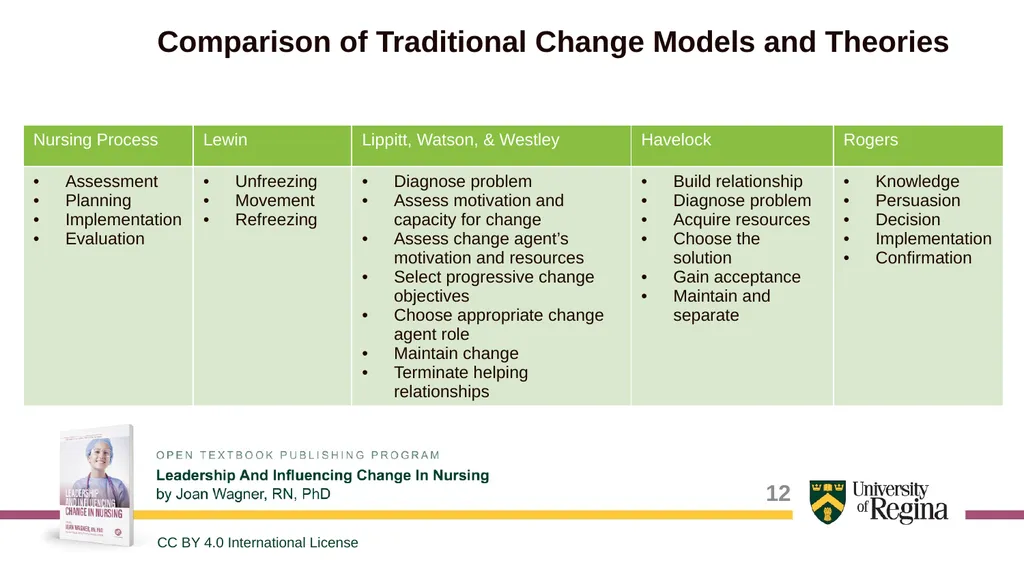
Theories and Models of Change Theories (Cont’d) Unfreezing-Movement-Refreezing: based on the idea that if one can identify and determine the potency of forces, then it is possible to know the forces that need to be diminished or strengthened to bring about change (Burnes, 2004).
Unfreezing: disequilibrium occurs to disrupt the system, making it possible to identify the driving forces for the change and the likely restraining forces against it.
Moving or change: involves the process of a change in thoughts, feelings, and/or behaviours—often faced with fear and uncertainty.
Refreezing: establishing the change as a new habit. CC BY 4.0 International License 7<br>
Unfreezing: disequilibrium occurs to disrupt the system, making it possible to identify the driving forces for the change and the likely restraining forces against it.
Moving or change: involves the process of a change in thoughts, feelings, and/or behaviours—often faced with fear and uncertainty.
Refreezing: establishing the change as a new habit. CC BY 4.0 International License 7<br>
08
Planned Change Lippitt, Watson, and Westley (1958) focus more on the role and responsibility of the change agent than on the process of the change itself. Their theory expands Lewin’s model of change into a seven-step process and emphasizes the participation of those affected by the change. CC BY 4.0 International License 8<br>
09
Planned Change (Cont’d) The seven steps of the planned change model:
Diagnosing the problem
Assessing the motivation and capacity for change in the system
Assessing the resources and motivation of the change agent
Establishing change objectives and strategies
Determining the role of the change agent
Maintaining the change
Gradually terminating the helping relationship as the change becomes part of the organizational culture CC BY 4.0 International License 9<br>
Diagnosing the problem
Assessing the motivation and capacity for change in the system
Assessing the resources and motivation of the change agent
Establishing change objectives and strategies
Determining the role of the change agent
Maintaining the change
Gradually terminating the helping relationship as the change becomes part of the organizational culture CC BY 4.0 International License 9<br>
10
Planned Change (Cont’d) The six phases of Havelock’s model:
Building a relationship
Diagnosing the problem
Acquire resources for change
Selecting a pathway for the solution
Establish and accept change
Maintenance and separation CC BY 4.0 International License 10<br>
Building a relationship
Diagnosing the problem
Acquire resources for change
Selecting a pathway for the solution
Establish and accept change
Maintenance and separation CC BY 4.0 International License 10<br>
11
Planned Change (Cont’d) Rogers’ five-step theory:
Knowledge
Persuasion
Decision
Implementation
Confirmation CC BY 4.0 International License 11<br>
Knowledge
Persuasion
Decision
Implementation
Confirmation CC BY 4.0 International License 11<br>
12
Comparison of Traditional Change Models and Theories CC BY 4.0 International License 12<br>
13
Essential Learning Activity 9.3.1 Watch the video “Lewin's 3-Stage Model of Change: Unfreezing, Changing & Refreezing” (8:06) by Education-Portal.com for more about Lewin’s change model.
Watch the video “Rogers Diffusion of Innovation” (3:15) by Kendal Pho, Yuri Dorovskikh, and Natalia Lara (Digital Pixels) for more about Rogers’ theory of innovation. CC BY 4.0 International License 13<br>
Watch the video “Rogers Diffusion of Innovation” (3:15) by Kendal Pho, Yuri Dorovskikh, and Natalia Lara (Digital Pixels) for more about Rogers’ theory of innovation. CC BY 4.0 International License 13<br>
14
Non-Linear Change Models Chaos Theory
Non-human-induced responses in the environment indicate there is some predictability in random patterns (Thietart & Forgues, 1995; Wagner & Huber, 2003).
Small changes of randomness in a system that constantly changes can dramatically affect the long-term behaviour of that system and make it difficult to predict future outcomes. CC BY 4.0 International License 14<br>
Non-human-induced responses in the environment indicate there is some predictability in random patterns (Thietart & Forgues, 1995; Wagner & Huber, 2003).
Small changes of randomness in a system that constantly changes can dramatically affect the long-term behaviour of that system and make it difficult to predict future outcomes. CC BY 4.0 International License 14<br>
15
Essential Learning Activity 9.4.1 Watch Claire Burge’s TEDx Talk titled “The Future of Work is Chaos” (13:43) for a more in-depth understanding of chaos theory. CC BY 4.0 International License 15<br>
16
Essential Learning Activity 9.4.2 Cindy is an RN with three years’ experience working on a busy surgical unit in a large urban hospital. Cindy enjoys her job and is keen to pursue an intensive care course after which she plans to work in the intensive care unit of the same hospital. She has received a one-year grant to establish a cardiac program for patients and caregivers. This project will be evaluated at the end of the year. Cindy, as the change agent, is tasked with implementing the change. Stephanie, the nurse manager, is highly supportive, but some of the nurses don’t have time and are not willing to help make the program a reality. CC BY 4.0 International License 16<br>
17
Essential Learning Activity 9.4.2 (Cont’d) How should Cindy proceed with the change process? Could Lewin’s change theory be used to guide the change? If so, how would you envision the change occurring?
How can she persuade other nurses to buy into the change? What effective leadership and followership strategies could she implement in the change process? CC BY 4.0 International License 17<br>
How can she persuade other nurses to buy into the change? What effective leadership and followership strategies could she implement in the change process? CC BY 4.0 International License 17<br>
18
The Nursing Process as the Change Process Assessment—identifying the problem
Planning—participation of the staff that will be affected by the change
Sharing information
Disconfirming currently held beliefs
Providing psychological safety
Implementation—plans are put into action
Evaluation—have goals been met? CC BY 4.0 International License 18<br>
Planning—participation of the staff that will be affected by the change
Sharing information
Disconfirming currently held beliefs
Providing psychological safety
Implementation—plans are put into action
Evaluation—have goals been met? CC BY 4.0 International License 18<br>
19
The Medicine Wheel as a Change Model The medicine wheel, drawn as a circle with four quadrants, represents a holistic set of beliefs encompassing the mind, body, emotions, and spirit, which is foundational to the human being.
The medicine wheel is manifested within the community as a “process (healing), a ceremony (sweats, sharing circles) and teachings (a code for living)” (McCabe, 2008, p. 34). CC BY 4.0 International License 19<br>
The medicine wheel is manifested within the community as a “process (healing), a ceremony (sweats, sharing circles) and teachings (a code for living)” (McCabe, 2008, p. 34). CC BY 4.0 International License 19<br>
20
The Medicine Wheel as a Change Model (Cont’d) The medicine wheel helps community members connect with each other, while also supporting balance and harmony across the four dimensions of mind, body, emotions, and spirit for the individual and the extended community (Clarke & Holtslander, 2010).
The medicine wheel guides healthy change and can be individualized to the specific needs of the client or community, taking into account the context of culture, socioeconomic status, family situation, disease process, and other significant factors, culminating in balance, healing, and growth in all four aspects. CC BY 4.0 International License 20<br>
The medicine wheel guides healthy change and can be individualized to the specific needs of the client or community, taking into account the context of culture, socioeconomic status, family situation, disease process, and other significant factors, culminating in balance, healing, and growth in all four aspects. CC BY 4.0 International License 20<br>
21
Essential Learning Activity 9.6.1 Watch the video “Medicine Wheel: Beyond the Tradition” (9:20) for an explanation and overview of the Lakota (Sioux) medicine wheel, according to Don Warne, then answer the following questions:
What does the medicine wheel represent?
How does the use of the medicine wheel extend from traditional to modern times?
Which gifts come from each of the four directions? CC BY 4.0 International License 21<br>
What does the medicine wheel represent?
How does the use of the medicine wheel extend from traditional to modern times?
Which gifts come from each of the four directions? CC BY 4.0 International License 21<br>
22
The Nurse Leader’s Role in Managing Organizational Change The change agent has two main responsibilities:
Change oneself
Build capacity in others
A change coach or leader uses coaching behaviours that include:
Guidance
Facilitation
Inspiration (Stefancyk et al., 2013) CC BY 4.0 International License 22<br>
Change oneself
Build capacity in others
A change coach or leader uses coaching behaviours that include:
Guidance
Facilitation
Inspiration (Stefancyk et al., 2013) CC BY 4.0 International License 22<br>
23
Change Strategies Three strategies can be used to facilitate change. The characteristics of the change agent and the amount of resistance encountered will determine which of the following strategies should be used.
Power-coercive
Empirical-rational
Normative-reeducate CC BY 4.0 International License 23<br>
Power-coercive
Empirical-rational
Normative-reeducate CC BY 4.0 International License 23<br>
24
Response and Resistance to Change Several factors can influence resistance to change. Leaders who can help members psychologically own the change are more likely to see the change initiative sustained and embedded in practice. CC BY 4.0 International License 24<br>
25
Response and Resistance to Change (Cont’d) Strategies to counter resistance:
Understand resistance is a natural process
Learn why the change is being resisted
Bridge the old with the new
Identify people willing to change
Assist staff to value the change in their practice
Communicate a clear vision of and benefits to change CC BY 4.0 International License 25<br>
Understand resistance is a natural process
Learn why the change is being resisted
Bridge the old with the new
Identify people willing to change
Assist staff to value the change in their practice
Communicate a clear vision of and benefits to change CC BY 4.0 International License 25<br>
26
Exercises for Review How do you normally respond to change in your personal life? How did you respond to your first clinical situation?
Identify the leadership skills that a nurse leader must apply when implementing change.
Identify a change occurring in your workplace. Using one of the change theories presented in this chapter, analyze how well the change process is working.
What are some of the contributing factors to the failure of change projects?
Reflect on how you as a follower can be a positive asset to a change process. CC BY 4.0 International License 26<br>
Identify the leadership skills that a nurse leader must apply when implementing change.
Identify a change occurring in your workplace. Using one of the change theories presented in this chapter, analyze how well the change process is working.
What are some of the contributing factors to the failure of change projects?
Reflect on how you as a follower can be a positive asset to a change process. CC BY 4.0 International License 26<br>
27
References Burnes, B. (2004). Kurt Lewin and complexity theories: Back to the future? Journal of Change Management, 4, 309–25.
Clarke, V., & Holtslander, L. F. (2010). Finding a balanced approach: Incorporating medicine wheel teachings in the care of Aboriginal people at the end of life. Journal of Palliative Care, 26(1), 34–6.
Gilley, A., Gilley, J. W., & McMillan, H. S. (2009). Organizational change: Motivation, communication, and leadership effectiveness. Performance Improvement Quarterly, 21(4), 75–94. doi:10.1002/piq.20039
Lippitt, R., Watson, J., & Westley, B. (1958). The dynamics of planned change. New York: Harcourt Brace.
McCabe, G. (2008). Mind, body, emotions and spirit: Reaching to the ancestors for healing. Counselling Psychology Quarterly, 21(2), 143–52. doi:10.1080/09515070802066847
Stefancyk, A., Hancock, B., & Meadows, M. T. (2013). The nurse manager: Change agent, change coach? Nursing Administration Quarterly, 37(1), 13–17. doi:10.1097/NAQ.0b013e31827514f4
Sullivan, E. J. (2012). Effective leadership and management in nursing (8th ed.). Upper Saddle River, NJ: Pearson.
Thietart, R. A., & Forgues, B. (1995). Chaos theory and organization. Organization Science, 6(1), 19–31.
Wagner, C. M., & Huber, D. L. (2003). Catastrophe and nursing turnover: Nonlinear models. Journal of Nursing Administration, 33(9), 486–92. CC BY 4.0 International License 27<br>
Clarke, V., & Holtslander, L. F. (2010). Finding a balanced approach: Incorporating medicine wheel teachings in the care of Aboriginal people at the end of life. Journal of Palliative Care, 26(1), 34–6.
Gilley, A., Gilley, J. W., & McMillan, H. S. (2009). Organizational change: Motivation, communication, and leadership effectiveness. Performance Improvement Quarterly, 21(4), 75–94. doi:10.1002/piq.20039
Lippitt, R., Watson, J., & Westley, B. (1958). The dynamics of planned change. New York: Harcourt Brace.
McCabe, G. (2008). Mind, body, emotions and spirit: Reaching to the ancestors for healing. Counselling Psychology Quarterly, 21(2), 143–52. doi:10.1080/09515070802066847
Stefancyk, A., Hancock, B., & Meadows, M. T. (2013). The nurse manager: Change agent, change coach? Nursing Administration Quarterly, 37(1), 13–17. doi:10.1097/NAQ.0b013e31827514f4
Sullivan, E. J. (2012). Effective leadership and management in nursing (8th ed.). Upper Saddle River, NJ: Pearson.
Thietart, R. A., & Forgues, B. (1995). Chaos theory and organization. Organization Science, 6(1), 19–31.
Wagner, C. M., & Huber, D. L. (2003). Catastrophe and nursing turnover: Nonlinear models. Journal of Nursing Administration, 33(9), 486–92. CC BY 4.0 International License 27<br>
28
Presenters Presented by Thank you! Creative commons attribution 4.0 International license June 2018<br>