Common Framework for Hardware Root-of-Trust Timo Lilja, Kimmo Järvinen, Atte Tommiska, Petri Jehkonen SEFUW March 2025 ESTEC Agenda Short Company Intro Creating Trust in Computing Platforms Hardware Root-of-Trust Overview FSM based HW-ROT
"Common Framework for Hardware Root-of-Trust Timo" is the property of its rightful owner. Permission is granted to
download and print the materials on this website for personal, non-commercial use only, and to display it
on your personal computer provided you do not modify the materials and that you retain all copyright
notices contained in the materials. By downloading content from our website, you accept the terms of this
agreement.
Presentation Transcript
01
Common Framework for Hardware Root-of-Trust Timo Lilja, Kimmo Järvinen, Atte Tommiska, Petri Jehkonen
SEFUW March 2025 ESTEC<br>
02
Agenda Short Company Intro
Creating Trust in Computing Platforms
Hardware Root-of-Trust Overview
FSM based HW-ROT implementation
Future HW-ROT
Closing words 0. Agenda<br>
03
Xiphera Ltd. Finnish company founded in 2017
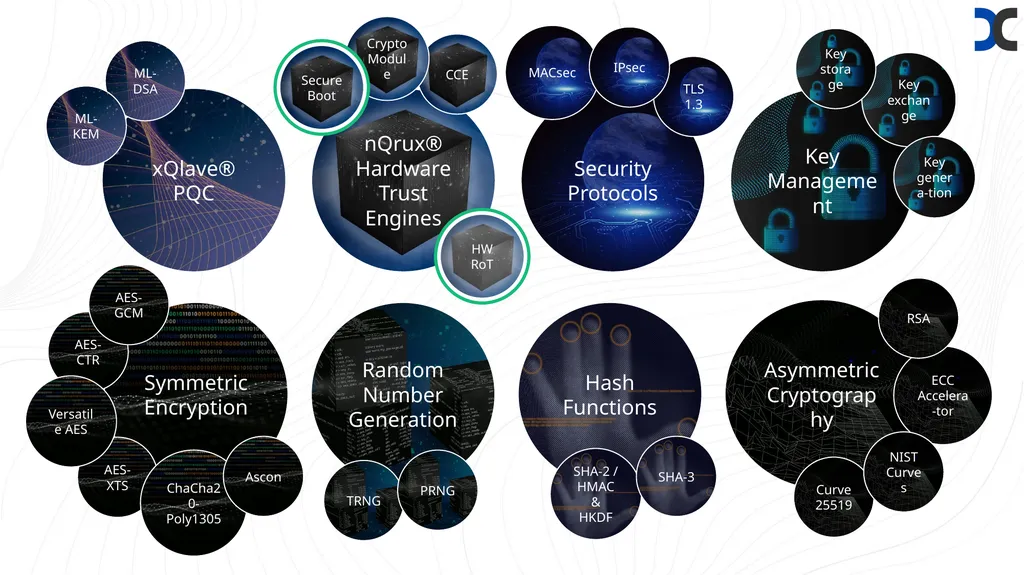
Secure and optimised cryptographic IP cores for SoCs and FPGAs
Hardware-based security solutions with proven cryptographic algorithms
Modern and comprehensive solution portfolio
Entire product line designed fully in-house
Committed roadmap to evolving cryptographic standards 1. Short Company Intro<br>
04
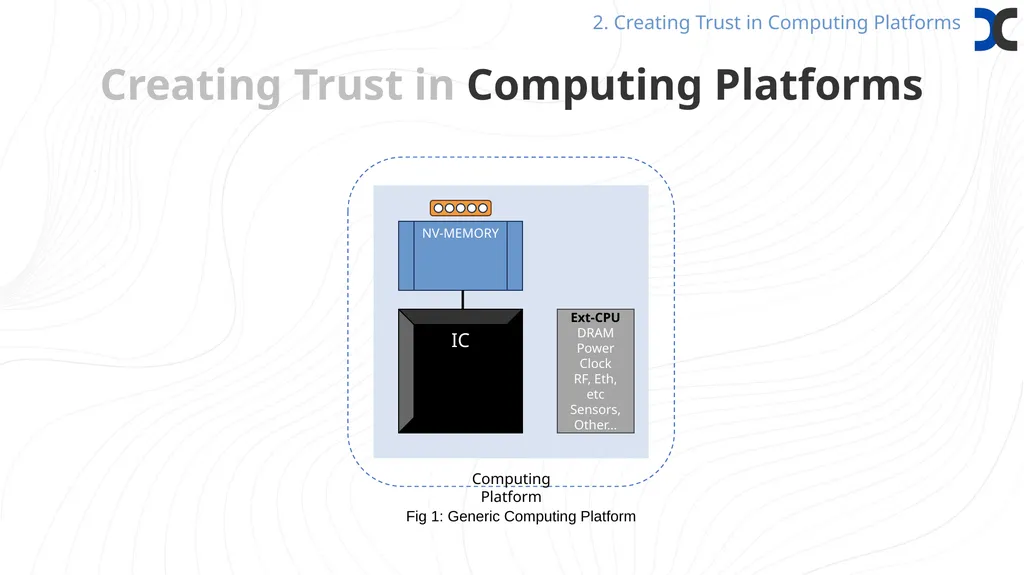
Creating Trust in Computing Platforms NV-MEMORY Ext-CPU
DRAM
Power
Clock
RF, Eth, etc
Sensors,
Other… Computing Platform IC Fig 1: Generic Computing Platform 2. Creating Trust in Computing Platforms<br>
05
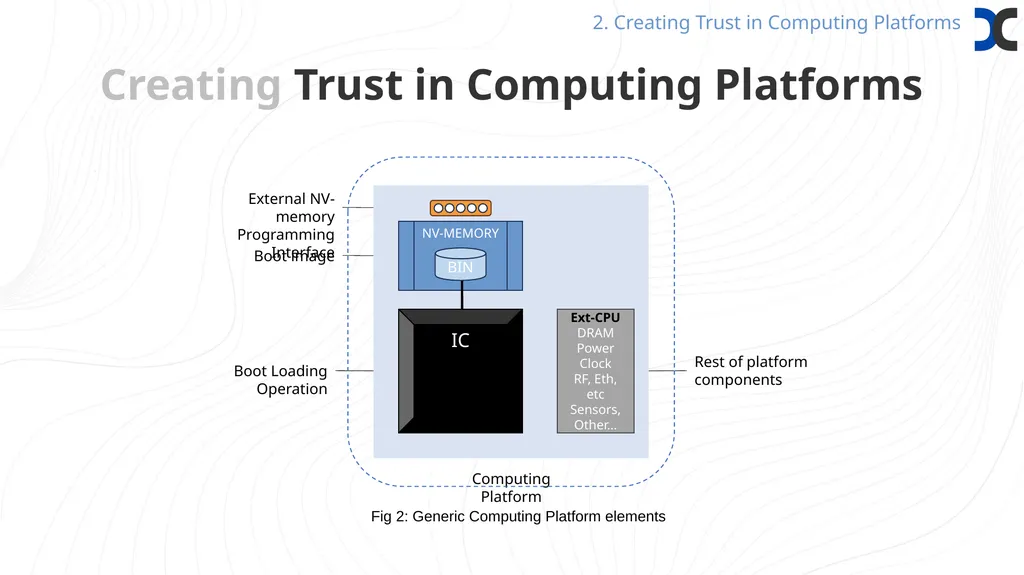
Creating Trust in Computing Platforms Rest of platform components External NV-memory Programming Interface Boot image Boot Loading Operation Computing Platform NV-MEMORY Ext-CPU
DRAM
Power
Clock
RF, Eth, etc
Sensors,
Other… IC BIN Fig 2: Generic Computing Platform elements 2. Creating Trust in Computing Platforms<br>
06
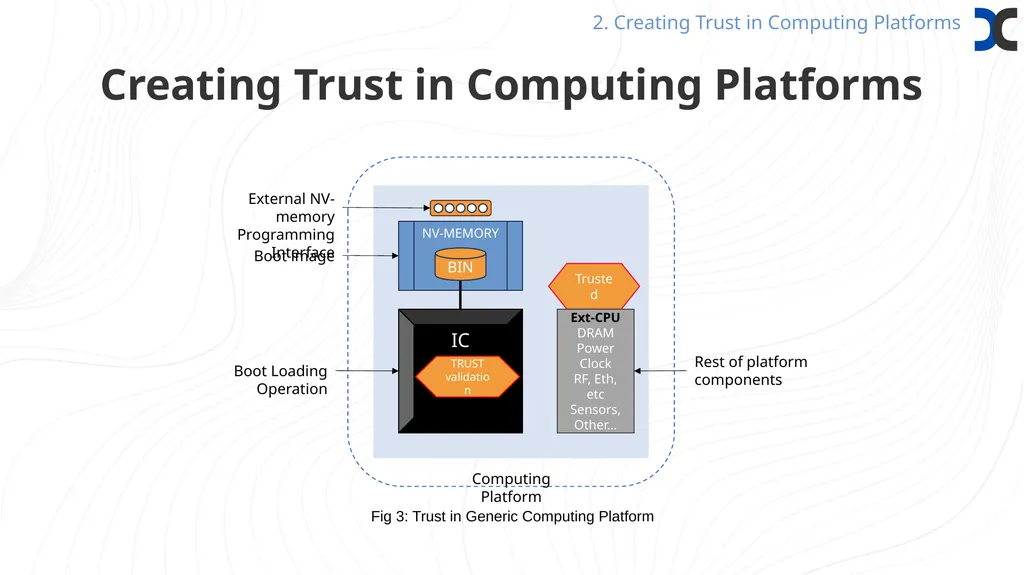
Computing Platform Creating Trust in Computing Platforms Rest of platform components External NV-memory Programming Interface Boot image Trusted NV-MEMORY Ext-CPU
DRAM
Power
Clock
RF, Eth, etc
Sensors,
Other… IC BIN TRUST
validation Boot Loading Operation Fig 3: Trust in Generic Computing Platform 2. Creating Trust in Computing Platforms<br>
07
Hardware Root-of-Trust Trust is as good as its foundation(s)
Agility to cope with changing requirements
Immutability with system level as basis of trust (trust anchors)
Hardware Root-of-Trust is the trust anchor of HW and SW platform 3. Hardware Root-of-Trust Overview<br>
08
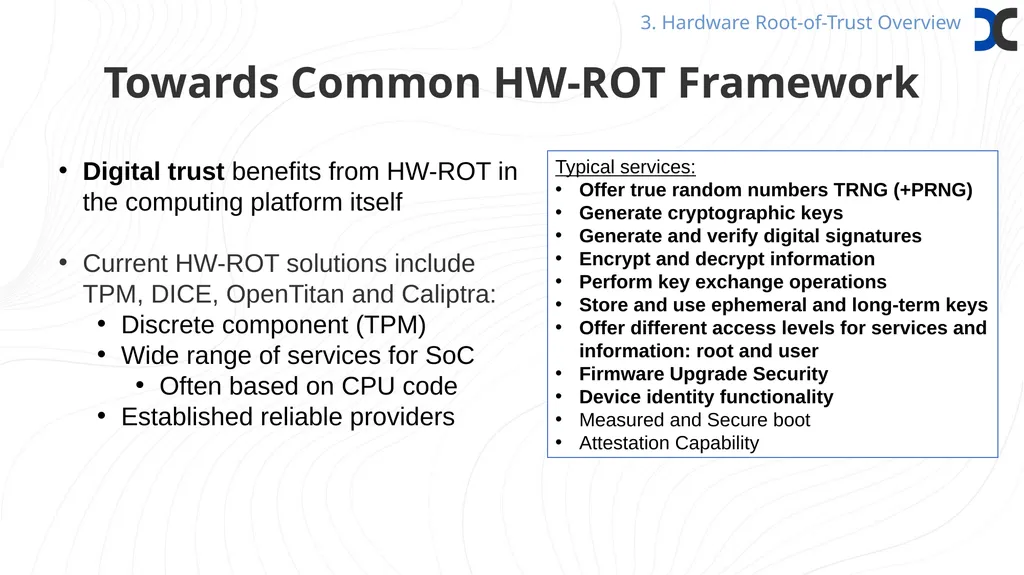
Towards Common HW-ROT Framework Digital trust benefits from HW-ROT in the computing platform itself
Current HW-ROT solutions include TPM, DICE, OpenTitan and Caliptra:
Discrete component (TPM)
Wide range of services for SoC
Often based on CPU code
Established reliable providers Typical services:
Offer true random numbers TRNG (+PRNG)
Generate cryptographic keys
Generate and verify digital signatures
Encrypt and decrypt information
Perform key exchange operations
Store and use ephemeral and long-term keys
Offer different access levels for services and information: root and user
Firmware Upgrade Security
Device identity functionality
Measured and Secure boot
Attestation Capability 3. Hardware Root-of-Trust Overview<br>
09
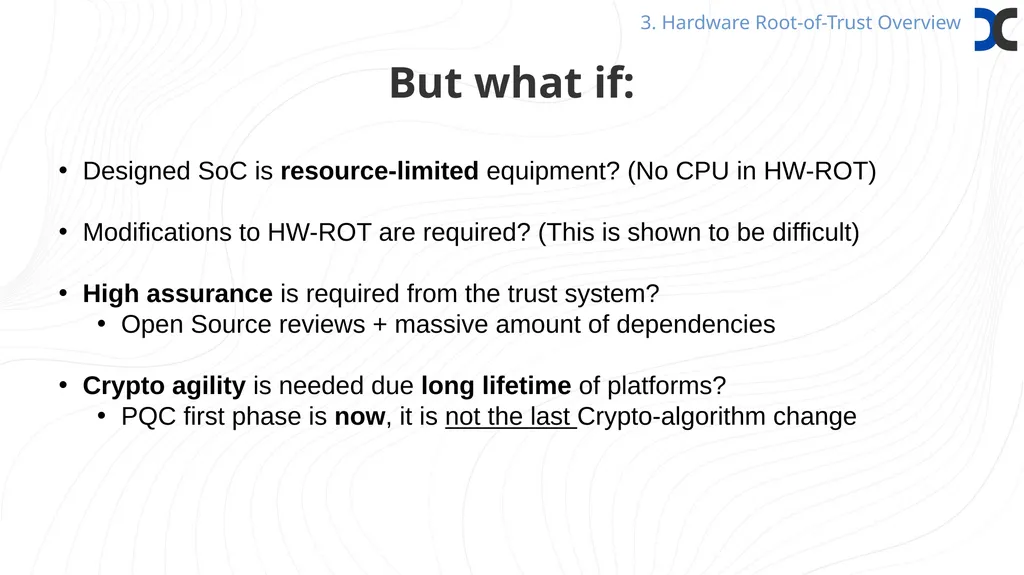
But what if: Designed SoC is resource-limited equipment? (No CPU in HW-ROT)
Modifications to HW-ROT are required? (This is shown to be difficult)
High assurance is required from the trust system?
Open Source reviews + massive amount of dependencies
Crypto agility is needed due long lifetime of platforms?
PQC first phase is now, it is not the last Crypto-algorithm change 3. Hardware Root-of-Trust Overview<br>
10
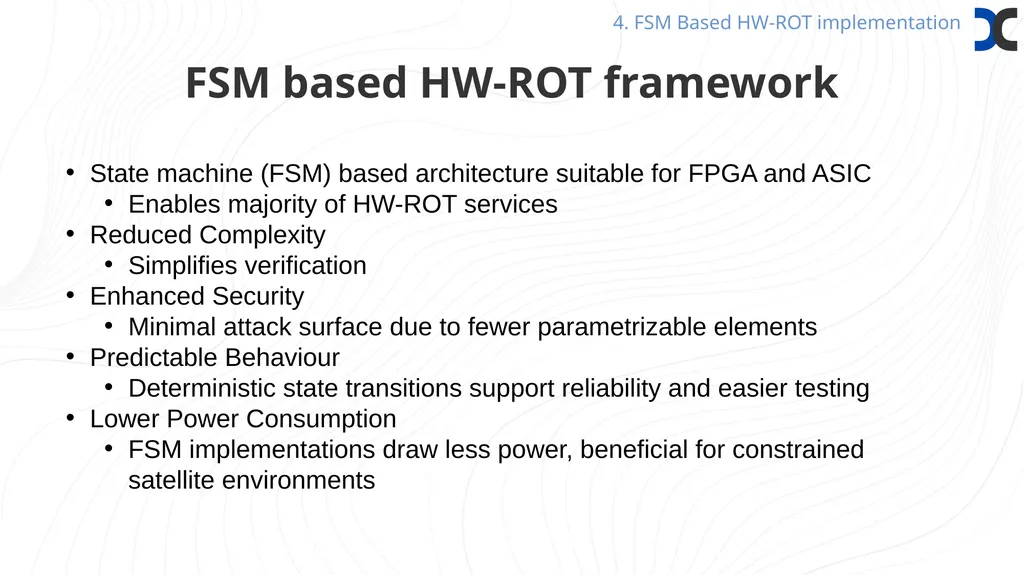
FSM based HW-ROT framework State machine (FSM) based architecture suitable for FPGA and ASIC
Enables majority of HW-ROT services
Reduced Complexity
Simplifies verification
Enhanced Security
Minimal attack surface due to fewer parametrizable elements
Predictable Behaviour
Deterministic state transitions support reliability and easier testing
Lower Power Consumption
FSM implementations draw less power, beneficial for constrained satellite environments 4. FSM Based HW-ROT implementation<br>
11
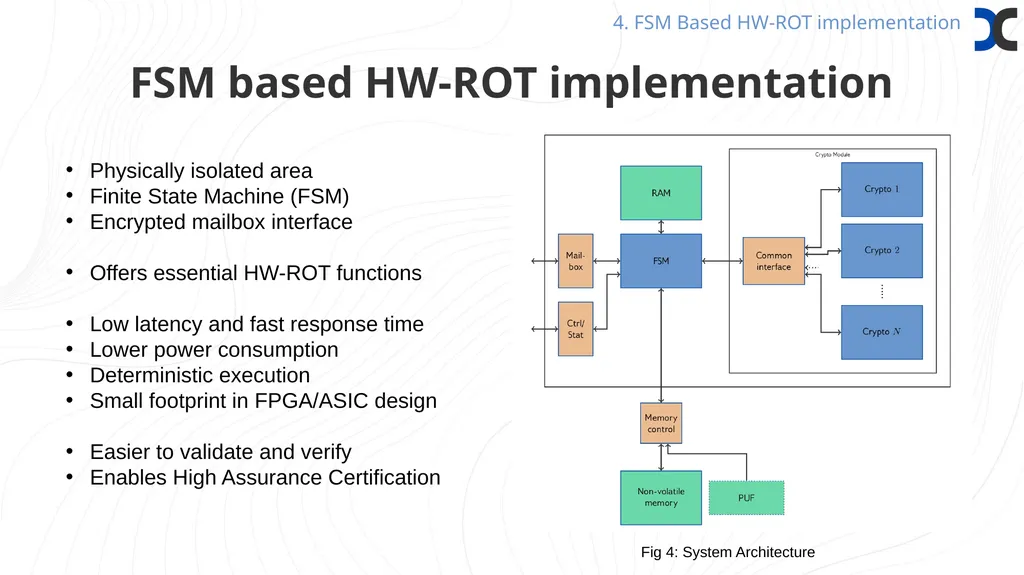
FSM based HW-ROT implementation Physically isolated area
Finite State Machine (FSM)
Encrypted mailbox interface
Offers essential HW-ROT functions
Low latency and fast response time
Lower power consumption
Deterministic execution
Small footprint in FPGA/ASIC design
Easier to validate and verify
Enables High Assurance Certification Fig 4: System Architecture 4. FSM Based HW-ROT implementation<br>
12
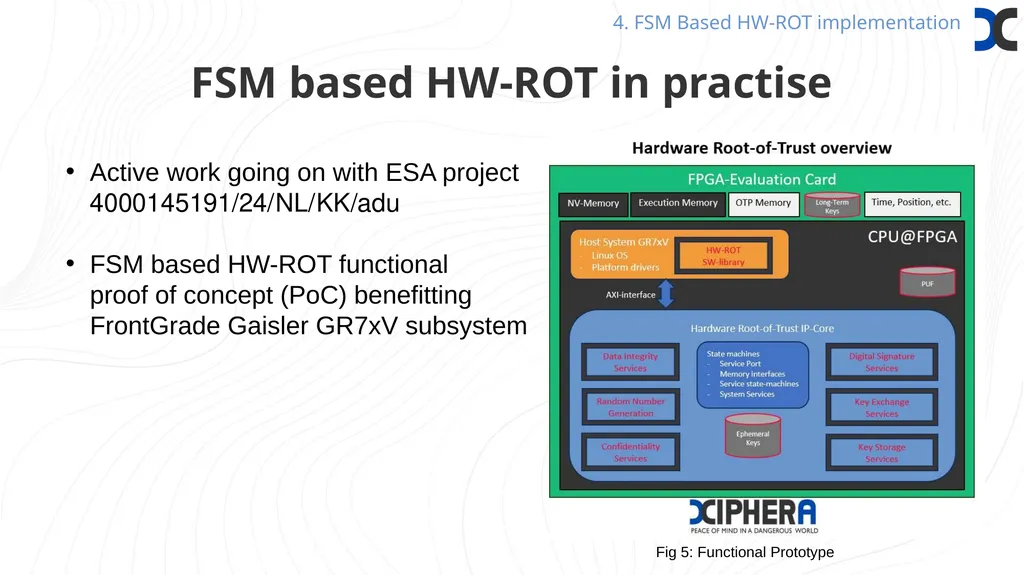
FSM based HW-ROT in practise Active work going on with ESA project 4000145191/24/NL/KK/adu
FSM based HW-ROT functional proof of concept (PoC) benefitting FrontGrade Gaisler GR7xV subsystem Fig 5: Functional Prototype 4. FSM Based HW-ROT implementation<br>
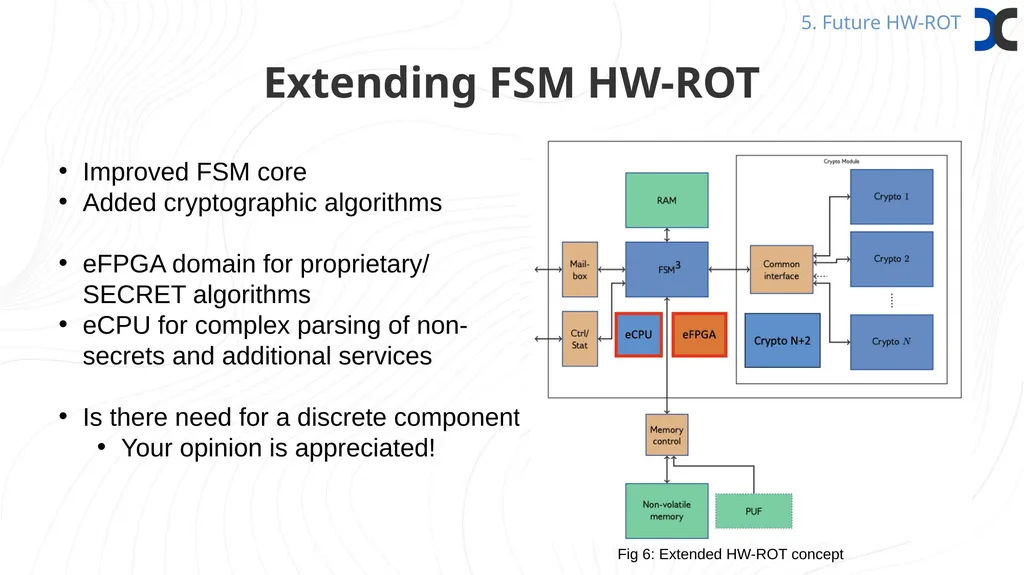
eFPGA domain for proprietary/ SECRET algorithms
eCPU for complex parsing of non-secrets and additional services
Is there need for a discrete component?
Your opinion is appreciated! Fig 6: Extended HW-ROT concept 5. Future HW-ROT<br>
14
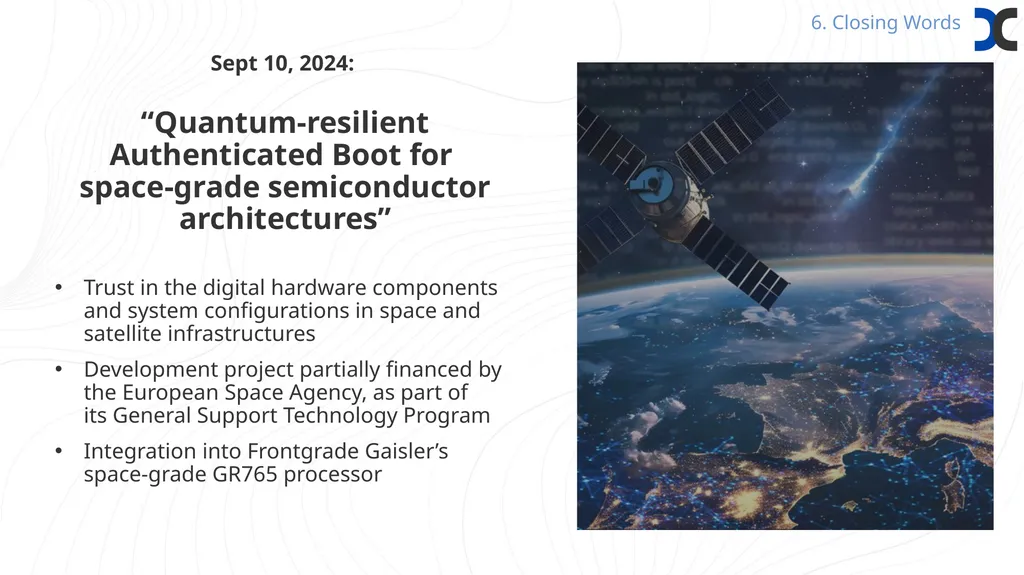
Sept 10, 2024: “Quantum-resilient Authenticated Boot for space-grade semiconductor architectures” Trust in the digital hardware components and system configurations in space and satellite infrastructures
Development project partially financed by the European Space Agency, as part of its General Support Technology Program
Integration into Frontgrade Gaisler’s space-grade GR765 processor 6. Closing Words<br>