
Common Law Contracts, Arbitration and Advocacy
BR
Published · 34 slides · 0 views

1 / 1



Description
Common Law Contracts, Arbitration and Advocacy Introduction to the course and to the Common Law of England and Wales Dr Velimir Zivkovic Common Law Contracts, Arbitration and Advocacy The Course Welcome! Overview Lectures Seminars
Related Topics
Share
Embed code
Download this presentation From Below
"Common Law Contracts, Arbitration and Advocacy" is the property of its rightful owner. Permission is granted to download and print the materials on this website for personal, non-commercial use only, and to display it on your personal computer provided you do not modify the materials and that you retain all copyright notices contained in the materials. By downloading content from our website, you accept the terms of this agreement.
Presentation Transcript
01
Common Law Contracts, Arbitration and Advocacy Introduction – to the course and to the Common Law of England and Wales Dr Velimir Zivkovic<br>
02
Common Law Contracts, Arbitration and Advocacy The Course – Welcome!<br>
03
Overview Lectures
Seminars
Reading Materials<br>
Seminars
Reading Materials<br>
04
Topics 1. Introduction to Common Law of England and Wales
2. General Principles of Contract Law
3. Formation of Contracts
4. Content and Interpretation of Contracts
5. Contractual Remedies<br>
2. General Principles of Contract Law
3. Formation of Contracts
4. Content and Interpretation of Contracts
5. Contractual Remedies<br>
05
Topics 6. General Principles of Arbitration and the English Arbitration Act
7. Arbitration Agreement and Contract Law
8. The Process of Arbitration
9. Arbitration Award and Enforcement<br>
7. Arbitration Agreement and Contract Law
8. The Process of Arbitration
9. Arbitration Award and Enforcement<br>
06
Topics 10.Different Styles of Writing and Advocating
11. Principles of Effective Legal Writing
12. Oral Advocacy
Revision Lecture<br>
11. Principles of Effective Legal Writing
12. Oral Advocacy
Revision Lecture<br>
07
Exam 2 hours
Problem question combining the material
Open-book<br>
Problem question combining the material
Open-book<br>
08
Common Law Contracts, Arbitration and Advocacy The (English) Legal System<br>
09
English Legal system Cownie and Bradney define legal system as a system constructed around the resolution of legal disputes:
'Legal systems are there to determine what will happen when people have disputes. Legal rules are also there so people can order their lives in such a way as to avoid such disputes' English Legal System in Context<br>
'Legal systems are there to determine what will happen when people have disputes. Legal rules are also there so people can order their lives in such a way as to avoid such disputes' English Legal System in Context<br>
10
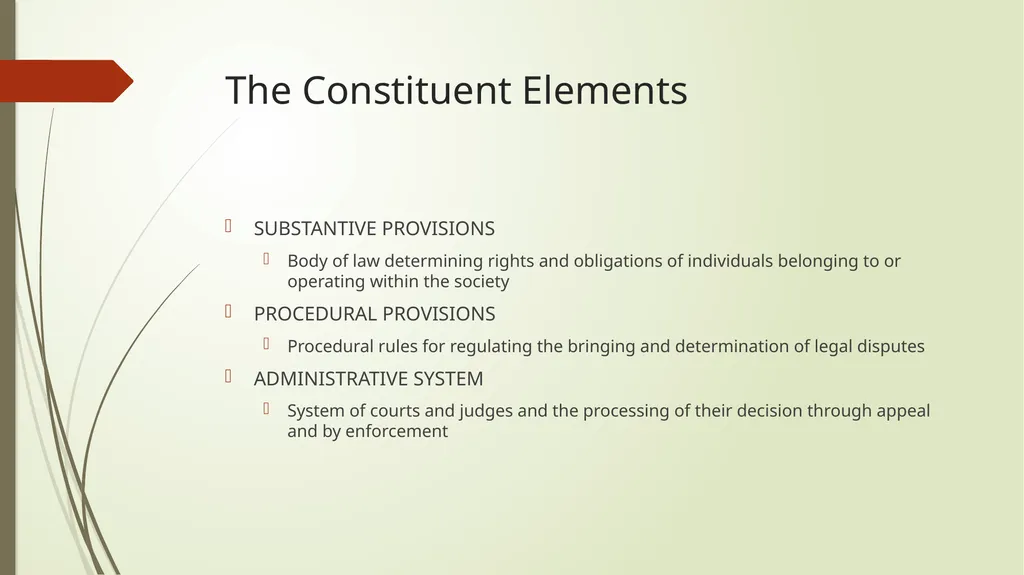
The Constituent Elements SUBSTANTIVE PROVISIONS
Body of law determining rights and obligations of individuals belonging to or operating within the society
PROCEDURAL PROVISIONS
Procedural rules for regulating the bringing and determination of legal disputes
ADMINISTRATIVE SYSTEM
System of courts and judges and the processing of their decision through appeal and by enforcement<br>
Body of law determining rights and obligations of individuals belonging to or operating within the society
PROCEDURAL PROVISIONS
Procedural rules for regulating the bringing and determination of legal disputes
ADMINISTRATIVE SYSTEM
System of courts and judges and the processing of their decision through appeal and by enforcement<br>
11
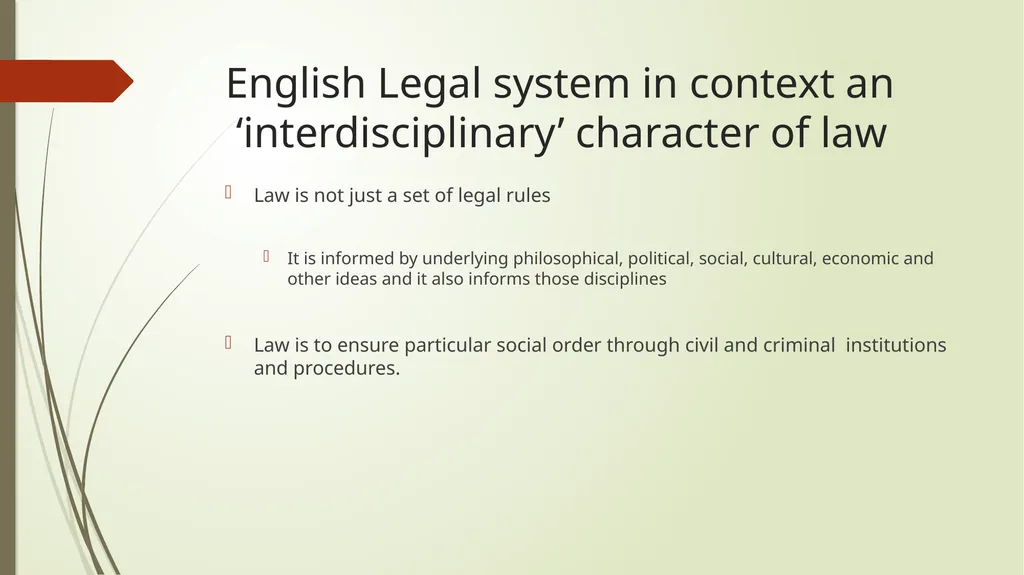
English Legal system in context an
‘interdisciplinary’ character of law Law is not just a set of legal rules
It is informed by underlying philosophical, political, social, cultural, economic and other ideas and it also informs those disciplines
Law is to ensure particular social order through civil and criminal institutions and procedures.<br>
It is informed by underlying philosophical, political, social, cultural, economic and other ideas and it also informs those disciplines
Law is to ensure particular social order through civil and criminal institutions and procedures.<br>
12
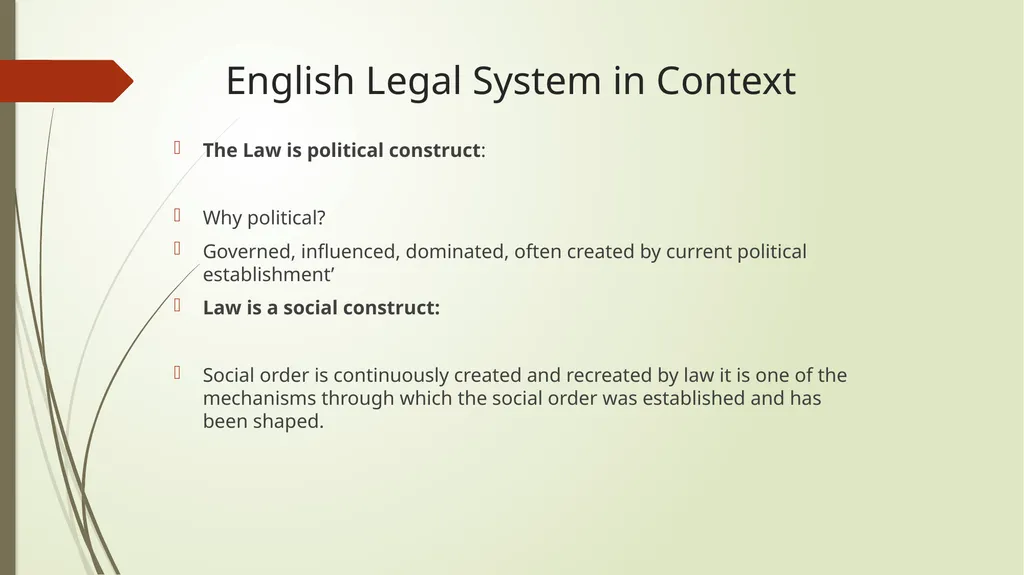
English Legal System in Context The Law is political construct:
Why political?
Governed, influenced, dominated, often created by current political establishment’
Law is a social construct:
Social order is continuously created and recreated by law it is one of the mechanisms through which the social order was established and has been shaped.<br>
Why political?
Governed, influenced, dominated, often created by current political establishment’
Law is a social construct:
Social order is continuously created and recreated by law it is one of the mechanisms through which the social order was established and has been shaped.<br>
13
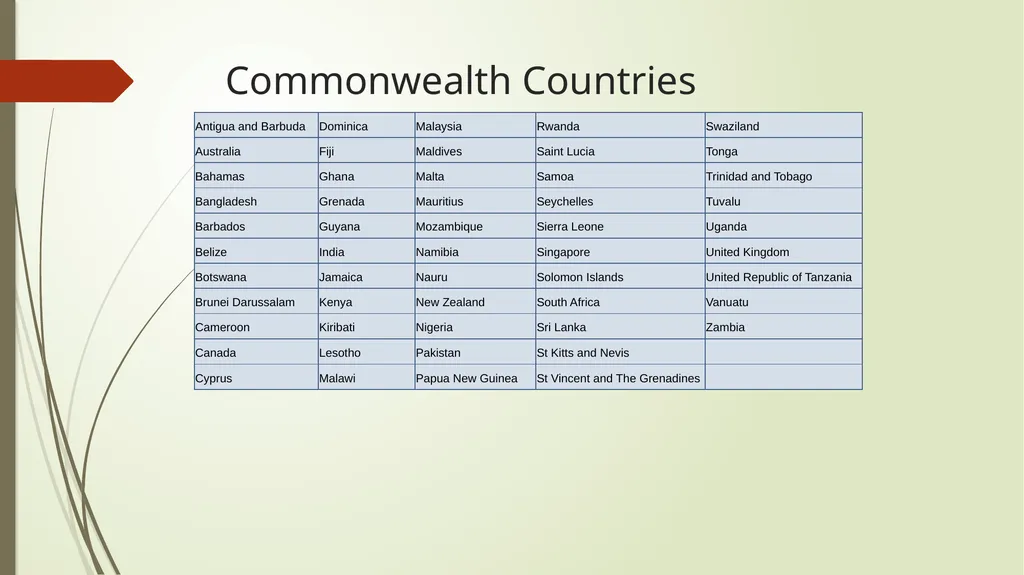
Commonwealth Countries<br>
14
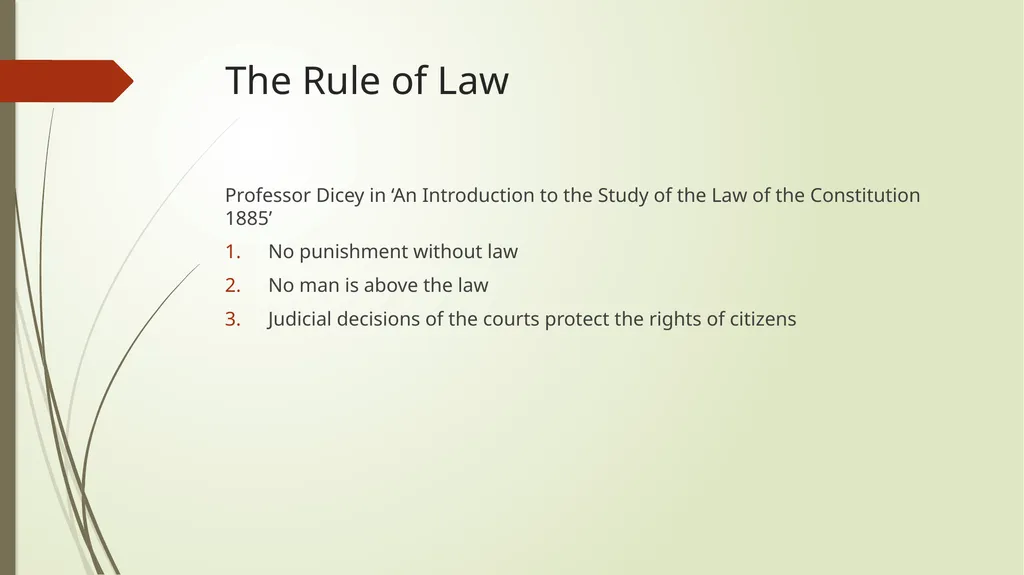
The Rule of Law Professor Dicey in ‘An Introduction to the Study of the Law of the Constitution 1885’
No punishment without law
No man is above the law
Judicial decisions of the courts protect the rights of citizens<br>
No punishment without law
No man is above the law
Judicial decisions of the courts protect the rights of citizens<br>
15
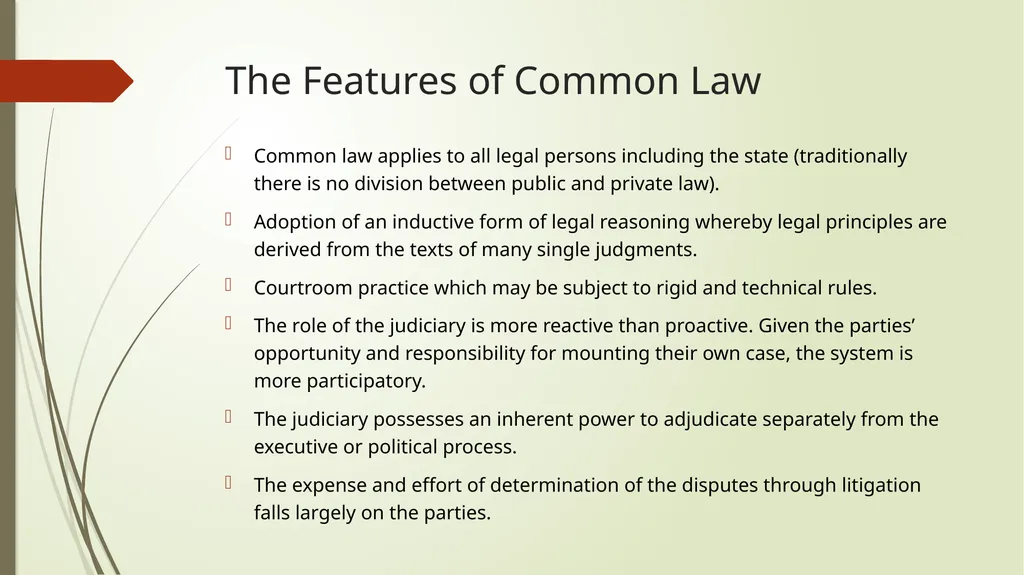
The Features of Common Law Common law applies to all legal persons including the state (traditionally there is no division between public and private law).
Adoption of an inductive form of legal reasoning whereby legal principles are derived from the texts of many single judgments.
Courtroom practice which may be subject to rigid and technical rules.
The role of the judiciary is more reactive than proactive. Given the parties’ opportunity and responsibility for mounting their own case, the system is more participatory.
The judiciary possesses an inherent power to adjudicate separately from the executive or political process.
The expense and effort of determination of the disputes through litigation falls largely on the parties.<br>
Adoption of an inductive form of legal reasoning whereby legal principles are derived from the texts of many single judgments.
Courtroom practice which may be subject to rigid and technical rules.
The role of the judiciary is more reactive than proactive. Given the parties’ opportunity and responsibility for mounting their own case, the system is more participatory.
The judiciary possesses an inherent power to adjudicate separately from the executive or political process.
The expense and effort of determination of the disputes through litigation falls largely on the parties.<br>
16
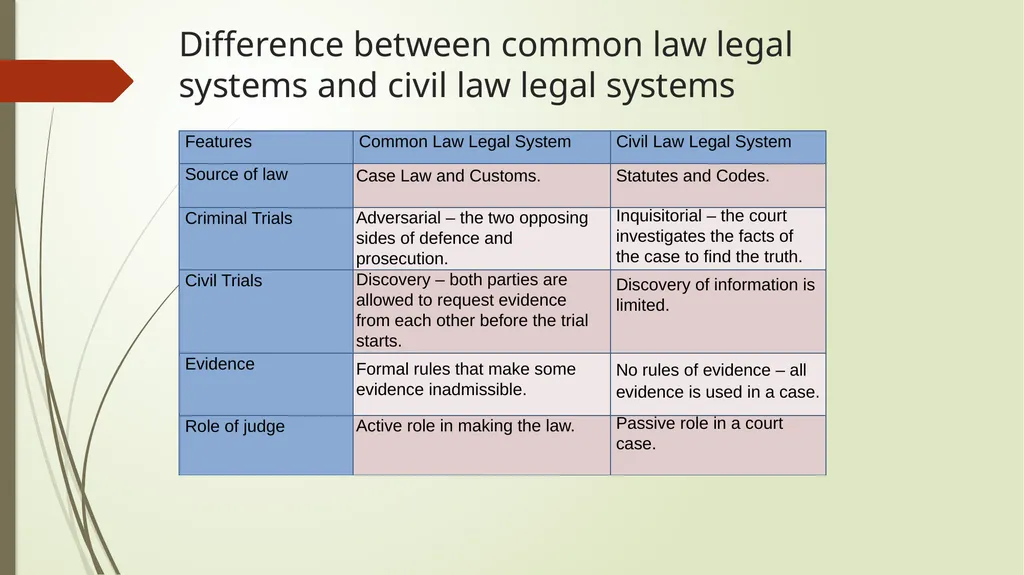
Difference between common law legal systems and civil law legal systems Case Law and Customs. Statutes and Codes. Adversarial – the two opposing sides of defence and prosecution. Inquisitorial – the court investigates the facts of the case to find the truth. Discovery – both parties are allowed to request evidence from each other before the trial starts. Discovery of information is limited. Formal rules that make some evidence inadmissible. No rules of evidence – all evidence is used in a case. Active role in making the law. Passive role in a court case.<br>
17
Common Law Contracts, Arbitration and Advocacy The Development of the Common Law<br>
18
FRANCIS BACON 1561-1625
LORD CHANCELLOR 1618-1621 “He that will not apply new remedies must expect new evils; for time is the great innovator”
Essay ‘Of Innovations’ written in 1625<br>
Essay ‘Of Innovations’ written in 1625<br>
19
Importance of History History shows that the development of an effective system for the administration of justice is a long and difficult process
What today might seem a straightforward dispute to resolve has not always been so
Consider the possibilities for resolving such a dispute in much earlier times<br>
What today might seem a straightforward dispute to resolve has not always been so
Consider the possibilities for resolving such a dispute in much earlier times<br>
20
The Dispute An ordinary commercial transaction between a trader and his customer for the sale of goods
Oldest form of contract
A dispute arises as to the quality of the goods being sold and the customer wants his money back
If the dispute is not resolved it will continue to fester and will affect others in the community who may take sides with one or other party
The disgruntled customer may threaten reprisals in order to get his money back
This is simple enough to resolve today by applying common law principles which have since been codified by Statute but how did these principles evolve?<br>
Oldest form of contract
A dispute arises as to the quality of the goods being sold and the customer wants his money back
If the dispute is not resolved it will continue to fester and will affect others in the community who may take sides with one or other party
The disgruntled customer may threaten reprisals in order to get his money back
This is simple enough to resolve today by applying common law principles which have since been codified by Statute but how did these principles evolve?<br>
21
The Development of the Common Law of England Consider 3 snapshots in time:
9th century
890: the 19th year in the reign of Alfred the Great, King of Wessex
10th century
920: the 21st year in the reign of Edward the Elder, King of England
11th century
1070: the 5th year in the reign of William 1 (the Conqueror), King of England<br>
9th century
890: the 19th year in the reign of Alfred the Great, King of Wessex
10th century
920: the 21st year in the reign of Edward the Elder, King of England
11th century
1070: the 5th year in the reign of William 1 (the Conqueror), King of England<br>
22
Birth of the Common Law Under William I no overriding common law
Under his successor, Henry I, (crowned 1100) there was a period of stability and consolidation of the central power of the crown
During this period Henry developed the feudal practice of hearing disputes in his “court” both in London and on his travels throughout his kingdom
Access to his court was controlled by a fee and depended not just on money but also on status and on the gravity of the matter in dispute
This practice was continued by Henry II (1154 following the unsettled intervening reign of Stephen)<br>
Under his successor, Henry I, (crowned 1100) there was a period of stability and consolidation of the central power of the crown
During this period Henry developed the feudal practice of hearing disputes in his “court” both in London and on his travels throughout his kingdom
Access to his court was controlled by a fee and depended not just on money but also on status and on the gravity of the matter in dispute
This practice was continued by Henry II (1154 following the unsettled intervening reign of Stephen)<br>
23
The New King’s Justice This was perceived as having 3 advantages:
The same body of law (customs) would be applied uniformly throughout the realm
The decision was final as the king’s authority overrode all other courts
The decision carried the desired enforceability as the king’s authority was supreme
The problem was one of access:
The level of fee required
The restrictions placed on access by virtue of the choice of matters entertained<br>
The same body of law (customs) would be applied uniformly throughout the realm
The decision was final as the king’s authority overrode all other courts
The decision carried the desired enforceability as the king’s authority was supreme
The problem was one of access:
The level of fee required
The restrictions placed on access by virtue of the choice of matters entertained<br>
24
Henry II’s innovations Henry was concerned to increase his personal authority throughout his realm
Breach or threatened breach of the king’s peace became a matter of concern to the king and such an allegation would render the matter sufficiently important for his attention
Henry created itinerant royal justices from among members of his court to travel the realm and dispense his justice in his name
Now the scene was set for the common law to develop and become the preferred method of resolution of disputes between his subjects<br>
Breach or threatened breach of the king’s peace became a matter of concern to the king and such an allegation would render the matter sufficiently important for his attention
Henry created itinerant royal justices from among members of his court to travel the realm and dispense his justice in his name
Now the scene was set for the common law to develop and become the preferred method of resolution of disputes between his subjects<br>
25
Further Development From this early beginning in the 12th century the Common Law developed from strength to strength
Magna Carta (1215) was the first of a series of statutes that enacted that no subject would be deprived of life, liberty or property except by due process of law
Due process of law came to be interpreted as meaning the Common Law of England<br>
Magna Carta (1215) was the first of a series of statutes that enacted that no subject would be deprived of life, liberty or property except by due process of law
Due process of law came to be interpreted as meaning the Common Law of England<br>
26
Then What? In all fairy tales, the ending is that they lived happily ever after
In this story that is not the ending
What happened so that the Common Law began to be seen as having serious defects and as not being fit for the purpose of providing a just solution to all disputes?<br>
In this story that is not the ending
What happened so that the Common Law began to be seen as having serious defects and as not being fit for the purpose of providing a just solution to all disputes?<br>
27
Pleading The Common Law had been helped to develop by the king as part of his policy of increasing his control over all parts of his kingdom
This development had been assisted by those learned in the law who had showed great ingenuity in getting their clients’ disputes heard before the king’s justice<br>
This development had been assisted by those learned in the law who had showed great ingenuity in getting their clients’ disputes heard before the king’s justice<br>
28
Precedent Precedent had played an essential role in the development of the Common Law
It was what brought uniformity to the body of law throughout the kingdom
Applied too rigidly it could be used to stifle the ability of the Common Law to respond to changing conditions thus resulting in a decision which failed to provide a just resolution of the dispute<br>
It was what brought uniformity to the body of law throughout the kingdom
Applied too rigidly it could be used to stifle the ability of the Common Law to respond to changing conditions thus resulting in a decision which failed to provide a just resolution of the dispute<br>
29
The Basics of Precedent A traditional picture of common law presents the source of law as being found in the texts of individual judgments. It was thus always ‘unwritten’ yet ‘written’, in contrast with the written law of statutes or codes.
There was no organised system of court reporting until the late nineteenth century and prior to that all reports were private initiatives (by barristers for a fee).Law Reports were not the common law, but what the common law can be argued to be.
The law making power of the judge is subordinate to that of parliament: judges try to limit their law making.
Judges are law makers: the critical issue is the extent to which this practice can be kept within legitimate boundaries.<br>
There was no organised system of court reporting until the late nineteenth century and prior to that all reports were private initiatives (by barristers for a fee).Law Reports were not the common law, but what the common law can be argued to be.
The law making power of the judge is subordinate to that of parliament: judges try to limit their law making.
Judges are law makers: the critical issue is the extent to which this practice can be kept within legitimate boundaries.<br>
30
Ratio and Obiter When giving a judgement in a case, the judge will state the ratio decidendi for the decision and often give an obiter dicta statement. This is in the interest of establishing a precedent and allowing future cases to be able to rely on the precedent set in the current case and interpret it with ease.
Firstly, a ratio decidendi of a judgement is the 'reason for the decision' made in a case. It is defined by Sir Rupert Cross as "Any rule expressly or impliedly treated by the judge as a necessary step in reaching his conclusion."
The ratio decidendi of a judgement is often looked at when deciding if a party can rely on the judgement for precedent in future cases. Therefore it is an important part of a judgement in the interests of this and is the potentially binding part of a judgement.<br>
Firstly, a ratio decidendi of a judgement is the 'reason for the decision' made in a case. It is defined by Sir Rupert Cross as "Any rule expressly or impliedly treated by the judge as a necessary step in reaching his conclusion."
The ratio decidendi of a judgement is often looked at when deciding if a party can rely on the judgement for precedent in future cases. Therefore it is an important part of a judgement in the interests of this and is the potentially binding part of a judgement.<br>
31
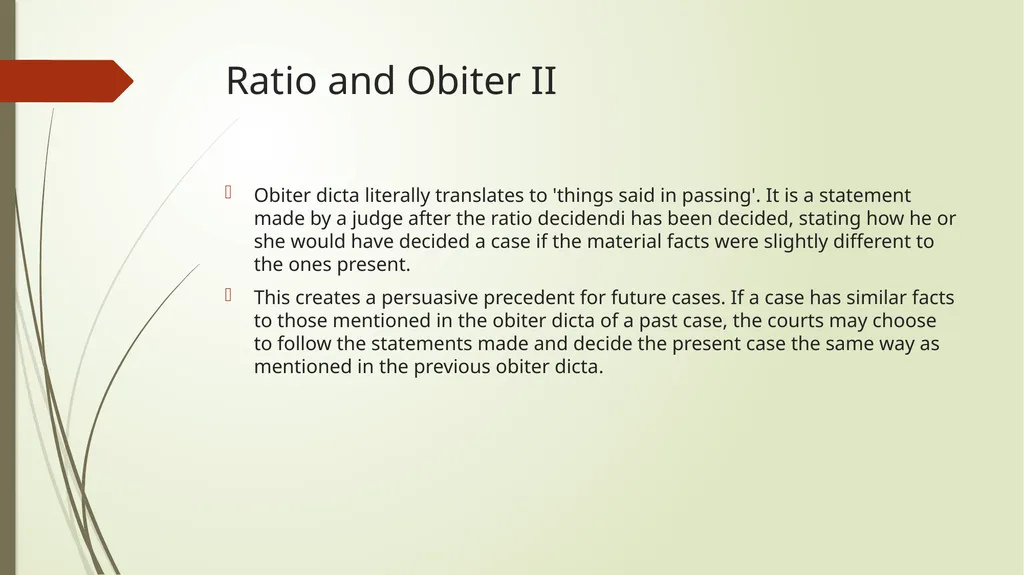
Ratio and Obiter II Obiter dicta literally translates to 'things said in passing'. It is a statement made by a judge after the ratio decidendi has been decided, stating how he or she would have decided a case if the material facts were slightly different to the ones present.
This creates a persuasive precedent for future cases. If a case has similar facts to those mentioned in the obiter dicta of a past case, the courts may choose to follow the statements made and decide the present case the same way as mentioned in the previous obiter dicta.<br>
This creates a persuasive precedent for future cases. If a case has similar facts to those mentioned in the obiter dicta of a past case, the courts may choose to follow the statements made and decide the present case the same way as mentioned in the previous obiter dicta.<br>
32
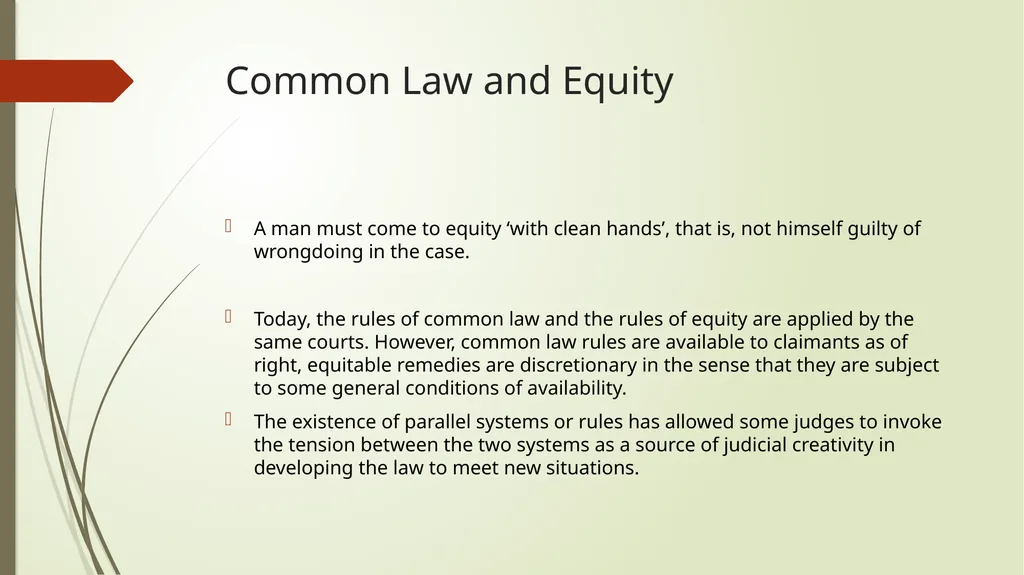
Common Law and Equity A man must come to equity ‘with clean hands’, that is, not himself guilty of wrongdoing in the case.
Today, the rules of common law and the rules of equity are applied by the same courts. However, common law rules are available to claimants as of right, equitable remedies are discretionary in the sense that they are subject to some general conditions of availability.
The existence of parallel systems or rules has allowed some judges to invoke the tension between the two systems as a source of judicial creativity in developing the law to meet new situations.<br>
Today, the rules of common law and the rules of equity are applied by the same courts. However, common law rules are available to claimants as of right, equitable remedies are discretionary in the sense that they are subject to some general conditions of availability.
The existence of parallel systems or rules has allowed some judges to invoke the tension between the two systems as a source of judicial creativity in developing the law to meet new situations.<br>
33
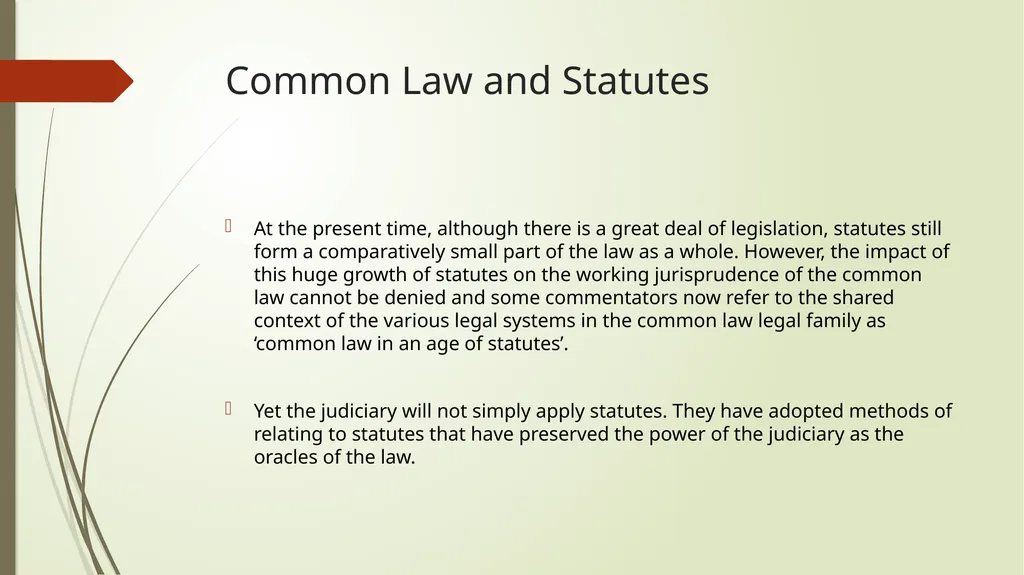
Common Law and Statutes At the present time, although there is a great deal of legislation, statutes still form a comparatively small part of the law as a whole. However, the impact of this huge growth of statutes on the working jurisprudence of the common law cannot be denied and some commentators now refer to the shared context of the various legal systems in the common law legal family as ‘common law in an age of statutes’.
Yet the judiciary will not simply apply statutes. They have adopted methods of relating to statutes that have preserved the power of the judiciary as the oracles of the law.<br>
Yet the judiciary will not simply apply statutes. They have adopted methods of relating to statutes that have preserved the power of the judiciary as the oracles of the law.<br>
34
All for today!<br>