
Common Respiratory Tract Infections: Evaluation
MY
Published · 44 slides · 0 views
1 / 1
Description
Common Respiratory Tract Infections: Evaluation and Therapy Antibiotic Stewardship Curriculum Developed by: Vera P. Luther, M.D. Christopher A. Ohl, M.D. Wake Forest School of Medicine With Support from the Centers for Disease Control and
Related Topics
Share
Embed code
Download this presentation From Below
"Common Respiratory Tract Infections: Evaluation" is the property of its rightful owner. Permission is granted to download and print the materials on this website for personal, non-commercial use only, and to display it on your personal computer provided you do not modify the materials and that you retain all copyright notices contained in the materials. By downloading content from our website, you accept the terms of this agreement.
Presentation Transcript
01
Common Respiratory Tract Infections: Evaluation and Therapy Antibiotic Stewardship Curriculum Developed by:
Vera P. Luther, M.D.
Christopher A. Ohl, M.D.
Wake Forest School of Medicine
With Support from the Centers for Disease Control and Prevention<br>
Vera P. Luther, M.D.
Christopher A. Ohl, M.D.
Wake Forest School of Medicine
With Support from the Centers for Disease Control and Prevention<br>
02
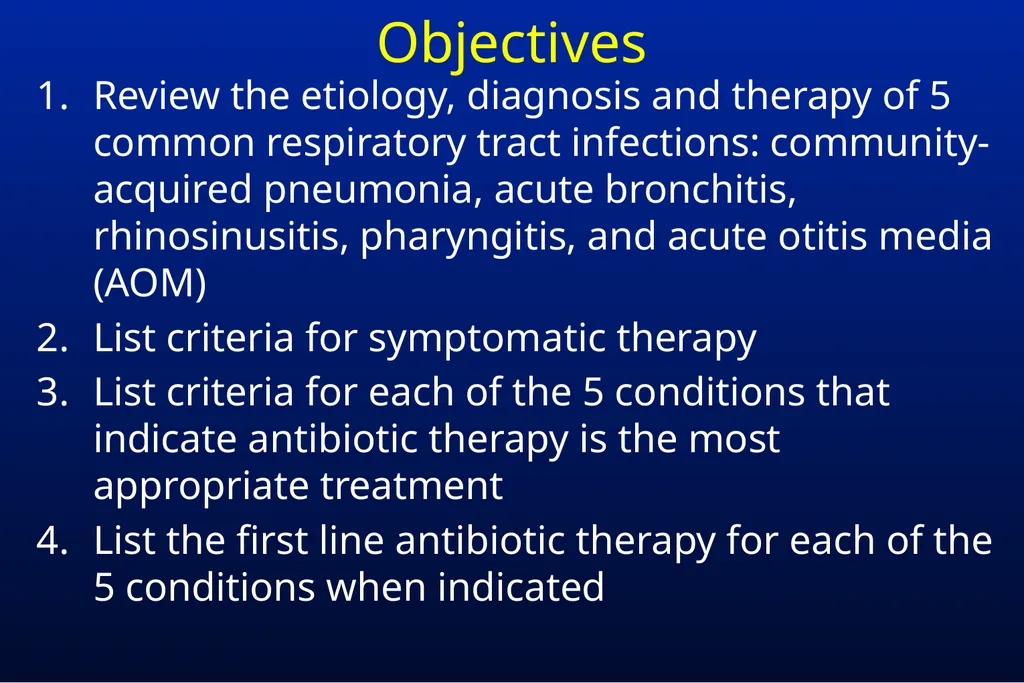
Objectives Review the etiology, diagnosis and therapy of 5 common respiratory tract infections: community-acquired pneumonia, acute bronchitis, rhinosinusitis, pharyngitis, and acute otitis media (AOM)
List criteria for symptomatic therapy
List criteria for each of the 5 conditions that indicate antibiotic therapy is the most appropriate treatment
List the first line antibiotic therapy for each of the 5 conditions when indicated<br>
List criteria for symptomatic therapy
List criteria for each of the 5 conditions that indicate antibiotic therapy is the most appropriate treatment
List the first line antibiotic therapy for each of the 5 conditions when indicated<br>
03
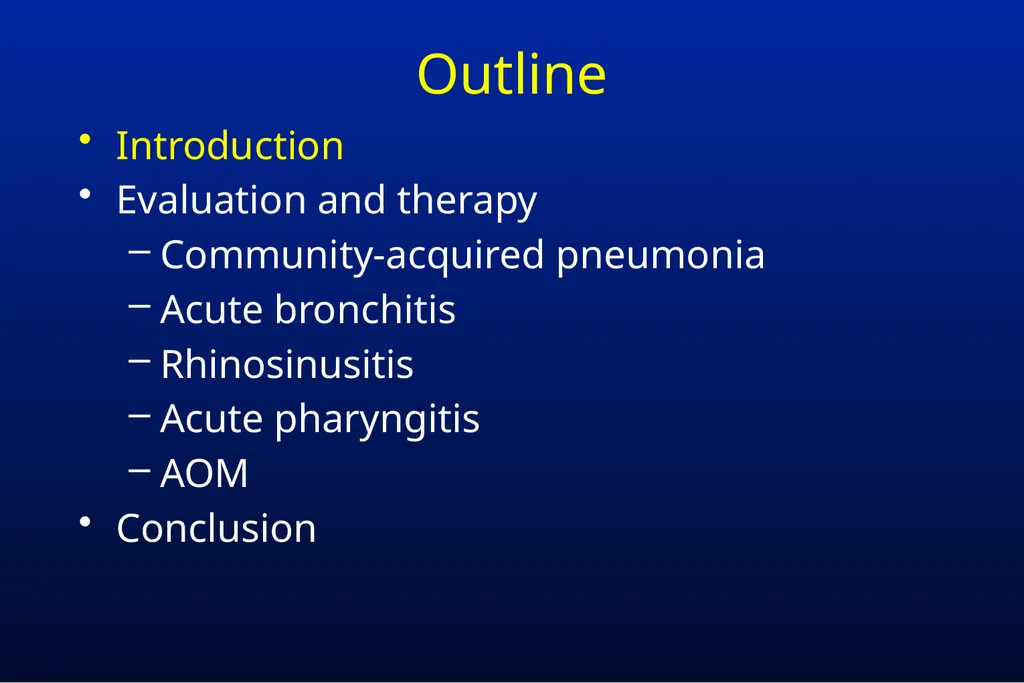
Outline Introduction
Evaluation and therapy
Community-acquired pneumonia
Acute bronchitis
Rhinosinusitis
Acute pharyngitis
AOM
Conclusion<br>
Evaluation and therapy
Community-acquired pneumonia
Acute bronchitis
Rhinosinusitis
Acute pharyngitis
AOM
Conclusion<br>
04
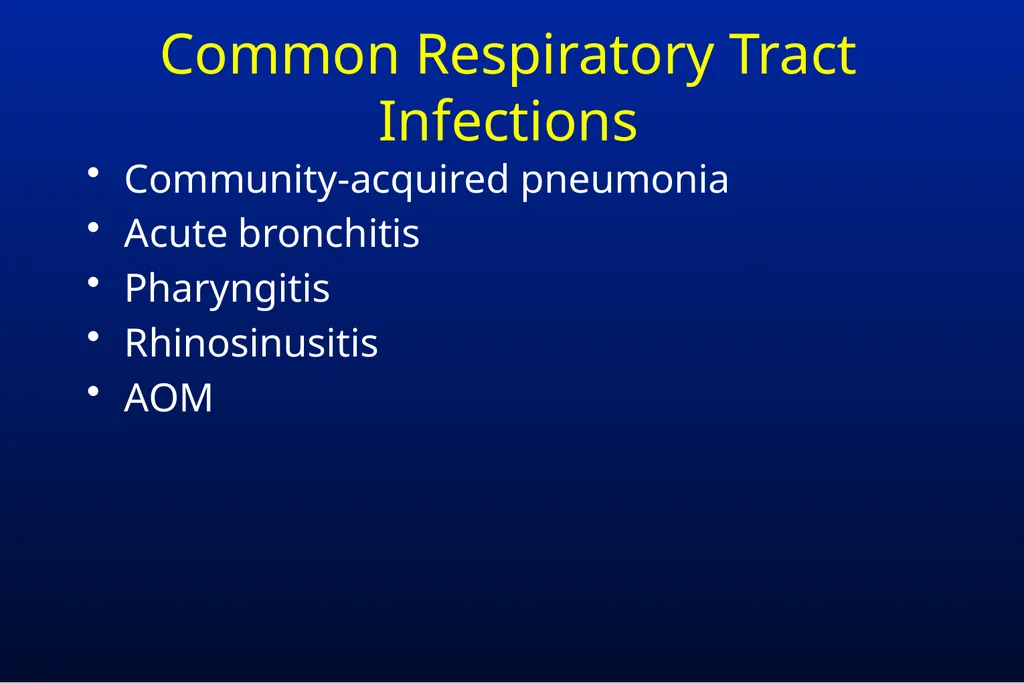
Common Respiratory Tract Infections Community-acquired pneumonia
Acute bronchitis
Pharyngitis
Rhinosinusitis
AOM<br>
Acute bronchitis
Pharyngitis
Rhinosinusitis
AOM<br>
05
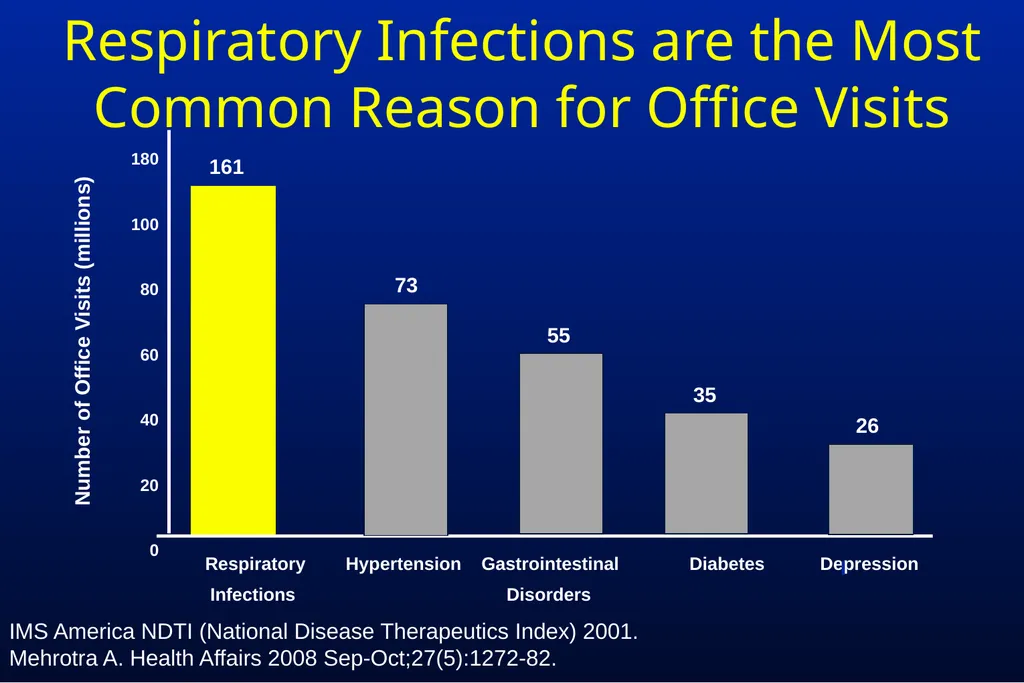
Respiratory Infections are the Most Common Reason for Office Visits IMS America NDTI (National Disease Therapeutics Index) 2001.
Mehrotra A. Health Affairs 2008 Sep-Oct;27(5):1272-82.<br>
Mehrotra A. Health Affairs 2008 Sep-Oct;27(5):1272-82.<br>
06
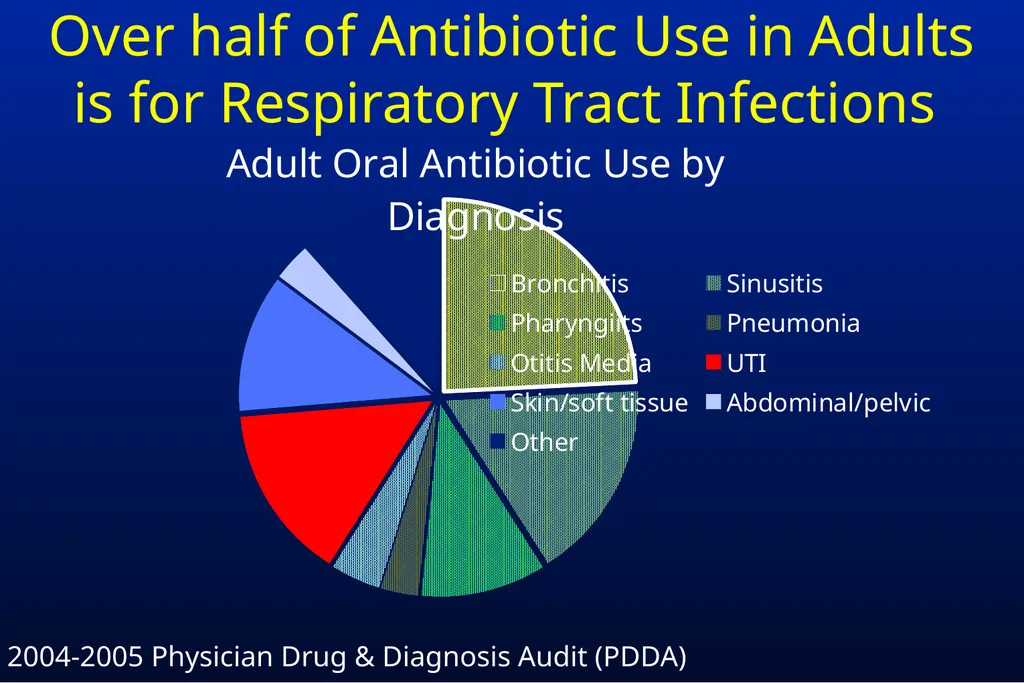
Over half of Antibiotic Use in Adults is for Respiratory Tract Infections 2004-2005 Physician Drug & Diagnosis Audit (PDDA)<br>
07
Burden of Acute Respiratory Tract Infections Significant time away from school and work
Significant healthcare expenditures for clinic visits, hospitalization and medications
Mortality rare except for community-acquired pneumonia in persons with comorbidities<br>
Significant healthcare expenditures for clinic visits, hospitalization and medications
Mortality rare except for community-acquired pneumonia in persons with comorbidities<br>
08
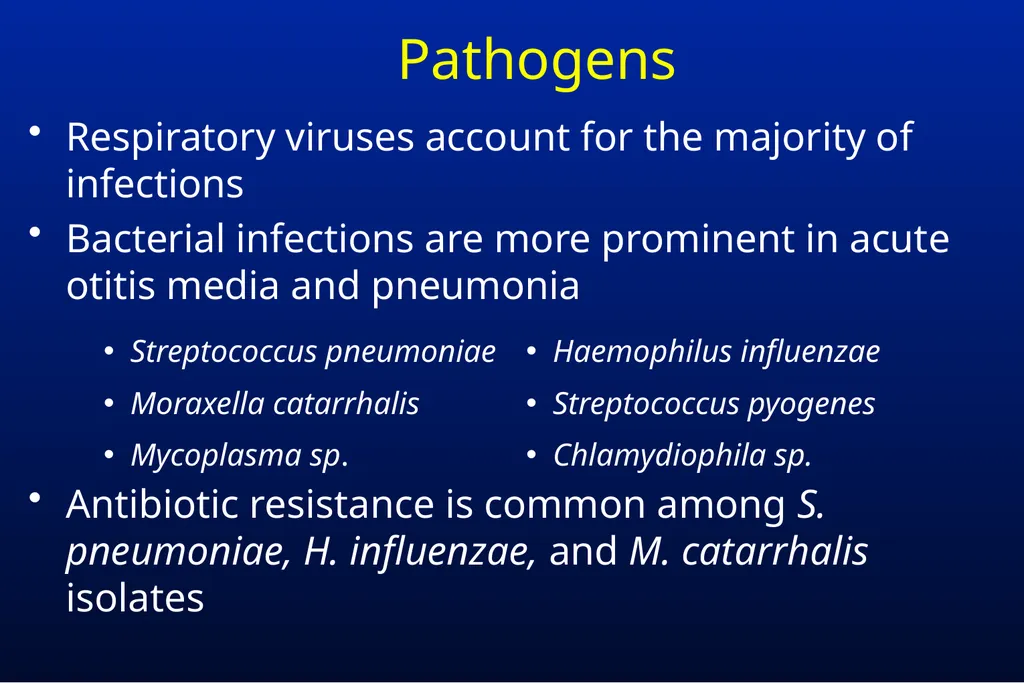
Pathogens Respiratory viruses account for the majority of infections
Bacterial infections are more prominent in acute otitis media and pneumonia
Antibiotic resistance is common among S. pneumoniae, H. influenzae, and M. catarrhalis isolates<br>
Bacterial infections are more prominent in acute otitis media and pneumonia
Antibiotic resistance is common among S. pneumoniae, H. influenzae, and M. catarrhalis isolates<br>
09
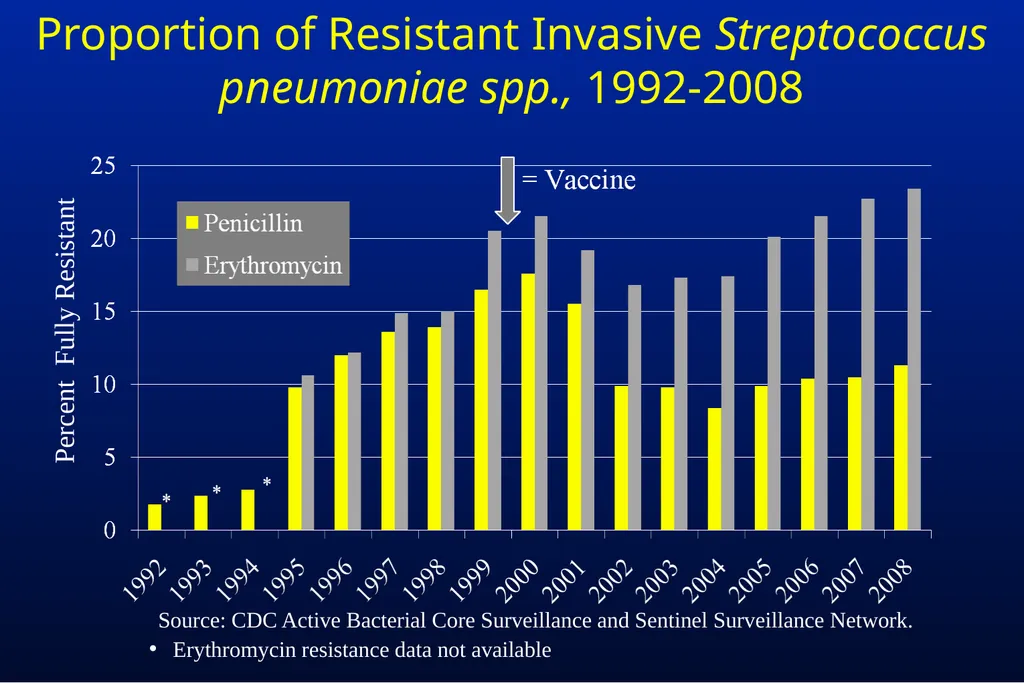
Proportion of Resistant Invasive Streptococcus pneumoniae spp., 1992-2008 Percent Fully Resistant Source: CDC Active Bacterial Core Surveillance and Sentinel Surveillance Network. Erythromycin resistance data not available<br>
10
Outline Introduction
Evaluation and therapy
Community-acquired pneumonia
Acute bronchitis
Rhinosinusitis
Acute pharyngitis
Acute otitis media
Conclusion<br>
Evaluation and therapy
Community-acquired pneumonia
Acute bronchitis
Rhinosinusitis
Acute pharyngitis
Acute otitis media
Conclusion<br>
11
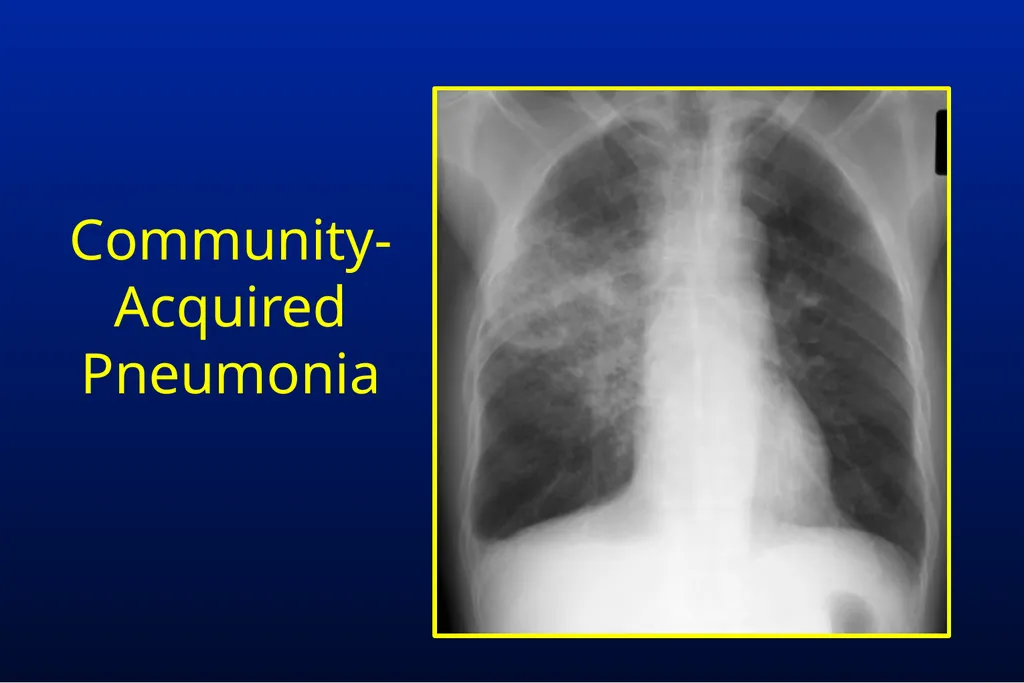
Community- Acquired
Pneumonia<br>
Pneumonia<br>
12
Community-Acquired Pneumonia
Overview 3-4 million cases/year
10 million patient visits/year
Approximately 80% are mild to moderate in severity and treated as outpatients
500,000 hospitalizations and 45,000 deaths/year
(8th leading cause of death)
Mortality
1% in outpatients
5% in inpatients
25-50% in patients admitted to ICU File TM, Marrie TJ Postgrad Med 2010;122(2):130.<br>
10 million patient visits/year
Approximately 80% are mild to moderate in severity and treated as outpatients
500,000 hospitalizations and 45,000 deaths/year
(8th leading cause of death)
Mortality
1% in outpatients
5% in inpatients
25-50% in patients admitted to ICU File TM, Marrie TJ Postgrad Med 2010;122(2):130.<br>
13
Community-Acquired Pneumonia
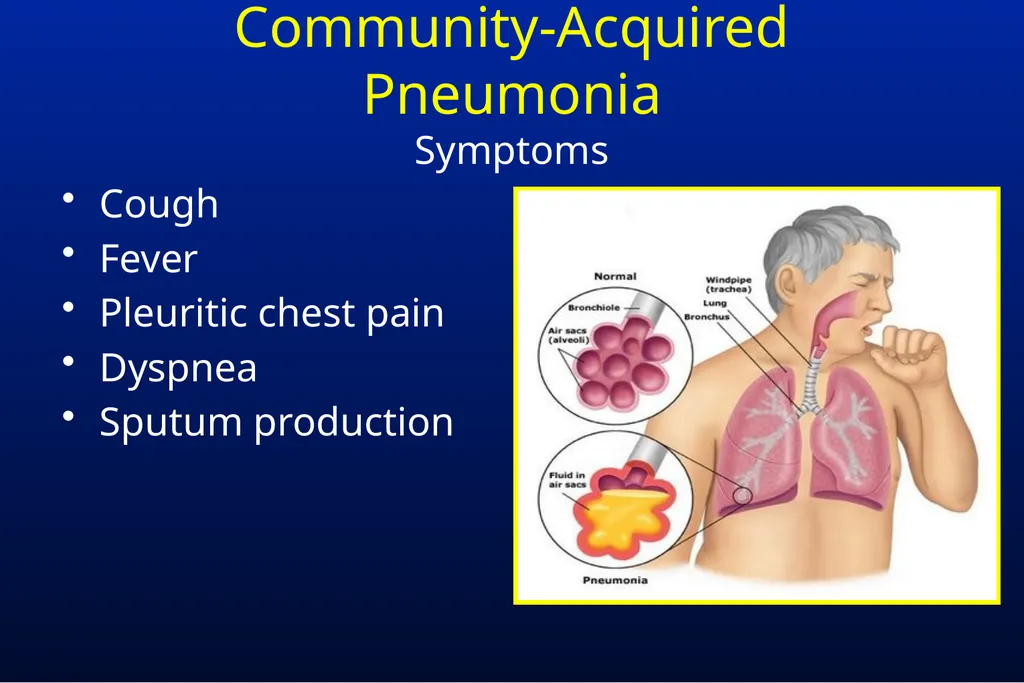
Symptoms Cough
Fever
Pleuritic chest pain
Dyspnea
Sputum production<br>
Fever
Pleuritic chest pain
Dyspnea
Sputum production<br>
14
Community-Acquired Pneumonia
Diagnosis Common physical examination findings
Fever
Respiratory rate > 24 breaths/minute
Heart rate > 100 beats/minute
Crackles/râles usually present on auscultation
Evidence of consolidation on exam
Peripheral white blood cell count (WBC) usually elevated
Chest x-ray (CXR) should be used to confirm diagnosis<br>
Fever
Respiratory rate > 24 breaths/minute
Heart rate > 100 beats/minute
Crackles/râles usually present on auscultation
Evidence of consolidation on exam
Peripheral white blood cell count (WBC) usually elevated
Chest x-ray (CXR) should be used to confirm diagnosis<br>
15
Community-Acquired Pneumonia
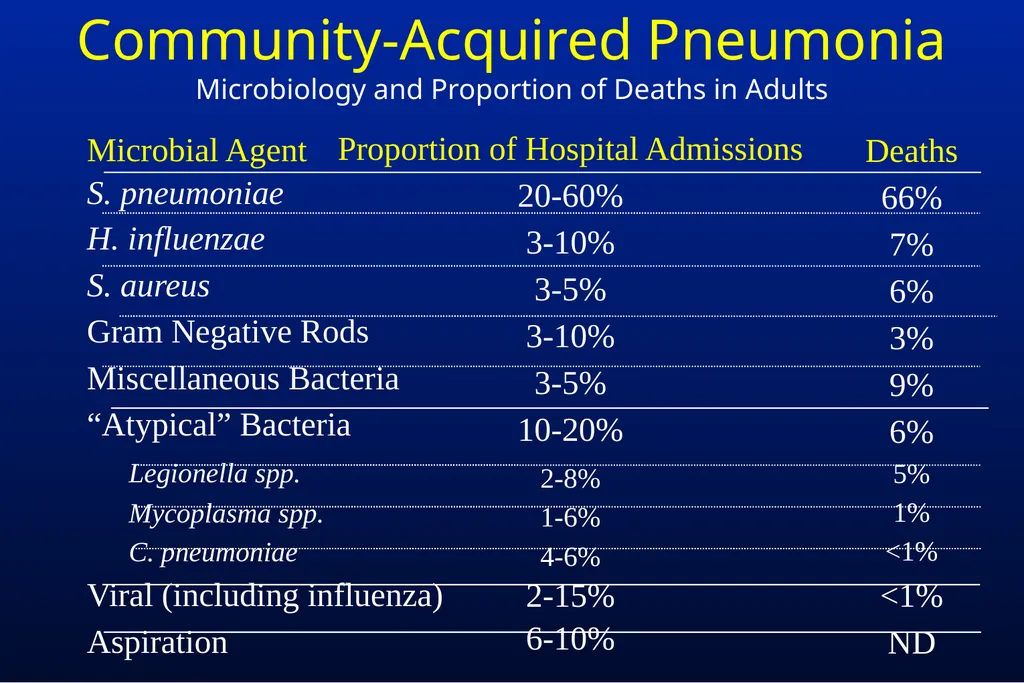
Microbiology and Proportion of Deaths in Adults Microbial Agent
S. pneumoniae
H. influenzae
S. aureus
Gram Negative Rods
Miscellaneous Bacteria
“Atypical” Bacteria
Legionella spp.
Mycoplasma spp.
C. pneumoniae
Viral (including influenza)
Aspiration Proportion of Hospital Admissions
20-60%
3-10%
3-5%
3-10%
3-5%
10-20%
2-8%
1-6%
4-6%
2-15%
6-10% Deaths
66%
7%
6%
3%
9%
6%
5%
1%
<1%
<1%
ND<br>
S. pneumoniae
H. influenzae
S. aureus
Gram Negative Rods
Miscellaneous Bacteria
“Atypical” Bacteria
Legionella spp.
Mycoplasma spp.
C. pneumoniae
Viral (including influenza)
Aspiration Proportion of Hospital Admissions
20-60%
3-10%
3-5%
3-10%
3-5%
10-20%
2-8%
1-6%
4-6%
2-15%
6-10% Deaths
66%
7%
6%
3%
9%
6%
5%
1%
<1%
<1%
ND<br>
16
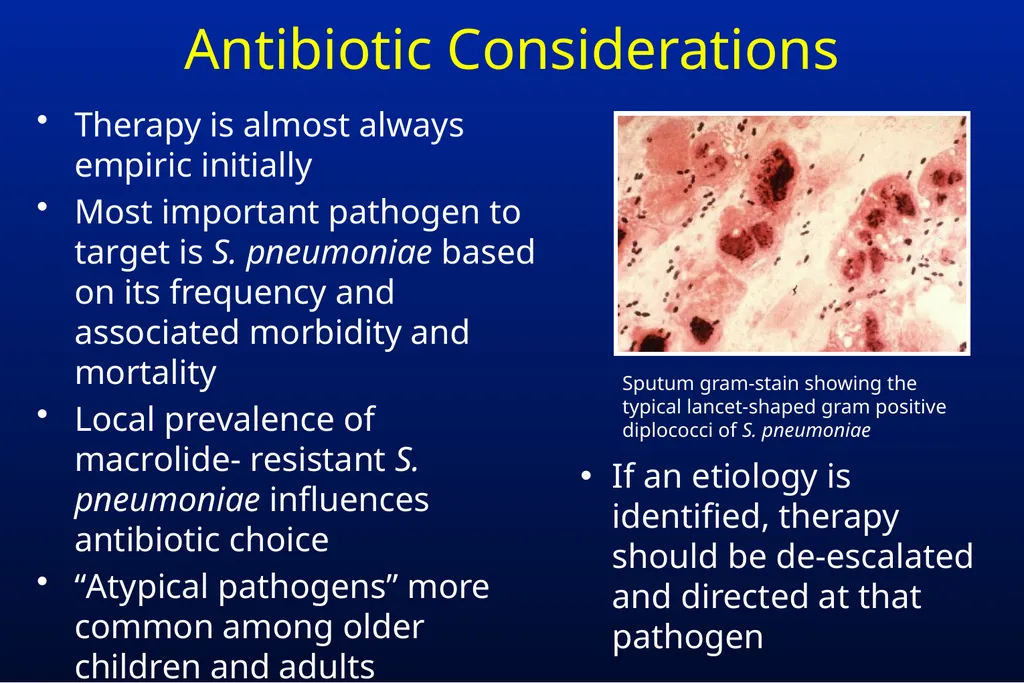
Antibiotic Considerations Therapy is almost always empiric initially
Most important pathogen to target is S. pneumoniae based on its frequency and associated morbidity and mortality
Local prevalence of macrolide- resistant S. pneumoniae influences antibiotic choice
“Atypical pathogens” more common among older children and adults If an etiology is identified, therapy should be de-escalated and directed at that pathogen<br>
Most important pathogen to target is S. pneumoniae based on its frequency and associated morbidity and mortality
Local prevalence of macrolide- resistant S. pneumoniae influences antibiotic choice
“Atypical pathogens” more common among older children and adults If an etiology is identified, therapy should be de-escalated and directed at that pathogen<br>
17
Community-Acquired Pneumonia
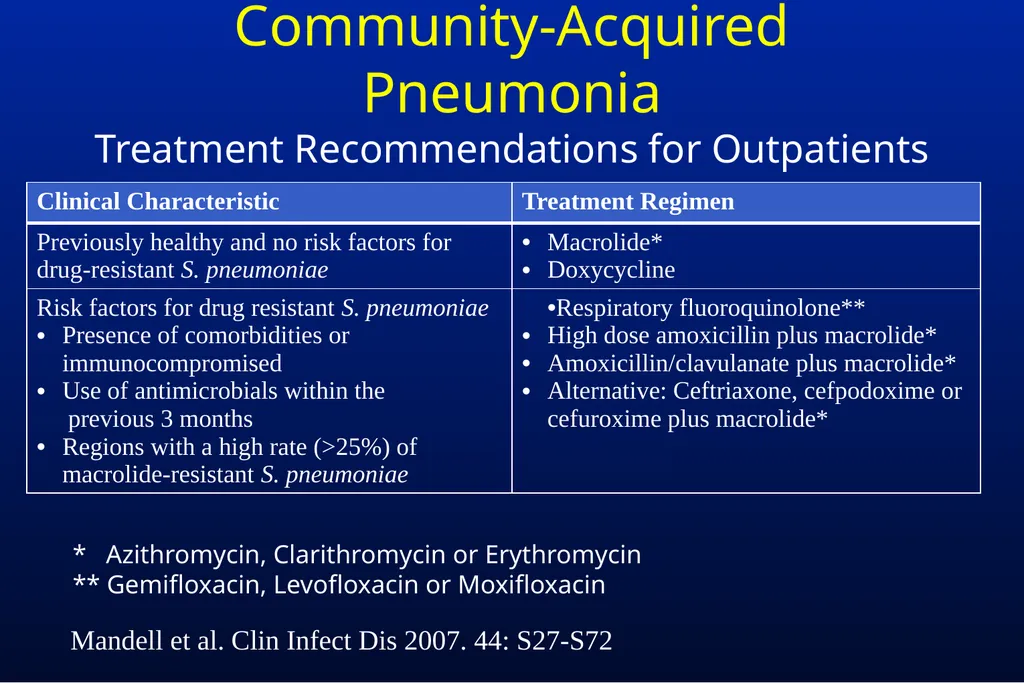
Treatment Recommendations for Outpatients * Azithromycin, Clarithromycin or Erythromycin
** Gemifloxacin, Levofloxacin or Moxifloxacin Mandell et al. Clin Infect Dis 2007. 44: S27-S72<br>
** Gemifloxacin, Levofloxacin or Moxifloxacin Mandell et al. Clin Infect Dis 2007. 44: S27-S72<br>
18
Community-Acquired Pneumonia
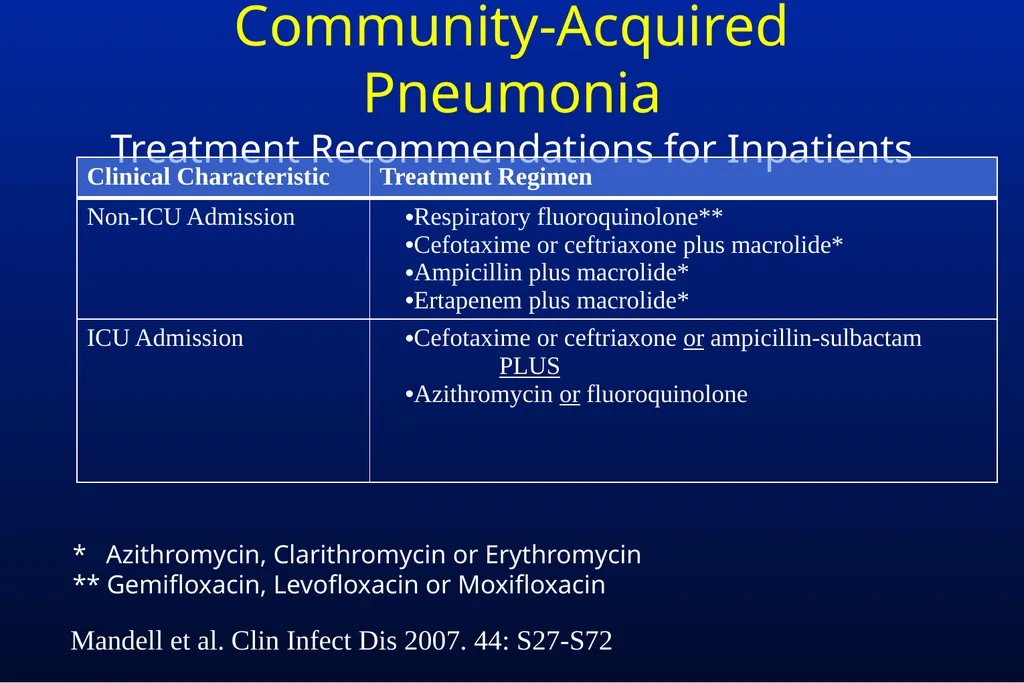
Treatment Recommendations for Inpatients * Azithromycin, Clarithromycin or Erythromycin
** Gemifloxacin, Levofloxacin or Moxifloxacin Mandell et al. Clin Infect Dis 2007. 44: S27-S72<br>
** Gemifloxacin, Levofloxacin or Moxifloxacin Mandell et al. Clin Infect Dis 2007. 44: S27-S72<br>
19
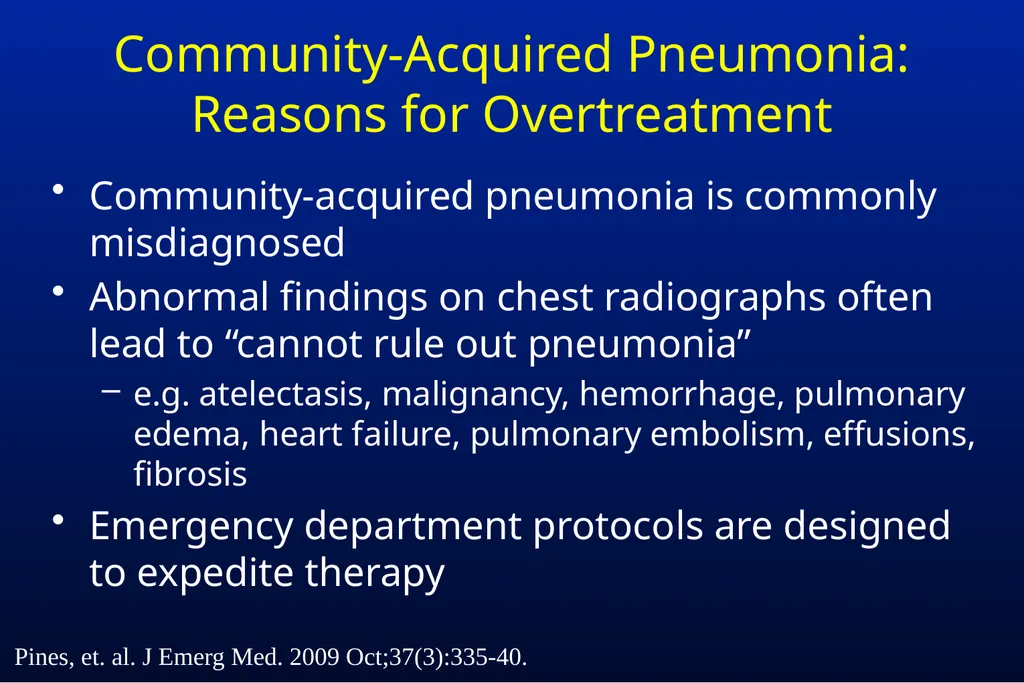
Community-Acquired Pneumonia: Reasons for Overtreatment Community-acquired pneumonia is commonly misdiagnosed
Abnormal findings on chest radiographs often lead to “cannot rule out pneumonia”
e.g. atelectasis, malignancy, hemorrhage, pulmonary edema, heart failure, pulmonary embolism, effusions, fibrosis
Emergency department protocols are designed to expedite therapy Pines, et. al. J Emerg Med. 2009 Oct;37(3):335-40.<br>
Abnormal findings on chest radiographs often lead to “cannot rule out pneumonia”
e.g. atelectasis, malignancy, hemorrhage, pulmonary edema, heart failure, pulmonary embolism, effusions, fibrosis
Emergency department protocols are designed to expedite therapy Pines, et. al. J Emerg Med. 2009 Oct;37(3):335-40.<br>
20
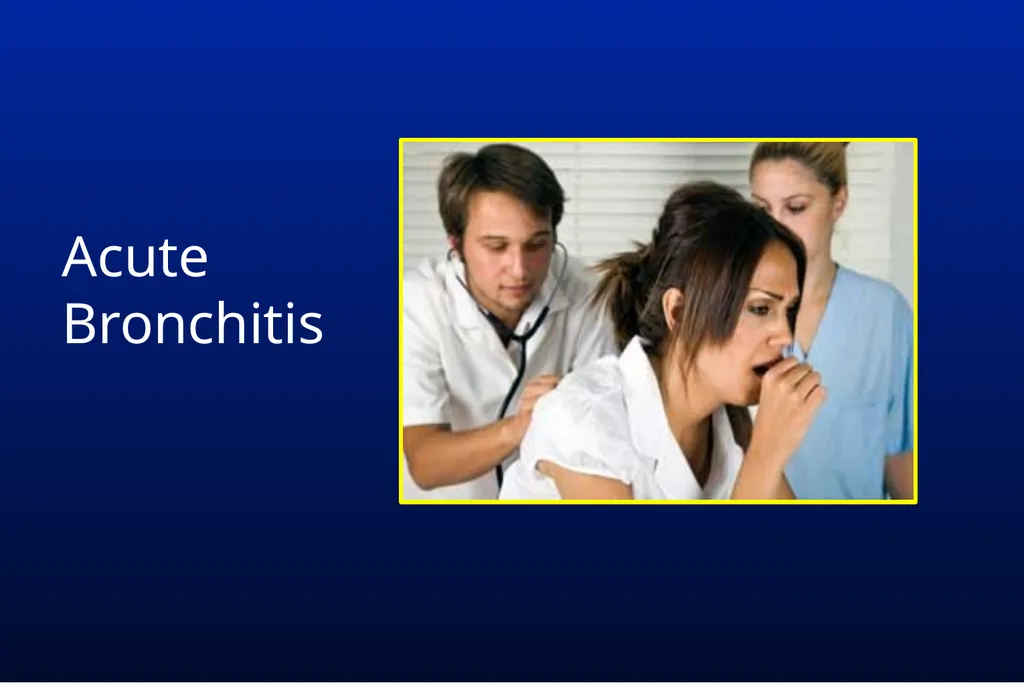
Acute
Bronchitis<br>
Bronchitis<br>
21
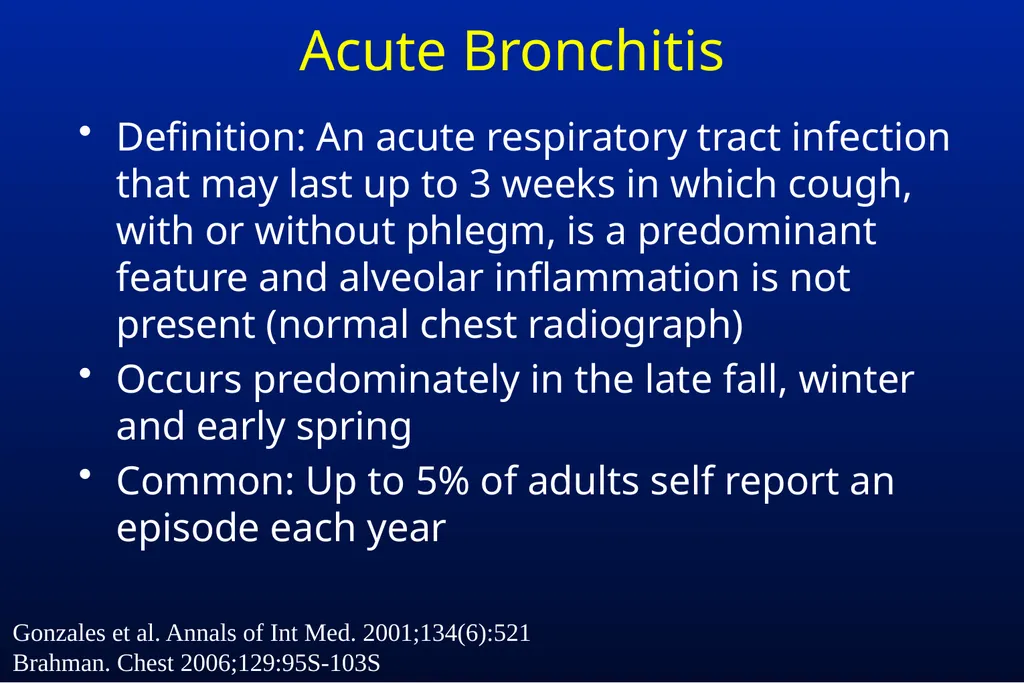
Acute Bronchitis Definition: An acute respiratory tract infection that may last up to 3 weeks in which cough, with or without phlegm, is a predominant feature and alveolar inflammation is not present (normal chest radiograph)
Occurs predominately in the late fall, winter and early spring
Common: Up to 5% of adults self report an episode each year Gonzales et al. Annals of Int Med. 2001;134(6):521
Brahman. Chest 2006;129:95S-103S<br>
Occurs predominately in the late fall, winter and early spring
Common: Up to 5% of adults self report an episode each year Gonzales et al. Annals of Int Med. 2001;134(6):521
Brahman. Chest 2006;129:95S-103S<br>
22
Acute Bronchitis
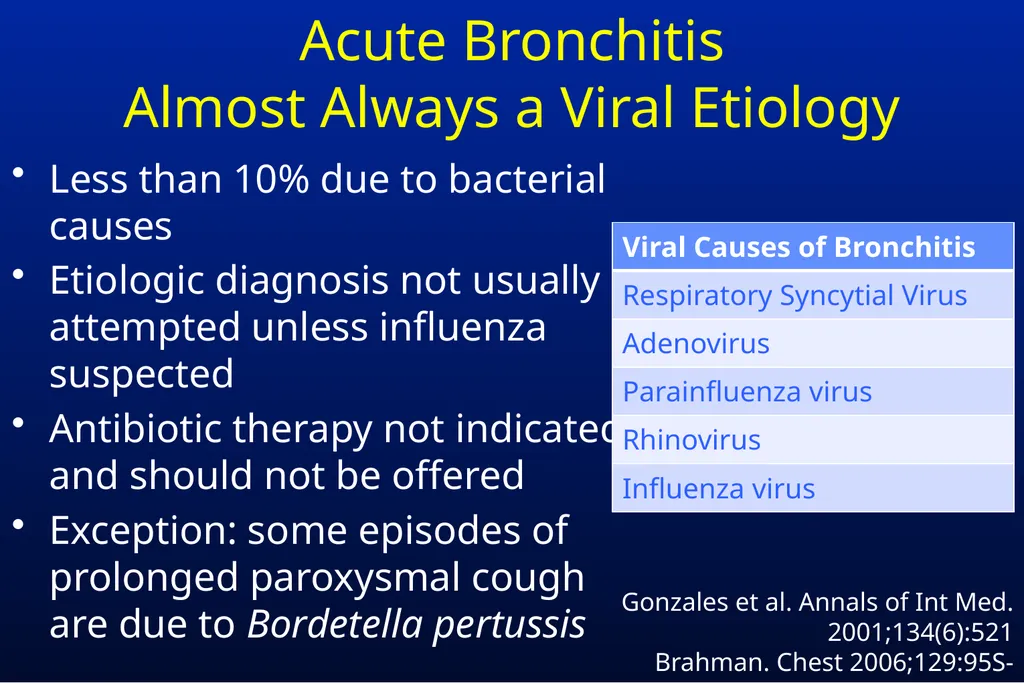
Almost Always a Viral Etiology Less than 10% due to bacterial causes
Etiologic diagnosis not usually attempted unless influenza suspected
Antibiotic therapy not indicated and should not be offered
Exception: some episodes of prolonged paroxysmal cough are due to Bordetella pertussis Gonzales et al. Annals of Int Med. 2001;134(6):521
Brahman. Chest 2006;129:95S-103S<br>
Etiologic diagnosis not usually attempted unless influenza suspected
Antibiotic therapy not indicated and should not be offered
Exception: some episodes of prolonged paroxysmal cough are due to Bordetella pertussis Gonzales et al. Annals of Int Med. 2001;134(6):521
Brahman. Chest 2006;129:95S-103S<br>
23
Patient Management Some patients may expect an antibiotic based on past experience or expectations
Explain to the patient why an antibiotic is not necessary and that these drugs may have unwanted side-effects
Use terms like “chest cold” rather than bronchitis or infection
Suggestions for symptom relief
Humidified air
Over-the-counter pain relievers
Some recommend cough suppressants
No role for bronchodilators in absence of asthma or chronic obstructive pulmonary disease (COPD)<br>
Explain to the patient why an antibiotic is not necessary and that these drugs may have unwanted side-effects
Use terms like “chest cold” rather than bronchitis or infection
Suggestions for symptom relief
Humidified air
Over-the-counter pain relievers
Some recommend cough suppressants
No role for bronchodilators in absence of asthma or chronic obstructive pulmonary disease (COPD)<br>
24
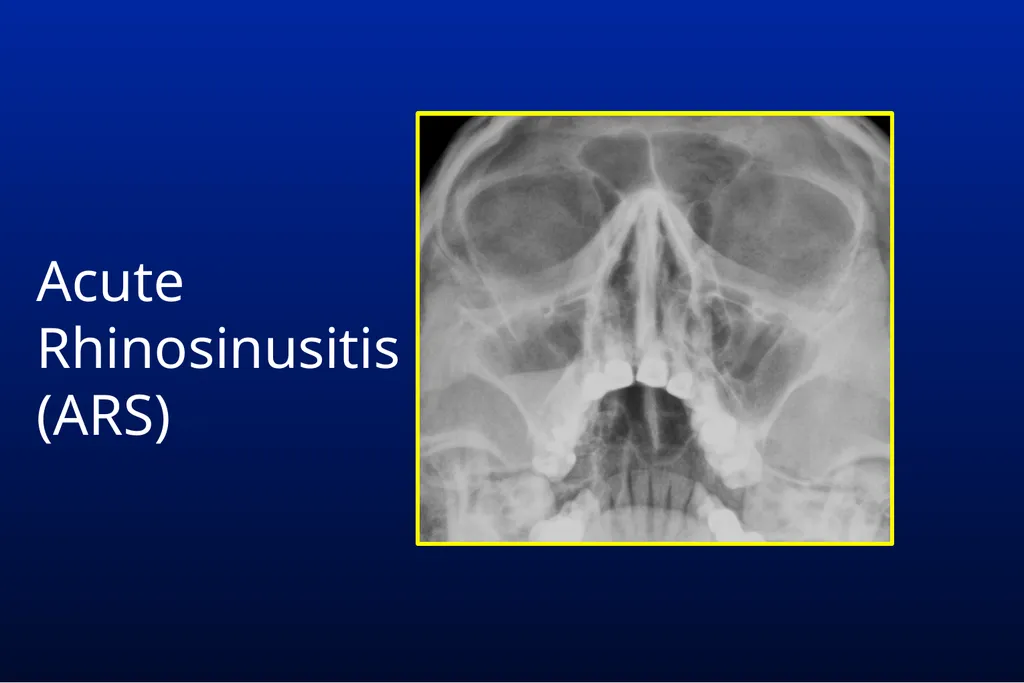
Acute Rhinosinusitis (ARS)<br>
25
Acute Rhinosinusitis Broad term describing multiple disease processes affecting the nasal cavity and sinuses with a duration of <4 weeks
Allergy
Infection (viral, bacterial, fungal)
Polyps
Frequent: 1 of 7 adults per year seeks medical attention for acute rhinosinusitis (ARS) Chow et al. Clin Infect Dis. 2012; 54(8):e72-112<br>
Allergy
Infection (viral, bacterial, fungal)
Polyps
Frequent: 1 of 7 adults per year seeks medical attention for acute rhinosinusitis (ARS) Chow et al. Clin Infect Dis. 2012; 54(8):e72-112<br>
26
Acute Viral Rhinosinusitis (Common Cold) Pathogens: Viruses similar to acute bronchitis
Common symptoms: Nasal congestion and mucous discharge, facial pressure, post-nasal discharge
Usually symptoms peak at 2-3 days and resolve by day 7-10
Diagnosis relies on exam: radiographs not sensitive or specific
Treat with topical and oral decongestants, nasal irrigation, +/- topical corticosteroids
No indication for antibiotics Meltzer et. al. Mayo Clin Proc. 2011 86: 427
Chow et al. Clin Infect Dis. 2012; 54(8):e72-112<br>
Common symptoms: Nasal congestion and mucous discharge, facial pressure, post-nasal discharge
Usually symptoms peak at 2-3 days and resolve by day 7-10
Diagnosis relies on exam: radiographs not sensitive or specific
Treat with topical and oral decongestants, nasal irrigation, +/- topical corticosteroids
No indication for antibiotics Meltzer et. al. Mayo Clin Proc. 2011 86: 427
Chow et al. Clin Infect Dis. 2012; 54(8):e72-112<br>
27
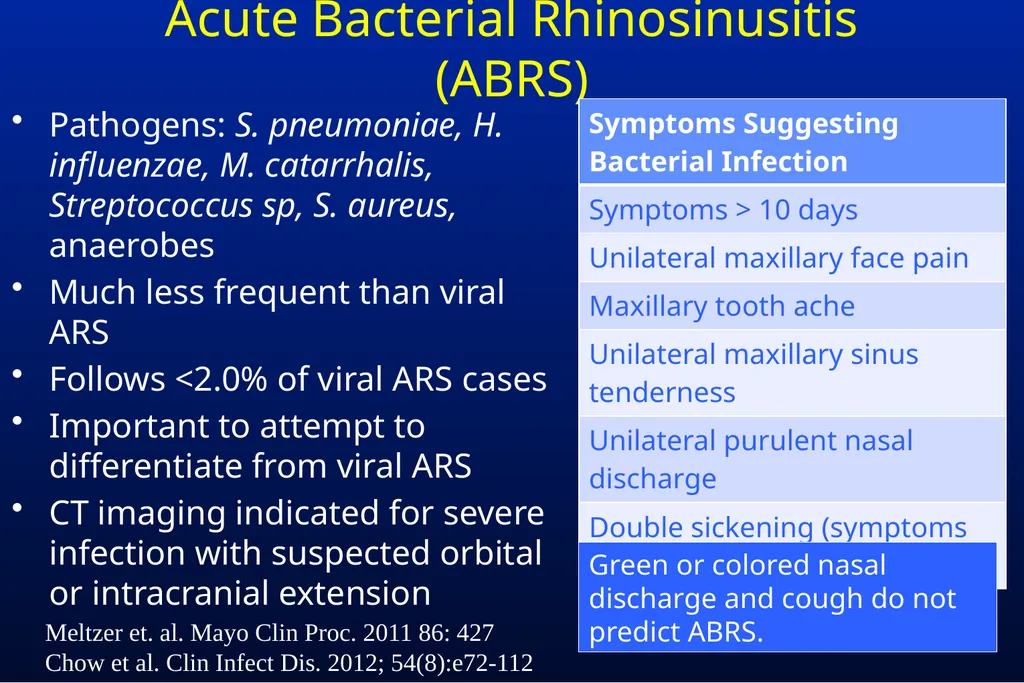
Acute Bacterial Rhinosinusitis (ABRS) Pathogens: S. pneumoniae, H. influenzae, M. catarrhalis, Streptococcus sp, S. aureus, anaerobes
Much less frequent than viral ARS
Follows <2.0% of viral ARS cases
Important to attempt to differentiate from viral ARS
CT imaging indicated for severe infection with suspected orbital or intracranial extension Green or colored nasal discharge and cough do not predict ABRS. Meltzer et. al. Mayo Clin Proc. 2011 86: 427
Chow et al. Clin Infect Dis. 2012; 54(8):e72-112<br>
Much less frequent than viral ARS
Follows <2.0% of viral ARS cases
Important to attempt to differentiate from viral ARS
CT imaging indicated for severe infection with suspected orbital or intracranial extension Green or colored nasal discharge and cough do not predict ABRS. Meltzer et. al. Mayo Clin Proc. 2011 86: 427
Chow et al. Clin Infect Dis. 2012; 54(8):e72-112<br>
28
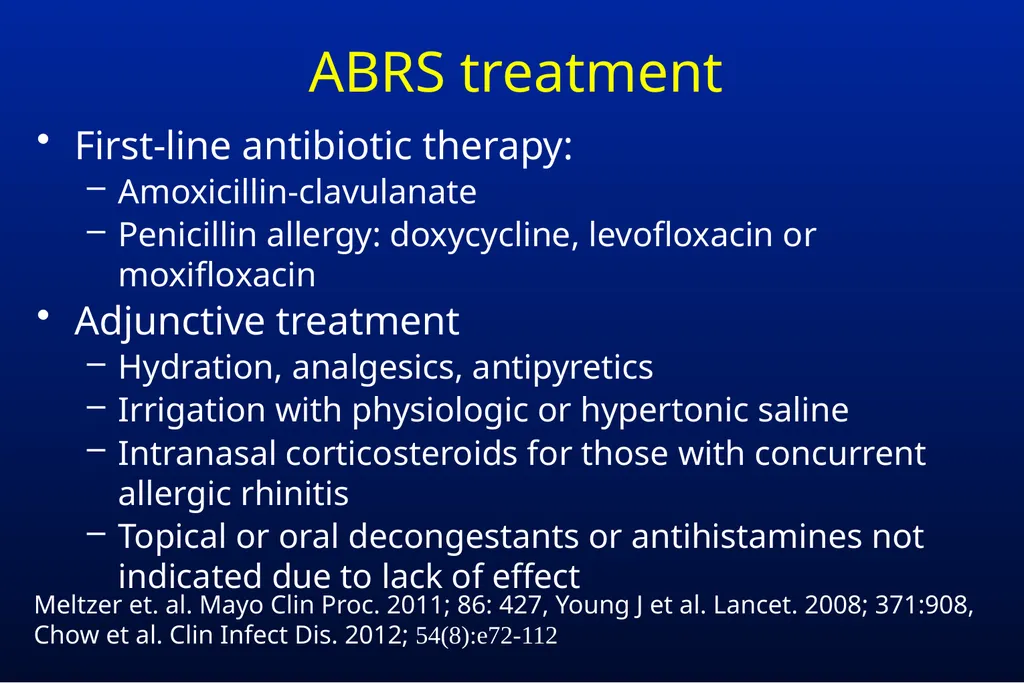
ABRS treatment First-line antibiotic therapy:
Amoxicillin-clavulanate
Penicillin allergy: doxycycline, levofloxacin or moxifloxacin
Adjunctive treatment
Hydration, analgesics, antipyretics
Irrigation with physiologic or hypertonic saline
Intranasal corticosteroids for those with concurrent allergic rhinitis
Topical or oral decongestants or antihistamines not indicated due to lack of effect Meltzer et. al. Mayo Clin Proc. 2011; 86: 427, Young J et al. Lancet. 2008; 371:908,
Chow et al. Clin Infect Dis. 2012; 54(8):e72-112<br>
Amoxicillin-clavulanate
Penicillin allergy: doxycycline, levofloxacin or moxifloxacin
Adjunctive treatment
Hydration, analgesics, antipyretics
Irrigation with physiologic or hypertonic saline
Intranasal corticosteroids for those with concurrent allergic rhinitis
Topical or oral decongestants or antihistamines not indicated due to lack of effect Meltzer et. al. Mayo Clin Proc. 2011; 86: 427, Young J et al. Lancet. 2008; 371:908,
Chow et al. Clin Infect Dis. 2012; 54(8):e72-112<br>
29
Acute Pharyngitis<br>
30
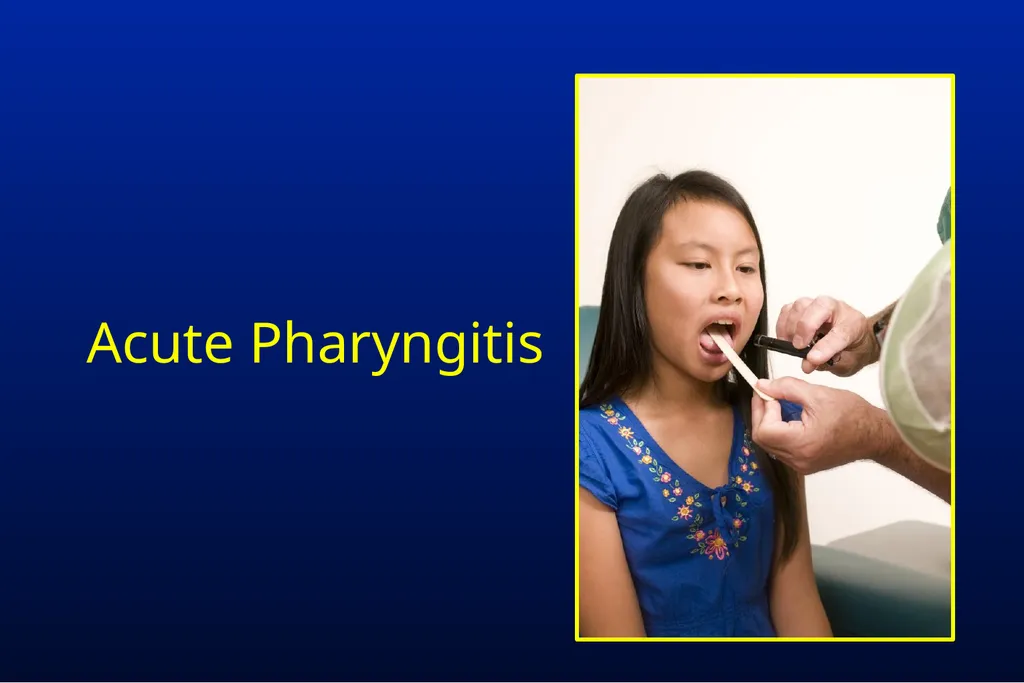
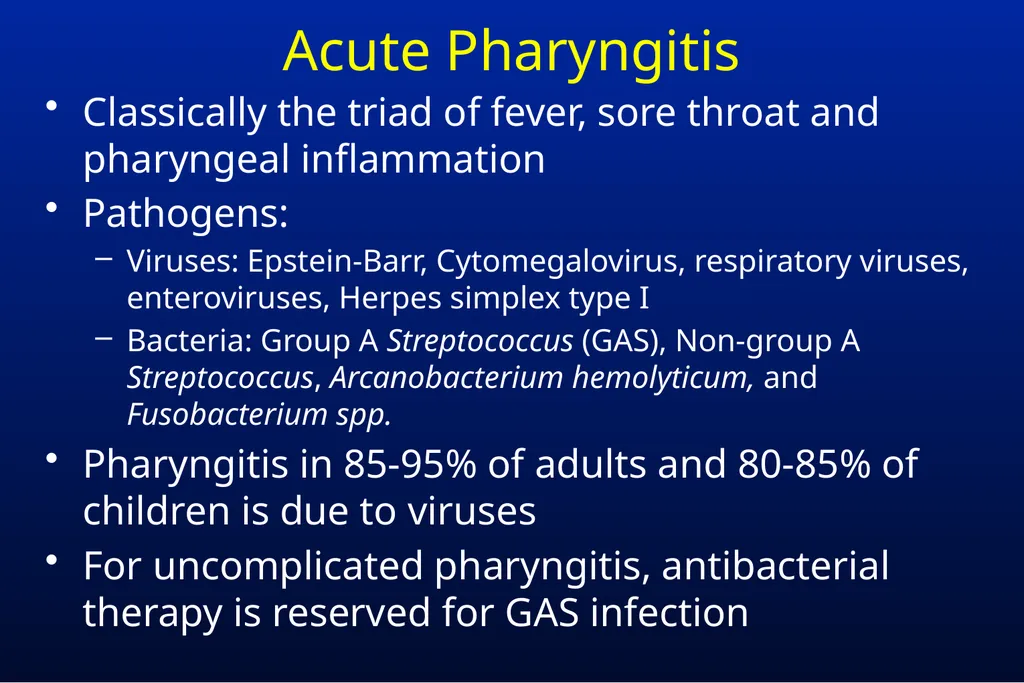
Acute Pharyngitis Classically the triad of fever, sore throat and pharyngeal inflammation
Pathogens:
Viruses: Epstein-Barr, Cytomegalovirus, respiratory viruses, enteroviruses, Herpes simplex type I
Bacteria: Group A Streptococcus (GAS), Non-group A Streptococcus, Arcanobacterium hemolyticum, and Fusobacterium spp.
Pharyngitis in 85-95% of adults and 80-85% of children is due to viruses
For uncomplicated pharyngitis, antibacterial therapy is reserved for GAS infection<br>
Pathogens:
Viruses: Epstein-Barr, Cytomegalovirus, respiratory viruses, enteroviruses, Herpes simplex type I
Bacteria: Group A Streptococcus (GAS), Non-group A Streptococcus, Arcanobacterium hemolyticum, and Fusobacterium spp.
Pharyngitis in 85-95% of adults and 80-85% of children is due to viruses
For uncomplicated pharyngitis, antibacterial therapy is reserved for GAS infection<br>
31
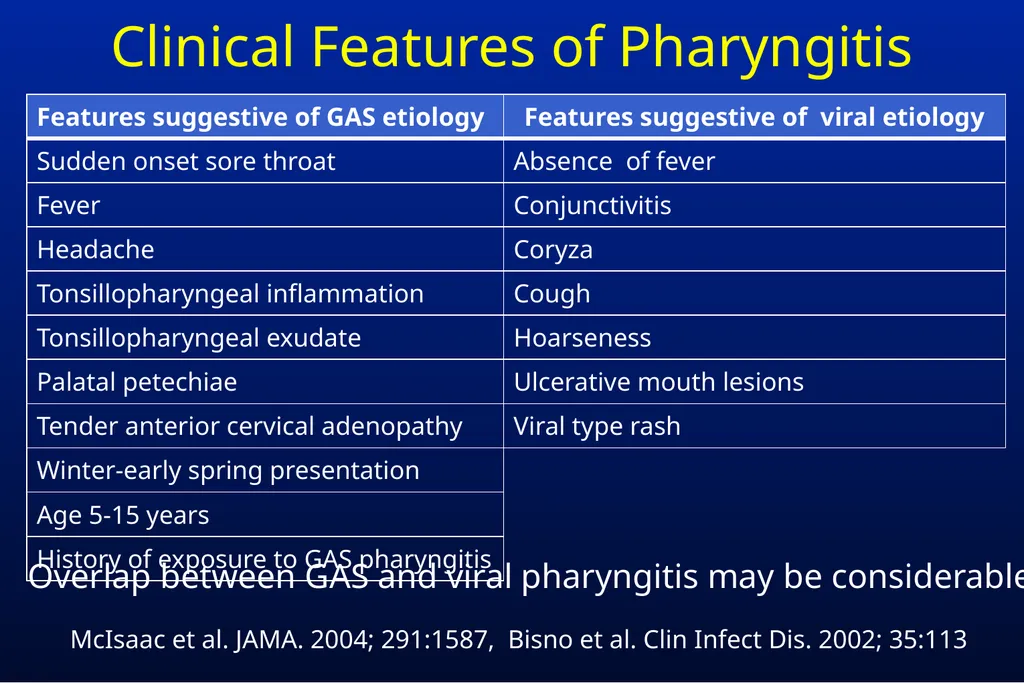
Clinical Features of Pharyngitis Overlap between GAS and viral pharyngitis may be considerable McIsaac et al. JAMA. 2004; 291:1587, Bisno et al. Clin Infect Dis. 2002; 35:113<br>
32
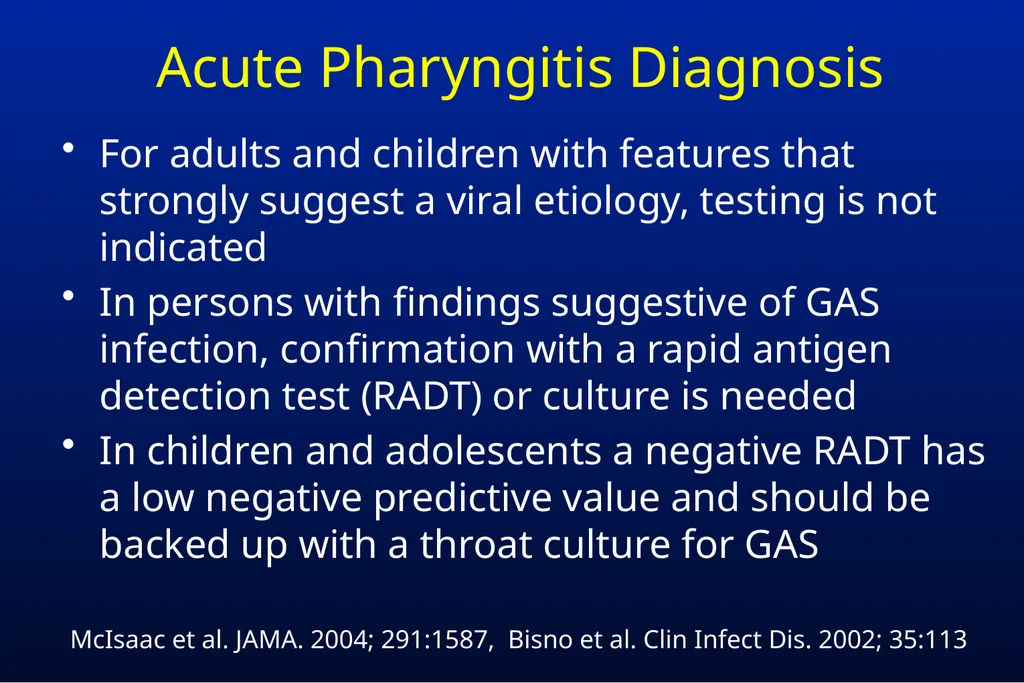
Acute Pharyngitis Diagnosis For adults and children with features that strongly suggest a viral etiology, testing is not indicated
In persons with findings suggestive of GAS infection, confirmation with a rapid antigen detection test (RADT) or culture is needed
In children and adolescents a negative RADT has a low negative predictive value and should be backed up with a throat culture for GAS McIsaac et al. JAMA. 2004; 291:1587, Bisno et al. Clin Infect Dis. 2002; 35:113<br>
In persons with findings suggestive of GAS infection, confirmation with a rapid antigen detection test (RADT) or culture is needed
In children and adolescents a negative RADT has a low negative predictive value and should be backed up with a throat culture for GAS McIsaac et al. JAMA. 2004; 291:1587, Bisno et al. Clin Infect Dis. 2002; 35:113<br>
33
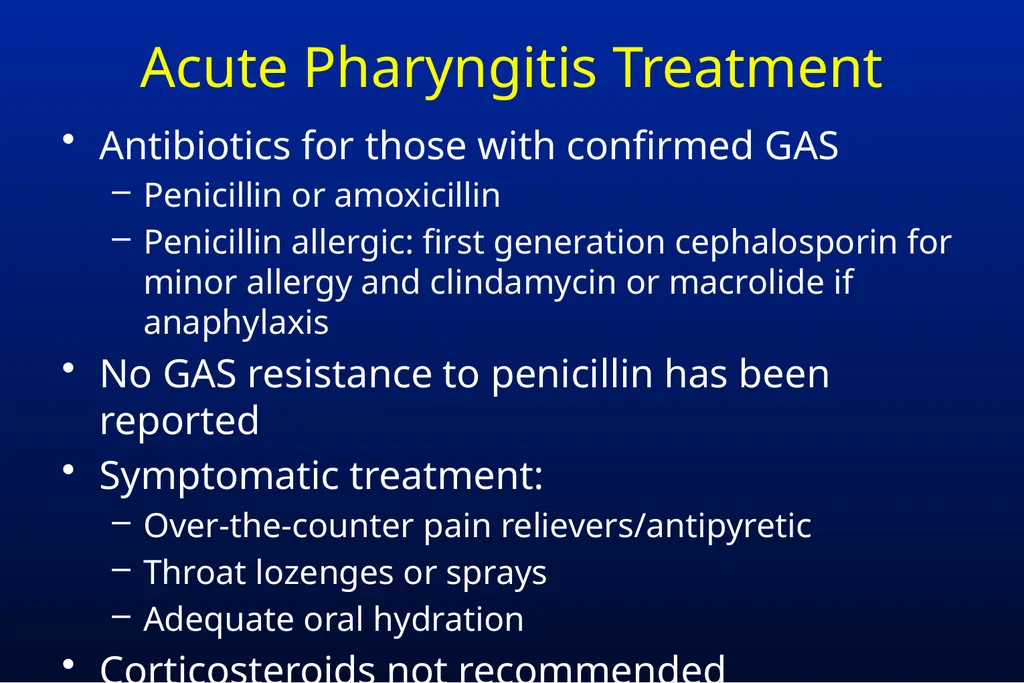
Acute Pharyngitis Treatment Antibiotics for those with confirmed GAS
Penicillin or amoxicillin
Penicillin allergic: first generation cephalosporin for minor allergy and clindamycin or macrolide if anaphylaxis
No GAS resistance to penicillin has been reported
Symptomatic treatment:
Over-the-counter pain relievers/antipyretic
Throat lozenges or sprays
Adequate oral hydration
Corticosteroids not recommended<br>
Penicillin or amoxicillin
Penicillin allergic: first generation cephalosporin for minor allergy and clindamycin or macrolide if anaphylaxis
No GAS resistance to penicillin has been reported
Symptomatic treatment:
Over-the-counter pain relievers/antipyretic
Throat lozenges or sprays
Adequate oral hydration
Corticosteroids not recommended<br>
34
Acute Otitis Media<br>
35
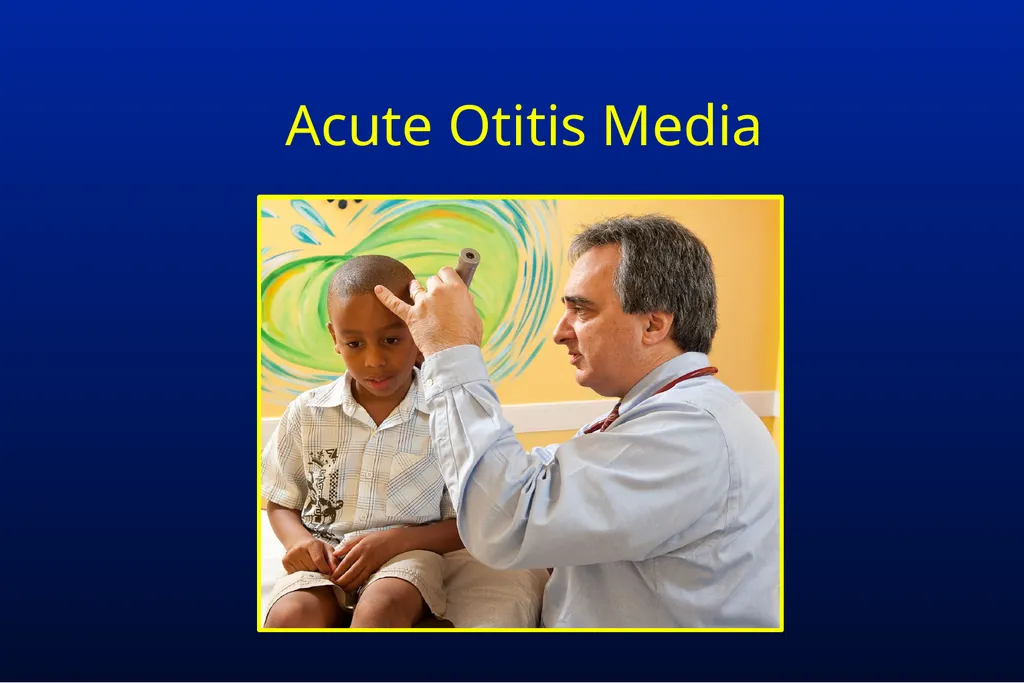
Acute Otitis Media (AOM) Acute illness with fluid and mucosal inflammation of the middle ear space
Extremely common in young children: By age 3, two-thirds have had at least one episode
Much less common in adults
Increased risk with some ethnic groups, exposure to polluted air (including tobacco smoke), and with children who attend daycare<br>
Extremely common in young children: By age 3, two-thirds have had at least one episode
Much less common in adults
Increased risk with some ethnic groups, exposure to polluted air (including tobacco smoke), and with children who attend daycare<br>
36
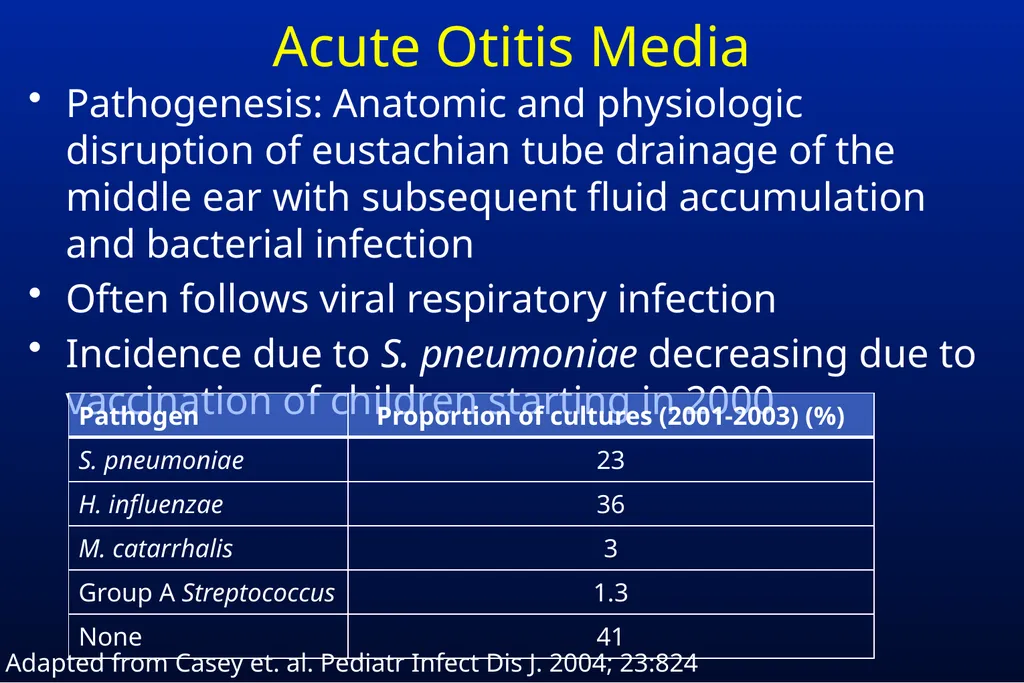
Acute Otitis Media Pathogenesis: Anatomic and physiologic disruption of eustachian tube drainage of the middle ear with subsequent fluid accumulation and bacterial infection
Often follows viral respiratory infection
Incidence due to S. pneumoniae decreasing due to vaccination of children starting in 2000 Adapted from Casey et. al. Pediatr Infect Dis J. 2004; 23:824<br>
Often follows viral respiratory infection
Incidence due to S. pneumoniae decreasing due to vaccination of children starting in 2000 Adapted from Casey et. al. Pediatr Infect Dis J. 2004; 23:824<br>
37
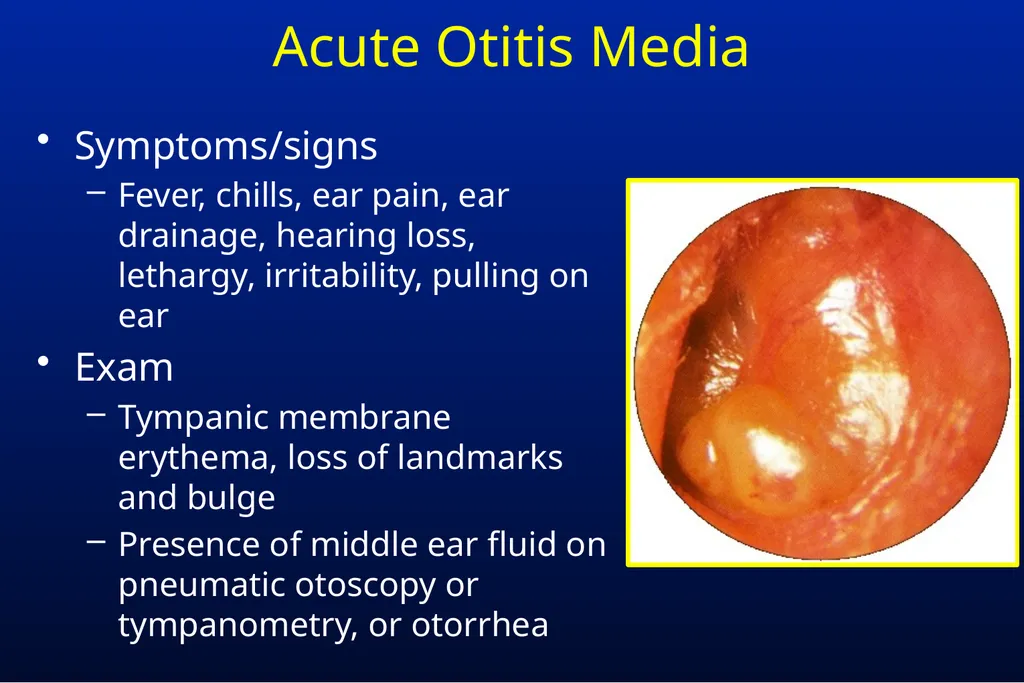
Acute Otitis Media Symptoms/signs
Fever, chills, ear pain, ear drainage, hearing loss, lethargy, irritability, pulling on ear
Exam
Tympanic membrane erythema, loss of landmarks and bulge
Presence of middle ear fluid on pneumatic otoscopy or tympanometry, or otorrhea<br>
Fever, chills, ear pain, ear drainage, hearing loss, lethargy, irritability, pulling on ear
Exam
Tympanic membrane erythema, loss of landmarks and bulge
Presence of middle ear fluid on pneumatic otoscopy or tympanometry, or otorrhea<br>
38
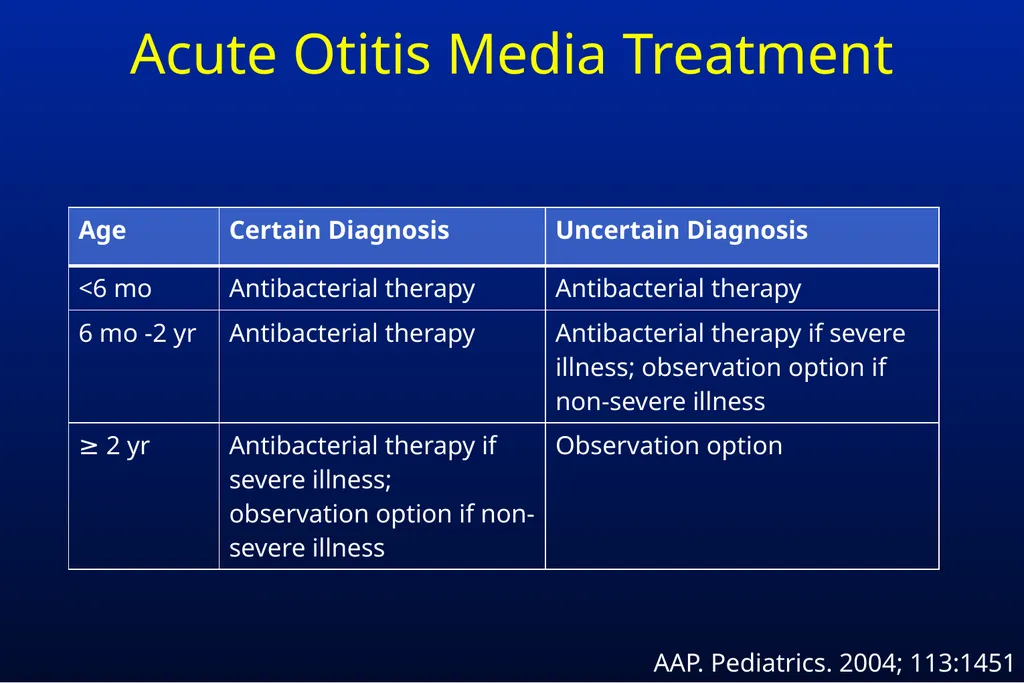
Acute Otitis Media: Treatment Many cases of AOM (~25%) are due to viruses and will not respond to antibiotics
A significant number of cases due to bacteria will spontaneously resolve without antibiotics
If antibiotics are indicated, use high dose amoxicillin
Severe illness: Amoxicillin-clavulanate
Penicillin allergy: 2nd or 3rd generation cephalosporin, azithromycin or clarithromycin AAP. Pediatrics. 2004; 113:1451<br>
A significant number of cases due to bacteria will spontaneously resolve without antibiotics
If antibiotics are indicated, use high dose amoxicillin
Severe illness: Amoxicillin-clavulanate
Penicillin allergy: 2nd or 3rd generation cephalosporin, azithromycin or clarithromycin AAP. Pediatrics. 2004; 113:1451<br>
39
Acute Otitis Media Treatment AAP. Pediatrics. 2004; 113:1451<br>
40
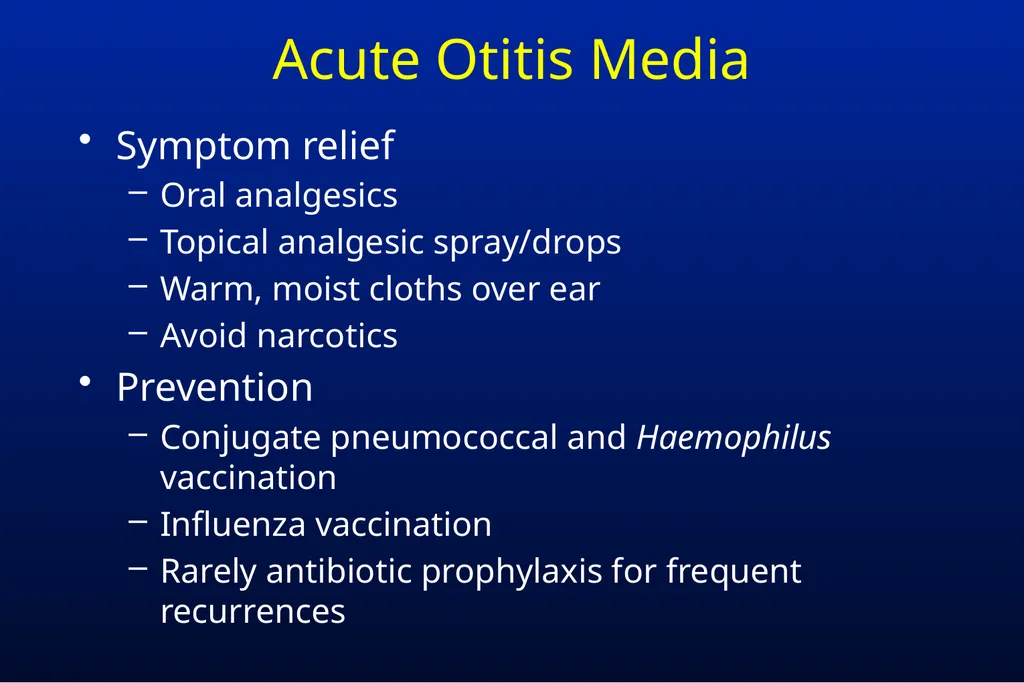
Acute Otitis Media Symptom relief
Oral analgesics
Topical analgesic spray/drops
Warm, moist cloths over ear
Avoid narcotics
Prevention
Conjugate pneumococcal and Haemophilus vaccination
Influenza vaccination
Rarely antibiotic prophylaxis for frequent recurrences<br>
Oral analgesics
Topical analgesic spray/drops
Warm, moist cloths over ear
Avoid narcotics
Prevention
Conjugate pneumococcal and Haemophilus vaccination
Influenza vaccination
Rarely antibiotic prophylaxis for frequent recurrences<br>
41
Outline Introduction
Evaluation and therapy
CAP
Acute bronchitis
Rhinosinusitis
Acute pharyngitis
Acute otitis media
Conclusion<br>
Evaluation and therapy
CAP
Acute bronchitis
Rhinosinusitis
Acute pharyngitis
Acute otitis media
Conclusion<br>
42
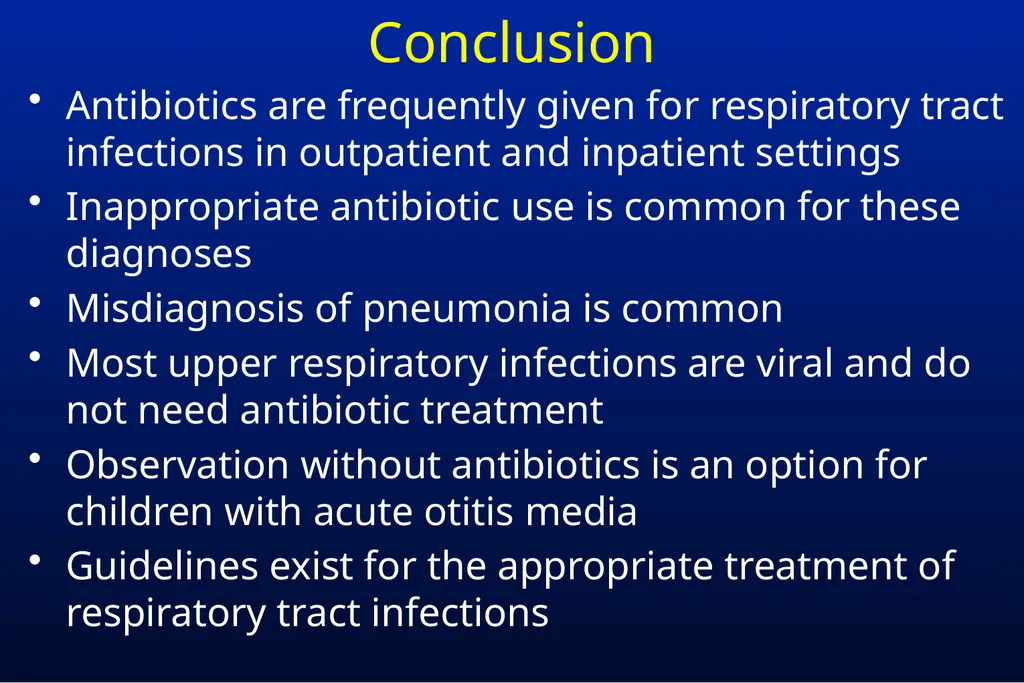
Conclusion Antibiotics are frequently given for respiratory tract infections in outpatient and inpatient settings
Inappropriate antibiotic use is common for these diagnoses
Misdiagnosis of pneumonia is common
Most upper respiratory infections are viral and do not need antibiotic treatment
Observation without antibiotics is an option for children with acute otitis media
Guidelines exist for the appropriate treatment of respiratory tract infections<br>
Inappropriate antibiotic use is common for these diagnoses
Misdiagnosis of pneumonia is common
Most upper respiratory infections are viral and do not need antibiotic treatment
Observation without antibiotics is an option for children with acute otitis media
Guidelines exist for the appropriate treatment of respiratory tract infections<br>
43
Treatment Guidelines and Resources Centers for Disease Control and Prevention (CDC)
http://www.cdc.gov/getsmart/
Get Smart: Know When Antibiotics Work
Adult Guideline Summaries
Pediatric Guideline Summaries
Infectious Diseases Society of America (IDSA) http://www.idsociety.org/IDSA_Practice_Guidelines/
American Academy of Pediatrics (AAP)
American Academy of Family Physicians(AAFP)<br>
http://www.cdc.gov/getsmart/
Get Smart: Know When Antibiotics Work
Adult Guideline Summaries
Pediatric Guideline Summaries
Infectious Diseases Society of America (IDSA) http://www.idsociety.org/IDSA_Practice_Guidelines/
American Academy of Pediatrics (AAP)
American Academy of Family Physicians(AAFP)<br>