
Communicate strategically How to draft a
Description: Communicate strategically How to draft a communication strategy Introduction For the purposes of the Programme, you are required to draft a summary document outlining the key points of your projects communication strategy. On the following
Related Topics
Download Presentation
"Communicate strategically How to draft a" is the property of its rightful owner. Permission is granted to download and print the materials on this website for personal, non-commercial use only, and to display it on your personal computer provided you do not modify the materials and that you retain all copyright notices contained in the materials. By downloading content from our website, you accept the terms of this agreement.
Presentation Transcript
slide1. Communicate strategically
How to draft a communication strategy<br>
slide2. Introduction For the purposes of the Programme, you are required to draft a summary document outlining the key points of your project's communication strategy.
On the following pages you will find a suggested structure for drafting the communication strategy of your project. There are no obligations, although the Programme recommends following this structure, you are free to develop it further and in the medium you prefer (ppt, word, etc.).<br>
slide3. Summary Strategic overview and situation analysis
Objectives
Target groups
Channels and tools
Key activities
Timeline
Financial and human resources
Evaluation<br>
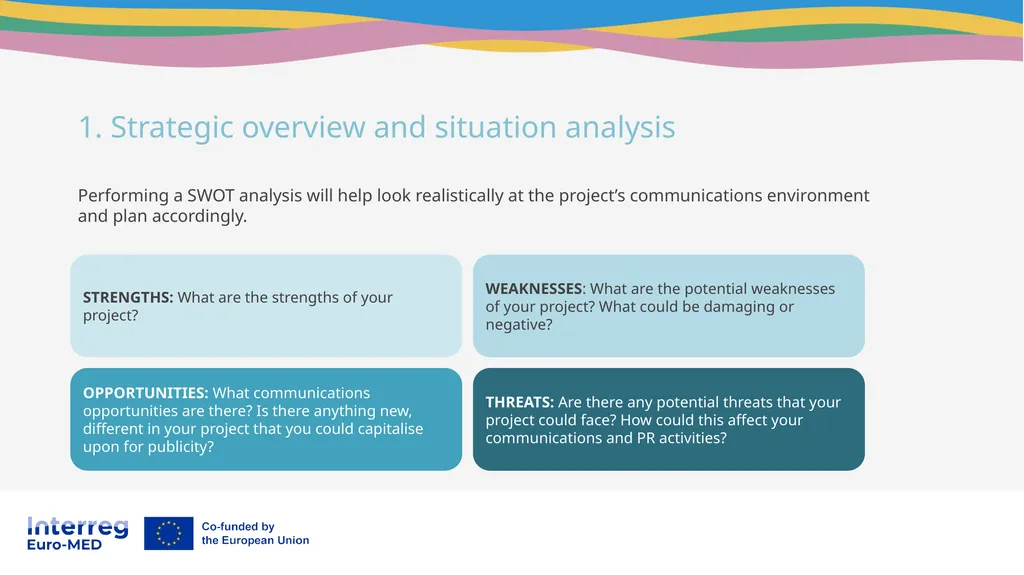
slide4. 1. Strategic overview and situation analysis Performing a SWOT analysis will help look realistically at the project’s communications environment and plan accordingly. STRENGTHS: What are the strengths of your project? WEAKNESSES: What are the potential weaknesses of your project? What could be damaging or negative? OPPORTUNITIES: What communications opportunities are there? Is there anything new, different in your project that you could capitalise upon for publicity? THREATS: Are there any potential threats that your project could face? How could this affect your communications and PR activities?<br>
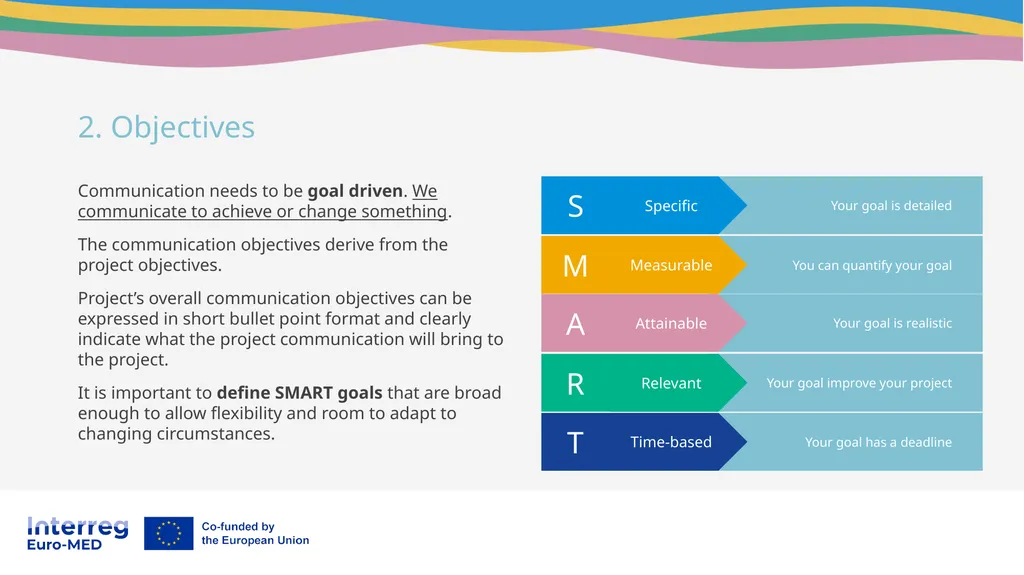
slide5. Your goal is detailed 2. Objectives Communication needs to be goal driven. We communicate to achieve or change something.
The communication objectives derive from the project objectives.
Project’s overall communication objectives can be expressed in short bullet point format and clearly indicate what the project communication will bring to the project.
It is important to define SMART goals that are broad enough to allow flexibility and room to adapt to changing circumstances. Specific S You can quantify your goal Measurable M Your goal is realistic Attainable A Your goal improve your project Relevant R Your goal has a deadline Time-based T<br>
slide6. 3. Target groups All partners need to communicate with several people/organisations who are – or might be – interested in their project and can have an influence on their ability to achieve their goals rapidly and efficiently. Knowing your “target audience” is the main starting point of a communication strategy.
“Who is our target audience in the project?” and more precisely “which target audience do I have to reach in order to achieve the project goals?” are the first questions that project partners should ask themselves. The target groups need to be identified as accurately as possible to ensure that the key messages are transferred to the right audience.<br>
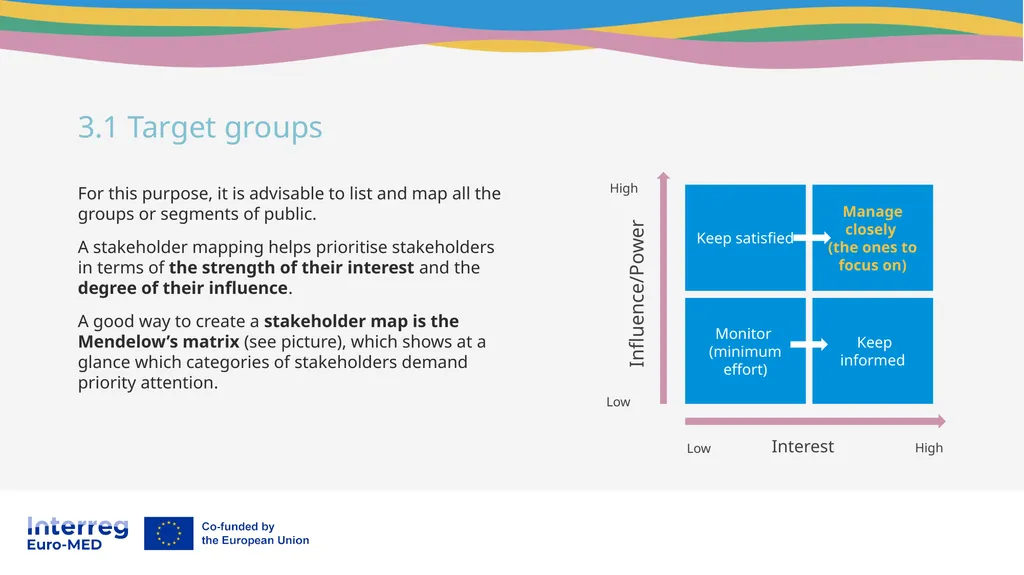
slide7. 3.1 Target groups For this purpose, it is advisable to list and map all the groups or segments of public.
A stakeholder mapping helps prioritise stakeholders in terms of the strength of their interest and the degree of their influence.
A good way to create a stakeholder map is the Mendelow’s matrix (see picture), which shows at a glance which categories of stakeholders demand priority attention.<br>
slide8. 4. Channels and tools Project partners need to define the channels that they will use to achieve their objectives and set in place a work plan. The choice of the channels must address the targets in an effective manner.
It is up to the project to decide which channels other than the Interreg Euro-MED Programme web platform are the most appropriate to reach their target audience.
There is a wide variety of channels, each with different purposes.<br>
slide9. 5. Key activities Once the channels selected in the communication strategy, project partners may define the key activities that will help them achieve their communication objectives.
The details of the activities will be further elaborated in the annual communication plan if applicable.
All activities must comply with EU and Programme publicity and information rules (Cf Chapter III. A. Eligibility of expenditures - viii Project branding and information and publicity rules of this manual).<br>
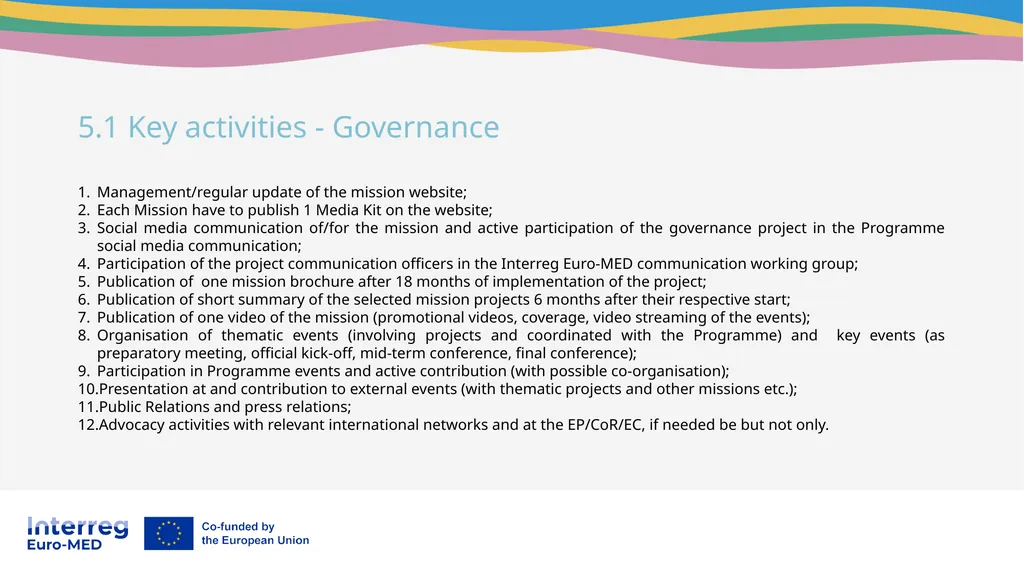
slide10. 5.1 Key activities - Governance Management/regular update of the mission website;
Each Mission have to publish 1 Media Kit on the website;
Social media communication of/for the mission and active participation of the governance project in the Programme social media communication;
Participation of the project communication officers in the Interreg Euro-MED communication working group;
Publication of one mission brochure after 18 months of implementation of the project;
Publication of short summary of the selected mission projects 6 months after their respective start;
Publication of one video of the mission (promotional videos, coverage, video streaming of the events);
Organisation of thematic events (involving projects and coordinated with the Programme) and key events (as preparatory meeting, official kick-off, mid-term conference, final conference);
Participation in Programme events and active contribution (with possible co-organisation);
Presentation at and contribution to external events (with thematic projects and other missions etc.);
Public Relations and press relations;
Advocacy activities with relevant international networks and at the EP/CoR/EC, if needed be but not only.<br>
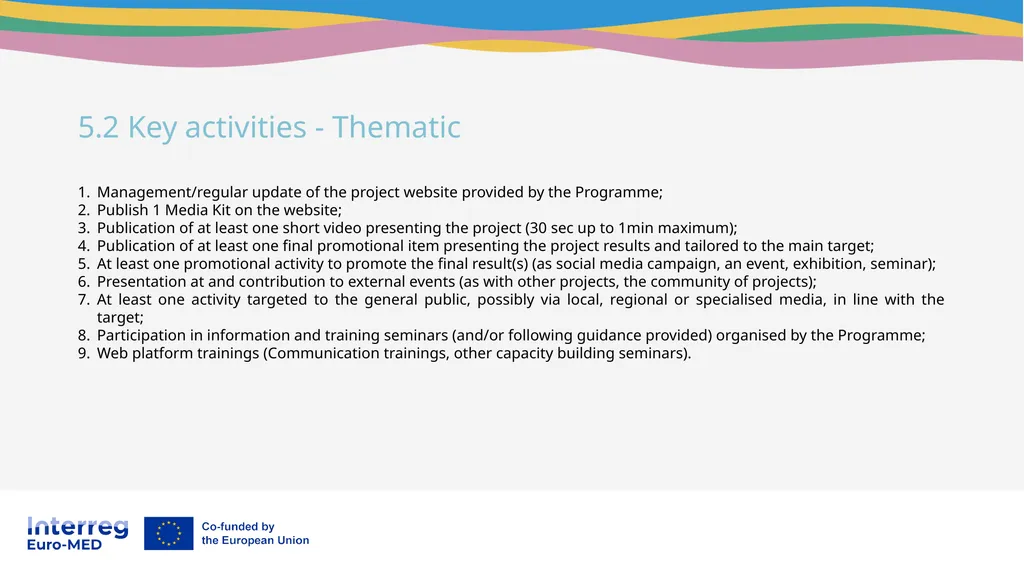
slide11. 5.2 Key activities - Thematic Management/regular update of the project website provided by the Programme;
Publish 1 Media Kit on the website;
Publication of at least one short video presenting the project (30 sec up to 1min maximum);
Publication of at least one final promotional item presenting the project results and tailored to the main target;
At least one promotional activity to promote the final result(s) (as social media campaign, an event, exhibition, seminar);
Presentation at and contribution to external events (as with other projects, the community of projects);
At least one activity targeted to the general public, possibly via local, regional or specialised media, in line with the target;
Participation in information and training seminars (and/or following guidance provided) organised by the Programme;
Web platform trainings (Communication trainings, other capacity building seminars).<br>
slide12. 5.3 Key activities – Study & Test Publish 1 short project summary targeting the general public in both languages: French and English (Technical studies and tests may be difficult to understand by a non-specialised audience. Therefore, project partners are highly recommended to use an accessible language and a user-friendly format to make the whole concept and its details easily understandable);
Results of analyses, studies and tests shall be communicated to projects target groups in the most adapted ways, according to the practices of the targets;
Study Projects can include the reinforcement or establishment of networks. It is advised to implement specific coordination and information tools to communicate a network to ensure that the members of the network can receive up to date information, exchange, be identified.<br>
slide13. 5.4 Key activities – Transfer Transfer Projects must transfer results from previous projects to territories and targeted beneficiaries.
This means that concrete actions on local or regional level or directed to specific targets should be undertaken to raise awareness of the target public.
Transfer projects shall carry out the following activities that may be strongly linked to their transfer strategy:
Stories, interviews, end user testimonials, images that will nourish communication on several levels;
Seminars or living exhibitions to present demonstrations, experiences, i.e. get the target groups into direct contact or experiencing the subject of the project.
In the case of policy recommendations, an advocacy strategy can be implemented and targeted to local levels of government or to specific targets.
Strategic territorial projects are expected to combine the activities foreseen for the specific modules they are including in the project.
All the activities mentioned above must comply with the EU and Programme communication rules.<br>
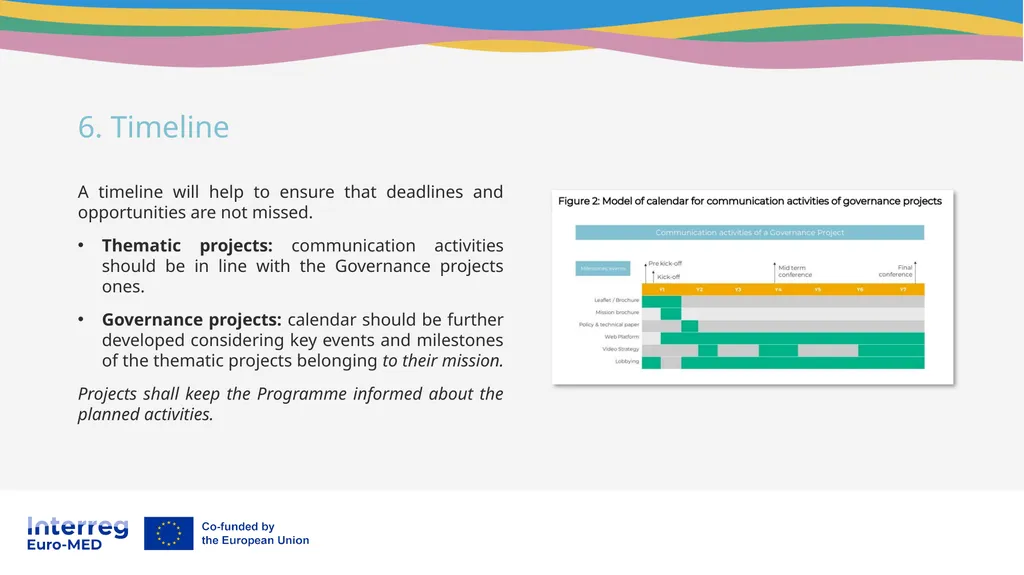
slide14. 6. Timeline A timeline will help to ensure that deadlines and opportunities are not missed.
Thematic projects: communication activities should be in line with the Governance projects ones.
Governance projects: calendar should be further developed considering key events and milestones of the thematic projects belonging to their mission.
Projects shall keep the Programme informed about the planned activities.<br>
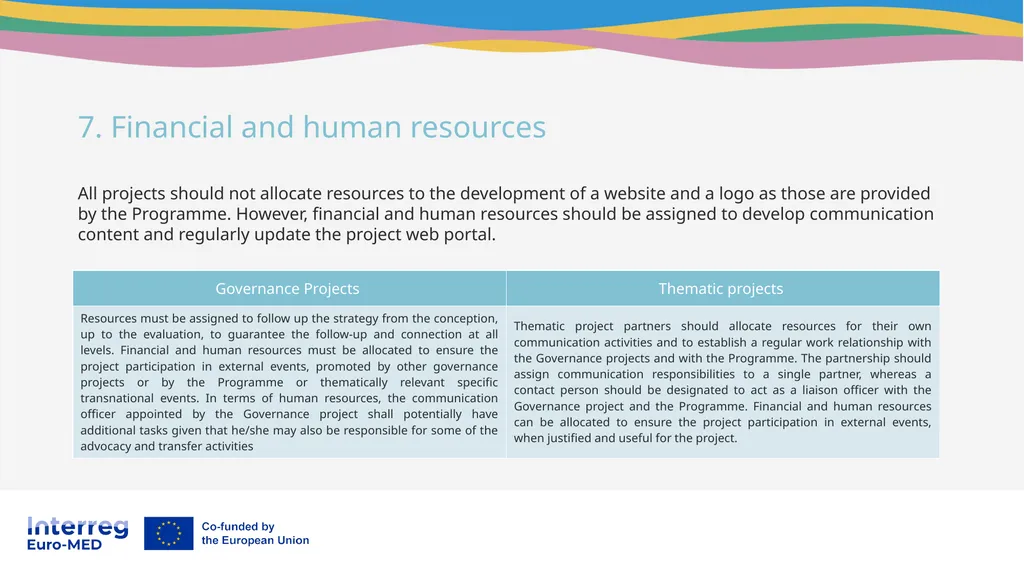
slide15. 7. Financial and human resources All projects should not allocate resources to the development of a website and a logo as those are provided by the Programme. However, financial and human resources should be assigned to develop communication content and regularly update the project web portal.<br>
slide16. 8. Evaluation It is highly important to assess the effectiveness of a communication strategy to know whether the objectives have been met, which activities were successful and which ones should be improved or left aside.
The communication evaluation criteria, indicators, measures and methods, during the operation and at its closure have to be defined in line with the project specific and communication objectives.
In order to assess its real impact also in the area of communication, the Programme requires projects to complete a report once a year. At this link (as an example) you will find the data that will be required.<br>
How to draft a communication strategy<br>
slide2. Introduction For the purposes of the Programme, you are required to draft a summary document outlining the key points of your project's communication strategy.
On the following pages you will find a suggested structure for drafting the communication strategy of your project. There are no obligations, although the Programme recommends following this structure, you are free to develop it further and in the medium you prefer (ppt, word, etc.).<br>
slide3. Summary Strategic overview and situation analysis
Objectives
Target groups
Channels and tools
Key activities
Timeline
Financial and human resources
Evaluation<br>
slide4. 1. Strategic overview and situation analysis Performing a SWOT analysis will help look realistically at the project’s communications environment and plan accordingly. STRENGTHS: What are the strengths of your project? WEAKNESSES: What are the potential weaknesses of your project? What could be damaging or negative? OPPORTUNITIES: What communications opportunities are there? Is there anything new, different in your project that you could capitalise upon for publicity? THREATS: Are there any potential threats that your project could face? How could this affect your communications and PR activities?<br>
slide5. Your goal is detailed 2. Objectives Communication needs to be goal driven. We communicate to achieve or change something.
The communication objectives derive from the project objectives.
Project’s overall communication objectives can be expressed in short bullet point format and clearly indicate what the project communication will bring to the project.
It is important to define SMART goals that are broad enough to allow flexibility and room to adapt to changing circumstances. Specific S You can quantify your goal Measurable M Your goal is realistic Attainable A Your goal improve your project Relevant R Your goal has a deadline Time-based T<br>
slide6. 3. Target groups All partners need to communicate with several people/organisations who are – or might be – interested in their project and can have an influence on their ability to achieve their goals rapidly and efficiently. Knowing your “target audience” is the main starting point of a communication strategy.
“Who is our target audience in the project?” and more precisely “which target audience do I have to reach in order to achieve the project goals?” are the first questions that project partners should ask themselves. The target groups need to be identified as accurately as possible to ensure that the key messages are transferred to the right audience.<br>
slide7. 3.1 Target groups For this purpose, it is advisable to list and map all the groups or segments of public.
A stakeholder mapping helps prioritise stakeholders in terms of the strength of their interest and the degree of their influence.
A good way to create a stakeholder map is the Mendelow’s matrix (see picture), which shows at a glance which categories of stakeholders demand priority attention.<br>
slide8. 4. Channels and tools Project partners need to define the channels that they will use to achieve their objectives and set in place a work plan. The choice of the channels must address the targets in an effective manner.
It is up to the project to decide which channels other than the Interreg Euro-MED Programme web platform are the most appropriate to reach their target audience.
There is a wide variety of channels, each with different purposes.<br>
slide9. 5. Key activities Once the channels selected in the communication strategy, project partners may define the key activities that will help them achieve their communication objectives.
The details of the activities will be further elaborated in the annual communication plan if applicable.
All activities must comply with EU and Programme publicity and information rules (Cf Chapter III. A. Eligibility of expenditures - viii Project branding and information and publicity rules of this manual).<br>
slide10. 5.1 Key activities - Governance Management/regular update of the mission website;
Each Mission have to publish 1 Media Kit on the website;
Social media communication of/for the mission and active participation of the governance project in the Programme social media communication;
Participation of the project communication officers in the Interreg Euro-MED communication working group;
Publication of one mission brochure after 18 months of implementation of the project;
Publication of short summary of the selected mission projects 6 months after their respective start;
Publication of one video of the mission (promotional videos, coverage, video streaming of the events);
Organisation of thematic events (involving projects and coordinated with the Programme) and key events (as preparatory meeting, official kick-off, mid-term conference, final conference);
Participation in Programme events and active contribution (with possible co-organisation);
Presentation at and contribution to external events (with thematic projects and other missions etc.);
Public Relations and press relations;
Advocacy activities with relevant international networks and at the EP/CoR/EC, if needed be but not only.<br>
slide11. 5.2 Key activities - Thematic Management/regular update of the project website provided by the Programme;
Publish 1 Media Kit on the website;
Publication of at least one short video presenting the project (30 sec up to 1min maximum);
Publication of at least one final promotional item presenting the project results and tailored to the main target;
At least one promotional activity to promote the final result(s) (as social media campaign, an event, exhibition, seminar);
Presentation at and contribution to external events (as with other projects, the community of projects);
At least one activity targeted to the general public, possibly via local, regional or specialised media, in line with the target;
Participation in information and training seminars (and/or following guidance provided) organised by the Programme;
Web platform trainings (Communication trainings, other capacity building seminars).<br>
slide12. 5.3 Key activities – Study & Test Publish 1 short project summary targeting the general public in both languages: French and English (Technical studies and tests may be difficult to understand by a non-specialised audience. Therefore, project partners are highly recommended to use an accessible language and a user-friendly format to make the whole concept and its details easily understandable);
Results of analyses, studies and tests shall be communicated to projects target groups in the most adapted ways, according to the practices of the targets;
Study Projects can include the reinforcement or establishment of networks. It is advised to implement specific coordination and information tools to communicate a network to ensure that the members of the network can receive up to date information, exchange, be identified.<br>
slide13. 5.4 Key activities – Transfer Transfer Projects must transfer results from previous projects to territories and targeted beneficiaries.
This means that concrete actions on local or regional level or directed to specific targets should be undertaken to raise awareness of the target public.
Transfer projects shall carry out the following activities that may be strongly linked to their transfer strategy:
Stories, interviews, end user testimonials, images that will nourish communication on several levels;
Seminars or living exhibitions to present demonstrations, experiences, i.e. get the target groups into direct contact or experiencing the subject of the project.
In the case of policy recommendations, an advocacy strategy can be implemented and targeted to local levels of government or to specific targets.
Strategic territorial projects are expected to combine the activities foreseen for the specific modules they are including in the project.
All the activities mentioned above must comply with the EU and Programme communication rules.<br>
slide14. 6. Timeline A timeline will help to ensure that deadlines and opportunities are not missed.
Thematic projects: communication activities should be in line with the Governance projects ones.
Governance projects: calendar should be further developed considering key events and milestones of the thematic projects belonging to their mission.
Projects shall keep the Programme informed about the planned activities.<br>
slide15. 7. Financial and human resources All projects should not allocate resources to the development of a website and a logo as those are provided by the Programme. However, financial and human resources should be assigned to develop communication content and regularly update the project web portal.<br>
slide16. 8. Evaluation It is highly important to assess the effectiveness of a communication strategy to know whether the objectives have been met, which activities were successful and which ones should be improved or left aside.
The communication evaluation criteria, indicators, measures and methods, during the operation and at its closure have to be defined in line with the project specific and communication objectives.
In order to assess its real impact also in the area of communication, the Programme requires projects to complete a report once a year. At this link (as an example) you will find the data that will be required.<br>