
Community Outreach and Systems Change Research for
T
Published · 40 slides · 0 views

1 / 1


Description
Community Outreach and Systems Change Research for Access to Education for Socio-Economically Marginalised Groups in Ireland and Europe Invited Online Lecture, Centre for Engaged Research Lecture Series, June 22, 2022 Professor Paul Downes
Related Topics
Share
Embed code
Download this presentation From Below
"Community Outreach and Systems Change Research for" is the property of its rightful owner. Permission is granted to download and print the materials on this website for personal, non-commercial use only, and to display it on your personal computer provided you do not modify the materials and that you retain all copyright notices contained in the materials. By downloading content from our website, you accept the terms of this agreement.
Presentation Transcript
01
Community Outreach and Systems Change Research for Access to Education for Socio-Economically Marginalised Groups in Ireland and Europe
Invited Online Lecture, Centre for Engaged Research Lecture Series, June 22, 2022
Professor Paul Downes Director, Educational Disadvantage Centre Professor of Psychology of Education Institute of Education Dublin City University, Ireland
Affiliate Professor, Centre for Resilience and Socio-Emotional Health,University of Malta
Advisor to EU Commission on Early School Leaving
paul.downes@dcu.ie<br>
Invited Online Lecture, Centre for Engaged Research Lecture Series, June 22, 2022
Professor Paul Downes Director, Educational Disadvantage Centre Professor of Psychology of Education Institute of Education Dublin City University, Ireland
Affiliate Professor, Centre for Resilience and Socio-Emotional Health,University of Malta
Advisor to EU Commission on Early School Leaving
paul.downes@dcu.ie<br>
02
Marginalisation, Exclusion, Inclusion, Voice and Hierarchies Presupposes a Spatial Understanding (Downes 2020)
Space is a System of Relations – Physical and Relational Space
– Space is not simply Place !
Reconfiguration of Space – Physical and Relational – for
Engaged Research to Bridge Research-Practice-Policy Divide
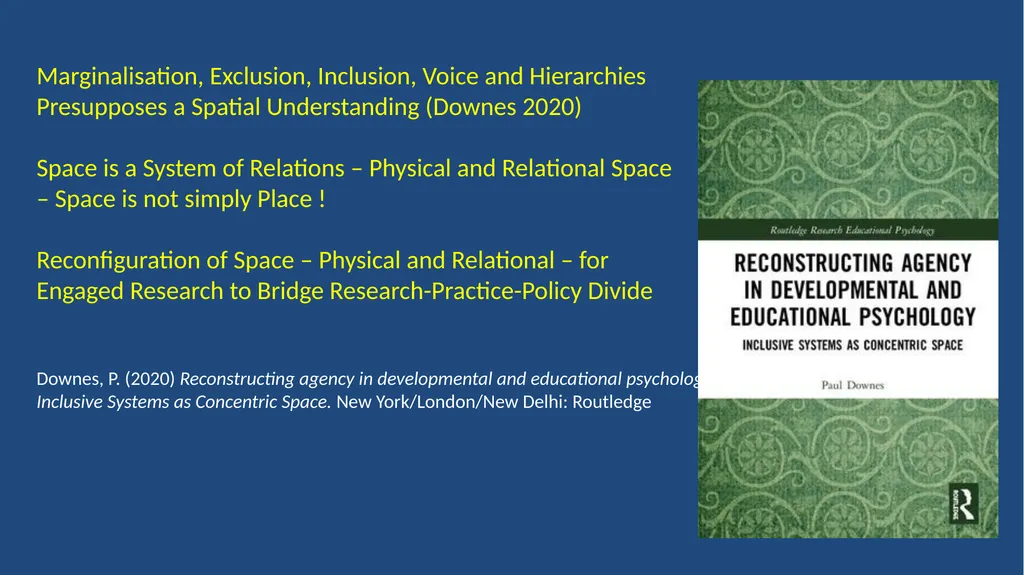
Downes, P. (2020) Reconstructing agency in developmental and educational psychology: Inclusive Systems as Concentric Space. New York/London/New Delhi: Routledge<br>
Space is a System of Relations – Physical and Relational Space
– Space is not simply Place !
Reconfiguration of Space – Physical and Relational – for
Engaged Research to Bridge Research-Practice-Policy Divide
Downes, P. (2020) Reconstructing agency in developmental and educational psychology: Inclusive Systems as Concentric Space. New York/London/New Delhi: Routledge<br>
03
Child-Centred Community Wide Consultations
Downes, P. (2004). Psychological support services for Ballyfermot: Present and future. Commissioned Research Report for European Union funded organisation, URBAN, Ballyfermot,
in conjunction with Ballyfermot Drugs Task Force.
* 342 questionnaires (180 girls, 162 boys) were returned in total from the primary schools in Ballyfermot: 20 focus groups were held in the primary schools
* 12 focus groups and 173 questionnaire responses from secondary students
*Interviews with local community services, parents, school principals, statutory services,
Downes, P. & Maunsell, C. (2007). Count us in: Tackling early school leaving in South West Inner City Dublin, An integrated response. Commissioned Research Report for South Inner City Community Development Association (SICCDA) & South Inner City Drugs Task Force: Dublin
Downes, P., Maunsell, C., & Ivers, J. (2006). A holistic approach to early school leaving and school retention in Blanchardstown: Current issues and future steps for services and schools. Blanchardstown Area Partnership, Dublin.<br>
Downes, P. (2004). Psychological support services for Ballyfermot: Present and future. Commissioned Research Report for European Union funded organisation, URBAN, Ballyfermot,
in conjunction with Ballyfermot Drugs Task Force.
* 342 questionnaires (180 girls, 162 boys) were returned in total from the primary schools in Ballyfermot: 20 focus groups were held in the primary schools
* 12 focus groups and 173 questionnaire responses from secondary students
*Interviews with local community services, parents, school principals, statutory services,
Downes, P. & Maunsell, C. (2007). Count us in: Tackling early school leaving in South West Inner City Dublin, An integrated response. Commissioned Research Report for South Inner City Community Development Association (SICCDA) & South Inner City Drugs Task Force: Dublin
Downes, P., Maunsell, C., & Ivers, J. (2006). A holistic approach to early school leaving and school retention in Blanchardstown: Current issues and future steps for services and schools. Blanchardstown Area Partnership, Dublin.<br>
04
12 national reports
196 interviews took place in total with members of senior management from 83 education institutions, as well as from senior officials in government departments relevant to lifelong learning in each country.
Sixty- nine of these interviews were with senior representatives from higher education across 30 institutions.
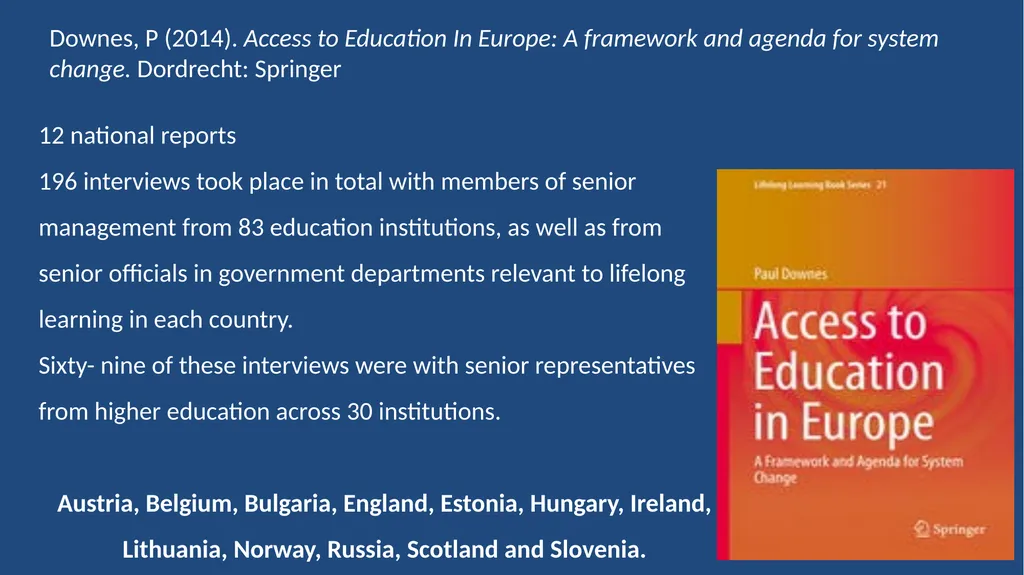
Austria, Belgium, Bulgaria, England, Estonia, Hungary, Ireland, Lithuania, Norway, Russia, Scotland and Slovenia. Downes, P (2014). Access to Education In Europe: A framework and agenda for system change. Dordrecht: Springer<br>
196 interviews took place in total with members of senior management from 83 education institutions, as well as from senior officials in government departments relevant to lifelong learning in each country.
Sixty- nine of these interviews were with senior representatives from higher education across 30 institutions.
Austria, Belgium, Bulgaria, England, Estonia, Hungary, Ireland, Lithuania, Norway, Russia, Scotland and Slovenia. Downes, P (2014). Access to Education In Europe: A framework and agenda for system change. Dordrecht: Springer<br>
05
1. Beyond Bronfenbrenner to address system blockages and power:
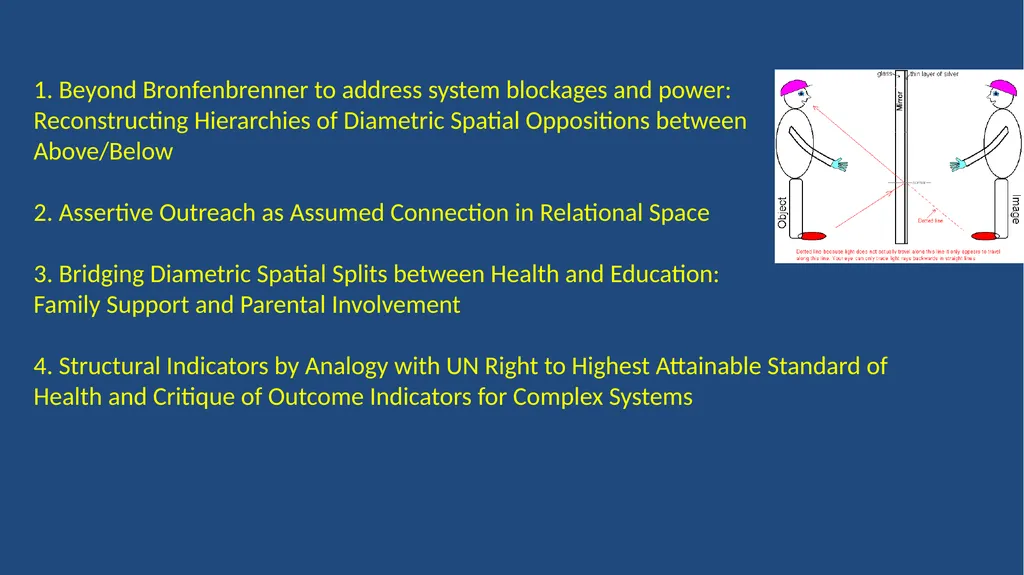
Reconstructing Hierarchies of Diametric Spatial Oppositions between Above/Below
2. Assertive Outreach as Assumed Connection in Relational Space
3. Bridging Diametric Spatial Splits between Health and Education:
Family Support and Parental Involvement
4. Structural Indicators by Analogy with UN Right to Highest Attainable Standard of Health and Critique of Outcome Indicators for Complex Systems<br>
Reconstructing Hierarchies of Diametric Spatial Oppositions between Above/Below
2. Assertive Outreach as Assumed Connection in Relational Space
3. Bridging Diametric Spatial Splits between Health and Education:
Family Support and Parental Involvement
4. Structural Indicators by Analogy with UN Right to Highest Attainable Standard of Health and Critique of Outcome Indicators for Complex Systems<br>
06
System Blockage as Fractured, Broken Spaces of Assumed Separation and Splitting
System blockage is an aspect largely overlooked in Bronfenbrenner’s (1979, 2005) systems theory, while Bronfenbrenner offered a limited account of power in a system (Downes, 2014).
System blockages may involve power-related issues of displacement from “official” system reality, resistance to change at various levels of a system, territoriality, and fragmentation (Downes, 2014)<br>
System blockage is an aspect largely overlooked in Bronfenbrenner’s (1979, 2005) systems theory, while Bronfenbrenner offered a limited account of power in a system (Downes, 2014).
System blockages may involve power-related issues of displacement from “official” system reality, resistance to change at various levels of a system, territoriality, and fragmentation (Downes, 2014)<br>
07
1. Reconstructing Hierarchies of Diametric Spatial Oppositions between Above/Below
Freirean Community Development Principles – Interrogate Community as Unit of Analysis in Spatial Systems terms
Community is a Spatial Concept – Physical and Relational Entwined
Children and Young People’s Voices – UN CRC Art 12
Voice assumes Relational Space ! Child-Centred – UN CRC weak on poverty
Listen !!<br>
Freirean Community Development Principles – Interrogate Community as Unit of Analysis in Spatial Systems terms
Community is a Spatial Concept – Physical and Relational Entwined
Children and Young People’s Voices – UN CRC Art 12
Voice assumes Relational Space ! Child-Centred – UN CRC weak on poverty
Listen !!<br>
08
Empirical Research in Psychology (e.g., ESL, Bullying, Mental Health, Child Development) is Weak on Documenting Background System Support Services at School and Community Levels Affecting Key Variables
A background system focus already takes place to some degree in the socio-ecological approach of Swearer et al. (2010) with a focus on community profile of school attendance in the district, crime etc.
Poverty, mobility, crime, singleparent families, and racial diversity have all been measured and linked to youth outcomes, while US census data has been used on the community profile, as well as area school attendance data and crime statistics (Swearer et al., 2006). The potential utility of smaller units of community analysis has been acknowledged (Swearer et al., 2006).<br>
A background system focus already takes place to some degree in the socio-ecological approach of Swearer et al. (2010) with a focus on community profile of school attendance in the district, crime etc.
Poverty, mobility, crime, singleparent families, and racial diversity have all been measured and linked to youth outcomes, while US census data has been used on the community profile, as well as area school attendance data and crime statistics (Swearer et al., 2006). The potential utility of smaller units of community analysis has been acknowledged (Swearer et al., 2006).<br>
09
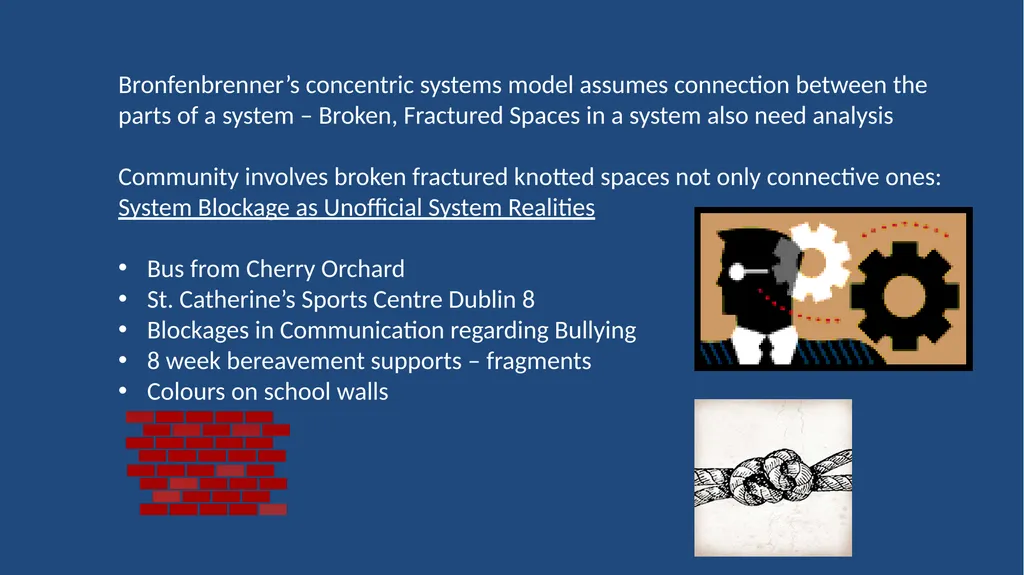
Bronfenbrenner’s concentric systems model assumes connection between the parts of a system – Broken, Fractured Spaces in a system also need analysis
Community involves broken fractured knotted spaces not only connective ones: System Blockage as Unofficial System Realities
Bus from Cherry Orchard
St. Catherine’s Sports Centre Dublin 8
Blockages in Communication regarding Bullying
8 week bereavement supports – fragments
Colours on school walls<br>
Community involves broken fractured knotted spaces not only connective ones: System Blockage as Unofficial System Realities
Bus from Cherry Orchard
St. Catherine’s Sports Centre Dublin 8
Blockages in Communication regarding Bullying
8 week bereavement supports – fragments
Colours on school walls<br>
10
Open Questions – Positions of Power Given to Children and Young People (Downes 2004)
If you had a younger sister or brother, what would be the 3 most important pieces of advice you would give to her/him
If you had the power, what would you change in your school ?
What are the biggest problems your friends have ? How can they be helped ?
In what areas of your life do you feel you are in control, that you have the power?
If you had the possibility not to go to school, would you? Why?
Break up consensus positions of power brokers to allow community and young people to be heard !<br>
If you had a younger sister or brother, what would be the 3 most important pieces of advice you would give to her/him
If you had the power, what would you change in your school ?
What are the biggest problems your friends have ? How can they be helped ?
In what areas of your life do you feel you are in control, that you have the power?
If you had the possibility not to go to school, would you? Why?
Break up consensus positions of power brokers to allow community and young people to be heard !<br>
11
The Russian national report reveals a lack of such involvement from those groups being targeted, according to the response of a senior official of the Committee for Labor and Employment, St. Petersburg:
Let’s go back to the risk target groups. Are their representatives
involved in these committees?
No, not really (Kozlovskiy et al. 2010 ).
I don’t really see how this can be possible. People who design outreach strategies are
the employers of the Committee, those who work here officially. I don’t think we will be
inviting other people to increase our outreach work just because they belong to the category we want to reach (Kozlovskiy et al. 2010 ).<br>
Let’s go back to the risk target groups. Are their representatives
involved in these committees?
No, not really (Kozlovskiy et al. 2010 ).
I don’t really see how this can be possible. People who design outreach strategies are
the employers of the Committee, those who work here officially. I don’t think we will be
inviting other people to increase our outreach work just because they belong to the category we want to reach (Kozlovskiy et al. 2010 ).<br>
12
interviewee in the Hungarian national report: while consultation is obliged by law, this tends to become a formal process rather than being one of substantial voice for diverse groups:
In many other cases strong civilian organisations based on unwritten laws intervene in
discussions. There is a consultation period before decisions are made, when interest groups,
professional circles, and civilian groups can express their views. According to Hungarian
law the consultation is considered to be compulsory. The law defines the ways and modes
of discussions, but in my opinion this is not a real partnership. I think, partnership is, when
the partner organisations are involved right from the beginning of the process of planning
(Balogh et al. 2010 ).
Tokenistic consultation leads to a loss of trust, as highlighted: Hungarian national report
The level of trust is rather low in many areas. A basic precondition of trust is transparent
planning and cooperation and less ad hoc conciliation. The committees or organisations do
not feel that they have a say in most of the issues.<br>
In many other cases strong civilian organisations based on unwritten laws intervene in
discussions. There is a consultation period before decisions are made, when interest groups,
professional circles, and civilian groups can express their views. According to Hungarian
law the consultation is considered to be compulsory. The law defines the ways and modes
of discussions, but in my opinion this is not a real partnership. I think, partnership is, when
the partner organisations are involved right from the beginning of the process of planning
(Balogh et al. 2010 ).
Tokenistic consultation leads to a loss of trust, as highlighted: Hungarian national report
The level of trust is rather low in many areas. A basic precondition of trust is transparent
planning and cooperation and less ad hoc conciliation. The committees or organisations do
not feel that they have a say in most of the issues.<br>
13
Institutional Resistance at National Level
The following response from an Estonian official raises the question as towhether central government wishes to hear voices of those ‘on the ground’ who may offer dissent and conflict with their perspectives, and thereby be labelled
‘destructive’:
Much depends on how active, exuberant and competent local people are. We are interested in partners who can contribute to the process. If a destructive person is appointed we will not be happy but we have to work with that person too …. (Tamm and Saar 2010 ).<br>
The following response from an Estonian official raises the question as towhether central government wishes to hear voices of those ‘on the ground’ who may offer dissent and conflict with their perspectives, and thereby be labelled
‘destructive’:
Much depends on how active, exuberant and competent local people are. We are interested in partners who can contribute to the process. If a destructive person is appointed we will not be happy but we have to work with that person too …. (Tamm and Saar 2010 ).<br>
14
An Access Strategy of Third-Level Institutions Which Engages with Primary and Secondary Students Experiencing Socio-economic Marginalisation
The Scottish national report provides one of the rare examples of a strategic approach to access to education which engages with younger learners, including those at the primary school level:
The college was heavily engaged with local schools with many children from 3rd and 4th. Members of staff had a big involvement with schools: We teach in schools, we run special projects for primary school kids so the kids in school are aware of us from a young age, they are aware of the college and what it does and when it comes time for them to leave school, college is seen as an opportunity for them (Executive Director, College A) (Weedon et al. 2010 ).<br>
The Scottish national report provides one of the rare examples of a strategic approach to access to education which engages with younger learners, including those at the primary school level:
The college was heavily engaged with local schools with many children from 3rd and 4th. Members of staff had a big involvement with schools: We teach in schools, we run special projects for primary school kids so the kids in school are aware of us from a young age, they are aware of the college and what it does and when it comes time for them to leave school, college is seen as an opportunity for them (Executive Director, College A) (Weedon et al. 2010 ).<br>
15
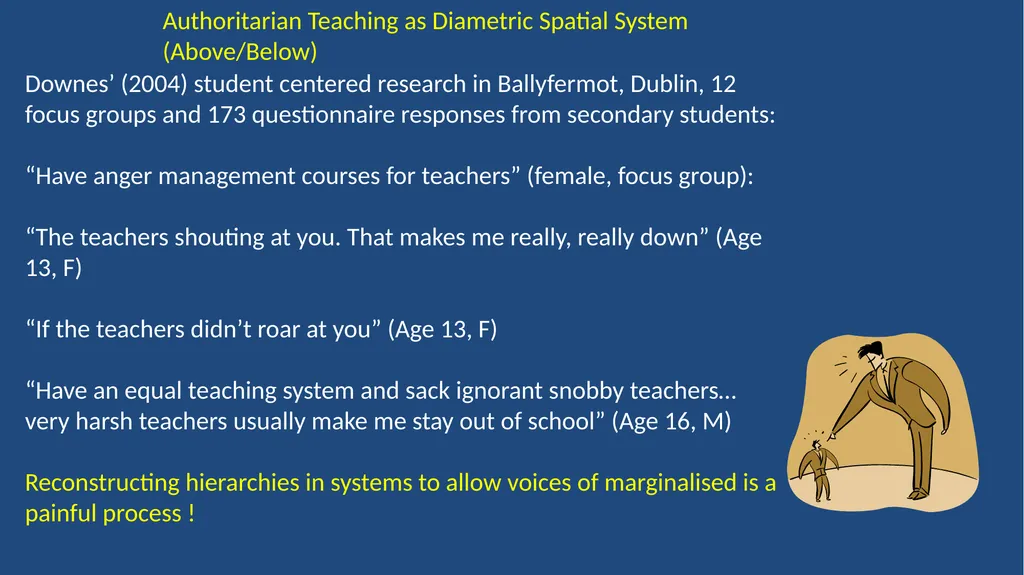
Downes’ (2004) student centered research in Ballyfermot, Dublin, 12 focus groups and 173 questionnaire responses from secondary students:
“Have anger management courses for teachers” (female, focus group):
“The teachers shouting at you. That makes me really, really down” (Age 13, F)
“If the teachers didn’t roar at you” (Age 13, F)
“Have an equal teaching system and sack ignorant snobby teachers…very harsh teachers usually make me stay out of school” (Age 16, M)
Reconstructing hierarchies in systems to allow voices of marginalised is a painful process ! Authoritarian Teaching as Diametric Spatial System (Above/Below)<br>
“Have anger management courses for teachers” (female, focus group):
“The teachers shouting at you. That makes me really, really down” (Age 13, F)
“If the teachers didn’t roar at you” (Age 13, F)
“Have an equal teaching system and sack ignorant snobby teachers…very harsh teachers usually make me stay out of school” (Age 16, M)
Reconstructing hierarchies in systems to allow voices of marginalised is a painful process ! Authoritarian Teaching as Diametric Spatial System (Above/Below)<br>
16
Structural Indicator: Representation of Target Groups (Including Ethnic Minorities in the Decision-Making Structures and Processes at National Level Regarding Access to Education
The Lithuania national report, according to this response from an Education Ministry official:
Are representatives from risk groups involved in a) creation and b) implementation of
strategies and programmes? They are surely involved in implementation; there are working
groups containing representatives from adults’ associations. They are involved in creation,
too—adults’ association creates a strategy. For instance, [representatives] of ethnic minorities give proposals for ethnic minorities [strategy], [representatives] of people with disabilities give them for their integration [strategy]. When there is a common document being arranged, for instance, for examinations’ adaptation—[there were] representatives of the people with disabilities (Taljunaite et al. 2010 ).<br>
The Lithuania national report, according to this response from an Education Ministry official:
Are representatives from risk groups involved in a) creation and b) implementation of
strategies and programmes? They are surely involved in implementation; there are working
groups containing representatives from adults’ associations. They are involved in creation,
too—adults’ association creates a strategy. For instance, [representatives] of ethnic minorities give proposals for ethnic minorities [strategy], [representatives] of people with disabilities give them for their integration [strategy]. When there is a common document being arranged, for instance, for examinations’ adaptation—[there were] representatives of the people with disabilities (Taljunaite et al. 2010 ).<br>
17
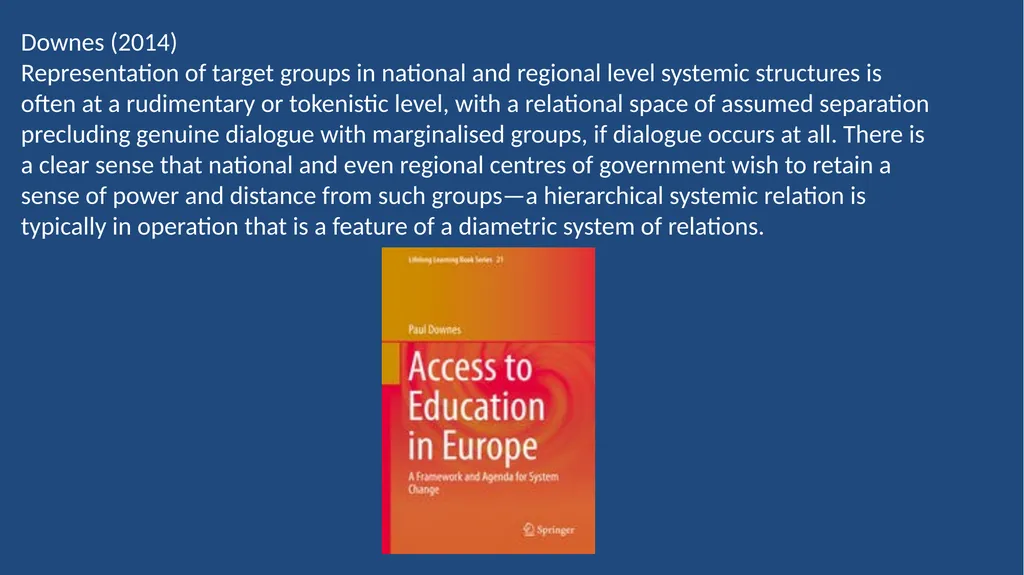
Downes (2014)
Representation of target groups in national and regional level systemic structures is often at a rudimentary or tokenistic level, with a relational space of assumed separation precluding genuine dialogue with marginalised groups, if dialogue occurs at all. There is a clear sense that national and even regional centres of government wish to retain a sense of power and distance from such groups—a hierarchical systemic relation is typically in operation that is a feature of a diametric system of relations.<br>
Representation of target groups in national and regional level systemic structures is often at a rudimentary or tokenistic level, with a relational space of assumed separation precluding genuine dialogue with marginalised groups, if dialogue occurs at all. There is a clear sense that national and even regional centres of government wish to retain a sense of power and distance from such groups—a hierarchical systemic relation is typically in operation that is a feature of a diametric system of relations.<br>
18
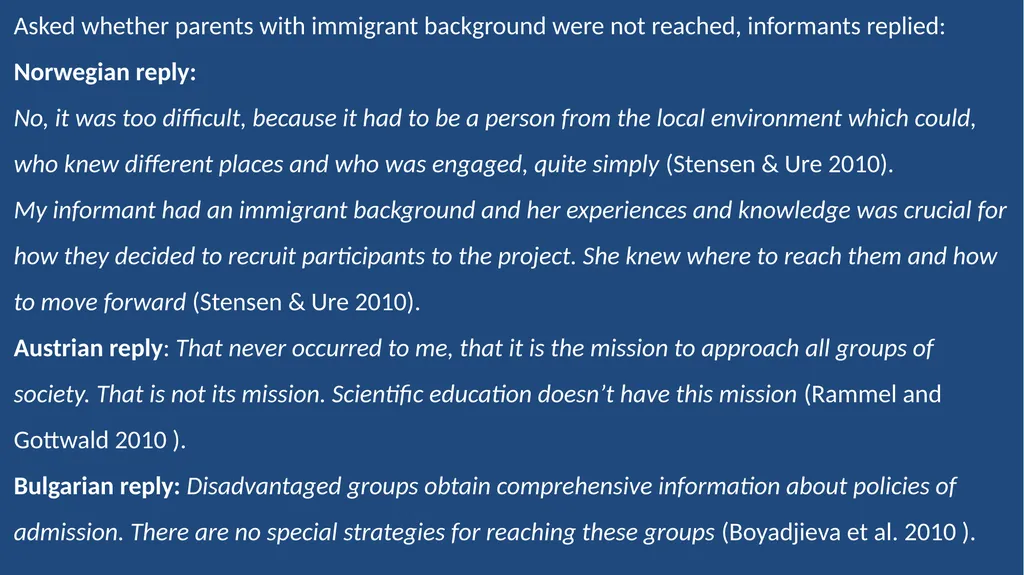
Asked whether parents with immigrant background were not reached, informants replied:
Norwegian reply:
No, it was too difficult, because it had to be a person from the local environment which could, who knew different places and who was engaged, quite simply (Stensen & Ure 2010).
My informant had an immigrant background and her experiences and knowledge was crucial for how they decided to recruit participants to the project. She knew where to reach them and how to move forward (Stensen & Ure 2010).
Austrian reply: That never occurred to me, that it is the mission to approach all groups of society. That is not its mission. Scientific education doesn’t have this mission (Rammel and Gottwald 2010 ).
Bulgarian reply: Disadvantaged groups obtain comprehensive information about policies of admission. There are no special strategies for reaching these groups (Boyadjieva et al. 2010 ).<br>
Norwegian reply:
No, it was too difficult, because it had to be a person from the local environment which could, who knew different places and who was engaged, quite simply (Stensen & Ure 2010).
My informant had an immigrant background and her experiences and knowledge was crucial for how they decided to recruit participants to the project. She knew where to reach them and how to move forward (Stensen & Ure 2010).
Austrian reply: That never occurred to me, that it is the mission to approach all groups of society. That is not its mission. Scientific education doesn’t have this mission (Rammel and Gottwald 2010 ).
Bulgarian reply: Disadvantaged groups obtain comprehensive information about policies of admission. There are no special strategies for reaching these groups (Boyadjieva et al. 2010 ).<br>
19
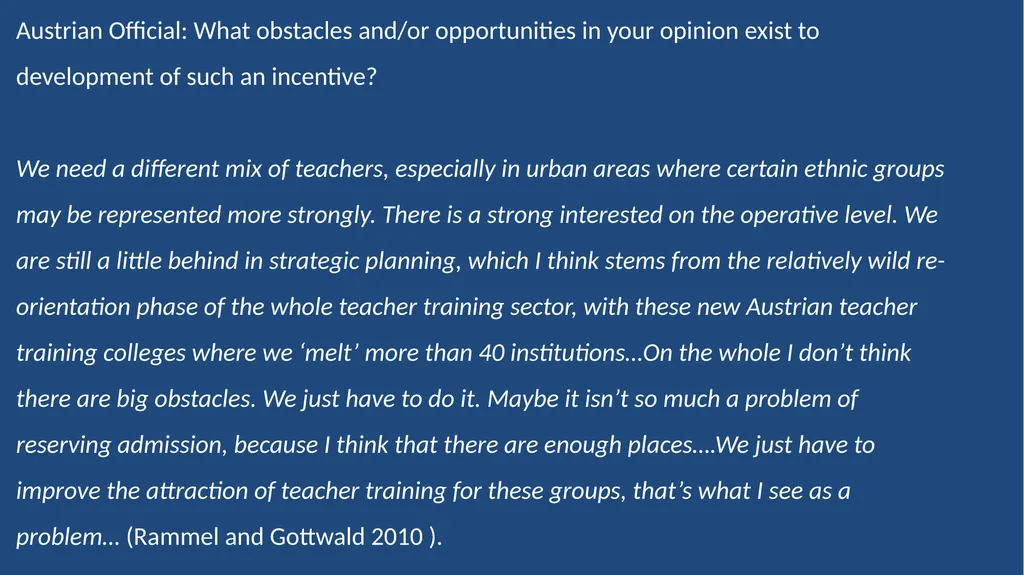
Austrian Official: What obstacles and/or opportunities in your opinion exist to development of such an incentive?
We need a different mix of teachers, especially in urban areas where certain ethnic groups may be represented more strongly. There is a strong interested on the operative level. We are still a little behind in strategic planning, which I think stems from the relatively wild re-orientation phase of the whole teacher training sector, with these new Austrian teacher training colleges where we ‘melt’ more than 40 institutions…On the whole I don’t think there are big obstacles. We just have to do it. Maybe it isn’t so much a problem of reserving admission, because I think that there are enough places….We just have to improve the attraction of teacher training for these groups, that’s what I see as a problem… (Rammel and Gottwald 2010 ).<br>
We need a different mix of teachers, especially in urban areas where certain ethnic groups may be represented more strongly. There is a strong interested on the operative level. We are still a little behind in strategic planning, which I think stems from the relatively wild re-orientation phase of the whole teacher training sector, with these new Austrian teacher training colleges where we ‘melt’ more than 40 institutions…On the whole I don’t think there are big obstacles. We just have to do it. Maybe it isn’t so much a problem of reserving admission, because I think that there are enough places….We just have to improve the attraction of teacher training for these groups, that’s what I see as a problem… (Rammel and Gottwald 2010 ).<br>
20
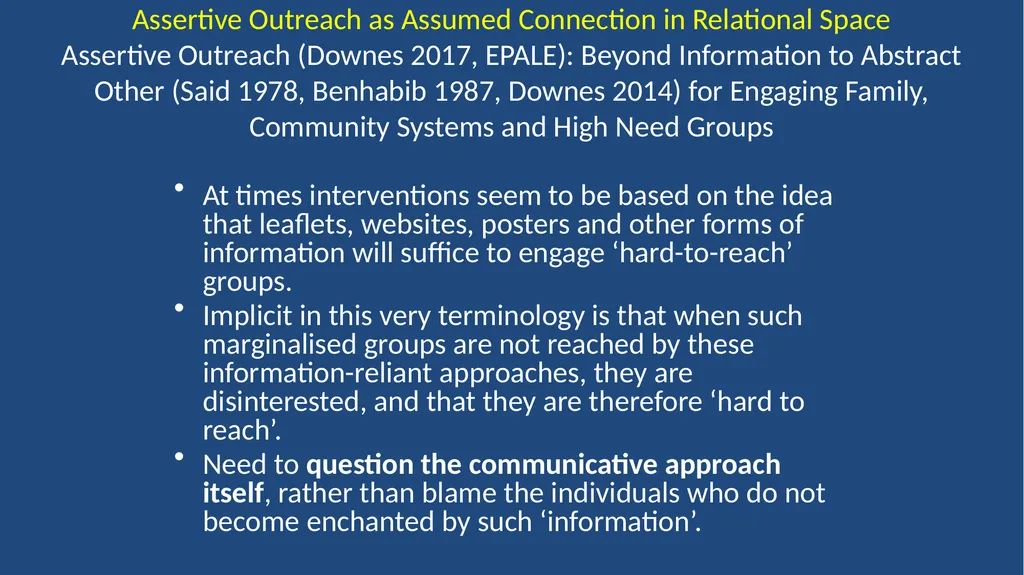
Assertive Outreach as Assumed Connection in Relational Space
Assertive Outreach (Downes 2017, EPALE): Beyond Information to Abstract Other (Said 1978, Benhabib 1987, Downes 2014) for Engaging Family, Community Systems and High Need Groups At times interventions seem to be based on the idea that leaflets, websites, posters and other forms of information will suffice to engage ‘hard-to-reach’ groups.
Implicit in this very terminology is that when such marginalised groups are not reached by these information-reliant approaches, they are disinterested, and that they are therefore ‘hard to reach’.
Need to question the communicative approach itself, rather than blame the individuals who do not become enchanted by such ‘information’.<br>
Implicit in this very terminology is that when such marginalised groups are not reached by these information-reliant approaches, they are disinterested, and that they are therefore ‘hard to reach’.
Need to question the communicative approach itself, rather than blame the individuals who do not become enchanted by such ‘information’.<br>
21
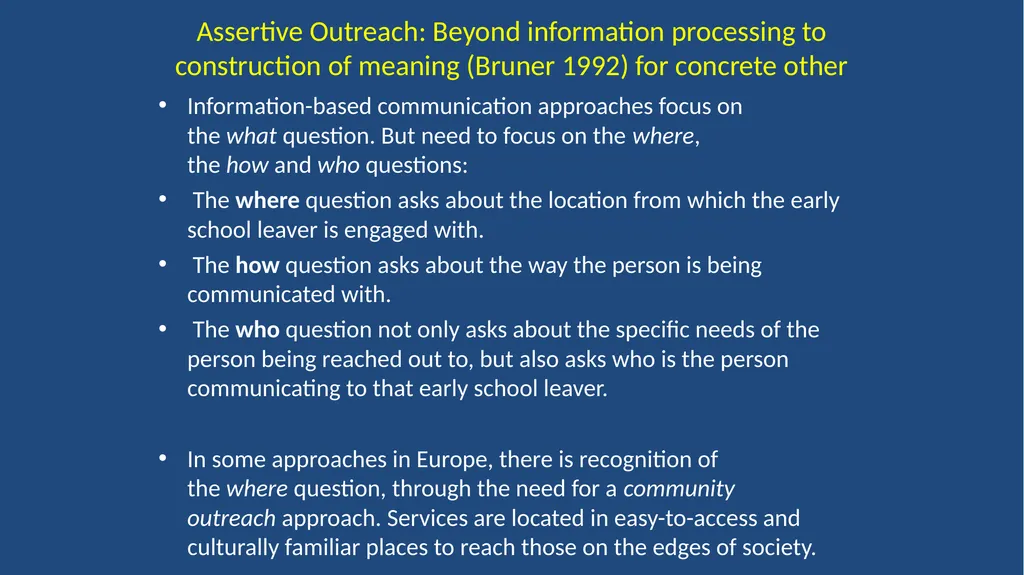
Assertive Outreach: Beyond information processing to construction of meaning (Bruner 1992) for concrete other Information-based communication approaches focus on the what question. But need to focus on the where, the how and who questions:
The where question asks about the location from which the early school leaver is engaged with.
The how question asks about the way the person is being communicated with.
The who question not only asks about the specific needs of the person being reached out to, but also asks who is the person communicating to that early school leaver.
In some approaches in Europe, there is recognition of the where question, through the need for a community outreach approach. Services are located in easy-to-access and culturally familiar places to reach those on the edges of society.<br>
The where question asks about the location from which the early school leaver is engaged with.
The how question asks about the way the person is being communicated with.
The who question not only asks about the specific needs of the person being reached out to, but also asks who is the person communicating to that early school leaver.
In some approaches in Europe, there is recognition of the where question, through the need for a community outreach approach. Services are located in easy-to-access and culturally familiar places to reach those on the edges of society.<br>
22
Structural Indicator: Development of outreach institutional strategies that go beyond mere information based models
The European Commission ( 2006 ) gives emphasis to an information- based approach to reaching those traditionally excluded and alienated from the educational system:
“More information about the advantages of attending higher education is essential, notably for people who do not attempt to enter higher education because they are unaware or unconvinced of the opportunities it affords. (Lee and Miller 2005 ; Studley 2003 ; Botelhoet al. 2001 )” (p. 26)
*The Council Recommendation (April 2013) on the Youth Guarantee appears to broaden this approach slightly through recognition of the need for ‘effective outreach’ and ‘awareness’, when recommending that EU Member States ‘develop effective outreach strategies towards young people, including information and awareness campaigns…’.<br>
The European Commission ( 2006 ) gives emphasis to an information- based approach to reaching those traditionally excluded and alienated from the educational system:
“More information about the advantages of attending higher education is essential, notably for people who do not attempt to enter higher education because they are unaware or unconvinced of the opportunities it affords. (Lee and Miller 2005 ; Studley 2003 ; Botelhoet al. 2001 )” (p. 26)
*The Council Recommendation (April 2013) on the Youth Guarantee appears to broaden this approach slightly through recognition of the need for ‘effective outreach’ and ‘awareness’, when recommending that EU Member States ‘develop effective outreach strategies towards young people, including information and awareness campaigns…’.<br>
23
The weaknesses of informational-type approaches have already been recognised in psychology internationally with regard to drug prevention strategies (Morgan 2001 ).
*Information about different drugs by public authorities tends to have the unintended effect of promoting these drugs<br>
*Information about different drugs by public authorities tends to have the unintended effect of promoting these drugs<br>
24
The Belgian national report highlights the severe limitations to an informational approach to an abstract other:
The Sociale School Heverlee Centrum voor Volwassenenonderwijs vzw (SSH-CVO) also uses printed press (programme brochure, local newspaper, flyers, adverts, documents, etc.) and online tools (such as a website) to increase the access to their educational provision. Although this type of advertisement reaches the most people, a recent evaluation research by the SSH-CVO has shown the effects of this strategy are rather minimal (Vermeersch & Vandenbroucke 2010). It emphasises a role for formal institutions cooperating with community leaders.<br>
The Sociale School Heverlee Centrum voor Volwassenenonderwijs vzw (SSH-CVO) also uses printed press (programme brochure, local newspaper, flyers, adverts, documents, etc.) and online tools (such as a website) to increase the access to their educational provision. Although this type of advertisement reaches the most people, a recent evaluation research by the SSH-CVO has shown the effects of this strategy are rather minimal (Vermeersch & Vandenbroucke 2010). It emphasises a role for formal institutions cooperating with community leaders.<br>
25
Outreach Strategy to Engage Young Migrants and Young Members of a Target Group: Cohort Effect as a Positive Potential
Beyond individual - Social interaction focus
Norwegian national report:
Immigrants’ perception of higher education should be changed. Hence, the solution has been to target specific nationalities, namely young immigrants, their parents and even the community they form part of. The latter point is illustrated by differences between immigrant communities in their propensity to start up higher education studies. In this regard, our informant reports that ethnic communities that are unified, such as Indians, Tamils and Vietnamese, more easily develop a culture emphasising the value of educational skills, while such attitudes are less easily nurtured in, e.g., the more fragmented Somalian community (Stensen and Ure 2010 ) (Downes 2014).<br>
Beyond individual - Social interaction focus
Norwegian national report:
Immigrants’ perception of higher education should be changed. Hence, the solution has been to target specific nationalities, namely young immigrants, their parents and even the community they form part of. The latter point is illustrated by differences between immigrant communities in their propensity to start up higher education studies. In this regard, our informant reports that ethnic communities that are unified, such as Indians, Tamils and Vietnamese, more easily develop a culture emphasising the value of educational skills, while such attitudes are less easily nurtured in, e.g., the more fragmented Somalian community (Stensen and Ure 2010 ) (Downes 2014).<br>
26
Assertive Inreach: Availability of school and university institutions free of charge during summertime and evenings for community groups from marginalised areas
The Slovenian national report provides an example where an educational institution makes its rooms available free of charge for community groups:
Institution’s building is available for evening and summer events for many associations. Especially
in the summer time, they can use it in the evenings for their meetings, lectures etc. Yes, they also use it. Various societies use lecture rooms, above all as a place for their meetings (Ivančič et al. 2010 )
Institution is open regarding availability for evening and summer events for the local community and/or target groups. There is no problem to give other profit or non-profit organisations rooms, when they are free. They do that free of charge, they do not demand any money for that (Ivančič et al. 2010 )<br>
The Slovenian national report provides an example where an educational institution makes its rooms available free of charge for community groups:
Institution’s building is available for evening and summer events for many associations. Especially
in the summer time, they can use it in the evenings for their meetings, lectures etc. Yes, they also use it. Various societies use lecture rooms, above all as a place for their meetings (Ivančič et al. 2010 )
Institution is open regarding availability for evening and summer events for the local community and/or target groups. There is no problem to give other profit or non-profit organisations rooms, when they are free. They do that free of charge, they do not demand any money for that (Ivančič et al. 2010 )<br>
27
Regarding the practical use of [State] university building [in Lithuania], it is being used in summer though the process could be even better elaborated. According to interviews it is obvious that there is no systematic use of the building. Some small groups coming for language courses are using the building in summer (Taljunaite et al. 2010 )
In Bulgaria, this issue is constructed in terms of institutional autonomy, and
availability of university premises to community groups is only if it is paid for:
The College establishes contacts with disadvantaged groups in order to improve their accessto higher education by: … organising visits to different schools and discussions with students.
[…] The college’s buildings may be rented to members of the local community for different
social events. (Boyadjieva et al. 2010 )<br>
In Bulgaria, this issue is constructed in terms of institutional autonomy, and
availability of university premises to community groups is only if it is paid for:
The College establishes contacts with disadvantaged groups in order to improve their accessto higher education by: … organising visits to different schools and discussions with students.
[…] The college’s buildings may be rented to members of the local community for different
social events. (Boyadjieva et al. 2010 )<br>
28
3. Bridging Diametric Spatial Splits between Health and Education:
Family Support and Parental Involvement
The Emotional-Relational Turn for ESL and Inclusive
Systems : Bridging health and education (Downes & Gilligan 2007, Downes & Maunsell 2007, Downes, Nairz-Wirth & Rusinaite 2017)
Simply reframing school dropout as a health issue has the potential to bring new players into the effort — parents, health institutions, young people, civil rights groups — and to encourage public officials to think of the dropout problem as central to community health and as a long-term solution beneficial to population health (Freudenberg and Ruglis 2007)<br>
Family Support and Parental Involvement
The Emotional-Relational Turn for ESL and Inclusive
Systems : Bridging health and education (Downes & Gilligan 2007, Downes & Maunsell 2007, Downes, Nairz-Wirth & Rusinaite 2017)
Simply reframing school dropout as a health issue has the potential to bring new players into the effort — parents, health institutions, young people, civil rights groups — and to encourage public officials to think of the dropout problem as central to community health and as a long-term solution beneficial to population health (Freudenberg and Ruglis 2007)<br>
29
Beyond Epstein – Integrating Health and Education to go beyond Diametric Spatial Split as Knots and Walls
= Joint Strategy for Family Support and Parental Involvement
Epstein’s (2001) ‘Framework of Parental Involvement’ identifies six ways in which schools and parents can be involved
i.e. Parenting, Communicating, Volunteering,
Learning at home, Decision Making, Collaborating with the Community.<br>
= Joint Strategy for Family Support and Parental Involvement
Epstein’s (2001) ‘Framework of Parental Involvement’ identifies six ways in which schools and parents can be involved
i.e. Parenting, Communicating, Volunteering,
Learning at home, Decision Making, Collaborating with the Community.<br>
30
Bringing together a common strategy for Parental Involvement and Family Support - bridging education and health domains
family support services and education of parents regarding their approaches to communication and supportive discipline with their children,
outreach to families to provide supports (Familibase Morning Programme of Home Visits)
Challenge System Blockage of Parallel Discourses ‘Side-by-Side’ as Diametric Opposition and Splits in Communication<br>
family support services and education of parents regarding their approaches to communication and supportive discipline with their children,
outreach to families to provide supports (Familibase Morning Programme of Home Visits)
Challenge System Blockage of Parallel Discourses ‘Side-by-Side’ as Diametric Opposition and Splits in Communication<br>
31
Overcoming System Blockages as Fragmentation, Resistance and Exclusion– linking health and education
Multidisciplinary teams: Chronic need indicated prevention level
Family support services and parental involvement The Alliances for Inclusion report (Edwards & Downes 2013) 16 examples of cross-sectoral work from 10 European countries.
-A policy focus is needed to go beyond multiple agencies
-Need to minimise fragmentation across diverse services ‘passing on bits of the child’ and family (Edwards & Downes 2013)
- Direct delivery multidisciplinary teams – not committee sitting
Territories
Local rivalries across municipalities and schools
an obstacle to sharing of good practice
Local rivalries across agencies especially in a
recession – to claim resources and credit for gains<br>
Multidisciplinary teams: Chronic need indicated prevention level
Family support services and parental involvement The Alliances for Inclusion report (Edwards & Downes 2013) 16 examples of cross-sectoral work from 10 European countries.
-A policy focus is needed to go beyond multiple agencies
-Need to minimise fragmentation across diverse services ‘passing on bits of the child’ and family (Edwards & Downes 2013)
- Direct delivery multidisciplinary teams – not committee sitting
Territories
Local rivalries across municipalities and schools
an obstacle to sharing of good practice
Local rivalries across agencies especially in a
recession – to claim resources and credit for gains<br>
32
Beyond Diametric Splits between Education and Health (Downes 2020): Sleep Loss invisible in DEIS and BOBF
Promoting Adequate Sleep for Students Most children need at least 9 hours of restful sleep each night (Taras and Potts-Datema, 2005).
Impact on the wide spectrum of cognitive functioning, including attention, reasoning and memory, moreover during prolonged periods of sleep restriction, the negative effects accumulate (de Bruin et al, 2016).
Sleep deficiency is interwoven in complex ways with substance abuse (Loureiro et al., 2014), aggressive behaviours (Lemola et al., 2012)<br>
Impact on the wide spectrum of cognitive functioning, including attention, reasoning and memory, moreover during prolonged periods of sleep restriction, the negative effects accumulate (de Bruin et al, 2016).
Sleep deficiency is interwoven in complex ways with substance abuse (Loureiro et al., 2014), aggressive behaviours (Lemola et al., 2012)<br>
33
Other key steps in this proposed post-pandemic social contract between health and education are the successive Programme for Government commitments to speech and language therapists and occupational therapists onsite in schools (recommended in Educational Disadvantage Centre/CDI Tallaght briefing papers in 2016) that need to be expanded beyond pilot projects across DEIS schools.
Even with this reconfiguration of educationally relevant health services for Irish schools, Ireland still lags far behind the standards of, for example, Denmark, which provides a multidisciplinary team for every school. A New Post-Pandemic Social Contract between Health and Education in Ireland<br>
Even with this reconfiguration of educationally relevant health services for Irish schools, Ireland still lags far behind the standards of, for example, Denmark, which provides a multidisciplinary team for every school. A New Post-Pandemic Social Contract between Health and Education in Ireland<br>
34
Familiscope Colocation of Services – Both/And – Both Community and School Based
In the National Economic and Social Forum (NESF) report on Child Literacy and Social Inclusion (2009), Familiscope is cited as an example of good practice in a range of areas – as an example of projects a) incorporating broader developmental approaches of arts and culture activities, b) customized literacy-based approaches through speech and language therapy, and of projects c) driven by the public policy area of health, d) through systematic evidence-based planning and as an example of an e) innovative area-based cross-sectoral approach.
The Irish Oireachtas (Parliament and Senate) Joint Committee on Education and Science Report on Early School Leaving 2010 explicitly cited Familiscope as a model of good practice nationally
The Irish Department of Children and Youth Affairs selected Familiscope as a model initiative for the New Zealand Minister for Social Development, Paula Bennett to visit in 2013
*Familiscope’s three level systemic speech and language model (child, parent, teacher) was the basis for CDI Tallaght’s model subsequently evaluated positively and part of DES national pilot school based model.
* Familibase part of Romanian EU Presidency (2019) Forum good practice example of combining multidisciplinary team and community lifelong learning centre<br>
In the National Economic and Social Forum (NESF) report on Child Literacy and Social Inclusion (2009), Familiscope is cited as an example of good practice in a range of areas – as an example of projects a) incorporating broader developmental approaches of arts and culture activities, b) customized literacy-based approaches through speech and language therapy, and of projects c) driven by the public policy area of health, d) through systematic evidence-based planning and as an example of an e) innovative area-based cross-sectoral approach.
The Irish Oireachtas (Parliament and Senate) Joint Committee on Education and Science Report on Early School Leaving 2010 explicitly cited Familiscope as a model of good practice nationally
The Irish Department of Children and Youth Affairs selected Familiscope as a model initiative for the New Zealand Minister for Social Development, Paula Bennett to visit in 2013
*Familiscope’s three level systemic speech and language model (child, parent, teacher) was the basis for CDI Tallaght’s model subsequently evaluated positively and part of DES national pilot school based model.
* Familibase part of Romanian EU Presidency (2019) Forum good practice example of combining multidisciplinary team and community lifelong learning centre<br>
35
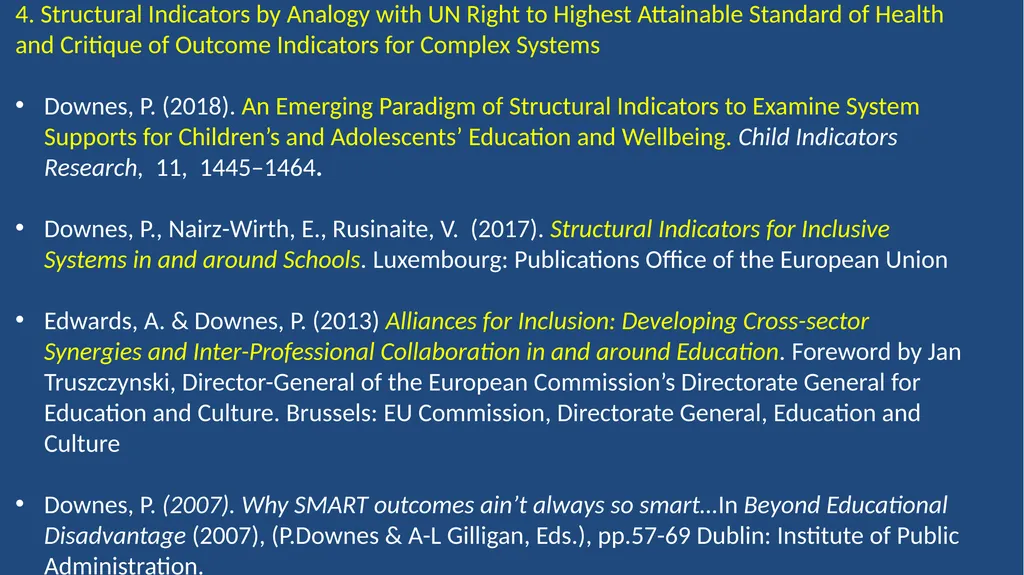
4. Structural Indicators by Analogy with UN Right to Highest Attainable Standard of Health and Critique of Outcome Indicators for Complex Systems
Downes, P. (2018). An Emerging Paradigm of Structural Indicators to Examine System Supports for Children’s and Adolescents’ Education and Wellbeing. Child Indicators Research, 11, 1445–1464.
Downes, P., Nairz-Wirth, E., Rusinaite, V. (2017). Structural Indicators for Inclusive Systems in and around Schools. Luxembourg: Publications Office of the European Union
Edwards, A. & Downes, P. (2013) Alliances for Inclusion: Developing Cross-sector Synergies and Inter-Professional Collaboration in and around Education. Foreword by Jan Truszczynski, Director-General of the European Commission’s Directorate General for Education and Culture. Brussels: EU Commission, Directorate General, Education and Culture
Downes, P. (2007). Why SMART outcomes ain’t always so smart…In Beyond Educational Disadvantage (2007), (P.Downes & A-L Gilligan, Eds.), pp.57-69 Dublin: Institute of Public Administration.<br>
Downes, P. (2018). An Emerging Paradigm of Structural Indicators to Examine System Supports for Children’s and Adolescents’ Education and Wellbeing. Child Indicators Research, 11, 1445–1464.
Downes, P., Nairz-Wirth, E., Rusinaite, V. (2017). Structural Indicators for Inclusive Systems in and around Schools. Luxembourg: Publications Office of the European Union
Edwards, A. & Downes, P. (2013) Alliances for Inclusion: Developing Cross-sector Synergies and Inter-Professional Collaboration in and around Education. Foreword by Jan Truszczynski, Director-General of the European Commission’s Directorate General for Education and Culture. Brussels: EU Commission, Directorate General, Education and Culture
Downes, P. (2007). Why SMART outcomes ain’t always so smart…In Beyond Educational Disadvantage (2007), (P.Downes & A-L Gilligan, Eds.), pp.57-69 Dublin: Institute of Public Administration.<br>
36
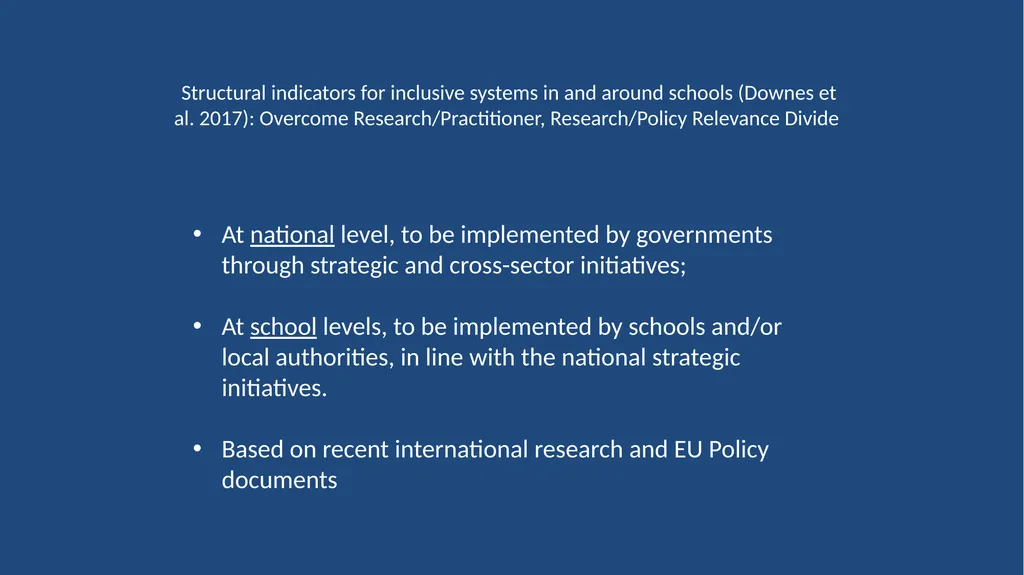
Structural indicators for inclusive systems in and around schools (Downes et al. 2017): Overcome Research/Practitioner, Research/Policy Relevance Divide At national level, to be implemented by governments through strategic and cross-sector initiatives;
At school levels, to be implemented by schools and/or local authorities, in line with the national strategic initiatives.
Based on recent international research and EU Policy documents<br>
At school levels, to be implemented by schools and/or local authorities, in line with the national strategic initiatives.
Based on recent international research and EU Policy documents<br>
37
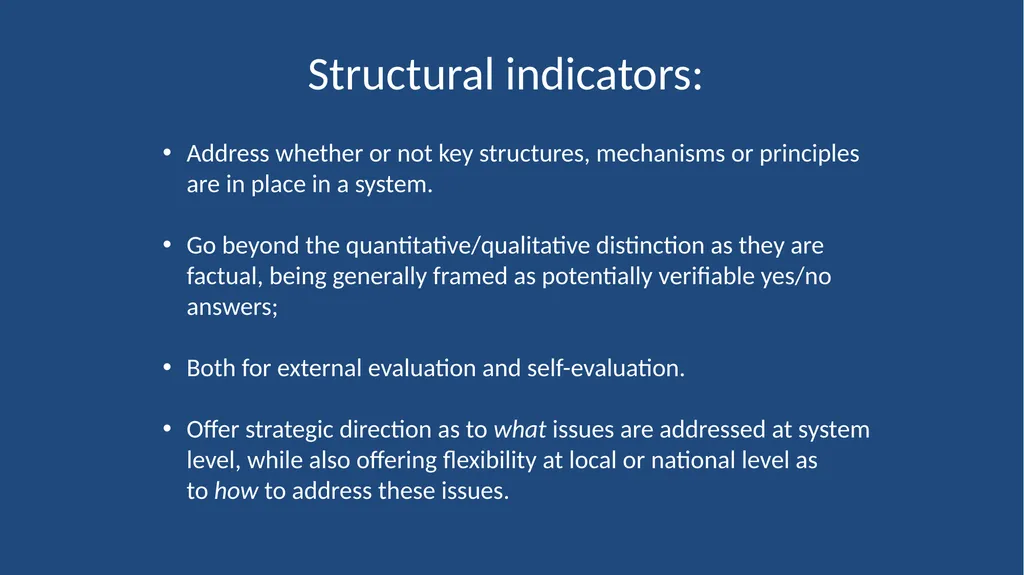
Structural indicators: Address whether or not key structures, mechanisms or principles are in place in a system.
Go beyond the quantitative/qualitative distinction as they are factual, being generally framed as potentially verifiable yes/no answers;
Both for external evaluation and self-evaluation.
Offer strategic direction as to what issues are addressed at system level, while also offering flexibility at local or national level as to how to address these issues.<br>
Go beyond the quantitative/qualitative distinction as they are factual, being generally framed as potentially verifiable yes/no answers;
Both for external evaluation and self-evaluation.
Offer strategic direction as to what issues are addressed at system level, while also offering flexibility at local or national level as to how to address these issues.<br>
38
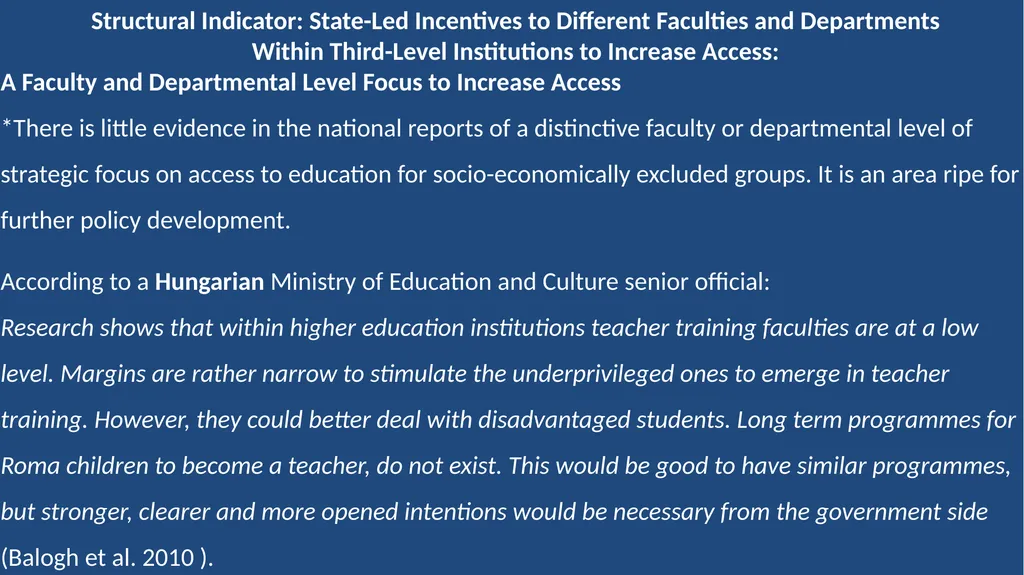
Structural Indicator: State-Led Incentives to Different Faculties and Departments
Within Third-Level Institutions to Increase Access:
A Faculty and Departmental Level Focus to Increase Access
*There is little evidence in the national reports of a distinctive faculty or departmental level of strategic focus on access to education for socio-economically excluded groups. It is an area ripe for further policy development.
According to a Hungarian Ministry of Education and Culture senior official:
Research shows that within higher education institutions teacher training faculties are at a low level. Margins are rather narrow to stimulate the underprivileged ones to emerge in teacher training. However, they could better deal with disadvantaged students. Long term programmes for Roma children to become a teacher, do not exist. This would be good to have similar programmes, but stronger, clearer and more opened intentions would be necessary from the government side (Balogh et al. 2010 ).<br>
Within Third-Level Institutions to Increase Access:
A Faculty and Departmental Level Focus to Increase Access
*There is little evidence in the national reports of a distinctive faculty or departmental level of strategic focus on access to education for socio-economically excluded groups. It is an area ripe for further policy development.
According to a Hungarian Ministry of Education and Culture senior official:
Research shows that within higher education institutions teacher training faculties are at a low level. Margins are rather narrow to stimulate the underprivileged ones to emerge in teacher training. However, they could better deal with disadvantaged students. Long term programmes for Roma children to become a teacher, do not exist. This would be good to have similar programmes, but stronger, clearer and more opened intentions would be necessary from the government side (Balogh et al. 2010 ).<br>
39
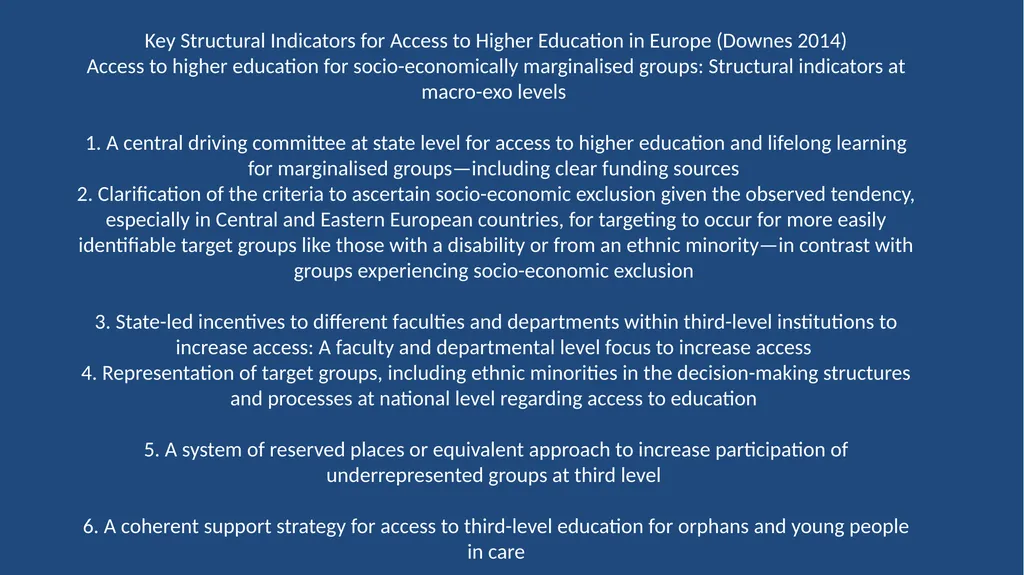
Key Structural Indicators for Access to Higher Education in Europe (Downes 2014)
Access to higher education for socio-economically marginalised groups: Structural indicators at macro-exo levels
1. A central driving committee at state level for access to higher education and lifelong learning for marginalised groups—including clear funding sources
2. Clarification of the criteria to ascertain socio-economic exclusion given the observed tendency, especially in Central and Eastern European countries, for targeting to occur for more easily identifiable target groups like those with a disability or from an ethnic minority—in contrast with groups experiencing socio-economic exclusion
3. State-led incentives to different faculties and departments within third-level institutions to increase access: A faculty and departmental level focus to increase access
4. Representation of target groups, including ethnic minorities in the decision-making structures and processes at national level regarding access to education
5. A system of reserved places or equivalent approach to increase participation of underrepresented groups at third level
6. A coherent support strategy for access to third-level education for orphans and young people in care<br>
40
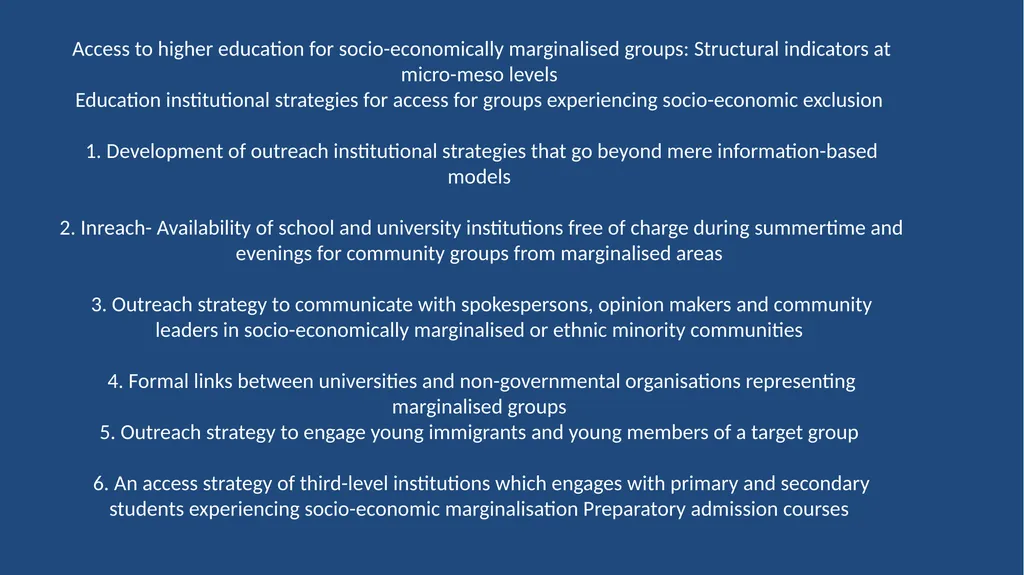
Access to higher education for socio-economically marginalised groups: Structural indicators at micro-meso levels
Education institutional strategies for access for groups experiencing socio-economic exclusion
1. Development of outreach institutional strategies that go beyond mere information-based models
2. Inreach- Availability of school and university institutions free of charge during summertime and evenings for community groups from marginalised areas
3. Outreach strategy to communicate with spokespersons, opinion makers and community leaders in socio-economically marginalised or ethnic minority communities
4. Formal links between universities and non-governmental organisations representing marginalised groups
5. Outreach strategy to engage young immigrants and young members of a target group
6. An access strategy of third-level institutions which engages with primary and secondary students experiencing socio-economic marginalisation Preparatory admission courses<br>