Community Recommendations to the Global Fund Partnership: War-Affected Circumstances in Ukraine and Eastern Europe Vitaly Djuma Consultation on defining EECA strategic priorities for 2023-2025 allocation period, Global Fund 3 October,
"Community Recommendations to the Global Fund" is the property of its rightful owner. Permission is granted to
download and print the materials on this website for personal, non-commercial use only, and to display it
on your personal computer provided you do not modify the materials and that you retain all copyright
notices contained in the materials. By downloading content from our website, you accept the terms of this
agreement.
Presentation Transcript
01
Community Recommendations to the Global Fund Partnership: War-Affected Circumstances in Ukraine and Eastern Europe Vitaly Djuma
Consultation on defining EECA strategic priorities for 2023-2025 allocation period, Global Fund
3 October, Geneva, Switzerland<br>
02
Key Messages Possible substantial domestic HIV and TB funding deficits
New urgent needs of PLHIV, people with TB and key populations related to the effects of the war in Ukraine
Sustainability of civil society and community-led organizations under threat
Possible negative impact of the war on epidemiology of HIV, TB in Ukraine and other countries incl. in Central Europe.
Civil society to treat the Global Fund as an advocacy partner rather than an advocacy target
Severely limited technical support for communities and civil society<br>
03
1. Increasing Financial Support to HIV and TB responses in EECA in NFM4 The Global Fund Board and Secretariat:
Increase NFM4 funding or prioritize adjustments in the above allocation requests;
Support fundraising skills of regional and national community-led and civil society networks;
Increase the Emergency Fund: another US$15 million for Ukraine in 2023; in the current emergency grant - more focus on the KPs needs
CCMs:
Ambitious funding requests with focus on prevention and treatment-related needs of communities, community systems strengthening, overcoming legal barriers and addressing gender inequalities.<br>
04
2. Adjusting Community Advocacy and HIV/TB Service Provision in EECA The Global Fund Board and Secretariat:
Simplified reprogramming for national HIV and TB programs in affected countries
Continuation of access to treatment and support for clients of GF supported programs - refugees in GF ineligible countries; allow this in the NFM4 funding requests from eligible counties
CCMs to include and prioritize:
Mental health services and prevention of staff burnout;
Advocacy responses to worsening situation of key populations (KP);
Protection of the rights of KPs, incl. those among internally displaced people and refugees;
Reprogramming to address emerging urgent needs
Technical partners and other donors (incl. UNAIDS TSM, USAID, GIZ, Expertise France):
Adjustment of service packages for PLHIV, people with TB and KPs;
Advocacy to address worsening situation of KPs, discrimination, violence and social inequality<br>
05
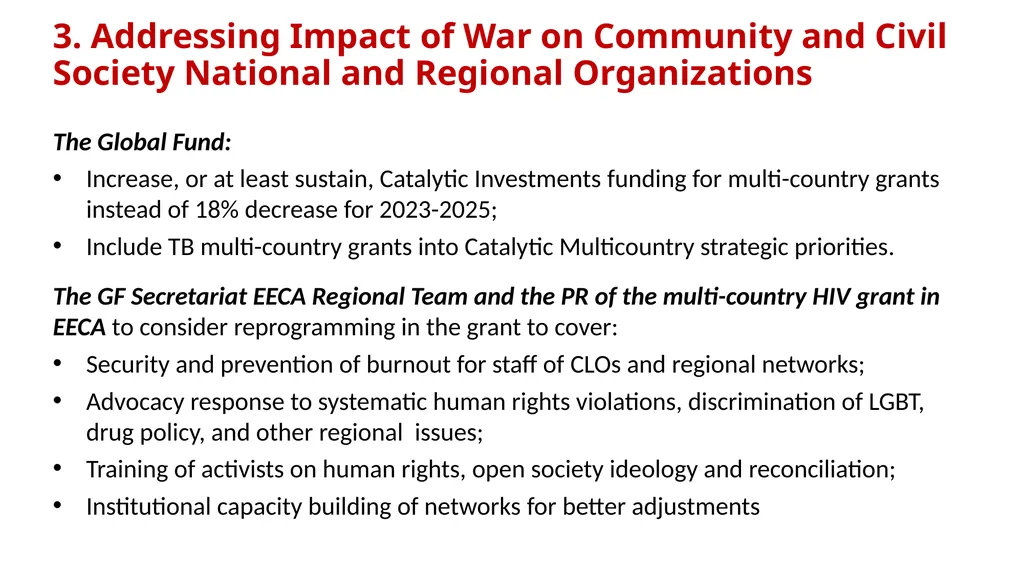
3. Addressing Impact of War on Community and Civil Society National and Regional Organizations The Global Fund:
Increase, or at least sustain, Catalytic Investments funding for multi-country grants instead of 18% decrease for 2023-2025;
Include TB multi-country grants into Catalytic Multicountry strategic priorities.
The GF Secretariat EECA Regional Team and the PR of the multi-country HIV grant in EECA to consider reprogramming in the grant to cover:
Security and prevention of burnout for staff of CLOs and regional networks;
Advocacy response to systematic human rights violations, discrimination of LGBT, drug policy, and other regional issues;
Training of activists on human rights, open society ideology and reconciliation;
Institutional capacity building of networks for better adjustments<br>
06
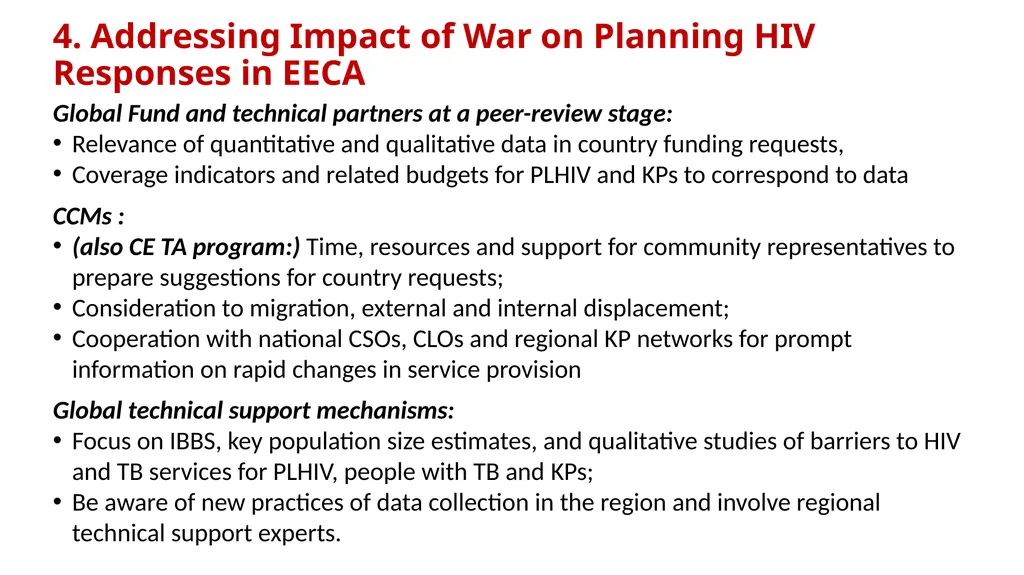
4. Addressing Impact of War on Planning HIV Responses in EECA Global Fund and technical partners at a peer-review stage:
Relevance of quantitative and qualitative data in country funding requests,
Coverage indicators and related budgets for PLHIV and KPs to correspond to data
CCMs :
(also CE TA program:) Time, resources and support for community representatives to prepare suggestions for country requests;
Consideration to migration, external and internal displacement;
Cooperation with national CSOs, CLOs and regional KP networks for prompt information on rapid changes in service provision
Global technical support mechanisms:
Focus on IBBS, key population size estimates, and qualitative studies of barriers to HIV and TB services for PLHIV, people with TB and KPs;
Be aware of new practices of data collection in the region and involve regional technical support experts.<br>
07
5. Strengthening Dialogue between Civil Society and the Global Fund to Explore New Partnership Modalities The Global Fund:
Maintain dialogue with the regional EECA networks to achieve a shared vision of the context, new challenges and possible ways to overcome those;
New formats and closer cooperation of the GF Secretariat EECA team and regional EECA networks for better coordination of joint activities.
Community-led networks:
Review approaches to cooperation with GF Board (esp. with the Delegations representing the region, communities, and NGOs) and Secretariat;
Dialogue with the GF Secretariat EECA team to achieve the best results in working with national governments.<br>
08
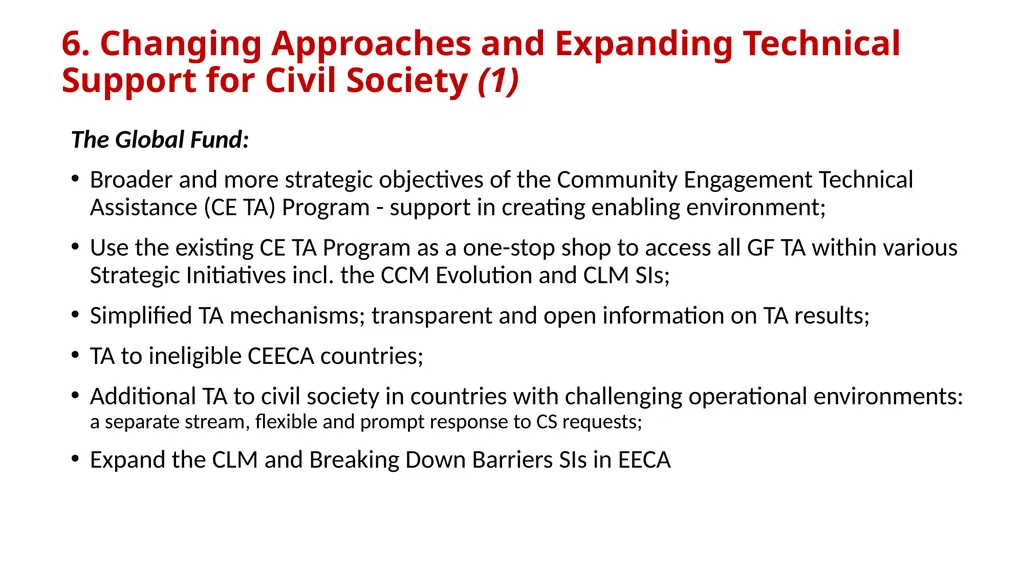
6. Changing Approaches and Expanding Technical Support for Civil Society (1) The Global Fund:
Broader and more strategic objectives of the Community Engagement Technical Assistance (CE TA) Program - support in creating enabling environment;
Use the existing CE TA Program as a one-stop shop to access all GF TA within various Strategic Initiatives incl. the CCM Evolution and CLM SIs;
Simplified TA mechanisms; transparent and open information on TA results;
TA to ineligible CEECA countries;
Additional TA to civil society in countries with challenging operational environments: a separate stream, flexible and prompt response to CS requests;
Expand the CLM and Breaking Down Barriers SIs in EECA<br>
09
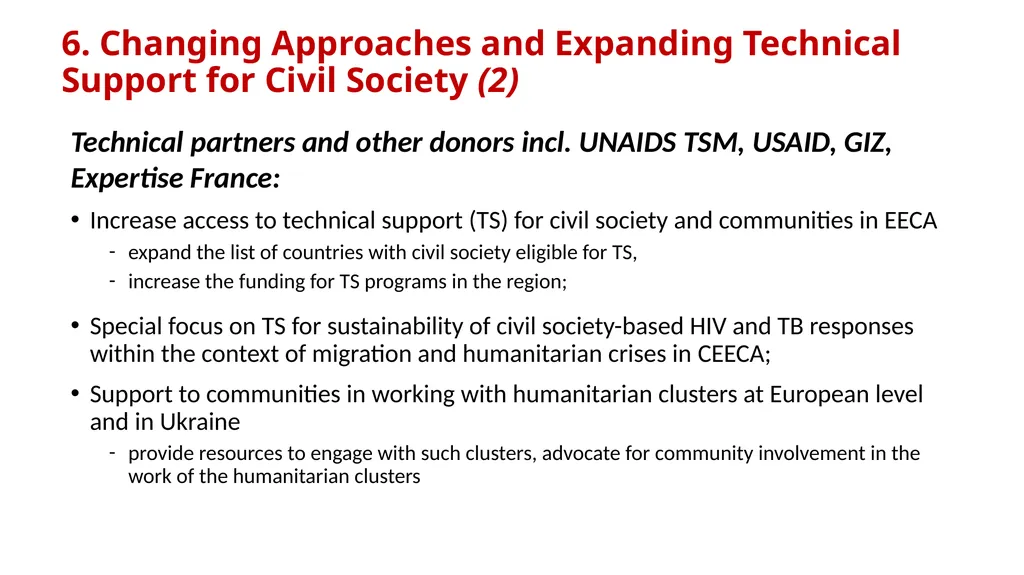
6. Changing Approaches and Expanding Technical Support for Civil Society (2) Technical partners and other donors incl. UNAIDS TSM, USAID, GIZ, Expertise France:
Increase access to technical support (TS) for civil society and communities in EECA
expand the list of countries with civil society eligible for TS,
increase the funding for TS programs in the region;
Special focus on TS for sustainability of civil society-based HIV and TB responses within the context of migration and humanitarian crises in CEECA;
Support to communities in working with humanitarian clusters at European level and in Ukraine
provide resources to engage with such clusters, advocate for community involvement in the work of the humanitarian clusters<br>