
COMMUNITY SOLAR 101 Realizing Affordable Solar



Description: COMMUNITY SOLAR 101 Realizing Affordable Solar Access for All How Does Solar Work? Solar panels convert sunlight directly into electricity. Solar electric technology is also known as photovoltaics, or PV for short. A solar energy system
Related Topics
Download Presentation
"COMMUNITY SOLAR 101 Realizing Affordable Solar" is the property of its rightful owner. Permission is granted to download and print the materials on this website for personal, non-commercial use only, and to display it on your personal computer provided you do not modify the materials and that you retain all copyright notices contained in the materials. By downloading content from our website, you accept the terms of this agreement.
Presentation Transcript
slide1. COMMUNITY SOLAR 101 Realizing Affordable Solar Access for All<br>
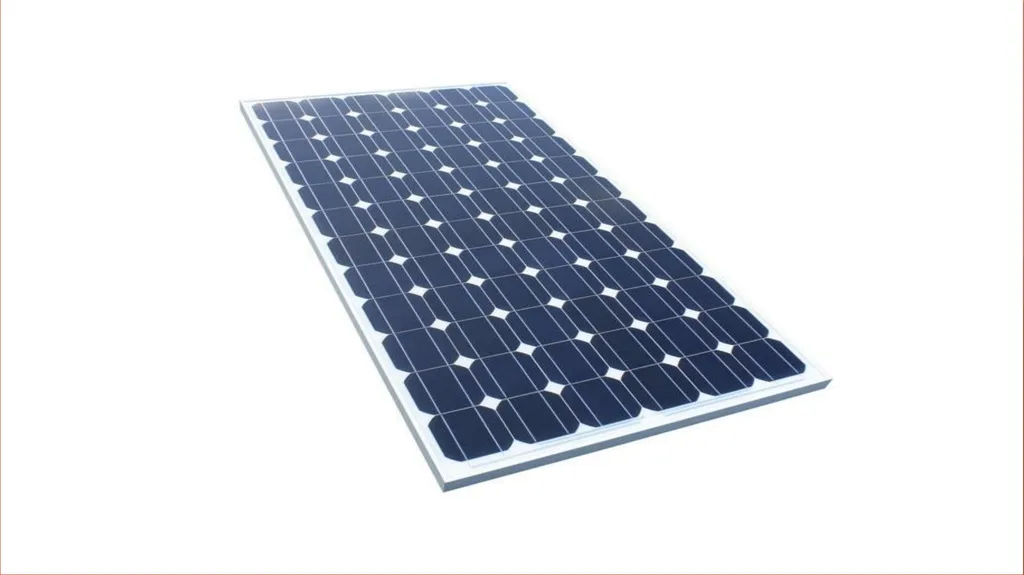
slide2. How Does Solar Work? Solar panels convert sunlight directly into electricity. Solar electric technology is also known as photovoltaics, or PV for short.
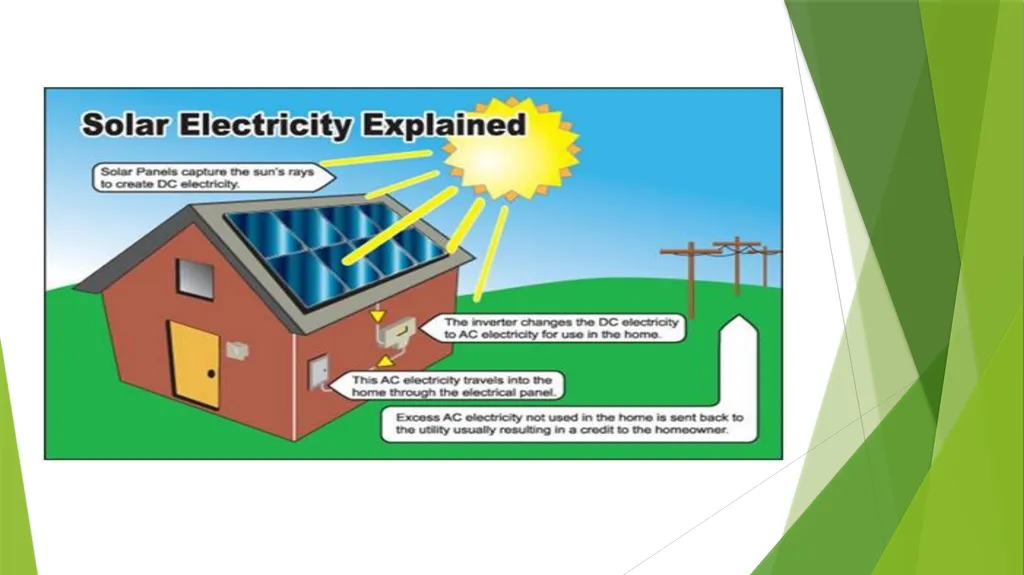
A solar energy system consists of many solar panels that are wired together in arrays, as well as an inverter, which converts the solar power from direct current (DC) to alternating current (AC).
Electricity from the solar array goes through an inverter, powers the building, and any excess energy is sent out to the grid.<br>
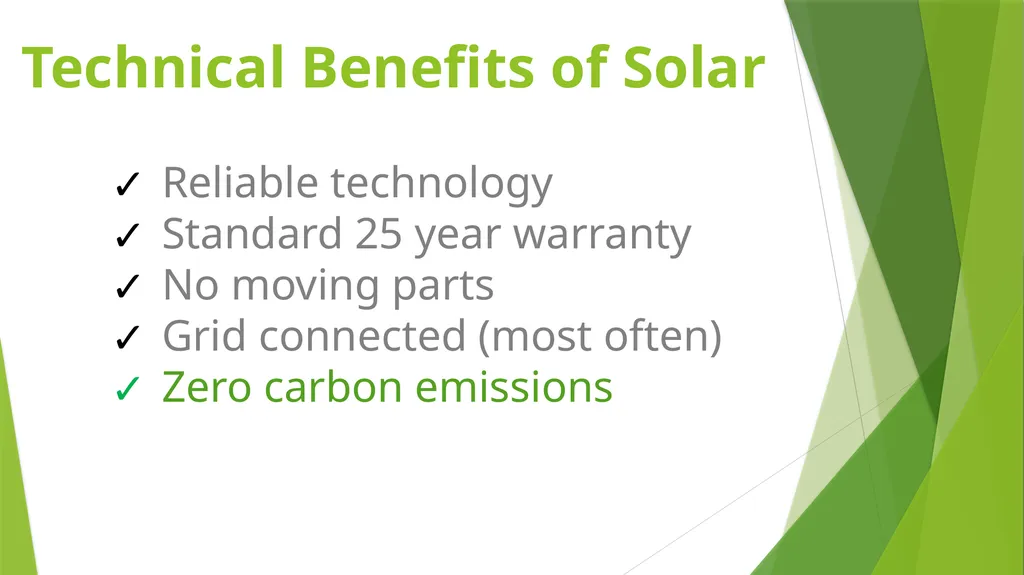
slide6. Reliable technology
Standard 25 year warranty
No moving parts
Grid connected (most often)
Zero carbon emissions Technical Benefits of Solar<br>
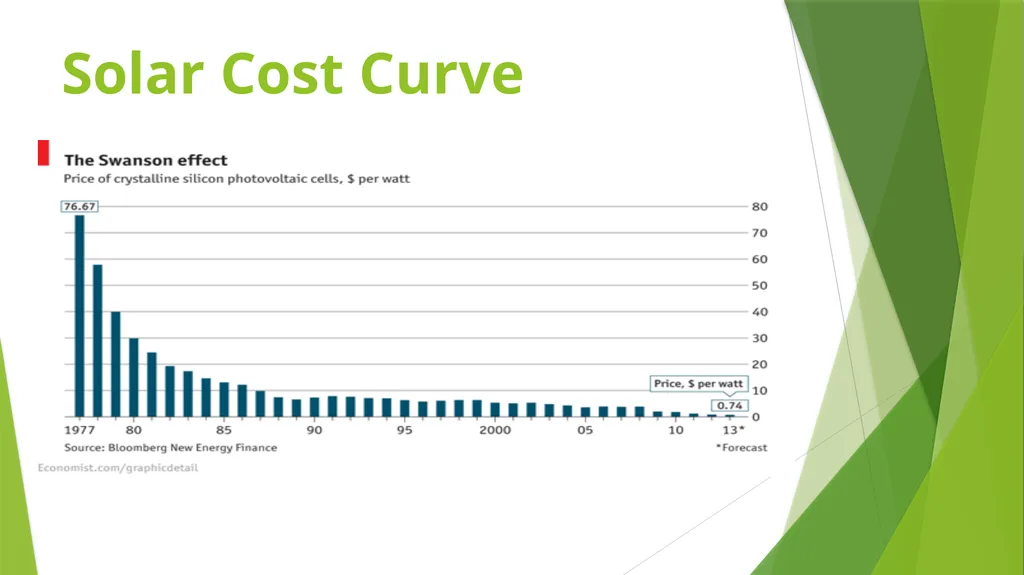
slide7. Solar Cost Curve<br>
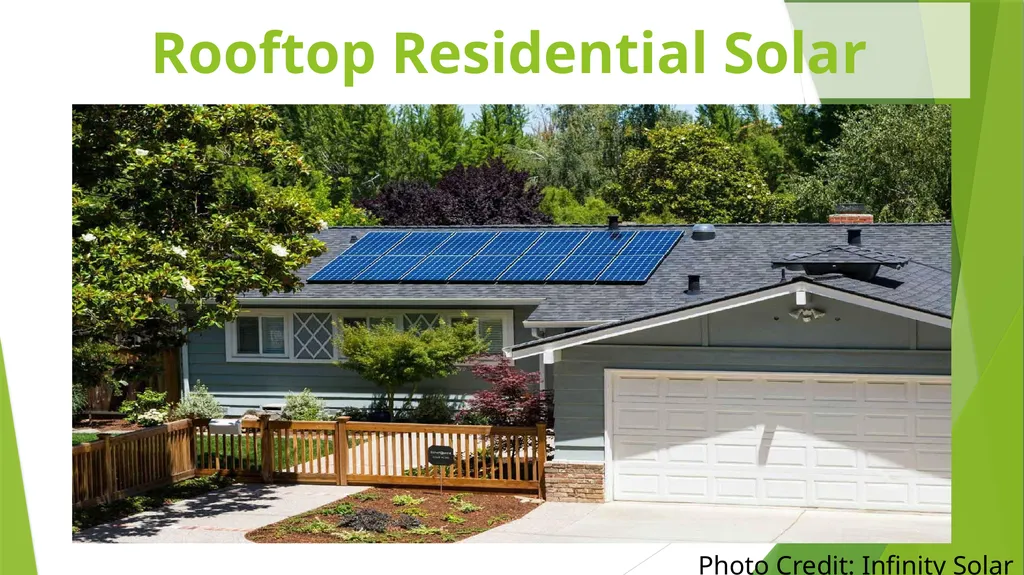
slide8. Rooftop Residential Solar Photo Credit: Infinity Solar<br>
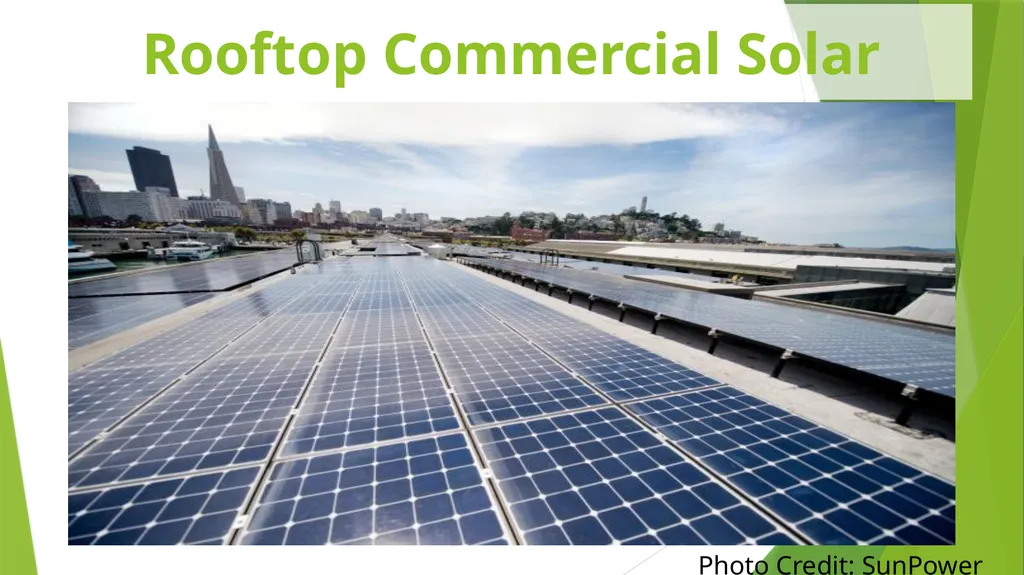
slide9. Rooftop Commercial Solar Photo Credit: SunPower<br>
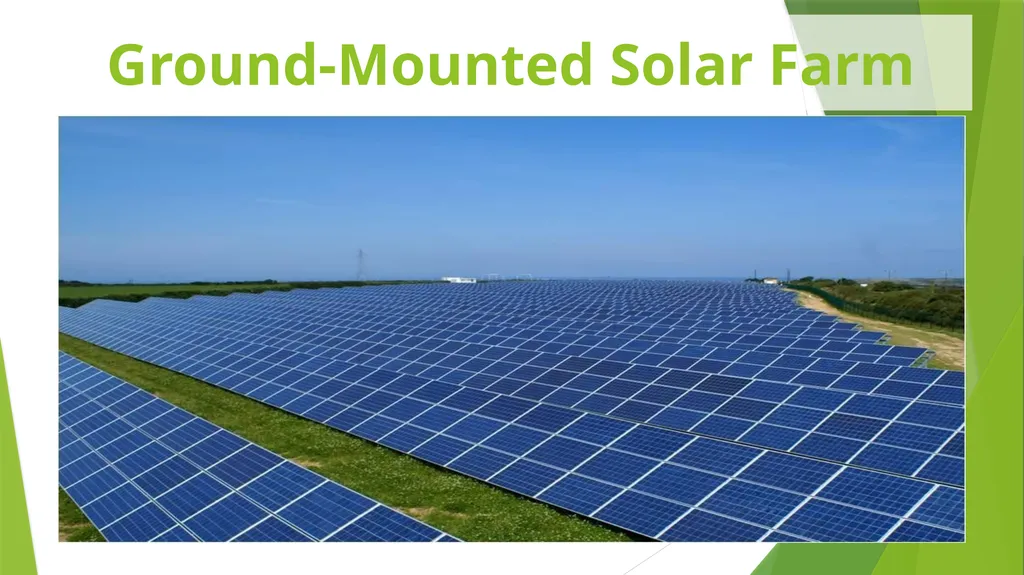
slide10. Ground-Mounted Solar Farm<br>
slide11. Utility Bill Savings Energy is measured in kilowatt hours (kWh).
National Grid charges about $0.13 for each kilowatt hour for a residential utility customer.
Every kilowatt hour of solar energy you produce saves you money on your bill.
Solar energy exported to the utility grid on sunny days generates credits that can be used at night and on cloudy days.<br>
slide12. Barriers to Solar Participation Why New Yorkers Need Community Shared Solar<br>
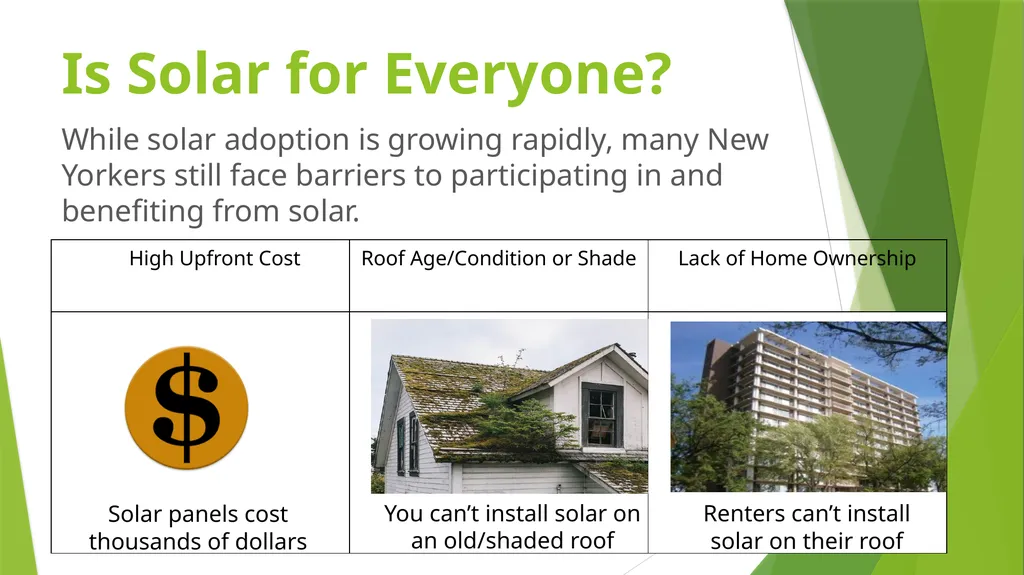
slide13. Is Solar for Everyone? While solar adoption is growing rapidly, many New Yorkers still face barriers to participating in and benefiting from solar. Solar panels cost thousands of dollars You can’t install solar on an old/shaded roof Renters can’t install solar on their roof<br>
slide14. Community Shared Solar An Opportunity to Expand Access<br>
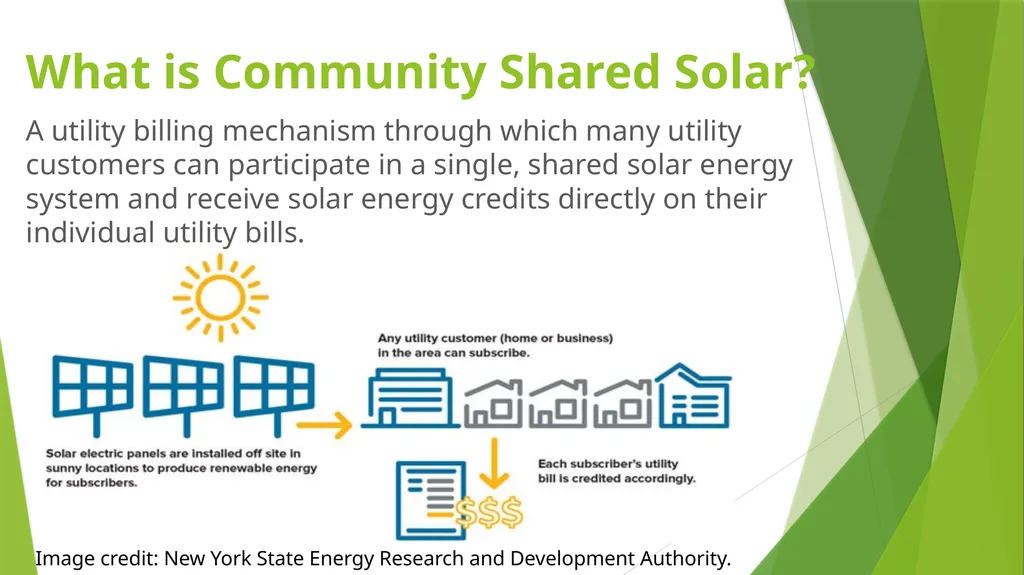
slide15. What is Community Shared Solar? A utility billing mechanism through which many utility customers can participate in a single, shared solar energy system and receive solar energy credits directly on their individual utility bills. Image credit: New York State Energy Research and Development Authority.<br>
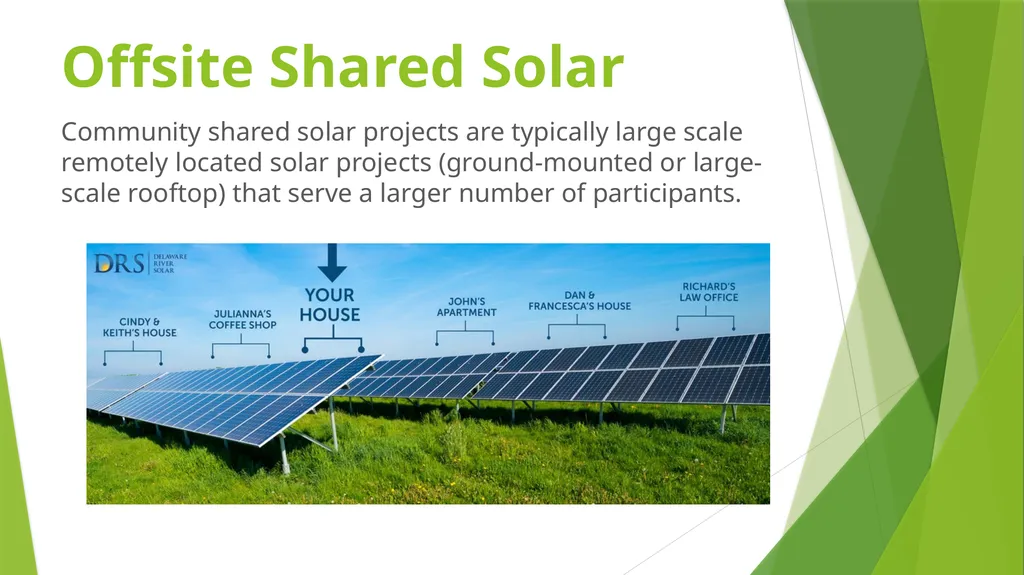
slide16. Offsite Shared Solar Community shared solar projects are typically large scale remotely located solar projects (ground-mounted or large-scale rooftop) that serve a larger number of participants.<br>
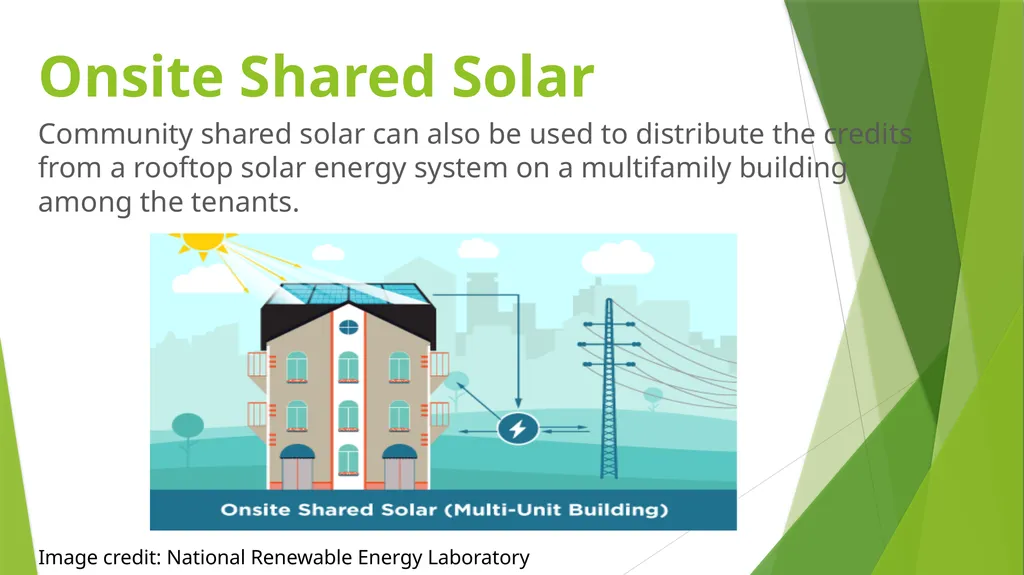
slide17. Onsite Shared Solar Community shared solar can also be used to distribute the credits from a rooftop solar energy system on a multifamily building among the tenants. Image credit: National Renewable Energy Laboratory<br>
slide18. Community Shared Solar in NY In July 2015 the NY Public Service Commission passed an order allowing community shared solar. Under the order, every kilowatt hour of solar energy was to be credited to participants at the full retail electricity rate (just like if the solar were on their roof!)…and the crowd went wild!
Solar project developers submitted a lot of interconnection applications to the utilities. So many that utilities and regulators got nervous about the cost of paying for all the solar.
In 2017, the NY PSC announced a new method of valuing shared solar energy credits, starting at the full retail rate and decreases over time as more projects come online.<br>
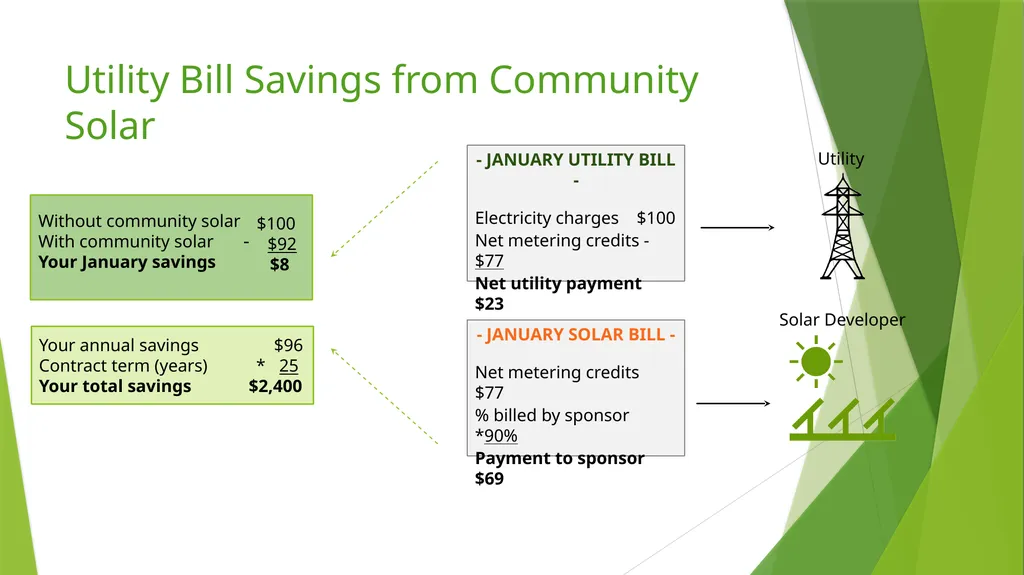
slide19. Utility Bill Savings from Community Solar - JANUARY UTILITY BILL -
Electricity charges $100
Net metering credits -$77
Net utility payment $23 - JANUARY SOLAR BILL -
Net metering credits $77
% billed by sponsor *90%
Payment to sponsor $69 Solar Developer Utility $100
$92
$8 Without community solar
With community solar
Your January savings Your annual savings $96
Contract term (years) * 25
Your total savings $2,400<br>
slide20. Ingredients for a Community Shared Solar Project The Basic Pieces of the Puzzle to Make Community Solar Happen<br>
slide21. Ingredients for Community Shared Solar Community shared solar projects can be diverse and unique, but there are some key ingredients that every project needs:
Host site. This is the physical space where the solar system is installed.
Subscribers. Every project needs subscribers that sign up to receive a portion of the solar energy credits generated by the system.
Project sponsor. Someone needs to own, operate, and manage the solar energy system. This can be one entity (e.g. a company) or many individuals depending on the financing model.
Financing. Solar projects can be expensive and someone needs to foot the bill! Financing packages for solar projects vary based on project type but often include different forms of debt and equity.
Interconnection approval. The utility needs to give approval for your solar system to get connected into the larger electricity grid.
Solar installer. Someone to design, permit and actually build the system!
Operations & maintenance. Someone to repair and maintain the system over time. This can be the same entity as the installer but may not be.<br>
slide22. Ladder of Community Solar Engagement Roles for individuals, organizations, and municipalities<br>
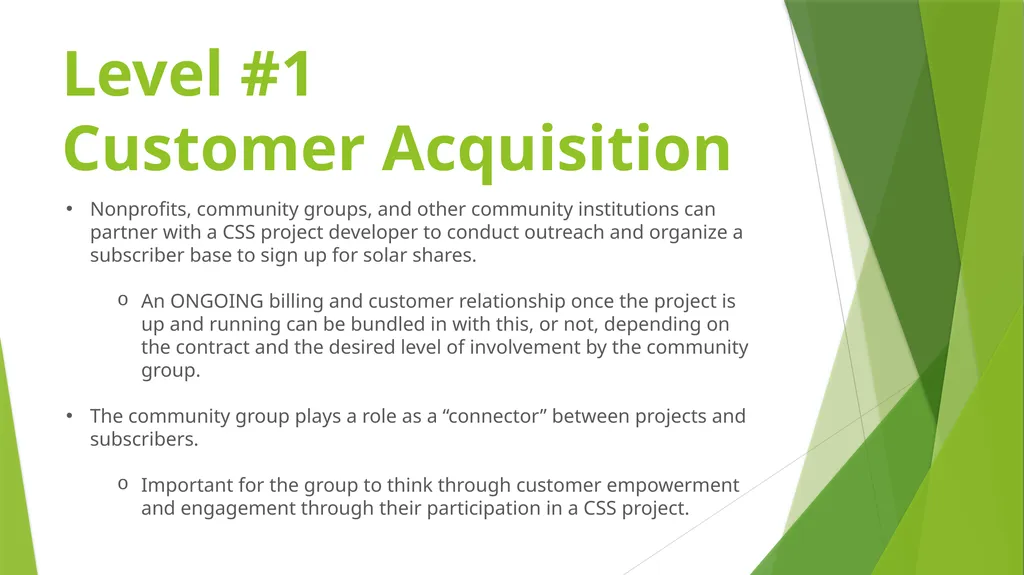
slide23. Level #1 Customer Acquisition Nonprofits, community groups, and other community institutions can partner with a CSS project developer to conduct outreach and organize a subscriber base to sign up for solar shares.
An ONGOING billing and customer relationship once the project is up and running can be bundled in with this, or not, depending on the contract and the desired level of involvement by the community group.
The community group plays a role as a “connector” between projects and subscribers.
Important for the group to think through customer empowerment and engagement through their participation in a CSS project.<br>
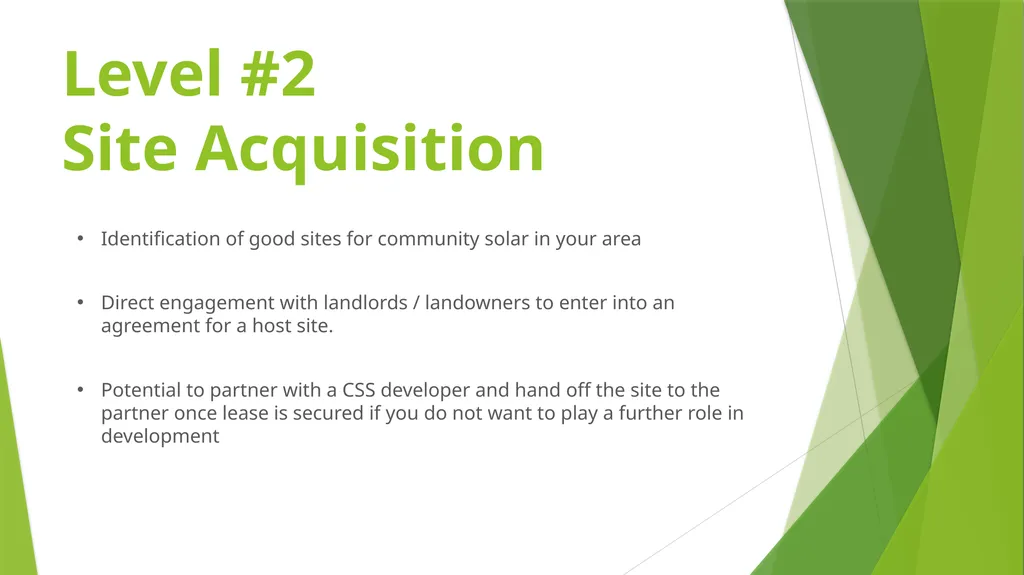
slide24. Level #2 Site Acquisition Identification of good sites for community solar in your area
Direct engagement with landlords / landowners to enter into an agreement for a host site.
Potential to partner with a CSS developer and hand off the site to the partner once lease is secured if you do not want to play a further role in development<br>
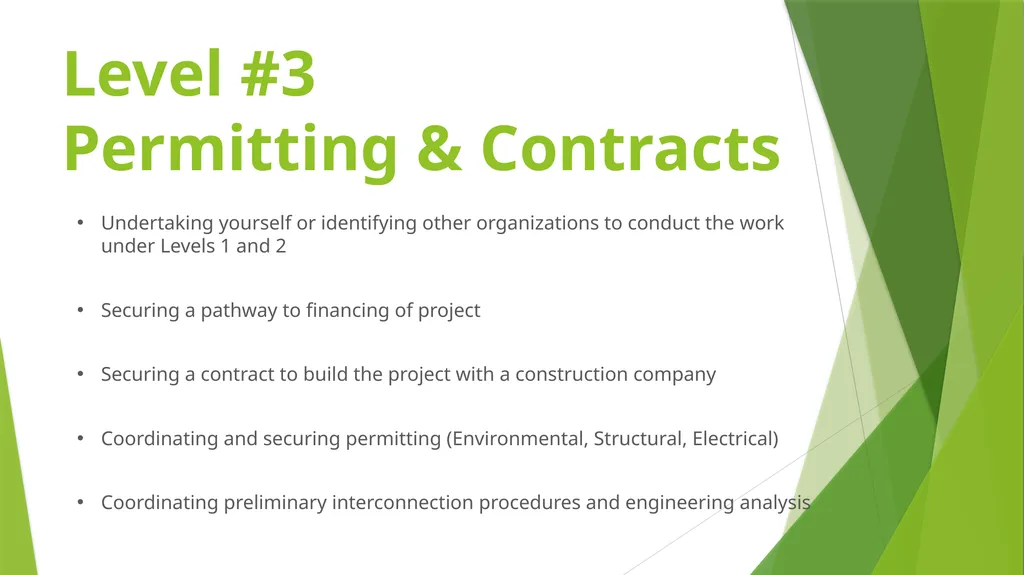
slide25. Level #3 Permitting & Contracts Undertaking yourself or identifying other organizations to conduct the work under Levels 1 and 2
Securing a pathway to financing of project
Securing a contract to build the project with a construction company
Coordinating and securing permitting (Environmental, Structural, Electrical)
Coordinating preliminary interconnection procedures and engineering analysis<br>
slide26. Level #4 Project Sponsor Identifying organizations/consultants to conduct the work under Levels 1 and 2
Recruiting tax equity and debt directly for the project, then owning, operating, and maintaining the array over its useful life.
Choosing and creating the legal and business entity for the project
**The project sponsor is the role where you can have real power in shaping the project and actualizing concepts of energy democracy and local control of energy resources<br>
slide27. Where do you see you or your organization playing a role?<br>
slide28. Community Ownership Models Members of a community solar project not only subscribe to and receive energy credits on their bill but also have an ownership stake and receive the additional benefits of asset ownership and additional revenue generation
Creates parity between the benefits of traditional rooftop solar and community solar
Many different approaches:
Cooperatives
LLCs or other special purpose entity (SPE)
Community-based organizations as project sponsors<br>
slide29. Benefits of Community Ownership Benefits are not extracted from but stay in the community
Control and governance over assets
Engagement and empowerment around energy choices
Support for local workforce development<br>
slide30. Considerations in Ownership Structure What is the level of engagement desired by community stakeholders?
What are the sources and strategies for raising money for project costs?
How will decisions about the project be made and who will make them?
How will revenue from the project be distributed and to whom?<br>
slide31. If you were the subscriber, what questions would you have about community solar?<br>
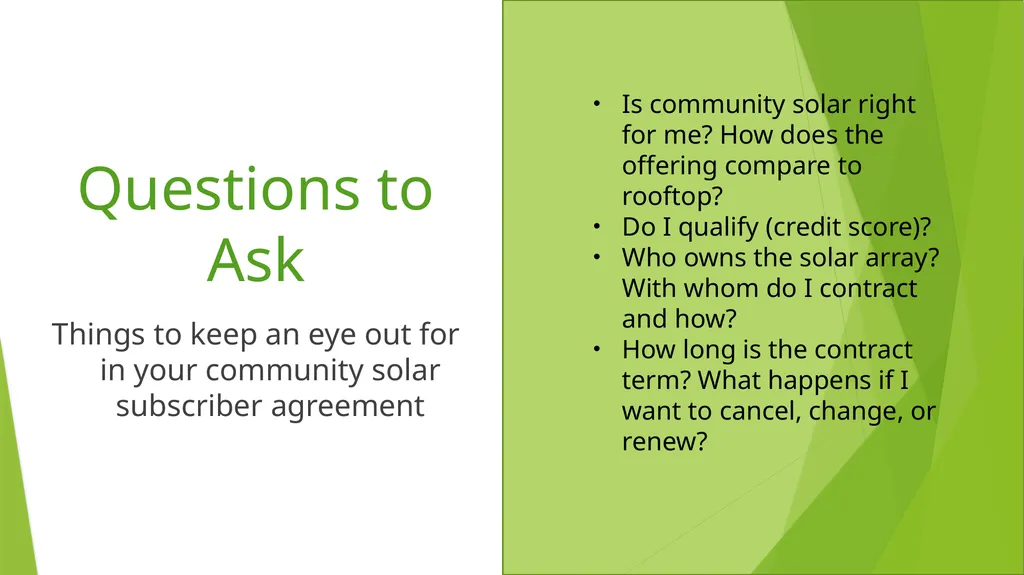
slide32. Questions to Ask Things to keep an eye out for in your community solar subscriber agreement Is community solar right for me? How does the offering compare to rooftop?
Do I qualify (credit score)?
Who owns the solar array? With whom do I contract and how?
How long is the contract term? What happens if I want to cancel, change, or renew?<br>
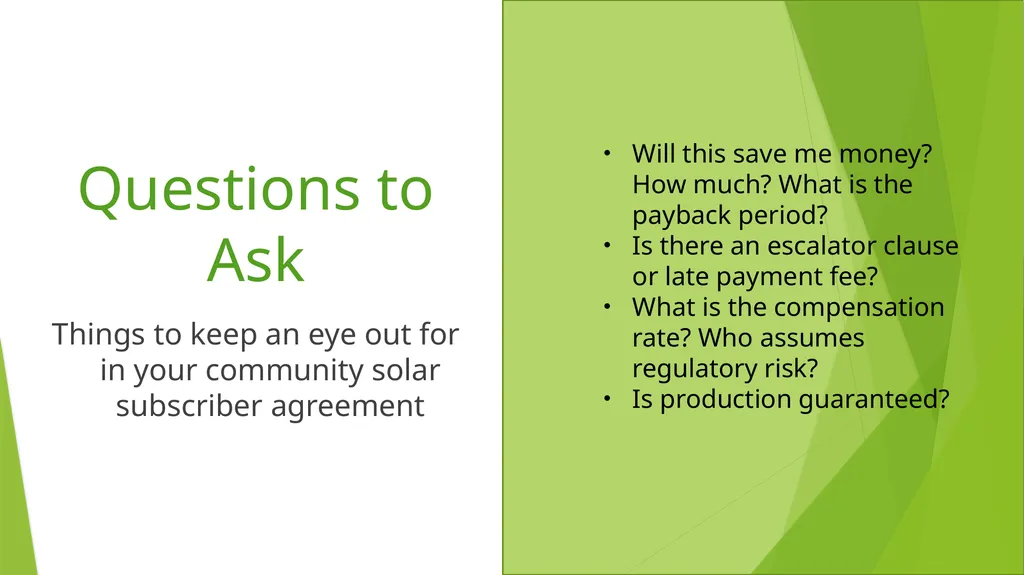
slide33. Will this save me money? How much? What is the payback period?
Is there an escalator clause or late payment fee?
What is the compensation rate? Who assumes regulatory risk?
Is production guaranteed? Questions to Ask Things to keep an eye out for in your community solar subscriber agreement<br>
slide2. How Does Solar Work? Solar panels convert sunlight directly into electricity. Solar electric technology is also known as photovoltaics, or PV for short.
A solar energy system consists of many solar panels that are wired together in arrays, as well as an inverter, which converts the solar power from direct current (DC) to alternating current (AC).
Electricity from the solar array goes through an inverter, powers the building, and any excess energy is sent out to the grid.<br>
slide6. Reliable technology
Standard 25 year warranty
No moving parts
Grid connected (most often)
Zero carbon emissions Technical Benefits of Solar<br>
slide7. Solar Cost Curve<br>
slide8. Rooftop Residential Solar Photo Credit: Infinity Solar<br>
slide9. Rooftop Commercial Solar Photo Credit: SunPower<br>
slide10. Ground-Mounted Solar Farm<br>
slide11. Utility Bill Savings Energy is measured in kilowatt hours (kWh).
National Grid charges about $0.13 for each kilowatt hour for a residential utility customer.
Every kilowatt hour of solar energy you produce saves you money on your bill.
Solar energy exported to the utility grid on sunny days generates credits that can be used at night and on cloudy days.<br>
slide12. Barriers to Solar Participation Why New Yorkers Need Community Shared Solar<br>
slide13. Is Solar for Everyone? While solar adoption is growing rapidly, many New Yorkers still face barriers to participating in and benefiting from solar. Solar panels cost thousands of dollars You can’t install solar on an old/shaded roof Renters can’t install solar on their roof<br>
slide14. Community Shared Solar An Opportunity to Expand Access<br>
slide15. What is Community Shared Solar? A utility billing mechanism through which many utility customers can participate in a single, shared solar energy system and receive solar energy credits directly on their individual utility bills. Image credit: New York State Energy Research and Development Authority.<br>
slide16. Offsite Shared Solar Community shared solar projects are typically large scale remotely located solar projects (ground-mounted or large-scale rooftop) that serve a larger number of participants.<br>
slide17. Onsite Shared Solar Community shared solar can also be used to distribute the credits from a rooftop solar energy system on a multifamily building among the tenants. Image credit: National Renewable Energy Laboratory<br>
slide18. Community Shared Solar in NY In July 2015 the NY Public Service Commission passed an order allowing community shared solar. Under the order, every kilowatt hour of solar energy was to be credited to participants at the full retail electricity rate (just like if the solar were on their roof!)…and the crowd went wild!
Solar project developers submitted a lot of interconnection applications to the utilities. So many that utilities and regulators got nervous about the cost of paying for all the solar.
In 2017, the NY PSC announced a new method of valuing shared solar energy credits, starting at the full retail rate and decreases over time as more projects come online.<br>
slide19. Utility Bill Savings from Community Solar - JANUARY UTILITY BILL -
Electricity charges $100
Net metering credits -$77
Net utility payment $23 - JANUARY SOLAR BILL -
Net metering credits $77
% billed by sponsor *90%
Payment to sponsor $69 Solar Developer Utility $100
$92
$8 Without community solar
With community solar
Your January savings Your annual savings $96
Contract term (years) * 25
Your total savings $2,400<br>
slide20. Ingredients for a Community Shared Solar Project The Basic Pieces of the Puzzle to Make Community Solar Happen<br>
slide21. Ingredients for Community Shared Solar Community shared solar projects can be diverse and unique, but there are some key ingredients that every project needs:
Host site. This is the physical space where the solar system is installed.
Subscribers. Every project needs subscribers that sign up to receive a portion of the solar energy credits generated by the system.
Project sponsor. Someone needs to own, operate, and manage the solar energy system. This can be one entity (e.g. a company) or many individuals depending on the financing model.
Financing. Solar projects can be expensive and someone needs to foot the bill! Financing packages for solar projects vary based on project type but often include different forms of debt and equity.
Interconnection approval. The utility needs to give approval for your solar system to get connected into the larger electricity grid.
Solar installer. Someone to design, permit and actually build the system!
Operations & maintenance. Someone to repair and maintain the system over time. This can be the same entity as the installer but may not be.<br>
slide22. Ladder of Community Solar Engagement Roles for individuals, organizations, and municipalities<br>
slide23. Level #1 Customer Acquisition Nonprofits, community groups, and other community institutions can partner with a CSS project developer to conduct outreach and organize a subscriber base to sign up for solar shares.
An ONGOING billing and customer relationship once the project is up and running can be bundled in with this, or not, depending on the contract and the desired level of involvement by the community group.
The community group plays a role as a “connector” between projects and subscribers.
Important for the group to think through customer empowerment and engagement through their participation in a CSS project.<br>
slide24. Level #2 Site Acquisition Identification of good sites for community solar in your area
Direct engagement with landlords / landowners to enter into an agreement for a host site.
Potential to partner with a CSS developer and hand off the site to the partner once lease is secured if you do not want to play a further role in development<br>
slide25. Level #3 Permitting & Contracts Undertaking yourself or identifying other organizations to conduct the work under Levels 1 and 2
Securing a pathway to financing of project
Securing a contract to build the project with a construction company
Coordinating and securing permitting (Environmental, Structural, Electrical)
Coordinating preliminary interconnection procedures and engineering analysis<br>
slide26. Level #4 Project Sponsor Identifying organizations/consultants to conduct the work under Levels 1 and 2
Recruiting tax equity and debt directly for the project, then owning, operating, and maintaining the array over its useful life.
Choosing and creating the legal and business entity for the project
**The project sponsor is the role where you can have real power in shaping the project and actualizing concepts of energy democracy and local control of energy resources<br>
slide27. Where do you see you or your organization playing a role?<br>
slide28. Community Ownership Models Members of a community solar project not only subscribe to and receive energy credits on their bill but also have an ownership stake and receive the additional benefits of asset ownership and additional revenue generation
Creates parity between the benefits of traditional rooftop solar and community solar
Many different approaches:
Cooperatives
LLCs or other special purpose entity (SPE)
Community-based organizations as project sponsors<br>
slide29. Benefits of Community Ownership Benefits are not extracted from but stay in the community
Control and governance over assets
Engagement and empowerment around energy choices
Support for local workforce development<br>
slide30. Considerations in Ownership Structure What is the level of engagement desired by community stakeholders?
What are the sources and strategies for raising money for project costs?
How will decisions about the project be made and who will make them?
How will revenue from the project be distributed and to whom?<br>
slide31. If you were the subscriber, what questions would you have about community solar?<br>
slide32. Questions to Ask Things to keep an eye out for in your community solar subscriber agreement Is community solar right for me? How does the offering compare to rooftop?
Do I qualify (credit score)?
Who owns the solar array? With whom do I contract and how?
How long is the contract term? What happens if I want to cancel, change, or renew?<br>
slide33. Will this save me money? How much? What is the payback period?
Is there an escalator clause or late payment fee?
What is the compensation rate? Who assumes regulatory risk?
Is production guaranteed? Questions to Ask Things to keep an eye out for in your community solar subscriber agreement<br>