
Community Support Person (CSP) Training CT Mental
TA
Published · 30 slides · 0 views

1 / 1
Description
Community Support Person (CSP) Training CT Mental Health Waiver 2024 Agenda Job Description and Role Expectations Community Support Program visit structure Skill Builders Toolkit Transitional Case Management Roles Responsibilities
Related Topics
Share
Embed code
Download this presentation From Below
"Community Support Person (CSP) Training CT Mental" is the property of its rightful owner. Permission is granted to download and print the materials on this website for personal, non-commercial use only, and to display it on your personal computer provided you do not modify the materials and that you retain all copyright notices contained in the materials. By downloading content from our website, you accept the terms of this agreement.
Presentation Transcript
01
Community Support Person (CSP) Training CT Mental Health Waiver
2024<br>
2024<br>
02
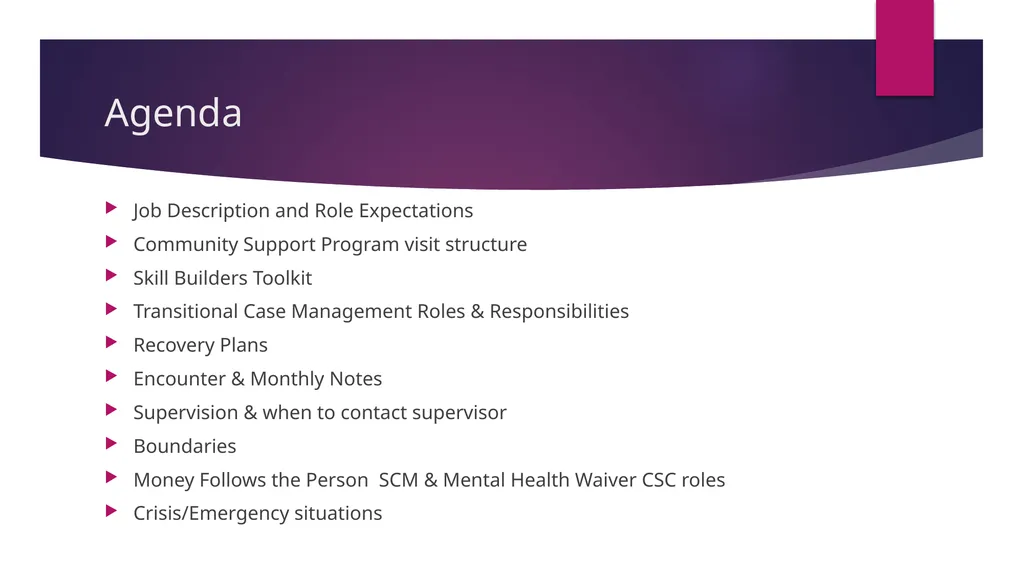
Agenda Job Description and Role Expectations
Community Support Program visit structure
Skill Builders Toolkit
Transitional Case Management Roles & Responsibilities
Recovery Plans
Encounter & Monthly Notes
Supervision & when to contact supervisor
Boundaries
Money Follows the Person SCM & Mental Health Waiver CSC roles
Crisis/Emergency situations<br>
Community Support Program visit structure
Skill Builders Toolkit
Transitional Case Management Roles & Responsibilities
Recovery Plans
Encounter & Monthly Notes
Supervision & when to contact supervisor
Boundaries
Money Follows the Person SCM & Mental Health Waiver CSC roles
Crisis/Emergency situations<br>
03
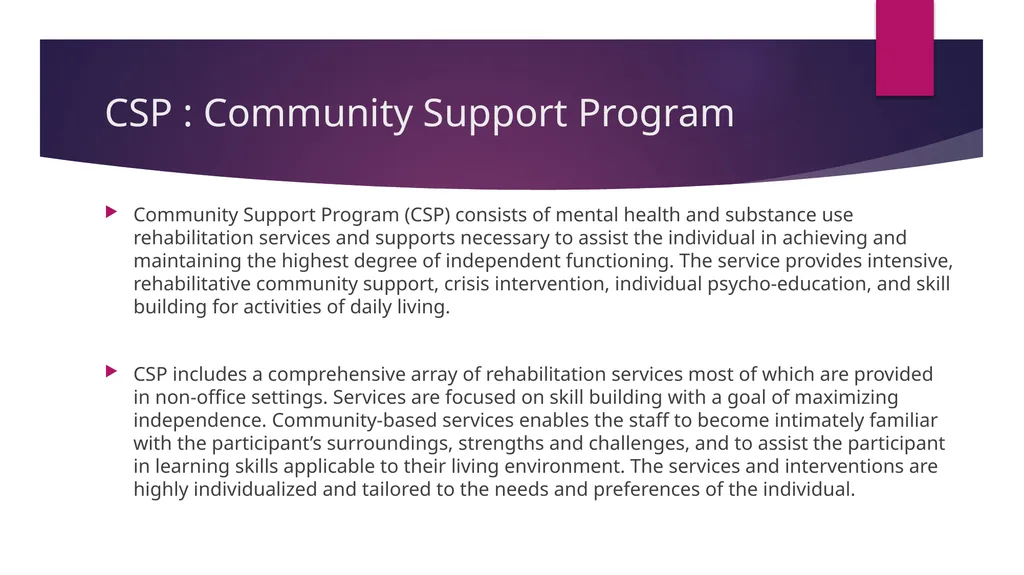
CSP : Community Support Program Community Support Program (CSP) consists of mental health and substance use rehabilitation services and supports necessary to assist the individual in achieving and maintaining the highest degree of independent functioning. The service provides intensive, rehabilitative community support, crisis intervention, individual psycho-education, and skill building for activities of daily living.
CSP includes a comprehensive array of rehabilitation services most of which are provided in non-office settings. Services are focused on skill building with a goal of maximizing independence. Community-based services enables the staff to become intimately familiar with the participant’s surroundings, strengths and challenges, and to assist the participant in learning skills applicable to their living environment. The services and interventions are highly individualized and tailored to the needs and preferences of the individual.<br>
CSP includes a comprehensive array of rehabilitation services most of which are provided in non-office settings. Services are focused on skill building with a goal of maximizing independence. Community-based services enables the staff to become intimately familiar with the participant’s surroundings, strengths and challenges, and to assist the participant in learning skills applicable to their living environment. The services and interventions are highly individualized and tailored to the needs and preferences of the individual.<br>
04
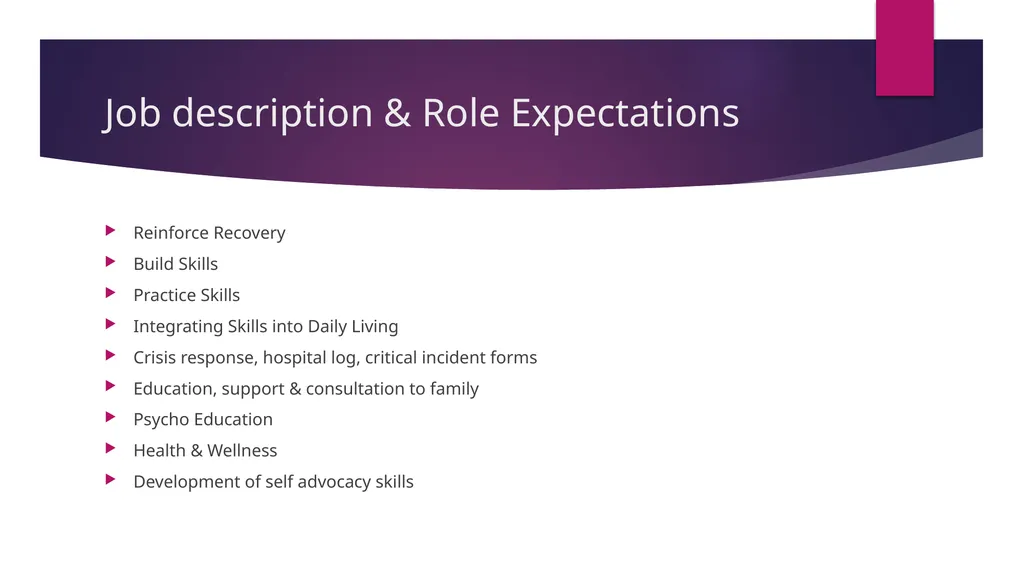
Job description & Role Expectations Reinforce Recovery
Build Skills
Practice Skills
Integrating Skills into Daily Living
Crisis response, hospital log, critical incident forms
Education, support & consultation to family
Psycho Education
Health & Wellness
Development of self advocacy skills<br>
Build Skills
Practice Skills
Integrating Skills into Daily Living
Crisis response, hospital log, critical incident forms
Education, support & consultation to family
Psycho Education
Health & Wellness
Development of self advocacy skills<br>
05
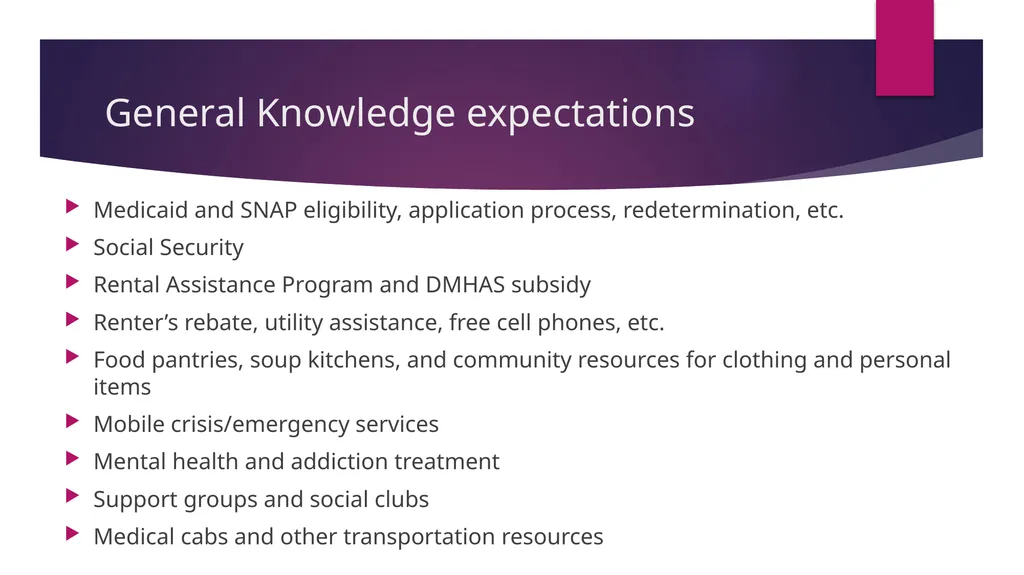
General Knowledge expectations Medicaid and SNAP eligibility, application process, redetermination, etc.
Social Security
Rental Assistance Program and DMHAS subsidy
Renter’s rebate, utility assistance, free cell phones, etc.
Food pantries, soup kitchens, and community resources for clothing and personal items
Mobile crisis/emergency services
Mental health and addiction treatment
Support groups and social clubs
Medical cabs and other transportation resources<br>
Social Security
Rental Assistance Program and DMHAS subsidy
Renter’s rebate, utility assistance, free cell phones, etc.
Food pantries, soup kitchens, and community resources for clothing and personal items
Mobile crisis/emergency services
Mental health and addiction treatment
Support groups and social clubs
Medical cabs and other transportation resources<br>
06
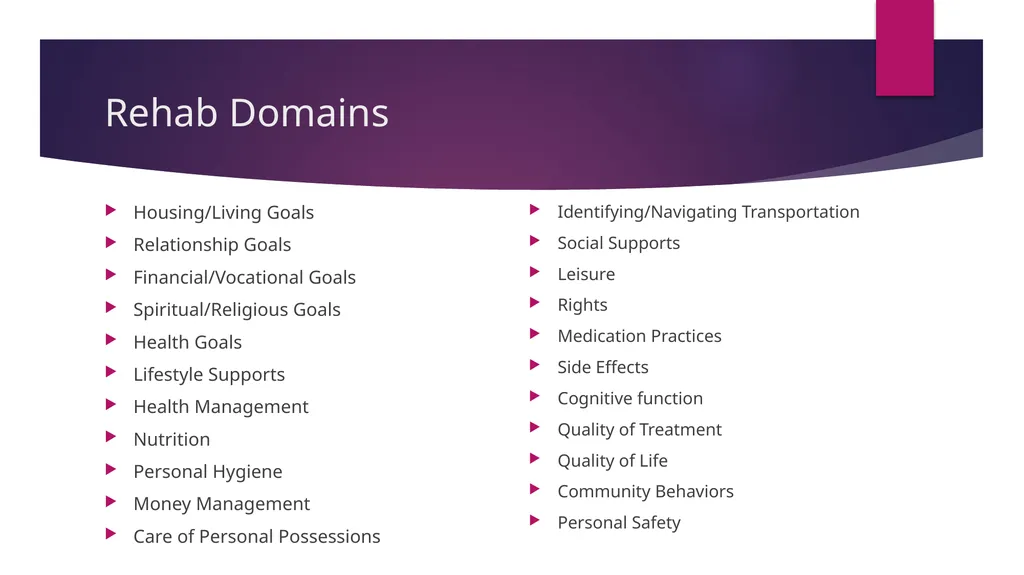
Rehab Domains Housing/Living Goals
Relationship Goals
Financial/Vocational Goals
Spiritual/Religious Goals
Health Goals
Lifestyle Supports
Health Management
Nutrition
Personal Hygiene
Money Management
Care of Personal Possessions Identifying/Navigating Transportation
Social Supports
Leisure
Rights
Medication Practices
Side Effects
Cognitive function
Quality of Treatment
Quality of Life
Community Behaviors
Personal Safety<br>
Relationship Goals
Financial/Vocational Goals
Spiritual/Religious Goals
Health Goals
Lifestyle Supports
Health Management
Nutrition
Personal Hygiene
Money Management
Care of Personal Possessions Identifying/Navigating Transportation
Social Supports
Leisure
Rights
Medication Practices
Side Effects
Cognitive function
Quality of Treatment
Quality of Life
Community Behaviors
Personal Safety<br>
07
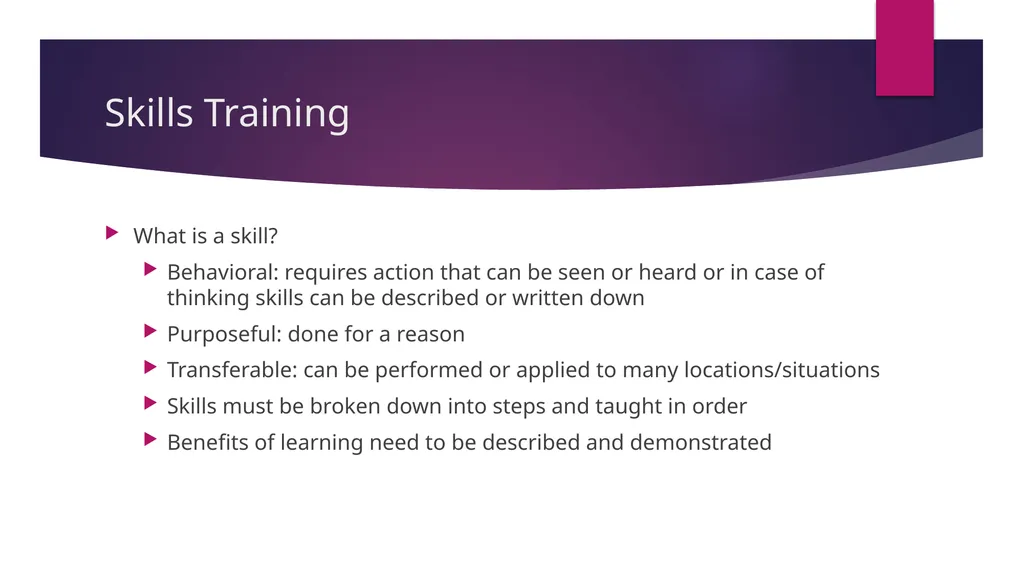
Skills Training What is a skill?
Behavioral: requires action that can be seen or heard or in case of thinking skills can be described or written down
Purposeful: done for a reason
Transferable: can be performed or applied to many locations/situations
Skills must be broken down into steps and taught in order
Benefits of learning need to be described and demonstrated<br>
Behavioral: requires action that can be seen or heard or in case of thinking skills can be described or written down
Purposeful: done for a reason
Transferable: can be performed or applied to many locations/situations
Skills must be broken down into steps and taught in order
Benefits of learning need to be described and demonstrated<br>
08
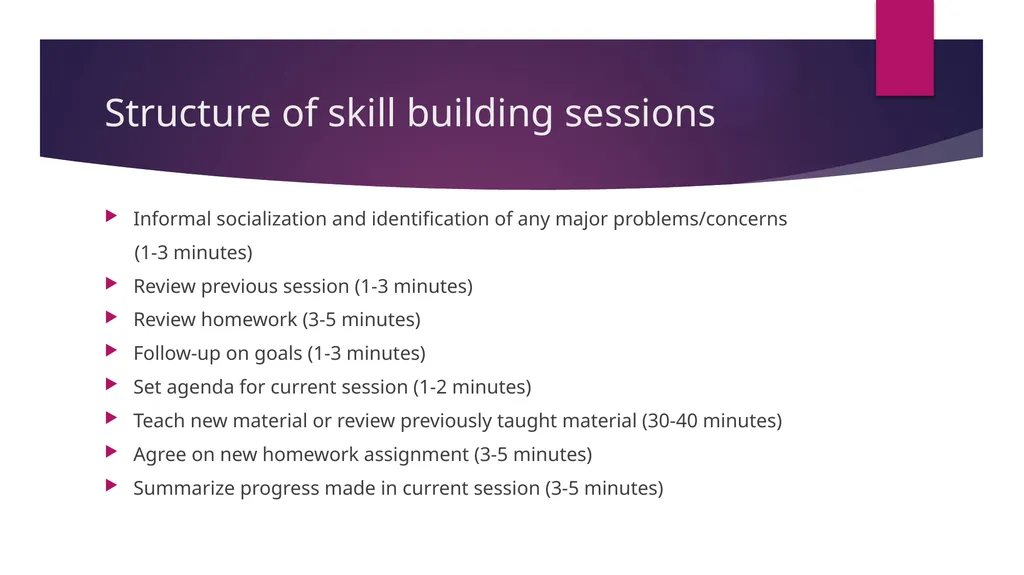
Structure of skill building sessions Informal socialization and identification of any major problems/concerns
(1-3 minutes)
Review previous session (1-3 minutes)
Review homework (3-5 minutes)
Follow-up on goals (1-3 minutes)
Set agenda for current session (1-2 minutes)
Teach new material or review previously taught material (30-40 minutes)
Agree on new homework assignment (3-5 minutes)
Summarize progress made in current session (3-5 minutes)<br>
(1-3 minutes)
Review previous session (1-3 minutes)
Review homework (3-5 minutes)
Follow-up on goals (1-3 minutes)
Set agenda for current session (1-2 minutes)
Teach new material or review previously taught material (30-40 minutes)
Agree on new homework assignment (3-5 minutes)
Summarize progress made in current session (3-5 minutes)<br>
09
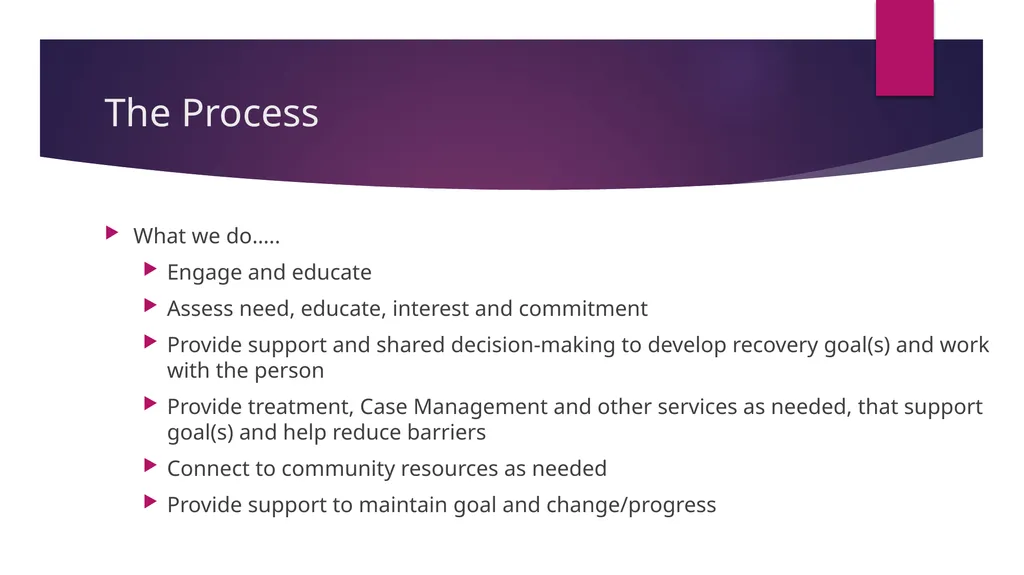
The Process What we do…..
Engage and educate
Assess need, educate, interest and commitment
Provide support and shared decision-making to develop recovery goal(s) and work with the person
Provide treatment, Case Management and other services as needed, that support goal(s) and help reduce barriers
Connect to community resources as needed
Provide support to maintain goal and change/progress<br>
Engage and educate
Assess need, educate, interest and commitment
Provide support and shared decision-making to develop recovery goal(s) and work with the person
Provide treatment, Case Management and other services as needed, that support goal(s) and help reduce barriers
Connect to community resources as needed
Provide support to maintain goal and change/progress<br>
10
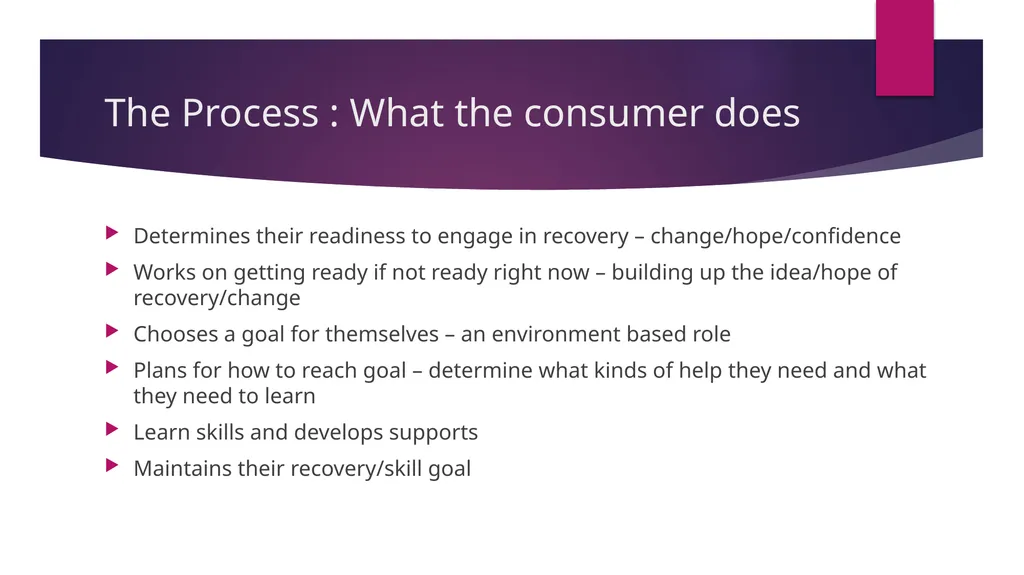
The Process : What the consumer does Determines their readiness to engage in recovery – change/hope/confidence
Works on getting ready if not ready right now – building up the idea/hope of recovery/change
Chooses a goal for themselves – an environment based role
Plans for how to reach goal – determine what kinds of help they need and what they need to learn
Learn skills and develops supports
Maintains their recovery/skill goal<br>
Works on getting ready if not ready right now – building up the idea/hope of recovery/change
Chooses a goal for themselves – an environment based role
Plans for how to reach goal – determine what kinds of help they need and what they need to learn
Learn skills and develops supports
Maintains their recovery/skill goal<br>
11
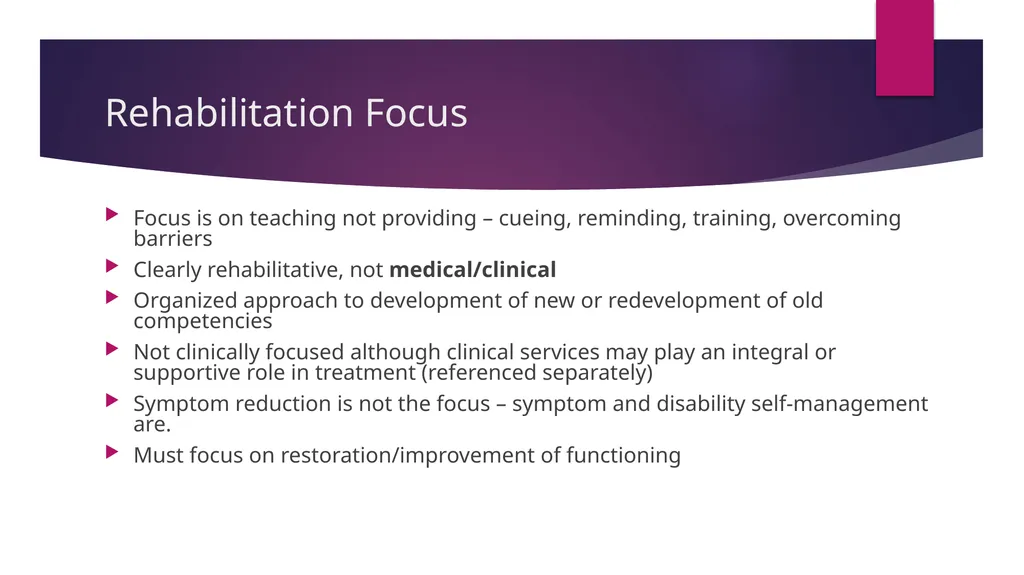
Rehabilitation Focus Focus is on teaching not providing – cueing, reminding, training, overcoming barriers
Clearly rehabilitative, not medical/clinical
Organized approach to development of new or redevelopment of old competencies
Not clinically focused although clinical services may play an integral or supportive role in treatment (referenced separately)
Symptom reduction is not the focus – symptom and disability self-management are.
Must focus on restoration/improvement of functioning<br>
Clearly rehabilitative, not medical/clinical
Organized approach to development of new or redevelopment of old competencies
Not clinically focused although clinical services may play an integral or supportive role in treatment (referenced separately)
Symptom reduction is not the focus – symptom and disability self-management are.
Must focus on restoration/improvement of functioning<br>
12
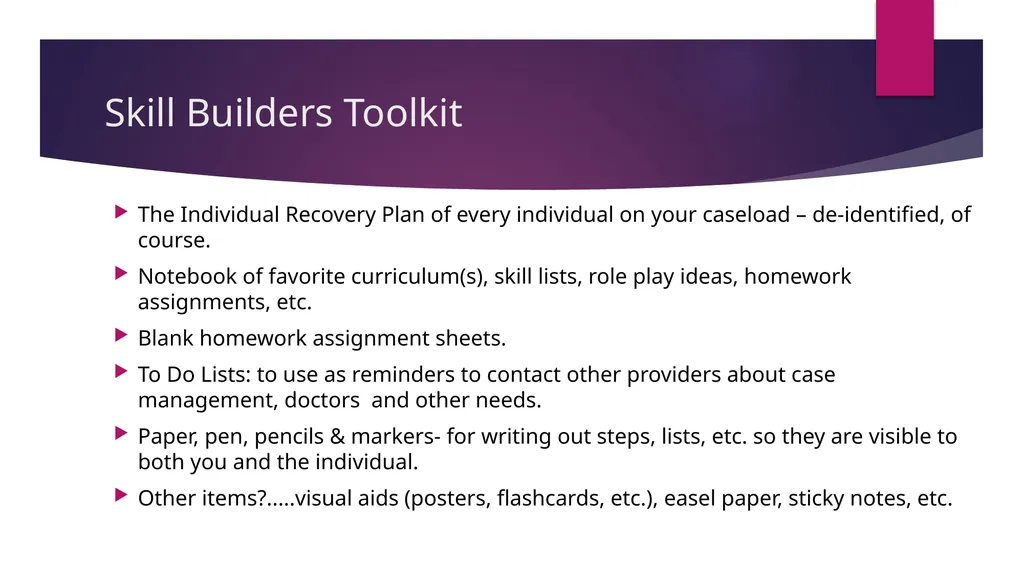
Skill Builders Toolkit The Individual Recovery Plan of every individual on your caseload – de-identified, of course.
Notebook of favorite curriculum(s), skill lists, role play ideas, homework assignments, etc.
Blank homework assignment sheets.
To Do Lists: to use as reminders to contact other providers about case management, doctors and other needs.
Paper, pen, pencils & markers- for writing out steps, lists, etc. so they are visible to both you and the individual.
Other items?.....visual aids (posters, flashcards, etc.), easel paper, sticky notes, etc.<br>
Notebook of favorite curriculum(s), skill lists, role play ideas, homework assignments, etc.
Blank homework assignment sheets.
To Do Lists: to use as reminders to contact other providers about case management, doctors and other needs.
Paper, pen, pencils & markers- for writing out steps, lists, etc. so they are visible to both you and the individual.
Other items?.....visual aids (posters, flashcards, etc.), easel paper, sticky notes, etc.<br>
13
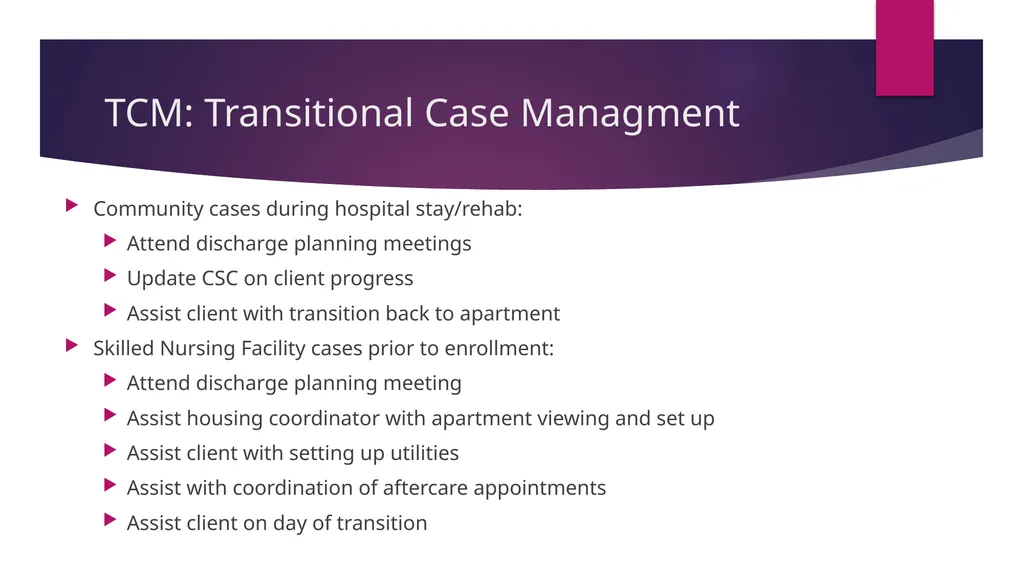
TCM: Transitional Case Managment Community cases during hospital stay/rehab:
Attend discharge planning meetings
Update CSC on client progress
Assist client with transition back to apartment
Skilled Nursing Facility cases prior to enrollment:
Attend discharge planning meeting
Assist housing coordinator with apartment viewing and set up
Assist client with setting up utilities
Assist with coordination of aftercare appointments
Assist client on day of transition<br>
Attend discharge planning meetings
Update CSC on client progress
Assist client with transition back to apartment
Skilled Nursing Facility cases prior to enrollment:
Attend discharge planning meeting
Assist housing coordinator with apartment viewing and set up
Assist client with setting up utilities
Assist with coordination of aftercare appointments
Assist client on day of transition<br>
14
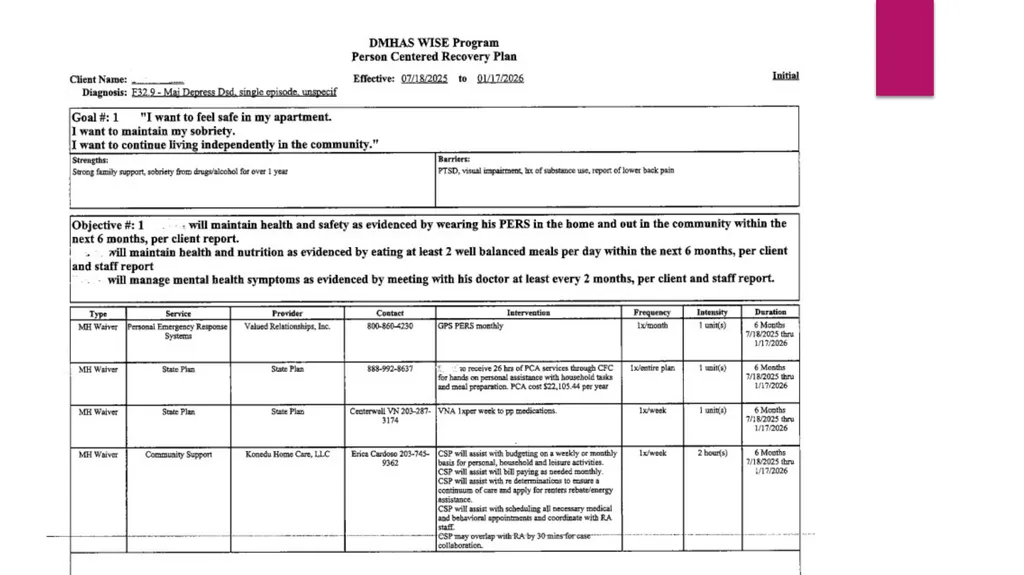
Recovery Plan<br>
15
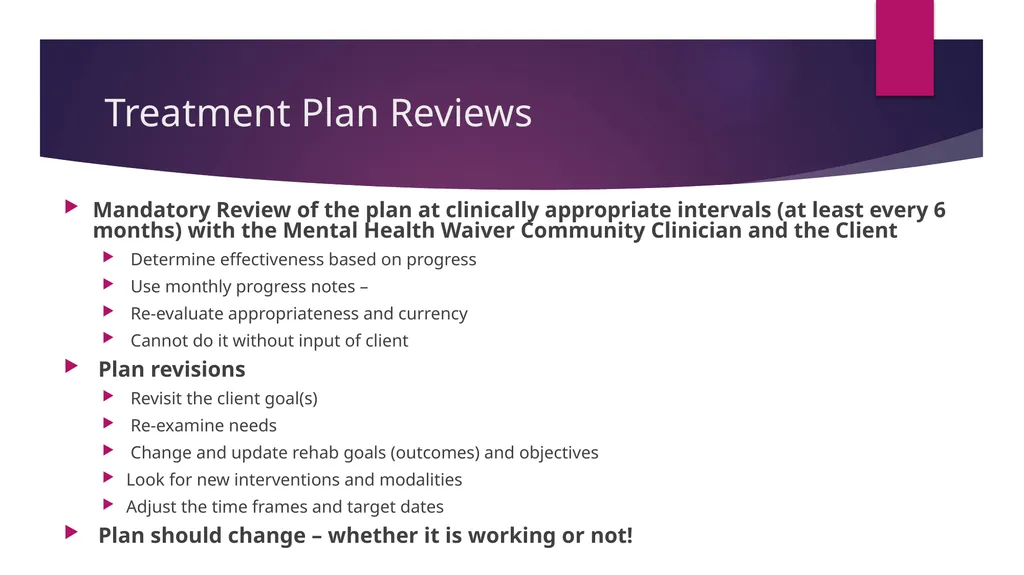
Treatment Plan Reviews Mandatory Review of the plan at clinically appropriate intervals (at least every 6 months) with the Mental Health Waiver Community Clinician and the Client
Determine effectiveness based on progress
Use monthly progress notes –
Re-evaluate appropriateness and currency
Cannot do it without input of client
Plan revisions
Revisit the client goal(s)
Re-examine needs
Change and update rehab goals (outcomes) and objectives
Look for new interventions and modalities
Adjust the time frames and target dates
Plan should change – whether it is working or not!<br>
Determine effectiveness based on progress
Use monthly progress notes –
Re-evaluate appropriateness and currency
Cannot do it without input of client
Plan revisions
Revisit the client goal(s)
Re-examine needs
Change and update rehab goals (outcomes) and objectives
Look for new interventions and modalities
Adjust the time frames and target dates
Plan should change – whether it is working or not!<br>
16
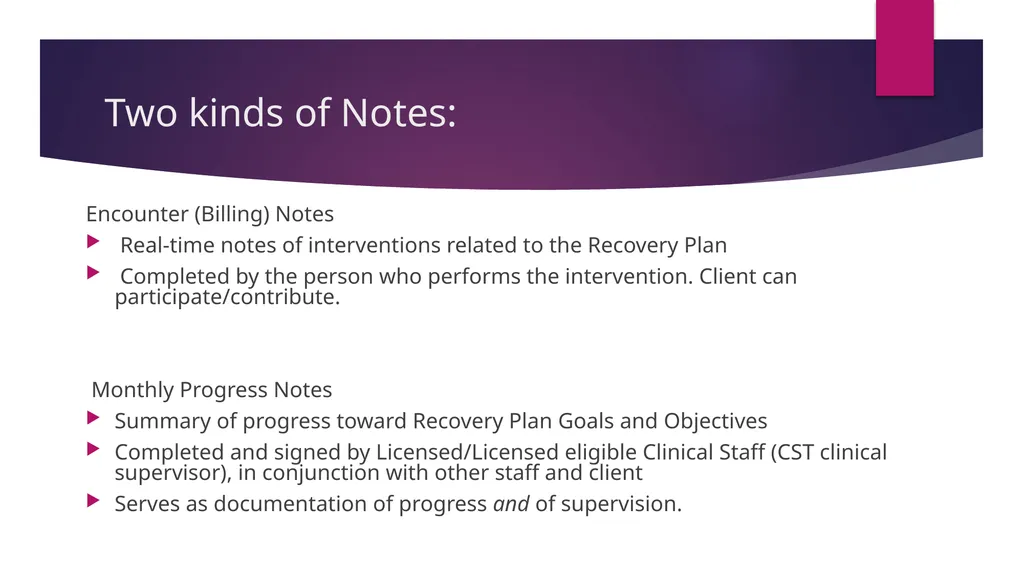
Two kinds of Notes: Encounter (Billing) Notes
Real-time notes of interventions related to the Recovery Plan
Completed by the person who performs the intervention. Client can participate/contribute.
Monthly Progress Notes
Summary of progress toward Recovery Plan Goals and Objectives
Completed and signed by Licensed/Licensed eligible Clinical Staff (CST clinical supervisor), in conjunction with other staff and client
Serves as documentation of progress and of supervision.<br>
Real-time notes of interventions related to the Recovery Plan
Completed by the person who performs the intervention. Client can participate/contribute.
Monthly Progress Notes
Summary of progress toward Recovery Plan Goals and Objectives
Completed and signed by Licensed/Licensed eligible Clinical Staff (CST clinical supervisor), in conjunction with other staff and client
Serves as documentation of progress and of supervision.<br>
17
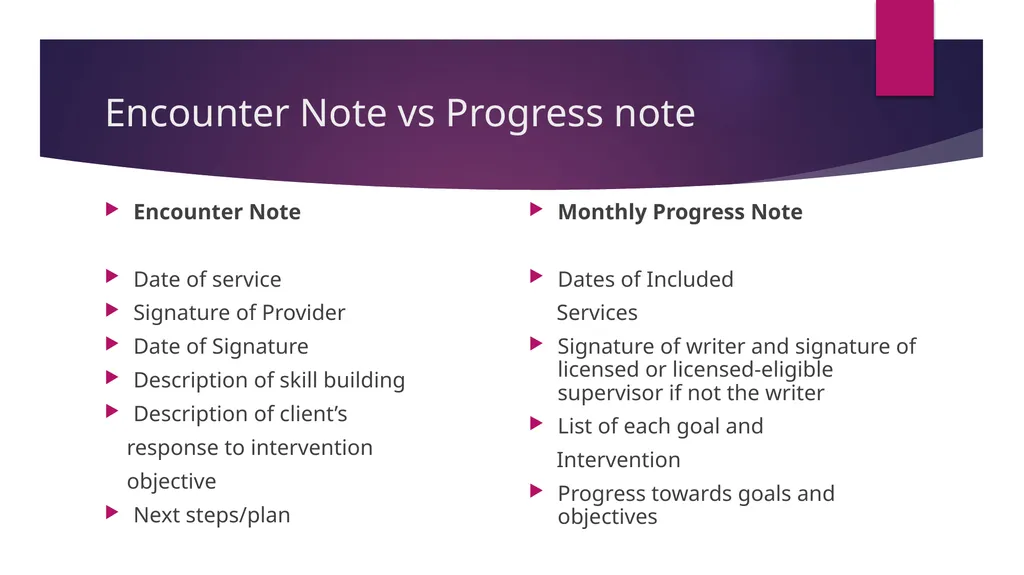
Encounter Note vs Progress note Encounter Note
Date of service
Signature of Provider
Date of Signature
Description of skill building
Description of client’s
response to intervention
objective
Next steps/plan Monthly Progress Note
Dates of Included
Services
Signature of writer and signature of licensed or licensed-eligible supervisor if not the writer
List of each goal and
Intervention
Progress towards goals and objectives<br>
Date of service
Signature of Provider
Date of Signature
Description of skill building
Description of client’s
response to intervention
objective
Next steps/plan Monthly Progress Note
Dates of Included
Services
Signature of writer and signature of licensed or licensed-eligible supervisor if not the writer
List of each goal and
Intervention
Progress towards goals and objectives<br>
18
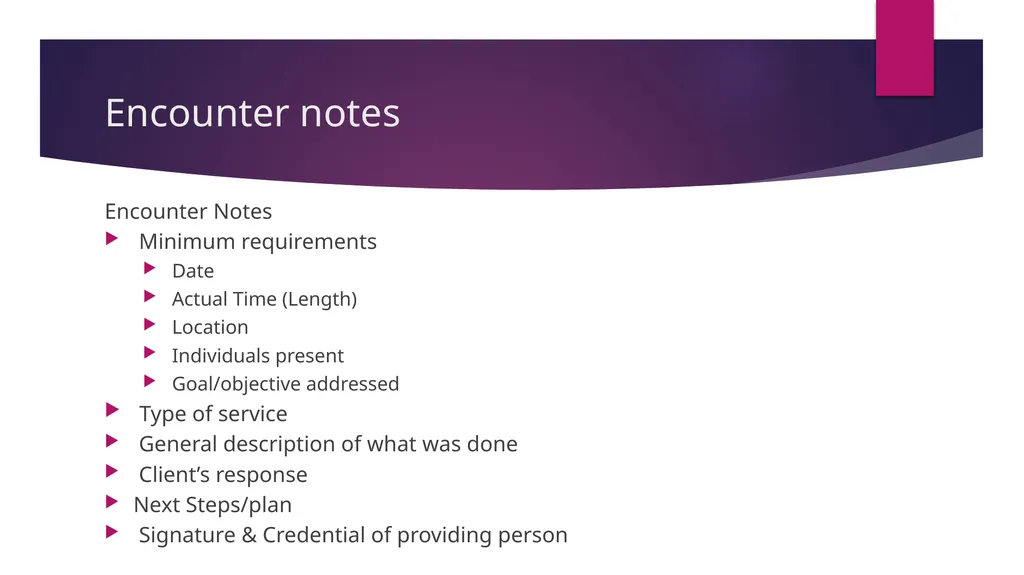
Encounter notes Encounter Notes
Minimum requirements
Date
Actual Time (Length)
Location
Individuals present
Goal/objective addressed
Type of service
General description of what was done
Client’s response
Next Steps/plan
Signature & Credential of providing person<br>
Minimum requirements
Date
Actual Time (Length)
Location
Individuals present
Goal/objective addressed
Type of service
General description of what was done
Client’s response
Next Steps/plan
Signature & Credential of providing person<br>
19
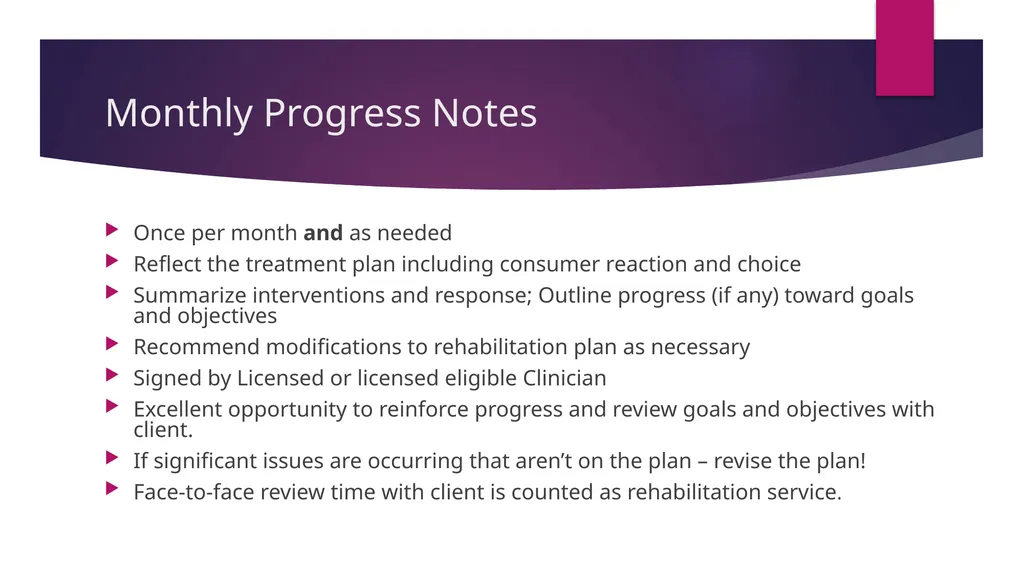
Monthly Progress Notes Once per month and as needed
Reflect the treatment plan including consumer reaction and choice
Summarize interventions and response; Outline progress (if any) toward goals and objectives
Recommend modifications to rehabilitation plan as necessary
Signed by Licensed or licensed eligible Clinician
Excellent opportunity to reinforce progress and review goals and objectives with client.
If significant issues are occurring that aren’t on the plan – revise the plan!
Face-to-face review time with client is counted as rehabilitation service.<br>
Reflect the treatment plan including consumer reaction and choice
Summarize interventions and response; Outline progress (if any) toward goals and objectives
Recommend modifications to rehabilitation plan as necessary
Signed by Licensed or licensed eligible Clinician
Excellent opportunity to reinforce progress and review goals and objectives with client.
If significant issues are occurring that aren’t on the plan – revise the plan!
Face-to-face review time with client is counted as rehabilitation service.<br>
20
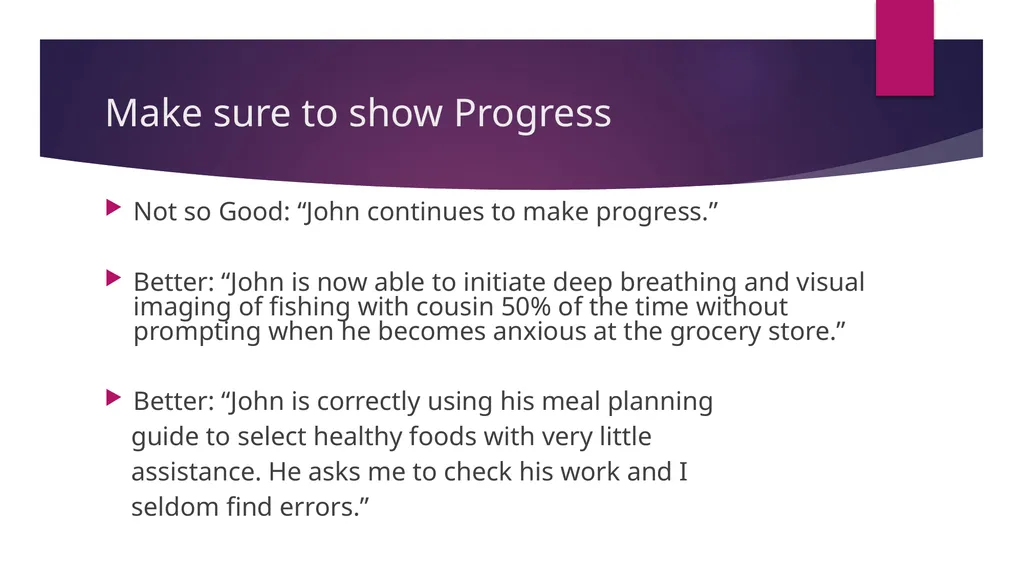
Make sure to show Progress Not so Good: “John continues to make progress.”
Better: “John is now able to initiate deep breathing and visual imaging of fishing with cousin 50% of the time without prompting when he becomes anxious at the grocery store.”
Better: “John is correctly using his meal planning
guide to select healthy foods with very little
assistance. He asks me to check his work and I
seldom find errors.”<br>
Better: “John is now able to initiate deep breathing and visual imaging of fishing with cousin 50% of the time without prompting when he becomes anxious at the grocery store.”
Better: “John is correctly using his meal planning
guide to select healthy foods with very little
assistance. He asks me to check his work and I
seldom find errors.”<br>
21
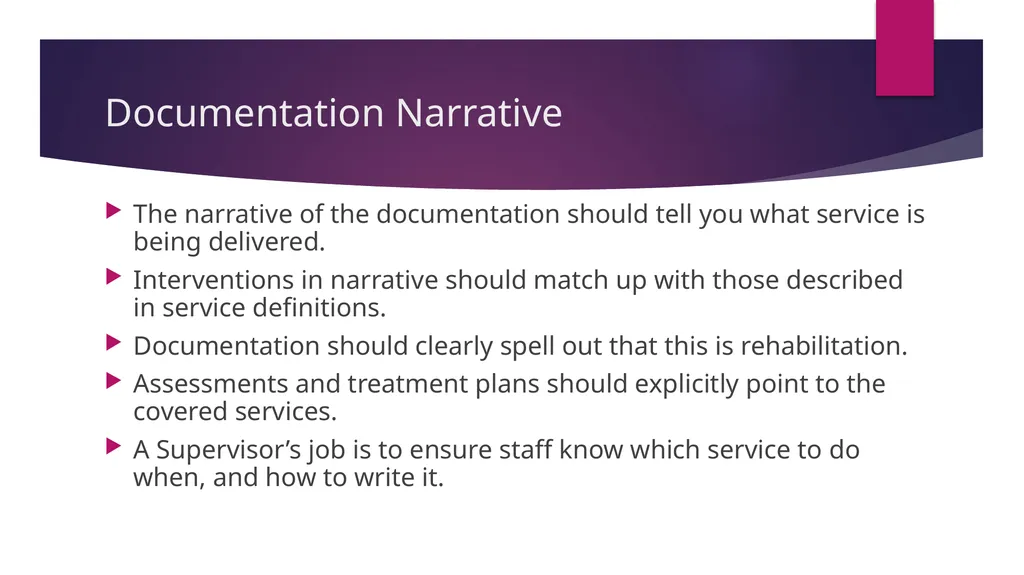
Documentation Narrative The narrative of the documentation should tell you what service is being delivered.
Interventions in narrative should match up with those described in service definitions.
Documentation should clearly spell out that this is rehabilitation.
Assessments and treatment plans should explicitly point to the covered services.
A Supervisor’s job is to ensure staff know which service to do when, and how to write it.<br>
Interventions in narrative should match up with those described in service definitions.
Documentation should clearly spell out that this is rehabilitation.
Assessments and treatment plans should explicitly point to the covered services.
A Supervisor’s job is to ensure staff know which service to do when, and how to write it.<br>
22
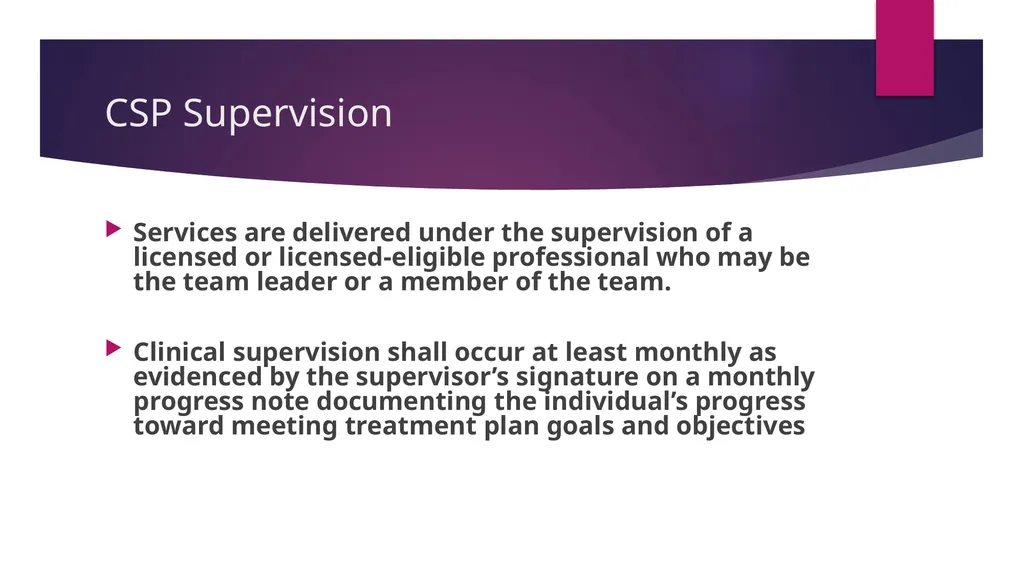
CSP Supervision Services are delivered under the supervision of a licensed or licensed-eligible professional who may be the team leader or a member of the team.
Clinical supervision shall occur at least monthly as evidenced by the supervisor’s signature on a monthly progress note documenting the individual’s progress toward meeting treatment plan goals and objectives<br>
Clinical supervision shall occur at least monthly as evidenced by the supervisor’s signature on a monthly progress note documenting the individual’s progress toward meeting treatment plan goals and objectives<br>
23
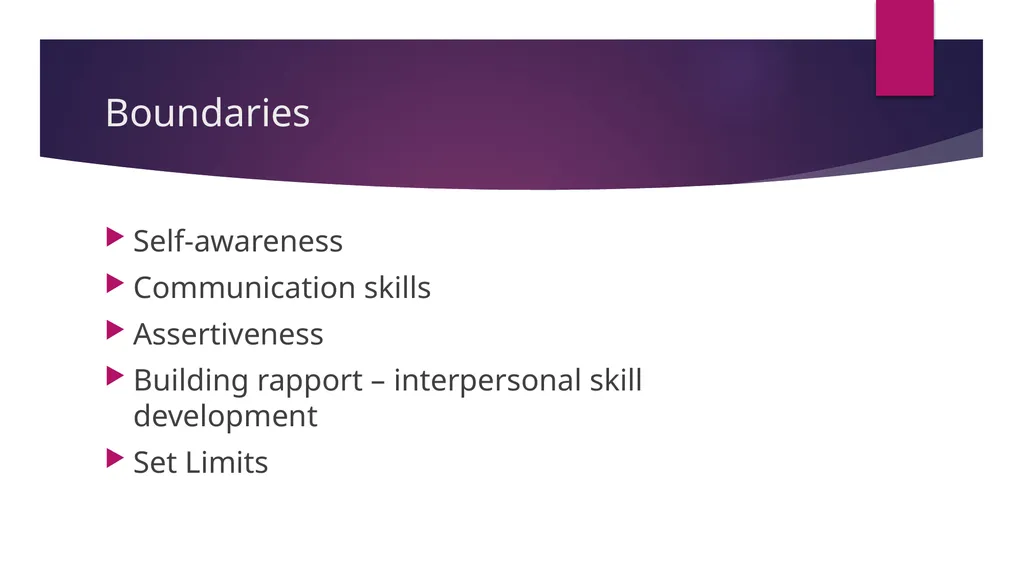
Boundaries Self-awareness
Communication skills
Assertiveness
Building rapport – interpersonal skill development
Set Limits<br>
Communication skills
Assertiveness
Building rapport – interpersonal skill development
Set Limits<br>
24
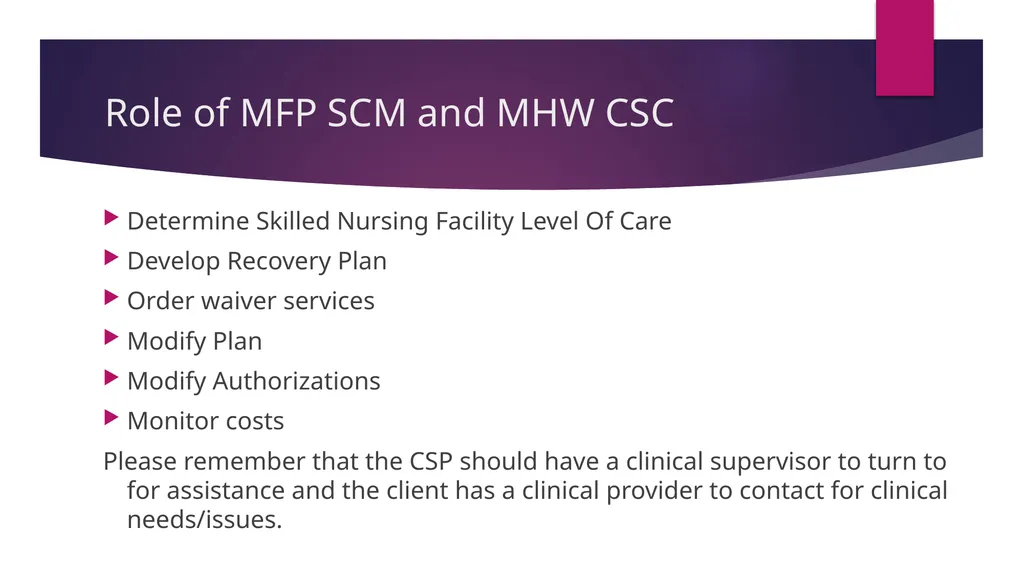
Role of MFP SCM and MHW CSC Determine Skilled Nursing Facility Level Of Care
Develop Recovery Plan
Order waiver services
Modify Plan
Modify Authorizations
Monitor costs
Please remember that the CSP should have a clinical supervisor to turn to for assistance and the client has a clinical provider to contact for clinical needs/issues.<br>
Develop Recovery Plan
Order waiver services
Modify Plan
Modify Authorizations
Monitor costs
Please remember that the CSP should have a clinical supervisor to turn to for assistance and the client has a clinical provider to contact for clinical needs/issues.<br>
25
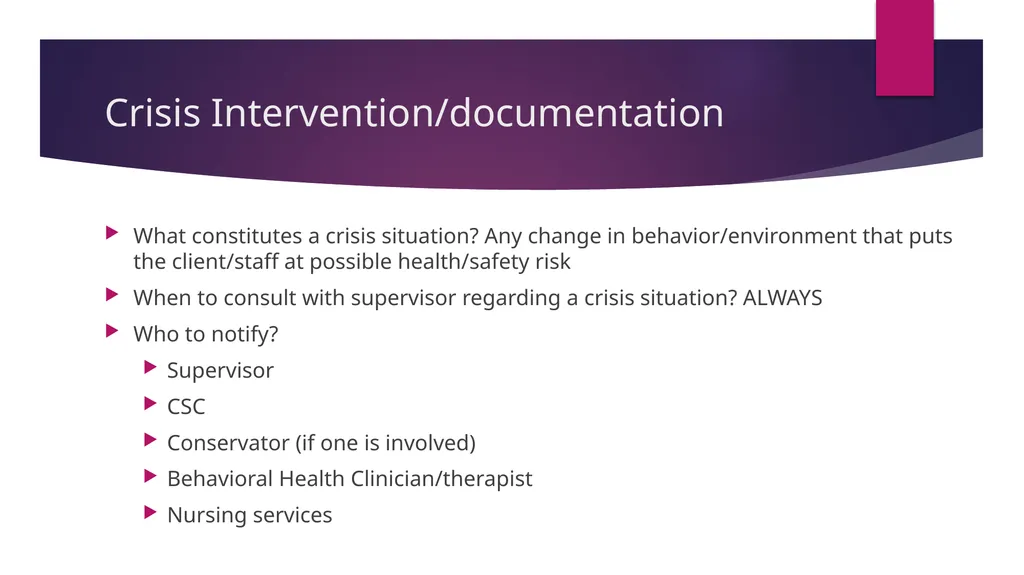
Crisis Intervention/documentation What constitutes a crisis situation? Any change in behavior/environment that puts the client/staff at possible health/safety risk
When to consult with supervisor regarding a crisis situation? ALWAYS
Who to notify?
Supervisor
CSC
Conservator (if one is involved)
Behavioral Health Clinician/therapist
Nursing services<br>
When to consult with supervisor regarding a crisis situation? ALWAYS
Who to notify?
Supervisor
CSC
Conservator (if one is involved)
Behavioral Health Clinician/therapist
Nursing services<br>
26
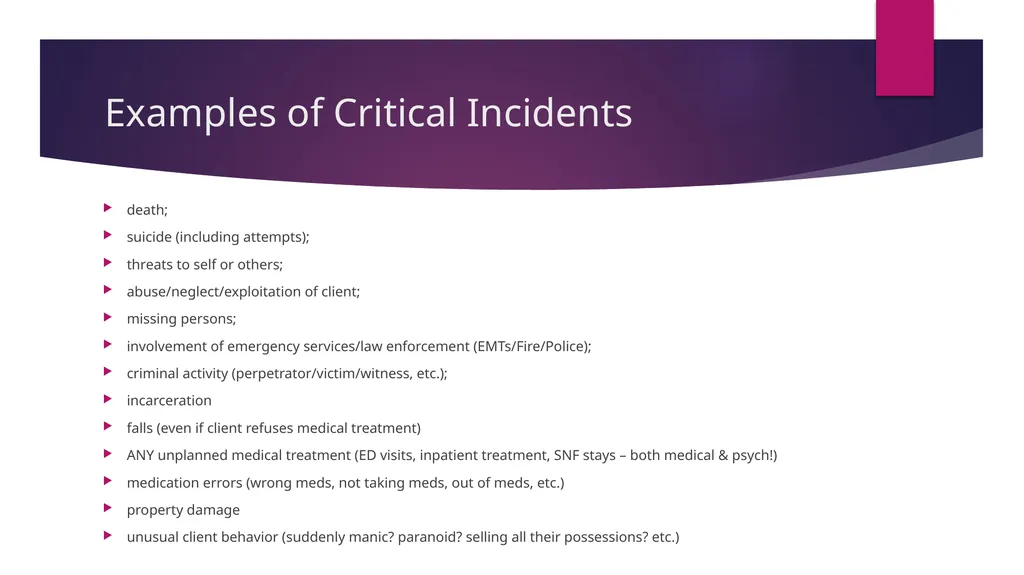
Examples of Critical Incidents death;
suicide (including attempts);
threats to self or others;
abuse/neglect/exploitation of client;
missing persons;
involvement of emergency services/law enforcement (EMTs/Fire/Police);
criminal activity (perpetrator/victim/witness, etc.);
incarceration
falls (even if client refuses medical treatment)
ANY unplanned medical treatment (ED visits, inpatient treatment, SNF stays – both medical & psych!)
medication errors (wrong meds, not taking meds, out of meds, etc.)
property damage
unusual client behavior (suddenly manic? paranoid? selling all their possessions? etc.)<br>
suicide (including attempts);
threats to self or others;
abuse/neglect/exploitation of client;
missing persons;
involvement of emergency services/law enforcement (EMTs/Fire/Police);
criminal activity (perpetrator/victim/witness, etc.);
incarceration
falls (even if client refuses medical treatment)
ANY unplanned medical treatment (ED visits, inpatient treatment, SNF stays – both medical & psych!)
medication errors (wrong meds, not taking meds, out of meds, etc.)
property damage
unusual client behavior (suddenly manic? paranoid? selling all their possessions? etc.)<br>
27
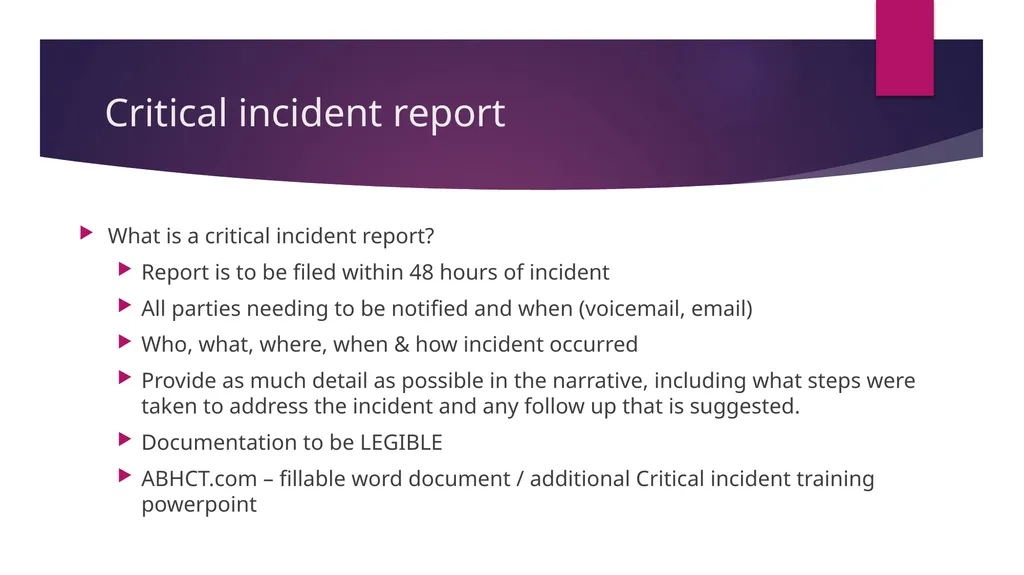
Critical incident report What is a critical incident report?
Report is to be filed within 48 hours of incident
All parties needing to be notified and when (voicemail, email)
Who, what, where, when & how incident occurred
Provide as much detail as possible in the narrative, including what steps were taken to address the incident and any follow up that is suggested.
Documentation to be LEGIBLE
ABHCT.com – fillable word document / additional Critical incident training powerpoint<br>
Report is to be filed within 48 hours of incident
All parties needing to be notified and when (voicemail, email)
Who, what, where, when & how incident occurred
Provide as much detail as possible in the narrative, including what steps were taken to address the incident and any follow up that is suggested.
Documentation to be LEGIBLE
ABHCT.com – fillable word document / additional Critical incident training powerpoint<br>
28
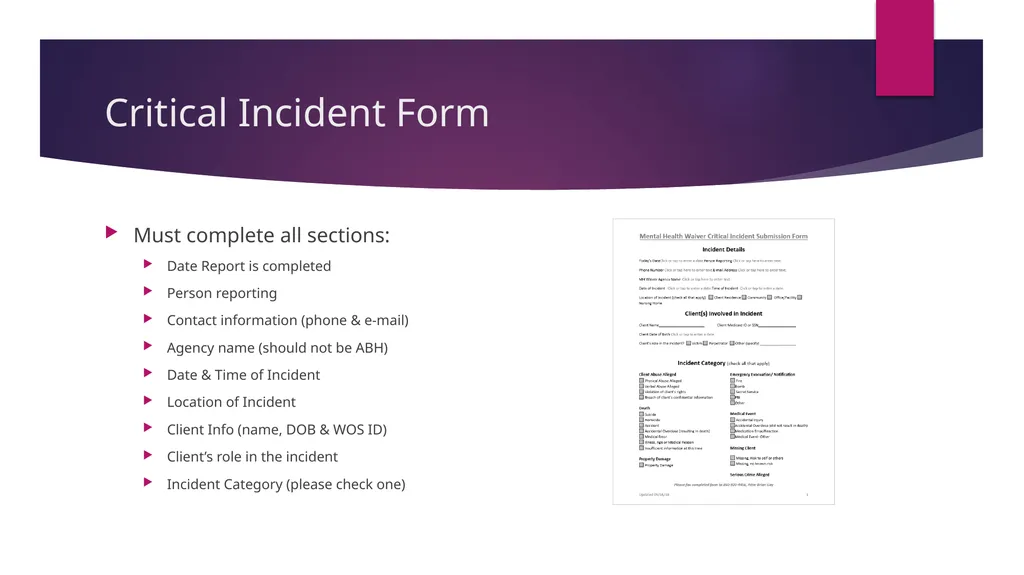
Critical Incident Form Must complete all sections:
Date Report is completed
Person reporting
Contact information (phone & e-mail)
Agency name (should not be ABH)
Date & Time of Incident
Location of Incident
Client Info (name, DOB & WOS ID)
Client’s role in the incident
Incident Category (please check one)<br>
Date Report is completed
Person reporting
Contact information (phone & e-mail)
Agency name (should not be ABH)
Date & Time of Incident
Location of Incident
Client Info (name, DOB & WOS ID)
Client’s role in the incident
Incident Category (please check one)<br>
29
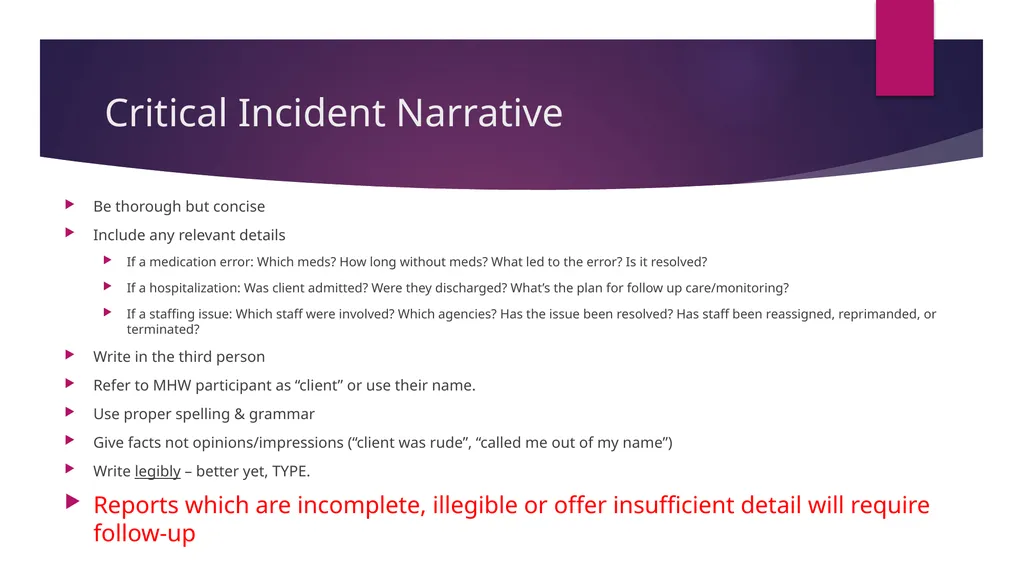
Critical Incident Narrative Be thorough but concise
Include any relevant details
If a medication error: Which meds? How long without meds? What led to the error? Is it resolved?
If a hospitalization: Was client admitted? Were they discharged? What’s the plan for follow up care/monitoring?
If a staffing issue: Which staff were involved? Which agencies? Has the issue been resolved? Has staff been reassigned, reprimanded, or terminated?
Write in the third person
Refer to MHW participant as “client” or use their name.
Use proper spelling & grammar
Give facts not opinions/impressions (“client was rude”, “called me out of my name”)
Write legibly – better yet, TYPE.
Reports which are incomplete, illegible or offer insufficient detail will require follow-up<br>
Include any relevant details
If a medication error: Which meds? How long without meds? What led to the error? Is it resolved?
If a hospitalization: Was client admitted? Were they discharged? What’s the plan for follow up care/monitoring?
If a staffing issue: Which staff were involved? Which agencies? Has the issue been resolved? Has staff been reassigned, reprimanded, or terminated?
Write in the third person
Refer to MHW participant as “client” or use their name.
Use proper spelling & grammar
Give facts not opinions/impressions (“client was rude”, “called me out of my name”)
Write legibly – better yet, TYPE.
Reports which are incomplete, illegible or offer insufficient detail will require follow-up<br>
30
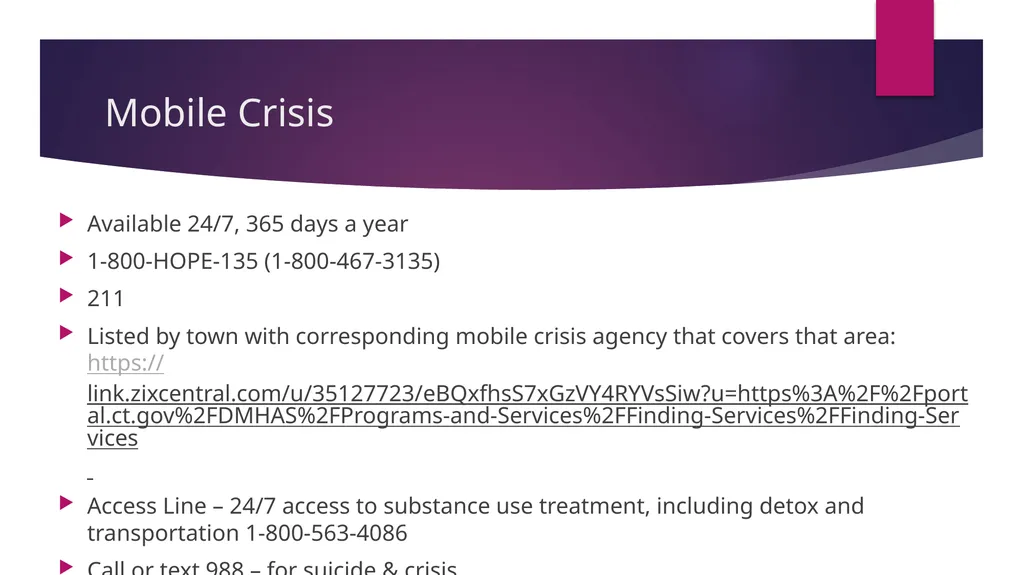
Mobile Crisis Available 24/7, 365 days a year
1-800-HOPE-135 (1-800-467-3135)
211
Listed by town with corresponding mobile crisis agency that covers that area: https://link.zixcentral.com/u/35127723/eBQxfhsS7xGzVY4RYVsSiw?u=https%3A%2F%2Fportal.ct.gov%2FDMHAS%2FPrograms-and-Services%2FFinding-Services%2FFinding-Services
Access Line – 24/7 access to substance use treatment, including detox and transportation 1-800-563-4086
Call or text 988 – for suicide & crisis<br>
1-800-HOPE-135 (1-800-467-3135)
211
Listed by town with corresponding mobile crisis agency that covers that area: https://link.zixcentral.com/u/35127723/eBQxfhsS7xGzVY4RYVsSiw?u=https%3A%2F%2Fportal.ct.gov%2FDMHAS%2FPrograms-and-Services%2FFinding-Services%2FFinding-Services
Access Line – 24/7 access to substance use treatment, including detox and transportation 1-800-563-4086
Call or text 988 – for suicide & crisis<br>