
Comparative Anatomy of Digestive System in
MY
Published · 14 slides · 0 views

1 / 1

Description
Comparative Anatomy of Digestive System in Vertebrates Ms. Sarojmoni Sonowal Assistant Professor Department of Zoology Pub Kamrup College DIGESTIVE SYSTEM CONSISTS OF TWO PARTS ALIMENTARY CANAL AND ASSOCIATED ORGANS The alimentary canal of
Related Topics
Share
Embed code
Download this presentation From Below
"Comparative Anatomy of Digestive System in" is the property of its rightful owner. Permission is granted to download and print the materials on this website for personal, non-commercial use only, and to display it on your personal computer provided you do not modify the materials and that you retain all copyright notices contained in the materials. By downloading content from our website, you accept the terms of this agreement.
Presentation Transcript
01
Comparative Anatomy of Digestive System in Vertebrates Ms. Sarojmoni Sonowal
Assistant Professor
Department of Zoology
Pub Kamrup College<br>
Assistant Professor
Department of Zoology
Pub Kamrup College<br>
02
DIGESTIVE SYSTEM CONSISTS OF TWO PARTS
ALIMENTARY CANAL AND ASSOCIATED ORGANS
The alimentary canal of vertebrates includes the following parts:
Mouth, oral cavity, pharynx, oesophagus, Stomach and intestine
Associated glands includes: Liver, Pancreas
The digestive tract and associated accessory organs together constitute the digestive system.
THE BASIC PATTERN OF DIGESTIVE SYSTEM IS SIMILAR IN ALL VERTEBRATES
But some modifications of alimentary canal in different vertebrates is observed.<br>
ALIMENTARY CANAL AND ASSOCIATED ORGANS
The alimentary canal of vertebrates includes the following parts:
Mouth, oral cavity, pharynx, oesophagus, Stomach and intestine
Associated glands includes: Liver, Pancreas
The digestive tract and associated accessory organs together constitute the digestive system.
THE BASIC PATTERN OF DIGESTIVE SYSTEM IS SIMILAR IN ALL VERTEBRATES
But some modifications of alimentary canal in different vertebrates is observed.<br>
03
ALIMENTARY CANAL OR TRACT Major part of the alimentary tract are- mouth, oral cavity, pharynx, oesophagus, stomach, small and large intestine.
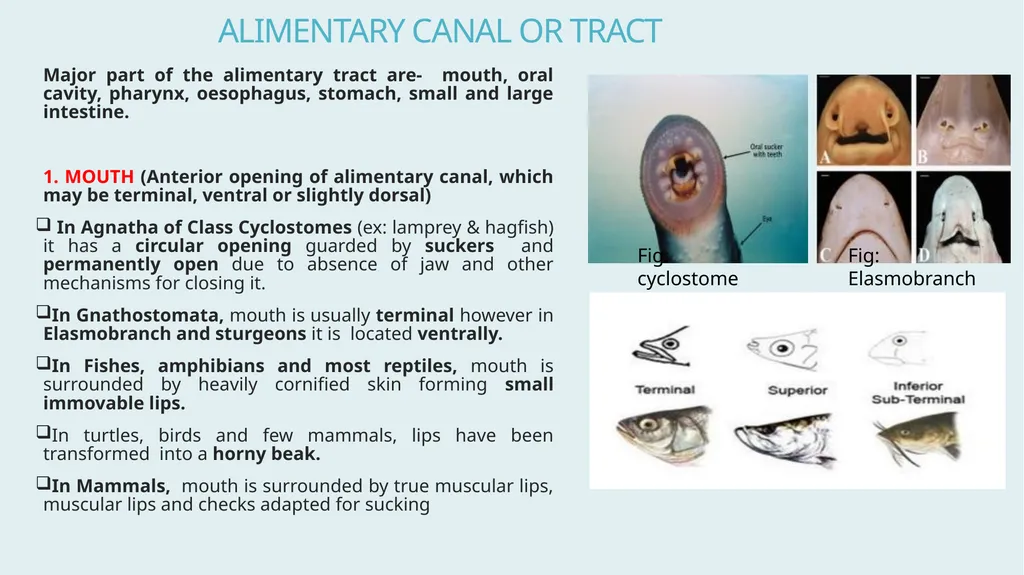
1. MOUTH (Anterior opening of alimentary canal, which may be terminal, ventral or slightly dorsal)
In Agnatha of Class Cyclostomes (ex: lamprey & hagfish) it has a circular opening guarded by suckers and permanently open due to absence of jaw and other mechanisms for closing it.
In Gnathostomata, mouth is usually terminal however in Elasmobranch and sturgeons it is located ventrally.
In Fishes, amphibians and most reptiles, mouth is surrounded by heavily cornified skin forming small immovable lips.
In turtles, birds and few mammals, lips have been transformed into a horny beak.
In Mammals, mouth is surrounded by true muscular lips, muscular lips and checks adapted for sucking Fig: cyclostome Fig: Elasmobranch<br>
1. MOUTH (Anterior opening of alimentary canal, which may be terminal, ventral or slightly dorsal)
In Agnatha of Class Cyclostomes (ex: lamprey & hagfish) it has a circular opening guarded by suckers and permanently open due to absence of jaw and other mechanisms for closing it.
In Gnathostomata, mouth is usually terminal however in Elasmobranch and sturgeons it is located ventrally.
In Fishes, amphibians and most reptiles, mouth is surrounded by heavily cornified skin forming small immovable lips.
In turtles, birds and few mammals, lips have been transformed into a horny beak.
In Mammals, mouth is surrounded by true muscular lips, muscular lips and checks adapted for sucking Fig: cyclostome Fig: Elasmobranch<br>
04
2. ORAL CAVITY
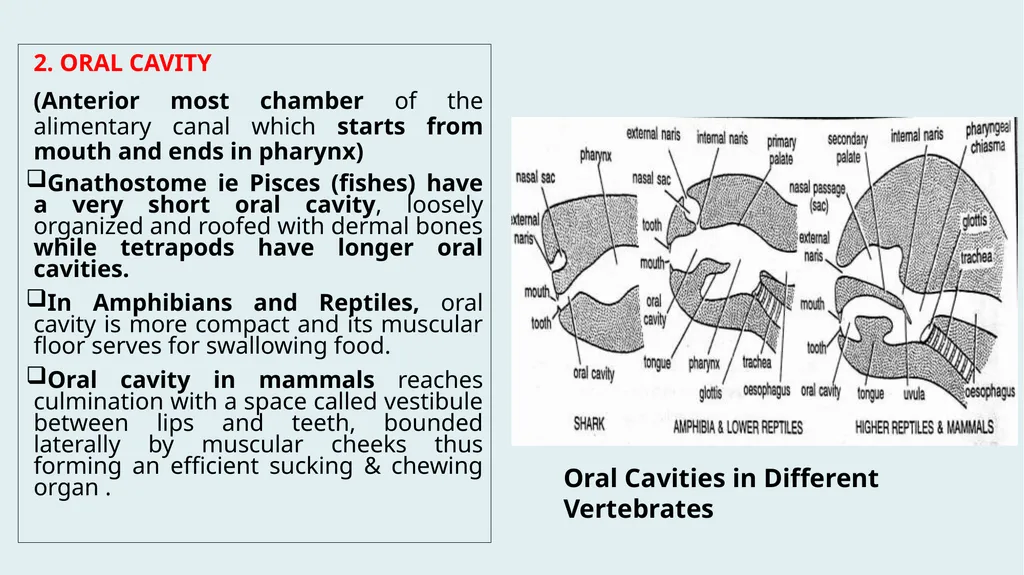
(Anterior most chamber of the alimentary canal which starts from mouth and ends in pharynx)
Gnathostome ie Pisces (fishes) have a very short oral cavity, loosely organized and roofed with dermal bones while tetrapods have longer oral cavities.
In Amphibians and Reptiles, oral cavity is more compact and its muscular floor serves for swallowing food.
Oral cavity in mammals reaches culmination with a space called vestibule between lips and teeth, bounded laterally by muscular cheeks thus forming an efficient sucking & chewing organ . Oral Cavities in Different Vertebrates<br>
(Anterior most chamber of the alimentary canal which starts from mouth and ends in pharynx)
Gnathostome ie Pisces (fishes) have a very short oral cavity, loosely organized and roofed with dermal bones while tetrapods have longer oral cavities.
In Amphibians and Reptiles, oral cavity is more compact and its muscular floor serves for swallowing food.
Oral cavity in mammals reaches culmination with a space called vestibule between lips and teeth, bounded laterally by muscular cheeks thus forming an efficient sucking & chewing organ . Oral Cavities in Different Vertebrates<br>
05
3. Accessory organs of Oral Cavity (Oral cavity contains teeth, Tongue and oral glands)
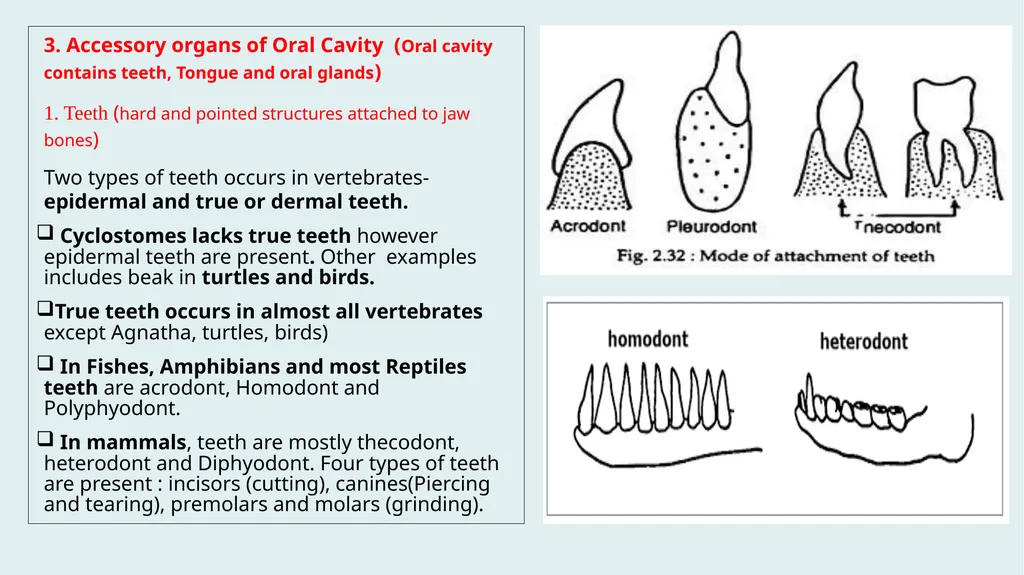
1. Teeth (hard and pointed structures attached to jaw bones)
Two types of teeth occurs in vertebrates- epidermal and true or dermal teeth.
Cyclostomes lacks true teeth however epidermal teeth are present. Other examples includes beak in turtles and birds.
True teeth occurs in almost all vertebrates except Agnatha, turtles, birds)
In Fishes, Amphibians and most Reptiles teeth are acrodont, Homodont and Polyphyodont.
In mammals, teeth are mostly thecodont, heterodont and Diphyodont. Four types of teeth are present : incisors (cutting), canines(Piercing and tearing), premolars and molars (grinding).<br>
1. Teeth (hard and pointed structures attached to jaw bones)
Two types of teeth occurs in vertebrates- epidermal and true or dermal teeth.
Cyclostomes lacks true teeth however epidermal teeth are present. Other examples includes beak in turtles and birds.
True teeth occurs in almost all vertebrates except Agnatha, turtles, birds)
In Fishes, Amphibians and most Reptiles teeth are acrodont, Homodont and Polyphyodont.
In mammals, teeth are mostly thecodont, heterodont and Diphyodont. Four types of teeth are present : incisors (cutting), canines(Piercing and tearing), premolars and molars (grinding).<br>
06
Accessory organs of Oral Cavity (Teeth, Tongue and oral glands)
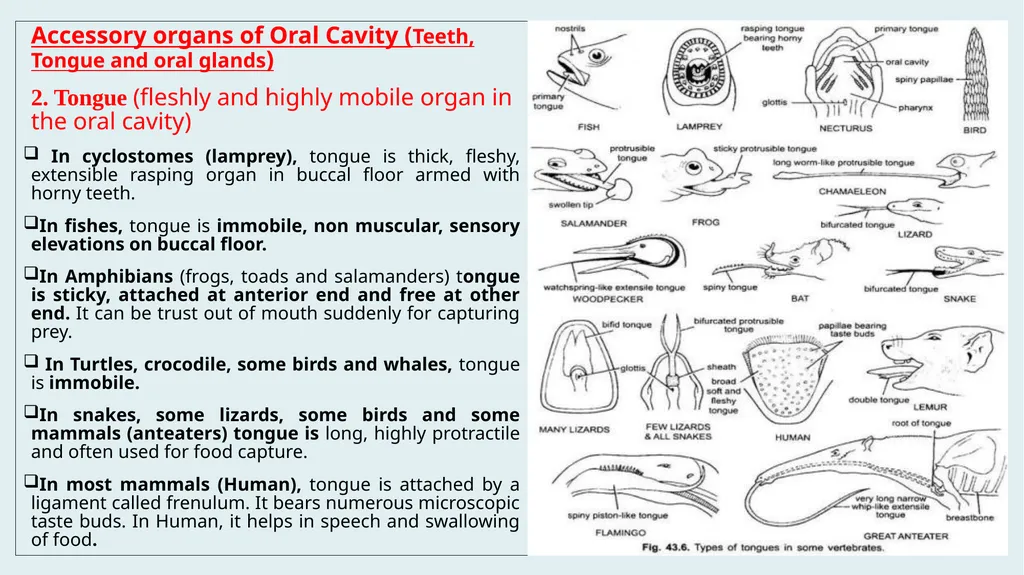
2. Tongue (fleshly and highly mobile organ in the oral cavity)
In cyclostomes (lamprey), tongue is thick, fleshy, extensible rasping organ in buccal floor armed with horny teeth.
In fishes, tongue is immobile, non muscular, sensory elevations on buccal floor.
In Amphibians (frogs, toads and salamanders) tongue is sticky, attached at anterior end and free at other end. It can be trust out of mouth suddenly for capturing prey.
In Turtles, crocodile, some birds and whales, tongue is immobile.
In snakes, some lizards, some birds and some mammals (anteaters) tongue is long, highly protractile and often used for food capture.
In most mammals (Human), tongue is attached by a ligament called frenulum. It bears numerous microscopic taste buds. In Human, it helps in speech and swallowing of food.<br>
2. Tongue (fleshly and highly mobile organ in the oral cavity)
In cyclostomes (lamprey), tongue is thick, fleshy, extensible rasping organ in buccal floor armed with horny teeth.
In fishes, tongue is immobile, non muscular, sensory elevations on buccal floor.
In Amphibians (frogs, toads and salamanders) tongue is sticky, attached at anterior end and free at other end. It can be trust out of mouth suddenly for capturing prey.
In Turtles, crocodile, some birds and whales, tongue is immobile.
In snakes, some lizards, some birds and some mammals (anteaters) tongue is long, highly protractile and often used for food capture.
In most mammals (Human), tongue is attached by a ligament called frenulum. It bears numerous microscopic taste buds. In Human, it helps in speech and swallowing of food.<br>
07
3. Oral Glands
In Vertebrates, a great variety of oral glands are found that secretes a variety of substances.
In Aquatic organisms, oral glands are few or absent but gradually increases in number and complexity in terrestrial forms.
Fish and Aquatic amphibians have simple mucous gland.
Poisonous snakes (Reptiles) have large poison glands which are modification of parotid gland.
The largest oral glands are the salivary glands of Mammals. Salivary glands secretes enzyme called salivary amylase or ptyalin. 4. Pharynx
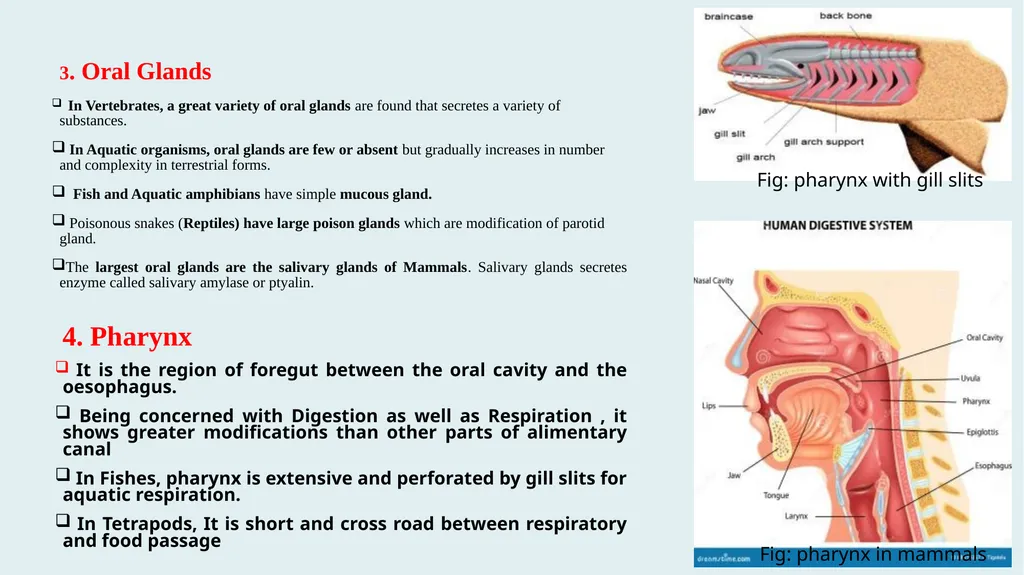
It is the region of foregut between the oral cavity and the oesophagus.
Being concerned with Digestion as well as Respiration , it shows greater modifications than other parts of alimentary canal
In Fishes, pharynx is extensive and perforated by gill slits for aquatic respiration.
In Tetrapods, It is short and cross road between respiratory and food passage Fig: pharynx with gill slits Fig: pharynx in mammals<br>
In Vertebrates, a great variety of oral glands are found that secretes a variety of substances.
In Aquatic organisms, oral glands are few or absent but gradually increases in number and complexity in terrestrial forms.
Fish and Aquatic amphibians have simple mucous gland.
Poisonous snakes (Reptiles) have large poison glands which are modification of parotid gland.
The largest oral glands are the salivary glands of Mammals. Salivary glands secretes enzyme called salivary amylase or ptyalin. 4. Pharynx
It is the region of foregut between the oral cavity and the oesophagus.
Being concerned with Digestion as well as Respiration , it shows greater modifications than other parts of alimentary canal
In Fishes, pharynx is extensive and perforated by gill slits for aquatic respiration.
In Tetrapods, It is short and cross road between respiratory and food passage Fig: pharynx with gill slits Fig: pharynx in mammals<br>
08
5. Oesophagus
Oesophagus is muscular, distensible tube connecting pharynx with stomach.
Its length is related to the length of the neck of the vertebrates.
In Cyclostomes, Fishes and Amphibians, Oesophagus is very short but longer in amniotes
In birds (Aves), the oesophagus contains a distensible sac called crop, which is located at the upper part of the digestive tract that acts as a temporary food storage.
In snakes (Reptiles) that swallow whole large prey, oesophagus can stretch considerably to accommodate the passage of large prey.
In many mammals including humans, the oesophagus is relatively short and straight and in some herbivores mammals eg. cows and rabbits, the oesophagus is quite large to accommodate the passage of large amounts of plant materials Fig: Bird (Alimentary tract)<br>
Oesophagus is muscular, distensible tube connecting pharynx with stomach.
Its length is related to the length of the neck of the vertebrates.
In Cyclostomes, Fishes and Amphibians, Oesophagus is very short but longer in amniotes
In birds (Aves), the oesophagus contains a distensible sac called crop, which is located at the upper part of the digestive tract that acts as a temporary food storage.
In snakes (Reptiles) that swallow whole large prey, oesophagus can stretch considerably to accommodate the passage of large prey.
In many mammals including humans, the oesophagus is relatively short and straight and in some herbivores mammals eg. cows and rabbits, the oesophagus is quite large to accommodate the passage of large amounts of plant materials Fig: Bird (Alimentary tract)<br>
09
6. Stomach
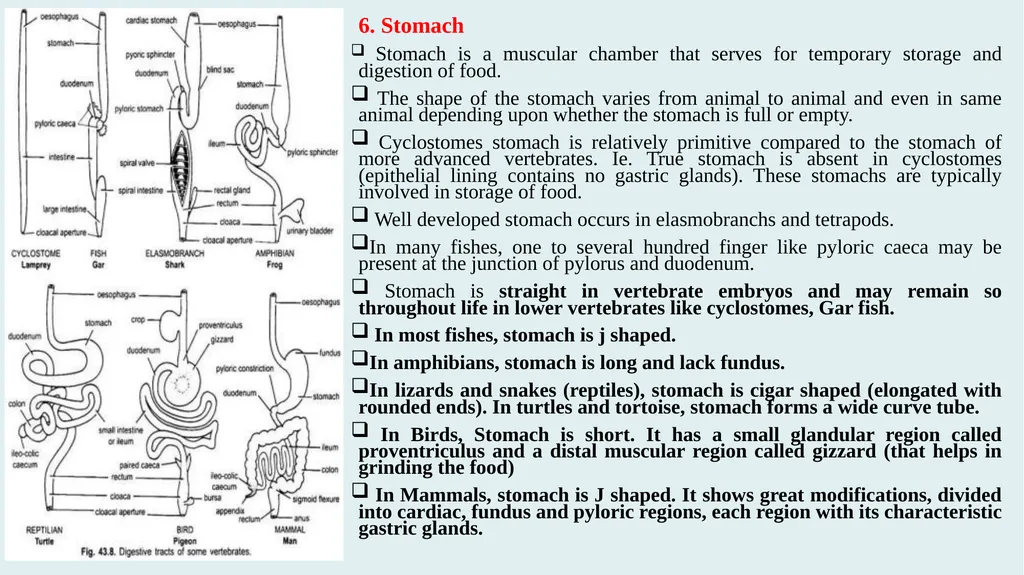
Stomach is a muscular chamber that serves for temporary storage and digestion of food.
The shape of the stomach varies from animal to animal and even in same animal depending upon whether the stomach is full or empty.
Cyclostomes stomach is relatively primitive compared to the stomach of more advanced vertebrates. Ie. True stomach is absent in cyclostomes (epithelial lining contains no gastric glands). These stomachs are typically involved in storage of food.
Well developed stomach occurs in elasmobranchs and tetrapods.
In many fishes, one to several hundred finger like pyloric caeca may be present at the junction of pylorus and duodenum.
Stomach is straight in vertebrate embryos and may remain so throughout life in lower vertebrates like cyclostomes, Gar fish.
In most fishes, stomach is j shaped.
In amphibians, stomach is long and lack fundus.
In lizards and snakes (reptiles), stomach is cigar shaped (elongated with rounded ends). In turtles and tortoise, stomach forms a wide curve tube.
In Birds, Stomach is short. It has a small glandular region called proventriculus and a distal muscular region called gizzard (that helps in grinding the food)
In Mammals, stomach is J shaped. It shows great modifications, divided into cardiac, fundus and pyloric regions, each region with its characteristic gastric glands.<br>
Stomach is a muscular chamber that serves for temporary storage and digestion of food.
The shape of the stomach varies from animal to animal and even in same animal depending upon whether the stomach is full or empty.
Cyclostomes stomach is relatively primitive compared to the stomach of more advanced vertebrates. Ie. True stomach is absent in cyclostomes (epithelial lining contains no gastric glands). These stomachs are typically involved in storage of food.
Well developed stomach occurs in elasmobranchs and tetrapods.
In many fishes, one to several hundred finger like pyloric caeca may be present at the junction of pylorus and duodenum.
Stomach is straight in vertebrate embryos and may remain so throughout life in lower vertebrates like cyclostomes, Gar fish.
In most fishes, stomach is j shaped.
In amphibians, stomach is long and lack fundus.
In lizards and snakes (reptiles), stomach is cigar shaped (elongated with rounded ends). In turtles and tortoise, stomach forms a wide curve tube.
In Birds, Stomach is short. It has a small glandular region called proventriculus and a distal muscular region called gizzard (that helps in grinding the food)
In Mammals, stomach is J shaped. It shows great modifications, divided into cardiac, fundus and pyloric regions, each region with its characteristic gastric glands.<br>
10
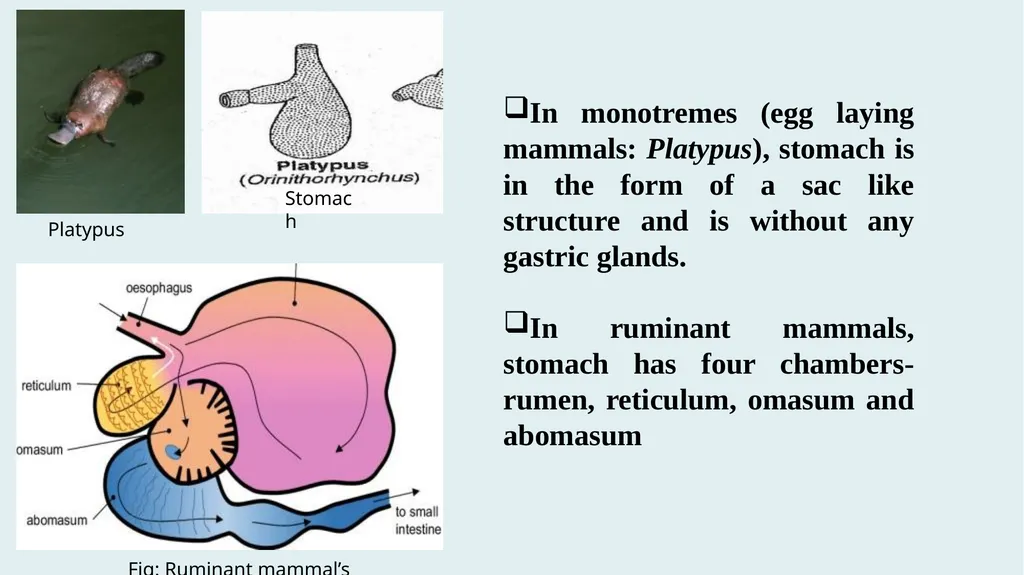
In monotremes (egg laying mammals: Platypus), stomach is in the form of a sac like structure and is without any gastric glands.
In ruminant mammals, stomach has four chambers- rumen, reticulum, omasum and abomasum Platypus Stomach Fig: Ruminant mammal’s Stomach<br>
In ruminant mammals, stomach has four chambers- rumen, reticulum, omasum and abomasum Platypus Stomach Fig: Ruminant mammal’s Stomach<br>
11
7. Intestine:
Most important part of alimentary tract where digestion and absorption takes place. It undergoes several modification in vertebrates
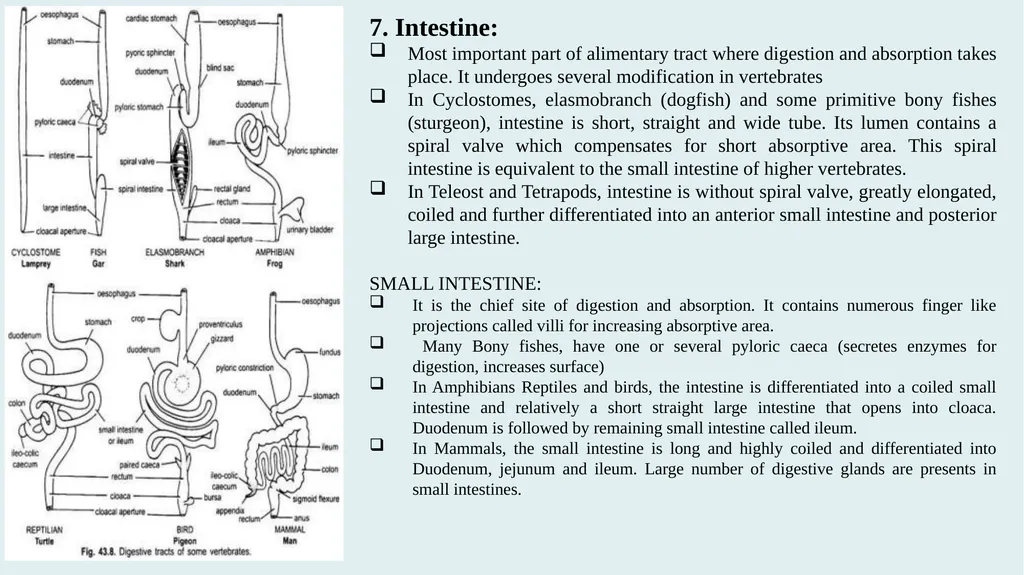
In Cyclostomes, elasmobranch (dogfish) and some primitive bony fishes (sturgeon), intestine is short, straight and wide tube. Its lumen contains a spiral valve which compensates for short absorptive area. This spiral intestine is equivalent to the small intestine of higher vertebrates.
In Teleost and Tetrapods, intestine is without spiral valve, greatly elongated, coiled and further differentiated into an anterior small intestine and posterior large intestine.
SMALL INTESTINE:
It is the chief site of digestion and absorption. It contains numerous finger like projections called villi for increasing absorptive area.
Many Bony fishes, have one or several pyloric caeca (secretes enzymes for digestion, increases surface)
In Amphibians Reptiles and birds, the intestine is differentiated into a coiled small intestine and relatively a short straight large intestine that opens into cloaca. Duodenum is followed by remaining small intestine called ileum.
In Mammals, the small intestine is long and highly coiled and differentiated into Duodenum, jejunum and ileum. Large number of digestive glands are presents in small intestines.<br>
Most important part of alimentary tract where digestion and absorption takes place. It undergoes several modification in vertebrates
In Cyclostomes, elasmobranch (dogfish) and some primitive bony fishes (sturgeon), intestine is short, straight and wide tube. Its lumen contains a spiral valve which compensates for short absorptive area. This spiral intestine is equivalent to the small intestine of higher vertebrates.
In Teleost and Tetrapods, intestine is without spiral valve, greatly elongated, coiled and further differentiated into an anterior small intestine and posterior large intestine.
SMALL INTESTINE:
It is the chief site of digestion and absorption. It contains numerous finger like projections called villi for increasing absorptive area.
Many Bony fishes, have one or several pyloric caeca (secretes enzymes for digestion, increases surface)
In Amphibians Reptiles and birds, the intestine is differentiated into a coiled small intestine and relatively a short straight large intestine that opens into cloaca. Duodenum is followed by remaining small intestine called ileum.
In Mammals, the small intestine is long and highly coiled and differentiated into Duodenum, jejunum and ileum. Large number of digestive glands are presents in small intestines.<br>
12
LARGE INTESTINE:
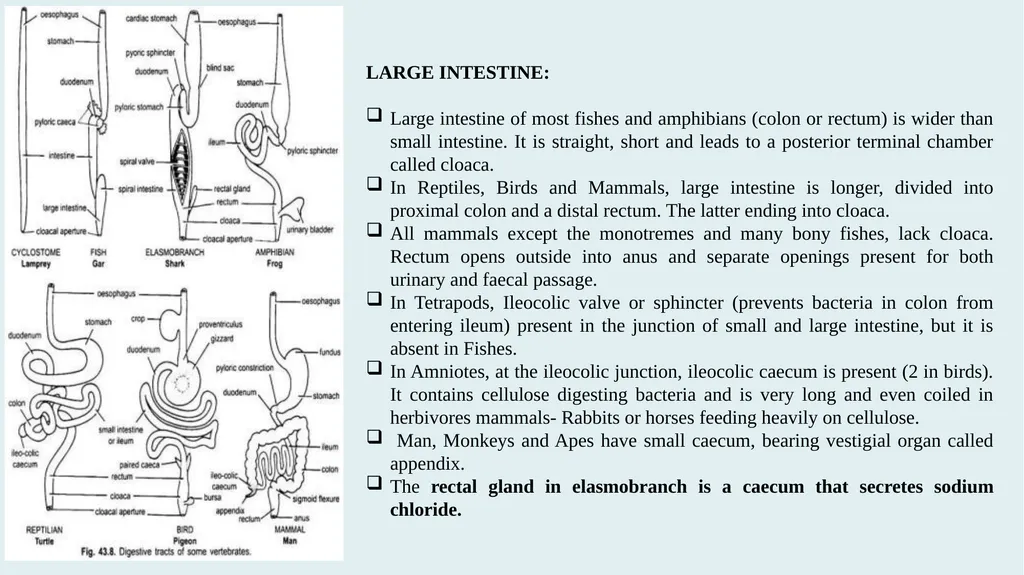
Large intestine of most fishes and amphibians (colon or rectum) is wider than small intestine. It is straight, short and leads to a posterior terminal chamber called cloaca.
In Reptiles, Birds and Mammals, large intestine is longer, divided into proximal colon and a distal rectum. The latter ending into cloaca.
All mammals except the monotremes and many bony fishes, lack cloaca. Rectum opens outside into anus and separate openings present for both urinary and faecal passage.
In Tetrapods, Ileocolic valve or sphincter (prevents bacteria in colon from entering ileum) present in the junction of small and large intestine, but it is absent in Fishes.
In Amniotes, at the ileocolic junction, ileocolic caecum is present (2 in birds). It contains cellulose digesting bacteria and is very long and even coiled in herbivores mammals- Rabbits or horses feeding heavily on cellulose.
Man, Monkeys and Apes have small caecum, bearing vestigial organ called appendix.
The rectal gland in elasmobranch is a caecum that secretes sodium chloride.<br>
Large intestine of most fishes and amphibians (colon or rectum) is wider than small intestine. It is straight, short and leads to a posterior terminal chamber called cloaca.
In Reptiles, Birds and Mammals, large intestine is longer, divided into proximal colon and a distal rectum. The latter ending into cloaca.
All mammals except the monotremes and many bony fishes, lack cloaca. Rectum opens outside into anus and separate openings present for both urinary and faecal passage.
In Tetrapods, Ileocolic valve or sphincter (prevents bacteria in colon from entering ileum) present in the junction of small and large intestine, but it is absent in Fishes.
In Amniotes, at the ileocolic junction, ileocolic caecum is present (2 in birds). It contains cellulose digesting bacteria and is very long and even coiled in herbivores mammals- Rabbits or horses feeding heavily on cellulose.
Man, Monkeys and Apes have small caecum, bearing vestigial organ called appendix.
The rectal gland in elasmobranch is a caecum that secretes sodium chloride.<br>
13
ASSOCIATED DIGESTIVE GLANDS 1. LIVER & GALL BLADDER
The liver is the largest gland of the body and is found in all vertebrates
Liver cells manufacture alkaline bile which is stored in gall bladder before getting released into duodenum.
Gall bladder is present in Hagfishes of cyclostomes class and in all higher vertebrates but absent in Lampreys, many birds (pigeons) and mammals (rats and whales)
In Cyclostomes, liver is very small and singled lobed in lampreys but 2 lobed in hagfishes.
In fishes, Amphibians and snakes, liver is elongated, narrow and cylindrical but short broad and flattened in Birds and Mammals
It is bilobed in elasmobranch, 2-3 lobed in teleosts, amphibians and Reptiles and birds and multilobed in Mammals.
Liver is relatively large in carnivores than herbivores.<br>
The liver is the largest gland of the body and is found in all vertebrates
Liver cells manufacture alkaline bile which is stored in gall bladder before getting released into duodenum.
Gall bladder is present in Hagfishes of cyclostomes class and in all higher vertebrates but absent in Lampreys, many birds (pigeons) and mammals (rats and whales)
In Cyclostomes, liver is very small and singled lobed in lampreys but 2 lobed in hagfishes.
In fishes, Amphibians and snakes, liver is elongated, narrow and cylindrical but short broad and flattened in Birds and Mammals
It is bilobed in elasmobranch, 2-3 lobed in teleosts, amphibians and Reptiles and birds and multilobed in Mammals.
Liver is relatively large in carnivores than herbivores.<br>
14
2. PANCREAS
Pancreas is the second largest gland of the body and found in all vertebrates.
Pancreas has dual role- endocrine and exocrine. Endocrine part secretes hormones such as insulin and exocrine part secretes pancreatic juices containing digestive enzymes
In Lampreys, some teleosts, lungfishes and lower tetrapods, pancreas is distributed diffusely in liver and intestinal wall, mostly with exocrine function.
In Elasmobranch and higher tetrapods, Pancreas is well defined structure with both endocrine and exocrine function. ASSOCIATED DIGESTIVE GLANDS<br>
Pancreas is the second largest gland of the body and found in all vertebrates.
Pancreas has dual role- endocrine and exocrine. Endocrine part secretes hormones such as insulin and exocrine part secretes pancreatic juices containing digestive enzymes
In Lampreys, some teleosts, lungfishes and lower tetrapods, pancreas is distributed diffusely in liver and intestinal wall, mostly with exocrine function.
In Elasmobranch and higher tetrapods, Pancreas is well defined structure with both endocrine and exocrine function. ASSOCIATED DIGESTIVE GLANDS<br>