
Comparative Economic Organization: The Analysis of


Description: Comparative Economic Organization: The Analysis of Discrete Structural Alternatives Oliver E. Williamson, 1991 Administrative Science Quarterly Key differences in three generic forms of economic organization: market, hybrid, and hierarchy
Related Topics
Download Presentation
"Comparative Economic Organization: The Analysis of" is the property of its rightful owner. Permission is granted to download and print the materials on this website for personal, non-commercial use only, and to display it on your personal computer provided you do not modify the materials and that you retain all copyright notices contained in the materials. By downloading content from our website, you accept the terms of this agreement.
Presentation Transcript
slide1. Comparative Economic Organization: The Analysis of Discrete Structural Alternatives Oliver E. Williamson, 1991
Administrative Science Quarterly<br>
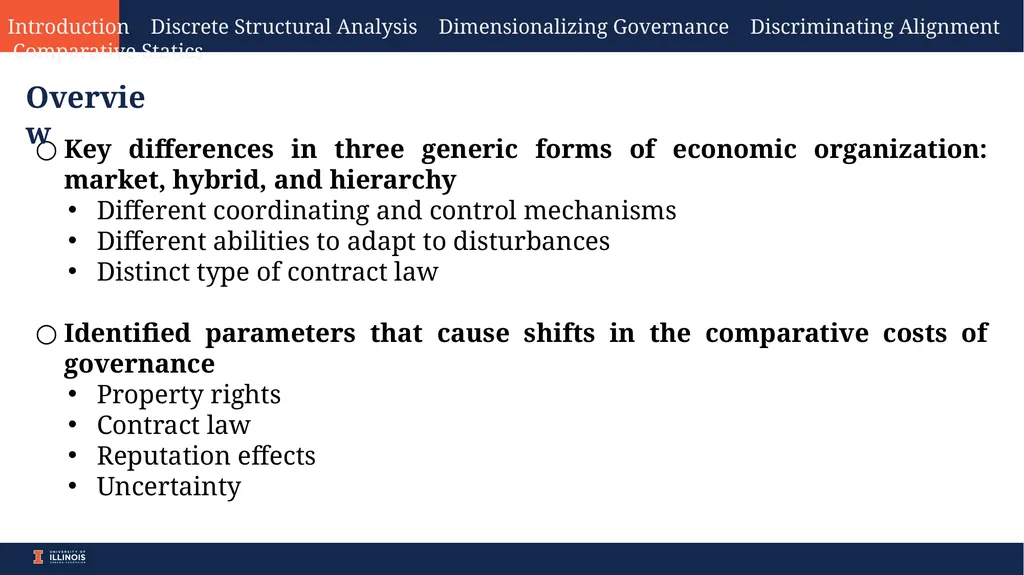
slide2. Key differences in three generic forms of economic organization: market, hybrid, and hierarchy
Different coordinating and control mechanisms
Different abilities to adapt to disturbances
Distinct type of contract law
Identified parameters that cause shifts in the comparative costs of governance
Property rights
Contract law
Reputation effects
Uncertainty Overview Introduction Discrete Structural Analysis Dimensionalizing Governance Discriminating Alignment Comparative Statics<br>
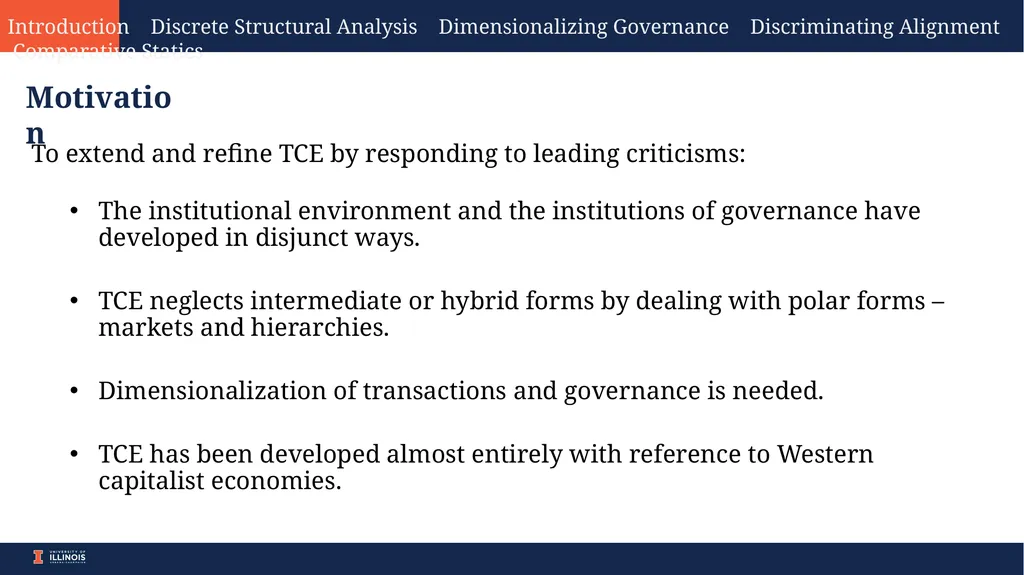
slide3. To extend and refine TCE by responding to leading criticisms:
The institutional environment and the institutions of governance have developed in disjunct ways.
TCE neglects intermediate or hybrid forms by dealing with polar forms –markets and hierarchies.
Dimensionalization of transactions and governance is needed.
TCE has been developed almost entirely with reference to Western capitalist economies. Motivation Introduction Discrete Structural Analysis Dimensionalizing Governance Discriminating Alignment Comparative Statics<br>
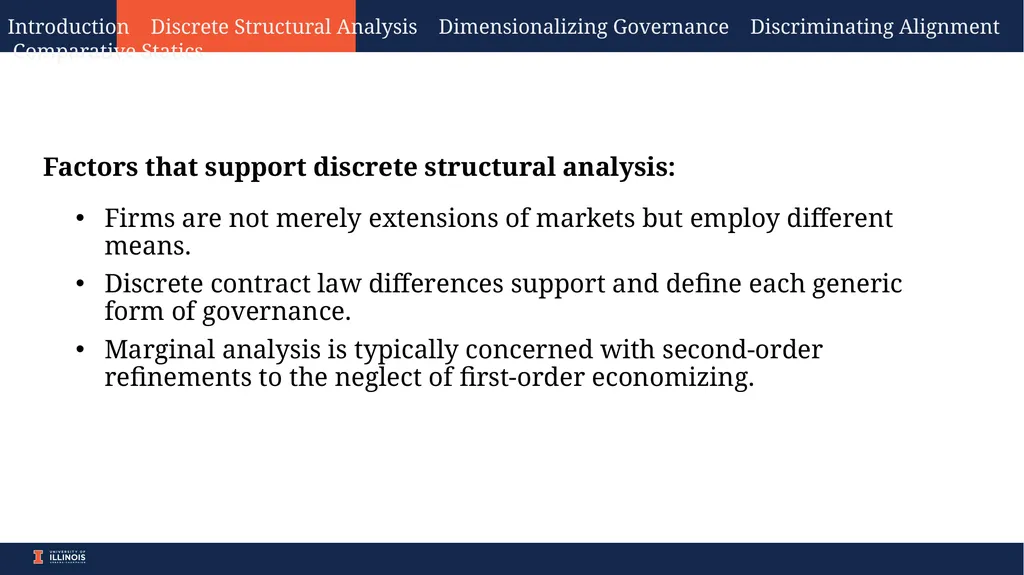
slide4. Factors that support discrete structural analysis:
Firms are not merely extensions of markets but employ different means.
Discrete contract law differences support and define each generic form of governance.
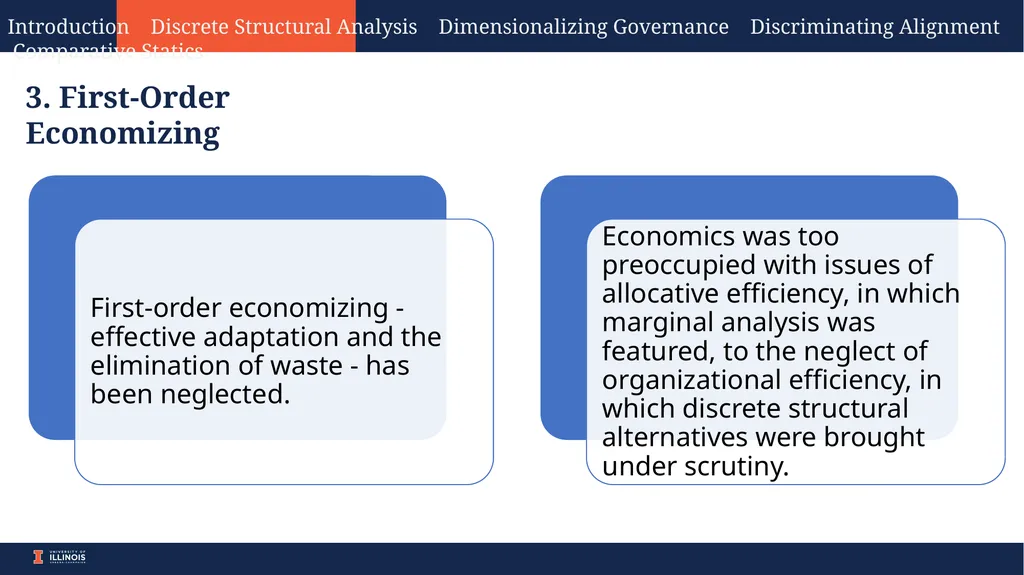
Marginal analysis is typically concerned with second-order refinements to the neglect of first-order economizing. Introduction Discrete Structural Analysis Dimensionalizing Governance Discriminating Alignment Comparative Statics<br>
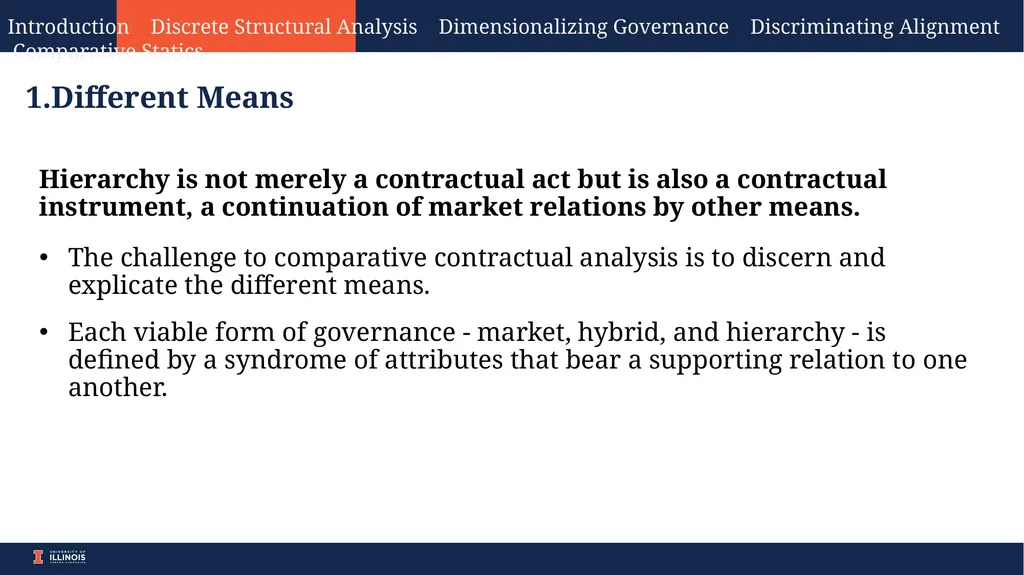
slide5. Hierarchy is not merely a contractual act but is also a contractual instrument, a continuation of market relations by other means.
The challenge to comparative contractual analysis is to discern and explicate the different means.
Each viable form of governance - market, hybrid, and hierarchy - is defined by a syndrome of attributes that bear a supporting relation to one another. 1.Different Means Introduction Discrete Structural Analysis Dimensionalizing Governance Discriminating Alignment Comparative Statics<br>
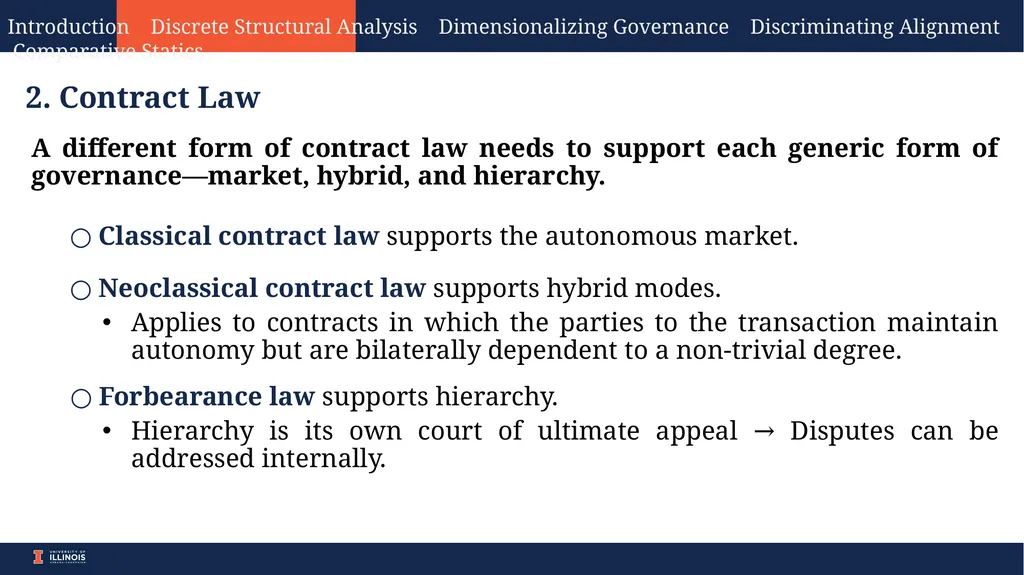
slide6. A different form of contract law needs to support each generic form of governance—market, hybrid, and hierarchy.
Classical contract law supports the autonomous market.
Neoclassical contract law supports hybrid modes.
Applies to contracts in which the parties to the transaction maintain autonomy but are bilaterally dependent to a non-trivial degree.
Forbearance law supports hierarchy.
Hierarchy is its own court of ultimate appeal → Disputes can be addressed internally. 2. Contract Law Introduction Discrete Structural Analysis Dimensionalizing Governance Discriminating Alignment Comparative Statics<br>
slide7. 3. First-Order Economizing Introduction Discrete Structural Analysis Dimensionalizing Governance Discriminating Alignment Comparative Statics<br>
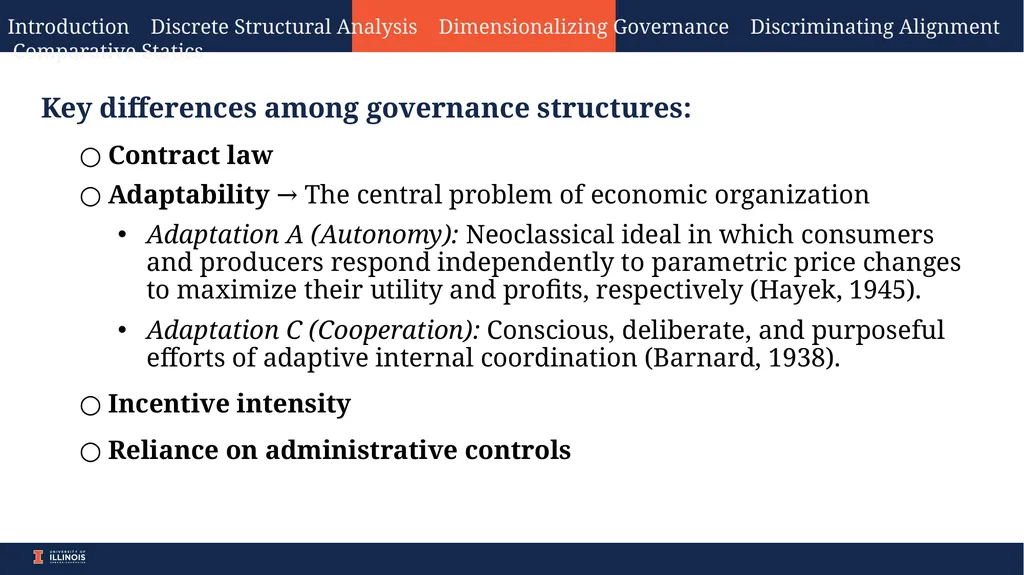
slide8. Key differences among governance structures:
Contract law
Adaptability → The central problem of economic organization
Adaptation A (Autonomy): Neoclassical ideal in which consumers and producers respond independently to parametric price changes to maximize their utility and profits, respectively (Hayek, 1945).
Adaptation C (Cooperation): Conscious, deliberate, and purposeful efforts of adaptive internal coordination (Barnard, 1938).
Incentive intensity
Reliance on administrative controls Introduction Discrete Structural Analysis Dimensionalizing Governance Discriminating Alignment Comparative Statics<br>
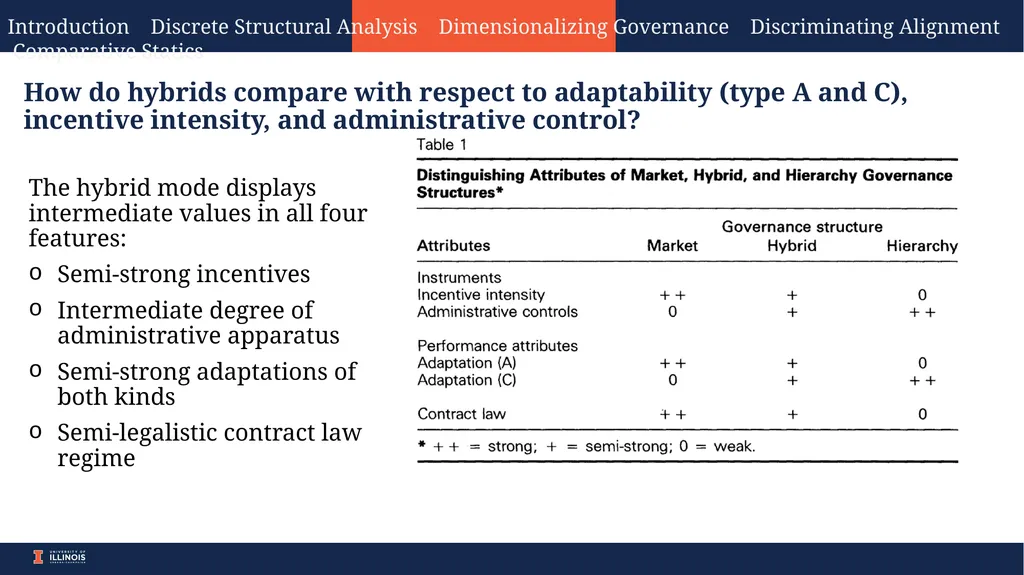
slide9. How do hybrids compare with respect to adaptability (type A and C), incentive intensity, and administrative control? The hybrid mode displays intermediate values in all four features:
Semi-strong incentives
Intermediate degree of administrative apparatus
Semi-strong adaptations of both kinds
Semi-legalistic contract law regime Introduction Discrete Structural Analysis Dimensionalizing Governance Discriminating Alignment Comparative Statics<br>
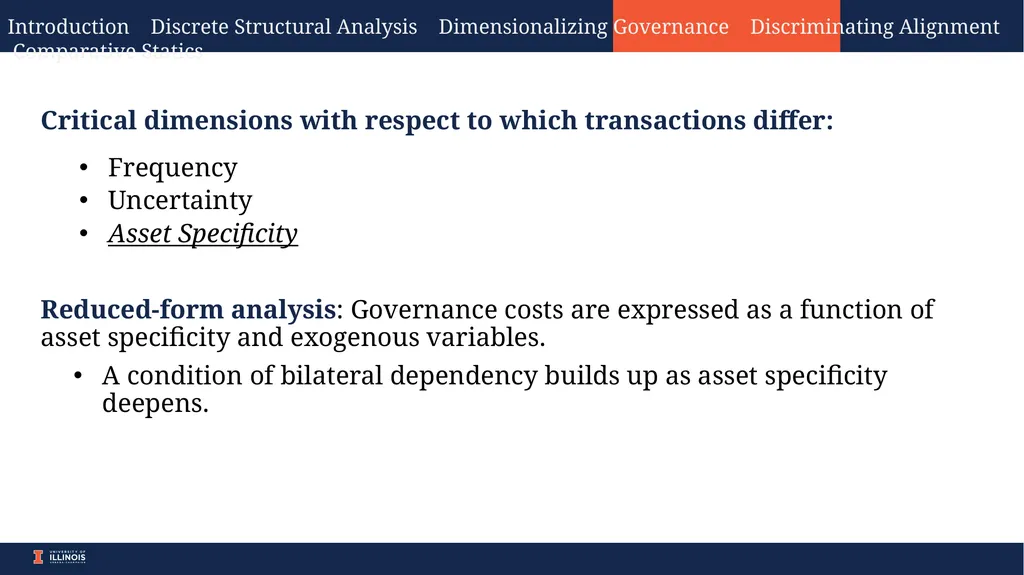
slide10. Critical dimensions with respect to which transactions differ:
Frequency
Uncertainty
Asset Specificity
Reduced-form analysis: Governance costs are expressed as a function of asset specificity and exogenous variables.
A condition of bilateral dependency builds up as asset specificity deepens. Introduction Discrete Structural Analysis Dimensionalizing Governance Discriminating Alignment Comparative Statics<br>
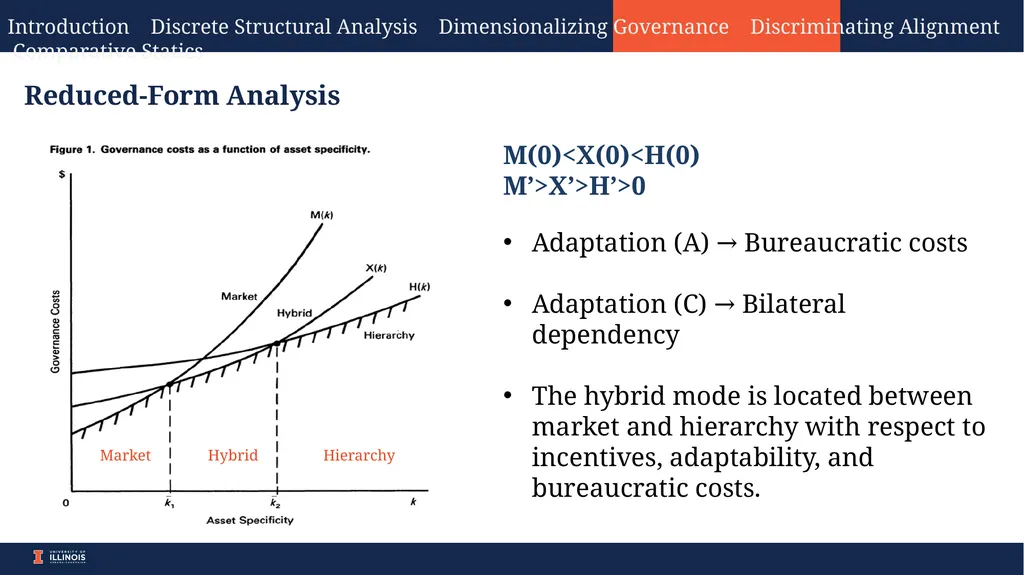
slide11. Reduced-Form Analysis M(0)<X(0)<H(0)
M’>X’>H’>0 Adaptation (A) → Bureaucratic costs
Adaptation (C) → Bilateral dependency
The hybrid mode is located between market and hierarchy with respect to incentives, adaptability, and bureaucratic costs. Introduction Discrete Structural Analysis Dimensionalizing Governance Discriminating Alignment Comparative Statics<br>
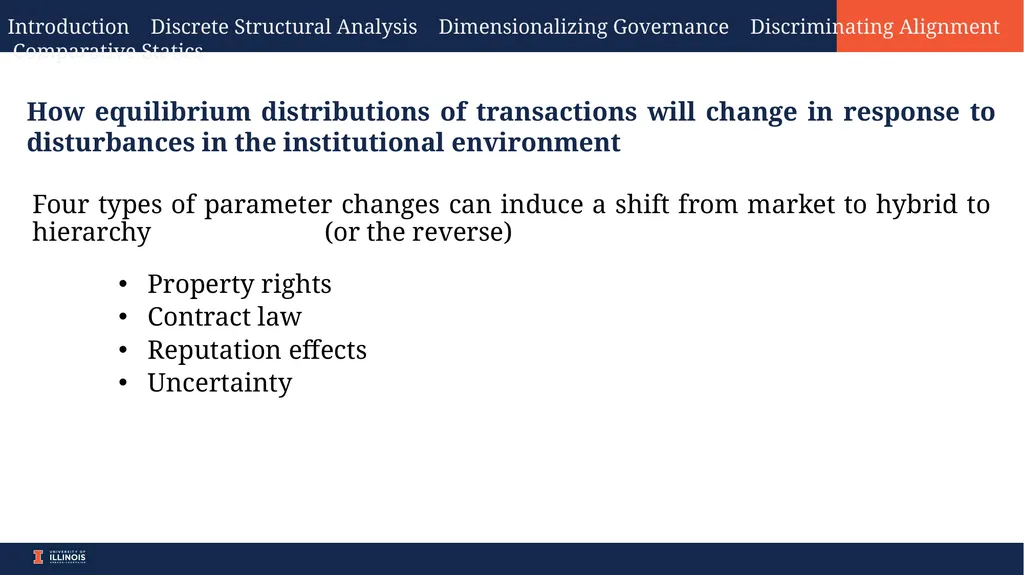
slide12. Four types of parameter changes can induce a shift from market to hybrid to hierarchy (or the reverse)
Property rights
Contract law
Reputation effects
Uncertainty How equilibrium distributions of transactions will change in response to disturbances in the institutional environment Introduction Discrete Structural Analysis Dimensionalizing Governance Discriminating Alignment Comparative Statics<br>
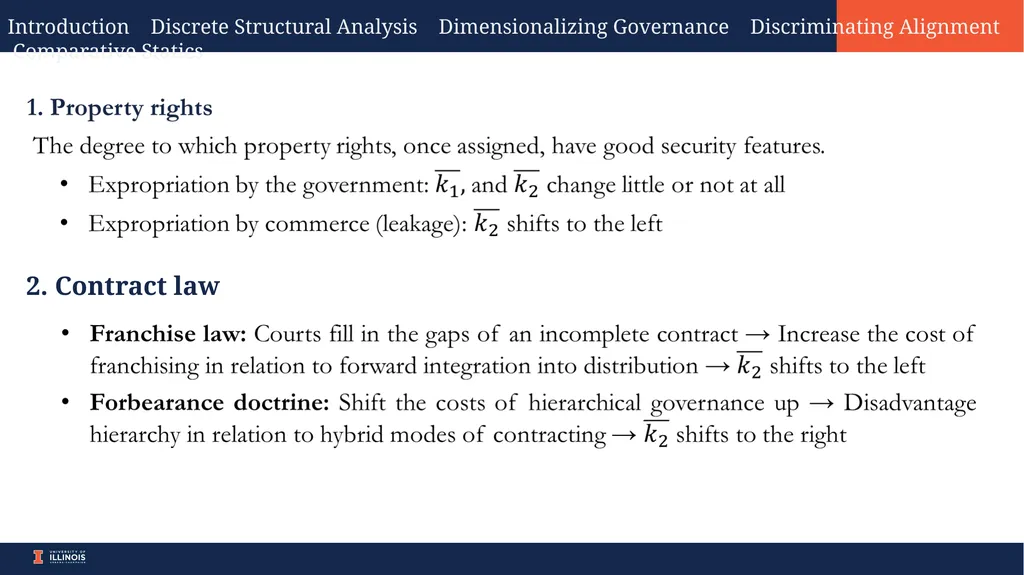
slide13. 2. Contract law Introduction Discrete Structural Analysis Dimensionalizing Governance Discriminating Alignment Comparative Statics<br>
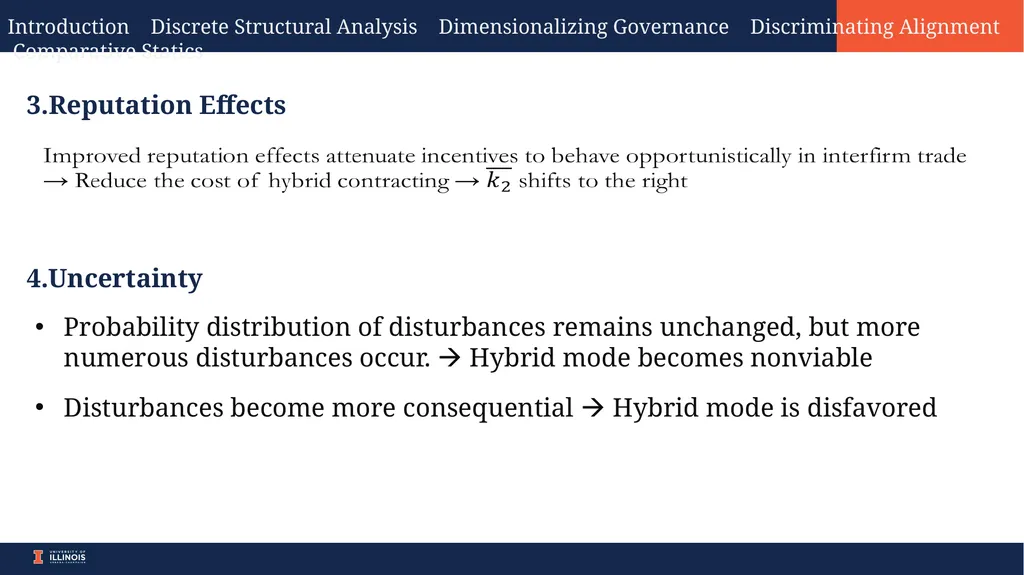
slide14. 3.Reputation Effects Probability distribution of disturbances remains unchanged, but more numerous disturbances occur. Hybrid mode becomes nonviable
Disturbances become more consequential Hybrid mode is disfavored 4.Uncertainty Introduction Discrete Structural Analysis Dimensionalizing Governance Discriminating Alignment Comparative Statics<br>
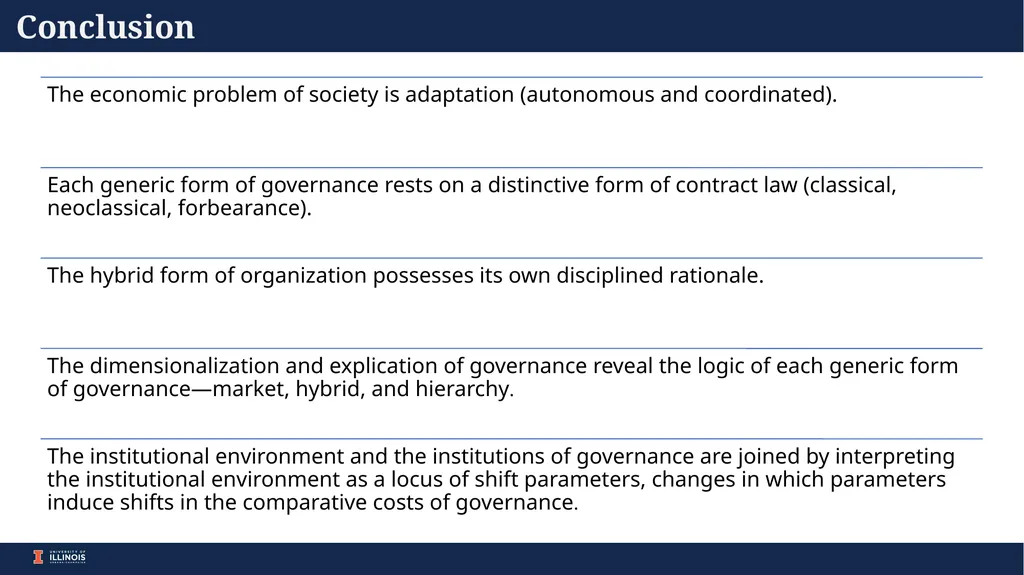
slide15. Conclusion<br>
Administrative Science Quarterly<br>
slide2. Key differences in three generic forms of economic organization: market, hybrid, and hierarchy
Different coordinating and control mechanisms
Different abilities to adapt to disturbances
Distinct type of contract law
Identified parameters that cause shifts in the comparative costs of governance
Property rights
Contract law
Reputation effects
Uncertainty Overview Introduction Discrete Structural Analysis Dimensionalizing Governance Discriminating Alignment Comparative Statics<br>
slide3. To extend and refine TCE by responding to leading criticisms:
The institutional environment and the institutions of governance have developed in disjunct ways.
TCE neglects intermediate or hybrid forms by dealing with polar forms –markets and hierarchies.
Dimensionalization of transactions and governance is needed.
TCE has been developed almost entirely with reference to Western capitalist economies. Motivation Introduction Discrete Structural Analysis Dimensionalizing Governance Discriminating Alignment Comparative Statics<br>
slide4. Factors that support discrete structural analysis:
Firms are not merely extensions of markets but employ different means.
Discrete contract law differences support and define each generic form of governance.
Marginal analysis is typically concerned with second-order refinements to the neglect of first-order economizing. Introduction Discrete Structural Analysis Dimensionalizing Governance Discriminating Alignment Comparative Statics<br>
slide5. Hierarchy is not merely a contractual act but is also a contractual instrument, a continuation of market relations by other means.
The challenge to comparative contractual analysis is to discern and explicate the different means.
Each viable form of governance - market, hybrid, and hierarchy - is defined by a syndrome of attributes that bear a supporting relation to one another. 1.Different Means Introduction Discrete Structural Analysis Dimensionalizing Governance Discriminating Alignment Comparative Statics<br>
slide6. A different form of contract law needs to support each generic form of governance—market, hybrid, and hierarchy.
Classical contract law supports the autonomous market.
Neoclassical contract law supports hybrid modes.
Applies to contracts in which the parties to the transaction maintain autonomy but are bilaterally dependent to a non-trivial degree.
Forbearance law supports hierarchy.
Hierarchy is its own court of ultimate appeal → Disputes can be addressed internally. 2. Contract Law Introduction Discrete Structural Analysis Dimensionalizing Governance Discriminating Alignment Comparative Statics<br>
slide7. 3. First-Order Economizing Introduction Discrete Structural Analysis Dimensionalizing Governance Discriminating Alignment Comparative Statics<br>
slide8. Key differences among governance structures:
Contract law
Adaptability → The central problem of economic organization
Adaptation A (Autonomy): Neoclassical ideal in which consumers and producers respond independently to parametric price changes to maximize their utility and profits, respectively (Hayek, 1945).
Adaptation C (Cooperation): Conscious, deliberate, and purposeful efforts of adaptive internal coordination (Barnard, 1938).
Incentive intensity
Reliance on administrative controls Introduction Discrete Structural Analysis Dimensionalizing Governance Discriminating Alignment Comparative Statics<br>
slide9. How do hybrids compare with respect to adaptability (type A and C), incentive intensity, and administrative control? The hybrid mode displays intermediate values in all four features:
Semi-strong incentives
Intermediate degree of administrative apparatus
Semi-strong adaptations of both kinds
Semi-legalistic contract law regime Introduction Discrete Structural Analysis Dimensionalizing Governance Discriminating Alignment Comparative Statics<br>
slide10. Critical dimensions with respect to which transactions differ:
Frequency
Uncertainty
Asset Specificity
Reduced-form analysis: Governance costs are expressed as a function of asset specificity and exogenous variables.
A condition of bilateral dependency builds up as asset specificity deepens. Introduction Discrete Structural Analysis Dimensionalizing Governance Discriminating Alignment Comparative Statics<br>
slide11. Reduced-Form Analysis M(0)<X(0)<H(0)
M’>X’>H’>0 Adaptation (A) → Bureaucratic costs
Adaptation (C) → Bilateral dependency
The hybrid mode is located between market and hierarchy with respect to incentives, adaptability, and bureaucratic costs. Introduction Discrete Structural Analysis Dimensionalizing Governance Discriminating Alignment Comparative Statics<br>
slide12. Four types of parameter changes can induce a shift from market to hybrid to hierarchy (or the reverse)
Property rights
Contract law
Reputation effects
Uncertainty How equilibrium distributions of transactions will change in response to disturbances in the institutional environment Introduction Discrete Structural Analysis Dimensionalizing Governance Discriminating Alignment Comparative Statics<br>
slide13. 2. Contract law Introduction Discrete Structural Analysis Dimensionalizing Governance Discriminating Alignment Comparative Statics<br>
slide14. 3.Reputation Effects Probability distribution of disturbances remains unchanged, but more numerous disturbances occur. Hybrid mode becomes nonviable
Disturbances become more consequential Hybrid mode is disfavored 4.Uncertainty Introduction Discrete Structural Analysis Dimensionalizing Governance Discriminating Alignment Comparative Statics<br>
slide15. Conclusion<br>