
Comparative Law Prof.ssa Letizia Coppo A.A.
PM
Published · 25 slides · 0 views

1 / 1




Description
Comparative Law Prof.ssa Letizia Coppo A.A. 2022-2023 Cattedra di Diritto comparato For civil law: the teaching of Roman law in the universities, the development of the scientia juris in the Middle Ages and its spread as jus commune; the
Related Topics
Share
Embed code
Download this presentation From Below
"Comparative Law Prof.ssa Letizia Coppo A.A." is the property of its rightful owner. Permission is granted to download and print the materials on this website for personal, non-commercial use only, and to display it on your personal computer provided you do not modify the materials and that you retain all copyright notices contained in the materials. By downloading content from our website, you accept the terms of this agreement.
Presentation Transcript
01
Comparative Law Prof.ssa Letizia Coppo A.A. 2022-2023 Cattedra di Diritto comparato<br>
02
For civil law: the teaching of Roman law in the universities, the development of the scientia juris in the Middle Ages and its spread as jus commune; the Gregorian reform, jusnaturalism and jusrationalism.
For common law: the Norman conquest of England in the Middle Ages; the hierarchical organisation of judicial and executive power; the bureaucratisation of the system and the feudal structure of society. 2 THE COMMON ROOTS OF THE WESTERN LEGAL TRADITION The origins and the common background<br>
For common law: the Norman conquest of England in the Middle Ages; the hierarchical organisation of judicial and executive power; the bureaucratisation of the system and the feudal structure of society. 2 THE COMMON ROOTS OF THE WESTERN LEGAL TRADITION The origins and the common background<br>
03
The common roots of the civil law tradition And the subsequent divergence between the Romanistic and the Germanic legal family<br>
04
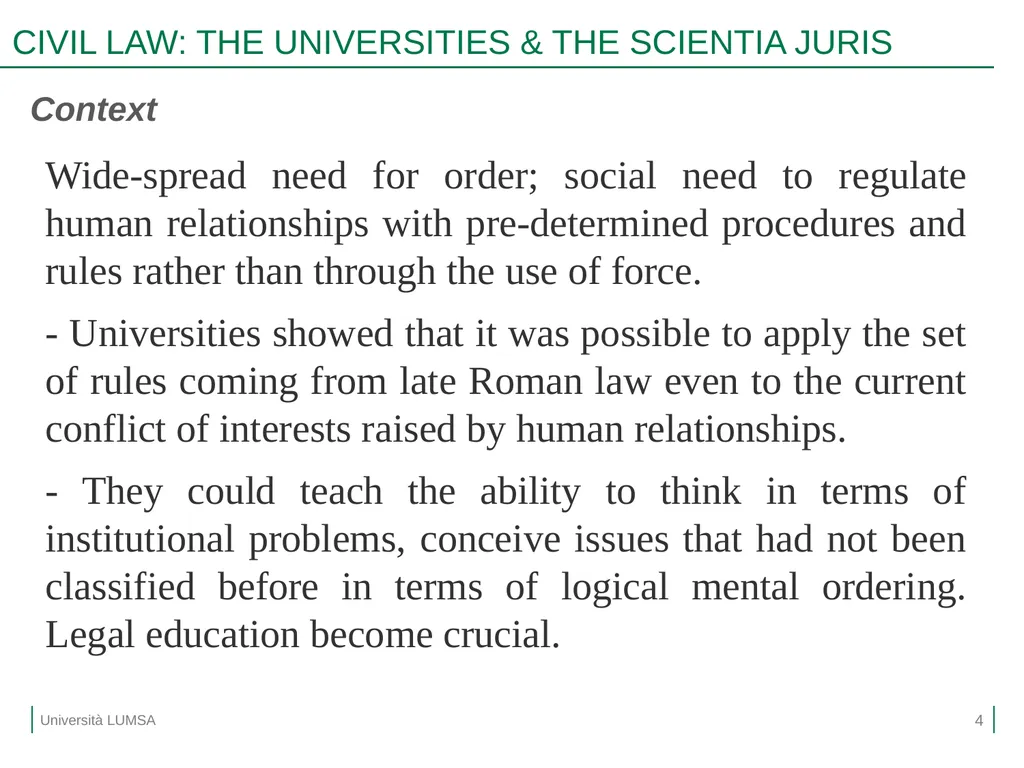
Wide-spread need for order; social need to regulate human relationships with pre-determined procedures and rules rather than through the use of force.
- Universities showed that it was possible to apply the set of rules coming from late Roman law even to the current conflict of interests raised by human relationships.
- They could teach the ability to think in terms of institutional problems, conceive issues that had not been classified before in terms of logical mental ordering. Legal education become crucial. 4 CIVIL LAW: THE UNIVERSITIES & THE SCIENTIA JURIS Context<br>
- Universities showed that it was possible to apply the set of rules coming from late Roman law even to the current conflict of interests raised by human relationships.
- They could teach the ability to think in terms of institutional problems, conceive issues that had not been classified before in terms of logical mental ordering. Legal education become crucial. 4 CIVIL LAW: THE UNIVERSITIES & THE SCIENTIA JURIS Context<br>
05
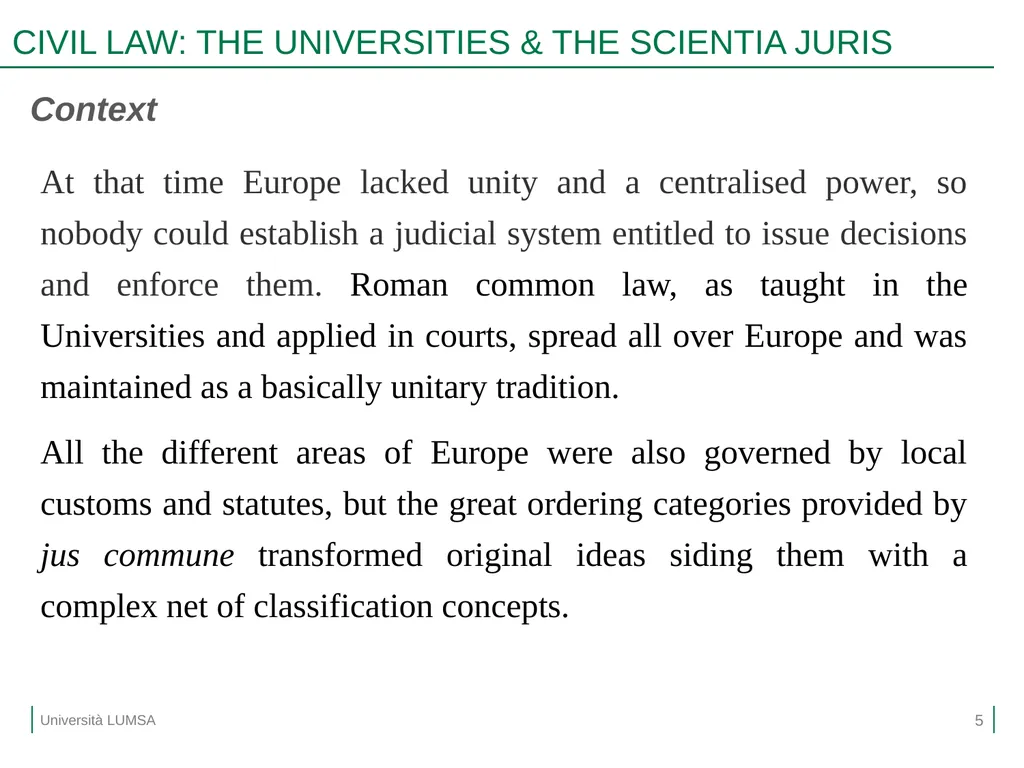
At that time Europe lacked unity and a centralised power, so nobody could establish a judicial system entitled to issue decisions and enforce them. Roman common law, as taught in the Universities and applied in courts, spread all over Europe and was maintained as a basically unitary tradition.
All the different areas of Europe were also governed by local customs and statutes, but the great ordering categories provided by jus commune transformed original ideas siding them with a complex net of classification concepts. 5 CIVIL LAW: THE UNIVERSITIES & THE SCIENTIA JURIS Context<br>
All the different areas of Europe were also governed by local customs and statutes, but the great ordering categories provided by jus commune transformed original ideas siding them with a complex net of classification concepts. 5 CIVIL LAW: THE UNIVERSITIES & THE SCIENTIA JURIS Context<br>
06
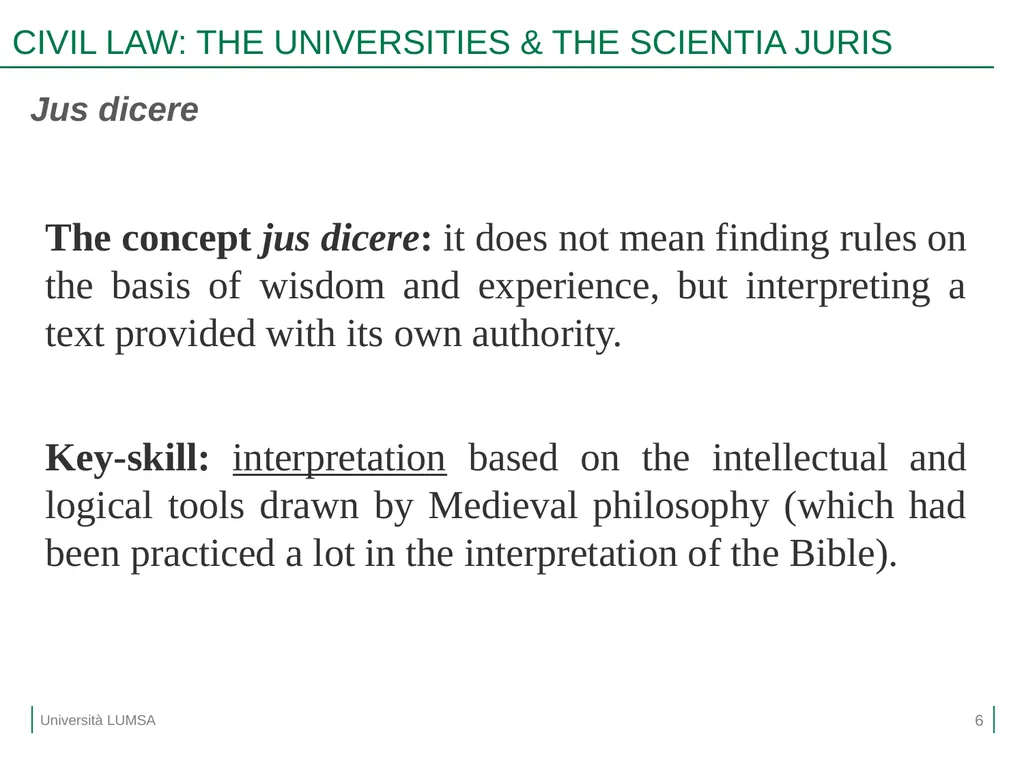
The concept jus dicere: it does not mean finding rules on the basis of wisdom and experience, but interpreting a text provided with its own authority.
Key-skill: interpretation based on the intellectual and logical tools drawn by Medieval philosophy (which had been practiced a lot in the interpretation of the Bible). 6 CIVIL LAW: THE UNIVERSITIES & THE SCIENTIA JURIS Jus dicere<br>
Key-skill: interpretation based on the intellectual and logical tools drawn by Medieval philosophy (which had been practiced a lot in the interpretation of the Bible). 6 CIVIL LAW: THE UNIVERSITIES & THE SCIENTIA JURIS Jus dicere<br>
07
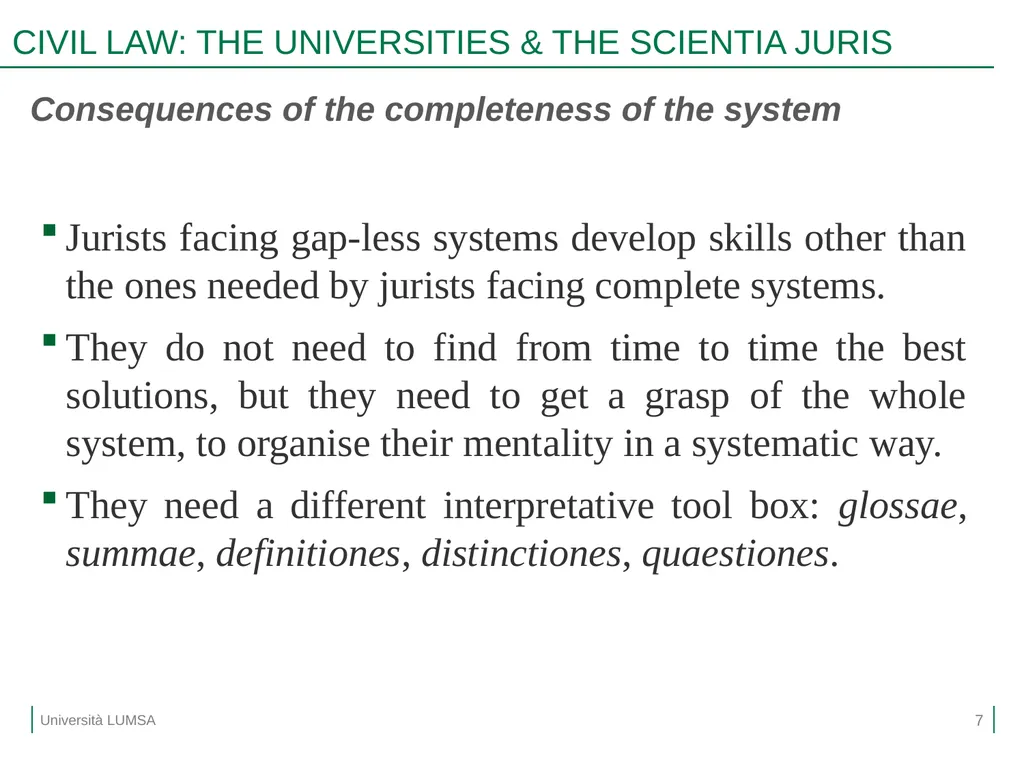
Jurists facing gap-less systems develop skills other than the ones needed by jurists facing complete systems.
They do not need to find from time to time the best solutions, but they need to get a grasp of the whole system, to organise their mentality in a systematic way.
They need a different interpretative tool box: glossae, summae, definitiones, distinctiones, quaestiones. 7 CIVIL LAW: THE UNIVERSITIES & THE SCIENTIA JURIS Consequences of the completeness of the system<br>
They do not need to find from time to time the best solutions, but they need to get a grasp of the whole system, to organise their mentality in a systematic way.
They need a different interpretative tool box: glossae, summae, definitiones, distinctiones, quaestiones. 7 CIVIL LAW: THE UNIVERSITIES & THE SCIENTIA JURIS Consequences of the completeness of the system<br>
08
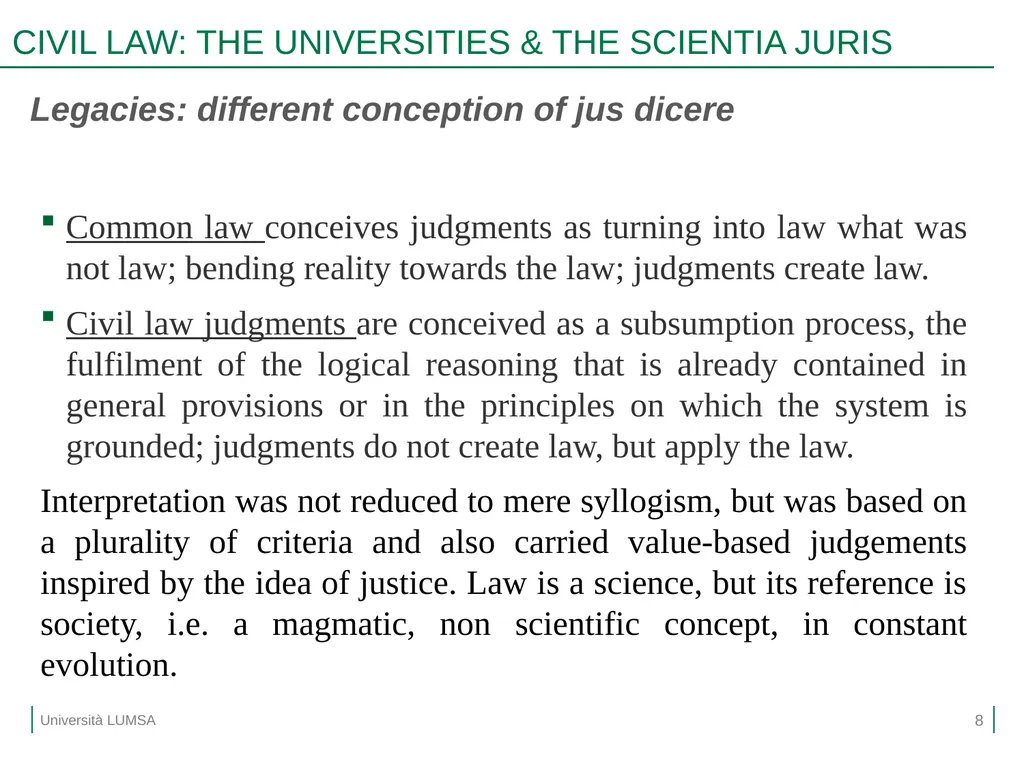
Common law conceives judgments as turning into law what was not law; bending reality towards the law; judgments create law.
Civil law judgments are conceived as a subsumption process, the fulfilment of the logical reasoning that is already contained in general provisions or in the principles on which the system is grounded; judgments do not create law, but apply the law.
Interpretation was not reduced to mere syllogism, but was based on a plurality of criteria and also carried value-based judgements inspired by the idea of justice. Law is a science, but its reference is society, i.e. a magmatic, non scientific concept, in constant evolution. 8 CIVIL LAW: THE UNIVERSITIES & THE SCIENTIA JURIS Legacies: different conception of jus dicere<br>
Civil law judgments are conceived as a subsumption process, the fulfilment of the logical reasoning that is already contained in general provisions or in the principles on which the system is grounded; judgments do not create law, but apply the law.
Interpretation was not reduced to mere syllogism, but was based on a plurality of criteria and also carried value-based judgements inspired by the idea of justice. Law is a science, but its reference is society, i.e. a magmatic, non scientific concept, in constant evolution. 8 CIVIL LAW: THE UNIVERSITIES & THE SCIENTIA JURIS Legacies: different conception of jus dicere<br>
09
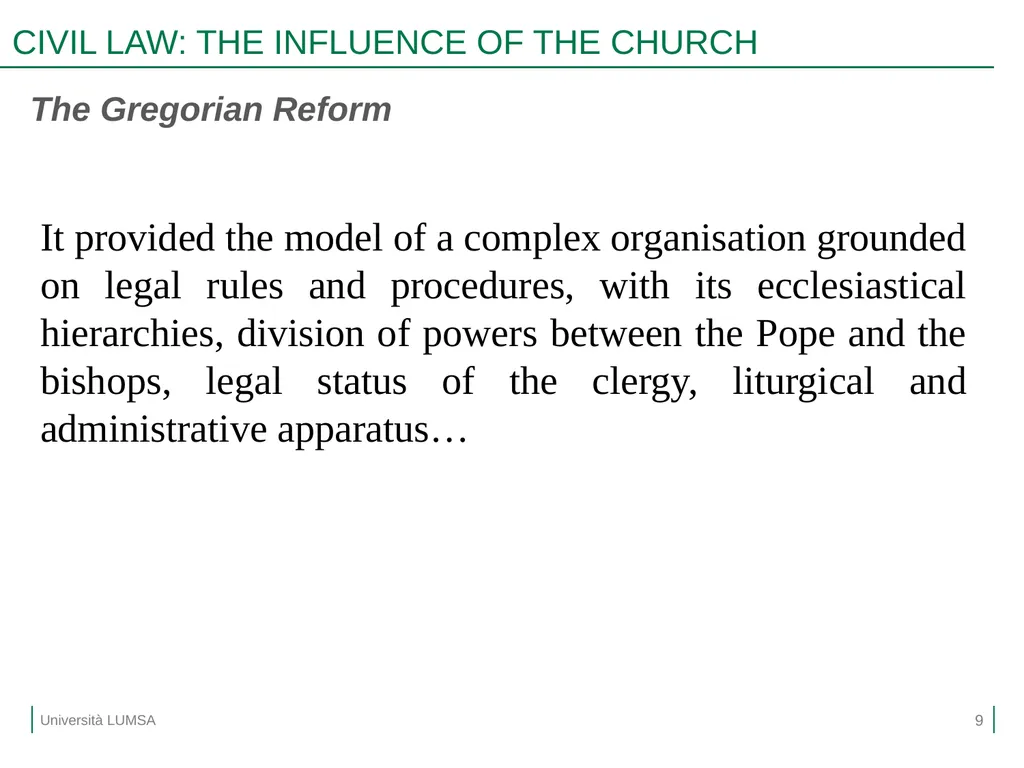
It provided the model of a complex organisation grounded on legal rules and procedures, with its ecclesiastical hierarchies, division of powers between the Pope and the bishops, legal status of the clergy, liturgical and administrative apparatus… 9 CIVIL LAW: THE INFLUENCE OF THE CHURCH The Gregorian Reform<br>
10
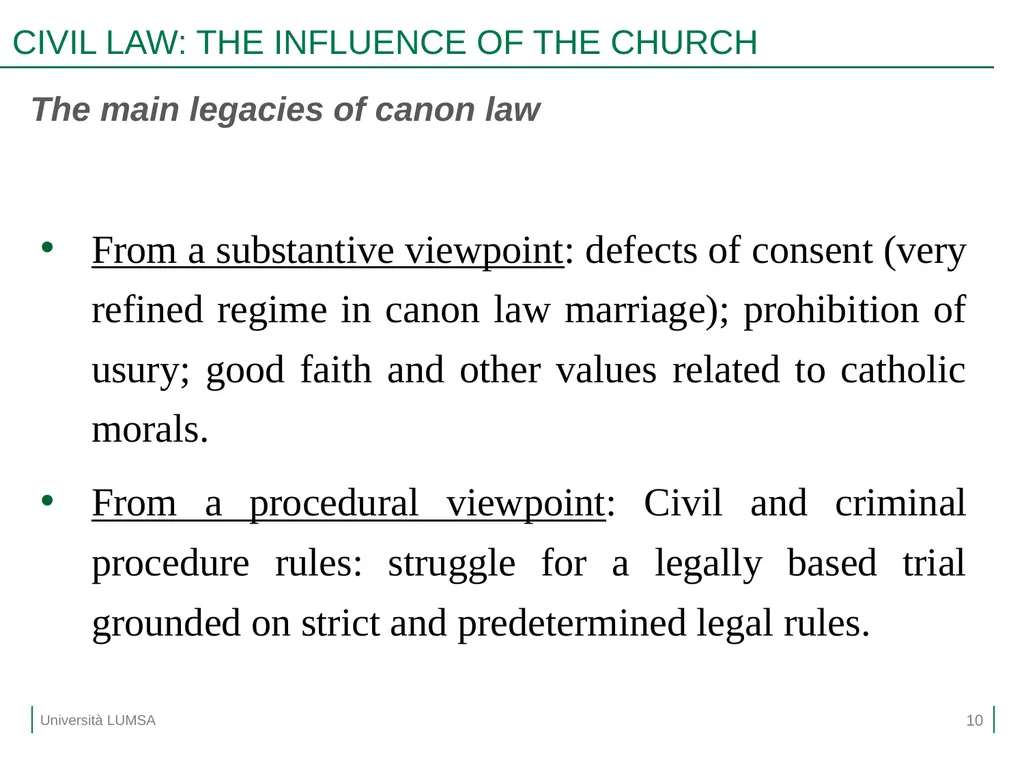
From a substantive viewpoint: defects of consent (very refined regime in canon law marriage); prohibition of usury; good faith and other values related to catholic morals.
From a procedural viewpoint: Civil and criminal procedure rules: struggle for a legally based trial grounded on strict and predetermined legal rules. 10 CIVIL LAW: THE INFLUENCE OF THE CHURCH The main legacies of canon law<br>
From a procedural viewpoint: Civil and criminal procedure rules: struggle for a legally based trial grounded on strict and predetermined legal rules. 10 CIVIL LAW: THE INFLUENCE OF THE CHURCH The main legacies of canon law<br>
11
Jusnaturalism (XVII-XVII): a cosmopolitan ideal stream aimed at finding the ethical basis of legal rules.
Jusrationalism: an ideal stream developed by Ugo Grozio, according to which legal rules are linked to the acknowledgement of the rationality inherent in human beings. Systematic study of the rules as a guarantee of their rational legitimacy; identification of the problems behind the single cases and identification of the rational basis of rules to assess them critically. 11 CIVIL LAW: THE INFLUENCE OF PHILOSOPHY Jusnaturalism and jusrationalism<br>
Jusrationalism: an ideal stream developed by Ugo Grozio, according to which legal rules are linked to the acknowledgement of the rationality inherent in human beings. Systematic study of the rules as a guarantee of their rational legitimacy; identification of the problems behind the single cases and identification of the rational basis of rules to assess them critically. 11 CIVIL LAW: THE INFLUENCE OF PHILOSOPHY Jusnaturalism and jusrationalism<br>
12
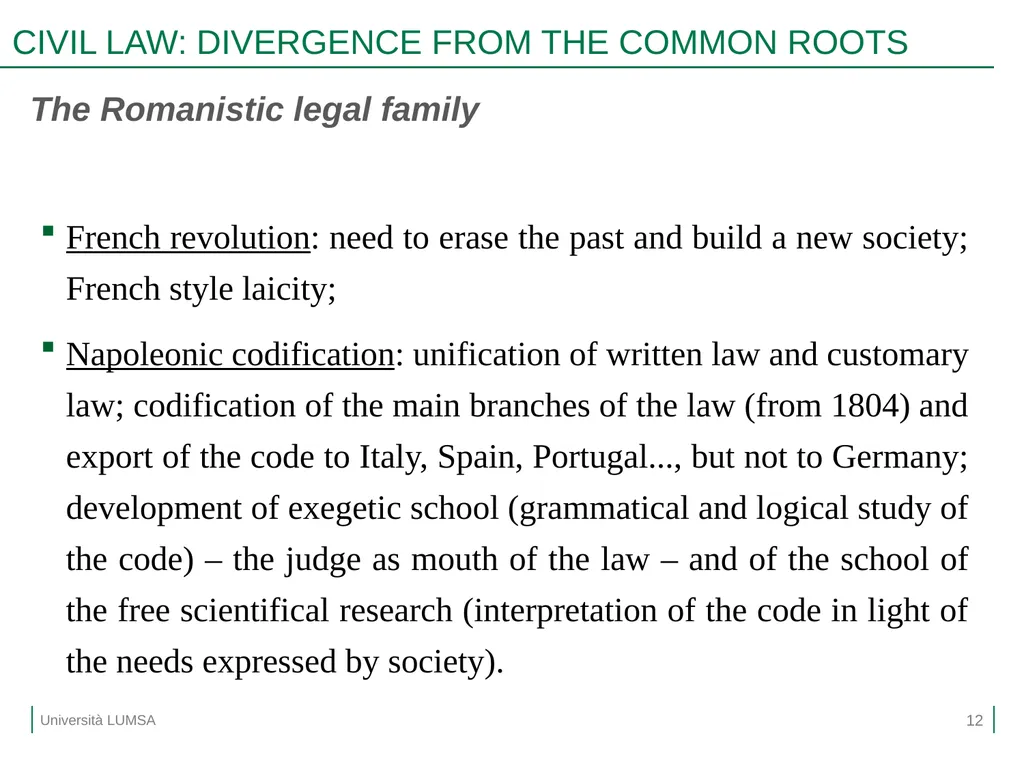
French revolution: need to erase the past and build a new society; French style laicity;
Napoleonic codification: unification of written law and customary law; codification of the main branches of the law (from 1804) and export of the code to Italy, Spain, Portugal..., but not to Germany; development of exegetic school (grammatical and logical study of the code) – the judge as mouth of the law – and of the school of the free scientifical research (interpretation of the code in light of the needs expressed by society). 12 CIVIL LAW: DIVERGENCE FROM THE COMMON ROOTS The Romanistic legal family<br>
Napoleonic codification: unification of written law and customary law; codification of the main branches of the law (from 1804) and export of the code to Italy, Spain, Portugal..., but not to Germany; development of exegetic school (grammatical and logical study of the code) – the judge as mouth of the law – and of the school of the free scientifical research (interpretation of the code in light of the needs expressed by society). 12 CIVIL LAW: DIVERGENCE FROM THE COMMON ROOTS The Romanistic legal family<br>
13
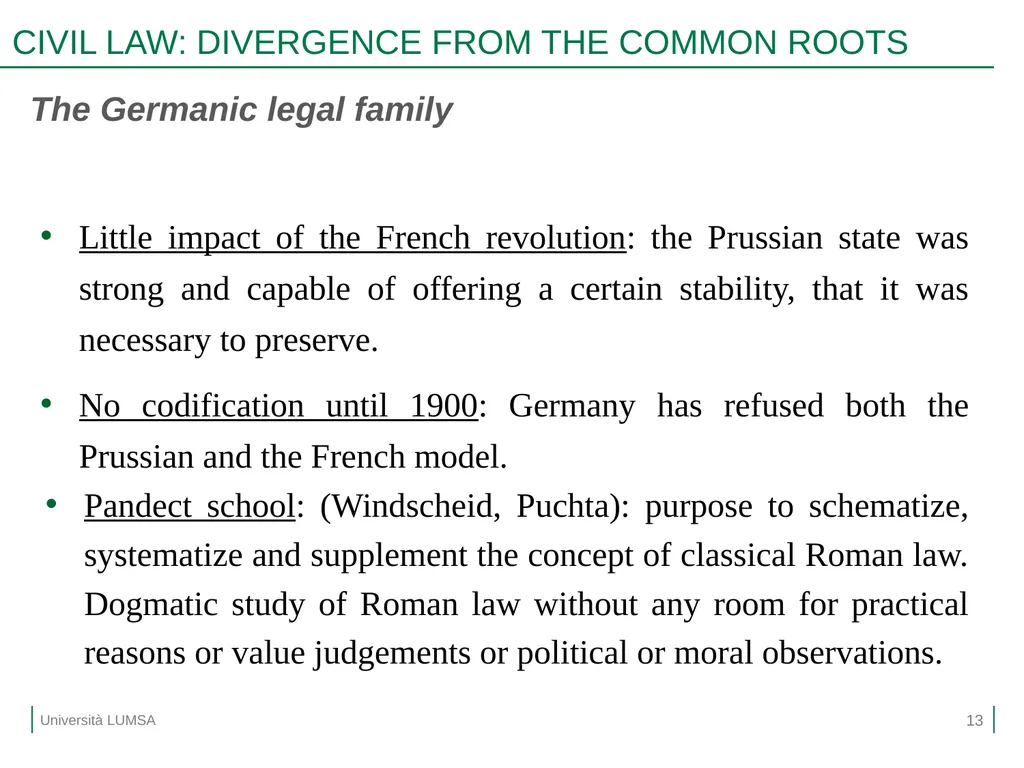
Little impact of the French revolution: the Prussian state was strong and capable of offering a certain stability, that it was necessary to preserve.
No codification until 1900: Germany has refused both the Prussian and the French model.
Pandect school: (Windscheid, Puchta): purpose to schematize, systematize and supplement the concept of classical Roman law. Dogmatic study of Roman law without any room for practical reasons or value judgements or political or moral observations. 13 CIVIL LAW: DIVERGENCE FROM THE COMMON ROOTS The Germanic legal family<br>
No codification until 1900: Germany has refused both the Prussian and the French model.
Pandect school: (Windscheid, Puchta): purpose to schematize, systematize and supplement the concept of classical Roman law. Dogmatic study of Roman law without any room for practical reasons or value judgements or political or moral observations. 13 CIVIL LAW: DIVERGENCE FROM THE COMMON ROOTS The Germanic legal family<br>
14
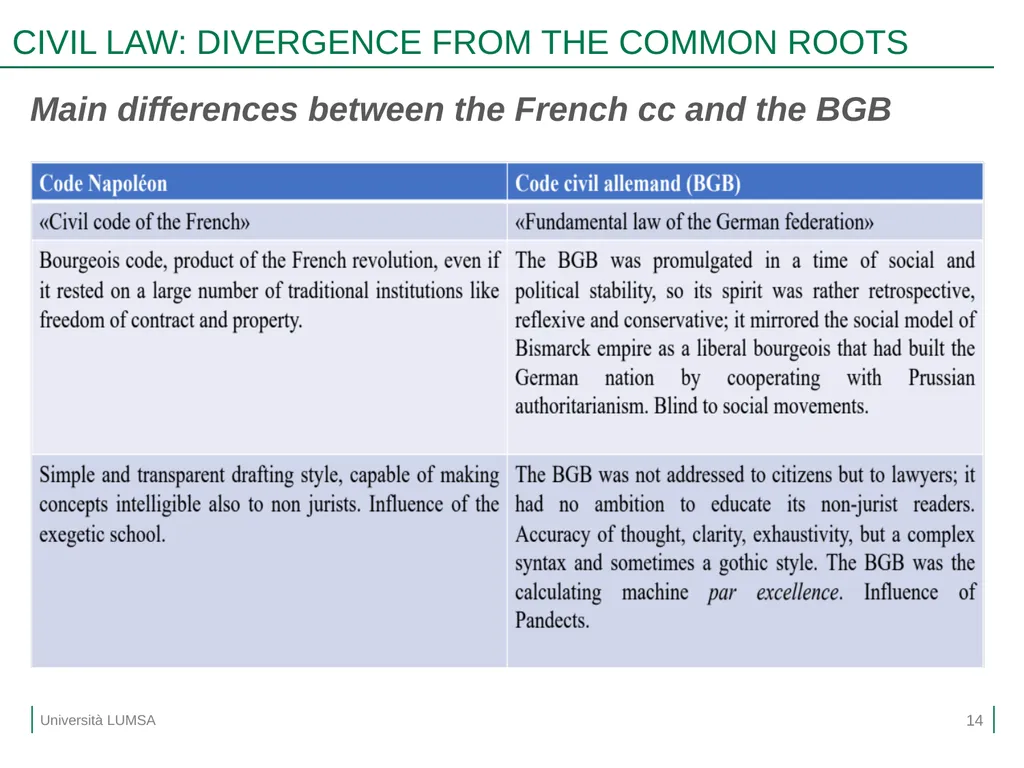
14 CIVIL LAW: DIVERGENCE FROM THE COMMON ROOTS Main differences between the French cc and the BGB<br>
15
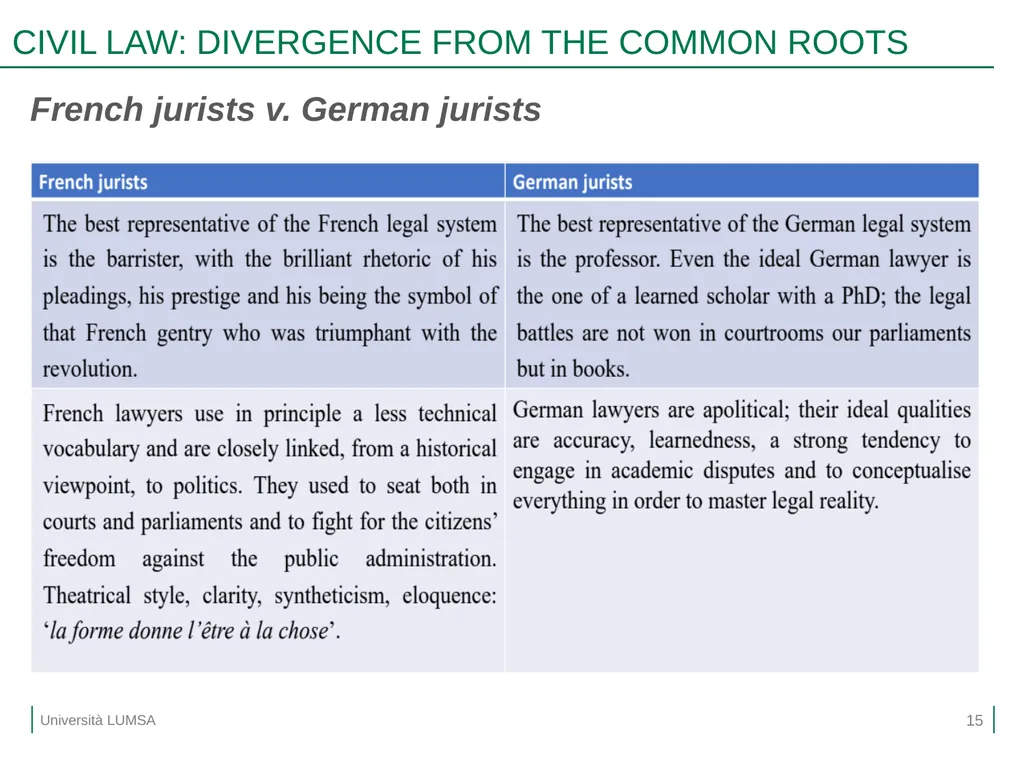
15 CIVIL LAW: DIVERGENCE FROM THE COMMON ROOTS French jurists v. German jurists<br>
16
The roots of the common law tradition The roots of English common law<br>
17
1066 a.D. – Battle of Hastings and Norman conquest of England. Construction of a well-organised feudal system, where land belong to the king and was awarded to subjects as a tenancy.
Political context: strong central royal authority; net of permanent administrative officers; centralised judicial system, with its own procedural rules. 17 COMMON LAW: THE MEDIEVAL PERIOD The Norman conquest<br>
Political context: strong central royal authority; net of permanent administrative officers; centralised judicial system, with its own procedural rules. 17 COMMON LAW: THE MEDIEVAL PERIOD The Norman conquest<br>
18
1) Curia Regis or Exchequer: supreme treasury and jurisdiction for tax litigation.
2) Court of Common Pleas: jurisdiction over disputes between individuals; power to supervise lower courts run by sheriffs.
3) Court of King’s Bench: matters of political significance. 18 COMMON LAW: THE MEDIEVAL PERIOD The organisation of the judiciary (1300-XVII century)<br>
2) Court of Common Pleas: jurisdiction over disputes between individuals; power to supervise lower courts run by sheriffs.
3) Court of King’s Bench: matters of political significance. 18 COMMON LAW: THE MEDIEVAL PERIOD The organisation of the judiciary (1300-XVII century)<br>
19
Procedural rules of royal courts were more modern and progressive, as based on forms of action made available by the royal administration (more authority and prestige).
Local rules applied by Anglo-Saxon tribes lost significance.
A formal system of claims developed, which was unconsciously close to ancient Roman trial structure. 19 COMMON LAW: THE MEDIEVAL PERIOD The procedural system<br>
Local rules applied by Anglo-Saxon tribes lost significance.
A formal system of claims developed, which was unconsciously close to ancient Roman trial structure. 19 COMMON LAW: THE MEDIEVAL PERIOD The procedural system<br>
20
In common language they were letters from a superior, whether ecclesiastical or law, containing a message for the addressee with a request or an instruction.
In legal language they were commands of the king directed to the competent officials, judges or magistrates, containing a brief description of the matter under dispute and instructing the addressee to call the defendant into court and solve the conflict before the parties. 20 COMMON LAW: THE MEDIEVAL PERIOD The procedural system: the writs<br>
In legal language they were commands of the king directed to the competent officials, judges or magistrates, containing a brief description of the matter under dispute and instructing the addressee to call the defendant into court and solve the conflict before the parties. 20 COMMON LAW: THE MEDIEVAL PERIOD The procedural system: the writs<br>
21
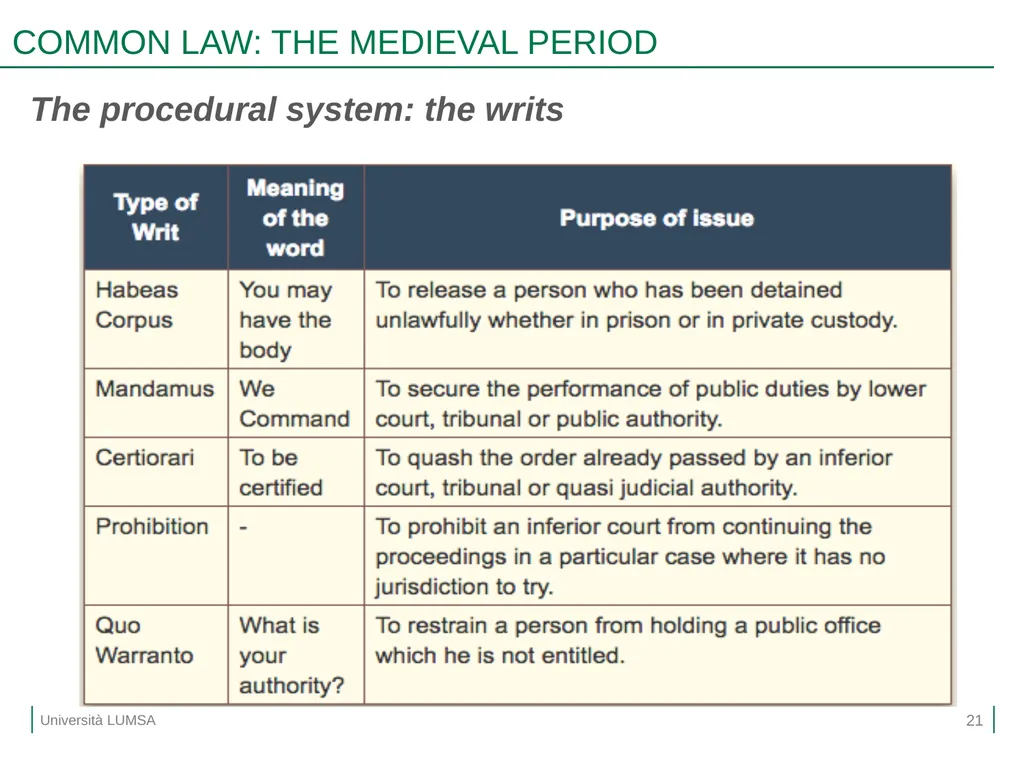
21 COMMON LAW: THE MEDIEVAL PERIOD The procedural system: the writs<br>
22
Writ of right: it enabled a vassal to demand that defendant refrains from interfering with his right to possess and use a piece of land.
Writ of customs and services: it enabled the landlord to claim from the vassal that he performed his services.
Writ of replevin: claim that the superior releases the chattels on which he has distrained in order to exact the feudal services. 22 COMMON LAW: THE MEDIEVAL PERIOD The procedural system: the writs<br>
Writ of customs and services: it enabled the landlord to claim from the vassal that he performed his services.
Writ of replevin: claim that the superior releases the chattels on which he has distrained in order to exact the feudal services. 22 COMMON LAW: THE MEDIEVAL PERIOD The procedural system: the writs<br>
23
Main features of writs
They were typical and begun to be standardised, but with a strong evolutionary potential (see writ of trespass).
Each matched with certain facts and a certain claim and had its own procedural rules; a miss-match meant the denial of the claim. 23 COMMON LAW: THE MEDIEVAL PERIOD The procedural system: the writs<br>
They were typical and begun to be standardised, but with a strong evolutionary potential (see writ of trespass).
Each matched with certain facts and a certain claim and had its own procedural rules; a miss-match meant the denial of the claim. 23 COMMON LAW: THE MEDIEVAL PERIOD The procedural system: the writs<br>
24
The formalism of Common Law trials was excessive, so parties who lost a lawsuit in the King’s Courts or could not obtain a writ, started addressing their petitions to the King in person.
Gradually, such petitions were committed to the King’s Chancellor, a churchman: his decisions developed into what is known as ‘Equity’
‘Common law’ and ‘Equity’ start being separate and potentially conflicting concepts, though they are not perceived by English jurists as antithetical. They were more perceived one (common law) as the text, or the code, the other as the supplement. 24 COMMON LAW: THE MEDIEVAL PERIOD Common law and equity<br>
Gradually, such petitions were committed to the King’s Chancellor, a churchman: his decisions developed into what is known as ‘Equity’
‘Common law’ and ‘Equity’ start being separate and potentially conflicting concepts, though they are not perceived by English jurists as antithetical. They were more perceived one (common law) as the text, or the code, the other as the supplement. 24 COMMON LAW: THE MEDIEVAL PERIOD Common law and equity<br>
25
Prof.ssa
Letizia
Coppo Email: l.coppo1@lumsa.it
lcoppo@univ-catholyon.fr<br>
lcoppo@univ-catholyon.fr<br>