
Compensatory Education: What is it and Do I Need
LS
Published · 31 slides · 0 views

1 / 1

Description
Compensatory Education: What is it and Do I Need it? Karem Castane-Blanco, Staff Attorney Advocacy, Education, Outreach Team Disability Rights Florida Funding, responsibility, and authority under nine federal programs to protect the rights
Related Topics
Share
Embed code
Download this presentation From Below
"Compensatory Education: What is it and Do I Need" is the property of its rightful owner. Permission is granted to download and print the materials on this website for personal, non-commercial use only, and to display it on your personal computer provided you do not modify the materials and that you retain all copyright notices contained in the materials. By downloading content from our website, you accept the terms of this agreement.
Presentation Transcript
01
Compensatory Education:
What is it and Do I Need it? Karem Castane-Blanco, Staff Attorney
Advocacy, Education, Outreach Team<br>
Advocacy, Education, Outreach Team<br>
02
Disability Rights Florida Funding, responsibility, and authority under nine federal programs to protect the rights of Floridians with disabilities
A not-for-profit corporation since 1987
Offices in Tallahassee, Tampa, Hollywood, and Gainesville
Satellite offices in several other communities<br>
A not-for-profit corporation since 1987
Offices in Tallahassee, Tampa, Hollywood, and Gainesville
Satellite offices in several other communities<br>
03
Our Mission To advance the quality of life, dignity, equality, self determination, and freedom of choice of persons with disabilities through collaboration, education, advocacy, as well as legal and legislative strategies.<br>
04
About Your Presenter Ms. Castane-Blanco has worked with Disability Rights Florida since 2019. She received her law degree from St. Thomas University School of Law, and her Bachelor of Science from the University of Central Florida.
Ms. Castane-Blanco is a member of the Florida State Bar. She is a Staff Attorney with Disability Rights Florida on the Advocacy, Education, and Outreach Team. Ms. Castane-Blanco’s work focuses primarily on primary and secondary special education.
Ms. Castane-Blanco is admitted to practice in the U.S. District Courts for the Southern, Middle, and Northern Districts of Florida.<br>
Ms. Castane-Blanco is a member of the Florida State Bar. She is a Staff Attorney with Disability Rights Florida on the Advocacy, Education, and Outreach Team. Ms. Castane-Blanco’s work focuses primarily on primary and secondary special education.
Ms. Castane-Blanco is admitted to practice in the U.S. District Courts for the Southern, Middle, and Northern Districts of Florida.<br>
05
What We Will Cover What is Compensatory Education
Case Examples and Laws
Advocacy and Legal Strategies
Hypotheticals<br>
Case Examples and Laws
Advocacy and Legal Strategies
Hypotheticals<br>
06
Legal Authority Where is compensatory education found in the Individuals with Disabilities Education Act (IDEA)?
It is not. Compensatory Education has been established through case law when there is a failure of an educational agency to provide FAPE to a student with a disability as required by IDEA. G v. Fort Bragg Dependent Sch. 343 F.3d 295, 309 (4th Cir. 2003)
IDEA “authorizes the court to ‘grant such relief as the court determines appropriate’”. Bd. Of Educ. Of Oak Park & River Forest High Sch. Dist. 200 v. Todd A., 79 F.3d 654, 656 (7th Cir. 1996).<br>
It is not. Compensatory Education has been established through case law when there is a failure of an educational agency to provide FAPE to a student with a disability as required by IDEA. G v. Fort Bragg Dependent Sch. 343 F.3d 295, 309 (4th Cir. 2003)
IDEA “authorizes the court to ‘grant such relief as the court determines appropriate’”. Bd. Of Educ. Of Oak Park & River Forest High Sch. Dist. 200 v. Todd A., 79 F.3d 654, 656 (7th Cir. 1996).<br>
07
IDEA The IDEA makes available a free appropriate public education (FAPE) to eligible children with disabilities throughout the nation and ensures special education and related services to those children.
* Individuals with Disabilities Education Act (IDEA), 20 U.S.C. §1400, et seq. and its implementing regulations at, 34 C.F.R. Part 300.<br>
* Individuals with Disabilities Education Act (IDEA), 20 U.S.C. §1400, et seq. and its implementing regulations at, 34 C.F.R. Part 300.<br>
08
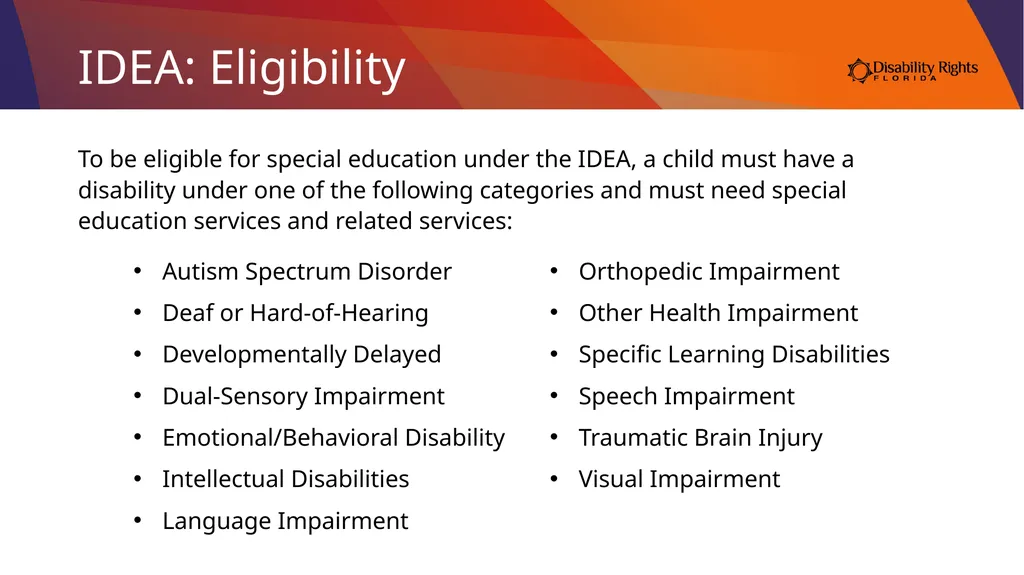
IDEA: Eligibility To be eligible for special education under the IDEA, a child must have a disability under one of the following categories and must need special education services and related services: Autism Spectrum Disorder
Deaf or Hard-of-Hearing
Developmentally Delayed
Dual-Sensory Impairment
Emotional/Behavioral Disability
Intellectual Disabilities
Language Impairment
Orthopedic Impairment
Other Health Impairment
Specific Learning Disabilities
Speech Impairment
Traumatic Brain Injury
Visual Impairment<br>
Deaf or Hard-of-Hearing
Developmentally Delayed
Dual-Sensory Impairment
Emotional/Behavioral Disability
Intellectual Disabilities
Language Impairment
Orthopedic Impairment
Other Health Impairment
Specific Learning Disabilities
Speech Impairment
Traumatic Brain Injury
Visual Impairment<br>
09
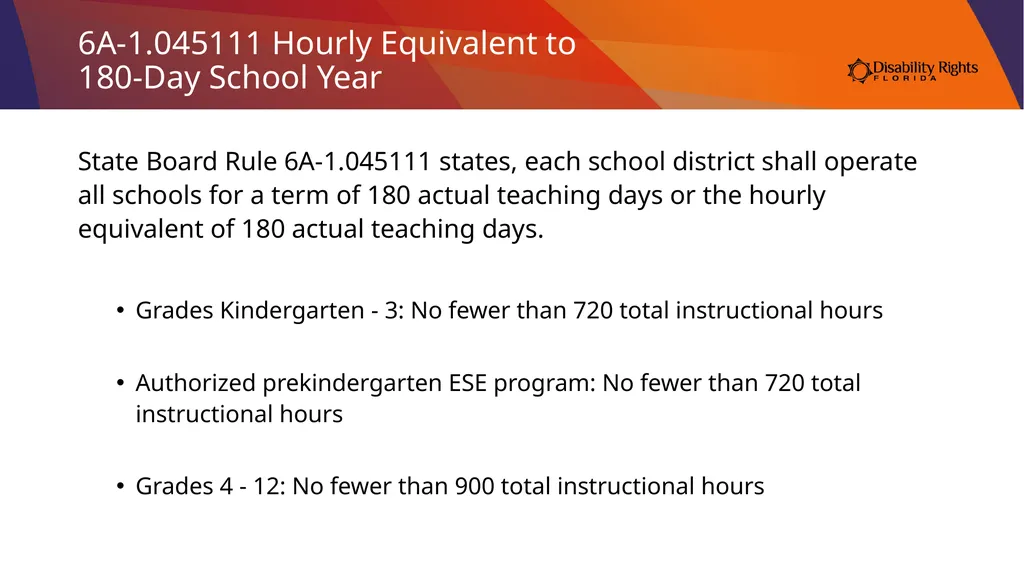
6A-1.045111 Hourly Equivalent to
180-Day School Year State Board Rule 6A-1.045111 states, each school district shall operate all schools for a term of 180 actual teaching days or the hourly equivalent of 180 actual teaching days.
Grades Kindergarten - 3: No fewer than 720 total instructional hours
Authorized prekindergarten ESE program: No fewer than 720 total instructional hours
Grades 4 - 12: No fewer than 900 total instructional hours<br>
Grades Kindergarten - 3: No fewer than 720 total instructional hours
Authorized prekindergarten ESE program: No fewer than 720 total instructional hours
Grades 4 - 12: No fewer than 900 total instructional hours<br>
10
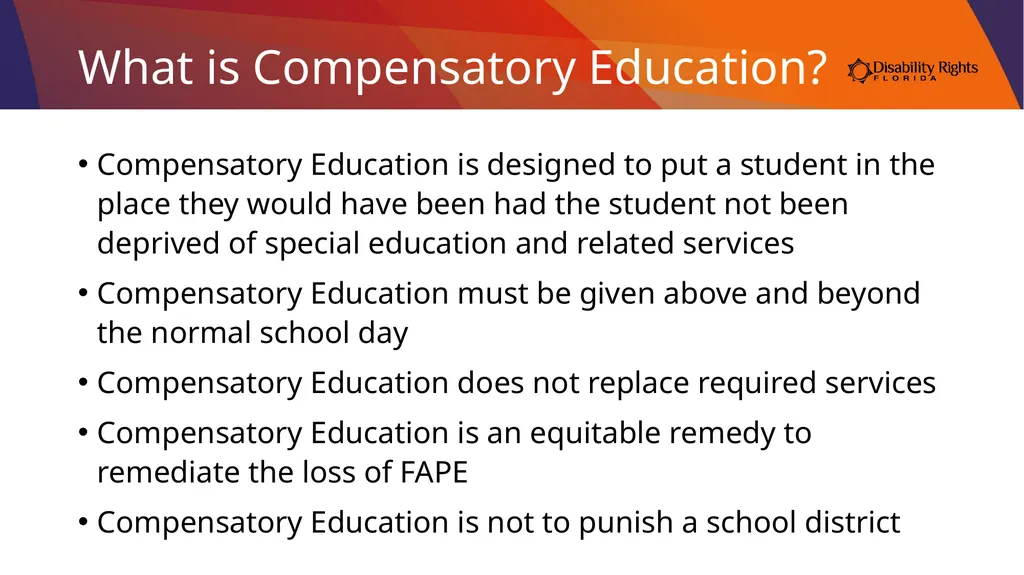
What is Compensatory Education? Compensatory Education is designed to put a student in the place they would have been had the student not been deprived of special education and related services
Compensatory Education must be given above and beyond the normal school day
Compensatory Education does not replace required services
Compensatory Education is an equitable remedy to remediate the loss of FAPE
Compensatory Education is not to punish a school district<br>
Compensatory Education must be given above and beyond the normal school day
Compensatory Education does not replace required services
Compensatory Education is an equitable remedy to remediate the loss of FAPE
Compensatory Education is not to punish a school district<br>
11
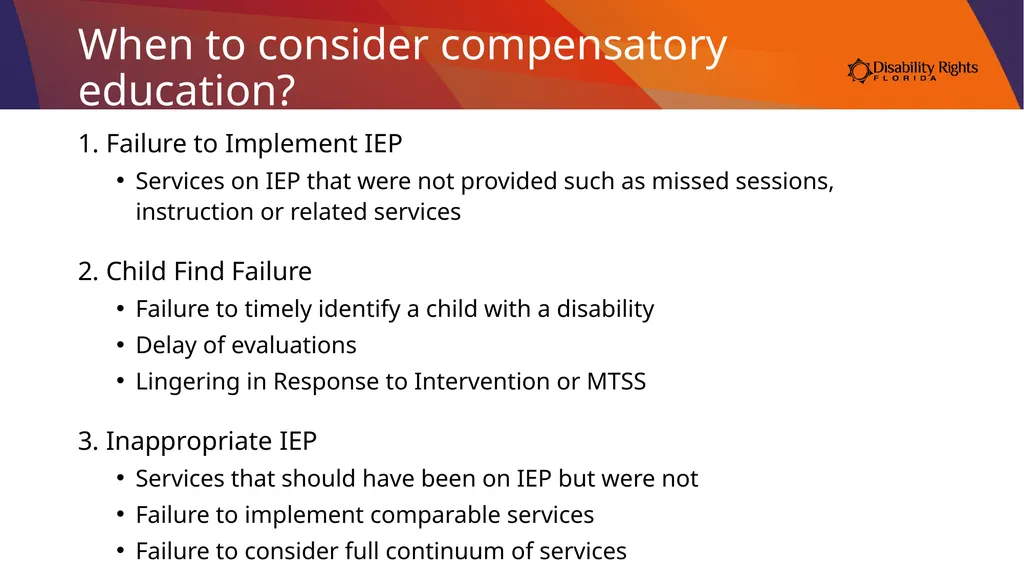
When to consider compensatory
education? 1. Failure to Implement IEP
Services on IEP that were not provided such as missed sessions, instruction or related services
2. Child Find Failure
Failure to timely identify a child with a disability
Delay of evaluations
Lingering in Response to Intervention or MTSS
3. Inappropriate IEP
Services that should have been on IEP but were not
Failure to implement comparable services
Failure to consider full continuum of services<br>
Services on IEP that were not provided such as missed sessions, instruction or related services
2. Child Find Failure
Failure to timely identify a child with a disability
Delay of evaluations
Lingering in Response to Intervention or MTSS
3. Inappropriate IEP
Services that should have been on IEP but were not
Failure to implement comparable services
Failure to consider full continuum of services<br>
12
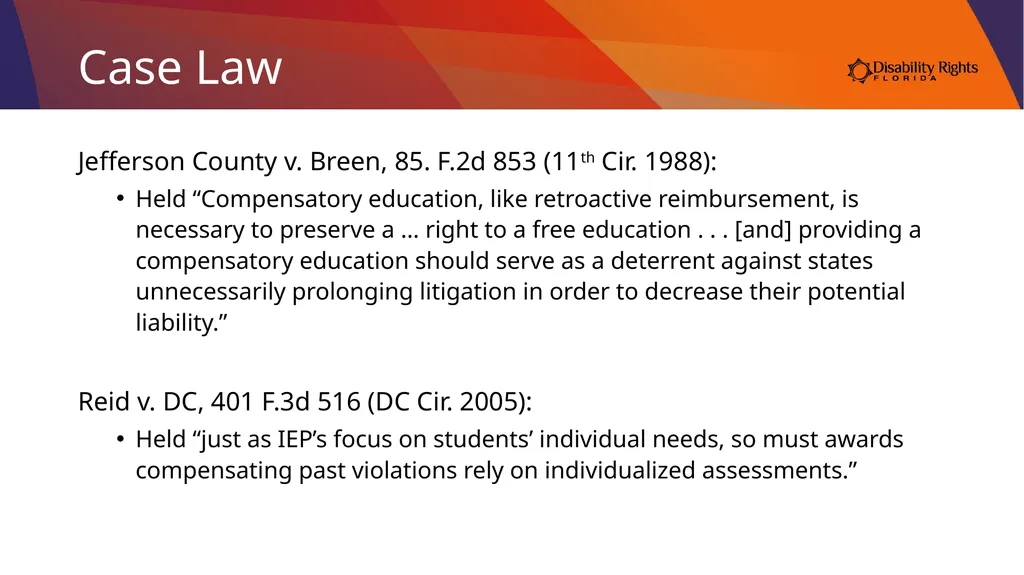
Case Law Jefferson County v. Breen, 85. F.2d 853 (11th Cir. 1988):
Held “Compensatory education, like retroactive reimbursement, is necessary to preserve a … right to a free education . . . [and] providing a compensatory education should serve as a deterrent against states unnecessarily prolonging litigation in order to decrease their potential liability.”
Reid v. DC, 401 F.3d 516 (DC Cir. 2005):
Held “just as IEP’s focus on students’ individual needs, so must awards compensating past violations rely on individualized assessments.”<br>
Held “Compensatory education, like retroactive reimbursement, is necessary to preserve a … right to a free education . . . [and] providing a compensatory education should serve as a deterrent against states unnecessarily prolonging litigation in order to decrease their potential liability.”
Reid v. DC, 401 F.3d 516 (DC Cir. 2005):
Held “just as IEP’s focus on students’ individual needs, so must awards compensating past violations rely on individualized assessments.”<br>
13
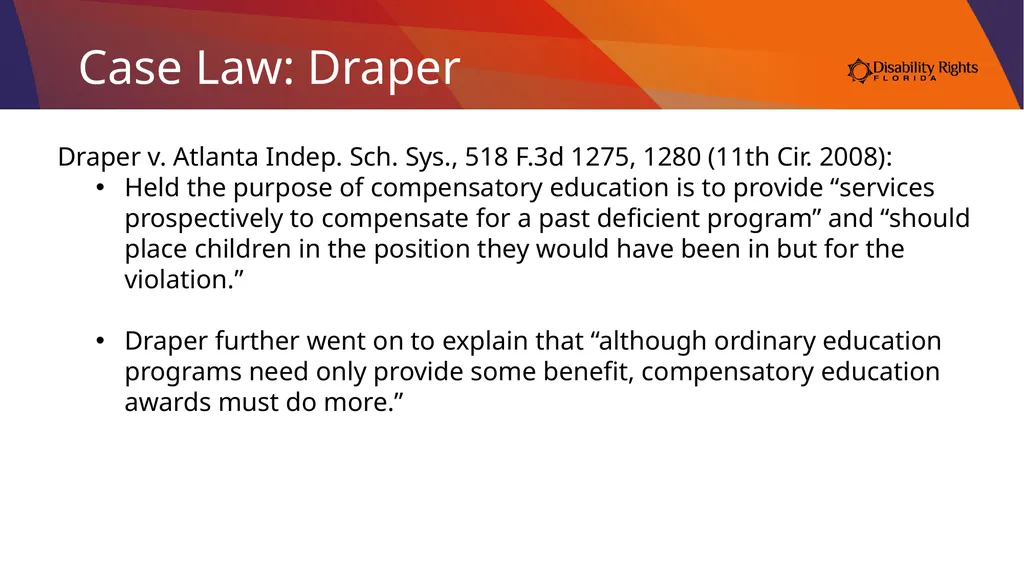
Case Law: Draper Draper v. Atlanta Indep. Sch. Sys., 518 F.3d 1275, 1280 (11th Cir. 2008):
Held the purpose of compensatory education is to provide “services prospectively to compensate for a past deficient program” and “should place children in the position they would have been in but for the violation.”
Draper further went on to explain that “although ordinary education programs need only provide some benefit, compensatory education awards must do more.”<br>
Held the purpose of compensatory education is to provide “services prospectively to compensate for a past deficient program” and “should place children in the position they would have been in but for the violation.”
Draper further went on to explain that “although ordinary education programs need only provide some benefit, compensatory education awards must do more.”<br>
14
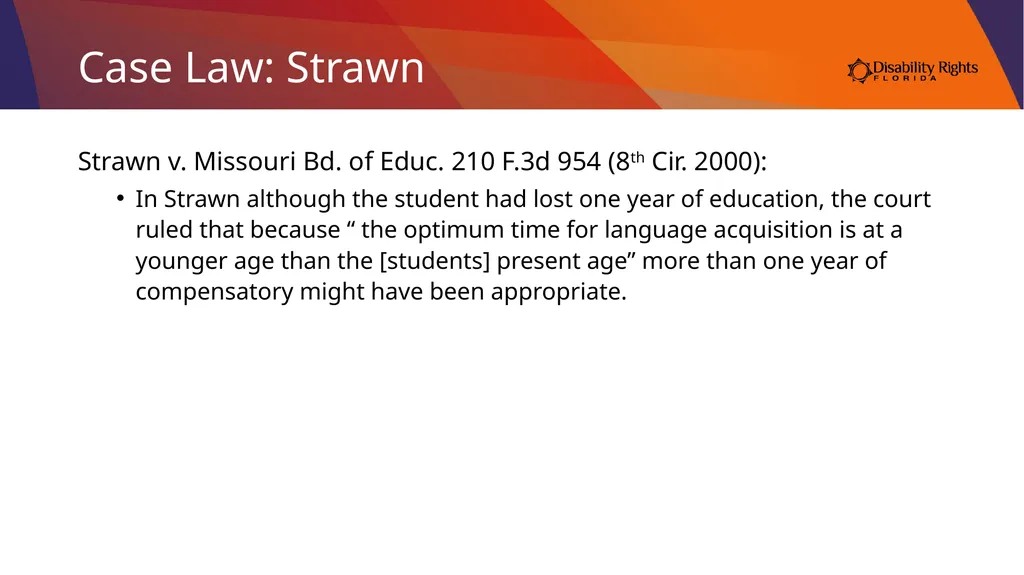
Case Law: Strawn Strawn v. Missouri Bd. of Educ. 210 F.3d 954 (8th Cir. 2000):
In Strawn although the student had lost one year of education, the court ruled that because “ the optimum time for language acquisition is at a younger age than the [students] present age” more than one year of compensatory might have been appropriate.<br>
In Strawn although the student had lost one year of education, the court ruled that because “ the optimum time for language acquisition is at a younger age than the [students] present age” more than one year of compensatory might have been appropriate.<br>
15
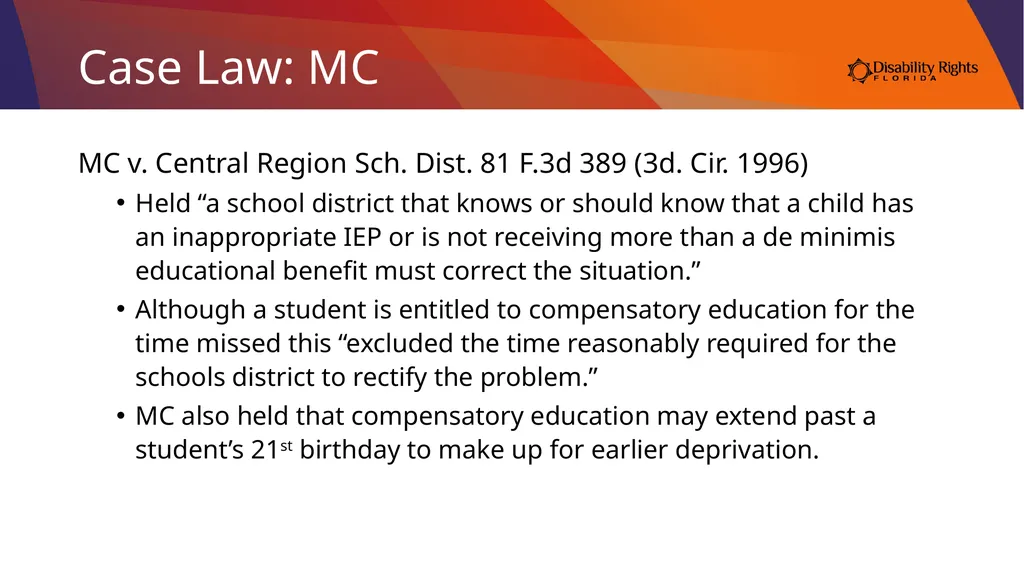
Case Law: MC MC v. Central Region Sch. Dist. 81 F.3d 389 (3d. Cir. 1996)
Held “a school district that knows or should know that a child has an inappropriate IEP or is not receiving more than a de minimis educational benefit must correct the situation.”
Although a student is entitled to compensatory education for the time missed this “excluded the time reasonably required for the schools district to rectify the problem.”
MC also held that compensatory education may extend past a student’s 21st birthday to make up for earlier deprivation.<br>
Held “a school district that knows or should know that a child has an inappropriate IEP or is not receiving more than a de minimis educational benefit must correct the situation.”
Although a student is entitled to compensatory education for the time missed this “excluded the time reasonably required for the schools district to rectify the problem.”
MC also held that compensatory education may extend past a student’s 21st birthday to make up for earlier deprivation.<br>
16
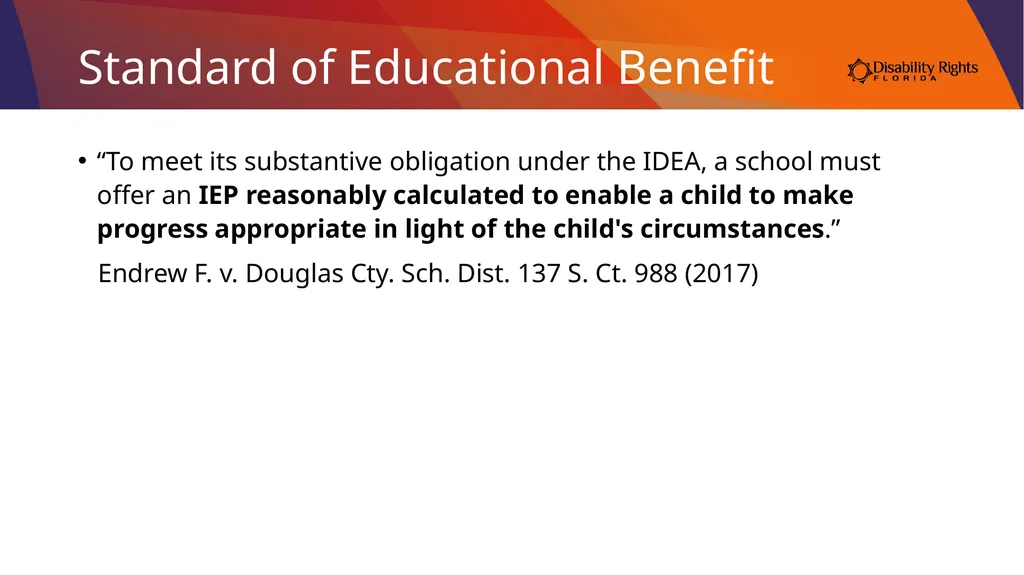
Standard of Educational Benefit “To meet its substantive obligation under the IDEA, a school must offer an IEP reasonably calculated to enable a child to make progress appropriate in light of the child's circumstances.”
Endrew F. v. Douglas Cty. Sch. Dist. 137 S. Ct. 988 (2017)<br>
Endrew F. v. Douglas Cty. Sch. Dist. 137 S. Ct. 988 (2017)<br>
17
Calculation 1 of 3 Compensatory education can be awarded by the quantitative method or qualitative method. Therefore, awards are not always provided on a minute for minute basis. Although minute for minute may be used to provide a baseline ultimately the focus will be on placing the student where they would have been had the services been received in the first place.<br>
18
Calculation 2 of 3 1. Quantitative Method
Compensatory education is awarded hour for hour of time lost
Ex: Student lost 10 weeks of speech therapy.
The speech therapy should be 30 minutes weekly.
10 x 30= 300 minutes or 5 hours of speech therapy.
These 5 hours must be provided in addition to special education and related services the student is already receiving<br>
Compensatory education is awarded hour for hour of time lost
Ex: Student lost 10 weeks of speech therapy.
The speech therapy should be 30 minutes weekly.
10 x 30= 300 minutes or 5 hours of speech therapy.
These 5 hours must be provided in addition to special education and related services the student is already receiving<br>
19
Calculation 3 of 3 2. Qualitative Method
Compensatory education is awarded based on the educational benefit lost
Ex: Student lost 10 weeks of speech therapy.
Speech therapy should be 30 minutes weekly.
After conducting new evaluations and reviewing recent data showing regression, it is determined that 30 minutes would not be sufficient to bring student to where he would have been, and 60 minutes is more appropriate.
10 x 60=600 or 10 hours of speech therapy.
These 10 hours must be provided in addition to special education and related services the student is already receiving.<br>
Compensatory education is awarded based on the educational benefit lost
Ex: Student lost 10 weeks of speech therapy.
Speech therapy should be 30 minutes weekly.
After conducting new evaluations and reviewing recent data showing regression, it is determined that 30 minutes would not be sufficient to bring student to where he would have been, and 60 minutes is more appropriate.
10 x 60=600 or 10 hours of speech therapy.
These 10 hours must be provided in addition to special education and related services the student is already receiving.<br>
20
Extended School Year 1 of 2 Is compensatory education the same as extended school year (ESY)?
No, compensatory education is special education or services that are owed to the student. ESY is provided to a student in addition to the services they receive through the regular school year and is designed to help maintain skills over school breaks to prevent regression in critical life skills related to academics, communication, independent functioning and self sufficiency, social or emotional development, and behavior; recoup skills or maintain emerging skills; or if the nature of the student’s disability is such that the student would be unlikely to benefit from their education without the provision of ESY.<br>
No, compensatory education is special education or services that are owed to the student. ESY is provided to a student in addition to the services they receive through the regular school year and is designed to help maintain skills over school breaks to prevent regression in critical life skills related to academics, communication, independent functioning and self sufficiency, social or emotional development, and behavior; recoup skills or maintain emerging skills; or if the nature of the student’s disability is such that the student would be unlikely to benefit from their education without the provision of ESY.<br>
21
Extended School Year 2 of 2 Extenuating circumstances pertinent to the student’s current situation that indicate the likelihood that FAPE would not be provided without ESY services.
Although compensatory education may be provided during ESY they are not interchangeable. Therefore, a student who is owed compensatory education for services missed but also requires ESY must receive both.
A student may have a perfect IEP and still need ESY. While for compensatory education to apply there had to be a failure.<br>
Although compensatory education may be provided during ESY they are not interchangeable. Therefore, a student who is owed compensatory education for services missed but also requires ESY must receive both.
A student may have a perfect IEP and still need ESY. While for compensatory education to apply there had to be a failure.<br>
22
Factors Outlined by FLDOE Regression/recoupment
Critical point of instruction
Emerging Skills
Nature of severity of disability
Interfering behaviors
Rate of progress
Special circumstances (e.g., transition from school to work)<br>
Critical point of instruction
Emerging Skills
Nature of severity of disability
Interfering behaviors
Rate of progress
Special circumstances (e.g., transition from school to work)<br>
23
Compensatory Education Compensatory education does not require bad faith on behalf of the schools or gross negligence, therefore missed special education or related services as a result of closures such as with the pandemic or other special circumstances may entitle a student to compensatory education.
Awards of compensatory education for special education and services missed as a result of the pandemic or other special circumstances are not automatic and will need to be evaluated on an individual basis and look at various factors such as the actual loss of services, the student’s present levels of performance, progress and regression.<br>
Awards of compensatory education for special education and services missed as a result of the pandemic or other special circumstances are not automatic and will need to be evaluated on an individual basis and look at various factors such as the actual loss of services, the student’s present levels of performance, progress and regression.<br>
24
I think I need it, what should I do? Document any missed sessions, services or issues
Maintain communication with teachers and service providers and understand how services are delivered and data is tracked
Ask for progress reports
Test your child at home for progress or regression
Due to COVID 19, school closures and distance learning, services have been provided differently. Video or audio recording the student periodically can help provide a record of any progression or regression for future discussion.
COVID 19 has also resulted in a change in the delivery of services
While the delivery might be different it is still important to have the student try to participate in the service and not just refuse outright.<br>
Maintain communication with teachers and service providers and understand how services are delivered and data is tracked
Ask for progress reports
Test your child at home for progress or regression
Due to COVID 19, school closures and distance learning, services have been provided differently. Video or audio recording the student periodically can help provide a record of any progression or regression for future discussion.
COVID 19 has also resulted in a change in the delivery of services
While the delivery might be different it is still important to have the student try to participate in the service and not just refuse outright.<br>
25
ADVOCACY AND LEGAL STRATEGIES How can you make your request?
Advocacy Letter
Request any denials in writing such as a prior written notice
State Complaint
Due Process<br>
Advocacy Letter
Request any denials in writing such as a prior written notice
State Complaint
Due Process<br>
26
HYPOTHETICAL #1 Student’s IEP team determined that student should receive one 30-minute session of occupational therapy (OT) per week. No OT was provided during the 2019 school year.
There were 36 weeks in the 2019 school year.
36 weeks x 30 minutes per week = 1,080 minutes
The 1,080 minutes of OT must be provided in addition to the OT student is to receive on current IEP.<br>
There were 36 weeks in the 2019 school year.
36 weeks x 30 minutes per week = 1,080 minutes
The 1,080 minutes of OT must be provided in addition to the OT student is to receive on current IEP.<br>
27
HYPOTHETICAL #2 Parent requested student who was on RtI without progress to be evaluated for specific learning disability and language impairment. Student was found eligible for an IEP under the SLD category but there was a delay in the language evaluations.
Even with an IEP in place, student still made no significant academic progress in 25 weeks and remained on a kindergarten reading level although in 3rd grade. Student in the meantime was receiving ESOL services to work on language skill although English was student’s primary language.
After submitting a state complaint student was entitled to 25 hours of specially designed instruction for reading. The ESOL services were not appropriate and removed, language therapy was added, and 6 hours were added for due to the delay in evaluating.<br>
Even with an IEP in place, student still made no significant academic progress in 25 weeks and remained on a kindergarten reading level although in 3rd grade. Student in the meantime was receiving ESOL services to work on language skill although English was student’s primary language.
After submitting a state complaint student was entitled to 25 hours of specially designed instruction for reading. The ESOL services were not appropriate and removed, language therapy was added, and 6 hours were added for due to the delay in evaluating.<br>
28
HYPOTHETICAL #3 Student with an IEP received two years of language services focusing on letter sounds. Student did not make significant progress during this time.
After an independent educational evaluation determined that student’s primary area of need was in pragmatics rather than letter sounds. A compensatory education request was made for two years before the due process complaint was filed because although the services on the IEP were received, they were not comparable to what the student actually required based on the evaluations and the student did not make meaningful gains.
Compensatory education was awarded based on the benefit lost.<br>
After an independent educational evaluation determined that student’s primary area of need was in pragmatics rather than letter sounds. A compensatory education request was made for two years before the due process complaint was filed because although the services on the IEP were received, they were not comparable to what the student actually required based on the evaluations and the student did not make meaningful gains.
Compensatory education was awarded based on the benefit lost.<br>
29
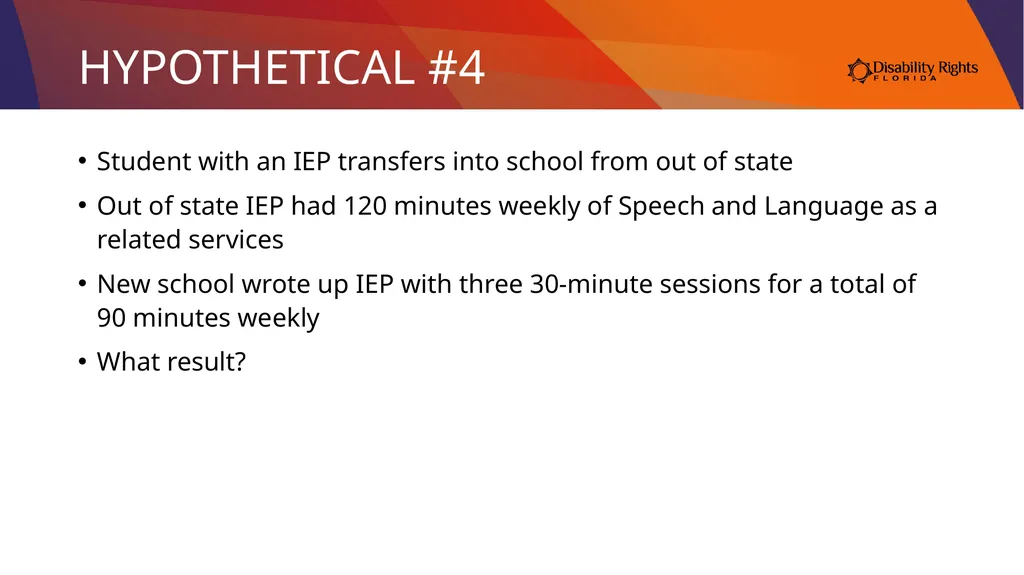
HYPOTHETICAL #4 Student with an IEP transfers into school from out of state
Out of state IEP had 120 minutes weekly of Speech and Language as a related services
New school wrote up IEP with three 30-minute sessions for a total of 90 minutes weekly
What result?<br>
Out of state IEP had 120 minutes weekly of Speech and Language as a related services
New school wrote up IEP with three 30-minute sessions for a total of 90 minutes weekly
What result?<br>
30
Resources http://www.fldoe.org/academics/exceptional-student-edu/
https://www2.ed.gov/about/offices/list/ocr/index.html
https://www.wrightslaw.com/
https://www2.ed.gov/policy/speced/guid/idea/memosdcltrs/qa-covid-19-03-12-2020.pdf<br>
https://www2.ed.gov/about/offices/list/ocr/index.html
https://www.wrightslaw.com/
https://www2.ed.gov/policy/speced/guid/idea/memosdcltrs/qa-covid-19-03-12-2020.pdf<br>
31
Contact Us:
800.342.0823 www.disabilityrightsflorida.org<br>