
Competitive Solar Incentive (CSI) Program
KL
Published · 39 slides · 0 views
1 / 1


Description
Competitive Solar Incentive (CSI) Program Stakeholder Meeting 2 May 26, 2022 This is the second public stakeholder meeting for Docket QO21101186 Competitive Solar Incentive (CSI) Program pursuant to P.L. 2021, C.169 Welcome This
Related Topics
Share
Embed code
Download this presentation From Below
"Competitive Solar Incentive (CSI) Program" is the property of its rightful owner. Permission is granted to download and print the materials on this website for personal, non-commercial use only, and to display it on your personal computer provided you do not modify the materials and that you retain all copyright notices contained in the materials. By downloading content from our website, you accept the terms of this agreement.
Presentation Transcript
01
Competitive Solar Incentive (CSI) Program
Stakeholder Meeting #2 May 26, 2022<br>
Stakeholder Meeting #2 May 26, 2022<br>
02
This is the second public stakeholder meeting for
Docket # QO21101186
Competitive Solar Incentive (“CSI”) Program
pursuant to P.L. 2021, C.169 Welcome<br>
Docket # QO21101186
Competitive Solar Incentive (“CSI”) Program
pursuant to P.L. 2021, C.169 Welcome<br>
03
This meeting will focus on the following parts of the CSI Straw Proposal released on April 26, 2022:
Section IV.A - Solicitation tranches
Section IV.A - Implementation of the “Grid Supply Solar Paired with Storage” tranche
Section IV.C - Auction procedure
Section IV.F - Procurement frequency Covered in this meeting<br>
Section IV.A - Solicitation tranches
Section IV.A - Implementation of the “Grid Supply Solar Paired with Storage” tranche
Section IV.C - Auction procedure
Section IV.F - Procurement frequency Covered in this meeting<br>
04
All attendees will be automatically muted
Questions? Please use the “Q &A” function in Zoom
We will address clarifying questions at the end of each section
Please note that the “Chat” function in Zoom is not available for this meeting
This meeting is being recorded. A copy of the recording and slides will be made available on the BPU website: https://www.nj.gov/bpu/newsroom/public/ Webinar Instruction Page<br>
Questions? Please use the “Q &A” function in Zoom
We will address clarifying questions at the end of each section
Please note that the “Chat” function in Zoom is not available for this meeting
This meeting is being recorded. A copy of the recording and slides will be made available on the BPU website: https://www.nj.gov/bpu/newsroom/public/ Webinar Instruction Page<br>
05
This presentation is provided for informational purposes only and should not be taken to represent the views of the New Jersey Board of Public Utilities, its Commissioners, or the State of New Jersey. Please be aware that any information presented is subject to change if there are changes to New Jersey statutes, rules, or policies.
All viewers are responsible for ensuring that they rely only on current legal authority regarding the matters covered in the presentation. Disclaimer<br>
All viewers are responsible for ensuring that they rely only on current legal authority regarding the matters covered in the presentation. Disclaimer<br>
06
The deadline for comments on the Siting Straw is 5:00 p.m. ET on Monday, June 20, 2022
Please submit comments directly to Docket No. QO21101186, using the “Post Comments” button on the Board’s Public Document Search tool.
Comments are considered “public documents” for purposes of the State’s Open Public Records Act and any confidential information should be submitted in accordance with the procedures set forth in N.J.A.C. 14:1-12.3.
Written comments may also be submitted to:
Carmen D. Diaz
Acting Secretary of the Board
44 South Clinton Avenue, 1st Floor
Post Office Box 350
Trenton, NJ 08625-0350
Phone: 609-292-1599
Email: board.secretary@bpu.nj.gov 6 Written Stakeholder Comment Guidelines<br>
Please submit comments directly to Docket No. QO21101186, using the “Post Comments” button on the Board’s Public Document Search tool.
Comments are considered “public documents” for purposes of the State’s Open Public Records Act and any confidential information should be submitted in accordance with the procedures set forth in N.J.A.C. 14:1-12.3.
Written comments may also be submitted to:
Carmen D. Diaz
Acting Secretary of the Board
44 South Clinton Avenue, 1st Floor
Post Office Box 350
Trenton, NJ 08625-0350
Phone: 609-292-1599
Email: board.secretary@bpu.nj.gov 6 Written Stakeholder Comment Guidelines<br>
07
Competitive Solar Incentive (CSI) Program Stakeholder Meeting
Session #2 – Straw Proposal May 26, 2022<br>
Session #2 – Straw Proposal May 26, 2022<br>
08
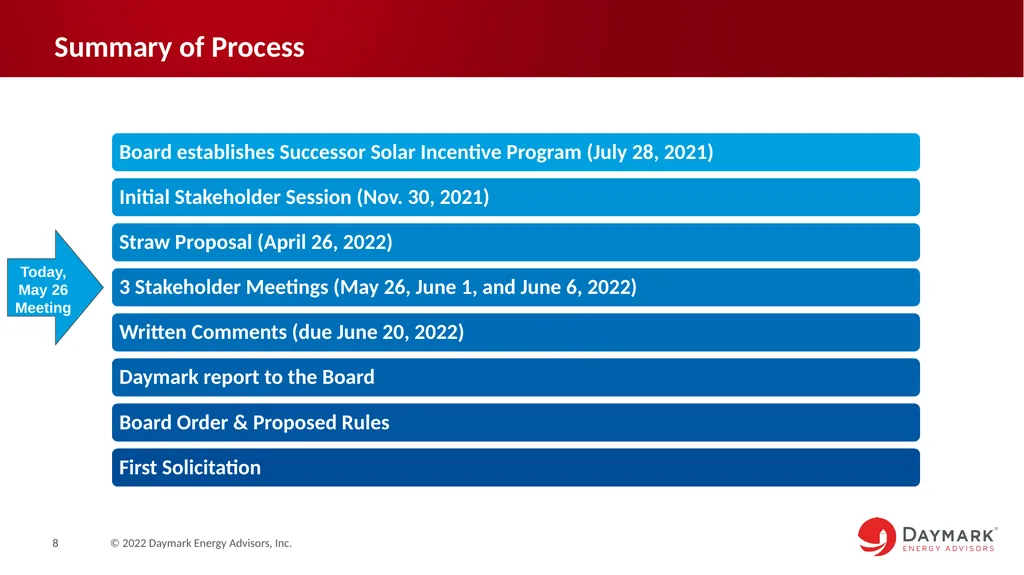
Summary of Process 8 Today, May 26 Meeting<br>
09
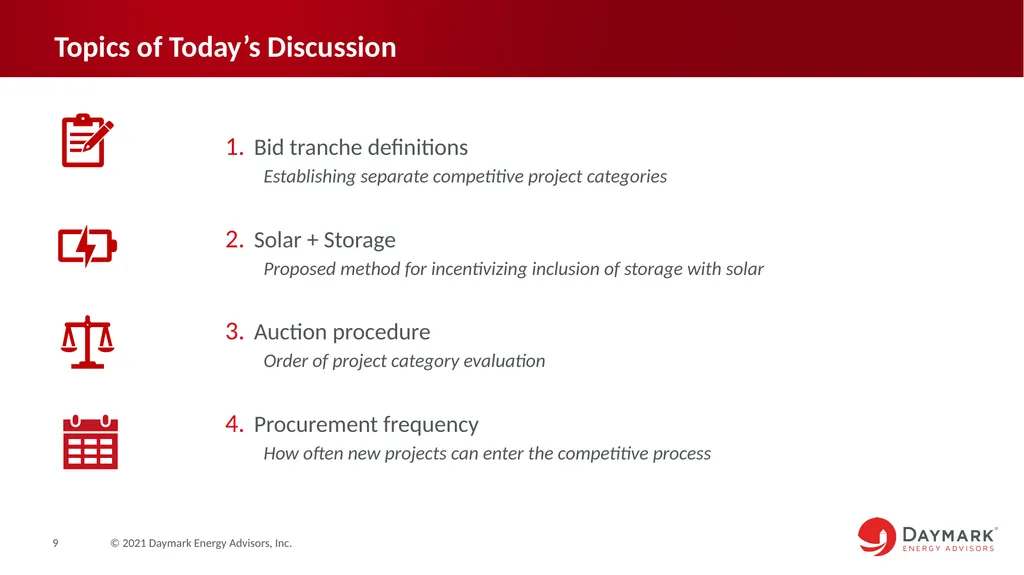
Topics of Today’s Discussion 9 Bid tranche definitions
Establishing separate competitive project categories
Solar + Storage
Proposed method for incentivizing inclusion of storage with solar
Auction procedure
Order of project category evaluation
Procurement frequency
How often new projects can enter the competitive process<br>
Establishing separate competitive project categories
Solar + Storage
Proposed method for incentivizing inclusion of storage with solar
Auction procedure
Order of project category evaluation
Procurement frequency
How often new projects can enter the competitive process<br>
10
Topic 1: Bid Tranche Definitions<br>
11
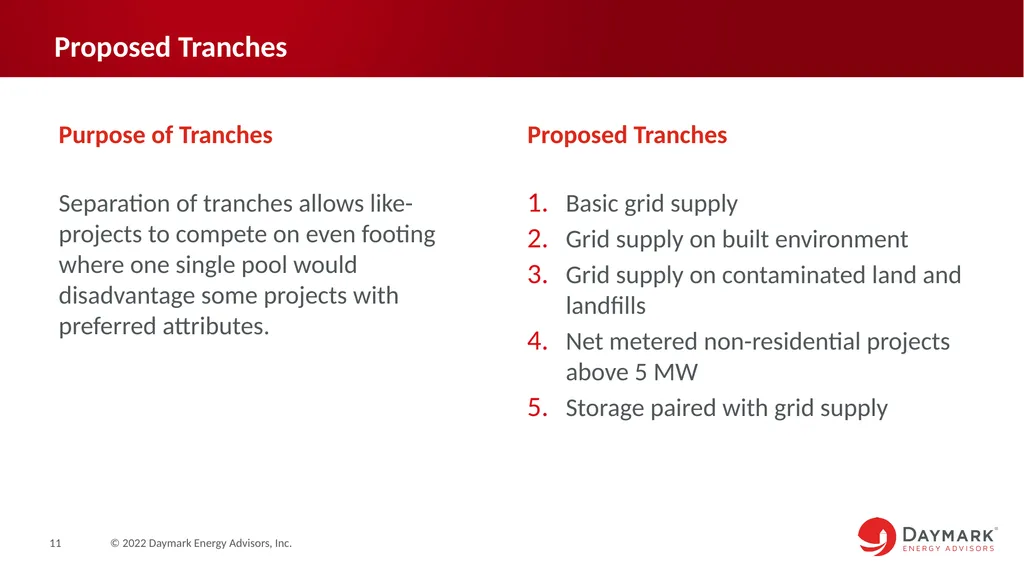
Purpose of Tranches Separation of tranches allows like-projects to compete on even footing where one single pool would disadvantage some projects with preferred attributes. Proposed Tranches Basic grid supply
Grid supply on built environment
Grid supply on contaminated land and landfills
Net metered non-residential projects above 5 MW
Storage paired with grid supply Proposed Tranches 11<br>
Grid supply on built environment
Grid supply on contaminated land and landfills
Net metered non-residential projects above 5 MW
Storage paired with grid supply Proposed Tranches 11<br>
12
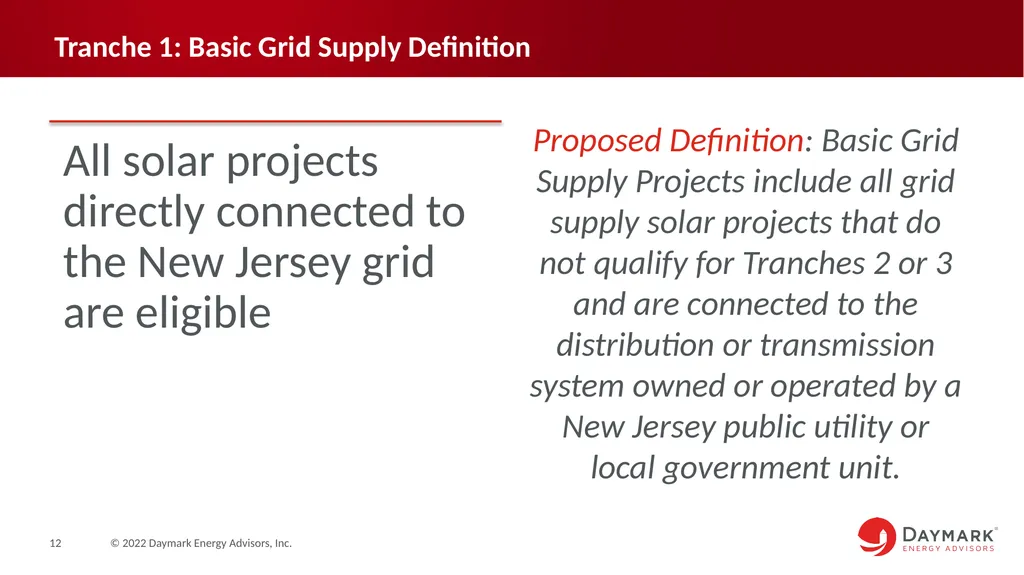
Proposed Definition: Basic Grid Supply Projects include all grid supply solar projects that do not qualify for Tranches 2 or 3 and are connected to the distribution or transmission system owned or operated by a New Jersey public utility or local government unit. Tranche 1: Basic Grid Supply Definition 12<br>
13
In this tranche, projects will be required to comply with all applicable solar siting regulations (see solar siting Straw Proposal) Tranche 1: Basic Grid Supply Detail 13<br>
14
Tranche 2: Grid Supply on the Built Environment Definition 14 Proposed Definition: Grid Supply on the Built Environment refers to all grid supply solar projects for which 100% of the photovoltaic panels are installed on rooftops, raised carports over parking lots or parking decks, or similar installations on the built environment, and connected to the distribution or transmission system owned or operated by a New Jersey public utility or local government unit.<br>
15
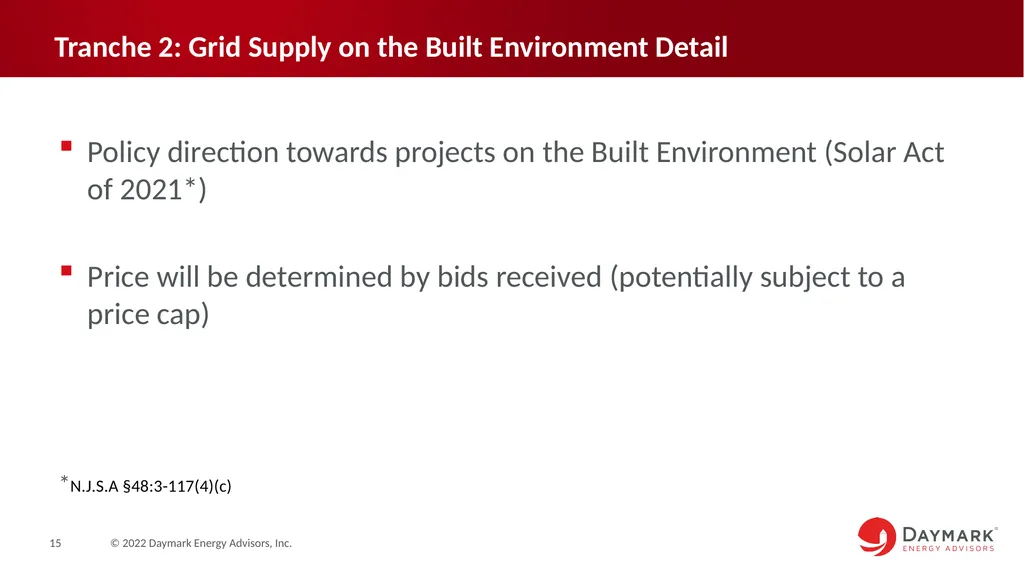
Policy direction towards projects on the Built Environment (Solar Act of 2021*)
Price will be determined by bids received (potentially subject to a price cap)
*N.J.S.A §48:3-117(4)(c) Tranche 2: Grid Supply on the Built Environment Detail 15<br>
Price will be determined by bids received (potentially subject to a price cap)
*N.J.S.A §48:3-117(4)(c) Tranche 2: Grid Supply on the Built Environment Detail 15<br>
16
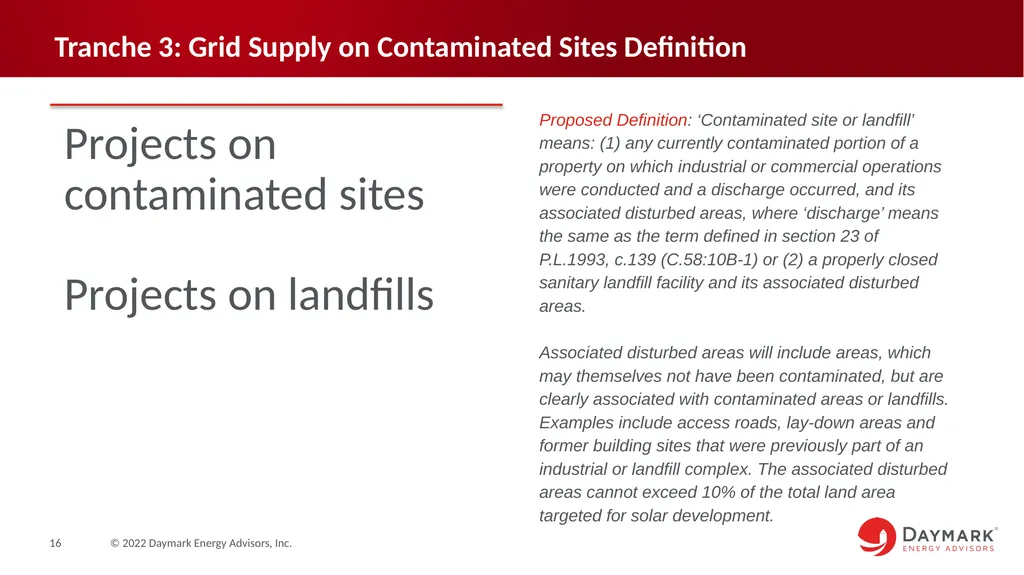
Tranche 3: Grid Supply on Contaminated Sites Definition 16 Proposed Definition: ‘Contaminated site or landfill’ means: (1) any currently contaminated portion of a property on which industrial or commercial operations were conducted and a discharge occurred, and its associated disturbed areas, where ‘discharge’ means the same as the term defined in section 23 of P.L.1993, c.139 (C.58:10B-1) or (2) a properly closed sanitary landfill facility and its associated disturbed areas.
Associated disturbed areas will include areas, which may themselves not have been contaminated, but are clearly associated with contaminated areas or landfills. Examples include access roads, lay-down areas and former building sites that were previously part of an industrial or landfill complex. The associated disturbed areas cannot exceed 10% of the total land area targeted for solar development.<br>
Associated disturbed areas will include areas, which may themselves not have been contaminated, but are clearly associated with contaminated areas or landfills. Examples include access roads, lay-down areas and former building sites that were previously part of an industrial or landfill complex. The associated disturbed areas cannot exceed 10% of the total land area targeted for solar development.<br>
17
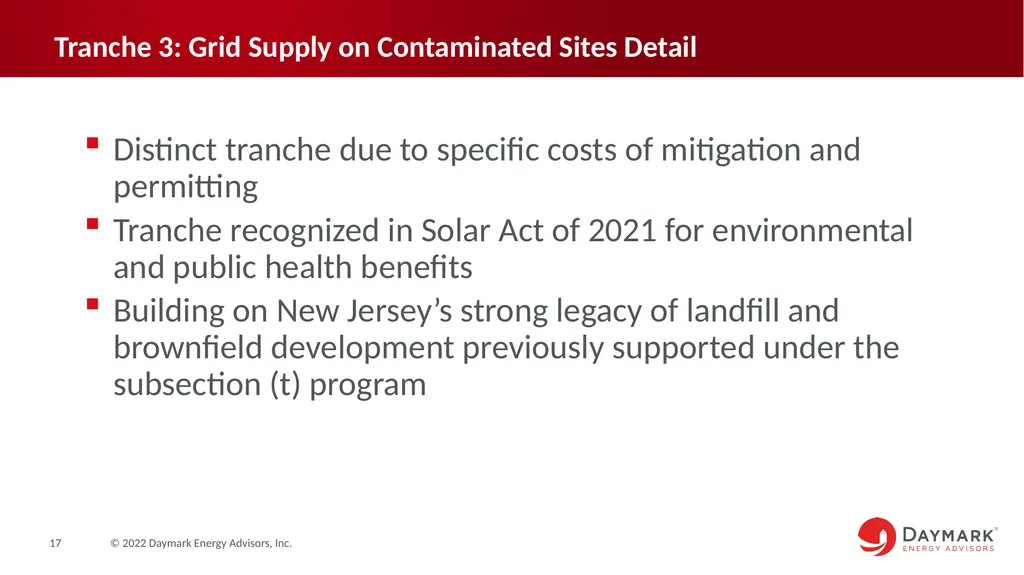
Distinct tranche due to specific costs of mitigation and permitting
Tranche recognized in Solar Act of 2021 for environmental and public health benefits
Building on New Jersey’s strong legacy of landfill and brownfield development previously supported under the subsection (t) program Tranche 3: Grid Supply on Contaminated Sites Detail 17<br>
Tranche recognized in Solar Act of 2021 for environmental and public health benefits
Building on New Jersey’s strong legacy of landfill and brownfield development previously supported under the subsection (t) program Tranche 3: Grid Supply on Contaminated Sites Detail 17<br>
18
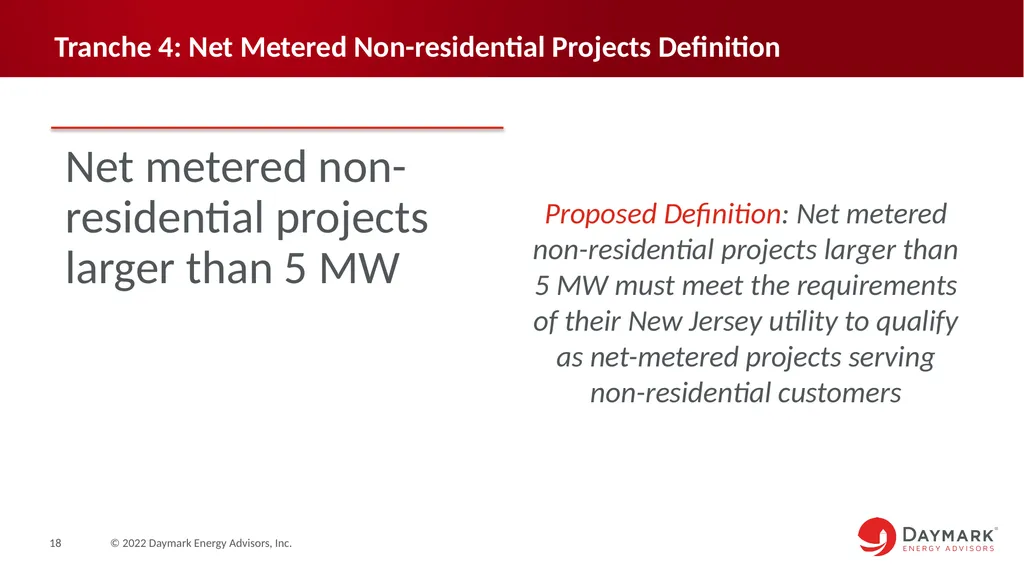
Proposed Definition: Net metered non-residential projects larger than 5 MW must meet the requirements of their New Jersey utility to qualify as net-metered projects serving non-residential customers Tranche 4: Net Metered Non-residential Projects Definition 18<br>
19
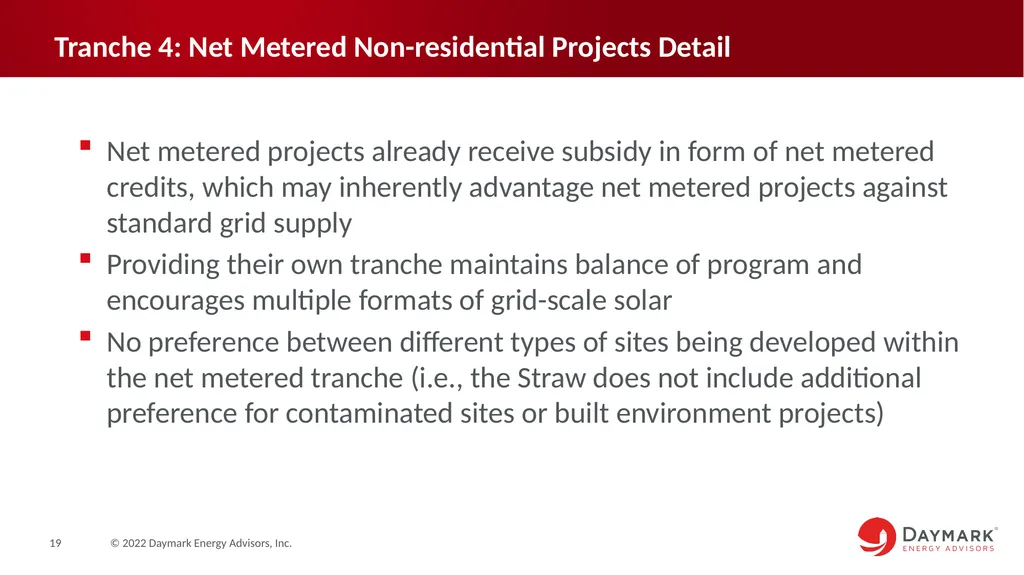
Net metered projects already receive subsidy in form of net metered credits, which may inherently advantage net metered projects against standard grid supply
Providing their own tranche maintains balance of program and encourages multiple formats of grid-scale solar
No preference between different types of sites being developed within the net metered tranche (i.e., the Straw does not include additional preference for contaminated sites or built environment projects) Tranche 4: Net Metered Non-residential Projects Detail 19<br>
Providing their own tranche maintains balance of program and encourages multiple formats of grid-scale solar
No preference between different types of sites being developed within the net metered tranche (i.e., the Straw does not include additional preference for contaminated sites or built environment projects) Tranche 4: Net Metered Non-residential Projects Detail 19<br>
20
Topic 2: Solar + Storage<br>
21
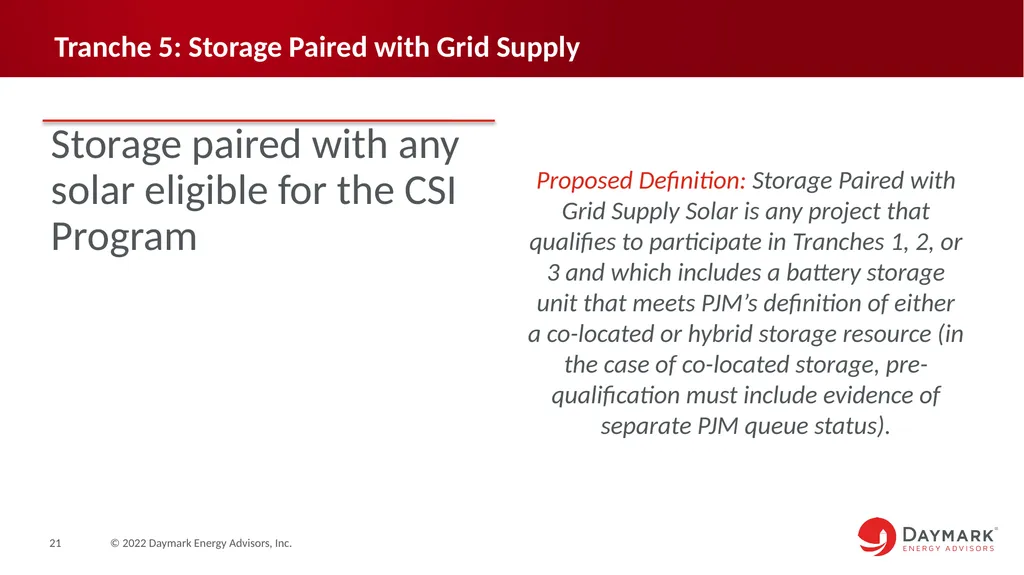
Proposed Definition: Storage Paired with Grid Supply Solar is any project that qualifies to participate in Tranches 1, 2, or 3 and which includes a battery storage unit that meets PJM’s definition of either a co-located or hybrid storage resource (in the case of co-located storage, pre-qualification must include evidence of separate PJM queue status). Tranche 5: Storage Paired with Grid Supply 21<br>
22
New Jersey currently has no independent energy storage incentive program
Clean Energy Act (P.L.2018, c.17.) specifies a goal of 2000 MW of storage by 2030
CSI Storage tranche will support the deployment of large-scale solar + storage and provide price discovery
Creating separate tranche ensures that bids which elect to include storage can participate equally in the selection process for solar
Projects cannot claim SREC-IIs in excess of total MWh power generated by associated solar generation Tranche 5: Storage Paired with Grid Supply Detail 22<br>
Clean Energy Act (P.L.2018, c.17.) specifies a goal of 2000 MW of storage by 2030
CSI Storage tranche will support the deployment of large-scale solar + storage and provide price discovery
Creating separate tranche ensures that bids which elect to include storage can participate equally in the selection process for solar
Projects cannot claim SREC-IIs in excess of total MWh power generated by associated solar generation Tranche 5: Storage Paired with Grid Supply Detail 22<br>
23
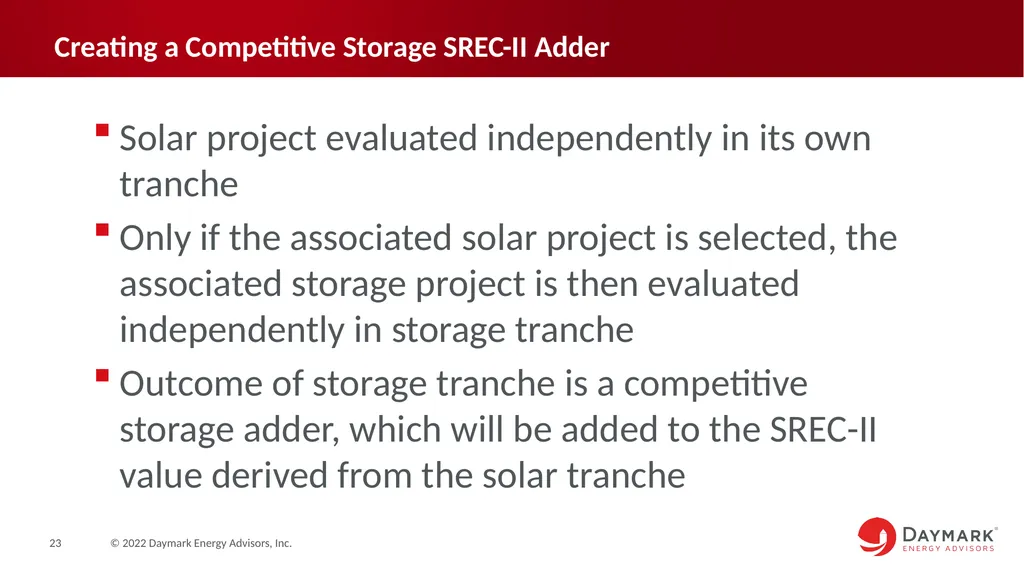
Solar project evaluated independently in its own tranche
Only if the associated solar project is selected, the associated storage project is then evaluated independently in storage tranche
Outcome of storage tranche is a competitive storage adder, which will be added to the SREC-II value derived from the solar tranche Creating a Competitive Storage SREC-II Adder 23<br>
Only if the associated solar project is selected, the associated storage project is then evaluated independently in storage tranche
Outcome of storage tranche is a competitive storage adder, which will be added to the SREC-II value derived from the solar tranche Creating a Competitive Storage SREC-II Adder 23<br>
24
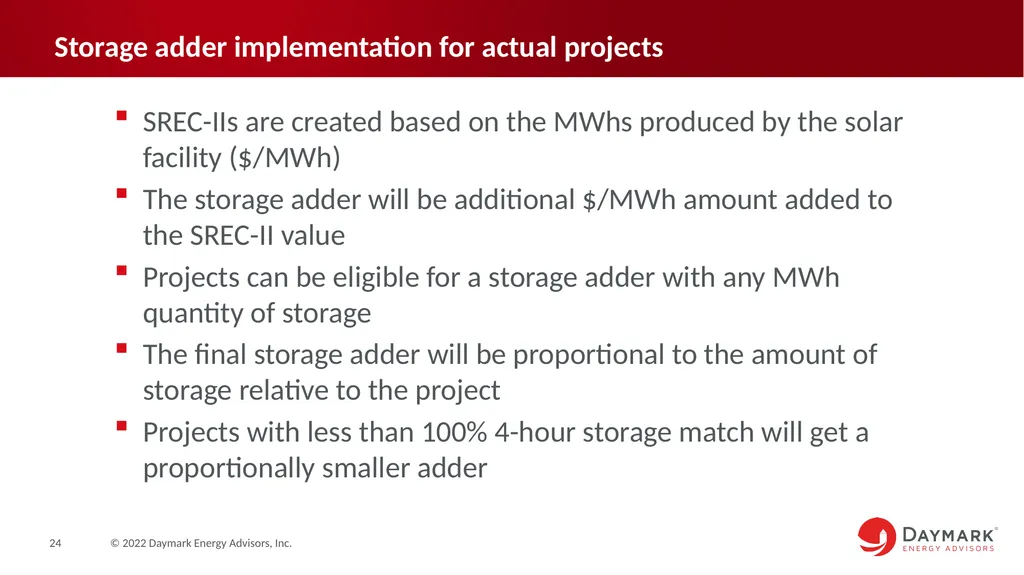
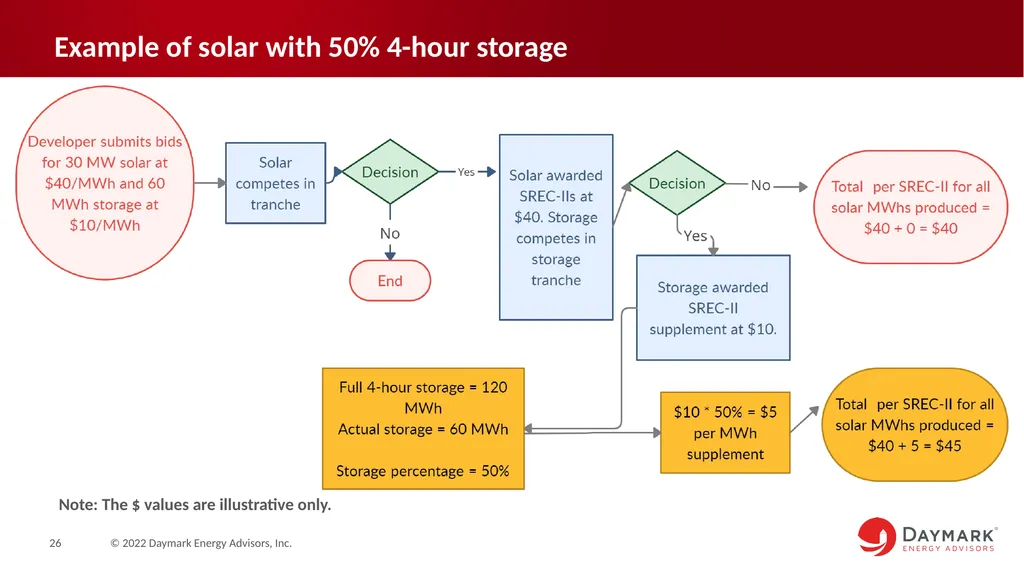
SREC-IIs are created based on the MWhs produced by the solar facility ($/MWh)
The storage adder will be additional $/MWh amount added to the SREC-II value
Projects can be eligible for a storage adder with any MWh quantity of storage
The final storage adder will be proportional to the amount of storage relative to the project
Projects with less than 100% 4-hour storage match will get a proportionally smaller adder Storage adder implementation for actual projects 24<br>
The storage adder will be additional $/MWh amount added to the SREC-II value
Projects can be eligible for a storage adder with any MWh quantity of storage
The final storage adder will be proportional to the amount of storage relative to the project
Projects with less than 100% 4-hour storage match will get a proportionally smaller adder Storage adder implementation for actual projects 24<br>
25
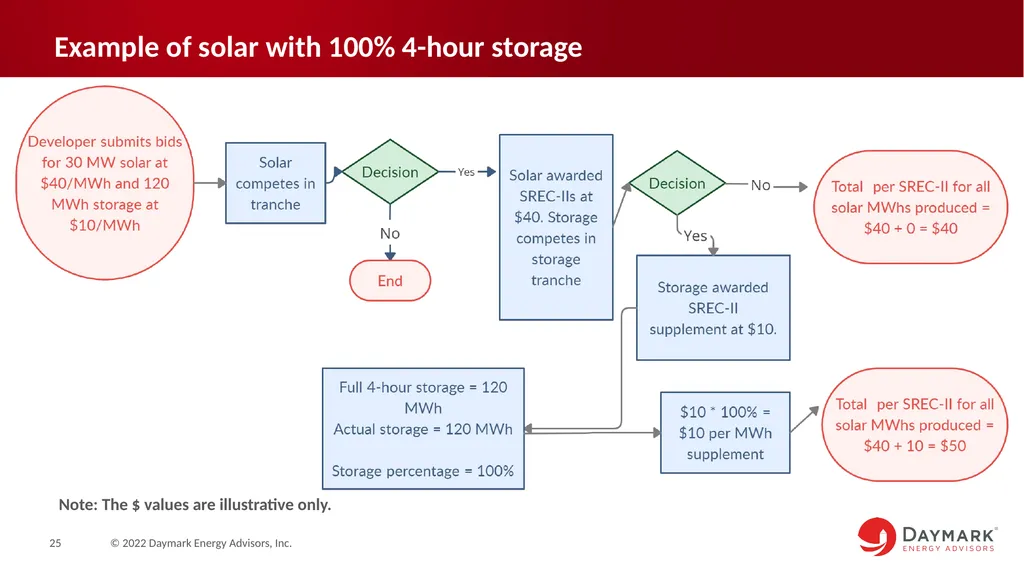
Example of solar with 100% 4-hour storage 25 Note: The $ values are illustrative only.<br>
26
Example of solar with 50% 4-hour storage 26 Note: The $ values are illustrative only.<br>
27
Topic 3: Auction Procedure<br>
28
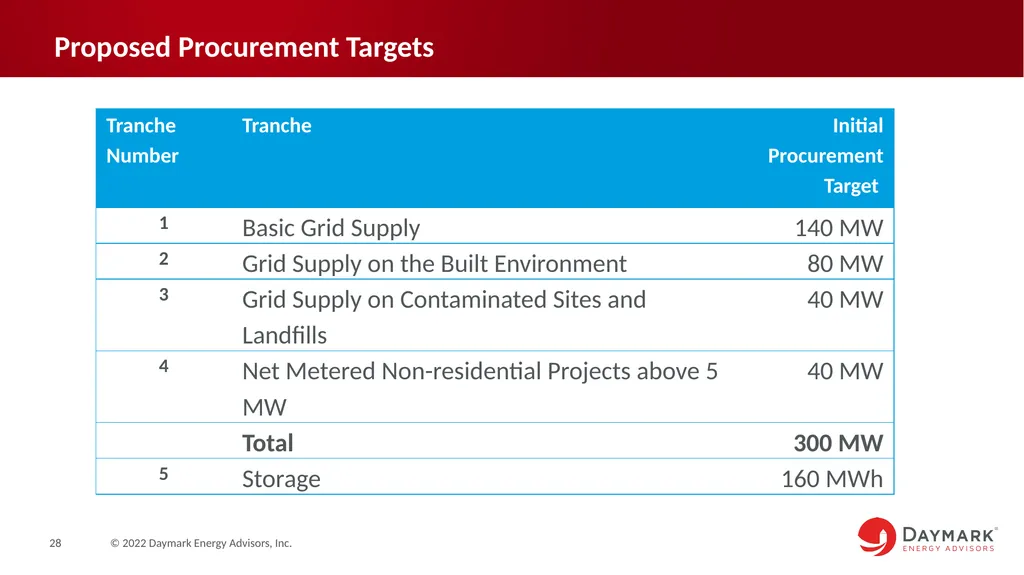
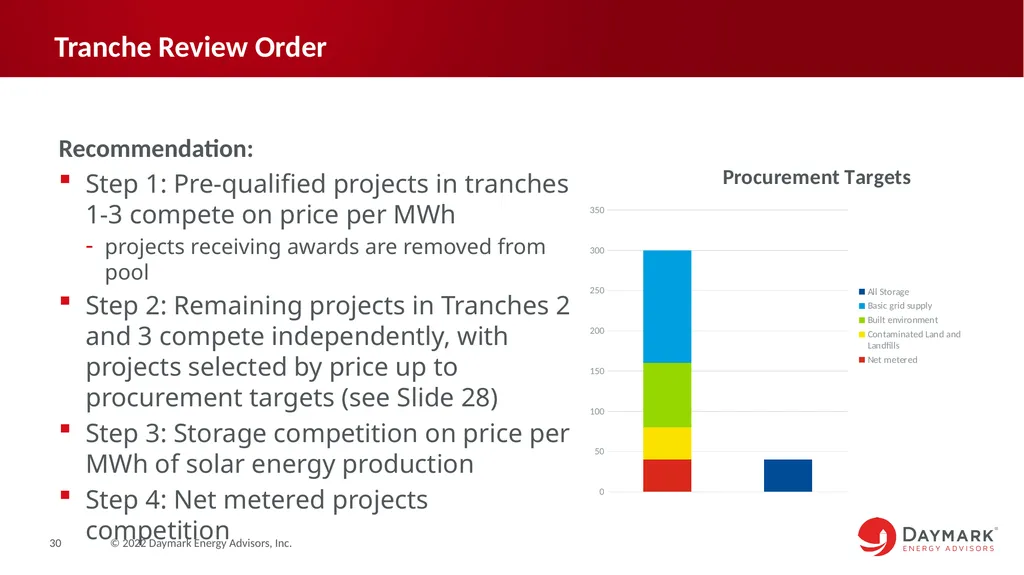
Proposed Procurement Targets 28<br>
29
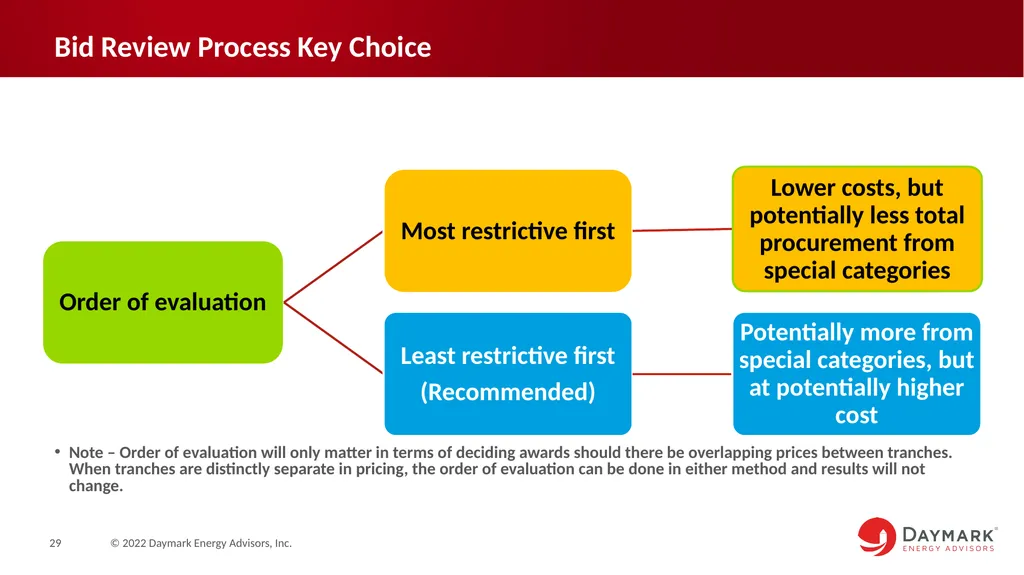
Bid Review Process Key Choice 29 Note – Order of evaluation will only matter in terms of deciding awards should there be overlapping prices between tranches. When tranches are distinctly separate in pricing, the order of evaluation can be done in either method and results will not change.<br>
30
Recommendation:
Step 1: Pre-qualified projects in tranches 1-3 compete on price per MWh
projects receiving awards are removed from pool
Step 2: Remaining projects in Tranches 2 and 3 compete independently, with projects selected by price up to procurement targets (see Slide 28)
Step 3: Storage competition on price per MWh of solar energy production
Step 4: Net metered projects competition Tranche Review Order 30<br>
Step 1: Pre-qualified projects in tranches 1-3 compete on price per MWh
projects receiving awards are removed from pool
Step 2: Remaining projects in Tranches 2 and 3 compete independently, with projects selected by price up to procurement targets (see Slide 28)
Step 3: Storage competition on price per MWh of solar energy production
Step 4: Net metered projects competition Tranche Review Order 30<br>
31
Topic 4: Procurement Frequency<br>
32
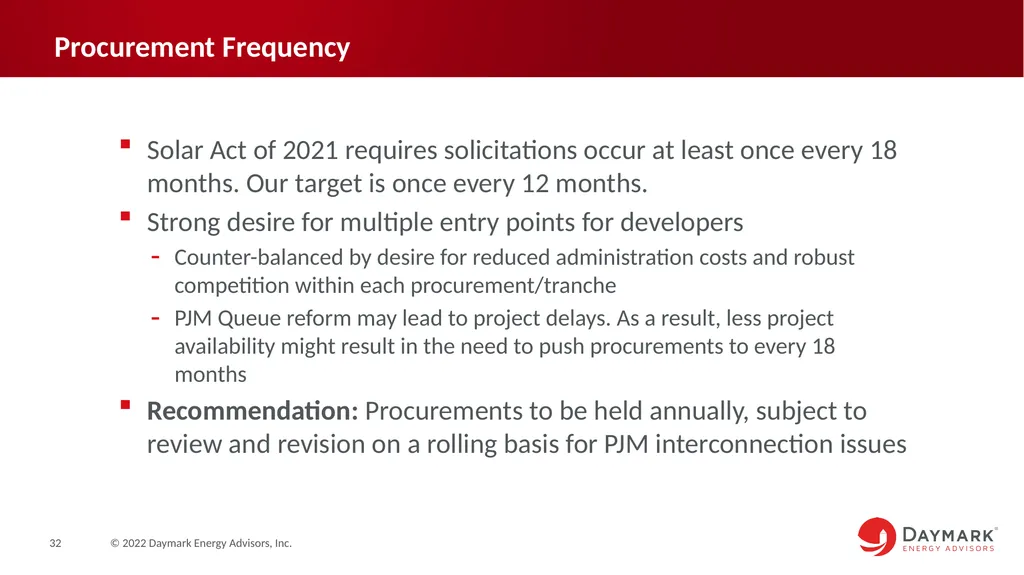
Solar Act of 2021 requires solicitations occur at least once every 18 months. Our target is once every 12 months.
Strong desire for multiple entry points for developers
Counter-balanced by desire for reduced administration costs and robust competition within each procurement/tranche
PJM Queue reform may lead to project delays. As a result, less project availability might result in the need to push procurements to every 18 months
Recommendation: Procurements to be held annually, subject to review and revision on a rolling basis for PJM interconnection issues Procurement Frequency 32<br>
Strong desire for multiple entry points for developers
Counter-balanced by desire for reduced administration costs and robust competition within each procurement/tranche
PJM Queue reform may lead to project delays. As a result, less project availability might result in the need to push procurements to every 18 months
Recommendation: Procurements to be held annually, subject to review and revision on a rolling basis for PJM interconnection issues Procurement Frequency 32<br>
33
Stakeholder Feedback<br>
34
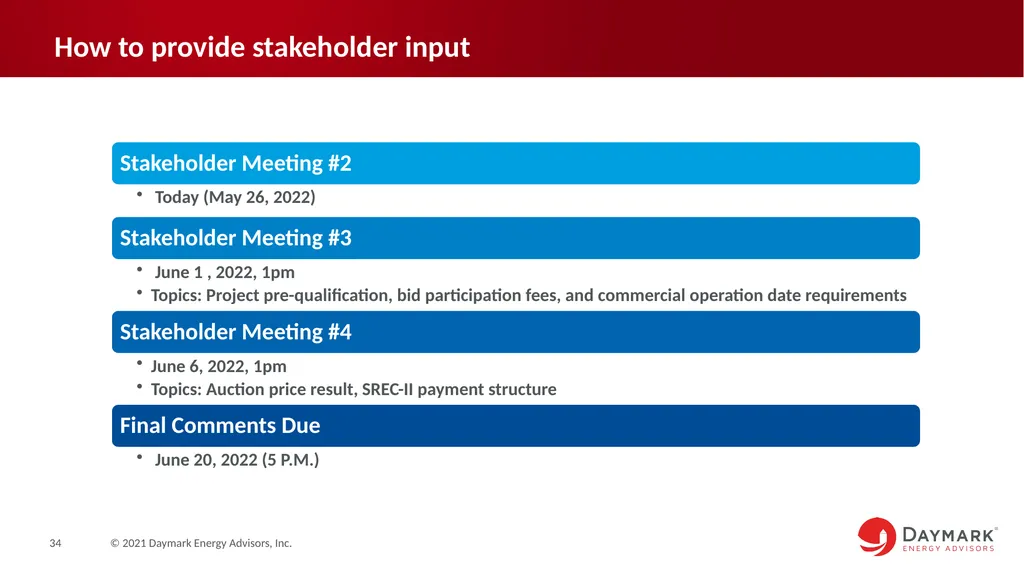
How to provide stakeholder input 34<br>
35
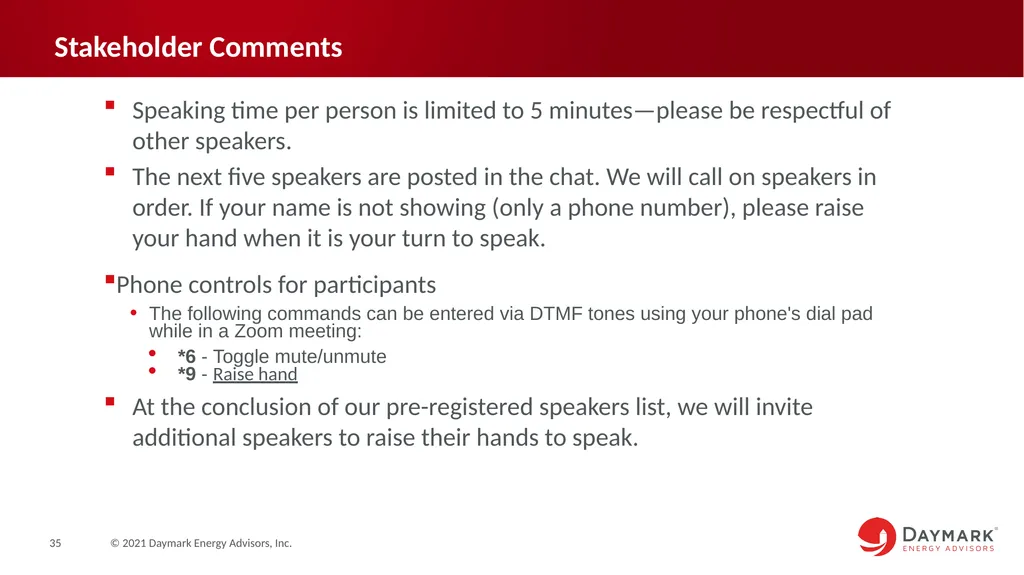
Speaking time per person is limited to 5 minutes—please be respectful of other speakers.
The next five speakers are posted in the chat. We will call on speakers in order. If your name is not showing (only a phone number), please raise your hand when it is your turn to speak.
Phone controls for participants
The following commands can be entered via DTMF tones using your phone's dial pad while in a Zoom meeting:
*6 - Toggle mute/unmute
*9 - Raise hand
At the conclusion of our pre-registered speakers list, we will invite additional speakers to raise their hands to speak. Stakeholder Comments 35<br>
The next five speakers are posted in the chat. We will call on speakers in order. If your name is not showing (only a phone number), please raise your hand when it is your turn to speak.
Phone controls for participants
The following commands can be entered via DTMF tones using your phone's dial pad while in a Zoom meeting:
*6 - Toggle mute/unmute
*9 - Raise hand
At the conclusion of our pre-registered speakers list, we will invite additional speakers to raise their hands to speak. Stakeholder Comments 35<br>
36
Stakeholder Feedback<br>
37
37 Thank you
Let’s continue the conversation DAYMARK ENERGY ADVISORS
Our team brings deep knowledge and an integrated view of energy infrastructure, regulation, and markets to help our clients make well-informed business, capital investment, and policy decisions in the face of transformative change to achieve decarbonization. Carrie Gilbert
(207) 347-3145 | cgilbert@daymarkea.com
Louisa Lund
(617) 778-2590 | llund@daymarkea.com DaymarkEA.com<br>
Our team brings deep knowledge and an integrated view of energy infrastructure, regulation, and markets to help our clients make well-informed business, capital investment, and policy decisions in the face of transformative change to achieve decarbonization. Carrie Gilbert
(207) 347-3145 | cgilbert@daymarkea.com
Louisa Lund
(617) 778-2590 | llund@daymarkea.com DaymarkEA.com<br>
38
The deadline for comments on the Siting Straw is 5:00 p.m. ET on Monday, June 20, 2022
Please submit comments directly to Docket No. QO21101186, using the “Post Comments” button on the Board’s Public Document Search tool.
Comments are considered “public documents” for purposes of the State’s Open Public Records Act and any confidential information should be submitted in accordance with the procedures set forth in N.J.A.C. 14:1-12.3.
Written comments may also be submitted to:
Carmen D. Diaz
Acting Secretary of the Board
44 South Clinton Avenue, 1st Floor
Post Office Box 350
Trenton, NJ 08625-0350
Phone: 609-292-1599
Email: board.secretary@bpu.nj.gov 38 Written Stakeholder Comment Guidelines<br>
Please submit comments directly to Docket No. QO21101186, using the “Post Comments” button on the Board’s Public Document Search tool.
Comments are considered “public documents” for purposes of the State’s Open Public Records Act and any confidential information should be submitted in accordance with the procedures set forth in N.J.A.C. 14:1-12.3.
Written comments may also be submitted to:
Carmen D. Diaz
Acting Secretary of the Board
44 South Clinton Avenue, 1st Floor
Post Office Box 350
Trenton, NJ 08625-0350
Phone: 609-292-1599
Email: board.secretary@bpu.nj.gov 38 Written Stakeholder Comment Guidelines<br>
39
THANK YOU – Let’s continue the conversation
veronique.oomen@bpu.nj.gov<br>