Compiled by Dr. Sarang Shankar Bhola Associate Professor, Karmaveer Bhaurao Patil Institute of Management Studies and Research, Varye, Satara Define: SCM Logistics Logistics typically refers to activities that occur within the boundaries
"Compiled by Dr. Sarang Shankar Bhola Associate" is the property of its rightful owner. Permission is granted to
download and print the materials on this website for personal, non-commercial use only, and to display it
on your personal computer provided you do not modify the materials and that you retain all copyright
notices contained in the materials. By downloading content from our website, you accept the terms of this
agreement.
Presentation Transcript
01
Compiled by
Dr. Sarang Shankar Bhola
Associate Professor,
Karmaveer Bhaurao Patil Institute of Management Studies and Research, Varye, Satara<br>
02
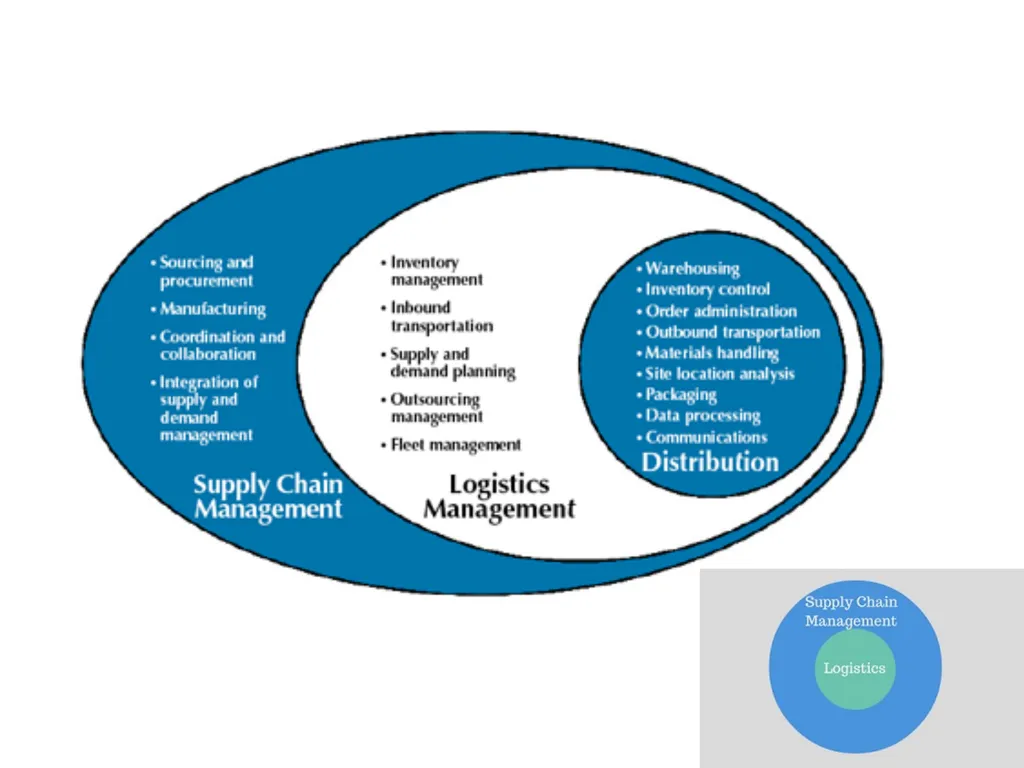
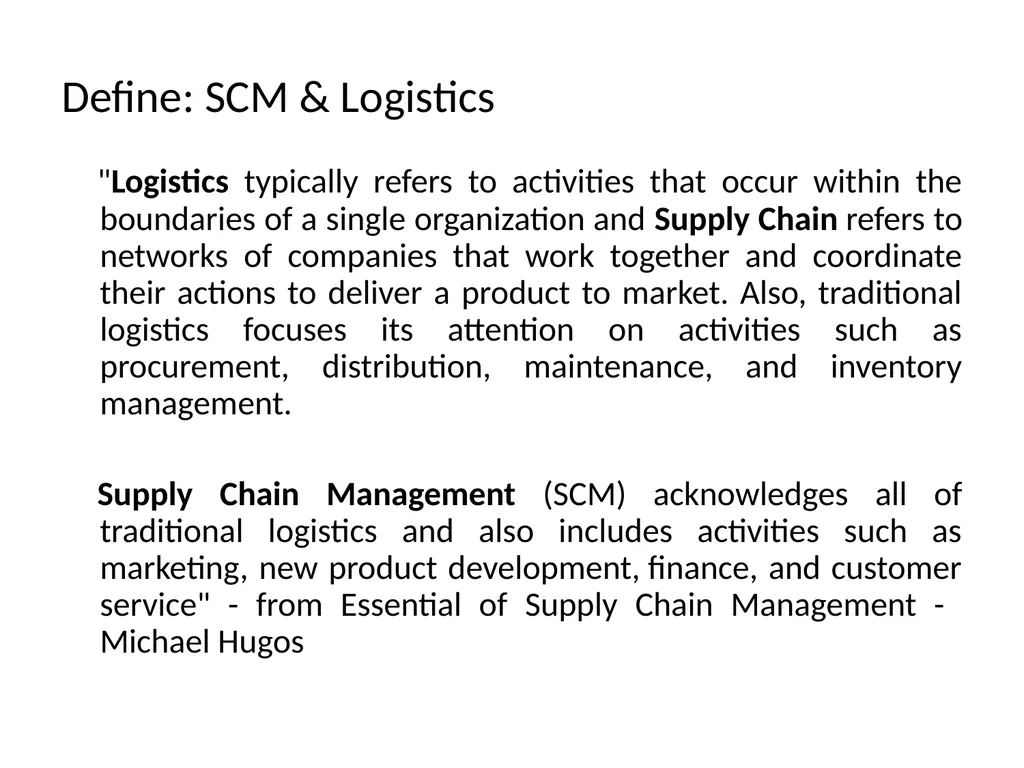
Define: SCM & Logistics "Logistics typically refers to activities that occur within the boundaries of a single organization and Supply Chain refers to networks of companies that work together and coordinate their actions to deliver a product to market. Also, traditional logistics focuses its attention on activities such as procurement, distribution, maintenance, and inventory management.
Supply Chain Management (SCM) acknowledges all of traditional logistics and also includes activities such as marketing, new product development, finance, and customer service" - from Essential of Supply Chain Management - Michael Hugos<br>
03
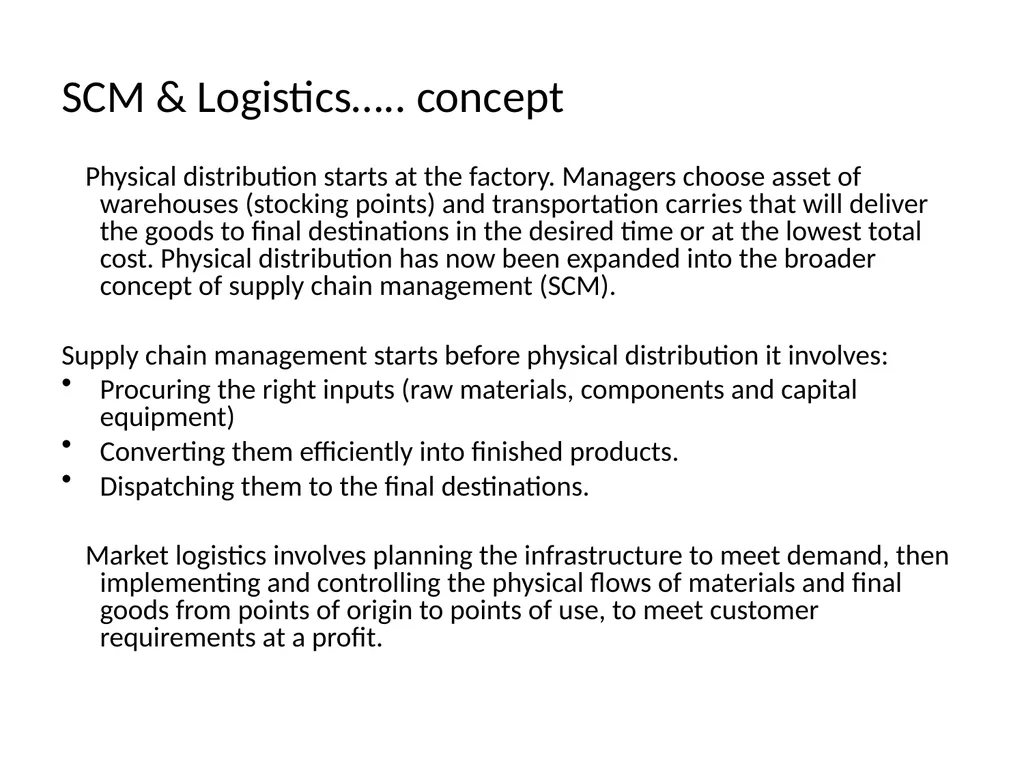
SCM & Logistics….. concept Physical distribution starts at the factory. Managers choose asset of warehouses (stocking points) and transportation carries that will deliver the goods to final destinations in the desired time or at the lowest total cost. Physical distribution has now been expanded into the broader concept of supply chain management (SCM).
Supply chain management starts before physical distribution it involves:
Procuring the right inputs (raw materials, components and capital equipment)
Converting them efficiently into finished products.
Dispatching them to the final destinations.
Market logistics involves planning the infrastructure to meet demand, then implementing and controlling the physical flows of materials and final goods from points of origin to points of use, to meet customer requirements at a profit.<br>
04
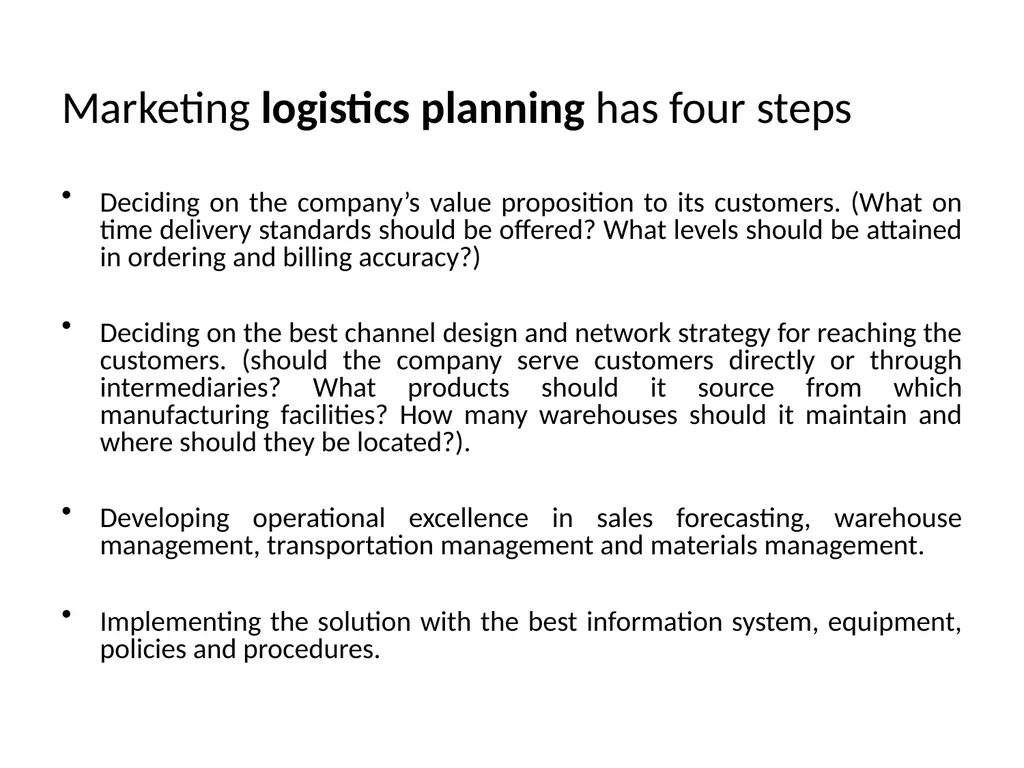
Marketing logistics planning has four steps Deciding on the company’s value proposition to its customers. (What on time delivery standards should be offered? What levels should be attained in ordering and billing accuracy?)
Deciding on the best channel design and network strategy for reaching the customers. (should the company serve customers directly or through intermediaries? What products should it source from which manufacturing facilities? How many warehouses should it maintain and where should they be located?).
Developing operational excellence in sales forecasting, warehouse management, transportation management and materials management.
Implementing the solution with the best information system, equipment, policies and procedures.<br>
05
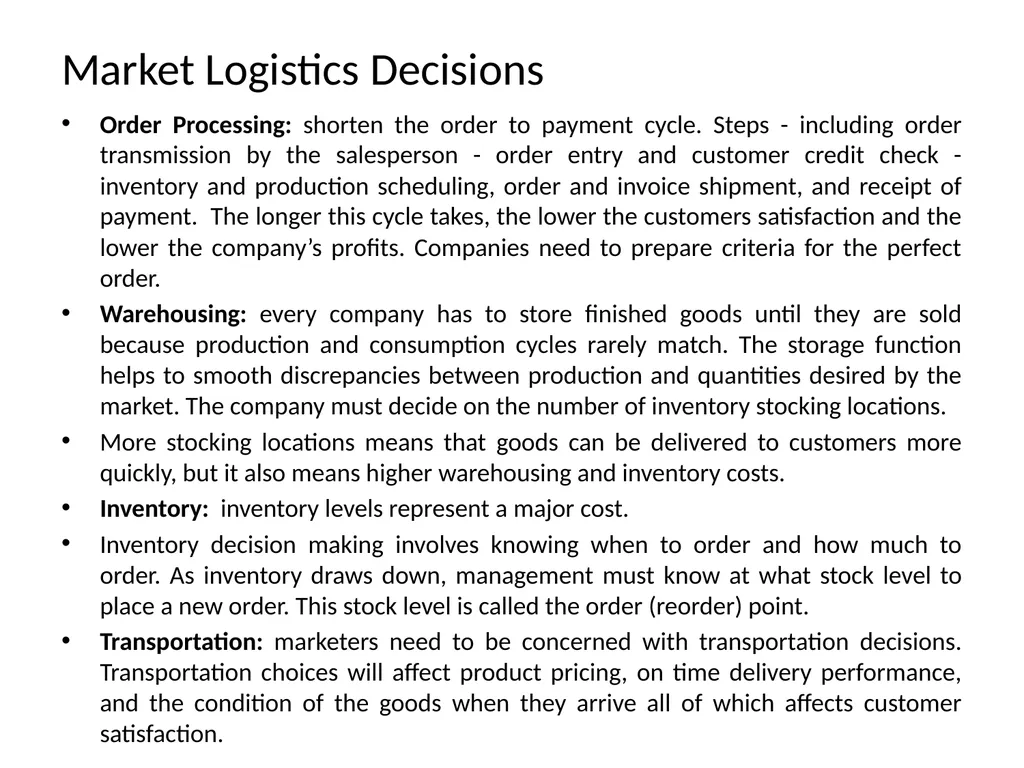
Market Logistics Decisions Order Processing: shorten the order to payment cycle. Steps - including order transmission by the salesperson - order entry and customer credit check - inventory and production scheduling, order and invoice shipment, and receipt of payment. The longer this cycle takes, the lower the customers satisfaction and the lower the company’s profits. Companies need to prepare criteria for the perfect order.
Warehousing: every company has to store finished goods until they are sold because production and consumption cycles rarely match. The storage function helps to smooth discrepancies between production and quantities desired by the market. The company must decide on the number of inventory stocking locations.
More stocking locations means that goods can be delivered to customers more quickly, but it also means higher warehousing and inventory costs.
Inventory: inventory levels represent a major cost.
Inventory decision making involves knowing when to order and how much to order. As inventory draws down, management must know at what stock level to place a new order. This stock level is called the order (reorder) point.
Transportation: marketers need to be concerned with transportation decisions. Transportation choices will affect product pricing, on time delivery performance, and the condition of the goods when they arrive all of which affects customer satisfaction.<br>
06
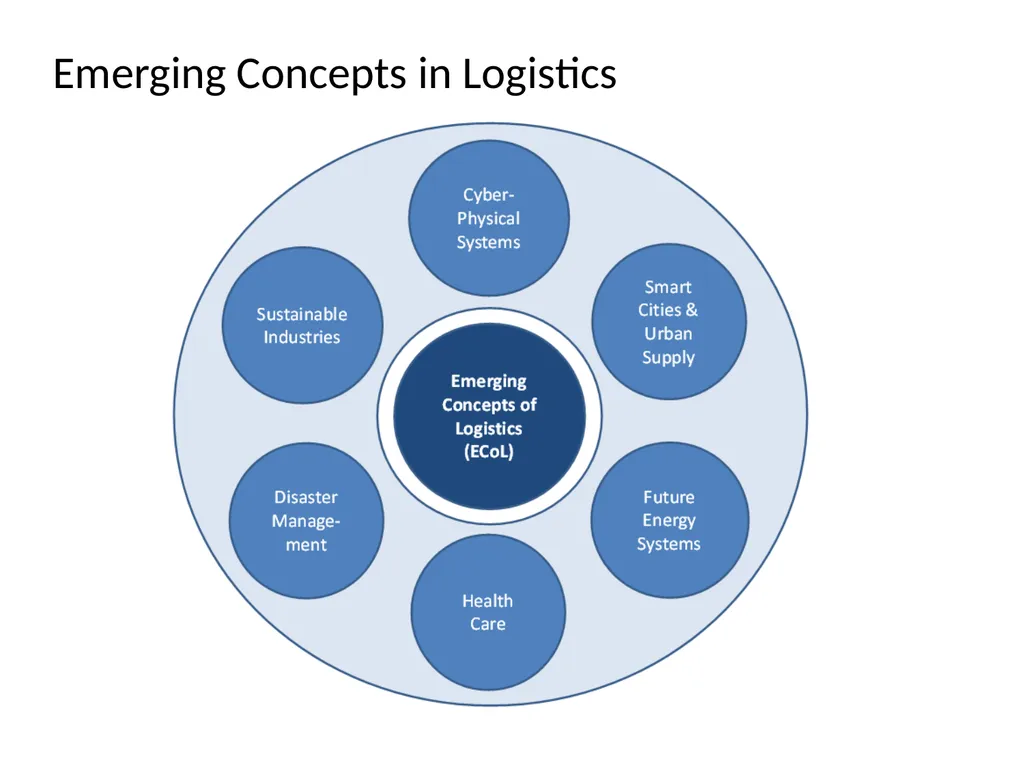
Emerging Concepts in Logistics<br>
07
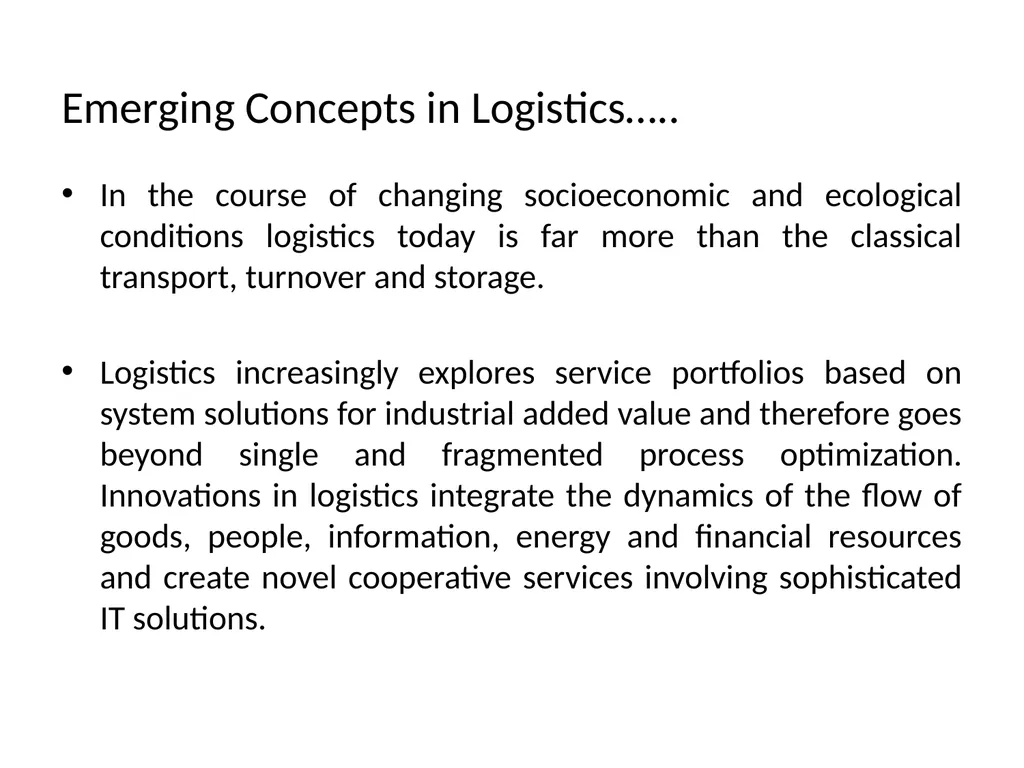
Emerging Concepts in Logistics….. In the course of changing socioeconomic and ecological conditions logistics today is far more than the classical transport, turnover and storage.
Logistics increasingly explores service portfolios based on system solutions for industrial added value and therefore goes beyond single and fragmented process optimization. Innovations in logistics integrate the dynamics of the flow of goods, people, information, energy and financial resources and create novel cooperative services involving sophisticated IT solutions.<br>
08
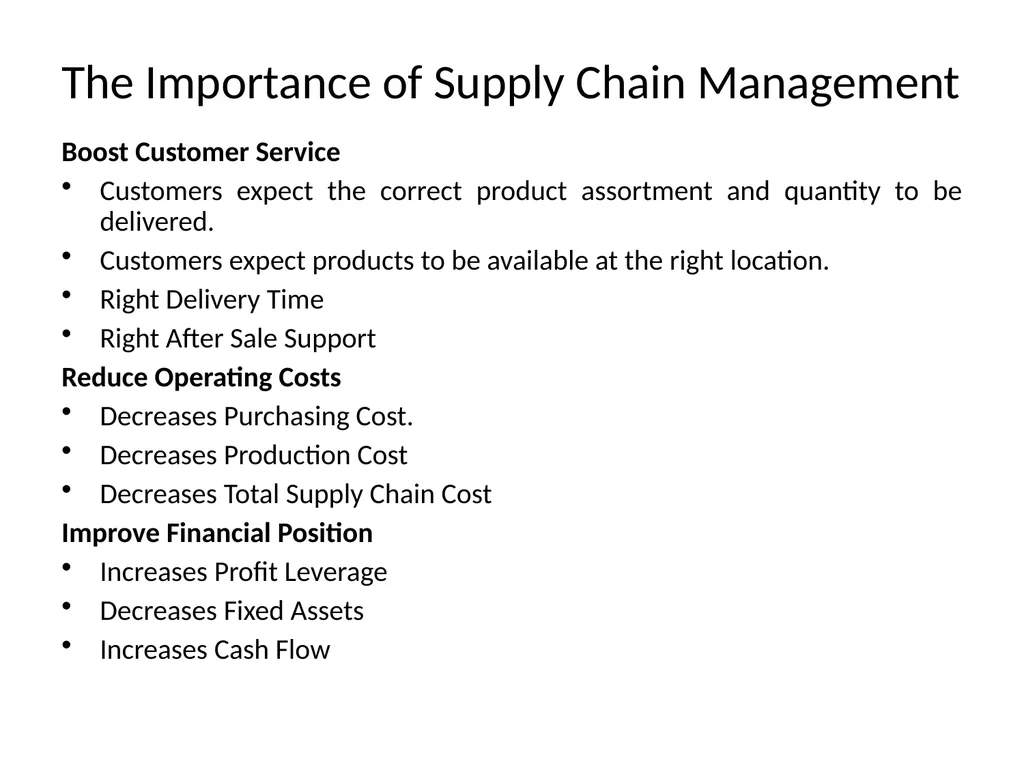
The Importance of Supply Chain Management Boost Customer Service
Customers expect the correct product assortment and quantity to be delivered.
Customers expect products to be available at the right location.
Right Delivery Time
Right After Sale Support
Reduce Operating Costs
Decreases Purchasing Cost.
Decreases Production Cost
Decreases Total Supply Chain Cost
Improve Financial Position
Increases Profit Leverage
Decreases Fixed Assets
Increases Cash Flow<br>
09
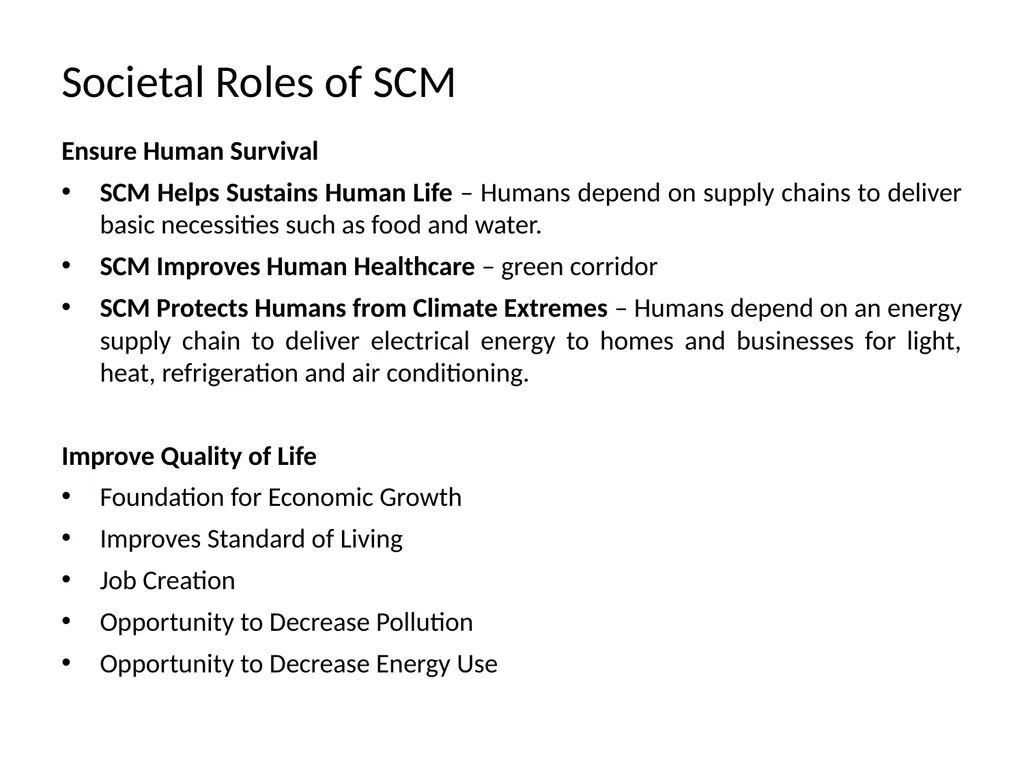
Societal Roles of SCM Ensure Human Survival
SCM Helps Sustains Human Life – Humans depend on supply chains to deliver basic necessities such as food and water.
SCM Improves Human Healthcare – green corridor
SCM Protects Humans from Climate Extremes – Humans depend on an energy supply chain to deliver electrical energy to homes and businesses for light, heat, refrigeration and air conditioning.
Improve Quality of Life
Foundation for Economic Growth
Improves Standard of Living
Job Creation
Opportunity to Decrease Pollution
Opportunity to Decrease Energy Use<br>
10
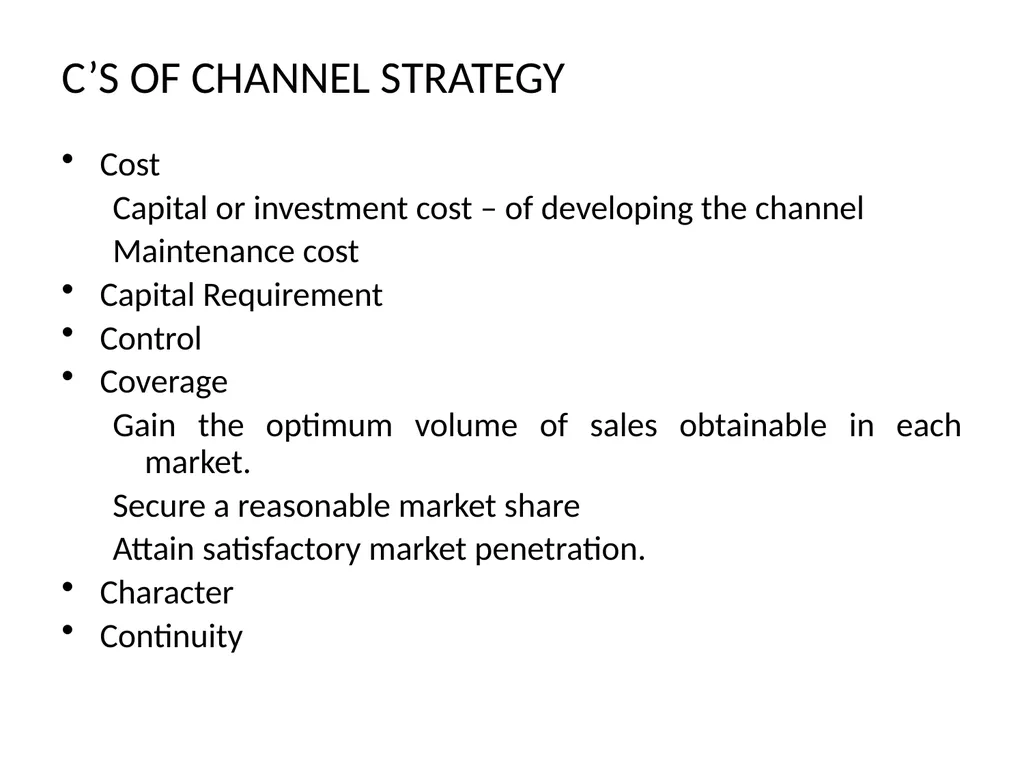
C’S OF CHANNEL STRATEGY Cost
Capital or investment cost – of developing the channel
Maintenance cost
Capital Requirement
Control
Coverage
Gain the optimum volume of sales obtainable in each market.
Secure a reasonable market share
Attain satisfactory market penetration.
Character
Continuity<br>