
Composite sets show several locations on stage at

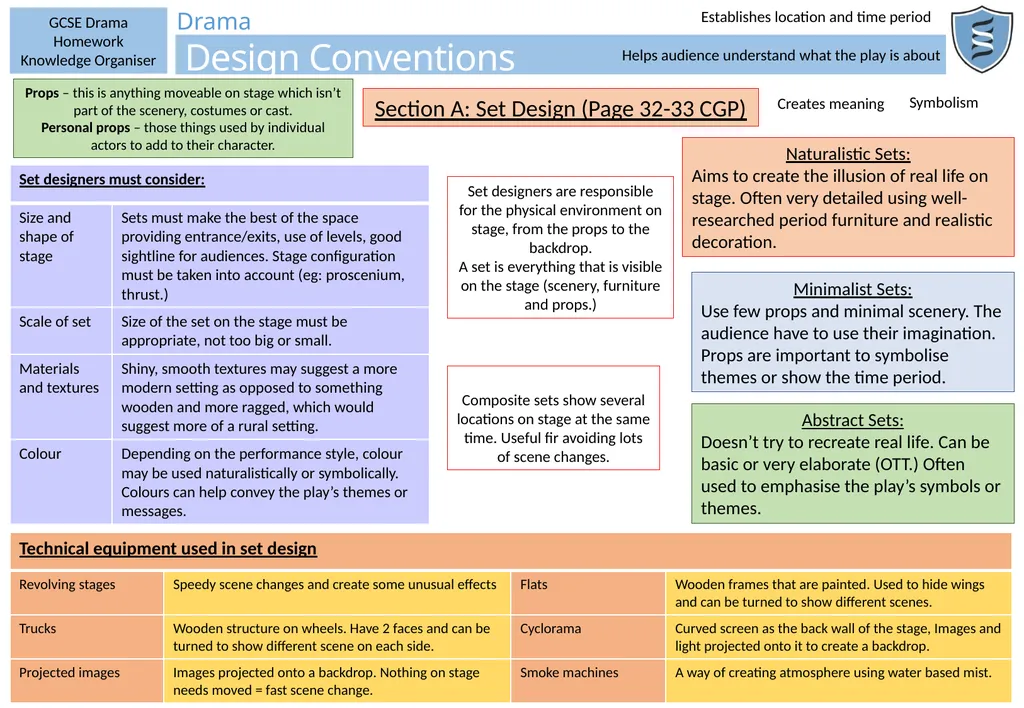
Description: Composite sets show several locations on stage at the same time. Useful fir avoiding lots of scene changes. Drama Design Conventions GCSE Drama Homework Knowledge Organiser Section A: Set Design (Page 32-33 CGP) Set designers are
Related Topics
Download Presentation
"Composite sets show several locations on stage at" is the property of its rightful owner. Permission is granted to download and print the materials on this website for personal, non-commercial use only, and to display it on your personal computer provided you do not modify the materials and that you retain all copyright notices contained in the materials. By downloading content from our website, you accept the terms of this agreement.
Presentation Transcript
slide1. Composite sets show several locations on stage at the same time. Useful fir avoiding lots of scene changes. Drama Design Conventions GCSE Drama Homework
Knowledge Organiser Section A: Set Design (Page 32-33 CGP) Set designers are responsible for the physical environment on stage, from the props to the backdrop.
A set is everything that is visible on the stage (scenery, furniture and props.) Creates meaning Helps audience understand what the play is about Establishes location and time period Symbolism Naturalistic Sets:
Aims to create the illusion of real life on stage. Often very detailed using well-researched period furniture and realistic decoration. Minimalist Sets:
Use few props and minimal scenery. The audience have to use their imagination. Props are important to symbolise themes or show the time period. Abstract Sets:
Doesn’t try to recreate real life. Can be basic or very elaborate (OTT.) Often used to emphasise the play’s symbols or themes. Props – this is anything moveable on stage which isn’t part of the scenery, costumes or cast.
Personal props – those things used by individual actors to add to their character.<br>
slide2. Drama Design Conventions GCSE Drama
Homework
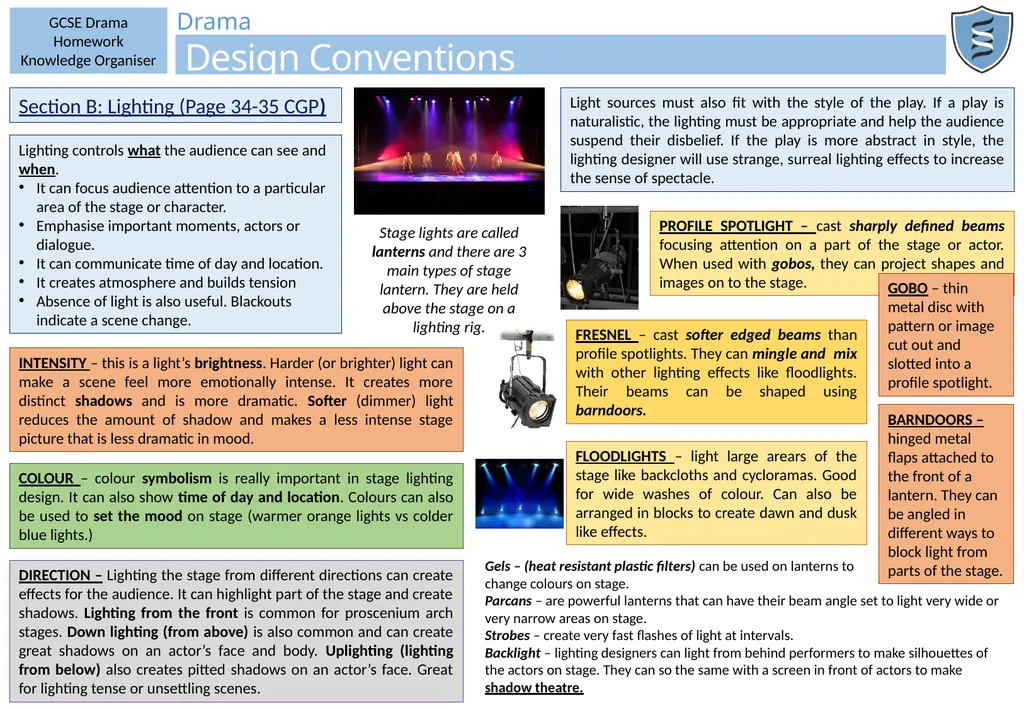
Knowledge Organiser Section B: Lighting (Page 34-35 CGP) Lighting controls what the audience can see and when.
It can focus audience attention to a particular area of the stage or character.
Emphasise important moments, actors or dialogue.
It can communicate time of day and location.
It creates atmosphere and builds tension
Absence of light is also useful. Blackouts indicate a scene change. Light sources must also fit with the style of the play. If a play is naturalistic, the lighting must be appropriate and help the audience suspend their disbelief. If the play is more abstract in style, the lighting designer will use strange, surreal lighting effects to increase the sense of spectacle. INTENSITY – this is a light’s brightness. Harder (or brighter) light can make a scene feel more emotionally intense. It creates more distinct shadows and is more dramatic. Softer (dimmer) light reduces the amount of shadow and makes a less intense stage picture that is less dramatic in mood. COLOUR – colour symbolism is really important in stage lighting design. It can also show time of day and location. Colours can also be used to set the mood on stage (warmer orange lights vs colder blue lights.) DIRECTION – Lighting the stage from different directions can create effects for the audience. It can highlight part of the stage and create shadows. Lighting from the front is common for proscenium arch stages. Down lighting (from above) is also common and can create great shadows on an actor’s face and body. Uplighting (lighting from below) also creates pitted shadows on an actor’s face. Great for lighting tense or unsettling scenes. Stage lights are called lanterns and there are 3 main types of stage lantern. They are held above the stage on a lighting rig. PROFILE SPOTLIGHT – cast sharply defined beams focusing attention on a part of the stage or actor. When used with gobos, they can project shapes and images on to the stage. FRESNEL – cast softer edged beams than profile spotlights. They can mingle and mix with other lighting effects like floodlights. Their beams can be shaped using barndoors. FLOODLIGHTS – light large arears of the stage like backcloths and cycloramas. Good for wide washes of colour. Can also be arranged in blocks to create dawn and dusk like effects. GOBO – thin metal disc with pattern or image cut out and slotted into a profile spotlight. BARNDOORS – hinged metal flaps attached to the front of a lantern. They can be angled in different ways to block light from parts of the stage. Gels – (heat resistant plastic filters) can be used on lanterns to
change colours on stage.
Parcans – are powerful lanterns that can have their beam angle set to light very wide or very narrow areas on stage.
Strobes – create very fast flashes of light at intervals.
Backlight – lighting designers can light from behind performers to make silhouettes of the actors on stage. They can so the same with a screen in front of actors to make shadow theatre.<br>
slide3. Drama Design Conventions GCSE Drama
Homework
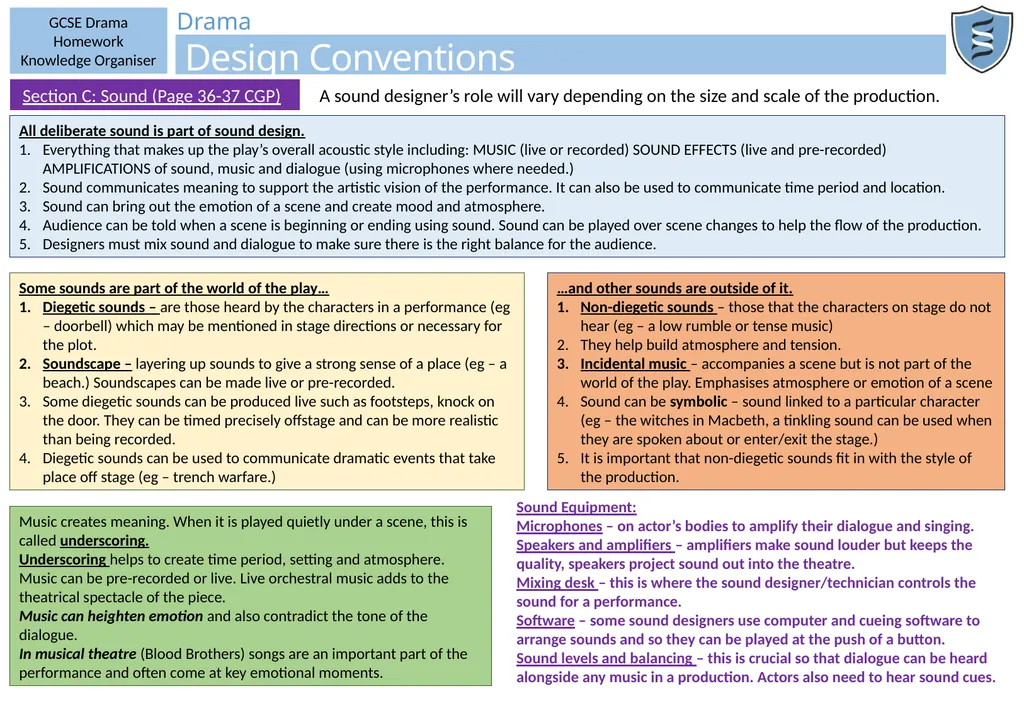
Knowledge Organiser Section C: Sound (Page 36-37 CGP) A sound designer’s role will vary depending on the size and scale of the production. All deliberate sound is part of sound design.
Everything that makes up the play’s overall acoustic style including: MUSIC (live or recorded) SOUND EFFECTS (live and pre-recorded) AMPLIFICATIONS of sound, music and dialogue (using microphones where needed.)
Sound communicates meaning to support the artistic vision of the performance. It can also be used to communicate time period and location.
Sound can bring out the emotion of a scene and create mood and atmosphere.
Audience can be told when a scene is beginning or ending using sound. Sound can be played over scene changes to help the flow of the production.
Designers must mix sound and dialogue to make sure there is the right balance for the audience. Some sounds are part of the world of the play…
Diegetic sounds – are those heard by the characters in a performance (eg – doorbell) which may be mentioned in stage directions or necessary for the plot.
Soundscape – layering up sounds to give a strong sense of a place (eg – a beach.) Soundscapes can be made live or pre-recorded.
Some diegetic sounds can be produced live such as footsteps, knock on the door. They can be timed precisely offstage and can be more realistic than being recorded.
Diegetic sounds can be used to communicate dramatic events that take place off stage (eg – trench warfare.) …and other sounds are outside of it.
Non-diegetic sounds – those that the characters on stage do not hear (eg – a low rumble or tense music)
They help build atmosphere and tension.
Incidental music – accompanies a scene but is not part of the world of the play. Emphasises atmosphere or emotion of a scene
Sound can be symbolic – sound linked to a particular character (eg – the witches in Macbeth, a tinkling sound can be used when they are spoken about or enter/exit the stage.)
It is important that non-diegetic sounds fit in with the style of the production. Music creates meaning. When it is played quietly under a scene, this is called underscoring.
Underscoring helps to create time period, setting and atmosphere.
Music can be pre-recorded or live. Live orchestral music adds to the theatrical spectacle of the piece.
Music can heighten emotion and also contradict the tone of the dialogue.
In musical theatre (Blood Brothers) songs are an important part of the performance and often come at key emotional moments. Sound Equipment:
Microphones – on actor’s bodies to amplify their dialogue and singing.
Speakers and amplifiers – amplifiers make sound louder but keeps the quality, speakers project sound out into the theatre.
Mixing desk – this is where the sound designer/technician controls the sound for a performance.
Software – some sound designers use computer and cueing software to arrange sounds and so they can be played at the push of a button.
Sound levels and balancing – this is crucial so that dialogue can be heard alongside any music in a production. Actors also need to hear sound cues.<br>
slide4. Drama Design Conventions GCSE Drama Homework
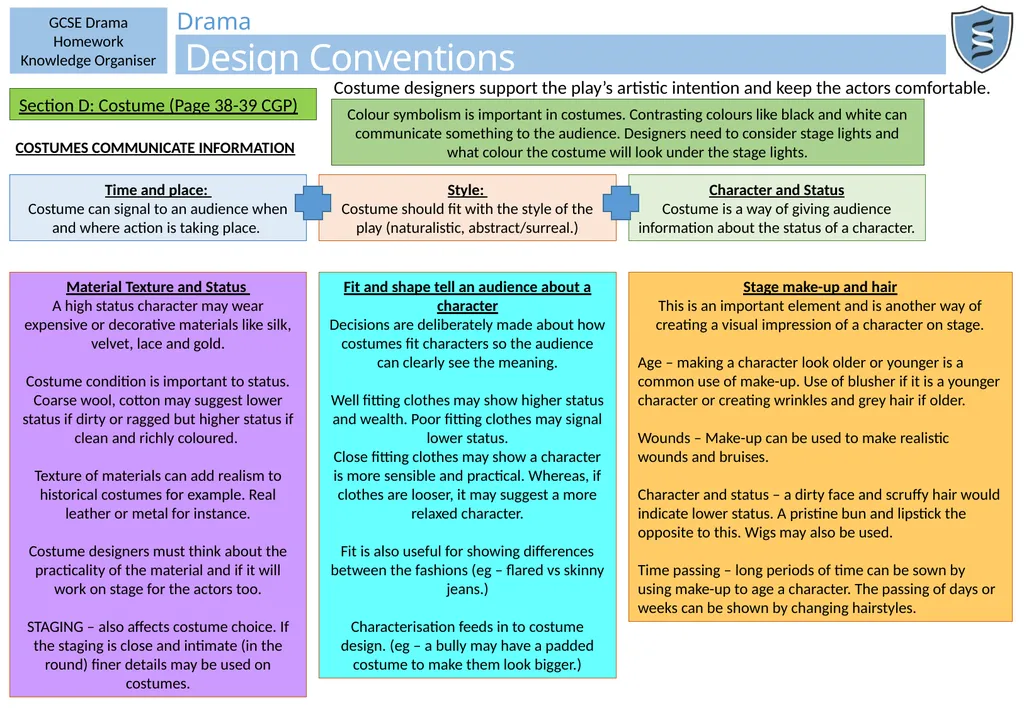
Knowledge Organiser Section D: Costume (Page 38-39 CGP) Costume designers support the play’s artistic intention and keep the actors comfortable. COSTUMES COMMUNICATE INFORMATION Time and place:
Costume can signal to an audience when and where action is taking place. Style:
Costume should fit with the style of the play (naturalistic, abstract/surreal.) Character and Status
Costume is a way of giving audience information about the status of a character. Colour symbolism is important in costumes. Contrasting colours like black and white can communicate something to the audience. Designers need to consider stage lights and what colour the costume will look under the stage lights. Material Texture and Status
A high status character may wear expensive or decorative materials like silk, velvet, lace and gold.
Costume condition is important to status. Coarse wool, cotton may suggest lower status if dirty or ragged but higher status if clean and richly coloured.
Texture of materials can add realism to historical costumes for example. Real leather or metal for instance.
Costume designers must think about the practicality of the material and if it will work on stage for the actors too.
STAGING – also affects costume choice. If the staging is close and intimate (in the round) finer details may be used on costumes. Fit and shape tell an audience about a character
Decisions are deliberately made about how costumes fit characters so the audience can clearly see the meaning.
Well fitting clothes may show higher status and wealth. Poor fitting clothes may signal lower status.
Close fitting clothes may show a character is more sensible and practical. Whereas, if clothes are looser, it may suggest a more relaxed character.
Fit is also useful for showing differences between the fashions (eg – flared vs skinny jeans.)
Characterisation feeds in to costume design. (eg – a bully may have a padded costume to make them look bigger.) Stage make-up and hair
This is an important element and is another way of creating a visual impression of a character on stage.
Age – making a character look older or younger is a common use of make-up. Use of blusher if it is a younger character or creating wrinkles and grey hair if older.
Wounds – Make-up can be used to make realistic wounds and bruises.
Character and status – a dirty face and scruffy hair would indicate lower status. A pristine bun and lipstick the opposite to this. Wigs may also be used.
Time passing – long periods of time can be sown by using make-up to age a character. The passing of days or weeks can be shown by changing hairstyles.<br>
slide5. Drama Design Conventions GCSE Drama Homework
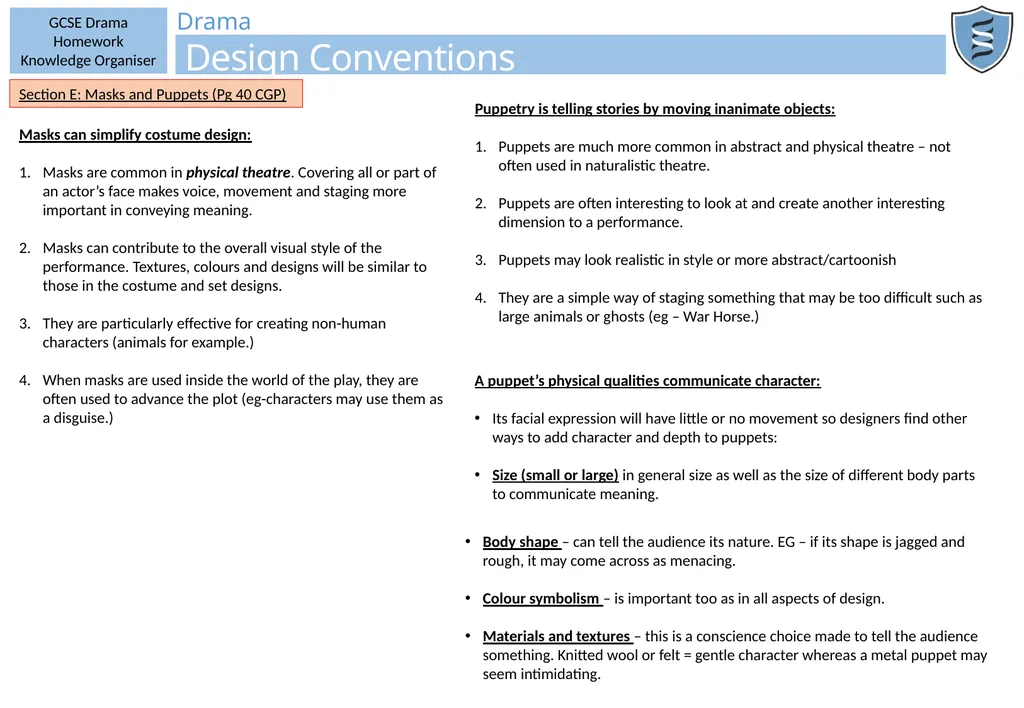
Knowledge Organiser Section E: Masks and Puppets (Pg 40 CGP) Masks can simplify costume design:
Masks are common in physical theatre. Covering all or part of an actor’s face makes voice, movement and staging more important in conveying meaning.
Masks can contribute to the overall visual style of the performance. Textures, colours and designs will be similar to those in the costume and set designs.
They are particularly effective for creating non-human characters (animals for example.)
When masks are used inside the world of the play, they are often used to advance the plot (eg-characters may use them as a disguise.) Puppetry is telling stories by moving inanimate objects:
Puppets are much more common in abstract and physical theatre – not often used in naturalistic theatre.
Puppets are often interesting to look at and create another interesting dimension to a performance.
Puppets may look realistic in style or more abstract/cartoonish
They are a simple way of staging something that may be too difficult such as large animals or ghosts (eg – War Horse.) A puppet’s physical qualities communicate character:
Its facial expression will have little or no movement so designers find other ways to add character and depth to puppets:
Size (small or large) in general size as well as the size of different body parts to communicate meaning. Body shape – can tell the audience its nature. EG – if its shape is jagged and rough, it may come across as menacing.
Colour symbolism – is important too as in all aspects of design.
Materials and textures – this is a conscience choice made to tell the audience something. Knitted wool or felt = gentle character whereas a metal puppet may seem intimidating.<br>
Knowledge Organiser Section A: Set Design (Page 32-33 CGP) Set designers are responsible for the physical environment on stage, from the props to the backdrop.
A set is everything that is visible on the stage (scenery, furniture and props.) Creates meaning Helps audience understand what the play is about Establishes location and time period Symbolism Naturalistic Sets:
Aims to create the illusion of real life on stage. Often very detailed using well-researched period furniture and realistic decoration. Minimalist Sets:
Use few props and minimal scenery. The audience have to use their imagination. Props are important to symbolise themes or show the time period. Abstract Sets:
Doesn’t try to recreate real life. Can be basic or very elaborate (OTT.) Often used to emphasise the play’s symbols or themes. Props – this is anything moveable on stage which isn’t part of the scenery, costumes or cast.
Personal props – those things used by individual actors to add to their character.<br>
slide2. Drama Design Conventions GCSE Drama
Homework
Knowledge Organiser Section B: Lighting (Page 34-35 CGP) Lighting controls what the audience can see and when.
It can focus audience attention to a particular area of the stage or character.
Emphasise important moments, actors or dialogue.
It can communicate time of day and location.
It creates atmosphere and builds tension
Absence of light is also useful. Blackouts indicate a scene change. Light sources must also fit with the style of the play. If a play is naturalistic, the lighting must be appropriate and help the audience suspend their disbelief. If the play is more abstract in style, the lighting designer will use strange, surreal lighting effects to increase the sense of spectacle. INTENSITY – this is a light’s brightness. Harder (or brighter) light can make a scene feel more emotionally intense. It creates more distinct shadows and is more dramatic. Softer (dimmer) light reduces the amount of shadow and makes a less intense stage picture that is less dramatic in mood. COLOUR – colour symbolism is really important in stage lighting design. It can also show time of day and location. Colours can also be used to set the mood on stage (warmer orange lights vs colder blue lights.) DIRECTION – Lighting the stage from different directions can create effects for the audience. It can highlight part of the stage and create shadows. Lighting from the front is common for proscenium arch stages. Down lighting (from above) is also common and can create great shadows on an actor’s face and body. Uplighting (lighting from below) also creates pitted shadows on an actor’s face. Great for lighting tense or unsettling scenes. Stage lights are called lanterns and there are 3 main types of stage lantern. They are held above the stage on a lighting rig. PROFILE SPOTLIGHT – cast sharply defined beams focusing attention on a part of the stage or actor. When used with gobos, they can project shapes and images on to the stage. FRESNEL – cast softer edged beams than profile spotlights. They can mingle and mix with other lighting effects like floodlights. Their beams can be shaped using barndoors. FLOODLIGHTS – light large arears of the stage like backcloths and cycloramas. Good for wide washes of colour. Can also be arranged in blocks to create dawn and dusk like effects. GOBO – thin metal disc with pattern or image cut out and slotted into a profile spotlight. BARNDOORS – hinged metal flaps attached to the front of a lantern. They can be angled in different ways to block light from parts of the stage. Gels – (heat resistant plastic filters) can be used on lanterns to
change colours on stage.
Parcans – are powerful lanterns that can have their beam angle set to light very wide or very narrow areas on stage.
Strobes – create very fast flashes of light at intervals.
Backlight – lighting designers can light from behind performers to make silhouettes of the actors on stage. They can so the same with a screen in front of actors to make shadow theatre.<br>
slide3. Drama Design Conventions GCSE Drama
Homework
Knowledge Organiser Section C: Sound (Page 36-37 CGP) A sound designer’s role will vary depending on the size and scale of the production. All deliberate sound is part of sound design.
Everything that makes up the play’s overall acoustic style including: MUSIC (live or recorded) SOUND EFFECTS (live and pre-recorded) AMPLIFICATIONS of sound, music and dialogue (using microphones where needed.)
Sound communicates meaning to support the artistic vision of the performance. It can also be used to communicate time period and location.
Sound can bring out the emotion of a scene and create mood and atmosphere.
Audience can be told when a scene is beginning or ending using sound. Sound can be played over scene changes to help the flow of the production.
Designers must mix sound and dialogue to make sure there is the right balance for the audience. Some sounds are part of the world of the play…
Diegetic sounds – are those heard by the characters in a performance (eg – doorbell) which may be mentioned in stage directions or necessary for the plot.
Soundscape – layering up sounds to give a strong sense of a place (eg – a beach.) Soundscapes can be made live or pre-recorded.
Some diegetic sounds can be produced live such as footsteps, knock on the door. They can be timed precisely offstage and can be more realistic than being recorded.
Diegetic sounds can be used to communicate dramatic events that take place off stage (eg – trench warfare.) …and other sounds are outside of it.
Non-diegetic sounds – those that the characters on stage do not hear (eg – a low rumble or tense music)
They help build atmosphere and tension.
Incidental music – accompanies a scene but is not part of the world of the play. Emphasises atmosphere or emotion of a scene
Sound can be symbolic – sound linked to a particular character (eg – the witches in Macbeth, a tinkling sound can be used when they are spoken about or enter/exit the stage.)
It is important that non-diegetic sounds fit in with the style of the production. Music creates meaning. When it is played quietly under a scene, this is called underscoring.
Underscoring helps to create time period, setting and atmosphere.
Music can be pre-recorded or live. Live orchestral music adds to the theatrical spectacle of the piece.
Music can heighten emotion and also contradict the tone of the dialogue.
In musical theatre (Blood Brothers) songs are an important part of the performance and often come at key emotional moments. Sound Equipment:
Microphones – on actor’s bodies to amplify their dialogue and singing.
Speakers and amplifiers – amplifiers make sound louder but keeps the quality, speakers project sound out into the theatre.
Mixing desk – this is where the sound designer/technician controls the sound for a performance.
Software – some sound designers use computer and cueing software to arrange sounds and so they can be played at the push of a button.
Sound levels and balancing – this is crucial so that dialogue can be heard alongside any music in a production. Actors also need to hear sound cues.<br>
slide4. Drama Design Conventions GCSE Drama Homework
Knowledge Organiser Section D: Costume (Page 38-39 CGP) Costume designers support the play’s artistic intention and keep the actors comfortable. COSTUMES COMMUNICATE INFORMATION Time and place:
Costume can signal to an audience when and where action is taking place. Style:
Costume should fit with the style of the play (naturalistic, abstract/surreal.) Character and Status
Costume is a way of giving audience information about the status of a character. Colour symbolism is important in costumes. Contrasting colours like black and white can communicate something to the audience. Designers need to consider stage lights and what colour the costume will look under the stage lights. Material Texture and Status
A high status character may wear expensive or decorative materials like silk, velvet, lace and gold.
Costume condition is important to status. Coarse wool, cotton may suggest lower status if dirty or ragged but higher status if clean and richly coloured.
Texture of materials can add realism to historical costumes for example. Real leather or metal for instance.
Costume designers must think about the practicality of the material and if it will work on stage for the actors too.
STAGING – also affects costume choice. If the staging is close and intimate (in the round) finer details may be used on costumes. Fit and shape tell an audience about a character
Decisions are deliberately made about how costumes fit characters so the audience can clearly see the meaning.
Well fitting clothes may show higher status and wealth. Poor fitting clothes may signal lower status.
Close fitting clothes may show a character is more sensible and practical. Whereas, if clothes are looser, it may suggest a more relaxed character.
Fit is also useful for showing differences between the fashions (eg – flared vs skinny jeans.)
Characterisation feeds in to costume design. (eg – a bully may have a padded costume to make them look bigger.) Stage make-up and hair
This is an important element and is another way of creating a visual impression of a character on stage.
Age – making a character look older or younger is a common use of make-up. Use of blusher if it is a younger character or creating wrinkles and grey hair if older.
Wounds – Make-up can be used to make realistic wounds and bruises.
Character and status – a dirty face and scruffy hair would indicate lower status. A pristine bun and lipstick the opposite to this. Wigs may also be used.
Time passing – long periods of time can be sown by using make-up to age a character. The passing of days or weeks can be shown by changing hairstyles.<br>
slide5. Drama Design Conventions GCSE Drama Homework
Knowledge Organiser Section E: Masks and Puppets (Pg 40 CGP) Masks can simplify costume design:
Masks are common in physical theatre. Covering all or part of an actor’s face makes voice, movement and staging more important in conveying meaning.
Masks can contribute to the overall visual style of the performance. Textures, colours and designs will be similar to those in the costume and set designs.
They are particularly effective for creating non-human characters (animals for example.)
When masks are used inside the world of the play, they are often used to advance the plot (eg-characters may use them as a disguise.) Puppetry is telling stories by moving inanimate objects:
Puppets are much more common in abstract and physical theatre – not often used in naturalistic theatre.
Puppets are often interesting to look at and create another interesting dimension to a performance.
Puppets may look realistic in style or more abstract/cartoonish
They are a simple way of staging something that may be too difficult such as large animals or ghosts (eg – War Horse.) A puppet’s physical qualities communicate character:
Its facial expression will have little or no movement so designers find other ways to add character and depth to puppets:
Size (small or large) in general size as well as the size of different body parts to communicate meaning. Body shape – can tell the audience its nature. EG – if its shape is jagged and rough, it may come across as menacing.
Colour symbolism – is important too as in all aspects of design.
Materials and textures – this is a conscience choice made to tell the audience something. Knitted wool or felt = gentle character whereas a metal puppet may seem intimidating.<br>