Computational Chemistry 4 Polarized Basis Sets 3-Polarized Basis Sets Polarized Basis Sets are added to describe polarization of the electron density of the atom in molecules these are called polarization functions ,and because they give
"Computational Chemistry 4 Polarized Basis Sets" is the property of its rightful owner. Permission is granted to
download and print the materials on this website for personal, non-commercial use only, and to display it
on your personal computer provided you do not modify the materials and that you retain all copyright
notices contained in the materials. By downloading content from our website, you accept the terms of this
agreement.
3-Polarized Basis Sets
Polarized Basis Sets are added to describe polarization of the electron density of the atom in molecules these are called polarization functions ,and because they give the wave function more flexibility to change shape and decrease the variation total energy .
Polarization functions are used because they often result in more accurate computed geometries and vibration frequencies.<br>
03
Such as :
6-31G* : A single asterisk mean that asset of (d) primitives has been added to atoms other than hydrogen, polarization functions on heavy atoms.
6-31G**: two asterisk mean that a set of (d ,p) primitives has been added to hydrogen as well ,and polarization functions on heavy atoms and hydrogen.<br>
04
.
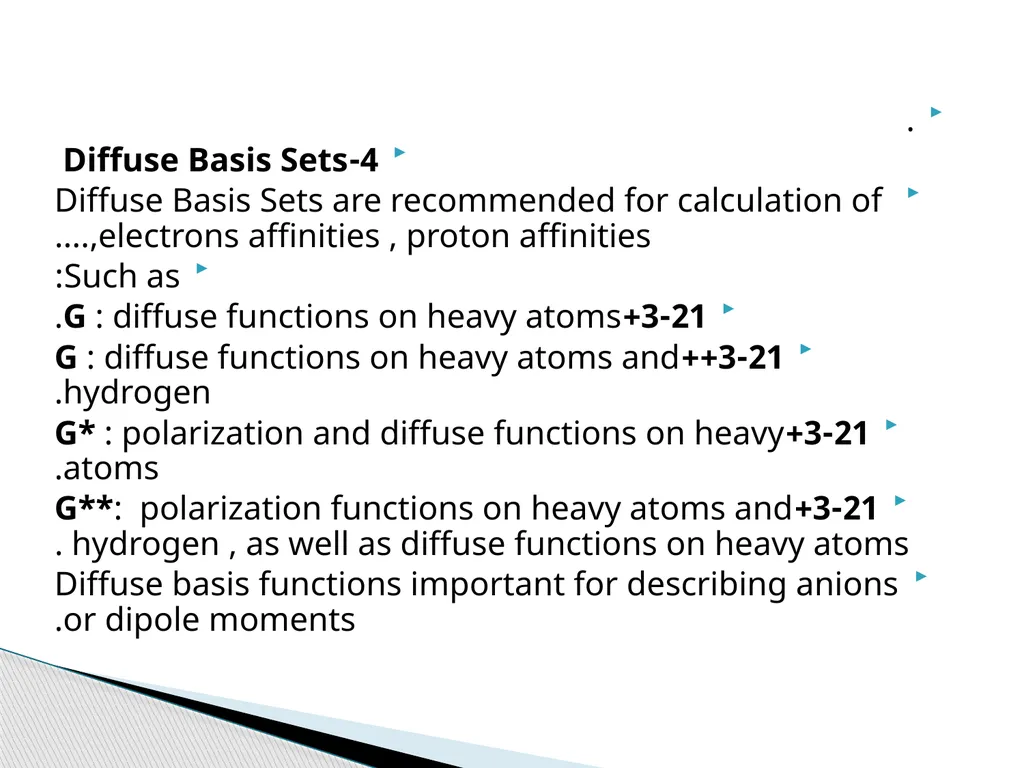
4-Diffuse Basis Sets
Diffuse Basis Sets are recommended for calculation of electrons affinities , proton affinities,….
Such as:
3-21+G : diffuse functions on heavy atoms.
3-21++G : diffuse functions on heavy atoms and hydrogen.
3-21+G* : polarization and diffuse functions on heavy atoms.
3-21+G**: polarization functions on heavy atoms and hydrogen , as well as diffuse functions on heavy atoms .
Diffuse basis functions important for describing anions or dipole moments.<br>
05
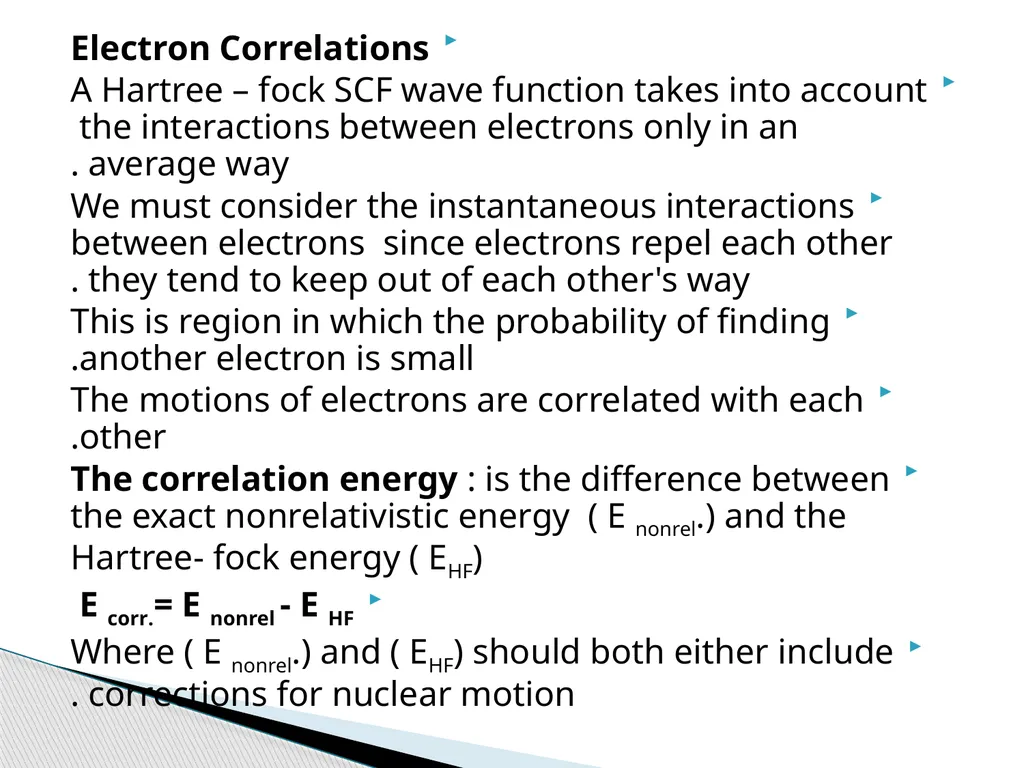
Electron Correlations
A Hartree – fock SCF wave function takes into account the interactions between electrons only in an average way .
We must consider the instantaneous interactions between electrons since electrons repel each other they tend to keep out of each other's way .
This is region in which the probability of finding another electron is small.
The motions of electrons are correlated with each other.
The correlation energy : is the difference between the exact nonrelativistic energy ( E nonrel.) and the Hartree- fock energy ( EHF)
E corr.= E nonrel - E HF
Where ( E nonrel.) and ( EHF) should both either include corrections for nuclear motion .<br>
06
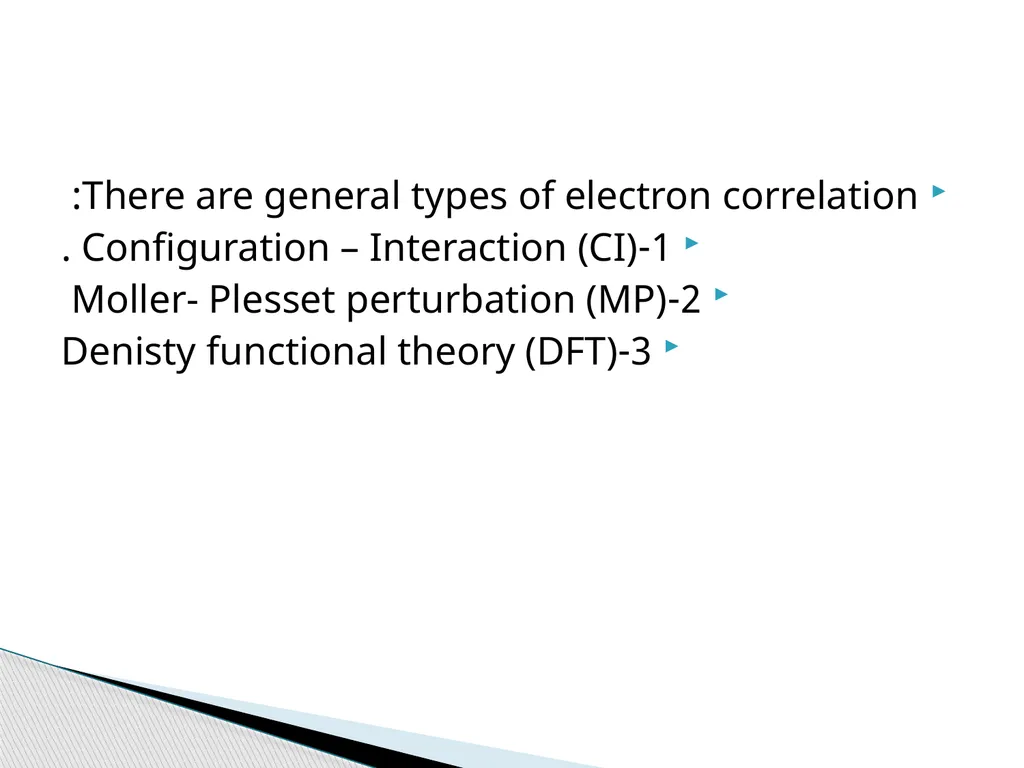
There are general types of electron correlation:
1-Configuration – Interaction (CI) .
2-Moller- Plesset perturbation (MP)
3-Denisty functional theory (DFT)<br>
07
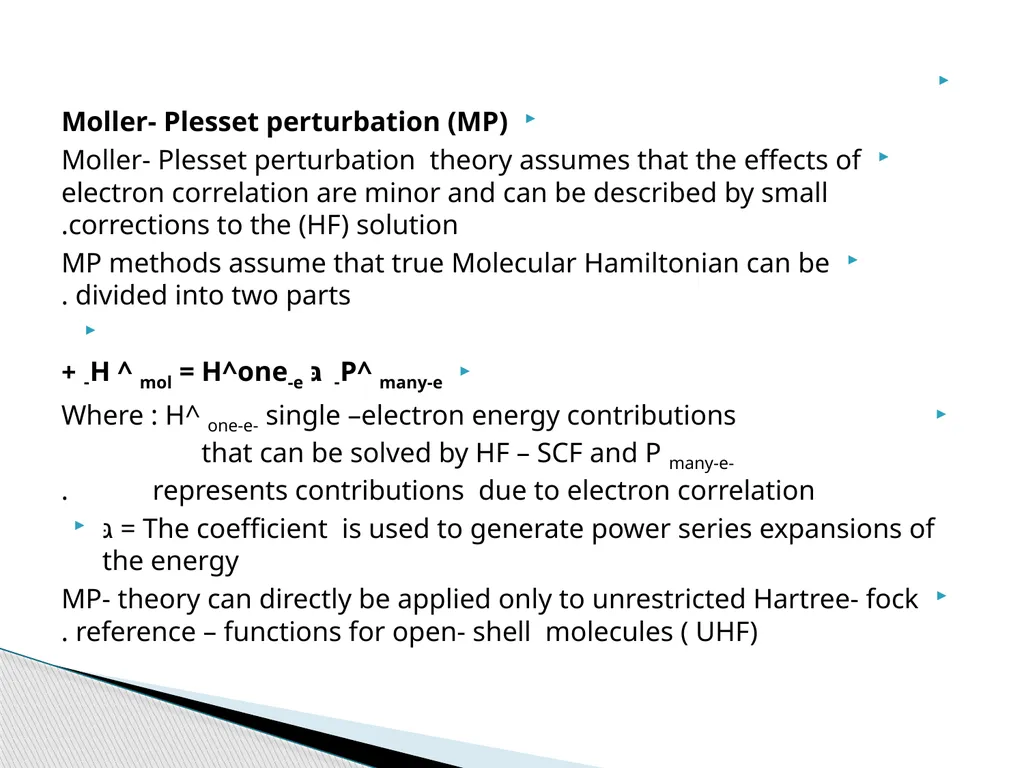
Moller- Plesset perturbation (MP)
Moller- Plesset perturbation theory assumes that the effects of electron correlation are minor and can be described by small corrections to the (HF) solution.
MP methods assume that true Molecular Hamiltonian can be divided into two parts .
P^ many-e- גּ H ^ mol = H^one-e- +
Where : H^ one-e- single –electron energy contributions that can be solved by HF – SCF and P many-e- represents contributions due to electron correlation.
גּ = The coefficient is used to generate power series expansions of the energy
MP- theory can directly be applied only to unrestricted Hartree- fock reference – functions for open- shell molecules ( UHF).<br>
08
Semi- empirical Methods quantum chemistry methods are based on the Hartree- fock method.
Because of the difficulties in applying Ab-initio methods to medium and large molecules many Semi-empirical methods were developed to treat such molecules .
The earliest Semi- empirical treated only the π electrons of conjugated molecules.
The Semi-empirical MO method apply to all Molecules and treat all the valence electrons.
Semi- empirical MO theories fall into two categories:
Those using a Hamiltonian that is the sum of one – electron terms and those using a Hamiltonian that includes two electron repulsion terms as well as one electron terms.
The Huckel Method is a one – electron theory, whereas the Parise- Parr- Pople method is a two –electron Theory. Semi- empirical Methods<br>