Computational Thinking 2.1 - Algorithms Unit 2: Computational Thinking, Algorithms Programming Thursday, 26 April 2018 Computational Thinking Learning Objective: To be able to demonstrate an understanding of the thought processes involved
"Computational Thinking 2.1 - Algorithms Unit 2:" is the property of its rightful owner. Permission is granted to
download and print the materials on this website for personal, non-commercial use only, and to display it
on your personal computer provided you do not modify the materials and that you retain all copyright
notices contained in the materials. By downloading content from our website, you accept the terms of this
agreement.
Thursday, 26 April 2018 Computational Thinking Learning Objective: To be able to demonstrate an understanding of the thought processes involved in understanding problems and formulating solutions that computers can process.
Success Criteria:
I can define the terms Decomposition, Abstraction and Algorithmic Thinking.
I can explain how each of these are used to help understand and process computing problems. Unit 2: Computational Thinking, Algorithms & Programming<br>
03
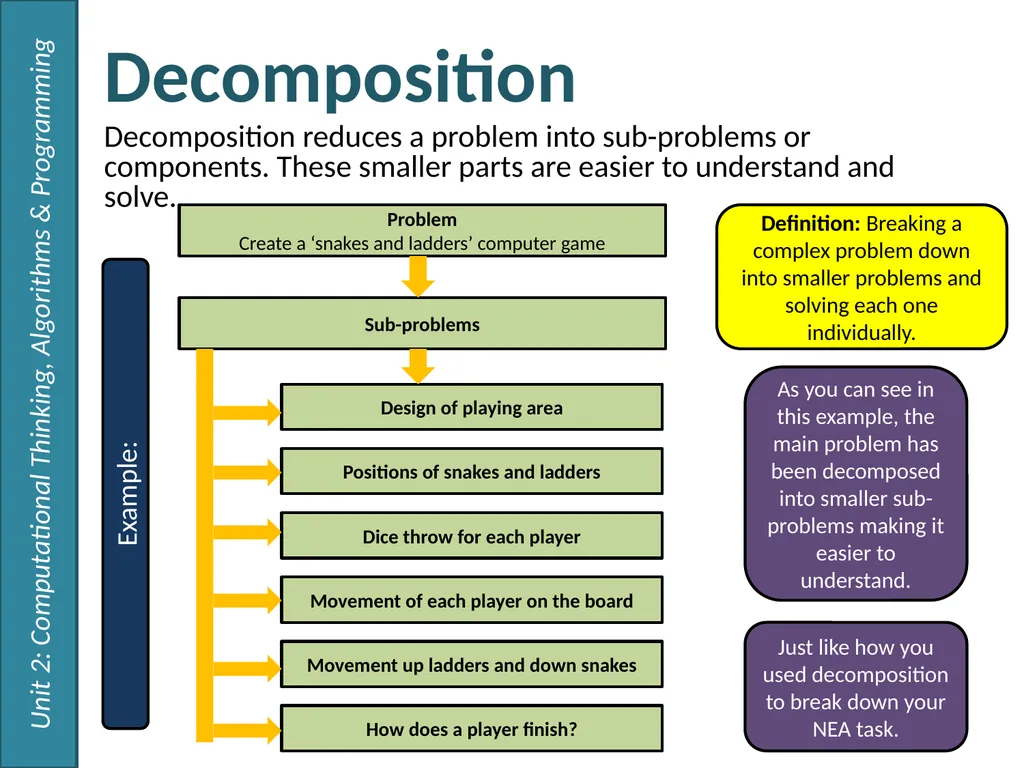
Decomposition Decomposition reduces a problem into sub-problems or components. These smaller parts are easier to understand and solve. Unit 2: Computational Thinking, Algorithms & Programming Problem
Create a ‘snakes and ladders’ computer game Sub-problems Design of playing area Positions of snakes and ladders Dice throw for each player Movement of each player on the board Movement up ladders and down snakes How does a player finish? As you can see in this example, the main problem has been decomposed into smaller sub-problems making it easier to understand. Just like how you used decomposition to break down your NEA task. Definition: Breaking a complex problem down into smaller problems and solving each one individually. Example:<br>
04
Abstraction Abstraction identifies essential elements that must be included in the computer models of real-life situations and discards inessential ones.
For a computer model of ‘Snakes and Ladders’, the sub-problem ‘Dice throw for each player’ includes the essential element ‘Generate a random number between 1 and 6’.
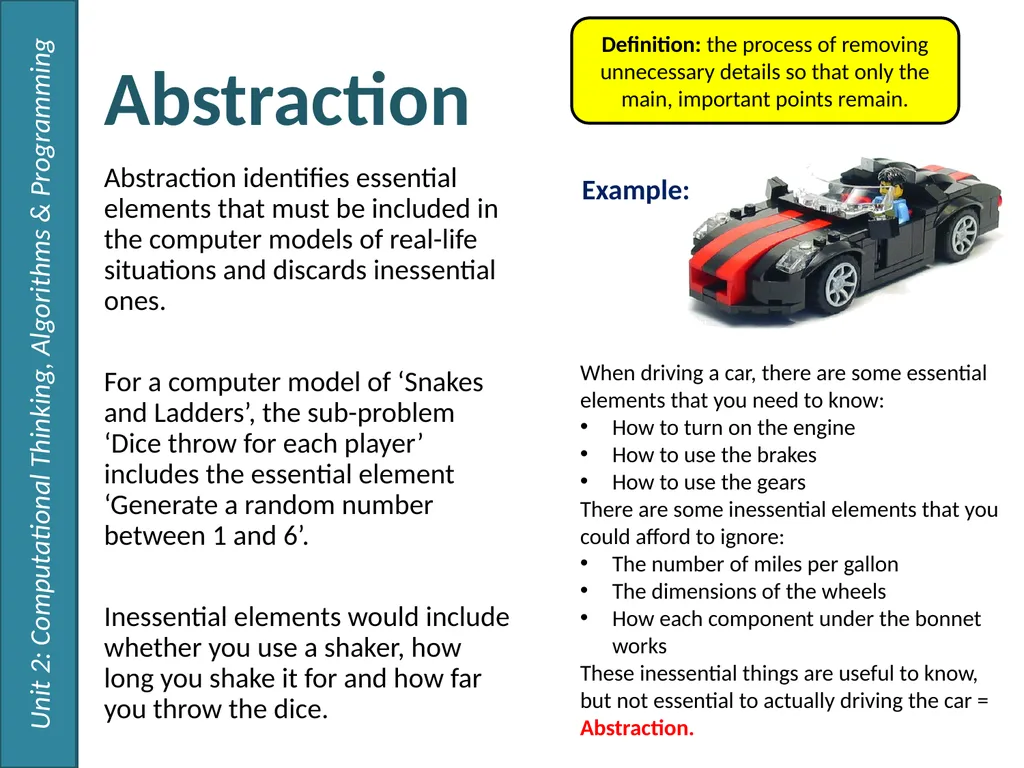
Inessential elements would include whether you use a shaker, how long you shake it for and how far you throw the dice. Unit 2: Computational Thinking, Algorithms & Programming Definition: the process of removing unnecessary details so that only the main, important points remain. Example: When driving a car, there are some essential elements that you need to know:
How to turn on the engine
How to use the brakes
How to use the gears
There are some inessential elements that you could afford to ignore:
The number of miles per gallon
The dimensions of the wheels
How each component under the bonnet works
These inessential things are useful to know, but not essential to actually driving the car = Abstraction.<br>
05
Algorithmic Thinking Algorithmic thinking is a subset of computational thinking that involves defining a clear set of instructions to solve a problem.
Once a successful solution to a problem has been found, it can be used repeatedly for the same problem.
For example, the process of calculating the mean of a set of numbers is always the same irrespective of how many numbers and what they are – add up all the numbers and divide the total by the number in the set. Unit 2: Computational Thinking, Algorithms & Programming Definition: a logical way of getting from the problem to the solution. A set of instructions for solving a problem.<br>