
Computer Security: Principles and Practice Fourth
EM
Published · 49 slides · 0 views
1 / 1

Description
Computer Security: Principles and Practice Fourth Edition By: William Stallings and Lawrie Brown Chapter 6 Malicious Software Malware NIST 800-83 defines malware as: a program that is inserted into a system, usually covertly, with the
Related Topics
Share
Embed code
Download this presentation From Below
"Computer Security: Principles and Practice Fourth" is the property of its rightful owner. Permission is granted to download and print the materials on this website for personal, non-commercial use only, and to display it on your personal computer provided you do not modify the materials and that you retain all copyright notices contained in the materials. By downloading content from our website, you accept the terms of this agreement.
Presentation Transcript
01
Computer Security:
Principles and Practice
Fourth Edition
By: William Stallings and Lawrie Brown<br>
Principles and Practice
Fourth Edition
By: William Stallings and Lawrie Brown<br>
02
Chapter 6 Malicious Software<br>
03
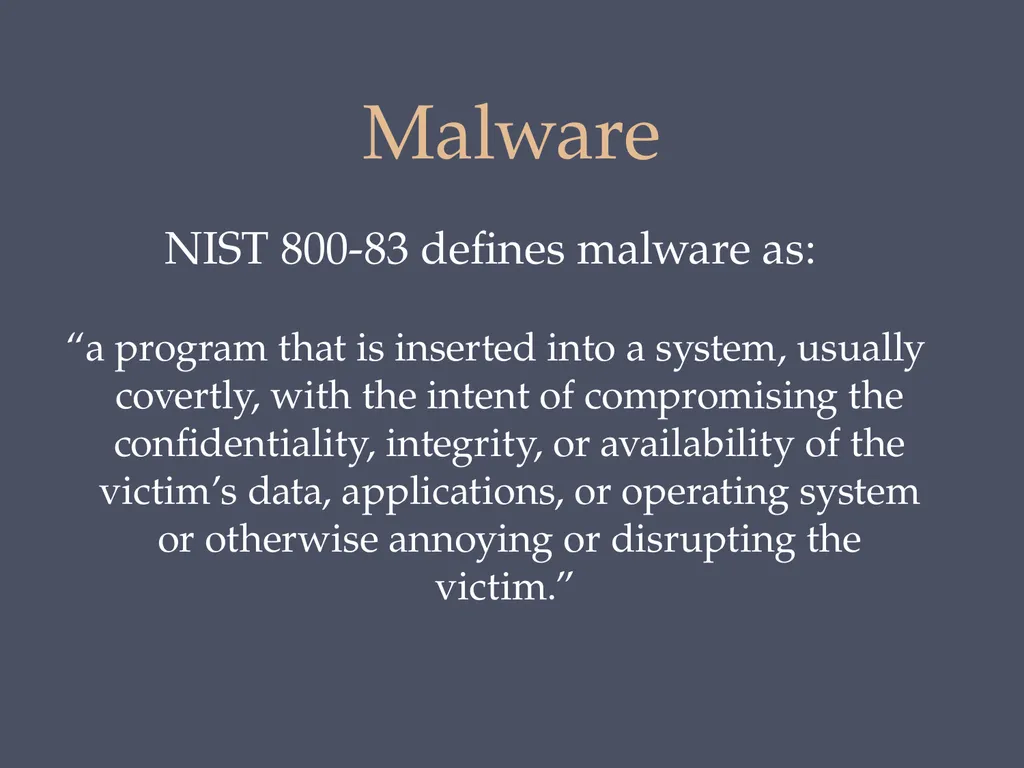
Malware NIST 800-83 defines malware as:
“a program that is inserted into a system, usually covertly, with the intent of compromising the confidentiality, integrity, or availability of the victim’s data, applications, or operating system or otherwise annoying or disrupting the victim.”<br>
“a program that is inserted into a system, usually covertly, with the intent of compromising the confidentiality, integrity, or availability of the victim’s data, applications, or operating system or otherwise annoying or disrupting the victim.”<br>
04
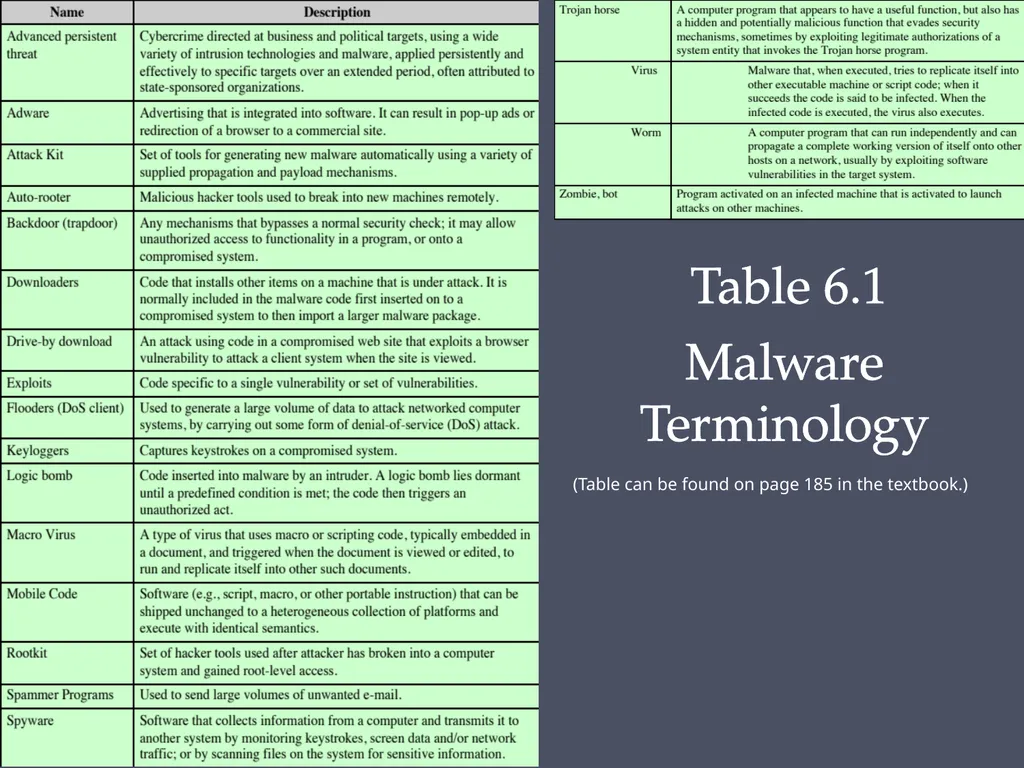
Malware Terminology Table 6.1 (Table can be found on page 185 in the textbook.)<br>
05
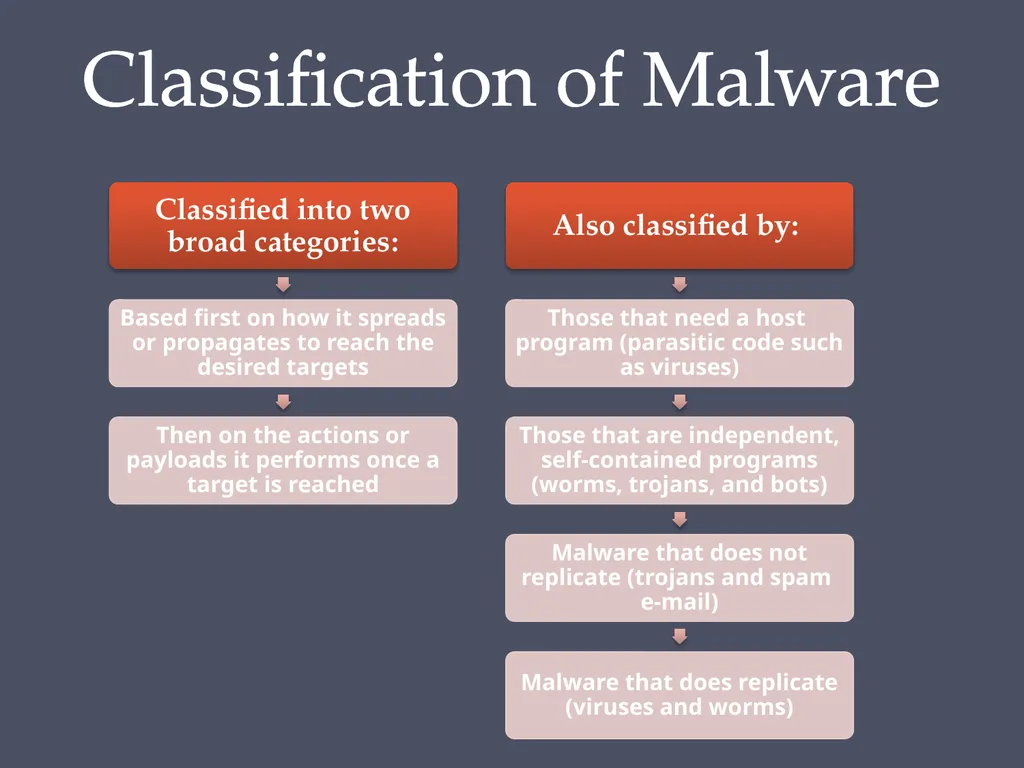
Classification of Malware<br>
06
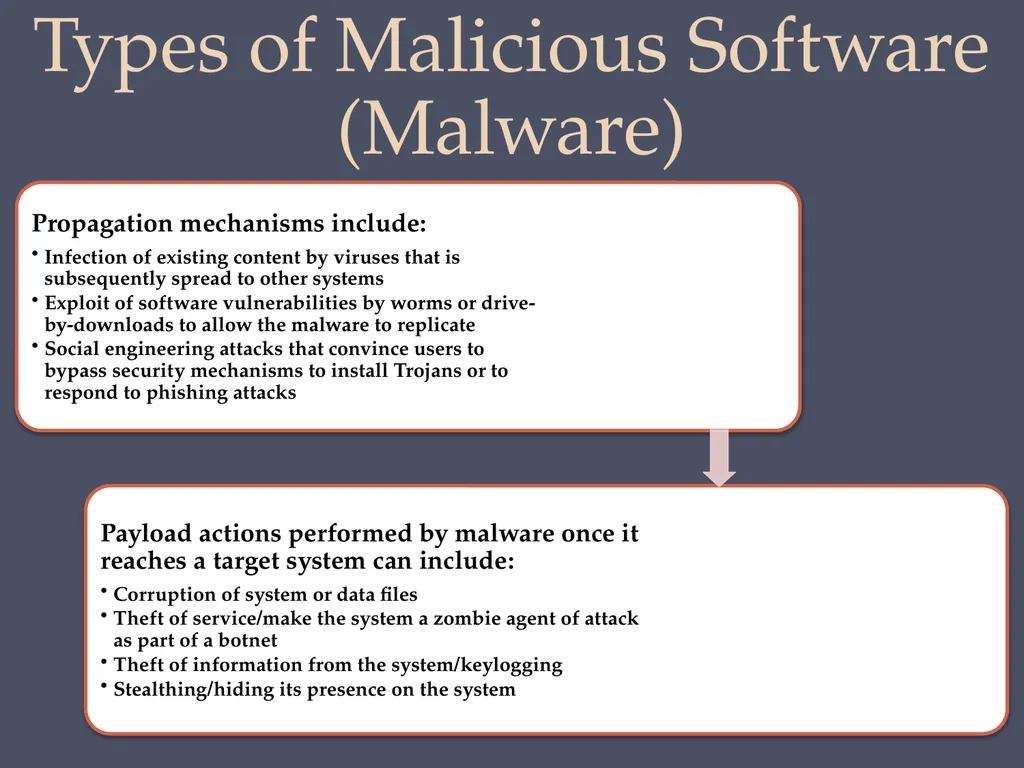
Types of Malicious Software (Malware)<br>
07
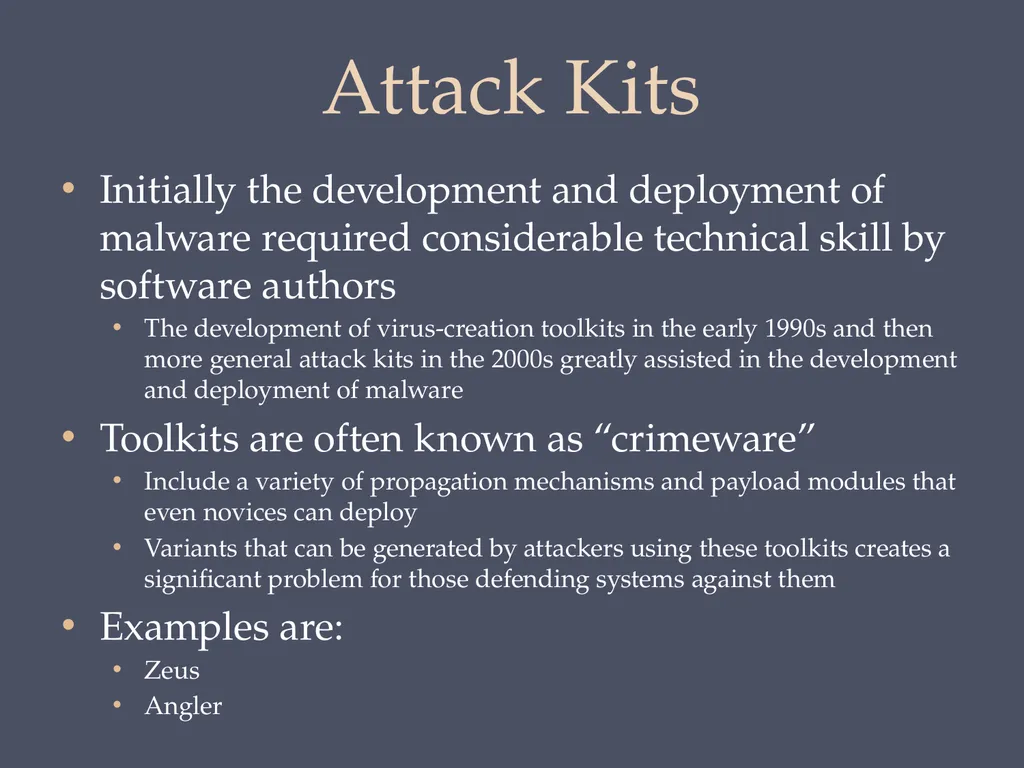
Attack Kits Initially the development and deployment of malware required considerable technical skill by software authors
The development of virus-creation toolkits in the early 1990s and then more general attack kits in the 2000s greatly assisted in the development and deployment of malware
Toolkits are often known as “crimeware”
Include a variety of propagation mechanisms and payload modules that even novices can deploy
Variants that can be generated by attackers using these toolkits creates a significant problem for those defending systems against them
Examples are:
Zeus
Angler<br>
The development of virus-creation toolkits in the early 1990s and then more general attack kits in the 2000s greatly assisted in the development and deployment of malware
Toolkits are often known as “crimeware”
Include a variety of propagation mechanisms and payload modules that even novices can deploy
Variants that can be generated by attackers using these toolkits creates a significant problem for those defending systems against them
Examples are:
Zeus
Angler<br>
08
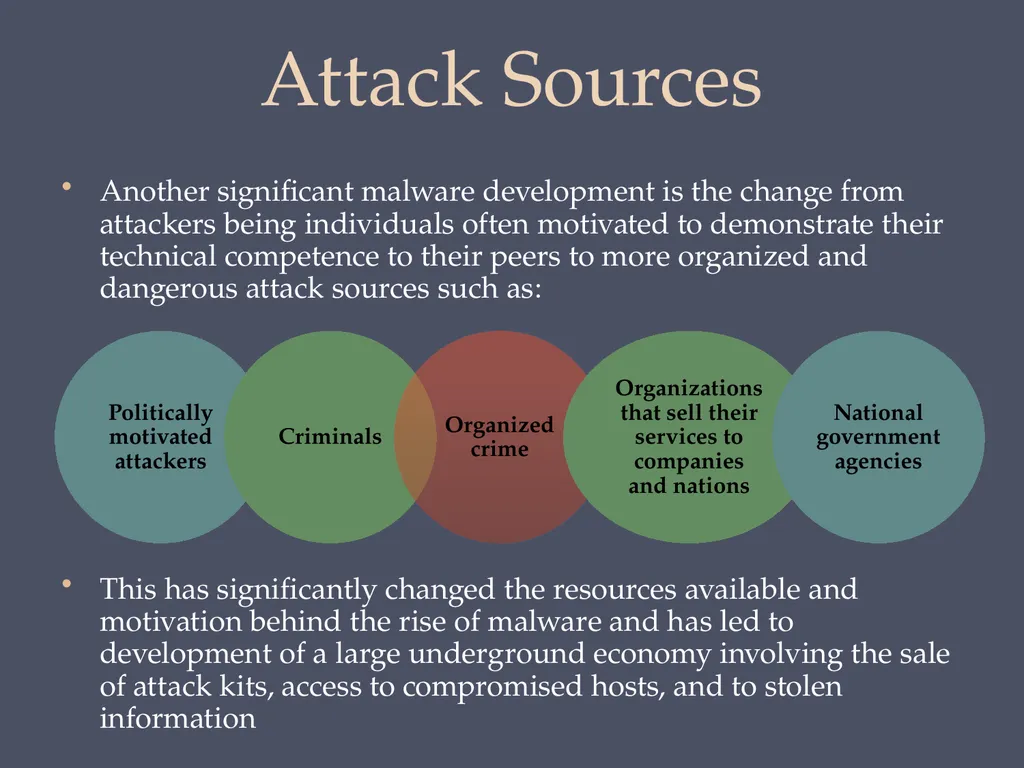
Attack Sources Another significant malware development is the change from attackers being individuals often motivated to demonstrate their technical competence to their peers to more organized and dangerous attack sources such as:
This has significantly changed the resources available and motivation behind the rise of malware and has led to development of a large underground economy involving the sale of attack kits, access to compromised hosts, and to stolen information<br>
This has significantly changed the resources available and motivation behind the rise of malware and has led to development of a large underground economy involving the sale of attack kits, access to compromised hosts, and to stolen information<br>
09
Advanced Persistent Threats (APTs) Well-resourced, persistent application of a wide variety of intrusion technologies and malware to selected targets (usually business or political)
Typically attributed to state-sponsored organizations and criminal enterprises
Differ from other types of attack by their careful target selection and stealthy intrusion efforts over extended periods
High profile attacks include Aurora, RSA, APT1, and Stuxnet<br>
Typically attributed to state-sponsored organizations and criminal enterprises
Differ from other types of attack by their careful target selection and stealthy intrusion efforts over extended periods
High profile attacks include Aurora, RSA, APT1, and Stuxnet<br>
10
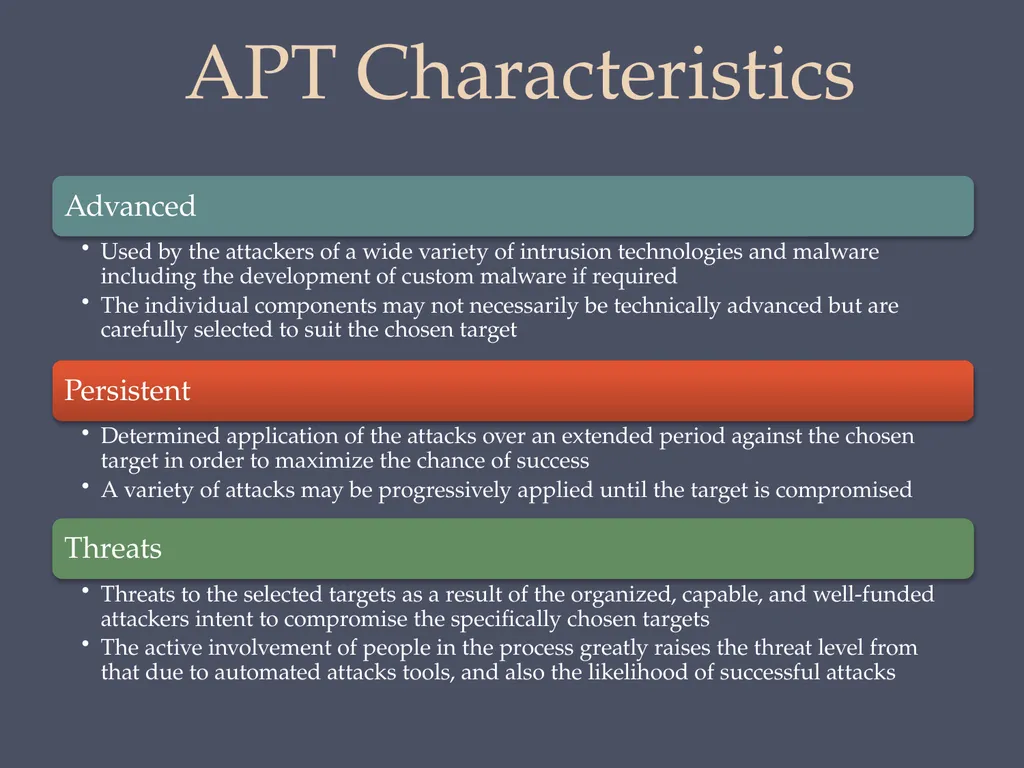
APT Characteristics<br>
11
APT Attacks Aim:
Varies from theft of intellectual property or security and infrastructure related data to the physical disruption of infrastructure
Techniques used:
Social engineering
Spear-phishing email
Drive-by-downloads from selected compromised websites likely to be visited by personnel in the target organization
Intent:
To infect the target with sophisticated malware with multiple propagation mechanisms and payloads
Once they have gained initial access to systems in the target organization a further range of attack tools are used to maintain and extend their access<br>
Varies from theft of intellectual property or security and infrastructure related data to the physical disruption of infrastructure
Techniques used:
Social engineering
Spear-phishing email
Drive-by-downloads from selected compromised websites likely to be visited by personnel in the target organization
Intent:
To infect the target with sophisticated malware with multiple propagation mechanisms and payloads
Once they have gained initial access to systems in the target organization a further range of attack tools are used to maintain and extend their access<br>
12
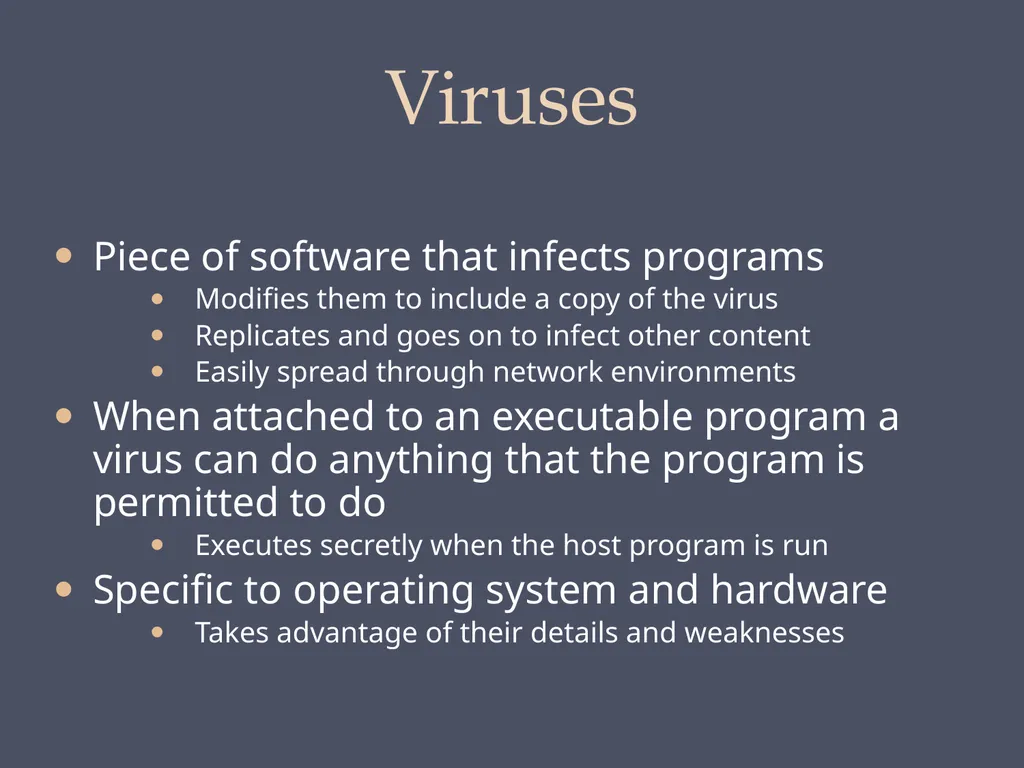
Viruses Piece of software that infects programs
Modifies them to include a copy of the virus
Replicates and goes on to infect other content
Easily spread through network environments
When attached to an executable program a virus can do anything that the program is permitted to do
Executes secretly when the host program is run
Specific to operating system and hardware
Takes advantage of their details and weaknesses<br>
Modifies them to include a copy of the virus
Replicates and goes on to infect other content
Easily spread through network environments
When attached to an executable program a virus can do anything that the program is permitted to do
Executes secretly when the host program is run
Specific to operating system and hardware
Takes advantage of their details and weaknesses<br>
13
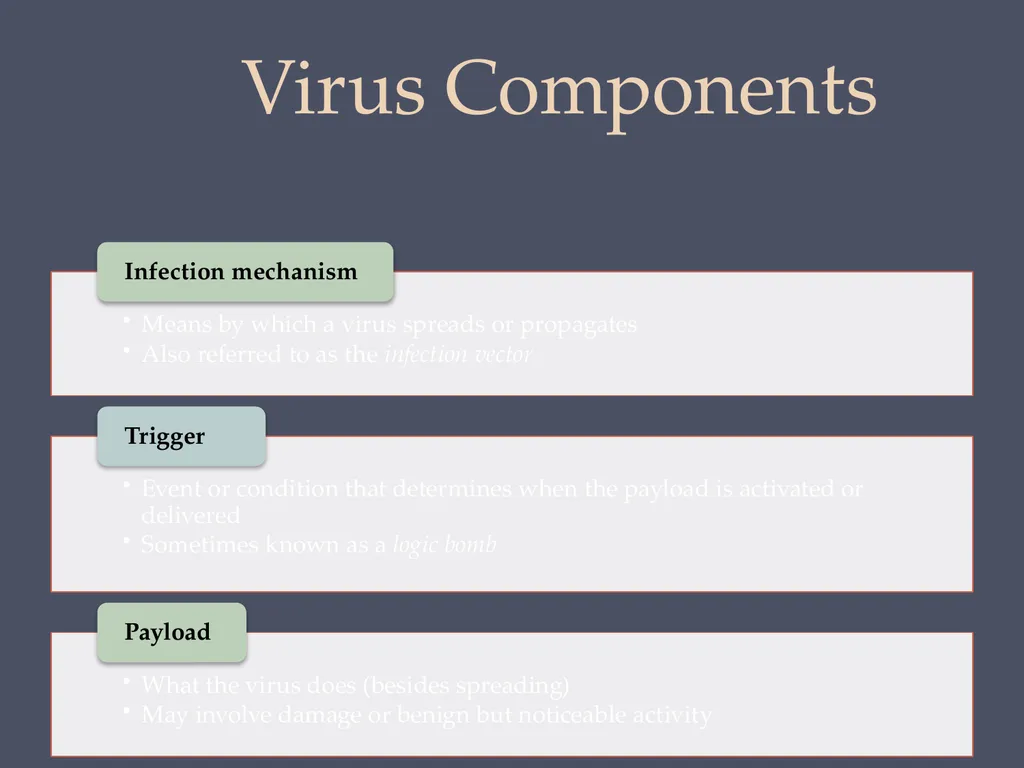
Virus Components<br>
14
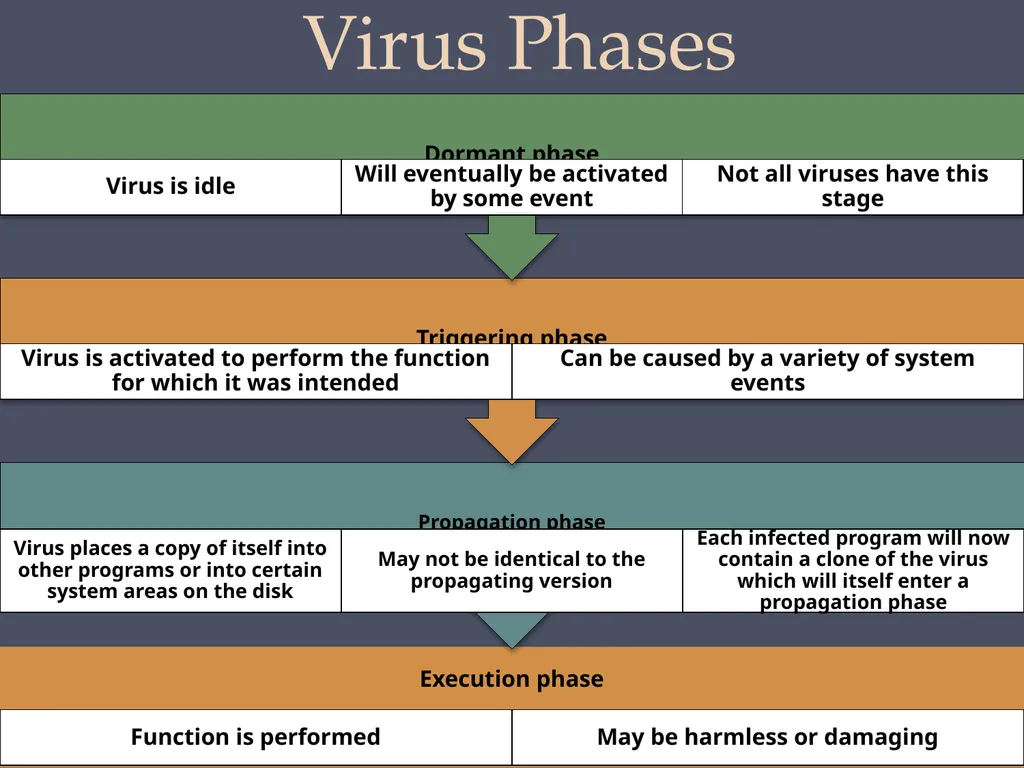
Virus Phases<br>
15
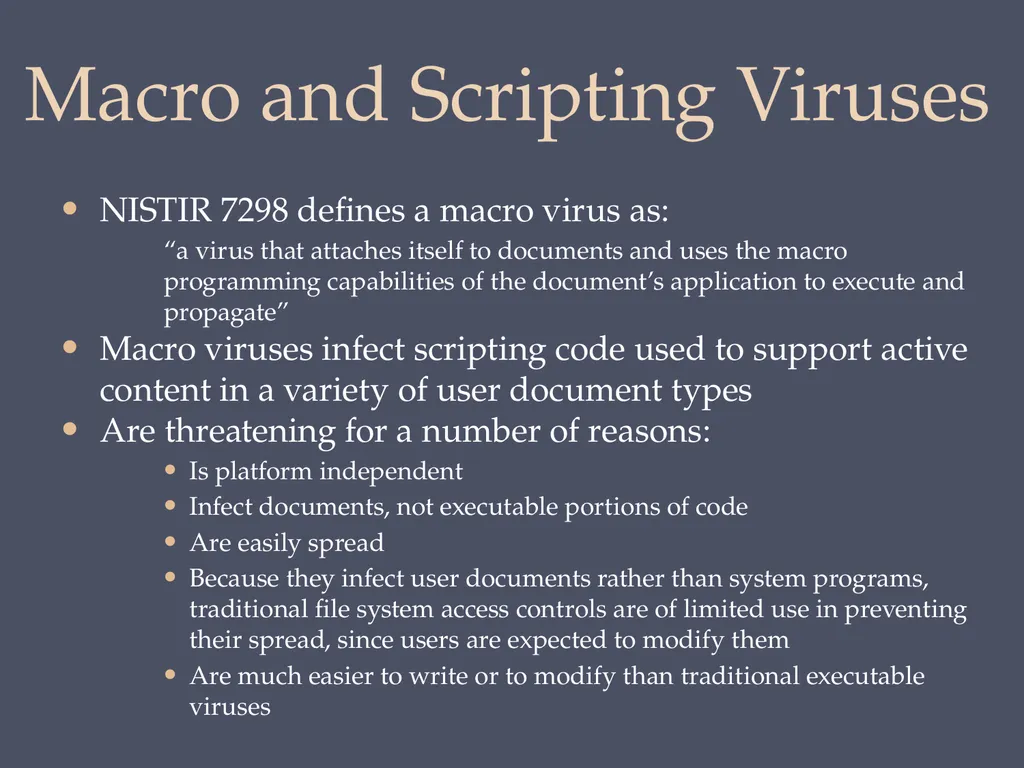
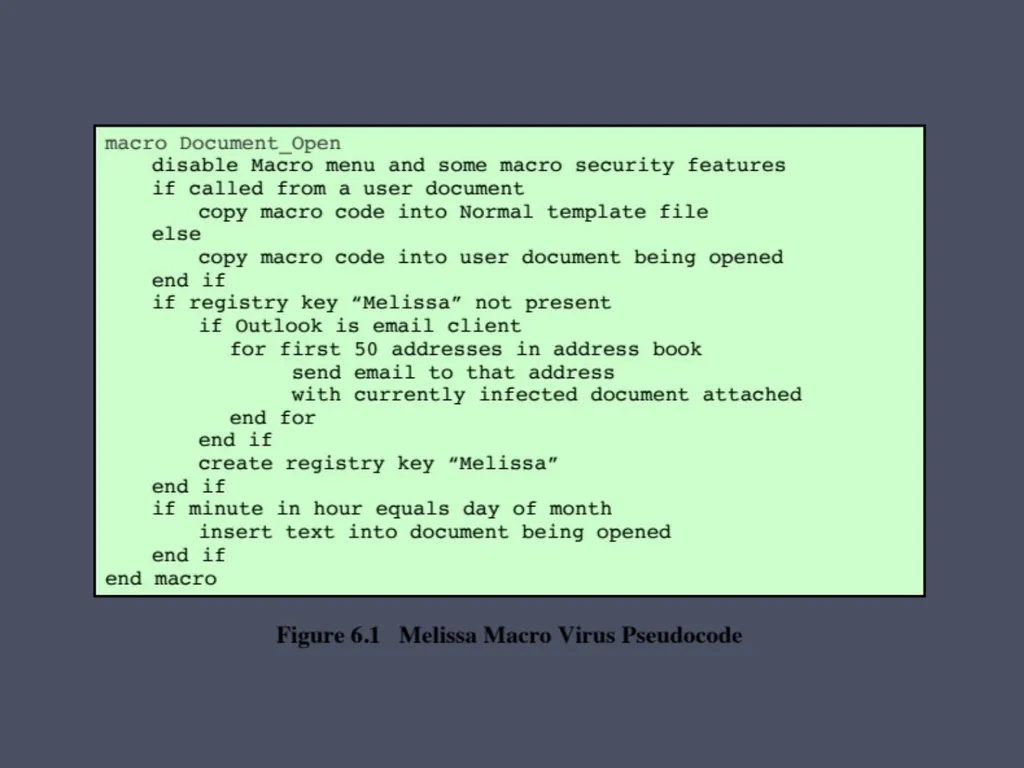
Macro and Scripting Viruses NISTIR 7298 defines a macro virus as:
“a virus that attaches itself to documents and uses the macro programming capabilities of the document’s application to execute and propagate”
Macro viruses infect scripting code used to support active content in a variety of user document types
Are threatening for a number of reasons:
Is platform independent
Infect documents, not executable portions of code
Are easily spread
Because they infect user documents rather than system programs, traditional file system access controls are of limited use in preventing their spread, since users are expected to modify them
Are much easier to write or to modify than traditional executable viruses<br>
“a virus that attaches itself to documents and uses the macro programming capabilities of the document’s application to execute and propagate”
Macro viruses infect scripting code used to support active content in a variety of user document types
Are threatening for a number of reasons:
Is platform independent
Infect documents, not executable portions of code
Are easily spread
Because they infect user documents rather than system programs, traditional file system access controls are of limited use in preventing their spread, since users are expected to modify them
Are much easier to write or to modify than traditional executable viruses<br>
16
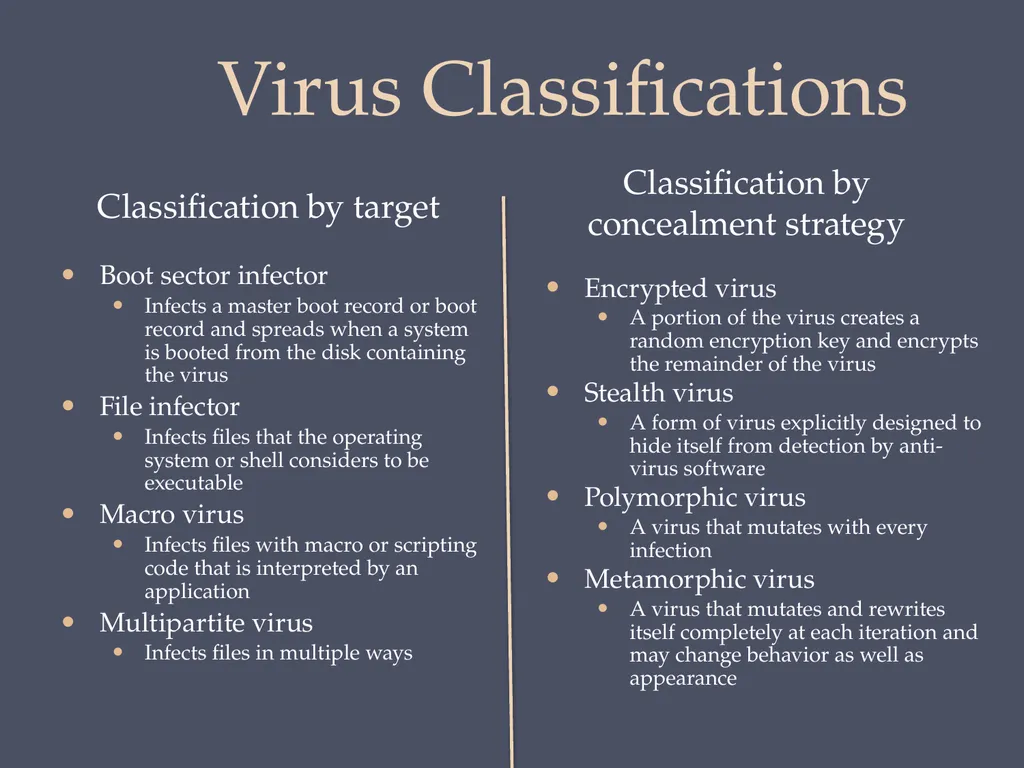
Virus Classifications Classification by target Classification by concealment strategy Boot sector infector
Infects a master boot record or boot record and spreads when a system is booted from the disk containing the virus
File infector
Infects files that the operating system or shell considers to be executable
Macro virus
Infects files with macro or scripting code that is interpreted by an application
Multipartite virus
Infects files in multiple ways Encrypted virus
A portion of the virus creates a random encryption key and encrypts the remainder of the virus
Stealth virus
A form of virus explicitly designed to hide itself from detection by anti-virus software
Polymorphic virus
A virus that mutates with every infection
Metamorphic virus
A virus that mutates and rewrites itself completely at each iteration and may change behavior as well as appearance<br>
Infects a master boot record or boot record and spreads when a system is booted from the disk containing the virus
File infector
Infects files that the operating system or shell considers to be executable
Macro virus
Infects files with macro or scripting code that is interpreted by an application
Multipartite virus
Infects files in multiple ways Encrypted virus
A portion of the virus creates a random encryption key and encrypts the remainder of the virus
Stealth virus
A form of virus explicitly designed to hide itself from detection by anti-virus software
Polymorphic virus
A virus that mutates with every infection
Metamorphic virus
A virus that mutates and rewrites itself completely at each iteration and may change behavior as well as appearance<br>
17
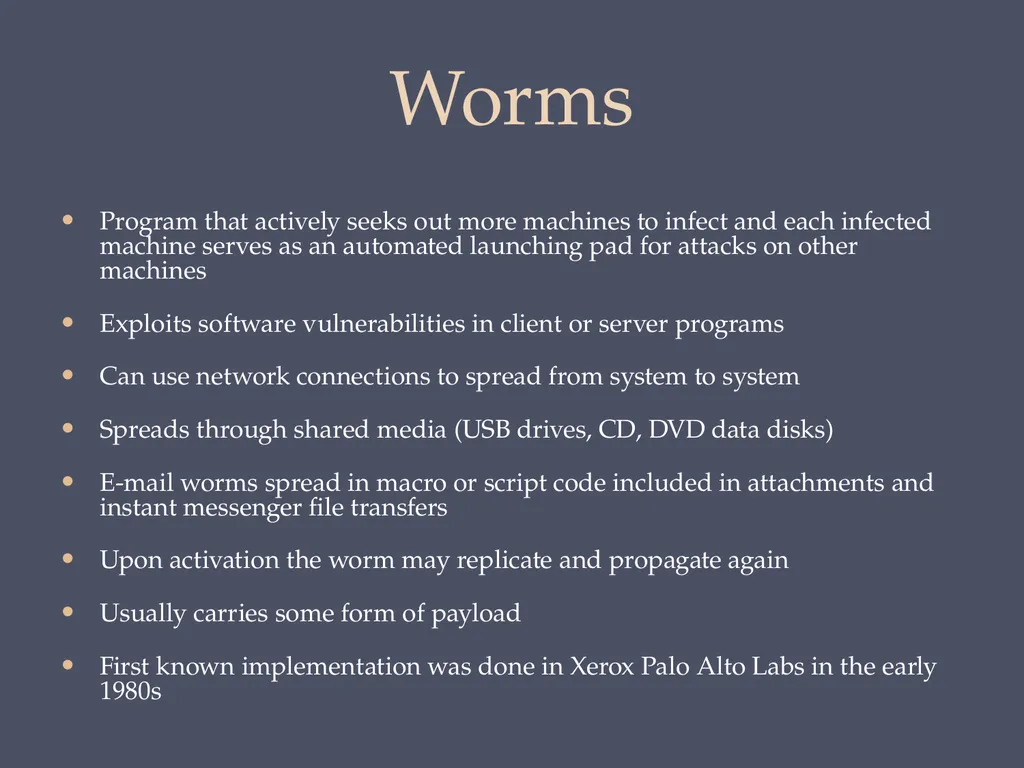
Worms Program that actively seeks out more machines to infect and each infected machine serves as an automated launching pad for attacks on other machines
Exploits software vulnerabilities in client or server programs
Can use network connections to spread from system to system
Spreads through shared media (USB drives, CD, DVD data disks)
E-mail worms spread in macro or script code included in attachments and instant messenger file transfers
Upon activation the worm may replicate and propagate again
Usually carries some form of payload
First known implementation was done in Xerox Palo Alto Labs in the early 1980s<br>
Exploits software vulnerabilities in client or server programs
Can use network connections to spread from system to system
Spreads through shared media (USB drives, CD, DVD data disks)
E-mail worms spread in macro or script code included in attachments and instant messenger file transfers
Upon activation the worm may replicate and propagate again
Usually carries some form of payload
First known implementation was done in Xerox Palo Alto Labs in the early 1980s<br>
18
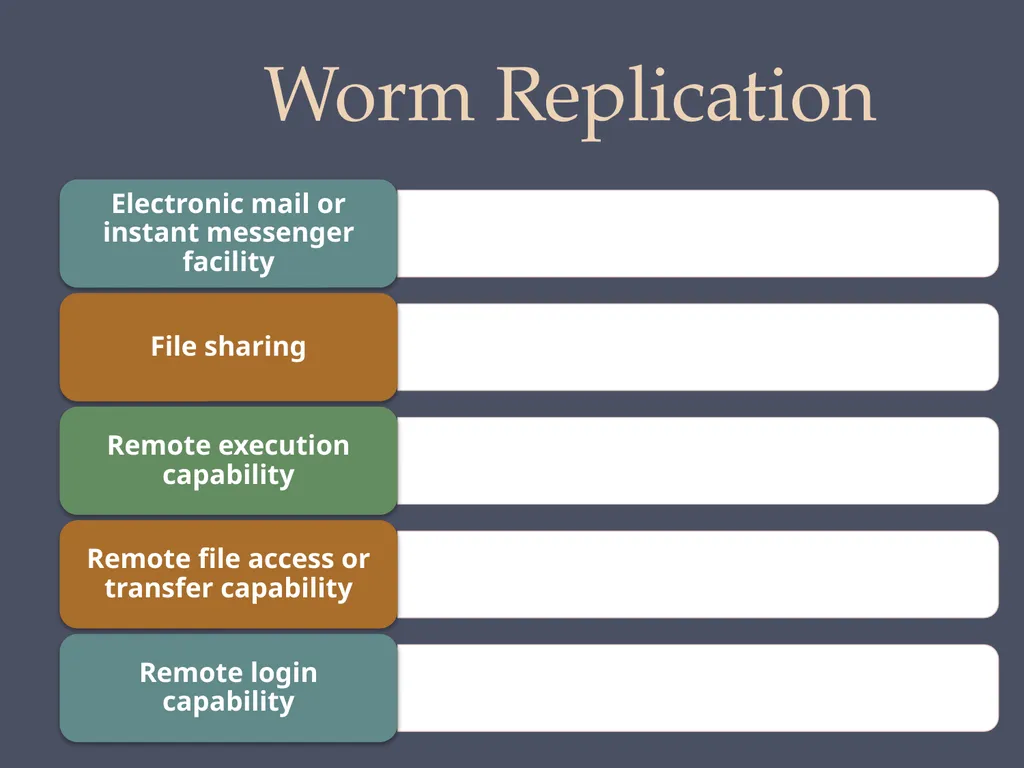
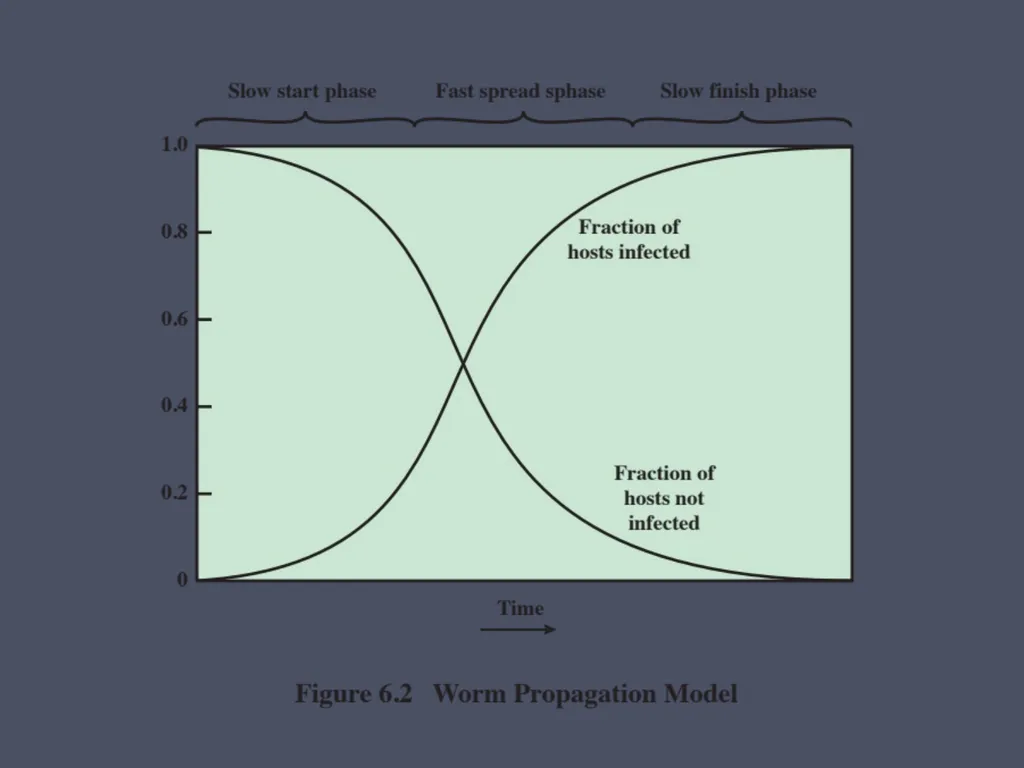
Worm Replication<br>
19
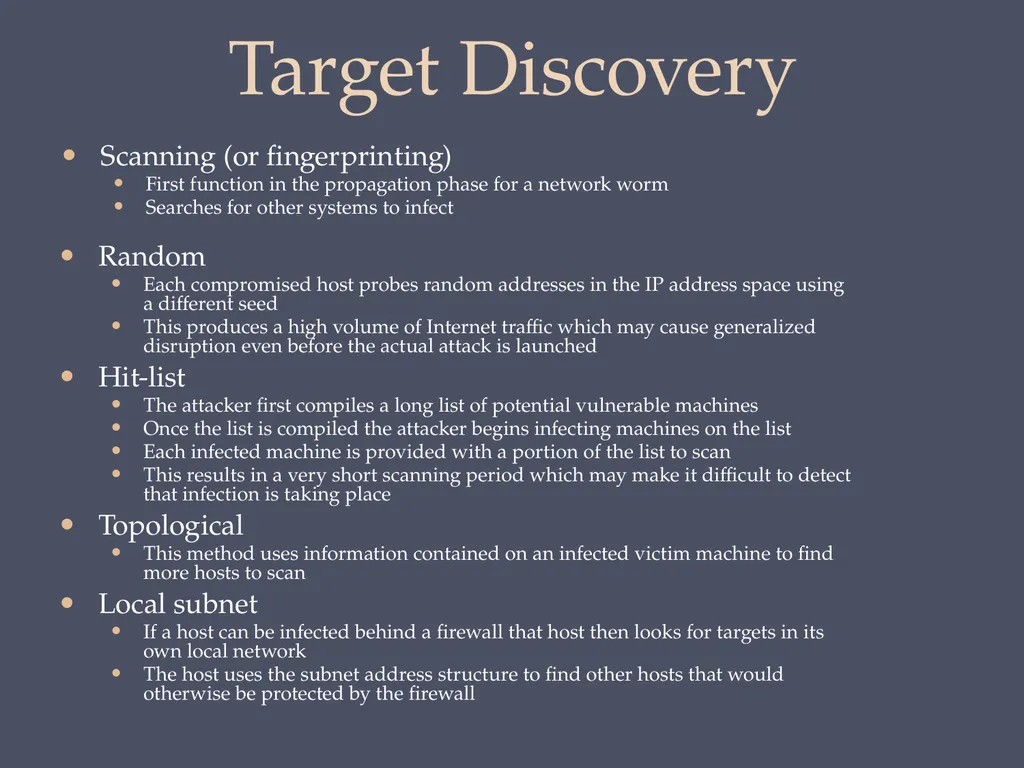
Target Discovery Scanning (or fingerprinting)
First function in the propagation phase for a network worm
Searches for other systems to infect Random
Each compromised host probes random addresses in the IP address space using a different seed
This produces a high volume of Internet traffic which may cause generalized disruption even before the actual attack is launched
Hit-list
The attacker first compiles a long list of potential vulnerable machines
Once the list is compiled the attacker begins infecting machines on the list
Each infected machine is provided with a portion of the list to scan
This results in a very short scanning period which may make it difficult to detect that infection is taking place
Topological
This method uses information contained on an infected victim machine to find more hosts to scan
Local subnet
If a host can be infected behind a firewall that host then looks for targets in its own local network
The host uses the subnet address structure to find other hosts that would otherwise be protected by the firewall<br>
First function in the propagation phase for a network worm
Searches for other systems to infect Random
Each compromised host probes random addresses in the IP address space using a different seed
This produces a high volume of Internet traffic which may cause generalized disruption even before the actual attack is launched
Hit-list
The attacker first compiles a long list of potential vulnerable machines
Once the list is compiled the attacker begins infecting machines on the list
Each infected machine is provided with a portion of the list to scan
This results in a very short scanning period which may make it difficult to detect that infection is taking place
Topological
This method uses information contained on an infected victim machine to find more hosts to scan
Local subnet
If a host can be infected behind a firewall that host then looks for targets in its own local network
The host uses the subnet address structure to find other hosts that would otherwise be protected by the firewall<br>
20
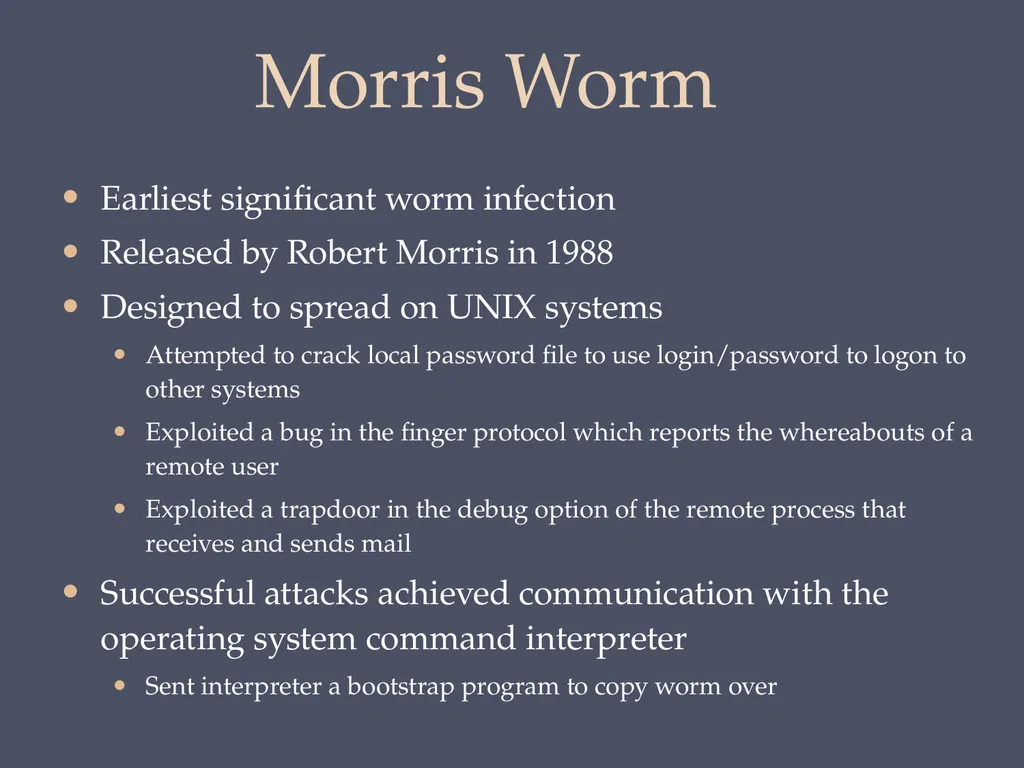
Morris Worm Earliest significant worm infection
Released by Robert Morris in 1988
Designed to spread on UNIX systems
Attempted to crack local password file to use login/password to logon to other systems
Exploited a bug in the finger protocol which reports the whereabouts of a remote user
Exploited a trapdoor in the debug option of the remote process that receives and sends mail
Successful attacks achieved communication with the operating system command interpreter
Sent interpreter a bootstrap program to copy worm over<br>
Released by Robert Morris in 1988
Designed to spread on UNIX systems
Attempted to crack local password file to use login/password to logon to other systems
Exploited a bug in the finger protocol which reports the whereabouts of a remote user
Exploited a trapdoor in the debug option of the remote process that receives and sends mail
Successful attacks achieved communication with the operating system command interpreter
Sent interpreter a bootstrap program to copy worm over<br>
21
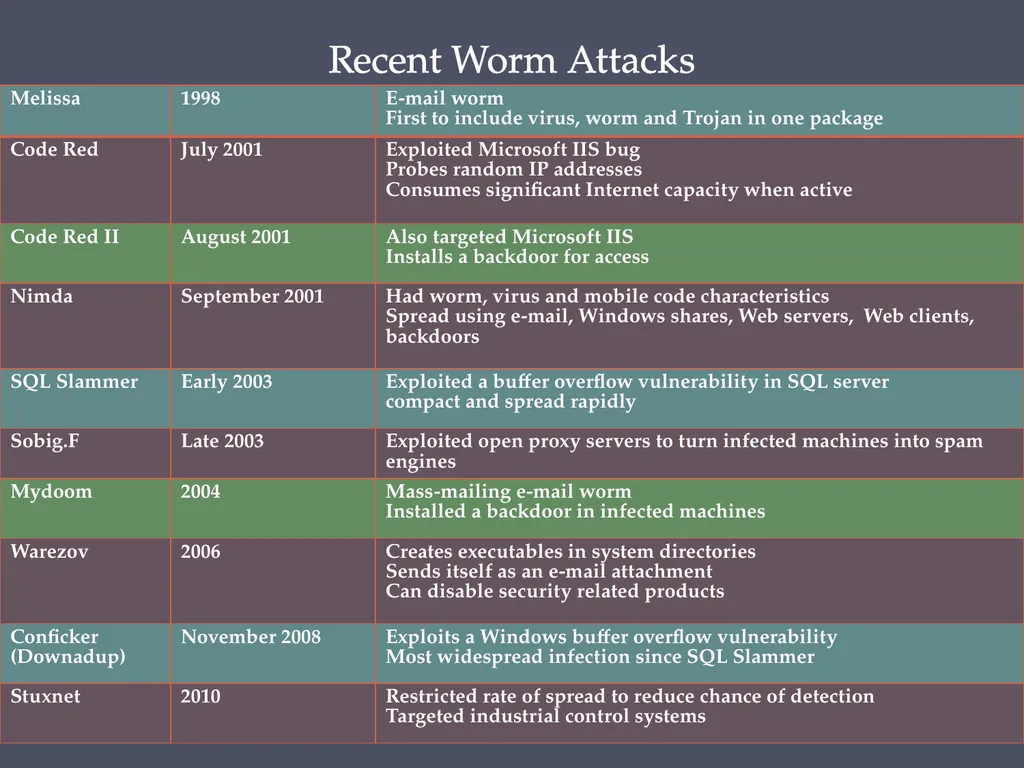
Recent Worm Attacks<br>
22
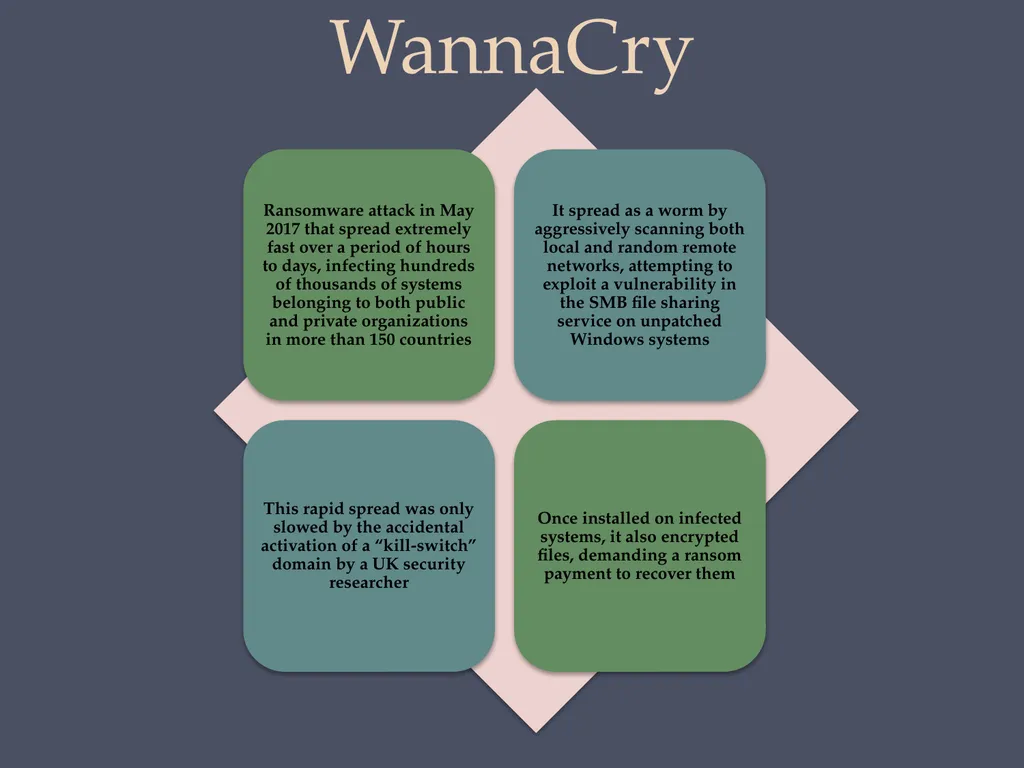
WannaCry<br>
23
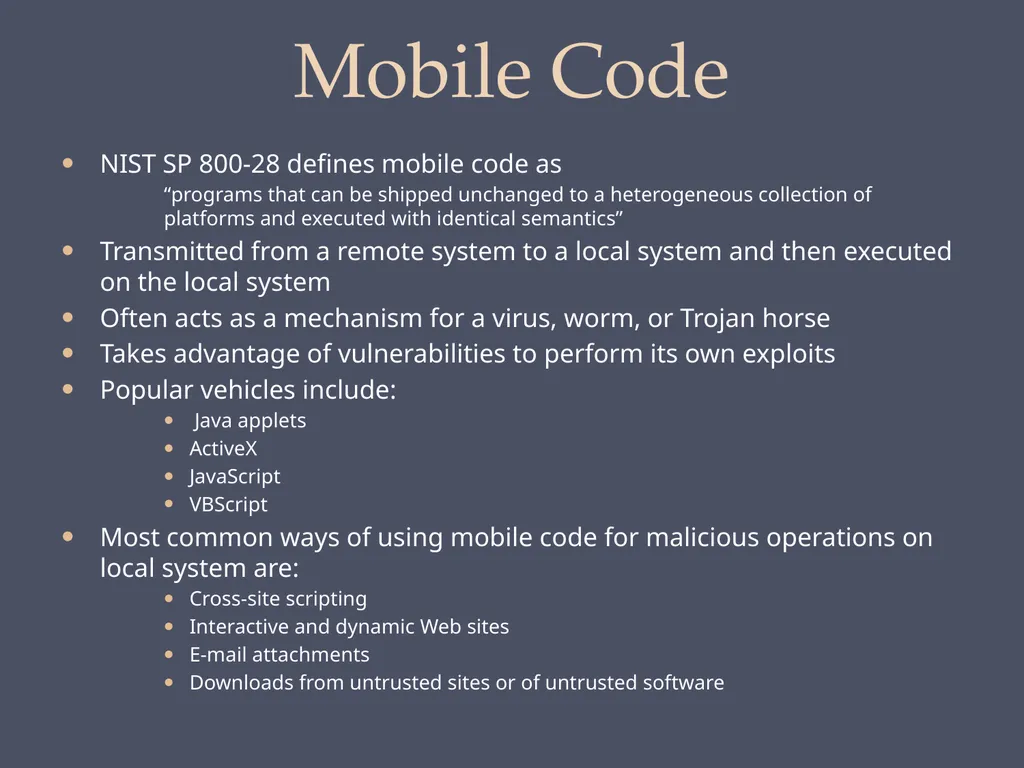
Mobile Code NIST SP 800-28 defines mobile code as
“programs that can be shipped unchanged to a heterogeneous collection of platforms and executed with identical semantics”
Transmitted from a remote system to a local system and then executed on the local system
Often acts as a mechanism for a virus, worm, or Trojan horse
Takes advantage of vulnerabilities to perform its own exploits
Popular vehicles include:
Java applets
ActiveX
JavaScript
VBScript
Most common ways of using mobile code for malicious operations on local system are:
Cross-site scripting
Interactive and dynamic Web sites
E-mail attachments
Downloads from untrusted sites or of untrusted software<br>
“programs that can be shipped unchanged to a heterogeneous collection of platforms and executed with identical semantics”
Transmitted from a remote system to a local system and then executed on the local system
Often acts as a mechanism for a virus, worm, or Trojan horse
Takes advantage of vulnerabilities to perform its own exploits
Popular vehicles include:
Java applets
ActiveX
JavaScript
VBScript
Most common ways of using mobile code for malicious operations on local system are:
Cross-site scripting
Interactive and dynamic Web sites
E-mail attachments
Downloads from untrusted sites or of untrusted software<br>
24
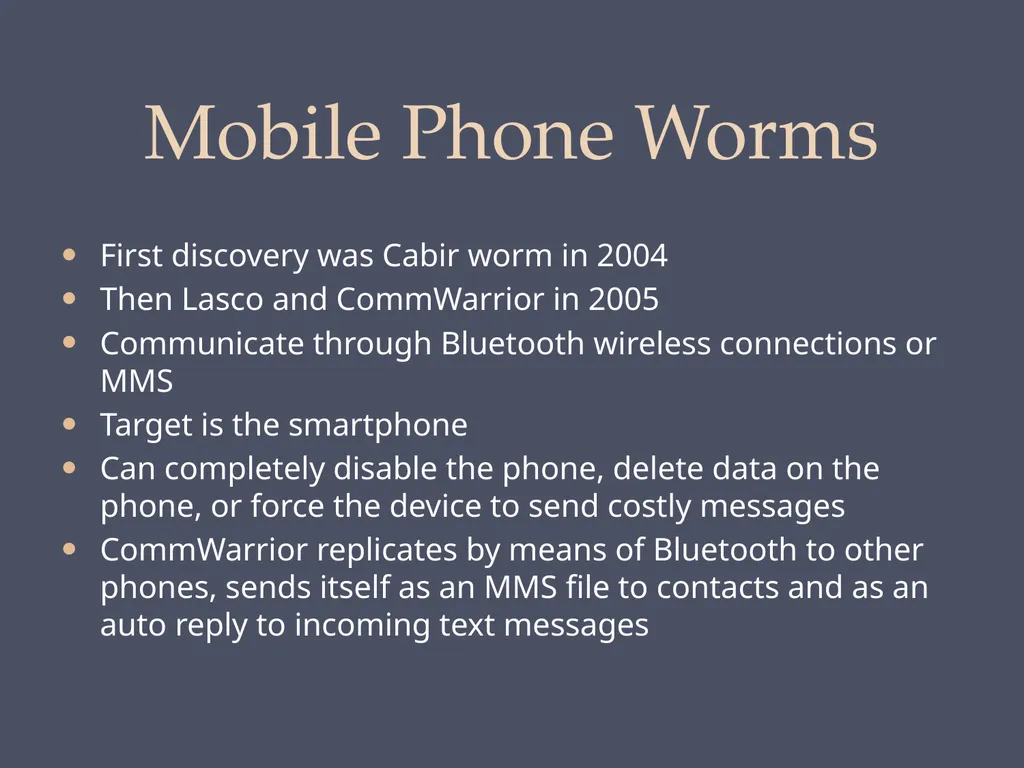
Mobile Phone Worms First discovery was Cabir worm in 2004
Then Lasco and CommWarrior in 2005
Communicate through Bluetooth wireless connections or MMS
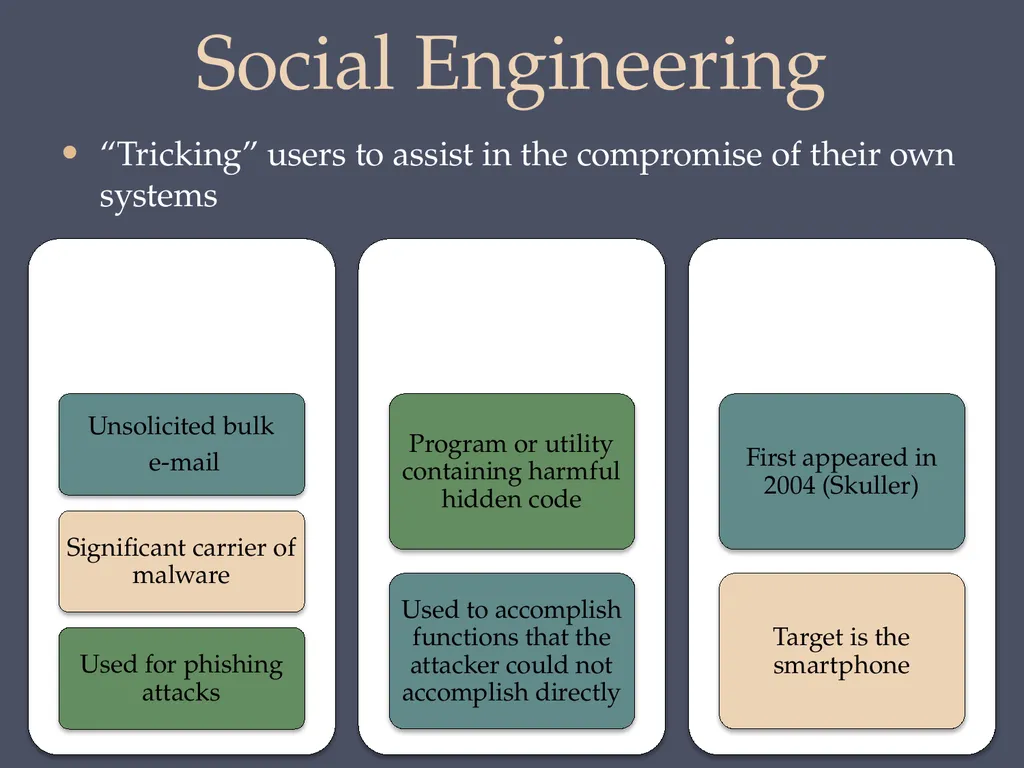
Target is the smartphone
Can completely disable the phone, delete data on the phone, or force the device to send costly messages
CommWarrior replicates by means of Bluetooth to other phones, sends itself as an MMS file to contacts and as an auto reply to incoming text messages<br>
Then Lasco and CommWarrior in 2005
Communicate through Bluetooth wireless connections or MMS
Target is the smartphone
Can completely disable the phone, delete data on the phone, or force the device to send costly messages
CommWarrior replicates by means of Bluetooth to other phones, sends itself as an MMS file to contacts and as an auto reply to incoming text messages<br>
25
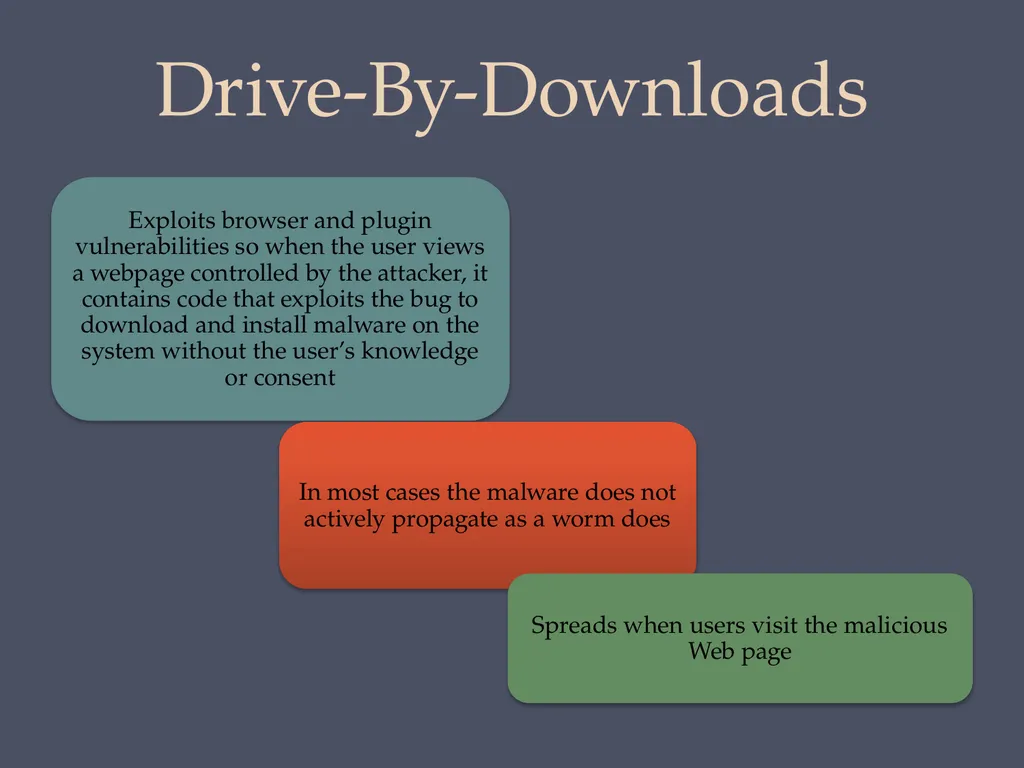
Drive-By-Downloads<br>
26
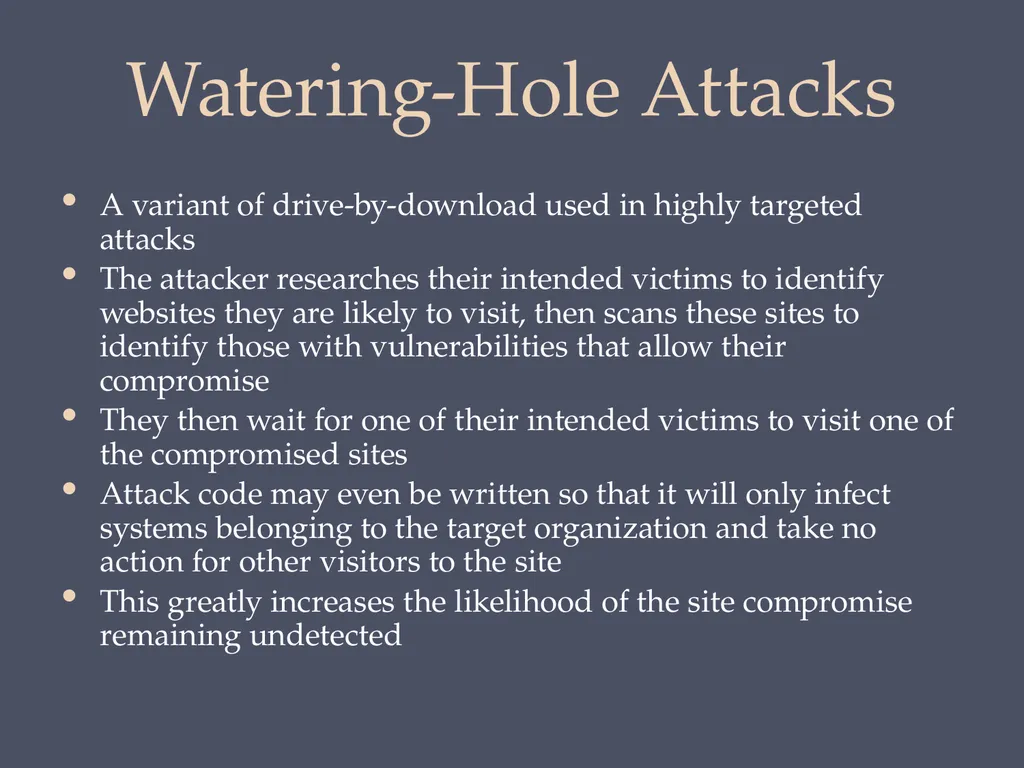
Watering-Hole Attacks A variant of drive-by-download used in highly targeted attacks
The attacker researches their intended victims to identify websites they are likely to visit, then scans these sites to identify those with vulnerabilities that allow their compromise
They then wait for one of their intended victims to visit one of the compromised sites
Attack code may even be written so that it will only infect systems belonging to the target organization and take no action for other visitors to the site
This greatly increases the likelihood of the site compromise remaining undetected<br>
The attacker researches their intended victims to identify websites they are likely to visit, then scans these sites to identify those with vulnerabilities that allow their compromise
They then wait for one of their intended victims to visit one of the compromised sites
Attack code may even be written so that it will only infect systems belonging to the target organization and take no action for other visitors to the site
This greatly increases the likelihood of the site compromise remaining undetected<br>
27
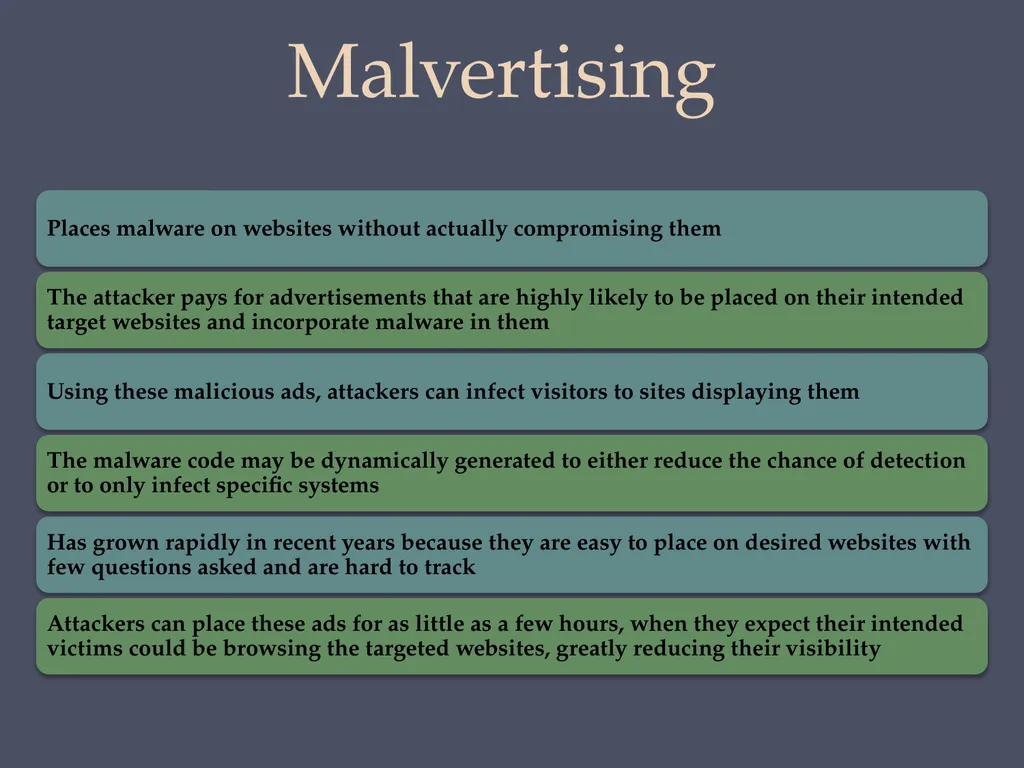
Malvertising<br>
28
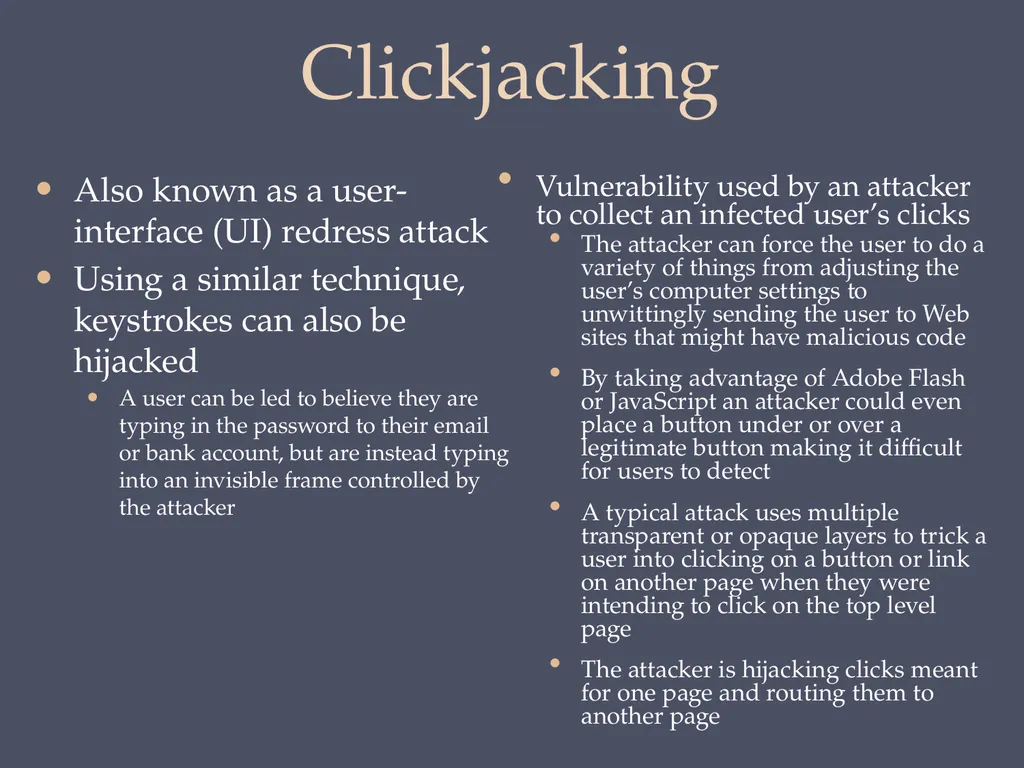
Clickjacking Also known as a user-interface (UI) redress attack
Using a similar technique, keystrokes can also be hijacked
A user can be led to believe they are typing in the password to their email or bank account, but are instead typing into an invisible frame controlled by the attacker Vulnerability used by an attacker to collect an infected user’s clicks
The attacker can force the user to do a variety of things from adjusting the user’s computer settings to unwittingly sending the user to Web sites that might have malicious code
By taking advantage of Adobe Flash or JavaScript an attacker could even place a button under or over a legitimate button making it difficult for users to detect
A typical attack uses multiple transparent or opaque layers to trick a user into clicking on a button or link on another page when they were intending to click on the top level page
The attacker is hijacking clicks meant for one page and routing them to another page<br>
Using a similar technique, keystrokes can also be hijacked
A user can be led to believe they are typing in the password to their email or bank account, but are instead typing into an invisible frame controlled by the attacker Vulnerability used by an attacker to collect an infected user’s clicks
The attacker can force the user to do a variety of things from adjusting the user’s computer settings to unwittingly sending the user to Web sites that might have malicious code
By taking advantage of Adobe Flash or JavaScript an attacker could even place a button under or over a legitimate button making it difficult for users to detect
A typical attack uses multiple transparent or opaque layers to trick a user into clicking on a button or link on another page when they were intending to click on the top level page
The attacker is hijacking clicks meant for one page and routing them to another page<br>
29
Social Engineering “Tricking” users to assist in the compromise of their own systems<br>
30
Payload
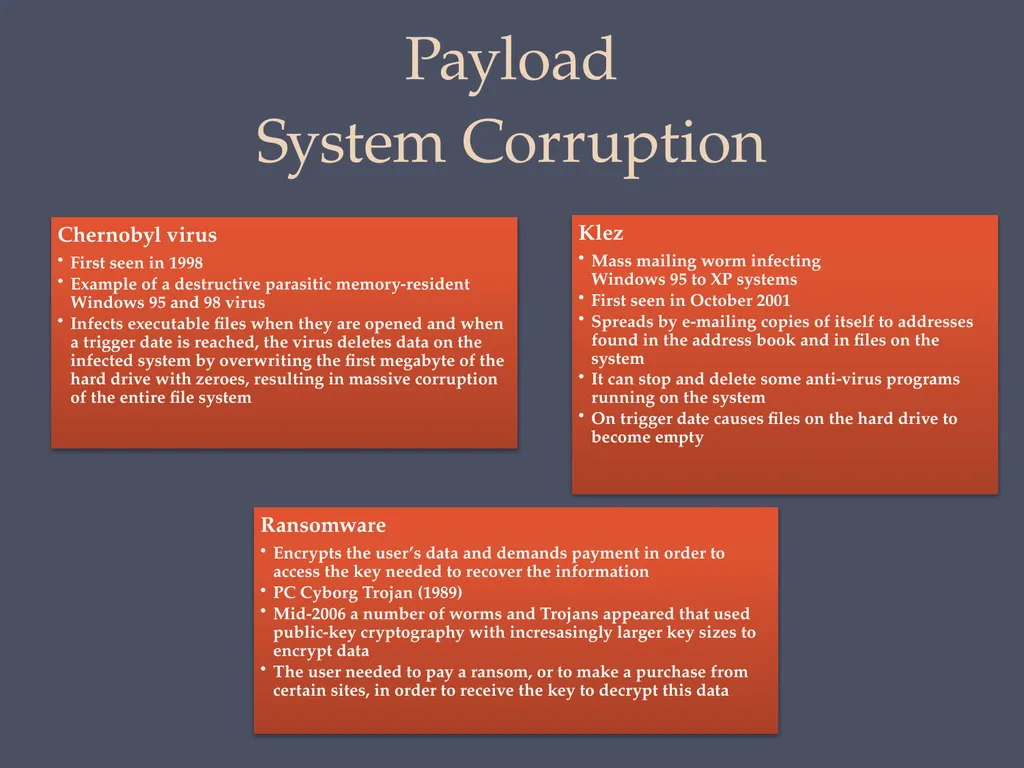
System Corruption<br>
31
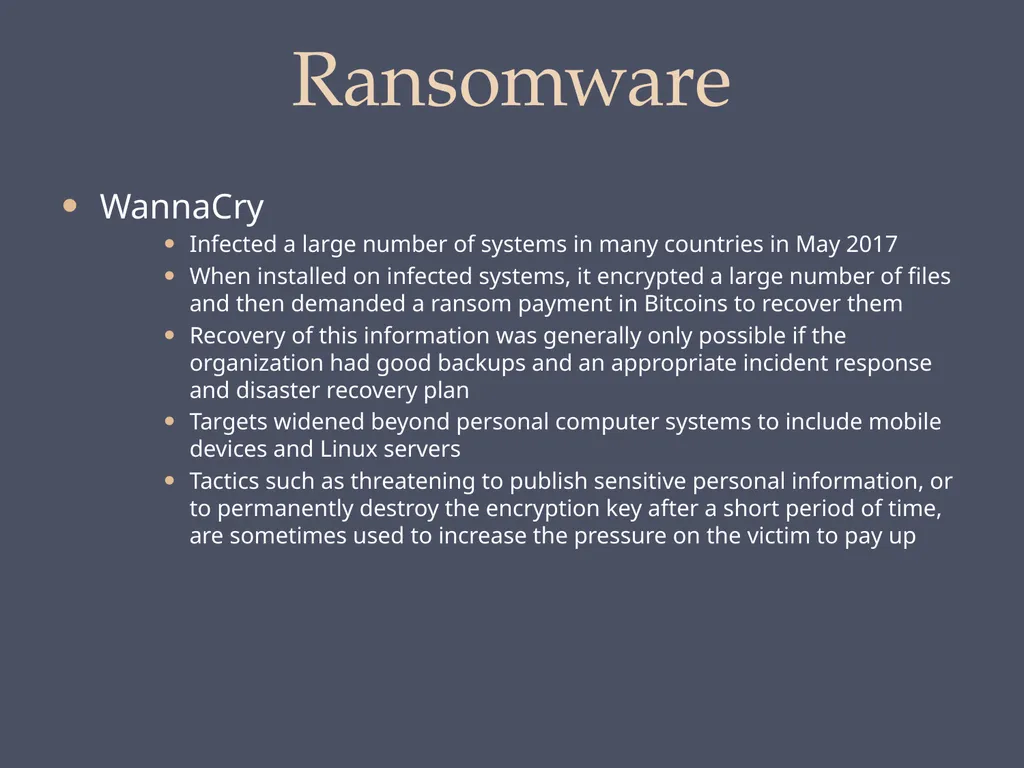
Ransomware WannaCry
Infected a large number of systems in many countries in May 2017
When installed on infected systems, it encrypted a large number of files and then demanded a ransom payment in Bitcoins to recover them
Recovery of this information was generally only possible if the organization had good backups and an appropriate incident response and disaster recovery plan
Targets widened beyond personal computer systems to include mobile devices and Linux servers
Tactics such as threatening to publish sensitive personal information, or to permanently destroy the encryption key after a short period of time, are sometimes used to increase the pressure on the victim to pay up<br>
Infected a large number of systems in many countries in May 2017
When installed on infected systems, it encrypted a large number of files and then demanded a ransom payment in Bitcoins to recover them
Recovery of this information was generally only possible if the organization had good backups and an appropriate incident response and disaster recovery plan
Targets widened beyond personal computer systems to include mobile devices and Linux servers
Tactics such as threatening to publish sensitive personal information, or to permanently destroy the encryption key after a short period of time, are sometimes used to increase the pressure on the victim to pay up<br>
32
Payload
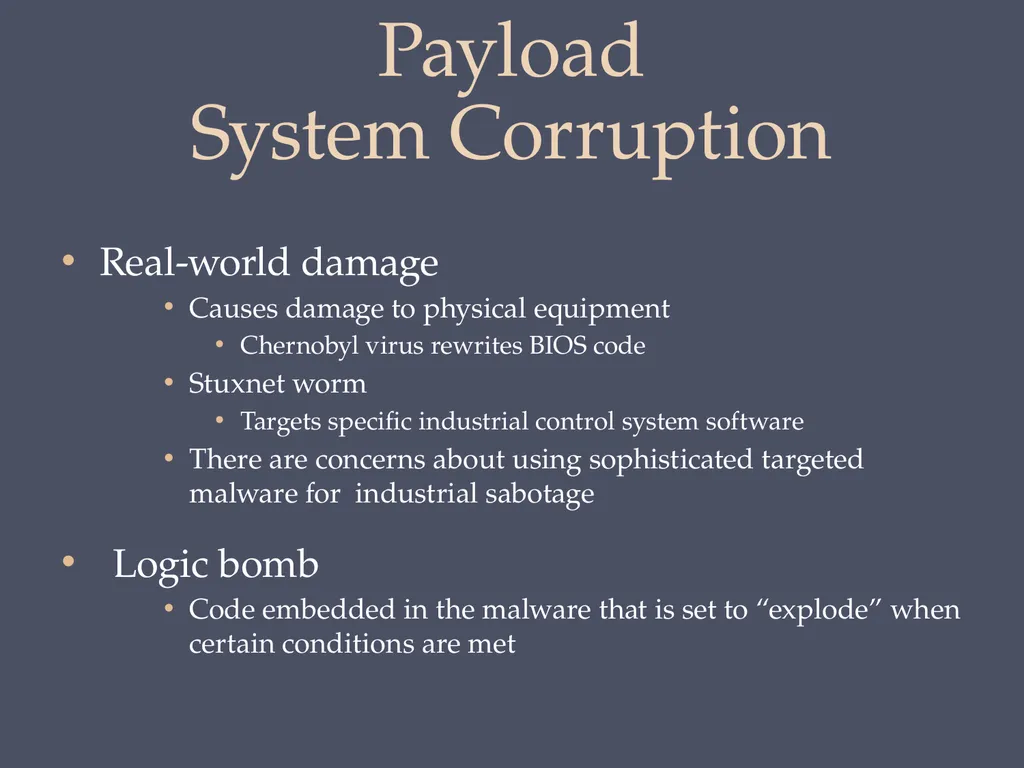
System Corruption Real-world damage
Causes damage to physical equipment
Chernobyl virus rewrites BIOS code
Stuxnet worm
Targets specific industrial control system software
There are concerns about using sophisticated targeted malware for industrial sabotage
Logic bomb
Code embedded in the malware that is set to “explode” when certain conditions are met<br>
Causes damage to physical equipment
Chernobyl virus rewrites BIOS code
Stuxnet worm
Targets specific industrial control system software
There are concerns about using sophisticated targeted malware for industrial sabotage
Logic bomb
Code embedded in the malware that is set to “explode” when certain conditions are met<br>
33
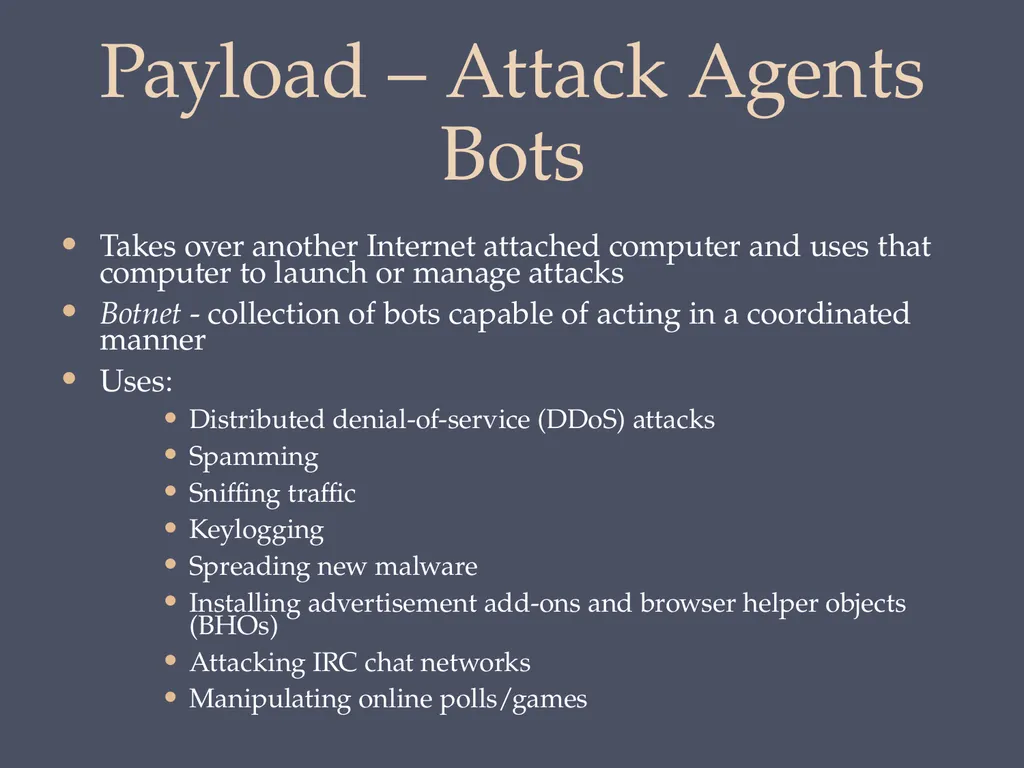
Payload – Attack Agents
Bots Takes over another Internet attached computer and uses that computer to launch or manage attacks
Botnet - collection of bots capable of acting in a coordinated manner
Uses:
Distributed denial-of-service (DDoS) attacks
Spamming
Sniffing traffic
Keylogging
Spreading new malware
Installing advertisement add-ons and browser helper objects (BHOs)
Attacking IRC chat networks
Manipulating online polls/games<br>
Botnet - collection of bots capable of acting in a coordinated manner
Uses:
Distributed denial-of-service (DDoS) attacks
Spamming
Sniffing traffic
Keylogging
Spreading new malware
Installing advertisement add-ons and browser helper objects (BHOs)
Attacking IRC chat networks
Manipulating online polls/games<br>
34
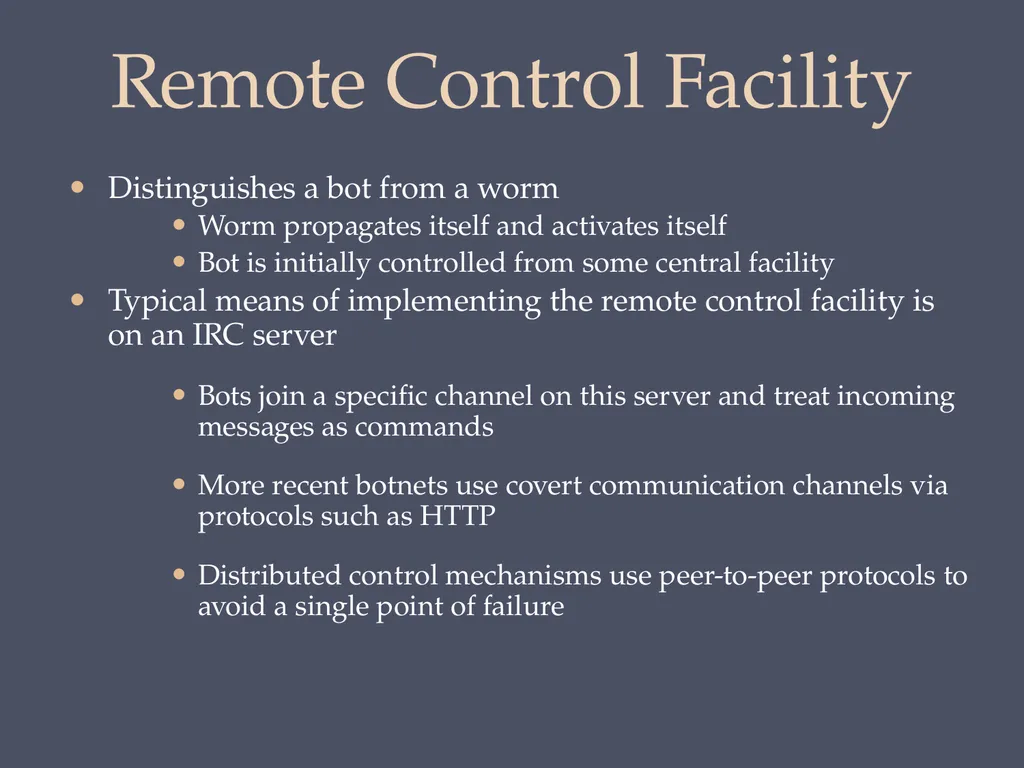
Remote Control Facility Distinguishes a bot from a worm
Worm propagates itself and activates itself
Bot is initially controlled from some central facility
Typical means of implementing the remote control facility is on an IRC server
Bots join a specific channel on this server and treat incoming messages as commands
More recent botnets use covert communication channels via protocols such as HTTP
Distributed control mechanisms use peer-to-peer protocols to avoid a single point of failure<br>
Worm propagates itself and activates itself
Bot is initially controlled from some central facility
Typical means of implementing the remote control facility is on an IRC server
Bots join a specific channel on this server and treat incoming messages as commands
More recent botnets use covert communication channels via protocols such as HTTP
Distributed control mechanisms use peer-to-peer protocols to avoid a single point of failure<br>
35
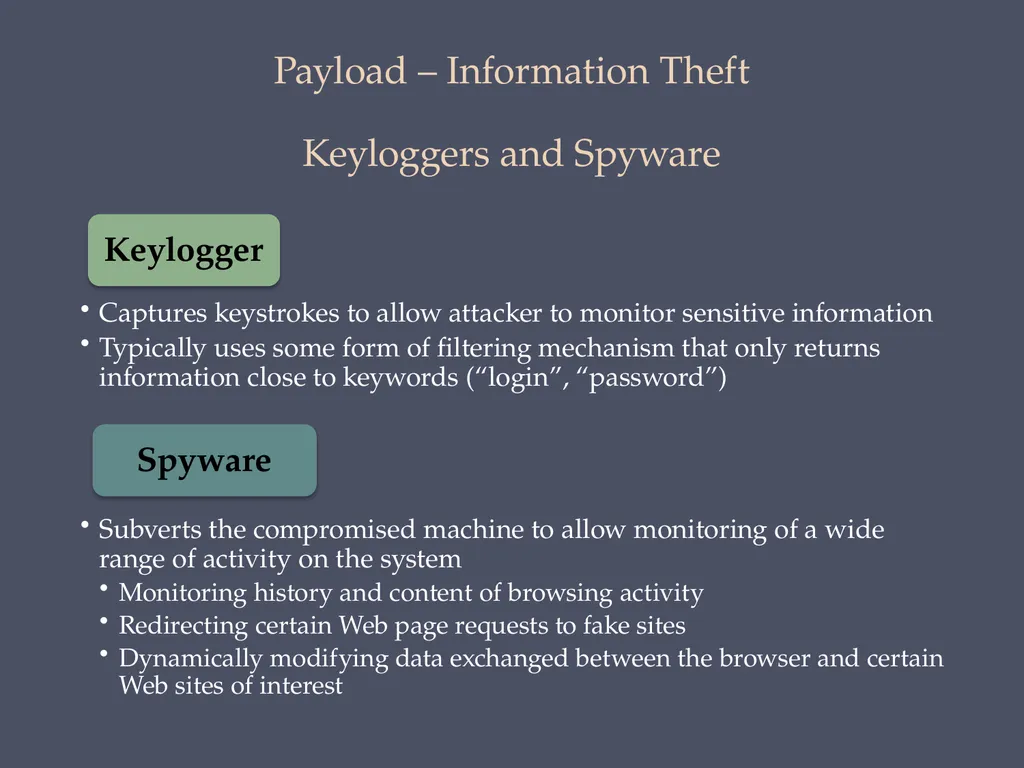
Payload – Information Theft
Keyloggers and Spyware<br>
36
Payload – Information Theft
Phishing Exploits social engineering to leverage the user’s trust by masquerading as communication from a trusted source
Include a URL in a spam e-mail that links to a fake Web site that mimics the login page of a banking, gaming, or similar site
Suggests that urgent action is required by the user to authenticate their account
Attacker exploits the account using the captured credentials Spear-phishing
Recipients are carefully researched by the attacker
E-mail is crafted to specifically suit its recipient, often quoting a range of information to convince them of its authenticity<br>
Include a URL in a spam e-mail that links to a fake Web site that mimics the login page of a banking, gaming, or similar site
Suggests that urgent action is required by the user to authenticate their account
Attacker exploits the account using the captured credentials Spear-phishing
Recipients are carefully researched by the attacker
E-mail is crafted to specifically suit its recipient, often quoting a range of information to convince them of its authenticity<br>
37
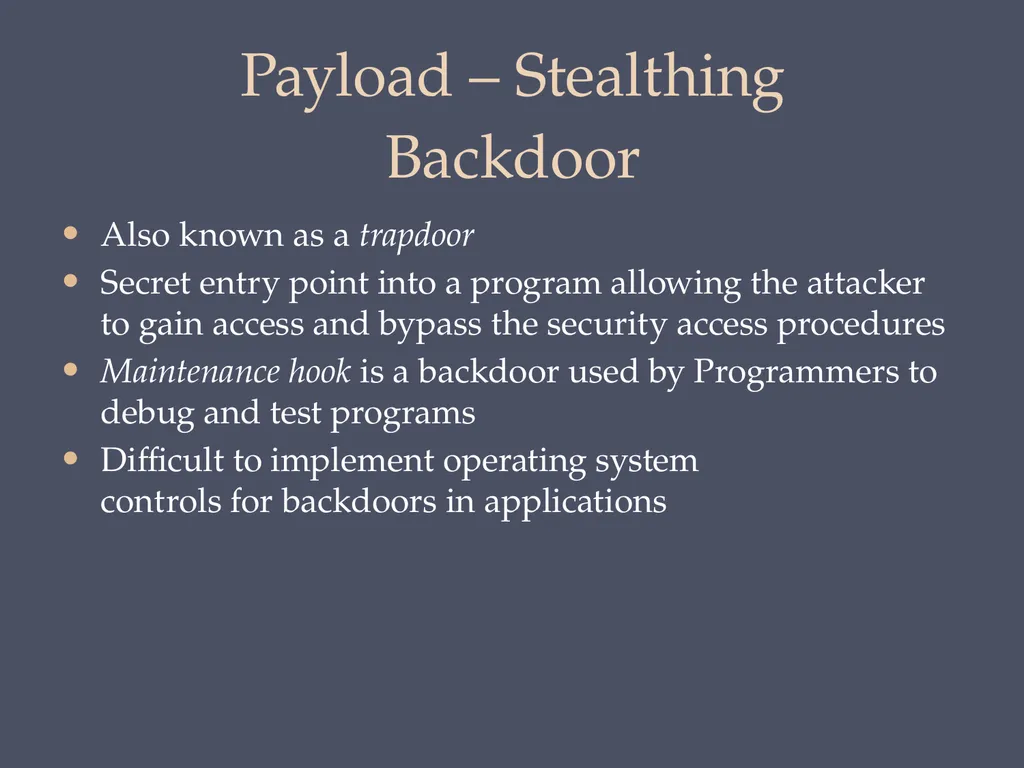
Payload – Stealthing
Backdoor Also known as a trapdoor
Secret entry point into a program allowing the attacker to gain access and bypass the security access procedures
Maintenance hook is a backdoor used by Programmers to debug and test programs
Difficult to implement operating system controls for backdoors in applications<br>
Secret entry point into a program allowing the attacker to gain access and bypass the security access procedures
Maintenance hook is a backdoor used by Programmers to debug and test programs
Difficult to implement operating system controls for backdoors in applications<br>
38
Payload - Stealthing
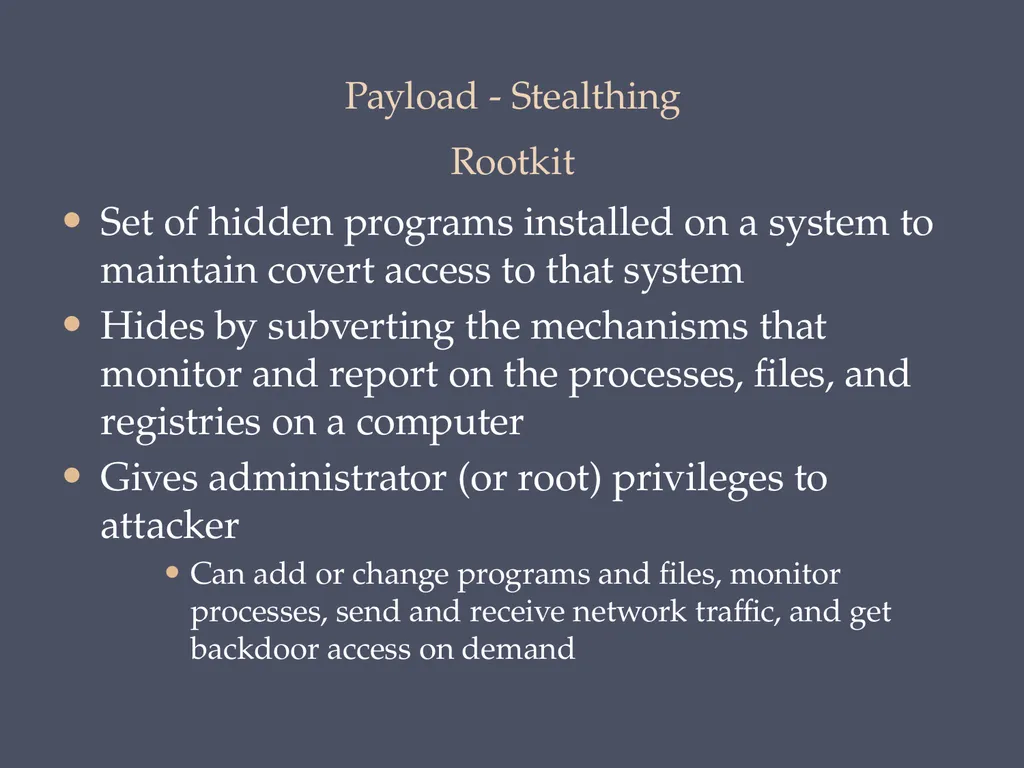
Rootkit Set of hidden programs installed on a system to maintain covert access to that system
Hides by subverting the mechanisms that monitor and report on the processes, files, and registries on a computer
Gives administrator (or root) privileges to attacker
Can add or change programs and files, monitor processes, send and receive network traffic, and get backdoor access on demand<br>
Hides by subverting the mechanisms that monitor and report on the processes, files, and registries on a computer
Gives administrator (or root) privileges to attacker
Can add or change programs and files, monitor processes, send and receive network traffic, and get backdoor access on demand<br>
39
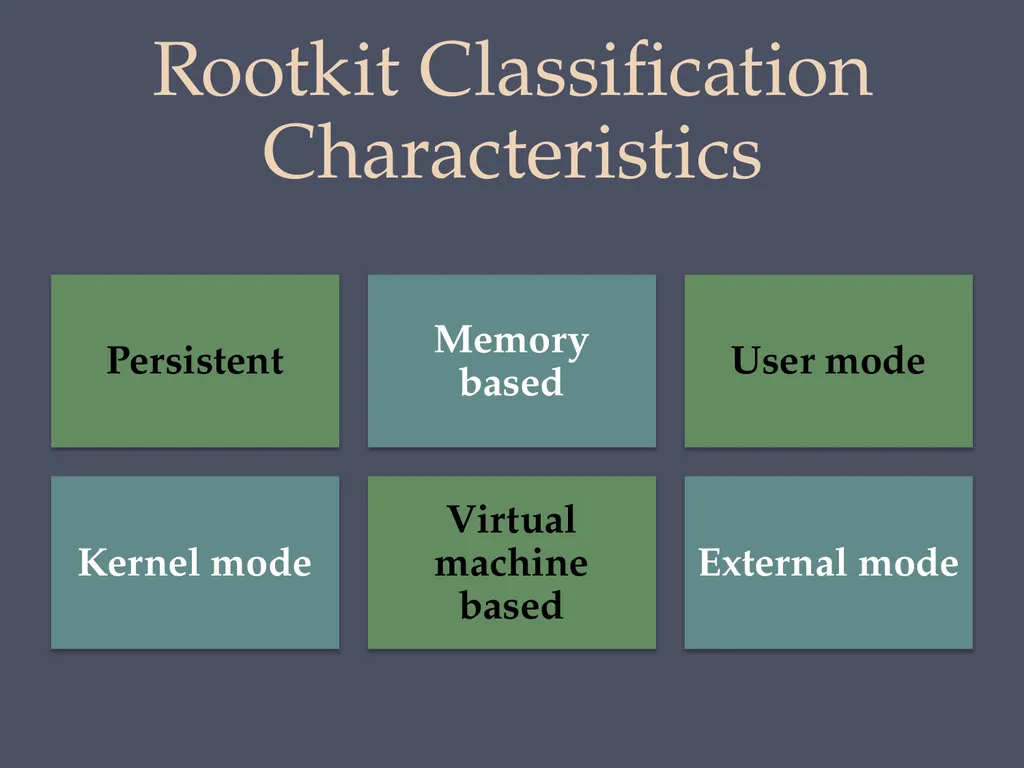
Rootkit Classification Characteristics<br>
40
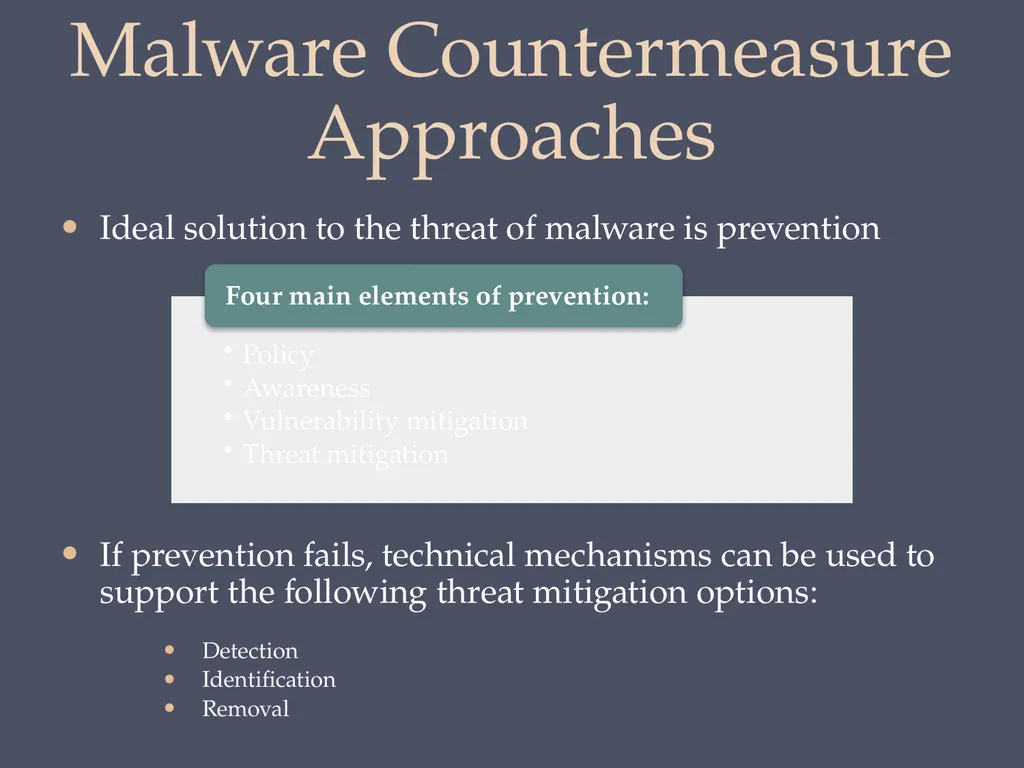
Malware Countermeasure Approaches Ideal solution to the threat of malware is prevention
If prevention fails, technical mechanisms can be used to support the following threat mitigation options:
Detection
Identification
Removal<br>
If prevention fails, technical mechanisms can be used to support the following threat mitigation options:
Detection
Identification
Removal<br>
41
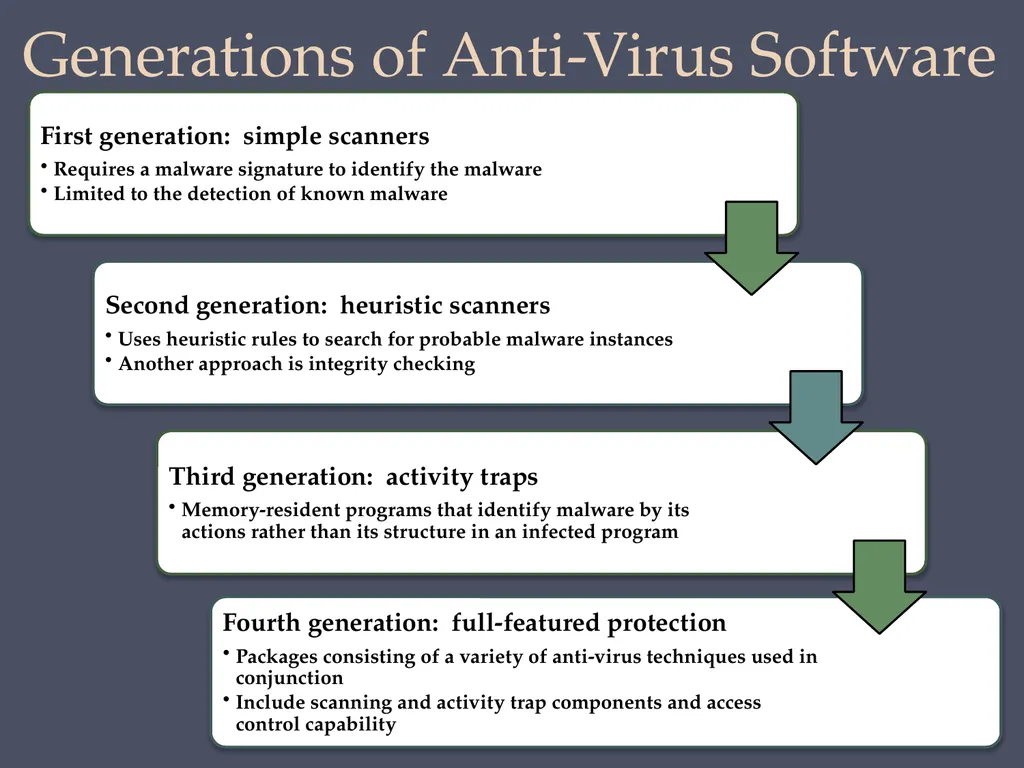
Generations of Anti-Virus Software<br>
42
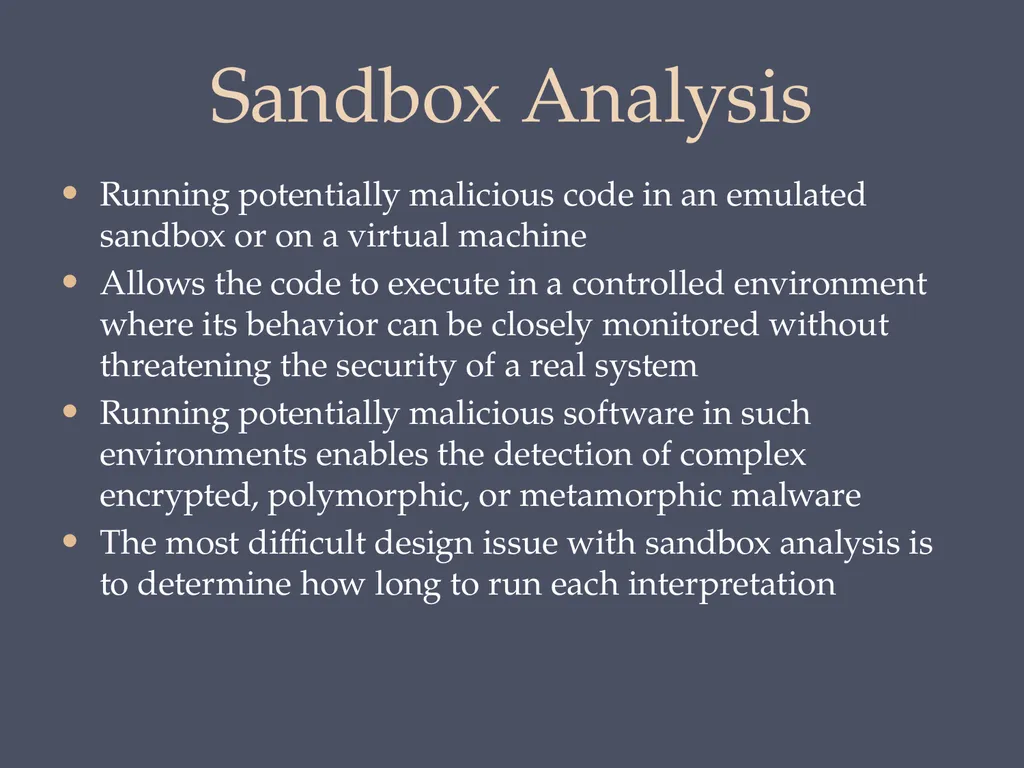
Sandbox Analysis Running potentially malicious code in an emulated sandbox or on a virtual machine
Allows the code to execute in a controlled environment where its behavior can be closely monitored without threatening the security of a real system
Running potentially malicious software in such environments enables the detection of complex encrypted, polymorphic, or metamorphic malware
The most difficult design issue with sandbox analysis is to determine how long to run each interpretation<br>
Allows the code to execute in a controlled environment where its behavior can be closely monitored without threatening the security of a real system
Running potentially malicious software in such environments enables the detection of complex encrypted, polymorphic, or metamorphic malware
The most difficult design issue with sandbox analysis is to determine how long to run each interpretation<br>
43
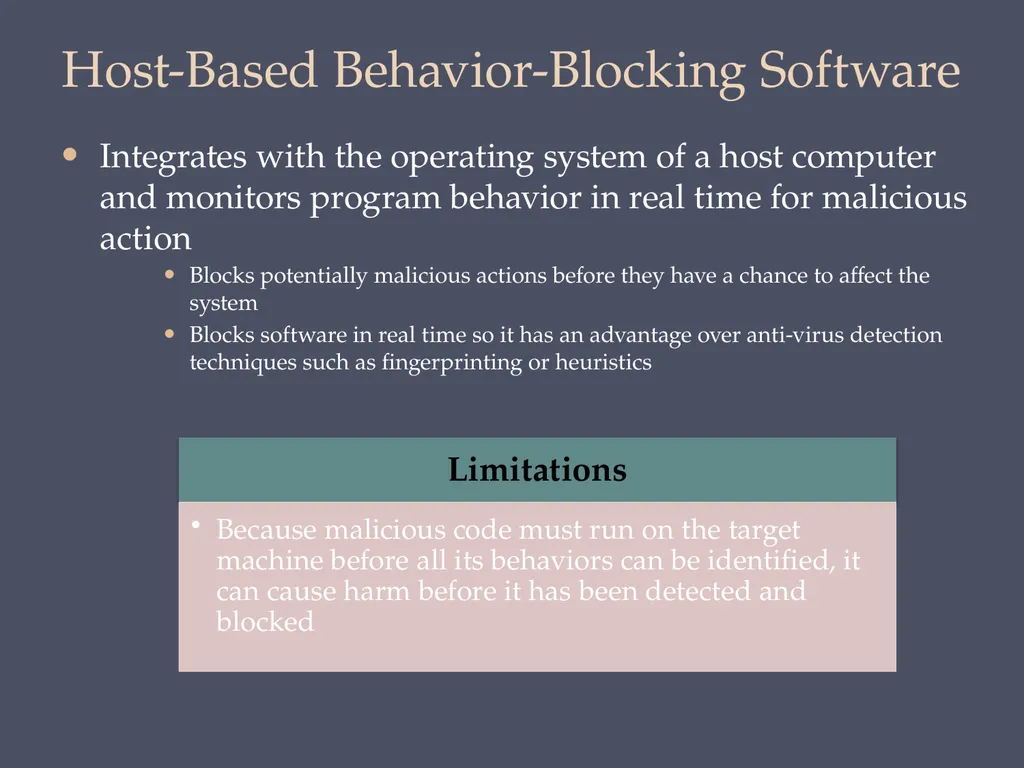
Host-Based Behavior-Blocking Software Integrates with the operating system of a host computer and monitors program behavior in real time for malicious action
Blocks potentially malicious actions before they have a chance to affect the system
Blocks software in real time so it has an advantage over anti-virus detection techniques such as fingerprinting or heuristics<br>
Blocks potentially malicious actions before they have a chance to affect the system
Blocks software in real time so it has an advantage over anti-virus detection techniques such as fingerprinting or heuristics<br>
44
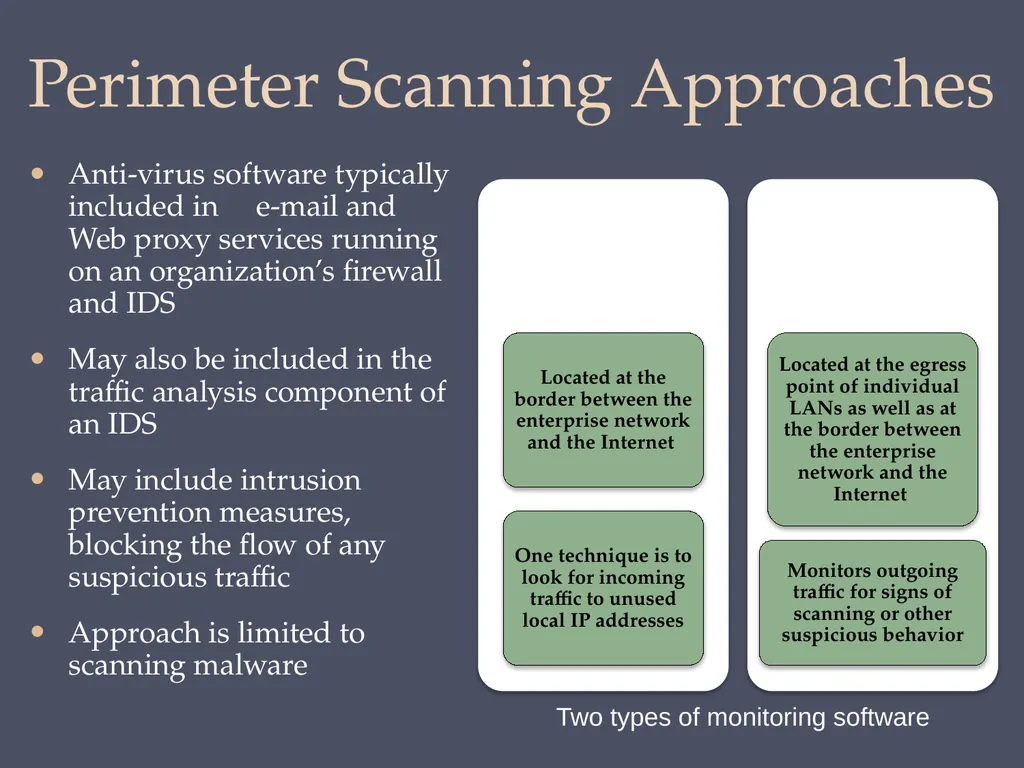
Perimeter Scanning Approaches Anti-virus software typically included in e-mail and Web proxy services running on an organization’s firewall and IDS
May also be included in the traffic analysis component of an IDS
May include intrusion prevention measures, blocking the flow of any suspicious traffic
Approach is limited to scanning malware Two types of monitoring software<br>
May also be included in the traffic analysis component of an IDS
May include intrusion prevention measures, blocking the flow of any suspicious traffic
Approach is limited to scanning malware Two types of monitoring software<br>
45
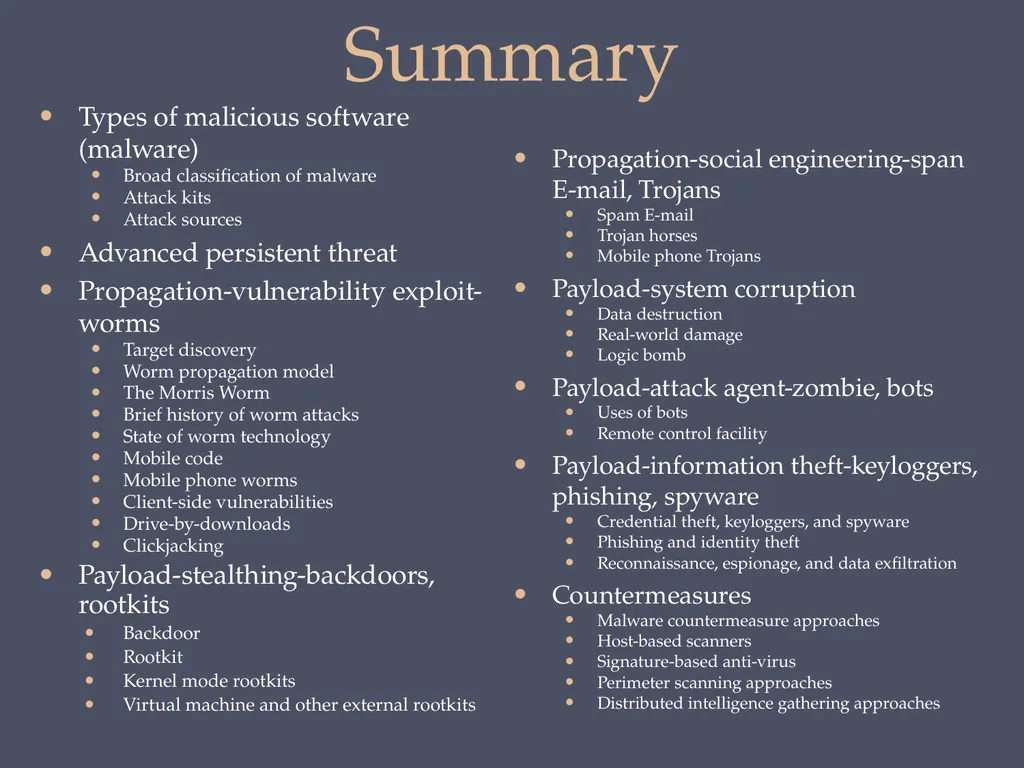
Summary Propagation-social engineering-span E-mail, Trojans
Spam E-mail
Trojan horses
Mobile phone Trojans
Payload-system corruption
Data destruction
Real-world damage
Logic bomb
Payload-attack agent-zombie, bots
Uses of bots
Remote control facility
Payload-information theft-keyloggers, phishing, spyware
Credential theft, keyloggers, and spyware
Phishing and identity theft
Reconnaissance, espionage, and data exfiltration
Countermeasures
Malware countermeasure approaches
Host-based scanners
Signature-based anti-virus
Perimeter scanning approaches
Distributed intelligence gathering approaches Types of malicious software (malware)
Broad classification of malware
Attack kits
Attack sources
Advanced persistent threat
Propagation-vulnerability exploit-worms
Target discovery
Worm propagation model
The Morris Worm
Brief history of worm attacks
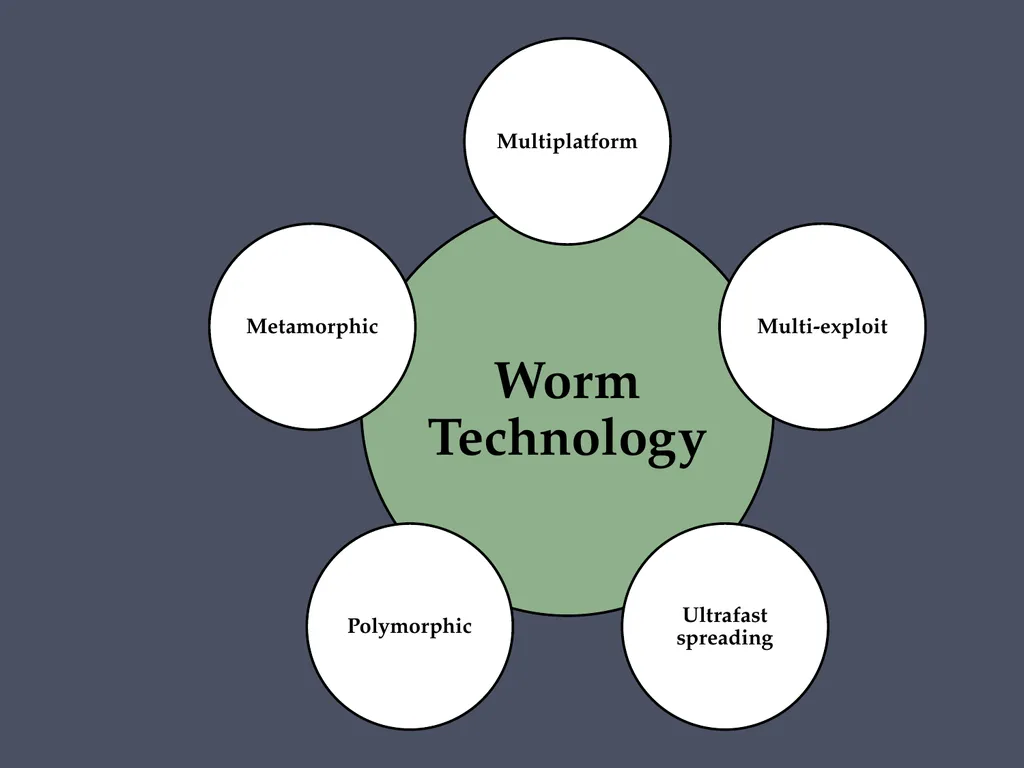
State of worm technology
Mobile code
Mobile phone worms
Client-side vulnerabilities
Drive-by-downloads
Clickjacking
Payload-stealthing-backdoors, rootkits
Backdoor
Rootkit
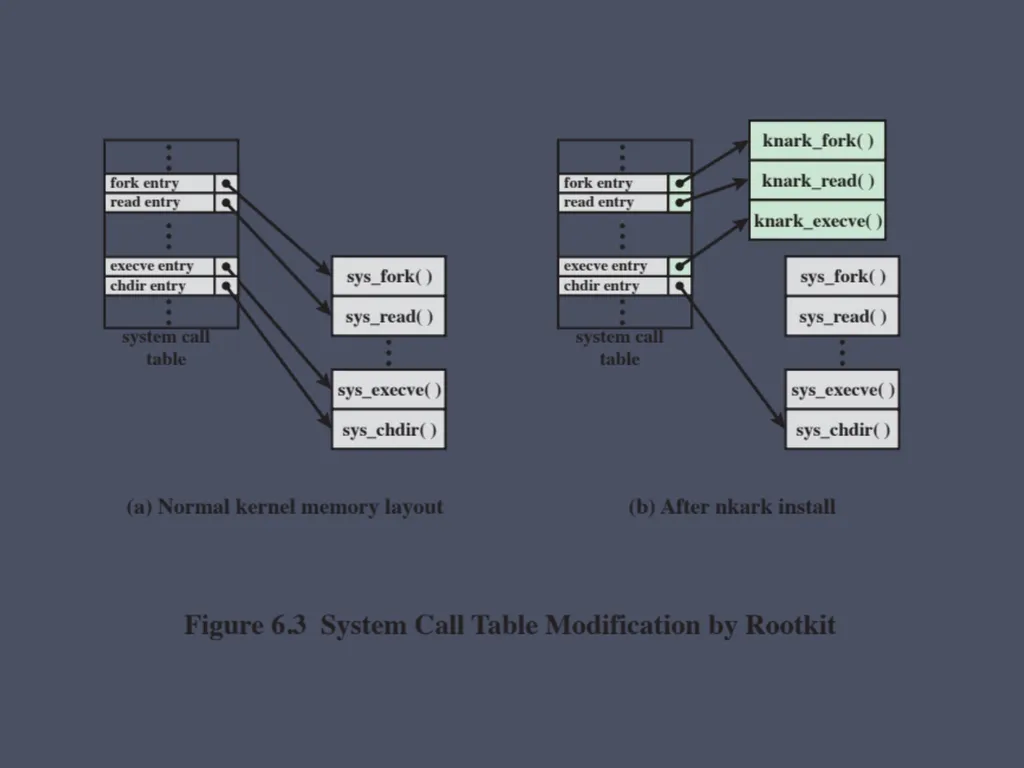
Kernel mode rootkits
Virtual machine and other external rootkits<br>
Spam E-mail
Trojan horses
Mobile phone Trojans
Payload-system corruption
Data destruction
Real-world damage
Logic bomb
Payload-attack agent-zombie, bots
Uses of bots
Remote control facility
Payload-information theft-keyloggers, phishing, spyware
Credential theft, keyloggers, and spyware
Phishing and identity theft
Reconnaissance, espionage, and data exfiltration
Countermeasures
Malware countermeasure approaches
Host-based scanners
Signature-based anti-virus
Perimeter scanning approaches
Distributed intelligence gathering approaches Types of malicious software (malware)
Broad classification of malware
Attack kits
Attack sources
Advanced persistent threat
Propagation-vulnerability exploit-worms
Target discovery
Worm propagation model
The Morris Worm
Brief history of worm attacks
State of worm technology
Mobile code
Mobile phone worms
Client-side vulnerabilities
Drive-by-downloads
Clickjacking
Payload-stealthing-backdoors, rootkits
Backdoor
Rootkit
Kernel mode rootkits
Virtual machine and other external rootkits<br>