
CONCEPTS OF BIOLOGY Chapter 11 EVOLUTION AND ITS
DP
Published · 61 slides · 0 views

1 / 1




Description
CONCEPTS OF BIOLOGY Chapter 11 EVOLUTION AND ITS PROCESSES PowerPoint Image Slideshow Introduction All species of living organisms evolved at some point from a different species Evolution is the process through which the Characteristics of
Related Topics
Share
Embed code
Download this presentation From Below
"CONCEPTS OF BIOLOGY Chapter 11 EVOLUTION AND ITS" is the property of its rightful owner. Permission is granted to download and print the materials on this website for personal, non-commercial use only, and to display it on your personal computer provided you do not modify the materials and that you retain all copyright notices contained in the materials. By downloading content from our website, you accept the terms of this agreement.
Presentation Transcript
01
CONCEPTS OF BIOLOGY Chapter 11 EVOLUTION AND ITS PROCESSES
PowerPoint Image Slideshow<br>
02
Introduction All species of living organisms evolved at some point from a different species
Evolution is the process through which the
Characteristics of species change and
Through which new species arise
The theory of evolution is the unifying theory of biology
The principle that all life has evolved and diversified from a common ancestor is the foundation from which we understand all other questions in biology<br>
03
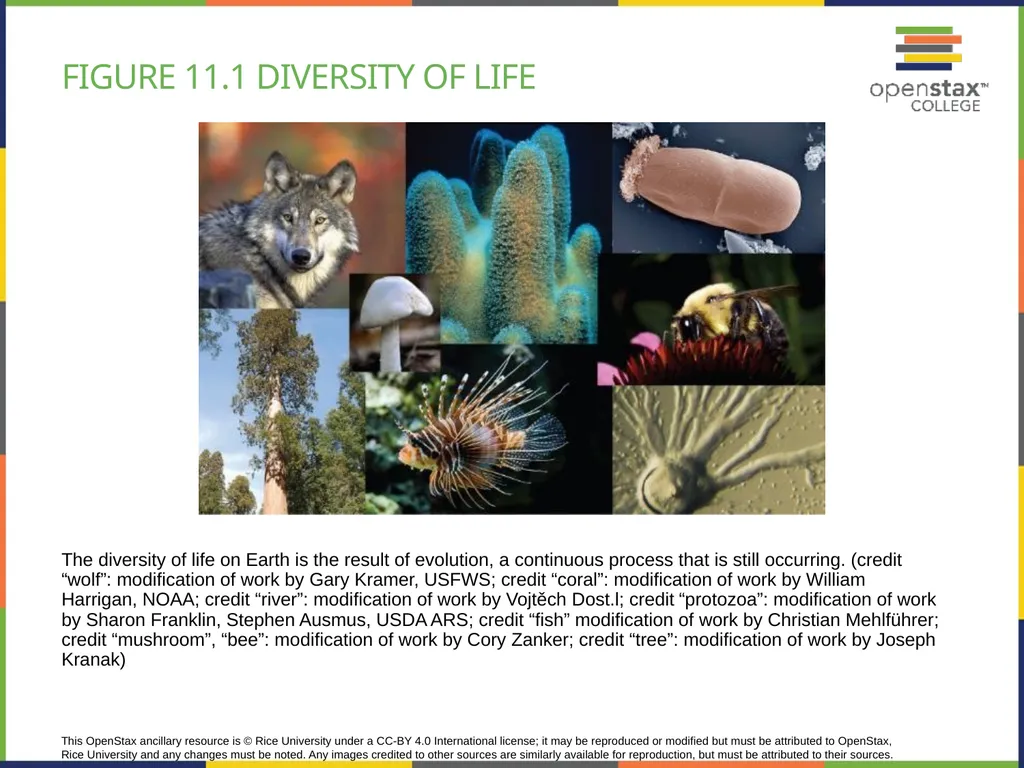
Figure 11.1 diversity of life The diversity of life on Earth is the result of evolution, a continuous process that is still occurring. (credit “wolf”: modification of work by Gary Kramer, USFWS; credit “coral”: modification of work by William Harrigan, NOAA; credit “river”: modification of work by Vojtěch Dost.l; credit “protozoa”: modification of work by Sharon Franklin, Stephen Ausmus, USDA ARS; credit “fish” modification of work by Christian Mehlführer; credit “mushroom”, “bee”: modification of work by Cory Zanker; credit “tree”: modification of work by Joseph Kranak) This OpenStax ancillary resource is © Rice University under a CC-BY 4.0 International license; it may be reproduced or modified but must be attributed to OpenStax, Rice University and any changes must be noted. Any images credited to other sources are similarly available for reproduction, but must be attributed to their sources.<br>
04
Discovering how populations change 1 of 2 (11.1) That species change had been suggested and debated well before Darwin
The ancient Greeks suggested evolutionary ideas
During the 18th century, ideas about evolution were reintroduced by several scientists and it was also accepted that there were extinct species
In the 19th century, Charles Lyell was a friend of Darwin’s and proposed that the earth was actually very old, giving more time for a gradual change in species
This contrasted the predominant view of the time that the earth was only several thousand years old<br>
05
Discovering how populations change 2 of 2 (11.1) In the early 19th century, Jean-Baptiste Lamarck published a mechanism for evolution called inheritance of acquired characteristics
This theory proposed that modification in an individual caused by changes in its environment could be inherited by its offspring and thus bring about change in a species
For example, over time, giraffe necks have gotten longer. Lamarck proposed that as giraffes try to reach the topmost branches of trees to eat leaves, their necks might stretch out some. This longer neck would then be passed on to their offspring.
This idea was eventually discredited but it was an important influence on evolutionary thought<br>
06
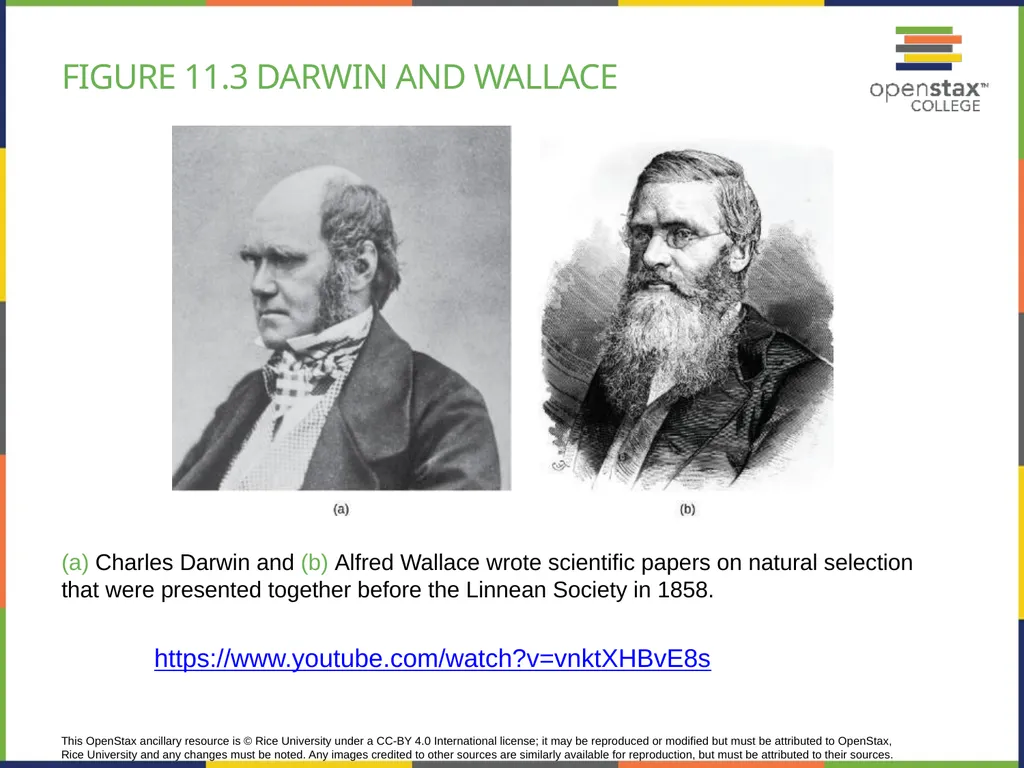
Charles Darwin and natural selection 1 of 5 (11.1) The theory of evolution by natural selection was proposed by Charles Darwin and Alfred Russell Wallace in 1858
From 1831 to 1836, Darwin was the naturalist aboard a mapping ship called The Beagle
He traveled all over the world but spent most of his time along the coast of South America, particularly the Galapagos Islands
The next year Darwin published his famous book, On the Origin of Species by Means of Natural Selection
Darwin proposed that
Characteristics of organisms are inherited from parent to offspring
More offspring are produced than are able to survive because resources are limited
Offspring vary among each other and these variations are inherited<br>
07
Individuals that have characteristics that allow them to best compete for limited resources will survive and have more offspring than individuals without these beneficial characteristics. This is natural selection.
These beneficial traits will become more common in the next generation. The observed change is evolution.
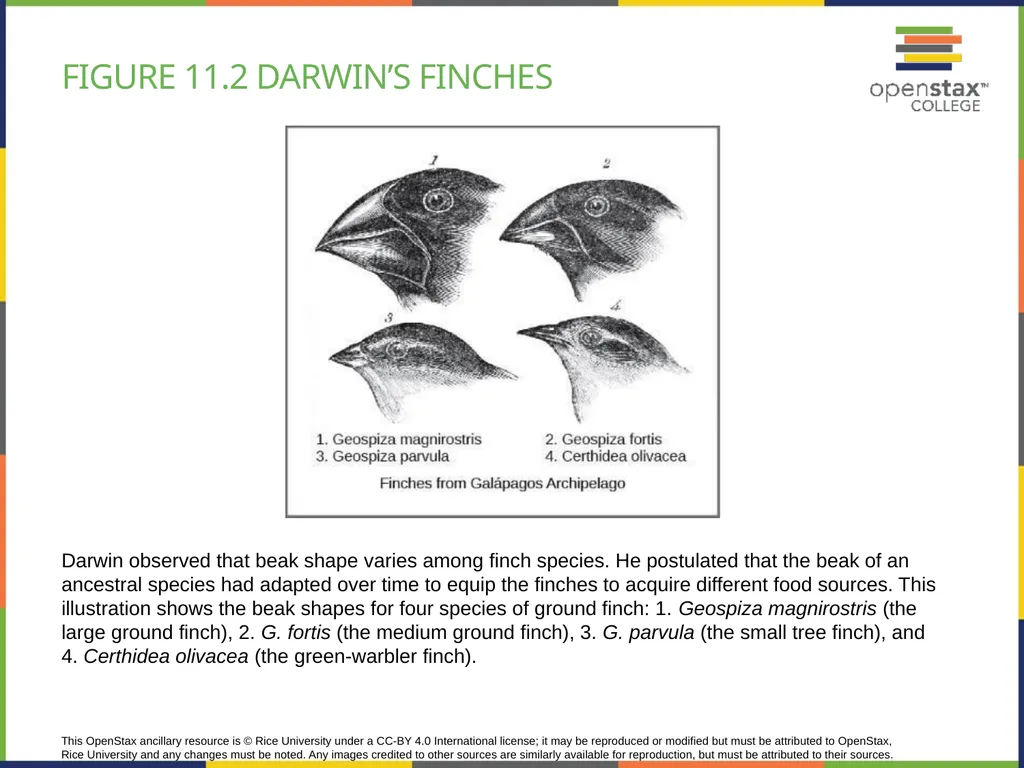
Darwin studied the ground finches on the Galapagos Islands and discovered that each species had a unique beak shape
Darwin thought that the island species were descended from an ancestral species on the mainland of South America
The birds went to different islands and their beaks were modified to match the food sources on their particular island
This modification of beaks is evolution by natural selection Charles Darwin and natural selection 2 of 5 (11.1)<br>
08
Figure 11.2 Darwin’s finches Darwin observed that beak shape varies among finch species. He postulated that the beak of an ancestral species had adapted over time to equip the finches to acquire different food sources. This illustration shows the beak shapes for four species of ground finch: 1. Geospiza magnirostris (the large ground finch), 2. G. fortis (the medium ground finch), 3. G. parvula (the small tree finch), and 4. Certhidea olivacea (the green-warbler finch). This OpenStax ancillary resource is © Rice University under a CC-BY 4.0 International license; it may be reproduced or modified but must be attributed to OpenStax, Rice University and any changes must be noted. Any images credited to other sources are similarly available for reproduction, but must be attributed to their sources.<br>
09
Figure 11.3 Darwin and Wallace (a) Charles Darwin and (b) Alfred Wallace wrote scientific papers on natural selection that were presented together before the Linnean Society in 1858. https://www.youtube.com/watch?v=vnktXHBvE8s This OpenStax ancillary resource is © Rice University under a CC-BY 4.0 International license; it may be reproduced or modified but must be attributed to OpenStax, Rice University and any changes must be noted. Any images credited to other sources are similarly available for reproduction, but must be attributed to their sources.<br>
10
Charles Darwin and natural selection 3 of 5 (11.1) But can evolution by natural selection be demonstrated?
Peter and Rosemary Grant have been studying the ground finch on Daphne Major since 1976
Ground finch feed on seeds and their beaks range in size from narrow to wide
Birds with small narrow beaks feed on soft small seeds which are abundant when there is enough rainfall
Birds with large wide beaks feed on hard large seeds which are abundant in droughts
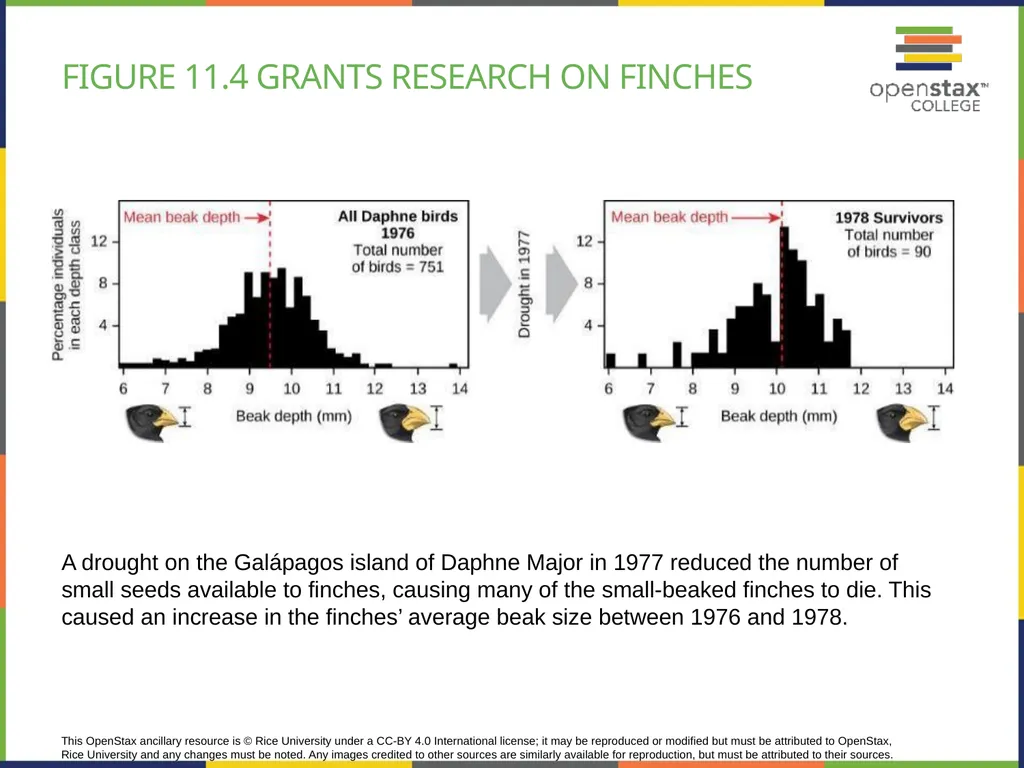
In 1977, Daphne Major experienced a drought, which caused a shortage of small seeds
In response, the beak depth increased (become larger and wider) in following years
This demonstrated natural selection on bill size caused by the availability of seeds
Subsequent studies over the last 40 years have shown similar results<br>
11
Figure 11.4 grants research on finches A drought on the Galápagos island of Daphne Major in 1977 reduced the number of small seeds available to finches, causing many of the small-beaked finches to die. This caused an increase in the finches’ average beak size between 1976 and 1978. This OpenStax ancillary resource is © Rice University under a CC-BY 4.0 International license; it may be reproduced or modified but must be attributed to OpenStax, Rice University and any changes must be noted. Any images credited to other sources are similarly available for reproduction, but must be attributed to their sources.<br>
12
Natural selection depends on variation differences among individuals in a population
Also, variation must have a genetic basis
Genetic diversity comes from mutation and sexual reproduction
Mutation is a change in DNA, and can be harmful, beneficial or neutral
Mutation is the ultimate source of genetic variation because it introduces new alleles
Sexual reproduction also leads to genetic diversity because reproduction involving 2 parents can lead to new combinations of traits
A heritable trait that aids the survival and reproduction of an individual in its particular environment is called an adaptation
Whether or not a trait is favorable depends on the environment at the time Charles Darwin and natural selection 4 of 5 (11.1)<br>
13
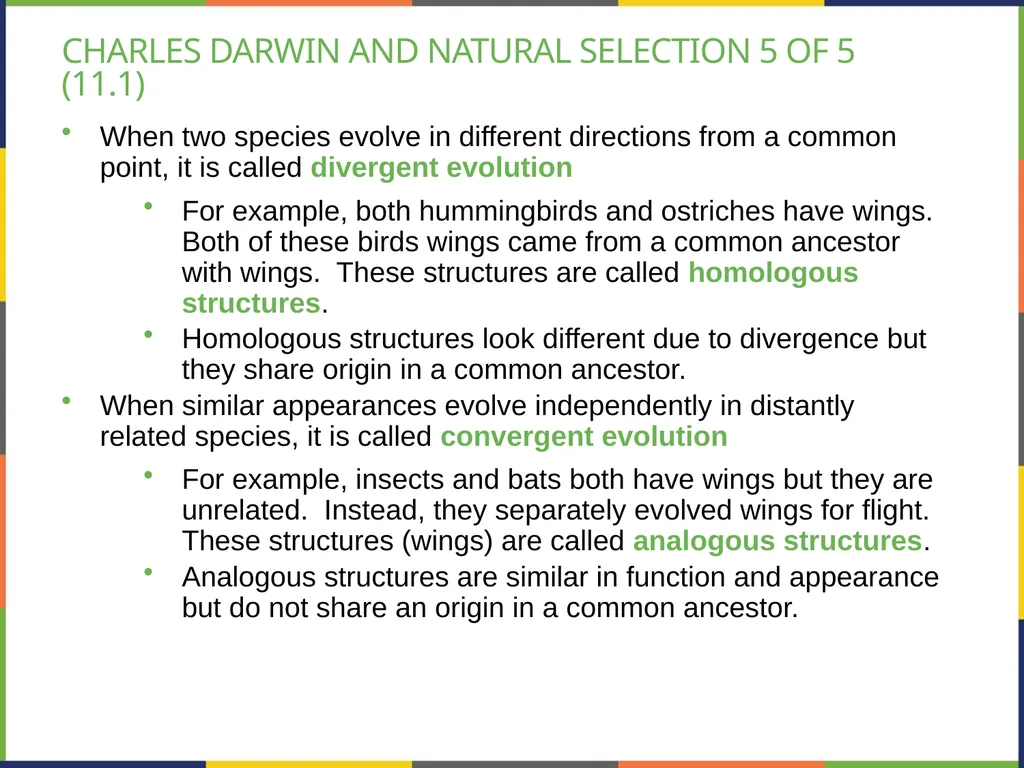
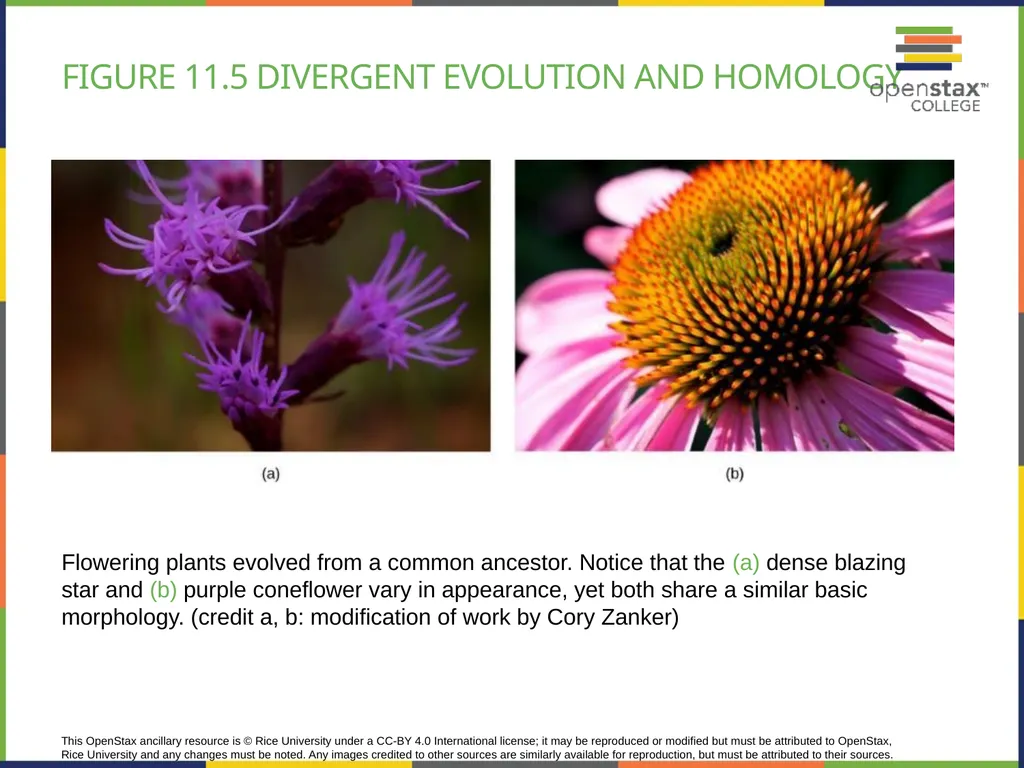
Charles Darwin and natural selection 5 of 5 (11.1) When two species evolve in different directions from a common point, it is called divergent evolution
For example, both hummingbirds and ostriches have wings. Both of these birds wings came from a common ancestor with wings. These structures are called homologous structures.
Homologous structures look different due to divergence but they share origin in a common ancestor.
When similar appearances evolve independently in distantly related species, it is called convergent evolution
For example, insects and bats both have wings but they are unrelated. Instead, they separately evolved wings for flight. These structures (wings) are called analogous structures.
Analogous structures are similar in function and appearance but do not share an origin in a common ancestor.<br>
14
Figure 11.5 divergent evolution and homology Flowering plants evolved from a common ancestor. Notice that the (a) dense blazing star and (b) purple coneflower vary in appearance, yet both share a similar basic morphology. (credit a, b: modification of work by Cory Zanker) This OpenStax ancillary resource is © Rice University under a CC-BY 4.0 International license; it may be reproduced or modified but must be attributed to OpenStax, Rice University and any changes must be noted. Any images credited to other sources are similarly available for reproduction, but must be attributed to their sources.<br>
15
The modern synthesis (11.1) Modern synthesis is an idea that took shape in the 1940’s and is widely accepted today
It describes how evolutionary pressures such as natural selection can affect population genetics and result in a gradual evolution of populations and species
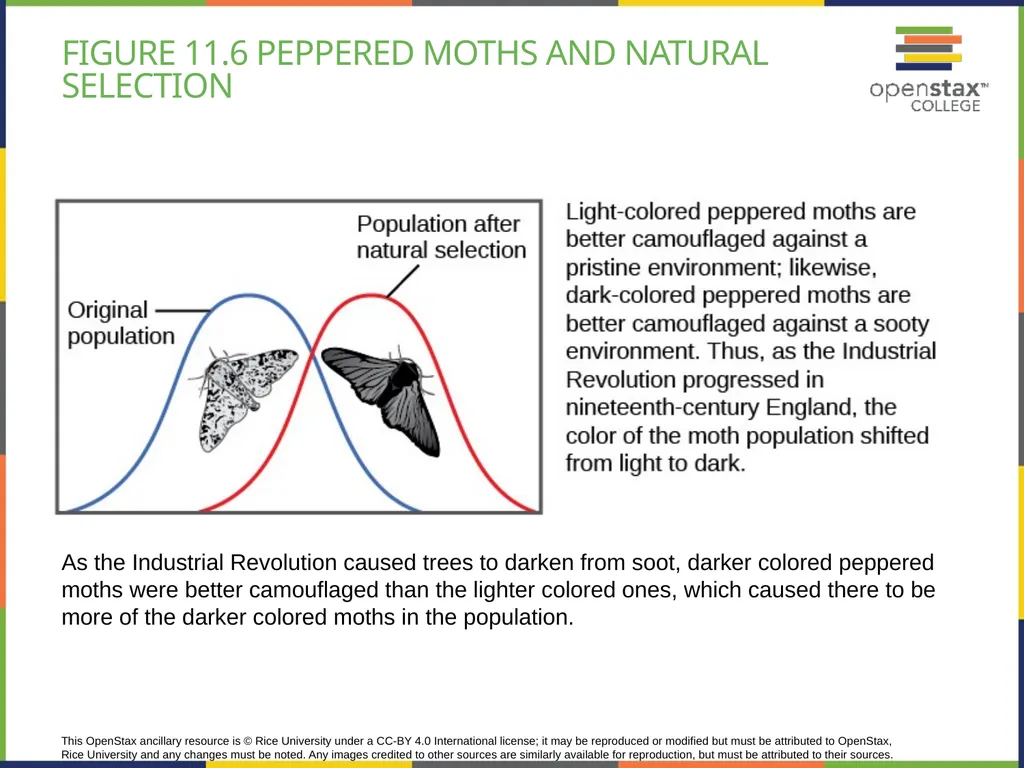
Microevolution is the gradual change in a population over time
Macroevolution is the process of giving rise to new species and higher taxonomic groups
Watch the video below for an example of microevolution caused by natural selection: the peppered moths https://www.youtube.com/watch?v=LyRA807djLc<br>
16
Figure 11.6 peppered moths and natural selection As the Industrial Revolution caused trees to darken from soot, darker colored peppered moths were better camouflaged than the lighter colored ones, which caused there to be more of the darker colored moths in the population. This OpenStax ancillary resource is © Rice University under a CC-BY 4.0 International license; it may be reproduced or modified but must be attributed to OpenStax, Rice University and any changes must be noted. Any images credited to other sources are similarly available for reproduction, but must be attributed to their sources.<br>
17
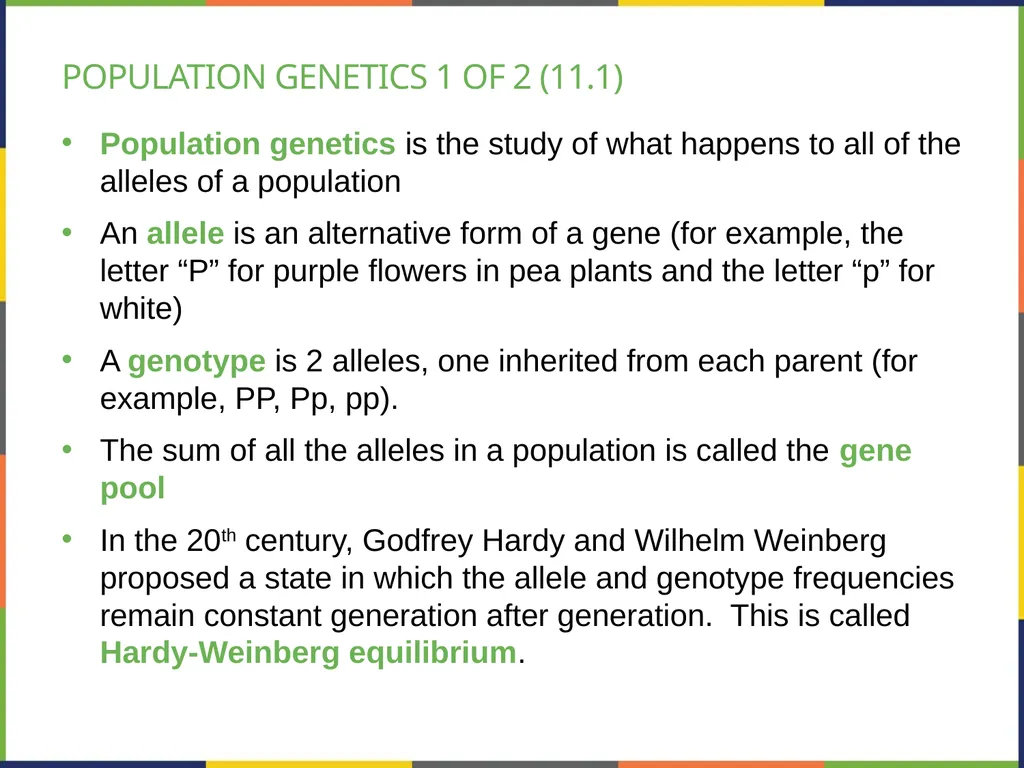
Population genetics 1 of 2 (11.1) Population genetics is the study of what happens to all of the alleles of a population
An allele is an alternative form of a gene (for example, the letter “P” for purple flowers in pea plants and the letter “p” for white)
A genotype is 2 alleles, one inherited from each parent (for example, PP, Pp, pp).
The sum of all the alleles in a population is called the gene pool
In the 20th century, Godfrey Hardy and Wilhelm Weinberg proposed a state in which the allele and genotype frequencies remain constant generation after generation. This is called Hardy-Weinberg equilibrium.<br>
18
Population genetics 2 of 2 (11.1) Hardy-Weinberg equilibrium does not occur in natural populations. Five evolutionary forces can disrupt this equilibrium, producing change::
Natural selection
Mutation
Gene flow (migration)
Genetic drift
Non-random mating
These are discussed in the next section.<br>
19
Mechanisms of evolution 1 of 5 (11.2) Natural selection has already been discussed.
The next slide mentions a special case of natural selection, sexual selection.
Mutation is a change in the DNA sequence of a gene and is the only source of new alleles in a population.
If it is a harmful mutation, the allele will be removed from the population and will be found in only low frequencies.
If it is a beneficial mutation, the allele will spread through the population and become more common.<br>
20
Mechanisms of evolution 2 of 5(11.2) Sexual selection is a special type of natural selection that affects an ability to mate and produce offspring
This can lead to dramatic traits that negatively influence survival but give their owners reproductive success.
Sexual selection occurs through
Male-male competition for mates
Female selection for mates
For example, large colorful feathers or elaborate courtship displays in male birds make them move obvious to predators (bad for survival) but are attractive to females (good for reproduction).<br>
21
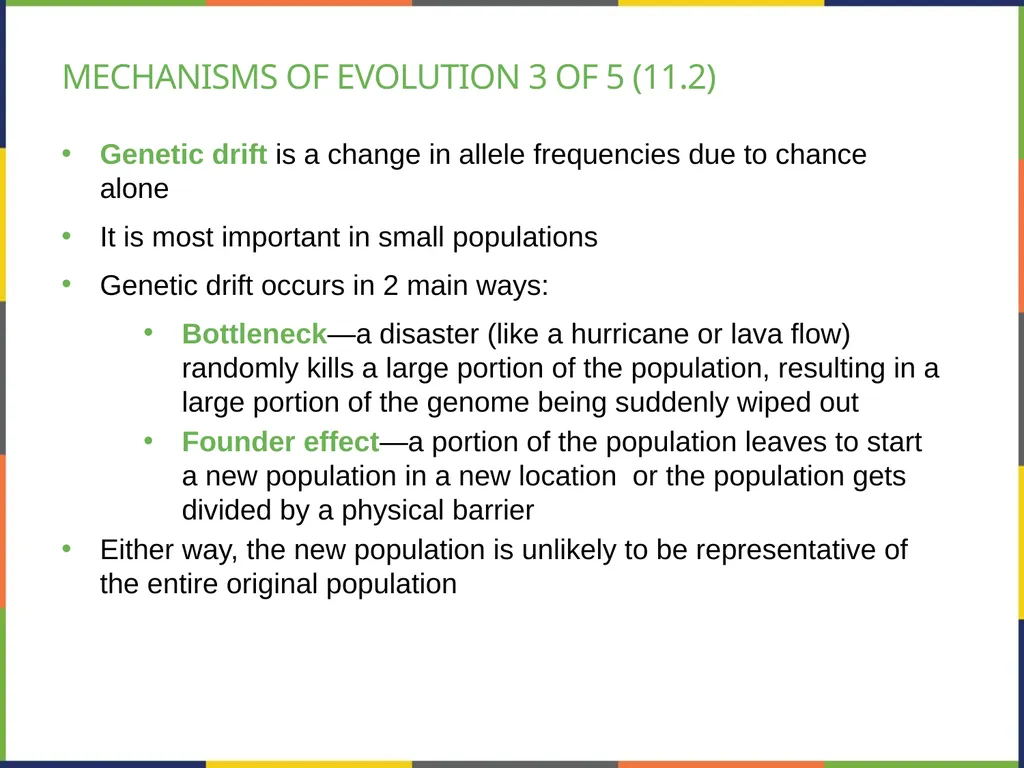
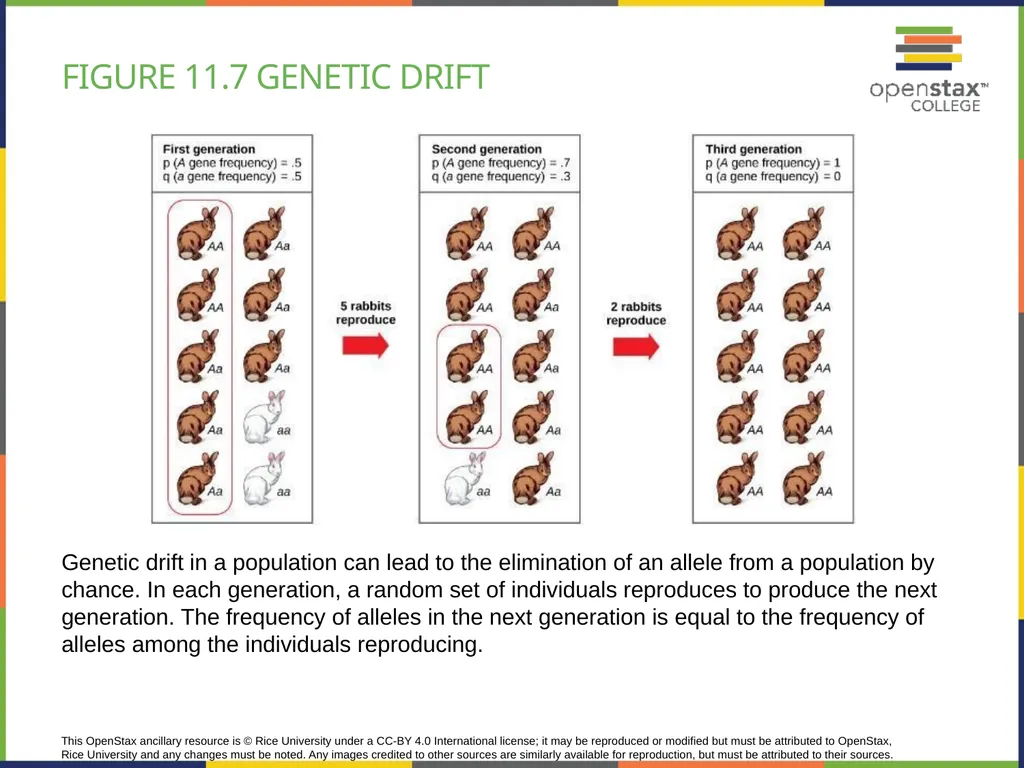
Mechanisms of evolution 3 of 5 (11.2) Genetic drift is a change in allele frequencies due to chance alone
It is most important in small populations
Genetic drift occurs in 2 main ways:
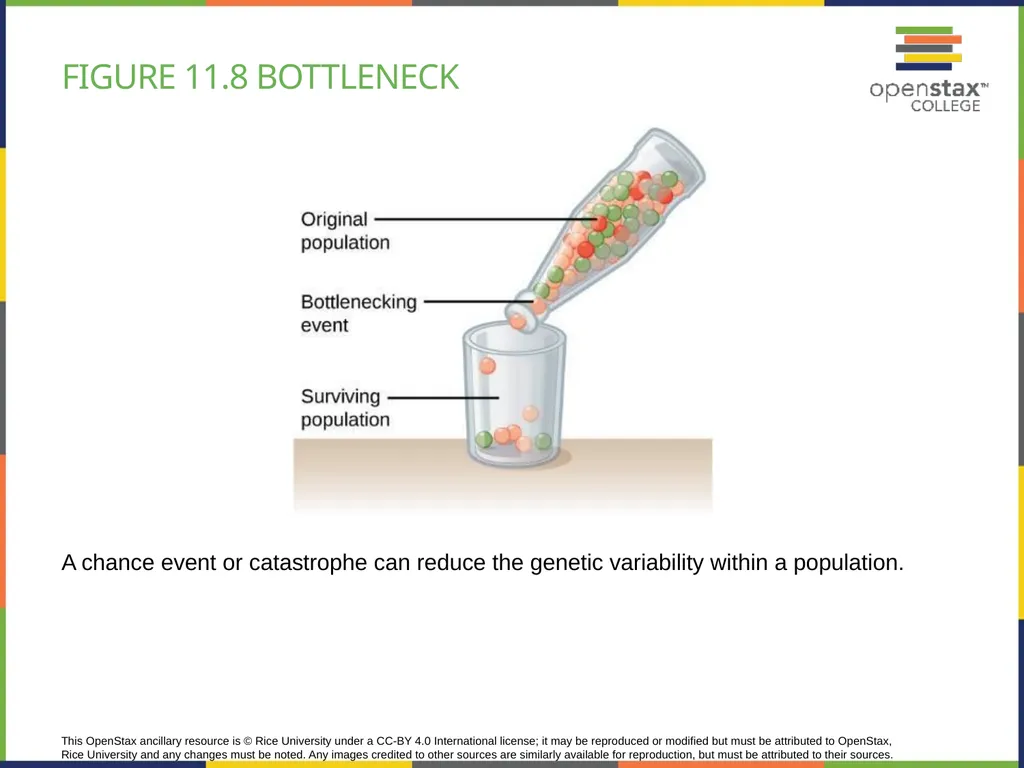
Bottleneck—a disaster (like a hurricane or lava flow) randomly kills a large portion of the population, resulting in a large portion of the genome being suddenly wiped out
Founder effect—a portion of the population leaves to start a new population in a new location or the population gets divided by a physical barrier
Either way, the new population is unlikely to be representative of the entire original population<br>
22
Figure 11.7 genetic drift Genetic drift in a population can lead to the elimination of an allele from a population by chance. In each generation, a random set of individuals reproduces to produce the next generation. The frequency of alleles in the next generation is equal to the frequency of alleles among the individuals reproducing. This OpenStax ancillary resource is © Rice University under a CC-BY 4.0 International license; it may be reproduced or modified but must be attributed to OpenStax, Rice University and any changes must be noted. Any images credited to other sources are similarly available for reproduction, but must be attributed to their sources.<br>
23
Figure 11.8 bottleneck A chance event or catastrophe can reduce the genetic variability within a population. This OpenStax ancillary resource is © Rice University under a CC-BY 4.0 International license; it may be reproduced or modified but must be attributed to OpenStax, Rice University and any changes must be noted. Any images credited to other sources are similarly available for reproduction, but must be attributed to their sources.<br>
24
Genetic drift Concepts in action Visit this site to learn more about genetic drift and to run simulations of allele changes caused by drift
http://openstaxcollege.org/l/genetic_drift2<br>
25
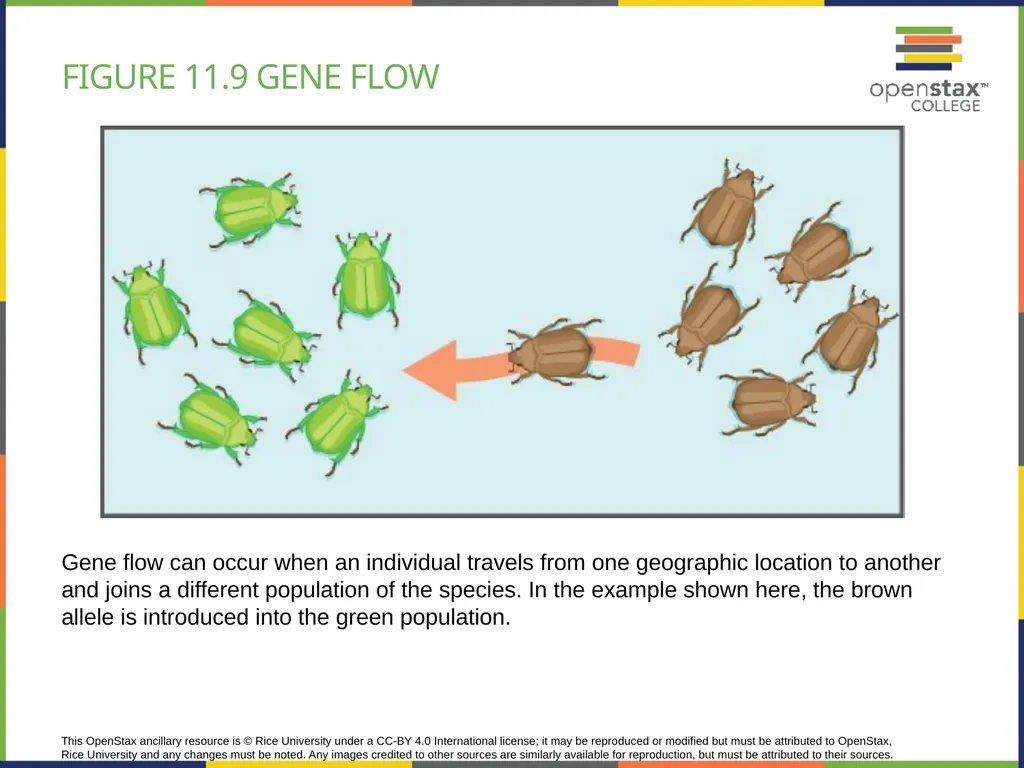
Mechanisms of evolution 4 of 5 (11.2) Gene flow is the flow of alleles into or out of a population resulting from the migration of individuals, gametes or immature forms.
For example
Many plants migrate far and wide through the use of pollen or seeds
Adult animals physically move from one location to another
Aquatic animals have gametes or larvae that float in the water
Fungus disperse spores on the wind<br>
26
Figure 11.9 gene flow Gene flow can occur when an individual travels from one geographic location to another and joins a different population of the species. In the example shown here, the brown allele is introduced into the green population. This OpenStax ancillary resource is © Rice University under a CC-BY 4.0 International license; it may be reproduced or modified but must be attributed to OpenStax, Rice University and any changes must be noted. Any images credited to other sources are similarly available for reproduction, but must be attributed to their sources.<br>
27
Mechanisms of evolution 5 of 5 (11.2) Non-random mating occurs when individuals choose to mate with like or unlike individuals rather than to mate at random
For example, inbreeding is a form of non-random mating in which organisms mate with like (even related) individuals
This mechanism will shift genotype frequencies (not allele frequencies)<br>
28
Evidence of evolution (11.3) Evidence of evolution comes from several sources:
Fossils
Anatomy
Embryology
Biogeography
Molecular biology<br>
29
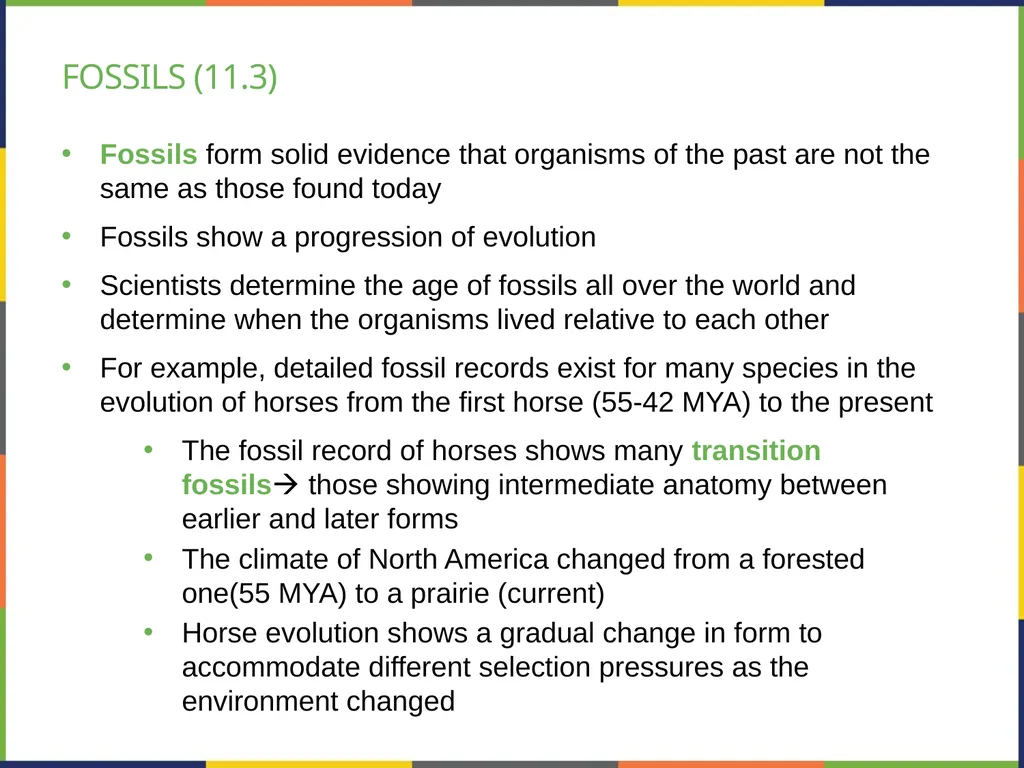
Fossils (11.3) Fossils form solid evidence that organisms of the past are not the same as those found today
Fossils show a progression of evolution
Scientists determine the age of fossils all over the world and determine when the organisms lived relative to each other
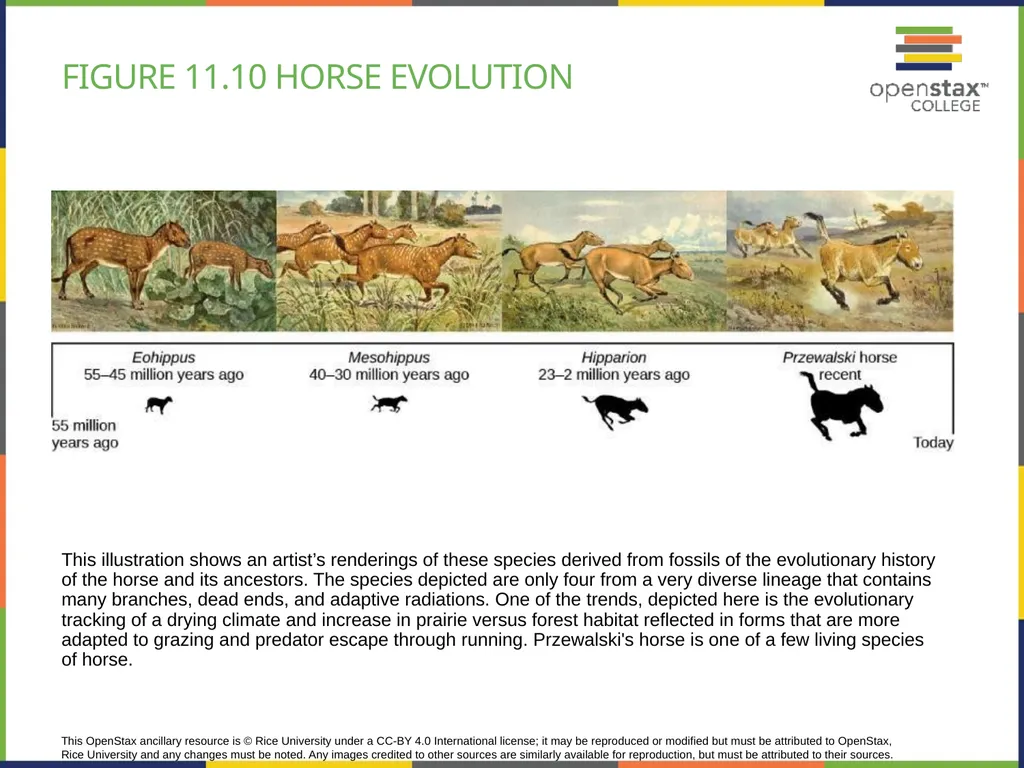
For example, detailed fossil records exist for many species in the evolution of horses from the first horse (55-42 MYA) to the present
The fossil record of horses shows many transition fossils those showing intermediate anatomy between earlier and later forms
The climate of North America changed from a forested one(55 MYA) to a prairie (current)
Horse evolution shows a gradual change in form to accommodate different selection pressures as the environment changed<br>
30
Figure 11.10 horse evolution This illustration shows an artist’s renderings of these species derived from fossils of the evolutionary history of the horse and its ancestors. The species depicted are only four from a very diverse lineage that contains many branches, dead ends, and adaptive radiations. One of the trends, depicted here is the evolutionary tracking of a drying climate and increase in prairie versus forest habitat reflected in forms that are more adapted to grazing and predator escape through running. Przewalski's horse is one of a few living species of horse. This OpenStax ancillary resource is © Rice University under a CC-BY 4.0 International license; it may be reproduced or modified but must be attributed to OpenStax, Rice University and any changes must be noted. Any images credited to other sources are similarly available for reproduction, but must be attributed to their sources.<br>
31
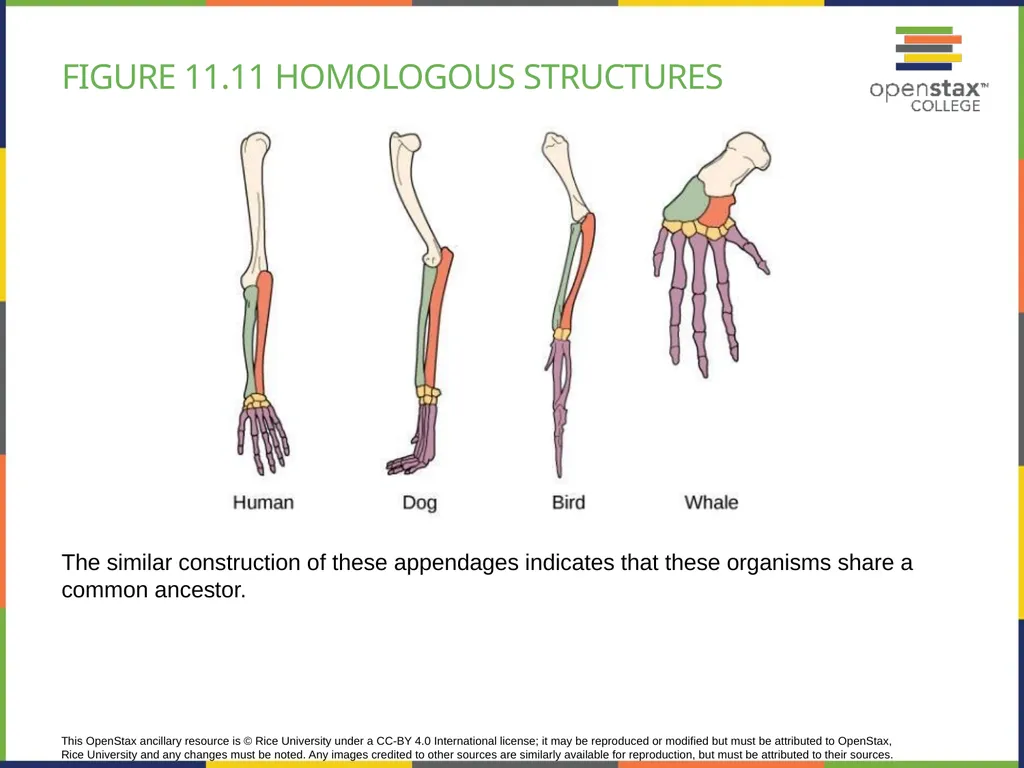
Anatomy and embryology 1 of 2 (11.3) Anatomy also provides evidence of evolution through homologous and vestigial structures
Homologous structures result from divergent evolution (11.1)
For example, the bones in the forelimb of a dog, human, bird, and whale all share the same construction even though they are used for different functions.
This results from their origin in a common ancestor
Vestigial structures exist but have no apparent function at all.
These structures exist because they are left over parts from a common ancestor in which they were used.
For example, some snakes have pelvic bones even though they have no legs. This is because snakes descended from a reptile that had legs.
Other examples are wings on flightless birds and cave animals that have sightless eyes.<br>
32
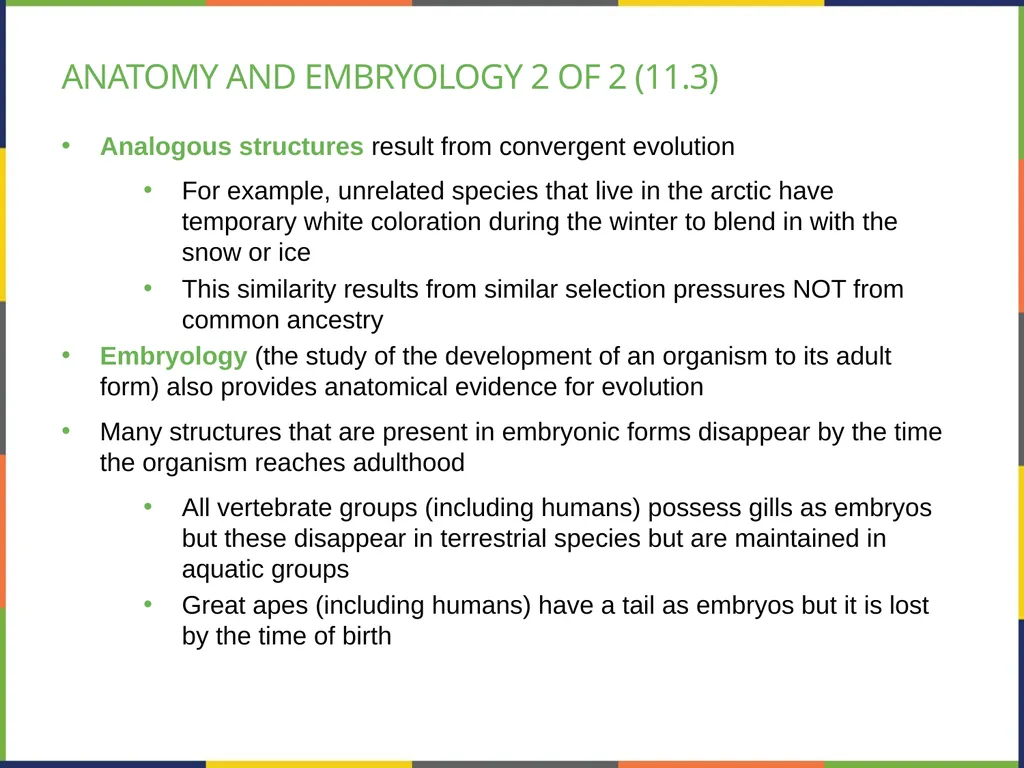
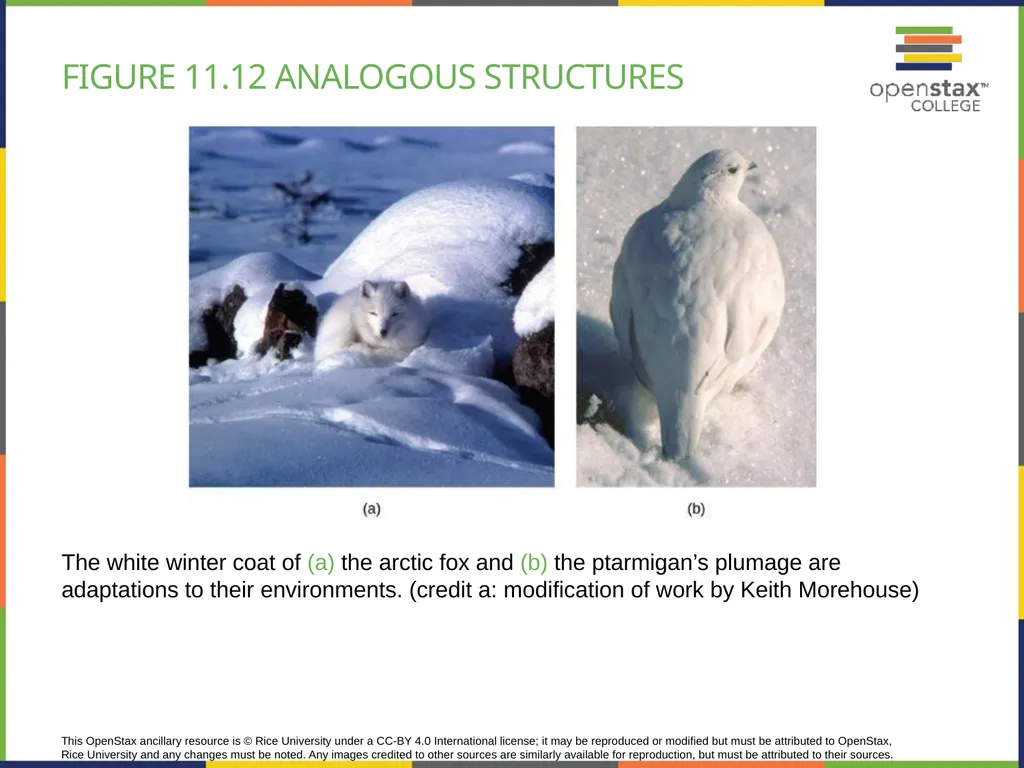
Anatomy and embryology 2 of 2 (11.3) Analogous structures result from convergent evolution
For example, unrelated species that live in the arctic have temporary white coloration during the winter to blend in with the snow or ice
This similarity results from similar selection pressures NOT from common ancestry
Embryology (the study of the development of an organism to its adult form) also provides anatomical evidence for evolution
Many structures that are present in embryonic forms disappear by the time the organism reaches adulthood
All vertebrate groups (including humans) possess gills as embryos but these disappear in terrestrial species but are maintained in aquatic groups
Great apes (including humans) have a tail as embryos but it is lost by the time of birth<br>
33
Figure 11.11 homologous structures The similar construction of these appendages indicates that these organisms share a common ancestor. This OpenStax ancillary resource is © Rice University under a CC-BY 4.0 International license; it may be reproduced or modified but must be attributed to OpenStax, Rice University and any changes must be noted. Any images credited to other sources are similarly available for reproduction, but must be attributed to their sources.<br>
34
Bone structure Concepts in action Click through the activities using the link below to guess which bone structures are homologous and which are analogous and to see examples of evolutionary adaptations that illustrate these concepts:
http://openstaxcollege.org/l/bone_structure2<br>
35
Figure 11.12 analogous structures The white winter coat of (a) the arctic fox and (b) the ptarmigan’s plumage are adaptations to their environments. (credit a: modification of work by Keith Morehouse) This OpenStax ancillary resource is © Rice University under a CC-BY 4.0 International license; it may be reproduced or modified but must be attributed to OpenStax, Rice University and any changes must be noted. Any images credited to other sources are similarly available for reproduction, but must be attributed to their sources.<br>
36
Biogeography (11.3) Biogeography is the study of the geographic distribution of organisms on the planet
The geographic distribution of organisms is best explained by the movement of tectonic plates over geological time
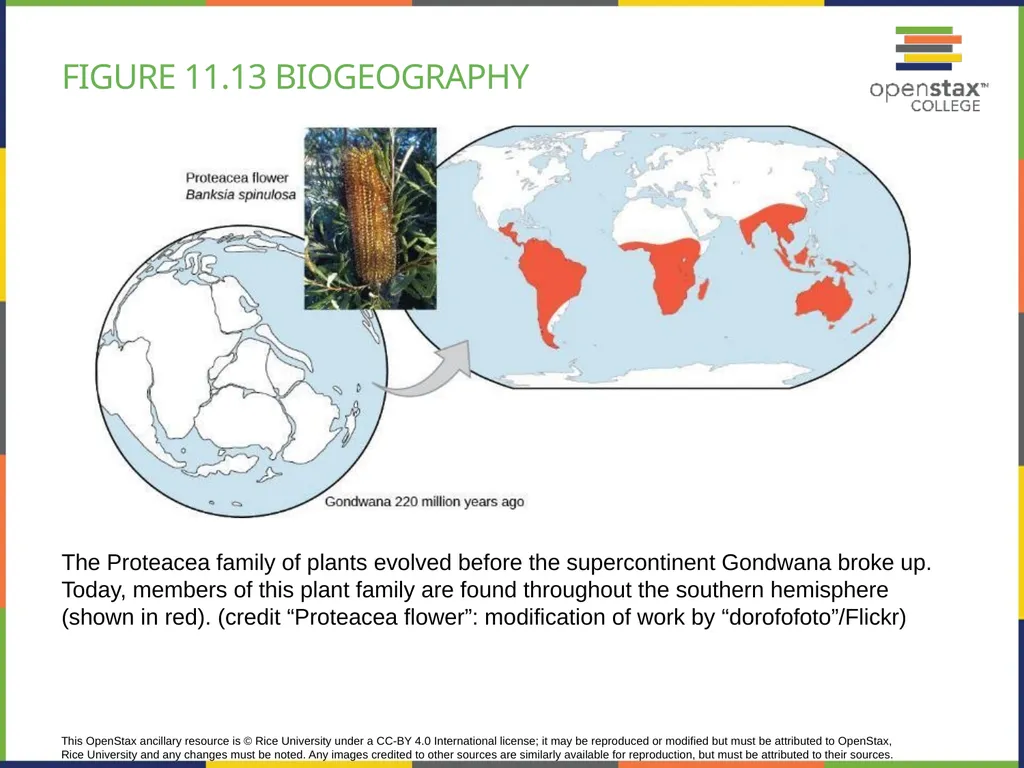
There was a supercontinent called Gondwana that existed about 1 billion to 500 million years ago
It collided with another landmass to form a supercontinent called Pangea
Broad groups that evolved before the breakup of Pangea (200 MYA) are distributed worldwide
Groups that evolved since the breakup are distributed uniquely in regions of the planet
For example, the Proteacea family of plants is found throughout the southern hemisphere<br>
37
Figure 11.13 biogeography The Proteacea family of plants evolved before the supercontinent Gondwana broke up. Today, members of this plant family are found throughout the southern hemisphere (shown in red). (credit “Proteacea flower”: modification of work by “dorofofoto”/Flickr) This OpenStax ancillary resource is © Rice University under a CC-BY 4.0 International license; it may be reproduced or modified but must be attributed to OpenStax, Rice University and any changes must be noted. Any images credited to other sources are similarly available for reproduction, but must be attributed to their sources.<br>
38
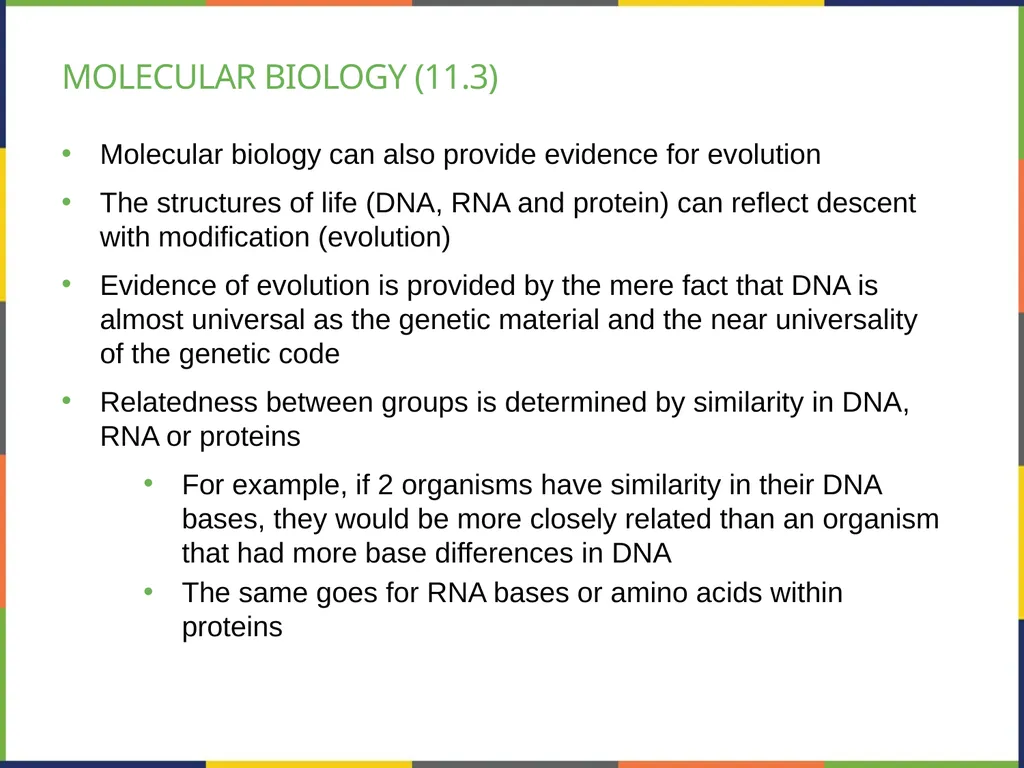
Molecular biology (11.3) Molecular biology can also provide evidence for evolution
The structures of life (DNA, RNA and protein) can reflect descent with modification (evolution)
Evidence of evolution is provided by the mere fact that DNA is almost universal as the genetic material and the near universality of the genetic code
Relatedness between groups is determined by similarity in DNA, RNA or proteins
For example, if 2 organisms have similarity in their DNA bases, they would be more closely related than an organism that had more base differences in DNA
The same goes for RNA bases or amino acids within proteins<br>
39
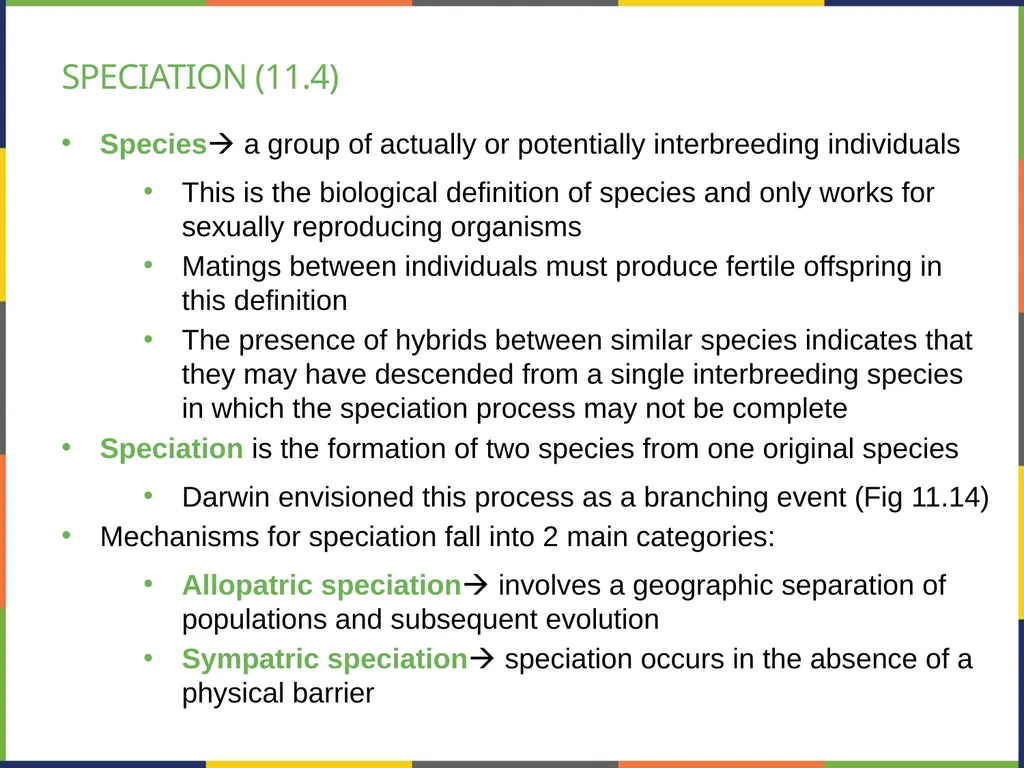
Speciation (11.4) Species a group of actually or potentially interbreeding individuals
This is the biological definition of species and only works for sexually reproducing organisms
Matings between individuals must produce fertile offspring in this definition
The presence of hybrids between similar species indicates that they may have descended from a single interbreeding species in which the speciation process may not be complete
Speciation is the formation of two species from one original species
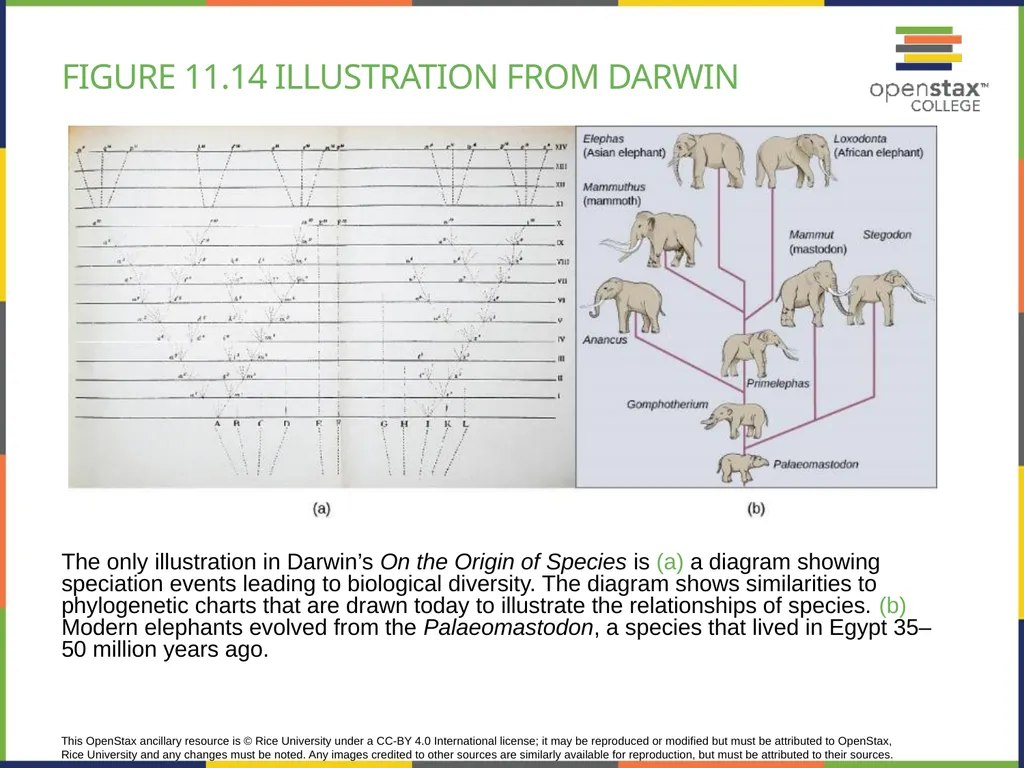
Darwin envisioned this process as a branching event (Fig 11.14)
Mechanisms for speciation fall into 2 main categories:
Allopatric speciation involves a geographic separation of populations and subsequent evolution
Sympatric speciation speciation occurs in the absence of a physical barrier<br>
40
Figure 11.14 illustration from Darwin The only illustration in Darwin’s On the Origin of Species is (a) a diagram showing speciation events leading to biological diversity. The diagram shows similarities to phylogenetic charts that are drawn today to illustrate the relationships of species. (b) Modern elephants evolved from the Palaeomastodon, a species that lived in Egypt 35–50 million years ago. This OpenStax ancillary resource is © Rice University under a CC-BY 4.0 International license; it may be reproduced or modified but must be attributed to OpenStax, Rice University and any changes must be noted. Any images credited to other sources are similarly available for reproduction, but must be attributed to their sources.<br>
41
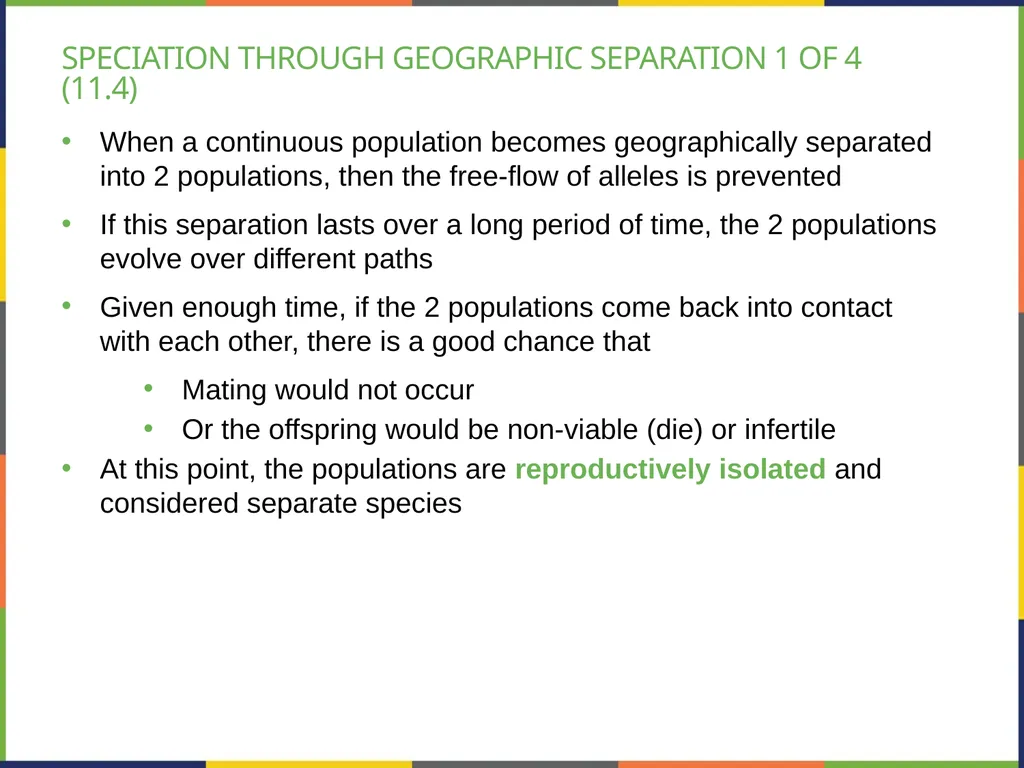
Speciation through geographic separation 1 of 4 (11.4) When a continuous population becomes geographically separated into 2 populations, then the free-flow of alleles is prevented
If this separation lasts over a long period of time, the 2 populations evolve over different paths
Given enough time, if the 2 populations come back into contact with each other, there is a good chance that
Mating would not occur
Or the offspring would be non-viable (die) or infertile
At this point, the populations are reproductively isolated and considered separate species<br>
42
Speciation through geographic separation 2 of 4 (11.4) Many factors can cause reproductive isolation and are grouped into 2 categories:
Prezygotic (those that occur before fertilization)
Postzygotic (those that occur after fertilization)
Prezygotic mechanisms include
Timing of mating
Courtship rituals
Sensitivity to pheromones
Location of mating
Physical incompatibilities
Postzygotic mechanisms include
A hybrid offspring dies or has low survivorship
A hybrid offspring is infertile (like a mule)<br>
43
Speciation through geographic separation 3 of 4 (11.4) Isolation of populations leading to allopatric speciation can be through
A river forms a new branch
Seeds float across the ocean to an island
Erosion forms a new valley
Scientists have documented numerous cases
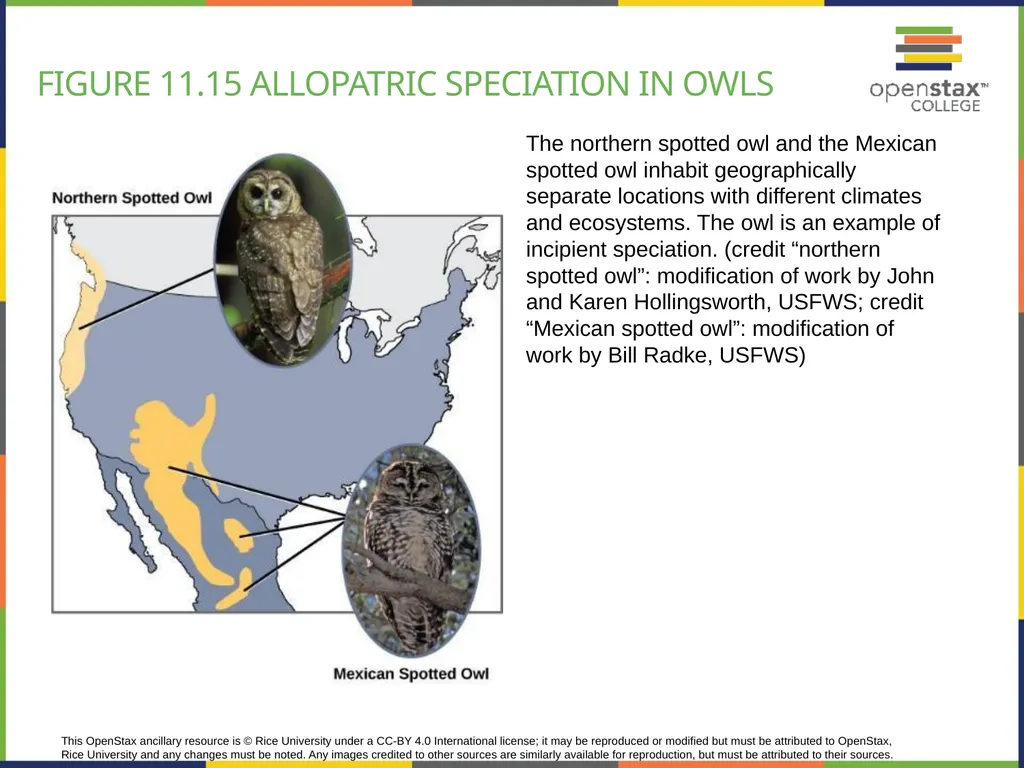
For example, two subspecies of spotted owls exist along the west coast of the US (Figure 11.15)
The further the distance between groups that were once the same species, the more likely for speciation to occur.<br>
44
Figure 11.15 allopatric speciation in owls The northern spotted owl and the Mexican spotted owl inhabit geographically separate locations with different climates and ecosystems. The owl is an example of incipient speciation. (credit “northern spotted owl”: modification of work by John and Karen Hollingsworth, USFWS; credit “Mexican spotted owl”: modification of work by Bill Radke, USFWS) This OpenStax ancillary resource is © Rice University under a CC-BY 4.0 International license; it may be reproduced or modified but must be attributed to OpenStax, Rice University and any changes must be noted. Any images credited to other sources are similarly available for reproduction, but must be attributed to their sources.<br>
45
Speciation through geographic separation
4 of 4 (11.4) In some cases, a population of one species disperses throughout an area and each group finds a distinct niche or isolated habitat
Over time, multiple speciation events may occur originating from a single species
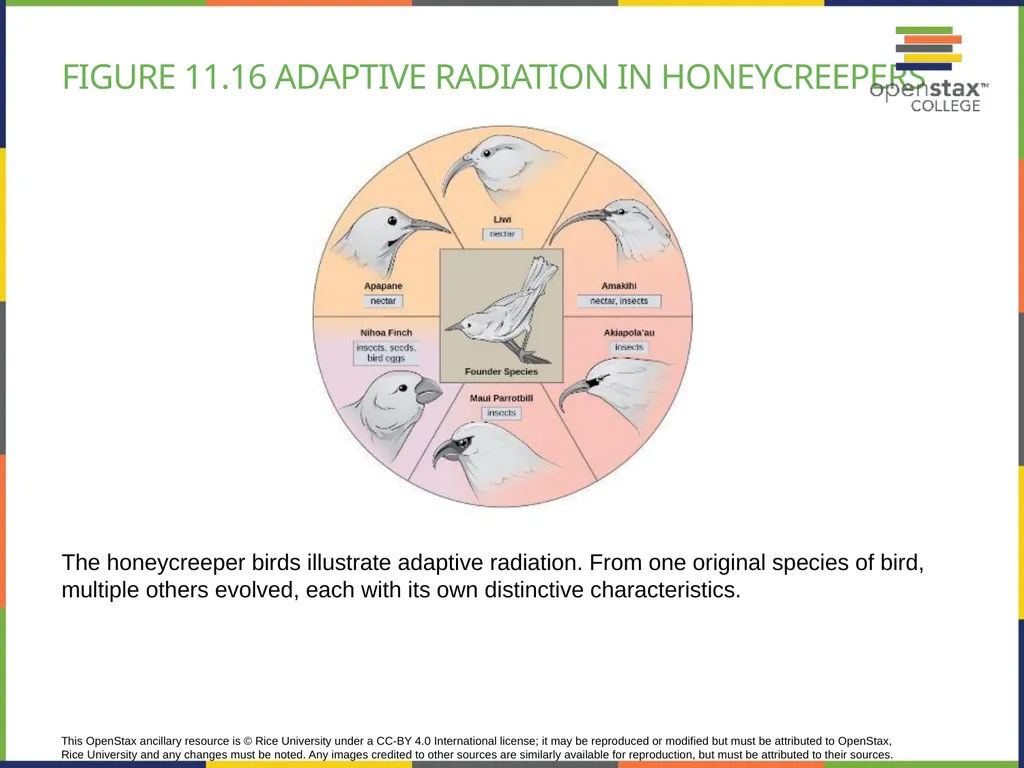
This is called adaptive radiation
Island chains like the Hawaiian Islands provide ideal contexts for adaptive radiations to occur
For example, the honeycreeper birds of the Hawaiian Islands (Figure 11.16)
Honeycreeper birds differ in their beaks
The beaks were modified to suit the specific food source they were utilizing on their island
The same type of adaptive radiation occurred on the Galapagos Islands with Darwin’s finches<br>
46
Figure 11.16 adaptive radiation in honeycreepers The honeycreeper birds illustrate adaptive radiation. From one original species of bird, multiple others evolved, each with its own distinctive characteristics. This OpenStax ancillary resource is © Rice University under a CC-BY 4.0 International license; it may be reproduced or modified but must be attributed to OpenStax, Rice University and any changes must be noted. Any images credited to other sources are similarly available for reproduction, but must be attributed to their sources.<br>
47
Bird evolution Concepts in action Click through is interactive site to see how island birds evolved; click to see images of each species in evolutionary increments from 5 MYA to today :
http://openstaxcollege.org/l/bird_evolution<br>
48
Speciation without geographic separation 1 of 2 (11.4) A number of mechanisms for sympatric speciation have been proposed and studied.
One form can begin with a chromosomal error during meiosis or through the formation of a hybrid individual with too many chromosomes.
Polyploidy is a condition in which a cell or organism has an extra set (or sets) of chromosomes
Two main types of polyploidy exist:
Autopolyploidy occurs when an individual has 2 or more sets of chromosomes from its own species
Allopolyploidy occurs when individuals from 2 different species reproduce to produce viable offspring<br>
49
Speciation without geographic separation
2 of 2 (11.4) Polyploidy is rare in animals because an abnormal chromosome number is usually lethal.
Polyploidy occurs often in plants. Many of our crops including wheat, cotton, strawberries and tobacco are polyploids.
Scientists have discovered that ½ of all plant species have had a polyploid episode in the past.<br>
50
Figure 11.17 sympatric speciation
through autoploidy Autopolyploidy results when mitosis is not followed by cytokinesis. This OpenStax ancillary resource is © Rice University under a CC-BY 4.0 International license; it may be reproduced or modified but must be attributed to OpenStax, Rice University and any changes must be noted. Any images credited to other sources are similarly available for reproduction, but must be attributed to their sources.<br>
51
Figure 11.18 sympatric speciation
through alloploidy Alloploidy results when two species mate to produce viable offspring. In the example shown, a normal gamete from one species fuses with a polyploid gamete from another. Two matings are necessary to produce viable offspring. This OpenStax ancillary resource is © Rice University under a CC-BY 4.0 International license; it may be reproduced or modified but must be attributed to OpenStax, Rice University and any changes must be noted. Any images credited to other sources are similarly available for reproduction, but must be attributed to their sources.<br>
52
Speciation without geographic separation 3 of 3 (11.4) Another form of sympatric speciation occurs when organisms evolve to utilize different resources (foods for example) within the same geographic area.
If the organisms interact less and less, genetic differences would tend to accumulate between them and speciation could occur.
For example, the cichlids of Lake Victoria (a large lake in Africa) underwent hundreds of speciation events within the same lake over time (Figure 11.19) because they utilized different food sources.
Another example is the apple maggot fly. This fly tends to feed on and mate in hawthorn trees in North America.
In the 19th century, the hawthorn population jumped hosts and began to mate in and feed on the apple trees.
Measurable differences accumulated between the 2 fly populations since then.
The 2 populations are separated by host species, not geography.<br>
53
Figure 11.19 sympatric speciation
in cichlids Cichlid fish from Lake Apoyeque, Nicaragua, show evidence of sympatric speciation. Lake Apoyeque, a crater lake, is 1800 years old, but genetic evidence indicates that the lake was populated only 100 years ago by a single population of cichlid fish. Nevertheless, two populations with distinct morphologies and diets now exist in the lake, and scientists believe these populations may be in an early stage of speciation. sympatric speciation
through autoploidy This OpenStax ancillary resource is © Rice University under a CC-BY 4.0 International license; it may be reproduced or modified but must be attributed to OpenStax, Rice University and any changes must be noted. Any images credited to other sources are similarly available for reproduction, but must be attributed to their sources.<br>
54
Common misconceptions about evolution
1 of 6 (11.5) Evolution is “just a theory”
This misconception lies in the fact that most people do not know what the term theory means to a scientist
In everyday speech, the word theory means a guess or tentative explanation
BUT, in science, the word theory is a concept that has been extensively tested and supported over time.
In science, the word theory expresses ideas of which scientists are most certain.
Other theories include the theory of relativity, the atomic theory, the cell theory, the theory of gravity, etc.<br>
55
Common misconceptions about evolution
2 of 6 (11.5) Individuals evolve
An individual is born with the genes it has—these do not change.
Evolution is the change in a population over time.
Individuals cannot evolve or adapt through natural selection; populations can.
Any change that an individual undergoes during its lifetime is called development.<br>
56
Common misconceptions about evolution
3 of 6 (11.5) Evolution explains the origin of life
Evolution DOES NOT try to explain the origin of life
Evolution explains how populations change over time and how new species originate
Evolution does not try to shed light on the origin of the first cells, which is how life is defined
The early stages of life included
Formation of organic molecules
Formation of genetic material (DNA or RNA)
Collection of these molecules into enclosed structures (pre-cells)
Evolution comes into play after pre-cells assembled<br>
57
Common misconceptions about evolution
4 of 6 (11.5) Organisms evolve on purpose
Keep in mind that individual organisms do not evolve; populations (groups of interbreeding organisms) do
Evolution is not intentional. Individuals with adaptations that better suit them to their environment will leave more offspring in the next generation, causing change over time (evolution).
The variation that natural selection acts on is already in a population and does not arise in response to an environmental change.
For example, bacteria can become antibiotic resistant over time when exposed to antibiotics. The resistance was already present in the gene pool of the bacteria. Evolution occurs because the resistant bacteria are the survivors.
Also, a trait that is beneficial in one environment could be harmful or even lethal in another. Evolution is not goal directed.<br>
58
Common misconceptions about evolution
5 of 6 (11.5) Evolution is controversial among scientists
Evolution was controversial when first proposed in 1859
Within 20 years, it was accepted by virtually every biologist , largely because Darwin had collected an impressive body of evidence
Only the arguments of religious leaders have persisted to today….however
Most of the major religious denominations in the US today have statements supporting the acceptance of evolution as compatible with their theologies
A recent poll (1997) found that 97% of the 2500 scientists polled believe that species evolve
Of the 3% of them that questioned evolution, most were non-biologists (physicians, chemists, engineers)<br>
59
Common misconceptions about evolution
6 of 6 (11.5) Other theories should be taught
A common argument among some religious leaders is that alternative theories to evolution should be taught in public schools.
In fact, there are no viable alternative scientific theories to evolution.
The last theory on evolution was Lamarck’s inheritance of acquired characteristics proposed and discredited in the 19th century and replaced by Darwin’s theory of evolution by natural selection
Intelligent design is not a scientific explanation
The theory of evolution (and science in general) is silent on the existence or non-existence of the spiritual world. Some biologists are atheists but there are also some deeply religious biologists.<br>
60
Evolution misconceptions
Concepts in action This website addresses some of the main misconceptions associated with the theory of evolution.
http://openstaxcollege.org/l/misconception2<br>
61
Vocabulary Adaptation
Adaptive radiation
Allopatric speciation
Analogous structure
Bottleneck effect
Convergent evolution
Divergent evolution
Founder effect
Gene flow
Gene pool
Genetic drift
Homologous structure
Inheritance of acquired characteristics
Macroevolution
Microevolution
Migration
Modern synthesis
Natural selection
Population genetics
Speciation
Sympatric speciation
Variation
Vestigial structure<br>