
Concepts of Engineering and Technology Ethics in
EM
Published · 33 slides · 0 views

1 / 1

Description
Concepts of Engineering and Technology Ethics in the Engineering Workplace Society and Ethics Introduction In this lesson we will explore Ethics in the Engineering Workplace. We understand the Code of Ethics for Engineers. We will learn
Related Topics
Share
Embed code
Download this presentation From Below
"Concepts of Engineering and Technology Ethics in" is the property of its rightful owner. Permission is granted to download and print the materials on this website for personal, non-commercial use only, and to display it on your personal computer provided you do not modify the materials and that you retain all copyright notices contained in the materials. By downloading content from our website, you accept the terms of this agreement.
Presentation Transcript
01
Concepts of Engineering and Technology
Ethics in the Engineering Workplace
Society and Ethics<br>
Ethics in the Engineering Workplace
Society and Ethics<br>
02
Introduction In this lesson we will explore “Ethics in the Engineering Workplace”. We understand the Code of Ethics for Engineers.
We will learn about the National Society of Professional Engineers (NSPE) and National Institute for Engineering Ethics (NIEE).
We will conclude our lesson with the Gilbane Gold Engineering Ethics Case Study.<br>
We will learn about the National Society of Professional Engineers (NSPE) and National Institute for Engineering Ethics (NIEE).
We will conclude our lesson with the Gilbane Gold Engineering Ethics Case Study.<br>
03
Technical Communication 130.362.4 The student describes the factors that affect the progression of technology and the potential intended and unintended consequences of technological advances.
(A) Describe how technology has affected individuals, societies, cultures, economies, and environments.<br>
(A) Describe how technology has affected individuals, societies, cultures, economies, and environments.<br>
04
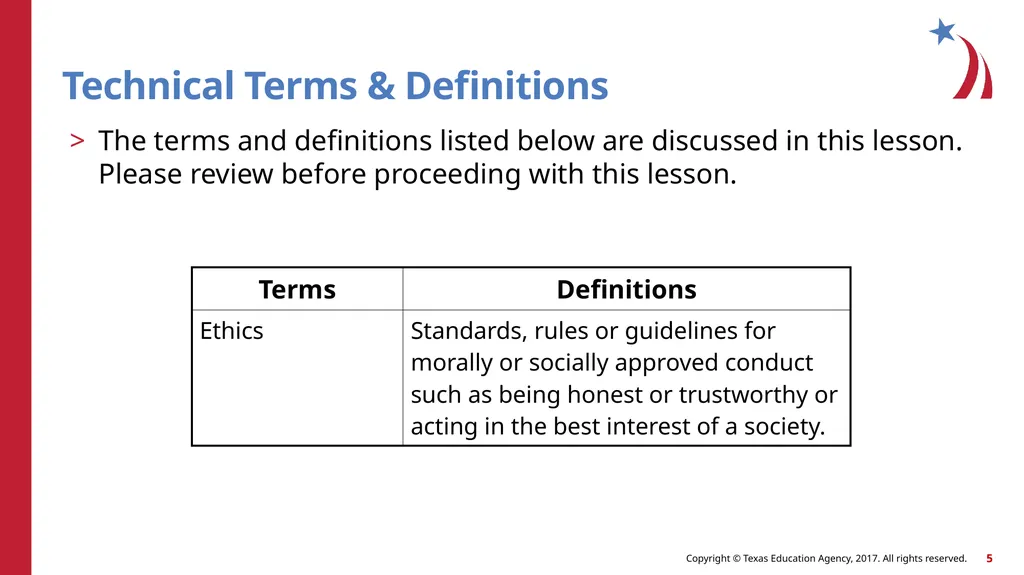
Technical Terms & Definitions The terms and definitions listed below are discussed in this lesson. Please review before proceeding with this lesson.<br>
05
Technical Terms & Definitions The terms and definitions listed below are discussed in this lesson. Please review before proceeding with this lesson.<br>
06
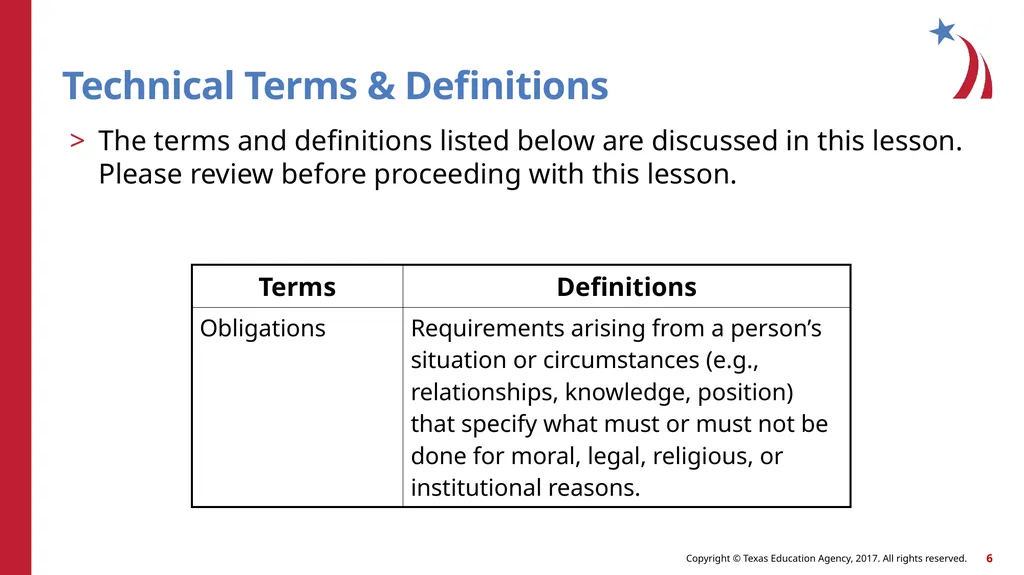
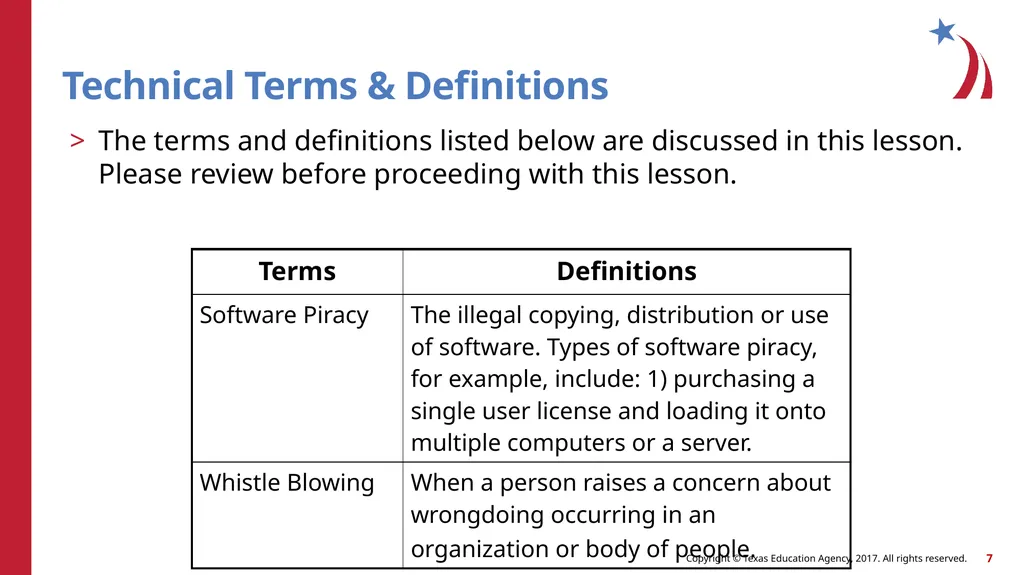
Technical Terms & Definitions The terms and definitions listed below are discussed in this lesson. Please review before proceeding with this lesson.<br>
07
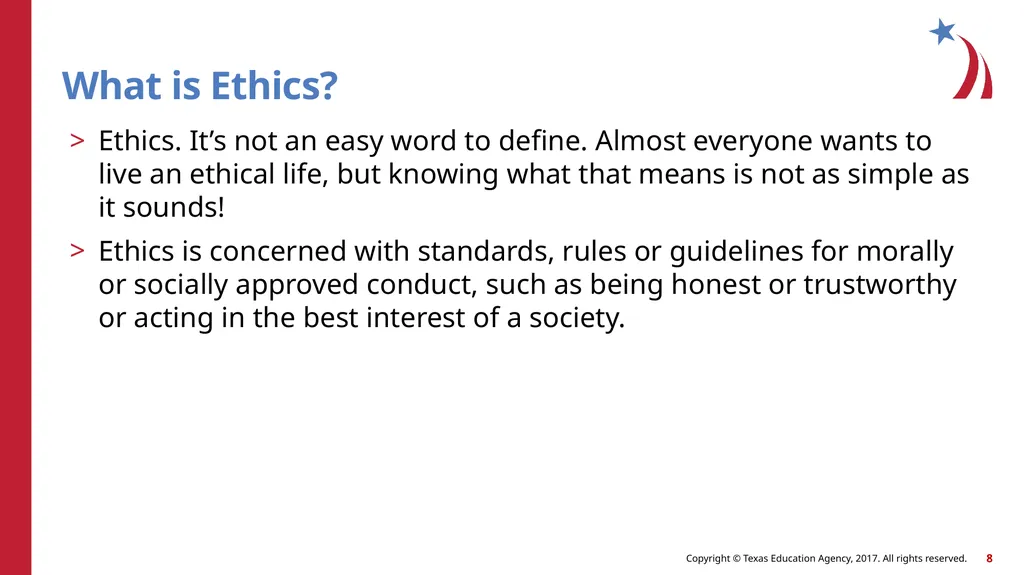
What is Ethics? Ethics. It’s not an easy word to define. Almost everyone wants to live an ethical life, but knowing what that means is not as simple as it sounds!
Ethics is concerned with standards, rules or guidelines for morally or socially approved conduct, such as being honest or trustworthy or acting in the best interest of a society.<br>
Ethics is concerned with standards, rules or guidelines for morally or socially approved conduct, such as being honest or trustworthy or acting in the best interest of a society.<br>
08
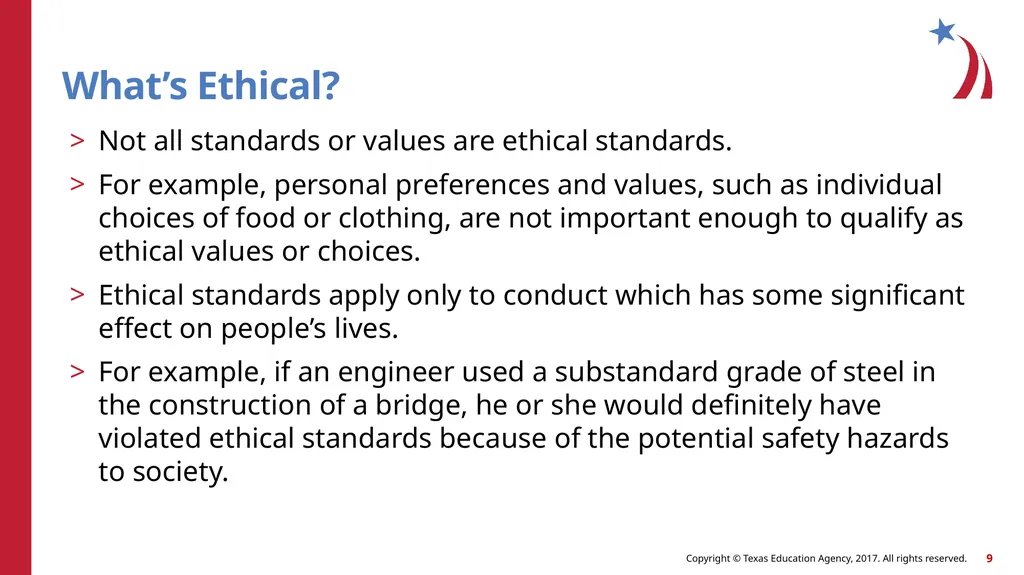
What’s Ethical? Not all standards or values are ethical standards.
For example, personal preferences and values, such as individual choices of food or clothing, are not important enough to qualify as ethical values or choices.
Ethical standards apply only to conduct which has some significant effect on people’s lives.
For example, if an engineer used a substandard grade of steel in the construction of a bridge, he or she would definitely have violated ethical standards because of the potential safety hazards to society.<br>
For example, personal preferences and values, such as individual choices of food or clothing, are not important enough to qualify as ethical values or choices.
Ethical standards apply only to conduct which has some significant effect on people’s lives.
For example, if an engineer used a substandard grade of steel in the construction of a bridge, he or she would definitely have violated ethical standards because of the potential safety hazards to society.<br>
09
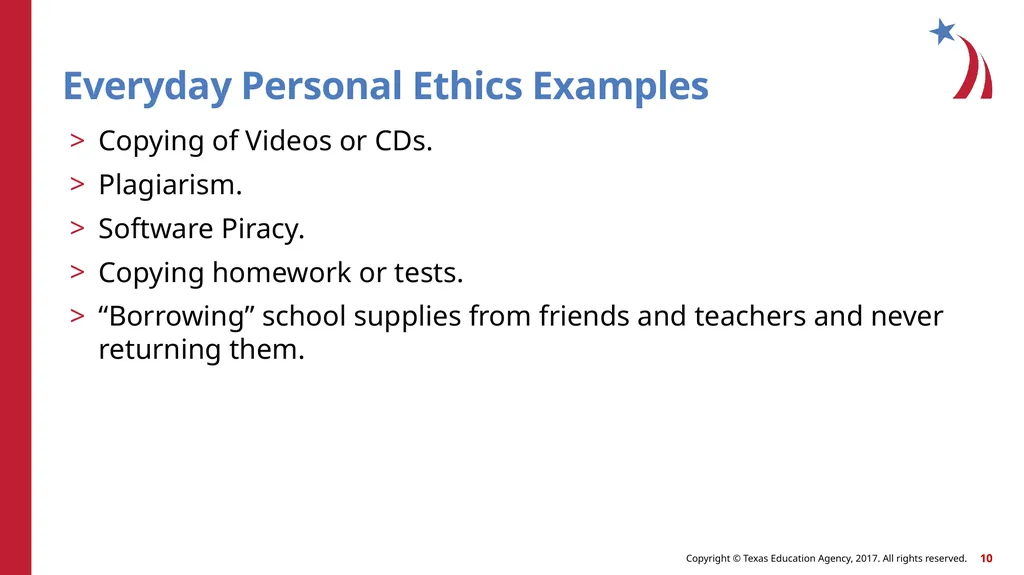
Everyday Personal Ethics Examples Copying of Videos or CDs.
Plagiarism.
Software Piracy.
Copying homework or tests.
“Borrowing” school supplies from friends and teachers and never returning them.<br>
Plagiarism.
Software Piracy.
Copying homework or tests.
“Borrowing” school supplies from friends and teachers and never returning them.<br>
10
Class Discussion on
Ethics<br>
Ethics<br>
11
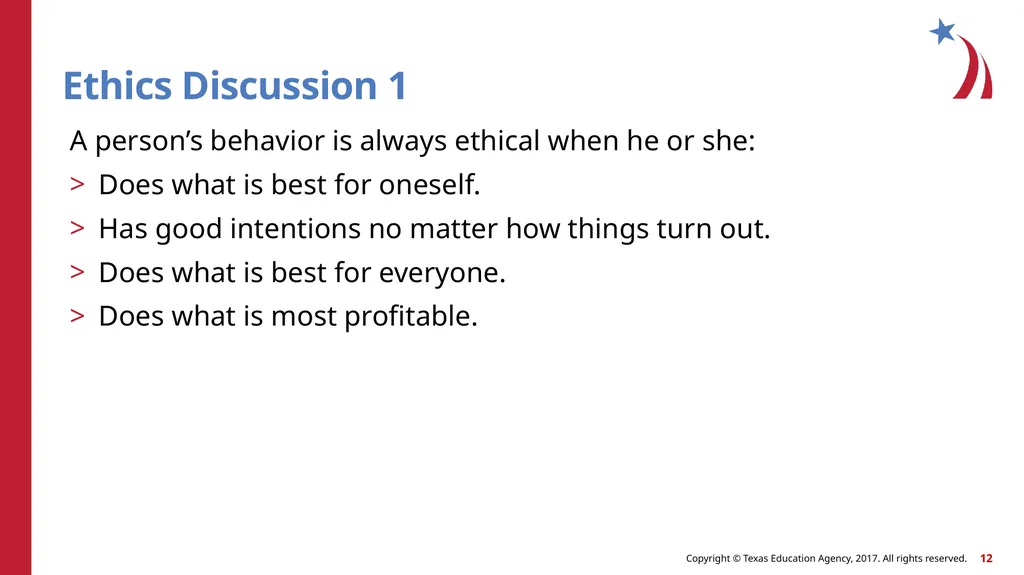
Ethics Discussion 1 A person’s behavior is always ethical when he or she:
Does what is best for oneself.
Has good intentions no matter how things turn out.
Does what is best for everyone.
Does what is most profitable.<br>
Does what is best for oneself.
Has good intentions no matter how things turn out.
Does what is best for everyone.
Does what is most profitable.<br>
12
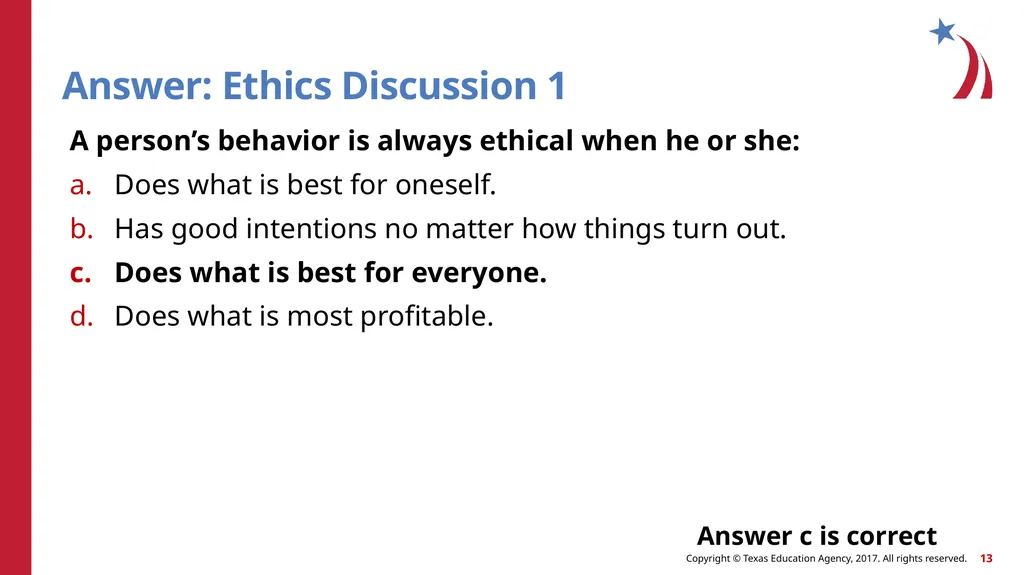
Answer: Ethics Discussion 1 A person’s behavior is always ethical when he or she:
Does what is best for oneself.
Has good intentions no matter how things turn out.
Does what is best for everyone.
Does what is most profitable. Answer c is correct<br>
Does what is best for oneself.
Has good intentions no matter how things turn out.
Does what is best for everyone.
Does what is most profitable. Answer c is correct<br>
13
Engineers and Ethics Engineers are expected to have technical expertise and to exhibit professionalism. They are also expected by society and their profession to maintain high standards of ethical conduct in their professional lives.<br>
14
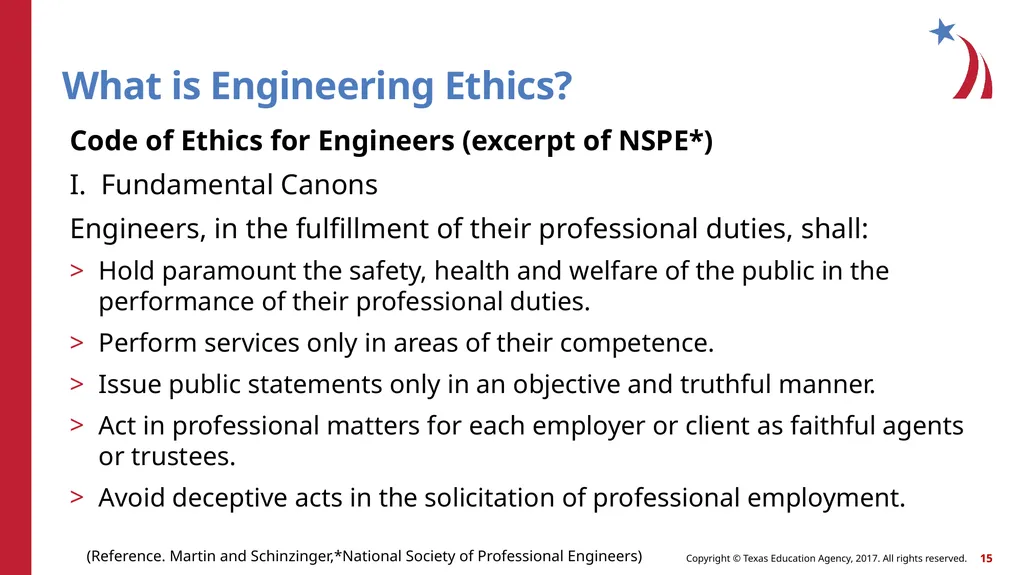
What is Engineering Ethics? Code of Ethics for Engineers (excerpt of NSPE*)
I. Fundamental Canons
Engineers, in the fulfillment of their professional duties, shall:
Hold paramount the safety, health and welfare of the public in the performance of their professional duties.
Perform services only in areas of their competence.
Issue public statements only in an objective and truthful manner.
Act in professional matters for each employer or client as faithful agents or trustees.
Avoid deceptive acts in the solicitation of professional employment. (Reference. Martin and Schinzinger,*National Society of Professional Engineers)<br>
I. Fundamental Canons
Engineers, in the fulfillment of their professional duties, shall:
Hold paramount the safety, health and welfare of the public in the performance of their professional duties.
Perform services only in areas of their competence.
Issue public statements only in an objective and truthful manner.
Act in professional matters for each employer or client as faithful agents or trustees.
Avoid deceptive acts in the solicitation of professional employment. (Reference. Martin and Schinzinger,*National Society of Professional Engineers)<br>
15
Class Discussion on
Engineering Ethics<br>
Engineering Ethics<br>
16
Engineering Ethics Discussion 1 Engineers should follow their professional ethics code because:
It helps them avoid legal problems, such as getting sued.
It provides a clear definition of what the public has a right to expect from responsible engineers.
It raises the image of the profession and, hence, gets engineers more pay.
The public will trust engineers more once they know engineers have an ethics code.<br>
It helps them avoid legal problems, such as getting sued.
It provides a clear definition of what the public has a right to expect from responsible engineers.
It raises the image of the profession and, hence, gets engineers more pay.
The public will trust engineers more once they know engineers have an ethics code.<br>
17
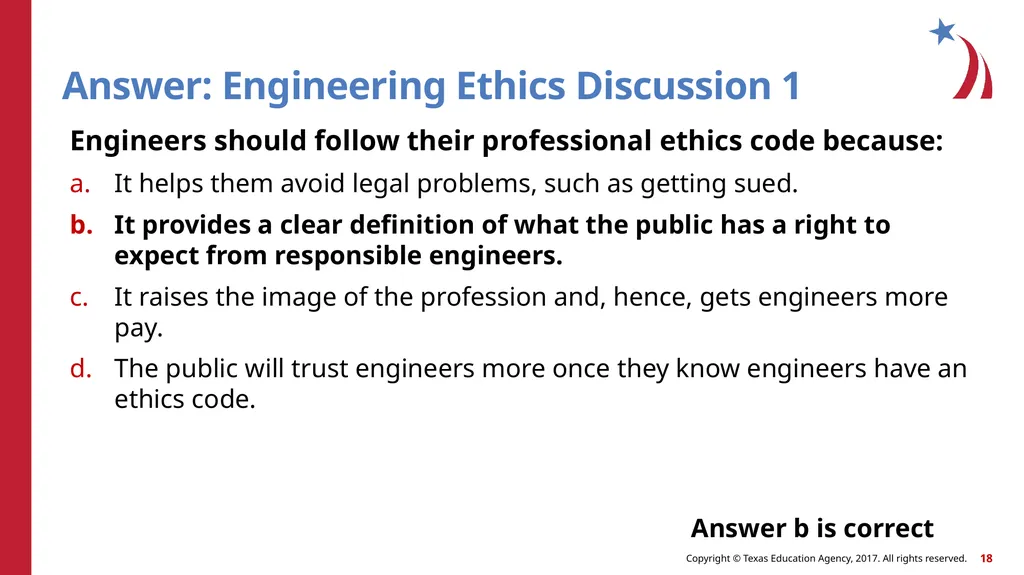
Answer: Engineering Ethics Discussion 1 Engineers should follow their professional ethics code because:
It helps them avoid legal problems, such as getting sued.
It provides a clear definition of what the public has a right to expect from responsible engineers.
It raises the image of the profession and, hence, gets engineers more pay.
The public will trust engineers more once they know engineers have an ethics code. Answer b is correct<br>
It helps them avoid legal problems, such as getting sued.
It provides a clear definition of what the public has a right to expect from responsible engineers.
It raises the image of the profession and, hence, gets engineers more pay.
The public will trust engineers more once they know engineers have an ethics code. Answer b is correct<br>
18
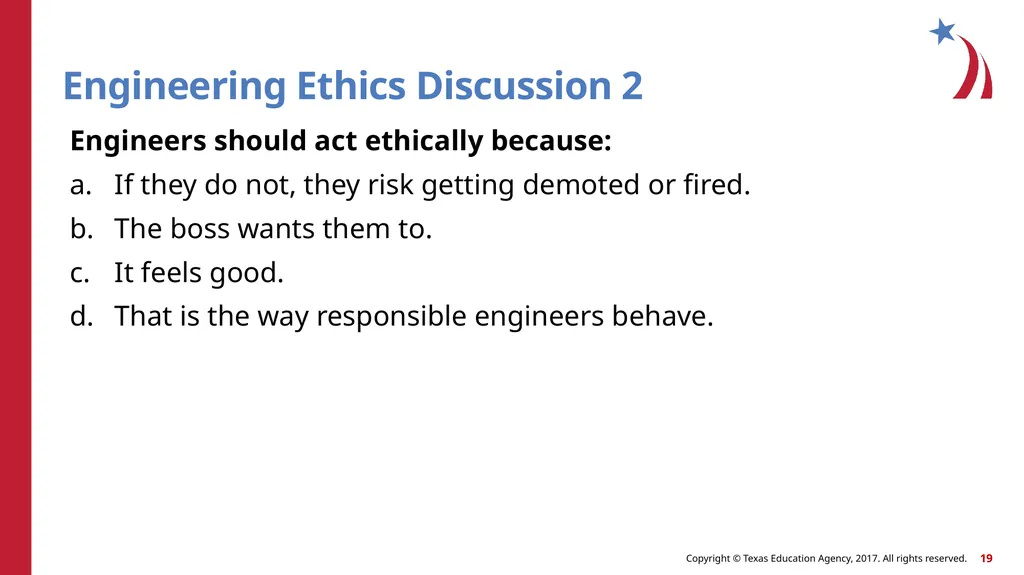
Engineering Ethics Discussion 2 Engineers should act ethically because:
If they do not, they risk getting demoted or fired.
The boss wants them to.
It feels good.
That is the way responsible engineers behave.<br>
If they do not, they risk getting demoted or fired.
The boss wants them to.
It feels good.
That is the way responsible engineers behave.<br>
19
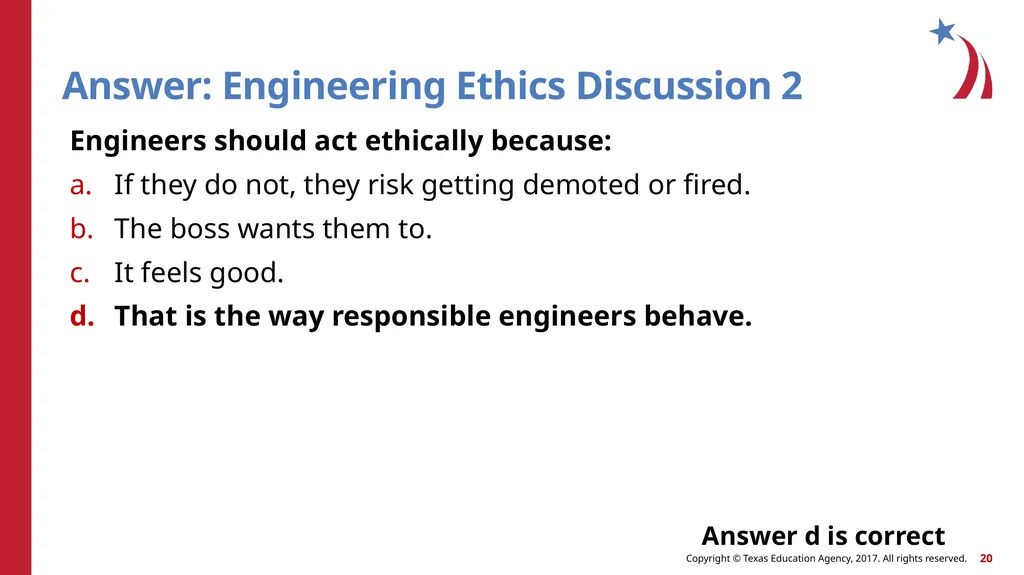
Answer: Engineering Ethics Discussion 2 Engineers should act ethically because:
If they do not, they risk getting demoted or fired.
The boss wants them to.
It feels good.
That is the way responsible engineers behave. Answer d is correct<br>
If they do not, they risk getting demoted or fired.
The boss wants them to.
It feels good.
That is the way responsible engineers behave. Answer d is correct<br>
20
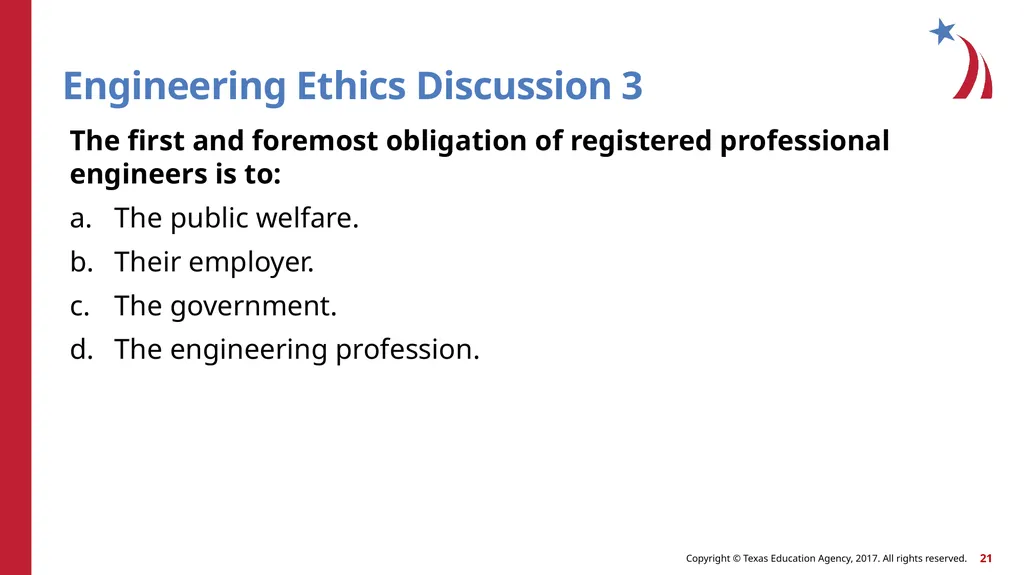
Engineering Ethics Discussion 3 The first and foremost obligation of registered professional engineers is to:
The public welfare.
Their employer.
The government.
The engineering profession.<br>
The public welfare.
Their employer.
The government.
The engineering profession.<br>
21
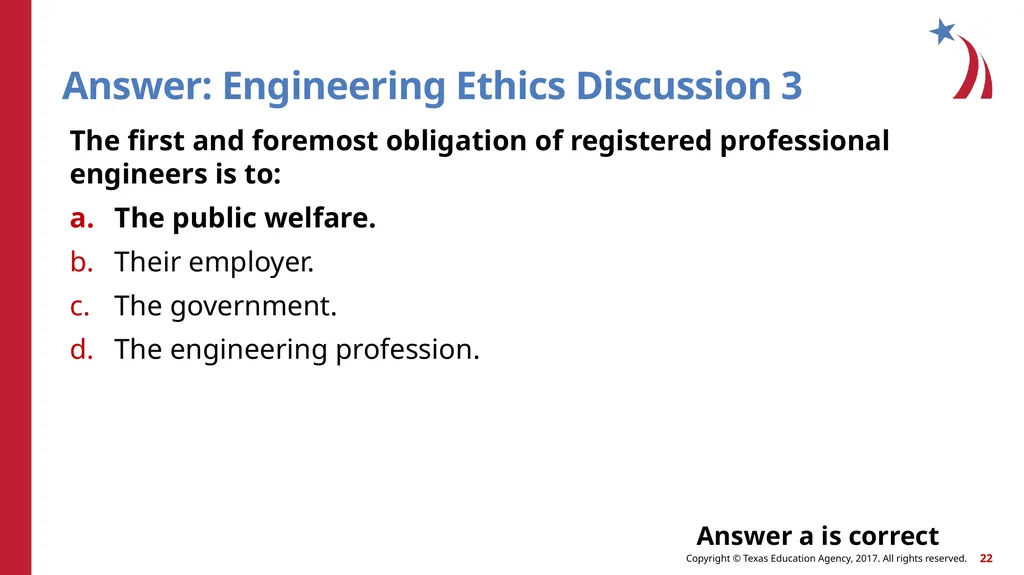
Answer: Engineering Ethics Discussion 3 The first and foremost obligation of registered professional engineers is to:
The public welfare.
Their employer.
The government.
The engineering profession. Answer a is correct<br>
The public welfare.
Their employer.
The government.
The engineering profession. Answer a is correct<br>
22
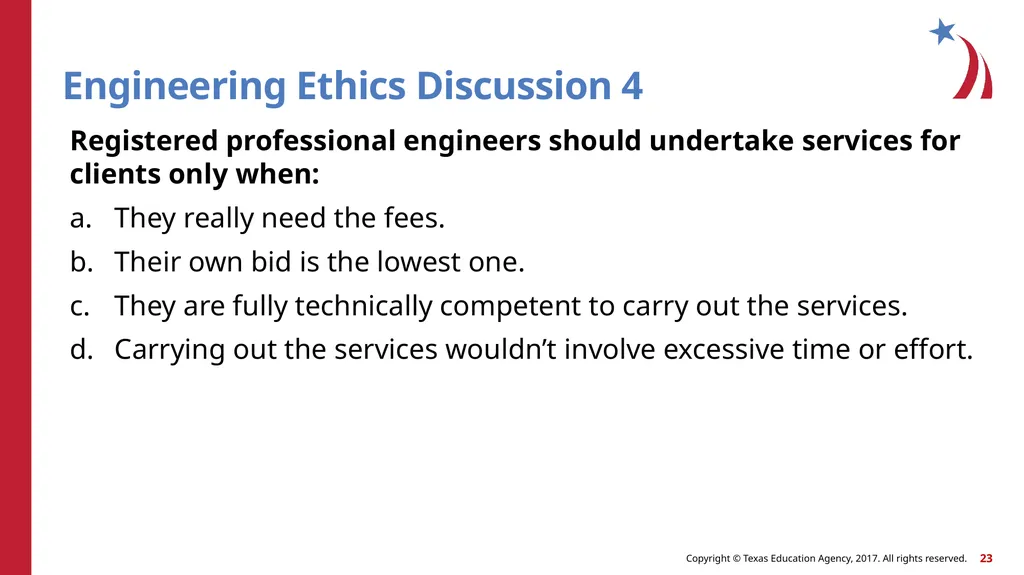
Engineering Ethics Discussion 4 Registered professional engineers should undertake services for clients only when:
They really need the fees.
Their own bid is the lowest one.
They are fully technically competent to carry out the services.
Carrying out the services wouldn’t involve excessive time or effort.<br>
They really need the fees.
Their own bid is the lowest one.
They are fully technically competent to carry out the services.
Carrying out the services wouldn’t involve excessive time or effort.<br>
23
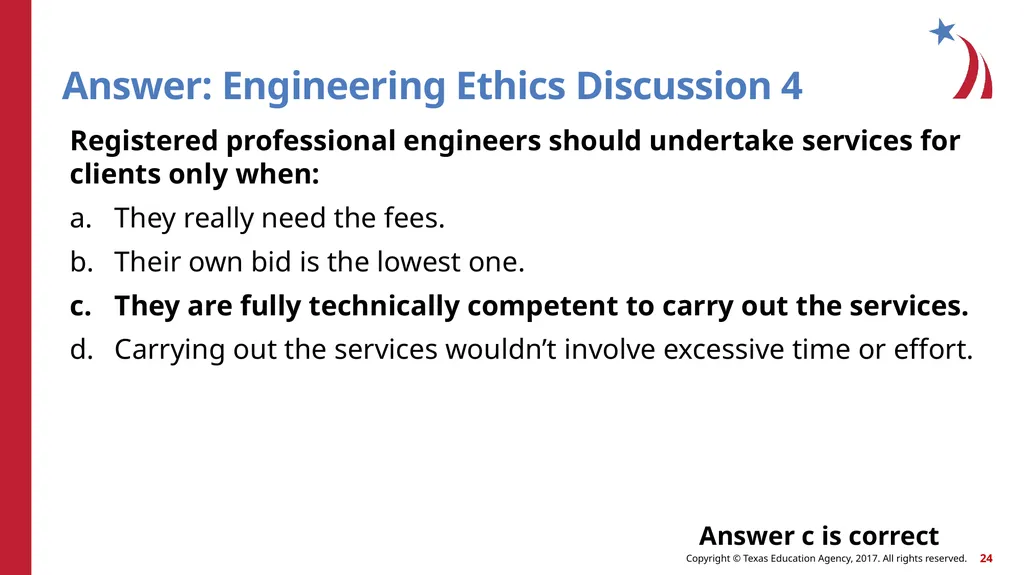
Answer: Engineering Ethics Discussion 4 Registered professional engineers should undertake services for clients only when:
They really need the fees.
Their own bid is the lowest one.
They are fully technically competent to carry out the services.
Carrying out the services wouldn’t involve excessive time or effort. Answer c is correct<br>
They really need the fees.
Their own bid is the lowest one.
They are fully technically competent to carry out the services.
Carrying out the services wouldn’t involve excessive time or effort. Answer c is correct<br>
24
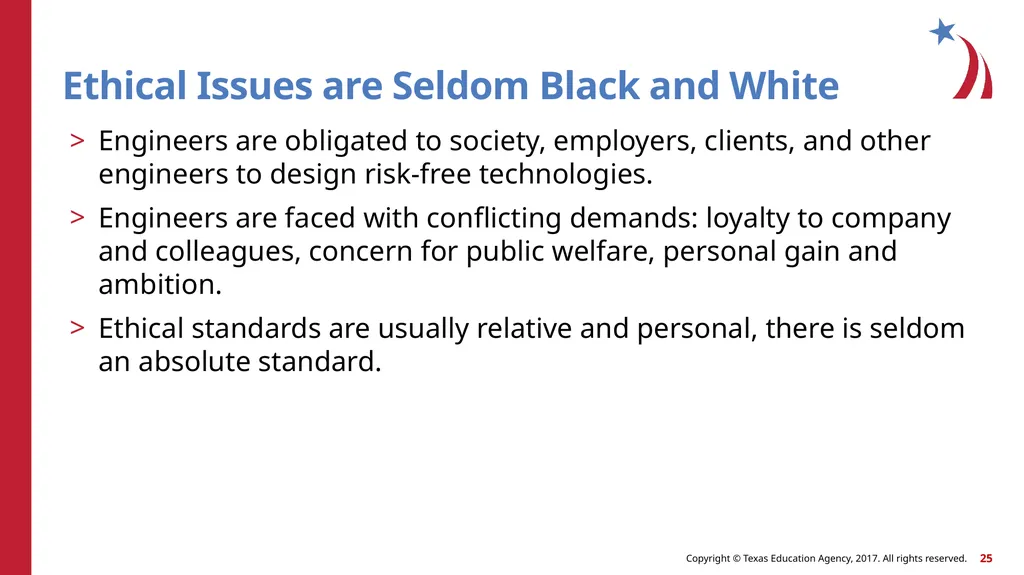
Ethical Issues are Seldom Black and White Engineers are obligated to society, employers, clients, and other engineers to design risk-free technologies.
Engineers are faced with conflicting demands: loyalty to company and colleagues, concern for public welfare, personal gain and ambition.
Ethical standards are usually relative and personal, there is seldom an absolute standard.<br>
Engineers are faced with conflicting demands: loyalty to company and colleagues, concern for public welfare, personal gain and ambition.
Ethical standards are usually relative and personal, there is seldom an absolute standard.<br>
25
National Society of Professional Engineers (NSPE) Is the only engineering society that represents individual engineering professionals and licensed engineers (PEs) across all disciplines.<br>
26
National Society of Professional Engineers (NSPE) Founded in 1934, NSPE strengthens the engineering profession by promoting engineering licensure and ethics, enhancing the engineer image, advocating and protecting PEs’ legal rights at national and state levels, publishing news of the profession, providing continuing education opportunities and more.<br>
27
National Society of Professional Engineers (NSPE) NSPE serves some 60,000 members and the public through 53 state and territorial societies and more than 500 chapters.<br>
28
National Institute for Engineering Ethics (NIEE) Is an official component of the Murdough Center for Engineering Professionalism in the College of Engineering at Texas Tech University.
NIEE was initially created by the National Society of Professional Engineers (NSPE), in 1988, and became an independent organization in 1995.<br>
NIEE was initially created by the National Society of Professional Engineers (NSPE), in 1988, and became an independent organization in 1995.<br>
29
Summary Where you draw the line is your choice.
Engineering ethics begins with each engineer.
Engineers may be held personally and legally responsible for their professional actions.
It is important to understand your company’s attitude toward ethics - it should be a factor in your choice of employer.<br>
Engineering ethics begins with each engineer.
Engineers may be held personally and legally responsible for their professional actions.
It is important to understand your company’s attitude toward ethics - it should be a factor in your choice of employer.<br>
30
Assignment: Engineering Ethics Case Study Students will review the Gilbane Gold PowerPoint - An Ethics Story Focusing on Responsibilities of Engineers.
Students will either watch the video or may act out the roles of the Gilbane Gold Script.
Students will complete the Gilbane Gold assignment worksheet.
Students may also read the Gilbane Gold Study Guide.<br>
Students will either watch the video or may act out the roles of the Gilbane Gold Script.
Students will complete the Gilbane Gold assignment worksheet.
Students may also read the Gilbane Gold Study Guide.<br>
31
References Gomez, Oakes, Leone. (2006). Engineering Your Future. Second Edition. Wildwood, MO: Great Lakes Press, Inc.
National Institute for ENGINEERING ETHICS (NIEE)
“Gilbane Gold: A Case Study in Engineering Ethics" - 1989 (23 min.)
National Institute for Engineering Ethics Texas Tech University
Box 41023
Lubbock , TX 79409-1023 Phone: 806-742-3525 (3521) / Fax: 806-742-0444<br>
National Institute for ENGINEERING ETHICS (NIEE)
“Gilbane Gold: A Case Study in Engineering Ethics" - 1989 (23 min.)
National Institute for Engineering Ethics Texas Tech University
Box 41023
Lubbock , TX 79409-1023 Phone: 806-742-3525 (3521) / Fax: 806-742-0444<br>
32
References National Society of Professional Engineers
http://www.nspe.org
Online Ethics Center for Engineering and Research Teaching Tools
http://www.onlineethics.org/Resources/TeachingTools.aspx<br>
http://www.nspe.org
Online Ethics Center for Engineering and Research Teaching Tools
http://www.onlineethics.org/Resources/TeachingTools.aspx<br>